Tuesday, July 30, 2013
Eileen Brennan (1932-2013)

Eileen Brennan, one of our most treasured character actresses, particularly when it came to roles with a comic spin, lost her battle with bladder cancer Sunday at 80. Her death was announced today. The prolific actress turned in many memorable performances, but probably will be best remembered as Capt. Doreen Lewis in the 1980 comedy Private Benjamin opposite Goldie Hawn and the subsequent television spinoff where Lorna Patterson took over for Hawn. The role of Capt. Lewis earned Brennan her sole Oscar nomination and three consecutive Emmy nominations, one of which she won.

After moving from her native California, Brennan performed some stage work with the Mask and Bauble Society at Georgetown University in Washington before returning west and beginning her film and television career. In 1966, she made her first television appearance in a production of Maxwell Anderson's play The Star Wagon where she starred opposite Orson Bean and whose cast included Dustin Hoffman and Marian Seldes. The next year, she made her film debut in Bud Yorkin's 1967 comedy Divorce, American Style with a cast that included Dick Van Dyke, Debbie Reynolds, Jason Robards and Jean Simmons. She was a regular on the first 14 episodes of Rowan and Martin's Laugh-In in 1968 and put in guest appearances on the TV series The Ghost and Mrs. Muir and The Most Deadly Game. With 1971 came the release of her second feature film and a true classic. This showed more of Brennan's abilities on the dramatic side of things as Genevieve the waitress in Peter Bogdanovich's The Last Picture Show. She even earned a BAFTA nomination as best supporting actress, quite a feat given the spectacular assemblage of female performers Bogdanovich gathered for his film. Along with her many episodic TV appearances, around the same time she appeared in the memorable All in the Family installment "The Elevator Story." In 1973, she had roles in two significant films: Scarecrow starring Gene Hackman and Al Pacino and that year's Oscar winner for best picture, the delightful caper comedy The Sting opposite Paul Newman and Robert Redford.
Brennan appeared in both of Neil Simon's 1970s film spoofs, usually attached by the hip to Peter Falk, in Murder By Death and The Cheap Detective. She guest-starred in a particularly memorable episode of Taxi, "The Boss's Wife," and earned an Emmy nomination as lead actress in a comedy series (the same year she won supporting actress for Private Benjamin). To get even with her husband, Mr. McKenzie, once a year, Mrs. McKenzie (Brennan) picks an employee of the Sunshine Cab Company to have an affair with, resulting in her husband's anger and the worker's firing. Louie (Danny DeVito) delights in the annual ritual — only this time she picks De Palma. Guest appearances on Newhart, thirtysomething and Will & Grace also brought Brennan Emmy nominations. Back on the big screen, she brought the game piece Mrs. Peacock to life in Clue and reprised Genevieve in the 1990 Last Picture Show sequel Texasville.
RIP Ms. Brennan. When you appeared on screen, I knew that whatever I was watching would be getting a lift.
Tweet
Labels: Bogdanovich, Debbie Reynolds, DeVito, Dustin Hoffman, Hackman, Jean Simmons, Newman, Obituary, Pacino, Redford, Robards
TO READ ON, CLICK HERE


Friday, January 27, 2012
Ian Abercrombie (1934-2012)

Why is this man eating a Snickers bar with a knife and fork? You'll have to ask Tom Gammill & Max Pross who wrote the 1994 episode of Seinfeld "The Pledge Drive" that had Elaine's mercurial boss Mr Pitt do such a thing. Mr. Pitt was just one of a multitude of TV and movie roles played by the British character actor Ian Abercrombie, who died Thursday at the age of 77.
Most of Abercrombie's early work was on the British stage. He made his American stage debut in a production of Stalag 17 with Jason Robards. He made his television debut on an episode of Burke's Law in 1965 and his uncredited film debut the same year in Von Ryan's Express. In fact, all his early film work went uncredited — including some big movies such as Star, They Shoot Horses, Don't They?, The Molly Maguires and Young Frankenstein. His first credited film role didn't come until 1978's Sextette, Mae West's final film co-starring Tony Curtis, Ringo Starr, Alice Cooper, Regis Philbin and Keith Moon, among many others.
During those 13 years of uncredited film work, Abercrombie did get credit (most of the time) for his many television series on shows such as Dragnet, Get Smart, Columbo, Barnaby Jones, Cannon and The Six Million Dollar Man.
While Abercrombie did do film work, television became his focus. Of his post-1978 feature films, the most notable ones include The Prisoner of Zenda with Peter Sellers, The Ice Pirates, The Public Eye with Joe Pesci, Sam Raimi's Army of Darkness, Addams Family Values, Steven Spielberg's The Lost World: Jurassic Park II, David Lynch's INLAND EMPIRE and the voice of Ambrose in last year's Rango.
When it came to TV, you could see or hear Abercrombie almost anywhere. Highlights of his post-1978 work (not counting Mr. Pitt) included: The original Battlestar Galactica, Quincy, M.E., Knots Landing, Happy Days, Fantasy Island, Three's Company, the soap Santa Barbara, L.A. Law, Moonlighting, playing himself on the "Fate" episode of "It's Garry Shandling's Show.", Murder, She Wrote, Dynasty, Twin Peaks, Northern Exposure, Buffy the Vampire Slayer, Nip/Tuck, Desperate Housewives and How I Met Your Mother.
Abercrombie still was working on his final two roles at the time of his death: Playing Professor Crumbs on Wizards of Waverly Place and providing the voice for Chancellor Palpatine/Darth Sidious on the animated Star Wars: The Clone Wars.
RIP Mr. Abercrombie.
Tweet
Labels: Animation, Lynch, Obituary, Pesci, Raimi, Robards, Seinfeld, Shandling, Spielberg, Star Wars, Theater, Tony Curtis, Twin Peaks
TO READ ON, CLICK HERE
Tuesday, July 26, 2011
The twilight of an extraordinary life

By Edward Copeland
When Charles Nelson Reilly died in 2007, the percentage of people who knew who he was by name, unfortunately, already had fallen precipitously. Thankfully, in the final years of his life the theater actor turned game show fixture had developed and toured in a solo show about his life called Save It for the Stage. Even though Reilly had stopped touring with the show, The Life of Reilly's co-directors Frank L. Anderson and Barry Polterman talked him into performing it one more time in October 2004 so they could film it. As a result, they made this film record of Reilly's remarkable story as only he could tell it.
As title cards explain at the film's opening, the solo show evolved from a talk Reilly was asked to give in 1999. He didn't have anything planned and spoke extemporaneously for more than three hours, enjoying the hell out of it. After that experience, he worked with actor Paul Linke to pare down the show into a more compact running time and Save It for the Stage was born.
While the version of the solo show captured in The Life of Reilly runs half the time that original three-hour speech did, I imagine Reilly would hold your interest at the longer running time based on the nonstop cyclone
 of energy he becomes as he shares an oral autobiography, beginning with his birth on Jan. 13, 1931, in The Bronx, and the difficulties growing up with his eccentric family, particularly his bigoted mother who was prone to say things such as "I should have thrown away the baby and kept the afterbirth." (She gave the stage show its name because any time young Charles would go on about something, she'd tell him to "Save it for the stage.") He was more enamored with his father who was a commercial artist, drawing beautiful color advertisements. Young Charles struggled in school, not realizing that his problem was his eyesight, not his intelligence, but he always was imaginative from an early age. A particularly poignant portion of the film comes when he describes his mom taking him to his first movie at the Loews Paradise and how he felt "so safe and warm" sitting there in the dark, gazing at those images.
Reilly's first taste of acting came in fourth grade when his teacher offered young Charles the role of Columbus in a class play. His mother was resistant, saying he'd never learn the lines because of his difficulties (still denying that eyesight was the problem) but the teacher talked her into it and his acting career was born in P.S. 53. Around the same time young Mr. Reilly received an opportunity, the elder Mr. Reilly missed a big one.
An artist who worked in black and white fell in love with his father's color artwork and urged him to go to California with him, but Reilly's mother nixed the move because all her relatives were on the East Coast. The man's name was Walt Disney. Soon, advertising turned more to photographs than illustrations and Reilly's father was thrown out of work and into alcoholism and eventually institutionalized, forcing young Charles and his mother to move to Hanover, Conn., to live with his uncle, aunt and grandparents, Swedish immigrants who spoke no English. Eventually, his father rejoined them and his aunt, who had her own problems, agreed to try a new medical procedure: a lobotomy. Though Reilly never dwells on his homosexuality, he tells how the neighbors to that household said that he was a "little odd."
"How do you think I felt being the odd one in that family?" he asks, adding that Eugene O'Neill wouldn't come near that house and that he spent his adolescence in an Ingmar Bergman film. However, he reminds his audience what Mark Twain said about laughter being the same in every language. Reilly's ability to tell these stories, some of them horrifying, and still be able to wring laughs from theatergoers was a great gift indeed and as he set out to act for a living in 1950, his tales of theater and show business prove even more entertaining.
A particularly astounding portion is when he discusses the acting class he attended taught by Uta Hagen at HB Studio, the school she founded with her husband Herbert Berghof. The cost was $3 a week. He reads the roll of his 11 a.m. Tuesday class and it's amazing because every name would achieve success, fame and accolades. Here is the list, minus Reilly, alphabetically:
As Reilly tells it, they all had three things in common: "We wanted to be on stage, none of us had any money and we COULDN'T ACT FOR SHIT!" Reilly adds that if they saw McQueen and Holbrook act out a scene as Biff and Happy Loman from Death of a Salesman one more time, "You'd go out of your fucking mind." He does make the point that people who wanted to act back then actually studied, something not as common as it used to be. By my count, this class (to date) has earned nine Tony Awards out of 30 nominations (11 out of 32 if you toss in Uta Hagen's two wins), six Oscars out of 16 nominations and 11 Emmys out of a whopping 61 nominations. Charles Nelson Reilly himself accounts for a Tony for featured actor in a musical as Bud Frump in the original production of Frank Loesser's How to Succeed in Business Without Really Trying, a nomination as Cornelius in the original Hello, Dolly! and a nomination for directing the revival of The Gin Game that starred Julie Harris and Charles Durning. Reilly earned three Emmy nominations: for The Ghost and Mrs. Muir, a guest shot on The Drew Carey Show and for reprising the Jose Chung character he created on The X-Files on an episode of Millennium.
As with all struggling actors in New York since the beginning of time, Reilly needed work to pay the bills until he started landing paying parts in production. He was excited when a female friend who worked at NBC got him a meeting with the possibility of on-air work. Reilly arrived and met Vincent J. Donahue, the NBC chief at the time, who dismissively sent him away telling him, "We don't put queers on television." Reilly admits that as hateful as that comment was, it rolled off his back. Words like that didn't bother him as much as coming home to find roaches in his Minute Rice. Though he eventually became somewhat of a gay icon, none of the autobiographical show deals with the difficulties of being a gay actor except for that anecdote and there is no mention of a romantic life. Reilly considered himself an actor first — his sexual orientation was just another aspect his life, just like his bad eyesight. Both were parts of him, but neither defined him.
Reilly lived and breathed theater and that is what he wanted to share with the audiences who came to his shows — the upbringing that got him to that point and how it always was an integral part of his life, even after he became better known for kids' TV shows and Match Game. In 1954, he appeared in 22 off-Broadway shows. His Broadway debut came, ironically, as an understudy for another actor who became a gay icon and game show staple — Paul Lynde. Lynde had to be out of Bye Bye Birdie every Thursday night because of a contract to appear on The Perry Como Show, so Reilly took his place once a week. Eventually, he also got to be Dick Van Dyke's understudy in the musical.
He discusses how his close friendship with Burt Reynolds began in New York when Reynolds was a struggling actor and then decades later, when Reynolds built his theater in Jupiter, Fla., he attached an acting school and gave Reilly a beach house to live in so he would teach.
He talks about his times in Hollywood, especially how much he enjoyed being on The Tonight Show Starring Johnny Carson where he was a guest more than 100 times. He talks about one particular time when another guest was a woman who ran a Shakespeare in the Park program in Ohio and he said something and she responded, quite snootily, "What would someone like you know about Shakespeare?" Then he showed her.
Before he taught in Florida, he would teach acting back at that old HB Studio and in a story that particularly cracked me up because it reminded me of my days of both attending and judging high school drama contests almost 25 years ago now, he says, "If I saw one more Agnes of God…" If you've experienced high school drama contests since that play was written, you know exactly what he means (and I'd toss in 'night, Mother as well).
Reilly talks and talks and talks and you're never bored. You're usually laughing, but sometimes, as when he describes being present at 13 at an infamous Ringling Bros. and Barnum & Bailey Circus fire that claimed many lives, including that of one of his childhood friends, you're mesmerized. The Life of Reilly truly captivates. The biggest barrier to enjoying it is finding a way to see it. It's on streaming at Netflix but not DVD, so watch it there before you cancel and go back to DVD only. Neither GreenCine nor Blockbuster carries it on DVD or On Demand. Redbox doesn't carry it. Hulu Plus doesn't stream it. Amazon Instant Video DOES have it for $2.99, though you could buy it for $9.99. Best Buy CinemaNow doesn't have it for streaming. Comcast XfinityTV ON Demand doesn't have it either.
It's a miracle that Netflix's streaming has it right now because eventually, it won't as smaller, wonderful titles such as The Life of Reilly that are a whole FOUR years old and are perceived as having too small a niche audience disappear entirely from home rental availability. It's a shame because it means the number of people who remember Charles Nelson Reilly will decline more rapidly than it is declining already.
Tweet
Labels: 00s, Awards, Burt Reynolds, Carson, Disney, Documentary, Durning, Frank Loesser, Geraldine Page, Grodin, Holbrook, Ingmar Bergman, Lemmon, Musicals, O'Neill, Oscars, Robards, Shakespeare, Television, Twain
TO READ ON, CLICK HERE
Monday, July 18, 2011
Centennial Tributes: Hume Cronyn Part II
Hume Cronyn

By Edward Copeland
We continue our tribute to Hume Cronyn as the decade turns to the 1950s. If you started here by mistake and missed Part I, click here. Cronyn continued to appear steadily on the various live theatrical programs on TV but only two feature films the entire decade. He definitely turned his focus to the stage, especially behind-the-scenes work. In March 1950, he directed his first Broadway play, the original comedy Now I Lay Me Down to Sleep whose cast included Fredric March. In November, he and his wife did their first New York stage collaboration when he directed her as the title character in the original drama Hilda Crane. In April 1951, he helped produce The Little Blue Light which reunited him with Burgess Meredith and had Melvyn Douglas in the cast. In August, his sole feature film of the year was released: the underrated Joseph L. Mankiewicz gem People Will Talk starring Cary Grant. Grant and Cronyn play professors at a medical school with diametrically opposed views on just about everything and Cronyn's character leads a crusade to get Grant removed from the faculty because of his unorthodox views.

Beginning Oct. 24, 1951, Cronyn and Tandy appeared on Broadway together for the first time in a play that became such a hit, that it managed to be spun off into radio, TV and movie versions with Cronyn and Tandy starring in all but the movie version because they were still enjoying the successful Broadway run at the time. The original comedy The Fourposter by Jan De Hartog is a two-character play where spouses Michael and Agnes re-enact their marriage around their four-poster bed and took place between 1890 and 1925. José
 Ferrer directed the production and both he and De Hartog won Tonys (meaning it won best play). Since Cronyn and Tandy stayed with the play until May 1953, their roles in the 1952 film version directed by Irving Reis went to Rex Harrison and Lili Palmer. Its only Oscar nomination was for black-and-white cinematography. When Cronyn and Tandy finished their run in the play, Cronyn produced an NBC radio sitcom version of the play, changing the title to The Marriage, the characters' names to Ben and Liz and losing the period element. While they worked on this during the play's run, the radio show didn't begin airing until October 1953. A total of 26 episodes aired and then The Marriage made history, albeit short-lived. It moved to NBC TV where it became the first sitcom broadcast in color, though it only lasted eight episodes when, tragically, Tandy suffered a miscarriage and live broadcasts ceased never to start again. The Fourposter would come back throughout Cronyn and Tandy's careers though in the form of revivals and tours (including a 15-performance Broadway revival in 1955). In fact, in the summer of 1955, Cronyn and Tandy performed The Fourposter on an episode of Producers' Showcase and Tandy received her first Emmy nomination for actress in a single performance.
Throughout the 1950s, movies didn't see much of Cronyn as he kept busy with productions on TV and the stage. Other than People Will Talk, the only other feature film IMDb lists for that decade is something called Crowded Paradise in 1956 of which IMDb contains the bare minimum of information. Part of the reason for this may have been that Hume Cronyn may have been one of the few people in this country's sordid history of the blacklist to keep himself busy so constantly that he didn't know he'd been blacklisted. Another reason was that it seemed inconceivable to him since he was never very active politically, never called before HUAC or ever attended any "suspect" meetings. It turned out eventually that his particularly puzzling blacklisting was because he had hired people who were blacklisted, not that he knew or even if he did he would have cared. Cronyn didn't suffer too much because by the time he became aware of his status, others had started breaking the blacklist anyway by doing what got him on the list in the first place.

In December 1953, he and Norman Lloyd inaugurated The Phoenix Theatre by co-directing and co-starring in Madam, Will You Walk? which also featured Tandy. Interestingly, the play with the same opening and closing dates is listed in both the Internet Broadway Database and the Internet Off-Broadway Database and I can find nothing in a quick look to settle where it belongs — not even number of seats or an address. Cronyn didn't spend all his stage time in New York though, he started doing a lot of tours, including a series of concert readings with Tandy in 1954 called Face to Face which were later turned into a recording. In 1955, Cronyn hit The Great White Way with Tandy twice: the aforementioned short revival of The Fourposter and an original farce by Roald Dahl called The Honeys. Sometime that year he had time to act in A Day By The Sea at the American National Theatre and Academy Theatre — and that's not counting 13 TV acting jobs between 1953 and 1955.

The remainder of the decade was even more dominated by work on television, to the exclusion of actual stage work in 1956 though he did make the first of two appearances (the second coming in 1958) on Alfred Hitchcock Presents. He returned to Broadway in 1957 to direct longtime friend Karl Malden in The Egghead. Cronyn and Tandy also toured several cities across the U.S. in 1957 with the new comedy The Man in the Dog Suit ahead of its Broadway premiere in 1958. Cronyn followed the same pattern in 1958, touring with Tandy and other actors in a production he both starred in and directed called Triple Play that consisted of three one-act plays and a monologue, which was considered an original one act play when it opened on Broadway in 1959, though it was written by the long dead Anton Chekhov. The one acts were Tennessee Williams' Portrait of a Madonna, two by Sean O'Casey: A Pound on Demand and Bedtime Story, and the Chekhov monologue which Cronyn performed Some Comments on the Harmful Effects of Tobacco. Cronyn and Tandy closed out the 1950s with a television movie adaptation of Somerset Maugham's novel The Moon and Sixpence with a cast led by Laurence Olivier and featuring Judith Anderson, Denholm Elliott, Geraldine Fitzgerald and Jean Marsh. IMDb actually had a link to the original Time magazine review of it.

As the 1960s began, movies began to enter Cronyn's life again and television receded a bit, mainly because the popularity of programs that televised plays were on the wane. Theater maintained its prominence in his life, and he started to see some award recognition for it. In the fall of 1960, he played Louis Howe to Ralph Bellamy's FDR and Greer Garson's Eleanor when Sunrise at Campobello was released. In early 1961, Cronyn opened on Broadway as Jimmie Luton, the main character of the new farce Big Fish, Little Fish by Hugh Wheeler, his first work on Broadway though he'd go on to write the books for A Little Night Music, Candide and Sweeney Todd, winning a Tony for all three. Cronyn was directed in Big Fish, Little Fish by John Gielgud, who won the Tony for best direction in a play. Cronyn received his first Tony nomination as actor in a play and the cast included Jason Robards, George Grizzard (Tony nominee for featured actor in a play) and Martin Gabel (Tony winner for featured actor in a play). The show proved to be such a success that
 the following year Cronyn made his London stage debut when he played Jimmie Luton again when Big Fish, Little Fish opened at the Duke of York's Theatre. While overseas he helped his friend Joe Mankiewicz by taking the part of Sosigenes in the out-of-control Cleopatra, which finally opened in 1963. When he was back in the U.S. in 1963, he helped inaugurate the premiere season of the Tyrone Guthrie's Minnesota Theatre Company at the Guthrie Theatre in Minneapolis by appearing in three productions: Harpagon in Moliere's The Miser, Tchebutkin in Chekhov's The Three Sisters and Willy Loman in Arthur Miller's Death of a Salesman. In 1964, Cronyn scored a coup — playing Polonious in a Broadway production of Hamlet starring Richard Burton and nearly stealing the show from the melancholy Dane. Directed by Gielgud as if the company were in rehearsal clothes, it also was filmed and aired on TV the same year. Cronyn's performance won him a Tony for featured actor in a play. Here is a YouTube clip of Cronyn and Burton at work.
A few months after his triumph in Hamlet, Cronyn returned to the Broadway stage with Tandy in tow in The Physicists opposite Robert Shaw. Two days after that show closed, Cronyn was one of the producers of the play Slow Dance on the Killing Ground, which earned Cronyn his third Tony nomination, his first as producer of a best play nominee. In late 1966, Cronyn and Tandy created the roles of Tobias and Agnes in a bona fide classic: Edward Albee's Pulitzer Prize-winning A Delicate Balance and Cronyn received another Tony nomination as actor in a play as Tobias. In 1967, Cronyn took A Delicate Balance on tour. He stayed on the road performing in productions in L.A. and Ontario in 1968 and 1969. He squeezed out two films in 1969: Elia Kazan's adaptation of his own novel The Arrangement and Norman Jewison's comedy Gaily, Gaily starring Beau Bridges. Somehow, in this busiest of schedules, Cronyn also had to recover from a bout of cancer that cost him one of his eyes in 1969 and left him with a glass eye for the rest of his life.

Now, we do draw near the end of the theatrical careers of Hume Cronyn and Jessica Tandy, but Cronyn wraps it up very actively and the couple will follow it up with prolific television and film work. First in 1977, Cronyn co-produced with Mike Nichols the two-person play The Gin Game for he and Tandy to star in and Nichols to direct. After an initial tryout in Long Wharf, Conn., they moved to Broadway to much success, running 517 performances. Cronyn received Tony and Drama Desk nominations for both best actor and best play while Tandy won both those awards for best actress. The play's author, D.L. Coburn, won the Pulitzer. Nichols received play and directing nominations from both groups. Cronyn and Tandy then took The Gin Game on tour, not just in the United States but throughout Canada, the United
 Kingdom and some cities in the Soviet Union as well through 1979. Then, they made a television version of the play that aired in a version made for Showtime in 1981. During this time period, dating back to 1977, Cronyn also was collaborating with writer Susan Cooper on what would become Cronyn and Tandy's penultimate stage project. Before they got to that, Cronyn managed to return to feature films three times and took Tandy along on two of them. They had small parts in the odd ensemble assembled for John Schlesinger's wacky satire Honky Tonk Freeway, Cronyn re-teamed alone with his Parallax View director Alan J. Pakula for an economic thriller called Rollover starring Jane Fonda and Kris Kristofferson and then he and Tandy had brief roles as the parents of the one-of-a-kind Jenny Fields (Glenn Close) in the movie adaptation of The World According to Garp.
Susan Cooper also hailed from England, but came to the U.S. when she married an American, though the marriage didn't work out. She primarily wrote novels and children's books until she developed an interest in
 playwriting and somehow began collaboration with Cronyn a long-gestating work called Foxfire about the end of an Appalachian family's way of life. It added to Cronyn's resume because not only was he co-author of the play, he, Cooper and Jonathan Holtzman wrote lyrics for songs for which Holtzman wrote the music, though it wasn't strictly a musical. After debuting first at The Stratford Festival in Stratford, Ontario and The Guthrie Theatre in Minneapolis, it opened on Broadway in November 1982. Playing Cronyn and Tandy's characters' son in the play was Keith Carradine. Tandy won both the Tony and the Drama Desk awards for best actress in a play. Five years later, it aired on CBS where Tandy again won outstanding actress, this time in a miniseries or special. Cronyn was nominated as outstanding actor and he and Cooper received a solo writing nomination. The movie itself was nominated as outstanding drama or comedy special and John Denver took Carradine's role. Below is a YouTube clip of the TV movie.
After having seen Foxfire, Cronyn's co-star in Rollover, Jane Fonda, asked if he and Susan Cooper would adapt the novel The Dollmaker into a script for a TV movie for her. They did and received Emmy nominations for writing the 1984 telefilm and Fonda won outstanding actress in a miniseries or special for it. It was (and remains) only the second time Fonda appeared in a TV production, the previous one being when she was just starting out in 1961. Cronyn started heading back to the cinema in the 1984 thriller Impulse and Richard Pryor's surprise relative who gives him the challenge of spending $30 million in 30 days if he wants to inherit his vast fortune of $300 million in the umpteenth remake of Brewster's Millions in 1985. However, Cronyn, with Tandy beside him, had another 1985 release that really made the veteran actors stars to an entirely new generation.
Joining Cronyn and Tandy as the leads of Ron Howard's Cocoon were Wilford Brimley, Maureen Stapleton, Gwen Verdon, Jack Gilford, Herta Ware and Don Ameche, who took home an Oscar for supporting actor for
 the film even though he wasn't even the best supporting actor in the film. A sci-fi comedy and meditation on aging and dying, it was made when Big Blue was a swimming pool loaded with extra-terrestrial magic making the seniors horny instead of a pill for erectile dysfunction. Cronyn and Tandy had particularly good moments as the pool awakened his character's libido and his wandering eye, reminding his wife of his younger days when he was far from faithful. Of course, they had to make an awful sequel, but to have that a big a hit with that many older actors as leads was quite something. It's not like Steve Guttenberg was the draw. The following year, 1986, Cronyn and Tandy were honored together as that year's batch of Kennedy Center honorees alongside Lucille Ball, Ray Charles, Yehudi Menuhin and Antony Tudor. Cronyn and Tandy would appear in two more feature films togethers (three counting the Cocoon sequel): 1987's *batteries not included and 1994's Camilla, Tandy's final film released after her death. Among the many televison and feature films we won't still talk about that Cronyn would go on to make the most notable were The Pelican Brief and Marvin's Room.
In 1986, Hume Cronyn and Jessica Tandy appeared in their last Broadway show, fittingly together. The Petition was a two-person play and earned each of them Tony nominations. In 1994, they received the very first Tony Awards ever given for lifetime achievement. It was just a few months before Tandy's death. Though their stage work considerably lessened and Broadway work ceased, movie and TV worked soared. Cronyn became a regular presence at the Emmys, being nominated five times between 1990 and 1998 and winning three times. He won lead actor for HBO's Age-Old Friends, which allowed him to act opposite daughter Tandy Cronyn. He won that, his first Emmy, the same year that Tandy won the best actress Oscar for Driving Miss Daisy. During this time, the pair went on 60 Minutes and had fun putting Mike Wallace on.

Cronyn earned two 1992 Emmy nominations, one for lead actor in a miniseries or special in Christmas on Division Street and one for supporting actor in a miniseries or special for Neil Simon's Broadway Bound, which he won. His third win was bittersweet. Written by Susan Cooper, To Dance With the White Dog co-starred Tandy who also was nominated, and dealt with a widower working through the grief over the loss of his wife. The awards ceremony took place shortly after Tandy's death. Cronyn's final Emmy nomination came for supporting actor in a miniseries or special for Showtime's version of 12 Angry Men in 1998. Two years after Tandy's death, Cronyn married Susan Cooper who remained his wife until his death in 2003. The only other writing project they worked on together was a screenplay adaptation of Anne Tyler's novel Dinner at the Homesick Restaurant, which they didn't complete. Cronyn completed one other bit of writing: his memoir A Terrible Liar which was published in 1991. Hume Cronyn only missed his own centennial by eight years, but with as much as he accomplished, he might as well have lived 200 years. It helps when you have a partner as simpatico to you as Jessica Tandy was to him.
SOURCES: Hume Cronyn and Jessica Tandy: A Register of Their Papers in the Library of Congress,, The Digital Deli Too, thelostland.com, film reference.com, Internet Accuracy Project, Superiorpics.com, Wikipedia, Lortel Archives: Internet Off-Broadway Database, The Internet Broadway Database and the Internet Movie Database.
Tweet
Labels: Albee, Beau Bridges, Bellamy, blacklist, Burgess Meredith, Cary, Ferrer, Fredric March, Garson, Gielgud, Glenn Close, J. Fonda, Jewison, K. Carradine, Kazan, Malden, Mankiewicz, Nichols, Olivier, Robards
TO READ ON, CLICK HERE
Tuesday, July 13, 2010
Crying on the inside, laughing everywhere else

By Edward Copeland
As "L-O-V-E" by Nat King Cole croons smoothly over the soundtrack, the camera pans slowly over the faces of the usual assortment of New York subway commuters until it lands on one man who sticks out: He's in full clown outfit and bearing balloons, but his facial expression certainly doesn't radiate joy. That's because beneath the makeup is Grimm (Bill Murray), an employee of the department of city planning who is about to carry out his plan to escape the city he's come to loathe in Quick Change, a woefully underrated film which turns 20 today and marks the only time Murray sat in the director's chair, though he shared the job with Howard Franklin, who adapted the film from Jay Cronley's novel.
Grimm's escape plan, which also involves his girlfriend Phyllis (Geena Davis) and dimwitted lifelong friend Loomis (Randy Quaid), is to rob a bank to finance their exit from the city they've come to despise. Of course,
 I think NYC is the greatest city in the world and would do anything to live there, yet that doesn't prevent me from loving this comedy which takes aspects of Sidney Lumet's Dog Day Afternoon and Martin Scorsese's After Hours, tosses them into a blender and hits puree. There also are nods to other great bank heist films, even some that had yet to be made such as Spike Lee's Inside Man. Grimm's opinion of the city is not reassured as he begins the robbery. The guard (Bob Elliott of the great comedy team Bob & Ray and father of Chris) believes he's serious when he flashes the gun and shows the dynamite strapped to his chest, prompting the guard to ask Grimm what kind of clown he is. "A crying on the inside kind, I guess," Grimm replies, but the customers and other employees need more convincing other than shouts of "This is a robbery" so Grimm finally has to fire a shot in the air.
Soon, once Grimm has secured all the hostages in the bank vault he makes phone contact with his newly minted nemesis, Rotzinger (Jason Robards), the heralded NY police chief who is on the edge of retirement. One of the thing that raises Quick Change above most bank heist films is that both the criminal and the cop are sympathetic characters and the viewer's loyalties are torn because you really don't want to see either foiled or embarrassed. Rotzinger is not a buffoon: He's sharp and a worthy adversary. While Murray's sparring with Robards is one of smart, sardonic politeness, Robards parries back well with the hard-bitten intelligence of a man who has seen it all and is doing his best to be a step ahead of Murray at every step of his plot. The two actors raise the level of Quick Change above that of a mere comedy.

When the criminal trio escape the confines of the bank (using new disguises and acting as if they are the first hostages released), the movie doesn't just retain its comic edge, it ups the suspense quotient and develops a bit of a surreal quality, thanks to the many fine actors in small character parts to just odd moments as when Grimm,
 Phyllis and Loomis, lost and seeking directions to the airports, stumble upon a strange bicycle jousting ritual. That is just one of the weird and inspired touches, not one of the obstacles that appear in their path which include construction that remove road signs and road workers who have no idea which way the directions were supposed to point; several instances of having guns pulled on them, some by crooks, some by new apartment dwellers; anal retentive bus drivers; cab drivers speaking unidentifiable languages; accidental run-ins with the mob; and just general chaos, none of which is helped by Loomis (Quaid), who may be Grimm's best friends but leaves a lot to be desired in the brains department. As Rotzinger confides to his lieutenant, when he's frustrated that his stellar career could end on such a sour note if these bank robbers get away with it, "Our only hope is that they are mired down in the same shit that you and I have to wade in every day."

With co-directors, especially when both Murray and Franklin in this case are first-timers, it's difficult to know who gets the credit to for a film's magic (it's not as easy to guess as when Robert Wise and choreographer Jerome Robbins shared directing duties on West Side Story), but Quick Change has it, kinetic energy that begins as soon as Grimm the clown steps off the subway, onto the Manhattan street and into the bank and that energy doesn't let up until the film ends 90 minutes later. One of the movie's aspects that keeps it speeding along so well is its wonderfully infectious score by Randy Edelman. One other thing that Quick Change has that's reminiscent of After Hours is a supporting cast of top-notch actors in even the smallest of roles. Included in the roll call: the aforementioned
 Bob Elliott, Victor Argo, Phil Hartman, Jamey Sheridan, Kurtwood Smith, Stanley Tucci and my two personal favorites here, Philip Bosco as the bus driver with the obsession with exact change and all other regulations and Tony Shalhoub as the cab driver who seemingly can only say one thing which, unfortunately, no one can translate since they can't even identify his language. Murray is as great as always and Davis gets quite a few good moments, especially as her own frustrations build, though at times Quaid overplays Loomis' stupidity. That aside, ever since I first saw Quick Change 20 years ago, it's held a warm place in my heart and re-watching it for the first time in many years did nothing to diminish that feeling. Franklin went on to direct the so-so Joe Pesci vehicle The Public Eye in 1992 and Murray again in 1996's Larger Than Life, which I've never seen, but Bill Murray has never stepped behind the camera again and since Quick Change turned out so well, I really wonder why.
Tweet
Labels: 90s, Geena Davis, J. Robbins, Lumet, Movie Tributes, Murray, Pesci, R. Quaid, Robards, Scorsese, Spike Lee, Tucci, Wise, Zemeckis
TO READ ON, CLICK HERE
Thursday, May 13, 2010
Peckinpah's wistful look at the dying of the West

By John Dacapias
When one thinks of famed director Sam Peckinpah, the mind immediately leaps to bodies flaying to and fro in slow motion, as bullets cut through their dying corpses, not the comically elegiac Ballad of Cable Hogue.
Released 40 years ago today, one year after the masterful The Wild Bunch, Cable Hogue centers on the soulful performance of Jason Robards in the title role. Robards plays a grizzled prospector left to die in the middle of a nondescript Arizona desert c. 1908 by his equally grungy and loquacious former partners, Bowen and Taggart (played respectively by Strother Martin and L.Q. Jones).
In what amounts to a more than four minute monologue, we hear Hogue cursing God in a seemingly empty universe. Out of nowhere, God grants Hogue his wish by directing him to a muddied waterhole, which he fashions into Cable Springs, a rest stop for stagecoaches.
In all due candor, I have to admit that when I first saw Cable Hogue as a skinny 14-year-old, I had images of hard bitten men living up to an unwritten macho code, then dying violently but gallantly because of said code. Yes, it was 1980, I had fallen in love with the Western, and I have just finished watching The Wild Bunch. Next stop on my journey through Peckinpah-land: Cable Springs!
Little did I know that Peckinpah loved to play against expectations. Those expecting a brutal glimpse into the disappearing West, look elsewhere. In fact, the only violent moment I can remember in Cable Hogue occurs in the pre-credit scene where a lizard is blasted apart by Hogue’s erstwhile partners.
Each subsidiary character is introduced in an appropriately unflattering light. When we think of Westerns, we usually think of characters like Clint Eastwood’s Man with No Name, striding into the foreground with an Ennio Morricone score literally backing up his mythic stature. In Cable Hogue though, we see grizzled drivers pissing off of stagecoaches and characters moving in fast motion, like a slapstick comedy. We even have “Butterfly Mornings,” a sensuous but peaceful musical duet, surprisingly well sung by both Stella Stevens and Robards.
This droll fashion of introducing each character is shown to its fullest with Hildy, a luscious Stevens playing the proverbial hooker with a heart of gold, the self-described “ladiest damn'd lady of them all.” Peckinpah, along with the fabled cinematographer Lucien Ballard, takes every opportunity to exploit Hildy’s rear end and ample chest. However, Stevens is able to fashion a three dimensional performance, both sexy yet humane, despite the leering camerawork.
Thinking back on my teenage years and raging hormones, I first fell in lust with Ms. Stevens when she graced the Playboy centerfold in 1960. Watching the actress craft and transcend a sexist stereotype into an earthy Women’s Libber from the Old West made my second viewing of Cable Hogue much more rewarding.
We can sense what James Coburn once said to be true, that Peckinpah “...was Cable.” Indeed, Sam Peckinpah often refers to The Ballad of Cable Hogue as being his personal favorite film. The wayward desert fox we see during the closing credits becomes a true symbol of Hogue, a grungy old coot clawing his way clear to his own corner of the world.

One also thinks of the journey of Cable Hogue from initial bitterness over his dire fate to finally finding forgiveness in his heart and soul to his lot in life. Instead of killing Joshua, like Hogue’s first “customer,” the wayward, womanizing preacher as played by David Warner (Straw Dogs and Time After Time) becomes Hogue’s ostensible right-hand man, helping him in constructing Cable Springs. Even Bowen, who left Hogue to die in the desert at the beginning of the film, becomes the new owner of Cable Springs at the end of the film.
Overall, we should enjoy The Ballad of Cable Hogue for what it is, not for what we expect it to be in light of its placement in the director’s chronology. It is a dirty but sweet look into the end of the West, slowly but surely encroached by the coming of technology. It is telling that Cable Hogue is run down by the new-fangled horseless carriage that bring Hildy back to Hogue, a symbolic death, if ever there were one.
If you stop and think about it, isn’t that all we ask of ourselves, to find acceptance for who we are in this world? Don’t we all want to be cast off with an appropriate sermon? This is what Joshua ultimately did for the ill-tempered but lovable Cable Hogue. He returned his body to a deep dark hole in the desert earth from whence it came: “He wasn’t strictly a good man, but Lord — he was a man.”
Tweet
Labels: 70s, David Warner, Eastwood, James Coburn, Movie Tributes, Peckinpah, Robards
TO READ ON, CLICK HERE
Sunday, May 02, 2010
From the Vault: Philadelphia

Just because a film covers an important subject, that doesn't make it a success by default and that's the case with Jonathan Demme's Philadelphia, a film whose earnestness gets in the way of its drama.
Philadelphia tells the story of Andrew Beckett (Tom Hanks), a smart lawyer at a prestigious law firm. In addition to being an excellent lawyer, Andrew happens to be gay and infected with AIDS, two facts he's hidden from his conservative colleagues.
When the firm (headed by Jason Robards) begins to get an inkling of the truth, they frame him for incompetence and fire him. Angered by the injustice done to him, Beckett seeks an attorney to argue a wrongful termination suit against the firm. After several lawyers turn him down, he settles for Joe Miller (Denzel Washington), an ambulance chaser who's just as homophobic as Beckett's ex-colleagues.
While Philadelphia boasts excellent performances (Hanks and Washington are equally good), the script seems determined to avoid even the slightest venture into gray areas. The movie spells out everything neatly and clearly.
Beckett's family stands solidly with him in his fight and the firm's defense gets as much serious consideration as the lone gunman theory got in JFK. They even feel compelled to toss in a shot of the firm's defense attorney (Mary Steenburgen) muttering how much she hates this case.
Anyone with a brain, a heart or both knows what the verdict should and probably will be. As a result, instead of creating a vivid drama concerning AIDS discrimination, Demme and screenwriter Ron Nyswaner fashion a film that won't change any minds. Some will cheer justice, others will cry propaganda and few in between will be swayed.
What Philadelphia does have going for it are the performances of Hanks and Washington. Hanks soars as the AIDS-stricken lawyer and Washington plays his role intelligently enough that his gradual change of heart doesn't seem sudden or artificial. In fact, you can't be positive he even has one.
Philadelphia isn't a horrendous film, just a tremendously disappointing one. Instead of being a thought-provoking landmark it ends up playing more like a two-hour episode of L.A. Law.
Tweet
Labels: 90s, Demme, Denzel, Hanks, Robards
TO READ ON, CLICK HERE
Thursday, July 09, 2009
Herzog Week: Burden of Dreams

By Edward Copeland
Can a documentary come with spoiler warnings? It probably depends on how much you know about the history of the making of Werner Herzog's Fitzcarraldo going in, but there were some real surprises for me when I watched Burden of Dreams.
For one thing, right off the top I learned something I didn't know: That the film began as an English language film with Jason Robards in the title role and Mick Jagger as his dimwitted actor sidekick. With filming 40% complete, but with numerous complications involving a border war, missed rainy seasons that left rivers unnavigable for the film's boats and the backing out of financiers, Robards became seriously ill and had to go back to the U.S., with orders not to return.
At the same time, the production had gone on so long, Jagger had to back out as well as the Rolling Stones had a commitment to a concert tour. Back to the drawing board for Herzog, who did a massive rewrite, got Klaus Kinski involved and had even more problems. The documentary is so amazing that it's a wonder that Fitzcarraldo got finished at all.
Of course, the big moment of the film involved the dragging of the large boat over a mountain to reach the river on the other side. The man who did this in real life had the good sense to disassemble his boat and do it in pieces, but Herzog insisted on doing it in one piece, making it even more of a maddening challenging.
One thing is for certain: No one should ever watch Fitzcarraldo without watching Burden of Dreams soon after. As an added plus on the Criterion DVD of Burden of Dreams is included an earlier short film by its director, Les Blank, called Werner Herzog Eats His Shoe.
Herzog had years earlier befriended a struggling young filmmaker named Errol Morris who was frustrated about how to get started in the business and Herzog bet him that if he got his film made (a documentary about pet cemeteries called Gates of Heaven), Herzog would eat his shoe, which he proceeds to do at the film's premiere.
Tweet
Labels: 80s, Documentary, Herzog, Robards
TO READ ON, CLICK HERE
Sunday, April 29, 2007
Centennial Tributes: Fred Zinnemann

By Edward Copeland
If someone asks, "What is a Fred Zinnemann film like?" How would you respond? It's not that Zinnemann, who would turn 100 years old today, didn't make quite a few good and great films and at least one bona fide classic, but is there something you can point to as a Zinnemannesque film the way you might say Hitchcockian or Hawksian? Not really. This isn't to disparage Zinnemann at all. He simply was a solid, workman-like director who ended up making movies worth watching far more often than he made clunkers. He earned seven Oscar nominations as director between 1948 and 1977 and won twice. He also won an Oscar for producing A Man for All Seasons and for the documentary short Benjy in 1951. Some might call him colorless, but his body of work certainly deserves reflection today on the anniversary of his birth.

Zinnemann has directing credits stretching all the way back to 1929, but this is the earliest one I've been able to see and what a pleasant surprise it turned out to be. A simple B programmer about a blind detective (the great Edward Arnold), the mystery may be more complicated than necessary (and easy to guess what's going on in general, if not in specific), but it's a lot of fun. Arnold is great and Donna Reed gives a performance unlike any I've seen from her as a bitter, manipulative young woman at odds with her stepmother. There are some slightly racist scenes involving Arnold's butler that made me uncomfortable, but they are so few that I was able to look aside. Besides, that dog! Friday may well be the most talented dog in the history of film, being a true partner to his blind owner. In fact, in one scene where Friday ends up with the gun of a bad guy in his mouth, I was surprised the canine didn't actually know how to fire it.
Zinnemann scored his first Oscar nomination as director for this moving drama set in post-World War II Berlin where an Army private (Montgomery Clift) tries to help a lost Czech boy find his mother while she similarly searches refugee camps for him. It's a simple, stark tale, but quite compelling, painting a vivid portrait of the desolation of the German city after the war and the timeless tale of people separated by events trying to find their way back together again.
The Search brought Zinnemann his Oscar nomination for 1948, but this taut thriller may be the better film. The always-great Robert Ryan plays a wounded WWII veteran on a mission to kill his former CO (Van Heflin), whom he holds responsible for his misfortune. The film holds the details close to its vest for awhile, and to good effect. Eventually, the stench of vengeance and violence contaminates most of the characters in the film so you're really not certain who will be on the receiving end of the film's title. Unfortunately, the payoff wimps out slightly, but until then the film is riveting, led by Ryan, Heflin and able supporting work, including Mary Astor as a hooker with a heart of stone.
More than anything else, this melodramatic portrait of recovering war veterans remains best known for marking the feature film debut of Marlon Brando. Brando plays an embittered soldier paralyzed from his war injuries. Much of the dramatics do go over the top, but The Men also contains surprising frankness, given when it was made, in terms of sexuality and balancing an antiwar message with a supportive one for fighting men, something that really rings true today, both in terms of the Iraq mess our troops find themselves embroiled in as well as the recent revelations of the piss-poor medical treatment they've received when they've returned home.
In the 2003 documentary All the Presidents' Movies, it was amazing how many occupants of the Oval Office
 picked Zinnemann's Western classic as one of the films they watched in the White House screening room multiple times. (In fact, since Eisenhower, it's been the film requested most often by all presidents.) Regardless of your political persuasion, it's easy to see why this tale of one man standing alone against a cadre of villains while all his supposed allies turn tail and run would appeal to commanders-in-chief. Of all Zinnemann's movies, this one remains my favorite. Really, it's the perfect role for the stoic Gary Cooper and having its action play out in real time works better than just about any other attempt to imitate that pattern. (Come on 24 fans, you can't get anywhere in Los Angeles in an hour let alone have all the things that happen on the show in 60 minutes occur.) High Noon works as well even if you don't know or notice its allegorical background of the blacklist. It's a classic that should never be forsaken.
While The Member of the Wedding still entertains after all these years, its stage origins remain painfully apparent. Julie Harris is quite good in her Oscar-nominated turn as the tomboy Frankie Addams unhappy with her lot in life and dreaming of something more. (You almost believe that Harris, in her late 20s at the time, is a 12-year-old.) However, the performance that stands out for me is Ethel Waters, the sensible maid who becomes Frankie's confidant. She grounds the film in a realism that some of its more theatrical flairs threaten to unravel. Waters should have been the one up for an Oscar that year.
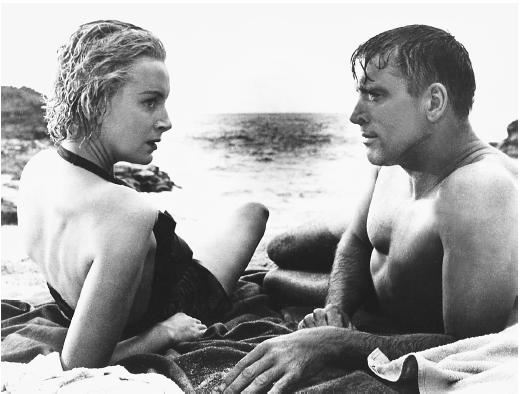
It's interesting to note that with all the people questioning whether it was too soon for films such as United 93 and World Trade Center to tackle the events of 9/11 that From Here to Eternity re-created the attack on Pearl Harbor a mere 12 years after it occurred, albeit as a glorified soap opera. (Actually, movies began referring to the attack on Pearl Harbor within months of December 1941, but I believe this is the first to actually depict the attack.) Thankfully though, Zinnemann was no Michael Bay and the film still has some teeth (and earned Zinnemann his first directing Oscar). Most importantly though, it has great performances from Burt Lancaster, Montgomery Clift, Deborah Kerr, Ernest Borgnine and Frank Sinatra's Oscar-winning turn as the doomed Pvt. Maggio. How Donna Reed won her Oscar I'm not certain. (As Josh R is fond of pointing out, she plays what must be the most virginal prostitute ever put on film.) However, enough remains to make it stand the test of time.
Zinnemann ventured into musicals and he went BIG, i.e. in full-blooded Technicolor, Todd-AO glory transferring this landmark Rodgers and Hammerstein musical to the truly big screen. In a way, Oklahoma! really is
 a stage show that should be opened up since a stage is too limiting for this tale of early settlers. Zinnemann takes true advantage of this with some nice shots, particularly the opening which moves the camera through the stalks of a corn field before coming upon Gordon MacRae singing "Oh, What a Beautiful Mornin.'" While the film is good enough, the importance of its stage version doesn't exactly transfer since Hollywood already had produced its own much better musical originals for the screen (such as Singin' in the Rain three years earlier). Despite that, there is much to admire in the songs and some of the performances, specifically Gloria Grahame's fun turn as Ado Annie. This is the performance that should have earned her an Oscar nomination and/or win, not her blink-or-you'll-miss-it work in The Bad and the Beautiful. Rod Steiger is good as the dark Jud, but his performance (and really the character himself) always has seemed somewhat out of place in what is essentially a musical comedy. Eddie Albert does what he can as Persian peddler Ali Hakim, but he's about as much a Persian as Mickey Rooney was Chinese in Breakfast at Tiffany's. (Well, Albert isn't offensive at least).
You can probably count on one hand the number of films about Catholic priests or nuns that still have them in their religious vocation by the time the film ends, and this bloated work isn't one of them. Audrey Hepburn does her best as the conflicted nun-in-training, but it's really Peter Finch who steals the show as a feisty doctor that Hepburn works with during some missionary work. It's not only an obscenely long film, it's also an eminently forgettable one.

Also too long, but immensely more fun was Zinnemann's next film, with Robert Mitchum and Deborah Kerr struggling to make ends meet in the outback as sheep drovers, with Kerr trying to be the sensible one and Mitchum's gambling spirit always getting the best of him (and their nest egg). She's tired of their wandering ways and wants to settle down, but his rambunctioness always gets in the way. There also are fine supporting performances by Peter Ustinov and Glynis Johns. Still, the cinematography by Jack Hildyard is stunning and there are some great set pieces, particularly a sheep-shearing competition. To say that its Oscar nomination for best picture was more than generous is no understatement.

Zinnemann truly created an odd one with this film that has Gregory Peck (?) playing an exiled Spanish revolutionary and Anthony Quinn as the Spanish official hoping to lure him back to the country to kill him with the news that his mother (Mildred Dunnock) is dying 20 years after the end of the Spanish civil war. Things get complicated further by a young boy named Paco (Marietto Angeleletti) who wants Peck to go back to kill Quinn to avenge his own father's death, but Peck also is torn by a possible traitor within his ranks. Despite the fact that Peck is even a less-convincing Spaniard than Eddie Albert was a Persian, the movie's overriding problem is that it's a world-class bore. It drags on and on to a truly anticlimactic ending. The most interesting thing about it is that it was based on a novel by Emeric Pressburger.
It had been a long time since I'd seen this best picture winner that earned Zinnemann his final two Oscars, one for directing and one for producing, and it plays even better than I remembered. While Robert Bolt's
 screenplay does show its stage origins, Zinnemann has turned this story of Sir Thomas More's stance on principle against the will of King Henry VIII into a sleek, compelling enterprise with the look and feel of an epic but a running time of a mere two hours. Central to the film's success of course is Paul Scofield's Oscar-winning turn as More, but Zinnemann does add a lot of nice touches as well, particularly in the great opening sequence showing the travel of a message from Cardinal Wolsey to More. There's also stunning cinematography by Ted Moore and a top-notch supporting cast that includes Wendy Hiller, Leo McKern, a young John Hurt and Robert Shaw in his Oscar-nominated turn as Henry VIII, which is a much smaller role than I recall. My 1966 Oscar preferences still lean to Who's Afraid of Virginia Woolf? but this film's win is not an embarrassment.
As Fred Zinnemann began his sixth decade as a filmmaker, he turned to yet another genre with this taut thriller starring the cool Edward Fox as a hired gun whose services are employed by embittered former members of the French Foreign Legion to assassinate French President Charles De Gaulle. The story moves on two tracks as Fox, code name The Jackal, pursues his plot and the French authorities, led by Col. Rolland (Michel Auclair) try to determine the killer's identity and to stop him before he is able to act. The film is a bit overlong, but Zinnemann does build quite a bit of suspense, even though we know De Gaulle won't be killed, and Fox is superb as the cold and calculating mercenary.
I saw Julia when it was originally released and I was in grade school, hardly the ideal audience. All I remembered really was that I was bored silly and the scene where a frustrated Lillian Hellman (Jane Fonda)
 tosses her typewriter out a window (I miss typewriters). So, in fairness, I decided I needed to take a new look, hoping that age would make me have a new view on the film the way I did a turnaround on Reds recently. Alas, 30 years later, I find Julia as boring as I did as an elementary school student. Its awards puzzle me more now than they did when I only had vague memories. Fonda at times is pretty bad. Jason Robards in his second consecutive Oscar-winning supporting turn is fine, but really doesn't have anything to do to deserve the prize. Maximilian Schell's presence is so fleeting that his nomination is a headscratcher. What shocked me the most was Vanessa Redgrave. While she is one of our finest actresses, there was more drama and suspense surrounding her nomination and her winning speech than she gets to create in the film itself. This was Zinnemann's final Oscar nomination as director (though he did direct one more film, which I haven't seen), but Julia is a bore. Pure and simple. Despite his less successful works, Zinnemann produced a lot of good and great movies in his time and I still salute him on his centennial.
Tweet
Labels: A. Hepburn, blacklist, Borgnine, Brando, Clift, Cooper, Deborah Kerr, Gregory Peck, Hammerstein, Lancaster, Mary Astor, Mitchum, Robards, Robert Ryan, Rodgers, Sinatra, Van Hefiin, Vanessa Redgrave, W. Hiller
TO READ ON, CLICK HERE
Wednesday, August 02, 2006
The lighter side of Peckinpah
.jpg)
By Edward Copeland
Immediately following his landmark Western The Wild Bunch, director Sam Peckinpah was in a more whimsical mood and as a result his followup was the mostly comic Ballad of Cable Hogue starring Jason Robards. Now there is violence and death — practically bloodless compared to Peckinpah's previous film — and if you scratch beneath the surface, you might find some religious allegory at work, but don't let that get in the way of enjoying the film. Robards stars as the title character, whom we meet wandering on his last legs through a barren desert after being robbed and abandoned by a pair of scoundrels. Near starvation, dehydration and death, Cable is about ready to call it a life when he stumbles upon a rare spring of water amidst the endless sand and his entrepreneurial spirit kicks in.

Before long, he's found his way to the nearest town, claimed the small patch of desert and christened it Cable Springs, charging passers-by and stagecoaches to quench their thirsts and starts accumulating a nice nest egg for himself. Time seems to stop — so much so that it's jarring when at one point in the film Cable says he's been at his new post for more than three years. Before he can get to the town, Cable needs a ride and it comes in the form of the horse of an eccentric self-proclaimed minister (David Warner) who happens by Cable Springs and soon becomes Cable's partner in developing the watering hole. Warner's performance and character aren't the only quirky elements in this tale — Peckinpah is in a particularly playful mood, employing split-screen techniques (sometimes dividing the image into four sections), speeding up the film like it's a silent slapstick comedy and other touches you almost don't want to give away so new viewers won't have the surprise ruined. (Here's a hint: adhere to Hal Holbrook's advice as Deep Throat in All the President's Men and "Follow the money.")
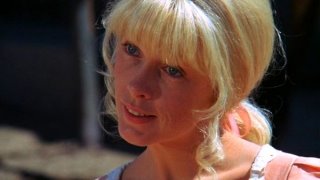
Aside from Robards and Warner, there are performances from other staples of the genre such as Strother Martin, Slim Pickens, L.Q. Jones and R.G. Armstrong. However, the most significant other character is Hildy (Stella Stevens), a town prostitute accurately described by Cable as "the ladiest damn'd lady" you're ever likely to meet. The story is deceptively simple — there is the element of Cable seeking vengeance on the bums who stranded him in the desert, but don't let that get in the way either. The Ballad of Cable Hogue is a lively and lyrical ode to the West and salvation, even containing themes left over from The Wild Bunch such as how progress changes everything. (As Al Swearengen so aptly put it on an episode of Deadwood this season: "Change ain't looking for friends.") Even the ending, which could be viewed as downbeat, has such a light touch, that it's hard not to smile. The movie is a quiet little gem — and there certainly are worse ways to spend two hours.
Tweet
Labels: 70s, David Warner, Deadwood, Holbrook, Peckinpah, Robards
TO READ ON, CLICK HERE


