Sunday, July 14, 2013
Summer of '88: Die Hard

“People get involved here, and that’s the thing. If people are patronized, if a film is geared toward a short attention span, then it’ll have a short shelf life. Films that involve that audience and embrace that ‘once upon a time’ principle have a chance of lasting…We’re storytellers and we forget that at our peril.” — Alan RickmanBy Edward Copeland
That Rickman quote appears on the text commentary on one of the many DVD versions circulating for the movie Die Hard. When Die Hard exploded into theaters in the summer of 1988, I didn't rush to see it. The reviews were mostly mixed to negative, and the action films of that era were low on my priority list (especially since, back then, I had to pay to see movies). When I finally ventured out to see it, it had moved to a dollar theater and a group of my bored friends and I decided to check it out for lack of better options. We arrived late, so it wasn't until seeing the film again on video that I caught the foreshadowing of the airplane passenger advising John McClane (Bruce Willis), as they're arriving in L.A., that the best way to readjust to Earth after a long flight involves removing your shoes and socks and making fists with your toes in carpeting. It takes more than one viewing of Die Hard to truly appreciate how much work and thought went into its construction and composition and to catch all the allusions (not just the obvious ones) to classic films.
Labels: 80s, Movie Tributes, Rickman, Willis
TO READ ON, CLICK HERE


Monday, July 01, 2013
What acting is all about — unemployment
BLOGGER'S NOTE: This post originally appeared Dec. 17, 2007. I'm re-posting it as part of The Sydney Pollack Blogathon occurring through July 22 at Seetimaar — Diary of a Movie Lover

By Edward Copeland
Film directing isn't often compared to completing a jigsaw puzzle, but that analogy seems most apt in describing exactly what Sydney Pollack accomplished with Tootsie, which opened 25 years ago today. What began with a story by Don McGuire and Larry Gelbart and a screenplay by Gelbart became the center of a fight between the film's star, Dustin Hoffman, and Pollack, and ended up with countless other notable scribes (among them Barry Levinson and Elaine May) taking shots at the script. In the end, the final screen credit went to McGuire and Gelbart for story and Gelbart and Murray Schisgal for screenplay, but Pollack's ability to weave the best parts of all those drafts and spin them into cinematic and comic gold deserved a credit all its own. If that feat of wizardry weren't enough, Pollack also turns in a fine supporting role as well, playing Hoffman's character's agent.

When originally released, while I loved Tootsie, being 13, my 1982 heart still belonged to E.T.: the Extra-Terrestrial, released months earlier. However, as the years went by, Tootsie grew in my estimation while E.T. became almost too schmaltzy to watch, so much so that I haven't returned to it in nearly 20 years. Perhaps my view would change again now. What makes Tootsie soar, like many other films, comes from the fact that its greatness proves impermeable to even a picky, critical mind such as mine. I mean, how exactly does "Dorothy Michaels" (Hoffman's drag alter ego) get paid when she doesn't exist and wouldn't have a Social Security number? Of course, the finale, involving an accident that forces the soap to redo a show live at the last minute seemed ridiculous to me even upon first viewing, but why question the logic of a scene that uproariously funny and with a payoff so huge? The brilliant ensemble cast, in addition to Pollack's patch job, holds Tootsie together.
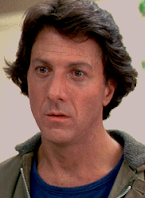 Hoffman, deservedly, gets a lot of credit for his drag creation, but I don't think he gets the kudos for Michael Dorsey that are due him. It might seem as if Hoffman's reputation for being difficult, makes Michael a cakewalk, but he not only plumbs
 Dorsey's depths for comedy and pathos, but convincingly depicts his transformation from a horny prima donna to a more sensitive man (At one point, Michael acknowledges that he thinks Dorothy is smarter than he is). The opening sequences, depicting his problems as an actor who hasn't had a job in two years, come stocked full of laughs, such as the scene where his agent George Fields (Pollack) explains the reasons he his client can't get work while Michael insists in his own defense "that nobody does vegetables like me" to justify his firing from a commercial where he played a tomato. Hoffman and Pollack don't carry the film alone. Ironically, the weakest link in the cast, Jessica Lange, was the only person to win an Oscar, a consolation prize for losing lead actress in Frances that year to Meryl Streep in Sophie's Choice. Frankly though, Lange wasn't even the best supporting actress in Tootsie, though her character provides the key to the film's serious undercurrent of exploring the way men sometimes treat women in all ranges from employment discrimination to out-and-out misogyny, but the message never interferes with the laughs.
Teri Garr's great turn as Michael's acting colleague and friend Sandy did earn an Oscar nomination, but she lost to Lange, as did my personal choice for 1982, Glenn Close in The World According to Garp. Garr, however, clearly led the field of women in Tootsie (hell, I could make a case for Doris Belack as the soap's producer over Lange). Always clandestinely stuffing food into her purse at parties, having Michael "enrage" her for an audition and her go-for-broke rage explosion when she learns Michael has been deceiving her provide some of the film's most priceless moments. The ensemble contains so many great supporting turns by the men in the film, I'm almost afraid to single anyone out. In addition to Pollack, viewers receive the gifts of George Gaynes as the soap's aging star, wholly dependent on cue cards and
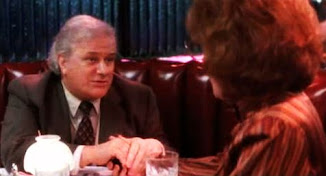 prompters, who hits on every new cast member; Dabney Coleman doing the chauvinistic asshole character he practically patented in the early 1980s as the soap's director; the great Charles Durning, who earned an Oscar nomination that year, albeit for The Best Little Whorehouse in Texas with his single but memorable scene singing and dancing a little "Sidestep," as Lange's widowed father who falls for Hoffman's Dorothy and longs for the days when men and women "were what they were." His proposal scene proves both funny and touching (though the comic gem resulting from this sequence comes later when Michael tells his agent about the offer and Pollack asks him what he said, with genuine happiness that makes him forget about the truth of the situation for a moment. Along with Belack, another fine supporting female in the cast happens to be a young Geena Davis who plays another actress on the soap and shares a dressing room with Dorothy.
The prize for the best of the supporting men though goes to the great Bill Murray, in a role that legend says he improvised completely and I believe it. He plays Jeff, Michael's playwright roommate, and if he truly did come up with all his own dialogue, what a treasure trove he unleashed. (My personal favorite: When he says he wishes he had a theater that was only open when it rained.) Even though Tootsie lags a bit when it takes a detour to Durning's farm, it's forgivable since those scenes give the film part of its heft and allows for even more comic grace notes. How Tootsie lost to the noble but limp Gandhi (including for original screenplay, patch job or no patch job) still baffles me.
Tweet
Labels: 80s, B. Levinson, Dabney Coleman, Durning, Dustin Hoffman, Geena Davis, Gelbart, Glenn Close, J. Lange, Movie Tributes, Murray, Streep, Sydney Pollack
TO READ ON, CLICK HERE
Thursday, March 22, 2012
"What do they want from me? After all, I’m only an actor."

By Roscoe
Hendrik Höfgen sets a new standard for protesting too much with the above line from István Szabó's film Mephisto, which celebrates the 30th anniversary of its U.S. release today. Höfgen, unforgettably embodied by Klaus Maria Brandauer, is an actor who finds himself living in, to put it politely, interesting times — 1930s Germany. Szabó's film, based on the novel by Klaus Mann, details Höfgen's career trajectory from provincial Hamburg star and Communist Party member to his final status as the most prominent actor in Nazi Germany, the darling of the Fascist elite. To do this, he, not surprisingly, has to do a lot of skillful maneuvering and charming and flattering, to say nothing of soul-selling.
Höfgen is first seen in his dressing room, screaming with rage and frustration at the wild ovation a visiting star performer is getting from her audience. In what turns out to be the first of many scenes involving Höfgen gazing into a mirror, he manages to pull himself together, going from abject misery to a teeth-baring defiance. He soon is complimenting the star on her performance (which he didn't see) and fishes for compliments from her, asking her to speak a little louder so that everyone can hear her high estimation of his talent.

Soon, the political climate of the era is laid out for us, with Höfgen's communist leanings and involvement in a Revolutionary Theater getting particular attention. The Nazis get some mention, but aren't taken particularly seriously until the terrible day when Hitler is elected chancellor, and everything is turned upside down. Höfgen's communist past suddenly is a liability as he finds some old enemies in high places. He makes the most of an even more highly placed acquaintance, who is the mistress of the Nazi Field Marshal (played by Rolf Hoppe, the character clearly based on Hermann Goering), and is able to get himself cast as Mephisto in a revival of Goethe's Faust. The Field Marshal is very taken
 with Höfgen's performance, and Höfgen's career is saved. He's soon the Nazis' go-to spokesman on cultural matters, spouting their platforms on German art with an actorly polish that is supposed to make the ideology more palatable. It isn't all roses, though, as Höfgen soon finds that there's more to pleasing Nazis than repeating their platitudes on High Culture. He eventually is the manager and star of the German National Theater, and has to deal with Nazi interference on personnel and cultural issues. Certain Jewish staff has to be dispensed with, and most serious works are not acceptable to the regime on political grounds. Höfgen’s production of Hamlet, based on the uncomfortable lecture he delivers, looks to be Shakespeare re-imagined in the Nazi mold, with Hamlet as a bold and resolute hero, a prince of the North. And, based on the final moment of the film, the Nazis seem to have bigger plans for Hendrik.
It should be mentioned that Mann's novel Mephisto was based on the career of the German actor Gustav Gründgens, best known today as the derby-hatted master criminal Schranker in Fritz Lang's M. Gründgens was Mann's brother-in-law, and had a career trajectory similar to Höfgen’s, running the German National Theater in Berlin during the war, with Goering's backing.

So how does Mephisto the film hold up, 30 years on? Remarkably well, I'd say. Szabó brings the film to life with a good deal of energy and style, favoring tight close-ups of his excellent cast. I’m very taken with the film’s multiple Mephistos — ranging from Höfgen’s own two performances of the role (one before and one after the Nazi takeover) to the group of costumed Mephistos who appear at Höfgen’s wedding late in the film, leading the entire party in a celebratory dance. To be fair, the film's 144
 minute length can feel a bit prolonged in places, but for a viewer willing to hang in and do the work, there are real rewards. The success of the film must depend largely on casting Höfgen properly, and there's no denying that Szabó hit a bull’s-eye with Klaus Maria Brandauer. Brandauer’s performance is a marvel, a real tour de force, a blowout display of overacting, underacting, and everything in between. He’s able to negotiate the character’s shifting allegiances and sell-outs large and small with what looks like ease. Not the least of the Mephistophelean bargains in the film is the one Brandauer makes with the audience — as bad as he gets, he’s always fascinating to watch as he veers from extreme egotism to extreme self-loathing. He's as electrifying now as he was in 1982. He gets excellent support from the rest of the cast, with special notice going to Karin Boyd as Juliette, Höfgen's Afro-German mistress and dance instructor, probably the only character in the film who really knows and loves him for what he really is. Their scenes together really crackle.
The film, alas, seems to have dropped off the map, strangely so since it picked up a best screenplay prize at the Cannes Film Festival and the Oscar for best foreign language film, the only film from Hungary to do so. The DVD is out of print, and no longer available via Netflix. A real shame. This film deserves a lot better.
Roscoe blogs at Roscoe Writes. He graduated from the film program at CUNY’s Brooklyn College, and lives in NYC with his husband.
Tweet
Labels: 80s, Books, Fiction, Foreign, Lang, Movie Tributes, Netflix, Oscars, Shakespeare
TO READ ON, CLICK HERE
Saturday, March 17, 2012
Round is funny
This post originally ran as part of The Slapstick Blog-a-Thon held at Film of the Year in September 2007. I've revised the piece slightly to mark the 25th anniversary of the release of the Coen brothers' second feature on March 13, 1987.

They say he's a decent man, so maybe his advisers are confused." — H.I. McDunnough
By Edward Copeland
The frenetic slapstick nature of Raising Arizona doesn't kick in immediately. As it begins, the movie restricts most of its wackiness to wordplay. The first (and I still think the best) instance of the Coen brothers milking laughs by creating dimwitted characters that spout purple prose in thickly painted-on accents, churning out phrases that people such as these never would utter if they existed in the real world. The Coens would recycle that formula many times in films such as Fargo, O Brother, Where Art Thou? and the ill-advised remake of The Ealing Studios classic The Ladykillers, having Tom Hanks assume Alec Guinness' memorable turn by impersonating Colonel Sanders. However, the Coens never would go that route with as much hilarious and charming success as they did in Raising Arizona, which holds up strongly 25 years later.

What impressed me first when I saw Raising Arizona a quarter-century ago was its opening prologue, which lasts a full 11 minutes before the title even appears. It's an amazingly efficient 11 minutes as well, setting up nearly all the main characters and situations. We meet habitual convenience store robber H.I. McDunnough (Nicolas Cage), whose parole board he frequently visits (and which frequently frees him) warns that he's only hurting himself with this "rambunctious behavior." We also meet his prison friends Gale and Evelle Snoats (John Goodman, William Forsythe). Most importantly, we meet the police officer who takes H.I.'s mugshot and prints each time he returns to prison. The
 officer goes by the name Ed, short for Edwina (Holly Hunter). We get to see the attraction grow between her and H.I., especially after Ed's fiancé dumps her and, during one of his releases, H.I. finally works up the courage to ask Ed to be his bride, even though he'd previously said, referring to his chosen profession of armed robbery, that "sometimes your career comes before family." Unfortunately, family doesn't seem to be in the offing for the McDunnoughs as they learn from doctors that Ed's "insides were a rocky place where my seed could find no purchase." That bit of narration from H.I. perfectly illustrates what I mean about the contrast between the characters' character and their speech. In Raising Arizona, the Coens excel at crafting this type of incongruous dialogue. The brothers followed up with two completely different films — Miller's Crossing and Barton Fink. After that, they tended to keep returning to a formula of dumb characters speaking flowery language in plots usually involving kidnapping and/or murder.
All that comes later. Today, we're praising when it worked in what was just their second feature. At the same time that the childless McDunnoughs are beginning married life, furniture kingpin Nathan Arizona (the late Trey Wilson) and his wife, thanks to fertility drugs, end up having quintuplets which prompts Nathan to remark is
 "more than they can handle." It gives Ed the idea that perhaps it would be OK if she and H.I. just took one of the five off the Arizonas' hands so she and H.I. would have a little one to raise as their own while they eased the Arizonas' burden at the same time. That's where the madness truly begins. What's remarkable about the Coens' work in Raising Arizona is that it's not just pure slapstick, but a brilliant blending of slapstick and suspense, beginning with the first outright slapstick sequence as H.I. climbs through the window of the Arizona household to try to snatch one of the infants, setting off a tense comic scene of toddlers gone wild. Set to Carter Burwell's musical score, which has more than a passing resemblance in this scene to John Williams' theme from Jaws, the babies roam, one perilously approaching the steps leading downstairs. You can't decide whether to laugh uproariously or in fright. Once the stolen baby rests comfortably in the McDunnoughs' trailer, things get really complicated.
 H.I.'s prison buddies Gale and Evelle literally burst through the mud outside the prison and escape, or as Evelle puts it, they released themselves "on their own recognizance." After briefly cleaning themselves up in a gas station rest room (Dr. Strangelove fans, check the
 acronym that's been spray-painted on the bathroom stall's door), the brothers arrive at H.I.'s trailer, looking for a place to stay and insisting to Ed that they "don't always smell this way." The police officer in Ed doesn't like fugitives in her family's home,
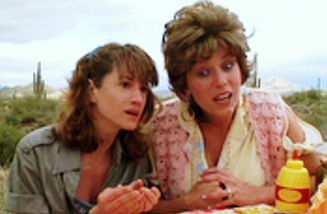 even though she herself is a felon now, albeit a good-intentioned one. Another complication arises with a visit from H.I.'s boss at work, Glen (Sam McMurray), his wife Dot (Frances McDormand) and their seemingly endless stream of diabolical children. "Mind you don't cut yourself, Mordecai" and "Take that diaper off your head and put it back on your sister" are just two of the many things Glen yells as his brood goes wild. While Dot rapidly lectures Ed on the need for insurance, avoiding orthodontic work and making sure the baby stays up to date on his "dip-tet boosters," Glen confides to H.I. that Dot wants another one, because these have grown too big to cuddle, but something has gone wrong with his semen. H.I. tries to lie about how he and Ed got to "adopt" a child so fast, but more trouble arises when Glen suggests to H.I. that they swap wives because he and Dot like to swing. H.I. punches Glen, who takes off like a madman and runs smack into a tree. Glen flees H.I., telling him not to bother coming into work anymore and promising to sue.
From that moment on, Raising Arizona essentially becomes an extended free-for-all chase. Since H.I. figures that Glen will make good on his word and fire him, he finds himself passing by convenience stores again "that weren't on the way home." Ed puts her foot down and wants Gale and Evelle gone. "I'd rather light a candle than curse your darkness," Gale tells H.I., while trying to convince him to help with a bank robbery. H.I. declines, but with Ed and the baby in the car, he does proceed to rob a convenience store for money and Huggies, setting off a loopy, more than five-minute long pursuit sequence. A pissed off Ed drives off with the baby, leaving H.I. to escape on foot. The Coens' hyperkinetic camera doesn't stop for a second as it rolls through groceries, streets and houses while clerks and dogs join the H.I. hunt.

Of course, the deadliest pursuit has yet to occur. H.I. already has had visions of a strange biker who takes no mercy on anyone or anything, and the vision turns out to be Leonard Smalls (Randall "Tex" Cobb), a self-described tracker, "some say hound dog." He meets with Nathan Arizona and offers to find his boy, but for a higher price than the reward the furniture magnate has offered. Arizona refuses, but Smalls insists he'll find the baby anyway and take whatever price "the market will bear." Back at the trailer, the chaos escalates as Glen figures out where H.I. and Ed got the baby and demands they turn the tot over to him and Dot. Before H.I. can even contemplate what to do, Gale and Evelle, who
 overheard the conversation, decide to steal the infant for themselves. Gale and H.I. tear the trailer apart in a residence-wrecking fight that takes place while Evelle shields Nathan Jr. The fugitives prevail and take off with Nathan Jr. with plans to hold him for ransom (and use him as a third man on the bank holdup). When Ed returns home to find H.I. tied up, she frees him and the couple leave to rescue the child, though Ed makes it clear that they aren't good for each other and should split once the baby is safe. The raucous slapstick melees run nearly nonstop after that as the convicts grow too fond of Nathan Jr. to part with him and Smalls arrives to whisk the baby away for his own nefarious purposes, leading to a final showdown with H.I. and Ed. Despite the frenzied pace and over-the-top nonsense, Raising Arizona even manages to conjure some warmth as the film winds down, though perhaps what touched me the most re-watching the film this time is remembering how much I loved the Coen brothers back then, until I felt their career went off the rails beginning with The Hudsucker Proxy. At least their upcoming film, No Country for Old Men, shows some promise as the vehicle marking their return to filmmaking I love instead of just doing variations on the same gags and gimmicks that I still love in their first four films, but has grown old by now.
From top to bottom, all the actors hit exactly the right notes for the movie. Forsythe and Goodman make for a hysterical pair of not-so-swift criminals. Cobb displays just the right amount of menace to remain a cartoon without pushing the film off its comic tone and into a terror mode. The late Parker gets some great material as Nathan Arizona as well as when he yells at the multitude of cops loitering at his house. "Dammit, are you boys gonna chase down your leads or are you gonna sit drinkin' coffee in the one house in the state where I know my boy ain't at?" Even the small roles of bank customers and store owners get priceless moments, especially Charles "Lew" Smith who plays the store owner who utters the response that gives this post its title when Evelle asks a question about some balloons. Cage still was in the early years of his career and Arizona marked the middle film of a three-film run of great Cage performances that started the year before with Peggy Sue Got Married and would concluded later in 1987 with Moonstruck. The breakout actor though was undoubtedly Holly Hunter as Ed. Hunter had appeared in a handful of films and TV movies, but Raising Arizona gave Hunter her biggest exposure so far, but it was just an appetizer for the gourmet meal Hunter would serve fans of great movies and acting in December 1987: Broadcast News.
UPDATE March 17, 2012: As we now know, my hopes for No Country for Old Men ended up being more than fulfilled. That same year, the brothers wrote and directed "Tuileries," one of the best shorts in the great compilation film, Paris, je t'aime . The Coens took a minor step backward with the so-so Burn After Reading that came next. However, the next movie they made ranked as one of their all-time greatest. A Serious Man also introduced me to the great actor Michael Stuhlbarg, who had mostly toiled upon the stage but would go on to impress me in a completely different type of role than his Larry Gopnik in A Serious Man when he became 1920s gangster Arnold Rothstein on HBO's Boardwalk Empire. Most recently, the Coens accomplished that rare feat of remaking a film and producing a greater version. Granted, the original True Grit wasn't a masterpiece, but it did contain John Wayne's Oscar-winning role as Rooster Cogburn which Jeff Bridges took on, easily besting the Duke. What really made the Coens' True Grit exceed the 1969 film version was young Hailee Steinfeld playing Mattie Ross. Yes, the Coens I loved early in their career have matured and returned better than ever. It's good that they can produce great works again and we continue to have their older classics such as Raising Arizona holding up after 25 years.

Tweet
Labels: 80s, Blog-a-thons, Boardwalk Empire, Coens, Guinness, Hanks, Holly Hunter, Jeff Bridges, John Goodman, John Williams, McDormand, Movie Tributes, Nicolas Cage, Oscars, Remakes, Wayne
TO READ ON, CLICK HERE
Wednesday, March 14, 2012
The Forest and Through the Trees

By Adam Ross
Horror movie franchises are typically based around an enduring villain (i.e. Frankenstein, Dracula, Jason Voorhees) but as The Evil Dead series gears up for another installment and celebrates the 25th anniversary of Evil Dead 2: Dead By Dawn, it's worth noting that its popularity is rooted in a constant hero. Played with career-defining conviction by Bruce Campbell, Ash has become one of the most popular modern movie heroes partly because we know he takes as much pain as he gives. When Evil Dead 2 premiered in 1987, it arrived as a sequel to a movie (The Evil Dead) which garnered only a microscopic theatrical release and, to those few who were familiar with the original, the new incarnation seemed more like a remake than a sequel. Even today it's still worth debating whether it's a true sequel or not, but it's undeniable in 2012 that Evil Dead 2 left a lasting fingerprint on the horror genre.
Six years passed between The Evil Dead and its sequel, an eternity in terms of horror follow-ups. Friday the 13th premiered in 1980, and by 1989 we already had Friday the 13th Part VIII: Jason Takes Manhattan. The Halloween franchise was readying its fifth installment by then, and the Nightmare On Elm Street series (which debuted in 1984) released No. 5 that year. While the aforementioned '80s horror standbys preyed on the audience's familiarity with their respective villains (needing only fresh victims or a new plot novelty in each iteration), the team behind The Evil Dead was banking on a returning hero with a plot that wasn't entirely original. Helped by an overly enthusiastic recommendation by author Stephen King, The Evil Dead was a modest box office hit, but thanks to its minuscule budget still turned a tidy profit. Short on budget, but not creativity, the original movie introduced the world to Ash (Bruce Campbell), who helped his friends fight off unseen evil from their isolated forest cabin. Compared to its follow-ups, The Evil Dead is more of a straightforward horror movie, with less emphasis on gross-out effects or slapstick humor. Behind the camera of The Evil Dead was the brotherly duo of Sam and Ted Raimi, along with a band of former Michigan State University students (including Campbell) with an affinity for horror movies.
The international success of The Evil Dead caught the attention of Italian film magnate Dino De Laurentiis, in particular the directing talents of Sam Raimi. Though De Laurentiis initially focused on having Raimi direct an adaptation of a King novel, the producer eventually
 greenlit a $3.6 million budget for Raimi and his crew to start work on Evil Dead 2. Acknowledging that most audiences were not familiar with The Evil Dead, the original script called for a preface with flashbacks to the first film ala The Road Warrior. But since Evil Dead 2 would be financed and distributed by another company, the filmmakers did not have license to use footage from the original movie. This legal setback was the genesis for making Evil Dead 2 more of a reboot plotwise of The Evil Dead. This was a positive for the sequel, because the predecessor's plot was ripe with potential for Raimi and company's larger budget. Writer Scott Spiegel was a utility man of sorts on The Evil Dead, performing a number of roles behind and in front of the camera. Spiegel was well known to the Raimi brothers and Campbell from their days as young amateur filmmakers in Michigan. For Evil Dead 2, he was tapped by Sam Raimi to co-write the script with him, and he is credited with the idea for bringing a more comedic and slapstick element to the movie. Evil Dead 2 would have the same setting and basic horror elements of The Evil Dead, but would include more characters, stunts, monsters, gore, laughs and pain.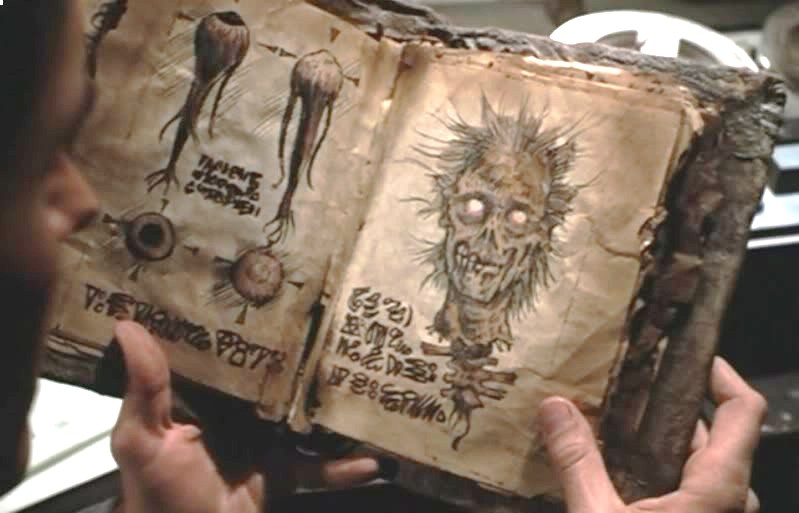
The movie starts again with Ash traveling to a remote cabin, this time with girlfriend Linda in tow. Little time is wasted before the MacGuffin from the original movie is introduced: the Necronomicon, or Book of the Dead. When Ash unwittingly plays a recording from the cabin's previous tenant (an archaeologist) reading from this cursed book, terrible forces start to attack the residence. After his girlfriend is possessed and attacks Ash, the movie briefly becomes a one-man show as our hero is attacked continually by forces ranging from the forest itself, the corpse of his girlfriend and even his own hand. The infamous scene where Ash must amputate his hand is one of the series' lasting images and illustrates the creative gulf between Team Raimi's vision of horror, and the typical slasher fare that populated theaters at the time. In freeing himself of the evil infection, Ash also painfully handicapped himself (however briefly) in a still ongoing fight against murderous forces. Before reinforcements arrive, Ash seemingly hits rock bottom when fountains of blood erupt from the walls and the house itself starts to laugh at him, but the real madness hasn't even begun.
The remaining cast is introduced when the archaeologist's daughter, Annie, and her team arrive at the cabin fresh from a dig, armed with more pages from the Necronomicon. This seemingly good news for Ash soon is spoiled when he promptly gets pummeled by one of Annie's assistants, mistaking him for a murderous lunatic (admittedly not far from the truth). This brief reprieve from paranormal punishment only lets the audience catch their breath for a moment before the intensity is again ratcheted up to new levels. This exhaustive pace is what makes Evil Dead 2 so refreshing compared to many horror movies still being poured into the same old molds. No killers lurk behind doors, no cars refuse to start — our characters barely can sit down in this tiny cabin without some new evil attacking them.

While the basis of the story was ported over from The Evil Dead, near the midpoint of Evil Dead 2 it firmly becomes its own movie, and that's when it merrily jumps off the rails. Raimi even includes a fun callback to the original movie. When Ash is locked in the basement by the new visitors and fights to escape, the action becomes a tribute to the monster in The Evil Dead, which spent many scenes vainly locked in that same room. The ridiculous climax where the forest itself starts to lay siege to the cabin, is a gleeful exercise by Raimi in one-upping every over-the-top gag you've seen so far in the movie. By the time Ash finds himself face down in the dirt in the Middle Ages, it barely even registers as a surprise after all the wild turns the movie has already made.
Even though the cast is larger than its predecessor, Evil Dead 2 undoubtedly belongs to Campbell. While he had been seen in several roles prior to this movie, it was his second turn as Ash that turned an actor with a generic name into Bruce Campbell. Playing a moving target for a myriad of possessed rednecks, invisible spirits and evil forestry, Campbell takes the action on his sharp chin again and again. Campbell famously did most of his stunts in the movie, and the actor forcibly brings you into his corner by charging again and again into the teeth of the titular enemies. The physical comedy Campbell displays would become one of the actor's trademarks: overplaying each dramatic mark with wide-eyed energy, coolly delivering his signature comeback lines and gladly sacrificing his health just to survive one more minute.

When we first see Ash, he's a normal guy with a beat-up Buick. By the end, he's not only lost his hand but he seems to have emerged stronger, aided by a newly installed chainsaw limb and the confidence from surviving an unrelenting attack from beyond the grave. When Ash raises his shotgun to lead his medieval followers, it's hard to doubt they will find victory together. Part of Ash's longevity as an action hero (he's been featured in video games, an iPhone app, comic books and various cameo appearances) has to be attributed to his rare standing as an everyman: he drives a crappy car, his idea of a vacation is a broken down cabin deep in the woods, he has some skills as a handyman, but prefers forcing the issue. Best of all, Ash doesn't run like so many horror movie characters — though it's not like he has a choice since a whole forest seems to be against him — he subscribes to the thinking that a good defense is a really good offense.
Evil Dead 2 became such a star-making turn for Campbell (and his character) that the series' third installment, Army of Darkness, relies more on the momentum and charm of Ash to carry it than simply continuing the previous movie's storyline. Compared to its predecessors, Army of Darkness is more adventure/sword and sorcery than horror, but still plows ahead with the same blunt-edged humor of Evil Dead 2. Featuring painful physicality, winking puns and Clint Eastwood-style one liners, the comedy of Evil Dead 2 and Army of Darkness has lived on in movies like Shaun of the Dead, Hellboy and, most recently, Tucker & Dale Vs. Evil. But Hollywood has yet to find another character with Ash's effortless courage in the face of terror combined with innocent charm. In most of Campbell's roles since the Evil Dead series, it's hard to tell where Ash ends and Campbell begins, or if the character is simply the actor playing it straight.
As the series marches on toward another sequel in the next couple years (with the story rumored to be another spinoff from The Evil Dead's framework), this low budget gross-out horror comedy only has increased in popularity through the decades. What did Evil Dead 2 do so right that so many of its peers could not? The best answer may be the best possible pairing of onscreen and offscreen talent. Sam Raimi has since proved his directing chops many times over with the likes of A Simple Plan, the Spider-Man trilogy and, most recently, Drag Me to Hell, and Campbell began a career as a cult action star with his performance here. When the two came together on screen with a script that pushed the envelope of typical horror conventions, the result was bloody good.
"Groovy."
Tweet
Labels: 80s, Bruce Campbell, Eastwood, Movie Tributes, Raimi, Remakes, Sequels
TO READ ON, CLICK HERE
Monday, March 12, 2012
30 Years Ain't That Long in Life, or Comedy

- Stand-up Act
- 1. a style of comedy where a comedian performs in front of a live audience, usually speaking directly to them.
- 2. a comic monologue performed by one person standing on a stage
By le0pard13
Take a look around you. Unsettled or distressing times spawn a push back in people. It's a natural reaction, especially in this country. Comedy thrives in periods of uncertainty. Hell, we even have a cable channel now dedicated to this style of entertainment. I wonder if that indicates we're in an ongoing epoch of apprehension? Oh well. I've read a number of examinations over the years on what and why comedy does (or doesn't) work. Two aspects draw me. Jokes, and their telling, can date quickly. What tickles today may fall flat tomorrow. Second, insightful jests can be enough to cut the comedian and/or the audience right down to the core.
We crank out comedians fairly regularly in the U.S. It seems, as a population, we feed on them incessantly, certainly enough to fill seven seasons of Last Comic Standing. (Who knew that was still running?) Most of the time, the funny men and women, riff off of other comics that have come before them, just with updated material. A few will bring something fresh, but there have been a very small number of humorists who've proved to be both revolutionary and evolutionary with what they brought while standing alone on the stage. Unquestionably, Richard Pryor was one of them. Witnessing Pryor perform his act live, nonetheless, turned out to be one of those rare and rarefied experiences for those lucky enough to catch him.
The closest the large majority of his fans would or did come to this were through viewing the three concert/documentary films of his stage act. Richard Pryor: Live in Concert (1979), Richard Pryor…Here and Now (1983) and, most assuredly, with Richard Pryor Live on the Sunset Strip, which marks its 30th anniversary today. Easily, out of the all of them, the concert film of his performance on the Strip remains the most popular and successful of that trio. Significantly, that's mainly because 1982 was a propitious crossing for the artist, his career and the fans who clearly loved him.
The key reason for that occurred two years prior (you could almost use the word Pryor as an adjective in this case) on June 9, 1980. Addictions plagued the comedian throughout his personal life, and most fans believe his alcohol and drug use reached both a pinnacle and low-point on this date. Whether it was a freebasing cocaine accident and/or dousing and lighting himself with high-proof rum in a drug-induced psychosis, the result remained the same. The comedian sustained burns covering more than half of his body on this day. Since this occurred in my hometown, at his Northridge residence, I still vividly recall the local news coverage and outpouring of shock and emotion this event sparked.
With this, the comedian, writer, social critic, television/film actor had become the most famous burn victim around. He was the poster child of troubled celebrity — almost four years before Michael Jackson's infamous Pepsi commercial accident. Nevertheless, the comedian's struggle to survive his most serious injury disappeared from airwaves, as they are apt to happen in American society, in the days and weeks post-accident. Many began to doubt his return. Richard Pryor's Phoenix-like comeback therefore was what this piece documented, and set the stage for his, and his fans, anxious scrutiny. All the well-wishing from friends and critics since '80 culminated in this, his reportedly (at the time) final comedy show.
I'm sure to many younger viewers, watching comedic monologues on stage these days touching on various bodily functions, sex and/or other embarrassments (of course, any combination of the first two usually dominate) is so common that it's old hat (now there's an idiom that dates me). It's something barely worth comment. Even so, it's a belief of myself and others that this type of replicated humor or delivery evolved purely from what Pryor shared with audiences first in the wellspring that were the '60s and '70s. He turned personal events (and some misfortunes) into brilliant classic comedy, many profane to boot.
The Museum of Broadcast Communications summarized him best, I think:
"Richard Pryor, comic, writer, television and film star was the first African-American stand-up comedian to speak candidly and successfully to integrated audiences using the language and jokes blacks previously only shared among themselves when they were most critical of America. His career really began when, as a high school student, his teacher persuaded him to discontinue cutting and disrupting class with the opportunity to perform his comic routine once a week for his classmates. Nevertheless, Pryor dropped out of high school, completed a tour of duty in the Army, then began his playing small clubs and bars, anywhere he could secure a venue. His keen and perceptive observation of people, especially his audiences, enabled him to develop into a gifted monologist, mimic and mime."
Few could write (let alone perform) comedy as deftly and penetratingly as this stand-up. Whether it was for his own stage monologues, film (he crafted Bustin' Loose, Jo Jo Dancer, Your Life is Calling and even co-wrote Blazing Saddles with Mel Brooks) or television (Sanford & Son, Lily Tomlin's first TV special, Flip Wilson's series and his own), his talent and personality always seemed to show through (along with his private and society's demons). His discussions of his relationships with women remain the stuff of legend.

Richard Pryor became known for his comic perceptions, keen and at times brutal as all get out. He'd regularly get his routines across to the point you'd laugh your ass off about them. To be sure, his rise was predicated upon dropping the Bill Cosby shtick he'd adopted in the '60s. He then managed to merge humor with a "street" mentality that drew audiences of all ethnicities, even when it sounded threatening to some. Once heard by others (black or white), he and this brand of entertainment weren't about to go back in the genie's bottle. Without a doubt, he could be dirty, much like Redd Foxx could be in clubs. But where Foxx's rep lay solely within his own community, Pryor's genius and impact was far broader. Through words and physician expression, he could deliver a poignancy amid all that laughter. It got under people's skin for its distinctive awareness (whether that dermis was black, white…whatever).
"Gettin' your motherfuckin' heart broke is like, I don't know. Men cannot graduate till a woman breaks your fuckin' heart. That is your diploma. It either kills you, or makes you fat."
The documentary opens with one of those typical aerial overviews panning down on the city. This time overlooking the Hollywood and West Hollywood stretches of the famed (or infamous depending upon your point of view as the '70s weren't that far off in the rearview) Sunset Blvd. Somehow, looking above the cheap, seedy motels, liquor stores alongside famous and elegant locations (some now long gone) also seemed a strangely appropriate launch. The sequence even includes a glimpse of the Chateau Marmont, the site of John Belushi's final reservation. It's bizarrely and uncomfortably fitting before the camera lands on the shot of the host Hollywood Palladium (where Joe Layton had his 'directed by' title splashed).
"There's not enough fuckin' going on in America. Americans, when Reagan gets in, you stopped fuckin'. We fucked when Carter was in; we fucked all of the time! Just had…nothing else to do. Hey, let's fuck. President's making a speech; let's fuck. Reagan's in now and everybody listens to this motherfucker. We can't fuck now. I say, get them last fucks in now!"
Richard Pryor's show actually ran two nights in December 1981. Given the numerous cuts and edits in the documentary, there is a sense this concert film is an amalgamation of his best takes from both sessions. Too many times, though, the filmmakers seem caught up in showing audience reaction shots (especially if it included the beautiful people of the decade, and Jesse Jackson in a big afro). Knowing what came before, watching Pryor walk onto the stage, resplendent in a flaming red tux, was at once audacious as ever, triumphant (he's greeted by a standing ovation) and yet oddly an uneasy thing to behold. Clearly, as he began to deliver his persona and act alone on that stage, before the decidedly mixed audience, it was a nervous start for him. That much is certain. Film critic Roger Ebert in his review of the film captured it best:
"He is back on a stage for the first time since he set himself on fire. That means he is working with the stand-up comedian's greatest handicap, the audience's awareness of his vulnerability. Whatever else they do, comics must project utter confidence in their material, and when Pryor had his accident, he also had his whole hip image blown out from under him."
To an extent, he's a different man at this stage of his career. The brash and shock he once brought to club scenes and concerts is muted, somewhat. He still was funny, vulgar enough for the '80s and could pull an audience to his side through the characters he long used in his act. There's a soundless bit early on with the comedian mouthing a profanity-filled dialogue that's vintage Pryor, but something was
 missing in this version at the onset. Yet even that wouldn't hold him down for long. When it came time, he seemingly reached back into the void during the final act of this documentary to rescue it all. While the first two-thirds of the movie showed a mere shadow of an extraordinary comedian's act (possibly not helped by the editing), the remainder is what made this factual film a must-see, even three decades later.
"I know I'm doing somethin' cause there's too many white folk paying attention to me for me not to be in jail and shit."
Pryor's gift of using truth and real life to power his comedy was never more piercing that at this portion of the show (or possibly in the course of his entire career). His drug use, and even the attempted intervention by his friend Jim Brown, was chronicled and acted out on stage with virtuoso style as only this one man could. And when the routine hits the mid-point with the notorious burn accident, "caused by dunking a cookie into a glass of low-fat and pasteurized milk, causing an explosion," it instantly lands with absurd hilarity. While you're busting a gut in reaction, it strikes you — the audience — with an unsettling awareness. You realize simultaneously that it shouldn't be funny at all and that he, Richard Pryor, has, clearly, without you first noticing, flayed himself open to put you into that state.

His follow-up post-burn bit may be even more uproarious, still it's at this point you, the viewer along with the audience, begin to sober up to the facts being put forth and causing that laughter. But that only made his performance in that moment even more remarkable. It's little wonder Pryor fired up a cigarette afterward (falling back on another addiction purely as a coping mechanism, no doubt, in what the stage effort cost him). Even after re-watching this segment years later, I remain dumbstruck that it managed to elicit the same reaction in me as the first time I witnessed it. Richard Pryor would go on to explore this further in his almost autobiographical film, Jo Jo Dancer, Your Life is Calling four years later. He continued to work on TV and film throughout this decade and the next even as his health declined due to multiple sclerosis. However, none of it ever came close to what the camera captured here with him alone up there on that stage.
"The last twenty minutes is one of the most remarkable marriages of comedy and truth I have ever seen." — Roger Ebert
Tweet
Labels: 80s, Documentary, Ebert, Mel Brooks, Movie Tributes, Television
TO READ ON, CLICK HERE
Tuesday, March 06, 2012
How terrible is wisdom when it brings no profit to the wise

By Edward Copeland
When contemplating possible headlines for my 25th anniversary tribute to Alan Parker's thriller Angel Heart, I almost considered using the words SPOILER ALERT. The 1987 movie is one of the first films released in my moviegoing lifetime in which an essential part of its appeal comes from the plot twist revealed near the end, though I had guessed it earlier in the film and the gimmick doesn't distract from the solid atmospherics, the great lead performance by Mickey Rourke and several supporting performances including one credited as "Special Appearance by Robert De Niro." If by chance you have not seen Angel Heart, move along now because it's difficult to discuss without giving away its secrets, even 25 years later. Some other titles containing twists might come up as well. It reminds me of a very early post on this blog about twists in films. You have been warned. It also makes me recall my dream that when any friends become new parents I beg them to keep all knowledge about Psycho away from the child until they see it since by the time I saw it, I knew what was coming. Then again, in the original 1960 trailer, Alfred Hitchcock points out the shower and the top of the steps, shows Janet Leigh screaming and suggests something's wrong with Anthony Perkins' character, so Hitch didn't try to hide it much himself.
Though Alan Parker's filmography always glowed eclectically, 1987's Angel Heart marked yet another turn in the British director's career as he helmed his first unabashed mystery thriller — and one with supernatural and voodoo undercurrents at that. In an introduction recorded for the 2004 special edition DVD, Parker discussed watching Angel Heart for the first time in many years. "It's strange seeing it at a distance because you kinda see it for the first time," Parker said. "Actually, seeing it again, I'm very proud of it. I think it holds up."

I found myself much in the same position as Parker when I revisited Angel Heart for this anniversary tribute, though the film left such an impression on me when I originally saw it in 1987 and a few more times in years soon after that it surprised me how well its specifics had stayed with me, thanks to the craftsmanship, the
 screenplay (which Parker also wrote, adapting it from the novel Falling Angel by William Hjortsberg) and the acting. Parker admits changing the novel quite a bit. While the novel took its setting exclusively certain parts of New York, primarily Brooklyn, Parker expanded it to Harlem and added the New Orleans element entirely. Parker also created characters, dialogue and shifted the time period backward from 1959 to 1955 because he wished to keep it further away from the 1960s and closer to the 1940s as a period piece. What, perhaps, startled me the most — seeing how young Mickey Rourke looked back when he was at the peak of his powers, though from a 2004 interview with Rourke on the DVD, you wouldn't get that. Rourke says he was close to losing his house when Angel Heart came his way and had been weighing quitting acting. The chance to work with Alan Parker attracted Rourke to Angel Heart more than the film itself. Thankfully, Rourke made his comeback after his flirtation with boxing, first in Sin City and then in The Wrestler (don't know if I should count Iron Man 2 or not), but I wonder how many great roles we lost while he was lost.
Of course, Angel Heart also includes that great supporting performance by Robert De Niro that reminds you of the days when he seemed to take parts for more than just a paycheck. In an interview on the DVD, Parker says he originally sought De Niro to play Harry Angel (Rourke's role), but De Niro expressed more interest in the Louis Cyphre role. Parker had been chasing Jack Nicholson for Cyphre, but Jack got to be devilish in a different 1987 film, as Darryl Van Horne in the in-title only adaptation of John Updike's The Witches of Eastwick. The process of nabbing De Niro, according to Parker, was an arduous game of back-and-forth until one day De Niro finally phoned and told Parker, "I'm of a mind to do the film." I gave you the spoiler warning up top, so, as the song goes, I hope you guessed De Niro's character's name and since he's a punny devil — Louis Cyphre…Lou-Cyphre…Lucifer. As Cyphre explains, "Mephistopheles is such a mouthful in Manhattan." Also like the lyrics of The Rolling Stones' classic, De Niro portrays Cyphre as a man of wealth and taste, well-dressed with frighteningly long fingernails, always playing with his cane. Many sources claim that De Niro's performance actually is a wicked impersonation of Martin Scorsese. Physically, he might resemble how Scorsese looks at times but that certainly isn't Marty's vocal style. De Niro's Angel Heart character speaks too deliberately without a shred of accent and never sounds as if he's on fast-forward as Scorsese does. I've said this many times about great actors and probably about De Niro, but his excellence extends to masterful manipulation of props. In Angel Heart, De Niro displays it with the cane and, later, with an egg. Like Rourke, 1987 gave moviegoers two memorable De Niro turns. He also preached "teamwork" as Al Capone in Brian De Palma's The Untouchables.

Angel Heart opens by getting the audience in a properly creepy mood opening on a dark street where a dog barks wildly on the pavement while way above the canine a cat hisses on a fire escape. At the bottom of the fire escape, where the pooch continues to make noise lays the violently slain body of a woman. Honestly, the movie never gets back around to telling us who she was or how she relates to rest of the story but the tableau combines with Trevor Jones' slightly sinister score and the proper look provided by d.p. Michael Seresin, who served as cinematographer on many Parker films including Midnight Express, Fame and Birdy. Seresin's work goes far in creating Angel Heart's atmosphere and accomplishing Parker's stated goal of making "a black-and-white film in color." After that opening, we appear to be on the same street, knowing now that it's Brooklyn 1955 as Mickey Rourke pops a bubble and then lights a cigarette as a faceless voice greets him as "Harry." Soon, he's sitting behind his desk in his disheveled office when he gets a phone call. "Harold Angel. Middle initial R. Just like in the phone book," he answers. "Of course I know what an attorney is. It's like a lawyer only their bills are higher," he tells the person on the phone. He scrounges for pen and paper, passing a gun in his desk drawer, and scrawls Winesap and McIntosh. Harry then adds Louis Cyphre and sets up a meeting, a bit out of his usual stomping grounds in Harlem, but Angel pledges to be there.
The best running gag in Angel Heart, since the film never tries too hard to conceal Louis Cyphre's true identity, has half of his meetings with Harry Angel taking place in churches — and Cyphre gets on the private detective when he uses unsavory language.
 Their first meeting takes place at a Harlem church. Harry climbs to the church's second level where he meets Herman Winesap (Dann Florek, who we now know best as Captain Kragen on the original Law & Order and Law & Order: SVU but always will be L.A. Law 's Dave Meyer to me). As Winesap prepares to take Harry to meet Cyphre, Angel notices a shrouded woman furiously scrubbing blood off the wall of a room. "An unfortunate husband of one of Pastor John's flock took a gun to his head," Winesap explains. "Most unpleasant." When Winesap opens the door to another room, we see
 that hand and those long fingernails playing with the handle of his cane before we see Louis Cyphre himself. Though De Niro makes no attempt at any sort of accent, he's introduced as "Monsieur Louis Cyphre." Without getting up, he shakes Harry's hand. In fact, Cyphre never stands in the entire film. He asks to see Angel's identification. "Nothing personal. I'm a little overcautious," Cyphre admits. De Niro's performance displays such control that it really makes me nostalgic for that De Niro. Harry asks how they came up with his name, assuming it was the phone book since most of his clients pick him since his last name starts with an A and they are lazy. As Harry spins his theory, Cyphre silently and definitely shakes his head no. That's a gesture most humans could make, but the De Niro of that time conveys so much with that small motion. He and Winesap then explain the case they want Angel to take. "Do you by chance remember the name Johnny Favorite?" Cyphre inquires.
The name Johnny Favorite doesn't ring a bell with Harry Angel, but Cyphre explains that Favorite was a crooner prior to the war. "Quite famous in his way," Louis adds. "I usually don't get involved in anything very heavy. I usually handle insurance jobs, divorces, things of that nature. If I'm lucky sometimes I handle people, but I don't know no crooners or anybody famous," Harry tells the mysterious Cyphre and his attorney. They inform the detective that Favorite’s real last name was Liebling, but Harry doesn’t know that name either. He asks the pair if this Johnny owes them money and that’s why they’re looking for him. “Not quite. I helped Johnny at the beginning of his career,” Cyphre says, leading Angel to ask if he was the singer’s agent. “No! Nothing so…,” the bearded man semi-smiles, not bothering to complete his thought. “Monsieur Cyphre has a contract. Certain collateral was to be forfeited in the event of his death,” Winesap steps in to explain. That takes Harry back a bit. “You're talking about a guy that's dead?” he asks. Cyphre and Winesap go on to tell Angel the story of how they lost track of Johnny Favorite. In 1943, the entertainer was drafted to aid the U.S. war effort in North Africa as part of the special entertainment services. Soon after his arrival, an attack severely disfigured Favorite, both physically and mentally. “Amnesia. I think you call it,” Cyphre tells Harry, who tosses out, “Shell shock.” Cyphre concurs with Angel’s description and his interest gets piqued when the private eye admits to knowing how that condition feels. He asks Harry if he was in the military. ‘I was in for a short time, but I got a little fucked up, excuse my language. They shipped me home, and I missed the whole shebang — the war, the medals, everything. I guess you could say I was lucky,” Harry declares. Louis continues Johnny Favorite’s story, telling Harry that Johnny wasn’t lucky. “He returned home a zombie. His friends had him transferred to a private hospital upstate. There was some sort of radical psychiatric treatment involved. His lawyers had the power of attorney to pay the bills, things like that, but you know how it is. He remained a vegetable, and my contract was never honored…I don't want to sound mercenary. My only interest in Johnny is in finding out if he's alive or dead,” Cyphre insists. “Each year, my office receives a signed affidavit confirming that Johnny Liebling is indeed among the living, but last weekend Monsieur
 Cyphre and I, just by chance, were near the clinic in Poughkeepsie. We decided to check for ourselves, but we got misleading information,” Winesap informs Harry. “I didn't want to cause a scene, I hate any sort of fuss. I thought, perhaps you could subtly and in a quiet manner…,” Cyphre doesn't have to finish his sentence. “You want me to check it out,” Angel surmises as he accepts the case. He rises and shakes Cyphre’s hand. ”I have a feeling I've met you before,” Cyphre tells Harry, but Harry doesn’t think so. Admittedly, the first time I saw Angel Heart, I figured out the twist before its reveal, but not this early though it’s so obvious in retrospect that I don’t see how I missed it. With two more recent films with twists, Fight Club and The Sixth Sense, I knew their secrets before I saw them. In the case of David Fincher’s satiric masterpiece, I don’t think I would have figured out its twist on my own, but knowing that going in allowed me to watch more closely as I watched the film and admire it all the more. As for The Sixth Sense, I honestly don’t get why it wasn’t obvious to everyone who saw it that Bruce Willis’ character was dead all along. I also could watch that film more closely for the signs, but it didn't prevent dissatisfaction with the whole. Lots of movies stick pivotal scenes at the very start, be it another 1987 release such as No Way Out with Kevin Costner or Evil Under the Sun, the second Agatha Christie adaptation that had Peter Ustinov play Hercule Poirot, hoping that the scene slips the audience’s mind so when the film finally comes back to it, they are surprised. That’s the curse of my good memory. I remembered that odd scene of Costner in the room yelling at a two-way mirror, asking when they were going to come out, and guessed early that he indeed worked as a Russian mole. The entire time I watched the overrated Sixth Sense, I kept coming back to the first scene and wondering, “What happened to that deal with the patient that shot Willis in his bedroom?” Angel Heart lacks any scene like that, but the clues get placed before the moviegoer early and often and it’s a tribute to the skills of all involved that it engaged me to the point that I didn’t catch the hints until much later than I should have otherwise.
So Harry Angel embarks on his investigation to find out what happened to Johnny Liebling nee Favorite after the war. He starts his search where Cyphre and Winesap got the "run-around" — The Sarah Dodds Harvest Memorial Clinic in Poughkeepsie. Pretending to be from the National Institute [sic] of Health, Harry inquires if they have Jonathan Liebling. The nurse (Kathleen Wilhoite) at the reception window tells Harry that he can't see a patient without an appointment, but Angel explains he just needs to know if he's "on the right track."
 Checking the files, the nurse informs Harry that Liebling once was a patient there but was transferred to another hospital. Spinning the file around so that Harry can see, the transfer date, written in pen, reads 12/31/43 and an Albert Fowler signed the form. Harry points out to the nurse that whoever wrote the transfer note did it with a ballpoint pen — and ballpoints weren't around in the U.S. in 1943. He asks her if this Dr. Fowler still works at the clinic, but she says he only does part-time now. Harry finds Fowler's house, but the old doctor isn't there, so he breaks in and waits. Snooping in the meantime, he discovers a huge stash of morphine in Fowler's refrigerator. When Fowler (Michael Higgins) returns home, he threatens to call the police but Harry doubts he'll do that with his "opium den" and grills him about Johnny Favorite. The doctor lies and says he transferred him to a VA hospital in Albany, but Angel shoots that theory down. Fowler obviously needs a fix, but Harry won't let him have one until he gives him something he can
 use, like where Johnny is now. "Some people came one night years ago. He got in the car with them and left," Fowler confesses. Harry inquires how a man who reportedly was in a vegetative state managed to get into a car. "At first, he was in a coma, but he quickly recovered," Fowler tells him, adding that Valentine still had amnesia. Harry pumps him for details about the friends. The doctor says the man was named Edward Kelley, but he didn't know about the woman because she stayed in the car. He believes they went Down South. They paid Fowler off to keep up the charade that Valentine remained in the clinic. Harry decides he could use some food and Fowler could clear his head so he helps the doctor to his bedroom, promising a fix when he returns, locking the doc in his room in the meantime. After a cheeseburger in a diner, Harry returns to Fowler's, grabs a bottle of morphine from the fridge and heads upstairs. He unlocks the bedroom door and finds Fowler dead, apparently a suicide, clutching a photograph and a Bible. Harry strikes a match off Fowler's shoe and wipes his prints off everything. When he wipes off the Bible, it opens and turns out to be hollowed out with bullets inside. Fowler will be just the first of many stiffs that cross Harry's path on what one could call the ultimate journey to find yourself.
As Harry told Cyphre and Winesap, his cases usually involved divorces and insurance, nothing heavy — and nothing weighs heavier than a corpse such as Dr. Fowler's. Harry's prepared to tell Cyphre what he knows when he meets him at a tiny Brooklyn eatery and then wash his hands of this case. He informs Cyphre, who plays with a dish of hard-boiled eggs, about what he learned concerning this Edward Kelley taking Johnny Favorite away while paying Fowler all these years to make it appear as if he still resided in the Poughkeepsie clinic. It's that great scene I alluded to earlier involving De Niro's manipulation of the egg. YouTube has the clip but, alas, embedding isn't allowed so click here and watch, then return. Of course, Cyphre convinces Harry to stay on the case. Besides — what would happen with the rest of the
 movie if he quit? I've never read Falling Angel but despite the changes that Parker acknowledges, I imagine the essential plot remains the same. Harry Angel hunts for Johnny Valentine and in a standard thriller, you could say that Valentine really serves as the MacGuffin, but Angel Heart pulls off something that not even Hitchcock tried. Sure, Norman assume his mother's identity in Psycho and Judy pretended to be Madeleine in Vertigo, but both are a far cry from Angel Heart where the MacGuffin actually is the main character, Harry Angel. He's hunting down himself and he's not aware of it. De Niro's Devil knows the whole time, but the people who aided Jonathan Liebling must pay a price and who better to deliver the bill than Johnny himself, unaware of what he's doing. Of course, selling your soul to the devil is an old story, but an innocent whose life becomes possessed by someone malevolent, even though Johnny Valentine appears just to be a rotten human being, foreshadows the inhabiting spirits, specifically BOB, of Twin Peaks who would commit heinous acts while in control of poor Leland Palmer, but Leland would have no memory until BOB exits and Leland's dying. When Harry gets together for a sexualromp with Epiphany Proudfoot (Lisa Bonet), the offspring of Johnny Valentine and a voodoo-practicing woman, he doesn't realize until it's after the fact — just like Leland — that he raped and murdered his own daughter. In a lot of ways, looking at Angel Heart now, it seems to portend some of the Lynchian trademarks that wouldn't really come to fruition until Twin Peaks and Wild at Heart. Blue Velvet debuted almost six months before Angel Heart, but for me it looks like a rough draft for the David Lynch template that he'd start perfecting in the '90s, especially with the large menagerice of eccentric characters.
Those characters start coming to the forefront as Harry makes his way to New Orleans. Even before that, we encounter the blatant "give me" preaching of Pastor John (Gerald L. John) who opens tells his parishioners that if they love God, he shouldn't be driving a Cadillac, he should be driving a Rolls-Royce. Harry's investigative trail takes him to old musician Spider Simpson (Charles Gordons), whose band Johnny used to play with, in a resting home (providing some of those doddering old folks that Lynch would revel in) who sends him to Coney Island chasing a gypsy fortune teller named Madame Zora. Despite Parker's insistence that he wanted to make a black and white film in color, Michael Seresin paints some bright and beautiful beach scenes when he meets with two more leads, Izzy (George Buck) and his wife (Judith Drake) who stands in the ocean in the belief it helps her varicose veins, even though Izzy says she hates the water. The Izzy conversation proves hysterical as he likes to give away nose shields from a box he found beneath the Boardwalk. Harry notes there isn't much sun. "Yeah, but it keeps the rain off too," Izzy tells him. He remembers Zora and his Baptist wife knew her well. Toward the end of their talk, Harry asks Izzy what he does in the summertime. "Bite the heads off of rats," he answers. "What do you do in the winter?" Harry inquires. "Same," Izzy replies, scratching his balls. His wife lets him know that Madame Zora is the same person as a Louisiana heiress named Margaret Krusemark. "She wasn't a gypsy, she was a debutante," the wife informs Angel. The wonderful but woefully underused Charlotte Rampling plays Margaret.

The cast of interesting characters stretches further than those. There's Stocker Fontelieu as Ethan Krusemark, Margaret's wealthy and connected daddy who ends up explaining the whole situation to Harry. We even get an early role by Pruitt Taylor Vince as one of the
 detectives aggravating Harry about the bodies that keep popping up connected to him. I made a reference earlier to Lisa Bonet's role. Harry first meets Epiphany with her infant son as she visits the grave of her mother, Evangeline Proudfoot, Johnny's secret lover. "Your mom left you with a very pretty name, Epiphany," Harry tells her. "And not much else," she replies. It seems so funny now how controversial it was at the time that she made this movie and ended up getting her booted off The Cosby Show because of her heavy duty sex scene with Mickey Rourke, soiling Denise Huxtable's
 innocent image. Apparently, the elaborate voodoo dance number where she appears to sacrifice a chicken and bathe her breasts in its blood was OK. (Interestingly enough, the same person staged the elaborate voodoo dance ritual as did the dance numbers in Fame — the late Louis Falco.) I wonder what would have happened if the story of Bill Cosby paying for the child of his former mistress had been revealed while the show had been on the air. Would he have kicked himself off the show? On the DVD, Parker admits that coming from England, he knew nothing of The Cosby Show or who Bonet was when he cast her. He said they all took great care to protect Bonet, then 19, when time came to film the explicit scene, but she exhibited fewer nerves than anyone else. Bonet, like most of the cast, got some good dialogue. Parker didn't write many of his films (and other than Bugsy Malone, the ones he did tended to be his lesser ones such as Come See the Paradise, The Road to Welville and Evita), but if he's telling the truth and he didn't take that much dialogue from the novel, he came up with a lot of keepers here. Before Harry and Epiphany couple, he asks her what her mother said about Valentine. "She once said that Johnny Valentine was as close to true evil as she ever wanted to be," Epiphany answers, adding that Evangeline called Johnny the best lover she ever had to which Harry shrugs as if to say, "That figures." Epiphany recognizes his reaction and tells him, "It's always the badass that makes a girl's heart beat faster."
As I mentioned early on, Parker said that rewatching the film for him was like seeing it for the first time. Parts of it did play like that for me with the exception of one character and the person who played him, who wasn't even an actor by trade. I forget who spoke the words but I remember a critic once saying that the mark of a memorable character was when the character's name stayed with you long after you'd finished watching the movie. It's 25 years, give or take, since I don't recall how soon I saw Angel Heart after its opening, and Toots Sweet remains vivid in my mind. It's a small role, a musician who played with Johnny Valentine and takes part in the voodoo rituals, portrayed by a real blues legend, Brownie McGhee. In real life, McGhee was known both for his solo work and his longtime musical partnership with blind harmonica player Sonny Terry. Harry offers to buy Toots a drink when he takes a break from his set,
 but Toots gets his drinks comped and takes a very special order. "Two Sisters cocktails. I don't know what's in it but gives a bigger kick than six stingers," Toots tells him. When Harry reminds him of Spider Simpson, Toots recalls, "I remember Spider. He used to play his drums like jack rabbits fuckin'." He then excuses himself for the rest room before has to play again. "A piss and a spit and back to work," the musician says, but Harry follows him and pushes for information and Toots finds the warning of a chicken foot in the toilet. He'll eventually become one of the string of bodies, dying in a particularly graphic way, but in his brief time in the movie, McGhee's Toots Sweet has stayed with me for a long
 time. There's another supporting player that I've neglected to honor with the plaudits he deserves for his essential role in Angel Heart. His work shows up in every scene of the movie despite the fact that his corporeal form doesn't appear. I'm referring to Gerry Hambling, whose superb film editing controls every aspect of Angel Heart, especially once Harry's memories mixed with Johnny's begin to come back to him with recurring images of fans that stop and switch directions, the shadows of those fans, soldiers in 1943 Times Square, a building with a single lit window, gazing down upon a long spiral staircase with various figures and steel elevators descending to somewhere you probably don't wish to go. Hambling and Parker's collaboration began with two short films in 1974 and has continued through 14 feature films, earning Hambling Oscar nominations for Parker's Midnight Express, Fame, Mississippi Burning, The Commitments and Evita. Hambling earned another nominated for editing Jim Sheridan's In the Name of the Father and his additional credits include Absolute Beginners and the infamous Bill Cosby bomb Leonard Part 6.
When boiled down, it's merely four great scenes by De Niro and a helluva performance by Rourke that gives Angel Heart its power a quarter-century after its release. The actors' third scene together, in the pews of a church, may be my favorite. Look for yourself. De Niro's Cyphre gets great lines (as usual) such as "The future isn't what it used to be, Mr. Angel" and "They say there's just enough religion in the world to make men hate one another but not enough to make them love." Cyphre via De Niro also gets to do a great wink and smile of the "Tsk, tsk" sort when Harry curses, reminding
 him they're in a church to which Angel indicates he doesn't care. "Are you an atheist?" Cyphre asks him. "Yeah, I'm from Brooklyn," Harry replies. What prompted his profanity was Cyphre's continued politician-like way to skirt straight answers to direct questions. "I'm a little fed up with fuckin' 'vaguely.' 'Vaguely' is starting to put a noose around my neck and it's starting to choke," Harry barks at him. Rourke performs superbly as a hardened private eye who slowly unravels as he realizes that everything he thought he knew wasn't true and he'd just traveled across the country obliviously chasing his own tail. Once Harry learns the truth about himself and Cyphre, he returns to his New Orleans hotel room, shocking the detectives that he'd come back to the scene of Epiphany's murder. The lead detective tells him that he's going to burn and he calmly responds, "I know — in hell." Alan Parker has a funny line in his interview on the DVD when he insists that he considers the story in Angel Heart doesn't get enough credit for its realism. "I think people sell their souls to the devil every day of the week. In Hollywood, even more regularly," Parker says.
Perhaps what turns out to be most shocking about Angel Heart concerns the course of Mickey Rourke's career. That it took until The Wrestler for Rourke to be recognized with an Oscar nomination. Snubbed in 1987 for both Angel Heart and Barfly when the weak actor field consisted of two essentially supporting roles (Michael Douglas in Wall Street and William Hurt in Broadcast News); a performance in an Italian film few people have seen even now, 25 years later (Marcello Mastroianni in Dark Eyes); an Oscar favorite in a deadly dull prestige picture (Nicholson in Ironweed); and a manic comic doing his shtick in the form of a war biopic (Robin Williams in Good Morning, Vietnam). Rourke also was overlooked in previous years for The Pope of Greenwich Village and, especially, Diner. On the other hand, they did get around to nominating Rourke sooner than they did Gary Oldman.
As for Angel Heart, the movie certainly has detractors — as most films that hinge on major twists do. In my mind, what raises it above other films with surprising turns — or for that matter makes any "twist" film that works such as The Crying Game or Fight Club — stems from the fact that Angel Heart provides solid filmmaking prior to the twist. I don't know if a great Angel Heart could have been made without that story turn, but the film Alan Parker made prior to the revelation was a damn good one and the secret kicked it to an even higher level of success.
Tweet
Labels: 80s, A. Parker, Books, Costner, De Niro, De Palma, Fiction, Fincher, Hitchcock, Law and Order, Lynch, Mickey Rourke, Movie Tributes, Nicholson, Oldman, Rampling, Scorsese, Twin Peaks, Updike, Willis
TO READ ON, CLICK HERE


