Friday, August 03, 2012
Edward Copeland's Top 100 of 2012 (40-21)

Fritz Lang made a lot of good movies, but nothing equaled this tale told in his native language. Peter Lorre made his mark as the hunted child killer in a film filled with atmosphere, suspense and thought.
Kept from the public for years after its initial release, the one plus to its exile was that I experienced this masterpiece of a political thriller — 50 years old this year — for the first time on the big screen in a crisp, black-and-white print. I hope that Jonathan Demme’s misguided idea of trying to remake this classic didn’t sour the original or scare younger viewers away from seeking out Frankenheimer’s version. The 1962 Manchurian Candidate contains many attributes that make it worth recommending, but every film lover must witness Angela Lansbury’s portrayal of Mrs. Iselin, a contender for the top 10 screen villains of all time.
My much-missed dog Leland Palmer Copeland didn’t usually watch TV, but whenever this classic came on, she was drawn to it. One time, Leland even seemed to sit on the couch and watch it from beginning to end. Maybe it was the music, maybe it was the colors. The sad side effect of Leland’s affection for this film that no one truly ever outgrows is that now that she isn’t here to watch it Dorothy and her friends with me any longer, Oz sometimes proves too painful for me to revisit.
No one gives this film the credit for its darkness that it really deserves. This isn't sappy sentimental drivel; this is about a man who feels as if he's been pissed on all his life and finally reaches the end of his rope. James Stewart's talent, Capra's gifts and the script by Frances Goodrich & Albert Hackett make George Bailey's journey plausible and touching. Only a Mr. Potter could hate this film.
Howard Hawks directed John Wayne to his second-greatest performance in this thrilling tale of a cattle drive and bitter rivalries. It also contains the perfect example of a Hawksian woman as Joanne Dru keeps talking, even with an arrow protruding from her body. I feel as if Hawks has slipped some in esteem among the old masters as far as the younger critics out there go. This master of nearly all genres seems long overdue for resurgence.

I wrote in my 2007 list that The Graduate and Bonnie and Clyde constantly swap slots for my choice as the best film of 1967 and damn if they haven’t done it again five years later. One of the many great lines in 2009’s (500) Days of Summer comes when the narrator, in describing Joseph Gordon-Levitt’s character, says that an early exposure to sad British pop music and a misreading of The Graduate led him to believe that the search for love always leads to The One. (If I’m still around to make another top 100 in 2019, I suspect you’ll find (500) Days of Summer there — after multiple viewings I believe it’s the 21st century Annie Hall.) Back to The Graduate itself, Nichols’ direction looks better with each viewing and the cast remains remarkable. It’s just that my reaction to the story itself that waxes and wanes. It’s never bad – it’s just that sometimes I find myself loving it a bit less than the last time.
The history of movies doesn’t lack for great teamings of directors and actors and the man who more or less made John Wayne an icon with the way he introduced him as The Ringo Kid in Stagecoach also directed the Duke to his best acting performance here. Wayne always worked as a good guy, but he proved his acting chops when someone inserted an element of darkness into his characters. The Searchers also has proved to be a useful template for many other films, most notably Taxi Driver and Paul Schrader’s Hardcore. Ford brought a lot of great imagery to this story and it arguably contains the greatest closing shot of his long career.
As I foretold a couple notches back when writing about The Graduate, Bonnie and Clyde holds the higher esteem in my heart in this snapshot in time. Perhaps it’s a side effect of the journey I took through Penn’s entire filmography following his death, but it’s a great film regardless. Each time I watch it again I become more convinced — harrowing moments of violence aside — this truly plays as much as a comedy as The Graduate. At the time I re-visited it, watching how the Depression-era bank robbers became folk heroes to the masses, the resonance with the destruction 21st century Wall Street bankers wreaked on our nation’s economy was easier to identify with than ever before.
In the 1927-28 contest for "Artistic Quality of Production" at the Oscars, this film faced off against Sunrise and Chang: A Drama of the Wilderness. While Sunrise won and I wouldn’t argue against its status as a superb film (It’s not that far back on this list after all), I admit to preferring Vidor's film and its tale of striving to succeed as everything in the world appears to conspire to keep you down.
There's a good reason that so many cite Robert Towne's screenplay as one of the great examples of writing for film. If only all scripts (including some of Towne’s) were this superb. It remains one of the best examples of a modern noir, filmed in color, as well as Polanski’s best work. Jack Nicholson’s Jake Gittes came in his unbelievable and unforgettable run of great 1970s performances that began with 1969’s Easy Rider. It also gives us one of the sickest screen villains in Noah Cross, played so well by John Huston. Chinatown always will live on in the pantheon of film’s with last lines so memorable even people who’ve never seen it know the words.

You know 1950 was a great year for movies released in the United States when a picture as great as All About Eve only finishes third on my list for that year (behind The Third Man and Sunset Blvd.). That takes nothing away from All About Eve though with its brittle and brilliant dialogue and multiple great performances, including Bette Davis’ best, Celeste Holm, Thelma Ritter and, most especially, George Sanders as Addison DeWitt.
Death comes in large doses in The Wild Bunch, but its violence, despite Peckinpah turning the carnage into quasi-ballet-like imagery, isn’t what makes the film so remarkable. The film delivers its true eulogy not for its human characters but for the death of an era and a way of life. As with so many of Peckinpah’s great films, too many misunderstood the film’s intent but The Wild Bunch only grows more evocative and timeless with age, thanks in large part to its ensemble of acting veterans who display the film’s themes through every crease and line on their faces. With the recent death of Ernest Borgnine, Jaime Sanchez (Angel) remains the last living actor who belonged to the bunch.
Billy Wilder (like Howard Hawks) had the talent to soar in almost any genre and this quintessential film noir is a supreme example. How it lost the Oscar to Going My Way and Fred MacMurray and Edward G. Robinson failed to get nominations still puzzles me. Wait — no it doesn't. The Academy picks wrong much more often than they pick right. Barbara Stanwyck gave a lot of great performances, but Phyllis Dietrichson may have topped them all — and if she didn’t, the others better look out.
Kurosawa gets routinely mentioned by many as a master (and deservedly so), thanks mainly to his great sword-laden epics, but for me this "modern" film stands high as one of his strongest, telling the sad story of a long suffering bureaucrat who seeks meaning in life when he's diagnosed with terminal cancer. A truly touching, remarkable film.
Has there ever been a more touching image placed on film that the ending of this silent film, made well after silent films were dead, when the newly sighted blind girl realizes her benefactor was a little tramp? I don't think so either.

The film that marked Woody’s leap from pure comedy to something more still stands as one of his very best 35 years later. With a structure that deserves comparisons to Citizen Kane in that you’re never quite sure what comes next that guarantees a perpetual freshness no matter how many times you’ve seen it. Allen threw almost every trick he could think of into Annie Hall — animated sequences, subtitles to translate what characters really thought, split screens (even if they actually filmed scenes in a room with a divider — and produced an instant classic. Diane Keaton delights as the title character, the film overflows with priceless lines and timeless sequences and the first great Christopher Walken monologue.
It's almost become shorthand to argue that Part II bests Part I in The Godfather trilogy, but I disagree. The original still takes the top spot in my book. I don't think the crosscutting of Michael and young Vito ever quite meshes and instead interrupts the rhythm of Part II. No such problem in the original, an example of making a movie masterpiece out of a pulpy novel. Examining the film more closely again earlier this year for its 40th anniversary while I enjoyed and admired it as much as ever, for the first time I had to acknowledge that unlike later mob classics such as Goodfellas or TV’s Sopranos, The Godfather does romanticize the Corleones. You never see innocents suffer from their line of work — Vito even denies they’re killers. It doesn’t change the film’s status as a fine piece of cinematic art, but it did make me think harder about it than I had before.
Many directors deliver great one-two punches in terms of brilliant consecutive films and Lumet pulled off one of the best of them in 1975 and 1976, beginning with this masterpiece based on a true bank robbery. Al Pacino delivers what may be one of his top two or three performances. It also contains the best work of the sadly too brief career of John Cazale and a peerless ensemble. Lumet’s direction aided by the editing of Dede Allen produced one of the most re-watchable films of all time. If I run across it on TV, even cut up, I stay glued to the end.
After more than 70 years, John Huston’s directing debut still sizzles. Watching Bogart embrace his first real role as a good guy exhilarates the viewer as he thrusts and parries with the delightful supporting cast of Mary Astor, Ward Bond, Elisha Cook Jr., Gladys George, Sydney Greenstreet, Peter Lorre, Barton McClane and Lee Patrick. What many forget about the film comes in that unforgettable climax that basically consists of five characters talking to each other for nearly 30 minutes — and it’s riveting.
The film that really put Spielberg on the pop culture map remains to me his greatest accomplishment. Two distinct and perfect halves: Terror on the beach followed by the brilliance of three men on a boat. It's also an example of how sometimes trashy novels can be turned into true works of film art in a way great novels usually miss the mark in translation (though Peter Benchley's novel at least killed Hooper off as well leaving nonexpert waterphobe Brody as the victor and sole survivor, which would have made for a slightly better ending but I'm nitpicking).
Tweet
Labels: Arthur Penn, Capra, Chaplin, Coppola, Hawks, John Ford, kinpah, Kurosawa, Lang, Lists, Lumet, Mankiewicz, Nichols, Polanski, Schrader, Spielberg, Towne, Wilder, Woody
TO READ ON, CLICK HERE


Thursday, March 29, 2012
Just when you thought you were out…

"If a team of assassins planned to ambush their target at a tollbooth, would it really be deemed necessary that the killers
wear their finest suits and fedoras while hiding before they perform the task? Did murder in the 1940s
require a dress code?" — Edward Copeland
By Edward Copeland
Some movies you love so much, have seen so many times in whole or in part, that when you stop to watch the film with a purpose (such as writing this post as well as the two previous ones, "America's first family" and "Merging art and commerce," to mark the 40th anniversary of The Godfather), you discover things you never noticed before and ideas occur to you for the first time. I still love The Godfather, but haven't watched it this closely in a long time — probably since viewing it in that Midtown Manhattan theater in 1997. When I saw it then, Goodfellas already existed in my life, but the sheer size of Coppola's images filtered through Gordon Willis' magnificent cinematography overwhelmed me so Martin Scorsese's masterpiece, albeit the greater film, didn't intrude on my thoughts then. This time though, I watched The Godfather on DVD on my TV — twice really, once for the movie, once for Coppola's commentary. This screening of rapt attention not only took place semi-horizontally at home, it also marked my first time observing The Godfather closely and in its entirety since The Sopranos entered the world. Because I have a lot to say, this will be a two-part post unlike the first two, which could stand alone. I plan, theoretically, for this final post to flow as a single piece even though I've divided it in half. To be a tease, I'm saving my new observations until the last section of this piece.
This reunion with the Corleones didn't change one aspect that amazed me the first time I viewed the film in a single, uncut setting: its miraculous pacing. Only a few minutes shy of three hours, The Godfather holds its length incredibly well. It never lags and you falsely sense that you've just settled in to the tale when, before you know it, the end credits roll. Coppola and his editing team of William
 Reynolds and Peter Zinner accomplish this without making the movie seem rushed either. While I knew the film incredibly well before I watched it again, the obvious never stood out until I heard what Coppola said on the commentary that I quoted in the first Godfather-related post, "America's first family," when he talked about seeing The French Connection during editing and thinking, "Compared to that, The Godfather is going to be this dark, boring, long movie with a lot of guys sitting around in chairs talking." On the commentary, Coppola follows that with the quote I put at the top of this post. Of course, the director's stress coughed up the adjective boring, but the film indeed does contain many scenes involving men sitting around talking. When you think about The Godfather, what usually springs to mind involves the masterfully choreographed sequences of violence such as the ending baptism montage or other memorable scenes such as the opening "I believe in America" monologue by the undertaker Bonsasera (Salvatore Corsitto). Those scenes with men talking play perfectly well, but you don't think about it. Not when the film containz scenes such as James Caan's Sonny being assassinated at the tollbooth, which Coppola freely acknowledges as his homage to Arthur Penn's finale in Bonnie and Clyde. "Like my dad always said, 'Steal from the best,'" Coppola says.
 The reason all those "talking scenes" work corresponds with the reason all those stylized scenes of violence work: great dialogue. Coppola didn't invent this. From the beginning of the torch Hollywood (and moviegoers) carried for gangsters and the mob, the genre's best examples always brought with them some of the most memorable line in movie history stretching back almost to the beginning of film. Literally, the list extends too long to name all the precursors. Of course, as the years went by, the country allowed more freedom of content in its movies. The Godfather debuted early in the process of those changes, becoming the first gangster film to truly benefit. As you'd expect, the prudes whined about moral decay then — just as many do now. (Those who yell loudest about losing their freedom inevitably also want to take it away from anyone who doesn't believe as they do.) Coppola addresses the issue of violence on the DVD. "The thing about violence in a film like this is you have to try to make every moment be in some way eccentric or have some unusual or memorable aspect so it's not just a bludgeoning or just violence but…there is some sort of context that singles it out," Coppola says. Wwile the big names get the lion's share of praise (deservedly) for their acting in The Godfather, not enough gets said about those in the
 smaller roles because on top of its other positive attributes, The Godfather, despite Coppola's fights with Paramount, turned out to be an exceptionally well-cast movie. Richard Conte not only performs well as the oily and duplicitous rival boss Barzini, his presence provides a crucial link to the history of the genre, as did several other actors, through films such as Joseph L. Mankiewicz's House of Strangers, The Brothers Rico and Jules Dassin's great Thieves' Highway, which includes a memorable truck crash whose shot of rolling apples echoes the strewn oranges when Marlon Brando's Don Vito gets shot in The Godfather. Another link to past noirs come through Sterling Hayden's turn as the crooked cop Capt. McCluskey after roles in classics such as John Huston's The Asphalt Jungle and Stanley Kubrick's The Killing. Leaving his mark, sadly an all too brief one, was Al
 Lettieri as Sollozzo, the Sicilian who wanted to bring narcotics into the city. Lettieri's acting success came late, appearing first on TV in 1957 at 29 but not making a movie until 1965. 1972 truly turned out to be his breakout year, appearing not only in The Godfather but in Sam Peckinpah's The Getaway. He died of a heart attack three years later at 47. One final connection, in a way, to noirs and gangsters of old came in the brief but fun performance of John Marley as movie studio President Jack Woltz with the unfortunate horse. Marley worked since the 1940s, mostly on
 television, but included uncredited work in Kiss of Death and The Naked City and a small credited role in 1951's The Mob. Still, Marley remained one of those familiar faces that no one could name. It wasn't until the 1960s that he began to gain notice with parts in films such as Cat Ballou, a well-received starring role in John Cassavetes' Faces and a 1970 supporting actor nomination as Ali MacGraw's father in Love Story. Woltz's role didn't take up much screentime, but Marley made the most of it, paired mostly with the sublime Robert Duvall as Tom Hagen. The dinner scene between the two men delights every time. Coppola says that Duvall usually only needed a couple of takes to nail a scene, but I don't know how he couldn't crack up since the meal consists mostly of Marley's monologue about why he
 hates Johnny Fontane (Al Martino) and wants to run him out of the business How Duvall sat there and ate without cracking up constantly I can't fathom. His spite stems because Fontane stole a girl that Woltz had from him, so that's why the studio chief seems determined not to give the singer the part in the movie he desires. "She was the greatest piece of ass I ever had — and I've had 'en all over the world," Woltz yells at Tom. This leads to the famous scene of Woltz waking up the next morning to find the head of his prized $400,000 thoroughbred in his bed, That wasn't a fake head either. Part of the crew went to a dog food company and looked over the horses they planned to kill eventually to turn into Fido's fixings. They selected the horse they liked and had the company save the head in dry ice and send it to them when they slaughtered the animal. Needless to say, many people went ballistic, Coppola said. He always thought it was fascinating how upset people got that they used the head of an already dead horse but the film's many human killings didn't bug many. As for Marley, years later he appeared on SCTV Network when they did their spoof of The Godfather with Joe Flaherty's station owner Guy Caballero as the title character, only Marley played Leonard Bernstein.
Of the larger supporting roles in The Godfather, the actor and character I come away admiring and enjoying more each time I see the film in whole or in part continues to be Richard Castellano as Pete Clemenza, one of Don Corleone's capos and best killers. He also happens to be the funniest character in the movie. If any of the creations in The Godfather universe reminds me of someone who could turn up working on Tony Soprano's crew, Clemenza would be the one. Castellano gets so many classic bits, whether he's teasing Michael (Al Pacino) about not being able to tell Kay (Diane Keaton) he loves her on the phone in the kitchen full of Corleone soldiers. "Mikey, why don't you tell that nice girl you love her? I love you with all-a my heart, if I don't see-a you again soon, I'm-a gonna die," Clemenza needles him with a mock girl's voice while he makes a huge pot of "gravy." Among Clemenza's other duties, he teaches well. Not only does he try to pass on the recipe to Michael, he's the one who instructs him how to pull off the hit on Sollozzo and McCluskey. Castellano worked wonders grabbing a laugh before or after whacking someone. When Carlo (Gianni Russo), the no-good husband of Corleone sister Connie (Talia Shire), gets in a car, believing Michael when he says that he's only exiling him to Vegas and kicking him out of the family business as punishment for
 setting up Sonny, Clemenza sounds perfectly friendly as he greets him with, "Hello Carlo" from the back seat before throttling him to death. According to Coppola, Castellano also improvised his most famous line (and one of the most repeated from the film as well). After a brief scene where Clemenza leaves his house to head to work, his wife (Adelle Sheridan) yells to him to remember to pick up cannolis. The top item on Clemenza's work schedule that day, by Sonny's orders, involvee killing Paulie (John Martino), the don's usual driver/bodyguard who conveniently was out ill the day before when Vito was ambushed. As Paulie drives Clemenza and Rocco (Tom Rosqui), one of
 Clemenza's crew, Clemenza asks Paulie to pull over so he can take a piss. As Clemenza gets out of the car, Rocco kills Paulie. Clemenza returns and utters those immortal words that Castellano improvised, "Leave the gun. Take the cannoli." Later, in that kitchen scene where Clemenza cooks and ribs Michael, Sonny comes in and asks him simply, "How's Paulie?" "Oh, Paulie…won't see him no more," Clemenza states matter-of-factly, never pausing in his stirring of the sauce. One thing I noticed this time that slipped by me before is that Clemenza actually supplied me with the origin of the phrase "going to the mattresses." It's so obvious in meaning I don't know how it escaped me, especially since Tony and his men did exactly that in the penultimate Sopranos episode. In the Godfather sequel, Bruno Kirby played the young Clemenza, but Castellano's presence was sorely missed. They couldn't reach a deal on a contract. In a rarity, the issue had nothing to do with pay. Castellano insisted that a friend of his had to be hired to write all his dialogue personally for The Godfather Part II. That request proved way too easy for Coppola to refuse and that's how Michael V. Gazzo's character of Frank Pentangeli got created for Part II, earning Gazzo a supporting actor Oscar nomination. Castellano received a supporting actor nomination, but not for The Godfather. His came for the 1970 comedy Lovers and Other Strangers. The actor died in 1988.
Another good supporting performance brings with it a great story. As I mentioned before, throughout his DVD commentary Coppola offers advice to new directors. One tip he gives repeatedly, actually he suggests it for directors at all levels of experience: Always hold at least a day or two of open auditions. He did this on The Godfather and filled several roles this way, but his best find (according to Coppola and I agree) turned out to be Abe Vigoda as Sal Tessio, Corleone's other main capo. Vigoda turned in a great performance, especially at the end when it's figured out that Tessio betrayed the Corleones and he knows he's being taken off to his death and makes a quiet plea to Duvall's Hagen to get him out of it "for old time's sake." Vigoda went on to become such a cult figure after playing Fish on Barney Miller and his short-lived spinoff Fish to getting much mileage out of premature reports of his death, especially through frequent appearances on Late Night With Conan O'Brien. Vigoda continues to work, having turned 91 in February and, according to the Inaccurate Movie Database, in pre-production for a feature comedy called The Mobster Movie co-starring Alice Cooper to be released next year. Vigoda's final moment in The Godfather should be a lesson to all directors to hold at least a day or two of open auditions because "you never know who is out there," Coppola said.
Tweet
Labels: 70s, Arthur Penn, Brando, Caan, Cassavetes, Coppola, Dassin, Diane Keaton, Duvall, Huston, Kubrick, Mankiewicz, Movie Tributes, Pacino, Peckinpah, Scorsese, The Sopranos
TO READ ON, CLICK HERE
Sunday, December 18, 2011
Centennial Tributes: Jules Dassin Part I

By Edward Copeland
With a name like Jules Dassin and some of his most classic films made in France, Turkey, Italy and Greece and mostly filmed in French with some Italian, Greek, Turkish and Russian thrown in, it's easy to assume that the great director himself hailed from Europe, probably France. In actuality, when Dassin was born 100 years ago today, that event occurred in Middletown, Conn., and he grew up in Harlem, N.Y., and went to school in The Bronx. Dassin was quintessentially American — until after working in the theater and making 11 features
 for or distributed by Hollywood studios, Dassin was one of those unfortunate artists who received the most un-American of treatments from the first round of Communist witch-hunting by the House Un-American Activities Committee (before Joe McCarthy really made blacklisting a phenomenon) and Dassin couldn't work in the U.S. so he headed to Europe where he made one of the greatest heist films ever. Eventually, he did come back to the U.S. from time to time, but his later films lacked the punch of either his early studio work or his movies made in exile. That exile also introduced him to the woman who became his second wife and the great love of his life — Melina Mercouri. So, though eventually he returned to the U.S. to make some films and direct a Broadway musical based on the couple's most famous film collaboration, Never on Sunday, Greece became his adopted home — until he and Mercouri were booted from there by a military coup led by dictators who felt they were agitators. Eventually, they were able to return to Greece as well, staying together until Mercouri's death in 1994 at the age of 73. However, Dassin lived a much longer and vibrant life, almost making it to his own centennial. He only died a little more than three years ago at the age of 96. In some of his early work in Hollywood, he directed some classic examples of film noir that also boasted elements of social consciousness, something he maintained in real life right up until the end as seen in one of the best discoveries I found preparing this piece: an interview conducted at the Los Angeles County Museum of Art in 2004 when he was 93 or 94 that Criterion included on The Naked City DVD. The invaluable Criterion Collection also includes interviews from other years with Dassin, the most recent being 2005, on DVDs of his various films, leaving us a great resource on the man, his films and the blacklist.
 As was the case with many directors, Dassin's first foray into the creative arts began as a theater actor, in Dassin's case working with The Yiddish Theater called ARTEF (acronym for the Arbeter Teater Farband or Worker’s Theatrical Alliance) in New York in the mid-1930s after studying acting at the Civic Repertory Theatre Company begun by Eva Le Gallienne. It was during this time that he joined the Communist Party, though he quit in 1939 when Stalin signed the Soviet Union's nonaggression pact with Hitler. “You grow up in Harlem where there’s trouble getting fed and keeping families warm, and live very close to Fifth Avenue, which is elegant,” he told The Guardian newspaper in a 2002 interview. “You fret, you get ideas, seeing a lot of poverty around you, and it’s a very natural process.”
Around the same time, he quit the party. Dassin decided to take his career in another direction — both literally and geographically. He headed to Hollywood where he was hired by RKO to a six-month apprentice director contract at $250 a week where Dassin got to assist directors at work but didn't actually do much in the way of hands-on participation. At least that was the way Dassin described it in the 2004 L.A. County museum interview on The Naked City DVD. One director working on the lot at the time that Dassin who Dassin was assigned to and who particularly fascinated Dassin with his technique was Alfred Hitchcock, who was making Mr. & Mrs. Smith at the time. As Dassin tells it, his awestruck gazing at Hitch at work became very noticeable — so much so that after each take Hitchcock would turn to find Dassin and ask him if the take was OK. As the RKO contract neared its end, the studio informed Dassin that he was being let go. Fortunately, MGM hired Dassin and gave him his first film assignment making shorts. Dassin said his farewells to his friends at RKO — even working up the nerve to say goodbye to Hitchcock, who already had heard that Dassin would be making his first film. Hitchcock gave Dassin these words of advice: "Don't ever make a picture with children, animals or Charles Laughton." Of course, Dassin would end up doing films with all three.
At MGM, he made short documentaries about Arthur Rubinstein and Marian Andersen. He then made a short adaptation of Edgar Allan Poe's story "The Tell-Tale Heart." Frustrated with his progress, Dassin was able to get his short of the Poe story screened theatrically and that prompted MGM to sign him to a seven-year contract. In that 2004 interview, Dassin didn't express much affection for his time at MGM, equating the contract to being a slave. While he was tied to them for seven years and had to make what they told him to make, they had the option of dumping him every six months. Dassin had tried to get time off to direct a play on Broadway, but MGM wouldn't even let him do that. (He had directed one play that ran a month in 1940 called Medicine Show.) Of the seven features and the Poe short (I have no idea if the other shorts still exist) that he made at MGM, I've only managed to see the short and two of the features. While none come close to what Dassin made later of the ones I saw, they weren't complete embarrassments.
This 20-minute adaptation of Edgar Allan Poe's famous short story proves to be quite a stylish film debut for Jules Dassin. The short opens with a biblical quote, specifically Romans II.15: "The law is written in their hearts, their conscience also bearing witness." It stars Joseph
 Schildkraut, the second person to ever win an Oscar for best supporting actor playing Captain Dreyfus in 1937's The Life of Emile Zola, as the young man who finally snaps at the abuse inflicted upon him by his tyrannical boss and kills the old man (Roman Bohnen). Dassin really pulls out the attention-getting stops: Focusing on Schildkraut's ear from the short's beginning before the killing even takes place. The boss slaps him on it and he threatens to quit, but the boss tells him he's too much of a coward to do that. He's worked for the old man since he was 14 and he's almost 30 now. Murder will out and the young killer slowly goes mad as he becomes convinced that he still hears the boss's beating heart below the floorboards where he hid his body. In his limited amount of time, Dassin creates a very atmospheric tale, helped immeasurably by cinematographer Paul Vogel, who later won an Oscar for his black & white photography in Battleground. The short's only negative is a somewhat obvious and overbearing musical score by Sol Kaplan. For some reason, The Tell-Tale Heart is included as a bonus feature on the Shadow of The Thin Man DVD in The Thin Man series box set.
 Didn't get to see this one which starred Conrad Veidt (best known as Nazi Major Strasser in Casablanca) as identical twins: one a stamp collector and rare bookshop owner, the other a ruthless Nazi. On one of the many interviews included on Criterion DVDs, Dassin said of Veidt on the French TV program Ciné Parade in 1972, "At the time, he was the big European star. He was a big actor with a personality to match." When Veidt realized he would be directed by a first-timer, he objected. Dassin sought advice and one of the crew suggested setting up dolly tracks so when Veidt returned to the set, he asked what they were for and Dassin explained that they were doing a shot that started back at one point and then zoomed up to him for a close-up. Veidt thought it sounded great and was satisfied after that.
Dassin's next film was a comedy I also haven't seen, so here's the IMDb summary by Les Adams, though I've added performers' names. "The town gossips are reporting that a household servant in exclusive Rocky Point is writing an expose of the colony. Mrs. Sophia Sommerfield (Spring Byington) is convinced it can't be either one of her maids, Martha Lindstrom (Marsha Hunt) or Mrs. McKessic (Marjorie Main), although, unknown to Sophia, she is totally unaware that her son, Jeff (Richard Carlson), is married to Martha."
Of Dassin's MGM features, this Joan Crawford vehicle happens to be the earliest one I've seen. Produced by Joseph L. Mankiewicz, Reunion in France opens telling us it's May 9, 1940, in Paris and then adds these words: The Ninth Night of the Ninth Month Too Uneventful to Be Taken Seriously and Too Far Away to Worry About. Crawford plays Michele de la Becque, a Parisian society figure with a high-profile
 beau Robert Cortot (Philip Dorn), trying to pretend that the Nazi threat isn't knocking on France's door. As Michele heads off on a train trip, an announcement at the station tells everyone to get into shelters. When Michele returns, she finds that the Nazis have not only occupied Paris — they've taken over her house as their headquarters as well, leaving her servants' quarters for use as her new home. More disturbing, she finds that Robert seems awfully cozy with the Nazi high command. Meanwhile, she stumbles across American pilot Pat Talbot working with the British (John Wayne) and hides him out, even though he's out to stop Cortot from supplying the Nazis with war machinery he's producing. It does lead to one nice dialogue exchange between Michele and Pat where Pat speaks negatively about Michele's love. "You hardly know Cortot," Michele tells Pat, defending her boyfriend's character. "I hardly know Hitler either," Pat replies. The story unfolds in a by-the-numbers fashion, but Dassin does add some nice touches. Old TV sitcom fans will spot Natalie Schafer aka Lovey on Gilligan's Island as the top Nazi's wife. On his appearance on Ciné Parade, Dassin told the interviewer about working with a huge star like Crawford and the star system in general in that era. "To explain the attitude of the time, I was young and I seemed even younger,"
 Dassin told the interviewer in 1972. "While shooting the first scene, at a certain point I said, 'Cut.' An icy silence fell over the set. She (Joan Crawford) turned as if to say, 'Who dared to say cut?' Immediately, the assistant director shouted, 'Why all this noise?' She said to me, 'Never say cut to Joan Crawford. Never.' I said, 'But it wasn't any good.' She said, 'What?' I said, 'It wasn't any good,'" the director shared with the audience. Two minutes later, Dassin found himself in Louis B. Mayer's office. "It's over," Mayer told him. "I thought I'd been fired on my very first scene, but no, she'd invited me to dinner. Joan Crawford. At her house. That was quite something," Dassin said. He went on to elaborate on what dinner at Joan Crawford's house was like, including being greeted by her three adopted children who all wore white gloves. Eventually, she asked him about why he had called cut during that scene. "Because the scene wasn't any good," Dassin told her. Crawford asked him if he thought she was a bad actress but he assured her that wasn't the case. "On the contrary. You're good," he told her "So what was wrong?" she asked. "When you're in character, and it's part of you, I love it, but when you act the grand lady, it feels fake," Dassin explained. "Really? I do that," Crawford said with surprise and Dassin confirmed it. "Fine. Let's give it another try tomorrow," Crawford agreed. Dassin got to keep his job as director on the film under the condition that he never say, "Cut." Instead, he and Crawford worked out a hand signal where he would run his finger across his forehead and then she would know.
Dassin's next film has been seen so rarely, IMDb doesn't even have a plot synopsis or summary. It's never been released on any home format, but apparently pops up on TCM now and then. I borrowed the first two grafs by Laura at Laura's Miscellaneous Musings to at least get an idea of the movie. "Young Ideas is an MGM "B" movie which starts poorly but builds to an entertaining second half, thanks largely to the talent of its fine cast. Jo (Mary Astor), a best-selling author, is swept off her feet by small-town chemistry professor Michael (Herbert Marshall), much to the dismay of Jo's college-age children Jeff and Susan (Elliott Reid, Susan Peters). Jeff and Susan don't want to leave their home in New York, and Jo's agent Adam (Allyn Joslyn) is also apoplectic. Adam conspires with Jeff and Susan to break up Jo and Michael's marriage."
When I saw The Canterville Ghost, I had no idea that it was directed by the man responsible for films such as Rififi and Night and the City. This fun little trifle teamed the charming Margaret O'Brien, the same year she stole the show in Meet Me in St. Louis as Judy
 Garland's little sister, and Charles Laughton, meaning Dassin ignored two-thirds of
 Hitchcock's advice on his fifth feature. Based on the Oscar Wilde story, Laughton plays the cowardly ghost of Sir Simon de Canterville, sealed in a wall by his father in the 17th century after running away from a duel and doomed to haunt the halls of his family's castle until some Canterville descendant commits an act of bravery while wearing the family ring. Alas, all subsequent Cantervilles have proved to be cowards as well. The charming young O'Brien plays Lady Jessica de Canterville, the 6-year-old who currently owns the castle, though she lives nearby with an aunt because Sir Simon's ghost scares her. A bunch of American soldiers take refuge in the empty castle and have first-hand experiences with the ghost when young Jessica discovers that one of the fighting men, Cuffy Williams (Robert Young), has the Canterville birthmark. After the little girl overcomes her fear enough to introduce Cuffy to Sir Simon, they decide that perhaps Cuffy is a Canterville and he might lift Sir Simon's curse. The Canterville Ghost isn't a masterpiece by any means, but it's likable enough.
 Again, I must rely on the plot summary provided by an IMDb user, this time by Kathy Li. Again, I've inserted the performers' names. "Evie's co-workers at the uniform shirt factory, and her almost-fiancée's inability to kiss, inspire Evie (Marsha Hunt) to slip a letter into a size 16½ shirt for some anonymous soldier. It's received by 'Wolf' Larson (John Carroll), who immediately throws it away, but his sensitive, dreaming — and short — buddy John McPherson (Hume Cronyn) snags it, and begins a correspondence with Evie, pretending to be Wolf. But things get complicated when Evie wants to meet her tall, handsome soldier. And even more complicated when Wolf sees Evie and likes what he sees."
Dassin finally finished his MGM contract with this film that IMDb also lacks a synopsis or summary to describe. TCM's website does, but I had to insert the performers' names there as well. "Carrying $500,000 in stolen government certificates, which are stashed in the binding of his favorite cookbook, master confidence artist Ace Connors (John Hodiak) meets with businessman Dwight Chadwick (Lloyd Corrigan) at a posh Beverly Hills hotel to discuss an oil investment deal. Chadwick's sultry friend, Ricki Woodner (Lucille Ball), a confidence artist working a phony art racket, joins the men at their poolside rendezvous and tries to sell Chadwick on some paintings she claims were smuggled out of Europe. Ricki wastes little time in souring Chadwick on his deal with Ace, to which Ace responds by identifying one of her paintings as a fake. Following the meeting, Ace receives word that detectives in New York are closing in on his bond scheme, and that a deal is being made in which he is to serve a five-year sentence in Sing Sing penitentiary in exchange for his voluntary return to New York to face trial. Assigned to escort Ace back to New York is detective Bob Simms (Lloyd Nolan), Ace's inept but persistent nemesis of many years. Ace accepts the terms of the Sing Sing deal after a menacing visit from Fly Feletti (Elisha Cook Jr.), his former partner, who is seeking his share of the half million-dollar bond deal."

With MGM's shackles removed from Dassin, you almost can say that it was at this point that his film career truly began and he began to direct the classic films that earned him his reputation. Mark Hellinger, who had achieved national fame as a New York columnist after starting out as a theater critic before trying his luck in Hollywood, spending several years at Warner Bros., where he worked on films such as They Drive By Night and High Sierra. Frustrated by the lack of social realism in films and being under the thumb of Jack Warner, Hellinger leaped at the opportunity to set himself up as an independent producer at Universal-International. The first film to come out of his new deal was The Killers starring Burt Lancaster. For his second film, he hired Lancaster again to star and Dassin to direct the prison noir Brute Force, Dassin's first great film. It also reunited the director with Cronyn from A Letter to Evie, but though I've only read the description of Cronyn's Evie character, that comedy's John McPherson bears little resemblance to Brute Force's Captain Munsey, head of the prison guards at Westgate Penitentiary and one of the all-time hissable screen villains. The film also had a screenplay by Richard Brooks, who would go on to write and direct films such as The Blackboard Jungle, Elmer Gantry, The Professionals and In Cold Blood. The opening credits for Brute Force show an imaginative flair, first listing Lancaster, Cronyn and Charles Bickford "As The Men Inside." After that, it ticks off the names Yvonne De Carlo, Ann Blyth, Ella Raines and Anita Colby "As The Women On The Outside." That hardly accounts for the entire ensemble as the credits announce that Brute Force is "Introducing Howard Duff, 'Radio's Sam Spade' as Soldier."

Though the film was made in 1947, Brute Force maintains a lot of intensity in its scenes today. Early on, there's a scene where inmates use blowtorches to drive another prisoner into a press to his death. Watch Brute Force and try to imagine The Shawshank Redemption being made without it. Granted, there isn't any shower rape in Brute Force and the warden (Roman Bohnen, the old man in Dassin's Tell-Tale Heart short) isn't corrupt as much as ineffective but the guards, led by Cronyn's Munsey are a different story. The overcrowded penitentiary has been facing political pressures from outside over a series of incidents, the most recent being a prisoner's suicide that Munsey provoked, so harsher discipline is demanded, including revoking all privileges, including paroles, and making all the men on the cell block where the suicide took place work on the prison's drain pipe. Of the prison staff, only the alcoholic Doc Walters (Art Smith) argues against a harder line doing any good. "He doesn't know that kindness is actually a weakness and weakness is an infection that makes a man a follower instead of a leader," the evil and ambitious Munsey says in the meeting. "You're worse than the worst inmates in this prison," the doctor tells Munsey.
The suspension of parole hearings even angers the generally genial Gallagher (Bickford), who runs the prison paper, The Westgate News, and is nearing release. Before Gallagher always urged the hot-head de facto inmate leader Joe Collins (Lancaster) to calm his rage, telling
 him, "Those gates only open three times. When you come in, when you've served your time, or when you're dead." Gallagher always has served as a peacemaker, even breaking up inmate fights, pissing off Munsey in the process. "I understand you're responsible for settling that little feud over in cell block J. We appreciate your assistance, of course, but…," Munsey tells Gallagher as he passes his table at breakfast. "The boys and I were only trying to help," Gallagher replies. "Gallagher, when are you gonna' remember that you're not back home, running a gang of hoodlums? Let me be the policeman. You just serve your time. And that way we'll both get paid off," Munsey warns him. "Like the good book says to us, Captain, we all get what's coming to us — all of us," Gallagher smiles at the guard. With the crackdown, Gallagher's attitude changes when Joe once again concocts an escape plan. "Look, Gallagher, I know this drum's full of crackpots. One convict's gonna' buy his way out, another knows the governor's cousin. A third guy's even gonna' float out in a homemade balloon. But I'm not buyin' any pipe dreams. It can be done. It's been done before, and it'll be done again. It can be done here — by us," Collins insists. "Collins, if I ever put in with anybody, it'll be with you," Gallagher pledges.
Brooks' dialogue overflows with memorable lines from the talented cast. Brute Force gets around the pure prison scenes when the various inmates share tales of their lives in the outside world, some touching, some funny. One of the best gets told by the inmate Spencer (John Hoyt, who decades later would play the grandfather on the Nell Carter sitcom Gimme a Break). His story becomes a first-person film noir parody within a tough prison noir drama. Spencer talks about the woman he still dreams about named Flossie (Anita Colby) back when he was a gambling fool. He delivers his voiceover monologue in the pitch-perfect style of the genre while the flashbacks play as a pantomime. Here's just the punchline excerpt: "Flossie had looks, brains and all the accessories. She was better than a deck with six aces. I regret to report that she also knew how to handle a gun — my gun…She wanted all the money I'd won and I never refused a lady — especially when she's armed." Spencer also gets one of the film's other most memorable lines when he says, "You know, I was just thinking. An insurance company could go flat broke in this prison." Brute Force really introduced Jules Dassin to the world as a director to watch. The great cast, daring producer and solid screenplay helped make Brute Force a classic, but the pulsating score by Miklos Rozsa, the crisp, stark cinematography by William H. Daniels and Edward Curtiss' film editing all contributed as well. Dassin's earlier works had shown hints of what he could do, but Brute Force was the first film where he could really show his stuff which he'd be able to do even more in his next three American-financed films.
Unfortunately, these would come just as he became a victim of the blacklist and headed to Europe so he could continue to work in film. When I started to delve into Dassin and discovered so many of the DVDS of his best films contained interviews with him, this tribute began to morph into something larger than usual. I hope to keep it two parts and I hope the second part comes today, but to do his life and work justice may end up taking three parts and two days.
Tweet
Labels: blacklist, Crawford, Cronyn, Dassin, Documentary, Foreign, Garland, Hitchcock, L. Ball, Lancaster, Laughton, Mankiewicz, Mary Astor, Musicals, Oscars, R. Brooks, Wayne
TO READ ON, CLICK HERE
Saturday, September 10, 2011
Cliff Robertson 1923-2011

Ordinarily, when someone with as long and as illustrious a career as Cliff Robertson passes away, I would try to be as comprehensive as possible in my appreciation. Unfortunately, because I've been so underwater in projects, I didn't receive the news until much later than I should have and the due dates of the projects require that I can't take myself away from them for too long a stretch. Before I write my short look at the career of Mr. Robertson, who died Saturday one day after his 88th birthday, I'd like to express regret for not finding a better photo of him as the slimy and manipulative presidential candidate Ben Cantwell in the 1964 film adaptation of Gore Vidal's play The Best Man. His at-any-costs maneuvers to wrestle the nomination away from Henry Fonda's William Russell, for me at least, was the best work Robertson ever did on screen.
Tweet
Labels: Aldrich, Crawford, De Palma, DeVito, Fosse, H. Fonda, John Carpenter, Mailer, Mankiewicz, Obituary, Oscars, Raimi, Redford, Television, Tennessee Williams, Theater, Vidal, Walken, Walsh
TO READ ON, CLICK HERE
Monday, August 29, 2011
"There is a vast difference between curing an ailment and making a sick person well"


By Edward Copeland
Joseph L. Mankiewicz accomplished something in 1949 and 1950 that has never been equaled in Oscar history: He won the awards for directing and writing in two consecutive years. John Ford also had won directing Oscars in consecutive years, but no one had won for both directing and writing as Mankiewicz did for A Letter to Three Wives and the incomparable All About Eve. That would be an impressive one-two punch for any filmmaker (and between those two films he co-wrote and directed the solid 1950 suspense drama No Way Out starring Richard Widmark and Sidney Poitier in his film debut) but in 1951, Mankiewicz made another great film, one that gets better each time I see it. Adapted from the play Dr. Praetorius by Curt Goetz, Mankiewicz wrote and directed People Will Talk, which was released 60 years ago today. It didn't receive any Oscar love, but it does contain one of Cary Grant's very best performances and aches to be re-discovered by film buffs or seen for the very first time by those who haven't.
Compared to Mankiewicz's previous two films, People Will Talk defies categorization at just about every step of its story. Though those title cards shown in screenshots above indicate that this will be the story of Dr. Noah Praetorius, we won't meet him in the form of Cary Grant right away. The first person we see is none other than the Wicked Witch of the West herself, Margaret Hamilton, sitting on a bench in a hallway. A man (Hume Cronyn) comes walking down the hall when the woman addresses him as Professor Elwell. He responds, though he doesn't know who she is. It soon becomes clear that she is Sarah Pickett, a woman he's been expecting from a detective agency. Professor Rodney Elwell unlocks his office door and invites her inside. The dialogue between the pair implies that we're definitely in store for a comedy.

PICKETT: If I come in, does the door stay closed?
ELWELL: Naturally.
PICKETT: Then I don't come in.
ELWELL: Why not?
PICKETT: You know why not. You're grown up.
ELWELL: My dear Mrs. Pickett —
PICKETT: Miss Pickett — and don't butter me up.
ELWELL: I have conducted my affairs behind closed doors for 20 years.
PICKETT: Not with me.
ELWELL: You overestimate both of us.
Miss Pickett joins Elwell in his office and the door remains open as the medical professor begins quizzing Miss Pickett about whether she knew a man named Praetorius in her hometown of Goose Creek. Yes, Pickett says, "He was a doc.…He healed people," Dr. Elwell asks how he did that. "If I knew how I'd be a doc myself," she replies, telling Elwell that he saved her grandmother. Elwell assumes that the old woman must have passed by now, but Miss Pickett says she's still alive. He asks her grandmother's age. "103, but I think she's lying," Pickett responds. "She's 108 if she's a day." She tells Elwell that her grandmother lay down to die four times and each time, Dr. Praetorius got her back up on her feet. Elwell inquires about the methods of this "miracle man." "Well, some healers use one thing, some use another, but Doc Praetorius used 'em all," she tells him. Elwell shows her a book of faculty members and points to a photo of Praetorius (our first glimpse of Grant) and Pickett positively identifies him, though she says he looked younger then. He asks Miss Pickett if Praetorius was a university-trained doctor.
PICKETT: When you say doctor, do you mean school doctor, out of books?
ELWELL: That is precisely what I mean.
PICKETT: Can't say. For my part I wouldn't get caught dead in a room with one of 'em.
ELWELL: Miss Pickett, I am a school doctor, out of books.
PICKETT: That's one reason why the door is open.
A student (George Offerman Jr.) interrupts the meeting to remind the professor that he's late for his anatomy class that Elwell asked Dr. Praetorius to attend. Elwell tells him to deliver the message that he's been
 unavoidably delayed. After the student leaves, he asks Miss Pickett what more she knows. Suddenly, Pickett looks around and she shuts the door. "You're a professor. It's hard to make you understand anything that ain't in the books. Well, most of what goes on in the world ain't in books." Elwell's skepticism is quite palpable. He then asks what she knows of a man named Shunderson. "I didn't know very much. Nobody did," she says with a shiver, though she admits they used to call him "The Bat" before she changes the subject, reminding him that Sergeant Canton of the detective agency that found her mentioned Elwell might have a job for her. This is a rare dropped ball in People Will Talk. It's implied that Elwell wants to plant Pickett as a housekeeper to spy on Praetorius, but her character never appears again. We really have no idea where this film is heading at this point. Is it a comedy? A mystery? As usual in a Joseph L. Mankiewicz screenplay, the dialogue comes full of gems, but since it's not an original screenplay, how much originated in the play, though it was written in German?

As we finally leave Elwell and Miss Pickett, we arrive in the lecture room of Professor Elwell's anatomy class. The infamous Dr. Noah Praetorius stands playing with the class' skeleton with his mysterious friend Shunderson (Finlay Currie) standing behind him. Praetorius keeps moving the jaw of the skull and wonders out loud, "Why should a man die and then laugh for the rest of eternity?" The student who had interrupted Elwell's meeting comes in and the doctor addresses him as Uriah and asks what he knows about Elwell. "He regrets exceedingly that he is unavoidably detained," Uriah tells him. "A meaningless phrase which could signify anything from oversleeping to being arrested for malpractice," Praetorius replies. The doctor walks to a table at the center
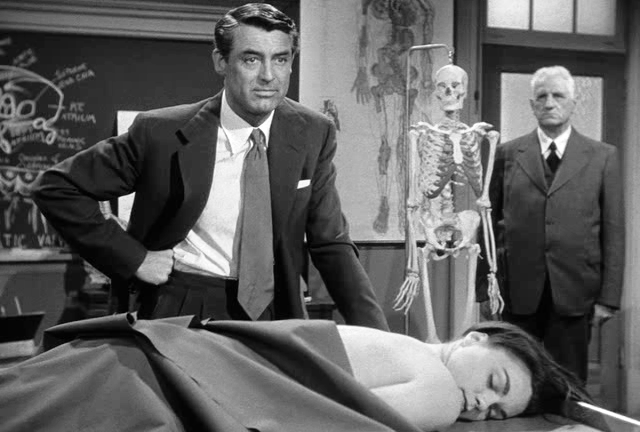 of the room where a corpse lies under a sheet. "I would be quite unable to give the lecture you came to hear and I'm not sure you should hear the lecture I'd like to give," Praetorius tells the students who all clamor, fearful he's going to leave without saying anything. Obviously, the doctor's reputation has made him a figure of fascination among the aspiring physicians and they'd be willing to hear him talk about anything. He asks them to get out their notebooks and uncovers the body, which turns out to be that of a very young woman. He gingerly strokes her long brown hair as he explains to the class, "Anatomy is more or less the study of the human body. The human body is not necessarily the human being. Here lies a cadaver. The fact that she was, not long ago, a living, warm, lovely young girl is of little consequence in this classroom. You will not be required to dissect and examine the love that was in her — or the hate. All the hope, despair, memories and desires that motivated every moment of her existence. They ceased to exist when she ceased to exist. Instead, for weeks and months to come, you will dissect, examine and identify her organs, bones,
 muscles, tissues and so on, one by one. These you will faithfully record in your notebooks and when the notebooks are filled, you will know all about this cadaver that the medical profession requires you to know." Following the doctor's introduction, a young lady (Jeanne Crain, one of the wives in Mankiewicz's A Letter to Three Wives) sitting among the students starts to flutter before she falls into the aisle. The students swarm her until Praetorius clears them away, saying, "A group of Cub Scouts would know better than to crowd like this." He asks if she's ever fainted before, but she says no. She says she's feeling better and the doctor gives her a piece of hard candy and asks another female student to escort her to the bathroom to splash some water on her face. Praetorius has grown impatient and decides to leave, bumping into Professor Elwell at the door. Elwell again apologizes for his delay. Praetorius says that Elwell wanted to ask him something about a tumor. "A malignant dysgerminoma," Elwell responds. "Professor Elwell, you are the only man I know who can say 'malignant' the way other people say 'Bingo!'" Praetorius tells his tardy colleague, unaware of Elwell's investigation into his past. The doctor and Shunderson leave with Praetorius' clinic as their destination.
At this point, a viewer still would be unclear where this story is heading, especially with the added presence of the large, mostly silent Shunderson usually near Praetorius' side. However, once we get to Praetorius' private
 clinic, which really functions more like a full-fledged hospital, the plot will start spinning in more directions. As I wrote earlier, I have no familiarity with the Curt Goetz play upon which it was based. Goetz began his career in Germany as a performer in silent films, including one directed by Ernst Lubitsch in 1918. He also began writing plays. In 1939, he went to Hollywood to try to get into filmmaking there, but got frustrated by the system and moved to Switzerland in 1945 (since he was Swiss by birth) and wrote some novels. His play Dr. Praetorius originally was written in Germany in 1934. The first English translation was called How to Die Laughing, was in seven acts and while it has some similarities to People Will Talk, the synopsis sounds quite different and even brings Sherlock Holmes and Dr. Watson into the tale. In 1949, Goetz co-directed with Karl Peter Gillmann a German-language version called Frauenarzt Dr. Prätorius that sounds exactly like People Will Talk, has Goetz himself playing the title role and is described as a "melodramatic comedy." That's probably as good a description as any of Mankiewicz's People Will Talk, which may be as idiosyncratic a film as he (or Cary Grant for that matter) ever made.
When we do get to the clinic, we do get more of a sense of what kind of doctor Noah Praetorius is and what the opening title cards meant when they said if he didn't exist, he should. If that were the case in the early 1950s, it's been multiplied exponentially by 2011. No sooner does he walk in the door that he starts getting hit by nurses and other staff with problems. One nurse informs him that a woman about to be discharged wants to take her gall bladder home with her. Praetorius finds that sweet and tells her to let her. The nurse says he knows they don't keep them after they are removed but the doctor guesses that the woman has no idea what her gall bladder looked like so just get another and "send her home happy." A bean counter talks to him about the costs of the hours for the kitchen staff and they should consider cutting back in terms of the patients' food. (That one is out of my life experience where one for-profit hospital I stayed at wanted to get their kitchen staff out early and served horrendous food out of a box for dinner.) Praetorius tells her that he has "the firm conviction that patients are sick people, not inmates." He then checks in on an older patient (Julia Dean) who doesn't look well and obviously is depressed about her condition.

PATIENT: I was thinking it's not much fun when you get old.
PRAETORIUS: It's even less fun if you don't get to be old.
PATIENT: I want to die.
PRAETORIUS: You'd like that, wouldn't you? Lie around in a coffin all day with nothing to do.
A nurse brings the good doctor a report on the final patient of the day and he asks her to show Mrs. Higgins into his office. She enters and it is the woman who fainted in class. Praetorius tells her the good news that
 there's absolutely nothing wrong with her and she can continue her studies, at least for a while. She confesses that she's not a medical student. She was just sitting in on the class to see him. Mrs. Higgins, who tells him to call her Deborah, shows signs of relief until Praetorius asks if she'll make a follow-up appointment or would she be getting her own obstetrician. Deborah breaks down, confusing the doctor, until he realizes that while she may be pregnant, he'd been mistaken to assume she was married. He inquires about the father, but she tells him that he's out of the picture. It seems he was called up to serve in Korea, which led to their coupling, and promptly got himself killed soon after arriving overseas. The doctor attempts to calm her, but Deborah isn't just worried about the shame unwed mothers faced at that time but she's convinced the news will kill her father. Praetorius tells her that parents can surprise you and be very understanding when you least expect it. Deborah insists her father is the most gentle, understanding man in the world, but his heart would be unable to take it.
After Praetorius has at least dammed the flow of Deborah's tears, she hastily exits. His receptionist returns and he asks if Deborah made another appointment but she informs her boss that she did not. The words have
 barely left her mouth when a shot is heard. Shunderson joins Praetorius in the hallway as does a nurse where they find a sprawled Deborah, derringer in hand. Miss Higgins is rushed into surgery and after much work, appears to be out of danger. Shunderson enters the operating room as Praetorius removes his surgical garb. "It's a good thing that most people don't have the foggiest notion where the heart is," the doctor says. "She missed it by a mile." Shunderson takes that to mean that her suicide attempt failed which Praetorius confirms. "Then she'll try again," Shunderson declares, giving Praetorius pause and a look of concern. At any rate, Miss Higgins will be out for awhile and Praetorius has an appointment to make. As if the doctor didn't have enough on his plate, he's also the conductor for the university's student-faculty orchestra and it's practice night.
Among the members of the orchestra is Praetorius' closest friend on the university's faculty — physics Professor Lyonel Barker (Walter Slezak) — who plays the bass violin in the orchestra, often to Praetorius' frustration. After the practice has finished, Barker asks Praetorius to stay behind because he needs to speak with him.
 Despite their playful bickering during rehearsal, Barker asks Noah if he considers him a trusted friend. Of course, Praetorius says. "Therefore I have the right to point out to you that there are occasions when you behave like a cephalic idiot," Barker tells him. He warns Praetorius that he's heard that Professor Elwell has been snooping around his past in the hopes of making a case with the university out of it. Praetorius doesn't seem concerned, but Barker admits that there are things about his past that even he doesn't know. Noah asks the physics professor if he told him everything there was to know about him, would it affect their friendship? Barker says not in the least. Noah pats Barker on the knee. "I know it's not much to have a friend who knows all about you but one who's afraid he's not quite sure, that's worth having," Praetorius smiles. He tells Barker not to worry, but he needs to drop by the clinic to check on a patient but tells his friend to drop by his house for a late supper when he returns from the clinic.

With Shunderson's words still echoing in his mind, Praetorius pays a visit to the recovering Deborah and tells her a whopper of a lie. He says they discovered that a lab error accidentally switched labels on two pregnancy tests being run at the same time and hers actually was negative while another woman's was positive. She therefore has no reason to be concerned. It still turns on the waterworks anyway. He asks her why she's crying now, but she says he wouldn't understand. He wishes her goodnight and tells her to rest because she has nothing to worry about now. When he gets home, he tells Barker what he did. The physics professor says he has to know that it's just a stall and she will learn the truth eventually. Noah says that he realizes that, but if he can ease her mind until perhaps he can talk to her father, things will be better. Barker's mind wanders off subject as he raves about how good the sauerkraut is, saying it reminds him of home. Praetorius lets him on his secret: He has his housekeeper make it. "Sauerkraut needs to come from a barrel, not a can," the doctor declares. He promises to send some home
 with Barker, but it's taken Praetorius' mind off subject as well to a pet peeve of his. He grabs a stick of paper-wrapped butter. "Our American mania for sterile packages has removed the flavor from most of our foods. Butter is no longer sold out of wooden buckets and a whole generation thinks butter tastes like paper," Praetorius complains. "There was never a perfume like an old-time grocery store. Now they smell like drug stores which don't even smell like drug stores even more." Before his tirade can go much further, the phone rings. It's the night matron at the clinic (Maude Wallace). It seems that Deborah has disappeared. She tells the doctor she doesn't know how she slipped out. Praetorius tells her that she probably walked past her and out the front door just as he did about an hour ago. When he hangs up, Barker guesses that the missing patient is the one that Noah lied to and now the doctor finds himself in a bit of a quandary.

Now as you probably can ascertain, as usually happens in films of this period and earlier, romance sparks insanely fast between Deborah and Noah, though to the film's credit you can't be certain at first if Praetorius truly has fallen for Deborah or if he simply proposes to her as a way of saving her reputation and rescuing her father Arthur (Sidney Blackmer) who lives under the thumb of his ultraconservative brother John (Will Wright) on his farm. Mr. Higgins describes himself as "an indifferent journalist, a minor poet, an ineffective teacher, a wretched businessman unable to provide for my wife and my child and then not even for my child" who ended up as his brother's dependent. In another classic Mankiewicz exchange after Praetorius has heard about all he can from Deborah's Uncle John, he and Deborah's father share this dialogue.
PRAETORIUS: How old were you when you learned to walk?
ARTHUR: I did pretty well by the time I was 4.
PRAETORIUS: When did you leave the farm?
ARTHUR: When I was 16.
PRAETORIUS: It couldn't have taken you 12 years to make up your mind.
We've got several plates spinning in the air now: A sudden marriage, a pregnant woman who doesn't know she's pregnant, a mysterious man, a professor secretly crusading against a popular doctor — no wonder if you peruse reviews written recently or when People Will Talk came out in 1951, many scratch their head because
 it doesn't fall into any standard formula. People criticize it for not being a good romance, but that's the weakest element and least interesting part of what's going on here. Praetorius admits to Deborah that he didn't marry her just to stop her from committing suicide and to save her reputation because that wouldn't be a very practical solution should a similar case arise. He can't marry all his patients. Deborah also finds the reality of the man once she lives with him and for his 42nd birthday buys him an elaborate toy train set which he sets up with her father running a line from one bedroom, Barker from another and Noah serving as chief conductor in another. Of course, there's a spectacular crash causing the three men to yell at each other and it coincides with the delivery of a message from Professor Elwell that the dean is assembling a hearing of faculty members to hear charges against Praetorius (set for the same night as the big orchestra concert no less). Deborah goes to their bedroom and collapses to the bed in tears. Noah assumes she's upset about the letter but she tells him, "It's just that I love you so much and I went and put all those candles on that cake when you're really only 9-years-old."
I think the reason People Will Talk confuses so many people comes down to three main factors: 1) Expectations for a Joe Mankiewicz film based on A Letter to Three Wives and All About Eve; 2) Expectations for a Cary Grant movie; and 3) Viewers lumping their own ideological baggage onto the film. With his two previous films, Mankiewicz truly established himself as a master of sharp, witty dialogue and that's present again in People Will Talk, only it doesn't always take the form of comedy. He has some points
 to make and I think that makes some feel uneasy, especially since the opening scene between Hume Cronyn and Margaret Hamilton sets the audience up to expect another pure comedy is on the way. When we switch to the anatomy class, though there are laughs to be found, he's subtly switching the tone to be more multi-faceted, particularly when he speaks of the cadaver's former life. By the time we get to the clinic, he's driven the point home that different approaches to medicine are what he's after here. It shouldn't have been a surprise: That's why I used the screenshots of those two title cards that start the film to start the post. There was a third, praising doctors in general, but given some of the doctors I've run across in my hellish journey through the health care system, that title card reads as hopelessly out of date because while there are good doctors today there also are a lot of greedy and incompetent bastards who don't give a shit as well. People Will Talk often is called ahead of its time because of its treatment of Deborah's out-of-wedlock pregnancy, but what really makes the film prophetic is how it pits Dr. Praetorius' commitment to healing the patient as the priority above everything else while doctors such as Professor Elwell want less to do with them and accountants try to cut costs on things such as food service for hospitals. This was made 60 years ago and it's only worse now. Imagine if the issues of billing and health insurance came into play.
By 1951, Cary Grant had been a star for a long time so most moviegoers had come to expect a certain type of role from him. Whether it be a fast-talking smoothie in a screwball comedy such as His Girl Friday, a more
 refined romancer in The Philadelphia Story, an adventurer in Gunga Din, a serious romantic with a mission that takes precedence in Notorious or even a fretful father in the weepy Penny Serenade, he always seemed to be in charge or at least care about the outcome. The only possible exception would be Bringing Up Baby where he's at Katharine Hepburn's mercy. As Praetorius, he certainly goes above and beyond when it comes to caring about his patients, but he plays the doctor at a distance from the audience, something quite unusual for him, and Praetorius seems indifferent to the investigation by Elwell. The real switch, which really I can only think of happening in Baby, is that Deborah figures out rather quickly what he's up to when he pursues her at the farm and she starts stalking him around the dairy. It's unusual to see Cary Grant be the prey and it’s to Jeanne Crain’s credit that she makes Deborah’s transition believable. Grant gave a lot of great performances and is one of Oscar's biggest crimes that he only was nominated twice, both for tear jerkers. While I love Walter Burns, I have to admit that Dr. Noah Praetorius might be the best work he ever did on film.
Now little can be done to control what people think they see in things. We live in a world where TV preachers thought certain Teletubbies were gay for crying out loud. Admittedly, the film does have some unmistakably liberal viewpoints, particularly in the scenes where Uncle John spouts his views at the farm, but I think far too
 many people mistake Professor Elwell's campaign against Praetorius as some sort of metaphor for McCarthyism. (This was based on a play originally written in Germany in 1934 after all.) People Will Talk's only concern is comparing medical philosophies. Elwell's only interested in one admittedly unusual faculty member who has an odd friend who always stands by his side. I won't give away the details of the hearing because I want more people to see this movie. It's not a perfect movie and it's certainly no All About Eve, but I think it's better than A Letter to Three Wives and I like that film a lot. The performances across the board are great and that sparkling Mankiewicz dialogue is as quotable as ever. Time and again I'm amazed how many early films addressed problems with our health care system in different ways such as 1931's Night Nurse and Mankiewicz's own No Way Out the year before, even though racism was its bigger issue. The Brits even exposed their own failings in 1938's The Citadel before they reformed their system. We in the U.S. should be ashamed. I think one great quote that Praetorius delivers during his hearing proves particularly prescient.
"The issue is whether the practice of medicine will become more intimately involved with the human being it treats or whether it is to continue to go on in its present way to become more and more a thing of pills, serums and knives until it eventually will undoubtedly evolve an electronic doctor."
Honestly, given some of the M.D.s I've encountered, I'm not so sure an electronic doctor would be worse. I do know though that what makes me like People Will Talk more each time I see it falls along the same lines as many new films that captivate me: They dare to be different and to eschew formula while employing talented casts to tell unusual stories well.
Tweet
Labels: 50s, Cary, Cronyn, John Ford, K. Hepburn, Lubitsch, Mankiewicz, Movie Tributes, Oscars, Poitier, Widmark
TO READ ON, CLICK HERE


