Sunday, December 01, 2013
Treme No. 32: Yes We Can Can, Part I
BLOGGER'S NOTE: This recap contains spoilers, so if you haven't seen the episode yet, move along. Unfortunately, another hospitalization put the final nail in me finishing this first recap on time and places the remaining recaps in doubt and jeopardy.

As we return to our friends in New Orleans more than a year after we last looked in our their lives, it happens to be Election Day 2008, and we see the familiar trappings of any campaign — signs stacked on top of one another, long lines of citizens eager to perform their civic duty, poll workers taking their seats, ballot boxes being unlocked and set up and, finally, the actual process of voting taking place. During this montage, we catch our first sightings of
 characters we know. Desiree (Phyllis Montana-Leblanc) watches news reports of the expectations of a historic day while Honoré plays at her mother’s feet. Toni and Sofia Bernette (Melissa Leo, India Ennenga) stand in line together, awaiting the college freshman’s first chance to vote in a presidential election. Playing throughout this section of the premiere’s opening, we hear “Every Man a King,” the campaign song used by Louisiana’s legendary Huey Long and currently being spun by DJ Davis McAlary (Steve Zahn) on WWOZ. As the tune ends, McAlary explains the station’s theme that day aims to play songs of political import. “The polls have indeed opened in our politically calcified and corrupt state and remember, if you want your vote to matter, the question is 'What are you doing here?' To paraphrase the great Lafcadio Hearn, better to vote once in Ohio in sackcloth and ashes than 10 times in every parish in Louisiana,” Davis tells his listeners, before switching to Allen Touissant’s own version of the song which gives this episode its title, “Yes We Can Can,” a song Touissant originally wrote as “Yes We Can” for Lee Dorsey in 1970, but which added the extra "Can" when it became a 1973 funk hit for The Pointer Sisters. (I swore I did try to avoid going overboard on the background, but I imagine I'll let up as outside forces close in on the time needed for even bare-bones recaps.)
 As Toussaint’s “Yes We Can Can” glides us from WWOZ to the Lambreaux residence, Albert (Clarke Peters) sews in his driveway, mystifying his children Delmond and Davina (Rob Brown, Edwina Findley) that he lacks interest in joining their trip to the polls. Del emphasizes that the chance to vote for a black man for president might not come again soon, but his father stoically replies, “You really think that’s going to change some shit?” Though the last time we saw the big chief, chemo had left him bald. Now, his hair has returned and he’s regrown his mustache. After voting, Antoine Batiste (Wendell Pierce) and Desiree come upon a musical garden party of sorts, where John Boutté sings Sam Cooke’s classic “A Change Is Gonna Come.” Sonny (Michiel Huisman) drops Linh and her father Tran (Hong Chau, Lee Nguyen) off to vote, but Tran questions why he isn’t coming in order to tell his wife how to vote. Sonny
 explains he isn’t a citizen, so Tran says he’ll tell Linh what to do this time. Tran plans to vote for McCain. “Democrats in Vietnam — they quit, give up. Republicans for me, always,” Tran says. Sonny shrugs to his wife and asks, “McCain?” Linh just grins and replies, “Father knows best.” When Antoine asks James Andrews who’s paying him for the gig with Boutté, he tells Batiste that all the gathered musicians are working for free. Antoine decides to go home and retrieve his bone. While Albert expressed disinterest to his children, he sits on his couch and watches the television reports of the long lines that began early on this Election Day. Once Antoine has joined Boutté and the other musicians, they burst forth with “Glory Glory Hallelujah.” When no one watches, Albert himself turns up at a polling station. As the day turns into night, the celebratory atmosphere intensifies as Toni and Sofia join an Obama rally outside Kermit Ruffins’ Sidney’s Saloon, also attended by Antoine and Desiree and presided over by Ruffins himself, where all watch Barack Obama’s acceptance speech from Chicago. “That’s your president, baby,” Antoine tells Honoré. “He looks just like you.” Back at home, Albert again watches alone, still with an uncertain sadness about him. Ruffins blows his trumpet and makes his ways through the crowd shouting, “Yes we can” repeatedly until he gets to the middle of St. Bernard Avenue alone, clear of the crowd, and sees the flashing lights of police cars in the distance. Some things remain the same. The entire opening sequence of the premiere (written by David Simon & Eric Overmyer & George Pelecanos, directed by Anthony Hemingway) runs for nearly seven minutes. It’s a beautiful sight to behold and a great beginning to our final hours with our friends in Treme.
Following the credit sequence, we slowly pan from a group of chickens gathered behind the back of a small gray station wagon until we see the vehicle’s door ajar while two roosters near the door seem to be attempting to converse with Davis on his knees in front of his mode of transportation, taken out by a very large pothole. McAlary, in a moment that could be lifted from a Werner Herzog film, unemotionally says, “Fuck you” to the fowl as if they mocked his misfortune.(In the early years of Treme, I felt Zahn received undue criticism for his portrayal of Davis McAlary, many seeing him as little more than a caricature, but I’ve never thought that to be the case. Perhaps part of my defense stems from being an early fan of Zahn’s work both on stage and in films, but the Davis detractors give neither the character nor the actor who inhabits him the credit each deserves or recognize McAlary’s many layers of emotional depth and serious intent when it comes to the musical heritage of New Orleans. Davis McAlary as a whole exists neither as a cartoon nor a buffoon. Now that I recall, Herzog directed Zahn in Rescue Dawn, the feature version of Herzog’s documentary Little Dieter Needs to Fly.) Meanwhile, it appears that last season’s tensions between Tim Feeny (Sam Robards) and Janette Desautel (Kim Dickens) reached a boiling point and Janette no longer works at the restaurant which continues to operate using her name, Desautel’s on the Avenue. Not one to give up, Janette currently paints her own sign for a new restaurant she’s about to open on Dauphine Street at Louisa Street in the Bywater area of New Orleans. Only selecting a name for her new eatery stumps Janette. Her sous chef (and lover when last we saw them) Jacques Jhoni (Ntare Guma Mbaho Mwine) suggests she call it Desautel’s, the only word she’s completed on the sign, but Janette nixes that since it was the name of her first restaurant. She floats the idea of Desautel’s on the Bywater, but Jacques says it summons the image of byproducts and might not be an appetizing image. For now, Janette remains stuck, but Davis’ vehicle does not as a tow truck comes to its rescue, if not McAlary’s. Once the station wagon leaves the scene, the viewer truly realizes what a monster the pothole that ensnared its front wheel is. It must be at least three feet wide, if not more, and who knows how deep, judging by the pooled water flooding to its surface. Davis yells in vain as the tow truck driver vanishes down the road about what should be done about the gaping hole. With no response forthcoming, McAlary surveys the surroundings. We leave New Orleans for a moment to check in on Nelson Hidalgo (Jon Seda), back home in Texas, Galveston to be precise, with his cousin Arnie (Jeffrey Carisalez) in tow, looking for new projects in the wake of Hurricane Ike. Hidalgo also busies himself cursing at not getting through to one of his brokers, telling Arnie that the elusive man has “Five mil of mine under this guy’s ass and I can’t get him on the phone like he’s just some discount broker? What the fuck is that?” Nelson meets with two businessmen, Jimmy Staunton and Doug McCreary (Patrick Kirton, John Niesler), about getting involved in the demolition game in Texas. McCreary asks how big a slice Hidalgo might like and Nelson tells him he already has 15 crews ready to work and can get more if needed. “You didn’t like New Orleans much?” McCreary inquires. “Work was good, but I’m home now and damn glad to be back in the Lone Star State, believe you me,” Nelson replies. Staunton declares that if Nelson is tight with Bobby (a reference to a character named Bobby Don Baxter, a Texas demolition baron that Nelson enlisted to help tear down the Lafitte Projects in Season 3), he’s tight with Staunton. However, in order to get the contracts, Nelson must use the Houston bank that McCreary happens to own. Back in the Crescent City, it first appears as if Davis plans to repair the pothole himself as he wheels a shopping cart out to it filled with buckets and what appear to be supplies. Instead, he uses the cart, buckets and various other tools to create an almost modern art sculpture tall enough to warn motorists and to cover the road hazard. “My work here is done,” Davis proclaims as he walks away. (This section of the episode — and you could include the Galveston scene I’m about to recap as part of it as well — cuts from one short scene to the next in ways that often proved disruptive in many Season 2 episodes but, as in Season 3, they’ve fixed that flow problem so it doesn’t feel as if the viewer constantly hits a road bump for no good reason. They don’t have an underlying connection as the magnificent collection of short scenes in this episode’s pre-credit sequence does, but that segment had Election Day to serve as the cake for which those disconnected moments could be frosted into confectionery perfection, giving us one of the greatest openings of a Treme episode ever in the first of its final five. However, even when they don’t feel superfluous, because of health difficulties and other interruptions that barely allowed me to post this first recap on time and put the timeliness of the remaining four in question, I will be leaving many scenes I deem of lesser importance out of these pieces entirely.)
Back in Galveston, Nelson's broker finally returns his call and gets an earful from Hidalgo as to why he hasn't sold his stocks yet. "We are shedding like a thousand points on the Dow in the two days since the election. I can't take anymore," a more subdued Nelson tells his broker on the other end of the line before erupting again, "Get me out of this fuckin' market now!" As Nelson pockets his phone, he joins Arnie at a food stand selling Tex-Mex cuisine where Arnie and Nelson's lunch orders wait on the counter. "What do you think happened?" Arnie asks. "It's Obama, I guess," the erstwhile Republican Hidalgo speculates. "Wall Street doesn't like the guy or something, but this shit started two months ago when they let Lehman Brothers go under," Nelson declares, pointing at his cousin for emphasis. Arnie asks how much of a hit Nelson has taken so far from the economic collapse. "Between yesterday and today, what I lost about two months ago — about a million four and climbing," Hidalgo replies. "Don't worry. These are on me," Arnie reassures his cousin about paying for lunch. A somewhat clumsy instrumental version of the children’s gospel classic “This Little Light of Mine” (composed by Harry Dixon Loes around 1920 and recorded in numerous styles and genres with its lyrics.) plays us out of Galveston and into the Theophile Jones Elie band room. Antoine circles the young teens before urging his budding musicians to stop,
 telling them that the notes emanating from their instruments are "cacophonous — from the Greek word caca." Antoine asks the kids why they aren't coming prepared as they'd discussed and one replies that they are trying. "Not hard enough," Mr. Batiste tells his class. One of the students, Markell (Markell Henderson), admits to missing the former lead instructor, Mr. LeCoeur, who left for a post at a New Orleans high school. Antoine tells the band that LeCoeur isn't coming back and the students have him as their instructor year-round now. As Batiste lectures the kids about coming to class "correct," Cherise (Camryn Jackson) disassembles her saxophone, places it in its case and prepares to leave. Antoine inquires about her destination and Cherise tells him that she has to pick up her little brother, though Jennifer (Jazz Henry) teases that Cherise plans to hook up with her boyfriend. The bell rings for the day, so most everyone exits anyway. Antoine shakes his head and mutters to himself about someone as young as Cherise already having a boyfriend. Then he notices Robert (Jaron Williams) still sitting in his desk, staring down and shaking. Antoine asks Robert what's wrong because he knows it couldn't have been him playing that horn. "It hurts, Mister Batiste," Robert replies, indicating his groin area as his trumpet bounces up and down off his jittery legs. Antoine asks the boy if he's been "pulling on it" and his student offers the additional information that "it burns when I pee. It's sticky down there." Pierce delivers a great empathetic cringe once he realizes what afflicts one of his best students. Antoine inquires as to whether Robert has had sex and the prodigy once nick-named Bear tells of one girl in his neighborhood and "she's been bothering me." Antoine sighs, "They all do." He learns, to no great surprise, that Robert lacks both a family doctor or any kind of health insurance. "Gather your things, boy — your horn, too," Batiste tells his student as he puts his coat and cap on, a grin of wistful STD-related nostalgia crossing his face. (As has been the case throughout Treme’s run, Pierce’s portrayal of Antoine remains the series’ heart and soul. Pierce finds new ways to make Antoine funny and serious, often simultaneously, and reveals new sides to Batiste each season. The show manages to give most members of its ensemble cast moments to shine, but I can’t remember a wasted moment involving Pierce.)
We’ve already witnessed changes in several characters’ lives: Janette working on another new restaurant; Nelson feeling the financial impact of the 2008 Wall Street collapse and Antoine becoming the year-round, lead instructor for young band students. The biggest upheaval though may have happened in the life of LaDonna Batiste-Williams (Khandi Alexander). LaDonna and Larry have separated and LaDonna visits with Alcide and Randall (Renwick Scott, Sean-Michael Bruno), her sons by Antoine, on the porch of Larry’s Mid-City home. She asks if the teens if their stepdad treats them well and they tell their mom that Larry even has improved as a cook, though they have breakfast for dinner a lot. “Larry’s a good man and he loves you two like you’re his own,” LaDonna tells the boys, though the oldest, Alcide, immediately fires back with the question, “Then why did you leave?” LaDonna tries to explain to the adolescents that sometimes things
 just don’t work out between people, but she promises the three of them will be together again soon — though she emphasizes that the reunion won’t occur in the house that holds the porch on which they currently sit. Alcide remains skeptical, having heard LaDonna’s promises before, but she insists that once she gets the bar up and running again that she’ll find a home for the three of them. “You finish the school year out here. It’s what’s best for you,” she tells her hardened oldest son. “Until things sort themselves out.” Alcide looks decidedly unconvinced and unmoved while Randall lets LaDonna cradle him in her arms on the porch swing. Antoine reunites unexpectedly with a former member of his Soul Apostles when he finds Sonny working part-time at The New Orleans Musicians’ Clinic that helps professional musicians who catch the sort of STDs that young Robert has. Sonny tells Antoine that he took this part-time job and does some gigs out of fear he’ll spend so much time on his father-in-law’s fishing boat that he’ll speak Vietnamese better than he does. Unfortunately, the clinic can’t help Robert since he not only isn’t a professional musician, but hasn’t reached the age of 15 yet, though Sonny says The Daughters of Charity at Ochsner will help him. “Fourteen and already burned, huh?” Sonny comments. “Yep. The kid’s a prodigy in more ways than one,” Antoine adds before sharing the hardest aspect about being a New Orleans musician to Sonny: “Having to explain to your girlfriend why she has to take penicillin for your kidney infection. The former bandmates erupt in hearty laughter. Even young Robert grins, though that prompts Batiste to swat him and ask, “What you laughing at, boy?”
Tweet
Labels: Clarke Peters, David Simon, HBO, Herzog, Kim Dickens, Melissa Leo, Overmyer, Treme, TV Recap, Wendell Pierce, Zahn
TO READ ON, CLICK HERE


Friday, August 03, 2012
Edward Copeland's Top 100 of 2012 (100-81)
With the release of the latest Sight & Sound poll, conducted every 10 years to determine the all-time best films, The House Next Door blog of Slant Magazine invited some of us not lucky enough to contribute to the S&S list to submit our own Top 10s to The House, which posted mine today. Sight & Sound magazine, a publication of the British Film Institute, began its survey in 1952, using only critics. Its 2002 list boasted its largest sample yet, receiving ballots from 145 film critics, writers and scholars as well as 108 directors. The results can be found here, though a note claims the page isn't actively maintained, though it appears complete to me. Since I planned to revise my personal Top 10, posted as part of my Top 100 in 2007, I figured I owed it to my entire Top 100 to redo my entire list. As before, my rule is simple: A film must be at least 10 years old to appear on my list. Therefore, movies released between 1998 and 2002 might appear on this list whereas they couldn't on the 2007 version. The most difficult part of assembling these lists always involves determining rankings. It's an arbitrary process and once you get past the Top 10 or 20, not only do the placements seem rather meaningless but inclusion and exclusions of films begin to weigh on you. In fact, selecting No. 1 remains easy but if I could, I'd have tied Numbers 2 through 20 or so at No. 2. A lot of great films didn't make this 100 through no fault of their own, falling victim to my whim at the moment I made the decision of what made the cut and where it went. In parentheses after a director's name, you'll find a film's 2007 rank or, if it's new to the list, you'll see NR for not ranked or NE for not eligible. I also should note that this does not mean the return of this blog. I had committed to taking part in The House's feature prior to pulling the plug and completed most of this before signing off.

Part of the arbitrary nature of this list (and from the very first all-time 10-best list I compiled in high school) was to try to make sure I represented my favorite directors while still allowing for those films that might be a more singular achievement. (For example, my first high school list had to be sure to include a Woody Allen, a Huston, a Hitchcock, a Wilder, a Truffaut, an Altman.) The more great cinema you see, the harder it becomes to justify that since lots of directors deserve recognition and many films might be a filmmaker's strongest work. As I've caught up with a lot of Werner Herzog's work over the years, I felt he'd earned inclusion. I was torn between choosing Nosferatu or Aguirre: The Wrath of God to represent him, but opted for the vampire tale because Herzog's "reversioning" of Murnau's silent classic manages to be both a masterpiece of atmospherics and the best version of the Dracula tale put on screen.
Pedro Almodóvar’s career evolution has taken an arc that I imagine few could have anticipated. I know I certainly didn’t back in the 1980s, when his films mainly consisted of camp, color and sexual obsession. Around the time of 1997’s Live Flesh, the Spanish filmmaker’s style took an abrupt change, filtering genres through his unique perspective to exhilarating results that continue through last year’s The Skin I Live In. The greatest of this run of seven features happens to be the most recent film to make this new Top 100 list. Telling the story of two men caring for women they love, both of whom happen to be comatose, Almodóvar’s Oscar-winning screenplay manages to balance humor, pathos and even outlandish touches you’d never expect to make one helluva movie and the writer-director’s best film so far.
Littered along the highways of film history lie multiple tales of adversity breeding triumphs of cinema. As director Jules Dassin faced a possible subpoena from the House Un-American Activities Committee, presumably followed by blacklisting, at the end of the 1940s, producer Darryl Zanuck gave him an exit strategy. Dassin flew to London to hurriedly begin filming an adaptation of the novel Night and the City, which he’d never read, and as a result produced one of the greatest noirs of all time. Not only did he make the movie on the fly, Zanuck even stuck him with creating a role for Gene Tierney, nearly suicidal after a bad love affair. The novel’s author, Gerald Kersh, hated the movie about hustler Harry Fabian (Richard Widmark) scheming to bring Greco-Roman wrestling to London while ducking all sorts of colorful characters played by wonderful actors such as Francis L. Sullivan, Googie Withers, Herbert Lom, Hugh Marlowe and Mike Mazurki. Of course, Kersh’s gripe was understandable — the film bore no resemblance whatsoever to his novel other than the title. However, that didn’t prevent it from being a damn fine film.
It takes a lot to fool me and, in retrospect, I should have seen the final twist coming, but I didn't because Sayles crafted in his best film a compelling story in which the plot turn was unexpected and the movie’s story didn't hinge on it. Even if the secret never had been revealed, this portrait of skeletons from the past and their influence on the lives of people in the present still would resonate. Sayles assembles a helluva ensemble including Chris Cooper, Elizabeth Peña, Matthew McConaughey, Kris Kristofferson, Joe Morton and, in one great single scene, Frances McDormand, to name but a few. Sayles has made some good films since Lone Star, but none come close to equaling the artistry, vitality and humanity of this one. I await another great one from him.
Set piece after set piece, Hitchcock puts Cary Grant through the paces and pulls the viewer along to his most purely entertaining offering. Grant never loses his cool as he's hunted by everyone, James Mason makes a suave bad guy and Martin Landau a perfectly sinister hired thug. With cameos by four former U.S. presidents. There's not much else to say about it: It's not an exercise in style or filled with layers and depth, it's just damn fun. In fact, it’s as much a comedy as a thriller.

There's something to be said for quitting while you're ahead and Charles Laughton, one of the finest screen actors ever, certainly did with the only film he ever directed. The film's influences seem more prevalent than people who have actually seen this disturbing thriller with the great Robert Mitchum as the creepy preacher with love on one hand and hate on the other and the legendary Lillian Gish as the equivalent of the old woman who lived in a shoe, assuming the old woman was well armed.
In describing the film that put Kurosawa on the world’s radar as a major filmmaker, I’m going to let Robert Altman speak for me. This quote comes from his introduction to the Criterion Collection edition of the movie. "Rashomon is the most interesting, for me, of Kurosawa's films.…The main thing here is that when one sees a film you see the characters on screen.…You see very specific things — you see a tree, you see a sword — so one takes that as truth, but in this film, you take it as truth and then you find out it's not necessarily true and you see these various versions of the episode that has taken place that these people are talking about. You're never told which is true and which isn't true which leads you to the proper conclusion that it's all true and none of it's true. It becomes a poem and it cracks this visual thing that we have in our minds that if we see it, it must be a fact. In reading, in radio — where you don't have these specific visuals — your mind is making them up. What my mind makes up and what your mind makes up…is never the same."
For years, my standard response when asked about Raging Bull was that it was a film easier to admire than love. Each time that I’d see the movie again though, that point-of-view became less satisfactory because, as any great film should, the film kept rising higher in my esteem. In the film's opening moments, when Robert De Niro plays the older, fat Jake preparing for his lounge act in 1964 before it cuts to the ripped fighter in 1941, even though I consciously know both versions of La Motta were played by the same actor and that De Niro was that actor, the performance so entrances that I actually ask, "Who is this guy and why hasn't he made more movies?" To gaze at the way he sculpted his body into the shape of a believable middleweight boxer, sweat glistening in Michael Chapman's gorgeous black-and-white cinematography, truly makes an impressive achievement. Acting isn't the proper word for what De Niro does here. He doesn't portray Jake La Motta, he becomes Jake La Motta, or at least the screen version, and leaves all vestiges of Robert De Niro somewhere else. Even when De Niro turns in good or great work in other roles, they never come as close to complete immersion as his La Motta does.
"Out of the worst crime novels I have ever read, Jules Dassin has made the best crime film I've ever seen," François Truffaut wrote about Rififi in his book The Films in My Life. I haven't read the Auguste Le Breton novel, but I don't doubt Truffaut's word. Dassin structures the film like a solid three-act play. Act I: Planning the heist. Act II: Carrying it out. Act III: The aftermath. Dassin fine-tunes each of the film's element to the point that Rififi practically runs as a machine all its own. The various characters behave more as chess pieces to be moved around as the story's game requires than as representatives of people. One single sequence though makes Rififi a landmark both in films and particularly heist movies: the robbery itself. Dassin films this in a 32-minute long silent sequence. No one speaks. Keeping everything as quiet as possible becomes the thieves' No. 1 priority. It's absolutely riveting. You'll be holding your breath as if you were involved in the crime yourself.
Howard Hawks appears for the first time on the list with a Western starring John Wayne that turned out to be so much fun they remade it (more or less) seven years later as El Dorado. I’ll stick with the original where the Duke’s allies include a great Dean Martin as a soused deputy sheriff, young Ricky Nelson and the always wily Walter Brennan. Wayne even gets to romance Angie Dickinson. No deep themes hidden here, though it's more layered than your typical Western. Still, that doesn't mean you can't kick up your spurs and enjoy.
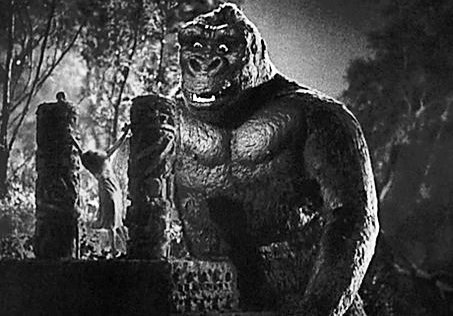
The first time was the charm. One of the few insightful comments I heard on the 2007 AFI special was when Martin Scorsese said that in many ways he finds the primitive stop-motion effects of the original King Kong more impressive than later CGI versions. He's absolutely right. The 1933 version also offers more thrills and emotions (and in half the time) than Peter Jackson's technically superior but dramatically inferior and unnecessary remake. Let’s not even discuss the 1976 version.
When L.A. Confidential debuted on this list in its first year of eligibility in 2007, I wrote, “Of the films of fairly recent vintage, this is one that grows stronger each time I see it, earning comparisons to the great Chinatown…Well acted (even if Kim Basinger's Oscar was beyond generous), well written and well directed, I believe L.A. Confidential’s reputation will only grow greater as the years go on — yet it lost the Oscar (and a spot on the AFI list) to the insipid Titanic.” When I re-watched the film recently, my prediction proved to be spot-on as it only deepens as an experience and an entertainment as time passes. It still boggles my mind that with Russell Crowe, Guy Pearce, Kevin Spacey and James Cromwell (just to name four) delivering impeccable work that only Basinger landed a nomination, but losing best picture and director to James Cameron and Titanic remains the bigger crime.
Simply put: The tensest comedy ever made and perhaps Scorsese's most underrated film. Griffin Dunne plays the perfect beleaguered straight man enveloped by a universe of misfits and oddballs in lower Manhattan when all he wanted to do was get laid. It’s hard to imagine that this movie nearly became a Tim Burton project, but thanks to the many setbacks Scorsese endured attempting to make The Last Temptation of Christ, the film ended up being his — and recharged his batteries as well. While Scorsese has made great films since, I’d love to see him step back sometime and make another indie feature like After Hours on the fly just to see what happens. Joseph Minion wrote an excellent script and this represents one case where I think the changed ending actually proves superior to the originally intended one. By the way, whatever happened to Joseph Minion?
Watchability often gets undervalued when rating a film's worth, but I never tire of sitting through this thrill ride. One aspect that has impressed me since I first saw it as a teen back in 1985 (and I went two nights in a row, dragging my parents to it on the second) was its attention to detail such as Marty arriving in 1955 and mowing down a pine tree on the farm of the deranged man trying to “breed pines.” Then, when he returns to 1985, Twin Pines Mall now bears the sign Lone Pine Mall. It’s just a quiet sight gag in the background without any overt attempt to call attention to the joke. You either catch it or you don’t. I always admire films that respect audiences like that, especially when they happen to be this much fun. With equal touches of satire, suspense and genuine emotion, Back to the Future elicits pure joy. No matter how many times I see it, the final sequence where they prepare to send Marty back to 1985 holds me in rapt attention as I wonder if this time might be the time he doesn't actually make it.
A comedy about the Vietnam War that's full of blood and set in Korea, just as a matter of subterfuge. The film that put Altman on the map and inspired one of TV's best comedies (until it got too full of itself), MASH still holds up with its brilliant ensemble and wicked wit. I still wish the TV show had kept that theme song with its lyrics. Through early morning fog I see/visions of the things to be/the pains that are withheld for me/I realize and I can see.../That suicide is painless/It brings on many changes/and I can take or leave it if I please.

Back in 1985, before Goodfellas and The Sopranos really mixed mob stories with jet black comedy, the great director John Huston, in his second-to-last film, brought to the screen an adaptation of Richard Condon's Mafia satire Prizzi's Honor, complete with great performances and some of the most memorable lines ever collected in a single film. Huston may have been in the twilight of his days, but his filmmaking prowess was as strong as ever. Jack Nicholson disappeared into the role of Charley Partanna more than he had any role in recent memory. Kathleen Turner matched well with Nicholson as Charley's love whose work outside the house causes problems. William Hickey gave an eccentric and indelible portrait of the aging don. Finally, John's daughter Anjelica made up for a misfire of an acting debut decades earlier with her brilliant performance as the scheming Maerose and took home one of the most deserved supporting actress Oscars ever given.
Before Zhang Yimou started being obsessed with spectacle and martial arts, film after film, he produced some of the greatest personal stories in the history of movies, especially when his muse was the great and beautiful Gong Li. This film was their first truly flawless effort as Gong plays the young bride of a powerful lord who already has multiple wives and who encourages the sometimes brutal competition between the women.
"The film actually is like a snail — it kind of turns in on itself and becomes itself," Altman describes his film in an interview on its DVD. One of the many "comebacks" of Robert Altman's career, this brilliant Hollywood satire holds up viewing after viewing because it's so much more than merely a satire. Thanks to Tim Robbins' superb performance as the sympathetic heel of a Hollywood executive and the cynical yet deeper emotional punch of Michael Tolkin's script, Altman wows from the opening eight-minute take to one of the greatest final punchlines in movie history. However, the more times you see it, the more you discover to see. While some specific references have aged, the movie's relevance remains — now more than ever.
Schindler’s List marked an important moment in Spielberg’s development as a filmmaker: Peter Pan finally grew up. It’s a harrowing, well-made movie that everyone should see. At the same time, I can foresee a time when it slips off this list entirely. It isn’t the fault of the film — I find it nearly flawless. However, if someone placed a gun to my head and ordered me to choose to watch either Schindler’s or one of Spielberg’s best post-1993 films such as Catch Me If You Can or Minority Report, I’d opt for one of the latter two. Are they better films than Schindler’s List? I can’t say that. However, the epic holocaust tale isn’t a film you find yourself wanting to pop a bowl of popcorn and watching on a whim. As I said earlier, for me at least, rewatchability remains an important factor. I’ve seen Schindler’s List three times but I haven’t reached the point where I want to go through that wrenching experience again.
Bergman once said that by the time he was done making Wild Strawberries, the film really belonged more to Victor Sjöström, who played Borg, the renowned professor and lauded physician about to receive an honorary degree. The film marked Sjöström 's return from semi-retirement, but he already was a legend as the first true Swedish acting-directing star. Borg decides to drive his old Packard to the event instead of flying to meet his son. The journey becomes more than just a road trip for the professor, but a metaphysical trek through his past as he questions what led him to this moment. As the car winds closer to the ceremony, Borg's inner journey does as well as he comes to realize that for all his scientific training, the only thing he can't analyze is himself. "The day's clear reality dissolves into even clearer remnants of memory," he says. Wild Strawberries represents Bergman growing into his powers as a filmmaker and while it may concern a 78-year-old man examining his life, the subject proves as timeless for people of any age as the film itself.
Tweet
Labels: Almodóvar, Altman, D. Zanuck, Dassin, Hawks, Herzog, Hitchcock, Huston, Ingmar Bergman, Kurosawa, Laughton, Lists, Murnau, Sayles, Scorsese, Spielberg, Tim Burton, Truffaut, Zemeckis, Zhang Yimou
TO READ ON, CLICK HERE
Friday, February 17, 2012
There is no point. That's the point.

By Edward Copeland
Tilda Swinton amazes. Each year, she delivers an incredible performance in a film that, in the hands of a Harvey Weinstein or experienced studio marketing team, would most assuredly land her in the best actress Oscar field. Granted, Swinton won an Oscar in the supporting category for Michael Clayton, but she's missed the cut three years running for Julia, I Am Love and now We Need to Talk About Kevin. The big difference this year is that I believe more saw We Need to Talk About Kevin than the two previous films since Swinton won several critic awards and was nominated for both the Golden Globe and Screen Actors Guild awards. Academy voters tend to skew more conservatively and I suspect they couldn't bring themselves to mark their ballots for a performance in a film so distinctly bizarre.
Directed by Lynne Ramsay from a screenplay she and Rory Kinnear adapted from the novel by Lionel Shriver, We Need to Talk About Kevin tells, in a very disjointed fashion, the story of Eva (Swinton), an artist by trade, suburban wife and mother by choice, attempting to come to grips with her guilt over the wreckage caused by her son, Kevin. The movie isn't told in a linear direction, perhaps in an attempt to surprise the audience by dropping out-of-sequence clues like breadcrumbs left to mark a meandering path back out of the woods. However, given the title, the visuals and snippets of scenes that obviously come after the incident happened, it should be clear what kind of horror took place, if only in the abstract and not the specific. The trailer and discussion of the movie pretty well gives it away anyway, so fretting about spoilers seems pointless. However, if you don't know what occurs in We Need to Talk About Kevin, plan to see the film and suspect foreknowledge could ruin that experience, just cease reading this now.
When I described the movie's story as being told in a nonlinear way, that's a bit of an understatement. This isn't simply a film that's not told in chronological order like innumerable works throughout cinematic history such as Orson Welles' Citizen Kane or Quentin Tarantino's Pulp Fiction. For one thing, only in director Lynne Ramsay's dreams would We Need to Talk About Kevin be mentioned in the same breath as Citizen Kane or Pulp Fiction, at least as far as quality goes. Secondly, the film has been edited by Joe Bini as if all the movie's scenes had been handed over cut into single frames and then tossed in the air as if someone had asked him if he'd ever played 52 Card Pickup. We don't stay in one spot very long. It makes Baz Luhrmann's Moulin Rouge, which I once described as being made for people with the attention spans of gnats, look as if it moved at the pace of Tarkovsky's Solaris. This isn't meant to be complimentary. Bini has edited practically everything Werner Herzog has made both fictional and documentary since Little Dieter Needs to Fly, so this is not his usual style even if he did have to cut the execrable The Bad Lieutenant: Port of Call — New Orleans.
It's a shame that Ramsay chose to employ this method to tell the story because it drains We Need to Talk About Kevin of any emotional power. For that matter, it also saps the opportunity to approach the material in any of the myriad ways it hints that it might in the brief segments that will pop up occasionally such as dark satire or horror. It never slows down long enough to explore the idea that Eva's husband Franklin (John C. Reilly, who seems either terribly miscast or was directed to play his role as if he were a clueless parent in a John Hughes film) raises that Eva resented her son Kevin from birth and every time she accuses the little bastard of doing some awful thing, Franklin insists, "He's just a little boy" and buys him fancier and more expensive bow and arrow sets as he ages.
We don't get those conversations in depth though because that would require stopping the fast-forward button and watching a scene play out. It takes their young daughter losing one of her eyes "in an accident" and the 15-year-old Kevin finally showing Dad his callous side for Franklin to catch on that he and his wife should have been on eBay looking for a Dagger of Megiddo to slay their own little Damien. The movie tosses in a brief scene of humor that seems out of place where men come to Eva's door after the high school massacre selling Christianity. One asks if she knows where she's going in the afterlife. "Oh! Yes! I do as a matter of fact. I'm going straight to hell. Eternal damnation, the whole bit. Thanks for asking," Eva replies before shutting the door.
That this chopped-up mess of a movie actually produced two great performances almost makes me believe in miracles. I assume that happened because they filmed scenes whole and then just butchered them later, but they couldn't ruin the performances trapped within. Swinton, as you would expect, delivers one of the two great portrayals. The other bravura turn comes from young Ezra Miller, so good in a completely different type of role in Another Happy Day, who plays Kevin from age 15 on. I also should praise the even younger Jasper Newell, who plays Kevin from ages 6-8. He's very good as well and matches Miller well physically.
As funny as Miller was in Another Happy Day, he's frightening here, even when forced to deliver some of the kitchen sink of topics that get thrown against the wall for a few minutes. Miller gets a good speech where he blames what he did on everyone's favorite target (after violent video games) — television. Never mind that the movie shows no scenes indicating the tube exerted undue influence on Kevin. It's just required to list one of those easy scapegoat favorites: It's the "Why did the teen go mad?" equivalent of Claude Rains' Renault's order in Casablanca to "Round up the usual suspects." Now, it isn't clear if Kevin really is appearing on television or if Eva, who's sleeping on a couch, just dreams his appearance where he says:
"I mean, it's gotten so bad that half the time the people on TV, the people inside the TV, they're watching TV. And what are all these people watching? People like me. And what are all of you doing right now but watching me? You don't think they'd change the channel by now if all I did was get an A in geometry?"
It may be true, but it ain't Paddy Chayefsky. I wasn't the biggest fan of Gus Van Sant's Elephant, but it had more to say coherently about school violence in the post-Columbine era. The brief bit that touched upon the subject in the HBO miniseries Empire Falls packed a bigger punch and came as more of a surprise. Just on a purely realistic level, once we finally see the sequence where Kevin massacres many of his classmates, how in the hell would he have been able to go on that long using a bow and an arrow as his weapon? We're supposed to believe that no one in that school could have swarmed him one of the numerous times he had to load a new arrow which was every time?
The filmmakers behind We Need to Talk About Kevin undermined their film in practically every conceivable way. It's a shame because two talented performers poured their hearts into characters for a film that treated their work as little more than jigsaw puzzle pieces and obviously had no idea in their collective heads what tone they wanted, what message to convey or even if they had any ideas lurking in their skulls at all.
Tweet
Labels: 10s, Awards, Chayefsky, H. Weinstein, HBO, Herzog, John C. Reilly, John Hughes, Oscars, Rains, Tarantino, Television, Tilda Swinton, Van Sant, Welles
TO READ ON, CLICK HERE
Monday, January 02, 2012
Boldly going where man's ancestors went before

By Edward Copeland
Werner Herzog's voice has embedded itself inside my brain. Each time I watch a documentary he directed and inevitably narrated, it takes longer to shake his German-accented English voiceover from my mind. A similar thing happened when I once listened to John Updike read one of his books on tape. After that, every time I read something by the great writer, I heard the prose in his voice. It's not an exact parallel with Herzog, since I only heard Updike when I read Updike. Once Cave of Forgotten Dreams finished, though Herzog's narration ceased to emanate from my TV, for some time afterward and as I write this, his voice continues to echo in my head.
Cave of Forgotten Dreams shares a thematic similarity with Herzog's Encounters at the End of the World except instead of looking at our least-explored continent, Herzog gains access to an ancient cave in southern France, sealed for thousands of years, that gives fascinating insight into what man's ancestors saw and could do in terms of paintings and sculptures believed to be the oldest ever found. The Chauvet Cave, named for Jean-Marie Chauvet, one of three cave explorers who followed an air current during an expedition in 1994 and found the cave apparently sealed to humans for more than 20,000 years.
France seized custody of the prehistoric site to prevent degradation, installing a locked steel door to bar access. The government allowed Herzog access under strict conditions, letting him film no more than four hours a day and if anyone had to leave during that time, the shoot stopped for the day. Making it more challenging, Herzog, who generally dismisses the need for 3D, felt it would make the experience more exciting for the viewer here (alas, Hugo remains the only 3D film I've seen since the gimmick's comeback). However, the narrow passages of the Chauvet Cave made the equipment necessary for 3D filming impossible so a special 3D camera had to be designed.
While some dispute the dating of what's been found in the cave, (Who wants to quibble between 20,000 and 32,000 years ago when either figure will set creationists' hair on fire?) even in two-dimensions the paintings astound. Depictions of animals extinct or evolved, some drawn in a succession that with the dim light almost make them appear to be the precursor of cinema. Handprints indicating an ancestor with a deformed finger is used as a map to trace the journey of the artist and the cave. The two sculptures found even indicate early depictions of a human-like form.
Herzog, always a jokester at heart, throws in an epilogue that questions both what our next step in the history of the world might be as well as whether France might see the tourist potential in this great find.
Herzog used to make some of the most interesting foreign language features around, especially when his stormy acting muse, Klaus Kinski, still lived to produce films ranging from the idiosyncratic (Woyzeck) to the astounding (Fitzcarraldo), from the one-of-a-kind (Aguirre, the Wrath of God) to a remake of a classic that became that rare classic remake itself (Nosferatu: Phantom Der Nacht).
Following Kinski's death in November 1991, Herzog turned almost exclusively to documentary filmmaking. Nonfiction works always held a place in Herzog's repertoire — both before and during his days with Kinski — but most were shorts made for television with theatrical features dominating his directing career. From the start of Herzog's feature career with Signs of Life in 1968 through his final film with Kinski (Cobra Verde) in 1987, Herzog directed 14 documentaries, all shorts except for three feature-length, only two of which were made for theatrical release.
Since 1987, Herzog only has directed five feature films (one of which was a fictionalized version of one of the documentaries he made in that time). With the exception of directing episodes of three separate German TV series, all his work in that time period has been on nonfiction filmmaking — shorts and feature-length, for television and theaters. What's even more fascinating is that his documentaries such as Cave of Forgotten Dreams prove far more interesting than the handful of fictional features that barely get released and, when they do, turn out to be flat-out disasters such as The Bad Lieutenant: Port of Call — New Orleans starring Nicolas Cage.
If he can keep finding topics such as Cave of Forgotten Dreams, the loss of Herzog the fiction filmmaker with Herzog the documentarian might make for a worthy swap.
Tweet
Labels: 10s, Documentary, Herzog, Nicolas Cage, Remakes, Updike
TO READ ON, CLICK HERE
Wednesday, February 16, 2011
It has no moral whatsoever and proves nothing at all
BLOGGER'S NOTE: This post is part of the For the Love of Film (Noir): The Film Preservation Blogathon hosted by Ferdy on Films and The Self-Styled Siren. To donate to the fundraiser for The Film Noir Foundation, click here.

By Edward Copeland
As we conclude my trilogy of posts for the For the Love of Film (Noir) Blogathon, I turn to Jean Renoir's 1931 La Chienne, which translates roughly to The Bitch. Its source material, a novel and play of the same name, also provided the basis of Fritz Lang's 1945 masterpiece Scarlet Street, an exemplary depiction of the
 noir genre. Even though the characters and plots of Renoir and Lang's films contain much in common, I'm not certain whether you can get away with calling La Chienne an example of noir given not only the year of its release but also the way Renoir approaches the material. Supposedly, Renoir hated the direction Lang took with Scarlet Street which, though a remake of Renoir's second sound film, was a remake of a movie that didn't get released in the United States until 1976, 45 years after its initial release. Renoir opens La Chienne with a shot of a tiny stage where a curtain rises and we see a puppet who informs us that we are about to see "a social drama where vice is always punished." A second puppet appears and contradicts the first, declaring that we are about to watch a "comedy of manners with a moral." The two puppets start arguing over which of them was supposed to be the announcer when a third puppet appears and knocks the first two out of the frame. The final puppet says to the audience, "Ladies and gentleman, pay no attention to them. The play you are about to see is neither a comedy nor a drama. It has no moral whatsoever and proves nothing at all. There are no heroes or villains. Just plain people like you and me." He then introduces the three main characters, who he tels us are, "HE, SHE and THE OTHER GUY, OF COURSE" and they appear like apparitions behind him. "He" is described as nice, timid and not too young, but much too naive." "She" has "a special brand of charm, always sincere, but she lies." As for the other guy, he is "just plain Dédé." The stage dissolves and the movie begins.
The basic mechanics of La Chienne follow Scarlet Street rather closely (or I guess I should say it the other way around since La Chienne preceded Scarlet Street by 14 years). Just for simplicity sake, before I begin delving into La Chienne in detail, I thought I'd include a chart so you'd know which characters in Renoir's film are the equivalent of the ones in Lang's American remake. It almost goes without saying that lots of SPOILERS are coming, but that's the case if you've already seen Scarlet Street.

The biggest differences in the characters in Renoir's version is that France didn't have to conform to the Hays Code and could be more frank about the nature and activities of its characters. It's blunt about the relationship between Lulu (Janie Marèze) and Dédé (Georges Flamant): She's a prostitute and he's a pimp. Maurice (the great Michel Simon, the year before he'd team with Renoir on the classic Boudu Saved From Drowning) still works as a cashier, only it's for a wholesaler, not a bank. La Chienne opens at a party for the employees of that wholesaler, just as Scarlet Street did, only it's not a celebration to honor Legrand's many years of faithful service. In fact, most of the partygoers spend their time mocking the cashier behind his back and talking about trying to trick him into a tryst with a woman, but abandoning the idea because they know he'd never go for it because he's too fearful of his wife. The initial meeting of the three main characters plays a bit differently as well. Legrand does stumble upon Dédé beating Lulu on the street and intervenes, but he doesn't run for the police. Instead, he offers to take Lulu home, but she expresses concern for Dédé's well-being, so he hails a cab and rides with both of them to their place. Once there, Dédé whispers to Lulu that given the way Legrand is dressed, she should try to score with him. Lulu stays and flirts with Legrand, who asks why she stays with Dédé, but she insists he can behave when he wants to. Legrand already has become smitten with the girl and she asks if she can write him, but he tells her she better write to him in care of his post office because he's married and he wouldn't want his wife to see.

The Adele portion of the story is what matches up most closely between the two films. She's a shrew in both versions, always pestering her husband and comparing him unfavorably to her presumed dead first husband. As in the American remake, Adele hates Maurice's painting and it's when he comes home late that she lays in to him about them and threatens to give them to the junk man. Her "late" husband wasn't a cop who died in the line of duty in La Chienne, but a soldier killed in World War I.

One month after their first meeting, Legrand has set Lulu up in her own place and moved in his paintings. La Chienne's frankness also extends to openness about the sexual nature of the relationship that develops between Lulu and Legrand. Lulu even admits at one point that she "can't say she minded doing it with him much, unlike others." It's a big switch from Kitty Burke, who cringed when Chris Cross even tried to kiss her. While it's clear that Dédé is her lover as well as her pimp, her relationship with Legrand pleases him as well. He tells an associate that he used to have rough Lulu up for cash, but living's a lot easier with Legrand on the hook. Dédé's greed gets him to show Legrand's art around and as in the other film, it earns raves. He decides to pass it off as Lulu's work, only instead of using her name, he invents the name of an American woman and places them in a gallery. It's not Adele who spots the art in the gallery in La Chienne though, it's Legrand himself. His reaction follows Chris' closely as he forgives his beloved Lulu as she gives a crying explanation (shown in a very nice zoom by Renoir).
It's about time for that not-so-dead husband of Adele's to show up and he does. Turns out that he had been a German prisoner of war and he switched names with a dead pal and went to work for a Manhattan advertising agency...(not really, just seeing if you are paying attention). He needs money to stay gone, but Legrand
 eagerly offers to hand Adele over to him right there. However, it seems her first hubby hasn't been a good boy while he was gone and if he tried to reclaim his life, he might face criminal charges. He suggests the same exact plan that Chris did in Scarlet Street. Legrand goes home to pack and Adele is ready for another round, but feeling as if the burden has been lifted off his shoulder, Maurice wants no part. He tells Adele that their marriage, "Tis a habit born of a long misunderstanding which brought us to exist in the same bed for several years." This part of La Chienne is one section I think it gives us that I felt Lang cheated the viewer out of in Scarlet Street. Whereas in the later film, all we hear is Adele's scream as her first husband enters her bedroom, Renoir shows us the whole reunion, including a great speech for Simon witnessed by neighbors that lets him leave the apartment with some sense of dignity instead of sneaking out with a giggle.
When Legrand arrives at Lulu giddily announcing his freedom and asking Lulu to marry him, her character undergoes an abrupt switch that we've really seen no hints of before. If the words came from Kitty, they'd be expected, but Lulu's turn is too sudden. At first, she just denies Legrand by admitting that Dédé isn't just her pimp, he's her boyfriend, and a dejected Legrand leaves angry. He comes back and tries to talk sense to her, saying that Dédé is no good for her, but then Lulu starts getting nasty and laughing at him. "What a fool I was. You make me sick," Legrand tells her. "You think it didn't make me sick? If it wasn't for your money, I'd have dropped you like a hot potato," she spits. "You wanted to be loved for your sweet self, What a laugh." The anger keeps rising in Legrand. "You aren't a woman. You a are a bitch," Maurice tells Lulu. "You lick the hand that feeds you and the hand that beats you too." Lulu just keeps laughing and it's too much for him and he stabs her to death.
Pretty much the rest plays out the same as well. Dédé goes down for the crime. Legrand gets caught for stealing from the wholesaler and only gets fired, though the investigator also figures out he did it for a
 woman and tells him, "It's a dangerous thing to have affairs at our age. They usually mean trouble — better to be quiet at home." However, as the puppets indicated at the beginning, the story proves nothing and though Legrand ends up a bum on the streets, he's not haunted the way Chris is in Scarlet Street. In fact, the ending almost has a comical air to it. We see Legrand years later, wandering the streets as a bum when another bum gets his attention. It turns out to be Adele's first husband. Legrand asks how she is and the man laughs and says she kicked off years ago. He asks Legrand what he's been up to and he tells him the truth about killing a woman, another man paying for the crime and losing his job for stealing, but he shares it with a sort of delighted air and the two men, who really only had the shrewish Adele in common, walk off together laughing as the curtain of the puppet stage falls again.
As enjoyable as La Chienne is and as many great touches as Renoir brings to the material, it really can't be called a noir. Renoir's approach, as with most of the master's films (and remember, this was only his second sound feature) took a humanistic approach. So many of Renoir's movies were remade by other directors, that it's truly fascinating to watch the different takes. Lang also remade Renoir's La Bête Humaine as Human Desire, Kurosawa remade The Lower Depths and Paul Mazursky turned Boudu into Down and Out in Beverly Hills. While most remakes are pointless wastes of time, when a Renoir work gets redone by a strong director, it's guaranteed to at least be interesting because it's damn near impossible to imitate Renoir's style so it forces a thorough rethinking of the material instead of just a carbon copy. That's why the same story works well whether it's approached lyrically as by Renoir or bleakly and suspensefully as by Lang.

The most tragic, dramatic and noirish part of La Chienne actually happened offscreen. Georges Flamant, who played Dédé, wasn't a professional actor but really was a criminal that Renoir thought would be perfect for the part. Meanwhile, as often happens on a movie set, Michel Simon and Janie Marèze not only played lovers onscreen, they assumed the role in real life as well. Unfortunately, while Flamant was driving Marèze to the premiere, he wrecked his car and she was killed. A despondent Simon actually fainted at her graveside funeral. Later, he pulled a gun on Renoir (how Herzog-Kinski!), threatening to kill him because he blamed him for hiring someone such as Flamant in the first place. Renoir reportedly told him to go ahead and kill him for he already had his film. Needless to say, Simon didn't kill Renoir and worked with him again on his next film and Renoir went on to make even greater films.
Tweet
Labels: 30s, Blog-a-thons, Foreign, Herzog, Kurosawa, Lang, Mazursky, Remakes, Renoir
TO READ ON, CLICK HERE
Thursday, January 06, 2011
It's not alright, Jack — the movie

By Edward Copeland
It's always fascinating to know a real story behind something and then see a fictionalized version or, in this case, to watch a documentary on a subject and then soon afterward watch the feature film take. The subject is Jack Abramoff and the documentary was the excellent Casino Jack and the United States of Money. The feature is Casino Jack starring Kevin Spacey as Abramoff and truth bests fiction once again.
There was a similar case when Werner Herzog made the documentary Little Dieter Needs to Fly and then years later went back and made a feature version called Rescue Dawn. In the case of Abramoff, we're seeing two different filmmakers take aim on Abramoff.
With the feature Casino Jack, ironically, it's the first time documentarian George Hickenlooper (Hearts of Darkness: A Filmmaker's Apocalypse) helmed a narrative feature. Sadly, Hickenlooper died shortly before the film opened.
I never met Hickenlooper, though he did belong to that strange new class of acquaintance known as a Facebook friend, so I wanted to be as charitable as possible to his posthumous release, but I have to be honest as well. As Robert Altman told Roger Ebert which Ebert mentioned in his little rule book for critics: "If you never gave me a bad review, what would a good review mean?"
My review of Casino Jack isn't a flat-out pan, but it certainly could be better and pales in the shadow of the documentary version of the Abramoff story. It's a shame, especially coming from a documentary filmmaker. Though Hickenlooper did not write the screenplay for Casino Jack (Norman Snider did), it definitely plays with the facts, at least as they are presented in the documentary, and they aren't outlined in a way that's as easy to tell what's going on as in the case of the nonfiction film.
One bit of casting in Casino Jack sticks out like a huge sore thumb and that's Jon Lovitz playing Adam Kidan, a mob-connected mattress king that Abramoff and Michael Scanlon (played here by Barry Pepper) enlist as part of their plan to wrest away control of the SunCruZ offshore gaming ships (which are called SunSail here for some reason) from shady Greek owner Gus Boulis (Daniel Kash) who later was killed.
The real Kidan gets interviewed extensively in Alex Gibney's documentary and doesn't come across remotely like the insecure, nebbish that Lovitz plays in Casino Jack. Later, when they use actual lines (and some real footage) from a Senate hearing that the documentary used as well, Casino Jack shows Abramoff as the one who testified when the documentary clearly showed it was Scanlon who appeared and frequently invoked the Fifth.
Spacey has made a point of saying that Abramoff loved to do impressions and the documentary also includes Abramoff's obsession with movies and Hollywood, but Spacey as Abramoff does impressions of famous people so often in Casino Jack, it really comes off more as a chance for Spacey to show off his gift for mimicry than historical accuracy or something that needed to be shown to get the full breadth of the story.
One other note worth mentioning is that Casino Jack contains one of the final appearances of the great character actor Maury Chaykin as a mobster that Kidran turned to in his conflict with Boulis.
Casino Jack isn't without its moments, but even if there hadn't been a documentary about Abramoff that I'd seen recently, it still wouldn't have been that good a movie. It's just that its lapses in accuracy wouldn't have been as apparent. It's sad that someone as talented as Hickenlooper should end on this note.
Tweet
Labels: 10s, Altman, Documentary, Ebert, Herzog, Spacey
TO READ ON, CLICK HERE
Saturday, September 11, 2010
Is Society Any Place for an Innocent?

By Iain Stott
The introduction of an innocent into society has, over the years, provided numerous filmmakers with a wealth of scope to satirize its less pleasant aspects. Hal Ashby’s majestic Being There (1979) uses a feeble-minded man-child to poke fun at political double-talk, pretentiousness, and general social arrogance. Similarly, Åke Sandgren’s little seen and unfairly maligned Dogme effort Truly Human/Et rigtigt menneske (2001) takes as its starting point the bringing into existence of the spirit of an aborted fetus, which had lived in the walls of its younger sister’s bedroom for several years, and then sets out into an uncaring Copenhagen society, revealing its loss of, and distrust of, innocence. In Werner Herzog's The Enigma of Kaspar Hauser (1974), the film’s titular hero uses his innate logic to belittle the religion-tainted bourgeois society that he finds himself in. Whilst Rolf de Heer’s exuberantly bonkers Bad Boy Bubby (1993) uses its imprisoned, sexually abused protagonist to both rail against religion in all its variant, abhorrent forms and celebrate an abundance of bloody big knockers.
So it might come as something of a surprise that, given its satirical potential, François Truffaut’s The Wild Child, his adaptation of Jean Itard’s factual Victor de l'Aveyron (1806) is such a reverential one.

The Wild Child (L’enfant sauvage), given a U.S. release 40 years ago today, details the case of Victor, The Wild Boy of Aveyron (played incredibly well by Jean-Pierre Cargol, a young gypsy boy who completely convinces us of his wildness), a child of approximately 10 to 12 years of age, who was found living ferally in the woods near Saint-Sernin-sur-Rance in the south of France in 1798. The film opens, after a dedication to Jean-Pierre Leaud, his first juvenile anti-hero, with the boy in his natural habitat. He is a wild creature; naked and covered in mud, with long unkempt hair, he blusters about the woods hunched-over, ape like, with his hands seldom leaving the floor, as he forages for food — when he finds it, he shoves it into his mouth as quickly as he can, smearing it across his face in the process. He drinks, animal like, with his face pushed directly into the stream. In a quiet moment, he sits in a tree and gives his head a damn good scratch.
After being spotted by a local woman, he is hunted down by men with guns and dogs. The dogs chase him up a tree, but a branch breaks, sending him crashing to the floor. The dogs attack, but he gives as good as he gets, seriously injuring one, before scampering away. There’s no getting away from them, though; his days of freedom are over. He manages to get back to his den, but is soon smoked out. Wrapped in a blanket and tied with rope, he is carried towards civilization. Poor bugger!
But he’s not shown much in the way of kindness — not at first, at least. Mistakenly believing him to be deaf, the authorities send him to The National Institute for Deaf Mutes in Paris, where he is put on public display and generally mistreated. Luckily for him, though, Jean Itard (played compassionately if occasionally woodenly
 by Truffaut himself) takes an interest in him, believing him to be a perfect case for the studying of the effects of growing to adolescence without the influence of education or socialization. Although, that would require the boy to have been psychologically healthy to begin with, which is doubtful. A physical examination of the boy reveals dozens of scars, most seeming to have been acquired during his period living in the wilderness, but one — on his throat — appears to be man (knife) made. The doctors surmise that, perhaps on account of his inability to speak, his parents slit his throat and left him to die — but somehow he managed to survive and grow to adolescence. A number of modern commentators believe that he showed signs of autism, which, if true, could well account for his lack of speech and subsequent abandonment. But, what ever the case, it seems unlikely that he was normal to begin with, making Itard’s study flawed from the outset.
Nevertheless, after lobbying the relevant parties, the boy is entrusted to him and his housekeeper, Madame Guerin, for a period of 12 months. What follows — his attempts to civilise the boy — make up the majority of the film. And whilst most filmmakers (such as those mentioned earlier) would take this opportunity to satirize bourgeois social mores, or make their position on how they felt about a genuine free spirit being broken perfectly clear, Truffaut oversees the process remarkably leniently and even-handedly. In fact, it’s hard to ascertain (at first, at least) where he stands on the matter at all. For every scene of a civilizing victory for Itard there is also a shot of a wistful Victor staring longingly out of the window at the ever-present but mostly out of reach countryside, or a Vivaldi scored scene of his occasional country jaunts, or glimpses of his sitting in the courtyard in the rain, revelling in the sensual beauty of natural wetness. That said, the film certainly seems to take pleasure in his progress.
When they begin, he can barely stand up straight; he has the most selective of hearing; words are meaningless to him; and communication is all but impossible. Progress is slow but sure. He is taught how to wear clothes, to use table manners, to listen, to interact with others (though we are spared the sight of his toilet training, which must surely have been rather messy). The film’s most heart warming scene sees Victor, who has just been taught to spell the word milk (the one and only word that he learns to say), take it upon himself to take the relevant letters — L A I T — on a visit to a neighbour’s house, and use them to ask for his customary cup of the white stuff. Which may not sound like much, but it is the first time that Victor uses anything taught to him by Itard unprompted, and is the first real proof that he genuinely understands what he is being taught.
In another scene, Itard, worried that his charge, though progressing remarkably well, might not understand the moral consequences of his education, decides to inflict a little injustice onto him, to test his reactions. Until this point, whenever Victor would complete a task successfully, he would reward him with a drink of water. But on this occasion, despite Victor completing his task successfully, he, instead of rewarding him, punishes him. Much to Itard’s pleasure, though, Victor refuses to take his punishment, and fights back — thus proving that his decision-aking has a moral center.
Most revealingly, the film ends with Victor returning home to his teacher, after having ran away a couple of days previously. With Itard ill in bed, he had been deprived of his country walks. When none were forthcoming, he absconded into the wild green yonder; but, proving his complete domestication, he subsequently returned to the comforts of his new home. And it is at this point, the pinnacle of his progress, that Truffaut decides to end the film — and end it completely (there is no written coda, no further details of their lives). This, perhaps, is most revealing of Truffaut’s true position. Had the film gone further, or merely informed us of what happened next, we would have learned that Victor never progressed any further, never learnt to talk, never made friends, never entered society. By ending on such a positive, optimistic note, Truffaut reveals to us that maybe he was on Itard’s side all the time, after all — making him something of a bourgeois anomaly in a genre filled with counter-cultural rebellious types.
Tweet
Labels: 70s, Ashby, Foreign, Herzog, Movie Tributes, Truffaut
TO READ ON, CLICK HERE
Thursday, July 29, 2010
Sometimes the movie isn't what you want to talk about

By Edward Copeland
The biggest plus to deciding what movies you want to write about, as opposed to the days when I worked at a newspaper and had no choice in what I saw and wrote about, is I also have great latitude in how I choose to write about them. This comes in handy with a movie such as The Runaways, which I might bypass altogether after seeing it if it weren't for Michael Shannon's performance. His sudden appearance as a welcome name to see in credits in just the span of a couple of years justifies me "reviewing" The Runaways, when it's really just my excuse to wax rhapsodic about Shannon's rapid rise as one of my favorite actors.
The Runaways, based on the memoir by Cherie Currie (played here by Dakota Fanning) tells the story of the brief run in the mid-1970s of an all-girl rock band whose impetus was a teen Joan Jett (Kristen Stewart). Given the period and the subject, you'd think the movie would have real possibilities, but it never seems to get its engine going, with one exception.
That exception is Shannon, playing the oddball rock figure Kim Fowley who tries to shape the girls less into a band than into a publicity stunt. It's as if he wants to create a jailbait version of The Monkees, only without the TV show and disregarding the fact that Jett and the other members except for Currie have real musical talent.
Until this film, Fowley was unfamiliar to me, but looking up his bio (and his own Web site), it seems as if a much more compelling film could have been made about Fowley, who produced or co-wrote songs for acts such as KISS, Blue Oyster Cult, Helen Reddy and many others, including some notable one-hit wonders. He also had a childhood bout of polio that makes him dependent on a cane to this date. More importantly, if that film had been made and the biopic were built around Shannon's wild and entertaining performance, that film might have been something worthwhile as opposed to this rather tepid outing by writer-director Floria Sigismondi.
Every scene in which Shannon appears as Fowley in The Runaways brings the movie to vivid, vibrant life. When he's off-screen, it's as if the film has experienced a serious drop in blood pressure. Shannon's work here carries that much importance to the energy of The Runaways, but in films of all range of quality and roles of all sizes, he's fast providing a welcome boost of adrenaline.
The 35-year-old actor first began appearing in things, according to IMDb, around 1992 with his distinctive face that for years made him one of those performers who always looked familiar, but whom you couldn't name. His early work included episodic television appearances as well as notable movies such as Groundhog Day and Jesus' Son, though I don't recall him in either. He also had the misfortune of appearing in clunkers suck as Pearl Harbor, Vanilla Sky and Bad Boys II.
Then came 2007 and Shannon seemed to explode, first in a small but attention-grabbing role in Sidney Lumet's Before the Devil Knows You're Dead. The following year, two magnetic scenes in the film adaptation of Richard Yates' Revolutionary Road earned him an Oscar nomination for supporting actor.
In 2009, he soared as the lead in the quirk and underseen detective story The Missing Person and this year has brought The Runaways and, still to come, a major role in the Martin Scorsese-produced series for HBO Boardwalk Empire starring Steve Buscemi. (I'm being nice and omitting his presence in Werner Herzog's awful The Bad Lieutenant: Port of Call — New Orleans and I haven't seen Jonah Hex.)
Did I mention Michael Shannon will turn a mere 36 in August? He has a long career ahead of him and while he's been at it a while, when he can make an otherwise dull film such as The Runaways watchable — hell, just about anything watchable — Shannon must have found his lucky star. Then again, maybe it's us, the viewer, who are the ones who found that lucky star.
Tweet
Labels: 10s, Buscemi, HBO, Herzog, Lumet, Michael Shannon, Scorsese
TO READ ON, CLICK HERE


