Wednesday, March 07, 2012
No explanations for the inexplicable Why do we feel the need to force meaning upon magic?

By Edward Copeland
A sentence, once begun, hung suspended in the air, as if frozen by the frost,
and picked up, probably where it left off — or elsewhere.
probably with a significant other, but not necessarily,
that you have again and again for years?"
How did Alain Resnais pull it off? Most films that aim for the abstract and teeter toward pretension just bore me or piss me off. One need look no further than Lars von Trier's recent Melancholia for an example of the type of film of which I speak. Now, I stand by my belief that there is no right or wrong in film criticism since all opinions are subjective (even though when reading positive reviews for films such as Melancholia I often visualize the writer struggling to convince himself of the film's worth, as if daring to say otherwise could mean the loss of her membership privileges to the hip critic tree house). Knowing my tastes, that makes my affection for Resnais' Last Year at Marienbad all the more mystifying — even to me. I can't explain my love for this film, which marks the 50th anniversary of its U.S. premoere today, but I do. It's not that I'm an across-the-board disciple of the French New Wave — a lot of Godard's work leaves me cold (though I worship Truffaut). Then Resnais differed from the other New Wavers in that he wasn't a critic first. He started out as a documentary filmmaker. Each time I see Last Year, those black-and-white images and nameless characters in its essentially plotless universe mesmerize me more than the last time. I couldn't give you a coherent explanation as to what Last Year is about and, what's more, I don't care. I just know it's beautiful and infused with the magic that only great cinema can conjure.
As I pondered what to say in this tribute, since I lack the desire to force an interpretation onto the film that would bore me to write even more than it would any reader to read and any attempt at synopsis surely would reach the higher rungs on the ladder of Fools' Errands, my thoughts drifted to more general areas of film and criticism. I loved Pauline Kael, though I'm certain if added up, I probably disagreed with her more often than not. Kael was not a fan of Marienbad. She'd bring it up frequently in reviews of other films, such as when she reviewed Antonioni's Blow-Up for The New Republic in 1967. "It has some of the Marienbad appeal: A friend phones for your
 opinion and when you tell him you didn't much care for it, he says, 'You'd better see it again. I was at a swinging party the other night and it's all anybody was talking about!' (Was there ever a good movie that everybody was talking about?" Kael wrote. Of course, that review was published more than two years before I was born and I haven't been to any swinging parties (or nonswinging, for that matter) of late and I sharply disagree with her about Resnais' film (I'm more mixed, leaning to positive, on Blow-Up, though it and L'Eclisse remain the only Antonionis I truly tolerate). Despite our differing opinions on Marienbad, how can I not laugh out loud at Kael's parenthetical punchline? As Fat Tony (voiced by Joe Mantegna) said once on The Simpsons, "It's funny 'cause it's true." So while I firmly live by what I said earlier about all criticism being subjective and you should avoid what Kael called "saphead objectivity," in this world we live in today the cruder saying, be it about movies or politics or religion or whatever, rings louder than ever: Opinions are like assholes: Everybody's got one. The question writing this tribute sparked in my mind is "Why does Marienbad work for me, but not for Kael or others" and continuing along those lines, "How can a director such as Lars von Trier have either fans who think he walks on water or people such as myself who mock him mercilessly but seemingly few who look at him dispassionately from the middle ground?" Does the magic reside in the movies or within ourselves? With these conundrums circulating in my head, I decided that two posts would be necessary, since a large portion wouldn't be dealing with Marienbad directly. Therefore, today the tribute to the film, Thursday (or maybe even Friday), the broader discussion.
 I decided two posts were required not only because of length and the larger issues bubbling in my brain but because I thought Last Year at Marienbad deserves separate words on its anniversary, especially after devouring its two-disc Criterion DVD. One of the most interesting special features is an audio interview with Resnais by François Thomas, author of the book The Workshop of Alain Resnais, recorded specifically for Criterion in 2008. (Resnais, who turns 90 in June, maintains an active filmmaking life, having made the great Wild Grass that opened in the U.S. in 2010. It also has little in common with Marienbad and should be accessible to most.) Resnais talks extensively about the process that led him to collaborate with highly regarded French novelist Alain Robbe-Grillet and produced Marienbad as a result. Two of the film's eventual producers, Raymond Froment and his friend Pierre Courau, suggested to Resnais the idea of a partnership with the novelist. "I'd never read a book of his, not a single line. I remember my first response was 'From what I've read in the press, he's a very difficult writer whose books are quite off-
 putting. I really don't know if we could collaborate on a film,'" Resnais admits in the interview. The men asked if the director would at least meet the author and so Resnais did. "(T)he meeting with Robbe-Grillet was so pleasant and friendly that I believe we spent the whole afternoon together discussing life, cinema and the arts. We realized that we had similarities as to certain (things) and even works of literature. I hadn't hidden the fact that I hadn't read his works and I wanted to read his four published books. I was as won over by his writings as I was won over by Robbe-Grillet in person," Resnais says. That sounds like a stroke of luck, but it pales compared to the actual process that occurred that produced this landmark (if you like it) film. "…Robbe-Grillet offered to write four ideas for screenplays, each a page in length, and if I found one of the four interesting enough, we could move forward with that. A week later, (he) did in fact give me four ideas and I took another 24 hours to make a decision because those four pages could easily have made four films and it was hard to decide and it was hard to decide on the most enticing and most captivating. I decided on Last Year. The words 'at Marienbad' were added later," Resnais explains. The full screenplay was written in less than two months — an extremely detailed script that had visuals on the left-hand side while dialogue and even stage directions filled the right-hand column. In fact, Resnais told Thomas that what they produced had so much spelled out, anyone could have picked it up and made the same movie. When Resnais composed his usual shot breakdown, it barely differed from the screenplay. The way Resnais conceives images on all his films turns out to be fascinating by itself. He has his screenwriters record all of a film's dialogue on tape without identifying which characters are speaking. Resnais then lies on a couch and listens to the tapes until the images come to him. While I wouldn't try to slap a meaning on Marienbad, I know what appeals to me. Part of it is its fluid nature, something best shown by this YouTube clip.
Resnais insisted on real sets because he needed shadows from the "molding in the decor, on doors, or even the actor's shadows to fall on
 something three-dimensional," he also says in the interview whose existence practically ensures that a first-person account of the mechanics of making Last Year at Marienbad should outlast us all. Though even as a fan, I wouldn't label this as a film about acting (Hell, the characters aren't given names, just letters), yet Resnais wanted the performers to know the tone he had in mind so he screened for the cast and crew G.W. Pabst's silent classic Pandora's Box. He also claims to have been influenced by the Stanislavsky acting
 method, even though his book hadn't been published in France yet, because the female lead A (Delphine Seyrig) had studied with Lee Strasberg in the United States. Seyrig did ruin one of Resnais' plans unexpectedly. He wanted her to have her hair cut similar to Louise Brooks' look in Pandora's Box, but she trimmed it after a break ruining any chance for that. The collaboration between Resnais and Robbe-Grillet only had one disagreement — over what did happen last year between A and X (Giorgio Albertazzi). The novelist scripted the encounter as a rape, but Resnais hated that idea, but everything in the movie plays with time and memory. "To me it was a simple love story, so I like to express the emotional love, precisely the opposite of the idea of a rape. I don't know how the film is interpreted, but I know my mind when I shot it," Resnais says. As I perused many reviews of the film for my larger question, I found a couple that connected the film to Hitchcock's Vertigo. Now, I don't know whether Resnais has mentioned this a lot, but he admits its influence in the DVD interview, even acknowledging that somewhere in the film you might spot a shadow of Hitch, though I couldn't spot it. "If you glimpse Hitchcock's profile in the film, it's an homage, a friendly wink of the eye, a way of saying to Hitch if he saw the film, 'We love you,'" Resnais tells Thomas. Those French New Wave filmmakers. (You know how much this film hypnotizes me? I decided to Google search for the Hitch image and discovered I had made a screenshot of it and NOT realized it. It will be in the second post.) As for the memory of what happened, it's as good as time as any for the other clip.
Since he's prominent at the end of the second clip, I probably should point out the film's third main character (main as he received a letter designation). The tall, gaunt-looking man standing at the table playing a game has been given the moniker M and presumably is A's
 husband. The actor Sacha Pitoëff portrays M. Last Year in Marienbad technically proved to be somewhat of a bridge between nuts-and-bolts moviemaking in France as well. While even detractors would find it hard to make a case against the beauty of Sacha Vierny's black-and-white cinematography, the actual camera operator, Philippe Brun, insisted on using the old-style hand-cranked camera, especially impressive considering the nearly constant movement of those shots. Brun wasn't an old timer either — Marienbad marked his third film as a camera operator, though he served as a cinematographer on two films in the 1950s. He's remained a camera operator through 1991's Impromptu and included such classics as Buñuel's Belle de Jour, Jean-Pierre Melville's Army of Shadows, Costa-Gavras' Missing and Bertrand Tavernier's A Sunday in the Country. Widescreen was a rarity in French films in 1960 and in order to get the look that Resnais wanted, they created their own lenses that were cut so both foreground and background stayed in focus
 simultaneously. Their modifications also allowed them to shoot split screens within the camera itself. Two of the film's most famous sequences took amazing planning. The classic room of mirror sequence required two days of rehearsals before actual shooting. The long corridor sequence looks as if it were one continuous tracking shot but they filmed it in three separate sections and at three different locations months apart. Because Resnais wanted the baroque look for the hotel and not much of that style of architecture existed in France, Marienbad filmed largely "mostly at the Nymphenburg Palace in Munich, with additional scenes at the Schleissheim Palace just outside the city," according to page five of press notes compiled by Rialto Pictures for a re-release of the film. Interesting enough, since much filming took place in Germany, one of the second assistant directors happened to be Volker Schlöndorff, who would go on to direct films such as The Lost Honor of Katharina Blum, The Tin Drum and The Handmaid's Tale. Though she took no credit, Coco
 Chanel designed the film's costumes, the first film she had done that for since Jean Renoir's The Rules of the Game. When they finished the film and screened it for the first time, Resnais says in the interview, the first audience openly mocked it for nearly the first half (and at 93 minutes long, there wouldn't be much left), but he tells Thomas that eventually the audience grew quiet as the film won them over. At the end, it received a standing ovation. That seems perfectly understandable to me. As much as I adore the film, I also can appreciate the potshots. That's why it's such a puzzling film for me. They submitted it to the Cannes Film Festival but (and this I find utterly ridiculous), the festival refused to accept Marienbad unless they dubbed all the dialogue of Italian actor Giorgio Albertazzi (X) with a French actor's voice. Resnais and his producers refused. The Venice Film Festival accepted it and it won the Golden Lion for 1961. It also received the best film prize that year from the French Syndicate of Critics. As it opened elsewhere in 1962, it joined 17 other nominees up for the BAFTA for best film from any source including Truffaut's Jules and Jim, Bergman's Through a Glass, Darkly, The Manchurian Candidate and West Side Story, though all lost to Lawrence of Arabia. The Oscars nominated it for best story and screenplay written directly for the screen and look at what kind of nominees joined Marienbad back then: Divorce — Italian Style, Freud, That Touch of Mink and Through a Glass Darkly. Three foreign films, a John Huston-directed biopic and one piece of fluff but no best picture nominees and certainly no piece of crap such as a Bridesmaids. Imagine that today. Unfortunately, Divorce — Italian Style, a fairly lame foreign comedy, won.
It can't be an accident that Coco Chanel provides a concrete link between Last Year at Marienbad and my favorite film of all time, The Rules of the Game, because I'd thought that subconsciously, though the two films couldn't be more different, that part of the appeal of Marienbad for me came from the large gathering at its hotel reminding me of the weekend gathering at the Marquis' chateau for Andre in Rules. In a piece Kael wrote on Rules, which she loved, that I re-read while searching for her Marienbad references, that she speculated that Resnais used Rules subliminally and that's why so many embraced it. For my part, the eerie feel Resnais creates with those long trips down seemingly endless corridors couldn't help but put me in mind of David Lynch and the halls of the high school, the hospital, the sheriff's station, the Great Northern, etc., in Twin Peaks. Though by and large I'm a Lynch fan, I found it dispiriting to read this by Mark Harris in The New York Times ahead of a two-week engagement of Marienbad in January 2008:
The people who walked out (literally) of INLAND EMPIRE, David Lynch’s Marienbad-influenced 2006 film, saying 'What was that all about?' will find similar though more elegantly concise cause for discomfort here.
What the hell? I scanned about the Web and found that Harris' words weren't isolated ones. I may be puzzled as to the hold that Marienbad has on me, but I'm not confused at all as to why I found INLAND EMPIRE to be an inexplicable mess. In comparison to Lynch's film, Marienbad plays as a rather conventional story about a love triangle. There lies why this post prompted my contemplation and, more
 importantly, why these issues deserve a separate forum. The influence of Last Year at Marienbad has been acknowledged by some filmmakers, seen by even more people. In Bergman's works starting with The Silence and stretching through Persona and beyond, it's been spotted. Everyone recognizes the signs in Kubrick's take on The Shining. It's set in a hotel after all. I wonder if anyone has spotted signs in the film of Neil Simon's Plaza Suite. (I know — they're referring to Kubrick's hallway shots, not the fact it took place in a hotel. Can't a fella make a joke? You all are way too Malickserious.) Some also think Kubrick sneaked some homage into the later scenes of 2001. Peter Greenaway did go on the record admitting its influence on his work. If you want to believe the list on the Inaccurate Movie Database, it popped up in an episode of I Dream of Jeannie. I do recall Don Draper watching Marienbad in the second season of Mad Men. The list even claims it influenced a video game.
Now that would be appropriate. I may not attempt to snap a lid on this movie with an all-encompassing theory as to its meaning as if I was sealing it in Tupperware, but games play a key part of Marienbad. That is obvious. The characters play all sorts of games, the kind you do for fun and the type you do to toy with people. "If you can't lose, it's not a game," X tells M when challenged to a game that M says
 he always wins. Within the walls of that hotel, everyone plays and everything gets debated. In a way, perhaps I'm too quick to declare INLAND EMPIRE incompatible with Marienbad when the headline I posted on my review of Lynch's film was "Film as nonsequitur" and Marienbad really runs on nonsequiturs. Anyone who knows me personally realize that my entire life I've been a fan on nonsequiturs, though mine usually lean to the comical. Those loopy lines you would hear in an Airplane! or Police Squad! or even Twin Peaks, but Resnais wasn't going for laughs — was he? I took very few notes from the film itself, but most were just lines that struck my fancy such as "These silences to which you confine me are worse than death. These days we spend here side by side are worse than death. We're like coffins lying side by side in a frozen garden." Did I find that profound or funny? In Kael's brief mention of the film in 5,001 Nights at the Movies, she refers to that very line after calling the characters "a tony variant of the undead of vampire movies."
 There will be time for that in the next post. Today, I celebrate Last Year at Marienbad neither for its story nor its message, its acting nor its dialogue. I celebrate it simply for its pure cinematic beauty, its mystical power to transfix, its fluid imagery, its ability to be repetitive without becoming redundant and its unusual use of sounds. I never even brought up the organ.
Tweet
Labels: 60s, Antonioni, Criticism, Foreign, Godard, Hitchcock, Ingmar Bergman, Kael, Kubrick, Lynch, Mad Men, Movie Tributes, Ray Top 100, Renoir, Resnais, Truffaut, Twin Peaks, von Trier
TO READ ON, CLICK HERE


Tuesday, March 06, 2012
How terrible is wisdom when it brings no profit to the wise

By Edward Copeland
When contemplating possible headlines for my 25th anniversary tribute to Alan Parker's thriller Angel Heart, I almost considered using the words SPOILER ALERT. The 1987 movie is one of the first films released in my moviegoing lifetime in which an essential part of its appeal comes from the plot twist revealed near the end, though I had guessed it earlier in the film and the gimmick doesn't distract from the solid atmospherics, the great lead performance by Mickey Rourke and several supporting performances including one credited as "Special Appearance by Robert De Niro." If by chance you have not seen Angel Heart, move along now because it's difficult to discuss without giving away its secrets, even 25 years later. Some other titles containing twists might come up as well. It reminds me of a very early post on this blog about twists in films. You have been warned. It also makes me recall my dream that when any friends become new parents I beg them to keep all knowledge about Psycho away from the child until they see it since by the time I saw it, I knew what was coming. Then again, in the original 1960 trailer, Alfred Hitchcock points out the shower and the top of the steps, shows Janet Leigh screaming and suggests something's wrong with Anthony Perkins' character, so Hitch didn't try to hide it much himself.
Though Alan Parker's filmography always glowed eclectically, 1987's Angel Heart marked yet another turn in the British director's career as he helmed his first unabashed mystery thriller — and one with supernatural and voodoo undercurrents at that. In an introduction recorded for the 2004 special edition DVD, Parker discussed watching Angel Heart for the first time in many years. "It's strange seeing it at a distance because you kinda see it for the first time," Parker said. "Actually, seeing it again, I'm very proud of it. I think it holds up."

I found myself much in the same position as Parker when I revisited Angel Heart for this anniversary tribute, though the film left such an impression on me when I originally saw it in 1987 and a few more times in years soon after that it surprised me how well its specifics had stayed with me, thanks to the craftsmanship, the
 screenplay (which Parker also wrote, adapting it from the novel Falling Angel by William Hjortsberg) and the acting. Parker admits changing the novel quite a bit. While the novel took its setting exclusively certain parts of New York, primarily Brooklyn, Parker expanded it to Harlem and added the New Orleans element entirely. Parker also created characters, dialogue and shifted the time period backward from 1959 to 1955 because he wished to keep it further away from the 1960s and closer to the 1940s as a period piece. What, perhaps, startled me the most — seeing how young Mickey Rourke looked back when he was at the peak of his powers, though from a 2004 interview with Rourke on the DVD, you wouldn't get that. Rourke says he was close to losing his house when Angel Heart came his way and had been weighing quitting acting. The chance to work with Alan Parker attracted Rourke to Angel Heart more than the film itself. Thankfully, Rourke made his comeback after his flirtation with boxing, first in Sin City and then in The Wrestler (don't know if I should count Iron Man 2 or not), but I wonder how many great roles we lost while he was lost.
Of course, Angel Heart also includes that great supporting performance by Robert De Niro that reminds you of the days when he seemed to take parts for more than just a paycheck. In an interview on the DVD, Parker says he originally sought De Niro to play Harry Angel (Rourke's role), but De Niro expressed more interest in the Louis Cyphre role. Parker had been chasing Jack Nicholson for Cyphre, but Jack got to be devilish in a different 1987 film, as Darryl Van Horne in the in-title only adaptation of John Updike's The Witches of Eastwick. The process of nabbing De Niro, according to Parker, was an arduous game of back-and-forth until one day De Niro finally phoned and told Parker, "I'm of a mind to do the film." I gave you the spoiler warning up top, so, as the song goes, I hope you guessed De Niro's character's name and since he's a punny devil — Louis Cyphre…Lou-Cyphre…Lucifer. As Cyphre explains, "Mephistopheles is such a mouthful in Manhattan." Also like the lyrics of The Rolling Stones' classic, De Niro portrays Cyphre as a man of wealth and taste, well-dressed with frighteningly long fingernails, always playing with his cane. Many sources claim that De Niro's performance actually is a wicked impersonation of Martin Scorsese. Physically, he might resemble how Scorsese looks at times but that certainly isn't Marty's vocal style. De Niro's Angel Heart character speaks too deliberately without a shred of accent and never sounds as if he's on fast-forward as Scorsese does. I've said this many times about great actors and probably about De Niro, but his excellence extends to masterful manipulation of props. In Angel Heart, De Niro displays it with the cane and, later, with an egg. Like Rourke, 1987 gave moviegoers two memorable De Niro turns. He also preached "teamwork" as Al Capone in Brian De Palma's The Untouchables.

Angel Heart opens by getting the audience in a properly creepy mood opening on a dark street where a dog barks wildly on the pavement while way above the canine a cat hisses on a fire escape. At the bottom of the fire escape, where the pooch continues to make noise lays the violently slain body of a woman. Honestly, the movie never gets back around to telling us who she was or how she relates to rest of the story but the tableau combines with Trevor Jones' slightly sinister score and the proper look provided by d.p. Michael Seresin, who served as cinematographer on many Parker films including Midnight Express, Fame and Birdy. Seresin's work goes far in creating Angel Heart's atmosphere and accomplishing Parker's stated goal of making "a black-and-white film in color." After that opening, we appear to be on the same street, knowing now that it's Brooklyn 1955 as Mickey Rourke pops a bubble and then lights a cigarette as a faceless voice greets him as "Harry." Soon, he's sitting behind his desk in his disheveled office when he gets a phone call. "Harold Angel. Middle initial R. Just like in the phone book," he answers. "Of course I know what an attorney is. It's like a lawyer only their bills are higher," he tells the person on the phone. He scrounges for pen and paper, passing a gun in his desk drawer, and scrawls Winesap and McIntosh. Harry then adds Louis Cyphre and sets up a meeting, a bit out of his usual stomping grounds in Harlem, but Angel pledges to be there.
The best running gag in Angel Heart, since the film never tries too hard to conceal Louis Cyphre's true identity, has half of his meetings with Harry Angel taking place in churches — and Cyphre gets on the private detective when he uses unsavory language.
 Their first meeting takes place at a Harlem church. Harry climbs to the church's second level where he meets Herman Winesap (Dann Florek, who we now know best as Captain Kragen on the original Law & Order and Law & Order: SVU but always will be L.A. Law 's Dave Meyer to me). As Winesap prepares to take Harry to meet Cyphre, Angel notices a shrouded woman furiously scrubbing blood off the wall of a room. "An unfortunate husband of one of Pastor John's flock took a gun to his head," Winesap explains. "Most unpleasant." When Winesap opens the door to another room, we see
 that hand and those long fingernails playing with the handle of his cane before we see Louis Cyphre himself. Though De Niro makes no attempt at any sort of accent, he's introduced as "Monsieur Louis Cyphre." Without getting up, he shakes Harry's hand. In fact, Cyphre never stands in the entire film. He asks to see Angel's identification. "Nothing personal. I'm a little overcautious," Cyphre admits. De Niro's performance displays such control that it really makes me nostalgic for that De Niro. Harry asks how they came up with his name, assuming it was the phone book since most of his clients pick him since his last name starts with an A and they are lazy. As Harry spins his theory, Cyphre silently and definitely shakes his head no. That's a gesture most humans could make, but the De Niro of that time conveys so much with that small motion. He and Winesap then explain the case they want Angel to take. "Do you by chance remember the name Johnny Favorite?" Cyphre inquires.
The name Johnny Favorite doesn't ring a bell with Harry Angel, but Cyphre explains that Favorite was a crooner prior to the war. "Quite famous in his way," Louis adds. "I usually don't get involved in anything very heavy. I usually handle insurance jobs, divorces, things of that nature. If I'm lucky sometimes I handle people, but I don't know no crooners or anybody famous," Harry tells the mysterious Cyphre and his attorney. They inform the detective that Favorite’s real last name was Liebling, but Harry doesn’t know that name either. He asks the pair if this Johnny owes them money and that’s why they’re looking for him. “Not quite. I helped Johnny at the beginning of his career,” Cyphre says, leading Angel to ask if he was the singer’s agent. “No! Nothing so…,” the bearded man semi-smiles, not bothering to complete his thought. “Monsieur Cyphre has a contract. Certain collateral was to be forfeited in the event of his death,” Winesap steps in to explain. That takes Harry back a bit. “You're talking about a guy that's dead?” he asks. Cyphre and Winesap go on to tell Angel the story of how they lost track of Johnny Favorite. In 1943, the entertainer was drafted to aid the U.S. war effort in North Africa as part of the special entertainment services. Soon after his arrival, an attack severely disfigured Favorite, both physically and mentally. “Amnesia. I think you call it,” Cyphre tells Harry, who tosses out, “Shell shock.” Cyphre concurs with Angel’s description and his interest gets piqued when the private eye admits to knowing how that condition feels. He asks Harry if he was in the military. ‘I was in for a short time, but I got a little fucked up, excuse my language. They shipped me home, and I missed the whole shebang — the war, the medals, everything. I guess you could say I was lucky,” Harry declares. Louis continues Johnny Favorite’s story, telling Harry that Johnny wasn’t lucky. “He returned home a zombie. His friends had him transferred to a private hospital upstate. There was some sort of radical psychiatric treatment involved. His lawyers had the power of attorney to pay the bills, things like that, but you know how it is. He remained a vegetable, and my contract was never honored…I don't want to sound mercenary. My only interest in Johnny is in finding out if he's alive or dead,” Cyphre insists. “Each year, my office receives a signed affidavit confirming that Johnny Liebling is indeed among the living, but last weekend Monsieur
 Cyphre and I, just by chance, were near the clinic in Poughkeepsie. We decided to check for ourselves, but we got misleading information,” Winesap informs Harry. “I didn't want to cause a scene, I hate any sort of fuss. I thought, perhaps you could subtly and in a quiet manner…,” Cyphre doesn't have to finish his sentence. “You want me to check it out,” Angel surmises as he accepts the case. He rises and shakes Cyphre’s hand. ”I have a feeling I've met you before,” Cyphre tells Harry, but Harry doesn’t think so. Admittedly, the first time I saw Angel Heart, I figured out the twist before its reveal, but not this early though it’s so obvious in retrospect that I don’t see how I missed it. With two more recent films with twists, Fight Club and The Sixth Sense, I knew their secrets before I saw them. In the case of David Fincher’s satiric masterpiece, I don’t think I would have figured out its twist on my own, but knowing that going in allowed me to watch more closely as I watched the film and admire it all the more. As for The Sixth Sense, I honestly don’t get why it wasn’t obvious to everyone who saw it that Bruce Willis’ character was dead all along. I also could watch that film more closely for the signs, but it didn't prevent dissatisfaction with the whole. Lots of movies stick pivotal scenes at the very start, be it another 1987 release such as No Way Out with Kevin Costner or Evil Under the Sun, the second Agatha Christie adaptation that had Peter Ustinov play Hercule Poirot, hoping that the scene slips the audience’s mind so when the film finally comes back to it, they are surprised. That’s the curse of my good memory. I remembered that odd scene of Costner in the room yelling at a two-way mirror, asking when they were going to come out, and guessed early that he indeed worked as a Russian mole. The entire time I watched the overrated Sixth Sense, I kept coming back to the first scene and wondering, “What happened to that deal with the patient that shot Willis in his bedroom?” Angel Heart lacks any scene like that, but the clues get placed before the moviegoer early and often and it’s a tribute to the skills of all involved that it engaged me to the point that I didn’t catch the hints until much later than I should have otherwise.
So Harry Angel embarks on his investigation to find out what happened to Johnny Liebling nee Favorite after the war. He starts his search where Cyphre and Winesap got the "run-around" — The Sarah Dodds Harvest Memorial Clinic in Poughkeepsie. Pretending to be from the National Institute [sic] of Health, Harry inquires if they have Jonathan Liebling. The nurse (Kathleen Wilhoite) at the reception window tells Harry that he can't see a patient without an appointment, but Angel explains he just needs to know if he's "on the right track."
 Checking the files, the nurse informs Harry that Liebling once was a patient there but was transferred to another hospital. Spinning the file around so that Harry can see, the transfer date, written in pen, reads 12/31/43 and an Albert Fowler signed the form. Harry points out to the nurse that whoever wrote the transfer note did it with a ballpoint pen — and ballpoints weren't around in the U.S. in 1943. He asks her if this Dr. Fowler still works at the clinic, but she says he only does part-time now. Harry finds Fowler's house, but the old doctor isn't there, so he breaks in and waits. Snooping in the meantime, he discovers a huge stash of morphine in Fowler's refrigerator. When Fowler (Michael Higgins) returns home, he threatens to call the police but Harry doubts he'll do that with his "opium den" and grills him about Johnny Favorite. The doctor lies and says he transferred him to a VA hospital in Albany, but Angel shoots that theory down. Fowler obviously needs a fix, but Harry won't let him have one until he gives him something he can
 use, like where Johnny is now. "Some people came one night years ago. He got in the car with them and left," Fowler confesses. Harry inquires how a man who reportedly was in a vegetative state managed to get into a car. "At first, he was in a coma, but he quickly recovered," Fowler tells him, adding that Valentine still had amnesia. Harry pumps him for details about the friends. The doctor says the man was named Edward Kelley, but he didn't know about the woman because she stayed in the car. He believes they went Down South. They paid Fowler off to keep up the charade that Valentine remained in the clinic. Harry decides he could use some food and Fowler could clear his head so he helps the doctor to his bedroom, promising a fix when he returns, locking the doc in his room in the meantime. After a cheeseburger in a diner, Harry returns to Fowler's, grabs a bottle of morphine from the fridge and heads upstairs. He unlocks the bedroom door and finds Fowler dead, apparently a suicide, clutching a photograph and a Bible. Harry strikes a match off Fowler's shoe and wipes his prints off everything. When he wipes off the Bible, it opens and turns out to be hollowed out with bullets inside. Fowler will be just the first of many stiffs that cross Harry's path on what one could call the ultimate journey to find yourself.
As Harry told Cyphre and Winesap, his cases usually involved divorces and insurance, nothing heavy — and nothing weighs heavier than a corpse such as Dr. Fowler's. Harry's prepared to tell Cyphre what he knows when he meets him at a tiny Brooklyn eatery and then wash his hands of this case. He informs Cyphre, who plays with a dish of hard-boiled eggs, about what he learned concerning this Edward Kelley taking Johnny Favorite away while paying Fowler all these years to make it appear as if he still resided in the Poughkeepsie clinic. It's that great scene I alluded to earlier involving De Niro's manipulation of the egg. YouTube has the clip but, alas, embedding isn't allowed so click here and watch, then return. Of course, Cyphre convinces Harry to stay on the case. Besides — what would happen with the rest of the
 movie if he quit? I've never read Falling Angel but despite the changes that Parker acknowledges, I imagine the essential plot remains the same. Harry Angel hunts for Johnny Valentine and in a standard thriller, you could say that Valentine really serves as the MacGuffin, but Angel Heart pulls off something that not even Hitchcock tried. Sure, Norman assume his mother's identity in Psycho and Judy pretended to be Madeleine in Vertigo, but both are a far cry from Angel Heart where the MacGuffin actually is the main character, Harry Angel. He's hunting down himself and he's not aware of it. De Niro's Devil knows the whole time, but the people who aided Jonathan Liebling must pay a price and who better to deliver the bill than Johnny himself, unaware of what he's doing. Of course, selling your soul to the devil is an old story, but an innocent whose life becomes possessed by someone malevolent, even though Johnny Valentine appears just to be a rotten human being, foreshadows the inhabiting spirits, specifically BOB, of Twin Peaks who would commit heinous acts while in control of poor Leland Palmer, but Leland would have no memory until BOB exits and Leland's dying. When Harry gets together for a sexualromp with Epiphany Proudfoot (Lisa Bonet), the offspring of Johnny Valentine and a voodoo-practicing woman, he doesn't realize until it's after the fact — just like Leland — that he raped and murdered his own daughter. In a lot of ways, looking at Angel Heart now, it seems to portend some of the Lynchian trademarks that wouldn't really come to fruition until Twin Peaks and Wild at Heart. Blue Velvet debuted almost six months before Angel Heart, but for me it looks like a rough draft for the David Lynch template that he'd start perfecting in the '90s, especially with the large menagerice of eccentric characters.
Those characters start coming to the forefront as Harry makes his way to New Orleans. Even before that, we encounter the blatant "give me" preaching of Pastor John (Gerald L. John) who opens tells his parishioners that if they love God, he shouldn't be driving a Cadillac, he should be driving a Rolls-Royce. Harry's investigative trail takes him to old musician Spider Simpson (Charles Gordons), whose band Johnny used to play with, in a resting home (providing some of those doddering old folks that Lynch would revel in) who sends him to Coney Island chasing a gypsy fortune teller named Madame Zora. Despite Parker's insistence that he wanted to make a black and white film in color, Michael Seresin paints some bright and beautiful beach scenes when he meets with two more leads, Izzy (George Buck) and his wife (Judith Drake) who stands in the ocean in the belief it helps her varicose veins, even though Izzy says she hates the water. The Izzy conversation proves hysterical as he likes to give away nose shields from a box he found beneath the Boardwalk. Harry notes there isn't much sun. "Yeah, but it keeps the rain off too," Izzy tells him. He remembers Zora and his Baptist wife knew her well. Toward the end of their talk, Harry asks Izzy what he does in the summertime. "Bite the heads off of rats," he answers. "What do you do in the winter?" Harry inquires. "Same," Izzy replies, scratching his balls. His wife lets him know that Madame Zora is the same person as a Louisiana heiress named Margaret Krusemark. "She wasn't a gypsy, she was a debutante," the wife informs Angel. The wonderful but woefully underused Charlotte Rampling plays Margaret.

The cast of interesting characters stretches further than those. There's Stocker Fontelieu as Ethan Krusemark, Margaret's wealthy and connected daddy who ends up explaining the whole situation to Harry. We even get an early role by Pruitt Taylor Vince as one of the
 detectives aggravating Harry about the bodies that keep popping up connected to him. I made a reference earlier to Lisa Bonet's role. Harry first meets Epiphany with her infant son as she visits the grave of her mother, Evangeline Proudfoot, Johnny's secret lover. "Your mom left you with a very pretty name, Epiphany," Harry tells her. "And not much else," she replies. It seems so funny now how controversial it was at the time that she made this movie and ended up getting her booted off The Cosby Show because of her heavy duty sex scene with Mickey Rourke, soiling Denise Huxtable's
 innocent image. Apparently, the elaborate voodoo dance number where she appears to sacrifice a chicken and bathe her breasts in its blood was OK. (Interestingly enough, the same person staged the elaborate voodoo dance ritual as did the dance numbers in Fame — the late Louis Falco.) I wonder what would have happened if the story of Bill Cosby paying for the child of his former mistress had been revealed while the show had been on the air. Would he have kicked himself off the show? On the DVD, Parker admits that coming from England, he knew nothing of The Cosby Show or who Bonet was when he cast her. He said they all took great care to protect Bonet, then 19, when time came to film the explicit scene, but she exhibited fewer nerves than anyone else. Bonet, like most of the cast, got some good dialogue. Parker didn't write many of his films (and other than Bugsy Malone, the ones he did tended to be his lesser ones such as Come See the Paradise, The Road to Welville and Evita), but if he's telling the truth and he didn't take that much dialogue from the novel, he came up with a lot of keepers here. Before Harry and Epiphany couple, he asks her what her mother said about Valentine. "She once said that Johnny Valentine was as close to true evil as she ever wanted to be," Epiphany answers, adding that Evangeline called Johnny the best lover she ever had to which Harry shrugs as if to say, "That figures." Epiphany recognizes his reaction and tells him, "It's always the badass that makes a girl's heart beat faster."
As I mentioned early on, Parker said that rewatching the film for him was like seeing it for the first time. Parts of it did play like that for me with the exception of one character and the person who played him, who wasn't even an actor by trade. I forget who spoke the words but I remember a critic once saying that the mark of a memorable character was when the character's name stayed with you long after you'd finished watching the movie. It's 25 years, give or take, since I don't recall how soon I saw Angel Heart after its opening, and Toots Sweet remains vivid in my mind. It's a small role, a musician who played with Johnny Valentine and takes part in the voodoo rituals, portrayed by a real blues legend, Brownie McGhee. In real life, McGhee was known both for his solo work and his longtime musical partnership with blind harmonica player Sonny Terry. Harry offers to buy Toots a drink when he takes a break from his set,
 but Toots gets his drinks comped and takes a very special order. "Two Sisters cocktails. I don't know what's in it but gives a bigger kick than six stingers," Toots tells him. When Harry reminds him of Spider Simpson, Toots recalls, "I remember Spider. He used to play his drums like jack rabbits fuckin'." He then excuses himself for the rest room before has to play again. "A piss and a spit and back to work," the musician says, but Harry follows him and pushes for information and Toots finds the warning of a chicken foot in the toilet. He'll eventually become one of the string of bodies, dying in a particularly graphic way, but in his brief time in the movie, McGhee's Toots Sweet has stayed with me for a long
 time. There's another supporting player that I've neglected to honor with the plaudits he deserves for his essential role in Angel Heart. His work shows up in every scene of the movie despite the fact that his corporeal form doesn't appear. I'm referring to Gerry Hambling, whose superb film editing controls every aspect of Angel Heart, especially once Harry's memories mixed with Johnny's begin to come back to him with recurring images of fans that stop and switch directions, the shadows of those fans, soldiers in 1943 Times Square, a building with a single lit window, gazing down upon a long spiral staircase with various figures and steel elevators descending to somewhere you probably don't wish to go. Hambling and Parker's collaboration began with two short films in 1974 and has continued through 14 feature films, earning Hambling Oscar nominations for Parker's Midnight Express, Fame, Mississippi Burning, The Commitments and Evita. Hambling earned another nominated for editing Jim Sheridan's In the Name of the Father and his additional credits include Absolute Beginners and the infamous Bill Cosby bomb Leonard Part 6.
When boiled down, it's merely four great scenes by De Niro and a helluva performance by Rourke that gives Angel Heart its power a quarter-century after its release. The actors' third scene together, in the pews of a church, may be my favorite. Look for yourself. De Niro's Cyphre gets great lines (as usual) such as "The future isn't what it used to be, Mr. Angel" and "They say there's just enough religion in the world to make men hate one another but not enough to make them love." Cyphre via De Niro also gets to do a great wink and smile of the "Tsk, tsk" sort when Harry curses, reminding
 him they're in a church to which Angel indicates he doesn't care. "Are you an atheist?" Cyphre asks him. "Yeah, I'm from Brooklyn," Harry replies. What prompted his profanity was Cyphre's continued politician-like way to skirt straight answers to direct questions. "I'm a little fed up with fuckin' 'vaguely.' 'Vaguely' is starting to put a noose around my neck and it's starting to choke," Harry barks at him. Rourke performs superbly as a hardened private eye who slowly unravels as he realizes that everything he thought he knew wasn't true and he'd just traveled across the country obliviously chasing his own tail. Once Harry learns the truth about himself and Cyphre, he returns to his New Orleans hotel room, shocking the detectives that he'd come back to the scene of Epiphany's murder. The lead detective tells him that he's going to burn and he calmly responds, "I know — in hell." Alan Parker has a funny line in his interview on the DVD when he insists that he considers the story in Angel Heart doesn't get enough credit for its realism. "I think people sell their souls to the devil every day of the week. In Hollywood, even more regularly," Parker says.
Perhaps what turns out to be most shocking about Angel Heart concerns the course of Mickey Rourke's career. That it took until The Wrestler for Rourke to be recognized with an Oscar nomination. Snubbed in 1987 for both Angel Heart and Barfly when the weak actor field consisted of two essentially supporting roles (Michael Douglas in Wall Street and William Hurt in Broadcast News); a performance in an Italian film few people have seen even now, 25 years later (Marcello Mastroianni in Dark Eyes); an Oscar favorite in a deadly dull prestige picture (Nicholson in Ironweed); and a manic comic doing his shtick in the form of a war biopic (Robin Williams in Good Morning, Vietnam). Rourke also was overlooked in previous years for The Pope of Greenwich Village and, especially, Diner. On the other hand, they did get around to nominating Rourke sooner than they did Gary Oldman.
As for Angel Heart, the movie certainly has detractors — as most films that hinge on major twists do. In my mind, what raises it above other films with surprising turns — or for that matter makes any "twist" film that works such as The Crying Game or Fight Club — stems from the fact that Angel Heart provides solid filmmaking prior to the twist. I don't know if a great Angel Heart could have been made without that story turn, but the film Alan Parker made prior to the revelation was a damn good one and the secret kicked it to an even higher level of success.
Tweet
Labels: 80s, A. Parker, Books, Costner, De Niro, De Palma, Fiction, Fincher, Hitchcock, Law and Order, Lynch, Mickey Rourke, Movie Tributes, Nicholson, Oldman, Rampling, Scorsese, Twin Peaks, Updike, Willis
TO READ ON, CLICK HERE
Sunday, March 04, 2012
"Buddy, no sax before a fight, remember."

By Edward Copeland
Since the first episode of Police Squad! remains the only flawless one, that's the only one I felt I needed to cover in a lot of detail. When we got to its second act, the first time they used the gag, it read ACT II: YANKEES ONE. I already showed you a photo from my favorite, from the second episode. (If you got here first and missed it, click here.) The remaining jokes for the other four episodes were:
Where Act II begins in "A Substantial Gift/The Broken Promise" ends up being hysterically funny, not so much for the scene itself but because one of those reactionary watchdog groups used it, combined with the rest of that episode of Police Squad!, as one of the most violent episodes of a TV series at that time.


Taking the information that Olson gave him about the discrepancies between Sally Decker's story and Olson's ballistics tests, Drebin returns to the credit union to test possible bullet trajectories — using real guns, real bullets and real people. Leslie Nielsen's deadpan narration works great again as he weighs theories in his mind, not noticing the increasing pile of corpses around him. The National Coalition Against Television Violence cited in May 1982 Police Squad! alongside such shows as The Fall Guy, The Greatest American Hero, Strike Force, T.J. Hooker and The Dukes of Hazzard as "the most violent programs," with ABC the worst network, showing "an average of 10 violent acts an
 hour." I couldn't find a report on the average times an hour a coalition member had to adjust the stick shoved up their ass for more comfortable seating or if their sense of humor ever was located. Drebin eventually gets a tip about one of Sally's old boyfriends who works at "one of those all-night wicker places." He eventually finds out about Sally's dental bills and visits her dentist, Dr. Zubatsky (Terrence Beasor), who Frank shoves against the wall, his mouth full of toothpaste so he's foaming at the mouth and Zubatsky getting Drebin to insist, "I am not an animal. I am a human being," in reference to David Lynch's The Elephant Man. If any problems exist through all the episodes of Police Squad! today, it's that the series used many very time-specific references that will be lost on many over time. When Frank and Sally have their showdown, he unmasks her multiple identities, taking off a series of wigs, before they have a shoot-out behind benches just a couple feet apart, one of many gags that would be recycled in the movies, something ZAZ freely admit in the commentaries. Once Hocken shows up to help Frank apprehend Sally (complete with other officers and a police car conveniently marked "POLICE CAR" on the hood), he asks him how he figured it out. Drebin tells his captain it was a little hunch back at the office. Hocken says he thought so and that's why he brought that little hunchback with him which, of course, leads literally to a short, hunchbacked man arriving to shake Drebin's hand.
I skipped out of order a bit because I wanted to devote a fair amount of space to the second recurring character introduced in the premiere. William Duell, the fine film, TV and theater character actor who died in December at the age of 88, should be recognizable to
 just about everyone for something. The last feature he appeared in was 2003's How to Lose a Guy in 10 Days. His first film was an uncredited appearance in The Hustler. His most famous film roles probably remain the congressional custodian in the 1972 screen adaptation of the musical 1776 and Sefelt, one of the patients in One Flew Over the Cuckoo's Nest. On TV, his last appearances were on Ed. On Broadway, he appeared frequently, including playing the same 1776 role when the musical premiered and replacing the original actor playing Caesar Rodney when 1776 was revived in the 1990s. I got to see Duell play Erronius in the 1996 revival of A Funny Thing Happened on the Way to the Forum starring Nathan Lane. On Police Squad!, Duell played Johnny the shoeshine boy who everyone went to for answers to their questions — and I do mean everyone. It always would start with Frank seeking a tip, as in that first episode. "What's the word
 on the street, Johnny?" Frank asks. "I don't know. I hear a lot of things. Pick a topic," Johnny replies. Some variation on that would be how every conversation with Johnny would begin, followed by the person in Johnny's shoeshine chair slipping him some cash. "You're barking up the wrong tree with this Ralph Twice. He's a decent family man and makes a good living. Wasn't his fault he got fired from the tire company, but who could predict Brazil would cut off the rubber supply? They're nationalizing the industry in two weeks so he would have gotten his job back anyway," Johnny informs Frank. Yes, this shoeshine man seemed to know what was going on everywhere and leads Drebin toward Sally. After Frank leaves, someone else would always step into Johnny's
 chair. In the first episode, it was a priest wanting to know if there really is life after death. "Are you talking existential being or anthropomorphic deity?" Johnny asks. Because the episodes aired out of order, the next two should have been the heart surgeon and the fireman but instead after the heart surgeon the celebrity parade began. First to sit in Johnny's chair was Tommy LaSorda, the legendary manager of the Los Angeles Dodgers seeking advice as to whether he needed to add another pitcher. Johnny explains the rigors of a season can punish a four-man rotation and he needs a left-handed swingman to fill out his long relief spot. He slips LaSorda some names and then adds, "You wouldn't be in this mess if you hadn't given up Tommy John." In the next episode, Dr. Joyce Brothers turns up wanting advice about what to tell her female patients about the Cinderella Complex. They aired the fireman after that and in the last episode, Dick Clark steps up to ask Johnny about this new form of music some of the kids talk about called ska. He also requests more of that secret formula youth cream. The Johnny scenes were the one recurring bit that always worked and it's a shame that they didn't bring Duell back for the pseudo-tipster scene they had in the first Naked Gun movie.
While the Zuckers and Abrahams served as executive producers on all six episodes, they didn't write or direct any of the other five Police Squad! installments, though according to the commentaries, they kept a presence on the set to make sure their comic style held. With that in mind, they tended to hire dramatic directors over TV comedy directors because the TV comedy directors would have their own ideas about humor that didn't necessarily jell with the ZAZ wackiness. That's why they selected directors such as Georg Stanford Brown, who helmed episodes of Hill Street Blues, Roots: The Next Generation, Family and Charlie's Angels, among others; Paul Krasny, who directed episodes of Quincy M.E., CHiPs, Mannix and Mission: Impossible; and Reza Badiyi who directed episodes of Hawaii Five-O, The Rockford Files, Mannix and Mission: Impossible, though Badiyi did start by directing comedies, specifically Get Smart and The Doris Day Show. The only director who got the chance to helm Police Squad! twice happens to be Joe Dante, who prior to his work on Police Squad! had made Piranha! and The Howling. In the second of the two episodes that Dante directed, the final episode "Dead Men Don't Laugh"/"Testimony of Evil," he even got to include one of his trademarks — cult actor Dick Miller. ZAZ had to keep a watchful eye anyway to make certain that the humor stuck close to their style. One of the trio admits on the second commentary that news of the cancellation almost came as a relief. "If we're gonna work this hard, we might as well do a feature," one of the commentary voices says he thought at the time. I can imagine. When I rewatched the first episode, I laughed nearly nonstop from beginning to end but in each of the subsequent five episodes, the laughs became more sporadic. How Police Squad! could be maintained on a weekly basis for 22 episodes a year for multiple seasons would seem to be an impossibility for that format.
Of the writers who worked on the staff of Police Squad!, one, in a way, became the fourth member of ZAZ. Prior to his work on Police Squad!, Pat Proft wrote for The Carol Burnett Show, Mel Brooks' original Robin Hood spoof, the TV show When Things Were Rotten and even the infamous Star Wars Holiday Special. (See — that was intended as a spoof.) On Police Squad!, Proft received story credit for "Rendezvous at Big Gulch"/"Terror in the Neighborhood" and wrote "A Bird in the Hand"/"The Butler Did It." When ZAZ finally decided to
 revive Police Squad! as The Naked Gun movie, which only David Zucker directed, Proft wrote the screenplay with ZAZ. (One person who couldn't have been more thrilled by the news of the Police Squad! movie was Leslie Nielsen, who had reverted to straight roles and was on the set of the Barbra Streisand drama Nuts when ZAZ contacted him about bringing Frank back.) On the sequels, Proft and David Zucker alone scripted the films. Proft also wrote Hot Shots! with Abrahams, who directed that film solo. Outside ZAZ-related projects, Proft co-wrote Bachelor Party, Police Academy and Real Genius. The other familiar name hired on the writing stuff was actor/comedian Robert Wuhl, who co-wrote both episodes that Dante directed and recorded his own commentary. He first met ZAZ when he was one of the many comics, including David Letterman, auditioning for Robert Hays' Ted Stryker role in Airplane!. The brothers and Abrahams later caught Wuhl's act at The Improv and invited him to write for Police Squad! "It was such a short period of time. We were only together for six episodes and we were gone," Wuhl says, explaining why he doesn't recall much in his commentary, which was recorded in 2006, 24 years after his time on the show. It did convince Wuhl that network television wasn't for him and the only other time he wrote for network TV was an episode of Sledge Hammer!, a series that definitely owes its beginnings to Police Squad! Wuhl did go on to create and star in Arli$$ for seven years on HBO. Insert your own joke about whether or not cable television is a place for Wuhl either.
Before I forget, I should note the last of the recurring characters on the show, Officer Norberg, portrayed by Peter Lupus, who played Willy Armitage on Mission: Impossible from 1966-73. The joke always has been that when they made The Naked Gun movies, they changed his race, but technically the two officers don't have to be the same character since the role O.J. played was named Nordberg, not Norberg. Of course, Mr. Olson's last name switched between Olsen and Olson, so consistency wasn't a paramount concern, at least that's what Capt. Sgt. Det. Lt. Drebin told me. Lupus' Norberg certainly came off as being as dumb as O.J.'s Nordberg, but the TV show didn't have any running gag about him being constantly injured as Nordberg would be in the films. On the commentaries, ZAZ and Weiss briefly discuss the decision to hire Simpson for the movie with one of the four voices saying that Lupus "didn't seem violent enough for the part, so we cast O.J." One of the remaining three admits not having seen O.J. since the wrap party for the third Naked Gun movie "when I sold him a set of knives." Lupus did get some fun moments in the series even though he didn't show up until the third installment, such as when they ask him to "put a tap on the phone," or when they want him to test suspected drugs to see if they are real and he gets high as a kite and grooves to The Mills Brothers' "Glow Worm." Perhaps his crowning achievement remains in the freeze frame when he comes in while everyone else has frozen in place and Norberg keeps changing his mind about what position to take.


In the first half of this post, I mentioned how the then-president of ABC blamed the failure of Police Squad! on the fact that you had to watch it. Thirty years later, I don't believe attention spans have grown longer, but with the expanded universe of television, you can find the influence of Police Squad! in the most unexpected places. Not just in an obvious show such as the already-mentioned Sledge Hammer!, which audiences still weren't ready for in 1986, or the not-so-obvious "It's Garry Shandling's Show." that debuted the same year but petered out, though it lasted four seasons. The most obvious direct descendant, at least in terms of having to watch to catch those sight gags, is The Simpsons, though the animated series has characters with more depth and dimensions than Police Squad! That close attention to detail can be found outside the comic realm though as well. The Wire wasn't tossing sight gags in the background, but some minor bit in an early episode of a season often came back later and you had to watch closely. That has applied to many of the recent cable dramas such as Breaking Bad and Boardwalk Empire. They demand more of their viewers and it ultimately makes the viewing experience more rewarding. You wouldn't think of Frank Drebin paving the way for Walter White but, in a way, I think he did.
I grabbed so many screenshots and wrote down so many gags, I can't possibly squeeze them all into this piece, but Police Squad! should be watched anyway. Nielsen blamed the size of television screens as another reason for the series' failure, which might be true, but one unfortunate development that happened to the ZAZ style of comedy was that it eventually lost that magic deadpan touch. Nielsen and other cast members reacted far too often to the chaos around them and it lessened the humor quotient. Nielsen's work (as well as old pros such as Robert Stack and Peter Graves) wowed in Airplane! and he maintained that in Police Squad!, but when The Naked Gun movies came about, Drebin became more about being silly and accidentally catching the crooks. I missed the Frank who could go undercover as a boxing manager in "Ring of Fear"/"A Dangerous Assignment" and have this straight-faced, fast-paced conversation with boxer Buddy Briggs (Patrick St. Esprit).
DREBIN: Buddy, I'm here to help you. Do you think you can beat the champ?
BUDDY: I can take him blindfolded.
DREBIN: What if he's not blindfolded?
BUDDY: I can still beat him.
I regret to say that improved technology actually has ruined one of the best, most subtle jokes that Police Squad! ever pulled off. Anyone
 who grew up with 1970s television probably recalls what an imperfect device color TV sets were even then. Often, you'd have to fiddle with the color and tint dials to try to get rid of inexplicable fuzziness. In that second episode, which I was watching on an old color TV set (forget the brand), Frank's suit kept driving me up the wall with fuzzy blue and green lines. I went up to the set to attempt to adjust it, but then I noticed that only Frank's suit had the problem. The rest of the screen was fine. Those clever people had designed a suit coat for him made up of subtle bands of blue and green to make viewers go nuts. Unfortunately, taking screenshots of the image of the suit from a DVD doesn't do justice to that inferior technology. That episode also had some other nice ones such as when Buddy shadowboxes and knocks his shadow out. When an earlier fighter (Thomas Rosales Jr.) managed by the crooked Cooper (Floyd Levine) is told that Martin (Rudy Solari), the man fixing the fight, will give the sign when he's supposed to take a dive, Martin signals a scuba diver in the back row who falls backward followed by a splash of water. When the undercover Frank gets in a poker game with Cooper to win Buddy's contract, he comments that the game was "as crooked as Cooper's smile" and we see that one of the players holds the Official Rules card in his hand. It also has a great freeze-frame epilogue where they bring Martin in. When he realizes that no one else is moving, he unlocks his handcuffs and tries to get out of the squad room.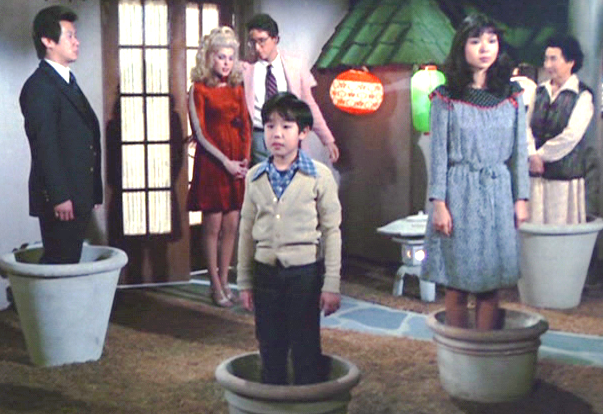
The other episodes did have priceless moments as well. In "The Butler Did It"/"A Bird in the Hand," there was an overabundance of sight gags. A young heiress named Terri (Lilibet Stern) celebrates her birthday but she gets kidnapped when visiting the family's Chinese Garden with her fiancé Kingsley (Ken Michelman). The ransom note is tied to a window and
 thrown into a rock garden. We see the typical shot of Frank driving his car except we soon realize that he's in the back seat and someone short must be driving because Frank scratches his nose while the hand stays on the steering wheel and later the driver hands the CB over the seat to Frank. Hocken decides to check a glove compartment which is, of course, filled with gloves. The kidnapper, the butler Thames (Byron Webster), holds a gun to Terri's head so Drebin tells him that "two can play at that game" and grabs a bystander and puts his gun to her hand, one of many gags that ZAZ freely admit to recycling later. Hocken asks Frank to cover him so he can sneak behind the butler so, yes, he throws a blanket over him. The final one before the epilogue is after the butler gets apprehended and Hocken announces that "the black and white is here." I'll let that photo speak for itself. This episode aired out of order. In each epilogue, they list all the criminals that have been sent to Statesville Prison and they mention a crook whose episode hadn't aired, presumably because ABC was eager to get those celebrities on to see Johnny.

Other sight gags and repeated jokes prevail, but returning to Police Squad!, what stands out above all else remains the incredible performance of Leslie Nielsen. It went beyond his deadpan delivery. In the last episode, "Testimony of Evil"/"Dead Men Don't Laugh," Drebin goes undercover as a nightclub entertainer and Nielsen performs an extended bit as a standup where we only hear punchlines such as "He looked up at her and said, 'Lady, I don't think I can take 60 more of those," and the crowd eats it up. He then segues into a medley of Judy Garland songs. He's awful of course, but it's a riot. That episode also has a great scene where a ventriloquist and his dummy pull a gun on Frank and the owner because he wasn't allowed to audition. Frank overpowers them — but he punches the doll first. The boss (Claudette Nevins), part of his investigation into a drug ring, commends him for taking such a chance. In great straight-faced delivery, Frank tells her, "You take a chance getting up in the morning, crossing the street or sticking your face in a fan." I've accumulated a lot of the gags and photos of them to share, but I should retire this tribute at some point. From the beginning, I planned to end this tribute with a YouTube assemblage of all six Epilogues and freeze frames the show employed. What other way could I?
Tweet
Labels: 80s, Boardwalk Empire, Breaking Bad, D. Zucker, Garland, HBO, J. Zucker, Jim Abrahams, Joe Dante, Letterman, Lynch, Mel Brooks, Nielsen, Star Wars, Streisand, The Simpsons, The Wire, TV Tribute
TO READ ON, CLICK HERE


