Saturday, March 17, 2012
Round is funny
This post originally ran as part of The Slapstick Blog-a-Thon held at Film of the Year in September 2007. I've revised the piece slightly to mark the 25th anniversary of the release of the Coen brothers' second feature on March 13, 1987.

They say he's a decent man, so maybe his advisers are confused." — H.I. McDunnough
By Edward Copeland
The frenetic slapstick nature of Raising Arizona doesn't kick in immediately. As it begins, the movie restricts most of its wackiness to wordplay. The first (and I still think the best) instance of the Coen brothers milking laughs by creating dimwitted characters that spout purple prose in thickly painted-on accents, churning out phrases that people such as these never would utter if they existed in the real world. The Coens would recycle that formula many times in films such as Fargo, O Brother, Where Art Thou? and the ill-advised remake of The Ealing Studios classic The Ladykillers, having Tom Hanks assume Alec Guinness' memorable turn by impersonating Colonel Sanders. However, the Coens never would go that route with as much hilarious and charming success as they did in Raising Arizona, which holds up strongly 25 years later.

What impressed me first when I saw Raising Arizona a quarter-century ago was its opening prologue, which lasts a full 11 minutes before the title even appears. It's an amazingly efficient 11 minutes as well, setting up nearly all the main characters and situations. We meet habitual convenience store robber H.I. McDunnough (Nicolas Cage), whose parole board he frequently visits (and which frequently frees him) warns that he's only hurting himself with this "rambunctious behavior." We also meet his prison friends Gale and Evelle Snoats (John Goodman, William Forsythe). Most importantly, we meet the police officer who takes H.I.'s mugshot and prints each time he returns to prison. The
 officer goes by the name Ed, short for Edwina (Holly Hunter). We get to see the attraction grow between her and H.I., especially after Ed's fiancé dumps her and, during one of his releases, H.I. finally works up the courage to ask Ed to be his bride, even though he'd previously said, referring to his chosen profession of armed robbery, that "sometimes your career comes before family." Unfortunately, family doesn't seem to be in the offing for the McDunnoughs as they learn from doctors that Ed's "insides were a rocky place where my seed could find no purchase." That bit of narration from H.I. perfectly illustrates what I mean about the contrast between the characters' character and their speech. In Raising Arizona, the Coens excel at crafting this type of incongruous dialogue. The brothers followed up with two completely different films — Miller's Crossing and Barton Fink. After that, they tended to keep returning to a formula of dumb characters speaking flowery language in plots usually involving kidnapping and/or murder.
All that comes later. Today, we're praising when it worked in what was just their second feature. At the same time that the childless McDunnoughs are beginning married life, furniture kingpin Nathan Arizona (the late Trey Wilson) and his wife, thanks to fertility drugs, end up having quintuplets which prompts Nathan to remark is
 "more than they can handle." It gives Ed the idea that perhaps it would be OK if she and H.I. just took one of the five off the Arizonas' hands so she and H.I. would have a little one to raise as their own while they eased the Arizonas' burden at the same time. That's where the madness truly begins. What's remarkable about the Coens' work in Raising Arizona is that it's not just pure slapstick, but a brilliant blending of slapstick and suspense, beginning with the first outright slapstick sequence as H.I. climbs through the window of the Arizona household to try to snatch one of the infants, setting off a tense comic scene of toddlers gone wild. Set to Carter Burwell's musical score, which has more than a passing resemblance in this scene to John Williams' theme from Jaws, the babies roam, one perilously approaching the steps leading downstairs. You can't decide whether to laugh uproariously or in fright. Once the stolen baby rests comfortably in the McDunnoughs' trailer, things get really complicated.
 H.I.'s prison buddies Gale and Evelle literally burst through the mud outside the prison and escape, or as Evelle puts it, they released themselves "on their own recognizance." After briefly cleaning themselves up in a gas station rest room (Dr. Strangelove fans, check the
 acronym that's been spray-painted on the bathroom stall's door), the brothers arrive at H.I.'s trailer, looking for a place to stay and insisting to Ed that they "don't always smell this way." The police officer in Ed doesn't like fugitives in her family's home,
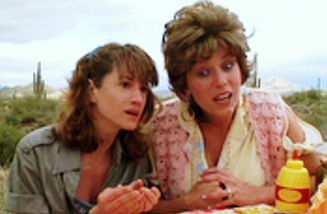 even though she herself is a felon now, albeit a good-intentioned one. Another complication arises with a visit from H.I.'s boss at work, Glen (Sam McMurray), his wife Dot (Frances McDormand) and their seemingly endless stream of diabolical children. "Mind you don't cut yourself, Mordecai" and "Take that diaper off your head and put it back on your sister" are just two of the many things Glen yells as his brood goes wild. While Dot rapidly lectures Ed on the need for insurance, avoiding orthodontic work and making sure the baby stays up to date on his "dip-tet boosters," Glen confides to H.I. that Dot wants another one, because these have grown too big to cuddle, but something has gone wrong with his semen. H.I. tries to lie about how he and Ed got to "adopt" a child so fast, but more trouble arises when Glen suggests to H.I. that they swap wives because he and Dot like to swing. H.I. punches Glen, who takes off like a madman and runs smack into a tree. Glen flees H.I., telling him not to bother coming into work anymore and promising to sue.
From that moment on, Raising Arizona essentially becomes an extended free-for-all chase. Since H.I. figures that Glen will make good on his word and fire him, he finds himself passing by convenience stores again "that weren't on the way home." Ed puts her foot down and wants Gale and Evelle gone. "I'd rather light a candle than curse your darkness," Gale tells H.I., while trying to convince him to help with a bank robbery. H.I. declines, but with Ed and the baby in the car, he does proceed to rob a convenience store for money and Huggies, setting off a loopy, more than five-minute long pursuit sequence. A pissed off Ed drives off with the baby, leaving H.I. to escape on foot. The Coens' hyperkinetic camera doesn't stop for a second as it rolls through groceries, streets and houses while clerks and dogs join the H.I. hunt.

Of course, the deadliest pursuit has yet to occur. H.I. already has had visions of a strange biker who takes no mercy on anyone or anything, and the vision turns out to be Leonard Smalls (Randall "Tex" Cobb), a self-described tracker, "some say hound dog." He meets with Nathan Arizona and offers to find his boy, but for a higher price than the reward the furniture magnate has offered. Arizona refuses, but Smalls insists he'll find the baby anyway and take whatever price "the market will bear." Back at the trailer, the chaos escalates as Glen figures out where H.I. and Ed got the baby and demands they turn the tot over to him and Dot. Before H.I. can even contemplate what to do, Gale and Evelle, who
 overheard the conversation, decide to steal the infant for themselves. Gale and H.I. tear the trailer apart in a residence-wrecking fight that takes place while Evelle shields Nathan Jr. The fugitives prevail and take off with Nathan Jr. with plans to hold him for ransom (and use him as a third man on the bank holdup). When Ed returns home to find H.I. tied up, she frees him and the couple leave to rescue the child, though Ed makes it clear that they aren't good for each other and should split once the baby is safe. The raucous slapstick melees run nearly nonstop after that as the convicts grow too fond of Nathan Jr. to part with him and Smalls arrives to whisk the baby away for his own nefarious purposes, leading to a final showdown with H.I. and Ed. Despite the frenzied pace and over-the-top nonsense, Raising Arizona even manages to conjure some warmth as the film winds down, though perhaps what touched me the most re-watching the film this time is remembering how much I loved the Coen brothers back then, until I felt their career went off the rails beginning with The Hudsucker Proxy. At least their upcoming film, No Country for Old Men, shows some promise as the vehicle marking their return to filmmaking I love instead of just doing variations on the same gags and gimmicks that I still love in their first four films, but has grown old by now.
From top to bottom, all the actors hit exactly the right notes for the movie. Forsythe and Goodman make for a hysterical pair of not-so-swift criminals. Cobb displays just the right amount of menace to remain a cartoon without pushing the film off its comic tone and into a terror mode. The late Parker gets some great material as Nathan Arizona as well as when he yells at the multitude of cops loitering at his house. "Dammit, are you boys gonna chase down your leads or are you gonna sit drinkin' coffee in the one house in the state where I know my boy ain't at?" Even the small roles of bank customers and store owners get priceless moments, especially Charles "Lew" Smith who plays the store owner who utters the response that gives this post its title when Evelle asks a question about some balloons. Cage still was in the early years of his career and Arizona marked the middle film of a three-film run of great Cage performances that started the year before with Peggy Sue Got Married and would concluded later in 1987 with Moonstruck. The breakout actor though was undoubtedly Holly Hunter as Ed. Hunter had appeared in a handful of films and TV movies, but Raising Arizona gave Hunter her biggest exposure so far, but it was just an appetizer for the gourmet meal Hunter would serve fans of great movies and acting in December 1987: Broadcast News.
UPDATE March 17, 2012: As we now know, my hopes for No Country for Old Men ended up being more than fulfilled. That same year, the brothers wrote and directed "Tuileries," one of the best shorts in the great compilation film, Paris, je t'aime . The Coens took a minor step backward with the so-so Burn After Reading that came next. However, the next movie they made ranked as one of their all-time greatest. A Serious Man also introduced me to the great actor Michael Stuhlbarg, who had mostly toiled upon the stage but would go on to impress me in a completely different type of role than his Larry Gopnik in A Serious Man when he became 1920s gangster Arnold Rothstein on HBO's Boardwalk Empire. Most recently, the Coens accomplished that rare feat of remaking a film and producing a greater version. Granted, the original True Grit wasn't a masterpiece, but it did contain John Wayne's Oscar-winning role as Rooster Cogburn which Jeff Bridges took on, easily besting the Duke. What really made the Coens' True Grit exceed the 1969 film version was young Hailee Steinfeld playing Mattie Ross. Yes, the Coens I loved early in their career have matured and returned better than ever. It's good that they can produce great works again and we continue to have their older classics such as Raising Arizona holding up after 25 years.

Tweet
Labels: 80s, Blog-a-thons, Boardwalk Empire, Coens, Guinness, Hanks, Holly Hunter, Jeff Bridges, John Goodman, John Williams, McDormand, Movie Tributes, Nicolas Cage, Oscars, Remakes, Wayne
TO READ ON, CLICK HERE


Monday, December 26, 2011
Factual healing

By Edward Copeland
When a filmmaker bases a movie on his own life, sometimes it hews so closely to those experiences that the film loses its elasticity, even if the writer-director attempts to avoid this trap by toying with timelines and using flashbacks as tools to tell his story. Fortunately for Mike Mills, Beginners has been blessed with performers who make his movie memoir stretch beyond the limits of his biography, but the cast only can do so much to overcome its overabundance of silly quirks on what could be a touching, human story all the way through.
Ewan McGregor stars as Oliver Fields, a graphic artist recalling the day shortly after his mother's death when his 75-year-old father Hal (Christopher Plummer) admitted to him that he was gay and had been during and before his 45-year marriage to Oliver's mother Georgia. Oliver's recollections come bubbling forth as he cleans out Hal's house after his passing from cancer several years after losing mom.
On a parallel track in the "current" time period (which sticks so closely to Mills' own that it must specifically take place in 2003), Oliver attempts to forge his first lasting relationship with an equally commitment-phobic French actress named Anna (Mélanie Laurent, Shosanna in Inglourious Basterds). Their initial meeting ventures beyond being a meet-cute and veers perilously close to a meet-puke as Oliver and Anna encounter each other at a costume party where he's dressed as Freud and she has laryngitis.
Plummer alone probably caused the torrent of praise poured upon Beginners and while he's good, the veteran actor doesn't deliver the performance of his lifetime either. It would be news if Plummer turned in a bad performance (not that he hasn't showed up in turkeys — I remember him as the cartoonish bad guy in the 1987 spoof Dragnet with Dan Aykroyd and Tom Hanks). He's perfectly fine in Beginners, especially in the scene where Hal describes to his son what it was like to be a gay man in the 1950s and how Georgia knew and promised she could "change him." That scene aside, I'd still rank Plummer's Oscar-nominated role as Tolstoy in The Last Station and his criminally neglected work as Mike Wallace in Michael Mann's The Insider higher on his lengthy filmography.
The performer I didn't recognize and whose character I would liked to have seen more of was Mary Page Keller (whom I recall from the early Fox comedy Duet) as Oliver's mother Georgia in flashbacks when he was a child. Her scenes contain just the right amount of cleverness before they wear out their welcome. Too often, that's what hinders most scenes in Beginners.
Early on, McGregor gets to deliver a funny scene when he inherits his dad's Jack Russell terrier Arthur (Cosmo) and explains to the dog the history of his breed and how they're all trained now to act overly cute in television and movies. That could have remained a humorous memory — but then the movie uses Arthur the same way it accuses other entertainment works of doing by not only cutting to him for expressions but giving him subtitled dialogue as well.
Perhaps Mills would have been better served telling his story in a book and then, if someone were interested, letting a person not involved in the events make a movie version. (I also wonder what's the point of telling the world that a story has been based on you but then giving the characters fake names. Did Mills fear he might sue himself?)
Mills' film Thumbsucker turned out relatively well, but that was based on a novel someone else wrote. Perhaps Mills should stick to movies that stem from someone else's material to give him appropriate distance.
Tweet
Labels: 10s, Aykroyd, Ewan McGregor, Hanks, Michael Mann, Plummer
TO READ ON, CLICK HERE
Friday, December 16, 2011
“…the names have been changed to protect the innocent...”

By Ivan G. Shreve, Jr.
In the winter of 1992, I moved from my Savannah, Ga., environs to chillier climes in Morgantown, W.Va., (what I often facetiously refer to at Thrilling Days of Yesteryear as “my years in exile”), but before getting my own place I shared the same living quarters with my best friend from high school, along with her husband and their two children. Every weeknight at 10 p.m., her hub and I had a ritual that involved watching reruns of Dragnet on Nick at Nite — laughing our asses off at the incredulous dialogue and the popsicle (stick-up-his-ass) demeanor of star Jack Webb, who as Sgt. Joe Friday frequently struggled to hide his contempt for civilians unable to provide him with the information (eyewitness descriptions, etc.) needed to make an arrest (they clearly had not undergone proper police academy training). Friday and partner Bill Gannon, played by the late Harry Morgan, also would exchange hilarious facial expressions with both men looking at one another knowingly and solemnly nodding — something my school chum’s spouse and I would duplicate to the supportive laughter of anyone who happened to be watching with us. Dragnet was never meant to be a comedy, but many of the episodes that were telecast between 1967 and 1970 certainly came across that way; the ones that provoked the most mirth in our crowd were the incredibly dated installments dealing with drugs/narcotics, particularly the classic premiere episode “The LSD Story” — known to its fans as the “Blue Boy” episode because the kid tripping on lysergic acid diethylamide paints his face blue.
Because of television’s reluctance to transmit black-and-white TV series unless they have the fan base of an I Love Lucy or Dick Van Dyke Show, future generations of boob tube audiences have associated Dragnet as an unintentionally funny crime drama that is nauseatingly pro-police at every turn and often looks as if it were filmed on location in the interiors of some cheap hotel from a David Lynch movie. It wasn’t always that way; Dragnet earned a reputation as being the seminal cop show, premiering at a time when most crime dramas involved wisecracking private eyes making the gendarmes look like jackasses by solving crimes they could not. Sixty years ago on this date, the first television episode of Dragnet appeared as part of Chesterfield Sound-Off Time, but before I toast that auspicious debut, it seems that a little background information is in order — because “the story you are about to hear is true.”
Radio actor John Randolph “Jack” Webb was fortunate to land a small role as a crime lab technician in the 1948 film noir He Walked by Night, a movie based on a real-life murder of a California Highway Patrol officer by a former Glendale, CA police department worker (and WWII veteran) named Erwin Walker (essayed in Night by actor Richard Basehart). Between takes, Webb chatted with Det. Sgt. Marty Wynn of the Los Angeles Police Department, who was serving as a technical adviser on the movie. Webb soon developed an interest in fashioning a radio series that would dramatize actual cases from the LAPD and would put a new wrinkle on police work over the airwaves. At that time, radio crime consisted mostly of private investigators who more often than not worked outside the law as opposed to with it. Webb himself had even played such shamuses on programs such as Jeff Regan, Investigator and Pat Novak for Hire — the latter a show he had created with writing partner Richard L. Breen when they were working for KGO in San Francisco circa 1946.
Webb, with assistance from both Wynn and Officer Vince Brasher, began to do research for his series by taking classes at the academy and riding around on night patrols, learning the lingo and the police's investigative methods. The series that Webb had in mind would focus on the day-to-day routine of an average cop, with less emphasis on melodramatic elements and a concentration on realism (most crimes, for example, are solved via interviewing suspects and witnesses while expending a lot of shoe leather). He pitched an audition record to NBC who really wasn’t interested in another radio crime drama since the airwaves were saturated with them, but the network was hurting for programming thanks to rival CBS's recent poaching of some of their top talent, and so they gave Webb the go-ahead — Dragnet premiered on NBC Radio on June 3, 1949.
Reaction to Dragnet was muted at first, but the program started to build a following due in part to its stark realism, sharp dialogue and underplayed acting (creator-actor Webb insisted that the byplay between the program’s characters be “as real as a guy pouring a cup of coffee”). Radio critic John Crosby was one of the show’s first champions, writing a laudatory review in which he observed that the show was “an astonishing cops-and-robbers job simply because nothing very astonishing happens on it.” Jack Webb established his reputation early on as one of the medium’s first “auteurs”; he not only starred on Dragnet, he supervised every aspect of the show from its hiring of actors to its writing to its sound effects. Co-starring alongside Webb was radio veteran Barton Yarbrough, who played partner Ben Romero, a Mexican-American who was the yang to Friday’s yin (Joe was a bachelor who still lived with his mother, Ben a devoted family man), and in the early broadcasts Raymond Burr (before he started winning cases as Perry Mason on Saturday nights) was Ed Backstrand, Joe and Ben’s superior.
The groundbreaking nature of Dragnet (the show explored then-taboo subjects such as sex crimes and drug addiction) plus the show’s success on radio made it a natural candidate for its transition to the new medium of television like so many of its radio brethren and sistern...and Webb enthusiastically approached the challenge of presenting his creation in a visual version, even to the point of insisting that many of the people involved with the radio show (actors, writers, production staff) work on the TV Dragnet as well. Many of the TV shows were culled from previous radio scripts; the premiere episode, “The Human Bomb,” had previously been broadcast on July 21, 1949, and in watching some of the early Dragnet TV episodes it’s possible to close one’s eyes and follow much of the story solely through the audio. To re-create the clipped dialogue that had become the series’ trademark, Webb often punctuated these exchanges by using tight camera close-ups, and in doing so, made the “close-up” the industry norm. The Dec. 16, 1951 pilot was a huge success, and Dragnet was added to NBC’s regular lineup a few weeks later on Jan. 3, 1952 (though at first it appeared on a bi-weekly basis for a year, alternating with another radio-to-TV transplant, Gangbusters).
Shortly after Dragnet’s television premiere, Sgt. Joe Friday found himself in need of another partner. Yarbrough, whose radio legacy included such shows as One Man’s Family and I Love a Mystery, had succumbed to a heart attack after filming only two episodes of Dragnet and it was decided that Yarbrough’s Ben Romero would pass on in a similar fashion, as dramatized on the radio episode “The Big Sorrow” (broadcast Dec. 27, 1951) and its TV adaptation “The Big Death” (Jan. 17, 1952). Webb tabbed another actor with whom he had worked previously on radio, Barney Philips, to replace the Romero character as Sgt. Ed Jacobs, and while Jack was satisfied with Philips’ performance, the network was not (they thought the two actors looked too much alike). So at the start of the show’s second season, Friday acquired another partner in Officer Frank Smith, who was played in his first four appearances by Herb Ellis (another Webb crony who frequently appeared on the radio Dragnet) before being replaced by Ben Alexander. Alexander was another actor who’d spent time in the radio trenches, both as an announcer and comic performer (he had a regular role on the early broadcasts of The Great Gildersleeve), but he maintained he was hired for Dragnet because “he looked like a cop.”
The byplay between Friday and his partners, from Romero to Jacobs to Smith, was sometimes serious and sometimes played for comic relief. Alexander’s Smith was probably the best at the latter; like Romero, he also was married with kids and had a tendency to prattle on at Joe about mundane subjects such as his favorite foods or projects he was working on at home. The give-and-take between the two actors was a respite from the grim tone of the series, which was uncompromising in its realistic depiction of investigating murders, robberies and missing persons (though the two men were also assigned to more low-key crimes such as fraud and shoplifting). One of the more interesting early episodes is “The Big Crime” (Sept. 9, 1954), which deals with the topic of child molestation and features character great Jack Kruschen as a pedophile. Another controversial episode, “The Big .22 Rifle for Christmas” (Dec. 18, 1952), tells the chillingly tragic tale of a young boy killed by the titular gift (the National Rifle Association got its undies in a bunch over this installment, by the way). Webb used this script on radio a few times as the series’ traditional Yuletide outing before switching to a kinder, gentler tone with “The Big Little Jesus” (Dec. 24, 1953), in which a statue of the Christ child vanishes from a mission church.
Dragnet’s enormous popularity on TV (it often competed with I Love Lucy for the top spot in the Nielsen ratings) made the show a pop culture icon: its theme song (with the unforgettable dum-de-dum-dum opening) was a huge hit for Ray Anthony and his Orchestra, it was parodied in MAD magazine (and also lampooned in a Three Stooges short, Blunder Boys, and a Daffy Duck-Porky Pig cartoon, Rocket Squad) and even became a staple of newspaper comics with a daily strip that ran from 1952 to 1955. Basically, any radio or television variety show of that era that didn’t send up the series in one of its comedy sketches clearly wasn’t trying hard enough. The success of the series also brought a version of the program to the big screen in 1954, but perhaps the most popular of the Dragnet tributes came from comedian Stan Freberg, who scored the first million-selling comedy record in history with a 1953 pastiche entitled St. George and the Dragonet. Webb thought Freberg’s record (and its subsequent follow-ups) was hysterical — his only objection was that in copying dialogue from one of the episodes to use for the recording (“All we want are the facts, ma’am...”), Stan created a myth in the same catchphrase league as “Me Tarzan, you Jane” and “Play it again, Sam” with “Just the facts, ma’am.”
Dragnet was telecast throughout almost the entire decade of the 1950s, and could have held out even longer were it not for Webb’s wish to pursue other projects, so the series came to a close in August 1959. (The radio version of the show even enjoyed a healthy run, lasting until 1957, though its final two seasons consisted of reruns). In 1966, however, Jack expressed interest in reviving the series and did so with a made-for-TV movie entitled Dragnet 1966 (to distinguish it from Dragnets 1951 through 1959, one supposes — though these shows also underwent a name change, Badge 714). But Frank Smith would not be reunited with Joe Friday; Ben Alexander was employed on another half-hour crime drama at that time (Felony Squad, also starring Howard Duff and Dennis Cole) and so Webb created a new partner in Bill Gannon, played by Harry Morgan. Morgan had appeared on the radio Dragnet on two occasions in 1949 when he and Webb were working on an Alan Ladd film entitled Appointment with Danger (which wasn’t released until 1951) and proved to be an excellent choice to fill Alexander’s shoes. The character of Gannon was played much broader than that of Smith, and Morgan’s flair for comedy (he had appeared on the sitcom December Bride and its spin-off, Pete and Gladys) added a new spin on the traditional exchanges between Friday and his partner. Dragnet 1966, the TV-movie pilot, wouldn’t actually be shown on NBC until 1969, but in the meantime the new Dragnet 1967 returned to its familiar Thursday night home in January of that year and became a hit all over again.
In the time frame between the 1950s and 1960s Dragnets, there had been more than a few changes apart from Friday’s new partner. Joe Friday had morphed into a relentless scold, delivering to miscreants lectures in his inimitable mile-a-minute fashion that were even more self-righteous than they had been in the past. (Maybe the fact that he had been demoted back to the rank of sergeant — after being promoted to lieutenant in the show’s 1958-59 season — was at the root of his new attitude.) On any given episode, you couldn’t dismiss the irritation that the Friday character displayed in questioning eyewitnesses, and he seemed to reserve most of his condescension for those individuals who espoused support for the counterculture (in my house, we nicknamed the long-held belief that marijuana acts as a gateway to harder narcotics “The Jack Webb Theory,” though a friend of mine once argued that dismissing this was not to be taken lightly because, after all, “Webb hung out with a lot of jazz musicians...maybe he knows something we don't”). Many of the 1967-70 episodes of Dragnet rival the absurdity of 1938's Reefer Madness, particularly the classic “The Big High,” in which a careless pot-smoking couple neglects their young daughter, found by episode’s end drowned in a bathtub. Webb would assert later that much of the content in the 1967-70 incarnation was to improve the image of the police at a particularly tumultuous time in this country, but his rah-rah depiction of law enforcement was scorned by more than a few critics; one wag humorously dubbed the new Dragnet “the fuzz industrial.”
Though the 1960s Dragnet never really reached the height of the Nielsens as did its predecessor, it still was a strong ratings performer and could have soldiered on had Webb not canceled the series on his own decision — by that time the actor was intent on becoming a major TV mogul, and was making inroads in that area with the success of the uniformed police drama Adam-12 (which he brought to TV in 1968) and the later Emergency! in 1973. But in 1982, he attempted a Dragnet hat trick by writing some preliminary scripts for a third incarnation of the series...and once again, he was going to have to break in another rookie as partner (Harry Morgan was at the time still a M*A*S*H regular, and in fact had signed on to appear in its spin-off, AfterMASH), this time with Kent McCord (whether McCord was going to play a new character or reprise his Adam-12 role as Officer Jim Reed was never made clear). Jack’s death from a heart attack on Dec. 23, 1982 put a halt to his Dragnet revival (the LAPD paid tribute to the best PR man they ever had by lowering flags to half-staff and retiring “Friday’s” badge number, 714), but the time-honored cop show concept was revamped in a 1989-90 syndicated version (The New Dragnet) and a 2003 series produced by Law & Order’s Dick Wolf (later re-titled L.A. Dragnet, as if that would make the show any better). A 1987 film that parodied the series starring Dan Aykroyd (as Joe Friday’s nephew) and Tom Hanks was a box office hit, though the only things in it that made me laugh were seeing Morgan’s Gannon get promoted to commander and Dabney Coleman as a lisping porn merchant (“Reverend, you got ballth as big as churchbellth...”).
In April 2011, Shout! Factory released the fourth and final season of the 1967-70 Dragnet on DVD (there had been a five year gap between the first season release by Universal Home Video in 2005 and Seasons 2 and 3 by the Factory in 2010), and with the proliferation of the repeats on outlets like Hulu.com, the show is widely available to a new generation of TV viewers. Sadly, the earlier incarnation of the show is absent (save for a smattering of public domain DVD releases and the presence of a 1955 episode, “The Big Smoke,” on Shout’s Season 3 set) on disc and that’s a tragedy; I adore both editions of the show, but watching it in its prime rewards you with the experience of what made Dragnet so remarkably groundbreaking before Jack Webb’s Joe Friday turned into your mother. If you get an opportunity to listen to the classic radio broadcasts or view vintage TV episodes, I think you’ll come away with a brand new appreciation of a program that broke all of the rules and invented new ones to present “your police force in action.”
Tweet
Labels: 50s, 60s, Aykroyd, Dabney Coleman, Hanks, Jack Webb, Law and Order, Lynch, TV Tribute
TO READ ON, CLICK HERE
Wednesday, January 19, 2011
While he's trapped, you'll get motion sickness

By Edward Copeland
Is there a reverse auteur theory? If there is, I fear Danny Boyle may have succumbed to it for his films get less interesting the longer he works. The new example is 127 Hours, which does feature a very good performance by James Franco, but Boyle directs it as if, at worst, he was on a cocaine binge during its filming or, at best, he thought it should be made for people who suffered from severe ADHD.
If you live in the United States (I don't know how much worldwide coverage it received) and happened to cross paths with a TV, you probably recall the amazing story of Aron Ralston, an engineer and part-time adventure seeker who found himself literally caught between a rock and a hard place. (He gave his book about the incident that title.)
While mountain climbing in Utah, he slipped in a crevice, trapping his right arm between an immovable boulder and the mountain. Isolated, with no way to get help (any screams went unanswered and, for some reason, he thought his video camera was more vital as equipment than a cell phone) and dwindling supplies of food and water, Ralston managed to free himself after the amount of time in the title by using a tiny knife to sever his arm from his body.
Truly, Ralston's tale makes for an inspiring study in survival, self-preservation and the will to live at any cost. As a film however, I'm not sure that this would really make that gripping a movie, especially as well known as the story is. What is certain is that Boyle's directorial approach makes it worse and borders on being unwatchable.
Given that this is a story about a man trapped in a relatively small space for a long period of time, you would think a director might want to build suspense, especially since he's compensating for a well-known event, by emphasizing the claustrophobia and desperation of Ralston's situation. Boyle goes in the opposite direction: His camera never sits still, constantly zooming and jumping, tilting to angles more often found on the 1960s Batman than in a grim 21st century story of against-the-odds survival.
He also employs lots of split and tri-split screens for no apparent reason, taking every opportunity he can to show Franco from every point of view he can muster. On top of that, this movie, especially in the opening sequence and again later, may be a triumph of product placement unequaled since Harley Davidson and the Marlboro Man.
At some point, it becomes clear that Boyle isn't doing this because it's the best way to serve the story and the film at that moment but because he's just bored silly. When there were early reports of people supposedly fainting at showings of this film, I don't think it was because of the scenes where Franco's Ralston gets around to cutting off his arm, I just think they all had sea sickness minus the ocean.
What in the world has happened to Boyle as a filmmaker? He started out so promisingly with films such as Shallow Grave and Trainspotting. Sure, A Life Less Ordinary was a misfire, but I thought The Beach was underrated and he followed that with the great 28 Days Later.
Then, things definitely started their slide. Millions wasn't without its charms, but it was slight. Admittedly, I never saw Sunshine, but nothing I heard from anyone who did convinced me I was missing anything. Then came the overrated Slumdog Millionaire, with its hyperactive subtitles and mostly downbeat story that would, of course, end with a joyous Bollywoodesque dance number. It was so over-the-top at times and overpraised, naturally it was showered with Oscars.
127 Hours doesn't contain subtitles, but it does contain words at the end to tell you what happened later, but he bounces those all over the screen too. What's worse is that they are in white type and they don't take into account what images they place them on so many words can't be read because they bleed into the background.
Two things that save 127 Hours from not making you want to either turn it off, walk out or ingest large doses of Dramamine are that it lasts less than 90 minutes and, most importantly, Franco's performance. He makes up a lot of the ground lost by Boyle's directing hysteria.
In this short a film, Franco creates a charismatic, rather distinct character almost from the moment he appears, thanks mainly to early scenes with others before he gets trapped. He manages to be good once he's confined as well despite Boyle's herky-jerky direction that keeps taking you away from his face. Since once he's caught, you basically have a one-man show, they add lots of flashbacks and hallucinations with other actors for him to interact with. He also gets to do monologues to the video camera, which I suppose serves as a better companion than Tom Hanks' volleyball did in Cast Away, though that was a better movie despite going on past the point where it should have ended.
Boyle co-wrote the script with Simon Beaufoy, who won an Oscar for writing Slumdog Millionaire. Beaufoy also wrote The Full Monty. Was that a fluke? Boyle also brings back composer A.R. Rahman from Slumdog and his music doesn't add anything either, just making the already nutty direction seem more frenzied.
That James Franco manages to deliver such a fine performance in this mess is nearly as miraculous as Aron Ralston's real-life story of survival.
Tweet
Labels: 10s, Danny Boyle, Franco, Hanks, Oscars
TO READ ON, CLICK HERE
Saturday, December 25, 2010
From the Vault: Bonfire of the Vanities

No pretenses: Being a huge fan of Tom Wolfe's best seller, it would have been impossible to be unbiased about this film. Particularly with one of the largest list of miscast parts in the history of film adaptations.
However, there was no way that I could be prepared for how bad Brian De Palma's rendering of Bonfire of the Vanities would be.
Even if someone hasn't had the benefit of reading the novel (and I very much recommend it. It's cheaper than the film's ticket price and infinitely more satisfying), it's obvious that the characters that appear on screen have no integrity.
For the unfamiliar, the story details the fall from grace of Sherman McCoy, a "master of the universe" on Wall Street with an aerobicized wife, a charming daughter and a lot of debt to keep up the appearance of upper-crust Manhattan wealth.
In addition to the trappings of success in the 1980s, Sherman (Tom Hanks) has a mistress, Maria Ruskin, the wife of an older, wealthy industrialist. After picking up Maria from the airport one night, the clandestine couple miss their exit and end up in the Bronx. Their well-bred WASP necks turn a bright shade of red as they suddenly find themselves surrounded by lots of African Americans.
While trying to find their way back to the expressway, the two find a tire in the path of Sherman's Mercedes. When Sherman gets out to remove it, he encounters two black youths and, thanks to his Caucasian paranoia, he ends up throwing the tire at them while Maria drives the two away, hitting one of the young men in the process.
This is one of the first large mistakes that De Palma's version makes. In the book, it was completely unclear if the men had dishonorable intentions. On film, it implies that they most certainly did. However, the biggest error this film makes is telling it from the point of view of tabloid journalist Peter Fallow (Bruce Willis).
Fallow was British in the novel, but he's just American in the movie, though for some reason all of his companions still have English accents. Willis' character, aside from the drinking, is not the same character that helped spark Sherman's fall in the book. In fact, Fallow's narration tries to turn McCoy into a hero. There aren't supposed to be heroes in this story. You have to develop a certain sympathy for McCoy by the end, but the changing of the film's ending even diffuses that element.
The most disturbing element of the film is its depiction of the angry African Americans. They aren't developed as human beings, tired of the two-faced way the justice system treats them as opposed to whites. Instead, they are portrayed as shrieking mobs, without a sense of outrage or purpose.
Even more disturbing about this aspect of the film is that the filmmakers, worried that it would be perceived as racist, cast the gifted actor Morgan Freeman as the judge. In the book, the judge was an older Jewish man named Myron Kovitsky. Wishing to have a positive black role, Freeman got the part, ironically renamed Judge White.
Then again, why should one worry about the clashes of culture and ethnic groups that were at the heart of the novel when the people who made this movie obviously didn't care about filming the novel's points? Instead, they chose to emphasize the comic aspects as slapstick rather than satire.
The performances are all particularly weak, though it is difficult to know whether to blame the actors or the bastardized script they were given. Hanks, glaring through capped teeth, doesn't have his inherent likability as a hindrance to a good performance, but his character was a realistic person who has been transported into a live-action comic strip. Dick Tracy's villains had more believability beneath their makeup.
Melanie Griffith has transformed the amoral but intelligent Maria of the novel into a bubbleheaded idiot. Willis sleepwalks through the ruined Fallow. Freeman is forced to deliver the most cloying, idiotic speech at the end of the film when it desperately seeks to find meaning in its one-dimensional world.
The worst casting is Kim Cattrall as Sherman's wife Judy. One of the few sympathetic characters in the book, this actress of Porky's and Mannequin fame turns Judy into a poorly acted caricature. In fact, only two characters come off well. F. Murray Abraham is good in an unbilled role as the district attorney and Geraldo Rivera is completely believable as an exploitive television journalist.
De Palma's direction is showy but without benefit. The script is horrendous and the actors suffer with the stick figures they've been given to play, wandering through vague interpretations of New York and the judicial system. One can't help but wonder if it's too soon to remake this film in an attempt to do it right. Wolfe hasn't commented publicly on De Palma's debacle, but at least he got $750,000 for the movie rights. All I got was a splitting headache and a nauseous stomach.
Tweet
Labels: 90s, De Palma, Hanks, Morgan Freeman, Willis
TO READ ON, CLICK HERE
Wednesday, October 27, 2010
NY Theater Flashbacks: 95-96 Season
As I mentioned in the second installment of this series, while the previous installments covered years, the future ones would cover seasons as my obsession grew and I saw more shows. While my last installment wrapped up in the summer of 1995, this one picks up in October of the same year but in a few months, I'd move from Oklahoma to Florida, making travel to New York easier and more frequent. On the plus side, while what I'd seen in 1995 so far had been a disappointment, the rest of the season turned out to have some of the best productions I would ever see on Broadway, though some dogs remained as well. One unusual thing though: The further ahead in time I go, the harder I'm finding it to locate art or clips to go with my words.
As I wrote in my piece earlier this year marking the 40th anniversary of Stephen Sondheim's landmark show,
 as with many of his works, the score always proves stronger than the book.
Still, the talented cast of Roundabout Theatre's revival of the show (the first since its original production) gave it their all. Led by Boyd Gaines in the lead role of Bobby, the cast included Debra Monk, La Chanze, Jane Krakowski and, exciting for a Soap fanatic such as myself, Diana Canova — Corinne Tate Flotsky herself.
Veanne Cox got the assignment of doing the frenzied mouthful of "Getting Married Today" and earned a Tony nomination for it, one of the few the revival received. Even as much of a Sondheim worshipper as I am, I found that understandable. Something seemed stillborn about the show. For every great moment — as when La Chanze belted "Another Hundred People" — the musical seemed to stop in its tracks in the silly skits, even when songs surrounded them. Still, it's hard to call it a loss of an afternoon when you get well-sung renditions of "Being Alive," "The Ladies Who Lunch," "The Little Things You Do" and "You Could Drive a Person Crazy."


Much as Sondheim's score propped up the weak book beneath Company, the performances, particularly the powerhouse lead, saved Terrence's McNally's lackluster Master Class. Zoe Caldwell won a well-deserved fourth Tony for her starring role as Maria Callas in McNally's play which showed the grand dame of opera running roughshod over three students who had earned the chance to be taught by the great one, one of whom was played by an equally good Audra McDonald who picked up her second Tony on her way to four total (so far). Interspersed with the class sequences are Callas' recollections of various events and loves throughout her life which might play as nothing more than filler in the rather short play if they were placed in hands less capable than Caldwell's, but she makes them work and helped McNally win his 2nd consecutive Tony for best play following the previous season's Love! Valour! Compassion!, even though Master Class was far from the best in its category but we'll get to my choice later.
After enduring what had been done when Andrew Lloyd Webber musicalized one of my favorite films of all time, Sunset Blvd., I started to question whether it was a good idea to turn any movies into musicals since more times than not the results turn out badly. You would think though that taking Victor/Victoria to
 the stage, which was essentially a movie musical to begin with, with the same star, albeit 14 years older than when she originally played the part, and the film's director guiding the production, despite the fact he'd never directed a musical for the stage before, what could possibly go wrong? As it turns out, pretty much everything. First of all, the film's composer, Henry Mancini, died early in the process, so the new songs needed to flesh out the show were composed by theatrical wunderhack Frank Wildhorn, a man I'm thoroughly convinced was invented for the sole purpose of improving Lloyd Webber's own reputation. The YouTube clip above of "Louie Says" is an example of one of Wildhorn's contributions with terrible reaches for rhymes by Leslie Bricusse to the show. I won't feel bad if you don't make it through the whole clip. On top of that, those 14 years did make a bit of a difference for Julie Andrews, who tried her best. The comic timing was terrible. As luck would have it during the show, a man came out of the side exit near my seat in the Marquis Theatre. It was Blake Edwards. It was all I could do to keep myself from getting out of my chair and taking Edwards aside and trying to advise him on some ways to improve the show. The cast tried their best but I didn't even get to see the performer who got the best reviews, Rachel York: She was out the day I went. It remains the worst musical I ever sat through on Broadway.
Now, a much better revival of a classic Sondheim, his first (staged on Broadway anyway) for which he
 composed both the music and the lyrics. Furthermore, it was a great comic farce with a book by Larry Gelbart and Burt Shevelove. Inspired by the farces of the ancient Roman playwright Plautus, it has proved a Tony success for every actor who took on its lead role as the scheming slave Pseudolus, first for Zero Mostel in the original, then for Phil Silvers in a revival in the 1972 and this time out for Nathan Lane.
Directed by the old pro Jerry Zaks, it's a joy from start to finish with a cast of top-notch musical comedy talents such as Mark Linn-Baker, Mary Testa, Ernie Sabella, Lewis J. Stadlen, William Duell and Cris Groenedall. Unfortunately, the night I saw it, Stadlen, who received a Tony nomination as Senex, wss out but MacIntyre Dixon did a more than adequate job. When I was in grade school, we often visited my grandma during summer and would attend Starlight Musicals in Indianapolis, an outdoor summer stock, and it was there that I first saw Forum and fell in love with it. Being a young autograph hound, I got autographs of the entire cast afterward which included Arte Johnson, Avery Schreiber, Hans Conried and John Carradine. Sadly, Johnson is the only one of the four who still is with us. One word of warning: The clip of "Comedy Tonight" above was filmed very poorly, but the infectious spirit of the song and the production remains.

As I mentioned when I marked the 50th anniversary of Stanley Kramer's film version of Inherit the Wind earlier this year, I'm just a sucker for this play in whatever form it takes. So, when Tony Randall's National
h!3w~~_12.jpg) Actors Theatre announced it would be staging a revival of Jerome Lawrence and Robert E. Lee's fictionalized take on the Scopes monkey trial with George C. Scott as Henry Drummond and Charles Durning as Matthew Brady, I was as good as there. Needless to say, I was not disappointed as its lines and messages got to me as they always do. If it had a problem, it was Scott. Not because his acting was weak: He was phenomenal. This was toward the end of his life and his ailing nature showed. In fact, he had to leave the play in the middle of one performance because he felt faint. As my dear and much missed friend Jennifer said at the time, Brady is supposed to be the one who seems to be in frail health.
Actors Theatre announced it would be staging a revival of Jerome Lawrence and Robert E. Lee's fictionalized take on the Scopes monkey trial with George C. Scott as Henry Drummond and Charles Durning as Matthew Brady, I was as good as there. Needless to say, I was not disappointed as its lines and messages got to me as they always do. If it had a problem, it was Scott. Not because his acting was weak: He was phenomenal. This was toward the end of his life and his ailing nature showed. In fact, he had to leave the play in the middle of one performance because he felt faint. As my dear and much missed friend Jennifer said at the time, Brady is supposed to be the one who seems to be in frail health. As I mentioned in the introduction to this installment, I had great difficulty find photos of any of the productions from this season, but I did luck out on this one and by this one I realized for the first time that I had seen Garret Dillahunt on Broadway playing Bertram Cates. Dillahunt was fine, but he didn't make much of an impression on me, but it's funny how much of one he would make many years down the road in not just one but two roles on Deadwood and he now pops up quite frequently in movies such as No Country for Old Men, The Assassination of Jesse James by the Coward Robert Ford and The Road as well as on many TV series. He currently is a regular on the new TV comedy Raising Hope.
Under normal circumstances, you wouldn't hear me expressing relief that a new Sondheim show for which I held a ticket closed before I could see it, but boy am I glad that is what happened to Getting Away With Murder. You see Getting Away With Murder wasn't a Sondheim musical, it was a mystery play that went along with the composer's obsession with puzzles, along the lines of the 1973 screenplay he co-wrote with
 Anthony Perkins, The Last of Sheila. Anyway, having come all the way to New York with a ticket to a show now closed, I had to exchange and I made one of the greatest decisions of my life by choosing to cash it in for the revival of Edward Albee's Pulitzer Prize-winning A Delicate Balance starring George Grizzard, Rosemary Harris and the incomparable Elaine Stritch. I got to see one of the best afternoons of Broadway theater I ever have. As much as I love Who's Afraid of Virginia Woolf, this may have become my favorite Albee that day with its tale of would-be empty nesters facing suburban angst and a fuller nest than ever with an alcoholic sister, a grown daughter returning home after the breakup of a fourth marriage and a similarly married couple who just suddenly found themselves "scared." The entire cast was brilliant, with Grizzard winning a much deserved Tony. Harris and Stritch unfortunately not only had to compete against each other, they also had to contend with Zoe Caldwell in Master Class, so they couldn't make it to the podium. I didn't even mention the great work of the other three cast members: Mary Beth Hurt, Elizabeth Wilson and John Carter. The show won best revival of the play and its director, the late great Gerald Gutierrez, won director of a play for the second consecutive year after giving The Heiress new life the year before. If not for Angels in America, A Delicate Balance would be the best thing I ever saw on Broadway.
Here's one of the plays that was more deserving of the best play Tony than Master Class: Seven Guitars,
 another of the plays in August Wilson's Pittsburgh cycle which depicts the African-American experience in the U.S. in the 20th century in each decade. This play, set in 1948, takes its title from its seven characters, the six we see and the seventh whose funeral begins and ends the action of the play. Keith David starred as a blues guitarist who squandered an advance from a record label while juggling women and making his way to his mother's funeral.
The excellent cast received Tony nominations for four members of its six-member ensemble: Viola Davis, Michele Shay, Roger Robinson and Ruben Santiago-Hudson, with Santiago-Hudson winning the prize. While Seven Guitars wasn't as solid as other works in Wilson's cycle such as The Piano Lesson and Fences, it still was quite good and provided a great mix of harrowing drama and boisterous comedy.
Its atmospheric scenic design by Scott Bradley also earned a nomination, though it lost to the colorful spectacle of The King and I since this was back in the days before there were separate technical categories for plays and musicals.
I love Shakespeare and while it's a pleasure to read The Bard's plays, I've found it's always much better to see his works performed, either on stage or film. Given that, you would think that no one would prove better at interpreting and staging Shakespeare's plays that a company such as The Royal Shakespeare Company. Then
 why on earth did their production of one of his most delightful works, A Midsummer Night's Dream, almost bore me to tears?
I seldom laughed as the natural comedy came off to me as the clumsiest of slapstick and many of the performers treated the language the way I hate: so carefully that it seemed as if they feared the iambic pentameter might break if they weren't careful. Looking back at my Playbill to see if any of the company included anyone I came to know better but the only name that leaped out at me was Lindsay Duncan who played Titania and Hippolyta here but would go on to give a wonderful turn as the vengeful Servilia on HBO's Rome.
Apparently, I wasn't alone in having lukewarm memories of this production. While, as I have mentioned, art of these various productions were difficult if not impossible to come by, I could usually guarantee I could find art of the corresponding Playbill. In the case of A Midsummer Night's Dream, even that could not be found. Thankfully, my wireless printer I was given a while back also scans and I used it for the first time to scan my own Playbill because that's the only way I could get art of it.
If Sunset Boulevard didn't make it a concrete decision and Victor/Victoria didn't cinch it as a rule, the musical version of Big made it a personal principle of mine not to go see a Broadway musical based on a movie. Now I know this means I would have missed, if I'd still been able to go to New York at the time, well-
 reviewed examples of movies-to-musicals such as The Producers, Billy Elliot, Hairspray and The Full Monty (another acclaimed musical, Grey Gardens, even came from a documentary), but look at some of what I would have avoided: Urban Cowboy, Footloose, Chitty Chitty Bang Bang, High Fidelity, High Society, Saturday Night Fever, Tarzan, The Little Mermaid, 9 to 5, Mary Poppins, Young Frankenstein, Shrek, The Addams Family (I know, based on the cartoons, not the TV show or movie. Uh-huh). Thoroughly Modern Millie, Sweet Smell of Success, Dirty Rotten Scoundrels, The Color Purple, The Wedding Singer and Cry-Baby to name a few too many. I gave a break to a few others that got some passable reviews such as Legally Blonde, Xanadu and A Catered Affair. Before my obsession ended and my ability to go to New York went away I would still see a couple, with qualifications, but enough was becoming enough.
 The saddest part about Big is that I saw it on its very first night of previews and I heard it improved slightly later but it was a sign of my mental illness that I went in the first place because I wasn't that crazy about the movie in the first place. I always thought Tom Hanks played the character as far too young for what age Josh was when he grew and the musical didn't fix that. Even worse, they took the sweet simplicity of the moment from the movie when the big Josh and his boss at the toy company played "Chopsticks" on the giant keyboards at F.A.O. Schwarz and transformed it into an overblown production number, sapping it of all its charm.
What luck did I have getting to see Rent when I did. First, I ordered my ticket the day before it received the Pulitzer Prize for drama, a rare feat for a musical. Secondly, on the day I was to see it, flying in from Florida, I thought I had plenty of time. I'd get to New York, check into the hotel and get to the theater. Unfortunately, flight delays started to push it and when we got to New York, for some reason we were sitting
r9sUw5qBMhS0-StQQ~~_3.jpg) on the tarmac, not allowed to get to the gate, for an interminable amount of time. The clock ticked. It got past 7 p.m. Finally, a flight attendant got on the intercom and asked the passengers to sit down and we could finally go to the gate. Some idiot businessman was still rifling through his overhead. I shouted, "Sit the hell down! We have places to be." Thankfully, I only had a carryon. I grabbed the first cab I could and told the driver I would make it worth his while if he got me to the Nederlander Theatre before 8 p.m. I love N.Y. cabbies: I got there at 7:45 p.m. I had to sit through the show with my carryon bag at my feet, but the show, which also happened to have recently received all its Tony nominations, was well worth it. Quite simply, I was enthralled. It's still the best new musical I saw on Broadway and the only one I paid to see twice. It still was as great the second time. I did see a few problems: I knew it would be almost immediately dated, but it was a show I couldn't stop talking about, wanting to spread the word and share it to everyone I knew. Of course, it became a phenomenon and I can always say I saw it with the original cast. It was magical. It also played to my age at the time: It seemed to speak to it and my generation. Who knows? While I still love the music, today as I become an old fogey, I might relate more to Benny the landlord than the squatters. For the record, I never saw the movie version and I never will because it was obvious how they were ruining it. Usually I support using the original cast members, but they were all more than a decade too old for their parts by then. Having Chris Columbus direct? Ugh. Again, with the clip above, the filming isn't the best, but the song, "What You Own," one of my favorites, still comes through fairly well.
on the tarmac, not allowed to get to the gate, for an interminable amount of time. The clock ticked. It got past 7 p.m. Finally, a flight attendant got on the intercom and asked the passengers to sit down and we could finally go to the gate. Some idiot businessman was still rifling through his overhead. I shouted, "Sit the hell down! We have places to be." Thankfully, I only had a carryon. I grabbed the first cab I could and told the driver I would make it worth his while if he got me to the Nederlander Theatre before 8 p.m. I love N.Y. cabbies: I got there at 7:45 p.m. I had to sit through the show with my carryon bag at my feet, but the show, which also happened to have recently received all its Tony nominations, was well worth it. Quite simply, I was enthralled. It's still the best new musical I saw on Broadway and the only one I paid to see twice. It still was as great the second time. I did see a few problems: I knew it would be almost immediately dated, but it was a show I couldn't stop talking about, wanting to spread the word and share it to everyone I knew. Of course, it became a phenomenon and I can always say I saw it with the original cast. It was magical. It also played to my age at the time: It seemed to speak to it and my generation. Who knows? While I still love the music, today as I become an old fogey, I might relate more to Benny the landlord than the squatters. For the record, I never saw the movie version and I never will because it was obvious how they were ruining it. Usually I support using the original cast members, but they were all more than a decade too old for their parts by then. Having Chris Columbus direct? Ugh. Again, with the clip above, the filming isn't the best, but the song, "What You Own," one of my favorites, still comes through fairly well.
The above clip is not from the actual revival of The King and I that starred Lou Diamond Phillips and won Donna Murphy her second Tony but of a brief rendition of "Shall We Dance?" the pair performed on the 1996 Tony Awards broadcast. I thought I'd begin with it because the thing I took away most prominently from seeing this show which I'd never noticed before but which I wanted everyone to listen to is how closely the refrain of "Be Our Guest" from Beauty and the Beast resembles "Shall We Dance?" Now, I don't want to accuse Alan Menken of plagiarism, but let your ears decide. As for the production of The King and I itself, it was fine. Murphy was great and Phillips put any skepticism I might have had about his casting to rest. It was a gorgeous production. It also finally made clear to me the lyric about "Eliza on the ice" in "Getting Married Today" in Company. It's a reference to Uncle Tom's Cabin, but I bet Sondheim would have never referenced it if they didn't enact the scene in The King and I by his mentor Oscar Hammerstein II first.
May 22, 1996 marks the date of the best night in terms of entertainment I ever had in Manhattan. On my
 way to the Brooks Atkinson Theatre to see the Broadway premiere (even though it was really a New York revival) of the Steppenwolf Theatre production of Sam Shepard's Buried Child, I passed The Supper Club and noticed that at the same time, Elvis Costello and Steve Nieve would be performing. I went on in and saw Buried Child, which was absolutely superb. Directed by Gary Sinise, it starred Terry Kinney, Jim True (of Wire fame, before he added the Frost to his last name), and, in their Tony-nominated roles, the great Lois Smith and the late James Gammon. Darkly funny and just as disturbing, Shepard's play remained riveting. Thanks to the ever-changing Tony rules, since it had never played Broadway before, it was eligible and was nominated for best play. It would have been my choice. Both it and Seven Guitars were leaps and bounds better than Master Class. I did not see the fourth nominee, David Hare's Racing Demon. Floating on air after such a stupendous night of theater, I exited the Brooks Atkinson and began the walk back toward my hotel. There were still lines outside The Supper Club. It seems Costello and Nieve were giving two performances that night and someone was selling tickets outside the club:
 at the ticket price no less. I bought one immediately and went straight from Buried Child to Elvis Costello, who gave a great performance, including many songs off his most recent album at the time that I still adore, All This Useless Beauty such as "The Other End of the Telescope": Shall we agree that just this once/I'm gonna change my life/Until it's just as tiny or important as you like?/And in time we won't even recall that we spoke/Words that turned out to be as big as smoke/As smoke that disappears in the air/There's always something that's smoldering somewhere/I know it don't make a difference to you/But oh! It sure made a difference to me/You'll see me off in the distance, I hope/At the other end/At the other end of the telescope. The next morning, I boarded a plane and went back to Florida after my greatest two-day N.Y. jaunt ever: Rent, The King and I, Buried Child and Elvis Costello — all in two days time. Those were the days.
 Tweet
Labels: Albee, Blake Edwards, Deadwood, Durning, Gelbart, George C. Scott, Hammerstein, Hanks, J. Carradine, Julie Andrews, Phil Silvers, Shakespeare, Shepard, Sondheim, The Wire, Tony Randall, Viola Davis
TO READ ON, CLICK HERE
Sunday, July 04, 2010
From the Vault: Animator Steven Williams

ORIGINALLY PUBLISHED JULY 29, 1994
When Steven Williams, chief animator for the special effects firm Industrial Light & Magic, began working on the T-Rex for Jurassic Park, even the experts at his company said it was impossible. The Toronto native did it anyway and the team at ILM, the company started by Star Wars creator George Lucas, ended up creating all the dinosaurs instead of just the five or six herd shots it was originally hired to do.
The Mask marks a welcome departure for Williams from the realistic effects of Jurassic and Forrest Gump to more cartoon-like visuals.
In The Mask, Jim Carrey (Ace Ventura, Pet Detective) plays Stanley Ipkiss, a mild-mannered bank employee who finds an ancient mask that transforms him into a fun-seeking, physics-defying creature.
"Doing something like The Mask is kind of a nice deviation because it's more like doing a cartoon and ... that was a lot more entertaining than making the ass of a reptile jiggle for two years."
Because The Mask marked a departure for ILM, many of the crew were anxious to become involved in the film, which is reminiscent of the style of famous cartoon animators like Tex Avery, Chuck Jones and Bob Clampett.
"The interest, which was attractive, was that it had all the Avery-type things in it and then I found out Jim Carrey was going to be in it and he's a biological cartoon anyway. All we did was pick up where he left off."
The deviation from the type of work Williams has been used to was a relief, since he has concerns about possible misuse of the technology.
"What scares me about it is the projects that we're getting now ... We're becoming a birthing shop over time. We're not really an effects shop. We're being asked to inject personality into what they hope will be stars without addictions or morals or even requiring paychecks or trailers. It will happen. People who say there will never be digital characters just don't know what they're talking about. Man is just obsessed with trying to duplicate himself synthetically. The computer's a bad attempt at it, to begin with."
Williams doesn't know what made him see the light about the technology's possible misuse, but he knows he was being driven by blind curiosity to get ILM to the point it is today.
"I don't know why all of a sudden I got religion about the whole thing, because I was so driven to try. Lucas, I think, has kind of built a bit of a machine that's out of control, a monster of sorts. He wanted the best, he got the best. The only reason I'm scared is 'cause I know it's going to happen and I haven't been wrong yet when it comes to anticipating."
Williams sees infinite possibilities, including replacing Arnold Schwarzenegger's body on screen once his body starts to deteriorate in real life. However, he can also envision others being able to use the technology to fool people, giving the example of Saddam Hussein engineering a film that looked like the U.S. president was punching out Hussein's wife.
"We will never, ever shoot Cleopatra-type shots again with 150 or 1,000 extras; we'd just replicate them. That's the easiest example right there."
An example of that this summer was in Forrest Gump, where crowds were replicated to make a peace rally in Washington look huge. This type of technology will eventually involve conflicts with the acting community, though some actors have already had themselves digitally scanned into computers.
"If you can take any image and freeze it in time, you can duplicate it, from an actor to a rock. Again, you're only dealing with a certain spectrum of colors and it's just a matter of time. "Ariflex is testing cameras that do not shoot directly to film but shoot directly to memory, to run like decoded files. ... The real power of this is that we can now start using pre-stored images of characters, mountains, rain and we're piping it through the view plane, the camera, so the whole post-production process becomes pre."
In theory, the technology that allows Tom Hanks to shake hands with President Kennedy in Forrest Gump could be used to recast any movie ever made.
"It will happen. It's a bad thing. The most powerful weapon in the house is the television, unfortunately. I get mothers coming up to me saying 'I bought my 7-year-old son a Macintosh. Isn't it wonderful?' and I say, 'No. Take it out in the backyard and bury it. Give him a block of wood and a knife. He'll learn a lot more.'"
Tweet
Labels: Animation, Hanks, Interview, Lucas, Schwarzenegger, Star Wars
TO READ ON, CLICK HERE
Monday, May 10, 2010
La ballo vuoto o Nein! Nein!

By Edward Copeland
Sometimes the announcement of film projects seem so obviously a bad idea (at least to me) that I can't understand why everyone doesn't see it, particularly the people putting up the money. Be it those who thought a modern remake (or any remake) of The Manchurian Candidate made sense or that casting Tom Hanks as Sherman McCoy in a screen version of The Bonfire of the Vanities was a good idea (before that was followed by bad idea after bad idea like an elaborate attempt by Brian De Palma to break the world record for domino toppling).
So, when a resurgence in film adaptations of musicals led to the announcement that the next Broadway tuner to hit the big screen would be Nine, I greeted the news with a big, "Why?" I've never seen Nine staged, but I know the score and, for the unfamiliar, what it is is a musicalized version of Fellini's masterpiece 8½. Maury Yeston's score is hardly memorable and as much as I love Fellini's film, if they remastered prints and did a large scale re-release of the original film, would great numbers go? Of course, I'm not in the business of reviewing films as financial decisions (even though I was right and they made a bad one), but now that I've seen it, I can review it as a film and can say that it fails as a movie as well.
Daniel Day-Lewis stars as Guido, the director with artistic block and the actor seems to sleepwalk through the entire film as if he's wondering how in the hell he got into this mess. Day-Lewis tends to enjoy disappearing into a role, but Guido is so translucent to begin with that there's no body to inhabit and certainly no scenery to chew. His chance to sing a couple of lackluster songs doesn't offer much in the way of something new either as he basically talk-sings through those, presumably to keep that Italian accent going. I'd much rather have been watching a Gangs of New York musical. Hell, as much as I despised it, a crooning Daniel Plainview in There Will Be Blood the Musical would have offered more entertainment. Just imagine the Act II showstopper "I Drink Your Milkshake!"
Coming from The Weinstein Company, most of Harvey's usual girls are there (apparently Gwyneth Paltrow was unavailable) and the cast boasts more acting Oscar winners than a 1970s disaster movie. Shit, excuse me a second. Sorry, had to stop and clean the vomit off my keyboard when I once again realized those award winners include Marion Cotillard. One of the few non-Academy Award winners or nominees in the cast is Fergie and she sure does look different than she did when she was married to Prince Andrew. Oh, I'm sorry. Different Fergie. Not really sure who she is, but actually she does do one of the best numbers performing "Be Italian," made famous on stage by the late Anita Morris (I remember that from a Tony broadcast).
As I guessed when I saw Penélope Cruz in Pedro Almodóvar's Broken Embraces, she got the Oscar nomination for the wrong movie when she received it for Nine. Cruz does what she can in Nine, but characterization is not a strong suit for any of the film's characters.
When Nine premiered on Broadway, it inexplicably won Tonys for best musical and best score, defeating Dreamgirls, which turned out to be a mixed bag as a movie but at least made sense to be turned into a movie. (Though the show was a flop, Maury Yeston's dull score for Nine defeated Stephen Sondheim's brilliant score for Merrily We Roll Along as well.) The Tony love at the time could mostly be attributed to the involvement of Tommy Tune, whom was worshipped by the Tonys in that era winning in multiple categories, year after year.
Making a musical out of Fellini's 8½ just seemed an odd idea to begin with. R.E.M.'s video for "Everybody Hurts" and its sequence paying homage to the film probably comes closer to the mark than the entire film of Nine does.
Now, I don't want to merely bash Maury Yeston, because years later he won another Tony for score for another best musical, Titanic, which had no connection to James Cameron's behemoth but came out the same year and was much better than the movie with the same name, and had a score infinitely better and more memorable than Nine.
Rob Marshall, who successfully directed the screen adaptation of Chicago, helmed the film Nine and honestly, I have no idea what his strategy for the film was. Some numbers seem to spring as fantasies out of conversations Guido has with the many women in his life while others seem to appear on a theater stage (or is that a movie set? Hard to tell). The dialogue scenes hardly improve the situation. You can't decide which you dread more: Characters breaking out into boring song or into boring conversation.
Though the film had its problems, his nonmusical direction of Memoirs of a Geisha showed much more promise for him as a film director. However, next up for him is yet another Pirates of the Caribbean sequel which one can only hope they subtitle We Really Are Devoid of New Ideas. It's a shame, because had many great choreography credits on Broadway and a co-directing credit with Sam Mendes on the marvelous revival of Cabaret that starred the late Natasha Richardson. Mendes seems to have made the switch in mediums much easier than Marshall.
With the exception of some clearly defined roles (Sophia Loren is the dead mother; Cotillard is the wife; Fergie is the prostitute Guido knew as a child) many of the women sort of exist in a blur without clear delineation. Judi Dench obviously is his agent and I guess Nicole Kidman is his frequent movie star, but I'm still working on Cruz and Kate Hudson, though Cruz obviously is at least a mistress.
The screenplay is credited to Michael Tolkin, author of both the novel and screenplay for The Player, and Anthony Minghella who, despite the fact he died in March 2008, must still be under contract to Harvey Weinstein, even in the afterlife. (IMDb still lists two films in development for him. Take a rest Anthony, you're dead.) In the movie, Guido hasn't written a word for the film he's supposed to start filming and Nine itself is similarly plotless. It's telling that at the Tonys the year Nine premiered on Broadway the book category is one category it did lose to Dreamgirls.
The best I can find myself saying about Nine is that the technical credits are fine from Dion Beebe's cinematography and Colleen Atwood's costumes to John Myhre's production design, but in the end it's just putting lovely wrapping paper on an empty box.
Tweet
Labels: 00s, Almodóvar, Awards, Cameron, Cotillard, Day-Lewis, De Palma, Dench, Fellini, Gwyneth Paltrow, H. Weinstein, Hanks, Musicals, Nicole Kidman, Oscars, Penélope Cruz, Remakes, Sondheim, Theater
TO READ ON, CLICK HERE


