Saturday, December 31, 2011
"I never claimed to be one of the 'involved'" — Straw Dogs Part II

its 40th anniversary Thursday. If you haven't seen it and plan to at some point, best not to read this.)
By Edward Copeland
We left off Part I of my Straw Dogs tribute as I was setting up the main players. If you're starting here by accident, click here to go back to Part I first. I also should note, which I failed to do in Part I (though I doubt its specific omission confused any reader) that I'm writing about Sam Peckinpah's 1971 original, not the recent remake which I haven't seen and don't plan to since it violates my rule on remakes: Don't remake films unless the original contained such big flaws that it allowed for improvement, but people seldom remake the bad or the mediocre. Two rare examples where filmmakers remade mediocre or OK originals and ended up with superior versions are Steven Soderbergh's Ocean's Eleven and the Coens' True Grit. Of course, the most famous case belongs to The Maltese Falcon which they didn't get right until the third try directed by John Huston after the awful 1931 version and the strange 1936 adaptation called Satan Met a Lady that changed nearly every detail of the story. Warren Beatty redid Here Comes Mr. Jordan as Heaven Can Wait and it ended up almost as a draw. The most unique case of all happens to be when a very good movie, 1931's The Front Page, got transformed by Howard Hawks into one of greatest comedies of all-time, His Girl Friday. I have to admit — I've enjoyed immensely watching the unnecessary remakes of great films such as Arthur and Fright Night sink like a stone this year. You're probably wondering why I'm wasting so much space in an article about Straw Dogs discussing these other films. That's because despite the spoiler warning at the beginning, some of the art will give things away as well and I wanted to put as much distance between the beginning of Part II and the important stuff as I could since I know how hard it is for some people to use willpower to avoid ruining things they shouldn't know about in a film before they've seen it. Now, I feel I can get back to Straw Dogs after the jump. (FYI: According to IMDb, the 1971 Straw Dogs had an estimated budget of $3,251,794 and worldwide gross of $11,148,828 (and that's largely 1971-72 ticket prices); the 2011 Straw Dogs, according to Box Office Mojo, had a production budget of $25 million and a worldwide gross (at 2011 ticket prices) of $10,324,441.)
Straw Dogs contains few light-hearted moments as it is, but as the film progresses they grow scarce as the tension tightens. The players have arrived, but we aren't sure how they figure in the game yet. Who is Henry Niles and how will he figure into
 anything when he shows up in the form of actor David Warner? Should we be wary of more of the villagers than just Norman Scutt, Chris Cawsey and perhaps Tom Hedden? Is Charlie Venner trying to be friendly or does he want to rekindle whatever he used to have with Amy? That will happen, but for that first night, the Sumners continue to have a playful marriage as Amy yells for David to come to bed already, since he has spent hours at work in his study. He doesn't notice that outside the study window, Janice Hedden spies on him, The teenage girl gets surprised by her brother Bobby, who wraps his arms around her. (The two have an unusually close relationship it seems to me.) "Do you fancy him?" Bobby asks his sister, who admits she thinks David is "sweet in a way." As David takes a cup and teapot to the kitchen, the Hedden siblings hike onto the roof. In what may be the most purely comical bit of physical acting Dustin Hoffman (or anyone for that matter) gets to do in Straw Dogs. As David shouts up to Amy, inquiring if she wants him to bring her anything, he throws, tosses and flings fruits and tomatoes at their cat who he clearly disdains. Some pieces he rolls as if he's bowling and as he's leaving the kitchen, he even lobs one behind his back. It's funny since the cat never gets hurt and Hoffman's expression never changes while he's doing it.


The cat beats David to the bedroom, taking refuge in her bed. Amy lies under the covers, a miniature chessboard on her lap and a book on chess tips in her hands, contemplating what move she should make next against David. He bets her that he can get undressed and do his bedtime exercises (which consists of jumping rope 100 times) before she makes her next move. As she notices how fast he strips, Amy accuses him of cheating so he speeds through his rope jumping and leaps into bed. Amy doesn't believe he did 100, but David says he was using binary numbers. It doesn't matter because Amy makes her move and puts David in check. His response is to close the chess set and start some foreplay — unaware that the Hedden brother and sister hold each other creepily close as they act as voyeurs. David disappears beneath the covers, telling Amy he's looking for a chess piece. "I think I found a rook," he tells her. Peckinpah does another quick insert here as we very briefly pay a visit to the pub where Scutt taunts Venner with the panties that Cawsey stole. We then return to Amy and David's bedroom where they continue their love play, which Amy certainly seems to be enjoying.
Starting at this point in Straw Dogs, characters begin to act without confirmation while the film deprives others crucial information that the audience knows, but they don't. Peckinpah seems to echo this in the editing style as well as events begin to happen that make the viewer feel as if he or she has missed some scenes. The night before, when we last saw Amy and David, they were enjoying each other when the screen faded to black. The next morning, we find them arguing in the studying. "I was just trying to help," Amy tells her
 husband. David's tone indicates the fight has been going on awhile as he suggests that if Amy wants to help, she'll get her friends to finish the work on the garage and leave him to his work. She gets up and draws a line with a piece of chalk through his formula, pissing David off further. "Don't play games with me. Don't do it, Amy," David threatens as she finally sticks a glob of gum on the board and leaves. The scene comes as a shock since nothing seems to have foreshadowed it, but the fragmentation has a purpose as we will see as more things develop. For we'll see that pretty much everyone plays a game of some sort. The movie goes from that scene to yet another cut of omission with Amy driving back to the farmhouse. No setup had been given to explain when she left or why — she just storms out of the study and then returns to the farmhouse. What occurred in between remains a mystery, but the scene does call back to the opening one with that inexplicable close-up of her walking braless down a village street. When she parks the car, we get a scene that could be interpreted two ways. Amy notices that her panty hose have developed a run and examines them, unwittingly giving Venner, Scutt, Cawsey and Riddaway a glimpse of her panties. Then again, perhaps she showed her legs and underwear purposely. It earns a tip of the hat from Cawsey, but it causes her to go inside and complain to David in a very important piece of dialogue.
AMY: They were practically licking my body.
DAVID: Who?
AMY: Venner and Scutt
DAVID: I congratulate them on their taste.
AMY: Damn rat catcher staring at me.
DAVID: Why don't you wear a bra?.
AMY: Why should I?
DAVID: You shouldn't go around without one and not expect that kind of stare.
It's illustrative in this case only of the Sumners, but all the characters in Straw Dogs want to have it both ways. Those who viewed the film as being about how men must embrace their inner beast to be real men got the underlying message wrong. People who thought that
 because Amy parades around without a bra and does other exhibitionist activities meant she secretly wanted to be raped got that wrong as well. First and foremost, Straw Dogs is a thriller, but it is a thriller with a message — that everyone's a hypocrite. Each character — from Dustin Hoffman's math professor to Susan George as his flirtatious wife, from the mischievous teen Janice to the various thuggish locals — wants to have it both ways on almost everything. The figurative straw dogs in Straw Dogs believe that's what's good for the goose is only good for the goose and the gander should back the hell off. That's how a thug such as Norman Scutt can rape Amy, but then help lead a lynch mob to find Henry Niles because they suspect he has molested or hurt Janice Hedden. The David-Amy argument goes on, as Amy accuses David of refusing to commit to anything, though they eventually make up but then, as if she hasn't learned a thing, she goes upstairs to take a shower, dropping her shirt down to David. He tells her to shut the curtains, but she doesn't, given Venner and the other workers a nice look at her naked bosom.
It isn't really mocking intellectuals either because every character belittles someone to prove their superiority. In one scene, Amy asks David what binary numbers are and he starts to give an explanation, but she figures out the rest, to which he responds, "You're not so dumb." With the exception of Henry Niles, who is mentally challenged in some way, every character in the movie finds someone to taunt. Even Reverend Hood (Colin Welland) takes a potshot at Tom Hedden during the church social.
REVEREND HOOD: And now for my next trick, the piece de resistance, I present to you an empty glass. I will now fill this glass with milk.
CAWSEY: Would it work better with whiskey, Vicar?
REVEREND HOOD: Nothing works better with whiskey.
TOM: I do.
REVEREND HOOD: You've never worked a day in your life, Tom.
That really, I believe, was Peckinpah's intention in using the title. Everyone selects their weaker argument (in this case, person) to knock down so they substitute themselves as the superior. Occasionally, it takes the actual form of arguments as when Maj. Scott bring Rev. Hood and his wife to the Sumners and David tries to describe his work and it turns into a discussion of the bloody record of the church that gets them to leave quickly.

DAVID: I'm an astral mathematician.
HOOD: Never heard of it.
DAVID: That's because I just made it up. I have a grant to study possible structures in stellar interiors and the implications regarding their radiation characteristics.
HOOD: Radiation. That's an unfortunate dispensation.
DAVID: Surely is. Yes, indeed.
HOOD: As long as it's not another bomb.
[beat]
HOOD: You're a scientist — can you deny the responsibility?
DAVID: Can you?
[beat]
DAVID: After all, there's never been a kingdom given to so much bloodshed as that of Christ.


Peckinpah's direction and his editing team ratchet the tension up to a boiling point, especially during the film's most controversial sequence. Venner and the other workers take David out on his first hunt (though you have to ask why he's willing to go since at this point he knows that one of them hung their pet cat to death and left her in their bedroom closet.


While David sits bored silly out in the country alone like a fool holding a shotgun, Charlie Venner sneaks back to the farmhouse to see Amy. The scene definitely begins as a rape as Amy resists Venner who smacks her around and rips her clothing. Somehow during the course of this, her attitude changes — they did have a past after all — and she even seizes part of the initiative. (It's interesting though that while they have their encounter, she has flashbacks to her encounter with her husband.)


The sequence becomes a sexual assault when Scutt enters with a shotgun. Venner shakes his head, silently urging him not to do it, but Scutt forces him to pin Amy's arms as Scutt sodomizes her, What's happening to Amy gets intercut with David who actually successfully kills a bird, but the act repulses him and he tries wiping the blood off. After they left him stranded, David decides to fire them all the next day — Amy never tells him what happened, so David doesn't realize what an inconsiderate asshole he comes home and starts attacking her over the conduct of her "friends," the workers.


They go to the church social where Amy starts having flashbacks and David decides to take her home. At the same time, Janice, who constantly teases Henry Niles, has left with him, causing an uproar. She takes him to a place and asks if he's ever kissed a girl and he says no and she kisses him. Henry gets frightened when he hears the mob searching for him and accidentally kills Janice, in a way reminiscent of Lennie with Curly's wife in Of Mice and Men and Frankenstein and the little girl by the pond. Niles flees and what brings everything together happens when David strikes Henry with his car. Feeling responsible, he takes the injured man back to the
 farmhouse and tries to find the doctor. The lynch mob laid siege to the farmhouse (even though they have no idea about Janice's fate) and Maj. Scott arrives to try to bring things to an end but gets shot to death by Tom instead. What's truly amazing about the climactic siege is that it lasts 35 minutes. As great as Jerry Fielding's score is, most of the climax actually plays without any music. David doesn't have any usual weapons (except Chekhov's mantrap hanging on the wall) and as the mathematician begins thinking of ways to fight back, it's difficult not to think of Walter White and Breaking Bad. At one point, as Scutt tries to break in through a window, David puts a knife to his throat as he binds his hands to the window with wire. He asks Scutt if he's hurting him. My neck's on some glass," Scutt tells him. "Good. I hope you slit your throat," David tells him. He boils alcohol on the stove and flings it on some of the marauders. When you see some of the villager's actions, especially when Cawsey takes to wearing a fake red nose, it's difficult not to picture them as droogs out of A Clockwork Orange. Amy stays torn, wanting to just give Niles to them.
AMY: David, give Niles to them. That's what they want. They just want him. Give them Niles, David!
DAVID: They'll beat him to death.
AMY: I don't care! Get him out!
DAVID: You really don't care, do you?
AMY: No, I don't.
DAVID: No. I care. This is where I live. This is me. I will not allow violence against this house.
When, against the odds, David has offed all the intruders, he looks at Amy and says, "Jesus. I got 'em all!" It's clear though that he and Amy probably are finished. As a viewer, you breathe a sigh of relief that one of tensest 30+ minute sequences on film have come to an end. David gathers Niles and puts him in his car to drive him to a doctor and lead to a perfect summation.

DAVID: "It's OK. I don't either.
While The Wild Bunch remains Peckinpah's lasting achievement, it's unfortunate that Straw Dogs, which may be his second best film, languished so long as a turkey, not because the movie failed to meet basic standards of good filmmaking but rather because Straw Dogs became a victim of its time. It was attacked unfairly for having attributes it didn't but those diatribes prevented its assessment purely as a film instead of a polemic. If I'd had more time, I'd be curious if Dustin Hoffman ever spoke at length about the film. Can anyone imagine that he would have agreed to appear in Straw Dogs if it truly were the film its 1971 critics accused it of being?
Tweet
Labels: 70s, Breaking Bad, Coens, David Warner, Dustin Hoffman, Hawks, Huston, Movie Tributes, Peckinpah, Remakes, Soderbergh, W. Beatty
TO READ ON, CLICK HERE


Friday, December 30, 2011
"I'm just glad I'm here where it's quiet…" — Straw Dogs Part I

its 40th anniversary Thursday. If you haven't seen it and plan to at some point, best not to read this.)
By Edward Copeland
When Sam Peckinpah's classic The Wild Bunch opened in 1969, its violence drew much controversy, though many critics saw past the bloodshed to recognize the movie's significance and greatness. Two years later, Peckinpah made Straw Dogs — and it received a near-universal greeting of pans, revulsion and diatribes that accused the film of being a one-dimensional attack on intellectuals and, even worse, an endorsement of the idea that rape victims "ask for it." Liking or disliking a movie always comes down to a person's subjective opinion and ideally — I believe anyway — that assessment should be formed by the artistry (or lack thereof) that's on the screen. When you read the reviews of Straw Dogs from 1971, that seldom seemed to be the case. In fact, many critics who despised the film praised Peckinpah's craft simultaneously. Straw Dogs became the victim of cinematic profiling, watched through the prism of real-world events. People projected views formed by outside experiences onto the movie and slammed it because of what they perceived it to be. There's always been a form of film criticism that chooses to judge movies in a political context and that's fine — it's a free country. However, that school of thought tries to apply that model to every movie, sometimes to the point of ridiculousness (I have good friends who believe that Forrest Gump somehow endorses Reaganism. I belong to the camp that believes if you don't think a film's good, just say so — a negative review need not be complicated with an ideological justification. A movie such as Thor sucks, but politics has nothing to do with why I formed that opinion.) I've went way off topic — this post salutes 1971's Straw Dogs. It's ironic, considering the film's title originated as a variation of the term "straw man," roughly defined as a mediocre argument or idea put out so it can be defeated by a better one. Over the decades, more have recognized the major misinterpretation that Straw Dogs received upon release. Its 40th anniversary offers an ideal opportunity for reassessment and analysis of the film as the complex, layered thriller that I believe Peckinpah made in the first place.
While I'm too young to have seen 1971's films in first run, knowing much of the history, events and certainly the movies that year, violence definitely dominated news and entertainment. Vietnam remained front and center as the South, backed by the U.S., invaded Laos and Cambodia while the war's unpopularity grew with larger protest marches (half-a-million people at one in D.C.) and bigger majorities in polls opposing it (60% in a Harris Poll); according to FBI statistics for 1971, the U.S. murder rate jumped to 8.6 people out of every 100,000, continuing the nonstop rise that began in 1964. Stats also showed that about 816,500 were victims of violent crime and there were 46,850 reports of forcible rape — a crime that often goes unreported which it did then more than it does now; Charles Manson and his followers were convicted and sentenced to death in the Tate-LaBianca murders, though a temporary repeal of capital punishment by the California Supreme Court the following year reverted the sentences to life; Wars were taking place beyond Vietnam. East Pakistan fought Pakistan for liberation, eventually becoming Bangladesh. Later, East Pakistan got into a skirmish with India, but the new country quickly surrendered. another "war" began in the U.S. that still continues when Nixon declared the "war on drugs"; Riots weren't uncommon in the U.S., including one in Camden, N.J., that began after police beat a Puerto Rican motorist to death. A more famous riot occurred at the Attica Correctional Facility in New York when nearly half of the more
 than 2,000 inmates seized the prison, taking 33 staff hostages for four days until New York state police retook it. At least 39 people were killed, including 10 hostages; It also was the era of frequent airplane hijackings. Though not a violent one, it was the year the infamous D.B. Cooper got his money and parachuted into oblivion; Coups, usually of the military type, brought down the governments in Turkey, Sudan, Thailand, Bolivia and Uganda, which brought to power Idi Amin. That's not counting the coups that failed. That's just a cursory glance at what an uneasy world it was in 1971. Flowing into this situation were many, many movies, some that played on that fear, others that allowed for a release of that feeling of impotence. A few of the more high-profile examples:
One of my all-time favorite critics is Pauline Kael, though I disagreed with her often, but she was completely off-base in what she wrote about Straw Dogs. I've compiled some of the key things she wrote in her New Yorker review of the film:
"Peckinpah's view of human experience seems to be no more than the sort of anecdote that drunks tell in bars."…"The actors are not allowed their usual freedom to become characters, because they're pawns in the overall scheme."…"The preparations are not in themselves pleasurable; the atmosphere is ominous and oppressive, but you're drawn in and you're held, because you can feel that it is building purposefully."…"The setting, the music and the people are deliberately disquieting. It is a thriller — a machine headed for destruction."…"What I am saying, I fear, is that Sam Peckinpah, who is an artist, has with Straw Dogs, made the first American film that is a fascist work of art."
While Kael mostly missed the mark, she came so close to acknowledging that she did see what Peckinpah's intentions were and that they were artistic ones, that it's almost sad. Let's look at those sentences separately. "Peckinpah's view of human experience seems to be no more than the sort of anecdote that drunks tell in bars." Mainly, that's Pauline doing what she loved to do best (and I admit I can be guilty of succumbing to myself) — thinking up a funny sentence and using it. In relation to Straw Dogs, Kael either was blinded by other factors as to what was on the screen or she refused to acknowledge that the story being told had more layers and complexity than a mere anecdote. I'll flesh out my rebuttal on that later. "The actors are not allowed their usual freedom to become characters, because they're pawns in the overall scheme." She's absolutely right here, but she's also being dishonest because as avid a moviegoer as she was she knew that not every film acts as a character study full of finely drawn portraits of the people inside. The woman who routinely answered the question, "What's your favorite film?" with 1932's Million Dollar Legs starring Jack Oakie and W.C. Fields isn't looking for that in every type of movie, especially a genre film and Straw Dogs belongs in the thriller family, albeit one with depth, intelligence and things to say. "The preparations are not in themselves pleasurable; the atmosphere is ominous and oppressive, but you're drawn in and you're held, because you can feel that it is building purposefully." Kael contradicts herself in the same sentence. All movies aren't designed to be pleasure rides, but they still can be enriching. It's the scenario I always posit among friends: You've gathered for a fun evening and you feel like watching Spielberg. What do you put in the DVD player — Jaws or Schindler's List? Just because you settle on Jaws doesn't mean that Schindler's isn't good, it's just not the type of movie you watch for a rollicking good time. The contradiction comes when she
 describes the atmosphere as "ominous," which would seem perfectly natural for a thriller and then admitting it held her attention because she could tell it was building toward something with a purpose. As I said, she was so close. That's exactly what Peckinpah was doing and did. "The setting, the music and the people are deliberately disquieting. It is a thriller — a machine headed for destruction." Finally, Pauline acknowledges that Straw Dogs is a thriller and within those two sentences, she doesn't say anything that indicates she thinks Peckinpah violated the rules of a thriller. The last sentence of Kael's that I excerpted shows where she hopped onboard a train to crazytown. "What I am saying, I fear, is that Sam Peckinpah, who is an artist, has with Straw Dogs, made the first American film that is a fascist work of art." Again, she admits Peckinpah's artistry but she claims he has used that gift to make a "fascist work of art." No wonder she prefaced that with "I fear" because one gift Kael always had, even when you disagreed with her (other than great writing skills) is that she made you re-think your opinion. She didn't necessarily change your mind, but she gave you ideas to mull. Her Straw Dogs review provides a rare example where I didn't believe that she believed the words she placed in print. Her review reads as if she wanted Straw Dogs perceived simply as a macho appeal to give in to our violent nature and a screed against intellectuals. That's what she wanted to see, but her heart and her brain seem to be having a wrestling match for control over her writing. The adjective fascist got bandied about a lot in reviews of Straw Dogs. I can see how some slapped that label onto Dirty Harry, even if I think that was an overreaction as well, because Dirty Harry carries political overtones and a point-of-view, but, as I said before, I believe films should be reviewed as films and ideology should stay out of it. What does it say then that a true fascist film such as Leni Riefenstahl's Triumph of the Will is a staple of film studies not because of content but technique? The adjective fascist should appear if a character in the movie has fascist characteristics or is a fascist, but to label a movie one — to me that's nearly as offensive as when Tipper Gore, James Baker's wife and the rest of the PMRC wanted to interpret what songs meant in the 1980s and institute stringent record labeling. As Frank Zappa said about their plans at the time, "It's like treating dandruff with decapitation." It also reminds me of what Jon Stewart said about politicians of both parties comparing opponents to Hitler. By doing that, they do a disservice to Hitler, he said, "who worked long and hard to be that evil." With that out of the way, it's high time I start talking about what actually happens in Straw Dogs. Before I do, I will say this: a bit of a pass can be given to Kael and other critics who shared her opinion and lay siege to Straw Dogs for all its perceived sins since the version that they saw wasn't the one I did. Peckinpah had to cut footage to avoid an X rating but on home media, they restored that scene. Granted, it might have elicited the same reaction, but the fact remains that when I saw Straw Dogs the first time, I literally didn't see the same cut that the critics of 1971 did — and the scene excised in 1971 got removed from the film's most controversial and debated scene, leaving only the ambiguous sexual assault that seems to turn consensual and omitting the second thug who undeniably commits rape.

The opening credits always remind me of parts of the beginning of The Wild Bunch, the titles themselves specifically naming that film's actors in semi-black-and-white (or more accurately, black-and-gray) freezes while they're on horseback. No actors lurk beneath the monochrome credits of Straw Dogs — where we first hear Fielding's foreboding score — but beneath the title cards, blurry images recall the ants overrunning the scorpion at the start of The Wild Bunch. When the picture comes into focus and color, we see that what's scurrying isn't insects but children, singing, dancing and playing with abandon — in a graveyard. Three of the youngsters circle a dog, which some interpret as torture. As someone who despises mistreatment of animals (I always say I've been screwed over by humans far more often than by dogs), it doesn't look that way to me. A few of the kids gaze through the cemetery fence at the activities in the center of the small Cornish village in England. American David Sumner (Dustin Hoffman) walks back toward his car carrying a box of supplies he's picked up while his wife Amy (Susan George), a native of the village, attracts leers as she struts down the street sans bra.


That shot, coming so early in the film, certainly had a lot to do with putting some of the critics in 1971 such as Kael on edge. She admits in her review that part of her reaction to the film probably stemmed from being a woman and if Peckinpah had placed that image of an extreme close-up of the actress's breasts with erect nipples for no apparent reason and it wasn't brought up again, I'd have been offended as well. When I first saw Straw Dogs, the shot took me aback. That looked like something you'd find in a cheap teen sex comedy in the wee hours of the morning on Cinemax, not in a Sam Peckinpah film starring Dustin Hoffman. Eventually though, it is discussed and you see the purpose — and it's not to say "some women want to be raped." We'll get to that later. I'll finish describing the opening sequence first. The teen Hedden siblings, Bobby and Janice (Lem Jones, Sally Thomsett), help Amy by carrying an antique mantrap that she purchased to her car. Charlie Venner (Del Henney) steps out of a phone booth when he catches sight of Amy. He dated Amy when she lived in the town with her father and the sight of her makes Venner salivate. In this very first sequence, Peckinpah and his editing team of Paul Davies, Tony Lawson (who'd go on to edit Kubrick's Barry Lyndon and every Neil Jordan film since Michael Collins) and Roger Spottiswoode (who also edited Peckinpah's Pat Garrett & Billy the Kid before turning to directing) set the quick-cut pattern that will dominate the movie. The director, stereotyped for slow-motion violence, paces much of Straw Dogs with split-second snapshots. Venner makes a beeline for David and Amy's car where Amy introduces Charlie to her husband. David puzzles over the mantrap that Amy bought and tries to place it in the backseat of the car with Bobby's help. David then tells Amy he's going to run into the pub to buy some cigarettes and David leaves her with Charlie, who shamelessly flirts with Amy and tries to get her to re-create old times.

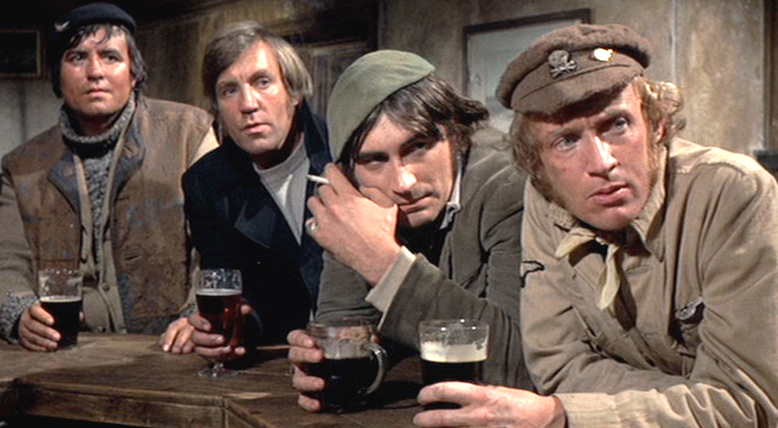
When David steps into the pub, he definitely feels and looks out of place — but it's not because he's wearing a sign that reads BRILLIANT MATHEMATICIAN STUDYING THEORIES YOU PEOPLE COULD NEVER COMPREHEND. No, his clothing, his look, his voice — they all point him out as someone who doesn't hail from that Cornish village as he asks for "Two packs of American cigarettes." However, no one taunts him or mocks him — they have a bigger troublemaker to deal with, one of their own. The burly, bearded Tom Hedden (Peter Vaughan), father to Bobby and Janice and the town drunk, somehow manages to maintain a degree of respect from those younger than him. As David has entered for his smokes, Tom wants another round after
 the pub's owner, Harry Ware (Robert Keegan), announces closing time for the afternoon. Tom slams his mug down, breaking it and cutting Harry's finger. As David witnesses this, Charlie enters the pub and asks how the work on David and Amy's garage is progressing. David complains that the two men working on it seem to be dragging their feet and Charlie volunteers to come up the next day with his cousin to help them pick up the pace. Sitting quietly in the pub, observing everything, happens to be the town's magistrate, Maj. John Scott (T.J. McKenna). Tom isn't going to take no for an answer, so he flips up the opening to the bar and serves himself. Scott warns Tom that he's had his fun, but he best be off or he'll have to bring charges and Charlie and another man help the drunkard out, but not before he apologizes to Harry and leaves money for the damage as well as David's cigarettes. Vaughan plays Tom well, straddling that line between charming old lush and frightening bastard. After they've left, David gives Harry the money for the cigarettes. The pub's owner tells him he's already been paid. "You have now," David says before leaving. Most of the actor's work has been in British television productions, though he did appear in Time Bandits and Brazil for Terry Gilliam and the HBO series Game of Thrones.

It takes a bit of a drive to get to Amy and David's farmhouse and since she's driving, Amy takes her husband on a fast and wild ride to get there, partly as punishment for his queries about her past with Charlie Venner. Before they get to the farm, Amy finally admits that years ago when she lived there, Charlie made a pass at her. David and Amy appear a rather unlikely couple, but in rare moments like this or when they're getting romantic, the two do show signs of sexual compatibility. In other instances, not so much. The screenplay by
 Peckinpah and David Zelag Goodman, based on the novel The Siege of Trencher's Farm by Gordon M. Williams, makes a point of showing that David doesn't respect Amy intellectually and, more than likely, views her as a sex object as much as the leering village thugs do. When the couple arrive at the farm, one of the two workers, Norman Scutt (Ken Hutchison) stands at attention on top of the garage. Amy makes a point of making out with David in the car in full view of Norman, though you can tell it makes her husband uncomfortable. The Sumners get out of the convertible and head separate directions — Amy to the house, David to inform Scutt of his incoming help. When David tells Scutt that Venner and his cousin will be arriving the next day to help him pick up the pace on the garage project, Scutt tells him that he and Mr. Cawsey don't have that much more to do. The name doesn't ring a bell with David, but Amy bumps into Mr. Chris Cawsey (Jim Norton) inside the farmhouse. When Cawsey steps outside, David remembers, "The rat man!" Cawsey helps Scutt on the garage, but his main skill involves exterminating rodents. Scutt asks David if he needs help unloading the mantrap (which really should be referred to as "Chekhov's mantrap" since you know its antique metal teeth shall clamp down on someone before the movie ends) and he gladly accepts. Cawsey explains that the mantraps were set them out in the field to catch poachers. As the three men stand alone outside, Straw Dogs comes as close as it ever will to explicitly discussing current world events occurring in 1971.
NORMAN: I hear it's pretty rough in the States.
CHRIS: Have you seen any of it, sir? Bombing, rioting, sniping, shooting the blacks. I hear it isn't safe to walk the streets, Norman.
NORMAN: Was you involved in it, sir? I mean, did you take part?
CHRIS: See anybody get knifed?
DAVID: Only between commercials. (after some talk concerning the mantrap) No, I'm just glad I'm here where it's quiet and you can breathe air that's clean and drink water that doesn't have to come out of a bottle.
David meekly flashes a peace sign and goes inside where Amy calls for the pet cat, who is nowhere to be found. Though the scene has moved inside, we hear the first line of dialogue between Cawsey and Scutt in the yard. Cawsey asks Scutt if he plans to "have a crack" at
 Amy. "Ten months inside" were enough for him," Norman replies, apparently referring to jail time. He then inquires if Cawsey saw anything in the house worth stealing and Chris answers no except for one item. He then twirls a pair of panties around his finger. Scutt calls him an idiot, but Cawsey assures him she has plenty and won't notice. "Don't you want my trophy?" Cawsey asks. Scutt says he'd rather have what goes in them. Cawsey tells him that Charlie Venner had a go at her when she lived there with her father and Scutt gets testy. "Venner's a bloody liar and so are you." Tensions in the house simmer more subtly. Amy continues her search for the cat and David mutters, "I'll kill her if she's in my study." Amy inquires as to what he said, pretending she didn't hear, but he doesn't repeat it, but she obviously did because she changes a plus sign in the equation on his study's blackboard to a minus sign. Later, Amy comes and annoys David in his study while he's trying to work. Finally getting the hint, she leaves, though David gazes out the window and sees she's laughing with Scutt and Cawsey who just sit on a wall, not working. She warns them that David will think that they're lazy.
When she returns to the study, he asks what the three of them found so funny. "They think you are strange," Amy tells him. "Do you think I'm strange?" David inquires of his wife. "Occasionally," she replies. He says she's acting like she's 14, which prompts her to chomp her gum louder, and he lowers her age to 12. "Want to try for 8?" She leaves him alone to his work, though later she calls to him that she needs some lettuce to prepare dinner. David gets up to fetch some from their tiny greenhouse when he notices the change on the chalkboard. "She's playing games now? What is this — grammar school?" he mumbles as he corrects the equation. When he gets to the greenhouse, Norman Scutt informs him that Riddaway (Donald Webster) has arrived to take he and Cawsey home. Cawsey stops by to share some odd little information with David. "I feel closer to rats than to people, even though I have to kill them to make a living. Their dying is my living," Cawsey declares as he climbs into Riddaway's truck and sings a little ditty, "Smell a rat, see a rat, kill a rat/That's me — Chris Cawsey/I'd be lost without em, I suppose/Cleverest thing I've seen around these parts is a rat." Later, Amy beckons David for dinner, but he seems peeved at being dragged from his work again.
A short scene in the pub gets inserted as night falls and a man comes in. Tom Hedden calls to the man, identifying him as John Niles (Peter Arne). He tells him that his brother Henry has been seen around young girls again and he better watch him or they'll have him put away. Tom's oldest son, Bertie (Michael Mundell), says that Henry only was tossing the ball to them, earning an icy stare from his father. John promises that if Henry starts to make any mistake "like he did before" he'll put him away himself. "If you don't, I will," Norman Scutt speaks up. When Henry shows up later in the film, he will be played by an unbilled David Warner in a part that's a million miles removed from his role in the previous Peckinpah film, The Ballad of Cable Hogue.
All of the major players have been mentioned or introduced and for the first time, I'm having to split the tribute to a single film in half. I don't have anything else ready to run anyway. For Part II, click here.
Tweet
Labels: 70s, Books, Caine, David Warner, Dustin Hoffman, Eastwood, Fiction, Fields, Hackman, HBO, Heston, Kael, Kubrick, Movie Tributes, Oscars, Peckinpah, Spielberg, Tarantino, Terry Gilliam
TO READ ON, CLICK HERE
Sunday, November 06, 2011
Stealing History

By Damian Arlyn
Time Bandits, which celebrates its 30th anniversary today, marked a significant turning point in Terry Gilliam's career. Gilliam first made his mark as the co-writer and animator for the now iconic British comedy troupe known as Monty Python. His directorial debut, which he shared with fellow Python member Terry Jones, was the hilarious Monty Python and the Holy Grail. His second film (the abysmal Jabberwocky) was another medieval spoof which featured Python members Michael Palin and Terry Jones as well as a whole host of typical Python gags. His third film, however, though it still has "Python-esque" moments (and features Michael Palin and John Cleese in small roles), was the first time Gilliam attempted to put on the big screen an actual story full of drama, action, horror and emotion as well as comedy. It was an important transitional point between Gilliam "the American Python member" and Gilliam "the serious filmmaker who tells stories such as Brazil and The Imaginarium of Doctor Parnassus." Time Bandits was Gilliam's "breaking out" work. Naturally I didn't know any of this as a kid when I used to watch the film often. I didn't know about Monty Python and I certainly didn't know who Terry Gilliam was. All I knew is that it was a dark and imaginative fantasy adventure that I loved. Needless to say, I still do.
It tells the story of an intelligent young British boy named Kevin (played with a refreshing lack of precociousness by Craig Warnock) whose parents would rather sit on their plastic-encased furniture watching game shows on TV and lusting after the latest electrical appliances than spend time with their son. Kevin, on the other hand, occupies his time reading history books about ancient warriors and great
 adventurers. One night, while sleeping peacefully in his bed, six strangely dressed dwarfs emerge from Kevin's wardrobe (as if it were Lewis' gateway to Narnia) and drag him with them on an arduous trek through time and space. Kevin soon discovers that these dwarfs were former employees of the Supreme Being who helped assist in the process of creation (specifically designing things such as trees and shrubs), but eventually grew tired of their job and wanted to use their knowledge of the flaws inherent in the fabric of the space-time continuum to their financial advantage. Stealing from God the only map that charts the location of all the holes in existence (which can be used as doorways leading from one time to another), the dwarfs inform Kevin of their plan to rob some of the wealthiest and most famous figures in human history and invite him to join them, which he agrees to do. This endeavor brings them into contact with the likes of Napoleon Bonaparte (portrayed by Ian Holm who had previously played the famous Frenchman in the 1974 TV miniseries Napoleon and Love and would play him again in 2001's The Emperor's New Clothes), legendary Greek ruler Agamemnon (Sean Connery) and even Robin Hood (played as a jolly nice fellow by John Cleese) before ending up on the RMS Titanic (although they mistakenly refer to it as the S.S. Titanic in the film) where they get a little more ice in their drinks than they requested.
What they don't realize is that they are being watched by none other than Evil himself (played with delicious wickedness by David Warner). Incidentally, this is apparently a point of confusion for some critics. Warner does not play Satan. He is not the "father of evil." He is evil incarnate, a personification of the abstract concept. His plan is to overthrow creation itself with the intent of fashioning a world based solely on technology, which allows for his character to make some great speeches ("God isn't interested in technology. He knows nothing of the potential of the microchip or the silicon revolution. Look how he spends his time. Forty-three species of parrots. Nipples for men. Slugs! He created slugs? They can't hear. They can't speak. They can't operate machinery. I mean, are we not in the hands of a lunatic? If I had created a world I wouldn't mess about with butterflies and daffodils. I would've started with lasers. Eight o'clock. Day one!"). Although it is never made exactly clear how or why this is the case, Evil presumably needs the map to accomplish all of this. Using their own greed against them, he lures the seven mini-explorers to the Fortress of Ultimate Darkness where he dwells. He steals the map and imprisons them, but they manage to escape.
All of this builds to a colossal climactic showdown between the forces of good and evil where each of the dwarfs (with the aid of reinforcements they gathered from numerous historical eras) attempt to destroy Evil once and for all only to be humiliatingly thwarted each and every time. In the end, it is God himself who shows up and defeats Evil, freezing him in stone. He then manifests himself in the form of a fastidious old Brit in a three-piece suit (a marvelous Ralph Richardson). Just as Evil had some wonderful lines elaborating on his
 own nature, God has some humdingers of his own ("I am the supreme Being. I'm not entirely dim."). As he enlists the help of the little thieves to help him clean up the disarray, ("If there's one thing I can't stand, it's mess.") he informs them that, in spite of their attempts to escape him, he was in full control of everything that was happening the whole time. In reality, they didn't steal his map. He gave it to them, because he needed a way of testing his own handiwork and, as he observes, "Evil turned out rather well." In the end, he invites them all back to creation again ("We mustn't waste anymore time. They'll think I lost control again and put it all down to evolution.") but leaves Kevin behind along with one overlooked piece of Evil which starts to smoke. As the smoke starts to engulf Kevin, he cries repeatedly for help only to awaken in his own bed still surrounded by smoke. Two firemen burst through the door and drag him from his burning home. His parents are already outside debating whether to run in and retrieve their beloved appliances. Kevin concludes it must all have been a dream until he discovers photographs he took during his adventure in his bag and realizes that one of the firemen looks exactly like Agamemnon. Eventually the cause of the fire is discovered. What looks like a burnt piece of charcoal is revealed cooking in their toaster oven. Although his parents are confused, Kevin recognizes it as a chunk of Evil and warns his parents not to touch it. Ignoring him, they both reach in to touch it and immediately explode leaving Kevin alone to fend for himself.
Terry Gilliam ostensibly wrote the script to Time Bandits over a weekend and it is a work of incredible originality. Filled with memorable sequences (the giant with the ship on his head, the magic act performed for King Agamemnon, the large disembodied head of God chasing the dwarfs down the long corridor) and combining dry, satirical British humor (or "humour" rather) with exciting action sequences and some fairly nightmarish images, Time Bandits is a truly unique film. Gilliam clearly made the film for children (even shooting it, as Spielberg would do a year later in E.T., from low angles to capture the diminutive perspective of the film's main characters) and as a child I absolutely loved it. I may not have understood or appreciated a lot of the social commentary or philosophical/theological dialogue in it, but I enjoyed the madcap ride through various lavish set pieces and familiar faces including Shelley Duvall, Katherine Helmond and Sean Connery (whose appearance in the screenplay was written simply as a joke until someone sent him the script and he, astoundingly, wanted to do it). It actually reminded me a lot of the kind of dreams I used to have as a youngster, with the outrageously random associations, the "stream-of-consciousness" storytelling and arbitrary transitions that seem to make total sense at the time. Time Bandits was Gilliam's first foray into putting dream-like imagery onscreen and he proved so proficient at it that he has duplicated that practice throughout his career. He is, in my mind, one of the few filmmakers who does that convincingly.
Another one of Gilliam's intentions in making the film was to, for a change, prominently feature dwarf actors. In this regard, Time Bandits was ahead of its time. Years before Warwick Davis did Willow or Peter Dinklage did The Station Agent, Gilliam recognized that it was rare in big-budget studio movies that dwarfs were made the leads. Instead they were usually relegated to minor roles in sci-fi/fantasy films (usually as fairies, goblins, elves or other mythical creatures). Although Time Bandits is a fantasy film, the dwarfs are not buried under mounds of make-up nor are included just for the sake of "bizarreness." They are fully fleshed-out, flawed, interesting characters. Each one has a distinct personality and distinguishing appearance. Particular standouts are David Rappaport as the unofficial leader Randall (who sadly committed suicide years later), Jack Purvis as the angry but athletic Wally and Kenny Baker as the lovable Fidget. To this day, roles in movies and TV are relatively scarce for dwarfs, but Gilliam still proves to be one of the most consistent directors in casting dwarf actors in his movies.
Time Bandits was very successful upon its release, earning $40 million at the box office and establishing Gilliam as a uniquely creative and visionary artist with enormous potential ahead of him. Time Bandits has also been referred to as the first entry in what is considered Gilliam's "fantasy" trilogy, a series of stories that highlights the pros and cons of the different periods of a person's life/maturity: the first (Time Bandits) being about childhood, the second (Brazil) focusing on adulthood and the third (The Adventures of Baron Munchausen) dealing with old age. In the 30 years that have elapsed since the release of Time Bandits, Gilliam has become a very significant (if very divisive) filmmaker whose work has been at times inspired (12 Monkeys, The Fisher King) and at other times embarrassing (The Brothers Grimm, Fear and Loathing in Las Vegas). While it may not be his best film (that honor I would probably award to Brazil), it is in some ways his "purest" movie. It is arguably his least pretentious, his most fun and entertaining and, by far, his most innocent and least cynical. Made by a director who barely grew up himself, it is (as the cliché goes) a film for the child in everyone…especially if that child happens to be a somewhat naughty or troubled kid.

Tweet
Labels: 80s, Cleese, Connery, David Warner, Ian Holm, Movie Tributes, Spielberg, Terry Gilliam
TO READ ON, CLICK HERE
Thursday, April 07, 2011
The Larry Sanders Show Season 3, Part 1

By Edward Copeland
In a way, the beginning of the third season of The Larry Sanders Show reminds me of the beginning of the second season of The Sopranos. With the cliffhanger devised for the second season ender, with Larry abruptly quitting the show and moving to Montana, it left all the various characters scattered (in theory at least). The Sopranos faced a similar dilemma in that it had pretty much resolved its central conflict with Uncle Junior, then in jail, Livia incapacitated and Tony and Dr. Melfi's relationship severed for security reasons. As a result, they had to spend time getting all the players back together again. Larry Sanders had a much easier time pulling this off (one episode) and with the departure of ex-wife Francine, the show now focused exclusively on the workplace and got even better, giving each member of the ensemble more chances to shine. The series still had a 17-episode load to carry, one less than the year before, and it took a few episodes for it to hit its stride again, but once it did... Because so many other projects and health factors kept eating into my chances to get back to the Larry Sanders project and left days without copy, I decided to split this season into two parts, since I've had the first nine episodes done for so long.

The first episode finds Larry still cloistered in that Montana lakeside cabin where he is watching tapes of old episodes of the talk show. He hears the approach of a car and quickly hides the cassette inside a cabinet full of tapes as if he's trying to keep a secret stash of porn. The arrival is Artie and he asks Larry if he's got any vodka, but Larry says all he has is Snapple, but the resourceful producer has brought his own ingredients for his beloved salty dogs. Larry heads to the kitchen for glasses and it doesn't take long for Artie to find the stored cassettes.
At first, Larry tries to keep up the illusion that moving to Montana is the best decision he's ever made but once Artie tells him he saw the tapes, Larry caves and says he's miserable and there must be a way to get the show back. "I knew you wouldn't be happy here," Artie tells him. "You are a talk show host. You are like one of those goddamn creatures out of Greek mythology — half man/half desk."
Artie's first suggestion is that they come up with the story that Larry had to leave so abruptly because he had a drug addiction and he's spent the last three months in rehab, but Sanders wisely suggests that they should save that for when he has a real drug problem. Artie has another ace up his sleeve though: It seems the network is suing him for breach of contract, so they can make it look as if they forced him to go back on the air and he can save face. Larry is eager to go back immediately, but Artie suggests keeping it low profile, so he doesn't seem desperate. Artie will fly back alone first. Of course, Larry can't wait to leave Montana so he actually takes the same flight as Artie, hiding in coach. Once back in L.A., the big discussion is the book The Late Shift by Bill Carter about the behind-the-scenes gameplaying around the time of Johnny Carson's retirement. Sanders can't believe Jay Leno hid in a closet to hear what NBC execs were saying about him. He wonders who could be that desperate to know what's being said about them, stopping to ask if anyone's talking about how little he's mentioned in the book. "Everybody's talking about it," Artie tells him.
For the most part, the staff has been doing very little for the past three months. Hank has been making do by drawing the lottery numbers for the state and adding "Say now" since "Hey now" is considered the intellectual property of The Larry Sanders Show. As Larry goes to gather the rest of the staff (something Artie specifically told him not to do), he finds that he never fired Beverly so his business manager has still been paying her the past three months. Paula, now a blonde (dammit, my Janeane should be a brunette!), is entertaining an offer to be an assistant producer at Late Night With Conan O'Brien. When Larry asks Phil what he's been doing, he says, "Jerking off. See you Monday." Darlene tells Sanders that working for Hank was the most rewarding experience of her life, but when Larry tells her that Hank has expressed reluctance about returning, Darlene seems fine about coming back as long as there is some kind of sidekick.
It may all be for naught though because the network's new owner Richard Germain (David Warner) basically sued only to save face himself. They've been doing fine filling his time slot with Cheers reruns, beating Leno even, and he really doesn't want to put the show back on. His attitude forces Artie to take him into his office and resort to Plan B. He tells Germain that he has a confession. Before Artie can spin his web of bullshit, Germain guesses that he and Larry are lovers. Artie is taken aback momentarily and asks why he would think that. "I don't know. Something about the dynamic." He then tells Germain that Larry left so abruptly because he'd developed an addiction to pills and had spent the past three months in rehab to spare the network embarrassment. Germaine says that explains the weight gain and asks if he's clean now. "As clean as Louie Anderson's dinner plate."
Germain makes a few demands, but he ultimately agrees and The Larry Sanders Show returns to the air, though Artie does have to slip Larry some pills to calm him down over all the turmoil.

Paula, Darlene and Phil are gathered around the break room reading a report that Larry may have survived Round I of the late night wars and drug rehab, but rumors are circulating that a Montana woman is about to file papers claiming he is the father of her unborn child. Beverly chides her fellow employees for believing such tabloid garbage until Paula informs her that it's not in a tabloid, it's in Howard Rosenberg's column in The Los Angeles Times.
Larry comes in and asks the staff if there was anything good in the paper this morning and they all say no except Darlene who tosses out that Baywatch was renewed. Larry says, "So no one saw that story about the woman in Montana claiming she's having my baby?" They keep to their denial and he thanks them all for lying through their teeth for him, though he adds that he hopes that part about Baywatch is true.
Artie quizzes Larry about the veracity of the item, but Larry says he hasn't even met someone he's liked in six months, that's why he's so excited about Mimi Rogers being a guest on that night's show. "I get some on a nightly basis," Artie interjects, "and I'm excited about Mimi Rogers." Before the show Hank asks how Larry wants to handle it on the air and he says the same way they did the drunk driving incident in '89. Of course, Hank doesn't remember that that means saying nothing and brings it up, calling the LA Times garbage, referring to the woman as "a loony out there in Montana" and bringing up his own stalker by name. On the commercial break, Artie lays into him and tells him he had to bleep out the name to avoid a lawsuit as great as the big outdoors.
When Mimi Rogers comes on, they resume their flirtation from season one and Larry asks her out, but she's hesitant because of the rumors about the possible paternity suit.
After the show, Hank brings a woman to Larry's office who introduced herself as a long-lost cousin, but it's really Mary Beth Nagler (Tracy Ellis), the woman claiming to be having his baby and she's spacey as all get out. She mentions that Hard Copy is offering her $5,000 to talk to them. Artie accuses her of blackmailing Larry and she bursts out laughing and says she just wanted to let Larry know in case he wanted to do something. "If you move another inch toward Larry, I'll take you down hard," Artie warns her and she laughs giddily again.

Then Twin Peaks fans, Ray Wise pops up to play Larry's lawyer Lloyd Simon. At first, Lloyd advises Larry not to settle, but later when witnesses pop up and Mary Beth provides a detailed description of Larry's penis, he changes his tune. After Lloyd leaves, Artie is shocked that she knows about "little Mickey" and Larry confesses that he never slept with Mary Beth, but he's ashamed of the truth — she gave him a hand job in the parking lot of a Denny's. Hank keeps calling Howard Rosenberg at the Times trying to make up stories about himself to take attention away from Larry, but ends up a subject of ridicule himself in the newspaper. Meanwhile, Mary Beth shows up at Larry's house, ruining his date with Mimi Rogers. Lloyd returns with the good news that they've found the real father and Mary Beth has tried to pull this sort of stunt before and now she's changed her story that she only gave Larry a hand job in a restaurant parking lot. Artie and Larry laugh and Larry says, "Like I'd go to a Denny's." Lloyd says he never said it was a Denny's.
While the third season will eventually turn in to a magnificent one, like the season premiere, this episode is one of the series' weaker efforts, but it does give us Wise playing a lawyer again, even if he isn't Leland Palmer.

"And now because he needs you more than you need him" is the throwaway phrase Hank uses before introducing Larry at the start of the show and damn if it's not the most truthful one ever spoken before the monologue. Showing again the only aspects that date the still-brilliant comedy usually pop up in the monologue, he references the recent breakup of Roseanne and Tom Arnold (though wait until we see how Roseanne plays a role in Sanders' world later in the season). More importantly, this episode really gives Penny Johnson an episode to give her all as Beverly.
Larry expresses concern to Artie that someone has been stealing money from his ATM. Artie asks who has access to his ATM and Larry says his business manager, his assistant, his gardener, his housekeeper..."So technically your account is a slush fund for the entire Pacific Rim," Artie says. Beverly comes in with possible ties for the Friars Roast, but she seems really distracted. She also informs him that Larry's father called and Larry asks her to handle it because he's trying to avoid him, even going so far as to hide in Hank's office to avoid a phone call.
Artie notices that Beverly is playing bloodhound to get Larry to talk to his father and accuses her of badgering Larry, reminding her that he's a grown man. A curt Beverly says that when she took this job, she came under the assumption that she was to do his schedules and return his phone calls, not play family therapist, do his tie shopping and pick the tomatoes out of his salad. Artie tells her that the job is to "keep their little host happy, whatever that takes." "Sometimes I think it takes too much," Beverly replies, "and do you think it would kill him to say 'Thank you' just once?" Artie thanks Beverly from the bottom of his heart.
Beverly finally brings the phone to him in Hank's office and he talks to his dad who tells him he's coming to visit the next day, much to Larry's displeasure.
Jason Alexander guests on the show and Hank apologizes for constantly calling him Kramer, saying he loves Seinfeld so much he kept confusing him with his character. Waiting backstage for Larry after the taping is his father, Jerry Sanders, and for the second episode in a row we get treated to an alumnus of Twin Peaks (and Seinfeld for that matter) as he is played by Warren Frost aka Doc Hayward on Twin Peaks and Susan's father on Seinfeld. (Of course, frequent Larry Sanders director Todd Holland did direct two episodes of Twin Peaks, so perhaps that explains it.)

As Larry strands his dad in his office, Hank goes in and shows him an album of Larry's work, to give him an idea of what his "son does so well" and getting misty eyed that his own father never even saw his first big boat show. Jerry Sanders identifies Hank as a sidekick "like Ed McMahon." He says that it must be a pretty sweet deal. "Take home a big paycheck just for holding down a couch and selling crap," the elder Sanders says. Tambor's reaction is priceless. Hank goes into where Larry is trying on costumes for a sketch behind a screen and tells Artie to get Larry's father the hell out of his office, not realizing Larry is there. Larry says that it's OK and Hank says that Jerry is a big pain in the ass. Larry says there is nothing more frustrating than doing everything for someone and not getting them to say thank you even once. Neither Artie nor Beverly say a word. When Artie and Larry are alone, Artie tells Larry he knows who has been taking his money.
Larry asks Beverly if she knows of any extra expenses this month because $1,500 is missing from his ATM account. She says she took it and if he wanted to know why all he had to do was ask. He says he would never have asked because he never would have thought she would steal from him. Beverly goes on a tirade, saying she didn't steal. She charged him for spending three hours in traffic on a Sunday going to Encino looking for a paint chip for his decorator. She charged him for shopping for his ties. She charged him for getting up at 7 every morning to make sure he got the first batch of frozen yogurt out of the machine. "I'm tired Larry. I'm tired of cleaning your ointment applicators. I'm tired of begging your father to come see your show so you can feel good about yourself," she sighs. Larry, never too far from self-involved, immediately wants to know what his father said when she asked. She leaves and he follows her, asking her if she wants a raise and telling her if there's something she doesn't want to do, have the weird intern do it. She tells him that it's not about money, it's about people who take others for granted and aren't appreciated or thanked. Larry assumes his father has done something else again.
During the next taping, his father actually comes to see the show. The weird intern (French Stewart) also brings him his butt cream during a commercial break. Larry points his dad out on the show and thanks him and then thanks Beverly on the show as well. Though it certainly has laughs, it's of the painful variety, but it's the best episode of the third season so far.

During a meeting discussing scheduling, Artie, Larry and Paula get hit with two big decisions: 1) An earthquake has caused significant structural damage to the ceiling of the studio and engineers recommend moving to another stage for safety; and 2) Danny DeVito backs out of that night's show at the last minute, citing illness and Larry implies guests have been doing this more frequently, making Paula fear for her job if she doesn't get DeVito back.
In private, Larry tells Artie that he doesn't think Paula has the right personality that she's — and it takes Artie several tries at adjectives to get the one Larry is going for — "incapable of putting the performer at ease because she has a basic contempt for the business," Artie finally says to Larry's agreement. Meanwhile, Paula busily works the phone trying to get a hold of DeVito anyway she can. Larry compliments Paula again and she lies and says she has DeVito back. Artie tries to get Larry to make a decision on the stage but he's become obsessed about the gifts they give guests, which appear to be the crappiest of all talk shows.
Larry spends the day trying on potential new gifts in his office when Hank and Darlene come in asking about the stage. Darlene says she has the same bad feeling she had before the earthquake. She says she's like a dog that way.
Paula gets a hold of De Vito and starts harassing him about doing the show but DeVito is just getting more annoyed, saying he doesn't feel well and he has to film a spot for juvenile diabetes. Artie whines to Beverly that Larry won't listen to him anymore since he's still ignoring him about the stage issue. "Oh Arthur, that's not true. Larry thinks of you as a close friend and a trusted adviser," Beverly tells him. "Cut the crap. Don't talk to me the way I would be talking to me," Artie responds. Artie asks if Larry is on something, but Beverly says just the same two things, but she thinks she took them at the same time.
Paula interrupts the shooting of De Vito's charity spot and begs him to come over, telling him that their studio is only 200 feet away, he could promote his movie and prevent Larry from firing her. As the show begins taping, Larry asks Paula what the deal is with DeVito and she says he is just running late, but Jimmie Walker is prepared to go on early.
Artie goes off about how bad the questions for the Potato Lady are, not realizing Beverly wrote them for Paula. Darlene says she's never had the feeling that bad before. DeVito shows up and asks Larry where he wants him. Larry wants to know why he's late and he tells him he just decided to do the show five minutes ago because he didn't want Paula's firing on his conscience. Larry tells Paula he'll talk to her after the show — then an aftershock hits, knocking a light down and causing Hank to flee the set.
DeVito is ready to bolt again but then Larry offers the new jogging suit but it's no sale until Artie says it's just wrapping a silver Tiffany's clock.
Boy, does this episode fly. It's not only the funniest third season episode so far, but Todd Holland's direction never lets up and it's a great Janeane Garofalo showcase that perfectly integrates the entire ensemble.

Artie informs Larry that during their next hiatus week, he'll be producing The People's Choice Awards and just wants to make sure there aren't any problems. Larry says he's fine with it, since he'll be in Maui, but once he's alone he starts making calls, asking why he wasn't considered as host over Paul Reiser.
Hank is taping a commercial spoof about shaving cream and asks Phil and Artie to let him do the line he came up with about the shaving cream tasting a little like coconut as opposed to the real joke about it tasting like chicken. Larry hears it and criticizes it, saying some shaving creams are scented to smell like coconut and Hank drops the props and walks off in a silent hissy fit. Phil tells him they only filmed that once to make Hank happy. They never planned to use it. Larry wonders if he should go talk to him, but Artie says no.
Hank starts sucking up to Artie about being the announcer for The People's Choice Awards. During the taping of the show, Larry lets Hank's coconut line go on.
Later, Reiser drops out at the last minute and Artie asks Larry to pinch-hit, so he says yes. When Larry's unctuous agent Stevie Grant hears about it, he goes nuts that Larry didn't consult him first because Larry isn't hosting solo — he's co-hosting with Rita Moreno and Dean Cain. Stevie says it detracts from his specialness as a performer and he had been getting close to grabbing the Oscars for him and Artie was screwing him.
Hank calls Dean Cain and gets nowhere trying to get him to help get him the announcing gig. Before the show goes to satellite, Larry has Phil change Hank's ad spoof back to the original line. He then bumps into executive Melanie Parrish in the elevator and learns that the network wanted a single host but that Artie had the final call and it was his idea to have three. Soon after, Larry and Artie are fighting at his house, with Artie saying Stevie had called him within an hour of Larry learning he was producing the show whining as to why Larry wasn't doing it and Artie sticking to his guns about the host triumvirate. Continuing to set up the season's theme about what seems to be Larry developing a real drug problem, Artie asks him what he is on now as he exits and Larry says he is quitting the awards show.
Hank interrogates Phil about why the line was changed back and Phil admits he did the deed, but only because Larry told him to do it. "And you just automatically do anything Larry asks you to do?" Hank asks angrily. "Yes. Don't you?" Phil responds. "Yes," Hank replies before ordering Phil out of his office.
Paula, in another strand that's been running through the show, has been trying to stop the staff from bringing in things for guest Elvis Costello to autograph, feeling it would make them look unprofessional. When Costello shows up, everyone purposely ignores him. Paula introduces him to Larry who starts to talk to him until he sees Artie coming and leaves. Artie does the same, except he ducks out as he sees Hank approaching. Paula
 introduces Costello to Hank saying, "Hank, this is Elvis" to which the always-clueless Kingsley responds, "I don't think so." Of course, I love Elvis Costello, so it's a treat beyond the show's usual comedy to hear him and the Attractions perform "Thirteen Steps Lead Down" from the then-new album Brutal Youth. Unfortunately, Artie, Hank and Larry all are too preoccupied during Costello's performance to pay any attention to the music, so much so that a pacing Hank's shadow can be seen behind the backdrop of The Attractions. After the show, Paula takes Larry and Artie to see Elvis because he's very upset. He tells them that not to give him any more of that "big fan shit," lashing out at them for jabbering away while he was performing and how no one on the staff will even look at him. Usually they want autographs, ask questions about songs, etc. Artie asks if there is anything they can do. Costello says that he already took care of that and says, "Bye bye" leaving them to discover a decimated dressing room. Larry says, "This reminds me of the time Angela Lansbury was on."
Artie sits down with Larry in his office and admits it was a mistake to take on the awards show. He said he should be using the hiatus to focus on their show like Larry is doing. Larry asks him if this means he quit. Artie says no. "Never quit. Always make them fire you. That way they have to pay you." He says he'll be on the plane to Maui with Larry. Unfortunately, Larry also felt so bad, he called them back and agreed to co-host the show again. It ends with him in rehearsals for one of the dance numbers he dreaded with Rita Moreno. Larry tries to back out unless they get Artie back, but Melanie assures him it will work and then he hears the announcer — it's Hank.
The third season is definitely on an uphill swing after a slow start with this fun episode, which was directed by Michael Lehmann, who directed the great movie Heathers.

With the sixth episode of the third season, we have the season's first undisputed classic and the first episode this year to let the awesome power that is Jeffrey Tambor as Hank Kingsley shine. Peter Tolan's script and Todd Holland's direction both earned well-deserved Emmy nominations, though they both unfortunately lost again to writing and directing on the middlebrow and unchallenging Frasier. Even more outrageous, Tambor, after being nominated for outstanding supporting actor in a comedy alongside Rip Torn as Artie in season one, was snubbed once again. At least Torn still made it, but to think after seeing Tambor's work in this episode alone that he didn't make the cut but they had room for David Schwimmer on Friends makes me want to choke on my own vomit. I believe Tambor deserved the prize over winner David Hyde Pierce on Frasier and Seinfeld's Jason Alexander and Michael Richards, but they at least are deserving nominees. To omit Tambor for Schwimmer borders on being a crime against humanity.
Anyway, back to the episode itself. Paula comes rushing to Artie in a panic with the news that Beverly was driving Larry to the frozen yogurt place and on the way back, he puked all over her car and then on Ventura Boulevard. Artie finds relief in the word that there were no witnesses. "Thank God. I've seen Larry vomit. It's not something you want to see over and over again on Hard Copy." Paula suggests canceling the show, but the guests are Angela Lansbury (a personal friend of Artie's) and George Wendt, who the network wants to promote a TV movie airing the next night so Paula has the uneviable task of finding a guest host 45 minutes before taping. Artie tells her to call in this order: Jerry Seinfeld, Richard Lewis, Bob Saget, John Ritter, Howie Mandel, Louie Anderson. "Howie Mandel?" Paula says quizzically. Artie agrees and tells her to flop Louie and Howie and to bump Saget from third to fourth and to make sure that Seinfeld knows he's their first choice. If he can't do it, make sure Richard Lewis thinks he was their first choice and so on down the list. "Oh your mind amazes me!" Paula declares. "I'm just now comfortable with it myself."
Paula goes through the list (trying her best to avoid Mandel) finding that most are out of town and have conflicts, coming closest with Richard Lewis who can do it the next night if needed, but can't then. Artie then has to make a grim move as he says, "Paula, are you aware that I'm about to open the lid of a box far nastier than Pandora's?" The next thing we see is Hank making a mess while eating in his office when Artie comes in and tells him he has to host the show that night. Hank's expression is giddy, but then fear sets in and he says he can't move his legs and Artie and Darlene have to physically help Hank out of his office.
As they drag him down the hall, Darlene tells Hank she's doing a visualization and sees the audience "screaming with laughter." Artie says he's seeing the same thing and thanks Darlene for explaining the screaming. Phil tries to coach him through the monologue and it looks ugly. Larry calls and asks Artie how far down the list they had to go for a host and Artie informs him they went off the list to Hank and Larry starts barfing again.
Five minutes before taping, Artie tries to pep Hank up as he goes on a crying jag, concerned that he's going to finally get his big chance and learn that he sucks. Before Artie's ready to open the curtain for Hank, he tells him that he has been in the business 40 years and he knows things and one of the things he knows is that Hank "does not suck." Hank tells him it's one of the kindest things anyone has ever said to him.

Larry watches the show from his sickbed and Beverly comes in and asks how Hank is doing. Larry says he just got his first big laugh. "Good for Hank," Beverly says. Larry tells her this will go straight to his head and he's going to become a huge pain in the ass. "You know Jimmy Woods? That's nothing." Yes, the bumbling, clueless, always incompetent Hank Kingsley scores, not just with the monologue, but interviewing George Wendt as well. His hosting proves an unqualified success — and Larry's prediction is absolutely right. The next morning, Artie asks Beverly for a report on Larry and she says he's over the food poisoning, but he slipped and hit his head and got a minor concussion so he finally got his hands on those pain pills he'd been after and would be out again. Hank enters the office like a triumphant hero, if that hero were a gigantic asshole I mean. When Artie asks if he's still buzzed from his success, Hank cuttingly says Artie sounds like he wouldn't be able to pull it off. Paula gives Hank a rather monotone "Good job" which he says doesn't sound very excited and then asks her to get him a cup of coffee. She tells him no, because that's not her job, she books talent. "Then could you book David Copperfield on the show and when he gets here, have him pull a cup of coffee out of his ass?" he replies to her.
Beverly finds Hank sitting in Larry's office and asks what he's doing there. He says it's customary for the guest host to use Larry's office. Beverly says that is right, but he's not the guest host and he should go back to his own office. He then tells her to switch desks with Darlene because he wants her closer to him. Beverly warns Hank not to get her angry and Hank repeats the same threat back. "Hank, would you like it if I called Larry about this? Because you know that if I do he'll give me the go-ahead to kick your balls right through the top of your head." Artie wanders into this ugly scene and Hank learns that Richard Lewis is guest hosting that night. Hank explodes. He saved their asses last night, he tells Artie, "and this is the fucking gratitude I get." Rip Torn's glare as Artie truly is frightening. You believe Artie killed men in Korea in hand-to-hand combat.
Hank goes back to his office and calls Richard Lewis and gets him to drop out by telling him that Larry and Artie were talking behind his back about his "neurotic Jewish shtick" being predictable and old.
Artie calls Larry to fill him in on the new developments, but Larry wanders out of the room during the call and then returns as if he didn't know he'd been talking to him, obviously having taken some pills in the interim. What Artie didn't get to tell him is that the only way to kill the monster he created was to let Hank host again and go down in flames, which he does in spectacular fashion.
Before the taping, Darlene tells Hank that there's a darkness around him and he admits that he actually got on his knees and prayed that Larry would stay sick for a long time. "I wish this man unwell, do you understand that?" Darlene begs Hank to stop. "You don't get it, do you? It's not Larry who is sick, it's me," Hank says in a rare moment of self-awareness.
The after-show silent walk to Larry's office between Artie and Hank is just one of the many great directing touches Holland brings to this episode. The frenetic pacing at the beginning is a wonder. In the DVD commentary on this episode by Holland and Garry Shandling, they talk about the show being so low budget that they didn't have tracks for what looked like tracking shots but they accomplished the same look by having their camerman film on rollerblades.
It's a brilliant episode on all levels and the third season's best episode so far.

Larry is leaving the office late and is surprised to find that Darlene still is there as well, even though it's nearly 9 p.m. Seems her car broke down and she's waiting on a cab. She asks Larry if he's going on this year's staff retreat, but he says he avoids those. He starts to leave, but then comes back and offers her a ride. First, she has to stop by Hank's restaurant to give him his reading glasses. Larry says he'll drop her off around the corner from there, so Hank doesn't see him.
Larry ends up going into the restaurant anyway, shocking the hell out of Hank, who's embarrassed that the floor isn't rotating (a couple of rats got caught in the mechanism) but he insists that Larry stay for supper on him. Larry keeps saying no until Darlene asks him to stay, then he agrees that he will. Darlene leaves to change and Hank asks Larry if this is the first time he's given Darlene a ride but before Larry can answer the floor starts moving again.
The next morning, Artie tells Larry plans for the retreat have changed. It's going to be held at the Calico Ranch in San Diego. Larry says it doesn't matter because he's not going. Artie, obviously hurt, says, "If you really mean it this time, I'll cancel the ranch and the rest of us will sit in a sensory deprivation tank and see who takes a shit first." Larry then tells Artie that he drove Darlene home which causes Artie to sit down with a grim look on his face. Larry sees his expression and says, "What?" Artie replies, "I drove Phil home once. It meant nothing." Artie bets Larry $1,000 that this is going to mean big trouble and screw up office dynamics into the next century. Larry adds that Darlene believes in tantric sex and Artie raises the bet to $1,500, though Larry says they didn't do anything, though he has to explain to Artie what tantric sex is. The bet goes to an even $2,000. Of course, the subtext of the episode is interesting since in real life Garry Shandling and Linda Doucett were involved at the time.
The ride quickly becomes office gossip as Beverly brings up the time she and Larry slept together and suggests that Paula better watch out. Hank then corners him in the kitchenette, ostensibly for Hank to heat a muffin, and asks how Larry would feel if he started dating Beverly. Larry says that it would be their business, not his. Hank says that he wouldn't because interracial dating never works, adding that the sex is good, but then the cultural differences rear their ugly head. "I believe the cultural differences would happen with you and any woman," Larry responds. Hank tells Larry to back off from Darlene, even though Larry assures him that nothing is going on. They leave the kitchenette and Larry asks Hank why he's not heating his muffin. "Oh, you'd like that, wouldn't you?" Kingsley growls before dumping the muffin in the garbage.
Larry ends up on the elevator with Darlene where he tells her that he's learned the hard way that office relationships are inappropriate. The quartet of Beverly, Hank, Phil and Paula (whose hair is getting darker again — hooray!) wait for the elevator and when the doors open they see Larry and Darlene making out. Larry tries to cover by acting as if he's congratulating her for something and wishes her good luck.
As Darlene cleans Hank's office, Hank tries to tell her that he thinks Larry is a wonderful guy — he'd date him if he could. Darlene lets Hank know that what she does in the elevator is her business. Hank swears he's just looking out for Darlene. Darlene says that it's sweet that he's looking out for her but then Hank immediately turns it into a surveillance mission, pumping her for any information about things Larry might have said about Hank.
Things get more complicated when Phil pulls Darlene into the makeup room to demand to know what's going on. Darlene tells him they never said they had an agreement to which Phil counters that she never said she was going to start dating the boss. Phil calls her an opportunist asking who's next — the Clintons? Darlene slaps Phil just as Hank walks in a costume for a skit. Phil tries to say it was for a sketch and say when you hit for a skit, it needs to be bigger, so Darlene punches him. Hank agrees — that is funnier.
The spurned Phil then starts trying to get Paula to go out with him and she agrees, admitting she'd been thinking of asking him out. Then she learns about him dating Darlene and just wanting to get back at her by dating Paula.
Finally, Larry tells Darlene they can't go any further and she gets upset. Paula tells Larry that they should have kept Jerry and fired Phil. Phil says that Paula has threatened him with physical violence and if he gets injured, he'll sue the show. Larry asks Artie if he wants to be paid in cash, but Artie says he'll be getting a bill for this new Browning rifle he's purchased which he shows him. Larry tells him to load it.
With everyone at each other's throats, they gather to head off for the staff retreat. Artie and Beverly are laughing about everyone as they walk down the hall toward the elevator, though Beverly adds that she got her and Artie adjoining cabins. He tells her that he thought they agreed that their evening of bliss was an event best not repeated. Beverly storms off, mad about the timing, and says it was three evenings. Larry wants his money back.
All in all, a pretty funny episode, but anything that comes after "Hank's Night in the Sun" will be at least a slight letdown.

With this episode, we've reached the second instant classic of the third season and the other episode that received an Emmy nomination for outstanding writing in a comedy series for Peter Tolan and Shandling.

Larry gets an invitation to a Clinton White House dinner (table 20) and Beverly says they want to know if he'll be bringing a guest. Larry isn't sure yet but somehow he and Artie start talking and using the phrase "pussy," offending Beverly. It gets worse when Hank comes in with the news that the People is reporting that Sharon Stone's engagement is off and she's a guest that night and then he says "pussy" as well. Beverly asks them how they would feel if she suddenly went around saying "Pussy pussy pussy" and Larry admits that takes the shine off it. Later, Larry lurks backstage where he meets Diane, Sharon Stone's assistant (played by none other than Lisa Edelstein, better known now as Cuddy on House) who says she's surprised to see him because she'd heard he doesn't usually see guests before the shows, but Larry denies that just as Phil comes running down the hall to see what's wrong. Larry tells Phil he's just saying hi to the guests. "If you are going to try something new, you should tell somebody," Phil tells him. "You scared the shit out of me."
Diane knocks on the door and says Larry is there and the dressing room door opens and we meet Sharon Stone. Sharon tells Larry she's glad that the show is back on the air. He tells her he had to go to Montana for awhile to straighten things out, adding that he was in a really unhealthy relationship with his ex-wife. "We're like locusts. We get together every seven years, destroy everything for miles around and then split apart again." He makes sure to add that he's in L.A. alone and Francine is in New York, but Stone sees through it and guesses he read the People article. Larry tries to play dumb and asks, "What article?" Before he can stick to the story though, Hank shows up and ruins the ruse by saying they both read it.
Once they are taping, Stone jokingly says she won't come back. Larry escorts her backstage during the commercial and asks what someone like her does on a night like this. She says she's going to have dinner with Oliver Stone. Paula (who is blonde again for some reason) comes running up wondering why he's there during the show. He tells her that he was just escorting Ms. Stone out out of common courtesy. Paula says, "Of course. There's a lot of gang activity in this part of the hallway." Larry says he'd love to meet Oliver Stone sometime because he's convinced his mother was involved in the Kennedy assassination. It's clear that chemistry is developing between the two and Sharon asks him to come along to the dinner. Larry says he doesn't want to act like he's weaseling in on her dinner and she says she knows he is, but she thinks it would be fine. Then Larry races back to the set to finish the show.
The next morning, a reporter from TV Guide is waiting for Sanders in his office. Larry is ready for questions about Leno, Letterman and the late night wars, but he's shocked when the first thing the guy brings up is his dinner with Sharon Stone and asking how the food at Morton's was. Larry buzzes Beverly and asks her if they've heard from the Cadillac dealer yet, which apparently is a code because she comes running in saying there is an emergency that something fell on a stagehand's head so Larry bolts from his office and the interview.

Diane calls and says Sharon wants to know where to meet Larry for dinner that night and Hank and Artie hear and both start acting giddy as can be. It also brings back David Paymer as network PR man Norman Litkey who wants to promote the relationship. Larry says it's his private life, but Litkey says, "This is SHARON STONE. I'm wetting myself." Larry tells him that that is a pre-existing condition. Litkey tells Larry that he needs to get in photos with her that all the shots of them last night have her but little of him. He then goes on to explain the Second Law of Thermodynamics: Heat always passes from a hotter body to a cooler body and never the other way around. In other words, Larry is getting Sharon Stone's heat, which means the show is getting heat, which means Litkey's kids will eat. "You have kids?" Larry says with surprise. "There are some kids in my neighborhood. Who gives a shit?" Norman says before departing.
 Artie, muffling his words, tries to explain to Larry when Larry says he knows what it's like to be watched all the time and be a celebrity that Sharon Stone is a bigger star than he is. Larry says it's all relative, but Artie warns that his ego is going to get the shit kicked out of it. After the taping of the next night's show, Larry has to wait around backstage as Sharon gets cornered by a phalanx of cameras and reporters asking her questions about her upcoming movie project with Sylvester Stallone. Finally, Larry and Sharon make it back to his place and he asks her if she'd like to go with him to the Clinton dinner and tells her he's at table 20. She tells him that she was going to ask him the same thing, only her tickets are for table 1. As you would expect, realizing that her table puts her with the Clintons, Larry's erection goes bye-bye until he turns the TV on and watches his own talk show.
When Larry tries to call Sharon the next day, he can't get past her assistant Diane who suddenly remembers that Stone was going to Canyon Ranch for two weeks. Larry recognizes it as the female equivalent of Big Bear, which he's used to blow women off. He has Beverly check and Diane admits that Sharon really likes Larry, but she needs someone outside show business who can nurture her. The relationship is over. Hank seems to take the news harder than Larry does.
Larry tells Artie he needs to find someone normal like a nurse, then he spots someone by an elevator and asks who it is. Artie identifies her as Julianne Phillips. "She's not more famous than I am, is she?" Artie assures him that she isn't. He hits her up about the Clinton dinner, saying he has extra tickets and she tells him she's already going. He asks where she's sitting and she responds, "Table 2."
The whole episode is another keeper and Sharon Stone really plays herself well and funny. It takes a lot to be that good a sport about yourself and she pulled it off with aplomb.

As I mentioned in the beginning, with no mate for Larry as a regular, this season really gives all the members of the workplace ensemble a chance to shine and this episode belongs to Wallace Langham as Phil. As the episode opens, Phil and Artie are flipping through resumes trying to find a headwriter. It seems the show has been unable to keep one ever since Jerry got fired. Mentioning one candidate, Phil says that his 3-year-old niece writes funnier stuff than these guys. Artie asks if she's available, but Phil says he doesn't want her because she cries a lot and walks around with a full diaper. "If she had a fondness for malt liquor, she could be my father-in-law," Artie responds.
As they are walking through the hall, Phil tosses his name into the hat, asking why he couldn't be the headwriter. Paula (still blonde) interrupts to announce that she's secured Steve Martin for a guest and Phil suggests that she offered to blow him to get the booking. He then returns to asking Artie why he thinks it's a bad idea for him to be headwriter, but Artie sas he doesn't think he has the temperament. Phil asks what that means and Artie says it means, "That you're a snide little prick, not that we don't love that about you." Phil really tries to make his case, though Artie still has his doubts that Phil has the diplomatic skills needed for the job. Phil tells Artie that he thinks it's a great show, but he knows he can make it better and he wants to do more sketches which Larry always has wanted to do. Phil says he'd also like to meet with Larry at 4 each day to go over that night's show and go over future projects. Artie says that all sounds good and agrees to run it by Larry. Phil thanks him and tells him he just wants him to know that whatever they decide, he'll go along with it. "No shit," Artie says.
A police detective comes to see Hank about a problem with drug dealing out of the Look-Around Cafe. Hank keeps obsessing about it and talking about it as he and Larry are shooting promotional photos, which gets Larry complaining that it will look like they are talking in all the pictures. In the middle of the shoot, Artie tosses out that Phil wants to be headwriter and Larry says, "Sure. Why not?" Artie goes to the writer's room where Phil sits with Mike (John Riggi), who we haven't seen so far this season, and another writer we've never seen named Greg (Jim Patterson) and gives him the news of his promotion. Phil brings out a sketch he's written for Steve Martin that Artie tells him to have Paula fax to Steve Martin. He also informs him that there is a network meeting at 3 the next day and to try to find a razor and dress appropriately as opposed to his usual attire. "You look like part of the Peanuts gang. Linus with a goatee." The other two writers immediately start grilling him about any salary increase and whether the decision was based purely on seniority.
Phil gives Paula the sketch to fax to Steve Martin and tells her to tell him to call him if he has any questions. "Whoa whoa whoa little big man," Paula barks. "Steve Martin isn't doing a sketch. He's just paneling." She says Martin won't do it and asks if Larry has even approved it. Phil says that it has been approved — by him, the headwriter. Paula asks if that's true and Phil confirms his new title. "Oh goodie. That means you'll be gone in a month."
The next morning, Phil shows up in a suit and tie, prompting Beverly to laugh hysterically. He prepares his notes for the big network meeting. The exec comes in says a few words as does Artie and the meeting lasts barely two minutes with Phil saying nothing, but he stops them because he wants to take part so they come back. He discusses his idea for more sketches by the executive, Dennis (Doug Ballard). Dennis says he doesn't like sketches and that research shows that the audience doesn't like it when Larry tries to act, with 38% feeling embarrassed for him.
Phil learns from Paula that Steve Martin didn't like the sketch and won't wear a loin cloth. He then goes to Larry's office for his 4 p.m. meeting only to learn that at that time every day, Larry goes for a drive in the canyon to clear his head where he can't be reached and that Artie is who he meets with. Artie likes the skit, but as he leaves he also lets him know that Mike's contract is up in two weeks and they are letting him go.
He takes the revised sketch to Paula to fax to Steve Martin and tells her he left the loin cloth in only to learn that Martin has already said he won't do it and has dropped out of the show entirely. "I wrote a great fucking script because you told us we had a great piece of talent booked on the show," Phil lays into Paula. "Now I come to find out that you don't know what you're talking about. Do your job, Paula." Paula shoots right back. "Do my job? You do it asswipe. You find a last-minute replacement for Steve Martin, someone willing to do a hack sketch about The Piano which, by the way, is about six months too late. Nice topical meter dipshit." Phil tells Paula to go fuck herself and she throws coffee on her shirt.
The sketch does go on, with Dave Thomas filling in for Martin as a Harvey Keitel surrogate, Hank playing the Holly Hunter part and Larry playing a marriage counselor, though the skit does go over well. Afterward, both Thomas and Sanders admit they've never seen The Piano.
Phil takes another meeting with Artie with a list of demands: complete control over the comedy pieces, his prop budget doubled, he wants Paula fired and he wants to watch. "If I'm to provide the level of service expected of me here, I need an environment that's supportive, do you hear what I'm saying?" Phil asks. Artie says yes — "You don't want to be headwriter anymore." Phil says exactly, citing the last four days as the worst of his life. He has no more friends there and he's the only one who does any of the work and at the end of the day all he can think about is how he has to come back and do it over again the next day. Artie laughs. "A lot more fun being the snotty little dork, wasn't it?" Artie won't let him quit though. "You're talented. You care about your work. You fight for what you want. That's the qualities that make you a good headwriter and give you ulcers and colitis for the rest of your professional life." Artie tries to soften it with the news of the huge raise, unfortunately later Larry puts the kibosh on that, at least for a trial period.
Tweet
Labels: 90s, Carson, David Warner, DeVito, Holly Hunter, Keitel, Lansbury, Larry Sanders, Letterman, Ray Wise, Rip Torn, Seinfeld, Shandling, Sharon Stone, Stallone, Steve Martin, Tambor, The Sopranos, TV Recap, Twin Peaks
TO READ ON, CLICK HERE


