Tuesday, May 08, 2012
Bring on the lovers, liars and clowns!

By Edward Copeland
Without a doubt, one song stands heads and shoulders above all others written by Stephen Sondheim for A Funny Thing Happened on the Way to the Forum and "Comedy Tonight" holds that perch. Even people unaware of the movie or the stage show of Forum probably know that infectious number that opens and closes both versions. No more proof need be delivered to back this claim than the sheer number of performances, spoofs and use of the song as background music for clips and slideshows that I stumbled upon on the World Wide Web. Who knows how many more are out there? One used the song to back scenes from The West Wing, but the quality of the video was so poor, I wasn't going to use it until I stumbled upon a better version. Another person did three separate Bewitched montages, two of which employed identical moments only one used Zero Mostel's 1962 original cast recording version while the other took Nathan Lane's 1996 revival recording. I chose not to toss those in this collection because each montage only lasts 42 seconds, cutting off the song early. Never fear though, that still left me with plenty of options. Before I "open up the curtain," I thought I'd start with a clip of "Invocation and Instructions to the Audience" from The Frogs, a 1974 musical staged and "freely adapted" by Burt Shevelove (co-author of Forum) from the play by Aristophanes (written in 405 B.C.) and staged in the Yale University Swimming Pool with a cast of Ivy League students whose ranks included one Meryl Streep. Sondheim originally composed "Invocation" as the opening number for Forum when his first attempt ("Love Is in the Air") wasn't working during out-of-town tryouts. The show's legendary director George Abbott, according to Sondheim's Finishing the Hat, didn't find "Invocation" "hummable enough" — no doubt inspiring the producer's complaint in Merrily We Roll Along. Thankfully, that led to the blessing of "Comedy Tonight" and "Invocation" returned with the addition of the hysterical "Instructions to the Audience" when Sondheim and Shevelove collaborated on The Frogs. The clip below comes from the BBC Proms program given July 31, 2010, to celebrate Sondheim's 80th birthday. With the backing of The BBC Concert Orchestra conducted by David Charles Abell, Daniel Evans, a Tony nominee for best actor in the 2008 revival of Sunday in the Park with George, and Simon Russell Beale, a Tony nominee for best actor in the 2004 revival of Tom Stoppard's Jumpers, perform the number.
As I mentioned, people love to use "Comedy Tonight" as a backdrop to scenes from their favorite television shows or, in one instance, a series' cast actually performed the song themselves. I thought I'd start with TV and go chronologically from the oldest to the newest. First, this variety show's ensemble performed the number in the show's third episode ever on Oct. 18, 1976. Honestly, it's pure coincidence that I led into this with the number from The Frogs.
Anyone recall the last time they saw a rerun of this hit 1980s detective series with romantic banter between the leads? No, not Moonlighting. I refer to Remington Steele, the series that made Pierce Brosnan a star during its run from 1982-1987. What did happen to Stephanie Zimbalist?
The English certainly aren't immune to the charms of A Funny Thing Happened on the Way to the Forum. Five major productions of the musical have played London since 1963 (with its original Pseudolus, Frankie Howerd, reprising the role in a 1986 revival) and a company that toured throughout the United Kingdom. Some enterprising fan of the musical combined the song with the long-running British spy series MI-5 (originally titled Spooks) that ran 10 seasons beginning in 2002.
This West Wing fan not only sets scenes to a version of "Comedy Tonight" but tosses in some of "Love Is in the Air," the first opening song that Sondheim wrote for Forum as well.
Finally, since in some ways the farcical elements of Forum almost make it a cartoon, its final television salute should, most appropriately, pair it with an animated work, namely Avatar: The Last Airbender, which ran from 2005-2008.
The song brings out the fun in everyday folk as well as we see here where "Comedy Tonight" underscores a year-end slideshow presentation for players, coaches and fans of the Long Beach State track and field team.
What happens in Vegas doesn't stay in Vegas if you post it on YouTube as with this parody of "Comedy Tonight" performed by the master of ceremonies (officially named MC Vegas) for an annual Edwardian Ball.
Now, I haven't heard much of them lately but the concept of flash mobs shouldn't be an unfamiliar one to most reading this. Apparently, at University of Western Ontario, you might be able to get course credits for participating in them since they appear to do them so often. The campus' improv broke out once into Handel's "Messiah." They interrupted this lecture with — you guessed it — "Comedy Tonight" Impressively, they choreographed some moves as well as learning the words.
I'm not sure what's funnier: That this boy named Ben (I believe his last name is Lerner) would perform this spoof of "Comedy Tonight" at his bar mitzvah (interrupted by his younger sister Nina) or that the explanatory note by his father informs us that when dad posted it years ago, the video and audio had problems, so we're watching a corrected version that he has labeled Take 2. I didn't try to track down the promised one that Nina later sang at her bat mitzvah.
Also on YouTube sits, as you'd expect, the song playing against photos of various Republican presidential contenders. I almost included it, but that's really like shooting water in a barrel, isn't it? Why waste the space? They make the point so much more brilliantly when they open their mouths than when we just look at them, even if we do see Rick Santorum chowing down on a very phallic-looking food item. Instead, we'll skip to the movies. As with television, I'm going to do this chronologically, starting with the oldest and we're going way back to 1928 and one of the last gasps of silent German Expressionism, Paul Leni's The Man Who Laughs starring Conrad Veidt as the creepy villain Gwynplaine, 14 years before Veidt became best known as Major Strasser in Casablanca.
For pure ambition, you have to give it to the students at The College of New Jersey Musical Theatre staged at the Ewing, N.J., campus a full-fledged musical based on the original Star Wars trilogy spoofing songs from a wide variety of musicals. The show opens with "Trilogy Tonight."
The title for the single best-edited video that I found involving a single subject probably deserves to go to the true identity of puddleglum128 for mating Zero Mostel's version to scenes from Jonathan Demme's The Silence of the Lambs. I'd call it perfect if it didn't contain the strange audio splice in the middle, but the right moments of Anthony Hopkins, Jodie Foster and the rest get used.
Christopher Nolan's second take on Batman, The Dark Knight, earns two takes of "Comedy Tonight!" The first, staged by The Pauper Players of the University of North Carolina at Chapel Hill as part of the group's annual Broadway Melodies in 2009 where they parody different works. (The other two that year were Lost and Super Mario Bros.) The second video features photos from Nolan's film set to Nathan Lane singing the finale version of the song and also includes stills of Gerard Way.
For the last montage, which must have required a tremendous amount of time and effort by CRAIGSWORLD1427, he asked people about what movies throughout film history tickled their funny bones the most and then assembled various bits and pieces (including dialogue) with the song for this nearly 10-minute long package. It's worth it though. Chuck Workman, be damned.
Tweet
Labels: Animation, Books, Christopher Nolan, Demme, Hopkins, Jodie Foster, Lost, Music, Musicals, Sondheim, Star Wars, Stoppard, Streep, Television, Theater
TO READ ON, CLICK HERE


Tuesday, February 14, 2012
Party On!

By VenetianBlond
Wayne’s World, released 20 years ago today, began life as a popular Saturday Night Live sketch that was expanded into a feature film and, surprisingly, became a cultural phenomenon. Catchphrases (Excellent! We’re not worthy!) spread like wildfire and the film became a must-see for fear of missing an integral part of American culture. It’s a no-strings-attached romp, but it’s also a frame for some biting commentary on corporate interest as well as some really heartfelt emotional moments. Without any one of these elements, it would not have held the warm spot in our memories that it does.
Wayne Campbell (Mike Myers) and Garth Algar (Dana Carvey) host a cable access show in Wayne’s basement. The show is a testament to doing your own thing. Wayne and Garth talk about what they want to talk about, usually babes, and there’s none of the usual pretension of cable access hosts trying to be more than they are. This makes their show popular in their hometown of Aurora, Ill. Throughout the film, they continually get, “Hi Wayne!” or “Party on!” greetings from anyone they run into. They’re keeping it real, and their audience responds to that. Wayne and Garth just pal around, doing their thing, going to concerts and hanging out with their friends. They’re living the teenage dream, even if they may be technically too old for that.

Then two things happen to throw off the slacker equilibrium. First, Wayne meets Cassandra (Tia Carrere), the woman of his dreams and lead singer for the band Crucial Taunt. Not only is she a total babe, she can totally rock. Second, Ad executive Benjamin Kane (as in Charles Foster?), played by Rob Lowe, sees the show and envisions using it to exploit his account with a video game arcade chain owner. He approaches Wayne and Garth about the show and, although they’re not really interested in changing anything, he convinces them to accept two $5,000 checks ("We got five thousand dol-lars! We got five thousand dol-lars!") and sign a contract. Of course, they can’t understand the contract at all, and they don’t know that they’ve sold the show entirely to Benjamin, who begins to “upgrade” it. The upgrades, of course, demolish everything about “Wayne’s World” that was authentic and appealing.
Meanwhile, Benjamin discovers Cassandra and begins the process of moving Wayne out of the way, because she is indeed a total babe. He can offer her money and fame by way of a legitimate music video. The final act of the movie is Garth and Wayne rallying their forces to get Cassandra seen performing in front of an even bigger producer using information they gleaned earlier that “seemed extraneous at the time.” The idea is to get Cassandra out of Benjamin’s clutches and back into Wayne’s arms. But Cassandra and Benjamin end upon a tropical beach, with Benjamin declaring, “you didn’t think she’d end up with Wayne, did you?” Record scratch, and Wayne and Garth decide to redo the ending with the Scooby-Doo ending as well as the “Mega Happy” ending” in which everyone discusses what they’ve learned.
The plot is…there, in the sense that our heroes have to have an adventure to go on, but the delights are the lines, scenes and references. They really make the movie. Garth has his own dream woman, played by Donna Dixon, who works in the doughnut shop they frequent. He can’t talk to her because just looking at her knocks him out of his chair. (Ow.) It’s a visual representation of what that intense crush-feeling actually feels like. Driving to an Alice Cooper concert (the bribe Benjamin uses to get them out of town so he can move in on Cassandra) Wayne and Garth get pulled over by a police officer played by Robert Patrick of Terminator 2. “Have you seen this boy?” he asks and they drive off in terror. When they get to Milwaukee, they act out the opening credits of Laverne & Shirley. The hits just keep on coming.

The throwback that had the most impact was the early sequence of Wayne, Garth and their friends singing along to Queen’s “Bohemian Rhapsody” in the car. That scene single-handedly put the song from 1975 back at No. 2 on the Billboard chart in 1992. The Wayne’s World scene won Queen an MTV Video Award for best video from a film. Director Penelope Spheeris was unsure that the song fit with Wayne and Garth’s hard-rocking personae, but Mike Myers convinced her it did, and it became a sensation. Wayne’s World may seem to have aged poorly, with the oh-so-'80s fashion and the role of hard metal filled with Jimi Hendrix covers, but it actually anticipated the YouTube generation. Rather than a satellite dish parked in the driveway, we’ve got smart phones and Facebook to serve the same basic purpose. Any of the Wayne’s World catchphrases could be considered some of the earliest memes. The film is also documentary evidence of one of the earliest instances of the “that’s what she said” rejoinder. (On the acting side, Rob Lowe's Benjamin Kane hints at his later performance as perfect human in training Chris Traeger on Parks and Recreation.)
There’s so much to touch on, including Wayne’s totally mental ex-girlfriend Stacy, played by Lara Flynn Boyle, Ed O’Neill at the height of his Married with Children popularity as a creepy doughnut shop worker and Alice Cooper’s educational backstage party. Oh, and the “Ex-squeeze me? Baking powder?” or “Assphincter says what?” For me what makes it work is the heart that holds all the individual jokes together. Wayne and Cassandra’s “camera one, camera two” scene shows the goofy affection of new love to perfection, and when it turns sour, the exchange “Could you be any more insulting?” “Yeah, I could,” has real emotional impact. Kudos to Mike Myers for that moment. A personal favorite is when lying on the hood of the car, Garth asks Wayne if he ever found Bugs Bunny dressed as a girl bunny attractive. Wayne just bursts out laughing, and it’s hard to fake that kind of relaxed laughter you have when you’re just hanging out with your best bud.
Excellent.
Tweet
Labels: 90s, Animation, Movie Tributes, Music, Television
TO READ ON, CLICK HERE
Friday, January 27, 2012
Ian Abercrombie (1934-2012)

Why is this man eating a Snickers bar with a knife and fork? You'll have to ask Tom Gammill & Max Pross who wrote the 1994 episode of Seinfeld "The Pledge Drive" that had Elaine's mercurial boss Mr Pitt do such a thing. Mr. Pitt was just one of a multitude of TV and movie roles played by the British character actor Ian Abercrombie, who died Thursday at the age of 77.
Most of Abercrombie's early work was on the British stage. He made his American stage debut in a production of Stalag 17 with Jason Robards. He made his television debut on an episode of Burke's Law in 1965 and his uncredited film debut the same year in Von Ryan's Express. In fact, all his early film work went uncredited — including some big movies such as Star, They Shoot Horses, Don't They?, The Molly Maguires and Young Frankenstein. His first credited film role didn't come until 1978's Sextette, Mae West's final film co-starring Tony Curtis, Ringo Starr, Alice Cooper, Regis Philbin and Keith Moon, among many others.
During those 13 years of uncredited film work, Abercrombie did get credit (most of the time) for his many television series on shows such as Dragnet, Get Smart, Columbo, Barnaby Jones, Cannon and The Six Million Dollar Man.
While Abercrombie did do film work, television became his focus. Of his post-1978 feature films, the most notable ones include The Prisoner of Zenda with Peter Sellers, The Ice Pirates, The Public Eye with Joe Pesci, Sam Raimi's Army of Darkness, Addams Family Values, Steven Spielberg's The Lost World: Jurassic Park II, David Lynch's INLAND EMPIRE and the voice of Ambrose in last year's Rango.
When it came to TV, you could see or hear Abercrombie almost anywhere. Highlights of his post-1978 work (not counting Mr. Pitt) included: The original Battlestar Galactica, Quincy, M.E., Knots Landing, Happy Days, Fantasy Island, Three's Company, the soap Santa Barbara, L.A. Law, Moonlighting, playing himself on the "Fate" episode of "It's Garry Shandling's Show.", Murder, She Wrote, Dynasty, Twin Peaks, Northern Exposure, Buffy the Vampire Slayer, Nip/Tuck, Desperate Housewives and How I Met Your Mother.
Abercrombie still was working on his final two roles at the time of his death: Playing Professor Crumbs on Wizards of Waverly Place and providing the voice for Chancellor Palpatine/Darth Sidious on the animated Star Wars: The Clone Wars.
RIP Mr. Abercrombie.
Tweet
Labels: Animation, Lynch, Obituary, Pesci, Raimi, Robards, Seinfeld, Shandling, Spielberg, Star Wars, Theater, Tony Curtis, Twin Peaks
TO READ ON, CLICK HERE
Thursday, January 12, 2012
The lawn care truck thief

By Edward Copeland
When the Screen Actors Guild announced its award nominations this year, a couple of head scratchers popped up in its film nominations — a known actor in an unfamiliar film and an unfamiliar actor in a movie that only sounded vaguely recognizable. I discussed the former when I wrote about Nick Nolte in the hokey and formulaic Warrior. The latter came with the nomination of Demián Bichir as best actor for A Better Life. Thankfully, A Better Life and Bichir turn out to be both a better film and better performance than Nolte and Warrior.
A Better Life seeks to be in its own way an American variation on Vittorio De Sica's Italian neo-realist classic Bicycle Thieves, formerly known as The Bicycle Thief much as Beijing once was Peking. The additional layer added to A Better Life comes from the plight of undocumented immigrants to the United States who sneak into the U.S. hoping to find what the title promises. Given the recent economic circumstances here, you'd think would-be illegal immigrants would think long and hard before making the treacherous border crossing to be greeted for use as fodder in rabid political attacks on top of the difficulties of trying to get by. (As I'm writing this, an MSNBC promo just asked, "Is the American Dream in danger of extinction?" I always follow George Carlin's line, "They call it the American Dream because you have to be asleep to believe it.")
I digress. Chris Weitz produced and directed A Better Life and boy has Weitz's career traveled all over the map since he first came to prominence in the late '90s as a producer, a writer and an actor. He and his brother Paul co-wrote the animated Antz; he executive produced and occasionally wrote the TV remake of Fantasy Island; he produced most of the American Pie series; he played Chuck to Mike White's Buck in Miguel Arteta's you'll-like-it-or-hate-it Chuck and Buck; he and his brother Paul were two of the many writers credited with Nutty Professor II: The Klumps: he wrote and directed the great About a Boy with his brother Paul (Peter Hedges also contributed to the screenplay); he wrote and directed The Golden Compass; he produced the great films Nick and Norah's Infinite Playlist and A Single Man; and he directed The Twilight Saga: New Moon.
Now, after this unusual mixture of lowbrow comedies, big-budget films and critical darlings, Weitz helms a low-budget (It's funny — according to Box Office Mojo, its budget was $10 million, and I consider this low budget. The original Star Wars had a $11 million budget.) human story such as A Better Life featuring no well-known actors and a story by Roger L. Simon (whose previous credits include an Oscar nomination with Paul Mazursky for adapted screenplay for Enemies, A Love Story) and a screenplay by Eric Eason (who wrote and directed a 2002 feature called Manito that won many film festival prizes and was nominated at the Independent Spirit Awards that year for best first feature and Eason was named "Someone to Watch").
Somehow, this small film cut through the cacophony that comes during awards season and landed Bichir lead actor nominations at both SAG and the Independent Spirit Awards. Bichir plays Carlos Galindo, who has been living illegally in Los Angeles for decades. In fact, since his relocation he had a son, Luis (José Julián), pretty much your typical American teen whose relationship with dad can be frosty.
Carlos raises Luis alone — it's never quite clear what happened to his mother — doing his best to give his son a life he never had. He worries about the influence of gangs at Luis' high school and lives in constant fear that immigration agents will bust Carlos and deport him back to Mexico, separating him from his American-born son. Carlos keeps his head down as much as possible, working for another immigrant, Blasco Martinez (Joaquin Cosio), who has built up his own lawn care business in the wealthier section of L.A.
One day, Blasco tells Carlos that he's finally made enough money so he can return to Mexico and buy a farm. He offers to sell Carlos his truck, equipment and client list. Carlos hesitates, worried as usual about what happens if he gets pulled over without a driver's license. Besides, he isn't sure he should spend the money.
Meanwhile, Luis faces the usual troubles of a 15-year-old boy dealing with raging hormones and high school bullies. He gets into a fight with some of the seedier elements on campus and the security guard (Trampas Thompson) insists he lift his shirt so he can photograph his tattoos because the school won't tolerate gangs. Luis insists that he neither has tattoos nor belongs to a gang and he's making assumptions just because he's Hispanic, but the guard makes him do it anyway. Luis complies and shows the guard his bare skin, which gets photographed anyway.
Carlos' sister Anita (Dolores Heredia), who also lives in L.A., hears about her brother's opportunity and loans him the cash to take over Blasco's business. Carlos feels confidant for a change and his usual friction-filled relationship with Luis improves. On his first day with the truck, Carlos scouts among the many immigrants looking for day laborer's work. Unfortunately, he makes the wrong pick, choosing a man named Santiago (Carlos Linares). When they get to a yard with a tall tree and Carlo shows Santiago how they scale it to do the work, Santiago takes the opportunity to steal the truck with all the equipment.
Most of the remainder of the movie involves Carlos and Luis attempting to locate Santiago and the truck that holds the key to their life right now. Carlos keeps his anger and anxiety mostly in check, but Luis doesn't hide his hotheadedness, ready to give anyone a beatdown. It's during this journey when we get a better understanding of the father.
Bichir gets some nice speeches, especially when he explains to his son what he meant to him when he first saw him. The actor, who has been working for a long time including playing Castro in Steven Soderbergh's Che and having the recurring role of Esteban Reyes on Showtime's Weeds. His performance isn't showy, but quiet and touching at times, which makes the fact it received any awards notice all the more surprising. As I always like to remind people during this season, though I can never recall who said it, the prizes usually go to those "who act the most, not the best."
Young Julián delivers a very good performance as well in his first English-language feature film.
Weitz properly modulates the pacing of A Better Life, never rushing to try to force it into a suspense tale. The screenplay doesn't really contain that many surprises though its closing image is a heart-rending one.
Tweet
Labels: 10s, Animation, Awards, Carlin, De Sica, Mazursky, Nolte, Soderbergh, Star Wars, Television
TO READ ON, CLICK HERE
Tuesday, November 22, 2011
A Timeless Love Story

By Damian Arlyn
I was recently playing the board game Loaded Questions with my wife, her brother and his wife. It was my brother-in-law's turn to guess. The card asked the rest of us to name our favorite animated feature film. His wife picked Beauty and the Beast. I selected The Hunchback of Notre Dame (although I could just as easily have gone with Pinocchio, The Secret of NIMH, The Prince of Egypt or The Nightmare Before Christmas). Being fairly familiar with my wife's tastes in animated films, I suspected she would name either Sleeping Beauty, The Lion King or Hunchback of Notre Dame as well. To my surprise, she also named Beauty and the Beast. I knew she loved the film, but was not aware that it was her favorite. After her brother correctly guessed all of our answers, I told her I was surprised by her choice because I always was under the impression she favored these other animated films. "I admire aspects of the other ones," she informed me. "I think the backgrounds and music in Sleeping Beauty are beautiful and I like the story and themes of Hunchback, but with Beauty and the Beast, I just love the whole package." I not only learned something new about my wife that day, I was reminded of something that I guess I had forgotten: namely, that Beauty and the Beast (which celebrates its 20th anniversary today) is deservedly one of Disney's most beloved animated features because, unlike numerous others (which can be very uneven), it excels in ALL of its areas. It is arguably the perfect Disney movie.
Beauty and the Beast came at a time when Disney was experiencing a real renaissance in animation. Throughout the '70s and early '80s, some decent movies such as The Fox and the Hound, The Great Mouse Detective and The Black Cauldron were produced, but they failed to achieve the kind of critical or commercial success that had come to be expected from a Disney product. To make matters worse, the live-action arm of the studio (which was churning out such "clunkers" as The Black Hole, Tron and Return to Oz) wasn't faring much better. The studio was finding it tremendously difficult reaching contemporary audiences with its somewhat antiquated material. Their attempt to produce something more "modern" and "cool" with the pop song-heavy Oliver and Company only reeked of desperation. Meanwhile Disney's competitors (including former Disney animator Don Bluth's An American Tail and The Land Before Time) were gaining a lot of ground. So, in the mid-1980s some "new blood," in the guise of former Paramount executives Michael Eisner and Jeffrey Katzenberg, was brought in to change things at the struggling studio and special attention was paid to the once-great animation department. Their plan was to try to recapture the essential elements of Disney's golden age: good stories simply but expertly told with gorgeous animation, interesting characters and memorable music.

The result was The Little Mermaid, an enormously entertaining creation that seemed to include all of the classic characteristics of Disney fairy tales as well as a few new qualities that made it resonate with both children and adults alike. I remember seeing it in the theater with my family in junior high and just being utterly charmed by it. It even went on to win two Academy Awards: one for the score and one for that catchy little tune "Under the Sea," proving that the music was a major ingredient for the film's success. That music came for the imaginative minds of the composer Alan Menken and his lyricist Howard Ashman, the team responsible for the subversive yet immensely melodic off-Broadway hit-turned 1986 movie Little Shop of Horrors. Thus, when Mermaid earned hundred of millions of dollars (much of it from the home video release, the first time a current Disney animated feature appeared in that format) and marked a real return to form for the endangered studio, it seemed only natural that its successor would try to build on the same foundation that it had laid (including the Menken/Ashman songs). Expectations were understandably high and whatever it was to be, they would have to make it something really special.

Disney decided to go with the well-known French fable of a beautiful woman (whose name was wisely changed from "Beauty" to "Belle") who stays in an enchanted castle run by a monstrous beast. Although she is repulsed by him initially, she eventually learns to see the kind, tormented and beautiful person hidden beneath the hideous veneer and in the process warms his own cold heart. In the end, she declares her love for him which transforms him back into the handsome prince that he was before being bewitched by an evil spell and the two live happily ever after. The story had been told onscreen before (most famously in Jean Cocteau's stunning 1946 adaptation La Belle et la Bête) but never in feature-length animation. Borrowing several elements from the Cocteau film (such as furniture within the castle coming to life) but adding quite a few touches of their own (including the heroine's rescue from a pack of wolves by the beast), the animators fashioned a colorful, sweet, funny and at times scary product. Not surprisingly the animation is gorgeous. The design of the beast is a particular standout. Whereas in other incarnations the beast usually resembles a really hairy human, this beast is fully animal with equal parts buffalo, lion, bear and various other carnivorous creatures. Despite all this, an undeniable humanity still comes through loud and clear in the character's facial expressions and body language.
This is no doubt due to the fact that his design was supervised by the eminent animator Glen Keane who has a track record of making huge, lumbering creatures look strangely graceful (see the bear in The Fox and the Hound and Professor Ratigan in The Great Mouse Detective). In fact, all of the characters in Beauty and the Beast, from the leads right down to the minor characters, are beautifully rendered with with distinct looks and interesting personalities. This is especially impressive when one considers that most of the characters in the film are sentient household objects such as clocks, teapots, candelabras, etc. The only other animated film I can think of that so effectively turns inanimate objects into living, breathing beings (not including the Toy Story trilogy) is the woefully underrated Brave Little Toaster. Of course, the believability of the characters is aided in no small way by the bravura vocal performances of the excellent cast. Beauty and the Beast followed another wise Disney tradition in that they decided to hire talented actors to give voice to these characters and not A-list movie stars. At the time I saw it, the only voice I really recognized was Angela Lansbury. Even though I was somewhat of a teenage movie buff, I had no idea who Jerry Orbach, Paige O'Hara, David Ogden Stiers and Robby Benson were and I suspect most audience members were like myself. Their ignorance of the actors working behind the scenes helped make it easier to merely accept the characters on screen at face value. Unfortunately, ever since Robin Williams was cast as the Genie in Disney's next animated blockbuster Aladdin, this turned into a practice that seemed no longer viable. Feature animation now appears to be populated primarily with celebrities (which is no doubt why so many distinguished voice actors such as Maurice LaMarche, Frank Welker and Rob Paulsen all have to work in television) and it creates a bizarre disconnect between the figures we see moving on screen and the voice we hear coming out of their mouths. We know that it's Cameron Diaz we are hearing but it is not Cameron Diaz that we are seeing (at least Pixar is trying to continue the tradition of casting the right actors for the roles regardless of their celebrity status).

Another significant development in the history of animation that occurred in Beauty and the Beast was the combination of hand-drawn characters with a completely three-dimensional CGI environment in the now iconic ballroom sequence. It wasn't the first time such a thing was attempted (the climactic clock tower scene from The Great Mouse Detective did the same thing) but this was the first time such a feat was accomplished so seamlessly. Though it may not be quite as impressive to us now, the sight of the "camera" gliding around the characters, swooping down toward them from above and even moving between them as they danced (almost as if we are dancing right along with them) really helped draw audiences even further into what was already an emotionally-charged scene a) because of what was happening in the story at that point and b) because of the lovely title song that was being sung by Angela Lansbury's matronly Mrs. Potts during it. As corny as it may sound, it really is a magical sequence that somehow seems to transcend all of the numerous technical achievements that helped make it so. One would have to be pretty jaded and heartless to not find themselves in some way touched by it.
Like The Little Mermaid, the songs that Howard Ashman and Alan Menken collaborated on for Beauty and the Beast are superb. Clearly modelling their work on Broadway showtunes, every song just pops. There is not a weak tune in the bunch. Also, every song either furthers the story or develops character. The opening number "Belle," for example, introduces the protagonist, establishes how the townspeople feel about her, acquaints us with handsome but obnoxious Gaston who is pursuing her and just generally sets the "stage" perfectly for everything that follows. Gaston even gets his own song wherein the townsfolk sing about how great he is and he in turn
 agrees with them mentioning all of his accomplishments and hilariously pointing out that every last inch of him is "covered with hair." The big show-stopping number of the piece, however, is "Be Our Guest," a massive extravaganza showcasing a parade of food and cutlery led by a spotlight-hogging candelabra named Lumiere (voiced and sung by the multi-gifted Jerry Orbach). Seriously, Joel Grey's Master of ceremonies from Cabaret has got nothing on him. Finally, the darker and more sinister "Kill the Beast," wherein Gaston reveals his true colors, rounds out an already impressive collection of melodies. It was a no-brainer that the film would receive Oscar nods for its music. The songs "Belle," "Be Our Guest" and "Beauty and the Beast" were all nominated but it was the title song that took home the statuette. What was unexpected, however, was that Beauty and the Beast would become the first animated feature film to ever be nominated for best picture. It was a milestone in the history of animation and made everyone who worked on it very proud. Alas, one individual who never got to see the awards, the critical acclaim or the commercial success that the film garnered was Howard Ashman. During production of Beauty and the Beast it became painfully clear that Howard was dying of AIDS and although he continued to work very hard on the film (helping with the script as well as with the music), on March 14, 1991, Howard died and what was perhaps the most auspicious musical teams since Rodgers and Hammerstein came to a sudden and tragic end. The film's final credits featured one of the most poetic dedications I've ever seen: "To our friend Howard, who gave a mermaid her voice and a beast his soul, we will be forever grateful."
Although some could argue it was The Lion King that represented the pinnacle of Disney's "renaissance period" (a time when Disney seemed to have the Midas touch, well before Eisner drove Katzenberg away and then proceeded to wreck the very company he had once saved), I think Beauty and the Beast is the true supreme achievement from that era. Everything just came together in such a way that the film managed to catch that ever elusive lighting in a bottle. Twenty years later it still looks, sounds and feels great. Recently it was released on DVD/Blu-ray in a "special edition" which included such notable features as a newly animated music number which was excised before the film's original release (the song was called "Human Again" and it's a charming little tune but I think they made the right decision cutting it as it sounds to my ears too similar to "Be Our Guest") as well as the "work-in-progress" version which the studio courageously premiered at the New York Film Festival. Though it gave birth to several inferior direct-to-video sequels and a successful Broadway show, its true legacy will be as one of the greatest (if not arguably the greatest) animated features that Disney ever produced. The word "masterpiece" gets thrown around a lot, but I feel it truly is a masterpiece, not just of animation but of cinematic storytelling. It is also the last time that a genuine fairy tale was depicted on the big screen. In our increasingly cynical culture, feel-good stories of princesses, monsters, villains, magic and, most of all, happy endings are becoming increasingly rare. Even when a film does attempt to bring a fairy tale to theaters it has to be done in a very sarcastic, self-aware manner (a la Shrek, Enchanted and Tangled); more of a "meta" fairy tale than an honest-to-God "true" fairy tale. Beauty and the Beast is a timeless love story with an enduring message, but it is also in some ways a relic of a bygone era. Unless Pixar's upcoming Brave can reinvigorate the genre, it may be a long, long time before we see another bona fide fairy tale told with such unapologetic enthusiasm and sincerity.

Tweet
Labels: 90s, Animation, Disney, Hammerstein, Lansbury, Movie Tributes, Musicals, Orbach, Oscars, Pixar, Robin, Rodgers, Theater
TO READ ON, CLICK HERE
Monday, November 07, 2011
A fabulous disaster

By Edward Copeland
For people around my age, one of the biggest laughs in (500) Days of Summer comes when Zooey Deschanel's Summer tells Joseph Gordon-Levitt's Tom that lately they've been acting like Sid and Nancy. Tom takes offense, thinking she's comparing him to the late Sex Pistols bass guitarist who stabbed girlfriend Nancy Spungen to death, but Summer corrects him, "No, I'm Sid Vicious." For anyone such as myself for whom Alex Cox's Sid & Nancy served as a seminal film during high school years, it is a hysterical moment. Today marks the 25th anniversary of the U.S. release of Cox's film. There's always a danger when revisiting treasured films of your youth, that the experience won't be the same decades down the road but I'm pleased to report that a quarter-century later, Sid & Nancy works better as a movie than I remember it doing when I originally saw it.

When the movie begins, we gaze upon a young Gary Oldman's version of Sid Vicious staring blankly, without expression, at a TV in a dark hotel room as detectives ask if he is the one who called 911. He says nothing, but we glimpse his bloody hand for a moment. What struck me isn't the context of the scene — no matter how long it's been since you've seen Sid & Nancy, you know that she's dead — no, what struck me is how amazingly young Gary Oldman looks. The actor in this 1986 film bears so little resemblance to the actor working under that name today. Can this possibly be the same man? This remarkably talented actor, still a couple of years shy of his 30th birthday then, who transformed himself so memorably into the drugged-out punk rock legend couldn't possibly be the same man now is in his early 50s and seen most often as Commissioner Gordon in Christopher Nolan's Batman movies or Sirius Black in Harry Potter films? It just seems impossible, doesn't it? It's great to hear the buzz that Oldman is receiving for Tinker Tailor Soldier Spy because embarrassments dominate his credits more than winners since at least 1995. Some examples: Lots of voice work for video games, The Scarlet Letter, Lost in Space, Hannibal, the TV show Friends and voices in Disney's 3-D Christmas Carol and Kung Fu Panda 2. Thankfully, we still have his Sid Vicious to be amazed by.

An even larger, more existential query loomed over me while I watched Sid & Nancy again, for the first time in I don't know how many years and began to think about what I would write in this tribute. First, came relief that I didn't find myself disappointed as has happened before when returning to a sacred relic from an earlier archaeological phase of my life. Then, I was struck by a question that had never occurred to me before about the movie — what appeal did it hold for me and many of my friends back in high school? We weren't punk rock enthusiasts — that day had largely passed though many of us owned the album Never Mind the Bollocks, Here's The Sex Pistols (and I mean album — on wax), but we tended to be eclectic musically. We weren't lurking around shooting heroin in our veins (though I can't make that statement with 100% certainty concerning one of our informal group). Why did Sid & Nancy speak to us in such a profound way that we not only fell for the film but went multiple times? The theater which showed this movie (and we often went to midnight showings — it wasn't always The Rocky Horror Picture Show or Pink Floyd — The Wall) would be the site for both the beginnings and ends of teen hookups. I guess watching a love story about two drug-addicted people, one of whom stabs the other to death, just brings out the romance
 in people. As I pondered the possibilities of why this cinematic portrait of punk had such pull over us, I looked over my notes and discovered one word that seemed to recur from different characters in the movie: Bored. There lies the link between the punk rockers in the movie and the suburban teens in a Bible Belt multiplex watching them: Both groups felt stifled to the point of losing their minds. Sid Vicious found his escape in drugs and his music; we had to make do with watching movies about him until we were old enough to get the hell out of town. In one scene in the movie, someone says, (you can't really tell who because there's a jumble of bodies crowded in sleeping bags and blankets on an apartment floor) "You know I was so bored once I fucked a dog passionately." Thankfully, it never got that bad here (that I know about). Sid & Nancy shows that even the punk fans grew tired of punk, as in a scene at a club where several sit behind a wall, not even paying attention to the Pistols. One has even brought her baby adorned with a green Mohawk haircut. One of the group, Clive (Mark Monero) announces, "Ain't gonna be a punk no more. Gonna be a rude boy just like my dad." When you consume so many drugs that you can't tell what day or country you're in, a state of ennui comes easy as later when Nancy (Chloe Webb, who's as great as Oldman) lies in bed with Sid and complains that she's so bored that she hates her life. "This is just a rough patch. Things'll be much better when we get to America, I promise," Sid reassures her. "We're in America. We've been here a week. New York is in America, you fuck," she yells at him, prompting him to look out the balcony at the Hotel Chelsea sign.


Watching Sid & Nancy now makes it easier to appreciate what Alex Cox accomplishes on a filmmaking level. He tosses out the idea of a conventional narrative (and shouldn't that be required when telling the story of punk pioneers?) while at the same time employing many standard cinematic techniques to great effect. When they get to the infamous concert on the ship on the Thames and the London police make them pull ashore, Cox throws in a short but effective tracking shot of Sid and Nancy, arm in arm and in love, oblivious to the chaos around them, as they simply walk away from the ship and the melee on the docks just to be with one another. Cox also frequently likes suddenly to distance us from characters, usually
 the title ones, but not always, so they appear as specks against a background that gives the scene a different connotation such as a message about abortion. He's not above some wacky film use either. When Sid, Nancy and her friend Gretchen (played by none other than Courtney Love) cross a vacant lot and see some kids picking on another one, Sid tells them to stop. The bullies ask him who he thinks he is. "I'm Sid Vicious," he answers and then the kids run away in fast-motion speed like something out of an Our Gang short. A moment such as that reminds me of what really goes unappreciated about Sid & Nancy — its nearly continuous strain of humor, albeit mostly dark humor. Truth be told, that aspect led to my friends and I returning to the film as much as any empathy for the bored. If you just lay out the basic plot of the film — The true story of heroin-addicted musician and his heroin-addicted girlfriend who he stabs to death but doesn't face justice for his crime because he overdoses first — well, it doesn't exactly sound like a rollicking night out. The first response to that description probably would be something like, "Sounds bleak." The word that begins the IMDb plot summary is "morbid." I'm not trying to convince you that Sid & Nancy produces a laugh riot, but I've sat through many bleak films in my time (Wendy and Lucy leaps to mind) and Sid & Nancy isn't one of them because Cox and his collaborators approached the subject matter with such verve, creativity and vitality.
Speaking of the painful Wendy and Lucy, two scenes in Sid & Nancy reminded me of that pretentious piece of misery (but in a good way). One emphasizes the careful balancing act Alex Cox and Abbe Wool's screenplay took with scenes that show these characters' desperation (and that one gets hit out of the park by Chloe Webb's superb work. She and Oldman both were robbed in not receiving Oscar
 recognition). The second one plays as sort of a twisted homage to another filmmakers' work. Both keep humor behind the anger and tears. In the first, the infamous telephone booth scene, anxious for drugs and out of cash, Nancy calls her mom in America in the middle of the night London time telling her that she and Sid just got married. She assures her mother that Vicious isn't at all as they describe him in the newspapers and no, she's not pregnant either. Not known for her subtlety, Nancy suggests that her mom would want to send them a wedding gift for their honeymoon. Nancy explains that they don't have a place yet, so money would be better and since it's a different time there, why doesn't she head over to Western Union and wire some to them and they can pick it up in the morning. We never hear the mother's side, but it's very reminiscent of that call Wendy (Michelle Williams) makes to her sister) who has heard all her crap before and doesn't want to deal with it. (Lucky her — I immediately wanted to watch a movie called Wendy's Sister and Lucy.) Nancy loses it. "I am so married!" Nancy yells into the phone. "YOU DON'T CARE ABOUT ME! IF YOU DON'T SEND US MONEY, WE'RE BOTH GONNA DIE! FUCK YOU!" Nancy screams before she hangs up and throws such a fit she breaks the glass in the phone booth. Sid gets her to rest down on the curb. "I fucking hate them! I fucking hate them! Fucking motherfuckers! They wouldn't send us any money! They said we'd spend it on DRUGS!" she tells Sid. Then Oldman gets the scene's deadpan punchline: "We would."
The other sequence proves truly hysterical (unless you were living it I imagine). While in America, Nancy takes Sid to visit her grandparents in a dinner scene that plays as if it's a twisted homage to Alvy's visit to Annie's parents in Woody Allen's Annie Hall. There are other scenes
 that obviously influenced later films or seem to predict other filmmakers' recurring trademarks. Recognizable character actors Gloria LeRoy (who still works today, which is her 80th birthday) and Milton Seltzer (who passed in 2006) play Granma and Granpa whose table gets filled out by many other men and women, mostly younger, whose relationship never is explained. What's so funny about the scene is that Nancy doesn't change herself in the presence of her grandparents and the young people, sprinkling her speech with F-bombs as always even though her demeanor is generally friendly. Sid comes off as downright polite — except for not wearing a shirt to the dinner table. The highlight comes when Granpa starts questioning Sid as he would any suitor. "So are you gonna make an honest woman of our Nancy, Sid?" he asks Vicious, who obviously misses the gist of the
 question. "She's always been an honest woman to me, grandpa, sir. She never lied to me," Sid tells him. Granpa tries again, "What are your intentions?" Nancy steps in to outline the couple's plans for this: Monday they'd go to the methadone clinic, then she'd get Sid a few gigs (this takes place after The Pistols have broken up, but I'll get back to that), then they'd move to Paris "and go out in a blaze of glory," Nancy says. "Don't worry, you'll be proud of us," Sid reassures the grandparents who look anything but reassured. As the family retires to the living room, Sid promptly passing out in a chair from a bit too much
 vodka, Nancy in his lap. Nancy assumes that they'll be staying there but Granma comes in and, being as polite as she can, tells her she thought it would be better if they stayed at a motel so they booked them a room there. Nancy admits she was hoping they'd drive them to the methadone clinic, but Granma says it's impossible because they are going on a trip the next day. One of the never-define teenage boys blurts, "Since when?" Granpa also gives Nancy money for transportation. She's wise enough to know what's up and storms out, but Vicious remains in the chair like a statue. The grandparents argue about how they can get him out. Eventually they do, and we see Sid and Nancy in the hotel lying in the dark watching TV. While much of the sequence has been played for laughs, it might be the film's most touching moment. "These people. Really lovely. Best fuckin' food I ever ate," Sid tells Nancy about her grandparents with a wisp of sadness in his voice. "Why'd they throw us out?" Just as he didn't understand what the meaning of Granpa's questions were, Vicious can't fathom how these people that seemed to be friendly and treating him like a human being would suddenly throw him out for some unknown reason. Nancy knows, and she gives the scene its clincher. "Because they know me." Oldman and Webb created such a magnificent acting partnership in Sid & Nancy that I wonder why no one has devised a project in 25 years that paired these two again.
Granted, the movie focuses on the couple, but it also looks at The Sex Pistols and the music industry in England at the time as well and that's where we find a lot of the humor as well. Though Sid & Nancy really only takes time to develop John "Johnny Rotten" Lydon (well played by Andrew Schofield unless you are John Lydon or are friends with John Lydon) with the other band members being more or less ciphers. While the movie portrays him as a prick at times, it also shows him as someone who aspires to some degree of professionalism, something difficult to reach when your bass guitarist tends to be wasted or not there at all. They'll be on stage at a club, ready to go and Sid will be roughhousing elsewhere in the crowd. "Sid, we'll go on when you're ready," John ("He hates being called Johnny") will shout. The movie also has much fun
 with its take on the band's manipulative manager Malcolm McLaren (acted with a perpetually bemused grin by David Hayman), who at times seems less concerned that Sid might be destroying himself as long as he gets press out of it. The first time we see Malcolm, he's standing outside a club trying to lure people into a performance. "Is it fucking worth it? Yes it is," he tells anyone who passes by. When Lydon and the other members come to him to complain, explaining that sometimes they have to turn off Vicious' amp because he isn't even playing the same song that the rest of the band is and they need a new bass guitarist, Malcolm doesn't seem upset. Instead, he replies, "Sidney's more than a mere bass player. He's a fabulous disaster. He's a symbol, a metaphor. He embodies the dementia of a
 nihilistic generation." Eventually, even McLaren sees the need for intervention. At first, he tries to talk his assistant Phoebe (Debby Bishop) to be Sid's handler for a couple of months, but she wants no part of it. He asks why. "Infectious hepatitis, loony girlfriend, drugs?" she lists off. "Boys will be boys," Malcolm counters. Everyone agrees when the discussion of an American tour comes up, that it's a good chance to separate Sid from Nancy for awhile, since both band and management see her as the bad influence. At a meeting at a small restaurant, they make it clear: no wives or girlfriends can go. When Nancy puts up a fit — Sid appears catatonic the whole time — Phoebe makes it clear that if they can't separate for a few weeks, Sid will be replaced. So Sid goes alone and that tour ends up being the band's end as they get booked in inappropriate venues by people not even clear who they are. (As in Atlanta, as you can see in the sign below.) The final straw comes when Sid heads to a party and walks through a hotel's glass door. When he reunites with Nancy and she decides to manage him, things go from bad to worse and everyone pretty much knows where this story ends.
As I mentioned before, the influences — intentional and otherwise — on other films and filmmakers become more apparent 25 years later. For example, it's even more obvious why Martin Scorsese thought of using Sid Vicious' take on "My Way" as the ending song for Goodfellas when you see the re-creation of the video for it in Sid & Nancy (and that is Gary Oldman doing the singing by the way), especially following the quick take of Joe Pesci as Tommy aping the famous shot from Edwin S. Porter's The Great Train Robbery. (Pardon the Portuguese subtitles.) Embedding is disabled for the Goodfellas ending, but click here.

While they stay at the Hotel Chelsea, Sid and Nancy manage to start a fire in their room and they just stare at it, fire fighters eventually coming in around them to extinguish the flames. The hotel manager (Sandy Baron), always bragging to potential tenants about the high-class clientele that have lived there, does berate them slightly but moves them to a room on the first floor accompanied by a slow-moving man who appears to be a decrepit bellhop, but doesn't appear to be that old. The only item he carries is Sid's guitar, which he hands back to him as he says something slow and cryptic along the lines of "Bob Dylan was born here" and
 then extends his hand for a trip. It's the type of character we'd see frequent many a work by David Lynch, but I don't recall one making an appearance yet. They didn't really kick in until Twin Peaks and Wild at Heart a few years later. It could be pure coincidence, but when I saw him again, Lynch came to my mind immediately. Musicians and fires aren't that unusual, but it did in a way remind me of Oliver Stone's awful movie The Doors, which also only bothered to define two members of the band. As for the fire, I'm still waiting to find out how the hell Meg Ryan got out of that closet. Imagery may be what I took away most from this return visit because I'd forgotten, if I'd ever known, that the director of photography for Sid & Nancy was the ultra-talented and, of late, Coen brothers' favorite Roger Deakins. For those of you keeping score at home, Deakins has received nine Oscar nominations for cinematography and won zero. His nominations have come for The Shawshank Redemption, Fargo, Kundun, O Brother, Where Art Thou?, The Man Who Wasn't There, The Assassination of Jesse James By the Coward Robert Ford, No Country for Old Men, The Reader (shared with Chris Menges) and True Grit. Look at it this way: Deakins has received more nominations for best cinematography without winning than Peter O'Toole went winless for best actor — and they at least gave O'Toole an honorary Oscar.
What boggled my mind then and still does now are people who think that somehow Sid & Nancy comes off as an endorsement for heroin use. Being broke, unaware of your surroundings, killing a loved one and accidentally yourself — tell me where I sign up. As the methadone case worker (Sy Richardson) tells the duo, who dismiss it as "political bullshit" when he paints it as a government conspiracy he claims to have seen first-hand in Vietnam, "(S)mack is the great controller. Keeps people stupid when they could be smart." Yes, the fantastical ending paints the idea that perhaps Sid and Nancy reunite on another plane, but that doesn't mean it's endorsing smack addiction as the path. Still, those closing sequences seem more spellbinding today than before, Of course, no knew in 1986, the symbolic power of including this image of Sid Vicious' path to a pizza joint after making bail in Nancy's slaying.

I almost could have created a 25th anniversary tribute to Sid & Nancy composed entirely of photos. As it is, I've left out many line and anecdotes that I wanted to write about, but I keep cutting them to squeeze in more art — and I'm not even getting all the art in that I wanted. I didn't begin to get into discussing what the hell has happened to Alex Cox or Chloe Webb. Still, there are so many shots I didn't get in — Sid and Nancy having a mock shoot-out on the roof of a hotel, Nancy hanging upside down from a hotel window, Malcolm scaring off men beating up Sid simply by pointing his finger like a gun, Sid spontaneously dancing with some kids after the pizza, Nancy's friend Brenda and her S&M business — but I do want to use one shot from the closing reunion sequence because I think it's the most beautiful.

Finally, just in case anyone might still believe that the movie serves as an ad for heroin, the final card that appears on the screen.

Tweet
Labels: 80s, Animation, Christopher Nolan, Coens, Disney, Dylan, Gordon-Levitt, Lynch, Michelle Williams, Movie Tributes, Music, O'Toole, Oldman, Oliver Stone, Oscars, Pesci, Scorsese, Twin Peaks, Woody, Zemeckis
TO READ ON, CLICK HERE
Sunday, October 23, 2011
The Little Elephant with the Big Ears

By Damian Arlyn
Dumbo, which celebrates its 70th anniversary today, was Walt Disney Studio's fourth animated feature and its first to be based on something other than a traditional fairy tale, folk story or fable. Although Walt Disney's debut picture, Snow White and the Seven Dwarfs, was a huge critical and commercial success, his following two films (the wonderful Pinocchio and the boldly experimental yet wildly uneven Fantasia) were unfortunately box office failures. Consequently, Dumbo — with its simpler animation, less ambitious storytelling and truncated length (at 67 minutes, one of Disney's shortest features) — was primarily an attempt to recoup much of the money lost on the company's two preceding efforts. While it is not perhaps the masterpiece that Pinocchio may be, it is deservedly a classic. It is a charming and heartwarming little parable told with sincerity, humor and a surprising amount of emotion, as corny as that may sound. I watched it often as a kid, and I have to confess that upon revisiting it recently, I was genuinely surprised by how moving it still is.
The story for Dumbo has perhaps the most unique origin of any Disney film. It began as a children's story, written by Helen Aberson and illustrated by Harold Pearl for something called a "Roll-A-Book." While I've personally never even heard of this item before now, a little Internet research reveals that it was a novelty toy, similar to a panorama, composed of only eight drawings and a few lines of text. Apparently Disney first discovered this children's trinket in 1939 and initially intended it to be a short film, though he eventually expanded it to feature length. Given its somewhat inauspicious beginnings, it's no surprise that Dumbo's story is simple, but it is nonetheless an effective one.

In a nameless traveling circus, a maternally inclined elephant named Mrs. Jumbo receives a special delivery from the stork (amusingly voiced by a pre-Winnie the Pooh Sterling Holloway): a baby son whom she calls "Jumbo, Jr." Although he is first fawned over by the other elephants, once it is learned that the little guy has abnormally large ears, he's immediately labeled a "freak" and treated rather cruelly, given the derisive moniker of "Dumbo." Naturally, his mother is the only one who loves and cares for him, but when she tries to protect him from a group of nasty teenagers, giving a much-needed spanking to one in particular, she's considered dangerous and is consequently ripped away from Dumbo and locked up. Things look pretty bleak for Dumbo, but with the help of a loyal circus mouse named Timothy and a group of sympathetic crows, Dumbo soon discovers a rather singular hidden talent: he can fly. His enormous ears, which previously had been the cause of his misery, become the secret to his success, or as Timothy aptly puts it, "The very things that held you down are gonna carry you up and up and up!" Dumbo subsequently wows audiences, captivates the world, reaps fame and fortune, gains acceptance, wins the release of his mother and is reunited with her for a joyous happy ending.
Confession time: although I watched Dumbo frequently in my youth (along with just about every other Disney movie), it was never one of my favorites. I enjoyed it well enough — especially the character of Timothy, with his thick Brooklyn accent and powerful sense of justice
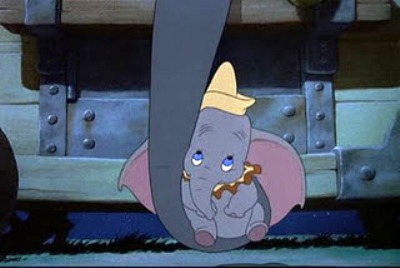 (seriously, with a friend like him, you don't need any more friends) — but the whole thing just seemed very light to me at the time. Watching it now I can see why I might have thought that. Naturally the animation is lovely, but in an attempt to keep costs down so the film could turn a profit, it's done in a far simpler, less detailed fashion than Disney's usual output from that period; indeed, at times it almost resembles a Fleischer cartoon more than a Disney. The backgrounds, though bright and colorful, are rendered in watercolors. Also, one of the most interesting characteristics of the film, which I can fully appreciate now, was one that I didn't care for when as a kid — namely, that the film's protagonist never speaks. Although Disney is iconic for anthropomorphizing animals in films such as Pinocchio, Bambi and even this one (interesting that all the other elephants have lots of dialogue), Dumbo's two main characters never speak. Except for a brief moment where Mrs. Jumbo tells the stork the intended name of her new arrival, Dumbo and his mom always look, sound and more or less act like real elephants, and I just wasn't as impressed by that as a youngster as I am now. In fact, all of the scenes between mother and son, which kind of bored me as a boy, now are the most emotionally resonant scenes in the picture.
Of course, Dumbo is not without its flaws. Everyone remembers "Heigh-Ho" from Snow White or "When You Wish Upon a Star" from Pinocchio, but Dumbo's songs, with the possible exception of the Oscar-nominated "Baby Mine," are pleasant enough but not especially memorable. Furthermore, in recent years some rather serious charges of racism have been leveled at the film for, among other things, its portrayal of the gang of crows who help Dumbo learn to fly as a bunch of jive-talkin' black stereotypes. (Ironic for a movie that is essentially a condemnation of prejudice.) In spite of these shortcomings, however, Dumbo turned out to be the huge hit that everyone hoped for and, as I mentioned earlier, has become a classic and a hallmark in animation. It also is, ostensibly, Disney's personal favorite of his animated features. Since very little can be said about the film that hasn't already been said in the 70 years that have elapsed since its release, I'll finish this anniversary tribute with a list of moments that I love from it (or that simply stood out to me during my most recent viewing):


Tweet
Labels: 40s, Animation, Disney, Movie Tributes, Star Wars
TO READ ON, CLICK HERE


