Sunday, July 14, 2013
Summer of '88: Die Hard

“People get involved here, and that’s the thing. If people are patronized, if a film is geared toward a short attention span, then it’ll have a short shelf life. Films that involve that audience and embrace that ‘once upon a time’ principle have a chance of lasting…We’re storytellers and we forget that at our peril.” — Alan RickmanBy Edward Copeland
That Rickman quote appears on the text commentary on one of the many DVD versions circulating for the movie Die Hard. When Die Hard exploded into theaters in the summer of 1988, I didn't rush to see it. The reviews were mostly mixed to negative, and the action films of that era were low on my priority list (especially since, back then, I had to pay to see movies). When I finally ventured out to see it, it had moved to a dollar theater and a group of my bored friends and I decided to check it out for lack of better options. We arrived late, so it wasn't until seeing the film again on video that I caught the foreshadowing of the airplane passenger advising John McClane (Bruce Willis), as they're arriving in L.A., that the best way to readjust to Earth after a long flight involves removing your shoes and socks and making fists with your toes in carpeting. It takes more than one viewing of Die Hard to truly appreciate how much work and thought went into its construction and composition and to catch all the allusions (not just the obvious ones) to classic films.
Labels: 80s, Movie Tributes, Rickman, Willis
TO READ ON, CLICK HERE


Monday, July 01, 2013
What acting is all about — unemployment
BLOGGER'S NOTE: This post originally appeared Dec. 17, 2007. I'm re-posting it as part of The Sydney Pollack Blogathon occurring through July 22 at Seetimaar — Diary of a Movie Lover

By Edward Copeland
Film directing isn't often compared to completing a jigsaw puzzle, but that analogy seems most apt in describing exactly what Sydney Pollack accomplished with Tootsie, which opened 25 years ago today. What began with a story by Don McGuire and Larry Gelbart and a screenplay by Gelbart became the center of a fight between the film's star, Dustin Hoffman, and Pollack, and ended up with countless other notable scribes (among them Barry Levinson and Elaine May) taking shots at the script. In the end, the final screen credit went to McGuire and Gelbart for story and Gelbart and Murray Schisgal for screenplay, but Pollack's ability to weave the best parts of all those drafts and spin them into cinematic and comic gold deserved a credit all its own. If that feat of wizardry weren't enough, Pollack also turns in a fine supporting role as well, playing Hoffman's character's agent.

When originally released, while I loved Tootsie, being 13, my 1982 heart still belonged to E.T.: the Extra-Terrestrial, released months earlier. However, as the years went by, Tootsie grew in my estimation while E.T. became almost too schmaltzy to watch, so much so that I haven't returned to it in nearly 20 years. Perhaps my view would change again now. What makes Tootsie soar, like many other films, comes from the fact that its greatness proves impermeable to even a picky, critical mind such as mine. I mean, how exactly does "Dorothy Michaels" (Hoffman's drag alter ego) get paid when she doesn't exist and wouldn't have a Social Security number? Of course, the finale, involving an accident that forces the soap to redo a show live at the last minute seemed ridiculous to me even upon first viewing, but why question the logic of a scene that uproariously funny and with a payoff so huge? The brilliant ensemble cast, in addition to Pollack's patch job, holds Tootsie together.
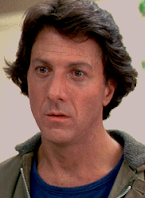 Hoffman, deservedly, gets a lot of credit for his drag creation, but I don't think he gets the kudos for Michael Dorsey that are due him. It might seem as if Hoffman's reputation for being difficult, makes Michael a cakewalk, but he not only plumbs
 Dorsey's depths for comedy and pathos, but convincingly depicts his transformation from a horny prima donna to a more sensitive man (At one point, Michael acknowledges that he thinks Dorothy is smarter than he is). The opening sequences, depicting his problems as an actor who hasn't had a job in two years, come stocked full of laughs, such as the scene where his agent George Fields (Pollack) explains the reasons he his client can't get work while Michael insists in his own defense "that nobody does vegetables like me" to justify his firing from a commercial where he played a tomato. Hoffman and Pollack don't carry the film alone. Ironically, the weakest link in the cast, Jessica Lange, was the only person to win an Oscar, a consolation prize for losing lead actress in Frances that year to Meryl Streep in Sophie's Choice. Frankly though, Lange wasn't even the best supporting actress in Tootsie, though her character provides the key to the film's serious undercurrent of exploring the way men sometimes treat women in all ranges from employment discrimination to out-and-out misogyny, but the message never interferes with the laughs.
Teri Garr's great turn as Michael's acting colleague and friend Sandy did earn an Oscar nomination, but she lost to Lange, as did my personal choice for 1982, Glenn Close in The World According to Garp. Garr, however, clearly led the field of women in Tootsie (hell, I could make a case for Doris Belack as the soap's producer over Lange). Always clandestinely stuffing food into her purse at parties, having Michael "enrage" her for an audition and her go-for-broke rage explosion when she learns Michael has been deceiving her provide some of the film's most priceless moments. The ensemble contains so many great supporting turns by the men in the film, I'm almost afraid to single anyone out. In addition to Pollack, viewers receive the gifts of George Gaynes as the soap's aging star, wholly dependent on cue cards and
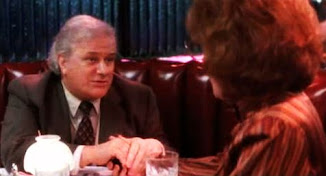 prompters, who hits on every new cast member; Dabney Coleman doing the chauvinistic asshole character he practically patented in the early 1980s as the soap's director; the great Charles Durning, who earned an Oscar nomination that year, albeit for The Best Little Whorehouse in Texas with his single but memorable scene singing and dancing a little "Sidestep," as Lange's widowed father who falls for Hoffman's Dorothy and longs for the days when men and women "were what they were." His proposal scene proves both funny and touching (though the comic gem resulting from this sequence comes later when Michael tells his agent about the offer and Pollack asks him what he said, with genuine happiness that makes him forget about the truth of the situation for a moment. Along with Belack, another fine supporting female in the cast happens to be a young Geena Davis who plays another actress on the soap and shares a dressing room with Dorothy.
The prize for the best of the supporting men though goes to the great Bill Murray, in a role that legend says he improvised completely and I believe it. He plays Jeff, Michael's playwright roommate, and if he truly did come up with all his own dialogue, what a treasure trove he unleashed. (My personal favorite: When he says he wishes he had a theater that was only open when it rained.) Even though Tootsie lags a bit when it takes a detour to Durning's farm, it's forgivable since those scenes give the film part of its heft and allows for even more comic grace notes. How Tootsie lost to the noble but limp Gandhi (including for original screenplay, patch job or no patch job) still baffles me.
Tweet
Labels: 80s, B. Levinson, Dabney Coleman, Durning, Dustin Hoffman, Geena Davis, Gelbart, Glenn Close, J. Lange, Movie Tributes, Murray, Streep, Sydney Pollack
TO READ ON, CLICK HERE
Wednesday, May 29, 2013
"A game-legged old man and a drunk. That's all you got?" "That's what I got."
BLOGGER'S NOTE: This post is part of The Howard Hawks Blogathon occurring through May at Seetimaar — Diary of a Movie Lover

By Edward Copeland
After the opening credits end, Howard Hawks begins Rio Bravo with a sequence somewhat unusual for a Western, or, for that matter, any film made in 1959. On the other hand, beneath the surface of Rio Bravo
 you'll find many more layers than your typical Western. The scene almost plays as if it hails from the silent era as a haggard-looking Dean Martin tentatively enters a large establishment providing libations, meals and even barber services. Martin's character's face tells you that he wants to resist liquor's siren call, but he's weak and he struggles. A man at the bar (Claude Akins) spots him after purchasing his own drink. He flashes Martin a smile, gestures at his glass and asks with his eyes whether Martin desires one. Aside from the film score and the ambient noise of the establishment's environs, no dialogue emanates from any of the characters that Hawks' camera focuses upon in this scene that's practically choreographed in mime. Martin's character replies with an eager but wordless "yes" and Akins
 tosses a coin — into a spittoon — laughing with his buddies (the closest thing to a human voice heard in this building) as Martin's character's desperation outweighs his pride and he
 gets down on his hands and knees, prepared to retrieve the money from the spit-out tobacco. Before he can, a foot kicks the spittoon out of the way and he looks up to see John Wayne towering above him in a great low-angle shot looking up at The Duke and giving him one of his many great screen entrances. His character's arrival also sets several of the story's strands into motion. You see, the man (Akins) taunting Dude (Martin) happens to be Joe Burdette, the blackest sheep of a powerful clan that gets away with practically anything it wants to do. Joe oversteps this time though as he continues to tease Dude after a brawl that includes the man who kicked over the spittoon, Sheriff John T. Chance (Wayne), Dude's boss when he's sober enough to carry out duties as deputy. Joe and his buddies keep harassing Dude when a sympathetic patron (Bing Russell) steps in, urging Joe to cut it out — still through gestures, not words. Joe Burdette doesn't take criticism well and shoots the unarmed man to death and exits the building to stagger to another saloon. Chance soon enters behind and speaks the film's first line, "Joe, you're under arrest."
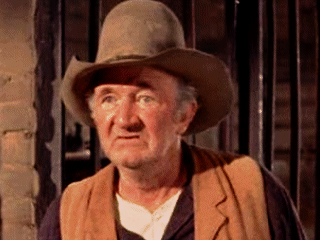
Burdette and his buddies don't take the sheriff seriously and seem intent to mow the lawman down when a still-shaky Dude arrives as backup, having composed himself enough to shoot the guns out of a couple of bad guys' hands. Seems Dude might have a drinking problem, but he's also Chance's deputy, and the lawmen take Joe into custody where the movie's waiting game begins. Can Chance, Duke (always battling the battle) and Chance's other deputy, Stumpy (Walter Brennan), aging and falling apart physically, keep Joe locked up until the U.S. marshal's arrival several days later to take Joe into custody for trial before Burdette's clan tries to free him In a few short minutes of screentime, the main story that drives most of Rio Bravo's 2 hours and 20 minutes has been set. Sideplots await, but all basically will converge in the main thread. Though nearly 2½ hours long, Hawks doesn't rush his film along, yet somehow he still keeps it moving and it holds its length incredibly well.
I'm not reporting earth-shattering news when I inform readers that Howard Hawks belongs to that select group of directors who excelled in every genre he attempted. One thing that sets Rio Bravo apart from Hawks' other works is that, while it resides in the Western genre, it snatches from many others — romantic comedies, war tales, detective stories, social dramas, even musicals. As film critic Richard Schickel says on a commentary track for Rio Bravo, Hawks liked saying
 that he loved to steal from himself. He'd do it again by practically remaking Rio Bravo as El Dorado eight years later, once again starring Wayne but with Robert Mitchum in the Dean Martin role. The plots diverge enough, as do the characters, (Mitchum plays a drunken sheriff as opposed to deputy while Wayne took on the role of gunfighter for hire helping a rancher's family get even with the rival rancher who killed their patriarch) to prevent it from being an exact facsimile. (Another shared aspect between the two films: screenwriter Leigh Brackett, who co-wrote Rio Bravo with Jules Furthman and wrote El Dorado by herself.) In the case of Rio Bravo, dialogue in the romantic sparring between Chance (Wayne) and possibly shady lady Feathers (Angie Dickinson) sounds lifted directly from To Have and Have Not, which Furthman co-wrote with William Faulkner. The relationship between Chance and Stumpy seems like a continuation of the one Wayne's Dunson and Brennan's Groot had in Red River, only minus Dunson's darkness. Part of Howard Hawks' greatness grew from his gift of swiping things from his previous films while changing the recipe just enough to make it fresh — a skill other self-plagiarists such as John Hughes never pulled off since they lacked Hawks' inherent talent, skill and imagination.
Hawks originally intended the action and imagery that runs beneath the opening credits to be its own sequence in the film, but later decided just to use it to accompany the list of cast and crew to a quieter piece of Dimitri Tiomkin's score before the set piece in the bar officially launches Rio Bravo. He films the footage of a wagon train caravan at such a distance that you can't readily identify its contents or characters, but a careful viewer connects it later as being the approach of the wagon train of Pat Wheeler
 (Ward Bond), who turns up shortly after the opening incident. At first, the audience can't be certain how to take the arrival of this man and his large crew, which includes a young gunman named Colorado (played by Ricky Nelson, teen idol and sitcom star at the time, who turns in a solid performance). For all the audience knows, these could be people sent to break Joe Burdette out of the jail where Stumpy handles most of his supervision. Dude, by then sobered up and handling more of his duties as deputy to Chance's Presidio County Texas sheriff, stops the wagon train in the middle of the town's main thoroughfare and insists that Wheeler and all of his men remove their weapons and hang them on a fence. They'll be free to collect the firearms when they depart the town again. (Wouldn't you love to watch Rio Bravo with the National Rifle Association's head flunky Wayne LaPierre and see how he reacts to law enforcement working for John Wayne in a Western that enforcing those rules?) Wheeler and those in his employ grumble at first, but soon comply. When Chance shows up, we realize he and Wheeler go way back on friendly terms, though Wheeler advises the sheriff they need to be careful where they store their cargo — it contains a large amount of dynamite. (Paging Chekhov if you don't think that's going to pay off somewhere down the road.)
 Labels: 50s, Angie Dickinson, Blog-a-thons, Dean Martin, Faulkner, Hawks, John Hughes, Mitchum, Movie Tributes, W. Brennan, Wayne
TO READ ON, CLICK HERE
"My Rifle, My Pony and Me" (Rio Bravo tribute, Part II)

While Sheriff Chance took on a major task by arresting Joe Burdette and incarcerating him in his small Presidio County jail, with Stumpy left to guard the bad guy most of the time, he still bears the responsibility for maintaining the law elsewhere in his town, something he accomplishes through street patrols and his nights staying at The Hotel Alamo (of all the names to pick) run by Carlos Robante (Pedro Gonzalez Gonzalez) and his wife Consuela (Estelita Rodriguez). One night, a poker game piques his interest as two of the players (Angie Dickinson, Walter Barnes) fit the profile of two hustlers warned about on handbills. After a cursory investigation, Chance arrests the woman, who goes by the name Feathers. She declares her innocence and Chance fails to find the crooked cards on her after she's left the table following a huge winning streak. When he returns though, he does find the stacked deck on the man, who has raked it in since her departure and tells him to return his ill-gotten gains and be on the morning stagecoach. He suggests that Feathers do the same, but she decides to stick around.

That next day, the Burdettes arrive as expected, led by Joe's smooth brother Nathan (John Russell, the gaunt, veteran actor of mostly Westerns where he usually played the villain. His second-to-last film was as the cold-blooded killer in Clint Eastwood's Pale Rider). He asks Chance why the streets appear so full of people. Chance offers no explanation, but suggests that perhaps gawkers came to town, drawn to the possibility that the Burdettes planned to put on a show.

Chance makes his nightly trek to the Hotel Alamo. When he gets there, Spencer pulls him over for a drink. The wagon master has heard of the trouble Chance faces. "A game-legged old man and a drunk. That's all you got?" Spencer asks in disbelief. "That's what I got," Chance responds. Spencer offers himself and his men as help against the Burdettes, but the sheriff expresses reluctance to take responsibility for others. He does ask about the confident young gunman Colorado that Spencer has hired. If he is as good as he thinks he is and lacks the family ties of the older men, Chance would be willing to take him on if Colorado agrees. Spencer calls Colorado over, but the young man politely declines, earning Chance's respect for being smart enough to know when to sit out a fight. Not long afterward, while Feathers flirts again and Chance urges her to get on the morning stage, shots ring out on the street and Spencer falls dead. Later, Nathan Burdette makes his first visit to see his brother Joe, despite Stumpy's withering verbal assaults, at the jail. First, Nathan wants the sheriff to
 explain why his brother looks so beat up. "He didn't take too kindly to being arrested for murder," Chance tells Nathan while Joe denies the shooting was murder. Nathan asks how Chance can be so certain or, at the very least, why Joe isn't being tried where the alleged murder occurred. Chance nixes that idea, content to let the U.S. marshal handle Joe Burdette and try him elsewhere. Nathan silkily makes no overt threats, but certainly implies that Joe might not remain in the Presidio County jail by the time that marshal shows up, especially if the sheriff relies on a drunk and an old man as his backup. Chance isn't in a mood to hide his cards. "You're a rich man, Burdette. Big ranch, pay a lot of people to do what you want 'em to do. And you got a brother. He's no good but he's your brother. He committed 20 murders you'd try and see he didn't hang for 'em," the sheriff spits out. "I don't like that kinda talk. Now you're practically accusing me," Nathan Burdette says, but Chance continues. "Let's get this straight. You don't like? I don't like a lot of things. I don't like your men sittin' on the road bottling up this town. I don't like your men watching us, trying to catch us with our backs turned. And I don't like it when a friend of mine offers to help and 20 minutes later he's dead! And i don't like you, Burdette, because you set it up." If war wasn't brewing before, it was now.
The murder of Spencer fully incorporates the last two major characters more fully into the film and the action. With his boss dead, Colorado at first finds himself content to take his pay from the slain wagon master's possessions and remains determined to mind his own business. Once he witnesses some more of the Burdette brutality, Colorado decides to join up and Chance deputizes him. Colorado becomes part of the team and helps Chance escape an ambush, an ambush for which the sheriff seems prepared to occur, quickly pumping off rounds from his rifle. "You always leave the carbine cocked?" Colorado asks. "Only when I carry it," Chance replies. Originally, Hawks opposed casting Ricky Nelson, though the director admits he probably boosted box office. He had sought someone popular with young viewers, but felt Nelson — who turned 18 during filming — lacked age and experience for the part. Hawks had chased Elvis Presley for the role, but as often was the case, Col. Tom Parker demanded too much money for his client and the Rio Bravo production had to take a pass. The pseudo love affair between Feathers and Chance also heats up, though Wayne's discomfort with the romantic scenes with Dickinson is readily apparent. Wayne felt uneasy about the 25-year age gap between him and Dickinson. On top of that, nervous studio bosses wanted no implication made that Chance and Feathers ever sleep together. Double entendres and innuendos abound, but truthfully more sparks fly in brief scenes between Martin and Dickinson and Nelson and Dickinson than ever produce friction in the Wayne-Dickinson scenes. What becomes most interesting about the relationship between Feathers and Chance is Feathers' transformation into the sheriff's protector, keeping watch over him as he sleeps to make sure that no Burdette makes a move on him.


You don't need to know how the rest of Rio Bravo unfolds. Besides, part of what makes the film so fascinating and more than your ordinary Western comes from the multiple tones Hawks balances. A viewer seeing Rio Bravo for the first time couldn't positively predict what mood shall prevail by the final reel: light-hearted, tragic, heroic, romantic, some combination of those elements. At any given moment, you might change your mind. Most of this uncertainty reflects the nature of the character Dude. With the possible exception of Feathers, almost every other character in the film stays on a static path. Dude captures our attention the most because of the dynamics within him. Will he maintain the upper hand in his battle with booze or will he fall off the wagon again and if he does, what consequences does that
 have for the others? Even sober, he's prone to depression, low self-esteem and self-pity. Still, he can croon a song or be a crack shot. A part this multifaceted requires a talented actor and back when Rio Bravo was made, Dean Martin wouldn't be one of the first names to jump to your mind. However, in the years 1958 and 1959, soon after the end of his partnership with Jerry Lewis, Martin turned in two impressive performances (perhaps three, but I haven't seen 1958's The Young Lions). In 1958, he gave a great turn as a professional gambler Bama Dillert in Vincente Minnelli's adaptation of the James Jones novel Some Came Running starring Frank Sinatra and Shirley MacLaine. He followed that with his astoundingly good work in Rio Bravo. While Martin continue to make entertaining films, for some reason those two years stand out as an aberration and he never got roles as good as Bama Dillert or Dude again.
Hawks' behind-the-scenes collaborators provided as much of the magic of Rio Bravo as its cast. From Russell Harlan's crisp and lush cinematography to Tiomkin's score that complements Hawks' leisurely pacing well. Tiomkin also teamed with lyricist Paul Francis West for the film's songs — "Cindy" and "My Rifle, My Pony and Me" in the extended musical interlude by Dude, Stumpy and
 Colorado as well as the title song. Reportedly, Wayne joined the singing at one point until they decided it inappropriate for the sheriff to take part (and also because the Duke allegedly could not carry a tune). In another instance of borrowing from past work, at Wayne's suggestion, Tiomkin actually reworked the theme to Red River into the song "My Rifle, My Pony and Me." Tiomkin also composed "Degüello," aka "The Cutthroat Song," which the Burdettes play to psych out the good guys guarding Joe. The film claims the music comes from Mexico where Santa Anna's soldiers played it continuously to unnerve those holed up inside the Alamo. Wayne loved the music and the story so much, even though the tale wasn't true, he used it in his film The Alamo the following year. His screenwriting team of Jules Furthman and Leigh Brackett both had worked with Hawks as a team and separately before and after Rio Bravo. Previously, Furthman and Brackett co-wrote Hawks' classic 1946 take on The Big Sleep. Furthman also co-wrote Come and Get It and To Have and Have Not and did a solo turn on Only Angels Have Wings. The legendary Brackett, despite her extensive screenwriting work, made a name for herself as a novelist, largely in the male-dominated field of science fiction. In Schickel's commentary, he refers to Brackett as an example of a real life Hawksian woman. In fact, before her death, the last screenplay she co-wrote was The Empire Strikes Back. In another non-Hawks project, she returned to Philip Marlowe when she wrote the screenplay for Robert Altman's The Long Goodbye. In addition to the Hawks titles already mentioned for Brackett, she also wrote the screenplay for 1962's Hatari! and co-wrote 1970's Rio Lobo. The DVD commentary also includes director John Carpenter, who names Hawks as his favorite director, and paid tribute to Leigh Brackett by naming the sheriff in the original Halloween after her.
Tweet
Labels: 50s, Altman, Angie Dickinson, Blog-a-thons, Dean Martin, Eastwood, Elvis, Hawks, Jerry Lewis, John Carpenter, MacLaine, Movie Tributes, Sinatra, Star Wars, W. Brennan, Wayne
TO READ ON, CLICK HERE
Friday, May 17, 2013
Enough beef for hungry cinephiles
BLOGGER'S NOTE: This post originally appeared Sept. 30, 2008. I'm re-posting it as part of The Howard Hawks Blogathon occurring through May 31 at Seetimaar — Diary of a Movie Lover

By Edward Copeland
Has any filmmaker shown mastery in more genres than Howard Hawks? Sixty years ago today, Hawks released one of his best Westerns (not a motel) in Red River, which also gave John Wayne one of his best roles and Montgomery Clift a notable early screen appearance.

Hawks made other great Westerns (most notably Rio Bravo, which also featured Wayne and Walter Brennan), but Red River, despite its abrupt climax, remains my favorite with its tale of a long cattle drive, surrogate father-son conflict and unmistakable gay subtext. Wayne admittedly was a limited actor, but he always was at his best when he played a character steeped in darkness and obsession such as Thomas Dunson here or Ethan Edwards in John Ford's The Searchers. He's helped immeasurably by getting to act opposite the young Clift, the antithesis of acting style when compared to Wayne. Hawks' direction of the film itself truly amazes, especially in the many scenes of the huge numbers of cattle, all done in the days without the easy out of CGI (A scene of the drive even earned a shoutout in Peter Bogdanovich's great 1971 film The Last Picture Show). He also manages to include plenty of his trademark humor, mostly through the ensemble of supporting character actors led by Brennan (whose character loses his false teeth in a poker game) and including Hank Worden (the decrepit waiter in Twin Peaks for those unfamiliar with the name) who gets plenty of throwaway lines such as how he doesn't like when things go good or bad, he just wants them to go in between.
Hawks even manages to toss in what may be an example of the ultimate Hawksian woman with Joanne Dru as Tess Millay, who doesn't let a little thing such as an arrow stop her from nagging a man with questions. Hawks astounds viewers to this day with his versatility among genres: Westerns, screwball comedies, musicals, war films, noirs, sci-fi — pick a genre and Hawks probably took it on and scored. It's a mystery to me why his name isn't brought up more by people other than the most obsessive film buffs. Red River isn't my favorite Hawks, but it's one of his many great ones and continues to entertain after 60 years.
Tweet
Labels: 40s, Bogdanovich, Clift, Hawks, John Ford, Movie Tributes, Twin Peaks, W. Brennan, Wayne
TO READ ON, CLICK HERE
Thursday, May 16, 2013
Leave the rooster story alone. That's human interest.
BLOGGER'S NOTE: This post originally appeared Jan. 18, 2010. I'm re-posting it as part of The Howard Hawks Blogathon occurring through May 31 at Seetimaar — Diary of a Movie Lover

By Edward Copeland
The list of remakes that exceed the original is a short one, especially when the original was a good one, but there never has been a better remake than Howard Hawks' His Girl Friday, which took the brilliance of The Front Page and turned it to genius by making its high-energy farce of an editor determined by hook or by crook to hang on to his star reporter by turning the roles of the two men into ex-spouses. Icing this delicious cake, which marks its 70th anniversary today, comes from casting Cary Grant and Rosalind Russell as the leads.
Words open His Girl Friday declaring that it takes place in the dark ages of journalism when getting that story justified anything short of murder, but insists that it bears no resemblance to the press of its day, 1940 in this case. What saddens me today is, despite the ethical lapses and underhandedness and downright lies
 committed by the reporters in this version (and really all versions based on the original play The Front Page by Ben Hecht and Charles MacArthur, themselves once Chicago journalists), their energetic devotion to capturing the story seems downright heroic compared to the herd mentality and lack of intellectual curiosity we see exhibited most of the time today by pack journalists such as the White House press corps. It's really why the first two film versions of the play are the only ones that work. The 1931 Lewis Milestone adaptation starring Adolphe Menjou definitely belonged to its time and Hawks' take with its inspired twist came along close enough to remain relevant. When Billy Wilder tried to remake the original in 1974 as a period piece with Jack Lemmon and Walter Matthau, it fell flat because in the era of Vietnam and Watergate, journalists actually existed in a moment of heroism for their profession. The 1988 disaster Switching Channels returned to the His Girl Friday model with Burt Reynolds and Kathleen Turner and tried to set it in the world of cable news but the only update they came up with was hiding the fugitive in a copy machine instead of a rolltop desk.
Each time I write one of these anniversary tributes, no matter how many times I've seen the film in question (and I can't count that high when we're discussing Friday, I try to watch the movie again, in a quest for fresh thoughts and reminders of lines that may have slipped my mind. In nearly every, case I notice something new (and with the rapid-fire pace of Friday's dialogue, remembering them all borders on impossible). What stood out as I
 started this salute wasn't just the work-a-day newshounds it depicts compared to the state of the industry today but the social subtext emerged more prominently this time. It's not that I've missed or ignored it before, but it's the light-speed comic hijinks that keeps me coming back. The story's main focus may concern Walter Burns (Grant), that sneaky editor of the Morning Post, trying to keep his ex-wife Hildy Johnson (Russell) from leaving the paper and his life to wed insurance agent Bruce Baldwin, who looks like that fellow in the movies, you know, Ralph Bellamy (who fortunately plays Bruce). However, the story Walter uses to keep his hooks into Hildy concerns that of Earl Williams (John Qualen), a man who killed a cop and received a ticket on a bullet train to the gallows by a politically hungry Republican mayor with an eye on unseating the Democratic, anti-death penalty governor, despite the fact the reporters and many others believe Earl's mental
 illness should stop his hanging. Qualen, a solid character actor in many films, and Mollie Malloy (Helen Mack), a woman who befriended Earl prior to the slaying and who the tabloids misrepresent as his lover and a prostitute, stand apart as the only characters in this screwball farce who play it completely straight. (In an all-time bit of miscasting, in the Wilder remake, Carol Burnett got the Mollie Malloy role. Of course, the nearly 50-year-old Jack Lemmon also was engaged to the 28-year-old Susan Sarandon in that film.) His Girl Friday requires neither Qualen nor Mack to garner laughs like every other character. As the courthouse reporters behave particularly cruelly to Mollie at one point, only Hildy comforts her. "They ain't human," Mollie cries. "I know," Hildy sympathizes. "They're newspapermen." Hildy realizes the jobless Earl spent too much time listening to socialist speeches in the park and his fascination with the concept of "production for use" led to his fatal error.
Social message aside, it's the earth-shattering cosmic comic chemistry of Grant and Russell, aided by Bellamy's perfect innocent foil and countless supporting vets. (One of them, Billy Gilbert, plays Mr. Pettibone (Roz holds his tie in the photo above) and I wish I could have found a good closeup photo of him because I think it's hysterical how much 9/11 mastermind/terrorist asshole Khalid Sheikh Mohammed resembles Gilbert in KSM's arrest mugshot.) The lines come fast and furious. While many do come from the original Hecht-MacArthur play, Hawks gets the credit for the film's amazing speed (though screenwriter Charles Lederer deserves more kudos). Still, in the end, Cary and Roz make the dialogue sizzle and Grant's physical touches serve as a master class in comic movement on film. Watch every little bounce he makes as Hildy kicks him beneath the table when he's trying to get things past poor Bruce and you'll crack up every time. Originally, I was writing down all my favorite lines, planning to try to work them all into this tribute, but then I thought: Maybe not everyone has seen His Girl Friday, even after 70 years,
_04.jpg)
Tweet
Labels: 40s, Bellamy, Burt Reynolds, Cary, Hawks, Hecht, K. Turner, Lemmon, Matthau, Menjou, Milestone, Movie Tributes, Remakes, Roz Russell, Susan Sarandon, Wilder
TO READ ON, CLICK HERE
Monday, May 07, 2012
Love Story

— Orson Welles on Make Way for Tomorrow
By John Cochrane
No one film dominated the 1937 Academy Awards, but with the country still in the grips of the Great Depression and slowly realizing Europe’s inevitable march back into war, the subtle theme of the evening in early 1938 seemed to be distant escapism — anything to help people forget the troubled times at home. The Life of Emile Zola, a period biopic set in France, won best picture. Spencer Tracy received his first best actor Oscar, playing a Portuguese sailor in Captains Courageous, and Luise Rainer was named best actress for a second year in a row, playing the wife of a struggling Chinese farmer in the morality tale The Good Earth.
Best director that year went to Hollywood veteran Leo McCarey for The Awful Truth. McCarey’s resume was impressive. He paired Stan Laurel and Oliver Hardy together as a team, and he had directed, supervised or helped write much of their best silent work. He had collaborated with W.C. Fields, Charley Chase, Eddie Cantor, Mae West, Harold Lloyd, George Burns and Gracie Allen — almost an early Hollywood Comedy Hall of Fame. He had also directed the Marx Brothers in the freewheeling political satire Duck Soup (1933) — generally now considered their best film. The Awful Truth was a screwball comedy about an affluent couple whose romantic chemistry constantly sabotages their impending divorce that starred Irene Dunne, Ralph Bellamy — and a breakout performance by a handsome leading man named Cary Grant — who supposedly had based a lot of his on-screen persona on the personality of his witty and elegant director. Addressing the Academy, the affable McCarey said “Thank you for this wonderful award. But you gave it to me for the wrong picture.”
The picture that McCarey was referring to was his earlier production from 1937, titled Make Way for Tomorrow — an often tough and unsentimental drama about an elderly couple who loses their home to foreclosure and must separate when none of their children are able or willing to take them both in. The film opened to stellar reviews and promptly died at the box office — being unknown to most people for decades. Fortunately, recent events have begun to rectify this oversight as this buried American cinematic gem turns 75 years old.

Based on Josephine Lawrence’s novel The Years Are So Long, the film opens at the cozy home of Barkley and Lucy Cooper (Victor Moore, Beulah Bondi), who have been married for 50 years. Four of their five children have arrived for what they believe will be a joyous family dinner — until Bark breaks the news that he hasn’t been able to keep up with the
 mortgage payments since being out of work and that the bank will repossess the property within days. Bark and Lucy insist that they will stay together, regardless of what happens. With little time to plan, the family decides that, for the time being, Lucy will move to New York to live with their eldest son George’s family in their apartment, while Bark will be 360 miles away — sleeping on the couch at the home of their daughter Cora (Elisabeth Risdon) and her unemployed husband Bill (Ralph Remley). For the film's first hour or so, we see Bark and Lucy trying to adjust to their new surroundings. While George (an excellent Thomas Mitchell) tries to be as pleasant and accommodating to his mother as possible, his wife Anita (Fay Bainter) and daughter Rhoda (Barbara Read) display little patience and dislike the disruption of their routines. Meanwhile, Bark spends his time walking around his new hometown, looking for a job and visiting a new friend, a local shopkeeper named Max Rubens (Maurice Moscowitz).
Many filmmakers develop a visual signature that dominates their work, but McCarey employs a fairly basic and straightforward style, using group and reaction shots as well as perceptive editing that places the emphasis on the actors and the story. Working with screenwriter Vina Delmar, McCarey creates set pieces that blend touches of light comedy and everyday drama that feel so correct and truthful that audiences likely feel a sometimes uncomfortable recognition with them. Often, this stems from McCarey's use of improvisation to sharpen his scenes before filming them. If short on ideas, he would play a nearby piano on the set until he figured out what to do. This practice creates a freshness that, as Peter Bogdanovich points out, gives the impression that what you’re watching wasn't planned but just happened. A large part of the film’s greatness also comes from the cast, headed by Moore and Bondi as Bark and Lucy. Both theatrically trained actors, vaudeville star Moore (age 61) and future Emmy winner Bondi (age 48), through the wonders of make-up and black and white photography prove completely convincing as an elderly couple in their 70s.

Moore performs terrifically as the blunt, but loving Bark. Bondi gives an even better turn as Lucy. In one scene, representative of McCarey’s direction and Bondi’s performance, Lucy inadvertently interrupts a bridge-playing class being taught by her daughter-in-law at the apartment by making small talk and noticing the cards in players’ hands. She’s an intrusion, but by the end of the evening, after being abandoned by her granddaughter at the movies and returning home, she takes a phone call in the living room from her husband. Critic Gary Giddins notes that as the class listens in to her side of the conversation, she becomes highly sympathetic — and the scene now flips with the card students visibly moved and feeling invasive of her space and privacy. Then there’s the crucial scene where Lucy sees the writing on the wall and offers to move out of the apartment and into a nursing home without Bark’s knowledge, before her family can commit her — so as not to be a burden to them anymore. She shares a loving moment with her guilt-ridden son George. (“You were always my favorite child,” she sincerely tells him.) His disappointment in himself in the scene’s coda resonates deeply. Lucy’s character seems meek and easily taken advantage of when we first meet her, but she’s really the strongest person in the story. It’s her love and sacrifice for her husband and family that give the movie much of its emotional weight, and the unforgettable final shot belongs to her.
McCarey and Delmar create totally believable characters and it should be pointed out that while friendly, decent people, Bark and Lucy, by no means, lack flaws. Bark doesn't make a particularly good patient when sick in bed two-thirds of the way through the story, and Lucy stands firm in her ways and beliefs — traits that can annoy, but people can be that way. Even the children aren’t bad — they have reasons that the audience can understand — even if we don’t agree with their often seemingly selfish or preoccupied behavior. This delicate skill of observation was not lost on McCarey’s good friend, the great French director Jean Renoir, who once said, “McCarey understands people better than anyone in Hollywood.”
As memorable a first hour as Make Way for Tomorrow delivers, McCarey saves the best moments for the film’s third act. Bark and Lucy meet one last time in New York, hours before his train departure for California to live with their unseen daughter Addie for health reasons. For the first time since the opening scene, the couple finally reunites. The last 20 minutes of the picture overflows with what Roger Ebert refers to in his Great Movies essay on the film as mono no aware — which roughly translated means “a bittersweet sadness at the passing of all things.” Regrets, but nothing that Bark and Lucy really would change if they had to do everything over again.

Throughout the story, the Coopers often have been humiliated or brushed off by their children. When a car salesman (Dell Henderson) mistakes them for a wealthy couple and takes them for a ride in a fancy car, the audience cringes — expecting another uncomfortable moment — but then something interesting happens. As they arrive at their destination and an embarrassed Bark and Lucy explain that there’s been a misunderstanding, the salesman tactfully assuages their concerns. He allows them to save face, by saying his pride in the car made him want to show it off. Walking into The Vogard Hotel where they honeymooned 50 years ago, the Coopers get treated like friends or VIPs — first by a hat check girl (Louise Seidel) and then by the hotel manager (Paul Stanton), who happily takes his time talking to them and comps their bar tab. Bark and Lucy's children expect their parents at George’s apartment for dinner, but Bark phones them to say that they won't be coming.

At one point, we see the couple from behind as they sit together, sharing a loving moment of intimate conversation. As Lucy leans toward her husband to kiss him, she seems to notice the camera and demurely stops herself from such a public display of affection. It’s an extraordinary sequence that’s followed by another one when Bark and Lucy get up to dance. As they arrive on the dance floor, the orchestra breaks into a rumba and the Coopers seem lost and out of place. The watchful bandleader notices them, without a word, quickly instructs the musicians to switch to the love song “Let Me Call You Sweetheart.” Bark gratefully acknowledges the conductor as he waltzes Lucy around the room. Then the clock strikes 9, and Bark and Lucy rush off to the train station for the film’s closing scene.
Paramount studio head Adolph Zukor reportedly visited the set several times, pleading with his producer-director to change the ending, but McCarey — who saw the movie as a labor of love and a personal tribute to his recently deceased father — wouldn’t budge. The film was released to rave reviews, though at least one reviewer couldn’t recommend it because it would “ruin your day.” Industry friends and colleagues such as John Ford and Frank Capra were deeply impressed. McCarey even received an enthusiastic letter from legendary British playwright George Bernard Shaw, but the Paramount marketing department didn’t know what to do with the picture. Audiences, still facing a tough economy, didn’t want to see a movie about losing your home and being marginalized in old age. They stayed away, while the Motion Picture Academy didn’t seem to notice. McCarey was fired from his contract at Paramount (later rebounding that year at Columbia with the unqualified success of The Awful Truth), and the film seemed to disappear from view for many years.

The movie never was forgotten completely though. Screenwriter Kogo Noda, who wrote frequently with the great Japanese director Yasujiro Ozu, saw the film and used it as an inspiration for Ozu’s masterpiece Tokyo Story (1953), in which an elderly couple journey to the big city to visit their adult children and quietly realize that their offspring don’t have time for them in their busy lives — only temporarily getting their full attention when one of the parents unexpectedly dies during the trip home. Ironically, Ozu’s film also would be unknown to most of the world for decades, until exported in the early 1970s, almost 10 years after the master filmmaker’s death. Tokyo Story, with its sublime simplicity and quiet insight into human nature now is considered by many critics and filmmakers to be one of the greatest movies ever made — placing high in the Sight & Sound polls of 1992 and 2002. In the meantime, Make Way for Tomorrow slowly started getting more attention in its own right, probably sometime in the mid- to late 1960s. Although the movie never was released on VHS, it occasionally was shown enough on television to garner a devoted underground following. More recently, the movie played at the Telluride Film Festival, where audiences at sold out screenings were stunned by its undeniable quality and its powerful, timeless message. Make Way for Tomorrow was finally was released on DVD by The Criterion Collection and was selected for preservation by the Library of Congress on the National Film Registry in 2010.
The funny phenomenon of how audiences in general dislike unhappy endings, and yet somehow our psyches depend on them always proves puzzling. Classics such as Casablanca (1942), Vertigo (1958), The Third Man (1949 U.K.; 1950 U.S.) and even the fictional romance in a more contemporary hit such as Titanic (1997) wouldn't carry the same stature or mystique in popular culture if they somehow had been pleasantly resolved. Life often disappoints and turns out unpredictably, messy and frequently filled with loss. Even though many people claim they don’t like sad stories, it comforts somehow to know that we aren’t alone — that others understand and feel similarly as we do about life’s experiences. It’s what makes us human.
Make Way for Tomorrow serves as many things. It’s a movie about family dynamics and the Fifth Commandment. Gary Giddins points out that it’s also a message film about the need for a safety net such as Social Security — which hadn't been fully implemented when the
 picture was released. It’s a plea for treating each other with more kindness — in a culture that increasingly pushes the old aside to embrace the young and the new, and it’s one of the saddest movies ever made. At its most basic level, it’s a tender love story between two people who have spent most of their lives together — knowing each other so well that words often seem unnecessary. However you choose to look at it, Make Way for Tomorrow remains one of the greatest American films — certainly a strong contender for the best classic Hollywood movie that most people have never heard of. Leo McCarey would create highly successful hits that were more sentimental later on in his career — including the enjoyable romance Love Affair (1939) and its subsequent color remake An Affair to Remember (1957), starring Cary Grant and Deborah Kerr. He also would direct Bing Crosby as a charismatic priest in 1944’s Going My Way (7 Oscars — including picture, director, actor) and its superior sequel, 1945’s The Bells of St. Mary’s (8 nominations, 1 win), co-starring Ingrid Bergman, but he never forgot about Make Way for Tomorrow, which remained a personal favorite until the day he died from emphysema in 1969. Leo McCarey did not live to see his masterpiece fully appreciated, but that wasn't necessary. In 1938, he knew the film’s value.
It’s a marvelous picture. Bring plenty of Kleenex.
Tweet
Labels: 30s, Bellamy, Bogdanovich, Capra, Cary, Deborah Kerr, Ebert, Fields, Ingrid Bergman, Irene Dunne, John Ford, Luise Rainer, Marx Brothers, McCarey, Movie Tributes, Oscars, Renoir, T. Mitchell, Tracy, Welles
TO READ ON, CLICK HERE
Monday, April 30, 2012
A vision for all — perhaps not meant for one man alone

"I was most jealous of Truffaut — in a friendly way — with Jules and Jim. I said, 'It's so good! How I wish I'd made it.' Certain scenes had me dying of jealousy. I said, 'I should've done that, not him.'" — Jean Renoir
By Edward Copeland
From the first time I saw Jules and Jim in high school, the movie became a personal touchstone and remains one as we mark its 50th anniversary. Truthfully, I know the parallels my teen eyes recognized between myself and others in my life then didn't mirror the characters on screen as closely as my imagination wanted to believe, but as that fantasy faded away, I began to appreciate more of the artistry of a film that I already loved. In addition to what Jules and Jim contains within its frames, the movie also forged the connection I've always felt with François Truffaut.
If you discovered, probably early in your life, that your genetic makeup left you susceptible to artistic impulses of some kind — it needn't matter whether that creative bent took the form of movies, writing, art, music, whatever — the odds weighed heavily toward you falling for at least one Catherine in your lifetime. (Now, I'm speaking from the point-of-view of a straight male. I wouldn't dare presume straight female or gay perspectives, though I've witnessed similar dynamics secondhand.) As far as we go, the Catherines of the real world function like those purple-hued bug zappers hanging on summer porches and inevitably drawing us like moths to their pulsating light and our doom — and we wouldn't trade one goddamn miserable minute of it if it meant losing a single second of the joy. This isn't a new phenomenon:
 F. Scott had his Zelda and Tom had his Viv during the same era when Jules and Jim takes place. (A brief aside: I think Tom sent me a personal message from the past when he published The Waste Land in 1922 and penned those lines, "April is the cruellest month.") To casual and outside observers, proclaiming that Catherine must be crazy comes rather easily and mounting a counterargument against that assumption makes for a steep climb. Yes, our real world Catherines come with a fair amount of mental instability, as do we, but without our neuroses and idiosyncrasies, we probably wouldn't be drawn to these wild, wonderful, wounding women in the first place. Of course, Henri-Pierre Roché's novel and François Truffaut's film take the men's point-of-view, even when filtered through Michel Sobor's narration, so Jules and Jim aren't portrayed as being as unstable as Catherine. The closest the male friends come shows through Jules' fear and neediness at times. As for the Catherines of the real world, people do have the capacity for change, no matter what David Chase might believe, and can end up being vital parts of your life even as you become the one holding the monopoly on the madness in the friendship. It's a cliché, but it originates from truth: Most of the best art stems from suffering. Anyone remember Billy Joel during the years when he and Christie Brinkley were happily married? Jules and Jim, for me at least, represents a cinematic temple to that idea. Of course, it also begs the question that if misery breeds great art, why in the hell haven't I accomplished something of note?
 Jules and Jim made its U.S. premiere April 23, 1962, the same year the film made its initial debut in France on Jan. 23. Though it marked Truffaut's third feature film as a director following The 400 Blows and Shoot the Piano Player, Jules and Jim was only the second of his films to reach U.S. movie theaters. Shoot the Piano Player, though it opened elsewhere in 1960, wouldn't get its U.S. release until July 23, 1962. (Like Jules and Jim, The 400 Blows reached U.S. shores in the same year, 1959, that Truffaut's directing
 debut did elsewhere, just a few months later.) As I remind people as often as possible, all opinions about movies are subjective. Before beginning my lovesick tribute to what I think holds the title as the true masterpiece born of the French New Wave, I feel that I shouldn't pretend all critics agreed about Jules and Jim and I'd allow one to have his say before I got started. "With the years, I've sometimes felt the reputation of Jules and Jim is a bit exaggerated," this former critic said to Richard Roud, then-director of the New York Film Festival, in October 1977 on a television program called Camera Three. The ex-critic added, "and that I was too young when I made it." That appearance happened to be François Truffaut's first time on American television. I guess you can remove the man from the role of film critic but you can't take the critic out of the man. "I continue to re-read the book every year. It was one of my favorites. I've often felt that the film was too decorative, not cruel enough, that love was crueler that that," Truffaut went on to tell Roud. Now, François, don't be so hard on yourself. For those who haven't seen Jules and Jim, I'll be vague, I think you could call the film's dénouement fairly devastating. Besides, most recognize (or know from experience) that cruelty usually crosses love's path at some point. On top of that, the subject cuts too close to Truffaut for him to judge. Jules and Jim may speak to me in personal ways, but that isn't why the film rests among my 20 favorite films of all time. As John Houseman used to claim in TV commercials about how Smith Barney made money, Jules and Jim got that rank on my list "the old-fashioned way. It earned it."
While I knew that Jules and Jim originated as a novel by Henri-Pierre Roché, it wasn't until I obtained the Criterion edition that I learned that Roché loosely based it on his relationship with Franz Hessel, a German writer who translated Proust into German (as Jim does in the film) and Helen Grund, who became Hessel's wife and herself translated Vladimir Nabokov's Lolita into German. Legend has it that Roché also introduced Gertrude Stein to Pablo Picasso through his original career as an art dealer and art collector. Though the circles that Roché circulated in preceded the time period of Woody Allen's recent Midnight in Paris, he did know many of the literary and artistic figures depicted in Allen's fantasy. The real-life coincidences that brought Truffaut and Roché together border on the extraordinary. Truffaut
 stumbled upon the novel in a secondhand bookstore and it led to a letter-writing relationship between himself and Roché where the young critic Truffaut promised that if he ever made movies, he would bring Jules and Jim to the screen. Jules and Jim was the first novel that Roché ever wrote — which he did at the age of 74. His second novel, also autobiographical, Two English Girls and the Continent, eventually became the source material of a later Truffaut film, Two English Girls. Two English Girls, sort of the inverse of Jules and Jim with two women pining for the same man, marks its 40th anniversary this year but unfortunately, like too many other great films I'd like to write about this year, no proper DVD copy has been made for rental or at a reasonable price, the same situation that in the past two years has befallen other films such as Steven Soderbergh's Kafka, Barbet Schroeder's Barfly with its great performances by Mickey Rourke and Faye Dunaway and two of John Sayles' very best films — City of Hope and Matewan. Who said only old classics become lost films? With the constant format changes, some never made the leap from pan-and-scanned VHS. A true travesty, but I've digressed from the subject at hand. Roché didn't live long enough to see the movie of his first novel, but the film version brought best-seller status to his book that it never saw in his lifetime. One aspect that didn't occur to me until I re-watched the movie for this tribute: Not only has the film reached its 50th anniversary this year, 2012 also means a full century has passed from where its story begins in 1912.
The film starts in blackness — literally if you were in a French-speaking country or watching without subtitles. You hear a voice (Jeanne Moreau's as Catherine, though we wouldn't know that yet) say, "You said, 'I love you.' I said, 'Wait.' I was about to say, 'Take me.' You said, 'Go.'" Then, quite abruptly, Truffaut launches us into the film's imagery with a bouncy spirit, playing music beneath the credits that seems to herald that a carnival lies ahead courtesy of prolific film composer Georges Delerue, who scores the entire film, though it won't all sound like this energetic romp which accompanies clips, some of scenes that will arrive later in the film, others that just fit the tone of the piece — such as Jules and Jim jokingly fencing with brooms. As with many others, Delerue would collaborate with Truffaut on nearly all of his films, having first worked on Shoot the Piano Player. We'll also get a glimpse of an hourglass, its sand pouring through to clue us in advance of the importance the passage of time serves in the story. We see our first swift sightings of Moreau as Catherine, though her actual entrance
 into the film doesn't occur immediately. While Catherine certainly acts as the catalyst for most events in Jules and Jim, her name isn't in the title for a reason. At its heart, Jules and Jim spins a story of friendship between two men. Oskar Werner's Jules acts as the outsider, the Austrian in Paris, until Henri Serre's Jim takes him beneath his wing, acting, quite literally, in the early days of their acquaintance as Jules' wingman. As with many Truffaut films, Jules and Jim employs a narrator (Michel Subor) not only to for exposition purposes but because Truffaut wanted to maintain as much of Roché's prose as possible in the adaptation he co-wrote with Jean Gruault. Jules and Jim's friendship begins when Jules, the foreigner in Paris, approaches Jim blindly to see if the Frenchman might wrangle him an invitation to the Quatres Arts Ball. Jim succeeds and a friendship blossoms as they search for a slave costume for Jules to wear to the event. From that, the men began to teach one another the other's language and culture and shared their poems,
 which they'd translate into the other's native tongue. Before long, the men saw each other every day, talking endlessly, finding common ground such as, the narrator informs us, "a relative indifference toward money." The omniscient voice also tells the viewer, "They chatted easily. Neither had ever had such an attentive listener." Jules though lacks luck when it comes to love in Paris, even of the transitory kind while Jim draws women to him as if he were a magnet. Jim finds getting women so easy that he willingly hands some off to Jules, including a musician. "They were in love for about a week." This early setup runs us through the women, most of whom bear little importance to the story so they receive scant attention from the film. Desperate for some amorous action, Jules even ignores Jim's warning to stay away from the "professionals" only to learn that he should have trusted Jim's word and avoided the disappointment. This changes one evening, when the men encounter a woman named Thérèse (Marie Dubois) seeking refuge from her loutish anarchist boyfriend who blames her for a shortage of paint that he thinks will make people believe that anarchists don't know how to spell.
What separates Jules' and Jim's relationship with Thérèse from what lies ahead with Catherine comes from Thérèse clearly indicating a preference between the two men, in this case Jules. Though Dubois' role takes up very little screen time, she does prove a charmer (and remember that U.S. moviegoers, at the time of Jules and Jim's release, had yet to see her film debut as the waitress Lena in love with Charles Aznavour's piano-playing Charlie in Truffaut's second feature, Shoot the Piano Player). When they return to the house,
 Jules acts the part of the gentleman, offering Thérèse his bed while he sleeps in a rocking chair, but romance occurs quickly and rectifies that situation. That hourglass first spotted in the opening credits reappears and Jules explains that he prefers it to a clock. When all the sand passes through to the bottom, that means it's time to go to sleep, he explains. She simply smiles and tells him he's sweet. Thérèse demonstrates for Jules her trick that she calls "the steam engine." She places a lit cigarette in her mouth and puffs out her cheeks like a blowfish and then chugs in a circle in the bedroom until she has reached Jules' chair, one of the many, recurrent visuals of circular imagery that Truffaut utilizes in the film. You shouldn't feel bad for Jim — he's busy bedding his frequent lover Gilberte (Vanna Urbino) and making excuses to depart her bed before the sun rises despite her request to lie beside her for a complete night for a change. Jim nixes that idea, saying that if they did that they might as well be married and she'd expect him to stay the next night as well. Gilberte expresses skepticism at his excuse, especially when he suggests that she imagine he's working at a factory, betting that his plan involves sleeping until noon. Later that night, Jules, Jim and Thérèse go to a café and no sooner have they sat down that after making eyes at another
 man, Thérèse asks Jules for some change to play music. He complies, she takes the money and the man follows her. Thérèse asks if she can stay with him that night and the two depart. Jules starts to stand in outrage, but Jim grabs his arm and he sits back down. "Lose one, find 10 more," Jim advises. Jules admits that he didn't love Thérèse. "She was both mother and doting daughter at the same time," Jules says, sighing that he doesn't have luck with Parisian women. He shows Jim photos of some of the women back home he loves, presenting them in order of preference and contemplating returning for one of them in a couple of months if the situation in France doesn't change. However, Jules lacks a photograph of one named Helga so he sketches her in broad strokes on the café's table. Jim tries to buy the table, but the establishment's owner refuses unless he purchases the entire set.

That night, they go to the home of Jules' friend Albert (played by Serge Rezvani, a renaissance artist, though he prefers the term multidisciplinarian, who billed himself as Bassiak here and added the first name Boris when taking credit as the composer of "Le Tourbillon" that Moreau memorably sings) to see his slides of ancient sculptures he found around the country. (Somehow it slips my mind between viewings of Jules and Jim how little dialogue the actors actually get to speak openly in the film in favor of voiceover. For example, when Jules and Jim enter Albert's place, they exchange introductions out loud but then Henri Serre as Jim doesn't simply ask Oskar Werner's Jules, "Who's Albert?" Instead, we hear Michel Subor's narrator say, "Jim asked" — When I first heard
 this the first few times I watched the film, it sounded as if Subor narrated this entire dialogue. After hearing it for the umpteenth time, it sounds as if Subor merely starts it the Serre asks in voiceover, "Who's Albert?" with Werner's voice replying, "A friend to artists and sculptors. He knows everyone who'll be famous in 10 years." I can't say with 100% certainty which interpretation stands as the correct answer. I've looked for verification, but found none. Jules' response tipped me in that direction because Werner's voice can be distinguished easily from Subor's while Serre's falls in the same vocal range.) One slide of a stone face particularly strikes the friends' fancy — and Subor definitely
 describes this, informing the viewer, "The tranquil smile of the crudely sculpted face mesmerized them. The statue was in an outdoor museum on an Adriatic island. They set out immediately to see it. They both had the same white suit made. They spent an hour by the statue. It exceeded their expectations. They walked rapidly around it in silence. They didn't speak of it until the next day. Had they ever met such a smile? Never. And if they ever did, they'd follow it. Jules and Jim returned home, full of this revelation. Paris took them gently back in." Later, Jules and Jim hit the gym where they spar with some kickboxing. Jules inquires about the progress of Jim's book. Jim tells him he thinks it's going well and will turn out to be very autobiographical and concern their friendship. He proceeds to read Jules a passage. "Jacques and Julien were inseparable. Julien's last novel had been a success. He had described, as if in a fairy tale, the women he had known before he met Jacques or even Lucienne. Jacques was proud for Jules' sake. People called them Don Quixote and Sancho Panza and rumors circulated behind their
 backs about their unusual friendship. They ate together in small restaurants, and each splurged on the best cigars to give the other." Jules finds the writing beautiful and offers to translate it to German. Jim's brief allusion in his novel to "rumors" about his friendship with Jules marks the closest the film ever comes to implying anything homoerotic between the men. While Jules and Jim opened the door for many cinematic variations on your standard triangle, we'd still need almost 40 years before Y Tu Mama Tambien. As the guys shower, Jules announces that his cousin wrote him and three girls that studied with him in Munich would be visiting Paris — one from Berlin, one from Holland and one from there in France, Jules plans to host a dinner for the visitors the next night. Neither friend has any idea who Catherine happens to be yet or that she will be the French girl in that group of visitors. This Quixote and Sancho soon will be tilting at a very shapely and unpredictable windmill that will change the course of all three lives forever. The next night, when Catherine (Moreau) descends the stairs and lifts the lace netting covering her face, her resemblance to the sculpture stuns Jules and Jim, something Truffaut emphasizes through quick cuts, and Michel Subor's narration, and the young men will keep the oath they made to that statue — they've found that smile, now they must follow it.
 While for me, Jules and Jim stands at the high watermark of the French New Wave films, I know many others won't agree and when you look objectively at the story of Jules and Jim, it may employ many of that movement's techniques but many aspects of Truffaut's film set it apart from its cinematic brethren such as its period setting and a time span that covers more than two decades. Jules and Jim also caused moral uproars about the open relationships among the various characters in the film (and though Jules, Jim and Catherine might be involved simultaneously, they never took part in a ménage à trois). In a funny way, the 1962 film forecast the free love movement to come later that decade except its source material happened to be a semiautobiographical novel set in the early part of the 20th century. The prurience though lies in the mind of the fuddy duddy because part of what makes Jules and Jim so special comes from Truffaut's refusal to pass any judgment, be it positive or negative, upon the behavior of his characters. Despite the director's own criticism many years down the road that the film isn't cruel enough when it comes to love, the three main characters do suffer by the end but he doesn't paint it as punishment for their sins.
Tweet
Labels: 60s, Books, Criticism, Dunaway, Fiction, Fitzgerald, Foreign, Mickey Rourke, Movie Tributes, Ray Top 100, Renoir, Sayles, Soderbergh, Truffaut, Woody
TO READ ON, CLICK HERE


