Wednesday, May 09, 2012
Such a little word, but oh, the difference it makes!

As people who pay attention to these sorts of things know, for quite some time the Broadway season, and by that I mean in terms of Tony Award eligibility, usually ends toward the end of April with the awards given in June. However, that hasn't always been the case. For example, though A Funny Thing Happened on the Way to the Forum opened May 8, 1962, when it received its Tony nominations they belonged to the crop of 1963 Tony nominations with winners handed out nearly a year later on April 28, 1963. Furthermore, Forum's May 8 opening came a mere nine days after the previous Tony Awards held April 29, 1962 for 1961's Broadway season. On the musical side,
 Frank Loesser's How to Succeed in Business Without Really Trying, which had just opened Oct. 14, 1961, hauled away the most awards. It won best musical, best actor (Robert Morse), best featured actor (Charles Nelson Reilly), best director of a musical (Abe Burrows), best authors of a musical (Burrows, Jack Weinstock and Willie Gilbert), best producers of a musical (Cy Feuer and Ernest Martin) and best conductor and musical director (Elliot Lawrence). In fact, the only nomination that How to Succeed lost was Loesser's as best composer. Richard Rodgers won for No Strings, his first solo effort since Oscar Hammerstein's death. Loesser did receive the consolation of a Pulitzer Prize for his work — one of several parallels between his career and Stephen Sondheim's, one of which we'll be coming upon shortly. As far as when the Tonys switched their eligibility dates and started holding the awards in June, as near as I can determine (cross your fingers, I'm forced to use Wikipedia as a source), the first time that happened was 1977, the year before CBS began carrying the broadcast which it has ever since, heaven help theater fans (at least as far as the past decade or so has gone). I must note, as I return to the subject at hand, that the photo at the top as well as the one inset in this lead both came from the camera of Tony Walton, the scenic and costume designer of the 1962 production. The inset photo shows his model of what the set should look like when complete. Both come courtesy of Walton via an interview he did with examiner.com.
 When those 1963 Tony nominations did come out, A Funny Thing Happened on the Way to the Forum, despite having opened so long ago, did very well. It received a nomination for best musical, competing against Little Me, Oliver!, and Stop the World — I Want to Get Off. Sondheim might have felt guilty about lying to David Merrick but he produced the latter two musicals that would be competing against Forum. Merrick also garnered a nomination as best producer of a musical with Donald Albery for their work on Oliver! where the duo faced off against Hal Prince for Forum as well as last year's winners, Cy Feuer and Ernest Martin, for Little Me. Larry Gelbart and Burt Shevelove picked up a nomination as best authors of a musical for Forum and one of the competition happened to be another veteran from the days of writing for Sid Caesar on television like Gelbart once did — Neil Simon for Little Me. which Simon happened to
 write specifically for Caesar, who would face off against Zero Mostel's Pseudolus in Forum, Anthony Newley in Stop the World — I Want to Get Off and Clive Revill in Oliver! for lead actor in a musical. Lionel Bart (Oliver!) and Leslie Bricusse and Newley (Stop the World — I Want to Get Off) rounded out the author of a musical category. The venerable George Abbott's work on Forum earned him a best director of a musical nomination and he also landed a nomination as best director of a play for Never Too Late, a comedy that actually ran longer than Forum. In the musical direction category, others receiving recognition were Peter Coe (Oliver!), John Fearnley (Brigadoon) and Feuer and Bob Fosse (Little Me). (At right, we see Abbott at the 1994 Tony Awards at the age of 106 braced by Gwen Verdon and Jean Stapleton. He died in January 1995 at 107.) David Burns as the leering, patrician Senex and Jack Gilford as the nervous slave Hysterium took half the nominations in featured actor in a musical for Forum. Filling out the category were a young David Jones as the Artful Dodger in Oliver! The recently passed Jones became better known when he changed his first name to Davy and became part of The Monkees. Sven Svenson in Little Me took the fourth slot. The final nomination that A Funny Thing Happened on the Way to the Forum garnered was for Ruth Kobart, who played Senex's suspicious wife Domina, as featured actress in a musical alongside Virginia Martin (Little Me), Anna Quayle (Stop the World — I Want to Get Off) and Louise Troy (Tovarich). Sondheim's score got snubbed and wasn't nominated in the category for best composer and lyricist. The composers of the other three nominated best musicals made the cut but the fourth slot went to Milton Schafer and Ronny Graham for Bravo Giovanni, a musical that ran only 76 performances and received only two other nominations for choreography and conductor and musical director. Sondheim, who didn't get nominations for his lyrics for West Side Story or Gypsy either, remained in the ranks of those never nominated for Broadway's top honor. Boy, would he make up for that later.
When Tony night 1963 arrived, A Funny Thing Happened on the Way to the Forum won almost every award for which it was nominated. Mostel defeated Gelbart's former boss. Gilford lost — but he lost to co-star Burns. Abbott won for director of a musical, though he didn't take the prize in the play category. Gelbart and Shevelove took the prize for their book, so Gelbart beat his former co-worker as well. Prince won as producer. The American Theatre Wing crowned the show best musical meaning David Merrick went 0 for 2 in that category. Other than Gilford, the only Forum nominee that didn't score was Ruth Kobart, who lost to Anna Quayle for Stop the World — I Want to Get Off. (Shown in the photo at left are the 1963 winners in the lead acting categories. From left, Mostel, Vivien Leigh, lead actress in a musical for Tovarich; Uta Hagen, lead actress in a play and Arthur Hill, lead actor in a play, both for Who's Afraid of Virginia Woolf?) In Meryle Secrest's biography, Stephen Sondheim: A Life, the composer described watching the ceremony from home. Secrest writes, "Prince…thanked Abbott, Gelbart and Shevelove. Gelbart and Shevelove, who won book, thanked each other, Abbott and Prince. 'Nobody mentioned me on the program at all. As far as they were all concerned, my friends, my colleagues, I did not exist. That's what really hurt,' Sondheim said. 'Hal was the only one — Hal called me the next day and apologized. He said, 'I'm sorry, kid. I should have mentioned you and I didn't.'" The lack of acknowledgment did lead to some rifts such as when the hurt Sondheim confronted Shevelove and Shevelove lashed out at him, saying his songs almost killed the show before it ever got to New York. In an anecdote that appears in Secrest's book and Sondheim's Finishing the Hat, Sondheim shares the tale of a special letter he received that lifted his spirits, though it's unclear when Sondheim got the correspondence. Secrest's book says he received the letter shortly after Forum opened, but places the story right after the Tony story. Sondheim doesn't date it at all, though he adds the detail that Frank Loesser told him in the letter that he commiserated with him because he remembered the reception for his first Broadway musical, Where's Charley?, and wanted to let Sondheim know how good he thought the score of Forum was. Specifically quoted in both books, Loesser wrote, "Sometimes even a composer's working partners, to say nothing of the critics, fail to dig every level and facet of what he is doing. But I know, and I wanted you to know that I know."
Before I discuss the revivals, I've been looking for a place to work in talk of the song "Love, I Hear" somewhere and failed to accomplish my mission. Now, I adore "Comedy Tonight" and "Everybody Ought to Have a Maid" but I can't believe that no one mentions "Love, I Hear" anywhere. Hell, "Bring Me My Bride" found its way into a review. While Sondheim criticizes himself for being clever instead of funny, I love his wordplay (and he can't hide his pride in Finishing the Hat about the alliterative string of double consonants that he pulled off in one line of the song, "Today I woke too weak to walk." Links: First "Love, I Hear" from 1962 original cast recording; Second "Love, I Hear" and "Bring Me My Bride" both from 1996 revival original cast recording.

Like most Sondheim shows, Forum tends to add and subtract songs in later versions. After missing out on the original production because they wouldn't let him wear his glasses, that didn't seem to be a problem anymore and Phil Silvers took the role of Pseudolus in the show's first major revival, directed by Burt Shevelove himself. It actually started in October 1971 for a 47 performance run at the Ahmanson Theater in Los Angeles. I mentioned in the last part that Reginald Owen played Erronius. The cast also included Larry Blyden as Hysterium, veteran comic actor Carl Ballantine as Marcus Lycus and, the second biggest name in the show after Silvers, Nancy Walker in the role of Domina. In fact, she felt she needed another solo so Sondheim wrote "Farewell" for her. One of the courtesans happened to be Ann Jillian. The only song dropped was Philia's "That'll Show Him" and "Echo Song" put in its place. When they made the move to Broadway and opened March 30, 1972, Walker and Jillian didn't travel with them and another song got the axe. This time, they excised "Pretty Little Picture." Whatever the Tony eligibility dates were for the 1972 awards were, Forum must have cut it close since the awards were given April 23. Shevelove received a nomination for directing but, ironically, lost to Prince and Michael Bennett for their work on Follies. Silvers won lead actor in a musical and Blyden won featured actor as Hysterium. The revival won two of its three nominations. (They hadn't added a revival category yet.) The show seemed to be doing well until Silvers got sick, reportedly because of "food poisoning." An understudy filled in as they hurried to rehearse Tom Poston as a replacement, but ticket sales fell fast. The show only ran 156 performances and it turned out that Silvers had suffered a stroke. Links: "Farewell" info beneath video; "That'll Show Him" and "Pretty Little Picture" from 1962 cast recording.

When the next Broadway revival arrived in 1996, it did so during the era when the Broadway bug had bitten me badly so I actually got to see it soon after its April 18 opening. I had pretty good orchestra seats — I swear at one point it appeared as if Nathan Lane addressed me personally and we locked eyes at one point. Quite different from the couple of times I bumped into Lane accidentally in Manhattan when he always seemed to be the most annoyed, pissed-off man in the universe. Sure, he hammed it up like crazy as Pseudolus but that's a role that doesn't require nuance and it still won him his first Tony Award. Mark Linn-Baker did fine as Hysterium and, as I mentioned earlier, I got to see the late William Duell as Erronius. Ernie Sabella took on the role of Marcus Lycus and the long-cut song of "The House of Marcus Lycus" finally made the show. Lewis J. Stadlen received a Tony nomination for his portrayal of Senex, but he was out the night I was there so I saw Macintyre Dixon in the role. Mary Testa played Domina. The songs followed the 1962 set with the exception of the addition I mention and continuing to keep "Pretty Little Picture" out of the show, though Lane recorded it for the cast album. Jerry Zaks received a nomination for directing the musical, but lost to George C. Wolfe for Bring in 'da Noise, Bring in 'da Funk. By now, the Tonys did have revival categories but Forum lost to The King & I. The revival made a bit of history when it recast Pseudolus
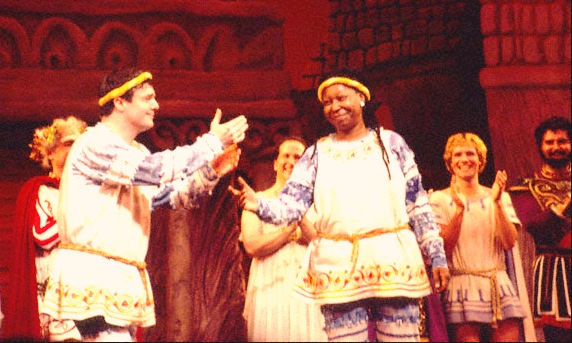 as Lane exited the show by installing Whoopi Goldberg in his place. Casting a woman, let alone an African-American one with Goldberg's reputation, made people wonder what she'd do. Ben Brantley wrote in The New York Times, "The work's authors, Burt Shevelove and Larry Gelbart, and its composer and lyricist, Stephen Sondheim, have always said they made a point of constructing a show true to its ancient sources and free of distracting anachronisms. But the leading role of Pseudolus, the wily slave in pursuit of freedom and a part that demands a manic comic spirit, has inevitably gone to wild-card performers unlikely to resist opportunities for their own shtick. As Mr. Gelbart said, in a recent interview with The Sondheim Review, 'after seeing Zero Mostel recite baseball scores in front of the House of Senex, there's not too much that would surprise me.' So there is Ms. Goldberg, queen of the devilish aside, firmly reminding you of just who she is in the production's opening moments. She finds comic fodder not only in her present personal life, but in her professional life in Hollywood as well.…That this occurs early raises delighted expectations that many audience members have brought with them: Just how bad, as in naughty, is their Whoopi going to be? Of course, others — that nasty breed of theatergoers who find Schadenfreude in seeing big stars blow it — are asking the same question with a different emphasis: Can this movie star-comedian possibly carry a musical? Sorry, guys, she can." Following Goldberg, David Alan Grier took on the role. The second revival ran for 715 performances.
The wreckage in that photo in 1993 represents the remains at the time of the outdoor amphitheater of Butler University in Indianapolis
 that for decades hosted Starlight Musicals every summer. Other cities around the Midwest also received visits from the touring program that would bring concerts, plays and musicals featuring celebrities. From
 the time I was a young child, each summer when we visited my grandma we would take in some shows. Many of the early things we saw tended to be concerts by people such as Mitzi Gaynor, Liberace and the tag team of Jim Nabors and Florence Henderson. In 1979 when I was 10, I got to see my first actual musical. I wish I could locate the program so I'd remember what songs were in that production of A Funny Thing Happened on the Way to the Forum. As a youngster, I tended to be an autograph hound so if we got there early, I'd either stake out the entrance to the backstage or I'd assault the performers after the show. For me, Forum boasted an all-star cast. Playing Pseudolus was none other than Arte Johnson from Rowan and Martin's
 Laugh-In. I'd see him again when I grew up and he appeared in the Broadway revival of Candide. Avery Schreiber portrayed Hysterium, but to me — unfamiliar with his comedy work with Jack Burns — he was the Doritos guy. When I got his autograph after the show, I even brought Doritos with me so when he
 stepped out I had one ready to take a big crunchy bite out of for him. Schreiber raised his hands and said to me, "You got me" then signed my autograph. John Carradine played the role he originated on Broadway, Marcus Lycus. I didn't know that at the time nor did I realize the breadth of his career, but at 73, he looked frail to me, though he'd live another eight years. The final big name belonged to Hans Conried who was cast as Senex. I didn't know at the time that he supplied the voice of Captain Hook in Disney's Peter Pan and I hadn't heard of The 5,000 Fingers of Dr. T. I knew Conried as Wrongway Feldman from an episode of Gilligan's Island. He died less than three years later. Johnson alone remains alive. Schreiber passed away in 2002. That same summer, I saw Rodgers and Hammerstein's Carousel starring a drunk-as-a-skunk Robert Goulet, who exited his limi when he arrived bellowing, "Nobody owns me!" However, that's another story. Tragedy tomorrow, comedy tonight.
Tweet
Labels: Awards, Books, Disney, Fosse, Frank Loesser, Gelbart, Hammerstein, J. Carradine, Music, Musicals, Neil Simon, Phil Silvers, Rodgers, Sid Caesar, Sondheim, Television, Theater Tribute, V. Leigh
TO READ ON, CLICK HERE


Tuesday, May 08, 2012
Something familiar, something peculiar, something for everyone


By Edward Copeland
If I'd located one, a photo of the number "Everybody Ought to Have a Maid" from the first Broadway revival of A Funny Thing Happened on the Way to the Forum in 1972 that starred Phil Silvers as Pseudolus would be resting between the still from the original 1962 production starring (from left to right) John Carradine as Marcus Lycus, Jack Gilford as Hysterium, David Burns as Senex and the magnificent Zero Mostel as Pseudolus, which opened 50 years ago tonight, and the photo below it showing the cast of the second Broadway revival in 1996 that starred (from left to right) Nathan Lane as Pseudolus, Mark Linn-Baker as Hysterium, Ernie Sabella as Marcus Lycus and Lewis J. Stadlen as Senex. (Sadly, not only could I only find two black-and-white photos from the 1972 revival, they
 never made a cast recording either, so we can't hear what Silvers sounded like singing the part. The song link takes you to the 1962 original Broadway cast recording) This musical comedy registers as a theatrical landmark on many levels, the most significant being that it marked the first time Stephen Sondheim wrote both the lyrics and the music for a Broadway musical. Stellar support surrounded Sondheim on all levels: I just named some of the cast, the future director of his landmark 1970s musicals, Harold Prince, produced Forum and the legendary George Abbott (then 75) directed. Jack Cole, currently undergoing a bit of a resurrection in terms of his reputation, choreographed the show and the book, based on three works by Plautus, famed playwright of ancient Rome (c. 254-184 B.C.). came from the pens of Burt Shevelove, a writer-director from early TV, and Larry Gelbart, whose best known credit at the time was as part of the many talented writers working for Sid Caesar on Your Show of Shows but who would go on to turn Robert Altman's MASH into the hit TV series M^A*S*H, be one of the Oscar-nominated (and credited) co-writers of Tootsie, writer of one of the first great HBO movies, Barbarians at the Gate, and author of the book for the Cy Coleman/David Zippel musical City of Angels. On a personal level, Forum holds a special place in my heart because it happens to be the first musical that I ever saw performed live — and Carradine played Marcus Lycus in the production. No, I'm not much older than you thought. I was only 10 at that time and it happened to be a touring summer stock production 17 years after he created the role in the original Broadway show. Somehow, it seems only appropriate that both the first Broadway musical and the last Broadway show I saw featured scores by Sondheim (Passion and Assassins, if you're curious) and so did my irst live musical, even if at 10 I hadn't the slightest notion who Sondheim was.
 Anyone who knows me personally or has read this blog for any length of time realizes what a devoted Sondheim acolyte I am and, without question, A Funny Thing Happened on the Way to the Forum certainly must be considered the most entertaining and crowd-pleasing of all musicals for which he composed the score. As much as I love his music, it's also sadly true in far too many cases that Sondheim's scores often end up being vastly superior to the books of his musicals. With Forum, that cannot be said. When you read what Sondheim wrote in his book Finishing the Hat or heard what others said in reviews, Forum may stand as the rare instance of a Sondheim musical where the book actually supersedes the score in quality. Hey, it was Sondheim's first produced show as composer as well as lyricist after all. Before that, he'd only served both functions on his unproduced musical Saturday Night. His Broadway experiences had been limited to being the lyricist (to Leonard Bernstein's music) on West Side Story and (to Jule Styne's music) on Gypsy. As we begin, I should tell you that if you see a link, by all means click on it. For example, at the top the first link on a song title takes you to the original Broadway cast recording of that song from the 1962 production. Sometimes the links direct you to videos, other times just to the songs, but I wanted to get as much comparison in as I could.
Now, a lot of funny things did occur on the way to the Forum (though, technically speaking, no character in the show ever discusses a trip to that famous location in ancient Rome), but getting the musical to Broadway proved to be an entirely different matter. That trip encountered many bumps that threatened to scuttle the production before Forum ever crossed the New York state line, let alone landed on a Broadway stage. Those associated with the show who still walk among us might be able to look back with some relief now (though in Finishing the Hat, Sondheim does deal himself some heavy self-criticism about his work on the show even now, despite the fact that Forum remains the biggest hit of his career). Sondheim writes that he, Gelbart and Shevelove wrote Forum over a four-year period and that the show went through two major producers, two major directors and a major star before getting to the rehearsal stage. Meryle Secrest's biography, Stephen Sondheim: A Life, spells out the specifics of his statement.
 Secrest quotes Sondheim about the dogged pursuit of Jerome Robbins, who would never settle on a decision about whether to direct the show or not. "The problem was we went to numbers of producers and directors. Jerry Robbins kept saying yes, then no, and then yes, and then no. We went to Joshua Logan and he wanted more naked boys and things like that. I went to Hal (Prince) and he said, 'Listen, kid, you know me. I hate farce.'…David Merrick agreed to produce. Then we were trying to get Jerry Robbins again. And Jerry said, 'OK, I'll tell you what. I'll do it, but I won't do it with David Merrick. You have to get it away from him." In Secrest's book, Sondheim expresses guilt for making up a lie to Merrick about the show not happening and returning an advance to Merrick but it did convince Prince to sign on though Robbins bailed again. Evemtually, they got George Abbott on board as director, but Robbins would return to play a pivotal role. The search for a lead also proved difficult. Their first choice, Phil Silvers, who eventually would portray Marcus Lycus in Richard Lester's 1966 film version and Pseudolus in the 1972 revival, rejected it out of hand because he couldn't perform while wearing his glasses and he'd be unable to navigate without them. Milton Berle agreed to star but when Gelbart and Shevelove turned in a draft of the book that would have run about four hours and received orders to make cuts (which they did), Berle claimed they removed his best stuff and quit. That's how Mostel got the part. In Secrest's book, Sondheim said that years later Mostel would claim that he didn't want to do Forum, but the truth was he needed the work badly and leaped at the part. Mostel's career, as had many others, had suffered during the McCarthy era, the House Un-American Activities Committee hearings and the Hollywood blacklist. One hitch: When Robbins returned to help the troubled show later, he'd face the glare of Mostel because Robbins had served as a friendly witness at the HUAC hearings. To make things worse, one of the names he named was Madeline Gilford, wife of Jack Gilford, who was playing Hysterium. Sondheim though sensed other problems.
Sondheim sought the advice of his friend James Goldman, who at this point in his career had written an original play that made it to Broadway and later would pen both the play and movie of The Lion in Winter as well as the book for Sondheim's Follies. Goldman also did some songwriting, so Sondheim let him look at the book for Forum and listen to the songs he had at that point, when the opening number was a song called "Love Is in the Air." According to what Sondheim wrote in Finishing the Hat, Goldman labeled Gelbart and Shevelove's book as "brilliant" and expressed enthusiasm about Sondheim's score. "The problem," Goldman said, "is they don't go together." Sondheim knew what Goldman meant, but he didn't start doing anything about it right then. Sondheim wrote that he'd been "trained by (Oscar) Hammerstein to think of a song as a one-act play which either intensifies a moment or moves the story the forward.…Prodded by my academic musical training as well as by Oscar, I had become accustomed to thinking of songs as being structured in sonata form: statement, development and recapitulation. For Oscar, it was first act, second act, third act. He tried to avoid writing lyrics that confined themselves to one idea, the traditional approach of every lyricist in the theater and the standard function of songs before he came along and revolutionized the way writers thought about musicals. Show Boat hadn't convinced them but once Oklahoma!, Carousel and South Pacific had become enormous hits, most songwriters converted. The success of those were not entirely beneficial however." In Finishing the Hat, Sondheim noted something Gelbart wrote in his introduction to the published libretto of Forum. "Broadway in its development of musical comedy had improved the quality of the former at the expense of a great deal of the latter," Gelbart wrote.

At one point — frustrated as he tried to unlearn all he knew about composing and fearing he did the show more harm than good — Sondheim even suggested Forum should just be a straight play, but Shevelove said it would be too frenetic and the audience would have no space to breathe (without songs). He informed the composer that the few surviving plays by Plautus sll had songs. Sondheim did end up composing an opening song more in keeping with the spirit of the show that would follow called "Invocation." That also would be dropped but would return in a 1974 farce that Shevelove "freely adapted" from Aristophanes called The Frogs and to which Sondheim added "Instructions to the Audience," which is the only way you can listen to that number now, as in this cut from its 2004 Broadway debut sung by Nathan Lane, Roger Bart and the ensemble. Sondheim writes honestly in his book that he didn't think much of George Abbott's talent or sense of humor — saying they had to explain a joke to the old man once, but Abbott's reputation for saving shows had achieved legendary status and as the show suffered in Washington to scathing reviews and small audiences in big houses (50 people filling 1,000 seats) not laughing a bit, Sondheim described to Secrest the only time Abbott made him laugh "when he said, 'I dunno. You had better call in George Abbott.'" Obviously, that wasn't an option, but given Robbins' worship of Abbott, that made it easier to call him in, though they worried about Mostel's reaction. Part of this can be seen in a clip from a one-man show called Zero Hour written and performed by Jim Brochu and presented at the West Coast Jewish Theatre.
At the time Robbins named names before the House Un-American Activities Committee, he didn't really have a career beyond New York, so his motives always have proved puzzling and he never settled the question before his death, The most pervasive theory, as seen on an American Masters profile on PBS a couple of years ago and detailed in biographies such as this one on The Official Masterworks Broadway Site that he got blackmailed into testifying out of fear that the rather open secret of his homosexuality would be revealed. (He felt secure
 enough to declare himself gay to get out of service in World War II.) The site says, "Robbins was booked for an appearance on Ed Sullivan’s Sunday night variety show (The Toast of the Town), but three weeks before the event, Sullivan, convinced that Robbins was a Communist (he had attended the notorious Scientific and Cultural Conference for World Peace at the Waldorf-Astoria in 1949), canceled the contract. It was Sullivan — threatening at one point to expose him as a homosexual if he did not deliver (directly to Sullivan himself!) a list of names of leftists in show business — who set the machinery in motion that brought Robbins under investigation by the FBI and landed him, two years later, before the House Un-American Activities Committee." Whatever the truth might be, Robbins' uncredited contributions to Forum not only saved the musical, they also changed the way new musicals got their starts forever.
 Earlier in the flirtation process, before tryouts had started and Robbins continued to flirt with the idea of directing the show, he demanded that the principals cast the show, get them all in a room to read the script for him while Sondheim performed the songs. In essence, Robbins invented the theater workshop. Prince and Sondheim actually found it helpful at pointing out flaws in the show and repeated the process with their classic collaborations in the 1970s, though Sondheim doesn't like what the practice ended up evolving into later. "What had begun as a learning experience for the authors became transmogrified into thinly disguised backers' auditions," he wrote in Finishing the Hat. As for his contributions to Forum, as soon as he saw "Invocation," Robbins recognized the problem. Secrest wrote in her biography of Sondheim, According to Sondheim, (Robbins) said, "The opening
 number is killing the show. You open with a charming number and the audience does not know what it's in for, that it's a real farce. You've got to write an opening number that says baggy pants." Sondheim went back to the drawing board and the show's most famous song, "Comedy Tonight," was born and Robbins did the staging, specifically telling Sondheim to leave the jokes to him. Sondheim wrote in Finishing the Hat that Robbins also staged the massive Act II chase, meaning that though he received no official credit, Robbins essentially choreographed the two most important pieces of movement in the show. Still, it isn't as if no one realizes he did it. When Robbins directed his own tribute show, Jerome Robbins' Broadway, re-creating his most famous stage creations the show included "Comedy Tonight" with Jason Alexander taking on the Pseudolus role for that number. In fact, three men have been nominated for Tonys for playing Pseudolus in the three Broadway productions of Forum and a fourth inhabited the role for one scene in another show and all four — Zero Mostel, Phil Silvers, Jason Alexander and Nathan Lane — took home Tony Awards. No other part in theater history can make that claim. The song has attained a level of such popularity you'd be amazed by the permutations you can find on the Internet. In fact, I did a separate post on those alone. Unfortunately, no visual record of the 1962 version exists. Instead, we'll start with a poorly shot bootleg of the 1996 revival starring Nathan Lane as Pseudolus (and Prologus, the character the lead actor plays when introducing the show.) If unfamiliar with the show or what I'm talking about, the song spells it out pretty clearly. I actually got to see the 1996 revival.
After the disastrous runs in Washington and New Haven, Conn., once Robbins had put the bug in Sondheim's ear about the opening number, he writes in Finishing the Hat that "Comedy Tonight" was composed over the course of a weekend. What is it about pressure
 and/or inspiration that some of the greatest works seem to be created when it gets to be crunch time? Most people know the story of Arthur Miller writing the first act of Death of a Salesman in less than a day. Forum opened 50 years ago tonight at The Alvin Theatre where it played through March 7, 1864 when it transferred to The Mark Hellinger Theatre for two months before completing its run through Aug. 29, 1965 at The Majestic Theatre for a total of eight previews and 964 performances. In 1966, a film version with Mostel and Gilford repeating their stage roles and featuring future Phantom of the Opera Michael Crawford opened. Richard Lester, hot off directing The Beatles' films A Hard Day's Night and Help!, helmed the Forum movie. The film eliminated some songs but it also gave Sondheim his first opportunity to design a song specifically for a movie. In Finishing the Hat, he writes about penning a different version of "Free," heard here from the 1962 cast album. He confesses to being a lifelong movie buff and having made some home movies where he especially enjoyed the editing process. (Who doesn't want to see some of these as long as they're suitable for general audiences?) Lester told Sondheim, the composer wrote, that he approved and that his idea would work but Lester never filmed the sequence. "(A)lthough in the finished print, there's a curiously clumsy cut at the place where I'd cued the song, which makes me think it was at least planned. Rereading it now, I wish he had. I didn't get the chance to design another for 26 years, when I wrote two sequences for the movie of A Little Night Music, one of which was filmed the way I wrote it, one of which was not." This clip shows Mostel doing the song during the movie's opening credits.
While Sondheim accepted Shevelove's notion that the musical numbers allowed the audience a chance to take a breath from the chaos consuming the stage, he still disagrees to this day about the suitability of stopping a farce for a song. In Finishing the Hat, he wrote, "Although I do think that the book of Forum is the tightest, most satisfyingly plotted and gratifyingly written farce I've ever encountered, I don't think that farces can be transformed into musicals without damage — at least, not good musicals. The tighter the plotting, the better the farce, but the better the farce the more the songs interrupt the flow and pace. Farces are express trains; musicals are locals." We can't see what Mostel looked like onstage singing "Comedy Tonight" in 1962, but we do have a clip of him performing a condensed version of the song at the 1971 Tony Awards.
"I had to write one-joke songs so I picked spots for them where the situations would supply substance: Songs like 'Impossible' and the drag version of 'Lovely,' which were dramatically static but theatrically funny. My mistake was that in trying to unlearn everything Oscar (Hammerstein) had taught me and write static songs which were nothing more than playful, I felt I had to justify them with cleverness, by juggling with words, leaning on rhymes, puns, alliteration and all the other boilerplate devices of light verse," Sondheim wrote. (Links: "Impossible" and "Lovely (Reprise)" both from 1962 original cast album.) Both in his own book and Secrest's, Sondheim praises producer Hal Prince's faith in the show, saying that most producers who endured the tryouts that Forum did in New
 Haven and Washington would have closed the show down and never brought it to New York. Prince didn't — and it paid off. The show would turn out to be a blockbuster, admittedly one with a few more hurdles to clear before it reached that point. When Robbins came in to help, everyone worried about the volatile Mostel's reaction. However, he'd behaved as a complete professional with nary an explosion up to this point in the chaotic production, according to Secrest's book. As they hurriedly rehearsed "Comedy Tonight" in New York, the stress weighed on the actors as Sondheim recounted in Secrest's book. "'We got to the afternoon of the first preview with our opening number, the one we hoped would change the show. And we were rehearsing and Zero kept screwing up his lines.' So once when Robbins stopped to consult with Tony Walton, the set designer, Sondheim went down to the footlights — 'I never, never give an actor a critical note in front of other people' — to correct one of Mostel's lines. 'Right, right, right,' Mostel said impatiently. They began again, and again Robbins stopped. Mostel was still making mistakes. 'And I said, "Please, I know you've got a lot on your mind, but it's the plural, not the singular." "Yeah. Yeah." The third time, Jerry stops again — 'Zero, it's the plural!' — and Mostel says in a booming voice that fills the entire theater and makes everyone start and turn around, he says, "Well, maybe if you'd write me a funny line, you cocksucker!" In front of everybody.' There was a silence that lasted for about four seconds. 'And in the back of the house, Mr. Abbott went, "All right, from the top please" and clapped his hands." Sondheim goes on to describe how Abbott defuse the tension that quickly and he realized that was part of the man's greatness. He also believes that Mostel made him the scapegoat for the anger he wanted to hurl in Robbins' direction.
In wrapping up this tribute's first half, I must praise the invention of Twitter, which introduced me to a man who not only witnessed the original production of Forum (as well as other original Broadway shows such as South Pacific with Mary Martin and Ezio Pinza, Fiddler on the Roof, also starring Mostel and featuring Bea Arthur, Bert Convy, Leonard Frey and Austin Pendleton and, the one that makes me green with envy, Ethel Merman in Gypsy — with Jack Klugman along as Herbie), but whose father became Mostel's doctor and, because of similar backgrounds, eventually the actor's good friend. Pietr Hitzig, also a doctor, wrote me briefly about his memories of those days. "I am 70 years old and as a NYC child had no idea what fantastic theater I was seeing.…Zero died at only 62 years old and had his most productive years destroyed by the witch hunters at the HUAC but is immortal for Fiddler, Forum and The Producers.…Nobody can play any of those roles today without remembering the bushy eyebrows and satanic leer," Hitzig wrote. On Twitter, Hitzig tweeted that his father saw Fiddler on the Roof at least 100 times. Imagine how inexpensive Broadway tickets cost to allow that back in the 1960s. I only paid to see one Broadway show twice (Rent) and saw another a second time because one ticket came to me as a freebie (Ragtime). (Piotr corrected me after I posted this that his father didn't pay all those times. He got free tickets.) "My father was a renowned Park Avenue doctor but lonely as hell as was Zero. They, children of the shtetl loved each other like brothers. Both were funny but had an angry side that alienated their families. After a busy day, rather than come home, my dad would head for Broadway and stand backstage as his idealized childhood in Fiddler was played out once again," Hitzig wrote. In The New York Times archives, I found a funny story that did illustrate Mostel's tendency to get riled. The British comedian Frankie Howerd, who would play Pseudolus in the London premiere of Forum in fall 1963, came to see the U.S. version earlier in 1963. Seated in the front row, Howerd tended to cover his mouth when amused so Mostel misinterpreted that he wasn't laughing at the show at all. "He is not laughing." the article says Mostel complained between numbers. The next day, Howerd, in an apologetic tone, insisted that he enjoyed the show. "I'm not a laugher. I don't lean back and flash my teeth. Actually, if anyone was frightened that night it was me, seeing how good Mostel was," Howerd told Louis Calta at The Times.
Tweet
Labels: Altman, Arthur Miller, Awards, Beatles, blacklist, Books, Gelbart, H. Prince, Hammerstein, HBO, J. Carradine, J. Robbins, Merman, Music, Musicals, Phil Silvers, Sid Caesar, Sondheim, Theater Tribute
TO READ ON, CLICK HERE
Puttering all around the house

It occurs to me that I haven't bothered to even attempt to summarize the plot of A Funny Thing Happened on the Way to the Forum, Partly, that's because Stephen Sondheim's song "Comedy Tonight" spells out most of the characters pretty well, but mainly it's because the shenanigans that Larry Gelbart and Burt Shevelove cooked up out of surviving Plautus works contain so many complications that it would
 prove damn difficult to synopsize. However, I do feel that one character in particular — Erronius — deserves separate mention since he didn't get a song of his own. In Finishing the Hat, Sondheim provides the lyrics for a cut song that had been intended for the character called "A Gaggle of Geese," which referred to his family's crest that appears on rings worn by his long-lost children, kidnapped decades earlier by pirates. He, however, persists in searching for his son and daughter. In the original Broadway production, Raymond Walburn, who made his Broadway debut in 1914 and his film debut in 1916, played the role. He played the butler Walter in Frank Capra's Mr. Deeds Goes to Town. In the 1972 revival, the part went to Reginald Owen, who first appeared on Broadway in 1925, though he started making movies in 1911 where his most famous role probably remains Scrooge in the 1938 version of A Christmas Carol. In the 1966 film version, the Erronius role found a masterful custodian in the great Buster Keaton, making his final film appearance. The reason I chose the photo above from the 1996 revival wasn't based solely on availability but because it shows its Erronius, William Duell, who just passed away in December. A very recognizable character actor of stage and screen, Duell appeared in both the original production, revival and film of 1776 as well as one of the patients in One Flew Over the Cuckoo's Nest. For many though, he'll always remain Johnny the shoeshine boy from TV's Police Squad!
 After all the excised songs and subplots, the restoration of said subplots, tensions causing everyone to blame each other for the problems (such as when Shevelove yelled at Sondheim, pointing to his songs as the main reason for the show's failings) and strained relations leftover from the blacklist, the audiences loved it and most reviews praised it. Looking back at those 1962 New York reviews, thanks to a friend with access to them since The New York Times alone provides easy
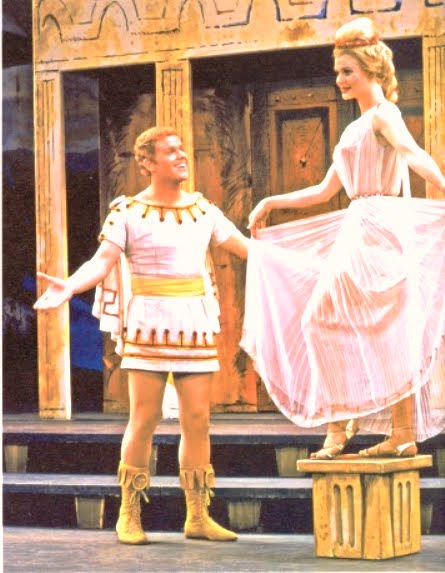 online access to its archives, not only do the critics provide interesting insight into the show's reception but it's amazing to see how many newspapers that city supported in 1962. Few of the critics, while acknowledging A Funny Thing Happened on the Way to the Forum entertained them immensely, wrote much — if anything — about Sondheim's score. The morning after it premiered, Howard Taubman, chief drama critic for The Times since Brooks Atkinson's retirement in 1960, wrote, "Know what they found on the way to the forum? Burlesque, vaudeville and a cornucopia of mad, comic hokum. The phrase for the title of the new musical comedy that arrived at the Alvin last night might be, caveat emptor. A Funny Thing Happened on the Way to the Forum indeed! No one gets to the forum; no one even starts for it. And nothing really happens that isn't older than the forum, more ancient than the agora in Athens. But somehow, you keep laughing as if the old sight and sound gags were as good as new. As for the score, Taubman said, "Mr. Sondheim's songs are accessories to the pre-meditated offense. With the Messrs. Mostel, Gilford, Burns and Carradine as a coy foursome, 'Everybody Ought to Have a Maid' recalls the days when delirious farceurs like the Marx Brothers could devastate a number. When Mr. Mostel, the slave with a nimble mind and a desire to be free, persuades Mr. Gilford, the nervous straw boss of the slaves, to don virgin's white, the two convert the show's romantic and pretty 'Lovely' into irresistible nonsense." Taubman penned one of the kinder notices to Sondheim's songs though he appears to have missed the point that even the first version of "Lovely" sung by the story's virginal courtesan Philia comes steeped in satire as the beauty sings an ode to superficiality and her own bubbleheadedness. (The first link takes you to Preshy Marker's version from 1962, the second to Jessica Boevers' from the 1996 revival; since I used the 1962 recording of "Everybody Ought to Have a Maid" at the beginning of the first half, this link goes to the BBC Proms rendition by Daniel Evans, Julian Ovendon, Simon Russell Beale and Bryn Terfel.) The score's assessment changes over the years and as of today, Sondheim may remain the toughest critic. In his book, he again wrote, "I made the subtle, though thankfully not fatal, error of being witty instead of funny." Below, watch a quite different take on "Lovely" from Putting It Together as performed by Carol Burnett and Ruthie Henshall.
Let's skip quickly through some excerpts from the other opening night reviews. Remember: Each of these came from New York newspapers and many no longer exist. Still, today, when some major cities fail to support one daily newspaper to think that this many could thrive in a single city, albeit one as large as New York, makes an old ex-journalist such as myself fill with both wonder and sadness. Walter Kerr for The New York Herald Tribune: "The funny thing about A Funny Thing Happened on the Way to the Forum is that it's
 funny. I'm not going to tell you it's anything more than that, but maybe I don't have to. For all I know, you like funny musicals. You may even like classical funny musicals, and this one is very classic.…Composer Stephen Sondheim begins by giving his lightfooted fools some rather odd recitative as substitute for melody and same vaguely Oriental wood-block effects as substitute for lively accompaniment. You wonder. Then, with a foursome in which Mr. Mostel, Mr. Burns, Mr. Gilford and a borrowed scarecrow named John Carradine, take off to a tune called 'Everybody Ought to Have a Maid,' the odd figurations Mr. Sondheim is attracted to begin to pay off. There's a faint edge of musical sarcasm to be dealt with here, and it crops up again — most effectively — in 'I'm Calm,' 'Impossible,' 'That Dirty Old Man,' and in Mr, Mostel's swooning reprise of a number that was mocking in the first place, "Lovely." The score is in and out, but wins out. The lyrics are fine. Is it me or does it seem as if Kerr keeps changing his mind as he's writing? Though a Broadway theater remains named after the critic today, I've always been leery of Kerr since he actively participated in the industry as a writer, director and lyricist at the same time he worked regularly as a critic. At least he recognized the humor in the first version of "Lovely" though, I'll give him that. (Isn't it fascinating to imagine that Broadway theater owners sometimes honor critics this way? A theater bears Brooks Atkinson's name as well and they even awarded him a special Tony after he retired. When will we see The Frank Rich Theater? Can you imagine and honorary Oscar to a film critic?) The links: "Everybody Ought to Have a Maid" from 1966 film; "Impossible" from the 1996 revival recording; "I'm Calm" and "That Dirty Old Man" both from the 1962 original cast recording. Below we have the clip from the poorly shot bootleg of the "Lovely" (reprise) from the 1996 revival performed by Nathan Lane and Mark Linn-Baker.
Others who opined about opening night. Unless they took contrarian views on the show itself, I'm limiting the comments to the score.: Except for calling Forum a musical comedy in his lead, the only other reference to the score Richard Watts Jr. made in The New York Post comes as part of the review's penultimate sentence. "…and Stephen Sondheim’s score is modest but pleasant." John McClain wrote in The Journal American, "Zero Mostel, a very animated blimp, will personally defy you not to like A Funny Thing Happened on the Way to the Forum…The clients laughed and seemed to enjoy themselves, but there was always the suggestion that had they not, Mr. Mostel would have passed among them and belabored them with a baseball bat. He is quite largely the whole show… The book by Burt Shevelove and Larry Gelbart (claiming some debt to Plautus) is a wispy affair, and Stephen Sondheim's score is less than inspired,
 but under George Abbott's slick direction the show moves and the audience roars. I should think it would succeed." At The New York Daily News, John Chapman chimed in, "(The performers) are grand muggers, leerers and slapstickers, and any old vaudeville fan will be happy to see them in operation.…The songwriter, Stephen Sondheim, comes up with an occasional bright and funny number, such as the four burlesquers song 'Everybody Ought to Have a Maid,' and Miss Kobart’s venomous hymn to Burns, 'That Dirty Old Man of Mine.'" Did he not look at his Playbill? How did he get the song title wrong? Links: "Everybody Ought to Have a Maid" performed by Carol Burnett and Bronson Pinchot in Putting It Together; "That Dirty Old Man" from 1996 revival cast recording. Another critic who didn't find it important to check song titles was Norman Nadel in The New York World Telegram, who delivered the harshest review I read. "But too high a price must be paid for entertaining moments in A Funny Thing… Much of the comedy repeats itself. Some of the players work so hard to exploit their thin materials that they generate more sympathy than laughter. The show is slow starting and sometimes heavy-footed. Stephen Sondheim’s music would have been a second-rate score even in 1940, but he has come up with some catchy lyrics. One is “All I Know is Lovely,” sung by Ms. Marker and Mr. Davies. Another is 'Bring Me My Bride,' in which Miles proclaims his own glory; this is done resonantly by baritone Holgate.…There are indications at the Alvin that A Funny Thing might have been an earthy, boisterous delight. From time to time, it is. For the most part, however, it strains too hard to achieve too little." Link: "Bring Me My Bride" from original 1962 cast recording; I've run out of versions of "Lovely." Finally, we get to Robert Colman reviewing at The New York Mirror with the nicest words for Sondheim's score. "Stephen Sondheim has supplied a score that falls pleasantly on the ears. Jack Cole has choreographed dances that would have delighted Billy Minsky’s. We suspect that A Funny Thing will prove the most controversial song-and-dancer of the season. You’ll either love it or loathe it. In our book, it looms as a hot ticket. A riotous and rowdy hit." The retired Brooks Atkinson filed a "critic at large" piece for The New York Times in July where he barely mentions that Forum contains music and Sondheim's name never appears, though the "low comedy" delights him to no end. Since "Everybody Ought to Have a Maid" comes up so often, I've reserved two video clips for you to watch. The first comes from the 1996 revival.
Before I get to the final clip of "Everybody Ought to Have a Maid," I thought it would be interesting to point out how quickly critics began to re-evaluate Sondheim's score for Forum. Granted, in these reviews I was limited to The New York Times and most come after the one-two punch of Company and Follies supersized his reputation, but the reconsideration started as early as the 1966 film version. Vincent Canby wrote in his review of the film, "Stephen Sondheim's music and lyrics hold up well, especially 'Comedy Tonight,' by which Mr. Mostel introduces the characters at the start, and the slightly bawdy 'Everybody Should Have A Maid' ('sweeping out, sleeping in')." When Clive Barnes assessed the 1972 revival for The Times, he said, "Mr. Sondheim's music is original and charming, with considerable musical subtlety but a regard for down-to-earth show-biz vigor that is precisely what is needed. And, as always, his lyrics are a joy to listen for. The American theater has not had a lyricist like this since Hart or Porter." By the time the 1996 revival arrived, Canby's beat had switched from film to theater. "This brazenly retro Broadway musical, inspired by Plautus, is almost as timeless as comedy itself. Here's a glorious, old-fashioned farce that, with its vintage Stephen Sondheim score and its breathless book by Burt Shevelove and Larry Gelbart, celebrates everything that man holds least dear but can't deny himself: lust, greed, vanity, ambition; in short, all of those little failings that make man human. Yet for all of its disguises, mistaken identities, pratfalls and leering jokes, A Funny Thing is as sophisticated as anything now on Broadway. In its own lunatic way, it's both wise and rigorously disciplined. Easy sentimentality is nowhere to be found here; in its place: the kind of organized chaos that leads to sheer, extremely contagious high spirits," Canby wrote. Now, that other clip of "Everybody Ought to Have a Maid" features original 1962 cast member Jack Gilford performing with two (well, at least one) other surprising performers in a television appearance.
I'd hoped to avoid this situation, but I got so caught up with the behind-the-scenes history that what I intended as a short tribute grew to be massive. I still need to write about the original production's performance at the Tony Awards and some tidbits concerning the two revivals, the second of which I saw, not to mention that version I saw in 1979 when I was 10. That won't be coming today I'm afraid. So, I'll leave you with the sequence for "Bring Me My Bride" from Richard Lester's film version.
Labels: blacklist, Books, Capra, Criticism, Gelbart, J. Carradine, J. Robbins, Keaton, Marx Brothers, Music, Musicals, Sondheim, Television, Theater Tribute, Welles
TO READ ON, CLICK HERE
Bring on the lovers, liars and clowns!

By Edward Copeland
Without a doubt, one song stands heads and shoulders above all others written by Stephen Sondheim for A Funny Thing Happened on the Way to the Forum and "Comedy Tonight" holds that perch. Even people unaware of the movie or the stage show of Forum probably know that infectious number that opens and closes both versions. No more proof need be delivered to back this claim than the sheer number of performances, spoofs and use of the song as background music for clips and slideshows that I stumbled upon on the World Wide Web. Who knows how many more are out there? One used the song to back scenes from The West Wing, but the quality of the video was so poor, I wasn't going to use it until I stumbled upon a better version. Another person did three separate Bewitched montages, two of which employed identical moments only one used Zero Mostel's 1962 original cast recording version while the other took Nathan Lane's 1996 revival recording. I chose not to toss those in this collection because each montage only lasts 42 seconds, cutting off the song early. Never fear though, that still left me with plenty of options. Before I "open up the curtain," I thought I'd start with a clip of "Invocation and Instructions to the Audience" from The Frogs, a 1974 musical staged and "freely adapted" by Burt Shevelove (co-author of Forum) from the play by Aristophanes (written in 405 B.C.) and staged in the Yale University Swimming Pool with a cast of Ivy League students whose ranks included one Meryl Streep. Sondheim originally composed "Invocation" as the opening number for Forum when his first attempt ("Love Is in the Air") wasn't working during out-of-town tryouts. The show's legendary director George Abbott, according to Sondheim's Finishing the Hat, didn't find "Invocation" "hummable enough" — no doubt inspiring the producer's complaint in Merrily We Roll Along. Thankfully, that led to the blessing of "Comedy Tonight" and "Invocation" returned with the addition of the hysterical "Instructions to the Audience" when Sondheim and Shevelove collaborated on The Frogs. The clip below comes from the BBC Proms program given July 31, 2010, to celebrate Sondheim's 80th birthday. With the backing of The BBC Concert Orchestra conducted by David Charles Abell, Daniel Evans, a Tony nominee for best actor in the 2008 revival of Sunday in the Park with George, and Simon Russell Beale, a Tony nominee for best actor in the 2004 revival of Tom Stoppard's Jumpers, perform the number.
As I mentioned, people love to use "Comedy Tonight" as a backdrop to scenes from their favorite television shows or, in one instance, a series' cast actually performed the song themselves. I thought I'd start with TV and go chronologically from the oldest to the newest. First, this variety show's ensemble performed the number in the show's third episode ever on Oct. 18, 1976. Honestly, it's pure coincidence that I led into this with the number from The Frogs.
Anyone recall the last time they saw a rerun of this hit 1980s detective series with romantic banter between the leads? No, not Moonlighting. I refer to Remington Steele, the series that made Pierce Brosnan a star during its run from 1982-1987. What did happen to Stephanie Zimbalist?
The English certainly aren't immune to the charms of A Funny Thing Happened on the Way to the Forum. Five major productions of the musical have played London since 1963 (with its original Pseudolus, Frankie Howerd, reprising the role in a 1986 revival) and a company that toured throughout the United Kingdom. Some enterprising fan of the musical combined the song with the long-running British spy series MI-5 (originally titled Spooks) that ran 10 seasons beginning in 2002.
This West Wing fan not only sets scenes to a version of "Comedy Tonight" but tosses in some of "Love Is in the Air," the first opening song that Sondheim wrote for Forum as well.
Finally, since in some ways the farcical elements of Forum almost make it a cartoon, its final television salute should, most appropriately, pair it with an animated work, namely Avatar: The Last Airbender, which ran from 2005-2008.
The song brings out the fun in everyday folk as well as we see here where "Comedy Tonight" underscores a year-end slideshow presentation for players, coaches and fans of the Long Beach State track and field team.
What happens in Vegas doesn't stay in Vegas if you post it on YouTube as with this parody of "Comedy Tonight" performed by the master of ceremonies (officially named MC Vegas) for an annual Edwardian Ball.
Now, I haven't heard much of them lately but the concept of flash mobs shouldn't be an unfamiliar one to most reading this. Apparently, at University of Western Ontario, you might be able to get course credits for participating in them since they appear to do them so often. The campus' improv broke out once into Handel's "Messiah." They interrupted this lecture with — you guessed it — "Comedy Tonight" Impressively, they choreographed some moves as well as learning the words.
I'm not sure what's funnier: That this boy named Ben (I believe his last name is Lerner) would perform this spoof of "Comedy Tonight" at his bar mitzvah (interrupted by his younger sister Nina) or that the explanatory note by his father informs us that when dad posted it years ago, the video and audio had problems, so we're watching a corrected version that he has labeled Take 2. I didn't try to track down the promised one that Nina later sang at her bat mitzvah.
Also on YouTube sits, as you'd expect, the song playing against photos of various Republican presidential contenders. I almost included it, but that's really like shooting water in a barrel, isn't it? Why waste the space? They make the point so much more brilliantly when they open their mouths than when we just look at them, even if we do see Rick Santorum chowing down on a very phallic-looking food item. Instead, we'll skip to the movies. As with television, I'm going to do this chronologically, starting with the oldest and we're going way back to 1928 and one of the last gasps of silent German Expressionism, Paul Leni's The Man Who Laughs starring Conrad Veidt as the creepy villain Gwynplaine, 14 years before Veidt became best known as Major Strasser in Casablanca.
For pure ambition, you have to give it to the students at The College of New Jersey Musical Theatre staged at the Ewing, N.J., campus a full-fledged musical based on the original Star Wars trilogy spoofing songs from a wide variety of musicals. The show opens with "Trilogy Tonight."
The title for the single best-edited video that I found involving a single subject probably deserves to go to the true identity of puddleglum128 for mating Zero Mostel's version to scenes from Jonathan Demme's The Silence of the Lambs. I'd call it perfect if it didn't contain the strange audio splice in the middle, but the right moments of Anthony Hopkins, Jodie Foster and the rest get used.
Christopher Nolan's second take on Batman, The Dark Knight, earns two takes of "Comedy Tonight!" The first, staged by The Pauper Players of the University of North Carolina at Chapel Hill as part of the group's annual Broadway Melodies in 2009 where they parody different works. (The other two that year were Lost and Super Mario Bros.) The second video features photos from Nolan's film set to Nathan Lane singing the finale version of the song and also includes stills of Gerard Way.
For the last montage, which must have required a tremendous amount of time and effort by CRAIGSWORLD1427, he asked people about what movies throughout film history tickled their funny bones the most and then assembled various bits and pieces (including dialogue) with the song for this nearly 10-minute long package. It's worth it though. Chuck Workman, be damned.
Tweet
Labels: Animation, Books, Christopher Nolan, Demme, Hopkins, Jodie Foster, Lost, Music, Musicals, Sondheim, Star Wars, Stoppard, Streep, Television, Theater
TO READ ON, CLICK HERE
Friday, April 20, 2012
What a glorious feeling

By Edward Copeland
Sixty years ago, another MGM musical extravaganza began to open across the country, premiering first in New York on March 27, 1952 — exactly one week after its star's previous lavish MGM musical, An American in Paris, took home the Oscar as 1951's best picture. An American in Paris just had opened about four-and-a-half months earlier in November 1951, so though both musicals came from the same studio, the same producer (Arthur Freed) and the same star (Gene Kelly), Paris essentially stole Singin' in the Rain's thunder, despite
 good reviews and decent box office (ultimately, Rain only grossed about $1 million less than Paris did worldwide). Over the course of the ensuing decades, Singin' in the Rain displayed staying power as more generations and critics discovered and delighted in its infectious shenanigans to the point that it routinely grabs the label as the greatest movie musical ever made, a title it most richly deserves. When the film came out in 1952 though, the shower of awards that rightfully should have left Singin' in the Rain drenched in accolades didn't occur, but rarely do the movie classics earn the kudos they should upon their original release. How Casablanca managed to snag its best picture Oscar truly belongs on a list of the wonders of the world. Singin' in the Rain garnered a total of two Oscar nominations and lost them both. The Academy felt the best picture prize for 1952 belonged to The Greatest Show on Earth, which beat High Noon, Ivanhoe, John Huston's Moulin Rouge and The Quiet Man. Admittedly, I'm a fan of High Noon and The Quiet Man, but neither is better than Singin' in the Rain. I admire much of Huston's film, but I couldn't go for Ivanhoe and, as far as The Greatest Show on Earth goes, the movie doesn't just stage a spectacular train wreck, that sequence serves as a metaphor, not so much for the decidedly mediocre circus film but for the majority of the Academy's choices for best picture throughout the years. The nearly always wrong Academy found no room at the inn in the best picture category for Singin' in the Rain and, yet once again, history proves that that organization almost always has figured out ways to screw things up. Oh, well. As our hero, Don Lockwood, would say to his fans, "Dignity. Always dignity."
 It's true — I did, I really did have a feeling of lightness about me when I first saw Singin' in the Rain on a small TV set in my bedroom when I was in grade school. The local PBS station aired it during one of its pledge drives late on a Friday or Saturday. I almost wrote something to the effect that though my age at that time stood in single digits, I wasn't unfamiliar with "older films." Then, I started doing something out of character for someone who spent his professional years in journalism: math. When Singin' in the Rain and I first crossed paths, the film still had a few years to go before it would reach its 30th anniversary. Figuring further, I realized that when I was born, the movie had existed for a mere 17 years. I suppose the point I should have been aiming for was that even as a youngster, I wasn't completely ignorant of films made prior to my birth — a contrast to an all-too-pervasive attitude pushed by magazines such as Entertainment Weekly that discounts most things made prior to its existence. I took a detour from my main point which was that no classic up to that point in my young life seized my imagination and prompted me to rattle about it nonstop the way I would a new release such as Star Wars could capture my youthful enthusiasm, but Singin' in the Rain did.

It probably didn't hurt that back in 1974 my parents took me to That's Entertainment! and I saw many of the film's famous musical numbers before viewing the entire picture. My attention also likely got captured early in the showing when the first face I noticed after the opening credits belonged to Aunt Harriet (Madge Blake) of TV's Batman. Blake begins the fun as she stands before a microphone in as Hollywood columnist/gossip hound Dora Bailey covering the 1927 premiere of The Royal Rascal, the latest Monumental Pictures production starring the hot team (onscreen and off, so they say) Guy Lockwood (Gene Kelly) and Lina Lamont (Jean Hagen), live outside Grauman's Chinese Theater. When I fell for Singin' in the Rain as a youngster, I could enjoy it immensely for its music and comedy, but I needed to age and accumulate knowledge of cinema history in order to appreciate its references and some of the silent figures it parodies. For example, the first name that Dora announces stepping onto the red carpet belongs to Zelda Zanders (played by a 19-year-old Rita Moreno, who my young eyes failed to recognize as the "HEY YOU GUUYYSSS!!!" lady from The Electric Company), known as "The Zip Girl," a play on silent superstar Clara Bow's nickname as "The It Girl." Following Zelda, comes the mysterious Olga Mara (Judy Landon), merging mostly Pola Negri with a bit of Gloria Swanson, based on her latest spouse, an older, wealthy aristocrat. Of course, I didn't need to know any film history to get a kick out
 of the exaggerated reactions of the starstruck fans crowding the barricades to catch a glimpse of the famous faces or to get the joke when Dora announces the arrival of Don's best friend Cosmo Brown (Donald O'Connor), who leaps out of his car and onto the red carpet only to watch the fans' faces fall in disappointment since he's a "nobody." With its marvelous screenplay by the legendary team of Betty Comden & Adolph Green, the songbook of lyricist Arthur Freed (yes, the same Freed producing the film) and composer Nacio Herb Brown and the second film pairing Kelly and Stanley Donen as co-directors following 1949's great On the Town, Singin' in the Rain had a damn strong team going in, even considering its start from such a vague kernel of an idea. Freed had left his songwriting days behind long ago, becoming a very successful producer at MGM, almost exclusively of musicals. (Last year, when I wrote my tribute to Stephen Sondheim's Merrily We Roll Along , I said that I never thought it made sense for a successful composer like that musical's Franklin Shepherd to switch gears and become a successful movie producer, but lyricist Freed did that in real life. I'm surprised no one called me out on that.) According to the commentary on the 50th anniversary DVD, Freed called Comden & Green and told them he wanted them to write a musical based around the old songs he wrote with Brown to be called Singin' in the Rain. "We didn't have a clue as to what it would be other than there had to be a scene where someone would be singing and it would be raining," Comden said on the commentary, which included her, Green, O'Connor, Donen, Debbie Reynolds, Cyd Charisse, Kathleen Freeman, Baz Luhrmann (who horned his way in somehow) and film historian and author Rudy Behlmer. Of that group, only Donen, Reynolds, Luhrmann and Behlmer remain with us 10 years later. As Comden & Green thought about the era in which those songs had been written — the late 1920s and early 1930s — they conceived the idea of setting the film in that time period and from that sprang forth the idea of making Singin' in the Rain be about Hollywood's transition from silent films to talking pictures.
At last, the car bringing the stars of The Royal Rascal, Don Lockwood and Lina Lamont, pulls up to the red carpet. Dora Bailey hardly can contain her excitement, telling her radio audience that Lockwood & Lamont go together "like bacon and eggs." If the parodies of silent screen stars flew over your head and the caricatures of overzealous fans somehow didn't give you an inkling of what type of musical comedy the behind-the-scenes team had devised for Singin' in the Rain, it becomes abundantly clear once Lockwood & Lamont arrive on the scene and Don steps up to Dora's microphone to recount to her listeners a brief primer of how he became the movie star he was that
 day. At first, it might seem as if he's being rude to Ms. Lamont, who looks as if she's trying to move toward the microphone to say something, but Don doesn't allow her to say a word. If you've seen Singin' in the Rain before, you know why that is. If you haven't, what in the hell are you waiting for? However, like what could happen with sound film projectors to come, the words emanating from Lockwood's lips didn't match the visuals we saw as he and Cosmo, beginning as pint-size hustlers sneaking into pool halls, began careers playing violin and piano at any old dive where they could earn a few measly bucks. Gene Kelly always had the knack when it came to singing and dancing, but he never received enough credit for his acting and from his entrance as the public persona of Don Lockwood, you can tell that Kelly has stepped up his thespian skills a notch. While he will perform some of his best and most memorable song-and-dance moments at the same time he's co-directing the film itself, Kelly will end up giving the best performance of his career as Don Lockwood. The Academy did see fit to nominate him for acting once (in 1945's Anchors Aweigh) and gave him an honorary Oscar for the year 1951, when An American in Paris took best picture, "in appreciation of his versatility as an actor, singer, director and dancer, and specifically for his brilliant achievements in the art of choreography on film." The Academy was only a year early because Kelly's best was yet to come. Lockwood's embellished flashback leads to the movie's first musical number. Once Don and Cosmo found their way on to the vaudeville circuit, they energetically performed the song "Fit as a Fiddle." The clip below begins with dialogue in another language, but the remainder is in English.

Kelly and O'Connor's choreographic chemistry confirms the correct choice in going with O'Connor as Cosmo instead of using Oscar Levant again following An American in Paris. On the commentary, O'Connor recalled that prior to rehearsal, Kelly had asked what his strongest dancing side was and expressed relief when O'Connor answered, "The right" which also was Kelly's strongest. O'Connor credited that for why they looked so well together as in "Fit as a Fiddle." Don's cursory version of his life story wraps up with him and Cosmo landing musician jobs at Monumental Pictures where Don soon finds himself working as a stuntman, hurtling over bars in the Old West, crashing airplanes and riding motorcycles to their doom. When he approaches Lina Lamont, already a star, she wants nothing to do with a lowly stuntman until the studio's president, R.F. Simpson (the great Millard Mitchell, notable in films such as Jules Dassin's Thieves' Highway and Winchester '73, who died too young at age 50 in 1953), offers Don an acting contract — then Lina can't keep her hands off him, but Lockwood quickly removes
 them. Following the showing of the swashbuckling Royal Rascal. Don and Lina come out and greet the audience briefly but, again, only Lockwood speaks. When they get off the stage, we finally hear Lina speak as she complains about never being allowed to talk and when you hear that squawk, which might have originated at a crossroads between The Bronx and Hell, you realize why it's best for all concerned that Lina Lamont stay mute. If anyone doubts me when I say how much this film enchanted me when young, I'll share a personal tale showing its magic holds for later generations as well. Several years ago, a friend of mine visited with her then 6- or 7-year-old daughter and as we drove, the subject of Singin' in the Rain came up. Mom asked her young daughter to do her Lina Lamont impression for me and the little girl did a dead-on Hagen repeating the line, "Waddya think I am, dumb or sumptin'?" That darling child turns 15 in a few months. Sigh… Hagen earned one of the film's only two Oscar nominations (losing to Gloria Grahame for her brief appearance in a more serious Hollywood story, The Bad and the Beautiful) and Hagen deserved that recognition. Two years earlier, Judy Holliday won an Oscar for perfecting the ditzy blonde by re-creating her stage
 role as Billie Dawn in Born Yesterday on the big screen. Lack of intelligence and hair color unify Holliday's Billie and Hagen's Lina, but where the characters diverge comes from inside. Billie Dawn may not be bright, but she means well. Lina isn't any smarter, but she's downright mean and devious when she feels her career needs protecting. Lina doesn't hear what everyone else does when she opens her mouth and that voice comes out. The studio fears the public hearing it then — and that's before talkies throw the studio into turmoil. What impresses even more about Hagen's hilarious work in Singin' in the Rain comes when they learn that the Hagen's primary reputation in theater and movies were dramas and film noirs such as The Asphalt Jungle and Side Street, where she inevitably played a moll or a femme fatale. "Jean Hagen was a legit actress. She'd never done comedy before so she didn't just play a ditzy blonde, she approached the role as if she were a ditzy blonde and she was brilliant," Donald O'Connor said on the DVD. Sadly, Hagen never really succeeded at capitalizing on her Singin' success except for earning three Emmy nominations playing Danny Thomas' wife on Make Room for Daddy. Hagen tired of the role though and quit, prompting a pissed off Thomas to kill her character off and change the show's title to The Danny Thomas Show. Hagen herself also died young, succumbing to throat cancer at 54 in 1977.
Following the premiere of The Royal Rascal and Lina's complaints about never being able to talk, despite the studio P.R. flaks trying to explain that it's to preserve her image as well as her insistence that she and Don's engagement exists and their romance wasn't cooked up
 by Monumental Pictures for publicity purposes. "Lina, you have to stop reading those fan magazines," Don tells her. "There's never been anything between us and there never will be." She just laughs it off, but the P.R. guys convince her that she and Don should travel to the after-party at R.F.'s house in separate cars to elude the fans and the press. Don hitches a ride with Cosmo in his jalopy which, unfortunately, gets a flat tire not too far from Grauman's, causing Don to be swarmed by fans seeking autographs, clothing and, perhaps one of his limbs. Cosmo offers no help to Don in this situation. When Don yells to him to call him a cab, Cosmo, standing out of range of the melee, simply says, "OK. You're
 a cab." Lockwood manages to escape the frenzy by leaping over a car and onto the roof of a streetcar before jumping into a young woman's convertible, causing her to scream, convinced he's a criminal fleeing the law. He tries to calm her down, but she spots a police officer and pulls over and the cop immediately recognizes him and then the young lady (Debbie Reynolds) realizes why he looked so familiar to her in the first place. She tells him her name is Kathy Selden and agrees to drop him off at his house so he can get out of the shredded tuxedo that he's wearing, explaining that its ventilation resulted from "a little too much love from my adoring fans." Kathy expresses shock that they would do something like that to him and thinks it's just terrible. Don thinks her sympathy might give him the opportunity to make some moves on the girl, trying to wring as much as he can out of the "burden of stardom" line. "Well, we movie stars get the glory, I
 guess we must take the little heartaches that go with it," he declares as he snakes his arm around her shoulder. "People think we lead lives of glamour and romance, but we're really lonely. Terribly lonely." Lockwood lays it on so thick even Lina would see through it and Kathy takes note of his hand and apologizes for mistaking him for a criminal before. She just knew she recognized him from somewhere. Don asks which of his movies she's seen, but Kathy can't remember which one it was. She thinks he was dueling in it and it had "that girl, Lina Lamont" in it. "I don't go to the movies much. If you've seen one, you've seen them all," Kathy says, putting a damper on his amorous mood rather quickly. His arm returns to his body, now crossed. "No offense. Movies are entertaining enough for the masses, but the personalities on the screen just don't impress me. They don't talk, they don't act. They just make a lot of dumb show," Kathy proclaims, scrunching her face in imitation of their facial mannerisms. "Like what I do," Don says. "Why yes," Kathy responds with a smile. Now, not only has Don lost any desire he had for this young woman, he's thoroughly pissed
 off. Do Kathy's criticisms about silent acting sound or, more accurately, read as familiar to you? If you're having trouble visualizing the context, remove Don and Kathy from the car, make Kathy a miscast brunette and rising sound movie star speaking too loudly during a radio interview at an upscale restaurant while Don dines at a nearby table, sports a mustache and overhears the insults to his profession indirectly. Also, let's swap out the gorgeous Technicolor cinematography by Harold Rosson for supercrisp, 21st century black-and-white imagery. Getting the picture now? If you're still in the dark, I imagine this photograph I've placed on the right should jog your memory. I know I refer to his quote too often, but when Godard said, "The best way to criticize a film is to make another film," he spoke words that cried out for repeated use. What puzzles me is how Kelly and Donen, Comden & Green and the rest of the Singin' in the Rain creative team applied Godard's advice pre-emptively, making their film rebuttal to the lackluster Oscar winner of 2011, The Artist, nearly 60 years before Harvey Weinstein bought the film its best picture statuette (and before Godard said that quote either, for that matter). Too bad Irving Berlin composed "Anything You Can Do (I Can Do Better)" for the musical Annie Get Your Gun instead of Freed & Brown — it would serve nicely as background accompaniment showing how Singin' in the Rain kicks The Artist's ass on every level.

When I wrote my review of The Artist, I admitted that I struggled to get a handle on the film. At first glance, it seems harmless but something gnawed at me. I watched it a second time before I wrote about it and figured out that it contained little beyond references and artifice. I did make a huge error on one point so blindingly obvious, I didn't see it at the time. I wrote, "Surprisingly, The Artist tends to steer clear of any direct references to the classic Singin' in the Rain… I don't think The Artist dared to go there because comparing it to Singin' in the Rain would be too dangerous. It can toss out references to great movies such as Citizen Kane, Vertigo and Sunset Blvd. because as a whole The Artist bears little resemblance to those films. Singin' in the Rain holds a mirror up to the essential emptiness inside The Artist."
 How I missed the borderline plagiarism in both imagery and plot turns. (The Artist's George Valentin even transforms himself from an adventurer in films to a song-and-dance man just as Don Lockwood does in Singin' in the Rain only The Artist doesn't provide a backstory to show that Valentin had any previous musical experience; Kathy Selden similarly gets discovered by the studio head in the chorus of a musical, though she doesn't rise as Peppy does in The Artist because of other factors,) The only explanation I can propose for missing steals that obvious stems from The Artist being too pedestrian for me to notice its similarity to something that rises so much higher in the ranks of cinematic greatness. Back to the brilliant movie. Don asks Kathy what she plans to pursue as a career that allows her to look down so much on his profession and — surprise — her goal involves serious acting in the theater. She plans to move to New York eventually. Kathy manages to get Lockwood so steamed by the time she drops him off at his house that when he tries to depart with some cutting remarks, his coat stays behind in her car door, getting shredded further, much to Ms. Selden's delight. Don stomps inside his home while Kathy drives on, stopping at another house and asking a servant if it's R.F. Simpson's house, explaining that she's from The Cocoanut Grove. "For the floor show," the
 servant says before pointing out where to park. Inside R.F.'s spacious mansion, the festivities commenced some time ago. Throngs of men surround Lina for a chance to light her cigarette; Olga Mara dominates the dance floor tangoing with some young buck; Cosmo makes time with a young lady with promises that he can get her into movies; R.F. holds court, wondering what's keeping Don. Lockwood finally appears in a tuxedo that hasn't been torn to pieces, but his spirits certainly could use boosting. He asks Cosmo if he thinks he's a good actor. "As long as Monumental Pictures signs my checks, I think you're the greatest actor in the world," Cosmo laughs before realizing that Lockwood isn't kidding around. He then tries to reassure Don sincerely. Don informs Cosmo he may need to be reminded occasionally. R.F greets Don, telling him that he's been holding his main attraction until he showed up. R.F. orders the movie screen opened, "A movie? We've just seen one," Don
 declares. "This is a Hollywood party — it's the law," Cosmo responds. Simpson informs everyone that he's about to show them something this madman has been coming into his office and bugging him about for months. When he gets the signal that everything is ready, the lights go out. Shuffling papers echo throughout the room and the long narrow face of a mustachioed man (Julius Tannen) addresses the room. "Hello! This is a demonstration of a talking picture. Notice, it is a picture of me and I am talking. Note how my lips and the sound issuing from them are synchronized together in perfect unison." The party guests think it's a trick with one woman accusing R.F. of hiding behind the screen until Simpson speaks up behind here. After the clip ends, the opinions vary. "It's a toy," one man grunts. "It's a scream!" a woman shouts. "It's vulgar!" Olga proclaims. R.F. informs them that production already has started on Warner Bros.' first talkie, The Jazz Singer. "They'll lose their shirts," R.F. says with certitude. "What do you think of it, Dexter?" Simpson then asks of Monumental's biggest director, Roscoe Dexter (Douglas Fowley). "It'll never amount to a thing." Roscoe replies. "That's what they said about the horseless carriage," Cosmo adds. Unlike The Artist, everyone keeps their heads buried in the sand about the coming sound revolution instead of presenting it as only Valentin against the world — a much more realistic look at the state of the times in a flat-out comedy. After the partygoers finish laughing at the idea of talking pictures, R.F. announces another surprise for his "starlets" Don and Lina — and he takes the pair to another part of the room where a man wheels a huge cake in for all to see. It truly surprises Don when he sees who pops out of that cake — and he's ready to mock the "high standards" of Ms. Selden mercilessly (and we get to see Debbie Reynolds' first number of the movie).
Where the clip ends, Don keeps pestering Kathy and a jealous Lina shows up. "Say, who is this dame anyway?" Lina wants to know. "Oh someone lofty and far above us all. She's an actress from the legitimate stage," Don informs Lina. Kathy has reached her limit and tells
 Lockwood, "Here's something I learned from the movies" as she grabs a pie — only Don's reflexes are quick and Lina's aren't so she gets the face covered with cream pie as Kathy darts from the scene in horror while Lina screams. Lina vows to kill her despite Don's insistence that Kathy had been aiming at him. Cosmo, always willing to help a situation, tells Lina that she's never looked lovelier. "It was an accident," Don insists to Lina. "Sure. Happens to me five or six times a day," Cosmo adds. Lockwood, who could care less about Lina Lamont, goes off in search of Kathy Selden, leaving Lina alone and covered in pie, crying his name. The other Cocoanut Grove girls inform him that she just "took her things and bolted," Don runs outside in time to see her car speeding away. He yells her name to no avail. He starts to return to the party, but instead just looks off wistfully and smiles. According to film historian Rudy Behlmer on the DVD commentary, one of the early drafts of the screenplay called for Don to sing "All I Do Is Dream of You" as a ballad at his home while wearing pajamas. As much entertainment as Singin' in the Rain has provided so far, its excellence only will escalate in terms of comedy, songs and dance — and this behind-the-scenes Hollywood story harbors some doozies of behind-the-scenes Hollywood stories of its own.
Tweet
Labels: 50s, Comden and Green, Cyd Charisse, Dassin, Debbie Reynolds, Donen, Gene Kelly, Gloria Swanson, Godard, H. Weinstein, Huston, Movie Tributes, Musicals, Oscars, Silents, Sondheim, Star Wars
TO READ ON, CLICK HERE


