Tuesday, October 18, 2011
Everything's Free In America, For a Small Fee in America

By VenetianBlond
Winner of 10 Academy Awards (including best picture), the second-highest grossing film of 1961, and the production that introduced powerhouse Rita Moreno to a grateful public, West Side Story was released 50 years ago today. Developed from the Broadway musical, which was itself a version of Shakespeare's Romeo and Juliet, the film won high praise from both critics and audiences. This Broadway show turned American musical theater in a new direction. The songs were more complex musically, the dancing was pulled into the forefront of the storytelling and although it was wrapped around the timeless boy-meets-girl storyline, it tackled major social problems such as racism and poverty.
Leonard Bernstein rarely wrote lyrics so he only composed the music for the score, leaving the lyrics to a then-unknown composer named Stephen Sondheim who made his Broadway debut. In the book by Arthur Laurents, who died earlier this year, and adapted by Ernest Lehman for the film, the Montagues and the Capulets became the Jets and the Sharks, two rival teenage street gangs. Not only are they at odds over turf, the Sharks are newly arrived Puerto Ricans. The Puerto Ricans suffer the disdain of the Jets, but also suffer discrimination from the police officers Schrank and Krupke. West Side Story opened the door for edgier musical theater when it debuted on Broadway in 1957.
The film was long in development, with a number of production and cast misstarts. Robert Wise was hired to direct because of his experience with New York dramas, but due to his inexperience with musicals, Jerome Robbins, choreographer of the Broadway show, was brought on to direct the musical numbers. The No. 1 “get” for Tony always was Elvis Presley. However, Elvis’ people didn’t want him associated with knife fighting. There also were rumors that the previous affair between Natalie Wood and Presley may have affected the decision to turn the role down. Natalie Wood was not even in contention until she read with her then-paramour Warren Beatty during his audition and was cast although Beatty was not. Former child actor Richard Beymer was given the job — even over triple threat Russ Tamblyn, who also had been acting since his early teens who got the role of Riff.

The trick in adapting a Broadway musical for film is to open up the world of the show from the space limitations of the stage to the wider world possible on film. The opening shots of the film show actual aerial footage of New York City. The view from above establishes New York as a warren of crowded buildings, gray rooftops and few distinctive features. From this angle, New York’s romance as a world class city is diminished, setting up the world of the working class people of the story. Another good use of the cinematic nature of film is in the “tunnel vision” the two lovers have when they are together. When they meet at the dance, the rest of the world blurs away. They only have eyes for each other.
Conventional wisdom holds that the two leads are the weakest part of a fantastic film. Marni Nixon dubbed Maria’s singing parts and Jimmy Clark sang the role of Tony. Natalie Wood wasn't entirely believable as a Puerto Rican, and Richard Beymer’s performance lacked spark. Certainly the performances of Rita Moreno as Anita and George Chakiris as Bernardo were so powerful as to outshine everything else. Chakiris’ performance went beyond mere generalized anger to a sense that Bernardo had collected every slight, every name he was called, every missed opportunity into a very specific sense of self and his place in opposition to the rest of “American” New York City. Moreno brilliantly walked the tightrope between mature woman with no illusions and American optimist. Her tour de force number is “America,” in which she counters every complaint about her new country. Anita so desperately wants everything to work out in America that her later admission that “Nardo was right” is just devastating.


The other problematic aspect of West Side Story in film is the supposedly deadly street toughs periodically breaking into song and dance. On stage, there is an expectation of stylized performance, but film is usually meant to be more “realistic.” Having a film cast with dancers though provides certain benefits. The physicality of the actors is as evident as in any action film. When they run, they are running flat out. They actually climb chain link fences and walls, and Russ Tamblyn actually performs those flips. The sweat and grime is real. When Ice spins on his knees in “Cool,” the knees of his pants come up dirty. The fight choreography is no more stylized than any kung fu film, where actors fight endlessly with no injury or effort.

The boy-meets-girl story is timeless, but so it seems is the issue of immigration as a hot topic in the United States. Recent restrictive legislation hinges on the question of “legality” or “illegality,” but the actual process of enforcement relies on an individual’s appearance. In addition, the “land of opportunity” has growing income inequality. When Anita sings, “you can be anything you choose,” but Bernardo retorts, “waiting on tables or shine shoes,” it still has resonance today. Bernardo’s is a hard lesson, because those with the most faith — Anita with her faith in America, and Maria, with her faith in love — lose those they love. It is not the usual musical happy ending, although Maria/Juliet survives in this version. In a scene that redeems Natalie Wood’s performance for me, Maria confronts both gangs over Tony’s dead body. She seems to have aged years in a moment, because “widowed,” she has gained the experience of a much older woman. “How many bullets are there?” she asks them. “Enough for you? And you?” Considering America today, the more things change, the more they stay the same.
Tweet
Labels: 60s, Elvis, J. Robbins, Movie Tributes, Musicals, Oscars, Shakespeare, Sondheim, Theater, W. Beatty, Wise
TO READ ON, CLICK HERE


Wednesday, September 28, 2011
All We Are Saying Is Give Klaatu a Chance

By Jonathan Pacheco
It's finally happened: intelligent extraterrestrial life has visited Earth in the form of Klaatu (Michael Rennie), a slender humanoid from an unnamed planet. Sporting some terribly sparkly clothing and a beefy robotic bodyguard named Gort, the alien brings a message of peace, but with a dire warning that he insists every nation hear at the same time. However, the nations of the planet are a bit preoccupied with politics and war, and have little time for weirdos who travel in flying saucers, so a frustrated Klaatu decides to mingle with the common folk in hopes of finding any way to deliver his urgent message. Under the name Mr. Carpenter, the space man walks among the humans undercover, eventually befriending little Bobby Benson (Billy Gray) and his mother Helen (Patricia Neal), enlisting their aid.
Honestly, The Day the Earth Stood Still isn't a particularly great film on its own, and hasn't aged very well after 60 years. You expect visual effects to date themselves as they do here, but even the film's story and approach seems a bit simple and naive. But thanks particularly to some solid acting, the film's fearful call to peace still manages to hold some weight.
Aside from the occassional fairly seamless matting effect, most of the films showy effects are just plain silly-lookin'. While Gort's entrance is striking to behold, the imposing, statuesque robot standing with intimidation on top of the spaceship, the effect falls apart as soon as he begins moving, his lifeless, rubbery arms wiggling as the pants of his costume bend awkwardly. Plus, with a head that size, Gort begins to resemble Shrek in a RoboCop suit. The effect of his Cyclops-esque laser beam would still be decent if it weren't for the Hanna-Barbera sound effects that accompany it. The unintentional comedy even bleeds over to the nontechnical, my favorite of which involves doctors speaking outside of Klaatu's room at a military hospital. They marvel at the alien's speed of recovery and young looks, considering his age, but they complain that he talks down to them, making them feel like third-class witch-doctors. Of course, as they discuss this, they light up a few cigarettes right there in the hospital hallway.

The film's straight-forward plot and earnest but blatant theme do little to differentiate it from other sci-fi tales of the era (after all, aren't most classic science fiction stories merely metaphors for a specific cause or call to action?), but The Day the Earth Stood Still bests many of them with its acting. Michael Rennie's Klaatu balances an other-worldliness (aided by the actor's sharp physique) with gentleness and wisdom. The actor is able to add some subtlety to some of the film's very direct declarations of theme. As Klaatu explains the tech specs of his flying saucer to little Bobby, he mentions how it harnesses atomic power, to which the boy points out that he thought that was for building bombs. Klaatu can't hold back a wry and somewhat sad smirk when he tells the kid that, no, it's used for other things as well, injecting the moment with much-needed poignancy. Patricia Neal, as Bobby's widow mother Helen, grounds the film with a performance nearly free of flash or histrionics. Her sincerity and calm keeps you in the story during important moments, as when she learns of Mr. Carpenter's true alien identity, or how she reacts when her boyfriend Tom rats out Klaatu for fame.
While the film's message of peace and cooperation is without a doubt admirable, it's presented in a slightly puzzling way. During the film's climax, Klaatu explains to the Earthlings that the planets of the universe have eliminated any need for stupidity, and therefore war and strife, but they have done so by creating a race of merciless super-robots capable of planetary annihilation, and giving them permission to zap any being that gets out of line. So yeah, they've all stopped fighting, but only with the threat of intergalactic police brutality hanging over their heads, which Klaatu now extends to Earth. The "you better behave, or else" approach slightly undermines the call for peace and sensibility, but whatever works, I guess.
Most impressive to me is how the film is able to represent Earth as one entity. Rarely do we view the people of this planet as one; instead, we group by city, state, province, region or nation, not to mention color, race and religion. Whatever it may be, there's always an "us" and there's always a "them" which is why it's difficult for "us" to be the entire planet Earth. Who would be "them" in that case? But from the beginning of The Day the Earth Stood Still, the message has been clear: for the survival of the planet, we absolutely must think of Earth as a whole. And not only is the film clear in this, it's actually convincing and clever in its approach. Pay attention to the language that Klaatu uses. He refers to our nation-to-nation dynamics not as "international affairs" but rather as "internal affairs." He brushes off our wars and issues as "petty squabbles" as if he were a visiting business consultant with no time for our meaningless interoffice politics — and in the grand scheme, perhaps that's all our squabbles really amount to.
Tweet
Labels: 50s, Hanna-Barbera, Movie Tributes, Patricia Neal, Wise
TO READ ON, CLICK HERE
Friday, September 02, 2011
What you've seen on the big screen (but not in its original release)

By Edward Copeland
As my readers can no doubt tell, my contributors and myself don't have much in the way of original copy to offer this week (that's why you've seen three days in a row of From the Vault posts of old reviews written when the films in question originally came out prior to this blog's existence). I'm taking this "week off" because I have several projects coming up that require lots of watching and writing so I can more or less place ECOF on autopilot. It then occurred to me that this would be a great opportunity to me to run something I've always wanted to and that really isn't labor intensive.
Since seeing movies in a theater, for the most part, is a logistical impossibility for me now, I've always wanted to list the films that I was fortunate enough to see in a theater through re-releases that I either wasn't born when they originally came out, I was too young to see in their original release or somehow I missed the first time and they happened to come back. I figured that would be a great comment starter. I've only linked to reviews I wrote based on being able to see the films in a theater the way God intended. Of course, I didn't count The Rocky Horror Picture Show since it never stopped playing. I just went with alphabetical order. I hope I've recalled them all.


Hamilton Luske & Wolfgang Reitherman

Tweet
Labels: Altman, Browning, Buñuel, Coppola, Curtiz, Fellini, G. Stevens, Godard, Hitchcock, Kubrick, Landis, Lean, Peckinpah, R. Scott, Renoir, Scorsese, Welles, Whale, Wilder, Wise
TO READ ON, CLICK HERE
Wednesday, June 29, 2011
Centennial Tributes: Bernard Herrmann Part I
”As a composer I might class myself as a Neo-Romantic, inasmuch as I have always regarded music as a highly personal and emotional form of expression. I like to write music which takes its inspiration from poetry, art and nature. I do not care for purely decorative music. Although I am in sympathy with modern idioms, I abhor music which attempts nothing more than the illustration of a stylistic fad. And in using modern techniques, I have tried at all times to subjugate them to a larger idea or a grander human feeling.”
Bernard Herrmann in Bernard Herrmann: Hollywood’s Music-Dramatist by Edward Johnson
By Edward Copeland
Our centennial tributes tend to be of actor, actresses, directors and writers. We were honored when lyricist Bill Russell wrote a tribute to composer Frank Loesser, but he was a songwriter, providing both music and lyrics, who penned many memorable songs for stage and screen. We've never attempted to salute a composer known for his instrumental scores, particularly ones he wrote for movies, but Bernard Herrmann born 100 years ago today (exactly one year younger than Loesser), didn't like to be pigeonholed as a film composer since his musical work spanned opera, symphonies, concerts, radio and television in addition to some of the most memorable film scores of all time. That's why instead of just starting this post with a photo of the man and some words, I figured it's more fitting to use clips or links to clips to demonstrate his works such as his score that accompanied the Saul Bass title sequence for Alfred Hitchcock's Vertigo, an example of one of his very best. Movie titles and still photographs don't do Bernard Herrmann justice, that's why I'm going to write less than usual in this tribute and let his music do the talking. However, the man was so prolific, I've had to divide the post in half so it doesn't grow so long anyway that it knocks other posts off the front page. While there will be some biography, mainly it will be about his music and I'm going to try to be chronological and, in a couple of occasions, show his influence. We even have a clip of the master musician discussing his craft relating to his scoring to a particular film. If you are reading this at work, I hope you have headphones.
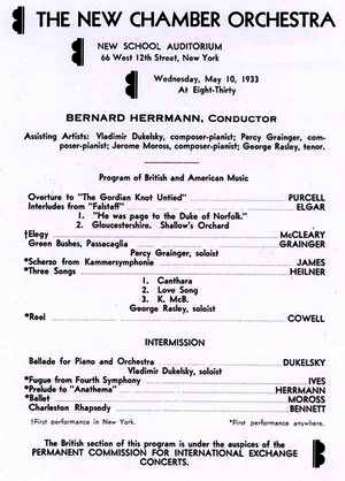
His father encouraged his interest in music and he took up the violin, winning a $100 prize for one of his own compositions at the age of 13. Herrmann's interest in composition became more serious sometime around 1927 while he attended DeWitt Clinton High School and studied with Gustav Heine. His first notable work is considered to be a tone poem called "The Forest" he wrote in January 1929. He enrolled at New York University (while still in high school) and studied composition with Philip James and conducting with Albert Stoessel. Stoessel later headed the opera and orchestra at Juilliard and Herrmann landed a fellowship there in 1930 where he studied conducting and composition with Bernard Wagenaar. He officially finished high school in 1931 around the time he formed his own orchestra, The New York Chamber Orchestra. This was before he was 20. He left Juilliard in 1932 but without a degree. That fall, he attended lectures in advanced composition and orchestration at NYU by Percy Grainger. Herrmann also worked as a music editor and arranger at the Harms music publishing company around this period. That same fall, some dancers he knew from Juilliard asked him to arrange ballet music for a musical revue called +New Americana, which inadvertently led to his professional composing, conducting, and Broadway debuts when he went on to direct the orchestra during his arrangement of The Shakers and his own piece, "Amour à la Militaire," when it opened Oct. 5, 1932. It ran 77 performances.*
By 1934, he was a staff conductor with CBS radio. He seriously began his prolific composing work during this period, writing many scores to accompany CBS radio programs including "The City of Brass" which accompanied David Ross' narration of one of the tales from One Thousand and One Nights or The Arabian Nights. In 1935, he composed the orchestral piece the Currier and Ives Suite. It was described as a short, five-movement piece on the Film Score website which has been running a series all year on Herrmann's centennial. The site notes that its composition occurred while he was employed by CBS because one of the pages of the composition was on CBS paper. Other than that, it says the origin of the piece is largely a mystery. There is a YouTube clip set against classic Currier and Ives drawings that has the orchestral piece.
Herrmann was named chief conductor of the CBS Symphony Orchestra in 1943 (a title he held until the orchestra disbanded in 1951 as TV began to displace radio), where it was said he introduced American audiences to more new musical works than any conductor in history. He particularly championed the American composer Charles Ives. Even before getting that post, Herrmann's output beyond the network and for mediums other than radio or orchestra bloomed. During the 1937-38 period, Herrmann got his feet wet for the first time in composing opera with a 45-minute cantata of Moby Dick. It didn't receive a world premiere until 1940 with The New York Philharmonic under the direction of Sir John Barbirolli. The cantata had never received a live performance in the United States since until April of this year when John Kendall Bailey conducted a 40-voice men's chorus and four soloists to perform it with the American Philharmonic-Sonoma County. Below are excerpts from the score, though it doesn't indicate from what recording it is taken and though it includes stills from John Huston's film of Moby Dick, note that Herrmann did not score that film.

While still just a staff conductor at CBS, the musical prodigy Herrmann would meet another young wunderkind making waves in New York named Orson Welles. He composed and arranged scores for Welles' Mercury Theater broadcasts, including the infamous 1938 War of the Worlds . While working at CBS, Welles lured Herrmann to Hollywood with him and when Welles made his astounding debut as the actor, writer and director of Citizen Kane in 1941, Herrmann had an equally impressive first year as a film composer. Not only did he make an impressive first showing with Citizen Kane and Welles' 1942 followup The Magnificent Ambersons, in between he composed the score for director William Dieterle's 1941 film The Devil and Daniel Webster aka All That Money Can Buy. In 1941, both the scores for Kane and Daniel Webster earned Herrmann Oscar nominations. His Daniel Webster score won (and there were 20 nominees). Though some of his greatest work still was to come, many for Hitchcock. He would receive another nomination in 1946 for director John Cromwell's Anna and the King of Siam but would not receive another nomination until he received two posthumous nominations in 1976. As is unfortunately the case with many YouTube clips, the embedding has been disabled, click here and listen to his lovely piece as the reporter reads Thatcher's diary leading into the flashback to Kane's childhood. Also, two pieces from Ambersons: Herrmann's subtle score running beneath Welles' narration of George's comeuppance and a much bouncier, holiday-theme Herrmann piece accompanying the snowride scene. I couldn't find a sample for The Devil and Daniel Webster/All That Money Can Buy.
In 1943, Herrmann composed the score for Jane Eyre directed by Robert Stevenson but involving many Mercury Theater players including Welles starring as Rochester, Agnes Moorehead as Mrs. Reed and John Houseman co-writing the script. Joan Fontaine starred in the title role. This is Herrmann's main title theme. He didn't score another film for two years when he did director John Brahm's 1945 psychological thriller Hangover Square, which I've never seen but certainly sounds interesting. It stars Laird Cregar as a composer suffering lapses in his memory who thinks he may have killed someone and seeks help from his doctor (George Sanders). Even though the composer is engaged, he somehow finds himself involved with a music hall dancer (Linda Darnell) and his temporary memory losses are threatening the concerto he has a deadline to finish. The following year, he composed the score for Anna and King of Siam, which earned him that third Oscar nomination.
In 1947, Herrmann penned the score for The Ghost and Mrs. Muir directed by Joseph L. Mankiewicz, a film that's very popular on YouTube, only for some reason people like to use scenes and stills from the movie and place modern songs over them. The next year, Herrmann made his first foray into composing for television, making music for many installments of Studio One which went by about a half-dozen different titles during its run. That kept him busy until 1951 when he debuted his first full-fledged opera Wuthering Heights. In the clip below, Yves Saelens sings "Now art thou dear, my golden June" (Edgar Linton's aria) in a concert performance of the opera at the Festival de Radio France et Montpellier 2010. Alain Altinoglu conducts the Orchestre National de Montpellier.
Directed by Robert Wise; Piece: Prelude/Outer Space/Radar
On Dangerous Ground (1952)
Directed by Nicholas Ray (Ida Lupino uncredited)
The Snows of Kiliminjaro (1952)
Directed by Henry King (Roy Ward Baker uncredited)
White Witch Doctor (1953) directed by Henry Hathaway
Now, I'm not going to list EVERY film or television show Herrmann scored, because it would grow too long. It's still going to be so long, that's why I've had to divide it into two posts so everything doesn't get knocked off the page. I'm tempted to leave out lesser titles or even bigger names if there isn't a music sample I can't find. Sometimes though, I'll find some other compelling reason to include a title figure anyone can click on his credits themselves.
Shower of Stars TV series (1954) Episode: "A Christmas Carol"
In 1955 when Burt Lancaster directed the first of the only two films he ever would helm, The Kentuckian, and he chose Herrmann for the score. Of course, that year was auspicious for another reason: It marked the first teaming of one of the most important director-composer partnerships in film history: Herrmann and Alfred Hitchcock. What brought The Master of Suspense and Herrmann together for the first time actually wasn't one of Hitchcock's tense masterpieces but his dark comedy The Trouble With Harry about the small Vermont town with the problem of a body that just won't stay put. It also marked the film debut of Shirley MacLaine.
Directed by Nunnally Johnson; Pieces: Prelude, The Children's Hour
So this is where we will leave part I. Click here just in case Part II still doesn't show on the main page.
*Much of the information in this section comes from the Herrmann biography found on Artists Direct.
Tweet
Labels: Agnes M., Books, Curtiz, Frank Loesser, Gregory Peck, Herrmann, Hitchcock, Huston, Lancaster, Lupino, MacLaine, Mankiewicz, Music, N. Ray, Oscars, Sanders, Television, Theater, Welles, Wise
TO READ ON, CLICK HERE
Sunday, May 01, 2011
The Magician & The Media Baron

Kate Cameron, New York Daily News (1941)
“Perhaps the one American talking picture that seems to be as fresh now as the day it opened.
It may seem even fresher.”
Pauline Kael, The New Yorker (1971)
"Staggering and belongs at once among the greatest screen achievements."
William Boehnel, New World Telegram (1941)
"The boldest free-hand stroke in major screen production since Griffith and Bitzer were running wild
to unshackle the camera."
Otis Ferguson, The New Republic (1941)
“Probably the one film that has started the largest number of filmmakers on their careers.”
François Truffaut

By John Cochrane
What can you say about Citizen Kane (1941) that hasn’t already been said many times before? Orson Welles’ landmark first feature — which received its American premiere 70 years ago today — has routinely been called by general consensus "The Greatest Movie Ever Made" by countless filmmakers, critics and movie buffs — topping lists such as AFI’s Greatest Films Of The Century, Cahiers du Cinema’s 100 Greatest Films Ever Made and every Sight & Sound Critics and Directors poll since 1962. Despite almost universal acclaim, even from the beginning, the movie was blacklisted on its initial release — and almost literally destroyed by a nervous industry that resented its precocious and talented creator and didn’t want to offend the then-still powerful publisher on which it was largely based. The film miraculously survived though, and many critics say that if D.W. Griffith’s The Birth of a Nation (1915) was a watershed moment for the silent period, Citizen Kane was a brilliant summation of the sound era up to that point in time — forever changing how movies could be photographed and edited, and how stories could be told.

Citizen Kane is a fictional biography of an enigmatic newspaper tycoon named Charles Foster Kane — a character largely inspired by William Randolph Hearst, but also borrowing details from real life figures such as Samuel Insull, Harold Fowler McCormick, Howard Hughes and, some would argue, even Orson Welles himself. The film begins with Kane’s death as an old man, and is made up mostly of flashbacks — which are shown in a circular, rather than linear fashion. We watch an almost completed newsreel of his life — which deftly gives a quick summary of the story we’re about to see. We then listen to
 interviews or diary entries from five different people — Kane’s guardian, his business manager, his closest friend, his second wife and his butler — who all tell overlapping anecdotes and opinions of him, in an attempt to fill in the gaps of who Charles Foster Kane really was. Kane inherited an enormous mining fortune from his mother — who sent him away from home as a child to be raised and groomed to be one of the world’s richest and most influential men. He took over a foundering newspaper at 25; created a publishing empire based on sensational journalism; was derailed from becoming governor of New York due to an extramarital affair; failed to mold his mistress-turned-second wife into an opera star and died alone when she left him. Kane’s last word was “Rosebud” — which has become the most famous single word in the history of cinema — and the quest of News on The March reporter Mr. Thompson is to determine what Rosebud is. He never does, though the audience learns what it means in the closing shots of the film.
Citizen Kane is remembered as Orson Welles’ masterpiece, and no one is more responsible for its greatness than Welles himself — who was heavily involved at practically all levels of the production. But the picture also was a coming together of a group of gifted craftsmen and actors, all working together at the top of their game. The first thing that comes to mind when most people think of Citizen Kane, is Gregg Toland’s amazing cinematography. By 1940, Toland already was one of the industry’s top cameramen — having worked with Hollywood heavyweights John Ford and William Wyler. He lobbied hard to be on Welles’ first picture, and the two made a terrific team. Welles later recalled how he believed that a film director was responsible for lighting a set — as a theatrical director would be. For the first few days of shooting, Toland would quietly shadow Welles — fixing his ideas so that they would work and telling everyone else to keep their mouths shut. When a crew member informed an embarrassed Welles that setting the lights was the cinematographer’s job, Toland was frustrated that his cover had been blown. He explained to Orson, “The only way you learn anything new is from someone who doesn’t know what can’t be done.”

Welles and Toland shot the film in deep focus — an extremely difficult process even today — which keeps the entire visual picture in absolute clarity, just like the human eye. (Toland had previously experimented with the process while making Ford’s The Long Voyage Home in 1940.) Working with special effects by Vernon L. Walker and optical printer effects by Linwood Dunn, Welles and Toland created impressive sets and crowd scenes out of miniatures, dissolves and creative shadows and lighting — most noticeably in photographing Kane’s vast, almost gothic estate of Xanadu — his campaign for governor and Susan Alexander’s opera house performances. Sometimes Welles and Toland double exposed the film to create two simultaneous images in focus — as in when Kane discovers Susan after she’s tried to commit suicide by an overdose of pills. Sometimes they simply spliced two images together, or put the camera in an odd place to get an unusual shot, such as cutting a hole in the floor to get an incredibly low shot of Kane and Leland after Kane loses the election making the characters appear bigger than life. Before Citizen Kane, you rarely saw ceilings in films. Toland and Welles used low cloth ceilings throughout the picture (which looked real in black and white) and concealed microphones to record the sound. Soon afterward, many other American filmmakers began to use this technique as well.

In the News on the March sequence — which wickedly satirizes Time magazine’s then-popular The March of Time newsreels — Welles and Toland dragged the film stock on the floor to make it look old and worn and used more camera effects to seemingly place Kane in historical places with famous figures. Orson once said, “A long playing full shot is what always separates the men from the boys. Anybody can make a picture with a pair of scissors and a two inch lens.” In that respect, Citizen Kane also has a number of long scenes that are played with very few cuts. In the sequence in which Kane’s mother signs away guardianship of him to Mr. Thatcher, the camera starts at a window that looks out at Charles playing in the snow, and then backs up over seemingly invisible furniture that is quietly moved into place beneath the moving camera. As Mary Kane sits down at a table to sign the document, a still-wobbling hat inadvertently shows how the shot was achieved. The scene then continues in one take — until Mrs. Kane returns to the window to call for her son — and the camera follows the Kanes and Mr. Thatcher outside, in the second of three shots for the entire sequence. Welles praised his cinematographer, saying that he would constantly ask for miracles and Gregg would perform them without fanfare, like it was no big deal. Orson would show his gratitude by sharing his director’s title card with Toland — an almost unheard of gesture in motion pictures. (Ford did the same thing on The Long Voyage Home, the previous year.) “He was the greatest cameraman who ever lived,” Welles would say. “He deserved it, didn’t he?”
Another key collaborator on Kane was Herman J. Mankiewicz, who co-wrote the script. A veteran screenwriter since the silent era, Mankiewicz worked — often uncredited — on dozens of Hollywood pictures such as The Wizard of Oz (1939), The Pride of the Yankees (1942) and comedies by the Marx Brothers. He also was part of the social circle of William Randolph Hearst and Marion Davies until he was banned from their parties due to his heavy alcoholism and gambling. Mankiewicz was nursing a broken leg in the hospital in 1939 when he met Welles, who was a big fan of Mank’s talent and sharp, cynical humor. After many brainstorming sessions together, Citizen Kane — under the working title The American — was born.
The actual credit for the screenplay has been the subject of debate for decades, with some people such as Pauline Kael and John Houseman suggesting that Mankiewicz was Kane’s sole screenwriter, with Welles usurping a co-writing credit. But these suggestions largely have been discredited by other vocal critics such as Robert Carringer, Jonathan Rosenbaum and filmmaker/writer Peter Bogdanovich. Various Welles’ collaborators on the film also vouched for his screenplay input — including Welles’ own secretary Katherine Trosper, who typed his manuscripts and notes. Welles’ own plausible explanation to Bogdanovich was that he and Mankiewicz discussed the story and characters for a long time and then, in the interest of efficiency, separated to write their own versions. When it came time to make the picture, Orson simply took what he liked from both scripts and improvised and rewrote as needed during the filming process — methods he used on practically every film he ever made — causing Mankiewicz to complain vocally about his many changes.


“Rosebud” was Mankiewicz’s invention. Telling a story from different viewpoints — an idea that was explored more fully by Akira Kurosawa in his great film Rashomon (1950) — was largely Welles’ idea. The breakfast montage between Kane and his first wife showing the disintegration of their marriage also was Welles. Bernstein’s speech about noticing the girl on the ferry for a split second and never forgetting her, was all Mank. It was Welles’ favorite moment in the picture. Despite accusations that likely damaged Welles’ career and that some argue brought a case brought before the Screenwriters Guild, Orson loved Mankiewicz. When the screenplay matter was settled with credit bestowed on both of them, Welles gave Mank top billing and continued to praise him for years afterward, calling his contribution to Citizen Kane “enormous.”

A third essential contribution was from composer Bernard Herrmann, a veteran of Welles’ radio days who was working on his first picture. Herrmann would go on to become synonymous with Alfred Hitchcock, but his score for Citizen Kane is wonderful and varied — sometimes mysterious, grim, tragic and mournful, at others, joyous, energetic or even romantic. Herrmann even created the opera pieces that Susan Alexander sings in her theatrical debut. The music consistently punctuates Kane’s pictures and words perfectly, heightening the emotional impact of the story. Even though Citizen Kane is in many ways a dark film, Herrmann’s score seems to celebrate its artistic quality and achievement and, by the movie’s end, you feel exhilarated. In at least one instance, Welles said that 50 percent of the film’s success was due to Bernard Herrmann. Kane also was a showcase for editor and future Oscar-winning director Robert Wise, who worked closely with Welles on the film’s perfectly cut flash-forward sequences and beautiful dissolves.

The fact that Citizen Kane largely is thought of as a technical masterpiece probably unfairly overshadows the many wonderful performances in the film. Welles used many of his Mercury Theater players in the film, with the idea that he wanted to present fresh faces that never appeared in movies before. He had an ability to bring out the best in his actors — encouraging their creativity, and making them feel like they could accomplish anything. The cast is terrific and their wonderful moments include Joseph Cotten as Kane’s friend and drama critic Jedediah Leland — absent-mindedly tearing up his program to shreds as he watches Susan Alexander perform on stage; Ruth Warrick as Kane’s first wife Emily Norton, arguing with her husband over breakfast; Everett Sloane as Kane’s loyal business manager Mr. Bernstein talking about the girl on the ferry who made a lifelong impression; Agnes Moorehead as Kane’s mother, Mary, calling her son to meet his new guardian and revealing that he’s to leave home and George Coulouris as Kane’s guardian and banker Walter Parks Thatcher, arguing with Kane about using his newspapers to attack companies with which Kane personally has stock in.

Best of all are Dorothy Comingore as Kane’s second wife, Susan Alexander, and Welles himself in the title role. Some people may argue that Charlie Kane isn’t a likable character, but Welles does make him sympathetic — particularly in his scenes with Comingore, which are among the most moving in the picture. Closeups reveal Kane’s insecurity and when he meets Susan Alexander for the first time, you can see how much he values being in the presence of someone who doesn’t realize his stature and likes him for who he is. A comment later in the same scene reveals a subtle feeling of wistfulness for his mother (who at this
 point in the story has died a long time ago). When Susan tries to kill herself with an overdose of pills, Kane looks genuinely fearful for her well-being and tries to cover up the embarrassment of her suicide attempt to the estate’s staff. When Susan finally leaves him, Charles Foster Kane looks sad and lonely. He is a defeated man, close to tears — walking through his castle in a daze, with a snow globe in his pocket — after tearing Susan’s room apart in a rage. As his wife, Dorothy Comingore gives Susan an often tacky and loud quality, but her quiet moments as an older alcoholic reflecting on her ex-husband are beautiful. Looking at him when she awakens in bed from her overdose, she appears like a frightened and vulnerable child. She is apologetic, but unable to endure the harsh notices from her singing career any longer. “The audience doesn’t want you,” she says. “That’s when you’ve got to fight them,” a visibly shaken Kane tells her. “You won’t have to fight them anymore. It’s their loss.”
Orson Welles was able to keep the subject matter of Citizen Kane secret for a long time, thanks to a closed set, very few rushes being seen and by carefully controlling the press. When word got out that Charles Foster Kane closely resembled William Randolph Hearst, Hollywood erupted in turmoil. It didn’t matter that there were many differences between Welles’ fictional character and the actual publisher. (McCormick built the opera house for his wife, not Hearst, for example.) But there were too many similarities, which deep down Welles and Mankiewicz wanted to exploit on some level to attract attention for their film. Hearst may have been 78 years old at the time, but he was still feisty and had a loyal staff that was ready to punish Welles, RKO and even the whole film industry in print for what they perceived to be a harsh portrayal of their employer and his mistress, Marion Davies, who was well-liked in Hollywood. Davies was in fact considered a talented comedienne — though Hearst inadvertently hampered her career by using his influence to miscast her as a starlet in romantic epics. Welles for the record personally liked and admired her, and he would later agree that Hearst had a right to be upset for how she was unfairly caricatured.
Led by Louis B. Mayer, the other Hollywood studios offered to reimburse RKO for all expenses if they burned the film’s negative and all prints. The film escaped that fate by the skin of its teeth but Hearst newspapers still managed to blacklist RKO's movies for two weeks. That ban was lifted, but any mention of Citizen Kane either in articles or advertising still was strictly forbidden. The film also was denied exhibition by most major movie chains — largely owned by the movie studios at that time — as a safety precaution to avoid repercussions from Hearst’s empire, which was more than ready to expose the private, dirty laundry of any Hollywood insider that it didn’t like. Despite rave reviews and good business in big cities — mostly from independent movie theaters that weren’t afraid to show the film — Citizen Kane died in the heartland of America and lost money on its initial run.
Going into the Academy Awards, Kane had nine nominations including best picture, best director, best actor, best black-and-white cinematography and best music score of a dramatic picture, but it only won one Oscar for best original screenplay, which most people acknowledged was really for well-liked Hollywood pro Mankiewicz and not Orson Welles. Nominated editor Robert Wise recalled that every time Citizen Kane was mentioned during the ceremony, the booing became louder. The big winner that year was How Green Was My Valley (1941), a beautiful elegiac story of a Welsh coal mining family by legendary director and industry favorite John Ford — whose classic western Stagecoach (1939) Welles had screened almost 40 times in preparation as a textbook for making his own film. Valley has an unfair reputation today as the film that beat Citizen Kane, but the movie is one of Ford’s masterworks — the finest movie to ever win best picture, according to Bogdanovich — though he was quick to add that Kane was the movie of the decade.
After its disappointing performance at the Oscars, RKO retired the film from distribution, keeping it out of circulation in America until 1956 — five years after Hearst’s death. During this time, the movie’s reputation as an unseen masterpiece began to take shape. Citizen Kane belatedly received its first release in Europe in 1946 after World War II, where it was immediately embraced by the French. The founding members of the New Wave would immediately hail Welles as one of the great American film auteurs, with Jean Luc Godard later exclaiming “Everyone will always owe him everything.”

So what did Orson Welles ever do after Citizen Kane? It was an unfair question that bothered Welles for the rest of his life. Orson was lured to Hollywood in 1939, as a 24-year-old prodigy who seemed to be able to do it all. He had created groundbreaking theatrical productions in New York — including radical re-workings of Shakespeare’s Macbeth (staged in Harlem with an all African-American cast) and Julius Caesar (updating the play with a modern Fascist Rome as its setting). He also had a vastly influential radio career with his company the Mercury Theater, whose countless programs culminated with the notorious broadcast of H.G. Wells' War of the Worlds in 1938, sending much of the country into hysterics with the idea that aliens were landing in New Jersey. Desperate to bring potential hits and prominence to their movie studio, RKO offered Orson a two-picture deal — with complete creative control as writer, director, producer and star. It even included final cut — a deal that even today few Hollywood filmmakers receive and many would kill for. To give this to an untested, brash 24-year-old rubbed many studio system veterans the wrong way and the town quietly watched with anticipation, waiting for Welles to be taken down. When Kane didn’t live up to box office expectations and only won one Oscar, many in the industry felt a sense of smug satisfaction.

Jonathan Rosenbaum suggests the theory that depending on whether you view Kane as a supreme example of the studio system or as an independent feature made in Hollywood, Orson Welles is either a failed artistic genius who burned bridges, couldn’t complete films and never lived up to his potential or he is a brilliant independent filmmaker who made the most of his opportunity to make one film in Hollywood with a good budget, top talent and complete creative freedom. Welles’ history and legacy is complicated, and there are a lot of conflicting facts and opinions, but Orson Welles was a lot more than just a one trick pony and his standing as a one of the cinema’s greatest directors has only grown since his death in 1985. It’s true that he never had final cut on any of the subsequent motion pictures he would make in Hollywood. His independent features from the '50s through the '70s also would be delayed and hampered by legal issues and a lack of funds which Welles would often raise himself through his many acting jobs, the most famous of these being Orson’s appearance as Harry Lime in Carol Reed’s immortal film noir The Third Man (1949) — arguably the greatest extended movie cameo in history.
Welles was a true renaissance man whose talents also included being an accomplished magician and painter. He was a maverick who never would have really thrived in the strict and careful confines of the Hollywood studio system. He also was a contradiction, exuding bigger than life confidence, but also deeply hurt by much of the criticism leveled at him over the years. He strongly disliked talking about his movies as art, but took his work very seriously and would freely admit that he was not a popular artist. Despite a number of setbacks and unfinished projects, Orson Welles would go on to complete 12 more films in his career, including at least three more masterpieces — The Magnificent Ambersons (1942), Touch of Evil (1958) and Chimes at Midnight (1965).
The Magnificent Ambersons — a darkly beautiful and disturbing film that depicts the decline of a prominent family, as America ends one era and enters into the age of the automobile — may have even been a better film than Citizen Kane, according to Orson himself
 and others who saw the original version. But the film was butchered and re-edited by the studio after a disastrous preview during Welles' absence on another project in Brazil, something that Kane never had to endure. Roughly an hour of Ambersons was removed, a happier ending shot by others was tacked on and the discarded footage destroyed. Welles’ cut (with its devastating finale) remains the Holy Grail of lost cinema. Chimes at Midnight (also known as Falstaff) draws from parts of five Shakespeare plays to create a new work about one of the Bard’s most beloved characters. Chimes has been widely unavailable in the United States for decades, but it was Welles’ personal choice for his best film — an opinion that a number of Welles historians and critics might agree with. Two Welles films — Touch of Evil and The Lady from Shanghai (1948) — also are considered classic films noir, a genre almost unthinkable without the visual influence of Citizen Kane. Welles never stopped being an artist and he never repeated himself. His flair for striking visuals and inventive editing always were a constant in his work. If you love the art of cinema, anything he directed is worth seeing.
As the life of William Randolph Hearst faded into history, he became largely remembered through the character and movie that he and his company tried to suppress. Welles himself resented being largely remembered only for Citizen Kane, but the picture’s quality and history captured the public imagination. The legend of a brilliant 25-year-old shaking up Hollywood and redefining the art of filmmaking to everyone’s astonishment was too much to resist. Pauline Kael called the film a shallow masterpiece, but that’s not really true. Everyone remembers Rosebud. (If you don’t know what it is, you deserve to find out for yourself.) What the picture really seems to say is that it is impossible to completely know
 someone. People are too complicated and mysterious and you can never truly know the secrets of their heart. Sometimes you might not even truly know the secrets of your own heart. We are many people in different situations — as the mirror sequence showing multiple Charles Foster Kanes walking down the hallway so beautifully exemplifies. As filmmaker Ernest R. Dickerson said in Sight & Sound magazine, “One word can't explain a man's life. But the final two words in this film can: "No Trespassing." It’s that mystery, along with the enigmatic genius of Orson Welles that makes Citizen Kane not only a great cinematic work of art, but a terrific entertainment that deserves to be seen and enjoyed.
Tweet
Labels: 40s, Agnes M., Bogdanovich, Carol Reed, Godard, Hitchcock, Howard Hughes, John Ford, Joseph Cotten, Kael, Kurosawa, Marx Brothers, Movie Tributes, Oscars, Shakespeare, Truffaut, Welles, Wise, Wyler
TO READ ON, CLICK HERE
Tuesday, July 13, 2010
Crying on the inside, laughing everywhere else

By Edward Copeland
As "L-O-V-E" by Nat King Cole croons smoothly over the soundtrack, the camera pans slowly over the faces of the usual assortment of New York subway commuters until it lands on one man who sticks out: He's in full clown outfit and bearing balloons, but his facial expression certainly doesn't radiate joy. That's because beneath the makeup is Grimm (Bill Murray), an employee of the department of city planning who is about to carry out his plan to escape the city he's come to loathe in Quick Change, a woefully underrated film which turns 20 today and marks the only time Murray sat in the director's chair, though he shared the job with Howard Franklin, who adapted the film from Jay Cronley's novel.
Grimm's escape plan, which also involves his girlfriend Phyllis (Geena Davis) and dimwitted lifelong friend Loomis (Randy Quaid), is to rob a bank to finance their exit from the city they've come to despise. Of course,
 I think NYC is the greatest city in the world and would do anything to live there, yet that doesn't prevent me from loving this comedy which takes aspects of Sidney Lumet's Dog Day Afternoon and Martin Scorsese's After Hours, tosses them into a blender and hits puree. There also are nods to other great bank heist films, even some that had yet to be made such as Spike Lee's Inside Man. Grimm's opinion of the city is not reassured as he begins the robbery. The guard (Bob Elliott of the great comedy team Bob & Ray and father of Chris) believes he's serious when he flashes the gun and shows the dynamite strapped to his chest, prompting the guard to ask Grimm what kind of clown he is. "A crying on the inside kind, I guess," Grimm replies, but the customers and other employees need more convincing other than shouts of "This is a robbery" so Grimm finally has to fire a shot in the air.
Soon, once Grimm has secured all the hostages in the bank vault he makes phone contact with his newly minted nemesis, Rotzinger (Jason Robards), the heralded NY police chief who is on the edge of retirement. One of the thing that raises Quick Change above most bank heist films is that both the criminal and the cop are sympathetic characters and the viewer's loyalties are torn because you really don't want to see either foiled or embarrassed. Rotzinger is not a buffoon: He's sharp and a worthy adversary. While Murray's sparring with Robards is one of smart, sardonic politeness, Robards parries back well with the hard-bitten intelligence of a man who has seen it all and is doing his best to be a step ahead of Murray at every step of his plot. The two actors raise the level of Quick Change above that of a mere comedy.

When the criminal trio escape the confines of the bank (using new disguises and acting as if they are the first hostages released), the movie doesn't just retain its comic edge, it ups the suspense quotient and develops a bit of a surreal quality, thanks to the many fine actors in small character parts to just odd moments as when Grimm,
 Phyllis and Loomis, lost and seeking directions to the airports, stumble upon a strange bicycle jousting ritual. That is just one of the weird and inspired touches, not one of the obstacles that appear in their path which include construction that remove road signs and road workers who have no idea which way the directions were supposed to point; several instances of having guns pulled on them, some by crooks, some by new apartment dwellers; anal retentive bus drivers; cab drivers speaking unidentifiable languages; accidental run-ins with the mob; and just general chaos, none of which is helped by Loomis (Quaid), who may be Grimm's best friends but leaves a lot to be desired in the brains department. As Rotzinger confides to his lieutenant, when he's frustrated that his stellar career could end on such a sour note if these bank robbers get away with it, "Our only hope is that they are mired down in the same shit that you and I have to wade in every day."

With co-directors, especially when both Murray and Franklin in this case are first-timers, it's difficult to know who gets the credit to for a film's magic (it's not as easy to guess as when Robert Wise and choreographer Jerome Robbins shared directing duties on West Side Story), but Quick Change has it, kinetic energy that begins as soon as Grimm the clown steps off the subway, onto the Manhattan street and into the bank and that energy doesn't let up until the film ends 90 minutes later. One of the movie's aspects that keeps it speeding along so well is its wonderfully infectious score by Randy Edelman. One other thing that Quick Change has that's reminiscent of After Hours is a supporting cast of top-notch actors in even the smallest of roles. Included in the roll call: the aforementioned
 Bob Elliott, Victor Argo, Phil Hartman, Jamey Sheridan, Kurtwood Smith, Stanley Tucci and my two personal favorites here, Philip Bosco as the bus driver with the obsession with exact change and all other regulations and Tony Shalhoub as the cab driver who seemingly can only say one thing which, unfortunately, no one can translate since they can't even identify his language. Murray is as great as always and Davis gets quite a few good moments, especially as her own frustrations build, though at times Quaid overplays Loomis' stupidity. That aside, ever since I first saw Quick Change 20 years ago, it's held a warm place in my heart and re-watching it for the first time in many years did nothing to diminish that feeling. Franklin went on to direct the so-so Joe Pesci vehicle The Public Eye in 1992 and Murray again in 1996's Larger Than Life, which I've never seen, but Bill Murray has never stepped behind the camera again and since Quick Change turned out so well, I really wonder why.
Tweet
Labels: 90s, Geena Davis, J. Robbins, Lumet, Movie Tributes, Murray, Pesci, R. Quaid, Robards, Scorsese, Spike Lee, Tucci, Wise, Zemeckis
TO READ ON, CLICK HERE
Tuesday, January 30, 2007
I hate when Oscar errors start being repeated as fact
This happens every year. Someone gets a fact wrong — and who knows where it starts? — then more people either too lazy, too arrogant or too ignorant to know better keep repeating the same mistake time and time again.
This week, it concerns Little Miss Sunshine after it won ensemble acting at the SAG awards, which for some reason people found surprising because they continue to operate under the false assumption that an ensemble acting prize is the same thing as a best picture prize when it's not and when a sizable chunk of SAG ensemble winners did not go on to win the Oscar for best picture and in one case (The Birdcage) wasn't even in the running.
Excuse me, I digress. The error that is being perpetuated is that when Driving Miss Daisy won best picture in 1989 without its director Bruce Beresford being nominated for director, it was the ONLY time it ever happened in Oscar history. WRONG! It was the first time it had happened since 1931-32 when Grand Hotel won without its director being nominated (Hell, Grand Hotel did even better than that best picture was its ONLY nomination.
First, I caught this mistake in the always factually challenged David Poland's column where he wrote:
Other stats working against the nominees include the fact that only one film has ever won Best Picture without a directing nod, Driving Miss Daisy. Does that mean the disqualification of Little Miss Sunshine? Oh yes... and it's been 29 years since the last comedy, Annie Hall, won Best Picture.
Now today, I find in an article by Richard Corliss at Time.com:
And only once did the Best Picture Oscar go to a film whose director didn't receive a nomination: in 1990 with Driving Miss Daisy and Bruce Beresford. So the odds against Little Miss Sunshine are 70 to 1. That a lot of Oscar history the indie movie has to buck.
To make matters even worse, Corliss also misspells Valerie Faris' last name as Feris and gets this fact wrong as well:
Sunshine has a more daunting historical obstacle to hurdle: its directors, Jonathan Dayton and Valerie Feris, were not nominated in their Oscar category. That citation would have been sweet, whatever you think of the movie, since the Academy has never nominated a directorial pair, and because you could count the number of women nominated for Best Directors on the fingers of a maimed hand. (Three: Lina Wertmuller for Seven Beauties, Jane Campion for The Piano and Sofia Coppola, the only American woman, for Lost in Translation.)
Not only has a directing pair been nominated before — Warren Beatty and Buck Henry for Heaven Can Wait in 1978. A directing pair actually won when Robert Wise and Jerome Robbins took the directing prize for West Side Story in 1961. UPDATE: The Corliss piece has corrected the misspelling of Faris' name and the error about no directing pairs being nominated, but the mistake about Driving Miss Daisy remains.
Of course, this got me starting to look for other goofs and in Susan King's article on the SAGs she wrote:
No Oscar has ever gone to a performer who has not been nominated for a SAG award.
Actually, Marcia Gay Harden did not get a SAG nomination (or a Golden Globe nomination for the matter) for Pollock before she went on to win the Oscar.
If I could have earned a nickel for every incorrect Oscar fact I've seen written over the years, I'd be a very rich man right now — and people in the media wonder why they keep losing credibility with the public when they can't even get the simple shit right.
Tweet
Labels: Awards, Buck Henry, J. Robbins, Oscars, W. Beatty, Wise
TO READ ON, CLICK HERE


