Sunday, March 11, 2012
What's so funny about critics, taste and Marienbad?
when one did not ask of a work of art what it said because one knew (or thought one knew) what it did.
From now to the end of consciousness, we are stuck with the task of defending art."
— from part 6 of "Against Interpretation" by Susan Sontag

By Edward Copeland
For those of you who read my Wednesday tribute to Alain Resnais' Last Year at Marienbad, you already know the genesis of this post. For those who didn't, I'll try to explain briefly. In exploring my love for Marienbad, a type of film I usually don't like, it got my mind wandering to questions about criticisms and movie tastes in general. What makes a film such as Marienbad magic for some and a misfire for others? I also thought deeper because while so many of the original and later fans of Marienbad spent much time developing theories as to what Resnais' film ultimately meant, that's never concerned me. As I began working to put this post together, uncertain exactly what form it would take, how it would turn out — quite frankly how I'd allowed myself, already behind and overburdened with editing of other contributors' pieces and writing my own future posts, to promise to readers that something else related to Marienbad (but not exclusively about that film) would be coming. I even did the thing I try never to do: Promise a date, though at least I stretched it to Friday with a "maybe." (As you can see, I blew that date.) Anyone who has ever watched or read many interviews with film directors likely knows that often on movie sets, sometimes incredible moments happen "by accident." Thursday night, while searching the Web for something related to this, I experienced a happy accident of my own. I'm certain many of you out there perusing this have read Susan Sontag's 10-part essay "Against Interpretation" before, but I had not. Another one of those Burgess Meredith Twilight Zone moments for me. You know what Forrest Gump always said,
 "Life is like Google's algorithms, type Manny Farber Last Year at Marienbad and you never know what you're gonna get." What I got was one helluva chocolate-covered raspberry creme candy in the form of "Against Interpretation." Part of me wanted to print Sontag's entire essay, but you can click on the link in the pullout quote above and read the entire thing if you wish. In part 6 of Sontag's essay, she wrote, "From interviews, it appears that Resnais and Robbe-Grillet consciously designed Last Year at Marienbad to accommodate a multiplicity of equally plausible interpretations. But the temptation to interpret Marienbad should be resisted. What matters in Marienbad is the pure, untranslatable, sensuous immediacy of some of its images, and its rigorous if narrow solutions to certain problems of cinematic form." Not only did her essay tie directly into the discussion I wanted to have here, for about an hour the essay in its entirety changed how I thought about my own film criticism. Against Interpretation became the title of Sontag's first collection of essays published in 1966 so, being a stickler, I figured the essay must have been published somewhere else first and I spent a while trying to track down the when and where (especially since the place where I found the complete 10-part essay had a 1964 at the bottom). During my hunt, I found another Sontag essay called "30 Years Later" that was published to mark the 30th anniversary republication of the 1966 book. That's the punchline of this story, so I'm saving it for later while we get back on track to my original purpose for this post. Why do we feel compelled to ascribe meaning to a movie? It's not like I don't do it, it's just that when I find myself discussing a film's point (or lack of one) that usually happens because I have problems with a film (read my review of The Artist, for example), but if it has worked, I don't. (I have to swipe another bit from part 6 of Sontag's essay here as well: "It is always the case that interpretation of this type indicates a dissatisfaction — conscious or unconscious — with the work, a wish to replace it by something else.") With Marienbad, critics worked overtime trying to explain its meaning or tearing it down (reading all of the great Pauline Kael's cutting remarks on the film prompted this in the first place). The 1960s proponents of Last Year at Marienbad loved to expound on the film's surreal nature, which is why I enjoyed what Resnais himself said in a 2008 audio interview recorded for the Criterion DVD:
"I don't think we were true surrealists but we certainly had very strong emotions. We didn't take ourselves seriously but when we started filming an atmosphere set in during the shoot…I was caught up in a kind of spiral, a kind of labyrinth, in which I felt like I was pushing buttons but had no control over the outcome…"
I haven't tried to assemble this type of post before, but as I've developed it, it's become clear that I should provide separate pieces: one relating specifically to Last Year at Marienbad , the second devoted to more general questions about all movies. Both posts will use thoughts from critic friends across the blogsphere and other writings that have appeared dating from the 1960s to now. I hope it's enjoyable and illuminating. Before we begin, I'm going to grab a quote that Sontag borrowed before she began "Against Interpretation."
— Oscar Wilde in a letter
In my Wednesday piece on the film itself, one of the last things I wrote about was my lifelong use and love of nonsequiturs, though usually of the quirky or humorous variety, and how, in many ways, Last Year at Marienbad was composed of 93 minutes of nonsequiturs and I wrote, "but Resnais wasn't going for laughs — was he?" When I decided to query some of my critic friends across the web about the issues, one of the first responses I received was from Matt Zoller Seitz, TV critic at New York magazine and publishes the Press Play blog on Indiewire, and part of what he sent said, "It verges on self-parody rather often, and Resnais is not known for his humor, so I suspect most of this is unintentional." Matt hadn't read what I wrote, so he didn't know I'd asked that question about whether Resnais could have been going for laughs, but the possibility of parody has been raised often in the half-century since the release of Last Year at Marienbad, by the film's devotees and detractors alike. Resnais almost hinted at that when he said that he and Alain Robbe-Grillet didn't take themselves seriously, but later in that DVD interview Resnais tells François Thomas, "It felt like we were in the realm of the conscious and the unconscious and that there were 'dark forces' guiding the mise en scene…we were almost afraid of what we were doing." What's truly funny is how many different stories you can get out of Resnais and Alain Robbe-Grillet, the avant-garde French novelist who wrote the film's screenplay, concerning Marienbad's origin. Granted, most of the information in my original post came from Resnais, who is pushing 90 and was in his late 80s when he recorded it, so perhaps fuzzy memory could be blame — and given the film we're talking about that would seem appropriate. How long the four story ideas that Robbe-Grillet gave Resnais changes as does the time the director took to pick one. Resnais says the producers asked him to meet with Robbe-Grillet while the novelist says the exact opposite. The puzzler comes from the amount of support they received from the producers. On the Criterion interview, Resnais specifically praises producer Raymond Froment for always standing behind the film his entire life. In an interview with Shusha Guppy in the Spring 1986 issue of The Paris Review, Robbe-Grillet said:
"The joke is that no one wanted to buy Marienbad! The producer decided that the film would never be shown, that it insulted and mocked the public, that it meant nothing. I was in a particularly awkward position, since I was “the bad Alain Robbe-Grillet” who had corrupted “the good Alain Resnais.” So for a year the film lay fallow. By chance, the Venice Film Festival saved it, and the absurd, idiotic film became a roaring success overnight."

Back to that idea of whether Marienbad could be a parody. With all the games that they play, particularly Nim, the pick-up-sticks game where only the player who goes first can win, I confess that this time I thought momentarily of Robert Altman's loony 1979 film Quintet, where on the DVD commentary Altman all but admits he made the movie as a joke on the audience, saying he enjoyed holding moviegoers hostage for two hours wondering what was going on. I can't pretend that Marienbad doesn't transfix me and lines that I jotted down I couldn't see myself laughing at in the right mood, but I've never laughed at them while watching the film. That's not been the case with others, especially critics such as Kael who disliked the film. She wrote in 5,001 Nights at the Movies, "The dialogue about whether the characters met the year before is like a parody of wealthy indolence. The settings and costumes seem to be waiting for a high romantic theme or fantasy; the people, pawns who are manipulated into shifting positions, seem to be placed for wit, or for irony. But all we get are pretty pictures." As I started searching through reviews of the film, both from the time of its release and since, it began to be difficult to find any that didn't mention parody — in either the plaudits or the pans.
In his capsule on the film in The Chicago Reader, the esteemed Jonathan Rosenbaum acknowledges both Marienbad's possibility as a tease while still recognizing its magnificence. "The overall tone is poker-faced parody of lush Hollywood melodrama, yet the film's dreamlike cadences, frozen tableaux and distilled surrealist poetry are too eerie, too terrifying even, to be shaken off as camp. For all its notoriety, this masterpiece among masterpieces has never really received its due." Long before being unceremoniously evicted from his longtime perch at The Village Voice by the dullards at New Times (oops — sorry — Voice Media Group. To think Norman Mailer helped to co-found this once glorious alternative newspaper. I digress.), J. Hoberman penned a piece on Marienbad in its Jan. 8, 2008, issue, ahead of an engagement at Film Forum. Headlined "The House of 1,000 Corpses," Hoberman began, "Back in the day, literal-minded audiences had great fun pretending to be baffled by this artiest of European art films." I have to admit — I love the idea that it wasn't Resnais and Robbe-Grillet putting the audience on, but moviegoers doing the pretending, much as The Academy acted as if they
 thought Tom Hooper directed The King's Speech better than David Fincher directed The Social Network (This isn't a joke — I had to look up Hooper's name. He slipped my mind that fast). Later, Hoberman wrote, "…the spectator is similarly obliged to surrender to the movie's incantatory rhythms and sublimely maddening mannerisms — or else leave the theater.…Hopelessly retro, eternally avant-garde, and one of the most influential movies ever made (as well as one of the most reviled), Marienbad is both utterly lucid and provocatively opaque — an elaborate joke on the world's corniest pickup line and a drama of erotic fixation that takes Vertigo to the next level of abstraction." (Since Vertigo has come up, this is as good a spot as any to place a screenshot of the moment in Marienbad where Resnais placed a cardboard cutout of Alfred Hitchcock.) The word parody doesn't stand alone as an oft-repeated word in writings on Marienbad: Both those who love it and loathe it like to link it with some form of the undead. Vampires and zombies get a lot of ink (or the online equivalent) though no necks get bitten or brains get eaten. It's understandable since, as much as I love the film, acting isn't required. Dennis Lim, writing in The Los Angeles Times on June 21, 2009, to mark Criterion's reissuing of Marienbad on DVD hit on both zombies and parody. His piece said, "Marienbad, with its solemn mannerisms, geometric topiary and cast of waxwork zombies, has inspired more parodies than any other art-house hit, save perhaps for Bergman's The Seventh Seal (also just reissued by Criterion). But what often goes unacknowledged is the edge of awareness beneath the movie's straight-faced absurdity.…On one hand, it's a proudly unsolvable enigma, an attempt to resist chronology and rational analysis and instead to mimic the associative flow of dream logic. On the other, it's the driest of high-concept comedies: an elaboration on the old 'Don't I know you from somewhere?' pickup line."
To finish off our Marienbad discussion (for the most part), I thought I would share a few of the interesting comments sent to me personally or that I found on the web about the film before I begin work on the second post. First, I'm going to share comments from Rialto Pictures' press notes for a re-release of the film about the various theories about what Last Year at Marienbad meant. Beginning on page seven of the booklet, it reads, "Inevitably, the authors were pressed to disclose the 'meaning' of the film. Among the possible solutions suggested have been the Orpheus-Eurydice myth; a visualization of the process of psychoanalysis (Giorgio Albertazzi as doctor pushing patient Delphine Seyrig to go deeper); Albertazzi as Death; or the whole as a kind of stream of consciousness of a single mind,
 presumably the woman’s, encompassing truth, lies, and visualized what-ifs, all taking place within a few seconds of 'real time’…(As if to illustrate the general ambiguity, at one point in the film a prominent statuary group elicits three different, equally convincing, interpretations.) To this day, the authors have studiously avoided endorsing any single interpretation." For his part, Resnais actually offered an abstract explanation once, suggesting that Marienbad's purpose "is an attempt, still very crude and very primitive, to approach the complexity of thought, of its processes." Robbe-Grillet steered clear of any maps, but he did write in the introduction to the published book of his screenplay that the film only can be watched two ways and only one will work. "(E)ither the spectator will try to reconstitute some 'Cartesian' scheme — the most linear, the most rational he can devise — and this spectator will certainly find the film difficult if not incomprehensible; or else the spectator will let himself be carried along by the extraordinary images in front of him…and to this spectator, the film will seem the easiest he has ever seen: a film addressed exclusively to his sensibility, to his faculties of sight, hearing, feeling." Robbe-Grillet's second description does sound like the effect that Last Year at Marienbad has on me. More frightening, one of the old, squarest of past critics wrote of his positive reaction using nearly the same terminology.
In general, during his 27-year reign as chief film critic for The New York Times, Bosley Crowther gained a reputation as a fuddy duddy and a moralizer, despite the fact the he was outspoken against McCarthyism and generally promoted foreign films. However, some of his pans (Throne of Blood, Psycho, Lawrence of Arabia, Bonnie and Clyde) put alongside his more enthusiastic picks (Ben-Hur, Cleopatra) earned him a reputation as someone out of touch. In particular, his infamous Bonnie and Clyde review signaled that perhaps his time had passed. However, Crowther happened to be present on March 7, 1962, when Last Year in Marienbad made its U.S. premiere. Resnais' film excited Crowther so much that he actually had a review in The Times the next day. His immediate, overstimulated first mash note to Marienbad starts like this: "Be prepared for an experience such as you've never had from watching a film when you sit down to look at Alain Resnais' Last Year at Marienbad, a truly extraordinary French film, which opened at the Carnegie Hall Cinema last night. It
 may grip you with a strange enchantment, it may twist your wits into a snarl, it may leave your mind and senses toddling vaguely in the regions in between. But this we can reasonably promise: when you stagger away from it, you will feel you have delighted in (or suffered) a unique and intense experience. And that, it appears, is precisely what M. Resnais means you to feel — the extreme and abnormal stimulation of a complete cinematic experience. For this is no usual movie drama that he is dishing up from a script of radical construction by Alain Robbe-Grillet. This is no lucid exposition of human behavior in terms of conventional dramatic situation, motivation and plot. This is an eye-opening example of the use of the cinema device — the machinery of visual image-making, conjoined with musical sounds and the contrapuntal assistance of vocalized images and ideas — to excite the imagination as it might be excited by a lyrical poem, or, better, by the tonal colorations and rhythms of a fine symphony." In 1962, March 7 was a Wednesday. Crowther obviously didn't get all he wanted to say out of his system on deadline because he published another piece on the film (under the headline "ESOTERIC POETRY") that ran Sunday, March 11. Highlights: “In truth and beyond any question, this is the ‘furthest out’ film we’ve ever had."; "Alongside of it, such esoterica as the rare fantasies of Jean Cocteau, Michelangelo Antonioni’s L’Avventura and M. Resnais’ Hiroshima, Mon Amour have the structure of fairly lucid dramas with some temporal continuity, at least." and, finally, the words that mirrors Robbe-Grillet's advice and my viewing experiences: "…if one sits down to it in a normally relaxed and pliant mood, with no rigid or stifling preconceptions of what a motion picture has to be or say, but ready to go along with it into whatever fancies it leads, one is likely — indeed, almost certain — to find it a fascinating film, productive of lovely sensations and provocative abstract ideas.” Interestingly enough, one of The New York Times' current film critics, A.O. Scott, said last year in The Times that, "I don’t feel guilty about not caring for Last Year at Marienbad."
Since I never could locate those Manny Farber pans against Marienbad, the main naysayer from that era I knew of was Pauline Kael. When Pauline launched her most-targeted missile at Last Year at Marienbad, she combined it in a piece taking down Fellini's La Dolce Vita and Antonioni's La Notte in the same article. As anyone who has read Kael much knows, she doesn't write brief so you can imagine that when she is covering three films together, under the heading "The Come-Dressed-As-the-Sick-Soul-of-Europe Parties." It is part of her collection I Lost It at the Movies. I'm only picking a few choice plums relating to Marienbad such as when she wrote, "The mood of the protagonists, if we can call them that, is lassitude;
 there is almost no conflict, only a bit of struggling — perhaps squirming is more accurate — amid the unvoiced acceptance of defeat.…It's easy enough to say ‘They are alienated; therefore, they exist,’ but unless we know what they are alienated from, their alienation is meaningless — an empty pose. And that is just what alienation is in these films — an empty pose; the figures are cardboard intellectuals — the middle-class view of sterile artists. Steiner's party from La Dolce Vita is still going on in La Notte, just as the gathering of bored aristocrats in La Dolce Vita is still going on in Marienbad." She finally makes the point that I made reference to in my actual piece on the film as a possible subliminal reason that I might have been swept up by Marienbad. "All these films have their source, I think, in Renoir's great The Rules of the Game [1939] — but how different his party was: it was a surreal fantasy, the culmination of the pursuit of love, a great chase, a great satirical comedy, a dance of death," Kael wrote. "The servants were as corrupt as the masters. And how different were the games — the shooting party in which almost all living creatures were the targets, and then the unplanned shooting party. But the themes were set - the old castle that seems to symbolize the remains of European civilization, and the guests with their weekend activities — sex and theatricals and games. Renoir's film was a dazzling, complex entertainment, brilliantly structured, building its themes toward a climax. These new party films are incoherent message movies."
Kael, of course, earned her greatest fame once she became ensconced at The New Yorker. As luck would have it, after I wrote my original piece, Richard Brody tweeted me with links to two articles he wrote for The New Yorker in May 2010 that come the closest to convincing me that Marienbad might have had reason behind its rhyme. Brody attended an invitation-only screening of a documentary called The Making of Last Year at Marienbad that was built around 8mm footage filmed by Françoise Spira, an actress in the film who committed suicide in 1965. In the article, Brody writes how this documentary came to be, quoting what Bernard Henri-Levy, one of the film's producer, wrote on The Daily Beast.
"Jean-Baptiste Thiérrée, Spira’s last companion, found the lost work hidden in the back of a basement and gave it to Alain Robbe-Grillet, who had written Marienbad’s original screenplay. A few weeks before he died [in 2008], Robbe-Grillet passed it on to Olivier Corpet’s Institut Mémoires de l’édition Contemporaine, with the rest of his archives, and Corpet, in turn, gave it to me to broadcast on the website of my review, La Règle du Jeu."
Levy contacted director Volker Schlöndorff, who worked as a second assistant director on Last Year at Marienbad Working from his notes, Schlöndorff assembled the film reels in order and only added his own voiceover. Brody describes a particularly fascinating part of the documentary which, unfortunately hasn't been released on DVD. Brody wrote, "An extraordinarily illuminating detail emerges, in the course of the documentary, at the one point that the action departs from the set of Resnais’s film: Spira filmed an excursion by the cast and crew to the Munich suburb of Dachau. There, they visited the remains of the concentration camp (which Spira didn’t film)…I’ve always thought that the film is noteworthy for the pre-war atmosphere it conjures, with no actual calendar reference. 'Marienbad' is, of course, a German name ('Bad' means 'bath,' referring to a spa), and the title of the film could (with a tiny tweak of the French) mean the last year at Marienbad — as in, this is how life was in Germany before all hell broke loose, or even, this is the sort of passionately decadent frivolity — and the sort of breakdown of memory — that results in disaster on a historical scale." Brody goes on to make the connection my mind already had leaped to as I read the early part of his piece: Marienbad might really have that connection to Renoir's film my subconscious sensed. While Rules mostly takes the form of a human farce, the entire rabbit hunt sequence heralds the impending sounds of war in Europe. Of course, Renoir made his film before the fact. Resnais, who came from a documentary background, earning much praise for one called Night and Fog that visited the sites of Nazi death camps. Perhaps the movie without a meaning concealed one all along. Brody explored these ideas in intriguing detail when he picked Marienbad as his DVD of the Week in the March 22, 2011, issue of The New Yorker.
I did happen to stumble upon another prominent figure who didn't go for Last Year at Marienbad when the film originally came out in the early 1960s. He wasn't a critic, he was three-time Academy Award-winning director William Wyler.
“Look at Marienbad honestly. What is it? It’s just another talking radio show with pictures. Nobody acts. People stand around while the author talks about the woodwork. There is nothing clever about confusion.”
As much as I like Marienbad, I always did think those long corridors could use a chariot race. I also found that when Michael Medved offered ill-informed opinions on movies with his brother Harry, they included Last Year at Marienbad as one of the 50 Worst Films of All Times. I know — that violates my edict about the equality and subjectivity of opinions about movies, but Michael surrendered that when he switched to giving ill-informed opinions on politics. I know I promised the punchline to the Sontag story, but I'm going to have to save it for the second post. It fits better thematically there. I did have one more famous opinion on Marienbad I wanted to include part of because it's just so damn evocative. Written by Roger Ebert as part of his Great Movie series on May 30, 1999.
"Yes, it's easy to smile at Alain Resnais' 1961 film, which inspired so much satire and yet made such a lasting impression. Incredible to think that students actually did stand in the rain to be baffled by it, and then to argue for hours about its meaning — even though the director claimed it had none. I hadn't seen Marienbad in years, and when I saw the new digitized video disc edition in a video store, I reached out automatically: I wanted to see it again, to see if it was silly or profound, and perhaps even to recapture an earlier self — a 19-year-old who hoped Truth could be found in Art.
"Viewing the film again, I expected to have a cerebral experience, to see a film more fun to talk about than to watch. What I was not prepared for was the voluptuous quality of Marienbad, its command of tone and mood, its hypnotic way of drawing us into its puzzle, its austere visual beauty. Yes, it involves a story that remains a mystery, even to the characters themselves. But one would not want to know the answer to this mystery. Storybooks with happy endings are for children. Adults know that stories keep on unfolding, repeating, turning back on themselves, on and on until that end that no story can evade.
…
"'I'll explain it all for you,' promised Gunther Marx, a professor of German at the U. of I. We were sitting over coffee in the student union, late on that rainy night in Urbana. (He would die young; his son Frederick would be one of the makers of Hoop Dreams.) 'It is a working out of the anthropological archetypes of Claude Levi-Strauss. You have the lover, the loved one and the authority figure. The movie proposes that the lovers had an affair, that they didn't, that they met before, that they didn't, that the authority figure knew it, that he didn't, that he killed her, that he didn't. Any questions?'"
The bigger question that I wanted to get to was, "Should there be questions?" Especially if a film works, but we'll get to that part as I finish it up later today along with other issues related to criticism such as one inspired by this paragraph from Mark Harris' New York Times piece in January 2008:
“The chief difference between Marienbad in 1962 and Marienbad in 2008 may be how many people are willing to tolerate that distress and walk into the theater in the first place. To revisit Marienbad today is to glimpse a vanished moment when American audiences drank in European films not because they were universal or ‘relatable,’ but for their otherness, their impenetrability, their defiant contrast to the simplistic and elephantine Technicolor epics that much of Hollywood was then embracing.
By March 1962, when Last Year at Marienbad opened, the pump had been primed; New Yorkers were ready, even eager to wrestle with pictures from abroad that tested their ability to ‘read’ a film. In the preceding 12 months moviegoers had had their first encounters with L’Avventura, Michelangelo Antonioni’s story of a young woman’s disappearance that seemingly abandoned its own interest in her halfway through; with La Dolce Vita, Federico Fellini’s more user-friendly take on sexually charged European ennui; and with Ingmar Bergman’s stern, uningratiating spiritual meditation Through a Glass Darkly.”
Those old THX ads used to shout THE AUDIENCE IS LISTENING, but is it to the movie on the screen, let alone critics? To be continued...
Tweet
Labels: Altman, Antonioni, Burgess Meredith, Criticism, Documentary, Ebert, Fellini, Fincher, Ingmar Bergman, Kael, Mailer, Renoir, Resnais, Wyler
TO READ ON, CLICK HERE


Thursday, January 26, 2012
Most freeborn things would submit to anything for a salary
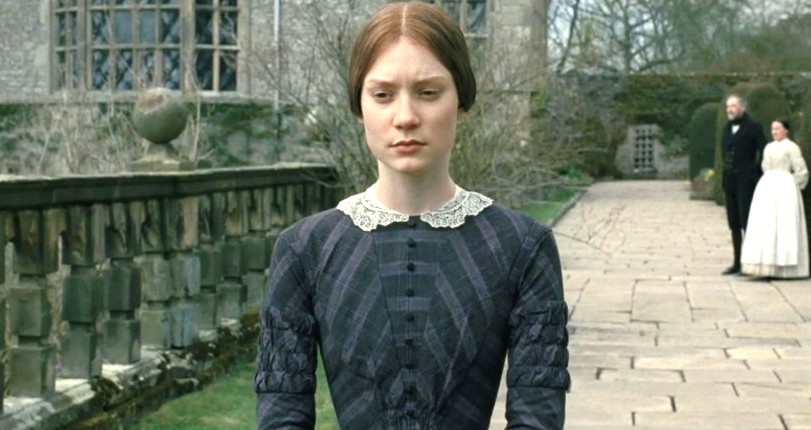
By Edward Copeland
Sometimes I feel like Burgess Meredith at the end of the classic Twilight Zone episode "Time Enough at Last" when he decides being the last man on earth is a small price to pay if that means he'll finally get to catch up on his reading — then he drops his glasses, breaking the spectacles while trying to find them. Fortunately, I'm neither the last man on earth nor, despite my many health problems, do I have bad sight. However, I've never allowed myself enough time to read every book or writer that I've wanted to or should have. One author on that list happens to be Charlotte Brontë. Amazingly, I've never even seen any of the more than two dozen adaptations of Jane Eyre that have been made for movies or TV dating back to 1910 until the 2011 version. Directed by Cary Joji Fukunaga and starring Mia Wasikowska in the title role and the busy Michael Fassbender as Rochester, I can't possibly speak with authority about how it compares with previous incarnations but I can say that this Jane Eyre had me engrossed from the start and wishing I'd read that novel at some point.
What I find funny is that though I've never read Jane Eyre or seen a depiction of the novel, I did see John Duigan's 1993 film of Wide Sargasso Sea, based on Jean Rhys' 1966 novel that imagined the story of Rochester's first wife in the West Indies. At the time I saw it, when the movie finished an audience member commented, "Now it leads to Jane Eyre" so though I really didn't know the story of Jane Eyre, I knew who was in the attic and started that fire.
Enough of that. We should be discussing this sumptuous movie itself, which landed a single Oscar nomination yesterday for Michael O'Connor's costumes. Quite deserving but cases could have been made for the art direction by Will Hughes-Jones, Karl Probert and Tina Jones; the cinematography of Adriano Goldman; and, most especially, Dario Marianelli's luscious and magnificent score.
That only takes into account the tech categories. This marks Fukunaga's fifth film as a director, but I haven't even heard of the other four, let alone seen them, but he does a helluva job with a great cast, particularly Jamie Bell as St. John Rivers, Amelia Clarkson as the young Jane, Sally Hawkins as the spiteful Mrs. Reed, Imogen Poots as Miss Ingram and Dame Judi Dench as Mrs. Fairfax.
Then there are the two leads. I haven't seen Shame or A Dangerous Method yet, but based on Jane Eyre and even X-Men: First-Class, Michael Fassbender probably deserved an Oscar nomination for best actor just for his body of work in 2011. He fills Rochester with the requisite amounts of mystery and romance, longing and guilt.
Finally and best of all we have Mia Wasikowska's work as Jane. This actress seldom disappoints even if her movies do (such as The Kids Are All Right and Alice in Wonderland) or get little notice (That Evening Sun). Jane Eyre provides her finest role yet. She's smart and willful, yet understandably guarded. Wasikowska deserved consideration, but I can't imagine that nominations aren't coming her way eventually.
Jane Eyre might seem to most people like territory that has been plowed before and often. I know that's true by the numbers but I also recognize a very good film when I see one and this Jane Eyre qualifies.
Tweet
Labels: 10s, Books, Burgess Meredith, Dench, Fassbender, Fiction, Oscars, Remakes
TO READ ON, CLICK HERE
Monday, July 18, 2011
Centennial Tributes: Hume Cronyn Part I

By Edward Copeland
When I planned to do a tribute to Hume Cronyn on what would be his 100th birthday, I never imagined that I'd have to break it into two parts, but the more I delved into his history, the more I realized the piece would be a long one because Cronyn's career was not only a long one, it was multifaceted. Believe it or not, I'm omitting a lot of what he did, just to make this salute as short as it is. In fairness, this tribute to the actor-screenwriter-playwright-author-director-producer-lyricist
 should ideally have led with a solo photo of the man, but his life and career was so inexorably linked with that of his second wife Jessica Tandy, it would be just as wrong not to include her since she figures so prominently in his story. Cronyn and Tandy met in 1940, wed in 1942 and stayed together until her death in 1994. In that time, the two of them collaborated in their first film together in 1944 and would go on to make a total of nine feature films, one feature documentary, appear in 10 plays shown on TV in the 1950s (one of which he directed), co-star in a short-lived 1954 sitcom (which he produced and began life as a radio show they did together), make five TV movies together, appear on countless talk shows and TV specials as a couple and, of course, teamed on the same Broadway productions 14 times, earning them the title of The First Couple of the American Theater. Cronyn did do plenty on his own though, not just as an actor, but as I mentioned earlier as a writer, not only of plays but of TV movies as well as two screenplays for Alfred Hitchcock, who directed Cronyn in his film debut in 1943, as well as his autobiography.
While Hume Cronyn, born on this date in 1911 in London, Ontario, Canada, certainly left his imprint on all entertainment mediums and in most of the possible roles associated with that industry, that almost wasn't going to be the course of his life's career. His father, also named Hume, was a banker and prominent member of the Canadian Parliament in Ontario and insisted his son go to law school so Cronyn studied law at McGill University in Montreal even though young Hume already had his sights set on a career in the theater. While at McGill, he also took an interest in boxing and developed skills good enough that he nearly landed a spot on Canada's 1932 Olympic boxing team as a featherweight, except he dropped out of McGill after the 1930-31 term and headed over the border to the United States. He made his professional stage debut in 1931 in the play Up Pops the Devil
 at The National Theatre in Washington. He played a paperboy for a salary of $15 a week. Cronyn began attending the American Academy of Dramatic Arts under Max Reinhardt where he graduated in 1934. He took acting jobs wherever he could find them, including working with The Barter Theatre in Abingdon, Va., outside Richmond. The city of Richmond reprints an article about the theater which still exists, from the Richmond Times-Dispatch about their production of a play called Mountain Ivy in summer 1934 as well as their unusual experiment where patrons could swap pigs, chickens, jellies and other assorted foods in exchange for a seat during the hard economic times. The article lists Cronyn as both a member of the cast and its production designer. He made his Broadway debut later that same year in the play Hippers' Holiday in the role of a janitor where he also served as understudy in the comedy whose cast also included Burgess Meredith. The next year, he replaced Garson Kanin (who would gain more fame later in his career as a writer) in the role of Green in George Abbott's production of the comedy Boy Meets Girl whose cast also included Everett Sloane, probably best known as Bernstein in Citizen Kane. Sometime in this time period, Cronyn wed for the first time, but no two sites agree on either the beginning or end dates of his marriage to Emily Woodruff or provides much information about her. They were either married in 1934 or 1935 and divorced in 1936 or 1941, the year after he met Jessica Tandy, but I was having no luck finding a definitive answer until I discovered that Cronyn and Tandy donated a treasure trove of their personal papers to The Library of Congress along with copies of divorce decrees, marriage licenses, etc. So I'll take their words as the final authority and Cronyn wed Emily Woodruff wed in 1934 and were divorced in 1936. Tandy, who actually was two years older than Cronyn and English born, ended her first marriage to the actor Jack Hawkins in 1942 after 10 years of marriage.
In January 1937, Cronyn landed the role of Elkus in the original production of Maxwell Anderson's fantasy High Tor, which won a New York Drama Critics Circle Award for show and whose cast included Meredith again as well as Peggy Ashcroft. He continued making Broadway appearances but 1939 became notable for two reasons. One: Cronyn made his first appearance on the fledgling medium of television on a program called Her Master's Voice. In October 1939, he made his biggest impression on The Great White Way to date in the role
 of Andrei Prozorov in a production of Chekhov's The Three Sisters. He continued working regularly on Broadway though 1940 proved more significant as the year he met Jessica Tandy. They wed two years later, though they didn't collaborate on the stage until six years later. In fact, Cronyn and Tandy shared the screen together first. When Cronyn and Tandy did make their first trip to Hollywood, it wasn't long before film roles came their way, especially for Cronyn who lucked out with his film debut. Though only 32 at the time, Cronyn was cast as the much older Herbie Hawkins, neighbor friend of Henry Travers in Alfred Hitchcock's great 1943 film Shadow of a Doubt starring Joseph Cotten and Teresa Wright. Travers played Wright's father and he and Cronyn's characters were obsessed with mysteries and scenarios for the perfect murder while completely unaware that Cotten's Uncle Charlie who is staying with Travers actually is a notorious serial killer. Cronyn and Travers' scenes are a hoot. The same year, Cronyn landed a small role in Claude Rains' rendering of The Phantom of the Opera and the war drama The Cross of Lorraine starring Jean-Pierre Aumont and Gene Kelly. Cronyn and Tandy also welcomed the birth of their first child, a son, Christopher. Cronyn also kept busy during those war years by staging and performing in many USO productions to entertain the troops.
His first working relationship with Hitchcock on Shadow of a Doubt would begin a professional relationship between the two that would persist and in many areas. The director cast Cronyn again as part of the ensemble in his next full-length feature, 1944's Lifeboat, for which YouTube provides a clip.
The same year also placed him in his first film with his wife, The Seventh Cross directed by Fred Zinnemann and starring Spencer Tracy. This war-time drama, which I've never managed to see, tells of seven men who
 escape a Nazi concentration camp. The camp's commandant orders that as each escapee is recaptured by the Gestapo, he be returned to the camp and put to death on one of the seven crosses he's erected. Tracy's character is the last of the seven still on the run, trying to flee to Holland. Cronyn and Tandy play a married couple who take Tracy in, unaware of who he is at first, though their own son is in the SS and Cronyn's character is tempted by a large reward. It earned Cronyn his first and only Oscar nomination as best supporting actor. It was the first film Tandy made in Hollywood. In 1945, Cronyn's major films took a lighter and, in one instance, a more domestic turn, as did he and Tandy's life with the birth of their second child, daughter Tandy. Filmwise, he co-starred with Robert Walker and June Allyson in The Sailor Takes a Wife and appeared in the all-star cast that included Judy Garland, Lena Horne, Gene Kelly and many, many more in the mix of music and comedy skits in Ziegfeld Follies. Cronyn acted in the sketch "Sweepstakes Ticket" with William Frawley and Fanny Brice. Again, YouTube actually has the clip and how often do you get to see the real Fanny Brice?
 The year 1946 proved especially busy for Cronyn on several fronts. In Los Angeles, he directed his wife for the first time on stage in a production of Tennessee Williams' Portrait of a Madonna at the Actors' Laboratory Theatre. Cronyn also was named a director of the Screen Actors Guild. He worked with director Jules Dassin for the first time in A Letter for Evie, teamed with his wife on screen for the second time in The Green
 Years, did uncredited voice work in The Secret Heart and co-starred as the smarmy defense attorney representing Lana Turner (or is he?) in the murder of Turner's husband in the film noir classic The Postman Always Rings Twice. Finally, on a personal note, Cronyn adopted Tandy's daughter, Susan, (from Tandy's marriage to Jack Hawkins) on the girl's 12th birthday and Susan changed her last name to Cronyn. In 1947, Cronyn became the first person to portray scientist Robert Oppenheimer in a film about the making of the atomic bomb The Beginning or the End. Tandy was making a mark on the East Coast creating one of the landmark characters in theatrical history — Blanche Du Bois in Tennessee Williams' A Streetcar Named Desire. In movies, Cronyn gave what may be the best performance I've ever seen him give — the tyrannical leader of the prison guards, Captain Munsey, locked in a battle of wills with Burt Lancaster in Dassin's Brute Force. This clip doesn't show Munsey at his cruelest or most terrifying and it has foreign subtitles, but you'll get the idea.
With 1948, Cronyn definitely indulged in the multi-faceted nature of his work in the arts. He only acted in one film that year: the comedy The Bride Goes Wild co-starring Van Johnson and June Allyson. Before he headed back east, he took his first crack at screenwriting. With Hitchcock's uncredited help, the two wrote
 the adaptation of Arthur Laurents' screenplay for Hitchcock's gem Rope, which was based on the play Rope's End by Patrick Hamilton. Rope not only was notable for the way Hitchcock filmed it in long takes that ran until the camera ran out of film, it also was the director's first film made in color. Cronyn then went back to New York where Jessica Tandy continued to play Blanche on Broadway. Cronyn returned to the stage for the first time in seven years in The Survivors whose cast included Louis Calhern, E.G. Marshall, Kevin McCarthy and Ray Walston. He also became a producer on the New York-based theater TV show that started on the fledgling ABC network called Actor's Studio, renamed The Play's the Thing in its final season when, by then, it aired on CBS. He directed an installment that broadcast Portrait of a Madonna and Tandy was even able on a night off to re-create the role she played in the L.A. production in which Cronyn directed her. The series attracted lots of big names and introduced viewers to many great works but sadly no copies of the program exist, including Marlon Brando's first appearance in a role on television in 1949, something he wouldn't do again until 1979.
As the 1940s ended, Cronyn was all over the map — literally. He only acted in one feature film — and it was a musical. Cronyn put on a brogue to play the assistant to an Irish town's police sergeant (Barry Fitzgerald) who calls on a singing insurance investigator from America (Bing Crosby) to help solve the mystery of the whereabouts of their missing Blarney Stone. That was the least of Cronyn's accomplishments that year. He still served as a producer on the series Actor's Studio, though he didn't have time to appear or direct on that program because he was so busy on other TV series. He worked again with Burgess Meredith as well as Pat Harrington Jr. in the "One Sunday Afternoon" installment of The Ford Theatre Hour in May; acted opposite Fay Bainter in "The Uncertain Hour" on The Chevrolet Tele-Theatre a week later; and played the title character in "Dr. Violet" on Suspense, a series that presented live plays with characters in dangerous situations. Cronyn would repeat the role in two more installments the following year.
He also found time to play the title role in a national tour of Shakespeare's Hamlet put on by The American National Theatre and Academy. Cronyn also repeated the job he had on Hitchcock's Rope on Hitch's next project Under Capricorn, the only movie by the director I couldn't even finish. It wasn't his usual suspenser, but a big costume drama set in 1831 Australia and starring Ingrid Bergman and Joseph Cotten. I'm far from alone in my criticism of it — Hitchcock himself regretted making it in the book-length interview he did with Francois Truffaut. Cronyn had a helluva task. First, it was a novel, then a play, then a screenplay and then he got his hands on it to try to turn it into something worth watching. Hitchcock admitted he only took the movie for the chance to work with Bergman and to return to England — and the big paycheck didn't hurt either. He also admitted that Cronyn was out of his element. "I wanted (Cronyn) because he's a very articulate man who knows how to voice his ideas, but as a scriptwriter he hadn't really sufficient experience," Hitchcock told Truffaut while taking the ultimate blame.
SOURCES: Hume Cronyn and Jessica Tandy: A Register of Their Papers in the Library of Congress, Fandango, biography.com, film reference.com, Encyclopedia of World Biography, Internet Accuracy Project, Hitchcock by Francois Truffaut, Wikipedia, The Internet Broadway Database and the Internet Movie Database.
Tweet
Labels: Burgess Meredith, Dassin, E.G. Marshall, Garland, Gene Kelly, Hitchcock, Ingrid Bergman, Joseph Cotten, Lancaster, Rains, Tandy, Tennessee Williams, Tracy, Truffaut, Zinnemann
TO READ ON, CLICK HERE
Centennial Tributes: Hume Cronyn Part II
Hume Cronyn

By Edward Copeland
We continue our tribute to Hume Cronyn as the decade turns to the 1950s. If you started here by mistake and missed Part I, click here. Cronyn continued to appear steadily on the various live theatrical programs on TV but only two feature films the entire decade. He definitely turned his focus to the stage, especially behind-the-scenes work. In March 1950, he directed his first Broadway play, the original comedy Now I Lay Me Down to Sleep whose cast included Fredric March. In November, he and his wife did their first New York stage collaboration when he directed her as the title character in the original drama Hilda Crane. In April 1951, he helped produce The Little Blue Light which reunited him with Burgess Meredith and had Melvyn Douglas in the cast. In August, his sole feature film of the year was released: the underrated Joseph L. Mankiewicz gem People Will Talk starring Cary Grant. Grant and Cronyn play professors at a medical school with diametrically opposed views on just about everything and Cronyn's character leads a crusade to get Grant removed from the faculty because of his unorthodox views.

Beginning Oct. 24, 1951, Cronyn and Tandy appeared on Broadway together for the first time in a play that became such a hit, that it managed to be spun off into radio, TV and movie versions with Cronyn and Tandy starring in all but the movie version because they were still enjoying the successful Broadway run at the time. The original comedy The Fourposter by Jan De Hartog is a two-character play where spouses Michael and Agnes re-enact their marriage around their four-poster bed and took place between 1890 and 1925. José
 Ferrer directed the production and both he and De Hartog won Tonys (meaning it won best play). Since Cronyn and Tandy stayed with the play until May 1953, their roles in the 1952 film version directed by Irving Reis went to Rex Harrison and Lili Palmer. Its only Oscar nomination was for black-and-white cinematography. When Cronyn and Tandy finished their run in the play, Cronyn produced an NBC radio sitcom version of the play, changing the title to The Marriage, the characters' names to Ben and Liz and losing the period element. While they worked on this during the play's run, the radio show didn't begin airing until October 1953. A total of 26 episodes aired and then The Marriage made history, albeit short-lived. It moved to NBC TV where it became the first sitcom broadcast in color, though it only lasted eight episodes when, tragically, Tandy suffered a miscarriage and live broadcasts ceased never to start again. The Fourposter would come back throughout Cronyn and Tandy's careers though in the form of revivals and tours (including a 15-performance Broadway revival in 1955). In fact, in the summer of 1955, Cronyn and Tandy performed The Fourposter on an episode of Producers' Showcase and Tandy received her first Emmy nomination for actress in a single performance.
Throughout the 1950s, movies didn't see much of Cronyn as he kept busy with productions on TV and the stage. Other than People Will Talk, the only other feature film IMDb lists for that decade is something called Crowded Paradise in 1956 of which IMDb contains the bare minimum of information. Part of the reason for this may have been that Hume Cronyn may have been one of the few people in this country's sordid history of the blacklist to keep himself busy so constantly that he didn't know he'd been blacklisted. Another reason was that it seemed inconceivable to him since he was never very active politically, never called before HUAC or ever attended any "suspect" meetings. It turned out eventually that his particularly puzzling blacklisting was because he had hired people who were blacklisted, not that he knew or even if he did he would have cared. Cronyn didn't suffer too much because by the time he became aware of his status, others had started breaking the blacklist anyway by doing what got him on the list in the first place.

In December 1953, he and Norman Lloyd inaugurated The Phoenix Theatre by co-directing and co-starring in Madam, Will You Walk? which also featured Tandy. Interestingly, the play with the same opening and closing dates is listed in both the Internet Broadway Database and the Internet Off-Broadway Database and I can find nothing in a quick look to settle where it belongs — not even number of seats or an address. Cronyn didn't spend all his stage time in New York though, he started doing a lot of tours, including a series of concert readings with Tandy in 1954 called Face to Face which were later turned into a recording. In 1955, Cronyn hit The Great White Way with Tandy twice: the aforementioned short revival of The Fourposter and an original farce by Roald Dahl called The Honeys. Sometime that year he had time to act in A Day By The Sea at the American National Theatre and Academy Theatre — and that's not counting 13 TV acting jobs between 1953 and 1955.

The remainder of the decade was even more dominated by work on television, to the exclusion of actual stage work in 1956 though he did make the first of two appearances (the second coming in 1958) on Alfred Hitchcock Presents. He returned to Broadway in 1957 to direct longtime friend Karl Malden in The Egghead. Cronyn and Tandy also toured several cities across the U.S. in 1957 with the new comedy The Man in the Dog Suit ahead of its Broadway premiere in 1958. Cronyn followed the same pattern in 1958, touring with Tandy and other actors in a production he both starred in and directed called Triple Play that consisted of three one-act plays and a monologue, which was considered an original one act play when it opened on Broadway in 1959, though it was written by the long dead Anton Chekhov. The one acts were Tennessee Williams' Portrait of a Madonna, two by Sean O'Casey: A Pound on Demand and Bedtime Story, and the Chekhov monologue which Cronyn performed Some Comments on the Harmful Effects of Tobacco. Cronyn and Tandy closed out the 1950s with a television movie adaptation of Somerset Maugham's novel The Moon and Sixpence with a cast led by Laurence Olivier and featuring Judith Anderson, Denholm Elliott, Geraldine Fitzgerald and Jean Marsh. IMDb actually had a link to the original Time magazine review of it.

As the 1960s began, movies began to enter Cronyn's life again and television receded a bit, mainly because the popularity of programs that televised plays were on the wane. Theater maintained its prominence in his life, and he started to see some award recognition for it. In the fall of 1960, he played Louis Howe to Ralph Bellamy's FDR and Greer Garson's Eleanor when Sunrise at Campobello was released. In early 1961, Cronyn opened on Broadway as Jimmie Luton, the main character of the new farce Big Fish, Little Fish by Hugh Wheeler, his first work on Broadway though he'd go on to write the books for A Little Night Music, Candide and Sweeney Todd, winning a Tony for all three. Cronyn was directed in Big Fish, Little Fish by John Gielgud, who won the Tony for best direction in a play. Cronyn received his first Tony nomination as actor in a play and the cast included Jason Robards, George Grizzard (Tony nominee for featured actor in a play) and Martin Gabel (Tony winner for featured actor in a play). The show proved to be such a success that
 the following year Cronyn made his London stage debut when he played Jimmie Luton again when Big Fish, Little Fish opened at the Duke of York's Theatre. While overseas he helped his friend Joe Mankiewicz by taking the part of Sosigenes in the out-of-control Cleopatra, which finally opened in 1963. When he was back in the U.S. in 1963, he helped inaugurate the premiere season of the Tyrone Guthrie's Minnesota Theatre Company at the Guthrie Theatre in Minneapolis by appearing in three productions: Harpagon in Moliere's The Miser, Tchebutkin in Chekhov's The Three Sisters and Willy Loman in Arthur Miller's Death of a Salesman. In 1964, Cronyn scored a coup — playing Polonious in a Broadway production of Hamlet starring Richard Burton and nearly stealing the show from the melancholy Dane. Directed by Gielgud as if the company were in rehearsal clothes, it also was filmed and aired on TV the same year. Cronyn's performance won him a Tony for featured actor in a play. Here is a YouTube clip of Cronyn and Burton at work.
A few months after his triumph in Hamlet, Cronyn returned to the Broadway stage with Tandy in tow in The Physicists opposite Robert Shaw. Two days after that show closed, Cronyn was one of the producers of the play Slow Dance on the Killing Ground, which earned Cronyn his third Tony nomination, his first as producer of a best play nominee. In late 1966, Cronyn and Tandy created the roles of Tobias and Agnes in a bona fide classic: Edward Albee's Pulitzer Prize-winning A Delicate Balance and Cronyn received another Tony nomination as actor in a play as Tobias. In 1967, Cronyn took A Delicate Balance on tour. He stayed on the road performing in productions in L.A. and Ontario in 1968 and 1969. He squeezed out two films in 1969: Elia Kazan's adaptation of his own novel The Arrangement and Norman Jewison's comedy Gaily, Gaily starring Beau Bridges. Somehow, in this busiest of schedules, Cronyn also had to recover from a bout of cancer that cost him one of his eyes in 1969 and left him with a glass eye for the rest of his life.

Now, we do draw near the end of the theatrical careers of Hume Cronyn and Jessica Tandy, but Cronyn wraps it up very actively and the couple will follow it up with prolific television and film work. First in 1977, Cronyn co-produced with Mike Nichols the two-person play The Gin Game for he and Tandy to star in and Nichols to direct. After an initial tryout in Long Wharf, Conn., they moved to Broadway to much success, running 517 performances. Cronyn received Tony and Drama Desk nominations for both best actor and best play while Tandy won both those awards for best actress. The play's author, D.L. Coburn, won the Pulitzer. Nichols received play and directing nominations from both groups. Cronyn and Tandy then took The Gin Game on tour, not just in the United States but throughout Canada, the United
 Kingdom and some cities in the Soviet Union as well through 1979. Then, they made a television version of the play that aired in a version made for Showtime in 1981. During this time period, dating back to 1977, Cronyn also was collaborating with writer Susan Cooper on what would become Cronyn and Tandy's penultimate stage project. Before they got to that, Cronyn managed to return to feature films three times and took Tandy along on two of them. They had small parts in the odd ensemble assembled for John Schlesinger's wacky satire Honky Tonk Freeway, Cronyn re-teamed alone with his Parallax View director Alan J. Pakula for an economic thriller called Rollover starring Jane Fonda and Kris Kristofferson and then he and Tandy had brief roles as the parents of the one-of-a-kind Jenny Fields (Glenn Close) in the movie adaptation of The World According to Garp.
Susan Cooper also hailed from England, but came to the U.S. when she married an American, though the marriage didn't work out. She primarily wrote novels and children's books until she developed an interest in
 playwriting and somehow began collaboration with Cronyn a long-gestating work called Foxfire about the end of an Appalachian family's way of life. It added to Cronyn's resume because not only was he co-author of the play, he, Cooper and Jonathan Holtzman wrote lyrics for songs for which Holtzman wrote the music, though it wasn't strictly a musical. After debuting first at The Stratford Festival in Stratford, Ontario and The Guthrie Theatre in Minneapolis, it opened on Broadway in November 1982. Playing Cronyn and Tandy's characters' son in the play was Keith Carradine. Tandy won both the Tony and the Drama Desk awards for best actress in a play. Five years later, it aired on CBS where Tandy again won outstanding actress, this time in a miniseries or special. Cronyn was nominated as outstanding actor and he and Cooper received a solo writing nomination. The movie itself was nominated as outstanding drama or comedy special and John Denver took Carradine's role. Below is a YouTube clip of the TV movie.
After having seen Foxfire, Cronyn's co-star in Rollover, Jane Fonda, asked if he and Susan Cooper would adapt the novel The Dollmaker into a script for a TV movie for her. They did and received Emmy nominations for writing the 1984 telefilm and Fonda won outstanding actress in a miniseries or special for it. It was (and remains) only the second time Fonda appeared in a TV production, the previous one being when she was just starting out in 1961. Cronyn started heading back to the cinema in the 1984 thriller Impulse and Richard Pryor's surprise relative who gives him the challenge of spending $30 million in 30 days if he wants to inherit his vast fortune of $300 million in the umpteenth remake of Brewster's Millions in 1985. However, Cronyn, with Tandy beside him, had another 1985 release that really made the veteran actors stars to an entirely new generation.
Joining Cronyn and Tandy as the leads of Ron Howard's Cocoon were Wilford Brimley, Maureen Stapleton, Gwen Verdon, Jack Gilford, Herta Ware and Don Ameche, who took home an Oscar for supporting actor for
 the film even though he wasn't even the best supporting actor in the film. A sci-fi comedy and meditation on aging and dying, it was made when Big Blue was a swimming pool loaded with extra-terrestrial magic making the seniors horny instead of a pill for erectile dysfunction. Cronyn and Tandy had particularly good moments as the pool awakened his character's libido and his wandering eye, reminding his wife of his younger days when he was far from faithful. Of course, they had to make an awful sequel, but to have that a big a hit with that many older actors as leads was quite something. It's not like Steve Guttenberg was the draw. The following year, 1986, Cronyn and Tandy were honored together as that year's batch of Kennedy Center honorees alongside Lucille Ball, Ray Charles, Yehudi Menuhin and Antony Tudor. Cronyn and Tandy would appear in two more feature films togethers (three counting the Cocoon sequel): 1987's *batteries not included and 1994's Camilla, Tandy's final film released after her death. Among the many televison and feature films we won't still talk about that Cronyn would go on to make the most notable were The Pelican Brief and Marvin's Room.
In 1986, Hume Cronyn and Jessica Tandy appeared in their last Broadway show, fittingly together. The Petition was a two-person play and earned each of them Tony nominations. In 1994, they received the very first Tony Awards ever given for lifetime achievement. It was just a few months before Tandy's death. Though their stage work considerably lessened and Broadway work ceased, movie and TV worked soared. Cronyn became a regular presence at the Emmys, being nominated five times between 1990 and 1998 and winning three times. He won lead actor for HBO's Age-Old Friends, which allowed him to act opposite daughter Tandy Cronyn. He won that, his first Emmy, the same year that Tandy won the best actress Oscar for Driving Miss Daisy. During this time, the pair went on 60 Minutes and had fun putting Mike Wallace on.

Cronyn earned two 1992 Emmy nominations, one for lead actor in a miniseries or special in Christmas on Division Street and one for supporting actor in a miniseries or special for Neil Simon's Broadway Bound, which he won. His third win was bittersweet. Written by Susan Cooper, To Dance With the White Dog co-starred Tandy who also was nominated, and dealt with a widower working through the grief over the loss of his wife. The awards ceremony took place shortly after Tandy's death. Cronyn's final Emmy nomination came for supporting actor in a miniseries or special for Showtime's version of 12 Angry Men in 1998. Two years after Tandy's death, Cronyn married Susan Cooper who remained his wife until his death in 2003. The only other writing project they worked on together was a screenplay adaptation of Anne Tyler's novel Dinner at the Homesick Restaurant, which they didn't complete. Cronyn completed one other bit of writing: his memoir A Terrible Liar which was published in 1991. Hume Cronyn only missed his own centennial by eight years, but with as much as he accomplished, he might as well have lived 200 years. It helps when you have a partner as simpatico to you as Jessica Tandy was to him.
SOURCES: Hume Cronyn and Jessica Tandy: A Register of Their Papers in the Library of Congress,, The Digital Deli Too, thelostland.com, film reference.com, Internet Accuracy Project, Superiorpics.com, Wikipedia, Lortel Archives: Internet Off-Broadway Database, The Internet Broadway Database and the Internet Movie Database.
Tweet
Labels: Albee, Beau Bridges, Bellamy, blacklist, Burgess Meredith, Cary, Ferrer, Fredric March, Garson, Gielgud, Glenn Close, J. Fonda, Jewison, K. Carradine, Kazan, Malden, Mankiewicz, Nichols, Olivier, Robards
TO READ ON, CLICK HERE
Tuesday, August 24, 2010
Sun-baked noir drawn from a dime store novel

By Edward Copeland
As I watched After Dark, My Sweet again, in preparation for this 20th anniversary piece, I was struck once again by the melancholy that often hits people like myself who have spent much of their lives trying to
 devour works in various fields of artistic endeavor. My readers realize my film obsession and my brief and expensive addiction to New York theater, as well as to various television shows. I've also tried to be a voracious reader, which I have been for most of my life except for frequent periods when severe headaches interfered. There simply isn't enough time in the day to watch and read (and listen: I like music too) and then write about them. I feel like Burgess Meredith in the classic Twilight Zone episode, though at least my eyesight is holding out so I don't have to worry about breaking my glasses after the bomb falls. Anyway, among the many regrets in my life is that I've never read any of the classic Jim Thompson pulp fiction novels, which enjoyed a resurgence in terms of film adaptations in the late 1980s and early 1990s of which James Foley's After Dark, My Sweet was the finest example. Even though my finances always hover in a precarious state and Thompson's books can't be bought for two bits anymore, after I rewatched the film, I did put out $7 to read the novel before sitting down to write this tribute. Of course, I had heard Thompson's words before because he'd also worked as a screenwriter, most notably on Stanley Kubrick's The Killing and Paths of Glory.
What makes Foley's film work so well is its casting of Jason Patric in the lead role of former boxer and recent mental institution escapee Kid Collins. One difference between the novel and the movie: His first name in the
 book is William, but the screenplay by Foley and Robert Redlin christens him Kevin, though it hardly matters since he's almost always referred to as Collins or, once he encounters the widow Fay Anderson (Rachel Ward), Collie. The book also describes him as blond, which the dark-haired Patric certainly is not. The movie, which like the novel, is narrated by Collins, doesn't make it clear what his problem is. Has he been punched a few too many times in the ring? Did guilt over killing another fighter in the ring set him off? Maybe he just has criminal tendencies, though at times he seems as gentle as Lennie in Of Mice and Men. Still, he's also prone to sudden rage that you don't want to find yourself on the receiving end of. On the first page of the novel, Collins shows the reader the classification card that has accompanied him through four mental institutions:
William ("Kid") Collins: Blond, extremely handsome; very strong, agile. Mild criminal tendencies or none, according to environmental factors. Mild multiple neuroses (environmental) Psychosis, Korsakoff (no syndrome) induced by shock; aggravated by worry. Treatment: absolute rest, quiet, wholesome food and surroundings. Collins is amiable, polite, patient, but may be very dangerous if aroused...
Except for the name change and the updating of the time period, the film sticks fairly closely to the book. Both are narrated by Collins, except the book shows that he isn't the swiftest guy in the world in terms of mastery of the English language while some of the internal lines the film gives him come off as a bit too well-formed for the character. The novel also makes his motivations much clearer than the film which by leaving things out make some scenes seem like a cheat or purposely vague. In a way, the Collie of the film is even more of an unreliable narrator than the Collie of Thompson's novel.
Of course, noir purists might dismiss a story set in modern time and filmed in sun-drenched color (to match its southwestern locale, it even includes a nice score from Maurice Jarre, the great composer of Lawrence of Arabia), but it hits all the marks. Still, as good as Foley's film is, Patric holds the key to its success in his
 portrayal of Collins. It's the best role of the talented actor's odd film career. Whether Collie has just been hit in the head one time too many or is just naturally mentally unbalanced (or perhaps he's smarter than we think and it's all a put on), Patric handles the turns of uncertainty in his part beautifully. The year following After Dark, My Sweet he had another good role opposite Jennifer Jason Leigh in Rush playing an undercover cop who becomes too involved in the drugs he is investigating, but that film and performance were overshadowed by Patric's tabloid fame as the man who broke up Julia Roberts and Kiefer Sutherland before they could wed. Given that Patric also is Jackie Gleason's grandson and the son of Jason Miller, Oscar-nominated actor for The Exorcist and Pulitzer Prize-winning playwright of That Championship Season, I can't help if all that attention has played a role in a purposeful obscurity. If so, it's a shame, because Patric has remarkable talent that's not seen nearly enough as it's on display in After Dark, My Sweet or in a handful of other films such as Your Friends and Neighbors.
The plot's engine ignites simply enough. Collins steps off the hot road into a saloon to get a cold beer from a disinterested bartender named Bert (Rocky Giordani) while sitting further down the bar is an attractive woman whose name he'll learn is Fay (Ward). Collins, as is his habit, tends to ramble, but in a good-natured
 way, telling about how he's lost track of his friend Jack Billingsley, but he's certain he'll wander in that bar at some point. Bert and Fay, recognizing that Collins may be a bit slow, have a bit of fun at the kid's expense, until it ceases to be fun for them anymore because Collins just won't shut up. Bert grabs the beer back before Collins can even finish it and tells him to get out. Collins insists that he hasn't done anything wrong: He's a veteran and just waiting on a friend. Bert doesn't care and reaches across the bar and grabs Collins' shirt. That's a mistake. Before you know it, Bert lies sprawled and Collins has hit the road again. He's surprised when Fay pulls up alongside him in her car, offering a ride. He thinks it's a scam and she'll take him back to the bar and the cops, but Fay insists that Bert is the last person who wants to be involved with the police. Reluctantly, Collins climbs in the vehicle and they drive to Fay's rundown plantation.
At her place, Fay reveals to Collie that she's a widow (she doesn't need to reveal that she's an alcoholic; even someone as slow as Collins can figure that out) and offers him a trailer on her property as a residence. As the two are getting acquainted in the main house, a car pulls up and Fay rushes out to see the man, almost as if she wants to steer him clear of Collie. That doesn't last long. As Collie and Fay go out that night, the man stumbles upon them again. His name is Garrett Stoker (played with a wonderful sleaze quotient by Bruce Dern), but everyone knows him as Uncle Bud. Thompson's, i.e. Collins', description of Uncle Bud in the novel truly hits the mark in a delightful introductory sequence:
You meet guys like Uncle Bud — just over a drink or a cup of coffee — and you feel like you'veknown them all your life. They make you feel that way.
The first thing you know they're writing down your address and telephone number, and the next thing you know they're dropping around to see you or giving you a ring. Just being friendly, you understand. Not because they want anything, you understand. Sooner or later, of course, they want something; and when they do it's awfully hard to say no to them. No matter what it is.

Uncle Bud says he's a former police detective and, yes, he does want Collie for something: to be part of a scheme he's been trying to sell Fay on for several months: kidnapping the young son of a wealthy family and collecting a big ransom. Fay and Collie both humor Uncle Bud, but later at Fay's house, she tells him that Uncle Bud has been trying to find a third for his cockeyed plan for a long time and it would be in Collie's best interest to get as far away from both of them as fast as he can.
Collins takes Fay's advice and stops off at a diner, where he bring his own booze much to the counterman's anger (as well as his usual spiel about waiting for Jack Billingsley). The counterman asks him to at least go wait in an out-of-the-way booth so he won't get in trouble and Collins complies, though being slightly tipsy, he
 stumbles into the booth of a man who turns out to be a doctor named Goldman (George Dickerson). The doctor recognizes the signs in Collins of someone who's been in a mental health facility and offers him some help. Collins refuses, though the doctor gives him his card anyway. Later, without any prospects, Collins looks up Doc Goldman, figuring he has nothing else to lose, so he might as well work some odd jobs and maybe find a nice place to stay for awhile. The doctor, who practices out of his home, is glad to see him and lets him do yard work in exchange for room and board. He tries to talk to Collins about his past and whether or not he needs to go back to an institution or, at the very least, quit boozing, but Collins isn't receptive to the idea. The biggest problem concerning Collins is that he can't get Fay out of his mind and he wonders if she's safe from Uncle Bud's plotting. His worry eventually leads him to flee again, back to Fay and getting himself neck deep in the kidnapping plan.
While After Dark, My Sweet exists at its core as a thriller and contains the many twists you'd expect, Foley's keeps his pacing loose, yet it never loses your attention. I'll spare you the details, in case you haven't seen the film or read the book, but it's riveting and suspenseful without building tension so taut it breaks. The one misstep I think Foley makes is an extended sex scene between Patric and Ward. It is important for a plot development, but the romp wastes too much screentime and almost brings the film to a halt. In the novel, Thompson accomplishes the same thing in a mere paragraph that's mostly allusion but the film's version goes on way too long. As Orson Welles once famously said, the two things that always look fake on film are praying and making love, and Foley certainly proves that adage with the length of the boinking here.

Still, that criticism is a minor one for an otherwise great film anchored by such a magnificent performance. Since I read the novel after having seen the film multiple times, it's hard to say which is better, though the book certainly makes things clearer and works more efficiently. Foley managed to come up with a more ambiguous ending than Thompson did and how often does that happen in a film? Not nearly enough anymore really, but 20 years ago it did and thank goodness that Foley cast an actor as talented as Jason Patric to pull it off. I just wish we got to see Patric put his gifts to use in worthy projects more often.
Tweet
Labels: 90s, Books, Burgess Meredith, Fiction, J.J. Leigh, Jim Thompson, Julia Roberts, K. Sutherland, Kubrick, Movie Tributes, Welles
TO READ ON, CLICK HERE


