Wednesday, May 29, 2013
"My Rifle, My Pony and Me" (Rio Bravo tribute, Part II)

While Sheriff Chance took on a major task by arresting Joe Burdette and incarcerating him in his small Presidio County jail, with Stumpy left to guard the bad guy most of the time, he still bears the responsibility for maintaining the law elsewhere in his town, something he accomplishes through street patrols and his nights staying at The Hotel Alamo (of all the names to pick) run by Carlos Robante (Pedro Gonzalez Gonzalez) and his wife Consuela (Estelita Rodriguez). One night, a poker game piques his interest as two of the players (Angie Dickinson, Walter Barnes) fit the profile of two hustlers warned about on handbills. After a cursory investigation, Chance arrests the woman, who goes by the name Feathers. She declares her innocence and Chance fails to find the crooked cards on her after she's left the table following a huge winning streak. When he returns though, he does find the stacked deck on the man, who has raked it in since her departure and tells him to return his ill-gotten gains and be on the morning stagecoach. He suggests that Feathers do the same, but she decides to stick around.

That next day, the Burdettes arrive as expected, led by Joe's smooth brother Nathan (John Russell, the gaunt, veteran actor of mostly Westerns where he usually played the villain. His second-to-last film was as the cold-blooded killer in Clint Eastwood's Pale Rider). He asks Chance why the streets appear so full of people. Chance offers no explanation, but suggests that perhaps gawkers came to town, drawn to the possibility that the Burdettes planned to put on a show.

Chance makes his nightly trek to the Hotel Alamo. When he gets there, Spencer pulls him over for a drink. The wagon master has heard of the trouble Chance faces. "A game-legged old man and a drunk. That's all you got?" Spencer asks in disbelief. "That's what I got," Chance responds. Spencer offers himself and his men as help against the Burdettes, but the sheriff expresses reluctance to take responsibility for others. He does ask about the confident young gunman Colorado that Spencer has hired. If he is as good as he thinks he is and lacks the family ties of the older men, Chance would be willing to take him on if Colorado agrees. Spencer calls Colorado over, but the young man politely declines, earning Chance's respect for being smart enough to know when to sit out a fight. Not long afterward, while Feathers flirts again and Chance urges her to get on the morning stage, shots ring out on the street and Spencer falls dead. Later, Nathan Burdette makes his first visit to see his brother Joe, despite Stumpy's withering verbal assaults, at the jail. First, Nathan wants the sheriff to
 explain why his brother looks so beat up. "He didn't take too kindly to being arrested for murder," Chance tells Nathan while Joe denies the shooting was murder. Nathan asks how Chance can be so certain or, at the very least, why Joe isn't being tried where the alleged murder occurred. Chance nixes that idea, content to let the U.S. marshal handle Joe Burdette and try him elsewhere. Nathan silkily makes no overt threats, but certainly implies that Joe might not remain in the Presidio County jail by the time that marshal shows up, especially if the sheriff relies on a drunk and an old man as his backup. Chance isn't in a mood to hide his cards. "You're a rich man, Burdette. Big ranch, pay a lot of people to do what you want 'em to do. And you got a brother. He's no good but he's your brother. He committed 20 murders you'd try and see he didn't hang for 'em," the sheriff spits out. "I don't like that kinda talk. Now you're practically accusing me," Nathan Burdette says, but Chance continues. "Let's get this straight. You don't like? I don't like a lot of things. I don't like your men sittin' on the road bottling up this town. I don't like your men watching us, trying to catch us with our backs turned. And I don't like it when a friend of mine offers to help and 20 minutes later he's dead! And i don't like you, Burdette, because you set it up." If war wasn't brewing before, it was now.
The murder of Spencer fully incorporates the last two major characters more fully into the film and the action. With his boss dead, Colorado at first finds himself content to take his pay from the slain wagon master's possessions and remains determined to mind his own business. Once he witnesses some more of the Burdette brutality, Colorado decides to join up and Chance deputizes him. Colorado becomes part of the team and helps Chance escape an ambush, an ambush for which the sheriff seems prepared to occur, quickly pumping off rounds from his rifle. "You always leave the carbine cocked?" Colorado asks. "Only when I carry it," Chance replies. Originally, Hawks opposed casting Ricky Nelson, though the director admits he probably boosted box office. He had sought someone popular with young viewers, but felt Nelson — who turned 18 during filming — lacked age and experience for the part. Hawks had chased Elvis Presley for the role, but as often was the case, Col. Tom Parker demanded too much money for his client and the Rio Bravo production had to take a pass. The pseudo love affair between Feathers and Chance also heats up, though Wayne's discomfort with the romantic scenes with Dickinson is readily apparent. Wayne felt uneasy about the 25-year age gap between him and Dickinson. On top of that, nervous studio bosses wanted no implication made that Chance and Feathers ever sleep together. Double entendres and innuendos abound, but truthfully more sparks fly in brief scenes between Martin and Dickinson and Nelson and Dickinson than ever produce friction in the Wayne-Dickinson scenes. What becomes most interesting about the relationship between Feathers and Chance is Feathers' transformation into the sheriff's protector, keeping watch over him as he sleeps to make sure that no Burdette makes a move on him.


You don't need to know how the rest of Rio Bravo unfolds. Besides, part of what makes the film so fascinating and more than your ordinary Western comes from the multiple tones Hawks balances. A viewer seeing Rio Bravo for the first time couldn't positively predict what mood shall prevail by the final reel: light-hearted, tragic, heroic, romantic, some combination of those elements. At any given moment, you might change your mind. Most of this uncertainty reflects the nature of the character Dude. With the possible exception of Feathers, almost every other character in the film stays on a static path. Dude captures our attention the most because of the dynamics within him. Will he maintain the upper hand in his battle with booze or will he fall off the wagon again and if he does, what consequences does that
 have for the others? Even sober, he's prone to depression, low self-esteem and self-pity. Still, he can croon a song or be a crack shot. A part this multifaceted requires a talented actor and back when Rio Bravo was made, Dean Martin wouldn't be one of the first names to jump to your mind. However, in the years 1958 and 1959, soon after the end of his partnership with Jerry Lewis, Martin turned in two impressive performances (perhaps three, but I haven't seen 1958's The Young Lions). In 1958, he gave a great turn as a professional gambler Bama Dillert in Vincente Minnelli's adaptation of the James Jones novel Some Came Running starring Frank Sinatra and Shirley MacLaine. He followed that with his astoundingly good work in Rio Bravo. While Martin continue to make entertaining films, for some reason those two years stand out as an aberration and he never got roles as good as Bama Dillert or Dude again.
Hawks' behind-the-scenes collaborators provided as much of the magic of Rio Bravo as its cast. From Russell Harlan's crisp and lush cinematography to Tiomkin's score that complements Hawks' leisurely pacing well. Tiomkin also teamed with lyricist Paul Francis West for the film's songs — "Cindy" and "My Rifle, My Pony and Me" in the extended musical interlude by Dude, Stumpy and
 Colorado as well as the title song. Reportedly, Wayne joined the singing at one point until they decided it inappropriate for the sheriff to take part (and also because the Duke allegedly could not carry a tune). In another instance of borrowing from past work, at Wayne's suggestion, Tiomkin actually reworked the theme to Red River into the song "My Rifle, My Pony and Me." Tiomkin also composed "Degüello," aka "The Cutthroat Song," which the Burdettes play to psych out the good guys guarding Joe. The film claims the music comes from Mexico where Santa Anna's soldiers played it continuously to unnerve those holed up inside the Alamo. Wayne loved the music and the story so much, even though the tale wasn't true, he used it in his film The Alamo the following year. His screenwriting team of Jules Furthman and Leigh Brackett both had worked with Hawks as a team and separately before and after Rio Bravo. Previously, Furthman and Brackett co-wrote Hawks' classic 1946 take on The Big Sleep. Furthman also co-wrote Come and Get It and To Have and Have Not and did a solo turn on Only Angels Have Wings. The legendary Brackett, despite her extensive screenwriting work, made a name for herself as a novelist, largely in the male-dominated field of science fiction. In Schickel's commentary, he refers to Brackett as an example of a real life Hawksian woman. In fact, before her death, the last screenplay she co-wrote was The Empire Strikes Back. In another non-Hawks project, she returned to Philip Marlowe when she wrote the screenplay for Robert Altman's The Long Goodbye. In addition to the Hawks titles already mentioned for Brackett, she also wrote the screenplay for 1962's Hatari! and co-wrote 1970's Rio Lobo. The DVD commentary also includes director John Carpenter, who names Hawks as his favorite director, and paid tribute to Leigh Brackett by naming the sheriff in the original Halloween after her.
Tweet
Labels: 50s, Altman, Angie Dickinson, Blog-a-thons, Dean Martin, Eastwood, Elvis, Hawks, Jerry Lewis, John Carpenter, MacLaine, Movie Tributes, Sinatra, Star Wars, W. Brennan, Wayne
TO READ ON, CLICK HERE


Monday, March 26, 2012
Merging art and commerce

— Pauline Kael, The New Yorker, March 18, 1972
By Edward Copeland
Picture this: The war Michael Corleone returns from at the beginning of The Godfather isn't World War II, but Vietnam. Perhaps Kay Adams looks more like a flower child (Diane Keaton had been a Member of the Tribe in the original Broadway production of Hair after all). Try to fathom what poor Fredo would be experimenting with once they sent him off to Las Vegas. If Paramount Pictures steamrolled over
 Francis Ford Coppola from the minute he agreed to direct the film, these things might not be theoretical flights of fancy. On the commentary track of The Godfather DVD, Coppola tells how when he climbed aboard the project, Paramount handed him a completed screenplay that the studio had developed, much as they financed the writing of the novel, with Mario Puzo. Only for some bizarre reason, while setting the story's beginnings in 1945 satisfied Paramount for
 the 1969 novel (which, remember, wasn't the blockbuster best seller yet as production plans began), it didn't work for a studio looking to make a quick feature on the cheap. The screenplay given to Coppola moved the events to the 1970s, added hippies and, according to Coppola, this quintessentially New York story would be filmed in Kansas City (though later in the commentary, Coppola refers to a plan to shoot it in St. Louis). "There was none of that post-war ambiance," Coppola said, which was one of the major attractions for him to the project in the first place since he didn't like the novel with its graphic sex and general tawdriness until he discovered the story of the family buried underneath the trash. I imagine that few people out there now have endured the actual reading of Mario Puzo's novel, which, awful as it is, spent 67 weeks on The New York Times best-seller list. Coppola's commentary, recorded in 2004, tries to be as nice as possible about the book because Puzo became a close friend right until his death in 1999. Pauline Kael's review of the movie goes into a lot of detail about the novel before she even starts writing about how good she thinks the movie turned out to be, but a few of her words give you who haven't read it a much better idea than my fuzzy memory of it could conjure.
"The movie starts from a trash novel that is generally considered gripping and readable, though (maybe because movies more than satisfy my appetite for trash) I found it unreadable.…Mario Puzo has a reputation as a good writer, so his potboiler was treated as if it were special, and not in the Irving Wallace-Harold Robbins class which, by its itch and hype and juicy roman-à-clef treatment, it plainly belongs.…The novel…features a Sinatra stereotype, and sex and slaughter, and little gobbets of trouble and heartbreak.…Francis Ford Coppola…has stayed very close to the book's greased-lightning sensationalism and yet has made a movie with the spaciousness and the strength that popular novels such as Dickens' used to have.…Puzo provided what Coppola needed: a storyteller's output of incidents and details to choose from, the folklore behind the headlines, heat and immediacy, the richly familiar. And Puzo's shameless turn-on probably left Coppola looser than if he had been dealing with a better book…"

Of course, Coppola had a long way to go and many battles to wage before that finished film could win Pauline's seal of approval.
Before we delve deeper into some of the behind-the-scenes brouhahas, I do want to pause for a moment to mention the one detail of the novel still trapped in my brain that convinced me the book stunk. Admittedly, this stretch of Puzo's work thoroughly amused friends of mine around the same age (junior high), who found the entire sequence hysterical. On the commentary, Coppola raises this, though he can't bring himself to talk about it in clinical detail, other than to say the lengthy plot point stood as a key factor in his thinking long and
 hard about whether or not he wanted to make a film version of this book. Now, the movie does show that James Caan's Sonny Corleone gets laid a lot, but that's nothing compared to Puzo's description of Santino. In the novel, covered over many pages, readers learn that Sonny isn't just a lothario, he happens to be a well-endowed lothario. Apparently, when standing at full attention, Sonny proves to be so mammoth in size that his mistress (who eventually will give birth to Andy Garcia for The Godfather Part III) requires corrective gynecological surgery because just having sex with him disfigures her vagina. (She needed the surgery or Baby Andy Garcia might have just slid out like a bowling ball through the return, dangling between her legs by the umbilical cord.) I know what you are thinking — did the Farrelly brothers help Puzo write The Godfather? I have no evidence to support such a rumor, though Peter was 15 and Bobby was 13 when the novel came out, so the two had hit the correct age for that kind of humor — and with The Godfather turning into such a huge hit, who could blame them for never wanting to abandon that mentality? Anyway, Coppola wisely decided that the film could leave out that part of the story, but what he did do borders on genius. He alludes to it by a simple, visual gag by unnamed female wedding guests after they spot Sonny sneaking off with his mistress for an assignation.
In Kael's review, she writes that Puzo claims that he wrote the novel "below my gifts" because he needed the money (other stories report that Puzo was drowning in gambling debts at the time). Coppola, Kael similarly said, told everyone he took the film for the money.
 Though he never makes that case on the DVD commentary, most stories sound different depending on the storyteller and evidence exists that Kael had the story correct when she penned that Coppola sought the cash so he could make the movies that he wanted to make. In Kael's opinion, Puzo taking the dough turned out a much worse result than Coppola doing it for the money did. "(Coppola) has salvaged Puzo's energy and lent the narrative dignity," Kael opined. First, he had to land that job. Mark Seal wrote a fascinating look of the events surrounding the making of the film in the March 2009 edition of Vanity Fair titled "The Godfather Wars." In it, he chronicled Coppola's initial reluctance to take the job as well as Paramount, which back then had the oil company Gulf & Western as its parent, considering selling the property instead of ponying up the money to make it. According to Seal's article, Coppola's chief cheerleader for the job at Paramount was Peter Bart, then vice president in charge of creative affairs at the studio. Bart later would run Variety before leaving as the once powerful trade paper went into its death throes, with its probable mercy killing appearing imminent any day now.
"Bart felt that Coppola would not be expensive and would work with a small budget. Coppola passed on the project, confessing that he had tried to read Puzo’s book but, repulsed by its graphic sex scenes, had stopped at page 50. He had a problem, however: he was broke. His San Francisco–based independent film company, American Zoetrope, owed $600,000 to Warner Bros., and his partners, especially George Lucas, urged him to accept. “Go ahead, Francis,” Lucas said. “We really need the money. What have you got to lose?” Coppola went to the San Francisco library, checked out books on the Mafia, and found a deeper theme for the material. He decided it should be not a film about organized crime but a family chronicle, a metaphor for capitalism in America."

When Robert Evans, then-head of production at Paramount, heard what Coppola thought the story should be, Evans thought the young director had lost it. More importantly, he feared that Paramount execs above him such as studio president Stanley Jaffe would sell the
 rights. Burt Lancaster had offered $1 million for them because he lusted after the role of Don Corleone for himself. The top studio brass weren't as hot as Evans on making the film anyway. Seal's account says "the studio bosses didn’t want to make the movie. Mob films didn’t play, they felt, as evidenced by their 1969 flop The Brotherhood, starring Kirk Douglas as a Sicilian gangster." Evans employed a last-ditch maneuver in hopes of keeping The Godfather, Seal recounts further. "(H)e dispatched Coppola to New York to meet with (Gulf & Western Chairman Charlie) Bluhdorn. Coppola’s presentation persuaded Bluhdorn to hire him. Immediately, he began re-writing the script with Mario Puzo, and the two Italian-Americans grew to love each other.'Puzo was an absolutely wonderful man,' says Coppola. 'To sum him up, when I put a line in the script describing how to make sauce and wrote, ‘First you brown some garlic,’ he scratched that out and wrote, ‘First you fry some garlic. Gangsters don’t brown.’'" Crisis averted. Now Coppola and Paramount just had each other to fight, especially about casting.
Since they thwarted Burt Lancaster's dream of playing Vito, Coppola and crew would need an actor to play the don. During discussions, according to Coppola's commentary track, they determined that the Don needed to be played by one of the world's greatest actors and
 Coppola narrowed that list to two men — Brando, who being in his 40s at the time was younger than the sixtysomething Corleone, and Laurence Olivier, who was in the right age range, seen in the photo at the left as he looked in 1973 in a television production of The Merchant of Venice playing the original Shylock. When casting The Godfather though, representatives described Olivier's health to them as precarious, almost implying the bell would soon toll for the actor. Of course, this wasn't the case and Olivier recovered soon enough that when Brando won the best actor Oscar for 1972 for playing Vito, Olivier held one of the other four nominations for Sleuth and didn't die until 1989. While Brando did get the part, the studio fought like hell to prevent it. His
 reputation as difficult and eccentric superseded his reputation as brilliant in their collective minds and it took a screen test, makeup tests and many promises that he'd be on his best behavior before Paramount agreed to let him play the part. Aside from his usual pranks on the set (such as in the scene when two men carry Vito upstairs on a gurney and he secretly added hundreds of pounds of weights beneath the sheet to watch them struggle), Brando actually stayed on his best behavior. Brando saved his only stunt for Oscar night when the world met a Native American woman who called herself Sacheen Littlefeather. (Digression: Coppola won Oscars for adapted screenplay three times: for the first two Godfathers and for Patton. Twice, the films also won best actor and both times, the actors refused to accept the Oscar — though George C. Scott announced in advance he wouldn't if he won and had said the same when nominated for The Hustler.) Imagine another scenario, one Paramount considered before Coppola's hiring. At one point, they seriously planned to cast Danny Thomas as the senior Corleone. I don't know if the film's title would have changed to Make Room for Godfather.
Casting Vito turned out to be a breeze compared to many names floated to play Michael before Coppola was involved and the director and Paramount displaying equal intransigence about who should play Michael. From the beginning, Coppola visualized the actors as certain
 characters in his head, going so far as to bring them down to American Zoetrope's San Francisco offices before any discussions with the studio. In his mind, Sonny always looked like James Caan and no one but Al Pacino played Michael. Back when it looked as if Danny Thomas would be playing the Don, the Gulf & Western CEO approached Warren Beatty not only to take the part of Michael but to produce and direct the film as well, Beatty told Mark Seal. This was 1970, not even a full three years since Bonnie and Clyde. Beatty said to Bluhdorn, "Charlie, not another gangster movie!" Film lovers reaped the rewards of Beatty refusing that offer, not only because ultimately it would lead to Coppola and Pacino in The Godfather but because instead Beatty teamed with Robert Altman on McCabe & Mrs. Miller. Other actors considered for
 Michael, some who actually received offers and turned them down included Robert Redford, Martin Sheen, Ryan O’Neal, David Carradine and Jack Nicholson. One thing became clear: Once Paramount determined that it would make the film, it fought about everything. They hated the idea of Pacino as Michael. Evans told Coppola that Pacino was too short for the part and that "a runt" couldn't play Michael. Caan called up Coppola before the film started and informed him that the studio and just offered him the part of Michael. Not only had Coppola always envisioned Caan as Sonny, he viewed the character as the Americanized one and that Michael should look more traditionally Italian which Pacino did and Caan did not, especially since Caan's ancestry was Jewish not Italian. The studio relented long enough to get production started, though Coppola just knew he'd be fired at any time so, as an insurance policy, he scheduled Michael's killing of Sollozzo and police Capt. McCluskey (Al Lettieri, Sterling Hayden) for the first week of filming. Coppola credits this memorable sequence, seen in the clip below, for selling the studio on Pacino and saving his job — temporarily, but the director continued to feel at risk as the studio tried to undermine his ideas at nearly every turn.
Robert Evans didn't like Nino Rota's score. Coppola decided to start playing rough with the studio. His certainty that he could be fired any moment freed him in a way so he began telling them to fire him each time the studio wanted to change something important to him. That music qualified as one of those for Coppola. Evans wouldn't budge, so they agreed to let a screening decide. The audience loved the
 movie so much, no one even noticed the score, if you can believe that. Another time, the studio complained that the film didn't have enough "action" in it and told Coppola that they planned to send an action director to the set to see how to pick it up. To beat them to the punch, so to speak, he came up with the scene where Connie (Talia Shire) gets into a huge fight with Carlo (Gianni Russo) when she intercepts a phone call from a woman and assumes he's cheating on her. She starts throwing every dish in the apartment at him. Coppola's young son even got in on the fun — handing objects to his aunt from offscreen for her to let fly. If the studio
 wasn't bitching about scenes they didn't see, they'd whine about ones that they told him should be coming out. On the commentary track, Coppola refers specifically about a studio hack that he doesn't name since the man has died who constantly appeared on the set saying, "We don't need that scene" or "That scene has been cut." Fortunately, on some sequences, Coppola covered the sequences with two cameras so when this man showed up to try to stop the famous scene of the Don's death in the garden while playing with his grandson, Coppola was able to shut off one to appease him while the second camera continued to work. The studio particularly hated that scene because of the costs associated with flying in the tomatoes and the hack's belief that just
 cutting from the previous scene to Vito's funeral would make the point just as well. The other incident when Coppola believed his firing was imminent concerned the scene where Brando as the Don met with Sollozzo. The studio only would tell Coppola that something dissatisfied them about the scene. Coppola offered to reshoot it, but he was informed that wouldn't be necessary so he knew what that meant. Then, on the commentary, he offers one of his many pieces of advice that he directs specifically for young filmmakers. They'll never fire you on a Wednesday. They'll always wait until Friday, wanting to use the weekend for a smoother transition. Coppola realized he wasn't just making a movie. If he famously described the making of Apocalypse Now as Vietnam, then shooting The Godfather paralleled mob warfare so Coppola hit them before the studio could whack him. Coppola fired four people that day — assistant directors and others that he suspected as being the traitors, and threw Paramount into disarray. With those four gone, he reshot the scene, Paramount didn't object any longer and Coppola didn't get the axe. The final battle over the film came down to the editing process itself. Coppola wanted to cut the film in his San Francisco studios, Paramount wanted to cut it in L.A. Evans relented, but warned Coppola that if he turned in a movie with a running time longer than 2 hours and 15 minutes, they'd move editing to Los Angeles. The first cut ran 2 hours and 45 minutes. Coppola got brutal, removing anything that added color or could be considered extraneous. When done, he had trimmed it to 2 hours and 20 minutes. He took his chances and delivered that to Paramount in L.A. Evans complained that he cut all the color and best stuff and they were moving the editing to L.A.. Coppola realized they would have done that no matter what, but they basically put back everything he cut and then some ending up with the cut we know that's just five minutes short of three hours.
Once the film had finished and it became abundantly clear that Coppola had made a hit for Paramount, they loved him. Its very limited opening weekend in merely six theaters took in $302,393 (an average of $50,398 per screen). That calculates today to $1,646,978.41 on six screens for a $274,491.86 per screen average. As The Godfather became a bigger hit, Coppola didn't get to enjoy its early success because now that Paramount valued him so much, Robert Evans begged him to come help re-write Jack Clayton's troubled adaptation of The Great Gatsby starring Robert Redford. For three weeks, Coppola says he was "pulling his hair out" trying to fix that. In the end, Coppola doesn't think that Clayton used any of his revisions in the dreadful Gatsby adaptation, which might end up looking better once Baz "Short Attention Span" Luhrmann releases his 3D version of Fitzgerald's masterpiece.
"I felt so embarrassed…I was very unhappy during The Godfather. I had been told by everyone that my ideas for it were so bad and I didn't have a helluva lot confidence in myself — I was only 30 years old or so — and I was just hangin' on by my wits…I had no idea that this nightmare was going to turn into a successful film much less a film that would become a classic."
Well, maybe directing a movie isn't always fun, at least that's Coppola's recollection of his time on The Godfather. He shot the film for $6.5 million in 52 days, but he admits he felt like an outsider on his own set. (Since it did become a huge blockbuster, Part II received a
 budget bump to $11 million and they actually got to go on location for shooting.) He speaks honestly about how the great cinematographer Gordon Willis and other crewmembers wondered why Coppola got the job. They didn't quite understand things that he tried but by the sequel, that had all changed. That took some time to happen though. Willis, the man who deserves much of the credit for the film's great look, often shook his head at Coppola's ideas. He particularly disdained high shots, though Coppola made him do some anyway, specifically when they try to kill Vito so you can see the oranges roll into the street and during the Sollozzo killing. Coppola recounts one incident when nature called and as he sat in the bathroom stall, two crewmembers walked in, unaware of Coppola's presence. "What do you think of this director?" one asked the other. "Boy, he doesn't know anything. What an asshole he is!" the other replied. It didn't help Coppola's confidence. Listening to his commentary, it doesn't just illuminate the history of the film's production, you also hear Coppola react to things that still bother him because of the cheap production such as obvious stock footage of cars driving in New York in the 1940s or cheap second unit shots of signs in Las Vegas. The low budget did force some ingenuity on him as well. When it came time to
 film the sequence where Michael goes to the hospital to see his recovering father and notices the lack of security, they didn't realize until editing that not enough suspense had been built up because where they filmed had such limited space. George Lucas searched through discarded strips of films for shots made of the hospital corridor and they strung them together to give the illusion that it was longer and to increase the suspense. Late in production, there turned out to be several scenes that Coppola realized they needed, the most important being that he'd failed to write a one-on-one scene between Pacino and Brando. Since he was in a frenzy as it was, he called up his friend Robert Towne and he quickly cranked out that memorable scene where Vito tells Michael what to watch out for and expresses regrets that he has assumed his role as don since he never wanted that life for him. He dreamed of a "Senator Corleone" or "Governor Corleone." Finally, Vito sighs, "There just wasn't enough time." "We'll get there, pop. We'll get there," Michael replies. One of the best-written scenes in the entire film came from a screenwriter who received no credit for it. Forget it Robert, it's Hollywood.
The Godfather comes stocked with so many memorable sequences, it's damn near impossible to list them all, but perhaps the most famous one of all, one which Coppola conceived for the movie, remains the most imitated of them all. Coppola himself tried to do variations in both of the Godfather sequels but, as with most things, it's hard to top the original. The ending killing spree montage surrounding the baptism of Carlo and Connie's newborn son with Michael standing by to be the child's godfather came about as a matter of practicality. In the novel, the revenge taken on the heads of the five families and Bugsy Siegel-stand-in Moe Green out in Vegas (played briefly but memorably by the great Alex Rocco) covered about 30 pages or so in the book. In the script, Coppola needed to condense that to two pages. As coincidence would have it, around the same time of the contemplation about how to accomplish this, Coppola's wife gave birth to future Oscar-winning screenwriter Sofia Coppola. Baby Sofia wasted no time joining the family business, even though she took on the acting challenge of portraying a baby boy. Her birth inspired Coppola to unify the killings around the baptism ceremony, something that seemed even more appropriate once he reminded himself of the specific baptism text. "Do you renounce Satan?" Still, Coppola said that the ingredient that makes the sequence truly work came courtesy of co-editor Peter Zinner who added the organ tract. Play the clip and try to imagine the sequence without that organ. I think Coppola has that exactly right.
Now, one final time I'm going to plug the Vanity Fair article from 2009 by Mark Seal called "The Godfather Wars". It's online and free and I was tempted to use a lot of material from it, but I had to cut somewhere so I didn't get into the really juicy stuff involving the real Frank Sinatra, the real mobsters and the interaction between the Mafia and the studios. Hell, I didn't even go into the story of who the real Johnny Fontane might have been. It's all in there, so it's worth reading. However, I'm not done. The Godfather was a trilogy after all, so I have one more post coming, which mostly will just me talking about what I think about the film itself with a little bit of other gangster-related entertainment thrown it. I give you my word: I'll do my damnedest to make certain that my third part turns out better than Coppola's did. I end with one last bit from Seal's piece, relating to something from the novel and what Mario Puzo said once.
"One of the most quoted lines from Puzo’s novel never made it to the screen: 'A lawyer with his briefcase can steal more than a hundred men with guns.' Before his death, in 1999, Puzo said in a symposium, 'I think the movie business is far more crooked than Vegas, and, I was going to say, than the Mafia.'”
Tweet
Labels: 70s, Altman, Brando, Caan, Coppola, Diane Keaton, Fitzgerald, George C. Scott, Hayden, Kael, Lancaster, Lucas, M. Sheen, Nicholson, Olivier, Pacino, Redford, Sinatra, Towne, W. Beatty
TO READ ON, CLICK HERE
Tuesday, February 14, 2012
Truth be told, you two are both dragging me down

By Edward Copeland
By the time I finally found myself in a position to watch Shame, my expectations rested on two separate planes. The first, for the film itself, had settled on not anticipating being wowed, based not only on what I'd heard but also because (I must admit) I never managed to make it all the way through director Steve McQueen's first film, Hunger. The other plane existed on a much higher level, formed solely on what I'd witnessed of Michael Fassbender in 2011, giving great performances in movies that couldn't be more different — X-Men: First Class and Jane Eyre. I haven't even had a chance to catch him as Carl Jung in David Cronenberg's A Dangerous Method. However, I've witnessed many an actor or actress rise above mediocre material and I expected that if Shame turned out to be a subpar film, Fassbender still could deliver a superb performance. Unfortunately, thespians can do only so much with scripts as aimless, pointless and devoid of meaning as Shame. While Fassbender lets it all hang out in service to this lackluster screenplay, Carey Mulligan delivers the film's best performance, far better than Shame deserves, as Fassbender's character's sister.
Fassbender plays Brandon Sullivan, an Irish transplant to the U.S. who works as an executive in Manhattan. For what kind of business, it's never clearly stated, but it allows Brandon enough free time to leave the office for hours during the day to go to a hotel and have vigorous sex with multiple women. Now, sometimes Brandon does have to stay in the office. You might not be able to smoke inside public buildings in New York anymore, but masturbation breaks seem to be OK. At night, Brandon occasionally carouses with his married boss, David Fisher (James Badger Dale), who doesn't even try to hide his adultery from his employees. However, when loads of particularly nasty paid porn sites turn up on the hard drive of Brandon's work computer, Fisher immediately assumes that someone has hacked into Brandon's account or been using his computer when Brandon isn't there.
Based on the portrait painted in Shame, it seems that nearly all currently living in New York — including the women — carry attitudes toward sex that's more likely to be found in 14-year-old boys, only real 14-year-olds aren't getting laid at this high a percentage and the teens probably display more maturity and hold fewer fears of long-lasting relationships. Yes, I understand that Brandon is a sex addict, but the screenplay by director McQueen and Abi Morgan may depict the life of a sex addict but it never deals with the subject of sex addiction. Imagine a film about a heroin addict and the entire movie consists of the addict shooting up or snorting the drug, showing little in the way of consequence and no discussion of the addiction before the film finishes. That's almost what Shame amounts to as a film. Hell, the TV sitcom Cheers treated sex addiction more seriously and with laughs when in a later season Sam sought treatment for it.

The film's complication, i.e. Brandon's complication, stems from the arrival of his estranged younger sister, Sissy (Mulligan), who crashes at Brandon's apartment because she and her boyfriend are on the outs. Her arrival, according to the production notes and a couple of dialogue scenes inserted to break up the monotony of Brandon's boffing, throws his world into "chaos." As near as I can tell from the movie, chaos for Brandon (as well as McQueen and Morgan) equals having Sissy living in his apartment meaning he must go elsewhere to fuck. Poor baby. What also upsets Brandon is that Sissy gets a booking to sing at a New York club, which Brandon's boss David hears about, forcing Brandon to reluctantly accompany Fisher to see her show. The scene actually ends up being one of the film's few highlights as Mulligan performs the most downbeat version of Kander & Ebb's "New York, New York" you'll ever hear. It's reminiscent of the scene in Georgia when Jennifer Jason Leigh performs Elvis Costello's "Almost Blue." It certainly bears no resemblance to Liza Minnelli's version in Martin Scorsese's film of the same name that introduced the song or Sinatra's recording that immortalized it. Rubbing salt in Brandon's wound about Sissy interfering in his nightlife and his apartment, she and David end up going back to Brandon's place and having loud, boisterous sex, forcing a pissy Brandon to leave.
While visually, cinematographer Sean Bobbitt provides a cool blue tint that comes across as wholly appropriate to the film, Shame suffers from being overscored — not just by the original music composed by Harry Escott but the misuse of lots of Bach, mostly taken from Glenn Gould's recording of "The Goldberg Variations," alongside John Coltrane's instrumental cover of Rodgers & Hammerstein's "My Favorite Things" from The Sound of Music, Chet Baker's "Let's Get Lost" and Blondie's "Rapture" — all of which get played at near deafening levels at times to compensate for the largely dialogue-free sections. In a way, Shame sounds as if it's trying to be one of those late-night Skin-emax movies, only employing a classier soundtrack to play over the continuous coitus.
When Shame finally comes to a stopping place, they do allow Brandon and Sissy to have a conversation (more like a fight) to pretend that a point might have been hiding all along. Brandon has had it not being able to screw strangers in his own bed so he orders his sister out, telling Sissy that he's not responsible for her. He didn't give birth to her. "I'm trying to help you," Sissy tells him. "How are you helping me,
 huh? How are you helping me? How are you helping me? Huh? Look at me. You come in here and you're a weight on me. Do you understand me? You're a burden. You're just dragging me down. How are you helping me? You can't even clean up after yourself. Stop playing the victim," Brandon responds bitterly. I have to agree with Brandon there. The film hasn't given any indication that Sissy has arrived to stage some sort of intervention. Hell, aside for her stumbling upon some live sex chat woman calling out for Brandon on his laptop and walking in on him beating off once, nothing indicates that Sissy has clued in on her brother's lifestyle. Then again, I don't notice much of a mess. "I'm not playing the victim. If I left, I would never hear from you again. Don't you think that's sad? Don't you think that's sad? You're my brother," Sissy declares. No, what's truly sad about this situation is watching talented actors such as Michael Fassbender and Carey Mulligan attempt to squeeze some sort of emotional truth from a movie that contained nothing but artifice up until that point. Fassbender tries his best, but he's burdened with the heavy lifting since he's in every scene and the shallow script leaves him rudderless. Carey Mulligan comes off looking so much better because her part takes up less time on screen so it's easier to give Sissy life even if the screenplay doesn't provide her any more depth than it does Brandon.
That scene between the siblings toward the end of the movie reinforces what we got a slight glimpse of in an earlier scene where Brandon takes a co-worker named Marianne (Nicole Beharie) out for dinner. She's separated from her husband. While Brandon behaves meek and pliable at the restaurant, accepting every suggestion that either Marianne or the waiter (Robert Montano) makes, relationship talk brings out the opinionated side of him. He tells her that he doesn't believe in relationships — sees no point in them. When Marianne asks him how long his longest relationship lasted, Brandon answers four months. The two part for the night at her subway stop. The next day at work, we see what kind of universe Shame resides in. Marianne expressed a bit of dismissive judgment about Brandon the night before, but he takes her into the break room and kisses her passionately and Marianne willingly skips off from work with him to a hotel for a sexual tryst. This exemplifies the filmmakers' attitude toward pretty much every character in the movie.
The longer I think about Shame, the worse the film gets. If you set out to make a provocative film, it helps to have something to say. Your aim should be to provoke thought, not anger about the time wasted by talents such as Fassbender and Mulligan making it and movie lovers such as me watching it.
Tweet
Labels: 10s, Carey Mulligan, Cronenberg, Ebb, Fassbender, Hammerstein, J.J. Leigh, Kander, Liza, Music, Rodgers, Scorsese, Sinatra
TO READ ON, CLICK HERE
Sunday, January 29, 2012
Luck Episode No. 1: Pilot Part I

By Edward Copeland
So begins the recapping of another series at ECOF. As you can imagine, even though the pilot only runs an hour, I had to split this recap into two because of all the exposition. As I wrote in the preview Friday, the Luck recaps will evolve as I
 write them. Be patient. Each show finds its own style of recap. Reminder: My comments are in italics and parentheses. Luck opens with the release of the series' main character, Chester "Ace" Bernstein (Dustin Hoffman), from FCI Victorville Medium II in Adelanto, Calif., which lies a bit away from the fictionalized version of Santa Anita Park where most of the series' action will take place. We won't learn exactly why Bernstein was incarcerated for three years in the first episode, but that information will be parceled out as the show develops. Once Ace exits the prison, he finds his faithful bodyguard/driver Gus "The Greek" Demitriou (Dennis Farina) behind the wheel of his car, ready to take him home. "How you doin', Ace?" Gus asks his boss as Bernstein climbs into the back seat and sighs. "We should get me a tape recorder," Bernstein says. "Meaning what?" Gus inquires. "Meaning what? Meaning we should get me a recorder," Ace replies. Two of the series' best-known executive producers, Michael Mann and David Milch, take hands-on roles in the premiere, with Mann directing and the cast speaking that unmistakable sound of Milchian dialogue. "Your trees. How are your trees in the back yard?" Ace asks. "Good. Good. Thanks for asking. You know, just this morning I was thinkin' that it's probably time to take the wraps off the figs," Gus replies. Much like Gus' figs, many things that have been concealed will be unwrapped during the course of Luck's inaugural season.
"Alright, let me see your horse owner's license," Ace requests of Gus, who hands the card back to his boss. "I'm surprised the camera guy didn't ask me who I thought I was kiddin'," Gus laughs. Bernstein leans over the seat to address his driver. "Hey — hey — no ifs, ands or buts — you're that horse's owner," Bernstein emphasizes. "Yes. I got it. I understand. Understood," Gus replies. "You think you're the first front in history?" Ace asks rhetorically with a slight grin as the car continues to speed down the two-lane mountain highway. Farina is great from the start of Luck, but it takes Hoffman some time to get into Bernstein's skin, especially in the pilot, which apparently was filmed long in advance of the rest of the episodes. He starts out, as in the scene in the car, as if he's supposed to be some kind of tough guy, a role he's never been that convincing at such as when he played Dutch Schultz in the film Billy Bathgate. As the show develops, he gets better as both Hoffman and the viewer get a better sense of who Chester "Ace" Bernstein is. One thing that's unmistakable from the beginning is the language could only spring from the mind of Milch. His unique rhythms, while not 19th century period prosaic, still stand out in a modern idiom from other writers' work.

Recurring throughout Luck, especially in the premiere, shots focus on horses' eyes. Those beautiful creatures' orbs captivate you, even more than the majesty the animals project when seen standing in full glory. (Of course, part of me thinks that if horses's brains were slightly larger, they'd hate our fucking guts.) That thoroughbred leads us to the horse barns and shedrow of Santa Anita Park itself. A rooster crows, a groom washes one horse, an exercise girl leads another on a walk while still others perform morning workouts on the track. Gamblers begin filling in Pick Six cards for the day as a large monitor in the median the track surrounds announces that today's Pick Six winners pays "at least $2,250,540." Our view shifts to a different pair of equine eyes: Pint of Plain, the Irish thoroughbred "owned" by Gus Demitriou. The track's head veterinarian, Jo Carter (Jill Hennessy), currently checks Pint of Plain over. "His gut sounds a little slow," she informs his trainer, a semi-legend at the track, Turo Escalante (John Ortiz). "So see what's what," Escalante, who emigrated from Peru, responds. Jo puts on a glove and adds some lube. "Don't you wish this was you?" she asks him jokingly before she goes exploring. "Loquita. A mental case," Turo replies before being distracted. He walks over to Leon Micheaux (Tom
 Payne), an apprentice jockey from Louisiana referred to as "Bug Boy" as most apprentice jockeys are. Escalante grabs Leon's crop. "You don't need no stick," Escalante tells him. "Yes sir, Mr. Escalante," Leon says politely. Escalante instructs Bug Boy to jog the horse once the wrong way around the track to loosen him up for the afternoon's race. "I was telling Joey before how psyched I am getting to ride for you," Leon declares enthusiastically, referring to his agent as Escalante helps him mount Mon Gateau. "We'll run big with this horse today." Bug Boy's statement puts Escalante in a foul mood. "Is this morning today or this afternoon?" Escalante asks him. The question puzzles Leon. "Pinhead — is today this morning so far?" Escalante rephrases. "I guess, sir," Leon answers. "Then jog him once the wrong way around and shut up on what you don't know before I call Porky Pig on you," Escalante threatens, using his derogatory nickname for Leon's agent Joey. "Yes sir, Mr. Escalante," Leon replies as he's led out of the shedrow. Escalante returns to the stable where Jo is removing her glove. "I can't believe you got that one in a race," Jo says of Mon Gateau. "I can't believe where you put your hands," Escalante replies. "No displacement, no obstructions or entrapments. Pretty sure it's just a gas colic," Jo reports. "Leche (Spanish slang for Milk of Magnesia) I can give him?" he asks. "Yeah. Give him some
 Milk of Mag. Once he's alert, just get him walking," she replies before switching subjects. "You met the limo driver yet? The one who broke the bank in Vegas?" Escalante seems skeptical about who really owns Pint of Plain. "And bought this horse for two million? Probably, too. Think they really landed on the moon," Escalante answers. "What? Monkey business?" Jo inquires. "For three years, he's a limo driver. Who he work for before that these three years is in jail?" he queries. Jo guesses Michael Vick, but Turo informs her it was Chester Bernstein. "Gorilla business," Jo says. "A long trip from Ireland. The quarantine — this guy's entitled to a touch of colic, Turo," she declares. He requests she check the horse again that afternoon. As Jo gathers her equipment, she asks Escalante if he's been to Ireland. "No," the Peruvian replies. "You have a heavy brogue," Jo tells him as she exits shedrow. As Escalante speaks Spanish with another worker, we hear Etta James singing, "I'd Rather Go Blind." "Whoo, I would rather, I would rather go blind, boy/Than to see you walk away from me, child, no/Whoo, so you see, I love you so much/That I don't wanna watch you leave me, baby" Escalante gingerly pats the sides of Pint of Plain's head. "For two million dollars, you got some plain head on you," he tells the horse.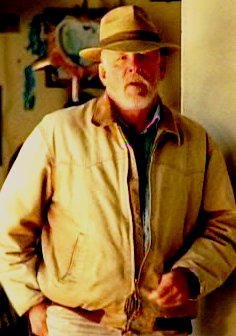
At another set of stables on the park grounds, an older man (Nick Nolte) dressed in beige from his pants to his hat steps up on the deck with his dog and doughnuts for his night watchman (Mario Roccuzzo) who sits outside one of the stables. "That's frosted. They said the chocolate covereds weren't fresh. How'd it go?" he asks the man. "The Big Horse got down. He slept all night, Mr. Walter. Even licked his tub clean," the night watchman replies before asking if "Mr. Walter" plans to bet that Pick Six that afternoon. He may refer to him as Mr. Walter as an old-fashioned courtesy, but his boss's name actually is Walter Smith, a longtime horse trainer
 who came to California by way of Kentucky. Smith not only trains but owns the animals as well now. The "Big Horse" the man referenced is Walter's prized colt Gettn'up Morning. There's a backstory involving both Smith and Gettn'up Morning's history that we'll learn about as the season unfolds. Smith's mind isn't focused on the Pick Six question, so his reply is less than definitive. His life focuses almost exclusively on Gettn'up Morning, to the exclusion of such extraneous matters. "I was wondering if in the last quarter the girl should loosen up and let him stretch the hell out," Smith says as his night watchman continues to talk about possible Pick Six payouts. "Yeah, let the big man show his stuff today," the man concurs with Smith. "Did I tell you that's frosted?" Smith, also known as "The Old Man," asks. "You did," his night guy replies. Smith gives him a pat and tells him to get some sleep. With a whistle and a click of his tongue, Walter gets the Big Horse's attention. "How ya doin' bub? Yeah, you know what I got," Smith says to the horse and we get another close look at one of those marvelous eyes. "What do you think? Do ya feel like stretchin' out?" Walter asks the colt. "Hey bruiser," Rosie Shanahan, the Irish exercise girl (Kerry Condon), says as she blows a kiss at Gettn'up Morning and puts down her gear. "About like last time?" Rosie asks Smith. "About like last time, but maybe you let him stretch out a bit in the lane," Walter tells her. "Great. 'Cause he's been pullin' my arms off," she responds. "He wants to run," The Old Man declares as he helps Rosie take her mount. Smith takes a seat in the bleachers with binoculars. "You're just hobby-horsing him," he comments.
Back in the shedrow, Escalante makes good on his promise and phones jockey's agent Joey Rathburn (Richard Kind) to complain about Bug Boy. "Why are you giving me a jockey who's running his lips about my business?" Escalante demands to know. "You're kidding, Turo," Joey says, expressing surprise from his spot by the track's rail. "I don't kid, you Porky Pig son of a bitch. He's chirping how he's gonna run him big when I told you that horse had no chance," the trainer responds. "A trainer like you throws us a bone, gives this kid a chance to ride for you and then — and then he's — he's gonna run his mouth on you?" an agitated Rathburn gets out, showing how he got his nickname. "Just tell him to shut the fuck up and loose lips sink boats," Turo tells Joey. "I'm gonna take him to the woodshed. Believe me," Rathburn promises as he stands beneath the entrance to Clockers' Corner. Meanwhile, Walter watches from the stands through his binoculars as Rosie begins getting Gettn'up Morning up to a good gallop.

Every track has them and Santa Anita is no exception: The serious gambler. Marcus Becker (Kevin Dunn) sits at one of the tables on the outside patio of Clockers' Corner, lots of forms and tip sheets spread about as he contemplates the day's betting plans. Marcus has to use a wheelchair and, periodically, take in
 oxygen from the mask that's attached to a tank on his wheelchair. Marcus currently eyes the day's 4th race when a member of his betting syndicate (not a crime syndicate as usually associated with the term, but a group of people who pool their money to make larger bets that cover more possibilities), Jerry Boyle (Jason Gedrick), joins him at the table. "I'm tapped," Jerry says as he sits. "You're what?" Marcus asks, removing the oxygen mask. "I'm tapped out. I'm tapioca," Jerry replies. "Yesterday you left the grounds a 390 dollar winner," Marcus declares. "Yeah, then I hit the Commerce Casino for a little poker fun after dark," Jerry explains. "With three days' worth of Pick Six carryovers worth several million dollars and you hand your bankroll to the ricers?" Marcus says, anger and disdain welling up in his voice. "Here's my picks," Jerry responds, sliding a napkin across the small table selecting horse Nos. 1,4,7 for the 3rd race; 5 for the 4th; 1,3,6,7 for the 5th; 2,3,5,7,8 for the 6th; 1,4,7 for the 7th and ALL for the 8th. "Fuck your picks, you degenerate prick — where's your money?" an openly pissed off Marcus demands to know. "Don't wind yourself up. Your face is going all different colors," Jerry says in his tranquil tone. "Fuck my face," Marcus responds, only to be interrupted by a coughing fit and the need to return the oxygen mask to his mouth.
In the stands, Walter continues to watch Rosie ride Gettn'up Morning around the track through his binoculars. "Oh, you're runnin' him around," Smith mutters as Rosie takes the colt to greater strides. Another member of the syndicate, Renzo Calagari (Ritchie Coster),
 shuffles on to the patio for the group's morning meeting. "Oh good. Now here comes the brain surgeon," a still pissy Marcus comments. Renzo holds up some cash. "Got my disability. Two hundred and fifty-five simoleons," Renzo announces as he hands the money over to Marcus. "Meaning against the Social Security he's gonna get, which is the mumbo jumbo these joints use to get around the usury laws," Marcus teaches his class. Gettn'up Morning's workout has captured the attention of eyes other than Walter Smith's. Joey Rathburn, pacing along the rail, and Jerry, still sitting with Marcus and Renzo, have noticed Rosie's ride on the Big Horse. Marcus pushes the napkin to Renzo. "That napkin's Jerry's whole contribution. Sick degenerate," Marcus tells Renzo.
 he took out a payday advance Walter puts his binoculars down and brings out a stopwatch. Rosie's ride continues to captivate Jerry. As she brings Gettn'up Morning to the theoretical finish line, Smith stops the clock and looks pleased. "Guess I still know a peach when I see one," Walter mumbles to himself. "You single the Fourth," Renzo says to Jerry, referring to his selection of only horse No. 5 in the 4th Race for the group's Pick Six plan. "I've got the Fourth semi-spread." Marcus examines Jerry's choice more closely. "A triple-bug apprentice hasn't won ten races in his life. He's gonna single a horse that's been — that hasn't run in two years," Marcus notes. From the racing form, we see that apprentice jockey's name is L. Micheaux and the horse that hasn't run in two years happens to be Mon Gateau, whose morning-line odds are 12-1. No wonder Escalante wanted Bug Boy to keep his mouth shut, but that's the reason behind the bet. "Yeah, but Escalante's the trainer," Renzo tells Marcus, who emits a sarcastic, "Oooh."
Leon slow rides Mon Gateau back and spots Joey. "I met Mr. Escalante in his barn," he tells his agent. "Oh yeah. How — How'd that go?" Rathburn asks as if he doesn't know. "Good. You know he's foreign. He's a little hard to understand," Leon replies, his Louisiana accent clear. One problem that will crop up throughout the series is that Tom Payne, the actor who plays Leon, hails from England and often that accent creeps out and he speaks in an unidentifiable dialect. Joey walks along the rail as the slow ride continues. "Well, you — you did some job," Joey tells his jockey. "I did?" Bug Boy responds with surprise. "P—Pissing him off with your wise-ass chirping about how good you thought this horse was gonna run today," Joey informs him. "I was just sayin' somethin' to say somethin'," Leon offers in defense. "That's what — that's what 'How's the weather?' is for," Rathburn suggests. "With a great trainer, I
 wanted to have somethin' to say," Leon insists. "Suppose he is making a bet, you — you think he wants some big mouth riding his horse?" Joey theorizes. Bug Boy asks if Escalante could be placing a bet, but the question only aggravates Joey more. "I—I—I don't know and if you want to know, I don't want to represent you. You're a bug. You ride everything hard and you don't chirp about what ain't your business," Joey instructs his client. "He could be on go, Joey," Leon whispers to his agent about Mon Gateau. "Moves like shine on a Saturday night." Rathburn makes another appeal, asking Leon to keep his mind right. As Leon rides on, Joey looks down the track as Walter greets the return of Rosie and Gettn'up Morning. Out of Joey's earshot, Walter says to Rosie, "11 and 2. He pulled up (stopped) at 23 and change." (23 and change is the time in seconds that it took the horse to breeze, or lightly run, the distance. Typically, horses are timed at intervals, in races or workouts — generally in ⅛ or ¼ mile increments. “11 and 2” would be the distance the horse ran, the 11 referring to furlongs. ⅛ mile equals one furlong. In the U.S., the classic distance is 1¼ miles. In Europe, it’s 1½ miles. Santa Anita's main dirt track is 1 mile long. Thanks to horse trainer Samantha Harvey of Alternative Horsekeeping With Samantha Harvey at The Equestrian Center in Yuma, Ariz., for helping explain that bit of dialogue for me.) As both the colt and Rosie pant, Rosie tells Smith, "Walter, listen, this guy's got nine more gears." Joey gets on his cell phone. "Ronnie, whereever it is you've flopped, find your coat, find your keys, find your car, get to the gym," Joey says into his phone. We don't see the person he's calling, but we do see his place, which has walls adorned with images of a victorious jockey, though we see Ronnie's wireless phone standing upright on a charger, its screen showing "12 new messages." Joey goes on, "Because if I didn't just see a Derby horse work, I'm a Chinese dentist. Plus the mount is open for you, Ronnie. An exercise girl was up. Yeah — yeah, call me back. Remember me — I'm y—your fucking agent, y—you drunken prick." I haven't spoken much about Mann's direction of this episode. It's been fine, but has been heavy on quick cuts after the initial Ace and Gus scene. However, I thought this sequence involving the various players noticing Gettn'up Morning that leads in to the great Joey-Leon talk that's filmed in a single walking/riding take shows Mann's most exceptional touch so far.
Jerry turns his attention back to his partners now that Gettn'up Morning has left the track. A hefty track security guard (Peter Appel) comes out of Top-O-The-Stretch (Top-O-The-Stretch is the name given to the betting area, either at self-service terminals that open even before the gates, and some manned ones later after the track opens for admissions) at a good gait. "Anyone seeking admission, please clear the grounds before the gates open at 10:30 unless you're a credentialed track employee," the guard announces as Marcus spins his wheelchair around to face the man. "Anyone morbidly fat? Anyone order a heart attack?" Marcus ridicules the guard (as if he has room to talk). "Yeah well, I wouldn't hold my breath. Oh, I forgot — you can't," the guard retorts. "When's the last time you saw your prick without a mirror?" Marcus shoots back. Jerry focuses the day's races instead of the insults. "Got the Pick Six in your crosshairs, Kagle?" Jerry asks the guard. "Yeah, I hold a few opinions," Kagle replies before getting a call on his walkie-talkie. Before Kagle leaves, he asks Jerry if he's going to "step up," but Boyle stays mum though Marcus looks suspiciously on the glances traded between Jerry and the guard. Renzo grabs Marcus' attention, telling him, "There may be more development at the coffee shop." Marcus seeks further explanation of said development, but Renzo prefers not to say. "A development of what type?" Marcus rephrases. "No. So if it doesn't happen," Renzo responds. "You're a moron," Marcus tells him, but he starts his chair moving when he sees Jerry leaving the table. "Hey — do not reach out to that three percent-a-week-charging bloodsucker," he warns Jerry about Kagle.
The drive from Ace's temporary Victorville residence ends as Gus pulls the car up in front of The Beverly Hilton, where Ace uses a suite as his home. When Chester exits the vehicle, he looks up and stares for a moment at his former stomping grounds. The hotel's executive manager (Spencer Garrett) greets Ace and shakes his hand. "Welcome home, Mr. Bernstein," he says. "If you've been partying up at my place, Maurice, they better all be out," Ace responds good-naturedly. "Oh if I missed one or two, you just send them down the fire escape," Maurice replies, adding that they've been preparing Bernstein's suite all week. "How about this guy?" Bernstein comments, indicating Gus. Maurice calls him "The Man With the Golden Arm," though he's referring to neither heroin addiction nor the Frank Sinatra movie. "I leave town. He hits a slot for five million dollars," Ace says. "I only do this for fun now," Gus offers since it would be unusual for millionaires to continue to serve as chauffeur/bodyguards. "I graduated, Mr. Bernstein," the young doorman tells Ace. "Good for you, kid," Bernstein says to the young man, patting him on the shoulder as he and Gus go inside. "So did I." (In a smoothly edited and executed segue, the glass doors of Ace's building turn into the glass doors where you enter the interior of the track's Clockers' Corner where they serve breakfast, seemingly without a cut.)

"There he is," Renzo exclaims as he, Marcus and Jerry enter the inside dining area. "Why do you sound so surprised?" asks a man in a yellow shirt and a light brown hat with his back to the camera. "I'm not. Because I never guaranteed you'd be here," Renzo replies as the man (Ian Hart) stands to greet the group. Jerry slides into a booth. "You gonna sit at the counter, you mind if I get by?" Marcus asks the guy obstructing his path. "That's Lonnie, Marcus. You met him once before," Renzo informs him as he moves into the booth. "And you're Jerry. We've met also, but I don't expect you to remember," Lonnie McHinery tells Boyle as he climbs in next to Renzo who suggests they all sit together there. Marcus wheels to the table's end. "You know what I still call you when I ask them how you are doing?" Lonnie asks Marcus. "Asshole?" he guesses. "The brains housing department," Lonnie answers. "Is it handicapped accessible?" Marcus inquires. Lonnie reminds Marcus where they met — a race day at Hollywood Park with Renzo. "You gave me a triple which I had to leave before I could play it," Lonnie recalls. "Does this story end sad?" Marcus asks in a tone indicating he could care less as he writes in a notebook. "No. No. No. I played it on TVG. 117 bucks it paid," Lonnie tells him. Lonnie's reminiscing gets halted temporarily by a waitress seeking breakfast orders. Once she finishes her business, the men resume theirs. "Now what would I always say to you?" Lonnie asks Renzo. "Let me once make half a score, I'll bankroll that genius gimp," Renzo replies. "Define — I'm afraid to ask — define 'half a score,'" Marcus seems slightly intrigued. "Off two women insurance agents paying me to fuck them senseless," Lonnie answers, a stack of bills in his hand wrapped by a rubberband.
Ace fiddles with a necktie in the bathroom of his suite before abandoning the effort. Gus calls from another room, asking if he's ready. "How'd you leave it with Escalante?" Bernstein asks. "That I'd call him from a few minutes out," Gus replies. "Your attitude with him — business. One hundred percent," Ace instructs Gus. Demitriou admits to being nervous about his planned meeting with Pint of Plain's trainer. Bernstein notices of pile of envelopes on a dresser that Gus explains are three years' worth of letters and notes wishing Ace well. "I wrote or called all of them back," Gus tells him. "You're friendly with Escalante, but you've got all the friends you need," Ace says, holding up his new microcassette recorder. "Spare me the hat dance," Gus pleads. "Just train my horse," Ace orders as they exit the suite.


Jerry dashes through the growing crowd at the betting windows until he finally spots Kagle and starts shouting the guard's name to get his attention. "Hey, would you loan you a thousand dollars?" Kagle asks Jerry. "What are you talking about? I'm not asking for a thousand," Jerry says. "Well. One policy fits all and from now on it's a thousand dollars minimum," the guard/loan shark informs him. "Why one policy? You're your own boss," Jerry points out. "Do I look self-employed in this uniform?" Kagle asks him. "As a shylock, you're self-employed. Does one pant size fit all?" Jerry says, sounding as if spending time with Marcus has rubbed off on him. "Yeah. Yeah. Good. Insult my weight," Kagle bristles. "Hat size, I said," Jerry insists, trying to erase his slur from the air. "It's a thousand minimum. Three points a week on the balance and I ain't chasin' you anymore for vig on a lousy three hundred dollars," Kagle makes clear. "Look, just let me take the fucking thousand then," Jerry says. "You do not qualify," Kagle declares. "Fuck you then and the Goodyear Blimp," Jerry spits as he storms off, but Kagle calls him back, holding cash in his right hand. "Mark my Pick Six," Kagle requests. A disgusted Jerry takes the money and starts filling in Kagle's betting card. Kagle thanks Jerry when he slaps the picks back at him, Playing in the background during the last part of the scene is part of Gil Scott-Heron's cover of Robert Johnson's "Me and the Devil Blues." "Early this morning/he knocked on my door/I said "Hello, Satan,/I believe it's time to go" Of course, if Jerry gave Kagle the same Pick Six selections that the syndicate has and they should pull off the win, the jackpot would be split — and you could count on Marcus being pissed. (Many thanks to Tony Dayoub for uncovering which artist was performing the cover for me. Check out his blog Cinema Viewfinder.)
The other three members of Jerry's group take spots behind the grandstand's last row since Marcus' wheelchair limits options. "I'll illustrate this degenerate's mind — why his vote's for singling the Fourth," Marcus says, referring to Jerry's picks. "Jerry, he's saying," Renzo tells Lonnie, in case he wasn't clear as to whom Marcus referred. Becker
 brings out the napkin as a visual aid. "Off form, it's completely open. He should really use every horse, but he ain't handicapping the horses, he's handicapping Escalante," Marcus elaborates. "Jerry's thinking, Marcus feels," Renzo conveys to Lonnie, as if he has to translate every word Marcus utters. "Escalante enters a horse away two years, all slow workouts, and he gives the mount to a triple-bug apprentice. The horse jumps up, who does that make the hero?" Marcus asks rhetorically. "Escalante, Jerry's thinking," Renzo answers, addressing Marcus this time. "We bet four deep in the Fifth and we're five deep in the Sixth. But you single Escalante. You bet only Escalante's horse and he wins, we just knocked out three-quarters of everybody else's bets. We're perfectly protected in the three races subsequent. And if we make it to the last, the Eighth race in which we bet every horse, we're in to a two million dollar jackpot," Marcus concludes, so excited by the strategy that his cough returns and it's oxygen time again. "Brains housing," Lonnie comments. "So where is Jerry? He feels bad because he tapped out in poker. He's probably got that fat fuck's fangs in his neck," Marcus guesses correctly about Kagle. Can't you hear Milch in that dialogue? "perfectly protected in the three races subsequent" "fat fuck's fangs" I love it. I miss being able to go to the track, not that I knew anything about horse betting. If I ever won, it was pure luck.
Ace enters the glass doors of another building and a woman steps out behind a desk in front of a case displaying wine bottles. She asks Bernstein how he is and if he's there to meet Mr. DiRossi. Ace confirms that he is and Nick DiRossi (Alan Rosenberg) spins on his seat at the lobby bar. "Oh. There he is. We're back to full strength," DiRossi says as he gets up to greet Ace and take him to his office, "So how you doin', Ace?" Nick asks, keeping his arms around Bernstein to guide him. "Great. You're doing real well," Ace comments, surveying the surroundings. This sequence is short, but Mann directs it in an interesting fashion. Though Nick and Ace walk and talk at a normal pace, the camera whizzes by unusually fast, giving the viewer blurry glimpses of the many bottles stacked in the display case. As I said earlier that Dustin Hoffman doesn't really get a handle on who Ace is right away, one thing he does do well is establish the physical side of Ace. Note at the beginning of this scene, if you re-watch it, the way Bernstein adjusts his cuffs and collar before he enters DiRossi's building. "The club is still strong. Last year we opened Atlantic City and Miami but the jewel in the crown is a club in Macau. That club is a real draw, Ace," DiRossi tells him.
Tweet
Labels: Deadwood, Dustin Hoffman, Farina, HBO, Luck, Michael Mann, Milch, Nolte, Sinatra, TV Recap
TO READ ON, CLICK HERE


