Thursday, August 08, 2013
Karen Black (1939-2013)

Throughout the late 1960s and early 1970s, Karen Black occupied a singular place in movies, hovering in that rarefied atmosphere that placed her somewhere between character actress and star. It landed her roles in many of the decade's classics as well as some of its silliness (such as Airport 1975) As the '80s came along, more of her work came on television and in low-budget horror films, but her early work kept her a recognizable name. Black died today at 74 after a battle with ampullary cancer diagnosed in 2010.

Born Karen Ziegler in Park Ridge, Ill., the actress attended Northwestern University before heading east and attending The Actors Studio with Lee Strasberg. She appeared in several off-Broadway plays and as an understudy in the 1961 comedy Take Her, She's Mine starring Art Carney before making her starring debut in 1965's The Playroom whose cast also included Bonnie Bedelia and Richard Thomas. Her second feature film made a mark for many people when she joined the cast of Francis Ford Coppola's 1966 comedy You're a Big Boy Now starring Elizabeth Hartman, Geraldine Page, Rip Torn and Tony Bill, among others. She made lots of episodic television appearances until she gained noticed in the small role of a hooker named Karen who drops acid in a cemetery with Dennis Hopper and Peter Fonda in 1969's Easy Rider. Her counterculture journey continued the following year when she played the role of Rayette, the country-music loving waitress who becomes crazy in love with the alienated Robert Dupea (Jack Nicholson) in Bob Rafelson's Five Easy Pieces. The part earned Black her sole Oscar nomination as supporting actress.
Black teamed with Nicholson again the following year, only Nicholson sat in the director's chair as she starred opposite Bruce Dern in Drive, He Said. She soon followed that by assuming the part of the Claire Bloom surrogate Mary Jo Reid or The Monkey opposite Richard Benjamin in Ernest Lehman's adaptation of Philip Roth's comic novel Portnoy's Complaint. In 1974, she joined Zero Mostel when he brought his Tony-winning role from Eugene Ionesco's Rhinoceros to the big screen co-starring Gene Wilder. That same year she assumed the role of Tom Buchanan's mistress, Myrtle Wilson, in Jack Clayton's version of The Great Gatsby starring Robert Redford and Mia Farrow and the film won Black a Golden Globe for best supporting actress — and she did it in two dimensions! Finally, she completed 1974 by playing the scrappy stewardess trying to fly a crippled jumbo jet whose flight crew got taken out when a small plane crashed into its side in the funniest of the Airport movies, Airport 1975 (which I'll always love for having Gloria Swanson playing herself dictating her memoirs into a tape recorder as the plane is going down).

Black found herself busy again in 1975, beginning with the cult classic horror film Trilogy of Terror where she starred in three shorts all based on stories by the recent passed Richard Matheson. She also co-starred in John Schlesinger's film of the Nathanael West classic novella Day of the Locust. Her epic piece for that year though involved her first collaboration with Robert Altman in his masterpiece Nashville. Black played country superstar Connie White, filling the bill for another ailing star Barbara Jean (Ronee Blakeley), during events surrounding the political campaign of Replacement Party candidate Hal Philip Walker. In 1976, Black worked again with Nashville co-star Barbara Harris and frequent co-star Bruce Dern as well as William Devane to appear in what would be the final film of the Master of Suspense, Alfred Hitchcock's darkly funny tale of crooks, con men and kidnapping, Family Plot. In 1982, she returned to Broadway under Altman's direction as part of the ensemble of Come Back to the Five & Dime, Jimmy Dean, Jimmy Dean. Altman's impossible-to-see film version featuring Black came out later that same year. Aside from some notable television appearances, most of her post-1982 career has been in horror and science fiction, but Karen Black delivered so much great work when her career was hot, she won't soon be forgotten. RIP Ms. Black.
Tweet
Labels: Altman, Awards, Coppola, Geraldine Page, Gloria Swanson, Hitchcock, Hopper, Mia Farrow, Nicholson, Obituary, Oscars, Redford, Rip Torn, Roth, Television, Theater
TO READ ON, CLICK HERE


Tuesday, July 30, 2013
Eileen Brennan (1932-2013)

Eileen Brennan, one of our most treasured character actresses, particularly when it came to roles with a comic spin, lost her battle with bladder cancer Sunday at 80. Her death was announced today. The prolific actress turned in many memorable performances, but probably will be best remembered as Capt. Doreen Lewis in the 1980 comedy Private Benjamin opposite Goldie Hawn and the subsequent television spinoff where Lorna Patterson took over for Hawn. The role of Capt. Lewis earned Brennan her sole Oscar nomination and three consecutive Emmy nominations, one of which she won.

After moving from her native California, Brennan performed some stage work with the Mask and Bauble Society at Georgetown University in Washington before returning west and beginning her film and television career. In 1966, she made her first television appearance in a production of Maxwell Anderson's play The Star Wagon where she starred opposite Orson Bean and whose cast included Dustin Hoffman and Marian Seldes. The next year, she made her film debut in Bud Yorkin's 1967 comedy Divorce, American Style with a cast that included Dick Van Dyke, Debbie Reynolds, Jason Robards and Jean Simmons. She was a regular on the first 14 episodes of Rowan and Martin's Laugh-In in 1968 and put in guest appearances on the TV series The Ghost and Mrs. Muir and The Most Deadly Game. With 1971 came the release of her second feature film and a true classic. This showed more of Brennan's abilities on the dramatic side of things as Genevieve the waitress in Peter Bogdanovich's The Last Picture Show. She even earned a BAFTA nomination as best supporting actress, quite a feat given the spectacular assemblage of female performers Bogdanovich gathered for his film. Along with her many episodic TV appearances, around the same time she appeared in the memorable All in the Family installment "The Elevator Story." In 1973, she had roles in two significant films: Scarecrow starring Gene Hackman and Al Pacino and that year's Oscar winner for best picture, the delightful caper comedy The Sting opposite Paul Newman and Robert Redford.
Brennan appeared in both of Neil Simon's 1970s film spoofs, usually attached by the hip to Peter Falk, in Murder By Death and The Cheap Detective. She guest-starred in a particularly memorable episode of Taxi, "The Boss's Wife," and earned an Emmy nomination as lead actress in a comedy series (the same year she won supporting actress for Private Benjamin). To get even with her husband, Mr. McKenzie, once a year, Mrs. McKenzie (Brennan) picks an employee of the Sunshine Cab Company to have an affair with, resulting in her husband's anger and the worker's firing. Louie (Danny DeVito) delights in the annual ritual — only this time she picks De Palma. Guest appearances on Newhart, thirtysomething and Will & Grace also brought Brennan Emmy nominations. Back on the big screen, she brought the game piece Mrs. Peacock to life in Clue and reprised Genevieve in the 1990 Last Picture Show sequel Texasville.
RIP Ms. Brennan. When you appeared on screen, I knew that whatever I was watching would be getting a lift.
Tweet
Labels: Bogdanovich, Debbie Reynolds, DeVito, Dustin Hoffman, Hackman, Jean Simmons, Newman, Obituary, Pacino, Redford, Robards
TO READ ON, CLICK HERE
Wednesday, July 17, 2013
What he really wanted to do was be an actor
BLOGGER'S NOTE: This post is part of The Sydney Pollack Blogathon occurring through July 22 at Seetimaar — Diary of a Movie Lover

By Edward Copeland
For 40 years, from 1965 to 2005, Sydney Pollack directed 19 feature films. His last directing effort appeared as an installment of PBS' American Masters series on the architect Frank Gehry. Prior to that, he directed lots of episodic television. As Pollack reached the end of his life (and beyond it) he produced projects more than he directed and toward the end he also resumed the artistic endeavor where he started, acting more
 and more often. When he ventured into show business, he aimed toward acting. His father hoped that Pollack would pursue a career in dentistry, but after catching the theater bug in high school in South Bend, Ind., he left for New York following graduation and studied with legendary acting teacher Sanford Meisner at Meisner's Neighborhood Playhouse (The same year he directed the American Masters special on Frank Gehry, he executive produce another episode of the series on Meisner). Eventually, he became an assistant to Meisner and even taught acting to others, though in a 2006 interview with Venice Magazine, Pollack resisted calling the technique he learned and passed on "The Method." "People call a lot of things 'The Method,' but there really isn’t one Method," Pollack said, "but it’s all derived from Stanislavsky. It’s all derived from Stanislavsky, but Stella Adler taught it different than Sandy Meisner and Strasberg taught it differently from both of them, and Harold Clurman taught it differently than the three of them, and Bobby Lewis took it in his own direction, as well. They each took The Moscow Art Theater of Stanislavsky and basic principles, and then developed their own approach. The goal was always the same: to find a way to analyze the construction of truthful behavior within imaginary circumstances."
As he acted a lot in television of the 1950s, Pollack's interest turned to directing. While Pollack directed and produced some great and good films (my favorite being 1982's Tootsie, where he took his first substantial acting role since an episodic television appearance on a 1964 episode of the crime drama Brenner starring Edward Binns and James Broderick), after Tootsie, he acted or did voicework in more films and TV shows than his entire filmography. In many ways, I found Pollack more interesting at times as an actor than as a filmmaker, and that's where his career in the arts began, with his single Broadway role in 1955's The Dark Is Light Enough by Christopher Fry and starring Katharine Cornell, Tyrone Power and featuring Christopher Plummer.

Pollack began directing episodic television in 1961 and had ceased television acting in 1964 with that appearance on Brenner. As he jettisoned acting to concentrate on directing, he made a single movie: the 1962 Korean War drama War Hunt. The film starred John Saxon and Charles Aidman, but in addition to Pollack's supporting role, the movie offered appearances by Gavin MacLeod, Tom Skerritt and uncredited work by another future director, Francis Ford Coppola, as an Army truck driver. The biggest name among the ranks (at least he would be eventually) turned out to be a young Robert Redford. Pollack would direct Redford in seven films: This Property Is Condemned, Jeremiah Johnson, The Way We Were, Three Days of the Condor, The Electric Horseman, Out of Africa and Havana. Redford served as one of the producers of A Civil Action which featured Pollack in an acting role.
The headline at the top of this piece isn't quite true. Pollack return to acting in 1982's Tootsie (aside from a brief cameo in 1979's The Electric Horseman) proved to be quite a reluctant one. He already had cast Dabney Coleman to play George Fields, agent to prima donna/unemployed actor Michael Dorsey (Dustin Hoffman) but Hoffman pushed Pollack into taking the role himself, seeing the dynamic they had in their disagreements over the script. Pollack didn't want to leave Coleman in the cold so he cast him in the role of movie's fictional soap opera's director instead. Hoffman's instincts didn't fail him or the film as his scenes with Pollack provide many of the movie's comic highlights. You get that in the scene above, in the scene in the Russian Tea Room where Michael surprises George by showing up as his new alter ego Dorothy Michaels and, in perhaps my favorite scene between the two of them, when Michael shows up at George's home late one night to try to explain the romantic complications, including the fact that the father (Charles Durning) of the woman he loves (Jessica Lange) bought Dorothy an engagement ring. Forgetting for a moment what this all means, Pollack's reaction to news of the proposal comes off as priceless.
Following Tootsie, Pollack returned to the directing-producing track for a decade. During this decade he won his two Oscars for Out of Africa, but looking at the projects in that decade on which he worked solely as a producer or executive producer actually look more interesting than most of the movies he directed in that time. Some examples of his producing output from 1982 to 1991: Songwriter, The Fabulous Baker Boys, Presumed Innocent, White Palace, (surprisingly) King Ralph and Dead Again. With Tootsie, Pollack displayed a grounded, realistic comic side, but when 1992 arrived and he began to act up a storm, his range
 widened, even if for the most part Pollack got pigeonholed as either a lawyer or a doctor, he played distinct members of each profession. Ten years after Tootsie, he managed roles in three films (and found time to executive produce two movies as well: HBO's A Private Matter and Leaving Normal, which had the misfortune of being too similar to Thelma & Louise and coming out a few months after the other film). The photo at the top of this post shows Pollack in his first 1992 role, Dick Mellon, business lawyer to besieged studio exec Griffin Mill (Tim Robbins) in Robert Altman's The Player. As Mellon, Pollack plays a no-nonsense Hollywood figure who has seen it all and never changes his vocal tone, no matter how serious the situation becomes, and doles out truisms such as in this exchange with Mill. "Rumors are always true. You know that," Mellon tells Mill. "I'm always the last to hear about them," Griffin sighs. "No, you're always the last one to believe them," Dick corrects his client. Pollack, as in the case of his casting in Tootsie, hadn't been the first choice of the director. Of course, Pollack had helmed Tootsie and opposed casting himself as George Fields. With The Player, Altman tried to cast as many of the character parts with lesser-known faces because his film contained so many star cameos and he wanted to avoid as much audience
 confusion as possible. Initially, Altman sought writer-director Blake Edwards, who also started his career as an actor, though he hadn't appeared on screen since 1948, for the part of Mellon, but it didn't work out and he went with Pollack, who only had that one role in Tootsie in 30 years. While The Player offers darker, satirical laughs than Tootsie did and Pollack doesn't get the laughs out of Dick Mellon that he did out of George Fields, he garnered more laughs in his most dramatic, deepest film role yet as Jack, the divorcing best friend of Gabe Roth (Woody Allen) in Husbands and Wives. I wasn't as crazy about the film as others, but Pollack delivered one of his greatest acting jobs, ranging from the at-ease midlife divorced man finding renewed vigor with a twentysomething aerobics instructor (Lysette Anthony) and then turning downright nasty on her at a party when she doesn't meet his standards for intellectual heft. He literally drags her from the soiree and tosses her toward his car, accusing her of being an "infant." It's a scary side of Pollack that we'll see more of in other roles. His third on-screen role of 1992 didn't receive a credit, but the cameo in Death Becomes Her provides what could be Pollack's funniest moments as an ER doctor examining Meryl Streep. The clip below leaves out his character's final punch line.
Until his death from cancer in May 2008, seeing Pollack act became a much more common sight than spotting his directing credit. He turned up in legal entanglements again in films such as A Civil Action, Michael Clayton and Changing Lanes. He guided Tom Cruise into the sexual netherworld of the rich and powerful in Stanley Kubrick's final film, Eyes Wide Shut. He took roles in the last two films he directed, Random Hearts and The Interpreter. Pollack even provided the voice for the studio executive in The Majestic and the French film Avenue Montaigne. His final film role was in the romantic comedy Made of Honor where he played the father of the male maid of honor (Patrick Dempsey). On television, he did more voice work on comedies such as Frasier and King of the Hill. He also played a doctor on an episode of Mad About You and had a recurring role as Will's father on Will & Grace. He even played himself on an episode of Entourage, his last TV or movie appearance. Of all his late appearances though, the one that stands out to me also came in 2007 and put him in the role of another doctor. In the batch of the last nine episodes of The Sopranos, Pollack played jailed oncologist Warren Feldman, incarcerated with the dying Johnny Sac (Vincent Curatola) in the great episode "Stage 5." This scene I believe gives a great example of how talented Pollack truly could be as an actor.
Tweet
Labels: Altman, Blake Edwards, Coppola, Cruise, Dabney Coleman, Durning, Dustin Hoffman, J. Lange, Kubrick, Plummer, Redford, Streep, Sydney Pollack, The Sopranos, Tim Robbins, Woody
TO READ ON, CLICK HERE
Monday, March 26, 2012
Merging art and commerce

— Pauline Kael, The New Yorker, March 18, 1972
By Edward Copeland
Picture this: The war Michael Corleone returns from at the beginning of The Godfather isn't World War II, but Vietnam. Perhaps Kay Adams looks more like a flower child (Diane Keaton had been a Member of the Tribe in the original Broadway production of Hair after all). Try to fathom what poor Fredo would be experimenting with once they sent him off to Las Vegas. If Paramount Pictures steamrolled over
 Francis Ford Coppola from the minute he agreed to direct the film, these things might not be theoretical flights of fancy. On the commentary track of The Godfather DVD, Coppola tells how when he climbed aboard the project, Paramount handed him a completed screenplay that the studio had developed, much as they financed the writing of the novel, with Mario Puzo. Only for some bizarre reason, while setting the story's beginnings in 1945 satisfied Paramount for
 the 1969 novel (which, remember, wasn't the blockbuster best seller yet as production plans began), it didn't work for a studio looking to make a quick feature on the cheap. The screenplay given to Coppola moved the events to the 1970s, added hippies and, according to Coppola, this quintessentially New York story would be filmed in Kansas City (though later in the commentary, Coppola refers to a plan to shoot it in St. Louis). "There was none of that post-war ambiance," Coppola said, which was one of the major attractions for him to the project in the first place since he didn't like the novel with its graphic sex and general tawdriness until he discovered the story of the family buried underneath the trash. I imagine that few people out there now have endured the actual reading of Mario Puzo's novel, which, awful as it is, spent 67 weeks on The New York Times best-seller list. Coppola's commentary, recorded in 2004, tries to be as nice as possible about the book because Puzo became a close friend right until his death in 1999. Pauline Kael's review of the movie goes into a lot of detail about the novel before she even starts writing about how good she thinks the movie turned out to be, but a few of her words give you who haven't read it a much better idea than my fuzzy memory of it could conjure.
"The movie starts from a trash novel that is generally considered gripping and readable, though (maybe because movies more than satisfy my appetite for trash) I found it unreadable.…Mario Puzo has a reputation as a good writer, so his potboiler was treated as if it were special, and not in the Irving Wallace-Harold Robbins class which, by its itch and hype and juicy roman-à-clef treatment, it plainly belongs.…The novel…features a Sinatra stereotype, and sex and slaughter, and little gobbets of trouble and heartbreak.…Francis Ford Coppola…has stayed very close to the book's greased-lightning sensationalism and yet has made a movie with the spaciousness and the strength that popular novels such as Dickens' used to have.…Puzo provided what Coppola needed: a storyteller's output of incidents and details to choose from, the folklore behind the headlines, heat and immediacy, the richly familiar. And Puzo's shameless turn-on probably left Coppola looser than if he had been dealing with a better book…"

Of course, Coppola had a long way to go and many battles to wage before that finished film could win Pauline's seal of approval.
Before we delve deeper into some of the behind-the-scenes brouhahas, I do want to pause for a moment to mention the one detail of the novel still trapped in my brain that convinced me the book stunk. Admittedly, this stretch of Puzo's work thoroughly amused friends of mine around the same age (junior high), who found the entire sequence hysterical. On the commentary, Coppola raises this, though he can't bring himself to talk about it in clinical detail, other than to say the lengthy plot point stood as a key factor in his thinking long and
 hard about whether or not he wanted to make a film version of this book. Now, the movie does show that James Caan's Sonny Corleone gets laid a lot, but that's nothing compared to Puzo's description of Santino. In the novel, covered over many pages, readers learn that Sonny isn't just a lothario, he happens to be a well-endowed lothario. Apparently, when standing at full attention, Sonny proves to be so mammoth in size that his mistress (who eventually will give birth to Andy Garcia for The Godfather Part III) requires corrective gynecological surgery because just having sex with him disfigures her vagina. (She needed the surgery or Baby Andy Garcia might have just slid out like a bowling ball through the return, dangling between her legs by the umbilical cord.) I know what you are thinking — did the Farrelly brothers help Puzo write The Godfather? I have no evidence to support such a rumor, though Peter was 15 and Bobby was 13 when the novel came out, so the two had hit the correct age for that kind of humor — and with The Godfather turning into such a huge hit, who could blame them for never wanting to abandon that mentality? Anyway, Coppola wisely decided that the film could leave out that part of the story, but what he did do borders on genius. He alludes to it by a simple, visual gag by unnamed female wedding guests after they spot Sonny sneaking off with his mistress for an assignation.
In Kael's review, she writes that Puzo claims that he wrote the novel "below my gifts" because he needed the money (other stories report that Puzo was drowning in gambling debts at the time). Coppola, Kael similarly said, told everyone he took the film for the money.
 Though he never makes that case on the DVD commentary, most stories sound different depending on the storyteller and evidence exists that Kael had the story correct when she penned that Coppola sought the cash so he could make the movies that he wanted to make. In Kael's opinion, Puzo taking the dough turned out a much worse result than Coppola doing it for the money did. "(Coppola) has salvaged Puzo's energy and lent the narrative dignity," Kael opined. First, he had to land that job. Mark Seal wrote a fascinating look of the events surrounding the making of the film in the March 2009 edition of Vanity Fair titled "The Godfather Wars." In it, he chronicled Coppola's initial reluctance to take the job as well as Paramount, which back then had the oil company Gulf & Western as its parent, considering selling the property instead of ponying up the money to make it. According to Seal's article, Coppola's chief cheerleader for the job at Paramount was Peter Bart, then vice president in charge of creative affairs at the studio. Bart later would run Variety before leaving as the once powerful trade paper went into its death throes, with its probable mercy killing appearing imminent any day now.
"Bart felt that Coppola would not be expensive and would work with a small budget. Coppola passed on the project, confessing that he had tried to read Puzo’s book but, repulsed by its graphic sex scenes, had stopped at page 50. He had a problem, however: he was broke. His San Francisco–based independent film company, American Zoetrope, owed $600,000 to Warner Bros., and his partners, especially George Lucas, urged him to accept. “Go ahead, Francis,” Lucas said. “We really need the money. What have you got to lose?” Coppola went to the San Francisco library, checked out books on the Mafia, and found a deeper theme for the material. He decided it should be not a film about organized crime but a family chronicle, a metaphor for capitalism in America."

When Robert Evans, then-head of production at Paramount, heard what Coppola thought the story should be, Evans thought the young director had lost it. More importantly, he feared that Paramount execs above him such as studio president Stanley Jaffe would sell the
 rights. Burt Lancaster had offered $1 million for them because he lusted after the role of Don Corleone for himself. The top studio brass weren't as hot as Evans on making the film anyway. Seal's account says "the studio bosses didn’t want to make the movie. Mob films didn’t play, they felt, as evidenced by their 1969 flop The Brotherhood, starring Kirk Douglas as a Sicilian gangster." Evans employed a last-ditch maneuver in hopes of keeping The Godfather, Seal recounts further. "(H)e dispatched Coppola to New York to meet with (Gulf & Western Chairman Charlie) Bluhdorn. Coppola’s presentation persuaded Bluhdorn to hire him. Immediately, he began re-writing the script with Mario Puzo, and the two Italian-Americans grew to love each other.'Puzo was an absolutely wonderful man,' says Coppola. 'To sum him up, when I put a line in the script describing how to make sauce and wrote, ‘First you brown some garlic,’ he scratched that out and wrote, ‘First you fry some garlic. Gangsters don’t brown.’'" Crisis averted. Now Coppola and Paramount just had each other to fight, especially about casting.
Since they thwarted Burt Lancaster's dream of playing Vito, Coppola and crew would need an actor to play the don. During discussions, according to Coppola's commentary track, they determined that the Don needed to be played by one of the world's greatest actors and
 Coppola narrowed that list to two men — Brando, who being in his 40s at the time was younger than the sixtysomething Corleone, and Laurence Olivier, who was in the right age range, seen in the photo at the left as he looked in 1973 in a television production of The Merchant of Venice playing the original Shylock. When casting The Godfather though, representatives described Olivier's health to them as precarious, almost implying the bell would soon toll for the actor. Of course, this wasn't the case and Olivier recovered soon enough that when Brando won the best actor Oscar for 1972 for playing Vito, Olivier held one of the other four nominations for Sleuth and didn't die until 1989. While Brando did get the part, the studio fought like hell to prevent it. His
 reputation as difficult and eccentric superseded his reputation as brilliant in their collective minds and it took a screen test, makeup tests and many promises that he'd be on his best behavior before Paramount agreed to let him play the part. Aside from his usual pranks on the set (such as in the scene when two men carry Vito upstairs on a gurney and he secretly added hundreds of pounds of weights beneath the sheet to watch them struggle), Brando actually stayed on his best behavior. Brando saved his only stunt for Oscar night when the world met a Native American woman who called herself Sacheen Littlefeather. (Digression: Coppola won Oscars for adapted screenplay three times: for the first two Godfathers and for Patton. Twice, the films also won best actor and both times, the actors refused to accept the Oscar — though George C. Scott announced in advance he wouldn't if he won and had said the same when nominated for The Hustler.) Imagine another scenario, one Paramount considered before Coppola's hiring. At one point, they seriously planned to cast Danny Thomas as the senior Corleone. I don't know if the film's title would have changed to Make Room for Godfather.
Casting Vito turned out to be a breeze compared to many names floated to play Michael before Coppola was involved and the director and Paramount displaying equal intransigence about who should play Michael. From the beginning, Coppola visualized the actors as certain
 characters in his head, going so far as to bring them down to American Zoetrope's San Francisco offices before any discussions with the studio. In his mind, Sonny always looked like James Caan and no one but Al Pacino played Michael. Back when it looked as if Danny Thomas would be playing the Don, the Gulf & Western CEO approached Warren Beatty not only to take the part of Michael but to produce and direct the film as well, Beatty told Mark Seal. This was 1970, not even a full three years since Bonnie and Clyde. Beatty said to Bluhdorn, "Charlie, not another gangster movie!" Film lovers reaped the rewards of Beatty refusing that offer, not only because ultimately it would lead to Coppola and Pacino in The Godfather but because instead Beatty teamed with Robert Altman on McCabe & Mrs. Miller. Other actors considered for
 Michael, some who actually received offers and turned them down included Robert Redford, Martin Sheen, Ryan O’Neal, David Carradine and Jack Nicholson. One thing became clear: Once Paramount determined that it would make the film, it fought about everything. They hated the idea of Pacino as Michael. Evans told Coppola that Pacino was too short for the part and that "a runt" couldn't play Michael. Caan called up Coppola before the film started and informed him that the studio and just offered him the part of Michael. Not only had Coppola always envisioned Caan as Sonny, he viewed the character as the Americanized one and that Michael should look more traditionally Italian which Pacino did and Caan did not, especially since Caan's ancestry was Jewish not Italian. The studio relented long enough to get production started, though Coppola just knew he'd be fired at any time so, as an insurance policy, he scheduled Michael's killing of Sollozzo and police Capt. McCluskey (Al Lettieri, Sterling Hayden) for the first week of filming. Coppola credits this memorable sequence, seen in the clip below, for selling the studio on Pacino and saving his job — temporarily, but the director continued to feel at risk as the studio tried to undermine his ideas at nearly every turn.
Robert Evans didn't like Nino Rota's score. Coppola decided to start playing rough with the studio. His certainty that he could be fired any moment freed him in a way so he began telling them to fire him each time the studio wanted to change something important to him. That music qualified as one of those for Coppola. Evans wouldn't budge, so they agreed to let a screening decide. The audience loved the
 movie so much, no one even noticed the score, if you can believe that. Another time, the studio complained that the film didn't have enough "action" in it and told Coppola that they planned to send an action director to the set to see how to pick it up. To beat them to the punch, so to speak, he came up with the scene where Connie (Talia Shire) gets into a huge fight with Carlo (Gianni Russo) when she intercepts a phone call from a woman and assumes he's cheating on her. She starts throwing every dish in the apartment at him. Coppola's young son even got in on the fun — handing objects to his aunt from offscreen for her to let fly. If the studio
 wasn't bitching about scenes they didn't see, they'd whine about ones that they told him should be coming out. On the commentary track, Coppola refers specifically about a studio hack that he doesn't name since the man has died who constantly appeared on the set saying, "We don't need that scene" or "That scene has been cut." Fortunately, on some sequences, Coppola covered the sequences with two cameras so when this man showed up to try to stop the famous scene of the Don's death in the garden while playing with his grandson, Coppola was able to shut off one to appease him while the second camera continued to work. The studio particularly hated that scene because of the costs associated with flying in the tomatoes and the hack's belief that just
 cutting from the previous scene to Vito's funeral would make the point just as well. The other incident when Coppola believed his firing was imminent concerned the scene where Brando as the Don met with Sollozzo. The studio only would tell Coppola that something dissatisfied them about the scene. Coppola offered to reshoot it, but he was informed that wouldn't be necessary so he knew what that meant. Then, on the commentary, he offers one of his many pieces of advice that he directs specifically for young filmmakers. They'll never fire you on a Wednesday. They'll always wait until Friday, wanting to use the weekend for a smoother transition. Coppola realized he wasn't just making a movie. If he famously described the making of Apocalypse Now as Vietnam, then shooting The Godfather paralleled mob warfare so Coppola hit them before the studio could whack him. Coppola fired four people that day — assistant directors and others that he suspected as being the traitors, and threw Paramount into disarray. With those four gone, he reshot the scene, Paramount didn't object any longer and Coppola didn't get the axe. The final battle over the film came down to the editing process itself. Coppola wanted to cut the film in his San Francisco studios, Paramount wanted to cut it in L.A. Evans relented, but warned Coppola that if he turned in a movie with a running time longer than 2 hours and 15 minutes, they'd move editing to Los Angeles. The first cut ran 2 hours and 45 minutes. Coppola got brutal, removing anything that added color or could be considered extraneous. When done, he had trimmed it to 2 hours and 20 minutes. He took his chances and delivered that to Paramount in L.A. Evans complained that he cut all the color and best stuff and they were moving the editing to L.A.. Coppola realized they would have done that no matter what, but they basically put back everything he cut and then some ending up with the cut we know that's just five minutes short of three hours.
Once the film had finished and it became abundantly clear that Coppola had made a hit for Paramount, they loved him. Its very limited opening weekend in merely six theaters took in $302,393 (an average of $50,398 per screen). That calculates today to $1,646,978.41 on six screens for a $274,491.86 per screen average. As The Godfather became a bigger hit, Coppola didn't get to enjoy its early success because now that Paramount valued him so much, Robert Evans begged him to come help re-write Jack Clayton's troubled adaptation of The Great Gatsby starring Robert Redford. For three weeks, Coppola says he was "pulling his hair out" trying to fix that. In the end, Coppola doesn't think that Clayton used any of his revisions in the dreadful Gatsby adaptation, which might end up looking better once Baz "Short Attention Span" Luhrmann releases his 3D version of Fitzgerald's masterpiece.
"I felt so embarrassed…I was very unhappy during The Godfather. I had been told by everyone that my ideas for it were so bad and I didn't have a helluva lot confidence in myself — I was only 30 years old or so — and I was just hangin' on by my wits…I had no idea that this nightmare was going to turn into a successful film much less a film that would become a classic."
Well, maybe directing a movie isn't always fun, at least that's Coppola's recollection of his time on The Godfather. He shot the film for $6.5 million in 52 days, but he admits he felt like an outsider on his own set. (Since it did become a huge blockbuster, Part II received a
 budget bump to $11 million and they actually got to go on location for shooting.) He speaks honestly about how the great cinematographer Gordon Willis and other crewmembers wondered why Coppola got the job. They didn't quite understand things that he tried but by the sequel, that had all changed. That took some time to happen though. Willis, the man who deserves much of the credit for the film's great look, often shook his head at Coppola's ideas. He particularly disdained high shots, though Coppola made him do some anyway, specifically when they try to kill Vito so you can see the oranges roll into the street and during the Sollozzo killing. Coppola recounts one incident when nature called and as he sat in the bathroom stall, two crewmembers walked in, unaware of Coppola's presence. "What do you think of this director?" one asked the other. "Boy, he doesn't know anything. What an asshole he is!" the other replied. It didn't help Coppola's confidence. Listening to his commentary, it doesn't just illuminate the history of the film's production, you also hear Coppola react to things that still bother him because of the cheap production such as obvious stock footage of cars driving in New York in the 1940s or cheap second unit shots of signs in Las Vegas. The low budget did force some ingenuity on him as well. When it came time to
 film the sequence where Michael goes to the hospital to see his recovering father and notices the lack of security, they didn't realize until editing that not enough suspense had been built up because where they filmed had such limited space. George Lucas searched through discarded strips of films for shots made of the hospital corridor and they strung them together to give the illusion that it was longer and to increase the suspense. Late in production, there turned out to be several scenes that Coppola realized they needed, the most important being that he'd failed to write a one-on-one scene between Pacino and Brando. Since he was in a frenzy as it was, he called up his friend Robert Towne and he quickly cranked out that memorable scene where Vito tells Michael what to watch out for and expresses regrets that he has assumed his role as don since he never wanted that life for him. He dreamed of a "Senator Corleone" or "Governor Corleone." Finally, Vito sighs, "There just wasn't enough time." "We'll get there, pop. We'll get there," Michael replies. One of the best-written scenes in the entire film came from a screenwriter who received no credit for it. Forget it Robert, it's Hollywood.
The Godfather comes stocked with so many memorable sequences, it's damn near impossible to list them all, but perhaps the most famous one of all, one which Coppola conceived for the movie, remains the most imitated of them all. Coppola himself tried to do variations in both of the Godfather sequels but, as with most things, it's hard to top the original. The ending killing spree montage surrounding the baptism of Carlo and Connie's newborn son with Michael standing by to be the child's godfather came about as a matter of practicality. In the novel, the revenge taken on the heads of the five families and Bugsy Siegel-stand-in Moe Green out in Vegas (played briefly but memorably by the great Alex Rocco) covered about 30 pages or so in the book. In the script, Coppola needed to condense that to two pages. As coincidence would have it, around the same time of the contemplation about how to accomplish this, Coppola's wife gave birth to future Oscar-winning screenwriter Sofia Coppola. Baby Sofia wasted no time joining the family business, even though she took on the acting challenge of portraying a baby boy. Her birth inspired Coppola to unify the killings around the baptism ceremony, something that seemed even more appropriate once he reminded himself of the specific baptism text. "Do you renounce Satan?" Still, Coppola said that the ingredient that makes the sequence truly work came courtesy of co-editor Peter Zinner who added the organ tract. Play the clip and try to imagine the sequence without that organ. I think Coppola has that exactly right.
Now, one final time I'm going to plug the Vanity Fair article from 2009 by Mark Seal called "The Godfather Wars". It's online and free and I was tempted to use a lot of material from it, but I had to cut somewhere so I didn't get into the really juicy stuff involving the real Frank Sinatra, the real mobsters and the interaction between the Mafia and the studios. Hell, I didn't even go into the story of who the real Johnny Fontane might have been. It's all in there, so it's worth reading. However, I'm not done. The Godfather was a trilogy after all, so I have one more post coming, which mostly will just me talking about what I think about the film itself with a little bit of other gangster-related entertainment thrown it. I give you my word: I'll do my damnedest to make certain that my third part turns out better than Coppola's did. I end with one last bit from Seal's piece, relating to something from the novel and what Mario Puzo said once.
"One of the most quoted lines from Puzo’s novel never made it to the screen: 'A lawyer with his briefcase can steal more than a hundred men with guns.' Before his death, in 1999, Puzo said in a symposium, 'I think the movie business is far more crooked than Vegas, and, I was going to say, than the Mafia.'”
Tweet
Labels: 70s, Altman, Brando, Caan, Coppola, Diane Keaton, Fitzgerald, George C. Scott, Hayden, Kael, Lancaster, Lucas, M. Sheen, Nicholson, Olivier, Pacino, Redford, Sinatra, Towne, W. Beatty
TO READ ON, CLICK HERE
Saturday, February 18, 2012
"Your horse is a mirror to your soul."

By Edward Copeland
So says Buck Brannaman, the inspiration for the idea of a "horse whisperer" and the subject of the documentary Buck. "Sometimes you may not like what you see, sometimes you will," Brannaman completes his statement. Directed by Cindy Meehl, Buck made the Academy's shortlist for best documentary feature though it didn't make the cut for the final five. It's a fine and interesting film and though my pool of 2011 documentaries runs much smaller than the Academy's, Buck wouldn't have made my final five either.
This isn't meant to imply that there's something intrinsically bad about Buck, it's just that other documentaries proved far more interesting, enlightening or informative to me. What did appeal to me most about Buck was watching and learning about Brannaman's "natural horsemanship" approach to training horses in light of my current enjoyment of the new HBO series Luck. Natural horsemanship is a movement that rejects the use of punishing the animals but instead attempts to speak to the horses in their language as opposed to expecting the horse to learn to speak human. Of course, Brannaman isn't training horses to race, but that's still what sparked my interest because when you get close to them they are just such beautiful, majestic creatures.

Brannaman was one of the primary inspirations for Nicholas Evans' novel The Horse Whisperer and served as a consultant on Robert Redford's film version. Coincidentally, writer Eric Roth adapted the novel into the screenplay for the movie and he now serves as a co-executive producer on Luck and is credited as the writer of the teleplay for the series' first season finale. Redford appears in the documentary and tells the story of how they had a scene where the horse was supposed to come up and nuzzle the young Scarlett Johansson but since it was a trained Hollywood horse who took its clues from his trainer who had no place to be in the sightline of the shot, they could never get the actor horse to do it. They were losing light and running long and Brannaman suggested using one of his horses. Redford, who directed and starred in the film, was skeptical, telling Brannaman that his horse wasn't an actor horse and wouldn't know how to his marks. Brannaman told him to give him about a half an hour and sure enough, Brannaman's horse hit the marks and nuzzled Scarlett and didn't leave a dry eye on the crew. It turned Redford into a true believer of Brannaman's methods right then and there.
Brannaman, who spends nine months out of the year on the road holding clinics and teaching his techniques, had Ray Hunt, one of the founders of the natural horsemanship movement, as his mentor for many years. Hunt popularized the clinic idea in the 1970s, where he began each one by saying, "I'm here for the horse, to help him get a better deal." Hunt also was known for telling participants his philosophy: "If you get bucked off or kicked or bitten, you obviously did something wrong, and that's just too bad. The horse, on the other hand, is never, ever wrong."

The documentary pulls its surprise, at least for someone like me unfamiliar with Brannaman before watching Buck, and makes it more interesting than a simple profile when it reveals that Brannaman's work with horses didn't come about because he sought to end the cycle of violence and cruelty against the animals but because horses along with the citizens of the town in which he and his brother were growing up rescued the boys from the abuse they endured at the hands of their father. When that section comes up, seemingly out of nowhere, it manages to sadden and inspire at the same time. When his P.E. teacher tells Buck in junior high that he must take a shower because Brannaman has been refusing. When he disrobes, the teacher sees the imprints left by his father's frequent whippings. The teacher says we're not going to have any of that and tells the sheriff who repeats the same words and the boys are rescued from their father and placed in the foster care of a protective, loving couple. It's there were Brannaman began seeking comfort in horses. If Buck contains a major flaw, it's that we never hear what happens to his brother. There's also some sad moments concerning an orphaned horse that a woman brings to Brannaman in hopes that he can help calm the horse to be around other horses and people, but even a horse whisperer can't be a miracle worker.
Buck provides many interesting moments but we're living in a time when a plethora of good and great documentaries get made each year — often at a much higher ratio than fictional features — so the competition can be fierce. Buck is good, but there were better.
Tweet
Labels: 10s, Books, Documentary, Fiction, HBO, Johansson, Luck, Redford
TO READ ON, CLICK HERE
Sunday, December 04, 2011
Re-fighting the Cold War
BLOGGER'S NOTE: This piece originally posted Jan. 3, 2007. I'm re-running it today to mark the 30th anniversary of the release of the movie Reds.
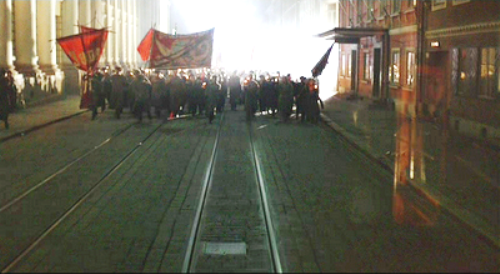
By Edward Copeland
It was with trepidation that I decided to use the occasion of its 25th anniversary DVD release to face off again with one of my old cinematic archenemies, namely Warren Beatty's 1981 film Reds. I'd known for a long time this day would come because through those two-and-a-half decades, I'd carried the scars of enduring the film and it had remained as one of the most boredom-inducing experiences of my filmgoing life. However, I also knew that it probably wasn't fair to the film. I saw Reds in its initial release — when my Oscar obsession was blossoming in seventh grade and deep down, I knew that perhaps a 12-year-old wasn't the movie's ideal audience and I needed to give the film another chance, to watch it with fresh, adult eyes.

Could the Reds I watched again in 2006 possibly be the same Reds that felt like as if a dentist were performing a root canal on me when I saw it decades ago — or is the real truth that the film remains the same but I'm not a different moviewatcher than I was back then? I think the answer is clear — and it would probably be plain stubborness on my part not to acknowledge that conditions must truly be correct for an individual to appreciate some films and a three hour-plus account of early socialists and the Russian revolution isn't really the best material for someone who at the time worshipped the reels Raiders of the Lost Ark unspooled from, especially since over the years Raiders has diminished in my eyes. Re-watching Reds, which initially to me seemed to move slower than Heinz ketchup, surprised the hell out of me when I realized that its pacing seemed exceptional for such a long movie. Sure, no Nazi faces were melting, but Reds' richness finally has become apparent to me. It's also worth noting that in the period between my initial seventh-grade viewing of Reds and my second encounter in 2006, one of my favorite courses at college was called Era of Russian Revolutions.
In many ways, Reds not only plays as a great film to me today in a way it didn't back in the 1980s, it also works as a far more relevant one as well. When you watch as the idealism of those who felt socialism was the answer to capitalism's wrongs inevitably gives way to cynicism as the communists in Russia begin using their power to deny the people rather than to give them a stronger voice, it's hard not
 to see the parallels. Ideology by necessity almost always gives way to disillusionment as true believers, no matter where they fall on the political spectrum, realize that the people whom they've trusted and believed in to realize their ideal dreams either have something else in mind or lack the essential ability to implement their goals. Reds also plays more clearly to me today as a story of the battle between art and politics as Jack Reed (Beatty) tries to balance his love of writing with his political sensibilities. He wants to help fight for his cause, but he still bristles when anyone tries to change his words. Deep down, even if he didn't admit it, he was more writer than revolutionary. Of course, the love that really lies at the heart of Reds is that between Reed and Louise Bryant (Diane Keaton). Keaton's performance resonates much more strongly for me now than it did when I was a bored adolescent. Perhaps, as much as I love Annie Hall, this might be Keaton's best performance as an often-fickle woman whose political views often drift as often as her interest in the men in her life. One of the things that annoyed me the most in junior high were the witness scenes, where the talking heads against the black backgrounds recounted their experiences with Reed and Bryant. I never appreciated the contradictions their stories presented at the time, but they shine through now, especially in the case of Bryant who remains a bit of an enigma.
Keaton hardly is the only actor who comes off even better than I remember from my first viewing. While Oscar winner Maureen Stapleton was my favorite part of the movie at the time, her great work as Emma Goldman actually is a much smaller role than I recalled. The other performance that plays even better now than it did
 then is Jack Nicholson's work as Louise's sometime lover, playwright Eugene O'Neill. It may well be Nicholson's most quiet and reserved work on film ever. I love Jack — and I love when he goes over the top, but there isn't any sign of that Nicholson here. Nicholson's O'Neill is smart, quiet and bitter over his treatment by Louise though still willing to help her in a pinch when she needs it. In the featurettes included on the 25th anniversary DVD, Nicholson recalls asking Beatty why he wanted him for this part and Beatty replied that he wanted someone who could conceivably steal Louise from Jack Reed and Nicholson certainly fills that bill. As for Beatty's work, you almost have to divide it into the four roles he served on the film. As producer, getting Reds made truly seems an impressive accomplishment in hindsight. As co-writer with Trevor Griffiths, his script plays much better than it did for the 12-year-old Edward Copeland. As director, his Oscar win seems deserved to me now, though I might still opt for Spielberg's work on Raiders in a pinch.
Then there is Beatty the actor. Beatty is never bad, but when you really get down to it, most of his performances come off sounding like the same person. The exceptions would be his earlier work as Clyde Barrow for Arthur Penn in Bonnie and Clyde and especially as John McCabe for Robert Altman in McCabe & Mrs. Miller. Close your eyes and listen to Heaven Can Wait's Joe Pendleton, Reds' Jack Reed or Bugsy's Bugsy Siegel, and aside from subject matter, they all sound the same. Even Bulworth to some extent falls prey to this. Perhaps it has something to do with when Beatty directs himself, even though Buck Henry co-directed him in Heaven Can Wait and Barry Levinson helmed Bugsy. Beatty reminds me much of Robert Redford — more star than actor. His range is limited and his directing output has been so scarce, I can't help but wonder if he'd moved more toward Clint Eastwood's later career and did less work in front of the camera and more behind, his film reputation might be held in higher esteem.
Reds as a whole plays as such a great movie to me now (even at 12, I recognized how great Oscar-winning Vittorio Storaro's cinematography was, though it's embarrassing to admit that I wasn't familiar with the movie's composer, a man named Sondheim), and Beatty's role in its success is so essential, that I won't begrudge him scoring high in only three of his four jobs on the film. Critics don't like to admit they were wrong — but I was, but at least I can blame it on my young age at the time. In one of the anecdotes on the great featurettes on the DVD, Beatty admits that when he offered to show Reds to his 13-year-old daughter she seemed completely disinterested, though he claims she saw it and liked it anyway, but would a young teen really want to tell her famous father what she really thought? Besides, even if she were lying, she likely will grow to admire it as she ages.
Tweet
Labels: 80s, Altman, Arthur Penn, B. Levinson, Buck Henry, Diane Keaton, Eastwood, Nicholson, O'Neill, Oscars, Redford, Sondheim, Spielberg, W. Beatty
TO READ ON, CLICK HERE
Saturday, September 10, 2011
Cliff Robertson 1923-2011

Ordinarily, when someone with as long and as illustrious a career as Cliff Robertson passes away, I would try to be as comprehensive as possible in my appreciation. Unfortunately, because I've been so underwater in projects, I didn't receive the news until much later than I should have and the due dates of the projects require that I can't take myself away from them for too long a stretch. Before I write my short look at the career of Mr. Robertson, who died Saturday one day after his 88th birthday, I'd like to express regret for not finding a better photo of him as the slimy and manipulative presidential candidate Ben Cantwell in the 1964 film adaptation of Gore Vidal's play The Best Man. His at-any-costs maneuvers to wrestle the nomination away from Henry Fonda's William Russell, for me at least, was the best work Robertson ever did on screen.
Tweet
Labels: Aldrich, Crawford, De Palma, DeVito, Fosse, H. Fonda, John Carpenter, Mailer, Mankiewicz, Obituary, Oscars, Raimi, Redford, Television, Tennessee Williams, Theater, Vidal, Walken, Walsh
TO READ ON, CLICK HERE
Monday, January 10, 2011
Peter Yates (1929-2011)

As a director, the Hampshire, England-born Peter Yates embraced a wide range of genres in the stories he brought to the silver screen, running the gamut from police thrillers to science fiction tales, from relationships dramas to beautifully rendered American slices of life, earning four Oscar nominations along the way, two for directing and two for producing. Yates has died at 81.
Though he began his career as an actor, Yates found his greatest fame behind the camera. He started doing second unit and assistant directing work on such notable films as Sons and Lovers, The Entertainer with Laurence Olivier, The Guns of Navarone and The Roman Spring of Mrs. Stone. He made his feature directing debut in 1963 with Summer Holiday, a musical romance starring pop star Cliff Richard. The following year, he turned to comedy with a film called One Way Pendulum.
For much of the mid-1960s, he worked in television, directing episodes of The Saint starring Roger Moore and Secret Agent starring Patrick McGoohan.
He returned to features in 1967 with a dramatization of the Great Train Robbery called Robbery, but it was the film he made in 1968 that made his name: Bullitt. Starring Steve McQueen as a San Francisco cop, Bullitt still contains one of the famous chase scenes in movie history, thanks largely to the hilly environs of its setting.
His next film couldn't have been more of a departure. In John and Mary, Dustin Hoffman and Mia Farrow play two people who meet at a bar, have a one night stand and then spend the next day getting to know one another.
In 1971, he helmed Murphy's War where Peter O'Toole played the title character, the sole survivor of a ship attacked by a German U-boat during World War II who washes up on an island and plots how to take out the U-boat all by himself.
With Robert Redford as his lead, 1972's The Hot Rock took Yates into the heist genre. With a script by William Goldman adapted from a Donald Westlake novel, Redford gathers his crew to steal a big diamond from a museum at the behest of an African doctor who wants it returned to his homeland. The problem: Every time they get it, they keep losing the damn thing and having to steal it again.
Yates filmed a crime classic the following year when Robert Mitchum starred in The Friends of Eddie Coyle. The next year, Yates went in a completely different direction again with the Barbra Streisand comedy For Pete's Sake.
Comedy was still on his plate in 1976 with Mother, Jugs and Speed about the competition between private ambulance companies which brought together the unusual trio of Bill Cosby, Raquel Welch and Harvey Keitel. The next year, he submerged himself with the adaptation of Peter Benchley's thriller The Deep.
His next film though, at least as far as I'm concerned, will be his legacy and remains his best. It brought him those first two Oscar nominations as he filmed Steve Tesich's brilliant script Breaking Away, a film that is as great today as it was the first time I saw it, if not better. He even served as executive producer for the short-lived television series of the movie.
Even though Tesich wrote the screenplay for his next film, Eyewitness, and it starred William Hurt and Sigourney Weaver, the film was a better idea than a movie and bit of a letdown. However, nothing could prepare for his next release, the monumentally silly sci-fi monstrosity Krull in 1983.
Fortunately, he had another 1983 offering to get the taste of Krull out of one's mouth and it earned him those final two Oscar nominations. The Dresser really was an actor's movie (literally) more than anything else as it told the story of an aging and dotty Shakespearean actor (Albert Finney) and his dresser (Tom Courtenay) who more or less serves as his protector. Both Finney and Courtenay were nominated as well.
Following The Dresser, Yates made several films, but nothing to equal those from the early portions of his career. There was Eleni with Kate Nelligan, Suspect with Cher, The House on Carroll Street with Kelly McGillis and Jeff Daniels, the wretched An Innocent Man with Tom Selleck, Year of the Comet, Roommates with Peter Falk and D.B. Sweeney, The Run of the Country with Finney and Curtain Call with James Spader.
His final two projects were made-for-television adaptations of Don Quixote and A Separate Peace.
Even with some dogs on that resume, Yates produced a helluva body of work and an eclectic one at that with several titles that will last for generations.
RIP Mr. Yates.
Tweet
Labels: Dustin Hoffman, Falk, Finney, Jeff Daniels, Keitel, Mia Farrow, Mitchum, Musicals, O'Toole, Obituary, Olivier, Redford, Sigourney Weaver, Streisand, Television, William Hurt
TO READ ON, CLICK HERE
Friday, October 22, 2010
Questioning Technology's Worth in a Kids' Film

“So we have to deal with our technological sophistication versus our spiritual sophistication — and technology always seems to be ahead of where we are spiritually. The machine in the movie ends up representing our own inventive side of ourselves and begs the question: Is it a good thing or is it a dangerous thing?” — Brad Bird
By J.D.
When The Iron Giant was released in 1999, it flew in the face of the current trend popularized by Disney animated musicals. Based on the 1968 children’s book, The Giant: A Story in Five Nights, by late British poet, Ted Hughes, The Iron Giant refuses to rely on musical numbers and simplify its message to appeal to kids. It is one of those rare animated films that both adults and kids can appreciate. It also is a nostalgic ode to the 1950s that is thought-provoking and entertaining.
Set in the small town of Rockwell, Maine in 1957, a 9-year old boy named Hogarth (the voice of Eli Marienthal) befriends a mysterious 50-foot robot (the voice of Vin Diesel) that has crash-landed near the town from outer space. Raised on steady diet of alien invasion B-movies, Hogarth tries his best to hide the presence of his large, metallic friend from his mother (voiced by Jennifer Aniston). He also keeps his new friend a secret from a snooping government agent (voiced by Christopher McDonald), but ends up sharing his secret with Dean, a jazz-loving beatnik sculptor (the voice of Harry Connick Jr.), who runs the local scrapyard.
The film originated with Pete Townsend (guitarist for the legendary rock band, The Who) who had produced a musical version of Hughes’ book in 1993, called The Iron Man. He brought the project to Warner Bros., with Des McAnuff, director of the Broadway version of Tommy, with the idea of transforming it into an animated musical. Animator Brad Bird heard of the project and met with Townsend and the film’s screenwriter, Tim McCanlies. Bird remembers, “I read the book and I liked the book, but I had a whole lot of ideas of my own about what this film could be about. Once it sort of went that direction, I didn’t envision it as a musical.” Bird pitched his take on the material to the studio as follows: “What if a gun had a soul?” Warner Bros. liked the idea and gave the project the go-ahead.
Bird drew his inspirations for the look and feel of the film from two unlikely sources. He was inspired by the cliched and dated educational films depicted in the documentary, The Atomic Café (1982) about the Cold War and the threat of nuclear war in the 1950’s. He also liked the radio broadcast about Sputnik that opens Robert Redford’s film, Quiz Show (1994). Bird said in an interview that “the bomb had changed our perspective and the future was no longer this perfect thing. Every upside had a dark underbelly.”
In many respects, The Iron Giant has a lot in common with another excellent film that came out around the same time, October Sky (1999). Both films are set in the same year (1957) with the beginnings of the space race and the dawn of the atomic age as their respective backdrops to the main action. The young protagonists of each film are dreamers and outsiders of their societies and present refreshingly peaceful resolutions to their respective conflicts.
To further reinforce the ‘50s vibe, Bird shot the film in Cinemascope, a widescreen form of cinema that was created to compete with the rising popularity of television. Bird said in an interview that, “There’s something immersive about the experience. Also, a lot of movies in the late ‘50s were shot in ‘Scope, so I thought it was appropriate for a movie set in 1957.”
The Iron Giant has a wonderfully nostalgic, small-town atmosphere that is brought to life by stunning animation that is on par with anything that Disney has produced in recent years. The attention to period detail, from the cheesy educational videos that Hogarth's class is forced to watch, to the way the townspeople talk, is faithfully recreated and goes a long way to drawing the viewer into this engaging world.
The animation style of this film recalls the early, groundbreaking Fleischer brothers' Superman cartoons of the 1940s with its depth of field, but without the German Expressionist influence. Bird and his team mixed computer animation (the robot) with traditional hand-drawn animation (the rest of the characters) in an exaggerated, cartoonish fashion that went against the current trend of realistically rendered characters (see Pixar). For Bird, “the reason to do animation is caricature. It’s the same reason that photography didn’t render portraiture obsolete. It’s because you can draw things in a way that is not trying to reproduce reality, but more the essence of reality.”

The real strength of The Iron Giant is the relationships between the characters — something that is often overlooked in animated films in favor of flashy visuals and epic musical numbers. This film has the feel of a very intimate, character-driven story with the relationship between Hogarth and his robot friend as the emotional center but with several other relationships (such as the ones between Hogarth and his mother and between him and Dean) featured prominently as well. This is no simple Saturday morning cartoon but a strong feature film that actually has something to say.
The Iron Giant did not do as well at the box office as Bird had hoped. Traditionally, animated films set promotional deals a year in advance so that the appropriate amount of hype and advanced word can be created. Warner Bros. delayed giving the film a release date and so every time Bird courted a potential sponsor, they would lose interest because no concrete date was set. Very few advanced posters and trailers were created and this hurt the film when it was finally released. It only grossed $23 million but has since found a new life on video and DVD.
The Iron Giant is one of those rare animated films that not only appeals to both children and adults; it does not contain one annoying musical number. It is also refuses to serve as one long, obvious advertisement for a toy. In fact, this film is an entertaining, even touching story about tolerance and compassion. It deals with real issues like death and bigotry — pretty heavy topics for a children's animated film — in an honest and heartfelt way. From all indications, The Iron Giant was clearly a labor of love for those involved and this translates into an enjoyable film for everyone to enjoy.
Tweet
Labels: 90s, Animation, Books, Disney, Musicals, Pixar, Redford
TO READ ON, CLICK HERE


