Friday, August 03, 2012
Edward Copeland's Top 100 of 2012 (100-81)
By Edward Copeland
With the release of the latest Sight & Sound poll, conducted every 10 years to determine the all-time best films, The House Next Door blog of Slant Magazine invited some of us not lucky enough to contribute to the S&S list to submit our own Top 10s to The House, which posted mine today. Sight & Sound magazine, a publication of the British Film Institute, began its survey in 1952, using only critics. Its 2002 list boasted its largest sample yet, receiving ballots from 145 film critics, writers and scholars as well as 108 directors. The results can be found here, though a note claims the page isn't actively maintained, though it appears complete to me. Since I planned to revise my personal Top 10, posted as part of my Top 100 in 2007, I figured I owed it to my entire Top 100 to redo my entire list. As before, my rule is simple: A film must be at least 10 years old to appear on my list. Therefore, movies released between 1998 and 2002 might appear on this list whereas they couldn't on the 2007 version. The most difficult part of assembling these lists always involves determining rankings. It's an arbitrary process and once you get past the Top 10 or 20, not only do the placements seem rather meaningless but inclusion and exclusions of films begin to weigh on you. In fact, selecting No. 1 remains easy but if I could, I'd have tied Numbers 2 through 20 or so at No. 2. A lot of great films didn't make this 100 through no fault of their own, falling victim to my whim at the moment I made the decision of what made the cut and where it went. In parentheses after a director's name, you'll find a film's 2007 rank or, if it's new to the list, you'll see NR for not ranked or NE for not eligible. I also should note that this does not mean the return of this blog. I had committed to taking part in The House's feature prior to pulling the plug and completed most of this before signing off.

100 NOSFERATU: PHANTOM DER NACHT directed by Werner Herzog (NR)
Part of the arbitrary nature of this list (and from the very first all-time 10-best list I compiled in high school) was to try to make sure I represented my favorite directors while still allowing for those films that might be a more singular achievement. (For example, my first high school list had to be sure to include a Woody Allen, a Huston, a Hitchcock, a Wilder, a Truffaut, an Altman.) The more great cinema you see, the harder it becomes to justify that since lots of directors deserve recognition and many films might be a filmmaker's strongest work. As I've caught up with a lot of Werner Herzog's work over the years, I felt he'd earned inclusion. I was torn between choosing Nosferatu or Aguirre: The Wrath of God to represent him, but opted for the vampire tale because Herzog's "reversioning" of Murnau's silent classic manages to be both a masterpiece of atmospherics and the best version of the Dracula tale put on screen.
99 TALK TO HER directed by Pedro Almodóvar (NE)
Pedro Almodóvar’s career evolution has taken an arc that I imagine few could have anticipated. I know I certainly didn’t back in the 1980s, when his films mainly consisted of camp, color and sexual obsession. Around the time of 1997’s Live Flesh, the Spanish filmmaker’s style took an abrupt change, filtering genres through his unique perspective to exhilarating results that continue through last year’s The Skin I Live In. The greatest of this run of seven features happens to be the most recent film to make this new Top 100 list. Telling the story of two men caring for women they love, both of whom happen to be comatose, Almodóvar’s Oscar-winning screenplay manages to balance humor, pathos and even outlandish touches you’d never expect to make one helluva movie and the writer-director’s best film so far.
98 NIGHT AND THE CITY directed by Jules Dassin (NR)
Littered along the highways of film history lie multiple tales of adversity breeding triumphs of cinema. As director Jules Dassin faced a possible subpoena from the House Un-American Activities Committee, presumably followed by blacklisting, at the end of the 1940s, producer Darryl Zanuck gave him an exit strategy. Dassin flew to London to hurriedly begin filming an adaptation of the novel Night and the City, which he’d never read, and as a result produced one of the greatest noirs of all time. Not only did he make the movie on the fly, Zanuck even stuck him with creating a role for Gene Tierney, nearly suicidal after a bad love affair. The novel’s author, Gerald Kersh, hated the movie about hustler Harry Fabian (Richard Widmark) scheming to bring Greco-Roman wrestling to London while ducking all sorts of colorful characters played by wonderful actors such as Francis L. Sullivan, Googie Withers, Herbert Lom, Hugh Marlowe and Mike Mazurki. Of course, Kersh’s gripe was understandable — the film bore no resemblance whatsoever to his novel other than the title. However, that didn’t prevent it from being a damn fine film.
97 LONE STAR directed by John Sayles (92)
It takes a lot to fool me and, in retrospect, I should have seen the final twist coming, but I didn't because Sayles crafted in his best film a compelling story in which the plot turn was unexpected and the movie’s story didn't hinge on it. Even if the secret never had been revealed, this portrait of skeletons from the past and their influence on the lives of people in the present still would resonate. Sayles assembles a helluva ensemble including Chris Cooper, Elizabeth Peña, Matthew McConaughey, Kris Kristofferson, Joe Morton and, in one great single scene, Frances McDormand, to name but a few. Sayles has made some good films since Lone Star, but none come close to equaling the artistry, vitality and humanity of this one. I await another great one from him.
96 NORTH BY NORTHWEST directed by Alfred Hitchcock (81)
Set piece after set piece, Hitchcock puts Cary Grant through the paces and pulls the viewer along to his most purely entertaining offering. Grant never loses his cool as he's hunted by everyone, James Mason makes a suave bad guy and Martin Landau a perfectly sinister hired thug. With cameos by four former U.S. presidents. There's not much else to say about it: It's not an exercise in style or filled with layers and depth, it's just damn fun. In fact, it’s as much a comedy as a thriller.

95 THE NIGHT OF THE HUNTER directed by Charles Laughton (87)
There's something to be said for quitting while you're ahead and Charles Laughton, one of the finest screen actors ever, certainly did with the only film he ever directed. The film's influences seem more prevalent than people who have actually seen this disturbing thriller with the great Robert Mitchum as the creepy preacher with love on one hand and hate on the other and the legendary Lillian Gish as the equivalent of the old woman who lived in a shoe, assuming the old woman was well armed.
94 RASHOMON directed by Akira Kurosawa (NR)
In describing the film that put Kurosawa on the world’s radar as a major filmmaker, I’m going to let Robert Altman speak for me. This quote comes from his introduction to the Criterion Collection edition of the movie. "Rashomon is the most interesting, for me, of Kurosawa's films.…The main thing here is that when one sees a film you see the characters on screen.…You see very specific things — you see a tree, you see a sword — so one takes that as truth, but in this film, you take it as truth and then you find out it's not necessarily true and you see these various versions of the episode that has taken place that these people are talking about. You're never told which is true and which isn't true which leads you to the proper conclusion that it's all true and none of it's true. It becomes a poem and it cracks this visual thing that we have in our minds that if we see it, it must be a fact. In reading, in radio — where you don't have these specific visuals — your mind is making them up. What my mind makes up and what your mind makes up…is never the same."
93 RAGING BULL directed by Martin Scorsese (NR)
For years, my standard response when asked about Raging Bull was that it was a film easier to admire than love. Each time that I’d see the movie again though, that point-of-view became less satisfactory because, as any great film should, the film kept rising higher in my esteem. In the film's opening moments, when Robert De Niro plays the older, fat Jake preparing for his lounge act in 1964 before it cuts to the ripped fighter in 1941, even though I consciously know both versions of La Motta were played by the same actor and that De Niro was that actor, the performance so entrances that I actually ask, "Who is this guy and why hasn't he made more movies?" To gaze at the way he sculpted his body into the shape of a believable middleweight boxer, sweat glistening in Michael Chapman's gorgeous black-and-white cinematography, truly makes an impressive achievement. Acting isn't the proper word for what De Niro does here. He doesn't portray Jake La Motta, he becomes Jake La Motta, or at least the screen version, and leaves all vestiges of Robert De Niro somewhere else. Even when De Niro turns in good or great work in other roles, they never come as close to complete immersion as his La Motta does.
92 RIFIFI directed by Jules Dassin (NR)
"Out of the worst crime novels I have ever read, Jules Dassin has made the best crime film I've ever seen," François Truffaut wrote about Rififi in his book The Films in My Life. I haven't read the Auguste Le Breton novel, but I don't doubt Truffaut's word. Dassin structures the film like a solid three-act play. Act I: Planning the heist. Act II: Carrying it out. Act III: The aftermath. Dassin fine-tunes each of the film's element to the point that Rififi practically runs as a machine all its own. The various characters behave more as chess pieces to be moved around as the story's game requires than as representatives of people. One single sequence though makes Rififi a landmark both in films and particularly heist movies: the robbery itself. Dassin films this in a 32-minute long silent sequence. No one speaks. Keeping everything as quiet as possible becomes the thieves' No. 1 priority. It's absolutely riveting. You'll be holding your breath as if you were involved in the crime yourself.
91 RIO BRAVO directed by Howard Hawks (79)
Howard Hawks appears for the first time on the list with a Western starring John Wayne that turned out to be so much fun they remade it (more or less) seven years later as El Dorado. I’ll stick with the original where the Duke’s allies include a great Dean Martin as a soused deputy sheriff, young Ricky Nelson and the always wily Walter Brennan. Wayne even gets to romance Angie Dickinson. No deep themes hidden here, though it's more layered than your typical Western. Still, that doesn't mean you can't kick up your spurs and enjoy.

90 KING KONG directed by Merian C. Cooper and Ernest B. Schoedsack (76)
The first time was the charm. One of the few insightful comments I heard on the 2007 AFI special was when Martin Scorsese said that in many ways he finds the primitive stop-motion effects of the original King Kong more impressive than later CGI versions. He's absolutely right. The 1933 version also offers more thrills and emotions (and in half the time) than Peter Jackson's technically superior but dramatically inferior and unnecessary remake. Let’s not even discuss the 1976 version.
89 L.A. CONFIDENTIAL directed by Curtis Hanson (90)
When L.A. Confidential debuted on this list in its first year of eligibility in 2007, I wrote, “Of the films of fairly recent vintage, this is one that grows stronger each time I see it, earning comparisons to the great Chinatown…Well acted (even if Kim Basinger's Oscar was beyond generous), well written and well directed, I believe L.A. Confidential’s reputation will only grow greater as the years go on — yet it lost the Oscar (and a spot on the AFI list) to the insipid Titanic.” When I re-watched the film recently, my prediction proved to be spot-on as it only deepens as an experience and an entertainment as time passes. It still boggles my mind that with Russell Crowe, Guy Pearce, Kevin Spacey and James Cromwell (just to name four) delivering impeccable work that only Basinger landed a nomination, but losing best picture and director to James Cameron and Titanic remains the bigger crime.
88 AFTER HOURS directed by Martin Scorsese (88)
Simply put: The tensest comedy ever made and perhaps Scorsese's most underrated film. Griffin Dunne plays the perfect beleaguered straight man enveloped by a universe of misfits and oddballs in lower Manhattan when all he wanted to do was get laid. It’s hard to imagine that this movie nearly became a Tim Burton project, but thanks to the many setbacks Scorsese endured attempting to make The Last Temptation of Christ, the film ended up being his — and recharged his batteries as well. While Scorsese has made great films since, I’d love to see him step back sometime and make another indie feature like After Hours on the fly just to see what happens. Joseph Minion wrote an excellent script and this represents one case where I think the changed ending actually proves superior to the originally intended one. By the way, whatever happened to Joseph Minion?
87 BACK TO THE FUTURE directed by Robert Zemeckis (86)
Watchability often gets undervalued when rating a film's worth, but I never tire of sitting through this thrill ride. One aspect that has impressed me since I first saw it as a teen back in 1985 (and I went two nights in a row, dragging my parents to it on the second) was its attention to detail such as Marty arriving in 1955 and mowing down a pine tree on the farm of the deranged man trying to “breed pines.” Then, when he returns to 1985, Twin Pines Mall now bears the sign Lone Pine Mall. It’s just a quiet sight gag in the background without any overt attempt to call attention to the joke. You either catch it or you don’t. I always admire films that respect audiences like that, especially when they happen to be this much fun. With equal touches of satire, suspense and genuine emotion, Back to the Future elicits pure joy. No matter how many times I see it, the final sequence where they prepare to send Marty back to 1985 holds me in rapt attention as I wonder if this time might be the time he doesn't actually make it.
86 MASH directed by Robert Altman (77)
A comedy about the Vietnam War that's full of blood and set in Korea, just as a matter of subterfuge. The film that put Altman on the map and inspired one of TV's best comedies (until it got too full of itself), MASH still holds up with its brilliant ensemble and wicked wit. I still wish the TV show had kept that theme song with its lyrics. Through early morning fog I see/visions of the things to be/the pains that are withheld for me/I realize and I can see.../That suicide is painless/It brings on many changes/and I can take or leave it if I please.

85 PRIZZI'S HONOR directed by John Huston (85)
Back in 1985, before Goodfellas and The Sopranos really mixed mob stories with jet black comedy, the great director John Huston, in his second-to-last film, brought to the screen an adaptation of Richard Condon's Mafia satire Prizzi's Honor, complete with great performances and some of the most memorable lines ever collected in a single film. Huston may have been in the twilight of his days, but his filmmaking prowess was as strong as ever. Jack Nicholson disappeared into the role of Charley Partanna more than he had any role in recent memory. Kathleen Turner matched well with Nicholson as Charley's love whose work outside the house causes problems. William Hickey gave an eccentric and indelible portrait of the aging don. Finally, John's daughter Anjelica made up for a misfire of an acting debut decades earlier with her brilliant performance as the scheming Maerose and took home one of the most deserved supporting actress Oscars ever given.
84 RAISE THE RED LANTERN directed by Zhang Yimou (84)
Before Zhang Yimou started being obsessed with spectacle and martial arts, film after film, he produced some of the greatest personal stories in the history of movies, especially when his muse was the great and beautiful Gong Li. This film was their first truly flawless effort as Gong plays the young bride of a powerful lord who already has multiple wives and who encourages the sometimes brutal competition between the women.
83 THE PLAYER directed by Robert Altman (82)
"The film actually is like a snail — it kind of turns in on itself and becomes itself," Altman describes his film in an interview on its DVD. One of the many "comebacks" of Robert Altman's career, this brilliant Hollywood satire holds up viewing after viewing because it's so much more than merely a satire. Thanks to Tim Robbins' superb performance as the sympathetic heel of a Hollywood executive and the cynical yet deeper emotional punch of Michael Tolkin's script, Altman wows from the opening eight-minute take to one of the greatest final punchlines in movie history. However, the more times you see it, the more you discover to see. While some specific references have aged, the movie's relevance remains — now more than ever.
82 SCHINDLER'S LIST directed by Steven Spielberg (78)
Schindler’s List marked an important moment in Spielberg’s development as a filmmaker: Peter Pan finally grew up. It’s a harrowing, well-made movie that everyone should see. At the same time, I can foresee a time when it slips off this list entirely. It isn’t the fault of the film — I find it nearly flawless. However, if someone placed a gun to my head and ordered me to choose to watch either Schindler’s or one of Spielberg’s best post-1993 films such as Catch Me If You Can or Minority Report, I’d opt for one of the latter two. Are they better films than Schindler’s List? I can’t say that. However, the epic holocaust tale isn’t a film you find yourself wanting to pop a bowl of popcorn and watching on a whim. As I said earlier, for me at least, rewatchability remains an important factor. I’ve seen Schindler’s List three times but I haven’t reached the point where I want to go through that wrenching experience again.
81 WILD STRAWBERRIES directed by Ingmar Bergman (NR)
Bergman once said that by the time he was done making Wild Strawberries, the film really belonged more to Victor Sjöström, who played Borg, the renowned professor and lauded physician about to receive an honorary degree. The film marked Sjöström 's return from semi-retirement, but he already was a legend as the first true Swedish acting-directing star. Borg decides to drive his old Packard to the event instead of flying to meet his son. The journey becomes more than just a road trip for the professor, but a metaphysical trek through his past as he questions what led him to this moment. As the car winds closer to the ceremony, Borg's inner journey does as well as he comes to realize that for all his scientific training, the only thing he can't analyze is himself. "The day's clear reality dissolves into even clearer remnants of memory," he says. Wild Strawberries represents Bergman growing into his powers as a filmmaker and while it may concern a 78-year-old man examining his life, the subject proves as timeless for people of any age as the film itself.
TO LEARN FILMS 80-61, CLICK HERE
Tweet
TO READ ON, CLICK HERE
With the release of the latest Sight & Sound poll, conducted every 10 years to determine the all-time best films, The House Next Door blog of Slant Magazine invited some of us not lucky enough to contribute to the S&S list to submit our own Top 10s to The House, which posted mine today. Sight & Sound magazine, a publication of the British Film Institute, began its survey in 1952, using only critics. Its 2002 list boasted its largest sample yet, receiving ballots from 145 film critics, writers and scholars as well as 108 directors. The results can be found here, though a note claims the page isn't actively maintained, though it appears complete to me. Since I planned to revise my personal Top 10, posted as part of my Top 100 in 2007, I figured I owed it to my entire Top 100 to redo my entire list. As before, my rule is simple: A film must be at least 10 years old to appear on my list. Therefore, movies released between 1998 and 2002 might appear on this list whereas they couldn't on the 2007 version. The most difficult part of assembling these lists always involves determining rankings. It's an arbitrary process and once you get past the Top 10 or 20, not only do the placements seem rather meaningless but inclusion and exclusions of films begin to weigh on you. In fact, selecting No. 1 remains easy but if I could, I'd have tied Numbers 2 through 20 or so at No. 2. A lot of great films didn't make this 100 through no fault of their own, falling victim to my whim at the moment I made the decision of what made the cut and where it went. In parentheses after a director's name, you'll find a film's 2007 rank or, if it's new to the list, you'll see NR for not ranked or NE for not eligible. I also should note that this does not mean the return of this blog. I had committed to taking part in The House's feature prior to pulling the plug and completed most of this before signing off.

Part of the arbitrary nature of this list (and from the very first all-time 10-best list I compiled in high school) was to try to make sure I represented my favorite directors while still allowing for those films that might be a more singular achievement. (For example, my first high school list had to be sure to include a Woody Allen, a Huston, a Hitchcock, a Wilder, a Truffaut, an Altman.) The more great cinema you see, the harder it becomes to justify that since lots of directors deserve recognition and many films might be a filmmaker's strongest work. As I've caught up with a lot of Werner Herzog's work over the years, I felt he'd earned inclusion. I was torn between choosing Nosferatu or Aguirre: The Wrath of God to represent him, but opted for the vampire tale because Herzog's "reversioning" of Murnau's silent classic manages to be both a masterpiece of atmospherics and the best version of the Dracula tale put on screen.
Pedro Almodóvar’s career evolution has taken an arc that I imagine few could have anticipated. I know I certainly didn’t back in the 1980s, when his films mainly consisted of camp, color and sexual obsession. Around the time of 1997’s Live Flesh, the Spanish filmmaker’s style took an abrupt change, filtering genres through his unique perspective to exhilarating results that continue through last year’s The Skin I Live In. The greatest of this run of seven features happens to be the most recent film to make this new Top 100 list. Telling the story of two men caring for women they love, both of whom happen to be comatose, Almodóvar’s Oscar-winning screenplay manages to balance humor, pathos and even outlandish touches you’d never expect to make one helluva movie and the writer-director’s best film so far.
Littered along the highways of film history lie multiple tales of adversity breeding triumphs of cinema. As director Jules Dassin faced a possible subpoena from the House Un-American Activities Committee, presumably followed by blacklisting, at the end of the 1940s, producer Darryl Zanuck gave him an exit strategy. Dassin flew to London to hurriedly begin filming an adaptation of the novel Night and the City, which he’d never read, and as a result produced one of the greatest noirs of all time. Not only did he make the movie on the fly, Zanuck even stuck him with creating a role for Gene Tierney, nearly suicidal after a bad love affair. The novel’s author, Gerald Kersh, hated the movie about hustler Harry Fabian (Richard Widmark) scheming to bring Greco-Roman wrestling to London while ducking all sorts of colorful characters played by wonderful actors such as Francis L. Sullivan, Googie Withers, Herbert Lom, Hugh Marlowe and Mike Mazurki. Of course, Kersh’s gripe was understandable — the film bore no resemblance whatsoever to his novel other than the title. However, that didn’t prevent it from being a damn fine film.
It takes a lot to fool me and, in retrospect, I should have seen the final twist coming, but I didn't because Sayles crafted in his best film a compelling story in which the plot turn was unexpected and the movie’s story didn't hinge on it. Even if the secret never had been revealed, this portrait of skeletons from the past and their influence on the lives of people in the present still would resonate. Sayles assembles a helluva ensemble including Chris Cooper, Elizabeth Peña, Matthew McConaughey, Kris Kristofferson, Joe Morton and, in one great single scene, Frances McDormand, to name but a few. Sayles has made some good films since Lone Star, but none come close to equaling the artistry, vitality and humanity of this one. I await another great one from him.
Set piece after set piece, Hitchcock puts Cary Grant through the paces and pulls the viewer along to his most purely entertaining offering. Grant never loses his cool as he's hunted by everyone, James Mason makes a suave bad guy and Martin Landau a perfectly sinister hired thug. With cameos by four former U.S. presidents. There's not much else to say about it: It's not an exercise in style or filled with layers and depth, it's just damn fun. In fact, it’s as much a comedy as a thriller.

There's something to be said for quitting while you're ahead and Charles Laughton, one of the finest screen actors ever, certainly did with the only film he ever directed. The film's influences seem more prevalent than people who have actually seen this disturbing thriller with the great Robert Mitchum as the creepy preacher with love on one hand and hate on the other and the legendary Lillian Gish as the equivalent of the old woman who lived in a shoe, assuming the old woman was well armed.
In describing the film that put Kurosawa on the world’s radar as a major filmmaker, I’m going to let Robert Altman speak for me. This quote comes from his introduction to the Criterion Collection edition of the movie. "Rashomon is the most interesting, for me, of Kurosawa's films.…The main thing here is that when one sees a film you see the characters on screen.…You see very specific things — you see a tree, you see a sword — so one takes that as truth, but in this film, you take it as truth and then you find out it's not necessarily true and you see these various versions of the episode that has taken place that these people are talking about. You're never told which is true and which isn't true which leads you to the proper conclusion that it's all true and none of it's true. It becomes a poem and it cracks this visual thing that we have in our minds that if we see it, it must be a fact. In reading, in radio — where you don't have these specific visuals — your mind is making them up. What my mind makes up and what your mind makes up…is never the same."
For years, my standard response when asked about Raging Bull was that it was a film easier to admire than love. Each time that I’d see the movie again though, that point-of-view became less satisfactory because, as any great film should, the film kept rising higher in my esteem. In the film's opening moments, when Robert De Niro plays the older, fat Jake preparing for his lounge act in 1964 before it cuts to the ripped fighter in 1941, even though I consciously know both versions of La Motta were played by the same actor and that De Niro was that actor, the performance so entrances that I actually ask, "Who is this guy and why hasn't he made more movies?" To gaze at the way he sculpted his body into the shape of a believable middleweight boxer, sweat glistening in Michael Chapman's gorgeous black-and-white cinematography, truly makes an impressive achievement. Acting isn't the proper word for what De Niro does here. He doesn't portray Jake La Motta, he becomes Jake La Motta, or at least the screen version, and leaves all vestiges of Robert De Niro somewhere else. Even when De Niro turns in good or great work in other roles, they never come as close to complete immersion as his La Motta does.
"Out of the worst crime novels I have ever read, Jules Dassin has made the best crime film I've ever seen," François Truffaut wrote about Rififi in his book The Films in My Life. I haven't read the Auguste Le Breton novel, but I don't doubt Truffaut's word. Dassin structures the film like a solid three-act play. Act I: Planning the heist. Act II: Carrying it out. Act III: The aftermath. Dassin fine-tunes each of the film's element to the point that Rififi practically runs as a machine all its own. The various characters behave more as chess pieces to be moved around as the story's game requires than as representatives of people. One single sequence though makes Rififi a landmark both in films and particularly heist movies: the robbery itself. Dassin films this in a 32-minute long silent sequence. No one speaks. Keeping everything as quiet as possible becomes the thieves' No. 1 priority. It's absolutely riveting. You'll be holding your breath as if you were involved in the crime yourself.
Howard Hawks appears for the first time on the list with a Western starring John Wayne that turned out to be so much fun they remade it (more or less) seven years later as El Dorado. I’ll stick with the original where the Duke’s allies include a great Dean Martin as a soused deputy sheriff, young Ricky Nelson and the always wily Walter Brennan. Wayne even gets to romance Angie Dickinson. No deep themes hidden here, though it's more layered than your typical Western. Still, that doesn't mean you can't kick up your spurs and enjoy.
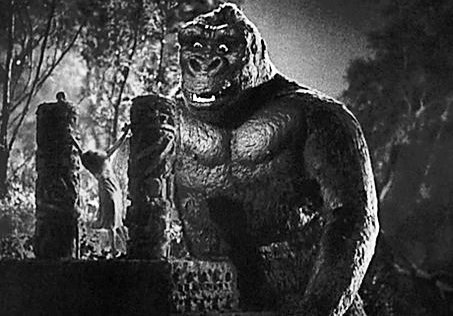
The first time was the charm. One of the few insightful comments I heard on the 2007 AFI special was when Martin Scorsese said that in many ways he finds the primitive stop-motion effects of the original King Kong more impressive than later CGI versions. He's absolutely right. The 1933 version also offers more thrills and emotions (and in half the time) than Peter Jackson's technically superior but dramatically inferior and unnecessary remake. Let’s not even discuss the 1976 version.
When L.A. Confidential debuted on this list in its first year of eligibility in 2007, I wrote, “Of the films of fairly recent vintage, this is one that grows stronger each time I see it, earning comparisons to the great Chinatown…Well acted (even if Kim Basinger's Oscar was beyond generous), well written and well directed, I believe L.A. Confidential’s reputation will only grow greater as the years go on — yet it lost the Oscar (and a spot on the AFI list) to the insipid Titanic.” When I re-watched the film recently, my prediction proved to be spot-on as it only deepens as an experience and an entertainment as time passes. It still boggles my mind that with Russell Crowe, Guy Pearce, Kevin Spacey and James Cromwell (just to name four) delivering impeccable work that only Basinger landed a nomination, but losing best picture and director to James Cameron and Titanic remains the bigger crime.
Simply put: The tensest comedy ever made and perhaps Scorsese's most underrated film. Griffin Dunne plays the perfect beleaguered straight man enveloped by a universe of misfits and oddballs in lower Manhattan when all he wanted to do was get laid. It’s hard to imagine that this movie nearly became a Tim Burton project, but thanks to the many setbacks Scorsese endured attempting to make The Last Temptation of Christ, the film ended up being his — and recharged his batteries as well. While Scorsese has made great films since, I’d love to see him step back sometime and make another indie feature like After Hours on the fly just to see what happens. Joseph Minion wrote an excellent script and this represents one case where I think the changed ending actually proves superior to the originally intended one. By the way, whatever happened to Joseph Minion?
Watchability often gets undervalued when rating a film's worth, but I never tire of sitting through this thrill ride. One aspect that has impressed me since I first saw it as a teen back in 1985 (and I went two nights in a row, dragging my parents to it on the second) was its attention to detail such as Marty arriving in 1955 and mowing down a pine tree on the farm of the deranged man trying to “breed pines.” Then, when he returns to 1985, Twin Pines Mall now bears the sign Lone Pine Mall. It’s just a quiet sight gag in the background without any overt attempt to call attention to the joke. You either catch it or you don’t. I always admire films that respect audiences like that, especially when they happen to be this much fun. With equal touches of satire, suspense and genuine emotion, Back to the Future elicits pure joy. No matter how many times I see it, the final sequence where they prepare to send Marty back to 1985 holds me in rapt attention as I wonder if this time might be the time he doesn't actually make it.
A comedy about the Vietnam War that's full of blood and set in Korea, just as a matter of subterfuge. The film that put Altman on the map and inspired one of TV's best comedies (until it got too full of itself), MASH still holds up with its brilliant ensemble and wicked wit. I still wish the TV show had kept that theme song with its lyrics. Through early morning fog I see/visions of the things to be/the pains that are withheld for me/I realize and I can see.../That suicide is painless/It brings on many changes/and I can take or leave it if I please.

Back in 1985, before Goodfellas and The Sopranos really mixed mob stories with jet black comedy, the great director John Huston, in his second-to-last film, brought to the screen an adaptation of Richard Condon's Mafia satire Prizzi's Honor, complete with great performances and some of the most memorable lines ever collected in a single film. Huston may have been in the twilight of his days, but his filmmaking prowess was as strong as ever. Jack Nicholson disappeared into the role of Charley Partanna more than he had any role in recent memory. Kathleen Turner matched well with Nicholson as Charley's love whose work outside the house causes problems. William Hickey gave an eccentric and indelible portrait of the aging don. Finally, John's daughter Anjelica made up for a misfire of an acting debut decades earlier with her brilliant performance as the scheming Maerose and took home one of the most deserved supporting actress Oscars ever given.
Before Zhang Yimou started being obsessed with spectacle and martial arts, film after film, he produced some of the greatest personal stories in the history of movies, especially when his muse was the great and beautiful Gong Li. This film was their first truly flawless effort as Gong plays the young bride of a powerful lord who already has multiple wives and who encourages the sometimes brutal competition between the women.
"The film actually is like a snail — it kind of turns in on itself and becomes itself," Altman describes his film in an interview on its DVD. One of the many "comebacks" of Robert Altman's career, this brilliant Hollywood satire holds up viewing after viewing because it's so much more than merely a satire. Thanks to Tim Robbins' superb performance as the sympathetic heel of a Hollywood executive and the cynical yet deeper emotional punch of Michael Tolkin's script, Altman wows from the opening eight-minute take to one of the greatest final punchlines in movie history. However, the more times you see it, the more you discover to see. While some specific references have aged, the movie's relevance remains — now more than ever.
Schindler’s List marked an important moment in Spielberg’s development as a filmmaker: Peter Pan finally grew up. It’s a harrowing, well-made movie that everyone should see. At the same time, I can foresee a time when it slips off this list entirely. It isn’t the fault of the film — I find it nearly flawless. However, if someone placed a gun to my head and ordered me to choose to watch either Schindler’s or one of Spielberg’s best post-1993 films such as Catch Me If You Can or Minority Report, I’d opt for one of the latter two. Are they better films than Schindler’s List? I can’t say that. However, the epic holocaust tale isn’t a film you find yourself wanting to pop a bowl of popcorn and watching on a whim. As I said earlier, for me at least, rewatchability remains an important factor. I’ve seen Schindler’s List three times but I haven’t reached the point where I want to go through that wrenching experience again.
Bergman once said that by the time he was done making Wild Strawberries, the film really belonged more to Victor Sjöström, who played Borg, the renowned professor and lauded physician about to receive an honorary degree. The film marked Sjöström 's return from semi-retirement, but he already was a legend as the first true Swedish acting-directing star. Borg decides to drive his old Packard to the event instead of flying to meet his son. The journey becomes more than just a road trip for the professor, but a metaphysical trek through his past as he questions what led him to this moment. As the car winds closer to the ceremony, Borg's inner journey does as well as he comes to realize that for all his scientific training, the only thing he can't analyze is himself. "The day's clear reality dissolves into even clearer remnants of memory," he says. Wild Strawberries represents Bergman growing into his powers as a filmmaker and while it may concern a 78-year-old man examining his life, the subject proves as timeless for people of any age as the film itself.
Tweet
Labels: Almodóvar, Altman, D. Zanuck, Dassin, Hawks, Herzog, Hitchcock, Huston, Ingmar Bergman, Kurosawa, Laughton, Lists, Murnau, Sayles, Scorsese, Spielberg, Tim Burton, Truffaut, Zemeckis, Zhang Yimou
TO READ ON, CLICK HERE


Edward Copeland's Top 100 of 2012 (80-61)

People like to mock Frank Capra as simple-minded at times and this film especially, but it remains a rousing indictment of corruption in Washington that echoes to this very day. It's too bad that a filibuster doesn't still mean that a senator has to do what Jefferson Smith did and hold the floor for as long as he can instead of the procedural gimmick it's turned into today that prevents legislation from moving out of the Senate. Still, whenever I catch Mr. Smith, no matter how long it has been on, I have to watch until the end. It's the curse of being both a movie buff and a political junkie. In a way, with recent events, it seems to have a bit of timeliness beneath the treacle and idealistic love of how this country should work.
When people think Ingmar Bergman, they think heavy, but here flows one of his lightest and most enjoyable concoctions. In an introduction made for the Criterion edition of the film, Bergman remarks how Smiles changed everything for him. At the time, he was broke and living off the actress Bibi Andersson when his studio entered the film at Cannes and it won a prize (best poetic humor) and became an international success. Bergman says it was a turning point for both him and his studio, earning him free rein to go on and make even more of the greatest films of all time. The film contains obvious echoes of The Rules of the Game, though Smiles more than stands on its own with its tale of love and adultery, male vanity and female cunning, aging and youth. It's not only a delight as a film but inspired the great Stephen Sondheim to write one of his earliest great scores as composer and lyricist in A Little Night Music. Isn't it rich?
The Weinstein P.R. machine spun so much press off this film's twist that I think it takes away from how great a movie had developed before that plot turn even happens. I was fortunate enough to see it early, before the hype went into overdrive, so I thought another story turn was the "twist" and relaxed and the real twist took me by complete, wonderful surprise. I hope someday new viewers will be able to see the film without knowing what lies ahead. Even if they don’t though, they will see a great study in human nature as well as great performances from Stephen Rea, Forest Whitaker, Miranda Richardson and Jaye Davidson.
While Spike Lee still has talent to spare, he has yet to come close to equaling the power of his third film and its study of one hot day in Bedford Stuy. His strongest work has flourished in his documentaries, especially his pair of post-Katrina films When the Levees Broke: A Requiem in Four Acts and If God Is Willing and Da Creek Don’t Rise and the feature Inside Man. Something tells me he’ll come back eventually. More than 20 years later, Do the Right Thing retains the power it unleashed in 1989 as that breed of film that has become rarer and rarer: the conversation starter.
The film marketed as Bergman's "last feature" truly is one of his best, painting a vast semiautobiographical canvas of two children from a large theatrical family who find their lives upended when their mother weds an authoritarian monster of a minister. Beyond the narrative, Sven Nykvist's photography, Anna Asp’s art direction, Susanne Lingheim’s sets and Marik Vos’ costumes present a sumptuous feast for the eyes. Its three-hour running time flies by and watching the 312-minute cut Bergman originally made for Swedish television proves even more rewarding.

Bogie got one of his best roles, John Huston made one of his greatest films (winning his only two Oscars for writing and directing) and his old man got a supporting actor Oscar in the deal as well. When you see Walter Huston do his mocking, triumphant little dance, you want to join in. Sierra Madre wasn’t John Huston’s only classic starring Humphrey Bogart released in 1948 either. The two also collaborated on Key Largo, While it’s good, it’s this film with its prospecting south of the border that’s the real keeper.
Here comes Howard Hawks again and Cary Grant (playing a nerd, believe it or not) as well. (I haven't added it up, but I suspect Grant appears in more movies on this list than any other actor). Katharine Hepburn's most inspired performance powers this screwiest of screwball comedies as her flighty socialite wreaks havoc on the world of Grant’s mild-mannered paleontologist. All of this and a leopard or two, too.
Salieri may consider himself the "patron saint of mediocrity," but little can be called mediocre about Forman's adaptation of Peter Shaffer's play. F. Murray Abraham and Tom Hulce were both brilliant and you can't really argue against its musical score. The unitiated might suspect slowgoing in a period costume drama such as this, but they haven't seen enough and certainly not Amadeus which overflows with humor and light as well as its darker elements.
There wouldn't be a Breakfast Club without a Virginia Woolf, but I don't hold that against Edward Albee or his great play turned into a superb movie by Mike Nichols. Elizabeth Taylor and Richard Burton were never better and while the truth games and verbal battles make you cringe, you can't avert your eyes from their power. Albee's play marks its 50th anniversary this year and it still packs a punch a half-century later.
To me, one of the crimes of both versions of the AFI list is that Psycho is the only representation of black-and-white Hitchcock, as if no one noticed him until he started working in color, but nothing is further from the truth and Notorious is one of the best examples of that. The kiss between Ingrid Bergman and Cary Grant remains one of the most sensual images ever put on celluloid and Claude Rains is superb as the conflicted heavy of the piece.

This film shouldn't work and it probably wouldn't if its stellar cast hadn't saved it. Kazan and Budd Schulberg's attempt to justify their actions during the McCarthy hearings doesn't quite work as an allegory, but the film itself works as a powerful story thanks to the indelible performances it contains. Brando earns the big kudos but the solid work of Eva Marie Saint, Rod Steiger, Karl Malden and especially Lee J. Cobb shouldn't be forgotten.
As digital projection sounds the death knell for celluloid, I feel even more grateful that when I saw Lawrence of Arabia for the first time, I saw the restored, 70mm print in a theater released for its 25th anniversary. I never could watch the cropped, pan-and-scan versions on TV. It’s a shame that more classics fail to get re-released outside major markets, but with the digital future, it’s almost moot. As for the film itself, if it weren't for the weaker second half, this movie that almost defines epic would have landed higher on this list. Still, with its stunning cinematography, gorgeous score and great Peter O'Toole performance, it belongs on the list nonetheless.
When I made my 2007 list, I admitted being torn between including 8½ or Nights of Cabiria to represent Fellini and I ended up opting for 8½. In the intervening five years, I’ve watched both films again and my preference clearly leans to Cabiria. While Giulietta Masina's remarkable performance as the title character might break your heart at times, more often than not, she'll leave you smiling, even if it's a sad smile. While Masina initially wins you over when seeing the film the first few times, on later viewings I've found the movie itself richer. It's constructed almost as a perfect circle, a ring of hell if you will, from which Cabiria would like to escape. "Everyone has a secret agony," a character tells her at one point and as much as Cabiria might try to avoid it, she hopes to abandon her life. First, she sees fun in a brief sojourn with a celebrated movie star (Amedeo Narrazi) that in a way predicts Pretty Woman some 30 years down the road, though without the manufactured happy ending. Fellini grounds Nights of Cabiria in reality, a world where the poor are forced to live in caves and anyone can be a victim. In another incident, when Cabiria realizes that once again she's been gypped, it leads to an ending that manages to be touching, magical and inspiring, all at the same time, ending with one of film's greatest close-ups.
Kirk Douglas probably was miscast, but this early Kubrick doesn't get the kudos it deserves and it certainly bears up better over the years than some of his later works such as A Clockwork Orange. Paths of Glory centers on one particular battle between the French and the German, where the poor French troops are outmanned and outgunned, but that's no excuse for disobeying orders in the eyes of one general. Kubrick often tackled the futility of war and its inherent contradictions, but he really knocked it out of the park with this one.
Of the many collaborations between Zhang Yimou and Gong Li, this one remains my favorite, even though it's less heralded than many of his others. Gong and Ge You portray a married couple and we follow their lives in a kaleidoscopic tour of Chinese history, beginning with the civil war in the 1940s and passing through The Great Leap Forward, the Cultural Revolution and a few years beyond. Epic while staying focused and personal in the telling, if you haven't seen To Live, you should. This might end up being Zhang’s masterpiece.

Another instance of the all-too-rare occurrence of a sequel that's better the film that spawned it. Whale's funny follow-up to his own Frankenstein contains most of the classic moments you probably associate with the story: the blind hermit, "She's alive!" and much more. It also adds some pure wackiness such as Ernest Thesiger’s Dr. Pretorius, with madder plans than Colin Clive’s original Dr. Frankenstein himself. We also get to hear Boris Karloff speak his first words as the monster and Elsa Lanchester play a dual role: Mary Shelley in a funny prologue setting up the sequel and as the bride herself. It’s a hoot from start to finish — and even manages to toss in a scare or two amidst the laughs.
Just as McCabe & Mrs. Miller isn't exactly a Western, it's not strictly a character study either. First and foremost, it's a Robert Altman film, one of those times when the late director got a hold of financing, cameras, actors, a crew and the things he needed for what intrigued him at that moment and did his cinematic dance, part strictly thought out, much improvised and lots that came about by happy accident. That style didn't always work throughout his long career, but when it did, magic resulted. As Pauline Kael wrote in her July 3, 1971, review of the film in The New Yorker, "Though Altman's method is a step toward a new kind of movie naturalism, the technique may seem mannered to those who are put off by the violation of custom — as if he simply didn't want to be straightforward about his storytelling.…He can't be straightforward in the old way, because he's improvising meanings and connections, trying to find his movie in the course of making it…" It took me about three viewings to warm to McCabe. Now, it stands as one of my very favorite Altman films and I can see it climbing higher in the future the more I watch it.
Even with a distance of more than a decade, I find it difficult deciding where to place newer films amid the established classics, but Memento continues to excite me more than any other new movie I saw between 1998 and 2002. The film surpasses the accusations of detractors who see it as merely a gimmick. It also manages to be both funny and heartbreaking as it spins the tale of Leonard Shelby (Guy Pearce), a man suffering from short-term memory loss that prevents him from remembering anything after a single day. Not helpful when you’re trying to solve your wife’s murder. The film that put Nolan on the map remains my favorite of his works. Pearce gives a great performance as do Joe Pantoliano and Carrie-Anne Moss. It feels as if in the wake of Nolan’s Batman films and Inception, Memento has slipped from many long-term memories. It shouldn’t be forgotten.
When I first saw de Sica's masterpiece, English speakers knew it as The Bicycle Thief. It's only been recently that we've learned the more correct English translation. I guess his film still has things to teach us today. De Sica mastered the art of making films that plucked on a viewer’s heart strings without being so sentimental that it bred resentment. Shoeshine plays like a rough draft for Bicycle Thieves and he later made the great Umberto D., but I have to opt for the simple heartbreaking beauty of Bicycle Thieves and that unforgettable final shot.
A meditation on life, the universe and everything and, for a film whose story begins with a chess game between a knight back from the Crusades and Death for the knight's life as the Black Plague spreads chaos around them, it has a bit more humor than you'd expect. The film also marked the first teaming of Bergman with Max von Sydow, who portrays the knight. It sets the stage for many of the themes Bergman would return again and again throughout his career dealing with God, faith and so much more.
Tweet
Labels: Albee, Altman, Capra, Christopher Nolan, De Sica, Fellini, Hawks, Hitchcock, Huston, Ingmar Bergman, Kazan, Kubrick, Lean, Lists, Nichols, Sondheim, Spike Lee, Whale, Zhang Yimou
TO READ ON, CLICK HERE
Tuesday, March 13, 2012
There are things in that paper which nobody knows but me, or ever will

By Kevin J. Olson
Through a Glass Darkly is interesting if for no other reason than Bergman didn’t seem to really care for it all. One could chalk it up to the usual case of the artist’s self-deprecation, but when reading his book Images: My Life in Film you understand that Bergman had a different film in mind before he shot Through a Glass Darkly, and the result — which is certainly one of the most seminal foreign films of the ‘60s — was not to his liking. I think Bergman is too hard on himself and critiquing the movie he had in his head instead of the one he actually filmed. What’s important about this film, aside from helping Americans ingratiate themselves into the foreign film world (along with Fellini and Antonioni), is that it marks a shift in tone for the auteur. With Through a Glass Darkly, Bergman worked out the kinks and used its aesthetic and its themes as a catalyst for what would be the Bergman tableau that everyone recognizes today.
Sparse seems the appropriate way to describe the film — Bergman himself declared the film a “chamber film” with its use of only four actors, minimal sets and essentially no music apart from the occasional chord of Bach’s “Sarabande from Suite No. 2 in D minor” (which is used effectively). Bergman and frequent collaborator Sven Nykvist use the film as a kind of practice round to establish the kind of aesthetic they would become known for, especially in terms of close-ups and two-shots that have an eerie way of simultaneously having the effect the shot is supposed to have but also being able to show the distance between two characters or a character and inner turmoil.

This is a “chamber film” due to its simplicity. It doesn't establish where or even who these characters are; they simply emerge from the waters, hand-in-hand, in the film's opening shot. The characters are a family that consists of Karin (Harriet Andersson), her husband Martin (Max von Sydow), her somewhat estranged father David (Gunnar Bjornstrand) and her brother Minus (Lars Passgard). The family is vacationing somewhere off the Swedish coast, and it is here that I will stop for a moment to recognize the film’s setting. There’s an opaque beauty to the location and sets (the broken-down ship being my favorite set piece). Nykvist always was a master at shooting anything anywhere, but these characters inhabit a real sense of place here. The film’s location actually was Fårö, which would be the setting for future Bergman pictures and, eventually, his home. The austerity of the island — its remoteness — seems an apt place for the director to call home.

Back to the plot: The film's events take place over 24 hours as we learn about Karin in the opening scenes as she walks along the shore with her brother. Karin has been released recently from a mental hospital where we find out that she endured electroshock therapy. While on the island, the family celebrates David’s birthday during his visit before he must run off again. Running off to do other things is somewhat of a habit for David, and we soon learn that he always was distant with Karin and her mother — and apparently Minus, who tells Karin that all he wants is to be able to talk to his father — and that he really is using this time on the island with his mentally unstable daughter to overcome a bad case of writer’s block. Disgusted by this, Martin confronts David who confesses his intention of exploiting his daughter’s illness. One night, Karin hears a distant foghorn and follows it up to the attic. As she stands in the middle of the attic, she begins to hear things that cause her to collapse; it’s the voice of God — and it’s coming from behind the wallpaper. And so it goes for Karin as she slowly devolves before she finally gives up and admits to Martin and her father that she can’t go on living between two realities.
The film has an eerie light to it — most everything happens during daylight adding to this effect — and it reminded me of what Roger Ebert says in his “Great Movies” review where he likens Nykvist’s lighting to being “another character,” and that you could “freeze almost any frame of this film and be looking at a striking still photograph” that mirrors the disconnect and unreliability of what our heroine sees and hears. Even when characters talk in close-up, something still is visible just enough in the background that is canted or split or decaying (my favorite set piece being the ship Karin finds herself retreating to near the end of the film; it’s one of the most perfect set pieces in all of Bergman’s films). It’s a perfect example of how Bergman and Nykvist were masters of stark mise-en-scene; despite its seemingly simplistic aesthetic, there’s something profound in every shot.
Sound is used to great effect in the film: the sound of rocks being walked upon, water breaking against the shore and, most significantly, of the foghorn that beckons Karin to the wallpaper where she begins to wait for something — a god or God — to emerge from the walls. I love the scene where Minus simply looks out at the sea, hears the foghorn and utters, “God.” I think for Bergman, God does seem that distant here; Like the boat, God makes Its presence known in a way that almost mocks the characters, letting them know via foghorn that something exists out there — you just can’t see it snd it won't intervene. Multiple sounds such as that echo in the film, and that’s one of the things that always affects me most about Bergman’s films: his attention to silence accentuates even the most mundane sounds so they become haunting.
The aesthetic and its sparseness is a bit showy (there’s a reason why the sometimes super-serious Bergman is so easy for people to riff on), but I’ve always loved Bergman for that. In no way does he shy away from big ideas and his aesthete aims. In today’s cinema, it would be hard to get a film such as this made without the filmmaker being tempted to at least let a little bit of irony seep in (but, hey, that's postmodernism for ya, and I think that's part of the reason why so many people are uncomfortable with a film such as The Tree of Life because of Malick's super-serious pretensions). Sure, the final set piece in the decaying ship is showy, on-the-nose and pretentious. But so what? What’s wrong with being overtly arty? It’s a beautiful metaphor for Karin’s own dug-out and decaying psyche, and I think in today’s cinema the crucial mistake that would get made — and the reason people would jump all over its pretentiousness — would be that too much attention would be given to the metaphor and not enough to the subjects. Here, the ship works perfectly because we’re invested in Karin as Andersson is just absolutely brilliant in the final moments of this film as she confronts her father about their relationship and how it’s been affected by her illness.
Through a Glass Darkly would retroactively be a part of a trilogy that included The Silence and Winter Light. What would become known as the “faith trilogy” set the tone for what would be Bergman’s darkest decade and his increasingly harsh explorations into spiritual wrestling. Bergman himself declared the film’s part of a trilogy only after he saw similar themes running through the films: "These three films deal with reduction. Through a Glass Darkly — conquered certainty. Winter Light — penetrated certainty. The Silence — God's silence — the negative imprint. Therefore, they constitute a trilogy." The ‘60s are the decade of Bergman's work I appreciate most, perhaps because this period if Bergman’s films often reflect my own uncertainties surrounding religion. Not everyone loves Through a Glass Darkly the same way they revere other Bergman films. I think that Bergman's own quote explains why as the movie's ending displeased himh — a kind of trite addendum that too neatly explained things, but I think in the light of how Bergman describes the “trilogy” above, Through a Glass Darkly still holds a tremendous amount of truth and power. Sure, “conquering” certainty isn’t nearly as interesting a thesis as penetrating it or looking at it though a nihilistic lens (I suppose that’s the juicier stuff), but I think love is a pretty interesting theme, and I like the biblical approach Bergman takes at trying to understand love.

Bergman felt uneasy about the film, even when it was released, as he felt it let viewers off a little too easily:
“Through a Glass Darkly was a desperate attempt to present a simple philosophy: God is love and love is God…So here we started with a falsehood (on the part of the filmmaker), largely unconscious, but a falsehood nevertheless. In a weird way, the film floats a couple of inches above the ground. But falsehood is one thing; the weaving of illusions is another.”
His initial plans for the film were really to focus the lens on schizophrenia, specifically how schizophrenia affects someone with religious tendencies. The film's working title was The Wallpaper, suggesting that perhaps Bergman was going for more of a Charlotte Perkins Gillman feel for the film. In his notes on the film, Bergman states, “Karin wants Martin, her husband, to worship the god; otherwise the god might turn dangerous. She tries to force Martin to do so. He finally gets David to help him give her an injection. Then she disappears into her world behind the wallpaper.” Bergman later goes on to describe that he wanted the film to be more about Karin pulling Martin into her descent in order for him to understand the god behind the wallpaper better. Martin is a character who needs the tangible to understand, and so Karin’s schizophrenic downfall is a lonely one because Martin’s attempts to understand what she sees and hears and feels are in vain. The tone of these notes is eerier than the tone the film produces; however, that’s not the product on the screen, and I think what Bergman did put on there is profound and moving, and somewhat eerie, too.
I didn’t find anything false about the theme, no matter how simplistic it may be, of love. Bergman brilliantly juxtaposes the mission of modernity (there is a moment where, prior to David and Martin setting out to fish in the cold, they say, “if it’s good enough for Hemingway…”) with the mission of love. For David and Martin, confronting and dealing with Karin's schizophrenia requires an unending kind of love; the kind of love Paul talks about in 1 Corinthians (the book of the Bible from which the film gets its title), and completely
 flies in the face of the modernist “go get what’s yours” mentality. David, as the struggling writer, seems at first OK with the exploiting his mentally ill daughter in hopes of finding some material for his latest bout with writer's block. This theme appealed most to Bergman. He himself states that he sees himself — the artist, the filmmaker, the writer — in these scenes, and it is not surprising when one looks at the film now to see Bergman so nakedly explicate this territory on screen; however, Bergman didn’t see the performance of David by Bjornstrand as something representative of himself. Bergman says, “The character of David […] became a problem. In him, two forms of unconscious lying came together: my own and actor Bjornstrand’s. Our combined efforts created a dreadful stew.” Bergman didn’t like the way Bjornstrand portrayed David (Bjornstrand himself recently had converted to Catholicism) and thought the performance was “poorly played” while Bjornstrand thought that his interpretation of the character was “splendid.” The truth is I don’t remember much of Bjornstrand’s performance because Andersson is so damn good here she trumps everyone else in the film. Andersson's portrayal of Karin seems to be the only thing, according to his notes, about the film that pleased Bergman. His notes on the film and its handling of Karin: “Don’t sentimentalize Karin’s illness. Show it in all its ghastly glory.” Because of Andersson’s performance and what she goes through, I buy the film as having something more to it than merely being the "safe" film with the toothless ending that Bergman thought he made.
 By the end of the film, David somewhat atones for his sins of misapplied love as he assures his son — after Karin has been helicoptered off the island back to the mental hospital — that the reality they live in is different than the one Karin does; and yet, they can help her — cure her in their own way — by loving her. As the apostle Paul writes:
"Though I speak with the tongues of men and of angels, but have not love, I have become sounding brass or a clanging cymbal. 2 And though I have the gift of prophecy, and understand all mysteries and all knowledge, and though I have allfaith, so that I could remove mountains, but have not love, I am nothing. 3 And though I bestow all my goods to feed the poor, and though I give my body to be burned, but have not love, it profits me nothing. 4 Love suffers long and is kind; love does not envy; love does not parade itself, is not puffed up; 5 does not behave rudely, does not seek its own, is not provoked, thinks no evil; 6 does not rejoice in iniquity, but rejoices in the truth; 7 bears all things, believes all things, hopes all things, endures all things. 8 Love never fails. But whether there are prophecies, they will fail; whether there are tongues, they will cease; whether there is knowledge, it will vanish away. 9 For we know in part and we prophesy in part. 10 But when that which is perfect has come, then that which is in part will be done away. 11 When I was a child, I spoke as a child, I understood as a child, I thought as a child; but when I became a man, I put away childish things. 12 For now we see in a mirror, dimly, but then face to face. Now I know in part, but then I shall know just as I also am known. 13 And now abide faith, hope, love, these three; but the greatest of these is love."

It seems to me that that is why, even 50 years later, Bergman’s film still holds up. It doesn’t move me the same way that Winter Light or The Silence moves me, but it’s an important film nonetheless because it marks a clear shift in Bergman’s tone; a shift toward the Bergman who wrestles with polarities: the darkly nihilistic and the light of grace — the kind of love — that saves.
So, yes, I don’t quite understand Bergman’s distaste with the ending. Sure, it may seem a little trite to some in how it so cleanly mitigates the problems the characters go through but, like the title of the film suggests — and what many Greek scholars talk about when they talk about Paul’s famous letter to the Corinthians — love, or better to understand God vis-à-vis love, is a riddle; there isn’t an easy answer just as one cannot look clearly through a murky mirror or dark glass. And so I like the dual endings presented in the film because it allows for the viewer to explicate those murky waters: is Karin, and our interpretation of God is love, “safe” because she’s surrounded by the people that love her most making it easy to better understand the pain she goes through, or do we understand God to be a passive one that allows for Karin to be haunted by some kind of demiurge shaped like a spider that will continue to emerge from walls, crawl up her body and possess and haunt her mind?
Just as easily as one could say, “God is love” so too could someone say, “God is not love” because it refuses to act on Karin’s behalf. That’s why, yes, even though the ending may seem sugary-sweet and wrapped up a little too neatly compared to how Bergman would fine-tune these ideas in better films such as Winter Light and The Silence, the film packs a punch because it leaves the viewer looking through the glass from all angles, trying their hardest to spy God and any kind of answer that helps make sense of the madness that surrounds us on a daily basis. Through the wrestling with these religious and existential quandaries that we learn the most (I firmly believe this, and it’s why I respond so strongly to Bergman’s ‘60s output). Through a Glass Darkly may contain an ending that seems too neat and tidy for some, but it’s an important film because it marks the beginning of the auteur's most inspired run of films. Looking back on it after a recent viewing, I understand even more clearly why the film still holds a special place for me: that ending gets me thinking and wrestling with the question of whether or not is as simple as just “love.” I believe it is.
Tweet
Labels: 60s, Antonioni, Beatles, Books, Ebert, Fellini, Ingmar Bergman, Malick, Movie Tributes, Von Sydow
TO READ ON, CLICK HERE
Sunday, March 11, 2012
What's so funny about critics, taste and Marienbad?
when one did not ask of a work of art what it said because one knew (or thought one knew) what it did.
From now to the end of consciousness, we are stuck with the task of defending art."
— from part 6 of "Against Interpretation" by Susan Sontag

By Edward Copeland
For those of you who read my Wednesday tribute to Alain Resnais' Last Year at Marienbad, you already know the genesis of this post. For those who didn't, I'll try to explain briefly. In exploring my love for Marienbad, a type of film I usually don't like, it got my mind wandering to questions about criticisms and movie tastes in general. What makes a film such as Marienbad magic for some and a misfire for others? I also thought deeper because while so many of the original and later fans of Marienbad spent much time developing theories as to what Resnais' film ultimately meant, that's never concerned me. As I began working to put this post together, uncertain exactly what form it would take, how it would turn out — quite frankly how I'd allowed myself, already behind and overburdened with editing of other contributors' pieces and writing my own future posts, to promise to readers that something else related to Marienbad (but not exclusively about that film) would be coming. I even did the thing I try never to do: Promise a date, though at least I stretched it to Friday with a "maybe." (As you can see, I blew that date.) Anyone who has ever watched or read many interviews with film directors likely knows that often on movie sets, sometimes incredible moments happen "by accident." Thursday night, while searching the Web for something related to this, I experienced a happy accident of my own. I'm certain many of you out there perusing this have read Susan Sontag's 10-part essay "Against Interpretation" before, but I had not. Another one of those Burgess Meredith Twilight Zone moments for me. You know what Forrest Gump always said,
 "Life is like Google's algorithms, type Manny Farber Last Year at Marienbad and you never know what you're gonna get." What I got was one helluva chocolate-covered raspberry creme candy in the form of "Against Interpretation." Part of me wanted to print Sontag's entire essay, but you can click on the link in the pullout quote above and read the entire thing if you wish. In part 6 of Sontag's essay, she wrote, "From interviews, it appears that Resnais and Robbe-Grillet consciously designed Last Year at Marienbad to accommodate a multiplicity of equally plausible interpretations. But the temptation to interpret Marienbad should be resisted. What matters in Marienbad is the pure, untranslatable, sensuous immediacy of some of its images, and its rigorous if narrow solutions to certain problems of cinematic form." Not only did her essay tie directly into the discussion I wanted to have here, for about an hour the essay in its entirety changed how I thought about my own film criticism. Against Interpretation became the title of Sontag's first collection of essays published in 1966 so, being a stickler, I figured the essay must have been published somewhere else first and I spent a while trying to track down the when and where (especially since the place where I found the complete 10-part essay had a 1964 at the bottom). During my hunt, I found another Sontag essay called "30 Years Later" that was published to mark the 30th anniversary republication of the 1966 book. That's the punchline of this story, so I'm saving it for later while we get back on track to my original purpose for this post. Why do we feel compelled to ascribe meaning to a movie? It's not like I don't do it, it's just that when I find myself discussing a film's point (or lack of one) that usually happens because I have problems with a film (read my review of The Artist, for example), but if it has worked, I don't. (I have to swipe another bit from part 6 of Sontag's essay here as well: "It is always the case that interpretation of this type indicates a dissatisfaction — conscious or unconscious — with the work, a wish to replace it by something else.") With Marienbad, critics worked overtime trying to explain its meaning or tearing it down (reading all of the great Pauline Kael's cutting remarks on the film prompted this in the first place). The 1960s proponents of Last Year at Marienbad loved to expound on the film's surreal nature, which is why I enjoyed what Resnais himself said in a 2008 audio interview recorded for the Criterion DVD:
"I don't think we were true surrealists but we certainly had very strong emotions. We didn't take ourselves seriously but when we started filming an atmosphere set in during the shoot…I was caught up in a kind of spiral, a kind of labyrinth, in which I felt like I was pushing buttons but had no control over the outcome…"
I haven't tried to assemble this type of post before, but as I've developed it, it's become clear that I should provide separate pieces: one relating specifically to Last Year at Marienbad , the second devoted to more general questions about all movies. Both posts will use thoughts from critic friends across the blogsphere and other writings that have appeared dating from the 1960s to now. I hope it's enjoyable and illuminating. Before we begin, I'm going to grab a quote that Sontag borrowed before she began "Against Interpretation."
— Oscar Wilde in a letter
In my Wednesday piece on the film itself, one of the last things I wrote about was my lifelong use and love of nonsequiturs, though usually of the quirky or humorous variety, and how, in many ways, Last Year at Marienbad was composed of 93 minutes of nonsequiturs and I wrote, "but Resnais wasn't going for laughs — was he?" When I decided to query some of my critic friends across the web about the issues, one of the first responses I received was from Matt Zoller Seitz, TV critic at New York magazine and publishes the Press Play blog on Indiewire, and part of what he sent said, "It verges on self-parody rather often, and Resnais is not known for his humor, so I suspect most of this is unintentional." Matt hadn't read what I wrote, so he didn't know I'd asked that question about whether Resnais could have been going for laughs, but the possibility of parody has been raised often in the half-century since the release of Last Year at Marienbad, by the film's devotees and detractors alike. Resnais almost hinted at that when he said that he and Alain Robbe-Grillet didn't take themselves seriously, but later in that DVD interview Resnais tells François Thomas, "It felt like we were in the realm of the conscious and the unconscious and that there were 'dark forces' guiding the mise en scene…we were almost afraid of what we were doing." What's truly funny is how many different stories you can get out of Resnais and Alain Robbe-Grillet, the avant-garde French novelist who wrote the film's screenplay, concerning Marienbad's origin. Granted, most of the information in my original post came from Resnais, who is pushing 90 and was in his late 80s when he recorded it, so perhaps fuzzy memory could be blame — and given the film we're talking about that would seem appropriate. How long the four story ideas that Robbe-Grillet gave Resnais changes as does the time the director took to pick one. Resnais says the producers asked him to meet with Robbe-Grillet while the novelist says the exact opposite. The puzzler comes from the amount of support they received from the producers. On the Criterion interview, Resnais specifically praises producer Raymond Froment for always standing behind the film his entire life. In an interview with Shusha Guppy in the Spring 1986 issue of The Paris Review, Robbe-Grillet said:
"The joke is that no one wanted to buy Marienbad! The producer decided that the film would never be shown, that it insulted and mocked the public, that it meant nothing. I was in a particularly awkward position, since I was “the bad Alain Robbe-Grillet” who had corrupted “the good Alain Resnais.” So for a year the film lay fallow. By chance, the Venice Film Festival saved it, and the absurd, idiotic film became a roaring success overnight."

Back to that idea of whether Marienbad could be a parody. With all the games that they play, particularly Nim, the pick-up-sticks game where only the player who goes first can win, I confess that this time I thought momentarily of Robert Altman's loony 1979 film Quintet, where on the DVD commentary Altman all but admits he made the movie as a joke on the audience, saying he enjoyed holding moviegoers hostage for two hours wondering what was going on. I can't pretend that Marienbad doesn't transfix me and lines that I jotted down I couldn't see myself laughing at in the right mood, but I've never laughed at them while watching the film. That's not been the case with others, especially critics such as Kael who disliked the film. She wrote in 5,001 Nights at the Movies, "The dialogue about whether the characters met the year before is like a parody of wealthy indolence. The settings and costumes seem to be waiting for a high romantic theme or fantasy; the people, pawns who are manipulated into shifting positions, seem to be placed for wit, or for irony. But all we get are pretty pictures." As I started searching through reviews of the film, both from the time of its release and since, it began to be difficult to find any that didn't mention parody — in either the plaudits or the pans.
In his capsule on the film in The Chicago Reader, the esteemed Jonathan Rosenbaum acknowledges both Marienbad's possibility as a tease while still recognizing its magnificence. "The overall tone is poker-faced parody of lush Hollywood melodrama, yet the film's dreamlike cadences, frozen tableaux and distilled surrealist poetry are too eerie, too terrifying even, to be shaken off as camp. For all its notoriety, this masterpiece among masterpieces has never really received its due." Long before being unceremoniously evicted from his longtime perch at The Village Voice by the dullards at New Times (oops — sorry — Voice Media Group. To think Norman Mailer helped to co-found this once glorious alternative newspaper. I digress.), J. Hoberman penned a piece on Marienbad in its Jan. 8, 2008, issue, ahead of an engagement at Film Forum. Headlined "The House of 1,000 Corpses," Hoberman began, "Back in the day, literal-minded audiences had great fun pretending to be baffled by this artiest of European art films." I have to admit — I love the idea that it wasn't Resnais and Robbe-Grillet putting the audience on, but moviegoers doing the pretending, much as The Academy acted as if they
 thought Tom Hooper directed The King's Speech better than David Fincher directed The Social Network (This isn't a joke — I had to look up Hooper's name. He slipped my mind that fast). Later, Hoberman wrote, "…the spectator is similarly obliged to surrender to the movie's incantatory rhythms and sublimely maddening mannerisms — or else leave the theater.…Hopelessly retro, eternally avant-garde, and one of the most influential movies ever made (as well as one of the most reviled), Marienbad is both utterly lucid and provocatively opaque — an elaborate joke on the world's corniest pickup line and a drama of erotic fixation that takes Vertigo to the next level of abstraction." (Since Vertigo has come up, this is as good a spot as any to place a screenshot of the moment in Marienbad where Resnais placed a cardboard cutout of Alfred Hitchcock.) The word parody doesn't stand alone as an oft-repeated word in writings on Marienbad: Both those who love it and loathe it like to link it with some form of the undead. Vampires and zombies get a lot of ink (or the online equivalent) though no necks get bitten or brains get eaten. It's understandable since, as much as I love the film, acting isn't required. Dennis Lim, writing in The Los Angeles Times on June 21, 2009, to mark Criterion's reissuing of Marienbad on DVD hit on both zombies and parody. His piece said, "Marienbad, with its solemn mannerisms, geometric topiary and cast of waxwork zombies, has inspired more parodies than any other art-house hit, save perhaps for Bergman's The Seventh Seal (also just reissued by Criterion). But what often goes unacknowledged is the edge of awareness beneath the movie's straight-faced absurdity.…On one hand, it's a proudly unsolvable enigma, an attempt to resist chronology and rational analysis and instead to mimic the associative flow of dream logic. On the other, it's the driest of high-concept comedies: an elaboration on the old 'Don't I know you from somewhere?' pickup line."
To finish off our Marienbad discussion (for the most part), I thought I would share a few of the interesting comments sent to me personally or that I found on the web about the film before I begin work on the second post. First, I'm going to share comments from Rialto Pictures' press notes for a re-release of the film about the various theories about what Last Year at Marienbad meant. Beginning on page seven of the booklet, it reads, "Inevitably, the authors were pressed to disclose the 'meaning' of the film. Among the possible solutions suggested have been the Orpheus-Eurydice myth; a visualization of the process of psychoanalysis (Giorgio Albertazzi as doctor pushing patient Delphine Seyrig to go deeper); Albertazzi as Death; or the whole as a kind of stream of consciousness of a single mind,
 presumably the woman’s, encompassing truth, lies, and visualized what-ifs, all taking place within a few seconds of 'real time’…(As if to illustrate the general ambiguity, at one point in the film a prominent statuary group elicits three different, equally convincing, interpretations.) To this day, the authors have studiously avoided endorsing any single interpretation." For his part, Resnais actually offered an abstract explanation once, suggesting that Marienbad's purpose "is an attempt, still very crude and very primitive, to approach the complexity of thought, of its processes." Robbe-Grillet steered clear of any maps, but he did write in the introduction to the published book of his screenplay that the film only can be watched two ways and only one will work. "(E)ither the spectator will try to reconstitute some 'Cartesian' scheme — the most linear, the most rational he can devise — and this spectator will certainly find the film difficult if not incomprehensible; or else the spectator will let himself be carried along by the extraordinary images in front of him…and to this spectator, the film will seem the easiest he has ever seen: a film addressed exclusively to his sensibility, to his faculties of sight, hearing, feeling." Robbe-Grillet's second description does sound like the effect that Last Year at Marienbad has on me. More frightening, one of the old, squarest of past critics wrote of his positive reaction using nearly the same terminology.
In general, during his 27-year reign as chief film critic for The New York Times, Bosley Crowther gained a reputation as a fuddy duddy and a moralizer, despite the fact the he was outspoken against McCarthyism and generally promoted foreign films. However, some of his pans (Throne of Blood, Psycho, Lawrence of Arabia, Bonnie and Clyde) put alongside his more enthusiastic picks (Ben-Hur, Cleopatra) earned him a reputation as someone out of touch. In particular, his infamous Bonnie and Clyde review signaled that perhaps his time had passed. However, Crowther happened to be present on March 7, 1962, when Last Year in Marienbad made its U.S. premiere. Resnais' film excited Crowther so much that he actually had a review in The Times the next day. His immediate, overstimulated first mash note to Marienbad starts like this: "Be prepared for an experience such as you've never had from watching a film when you sit down to look at Alain Resnais' Last Year at Marienbad, a truly extraordinary French film, which opened at the Carnegie Hall Cinema last night. It
 may grip you with a strange enchantment, it may twist your wits into a snarl, it may leave your mind and senses toddling vaguely in the regions in between. But this we can reasonably promise: when you stagger away from it, you will feel you have delighted in (or suffered) a unique and intense experience. And that, it appears, is precisely what M. Resnais means you to feel — the extreme and abnormal stimulation of a complete cinematic experience. For this is no usual movie drama that he is dishing up from a script of radical construction by Alain Robbe-Grillet. This is no lucid exposition of human behavior in terms of conventional dramatic situation, motivation and plot. This is an eye-opening example of the use of the cinema device — the machinery of visual image-making, conjoined with musical sounds and the contrapuntal assistance of vocalized images and ideas — to excite the imagination as it might be excited by a lyrical poem, or, better, by the tonal colorations and rhythms of a fine symphony." In 1962, March 7 was a Wednesday. Crowther obviously didn't get all he wanted to say out of his system on deadline because he published another piece on the film (under the headline "ESOTERIC POETRY") that ran Sunday, March 11. Highlights: “In truth and beyond any question, this is the ‘furthest out’ film we’ve ever had."; "Alongside of it, such esoterica as the rare fantasies of Jean Cocteau, Michelangelo Antonioni’s L’Avventura and M. Resnais’ Hiroshima, Mon Amour have the structure of fairly lucid dramas with some temporal continuity, at least." and, finally, the words that mirrors Robbe-Grillet's advice and my viewing experiences: "…if one sits down to it in a normally relaxed and pliant mood, with no rigid or stifling preconceptions of what a motion picture has to be or say, but ready to go along with it into whatever fancies it leads, one is likely — indeed, almost certain — to find it a fascinating film, productive of lovely sensations and provocative abstract ideas.” Interestingly enough, one of The New York Times' current film critics, A.O. Scott, said last year in The Times that, "I don’t feel guilty about not caring for Last Year at Marienbad."
Since I never could locate those Manny Farber pans against Marienbad, the main naysayer from that era I knew of was Pauline Kael. When Pauline launched her most-targeted missile at Last Year at Marienbad, she combined it in a piece taking down Fellini's La Dolce Vita and Antonioni's La Notte in the same article. As anyone who has read Kael much knows, she doesn't write brief so you can imagine that when she is covering three films together, under the heading "The Come-Dressed-As-the-Sick-Soul-of-Europe Parties." It is part of her collection I Lost It at the Movies. I'm only picking a few choice plums relating to Marienbad such as when she wrote, "The mood of the protagonists, if we can call them that, is lassitude;
 there is almost no conflict, only a bit of struggling — perhaps squirming is more accurate — amid the unvoiced acceptance of defeat.…It's easy enough to say ‘They are alienated; therefore, they exist,’ but unless we know what they are alienated from, their alienation is meaningless — an empty pose. And that is just what alienation is in these films — an empty pose; the figures are cardboard intellectuals — the middle-class view of sterile artists. Steiner's party from La Dolce Vita is still going on in La Notte, just as the gathering of bored aristocrats in La Dolce Vita is still going on in Marienbad." She finally makes the point that I made reference to in my actual piece on the film as a possible subliminal reason that I might have been swept up by Marienbad. "All these films have their source, I think, in Renoir's great The Rules of the Game [1939] — but how different his party was: it was a surreal fantasy, the culmination of the pursuit of love, a great chase, a great satirical comedy, a dance of death," Kael wrote. "The servants were as corrupt as the masters. And how different were the games — the shooting party in which almost all living creatures were the targets, and then the unplanned shooting party. But the themes were set - the old castle that seems to symbolize the remains of European civilization, and the guests with their weekend activities — sex and theatricals and games. Renoir's film was a dazzling, complex entertainment, brilliantly structured, building its themes toward a climax. These new party films are incoherent message movies."
Kael, of course, earned her greatest fame once she became ensconced at The New Yorker. As luck would have it, after I wrote my original piece, Richard Brody tweeted me with links to two articles he wrote for The New Yorker in May 2010 that come the closest to convincing me that Marienbad might have had reason behind its rhyme. Brody attended an invitation-only screening of a documentary called The Making of Last Year at Marienbad that was built around 8mm footage filmed by Françoise Spira, an actress in the film who committed suicide in 1965. In the article, Brody writes how this documentary came to be, quoting what Bernard Henri-Levy, one of the film's producer, wrote on The Daily Beast.
"Jean-Baptiste Thiérrée, Spira’s last companion, found the lost work hidden in the back of a basement and gave it to Alain Robbe-Grillet, who had written Marienbad’s original screenplay. A few weeks before he died [in 2008], Robbe-Grillet passed it on to Olivier Corpet’s Institut Mémoires de l’édition Contemporaine, with the rest of his archives, and Corpet, in turn, gave it to me to broadcast on the website of my review, La Règle du Jeu."
Levy contacted director Volker Schlöndorff, who worked as a second assistant director on Last Year at Marienbad Working from his notes, Schlöndorff assembled the film reels in order and only added his own voiceover. Brody describes a particularly fascinating part of the documentary which, unfortunately hasn't been released on DVD. Brody wrote, "An extraordinarily illuminating detail emerges, in the course of the documentary, at the one point that the action departs from the set of Resnais’s film: Spira filmed an excursion by the cast and crew to the Munich suburb of Dachau. There, they visited the remains of the concentration camp (which Spira didn’t film)…I’ve always thought that the film is noteworthy for the pre-war atmosphere it conjures, with no actual calendar reference. 'Marienbad' is, of course, a German name ('Bad' means 'bath,' referring to a spa), and the title of the film could (with a tiny tweak of the French) mean the last year at Marienbad — as in, this is how life was in Germany before all hell broke loose, or even, this is the sort of passionately decadent frivolity — and the sort of breakdown of memory — that results in disaster on a historical scale." Brody goes on to make the connection my mind already had leaped to as I read the early part of his piece: Marienbad might really have that connection to Renoir's film my subconscious sensed. While Rules mostly takes the form of a human farce, the entire rabbit hunt sequence heralds the impending sounds of war in Europe. Of course, Renoir made his film before the fact. Resnais, who came from a documentary background, earning much praise for one called Night and Fog that visited the sites of Nazi death camps. Perhaps the movie without a meaning concealed one all along. Brody explored these ideas in intriguing detail when he picked Marienbad as his DVD of the Week in the March 22, 2011, issue of The New Yorker.
I did happen to stumble upon another prominent figure who didn't go for Last Year at Marienbad when the film originally came out in the early 1960s. He wasn't a critic, he was three-time Academy Award-winning director William Wyler.
“Look at Marienbad honestly. What is it? It’s just another talking radio show with pictures. Nobody acts. People stand around while the author talks about the woodwork. There is nothing clever about confusion.”
As much as I like Marienbad, I always did think those long corridors could use a chariot race. I also found that when Michael Medved offered ill-informed opinions on movies with his brother Harry, they included Last Year at Marienbad as one of the 50 Worst Films of All Times. I know — that violates my edict about the equality and subjectivity of opinions about movies, but Michael surrendered that when he switched to giving ill-informed opinions on politics. I know I promised the punchline to the Sontag story, but I'm going to have to save it for the second post. It fits better thematically there. I did have one more famous opinion on Marienbad I wanted to include part of because it's just so damn evocative. Written by Roger Ebert as part of his Great Movie series on May 30, 1999.
"Yes, it's easy to smile at Alain Resnais' 1961 film, which inspired so much satire and yet made such a lasting impression. Incredible to think that students actually did stand in the rain to be baffled by it, and then to argue for hours about its meaning — even though the director claimed it had none. I hadn't seen Marienbad in years, and when I saw the new digitized video disc edition in a video store, I reached out automatically: I wanted to see it again, to see if it was silly or profound, and perhaps even to recapture an earlier self — a 19-year-old who hoped Truth could be found in Art.
"Viewing the film again, I expected to have a cerebral experience, to see a film more fun to talk about than to watch. What I was not prepared for was the voluptuous quality of Marienbad, its command of tone and mood, its hypnotic way of drawing us into its puzzle, its austere visual beauty. Yes, it involves a story that remains a mystery, even to the characters themselves. But one would not want to know the answer to this mystery. Storybooks with happy endings are for children. Adults know that stories keep on unfolding, repeating, turning back on themselves, on and on until that end that no story can evade.
…
"'I'll explain it all for you,' promised Gunther Marx, a professor of German at the U. of I. We were sitting over coffee in the student union, late on that rainy night in Urbana. (He would die young; his son Frederick would be one of the makers of Hoop Dreams.) 'It is a working out of the anthropological archetypes of Claude Levi-Strauss. You have the lover, the loved one and the authority figure. The movie proposes that the lovers had an affair, that they didn't, that they met before, that they didn't, that the authority figure knew it, that he didn't, that he killed her, that he didn't. Any questions?'"
The bigger question that I wanted to get to was, "Should there be questions?" Especially if a film works, but we'll get to that part as I finish it up later today along with other issues related to criticism such as one inspired by this paragraph from Mark Harris' New York Times piece in January 2008:
“The chief difference between Marienbad in 1962 and Marienbad in 2008 may be how many people are willing to tolerate that distress and walk into the theater in the first place. To revisit Marienbad today is to glimpse a vanished moment when American audiences drank in European films not because they were universal or ‘relatable,’ but for their otherness, their impenetrability, their defiant contrast to the simplistic and elephantine Technicolor epics that much of Hollywood was then embracing.
By March 1962, when Last Year at Marienbad opened, the pump had been primed; New Yorkers were ready, even eager to wrestle with pictures from abroad that tested their ability to ‘read’ a film. In the preceding 12 months moviegoers had had their first encounters with L’Avventura, Michelangelo Antonioni’s story of a young woman’s disappearance that seemingly abandoned its own interest in her halfway through; with La Dolce Vita, Federico Fellini’s more user-friendly take on sexually charged European ennui; and with Ingmar Bergman’s stern, uningratiating spiritual meditation Through a Glass Darkly.”
Those old THX ads used to shout THE AUDIENCE IS LISTENING, but is it to the movie on the screen, let alone critics? To be continued...
Tweet
Labels: Altman, Antonioni, Burgess Meredith, Criticism, Documentary, Ebert, Fellini, Fincher, Ingmar Bergman, Kael, Mailer, Renoir, Resnais, Wyler
TO READ ON, CLICK HERE


