Tuesday, February 21, 2012
A movie about being someone not doing something

By Edward Copeland
If you're like me, it drives you nuts when the so-called cable news channels continue to call something "breaking news" hours or even days after the initial event occurred. That's why I wonder if I'm wasting space by beginning my review of The Iron Lady heaping praise on Meryl Streep's performance as Margaret Thatcher. Streep Delivers Good Performance isn't exactly a jaw-dropping revelation by now, is it? If it were someone such as Kate Capshaw or Lori Petty turning in a bravura portrayal of the former prime minister of Great Britain, that would be news (as well as a sign of the impending apocalypse). Streep's work though happens to be what's best about The Iron Lady, which otherwise does not offer much worth lauding. Since most of this post consists of brickbats, I may as well begin with something nice.
Actually, I do have something else positive to say about The Iron Lady. The Oscar-nominated makeup job that Mark Coulier and J. Roy Helland performed on Meryl Streep to make her look like Margaret Thatcher at various ages deserves the highest praise. It not only succeeds at its primary goal, but achieves this effect without betraying that it is makeup (as opposed to the horrific prosthetics that Leonardo DiCaprio and Armie Hammer suffered beneath in J. Edgar). Coulier's credits include being involved in the prosthetic makeup on all of the Harry Potter films as well as working with the prosthetics on Star Wars: Attack of the Clones and Star Wars: The Phantom Menace, where Coulier also did work with animatronics. Helland has served as Streep's makeup and hair stylist on practically every film she's made dating back to 1982's Still of the Night.
It seems appropriate that Clint Eastwood's J. Edgar should come up while discussing The Iron Lady because both exemplify the difficulty filmmakers have making biopics. Somewhere, a book must exist on writing the screenplays for movies about historical figures and chapter one must emphasize, "Find a Framing Device." Inevitably, this almost always means having the movie's subject look back at his or her life (unless it's an epic biopic and the protagonist got killed or assassinated — then the film must begin with his death as in Lawrence of Arabia or Gandhi). In both of the 2011 films about Hoover and Thatcher, the results suffer from Cliffs Notes-like summaries of the subject's greatest hits. At least in J. Edgar, despite the hideous makeup, it comes in the form of Hoover dictating memoirs to a series of agents Hoover enlists as typists, which makes that film slightly better than The Iron Lady, which chooses the controversial path of having the current Thatcher, in her 80s and suffering from Alzheimer's, going through old items and believing she's having conversations with her long-dead husband Denis (played with a complete sense of frivolity by Jim Broadbent, who behaves at times as if he's back on the set of Moulin Rouge waiting for his cue to break out into "Like a Virgin.")
If you go by the description of the film put on The Weinstein Company's official website for the movie, it's hard not to laugh since their description doesn't really match what's on the screen, but then the paragraph below that admits how telling a factual story wasn't a top priority either.
"Set in the present day, The Iron Lady finds Margaret Thatcher, now in her 80s, struggling with the confines of her simple domestic life in Chester Square, London. Haunted by visions of her deceased husband Denis, Margaret is swept away by memories of her past — both personal and political — which shaped her life and career. As Margaret traces her rise to political prominence…(she) must come to terms with a legacy that is both admired and reviled, and grapple with the great personal cost that her convictions have exacted on her supporters, her family, and, finally, herself."
Sounds like that would make for a fascinating movie. Unfortunately, The Iron Lady didn't end up being that movie. I do have to ask if there's an implication that Thatcher's convictions somehow led to her Alzheimer's. Myself, a political and history buff, I would have liked to see an exploration of Thatcher's rise to power and the nitty-gritty of her governance with more that explained why her policies drew both admiration and revulsion. Instead, we keep returning to her old-age dementia and occasionally flash back to her young days as a student (where she's played by Alexandra Roach) and the movie seems like a remake of Iris. The Iron Lady though, much like J. Edgar, lacks any sort of attitude toward its subject. Look how that same website describe the film's director's approach (and why on earth would she be the choice for the film in the first place?)
"Combining fact, fiction and poetic flights of imagination into a new breed of biopic, director Phyllida Lloyd (Mamma Mia!) creates a piercing portrait which reveals the many faces of Margaret Thatcher: the hard-nosed conservative; the woman who demolished barriers of gender and class in a male-dominated world; the spirited wife and mother who longed to change her country for the better. Exposing the private life behind the headlines, The Iron Lady is a moving journey into the heart of an extraordinary complex woman."
On the plus side, Law's "poetic flights of imagination" didn't include having Streep crawl across the roof of No. 10 Downing Street singing some appropriate cut from Pink Floyd's "Wish You Were Here" as a group of protesters appear from nowhere and begin crawling toward her. Actually, that might have improved the movie. I can't be certain this portion of The Iron Lady falls into fact, fiction or a poetic flight, but in a flashback to Thatcher (then Roberts) and her first runs for office as a Conservative seeking the strong Labour seat at Dartford in 1950 and 1951, she meets Denis Thatcher, who proposes and they wed in late 1951. After his proposal, the film shows them dancing to "Shall We Dance?" from Rodgers and Hammerstein's musical The King and I, which didn't open on Broadway until March 1951 and didn't mount a West End production until 1953. How soon the original cast recording came out and the song made its way across the ocean, I have no idea.
As if selecting Lloyd as director for her second feature film wasn't an odd enough choice, the screenwriter turns out to be Abi Morgan, co-writer of the overrated, empty-headed Shame so I suppose we should be grateful that we didn't get any scenes of Maggie in bondage gear. Actually, adding Meryl Streep as Margaret Thatcher to Shame might have helped that film — Lord knows all the characters in that film needed a stern talking to. I should say, to Morgan's credit, she also wrote the fine HBO miniseries Tsunami: The Aftermath, so she's eclectic.
Which brings us back to Streep, the best thing The Iron Lady has going for it. She looks and sounds like Margaret Thatcher, though I have to ask — is this truly a great Streep performance or an example of great Streep mimicry? The foundation upon which she must perform isn't sturdy in the least, so how deep can Streep delve into Thatcher when she's in a movie that freely admits it's mixing fact, fiction and "poetic flights of imagination" for some new kind of biopic? Does her work in The Iron Lady really equal or top her performances in Doubt, The Devil Wears Prada, Adaptation, The Bridges of Madison County? I know it doesn't come close to A Cry in the Dark, Out of Africa or Sophie's Choice.
Tweet
Labels: 10s, Broadbent, DiCaprio, Eastwood, Hammerstein, HBO, Musicals, Rodgers, Star Wars, Streep
TO READ ON, CLICK HERE


Wednesday, January 18, 2012
How do you solve a problem like J. Edgar?


By Edward Copeland
After watching J. Edgar, I prepared to write my usual review, assessing the film overall for its direction, writing, performances and other technical qualities, but something kept sticking in my mind, preventing me from focusing on those aspects. My brain kept drifting back to a different question, one that has puzzled me in many movies for a long time but that reared its ugly head — literally — once again as I watched J. Edgar. Why in the 21st century, with all of the advancements that have been made in visual effects, does old age makeup still turn up so often looking so laughably bad as it does? It does such a disservice to the performers trying to act beneath the horrible messes slapped upon their visages. How can you concentrate on the performances of Leonardo DiCaprio, Armie Hammer and Naomi Watts in their characters' later years when their faces have been marred by such silly appliances? It doesn't always hurt — Jennifer Connelly won an Oscar for A Beautiful Mind despite the awful makeup that covered her at the end of that movie (or, more recently, Kate Winslet's awful aging in The Reader). What's more mystifying is when you look back at a film such as Arthur Penn's Little Big Man in 1970 and how great the old-age makeup on Dustin Hoffman was in that film. Enough on that subject. With that off my chest, I believe I'm ready to discuss the rest of J. Edgar now, truly a mixed bag of a movie if ever there were one.
John Edgar Hoover served as the first director of the Federal Bureau of Investigation, an agency whose creation he spearheaded in 1935 after leading its predecessor, the Bureau of Investigation, since 1924. Between the two bureaus, Hoover held the top job for nearly 50 years and in eight presidential administrations from Coolidge to Nixon. Hoover truly defined what it meant to be a man of contradictions. He led the way in modernizing many crucial techniques in criminal investigations such as fingerprinting and forensics but also frequently stepped outside the law to amass information on perceived enemies, either to himself or the country. His private life contained its own secrets, namely his close, perhaps gay, relationship with top assistant Clyde Tolson. At least as the movie portrays it, Hoover's paranoia about being gay stemmed from his mother, who once told him, "I would rather have a dead son than a daffodil for a son."
To compress a life full full of such huge historical events alongside the inner life of a man would be a challenge for any screenwriter and any director. While Dustin Lance Black (Oscar-winning writer of Milk) and two-time Oscar-winning director Clint Eastwood give it the old college try in J. Edgar, the sheer weight of all those years and all that material crushes them, leaving the film somewhat rudderless despite good performances.
Black's screenplay structures Hoover's life around the premise of a 1960s era Hoover (well-played by Leonardo DiCaprio, even beneath the hideous makeup) dictating his version of the events of his life to the first of several young agents, embellishing as he did in real life how much credit he deserved for various FBI triumphs. He practically claims to have shot and killed John Dillinger outside the movie theater himself, though he omits how in a pique he punished the agent who actually ended the '30s era bank robber's crime spree. Hoover, so closed-up and concerned about how he was perceived, would be a difficult role for any actor to pull off, so I don't think everyone realizes what a great job DiCaprio accomplishes here outside of those few rare moments of faint tenderness he allows himself to share with Clyde Tolson (equally well-played by Armie Hammer, so good as the Winklevoss twins in David Fincher's brilliant The Social Network.)
Because so much happened in U.S. history between 1924 and 1972, it would be damn near impossible to hit on everything that Hoover touched so the film concentrates on Communist radicals in the U.S. following the Russian Revolution, the kidnapping of the Lindbergh baby and the war on the criminals such as Dillinger in the 1930s. It also hits upon Hoover's efforts to form the FBI in the first place.
The uncertainty of his relationship with Tolson gives the film some heart. There's one scene where after a dinner together when the two men ride off together, Hoover nervously places his hand on Tolson's that's reminiscent of scenes in Jean-Jacques Annaud's The Lover and Martin Scorsese's The Age of Innocence.
Some of the more unsavory sides of Hoover's nature get short shrift such as his plans to sabotage Martin Luther King with stories of infidelity and Communist associates thinking it will get King to refuse his Nobel Peace Prize. He gets one scene with Robert Kennedy (Jeffrey Donovan) where he shows him evidence of sexual excess he has on his brother but nothing more comes of it until he hears of JFK's assassination, call his brother and tells him the president has been shot and hangs up.
Judi Dench and Naomi Watts turn in solid performances as the two important women in Hoover's life. Dench plays his mother whom Hoover lived with until her death and you see where most of his psychological blocks formed. Watts gives a subtle turn as Helen Gandy, Hoover's lifelong secretary who has as little interest in men or a family life as Hoover does in women. The film also shows her shredding Hoover's secret files upon his death while Nixon's men search frantically for them.
Aside for the dreadful makeup, J. Edgar looks exquisite in terms of cinematography, costumes and production design. Eastwood does his best trying to keep the film moving as it bounces between the various time periods, but the flaws with J. Edgar run deeper. The film lacks a compass, moral or otherwise, and desperately needs a point of view about Hoover. Imagine if this were an Oliver Stone film. Granted, his one brief touch on Hoover in Nixon had Bob Hoskins portraying him French-kissing Wilson Cruz as a pool boy, but that film itself was a surprisingly well-rounded look at Nixon himself.
J. Edgar, while DiCaprio turns in a very good performance in spite of the constraints, doesn't present a well-rounded Hoover. Everything the film has to say about the man seems drawn from quick pencil sketches on a napkin. DiCaprio manages to bring a depth to Hoover that the screenplay itself doesn't supply. In fact, based on the script's portrait, J. Edgar Hoover comes off as a smart but paranoid Forrest Gump who happened to be present at many of the key moments of the U.S. in the 20th century. Someone as consequential and important as he was, for both good and ill, needed a treatment that went beyond a Cliffs Notes version.
Tweet
Labels: 10s, Arthur Penn, Dench, DiCaprio, Dustin Hoffman, Eastwood, Fincher, Jennifer Connelly, Naomi Watts, Oliver Stone, Scorsese, Winslet
TO READ ON, CLICK HERE
Tuesday, July 20, 2010
A blockbuster with an arthouse sensibility

By J.D.
Ten years in the making, Inception (2010) is the culmination of Christopher Nolan’s career to date. It mixes the ingenious plot twists of his independent film darling Memento (2000) with the epic scale of his Hollywood blockbuster The Dark Knight (2008). His new film takes the heist genre to the next level by fusing it with science fiction as a group of corporate raiders steal ideas by entering their dreams — think Dreamscape (1985) meets The Matrix (1999) as if made by Michael Mann. While Nolan and his films certainly wear their respective influences on their sleeve — and this one is no different (2001: A Space Odyssey, Heat, etc.) — there is still enough of his own thematic preoccupations to make Inception distinctly his own. This film continues his fascination with the blurring of artifice with reality. With Inception, we are constantly questioning what is real.
Dom Cobb (Leonardo DiCaprio) and his team extract thoughts of value from people as they dream. However, during his jobs, Cobb is visited by deceased wife Mal (Marion Cotillard), a beautiful femme fatale character that serves as an increasingly dangerous distraction from the task at hand. The film’s opening sequence does an excellent job establishing how Cobb and his team extract information from the dream of Saito (Ken Watanabe), a Japanese businessman, in a visually arresting sequence. He catches up with Cobb in the real world and offers him a new deal: plant an idea Robert Fischer’s (Cillian Murphy) mind that will help break-up his father’s vast empire before it becomes too powerful and do it in a way so that it seems like Fischer thought of it for it to work. This is something that has never been done before. In exchange, he’ll make it so that Cobb can return home to the United States where his children live but where he is also wanted by the authorities. So, Cobb recruits a literal dream team of experts to help him pull off the most challenging job of his career.
Inception delves into all kinds of aspects of dreams as evident in a scene early on where Cobb explains how they work, how to design and then navigate them. This is arguably the most cerebral parts of the film as Nolan explores all sorts of intriguing concepts and sets up the rules for what we’ll experience later on — pretty heady stuff for a Hollywood blockbuster. And when he isn’t examining fascinating ideas, he’s orchestrating exciting and intense action sequences. There’s an incredible sequence where Nolan juggles three different action sequences operating on three different levels of dreams that are impressive staged while also a marvel of cross-cutting editing. He anchors Inception with Cobb and his desire to return home to children while also dealing with the death of his wife. It gives the film an emotional weight so that we care about what happens to him. It also raises the stakes on the Fischer job.
Dom Cobb continues Nolan’s interest in tortured protagonists. With Memento, Leonard Shelby tried to figure out who murdered his wife while operating with no short-term memory. Insomnia (2002) featured a cop with a checkered past trying to solve a murder on very little sleep. The Batman films focus on a costumed vigilante that wages war on criminals as a way of dealing with the guilt of witnessing his parents being murdered when he was a child. With The Prestige (2006), magician Robert Angier is tormented by the death of his wife and an all-consuming passion to outdo a rival illusionist. Inception’s Cobb also has a checkered past and is haunted by the death of loved one.

Leonardo DiCaprio delivers what may be his finest performance to date, playing a complex, layered character with a rich emotional life. Cobb must come to terms with what happened to his wife and his culpability in what happened to her. DiCaprio conveys an emotional range that he has not tapped into to this degree before. There’s a captivating tragic dimension to Cobb that DiCaprio does an excellent job of expressing so that we become invested in the dramatic arc of his character.
Nolan populates Inception with a stellar cast to support DiCaprio. The indie film world is represented by the likes of Joseph Gordon-Levitt and Tom Hardy while also drawing from international cinema with Ken Watanabe and Cillian Murphy. And it wouldn’t be a Nolan film without his good luck charm, Michael Caine, making an appearance. As he has done in the past, Nolan plucks a once dominant actor from the 1980s, now languishing in relative obscurity — think Rutger Hauer in Batman Begins (2005) or Eric Roberts in The Dark Knight — and gives them a high-profile role. Inception gives Tom Berenger well-deserved mainstream exposure, reminding everyone what a good actor he can be with the right material.
Regardless whether you like Inception or not, you’ve got to admire Nolan for making a film that is not a remake, a reboot, a sequel or an adaptation of an existing work. It is an ideal blend of art house sensibilities, with its weighty themes, and commercial conventions, like exciting action sequences. Capitalizing on the massive success of The Dark Knight, Nolan has wisely used his clout to push through his most personal and ambitious film to date. With Inception, he has created a world on a scale that he’s never attempted before and been able to realize some truly astonishing visuals, like gravity-defying fight scenes and having characters encounter a location straight out of the mind of M.C. Escher. It has been said that the power of cinema is the ability to transport you to another world and to dream with our eyes open. Inception does this. Nolan has created a cinematic anomaly: a summer blockbuster film with a brain.
Tweet
Labels: 10s, Berenger, Caine, Christopher Nolan, Cotillard, DiCaprio, Gordon-Levitt, Michael Mann
TO READ ON, CLICK HERE
Thursday, June 10, 2010
Sanity is not a choice

By Edward Copeland
Sometimes I wonder: Is there a director as acclaimed and revered as Martin Scorsese who gets bashed more each time he releases a new film? That's not to say his films are above criticism or that some aren't good, but it seems as if Scorsese is in a no-win situation. If he makes a film that's too different from his greatest works, he's slammed for straying too far from what he does well. If he treads on territory that's too familiar, he receives 100 lashes for coasting on past successes and not living up to them. Not every film Marty has made is a masterpiece, but then neither were every Altman, every Hitchcock, every Wilder, every Kurosawa or the works of dozens of other great directors you could name. It doesn't diminish those artists' greatness and it doesn't diminish Scorsese's either. Never have I heard anyone credit Scorsese for what he really is: A master filmmaker who also is extremely eclectic, as evidenced by his most recent effort, Shutter Island.
When Scorsese made his big breakthrough with 1973's Mean Streets and was forever labeled as a filmmaker whose films tended to emphasize violence and criminals, most often within the boroughs of New York, he couldn't have gone more far afield with his followup the next year, directing the story of a newly widowed mom in the American southwest in Alice Doesn't Live Here Anymore.
Shutter Island marks yet another departure for Scorsese, this time with a full-blown, old-fashioned example of the thriller genre. Even the look of the film, with cinematography by the always great d.p. Robert Richardson and in-camera effects Scorsese employs working in tandem, creates the feel of something that wouldn't seem out of place if it had been released in the 1950s (except of course for the profanity).
Leonardo DiCaprio teams with Scorsese for the fourth time, this time playing U.S. Marshal Teddy Daniels who is summoned with another marshal (Mark Ruffalo) to a strange insane asylum housed on the title island off the coast of Boston, Mass. One of the institution's patients has mysteriously vanished and the staff, led by one Dr. Cawley (Ben Kingsley) are stumped as to how it could have happened and where the woman could have gone.
Once on the grounds, Daniels finds himself getting the runaround from most of the officials and begins to suspect that some sinister things might be going on on Shutter Island that could supersede the task of finding an escaped patient.
The film, based on a novel by Dennis Lehane, builds twist upon twist, but not in the way you'd usually expect in a film of this type, because the way Scorsese directs the film, aided immeasurably by his faithful editor Thelma Schoonmaker, one can never quite be sure where the truth lies, what's real or what's imagined. He creates a suitably spooky atmosphere and holds on to it, allowing it to build and tighten until its revelatory crescendo.
The film is full of great performances from the main stars on down to many in small but crucial parts such as Max von Sydow, Ted Levine, Robin Bartlett, Jackie Earle Haley, Patricia Clarkson and Michelle Williams.
The one regret I have about Shutter Island is that it is the first film Scorsese has directed, with the exception of Shine a Light, that I wasn't able to see in a theater dating all the way back to The King of Comedy. I even saw A Personal Journal with Martin Scorsese Through American Movies on the big screen. It makes me sad knowing that The Departed likely will be the last Scorsese I see in a theater, but unlike many, I liked that film a lot and find it one of his most re-watchable, so I could have ended on a worse one.
Shutter Island will not go on the list of Scorsese's greatest works, but it's far from belonging on the ledger of his weakest either. It makes for a juicy and diverting couple of creepy hours. As Dr. Frank-N-Furter sang in "Planet Schmanet Janet" in The Rocky Horror Picture Show, "A mental mind fuck can be nice."
Tweet
Labels: 10s, Altman, DiCaprio, Hitchcock, Kingsley, Kurosawa, Michelle Williams, Scorsese, Von Sydow, Wilder
TO READ ON, CLICK HERE
Wednesday, June 02, 2010
Dances with delusions of grandeur

By Edward Copeland
There's a certain freedom that comes with being able to see and write about a film long after it's been dissected to death, especially a blockbuster such as Avatar. I don't have to waste time on the plot, I can just get to the critique and James Cameron, be prepared: both barrels are loaded.
Now, since my physical limitations prevented me from seeing Avatar in the theaters, I didn't get the 3D experience. Not that I think it would have changed my opinion of the lousy movie that I finally saw on DVD. Perhaps
 the 3D glasses were laced with a hallucinogen that made people believe they were enjoying themselves. I do understand why Cameron chose 3D, since the story and screenplay for Avatar barely register as one dimensional, he had to do something. I was shocked to see in the end credits that the great actress CCH Pounder also was in the film, but who the hell she played I have no idea. I assume one of the Ewoks — I mean Navi. What does puzzle me is that I read that the film was shot in scope (2:35:1 aspect ratio), but, for some reason, the DVD has been reconfigured to 1:85:1. It wouldn't have made my viewing experience better, but it did make it even less like theatergoers saw and for no good reason that I can discern. It's a puzzling decision by Cameron, supposedly such a stickler for the visual look of his films, to allow, but I don't have enough interest to go searching for the answer since the film would suck in any aspect ratio.
Granted, I was no fan of Titanic, but at least it had mostly top-notch actors from top to bottom giving Cameron's insipid dialogue more life than it deserved. In fact, I always said it could have been a truly great film if it had been a silent movie. Cameron also had a true story to help guide him as he tacked his ridiculous fictional one on top of it. (Billy Zane is chasing Leonardo DiCaprio and Kate Winslet around with a gun as the ship floods! I hope he doesn't shoot them! They might drown! I guess the sinking of the ship just wasn't suspenseful enough by itself.) Still, if you want the best film telling of the Titanic story, that title still belongs to Roy Ward Baker's 1958 classic A Night to Remember. Avatar only has Sigourney Weaver and the usually reliable Giovanni Ribisi (sadly trapped in a stock role) trying to hold up the acting end for the entire bloated film, which is otherwise populated by uncharismatic lightweights and Stephen Lang as a bad guy Marine colonel who comes fully armed with every cliche a military stereotype will need at his disposal.
Many made the comparison of Avatar's story to Dances With Wolves, but what really came to my mind was Willow, which borrowed heavily from every legend, myth, story and movie it could get its hands on. Just a short list of references I scribbled while watching Avatar: the aforementioned Dances With Wolves, the video game Joust, the
 speeder bike chase in Return of the Jedi and the Ewoks in general, This Boy's Life, The Last of the Mohicans, Platoon (minus Oliver Stone's subtlety), RoboCop, Ferngully: The Last Rainforest (though I'd have preferred to hear Tone Loc singing "If I'm Gonna Eat Somebody (It Might As Well Be You)" over James Horner's cloying score) and even Cameron's own Aliens. At one point in the film when one of the Navi says, "No more talk," I knew he meant it was time to fight, but there was part of me that hoped the film was about to become that silent movie I dreamed of for Titanic to spare me from the rotten dialogue and frequent shouts of "Nooooo!" as the good humans witness some new atrocity. You would think that perhaps on some level Cameron's message of protecting natural resources and ecosystems would touch me given my current level of outrage over the disaster BP has inflicted upon the Gulf of Mexico and beyond, but then again, the news does a much better job at getting me worked up over that than this terribly written, overlong movie assembled from bits and pieces of other, better films ever could.
Of course, what exactly is this mineral that the corporate bad guys are so eager to harvest anyway why are they allowed to use Marines to obtain it? As far as I know, it could be what Claude Rains kept in his wine bottle in Hitchcock's Notorious. By the way, when is this film set and who and what kind of president gave a corporate shill such free rein over the military for their company's pursuits (not that it's outside the realm of possibility)? When we get to the climactic battle between the Ewoks/Navi and the Marines, aren't the Marines just following orders? Should audiences root for their deaths and injuries?
Enough about Avatar. I really have nothing more to say about this equivalent of a roadside con man's very expensive miracle elixir that was sold to gullible millions. I want to discuss James Cameron himself. It is easy to see how he rose to prominence. His writing-directing projects started out as solid. In fact, he made some of the all-time best action films such as The Terminator, Aliens and Terminator 2: Judgment Day, films where the thrills moved the pictures along so fast that the dialogue hardly mattered. However, within this period there were signs of his supreme suckiness as a screenwriter. He authored Rambo: First Blood Part II and made what, in its own way, could almost be called his underwater Avatar, The Abyss, the first real evidence of him taking himself way too seriously in a movie that I largely forgot about as soon as I left the theater. I think Mary Elizabeth Mastrantonio got CPR at some point, though they may have just been trying to wake her up. No one offered to do the same for me.
He also wrote the muddled mish-mash Strange Days for his ex-wife Kathryn Bigelow, who continues to grow and garner acclaim as a director without ever stumbling upon a good screenplay. The film he wrote and directed that really showed he should stick with what he was good at was when he tried to mix action with comedy in the dreadful True Lies and ended up with a misogynistic misfire loaded with myriad ethnic stereotypes as well as Tom Arnold.
Then he really became obsessed with special effects and his own self-worth with Titanic, thanks to the Oscars and legions of teenage girls with too much time on their hands. Compare him to another filmmaker who can't write dialogue worth a damn, George Lucas. Lucas can at least tell a story and, as flawed as the Star Wars prequels are, Lucas never tries to pass them off as important or works of art. He's there to play with his expensive toy box and make entertainment. Cameron enjoys playing with his toys just as much, but he suffers from the delusion that the films he makes are IMPORTANT. Lucas' films turn out to be the equivalent of high-tech serials with lousy dialogue. Cameron's last two films, especially Avatar, turn out to be pompous crap with delusions of grandeur AND lousy dialogue without any storytelling sense. Whether his movie turns out for better or worse, George Lucas is a storyteller. James Cameron just wants to show off technology. Lucas has found the proper venue in movie theaters. Perhaps Cameron should be strutting his stuff at one of those preview conventions they hold in Las Vegas to introduce the latest in high-tech gear.
Now, I'm sure Avatar defenders will claim I'm just writing this to be a contrarian for contrarian's sake, but I honestly cannot fathom how anyone who truly loves film can sit through this hokum and think it stands up as a great movie on any level unless standards have been lowered to the point that cool visuals are enough. Perhaps I'm too old-fashioned a movie lover, but I don't care how stunning the images are if it's really only stunning wrapping paper masking a box with no gift inside.
I had neither the time nor the energy to try to find an interview with Cameron to answer a question I've long wondered about: Has he ever mentioned that he had any cinematic influences, important movies or favorite filmmakers? All I can ever find is his obsession with integrating science with filmmaking. (I guess that's why he's found favor with the Academy of Motion Picture Arts and Sciences.) Call me a film snob if you must, but I'm always going to prefer directors who love the medium itself, not the gadgets. It would explain his shitty scripts. He could care less about the story and dialogue — he's too busy concentrating on the technical wizardry. Perhaps Errol Morris can create a documentary on Cameron called Slow, Expensive and Out of Control.
Cameron has predicted that eventually all films will go 3D (it's the new colorization!), but all films don't need 3D. Will they go back and retrofit movies for 3D like they did with the Clash of the Titans remake? Who is up for that 3D Pretty Woman? Hell, let's go further back. I think 3D is what Mrs. Miniver always has needed. (I know the new 3D isn't the same as the old, but I can't help but think of John Candy on SCTV every time I hear about it.) A few years back, hack extraordinaire Michael Bay tried to spread the rumor that he was the illegitimate spawn of the great director John Frankenheimer. I wonder if the truth is that Bay actually was created in a lab by Cameron.
James Cameron, I challenge you. For your next film, let someone else write your screenplay and go small. If you really believe that you have become that important an artist, you must know that you can make a film about a subject you care about on a small scale without a gargantuan budget, 3D or CGI run amok. Remember how simple The Terminator was and how much better it still is when you compare it to Titanic or Avatar? You've broken box office records galore and made yourself a very wealthy man. You can get away with making a small project. Do a movie that has absolutely no need for anything besides a good script, good actors and good direction without gizmos and eye candy to distract the moviegoer. Prove me wrong about you. I dare you. Show your bona fides as an artist not just overpaid tech support.
BONUS: I couldn't find the specific SCTV clip I wanted, but here is an example that is just as funny, especially when you consider that the 3D trend has more to do with taking more of your money than making quality movies.
Tweet
Labels: 00s, Cameron, DiCaprio, Hitchcock, Lucas, Oliver Stone, Oscars, Rains, Sigourney Weaver, Star Wars, Television, Winslet
TO READ ON, CLICK HERE
Tuesday, May 11, 2010
Revenge and Redemption

By J.D.
Ever since Clint Eastwood's film Unforgiven (1992), the western has enjoyed a lucrative revival in Hollywood. That film's success paved the way for a whole slew of new takes on the genre from the traditional (Tombstone) to the gimmicky (Posse), with homages to all the old masters — most notably John Ford. However, no one had tried to pay tribute to Sergio Leone and his colorful Spaghetti Westerns (with the exception of Alex Cox’s surreal ode, Straight to Hell) that were wild, often surreal explorations of the western genre. No one that is, until Sam Raimi's film, The Quick and the Dead (1995) was released.
Raimi, best known for turning the horror genre upside down with his Evil Dead trilogy, was the ideal filmmaker to re-visit the Spaghetti Western. Like Leone, Raimi is not afraid to inject his own unique style into a film with the intention of breathing new life into a tired genre. Leone did this first with the western and later, the gangster film, while Raimi chose the horror film before tackling the western. The result: The Quick and the Dead is a playful, entertaining film that doesn't aspire to do anything more than take the viewer on a thrilling ride.
Essentially a series of shoot-outs, The Quick and the Dead distracts us from this simple concept with a twisted tale of revenge. Enter a mysterious woman (Sharon Stone) who is not only quick with her gun but with her snappy comebacks to snide remarks. She soon finds herself in the sorry excuse of a town named Redemption (you can almost cut the symbolism with a knife) conveniently before the start of its annual quick draw contest.
The competition throws all sorts of colorful characters into the mix: from Ace Handlen (Lance Henriksen), a preening card player and a crack shot, to The Kid (Leonardo DiCaprio), a young upstart who is as cocky as he is fast with a gun. To make the whole spectacle a little more interesting, the town's sheriff forces Cort (Russell Crowe), a lethal killer who used to ride with the lawman, into the contest. However, Cort has given up killing and turned into a repentant preacher with his lack of bloodlust adding a bit of variety to the proceedings.

The contest is run by the town's sheriff, John Herrod (Gene Hackman), a truly evil man who delights in keeping the town under his tyrannical boot heel. It soon becomes apparent, however, that the contest isn't the only reason that Stone's character has arrived in this town. The competition serves as a convenient excuse for her to exact a little revenge and also for us to watch all of these wild personalities square off against one another.
The Quick and the Dead was a refreshing change of pace for filmmaker Sam Raimi. He had just survived an exhausting and often frustrating battle with Universal Studios over Army of Darkness (1993), the last film in his Evil Dead trilogy. His budget had been cut back considerably, to the point where Raimi and the film's star Bruce Campbell were forced to use their own money to finish the film. To make matters worse, critics and audiences alike subsequently panned Army of Darkness. Raimi viewed his new project as a way of putting this horrendous experience behind him.
But he was not the first choice to direct The Quick and the Dead. Simon Moore, a British screenwriter, wrote the script and intended to direct the film himself. However, the producers had other ideas when Sharon Stone came on board as one of the stars and a co-producer as well. She was great admirer of Raimi's work and recommended him as director. "He was the only person on my list. If Sam hadn't made this movie, I don't think I would have made it."
Raimi accepted the job for a number of reasons. Up until that time, he had always been known primarily as an independent filmmaker working outside of the system. Raimi viewed this new project as his first Hollywood film with big name stars. "So it was time to see what it would be like to make a big Hollywood movie. It had always been a dream of mine, but I'd never done it." On another level, he saw this film as his homage to one of the masters of the western, Sergio Leone. No one had attempted to pay tribute to this particular filmmaker and Raimi thought it high time that someone did. As he commented in an interview with Cinescape magazine, "the current genre cycle, the 'Spaghetti Western,' which was Leone's cheesier, less-classy version of the big studio Western, hasn't really been re-explored. This script really hit upon that, updating it with a female lead and a different set of values."
What could have been just another novelty twist on the western is transformed by Raimi's Gonzo style into a slick film filled with dramatic slow motion shots, adrenaline-fueled zooms and tracking shots with unusual perspectives, and extensive usage of deep focus photography that resembles a demented Orson Welles on speed. This rather showy excess of style playfully sets the tone of the film between parody and seriousness to the point where you are never quite sure which side of the fence the film is on. This was Raimi's intention from the beginning as he saw this extravagant approach "as entertainment for the audience. This is a fun, entertaining Western for a '90s crowd."
Raimi's approach also keeps the film interesting to watch. In what is fundamentally a picture built around a series of shoot-outs, he keeps things fresh and exciting by filming each significant showdown in a different style. Raimi’s wild approach also gives The Quick and the Dead an almost surreal quality: we get an unusual perspective shot through a huge bullet hole left in one gunslinger's head that seems almost cartoonish in nature (only to be recycled in the director’s cut of Natural Born Killers). The bad guys are photographed at dramatically low angles as they chew up the scenery with their sneering, dirty looks and obvious contempt for anything decent. Pathetic fallacy also plays a large role in the film. When a fierce storm of biblical proportions hits the town, sure enough something rotten is bound to happen. Of course this all seems like some sort of pat cliché, but there is a playful quality and chutzpah on Raimi's part to use every camera trick and technique in the book, that gives the film real charm and makes it worth watching.

Another reason why The Quick and the Dead is so watchable lies in the fine group of actors that assembled to make this film. It’s a good blend of big name, marquee value stars like Sharon Stone, Leonardo DiCaprio and Gene Hackman, mixed with strong character actors like Lance Henriksen and, at that time, Russell Crowe. Even though most critics admired Stone’s turn as a no-nonsense gunslinger that ably holds her own against any man, I found Crowe’s tortured killer turned preacher to be the real standout performance of the film. You can almost feel the pain and frustration boiling inside Cort as Herrod forces him to kill time and time again, even though he has renounced his violent ways. Crowe doesn’t have nearly the amount of screen time that Stone, DiCaprio or Hackman have, but he makes every scene that he’s in count by playing against type — his character is quiet and reserved when everyone else threatens to go over the top with their performances.
The Quick and the Dead wasn’t all that well-received by mainstream critics when it first came out. Roger Ebert gave it two out of four stars and wrote, “As preposterous as the plot was, there was never a line of Hackman dialogue that didn't sound as if he believed it. The same can't be said, alas, for Sharon Stone, who apparently believed that if she played her character as silent, still, impassive and mysterious, we would find that interesting.” In his review for the Los Angeles Times, Kenneth Turan wrote, “The Quick and the Dead is showy visually, full of pans and zooming close-ups. Rarely dull, it is not noticeably compelling either, and as the derivative offshoot of a derivative genre, it inevitably runs out of energy well before any of its hotshots runs out of bullets.” The New York Times’ Janet Maslin wrote, “Suffice it to say that Ms. Stone's one tactical mistake, in a film she co-produced, is to appear to have gone to bed with Mr. DiCaprio's character … This episode has next to nothing to do with the rest of the story. And a brash, scrawny adolescent who is nicknamed the Kid can make even the most glamorous movie queen look like his mother.” In his review for the Washington Post, Desson Howe also criticized Stone’s performance: “Stone seems to conceive of acting as a series of fixed facial expressions. She goes from one to another — two in all — like someone playing with Peking opera masks … Suffice it to say, there hasn't been acting this mechanical since Speed Racer.” Finally, Entertainment Weekly gave the film a “C” rating and Owen Gleiberman wrote, “Of course, the superficiality of the characters wasn't a problem in Raimi's other films; those pictures reveled in their lurid cartooniness. Perhaps he's trying to outgrow his brazenly adolescent style, but if so, he picked the wrong genre in which to do it.”
Now, The Quick and the Dead may not have anything profound to say about the human condition but so what? That's not the film's goal. It serves as a piece of escapism, to make one forget about the problems of the real world and enter a fantastic realm filled with vivid characters and exotic locales that only the power of film can deliver. And on that level, The Quick and the Dead is a success.
Tweet
Labels: 90s, Bruce Campbell, DiCaprio, Eastwood, Ebert, Hackman, John Ford, Leone, Raimi, Russell Crowe, Sharon Stone, Welles
TO READ ON, CLICK HERE
Tuesday, June 23, 2009
Revolutionary Road by Richard Yates
BLOGGER'S NOTE: This post contains spoilers for both the novel, the movie and even the movie The Reader. You've been warned.

By Edward Copeland
When I reviewed the movie of Revolutionary Road, it seemed as if I was one of the few who found the film great. A lot of the criticism came from people stuck on the idea that it was merely another critique of suburban life when to me the setting was merely backdrop for its story. However, other negative reviews countered that it paled next to the novel upon which it was based by Richard Yates. Therefore, I took it upon myself to read the novel. I finished it quite awhile ago, but I wanted to re-watch the movie to refresh my memory and it just recently came out on DVD. Now that I've read the book and seen the movie twice and feel safe in saying that both are great, though the adaptation proves to be a curious one, being both fairly faithful to Yates' novel while at the same time deviating on crucial points.
The novel dives directly into the play that April Wheeler is starring in, beginning with a dress rehearsal that goes well. One of the reasons I wanted to
 make sure to watch the movie again is that the book makes it clear that the play being performed is The Petrified Forest and so little is shown of the play in the film, I wanted to see if there was a switch. There doesn't seem to be, though why the performance goes so badly in the novel involves a misfire of the special effects machine guns, almost to comic effects and I can see why the filmmakers went another way because it would have been a type of humor completely out of place in Sam Mendes' film version.
 After reading the novel, I do think (at least in my interpretation) that even the filmmakers missed the real point of Yates' book. On the DVD extras, director Mendes and screenwriter Justin Haythe emphasize that Revolutionary Road is about the splintering of a marriage and while that is certainly a theme and they recognize that the suburbs is just a setting, not the point, the novel made it clear to me (especially after reading Richard Price's introduction about Yates) the larger issue is mental illness. Marriage is certainly pivotal (especially since the novel looks more closely at the marriages of the neighbors the Campbells, who seem completely happy and content on the surface though Shep longs for April, and the older Givings, whose son is in a psych ward and where the husband has learned to deal with his wife's yammering simply by turning off his hearing aid.) It takes a while in the movie for Frank Wheeler (Leonardo DiCaprio) to become a sympathetic character, but you feel for him almost from the beginning of the novel which makes it clear from the outset that this isn't just a couple at the breaking point, it's a couple where the wife needs serious psychiatric help.
It also makes more sense as to why the character of John Givings (Oscar nominee Michael Shannon) is introduced and is viewed by April as some sort of truthteller. While I still love the movie, it gives the false impression that the failure of the play started the Wheelers' problems, when they began almost from the beginning since April has a hard time feeling anything. While the movie Frank asks her if she considered aborting either of their other two children, the book makes it clear that she did want to abort their first child, with Frank making the point that she's been pregnant three times and wanted to have abortions twice.
The other major difference between novel and film is that the book paints deeper portraits of the neighbors Shep and Milly and especially of Frank's mistress Maureen, including scenes with her roommate and the difficulties that Frank has ending the affair. Otherwise, I found the novel and film remarkably similar.
Certainly, the movie took some shortcuts for time reasons that the book didn't need to, but I got the same feeling from the book that I did from the movie, a feeling that must be common to most of Yates' works.
As Richard Price writes in the introduction of the Everyman edition of Revolutionary Road (which also includes The Easter Parade and the short story collection Eleven Kinds of Loneliness):
"...in his no-exit, unblinking honesty, in his bone-deep sorrowful conviction that loneliness is our inescapable lot, Yates pities his characters but has no choice but to doom them."
As in the movie, when April and Frank hit upon their Paris plan, you really want them to succeed, even though you know it's unlikely. I stick by my assertion that Kate Winslet won the Oscar for the wrong movie. What does it say about audiences that they are more willing to forgive a women who let Jews burn to death because she happened to be illiterate as in The Reader than they are a woman who needs psychological help?
Richard Yates' novel is well worth the read whether or not you've seen the movie (or whether or not you liked it for that matter). His prose is sharp, straight-forward and heartbreaking and overflowing with scenes that ring so truthful they hurt.
It's a great novel and while I still liked the film a lot the second time, I think the filmmakers didn't quite get at the essence of his story.
Tweet
Labels: Books, DiCaprio, Fiction, Michael Shannon, Winslet
TO READ ON, CLICK HERE
Tuesday, March 31, 2009
When teen angst bullshit had a body count

"Dark comedy is a strange thing. What might strike one person as hysterically funny another may find just plain sick. There may be no better illustration of this fine line than Heathers, a very good film that can offend some just by a vague description of its plot."
By Edward Copeland
Greetings and salutations. Twenty years ago, that's how I began my review of Heathers when I was a sophomore in college. I hadn't heard much about the movie and there was no ad in the city paper, but I always tried to review EVERYTHING that opened in the metropolitan area, so I was there that opening weekend, though there weren't many others for the Friday matinee. As the film rolled and I watched in glee, I got a feeling that I don't think I've ever had before: I wish I made this movie. It's not that I thought I could do it better or that I thought it was the greatest film of all time, just that its sensibility seem to be so on my wavelength, that I could imagine coming up with something like it in a way I could never imagine dreaming up a Citizen Kane.
No matter how much I sang the praises of Heathers, few of my contemporaries had the chance to see it during its brief theatrical run, but
 once it hit video...there was no stopping it. People using lines from Daniel Waters' screenplay seemed to be everywhere. To this day, when the situation calls for it, I'll still ask someone if they had a brain tumor for breakfast or to call me when the shuttle lands. While the film doesn't feel dated to me (except perhaps for its reference to Swatches. Do they still make those?), it definitely was made at a different time. Unless you were around in the mid to late 1980s, you can't quite appreciate what a big deal the media made of teenage suicide at the time. Think of it as the missing blonde and shark attacks of its time. There were countless made-for-TV movies, the more tolerable playing like glorified afterschool specials, the worse somehow turning out to be all about boomer parents. The worst of the movies, Surviving, was filmed in my hometown of Oklahoma City and several of my friends got extra work in the movie which starred Molly Ringwald, Zach Galligan and a young River Phoenix. The end result of the film was one of the parents, played by Marsha Mason, deciding to leave her husband and travel the world to "find herself." I can't speak for today's kids, but it seemed as if my generation was born with innate gallows humor, so Heathers was made for us. We were cracking jokes in bad taste within hours of the Challenger explosion.
As a longtime student journalist, one of the lines in Heathers that cracked me up the most was when Veronica (Winona Ryder) was going to help Heather Duke (Shannen Doherty) regurgitate her lunch and Heather Chandler (Kim Walker) comments, "Bulimia is so '87." In the 1984-85 year in high school, we were doing a student paper centerpiece on anorexia and bulimia and we fought (but lost) to use the headline "Barfing for Beauty." So you understand the type of warped audiences that were there to greet Heathers while middle-age and older critics were dumbfounded. At least some were honest enough to admit it. Take the start of Roger Ebert's review for instance:
"I approach Heathers as a traveler in an unknown country, one who does not speak the language or know the customs and can judge the natives only by taking them at their word. The movie is a morbid comedy about peer pressure in high school, about teenage suicide and about the deadliness of cliques that not only exclude but also maim and kill.
Life was simpler when I was in high school."
Lest you think my generation overflows with heartless bastards, when things do strike close to home, we do feel and we do get upset. We had a suicide in my high school class as well as a car wreck death and two heart-related fatalities and I don't recall much gallows humor related to any of those. The same

is true of Heathers, which did find brief moments of pathos within the dark comedy of the "double suicide" of Kurt and Ram (Lance Fenton, Patrick Labyorteaux) that becomes a double funeral where the corpses are decked out with football helmets and footballs and Kurt's dad (Mark Carlton) declaring that he loves his dead gay son while J.D. (Christian Slater) and Veronica, who killed the jocks, giggle about how he would react if Kurt's limp wrist had a pulse in it. Then Veronica sees what we assume is one of the jocks' devastated little sisters, clad in a letterman jacket, tears streaming down her young cheeks, and Veronica turns to stone and the deaths suddenly feel real and not a joke. The same thing happens when poor Martha Dunnstock (Carrie Lynn) aka Martha Dumptruck attempts her own very real suicide. Then it isn't funny. I'm curious not if Heathers is dated in the usual way (clothes, references, languages), because
 Daniel Waters' script was fairly clever in getting around that problem with the invention of his own slang ("How very," "What's your damage?" and "You're beautiful") and costumes that seemed to defy any era. However, without the precursor of the media obsession with teen suicide, how does it play? In fact, the landscape has changed in the 20 years hence. I remember when Columbine happened, with its report of a Trenchcoat Mafia with pipe bombs, the first thought that entered my mind was that the lazy media would figure out a way to lay the blame for the massacre at the feet of Heathers. Somehow though, they all glommed on to a brief segment from the movie The Basketball Diaries that I didn't even remember (and I bet even fewer saw) but, let's face it, Leonardo DiCaprio was a bigger star right then. Would it seem as funny after more than a decade of school shootings? When each new news report bring the same mock anchor shock that such a thing could happen. How many school shootings have to happen until newspeople have to admit that it isn't shocking anymore? We also live in a time where parents seem more obsessed than ever with their children's self-esteem. Talent shows have no winners. You are a winner just for being in it! When Tina Fey's Mean Girls came out and they compared it to Heathers, I was suspicious, especially with a PG-13 rating. Sure enough, that's as "mean" as we can be today. Then again, maybe not. In a recent Entertainment Weekly, there was a report about plans to turn Heathers into a Broadway musical. Director Michael Lehmann confirms the project via correspondence, though he's just a friend of the project. He says screenwriter Daniel Waters is more involved. I wish them the best, though I'm always skeptical of movies becoming musicals since far more fail than succeed and I wonder how the subject matter will play. It's not like they can approach it like Sweeney Todd, though I guess something akin to Little Shop of Horrors isn't out of the realm of possibility.
I've discussed so much of the background and the time that I don't want to neglect the movie itself which still holds up after 20 years. Watching it again, what really drew me this time were the bright color schemes,
 show mainly through the cinematography of d.p. Francis Kenny but also by the production design of Jon Hutman and costumes of Rudy Dillon. It also was nice to be reminded of the subtlety of David Newman's score, which never steps on scenes the way so many scores seem to do these days. It's also a refreshing reminder of how assured Michael Lehmann's direction was when his only previous film was a student effort called Beaver Gets a Boner, which I would still love to see. Daniel Waters' script almost goes without saying. I'm a sucker for any screenplay that has so many memorable lines that I can find myself repeating decades after the fact. I can only imagine how many great lines were excised from his original vision of a three-hour Stanley Kubrick epic (including a 20-minute long cafeteria scene). Personally, though I've never read the long version, I'm betting the Lehmann version is better, especially when you watch again the nearly eight-minute long cafeteria sequence that fluidly introduces all the teen characters, major and minor. Of course, there's always arguments about the alternate endings that Waters wanted, such as having the school blow up and everyone mingling in heaven or Veronica approaching Martha, who shoots her saying, "Take that Heather" while a dying Veronica gurgles, "I'm not a Heather." Now, I'm still
 a cynical man, but maybe it's just because I'm used to it, but I think Heathers has the right ending. Veronica takes the ribbon from Heather Duke's hair, declares herself the sheriff and makes nice with Martha. After all, Veronica said, she just wants her high school to be a nice place. Of course, while J.D. may be a psychopath, his point of view may be closer to correct than Veronica's utopian dream. The school didn't reflect society's ills, the school was society. While there seems to be more and more cases of bullying gone bad in the news these days, I have to wonder about decades before I was born, when parents urged them to confront their tormenters and it made them stronger for it when they had to move out to the evils of the real world. As Heather Walker told Veronica, "Real life sucks losers dry." I have to worry that some kids are being so sheltered and so coddled by squeamish parents that when they become adults, they will be stepped on time and time again. I know every time I turned the tables on someone who picked on me, I was usually the better for it, and I almost always used wit instead of physicality to get the better of jerks. Stymie their minds and their motor skills are hampered.
Upon looking at Heathers again, one thing that struck me that never had before is that, in a way, Heather Chandler and Jason Dean are two sides of the same coin. Both seek power through intimidation. While Heather would never actually kill someone, she has no qualms about destroying reputations. Both she and
 J.D. consider themselves superior to their victims. The major difference is that Heather is social enough to attract followers while J.D. prefers to keep to himself. The subordinate Heathers never quite have the thrill for the kill that Heather No. 1 has, that is until J.D. basically turns Heather Duke into the new Heather Chandler for his own twisted purposes after Veronica finally dumps him. Heather McNamara (Lisanne Falk) never seems to easily fit into a category until Heather Duke decides to select her for victimhood. The move almost succeeds the way J.D. intended: Getting Heather Duke to have the school sign a petition that is really a suicide note, almost winning Veronica back and getting her to think of killing Heather Duke. Which really brings us to the film's greatest mystery: Veronica. She seems to be smart and strong, but why is she so susceptible to being a follower? Why does she want to be one? That's why I think the compromised ending works as well as it does: Veronica triumphs over the clique
 and J.D. and promises "to be the new sheriff in town." As J.D. says, "Color me impressed. You've got strength. Strength I didn't think you had." Will she succeed? Who knows? We do know she's traveled far from when Heather Chandler berated her for being a Girl Scout cookie until she expressed interest in being part of the most powerful clique at Westerburg High and Heather rescued her. Then, that got old. As she described it to J.D., "They're like people I work with and our job is being popular and shit." Of course, J.D. has the added appeal of sexuality to woo Veronica. "Our love is God. Let's go get a Slushie!" Part of what makes Veronica seem so strong throughout the film is Winona Ryder, who unbelievably turned 16 while making Heathers. She was coming off her breakthrough in Beetlejuice and her agent begged her not to make Heathers, for fear it would sink her career. Later in 1989, she shone again as Jerry Lee Lewis' young cousin/wife in Great Balls of Fire.
There are so many great lines in Heathers that I feel I should keep writing until I squeeze them all in, but let them be enjoyed for the first or 50th time. I haven't had time to sing the praises of Penelope Milford as the loony teacher who represents the teen suicide obsession of the time (though I still want to know how a teacher got hold of a suicide note). No time to discuss how they pull the rug out from under you by presenting Veronica's parents as one-dimensional and then suddenly giving them depth. I do have to mention my favorite sight gag, in case you miss it. J.D. gets the idea to fake Heather's death as a suicide when he spots the Cliff's Notes for The Bell Jar. Heather couldn't even read Sylvia Plath's work.

Tweet
Labels: 80s, DiCaprio, Ebert, Kubrick, Movie Tributes, Musicals, River Phoenix, Winona
TO READ ON, CLICK HERE
Friday, January 09, 2009
You never forget the truth; it just gets easier to lie

By Edward Copeland
No matter how well manicured the lawn, how well dressed and behaved the couple, you can never be certain what's going on once the front door is closed, especially in the 1950s suburbia of Sam Mendes' Revolutionary Road, a film some are finding depressing beyond words but which I found riveting and remarkable.
Kate Winslet has compiled an impressive body of work in nearly a decade and a half and she's only 33 and in my opinion Revolutionary Road may be the topper. As April Wheeler, the young '50s housewife whose life hasn't gone in any direction that she'd hoped for or enjoyed, Winslet is magnificent. When I mentioned on Facebook that Winslet has the Oscar in the bag, no matter what degree you like or dislike Revolutionary Road, someone wrote to the effect "unless the viewer had slit their throat first."
While it's certainly true that the film is not a laugh riot, I had nowhere near that reaction and I still think even the film's biggest detractors have to recognize Winslet's brilliance here (plus if she's a double nominee this year bringing her career total to seven, will they want to make her the losingest actress of all time?).
Revolutionary Road is not a film like The Hours, where after a screening a journalist asked, "Cyanide capsules for everyone?" Now, that was a film that made a viewer contemplate ending one's life. Unlike The Hours, Revolutionary Road is well acted, well written and well directed on every level.
As much as I love Winslet, I don't want to leave the impression that she's the whole show because Leonardo DiCaprio gives one of his best performances as well as her husband Frank, similarly given to uncertainty about where he's going and where he wants to be. He's not a faithful husband, but the film doesn't make him guilty for the marital fissure. Alice is equally responsible, yet neither is to blame.
In addition to the great work by the leads, there is solid support from Dylan Baker, Kathy Bates, David Barbour and Kathryn Hahn, among others. The prize among the supporting players though goes to Michael Shannon as Bates' unstable son. If Viola Davis deserves Oscar consideration for her single lengthy scene in Doubt, then Shannon is equally worthy for his two electric appearances in Revolutionary Road.
Sam Mendes beautifully tells the tale through Justin Haythe's adaptation of Richard Yates' novel in his best film since his Oscar-winning debut with American Beauty. While Mendes is again dealing with suburbia, albeit period suburbia, it's not a satiric take and the time period almost is irrelevant because the sadness and truths are universal and heartbreaking.
While I can see why the film would be a depressing time for some, for me Revolutionary Road is one of 2008's best films.
Tweet
Labels: 00s, DiCaprio, K. Bates, Michael Shannon, Viola Davis, Winslet
TO READ ON, CLICK HERE
Monday, January 15, 2007
Hate it, Sorry
The toll has become staggering. Annette Bening. Jill Clayburgh. Those two unknowns in Babel. Peter O'Toole. Ellen Page. Toni Collette (in The Night Listener at least). Leonardo DiCaprio and Jennifer Connelly in Blood Diamond. The number of actors giving good to great performances in poor to mediocre movies in 2006 has been brutal. Add to that list Robin Wright Penn in Sorry, Haters, though in this case the movie is so awful that it's difficult to say that it's worth seeing despite the fact that Wright Penn is so good in it.
Jeff Stanzler's Sorry, Haters aspires to be a provocative take on people's addiction to tragedy, especially in light of 9/11 — at least that's my best guess as to this film's point. What it is really about is a crazy woman (Wright Penn) and it uses the 9/11 attacks as background.
For anyone who thought United 93 or World Trade Center might be exploitative, check out Sorry, Haters — this is exploitation of those events of the worst kind.
The story begins when Wright Penn's character steps into the taxi of a Muslim cab driver (Abdellatif Kechiche) and proceeds to turn the man's life into a nightmare. It's like Misery, only using New York as the setting instead of a snow-bound cabin and without the psychological depth.
Sorry, Haters was such a pain to watch, that I don't really even feel like writing that much about it. It reminds me of the dream I once had for a three word review of a movie I wanted to publish in a newspaper: "It's a turd."
However, I can't deny how good Wright Penn is in it. The question is why waste her talent on such lousy material as this? The Independent Spirit Awards nominated her for best actress and I think she deserves the nomination, but no one deserves to sit through this awful film just to see it. Maybe I was too hard on Running With Scissors.
Tweet
Labels: 00s, Bening, DiCaprio, Jennifer Connelly, O'Toole, Robin Wright, Toni Collette
TO READ ON, CLICK HERE
Tuesday, December 26, 2006
You can't get blood from a stone

By Edward Copeland
You also can't generate interest from a bore and nothing surprised me more than how uninterested I was watching Blood Diamond, almost to the point that I considered not writing anything at all because I find so little to say. Sure, the performances are good — Leonardo DiCaprio keeps getting better with age — but the story itself left me cold, something that's not helpful for a film that runs about 2 1/2 hours long.
It's puzzling — because the film raises so many interesting issues involving the exploitation of Africans, especially children, to finance the world's diamond trade yet it ends up playing as if it's just an action film, and not a particularly interesting one.
DiCaprio is good. Djimon Hounsou is fine — I've never quite understood all the adoration he's received since Amistad. Every performance of his seems to be the same to me whether he's playing a 19th-century slave, a New York resident suffering from AIDS or the African who finds a valuable gem here and fears for his family's future.
To me, the biggest surprise in Blood Diamond turns out to be Jennifer Connelly. She seems to be working in reverse from the so-called Oscar curse on supporting actress winners. I thought she won for a nothing role in A Beautiful Mind, but since then she's really impressed me, first in House of Sand and Fog, to a lesser extent in this year's Little Children and now in Blood Diamond.
Tweet
Labels: 00s, DiCaprio, Jennifer Connelly
TO READ ON, CLICK HERE
Sunday, October 08, 2006
Nobody gives it to you, you have to take it
By Edward Copeland
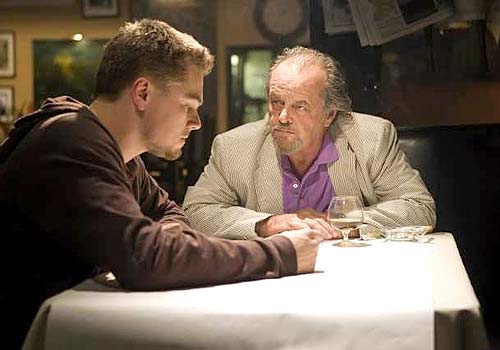
In the case of The Departed, Martin Scorsese not only takes it, he runs with it all the way down the field and past the goal line. Admittedly, I've liked far more Scorsese pictures than I've disliked, including his recent somewhat maligned efforts such as The Aviator and Gangs of New York, but neither compares to The Departed which marks Scorsese's best film since 1993's The Age of Innocence.

It would seem as if Scorsese has retreated to somewhat familiar turf by telling this story of Boston gangsters and the cops out to take them down, but Scorsese infuses the film with such kinetic energy and vitality, that the movie never feels as if it's a retread (unlike 1995's Casino). William Monahan adapted the screenplay from the great 2002 Hong Kong film Infernal Affairs about two undercover agents, one infiltrating the police for the gangster, the other infiltrating the gangster for the police. In the Americanized version, the mobsters are Irish with the police mole played by Leonardo DiCaprio, turning in his strongest performance for Scorsese yet, and the gangster plant played by Matt Damon, who uses his all-American good looks and blue eyes to hide the crook lying beneath. Of course, the greatest difference between Infernal Affairs and The Departed is the beefing up of the role of gangster kingpin, this time called Frank Costello and played with unmitigated glee by Jack Nicholson as a character loosely based on the real-life Irish mobster Whitey Bulger.
Announcing that Nicholson soars in a role such as Costello seems redundant. Yes, there is much scenery devoured, but Nicholson has earned that right long ago and it seems perfectly suited for Costello, with the necessary edge that arises from the long-overdue teaming of Nicholson with Scorsese. This may be the best ensemble Scorsese has ever assembled. In addition to DiCaprio, Damon and Nicholson, there are solid turns by Martin Sheen, Alec Baldwin, Anthony Anderson, Kevin Corrigan and Vera Farmiga as the police shrink who somehow gets herself involved with both moles, even though DiCaprio warns her that there is no one more full of shit than cops other than cops on TV, and Damon, who knows the answer to her question about what Freud said about the Irish: that they are the only group impervious to psychoanalysis.

The British actor Ray Winstone delivers another great turn as Mr. French, Costello's right-hand man, who may well be the most quietly menacing character in a film exploding with quietly menacing characters. His interplay with Nicholson and DiCaprio grounds both actors to a certain extent. What's most amazing about the film is that even if you've seen Infernal Affairs, whose outline it follows fairly closely, some of the twists you should know are coming still pack a punch thanks to Scorsese's taut direction. The Departed at 2½ hours is much longer than the film it's remaking, but you never really feel the padding. It's not news that Scorsese is a great director, but it's been so long since you've seen him produce something where he obviously feels so confident, that a fan leaves the theater practically giddy with excitement for both him and the medium again.
Of all aspects of The Departed that seemed most revelatory to me, it has to be Mark Wahlberg's role as Dignam, one of DiCaprio's police supervisors. Wahlberg truly has grown over the years into a fine actor, starting in films that were better than he was (such as Boogie Nights and Three Kings) until he gave performances better than the films he was in (as in I ♥ Huckabees). With The Departed, Wahlberg finally plays a role at the same quality level as the film he's in. Wahlberg has never been better as the decidedly profane and fast-talking cop here.
Over the past few years, a new Scorsese picture always has produced as much nervousness as anticipation as each film seemed more like a platform to discuss his long-overdue Oscar than a great film itself. I still had that feeling going into The Departed, but it was soon swept away as Scorsese grabs the viewer by the lapel and never lets go, whether it's in a noisy gunbattle with echoes of Peckinpah, a tense scene of silence between parties on opposite ends of a phone call or a foot chase through Boston. Marty, it's great to have you back in the fine form for which we feared may have been lost but which The Departed confirms was merely in remission.
Tweet
Labels: 00s, Alec Baldwin, DiCaprio, M. Sheen, Matt Damon, Nicholson, Peckinpah, Remakes, Scorsese, Wahlberg
TO READ ON, CLICK HERE


