Saturday, December 24, 2011
Less Is More: Minimalism and Vietnam

By David Gaffen
Aristotle's unities were adopted as a rigid form of construction for dramatic arts — theater, and then later film — stipulating that action in a play should take place within one location, with one plot that follows minimal subplots, and within a 24-hour period.
With drama, it is naturally easier to do this than a film, a medium begging to push the envelope of those boundaries, but what's striking about Oliver Stone's Platoon — one of the more deserved winners of the best picture Oscar released 25 years ago today — is that it pretty tightly restricts itself to two of these unities, those of location and of subject. Even if it violates the third, that of time, the swirling, nightmarish reality of war that this takes place in feels like one uninterrupted sequence.
That focused approach does more to reveal the tragedy of America's involvement in the war than other sprawling films that move from location to location, shift from one decade to the next, without maintaining the spotlight on a limited scope. Little events inform big events and, as any good English teacher would tell their students, showing rather than telling straight-out is more effective. By examining the mental development (or deterioration) of the main character, Chris Taylor (Charlie Sheen), more is said than any film that would tell the story with a more bombastic, didactic approach.
That's all the more surprising considering the director, Oliver Stone, who pretty much defines bombast when it comes to Hollywood (OK, there's Michael Bay, but let's stick with serious directors here). Perhaps it's because Stone focuses on what he knows — the journey of a grunt through Vietnam over a period of months — that helps the movie maintain perspective. The societal rot depicted in the lives of these soldiers mirrors the loss of the country's moral decline when it comes to justification for the fight.

Viewers will come to recognize the justification for further bloodshed through the words of several characters, notably Bunny (Kevin Dillon, in his pre-Johnny Drama days), vowing revenge on unnamed Vietnamese who have slain one of the soldiers of their platoon. Such rationale for more destruction was present late in Vietnam and certainly throughout the recent campaigns in Afghanistan and Iraq — that somehow, the loss of life by Americans justified further loss of life by others, that is, the "eye for an eye" approach. High-minded, moral reasoning that accompany such well-intentioned efforts (it's not for no reason that Sheen's character is college-educated, and has enlisted more to do the right thing than for any other reason) eventually breaks down, leaving the baser elements — vengeance, bloodlust, a self-fulfilling circle of violence predicated on giving back punishment. One could say a clear-headed view of war would recognize when too much blood and treasure has been given in service of an effort that is no longer necessary, but America's involvement in Vietnam lasted for several years after the events of this movie, and our troops are finally just leaving Iraq after nearly a decade, still accompanied by the cheerleading from those who would continue to justify more killing in service of an elusive utopia.
Much of what Stone presents in this fashion is understated. The greater political factions that exist behind the war are not presented — the action never leaves Vietnam and specifically follows the one platoon in the months leading to the 1968 Tet offensive, the results of which went a great distance toward changing American opinion about the conflict. There's no attempt to draw a greater lesson from poor decisions among higher leadership, save for the feckless Lt. Wolfe played by Mark Moses (who would go on to play another sad sack as "Duck" Phillips in Mad Men).

The difference between those who believe and those who don't are presented in stark fashion, between the weary, once-motivated Sgt. Elias (Willem Dafoe, in a great, understated turn) and the gung-ho, scarred Sgt. Barnes (Tom Berenger, a performance of such intensity that it overshadows every film he's made since). Elias smokes marijuana to escape the pain of this conflict, and counts a number
 of allies within the platoon as the squad splinters. He's forced to intervene to stop the killing of a young Vietnamese woman, and serves as the conscience of the platoon, the superego to Barnes, all rage and desire. This can be seen as a parable for America, certainly, but if the movie only worked on an allegorical level it would be a failure. Thankfully the rhythm of the action between the characters, and the enveloping fear of dread that surrounds the cast offsets these impulses. If Stone makes one mistake, it's to rely too much on narration that does cross into a more heavy-handed exposition, notably the last lines where Chris says he often feels like a child "born of those two fathers," those being Barnes and Elias. The images are powerful enough without the voiceovers, and indeed it works best, and most powerfully, at those moments — consider the way Elias's expression changes when he realizes Barnes is going to shoot him, or late in the film when Barnes, wounded, picks up a trenching tool to bludgeon anyone he sees, or the crushed look on the face of Sgt. O'Neil (John C. McGinley, a Stone regular) when he's assigned the platoon after Barnes' death.
If this all sounds dreary to the point of being unwatchable, it's not, thanks to a varied, lively group of supporting actors that include Forest Whitaker and Johnny Depp in early roles, engaging performances from Keith David as King and the late Francesco Quinn — son of Anthony Quinn — as Rhah, and the aforementioned Dillon and McGinley. They bring the subject alive in a way Terrence Malick's The Thin Red Line flounders in part because of his decision to cast actors largely devoid of personalities (Nick Nolte, John Cusack and Elias Koteas excepted).
Unfortunately, later in his career Stone stopped trusting the images to tell his story, larding up his films with cinematographic technique that often feels pulled from a Tony Scott film — switching from black-and-white to color, extreme close-ups, blurry imagery — and even more portentous narration. Natural Born Killers is the worst offender in Stone's catalog, but the seeds were there in JFK, which tries to will the viewer through misdirection and fancy editing into believing that everyone from the armed forces to Lyndon Johnson to the Mafia assassinated the president.
That's a disappointment, especially when it seems Stone passes the "Five" test proposed by Steven Hyden over at The AV Club a number of months ago, that sought to judge musical artists by their ability to produce five great records in a row, to have the kind of critical peak that few can achieve. It isn't all that much of a stretch to say Stone gets there, if only barely, with the streak that begins with Salvador, followed by Platoon, Wall Street, Talk Radio and finally, Born on the Fourth of July. They're all at least four-star movies, garnered two directing Oscars for Stone, and three writing nominations. (Interestingly, Berenger and Dafoe both show up in the last of these movies in what can be plausibly can be called alternate realities for the Barnes and Elias characters — Berenger appears in one scene as a square-jawed recruiter, Dafoe in a larger role as a disillusioned, disabled vet.)
The Vietnam film had a steady run in the late 1980s, as this was followed by Stanley Kubrick's acclaimed but uneven Full Metal Jacket, Casualties of War and less successful films such as The Hanoi Hilton and Hamburger Hill. Stone returns to the subject again with Heaven and Earth, another movie that tries to do too much despite strong performances. His feature films largely have failed to ever get back on track (though W. had its moments), but Platoon remains one of the strongest, most affecting movies from the 1980s.
Tweet
Labels: 80s, Berenger, C. Sheen, Dafoe, Depp, Kubrick, Mad Men, Malick, Nolte, Oliver Stone, Oscars
TO READ ON, CLICK HERE


Thursday, December 01, 2011
The dino ate her baby

By Edward Copeland
Most people who know me and my past opinions on director Terrence Malick won't believe me when I say that I started watching The Tree of Life with an open mind. Given the reviews it received — even from non-Malick devotees — and that it seems likely to figure in this
 year's awards, I thought I'd give it a shot. Besides, the fact that I ended up thinking The Tree of Life was profoundly muddled and silly was no more preordained than all the glowing reviews the film received from those who think the man walks on water. Actually, I bet the odds were better that I'd end up liking The Tree of Life than one of his worshippers would have written a pan. As it turns out, neither his apostles nor I ended up shocking anyone, though some of my criticisms of the movie surprised even me. I have my usual problems with The Tree of Life that I do with his other films: no narrative, no characters, pretty but empty. However, I didn't expect to review a Malick film and use the adjective derivative to describe it (and I don't mean derivative of himself). As a sort of unofficial rule, if one of our writers has reviewed a recent release, I tend not to run another one, but for this I make an exception. However, I don't want anyone to misinterpret this as a rebuttal to J.D.'s positive review of The Tree of Life. In fact, when I decided to watch it, I debated whether I would write about it, no matter how I ended up feeling about the film. I decided that if I ended up liking it, that deserved to be noted and if I had my usual reaction to his work, I was going to stay silent. As I watched the movie though and found more things I wanted to shout to the world, I knew I couldn't keep my naysaying to myself.
Before I dive into my own thoughts, I wanted to mention some amusing things I discovered on the Web that I felt were worth mentioning about the film.

Penn who makes a brief appearance in the film playing Brad Pitt's son, told Le Figaro that he is not sure what his character added to the film.
Penn said: "On screen, I didn't see the emotion of the script, which is the most beautiful I've ever read. In my opinion, a more conventional narrative would have made the film better and clearer without affecting its beauty and impact.
"Frankly, I'm still trying to understand what I was there to do and what I was meant to add in that context. Even Terry himself didn't manage to explain it to me clearly."

While cinephiles delight in deciphering the complexities of Terrence Malick’s new film, The Tree of Life, movie theaters across the country are dealing with something else: a steady stream of walkouts.
I counted 12 to 15 people leaving a showing I attended last weekend at the Cobb Jupiter 18 theater. A colleague at another screening counted 17.
At a Connecticut art-house theater, enough people were asking for refunds, which the theater does not permit, that management posted this notice: "We would like to take this opportunity to remind patrons that The Tree of Life is a uniquely visionary and deeply philosophical film from an auteur director. It does not follow a traditional, linear narrative approach to storytelling."
I remember a movie buff pal of mine in the thrall of having seen the movie predicting that it could be an unexpected box office hit and I told him at the time that even if it were really great, a Malick film would never set the box office on fire. (Current figures courtesy Box Office Mojo. Total domestic gross: $13,303,319. Foreign gross: $41 million. Production budget: $32 million. Perhaps not having English as your native language helps.) Granted, I'm not a Malick fan, but I do think it would be a great thing if we lived in a country where the majority of people had more discerning tastes, but unfortunately that isn't the case. Centuries ago, even the English peasants enjoyed Shakespeare as popular entertainment. Today, while many of us still worship the Bard, most think reading him or watching his plays is comparable to having a root canal. Look at the kind of people that get elected time and time again: People in West Virginia and South Carolina sent men over the age of 90 back to the Senate for six-year-terms and, not surprisingly, they died in office. We're not a country of rocket scientists.
Putting that aside, that doesn't excuse Malick for making the malarkey that is The Tree of Life. Now I'm fully prepared for the backlash I'll get and I don't care because one thing people forget — alas, even critics a lot of the time I'm afraid — is that all opinions are subjective. My opinion is as valid as yours. Too many people are insecure about what they believe so when someone posits the opposite, they take it as a personal attack when it isn't. Those who love The Tree of Life aren't wrong but neither are those who puncture its meandering pretentiousness because there isn't a right answer. It's not an equation such as what 2+2 equals. If only one point of view on a movie or a novel or a work of theater were valid and all others were bunk, that would delegitimize criticism in general.
I'm guilty of wanting to gird myself with backers of my point-of-view, but I decided not to list other critics who went against the wave on The Tree of Life with the exception of one, whose lead I enjoyed so much (and who actually identified himself as someone who had liked Malick's previous films). So, only Michael Atkinson at Sight & Sound gets a review excerpt:
As you may well have already deduced, Terrence Malick’s new hyper-reverie is an entirely unique launch into the present-moment film-culture ether — an ambitious Rorschach blot that is almost exactly as pretentious and unwittingly absurd as it is inspired, evocative and gorgeous. It often seems to have been deliberately calibrated to divide its viewership into warring camps, to intoxicate the Malickians into awestruck swoons just as it produces scoffings from the skeptics and stupefies the average filmgoer. But that presumes Malick considers a viewership at all — which he may not, and if there are many, many ways to look at The Tree of Life, which seems already to be a film that’s more interesting to argue about than to actually watch, then it’s difficult to shake the sense of it as the spectacle of a man gone deep-sea diving in his own navel.
Atkinson later adds, "I, just so we’re clear, have not been a Malick skeptic until now; his 1970s double-hitter ages beautifully, and The Thin Red Line (1998) is an epochal explosion of broken hearts, adrenal fever and genre-movie subversions. The New World (2005), for all its historical pathmarks, played like a sweet chapter elided from the previous film, with much of the same visual and tonal vocabulary." So I guess there were some admirers who felt that The Tree of Life was too much. Though as he gets deeper into the faults he finds within The Tree of Life, Atkinson asks two questions that I, myself found hilarious and wondered what the answer would be. "Does Malick think the universe shines out of his ass? Do you?" he asks.
I think my prologue has gone on long enough, now it's time for me to unload. One of the things that grated on my nerves in Days of Heaven and, most especially, in The Thin Red Line were the pseudo-philosophical voiceover narrations by characters with really bad attempts at backwoods Southern accents. One mark in the favor of The Tree of Life is that the inevitable voiceovers haven't been required to sound like untalented junior high school students trying to put on a production of Greater Tuna. Unfortunately, for the first 40 minutes or so of the movie, all dialogue, be it voiceover or between characters, is conducted in such a whispery tone that's
 overpowered by music and sound effects that you can barely hear what Jessica Chastain as Mrs. O'Brien, Brad Pitt's character's wife and mother of the three boys, is even saying. It may have been a blessing that I couldn't see it until DVD because then I could hit the subtitles to figure out what the hell was being said. As expected, it was the usual Malick attempt at being poetic, discussing the paths you choose in life. Thanks to having to use the subtitles, I can quote Mrs. O'Brien verbatim. "The nuns taught us there were two ways through life — the way of nature and the way of grace. You have to choose which one you'll follow. Grace doesn't try to please itself. Accepts being slighted, forgotten, disliked. Accepts insults and injuries. Nature only wants to please itself. Get others to please it too. Likes to lord it over them. To have its own way. It finds reasons to be unhappy when all the world is shining around it. And love is smiling through all things," Mrs. O'Brien says in a whispered voiceover, perhaps addressing us, perhaps addressing her sons. One thing is certain: I found it a surprising point-of-view from Malick who never met a leaf or a tree he didn't like, but if you delve into what she's saying — basically choosing a life of grace over nature "which only wants to please itself," this may be Malick's way of confessing to compulsive masturbation because Lord knows that's what his films play like and The Tree of Life may be the ultimate culmination of that habit. Call it autoerotic moviemmaking without a plastic bag over his head or noose around his neck (as far as we know).
During this opening section where you can't make out most of what anyone is saying, the O'Briens receive word that one of their sons has died (I honestly can't tell you which one other than it's not the one who grows up to be Sean Penn and it doesn't happen until that son is 19-years-old, not that Pitt or Chastain show any evidence of aging. The DVD labels this chapter "Grief." I will not go to the trouble of naming the infinite number of films that have had better depictions of grieving, mainly because it's one of the few moments of The Tree of Life that didn't look to me as if it was ripping off another (and usually better) movie. That front section though does, in its own odd way, set up the battle for young Jack's soul between Jessica Chastain's mother who is all that is good (she literally levitates around a tree in the yard in one scene without any explanation and ends up dying and placed in a Sleeping Beauty-like glass coffin in the woods; when she gives birth to one of the boys, it's done in a strange room completely draped in white). In contrast, Pitt's Mr. O'Brien, who gets fleshed out more in the film's second half, seems as if he was spawned by a lab experiment that united the genes of Robert De Niro's Dwight Hansen from This Boy's Life and Jack Nicholson's Robert Dupea in Five Easy Pieces. In its 1950s suburban Malick-like way (at one point Mr. O'Brien actually accuses his wife of trying to turn his sons against him), it almost sets the two up as if Chastain's Mrs. O'Brien is Willem DaFoe's Sgt. Elias and Pitt's Mr. O'Brien is Tom Berenger's Sgt. Barnes from Oliver Stone's Platoon, fighting over three young boys instead of Charlie Sheen. Before we can really dive into Mr. Brien's abusive "I wish I'd been a pianist" character more deeply, we interrupt this sketchiness for the creation of the world.
Throughout The Tree of Life, the film will fade to black and something resembling a large pilot light will appear in the middle of the screen, usually accompanied by voiceover, then back to another scene, either of the kids, or Mrs. O'Brien, or maybe the older Jack walking aimlessly in structures of glass and concrete supposedly looking contemplative. At one point, we do get Mrs. O'Brien swinging on a swing which, if I recall correctly, one of the wives or girlfriends back at home during World War II in The Thin Red Line did as well. I wonder if it's the same swring. Anyway, about 30 minutes into the movie, the flame doesn't go to a "normal" scene but to a more than
 15-minute sequence of exploding volcanoes with lots of magma, rushing water and all sorts of imagery evoking the creation of the universe. Eventually, we witness the development of the first sea creatures, which actually are better defined as characters than the human ones have been up to that point. We get to the infamous moment with the dinosaurs (which, much to my disappointment did not speak in voiceover) as one skips over to another lying by a creek and proceeds to step on its head, crushing it until it is dead. What a revelation! Is this the first murder? Dinosaurs predated man, but if man evolved from apes then apes predated man and they used a bone as a weapon to kill another ape for the first murder 43 years ago in Kubrick's 2001. The Tree of Life even tosses in a shot of the planet Jupiter for some reason and in the book and movie sequel, 2010, Jupiter answered the questions from 2001 no one really needed answered as the planet served as the beginning of a second sun for Earth. Then again, The Tree of Life's ending includes many shots of the sun, maybe Malick is endorsing Arthur C. Clarke's tale as science fact. On the other hand, perhaps he's a Star Wars nut and it's an homage to Tatooine. Now, I'm far from the first (nor will I be the last) to note similarities to 2001: A Space Odyssey, especially with Douglas Trumbull coming out of retirement to help Malick with special effects, but The Tree of Life is no 2001 — and I'm not even that film's biggest fan — but there's more character development in HAL 9000 than any of the stick figures of Malick's film.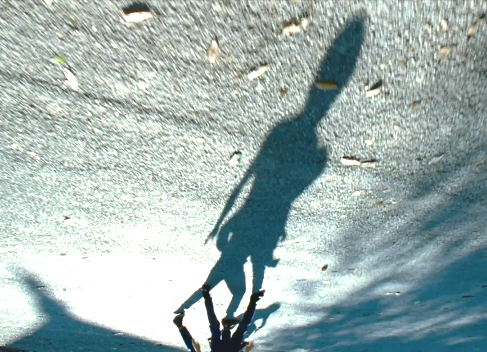
Even pieces on Malick I've read by people who love him and The Tree of Life acknowledge that with each new film, he seems to be less interested not only in conventional narrative structure but dialogue as well. I have no problem with playing around with structure — many of the greatest films of all time have done that, but it takes some special skills to pull off films that eschew dialogue and characterization, that embrace style at the expense of substance. Now, Malick defenders will argue that The Tree of Life actually overflows with substantive ideas, but does it or does Malick just toss some images on the screen and let the viewer do all the work, conjuring substance that may or may not be there. For me, the most telling shot of the entire film occurs early when Malick films the boys playing outside and their shadows on the sidewalk seem to resemble aliens. That seems wholly appropriate because watching Malick films, they don't seem to be made by someone who has any connection to humanity anymore. The one line of dialogue in the film that actually stood out to me is when Mr. O'Brien tells his son, "Toscanini recorded a piece 65 times. When he was done, he said, 'It could have been better.' Think about it." Perhaps that explains how Malick ended up with about a dozen different versions of The New World.
Now, I know I'm treading on dangerous ground with what I'm about to write, so I ask my friends who admire Malick and/or The Tree of Life not to take this part personally, but it's something that struck me as strange before I saw it. Now that I have seen the film, it makes me feel that it's an even odder side effect. The film's fans discuss it in terms of its spirituality and how it raises "the big questions."
 Friends, who in everyday life would willingly categorize themselves as atheists, agnostics or general nonbelievers or would even go so far as to mock those who do profess religious faith, suddenly ask, "What is God's plan for us?" "Why are we here?" and other similar existential questions inspired from the viewing the film. Malick certainly isn't playing the role of evangelist here and the next day, they'll be back to their normal selves, but it's so out of character. Even in an actual great film such as The Rapture which raises these issues, the conversation doesn't change the films' admirers' ways of thinking. (Coincidence or not, when Penn's adult Jack wanders toward the end, the barren landscape resembles both the desert that Mimi Rogers' character Sharon in The Rapture takes her daughter to as she awaits the endtimes and the purgatory she's left in because she refuses to give in to God. (There's a more compelling idea in the last half of that sentence describing The Rapture than in the entire 2 hours and 18 minutes of The Tree of Life.) In some cases, I think it stems from people so devoted to Malick that they'd never dare criticize, in others, they defy reason. As for being unable to criticize favorite directors of yours, I always remember what Roger Ebert says Robert Altman told him once. "If you never gave me a bad review, how could I believe the good ones?" Even masters such as Wilder and Hitchcock don't have perfect records.
In the end, what really struck me about The Tree of Life wasn't all the elements it had that annoyed me in previous Malick films but the amount of images and situations in a film hailed as such a unique and original vision that looked as if they were lifted from other films. When Penn wanders in that desert, it differs from The Rapture in that he finds a door and the thought that crossed my mind was Beetlejuice — not that I expected him to face off against giant worm creatures. I think it was my subconscious thinking of films I'd rather be watching and, honestly, had just as many profound things to say about the life cycle as Malick's film does. Then all the family members at their various ages reunite in the barren land to come to grace. Jack and his dad set aside their rocky relationship (and I awaited Jack to say to his dad with a crack in his voice, "Want to have a catch?"). Even though the living and the dead hadn't reassembled in a church, it also reminded me of the idyllic ending of Places in the Heart.
More than the many films that The Tree of Life reminded me of is the master filmmaker who kept invading my thoughts. If it's true that the O'Brien family represents a pseudo-autobiographical look at Malick's own family life and their story came out as this muddle, think of how many distinct and masterful films (not always directed by him) Ingmar Bergman wrote about his family's life. Aside from that, Bergman also made some of the greatest films of all time that tackled all the issues Malick supposedly flirts with in The Tree of Life — memory, dying, death, loss, faith, etc. — and he made them all with finesse, skill and daring — he even toyed with linear structure to represent memory. Sure, Bergman never thought about including dinosaurs, but he did let a knight play chess with death and I'd rather re-watch The Seventh Seal another hundred times before even considering dipping my toes into Malick's murky waters again.
Tweet
Labels: 10s, Altman, Berenger, Brad Pitt, C. Sheen, Dafoe, De Niro, Ebert, Hitchcock, Ingmar Bergman, Kubrick, Malick, Nicholson, Oliver Stone, Sean Penn, Shakespeare, Star Wars, Wilder
TO READ ON, CLICK HERE
Monday, July 26, 2010
Remembering James Gammon in Major League

By David Gaffen
For avid moviegoers one of the pleasures of the film-viewing experience is the chance to see recognizable faces again and again — character actors who are so instantly familiar that they bring a knowing smile upon their first appearance on the screen. Sometimes these people turn, however slowly, into the kind of name that ends up third- or fourth-billed in a movie, like Steve Buscemi or Sam Elliott, or into a strange sort of star such as Philip Seymour Hoffman.
More often than not, though, they appear in what seems to be every movie made, like M. Emmet Walsh. We lost one of those character actors recently, a gem of a movie presence, James Gammon, a longtime theater performer who was best known for his portrayal of Cleveland Indians manager Lou Brown in Major League.
Gammon had a bushy mustache and one of the most recognizable voices in the business, a raspy, gravelly croak perfectly suited for cowboys and weary authority figures. He shows up in Urban Cowboy and had a memorable bit in Silverado as a gunman incredulous that Scott Glenn’s character has brought a posse to one of his best hideouts.
Major League was released in 1989 and exists in the public consciousness as a sister to Bull Durham, which hit theaters a year earlier, because they share a subject matter (baseball) and they’re both comedies.
The reality is that Major League isn’t half the movie Bull Durham is, and without Gammon, it would be more or less unwatchable.
Looking back, with the exception of Bob Uecker’s moments as the team announcer, just about every amusing part of the movie involves Gammon in one way or another. He dismisses Wesley Snipes’ Willie “Mays” Hayes, who says, "I hit like Mays but I run like Mays," after he bats a pop-up with this terse summation: “You may run like Hayes, but you hit like shit.”
His early reaction to Dennis Haysbert’s breaking-ball challenged Pedro Cerrano is another great throwaway moment. Cerrano is crushing the ball during batting practice, and Gammon muses, “This guy hits a ton. How come nobody picked him up?” Cerrano then whiffs, badly, at a breaking ball, and Gammon, deflated, groans, “Ohhhhh.”
Frequent moviegoers are demanding of actors, generally not wanting to see big-name guys assume the same persona throughout each movie, which may be part of the reason certain stars seem to dim after they’ve been seen mining familiar ground. (Samuel L. Jackson’s shtick, for one, is really tired these days.)
Character actors get a good bit of latitude in this way, perhaps because their part in a production is limited, and so a familiar personality livens up the screen for a brief period of time before they fade into the background. Think of Dylan Baker in a blink-and-you’ll-miss-it moment of glee in the underrated Changing Lanes, or Bill Nighy’s venomous pharma exec in The Constant Gardener.
Gammon will forever be one of those. He had a couple of good meaty roles in later years, playing another cowboy in Traveller, a little-seen, but interesting character study with Bill Paxton and Mark Wahlberg, and one of the only roles really worth a darn in the overwrought Cold Mountain.
But it will be Lou Brown for which Gammon is most remembered for movie fans. It’s fitting that the sequel, Major League II, was vastly less successful than the original. (The original grossed nearly $50 million; five years later, the sequel only made $30 million.)
On some level, that had to be for the disastrous decision by the writers to sideline the character with a heart attack, only to give more screen time to the sleep-inducing character played by Tom Berenger. Lou Brown, given the chance to look at the script, would have reacted to that in the same fashion he did when confronted with an annoying provision in Roger Dorn’s (Corbin Bernsen) contract — threw it on the ground and pissed all over it.
Tweet
Labels: Berenger, Buscemi, P.S. Hoffman, Samuel L. Jackson
TO READ ON, CLICK HERE
Tuesday, July 20, 2010
A blockbuster with an arthouse sensibility

By J.D.
Ten years in the making, Inception (2010) is the culmination of Christopher Nolan’s career to date. It mixes the ingenious plot twists of his independent film darling Memento (2000) with the epic scale of his Hollywood blockbuster The Dark Knight (2008). His new film takes the heist genre to the next level by fusing it with science fiction as a group of corporate raiders steal ideas by entering their dreams — think Dreamscape (1985) meets The Matrix (1999) as if made by Michael Mann. While Nolan and his films certainly wear their respective influences on their sleeve — and this one is no different (2001: A Space Odyssey, Heat, etc.) — there is still enough of his own thematic preoccupations to make Inception distinctly his own. This film continues his fascination with the blurring of artifice with reality. With Inception, we are constantly questioning what is real.
Dom Cobb (Leonardo DiCaprio) and his team extract thoughts of value from people as they dream. However, during his jobs, Cobb is visited by deceased wife Mal (Marion Cotillard), a beautiful femme fatale character that serves as an increasingly dangerous distraction from the task at hand. The film’s opening sequence does an excellent job establishing how Cobb and his team extract information from the dream of Saito (Ken Watanabe), a Japanese businessman, in a visually arresting sequence. He catches up with Cobb in the real world and offers him a new deal: plant an idea Robert Fischer’s (Cillian Murphy) mind that will help break-up his father’s vast empire before it becomes too powerful and do it in a way so that it seems like Fischer thought of it for it to work. This is something that has never been done before. In exchange, he’ll make it so that Cobb can return home to the United States where his children live but where he is also wanted by the authorities. So, Cobb recruits a literal dream team of experts to help him pull off the most challenging job of his career.
Inception delves into all kinds of aspects of dreams as evident in a scene early on where Cobb explains how they work, how to design and then navigate them. This is arguably the most cerebral parts of the film as Nolan explores all sorts of intriguing concepts and sets up the rules for what we’ll experience later on — pretty heady stuff for a Hollywood blockbuster. And when he isn’t examining fascinating ideas, he’s orchestrating exciting and intense action sequences. There’s an incredible sequence where Nolan juggles three different action sequences operating on three different levels of dreams that are impressive staged while also a marvel of cross-cutting editing. He anchors Inception with Cobb and his desire to return home to children while also dealing with the death of his wife. It gives the film an emotional weight so that we care about what happens to him. It also raises the stakes on the Fischer job.
Dom Cobb continues Nolan’s interest in tortured protagonists. With Memento, Leonard Shelby tried to figure out who murdered his wife while operating with no short-term memory. Insomnia (2002) featured a cop with a checkered past trying to solve a murder on very little sleep. The Batman films focus on a costumed vigilante that wages war on criminals as a way of dealing with the guilt of witnessing his parents being murdered when he was a child. With The Prestige (2006), magician Robert Angier is tormented by the death of his wife and an all-consuming passion to outdo a rival illusionist. Inception’s Cobb also has a checkered past and is haunted by the death of loved one.

Leonardo DiCaprio delivers what may be his finest performance to date, playing a complex, layered character with a rich emotional life. Cobb must come to terms with what happened to his wife and his culpability in what happened to her. DiCaprio conveys an emotional range that he has not tapped into to this degree before. There’s a captivating tragic dimension to Cobb that DiCaprio does an excellent job of expressing so that we become invested in the dramatic arc of his character.
Nolan populates Inception with a stellar cast to support DiCaprio. The indie film world is represented by the likes of Joseph Gordon-Levitt and Tom Hardy while also drawing from international cinema with Ken Watanabe and Cillian Murphy. And it wouldn’t be a Nolan film without his good luck charm, Michael Caine, making an appearance. As he has done in the past, Nolan plucks a once dominant actor from the 1980s, now languishing in relative obscurity — think Rutger Hauer in Batman Begins (2005) or Eric Roberts in The Dark Knight — and gives them a high-profile role. Inception gives Tom Berenger well-deserved mainstream exposure, reminding everyone what a good actor he can be with the right material.
Regardless whether you like Inception or not, you’ve got to admire Nolan for making a film that is not a remake, a reboot, a sequel or an adaptation of an existing work. It is an ideal blend of art house sensibilities, with its weighty themes, and commercial conventions, like exciting action sequences. Capitalizing on the massive success of The Dark Knight, Nolan has wisely used his clout to push through his most personal and ambitious film to date. With Inception, he has created a world on a scale that he’s never attempted before and been able to realize some truly astonishing visuals, like gravity-defying fight scenes and having characters encounter a location straight out of the mind of M.C. Escher. It has been said that the power of cinema is the ability to transport you to another world and to dream with our eyes open. Inception does this. Nolan has created a cinematic anomaly: a summer blockbuster film with a brain.
Tweet
Labels: 10s, Berenger, Caine, Christopher Nolan, Cotillard, DiCaprio, Gordon-Levitt, Michael Mann
TO READ ON, CLICK HERE


