Monday, May 20, 2013
Prison of My Dreams

By Edward Copeland
As I snap the cuffs on Will Smith's wrists, I try to look stern and sympathetic simultaneously. "I take no pleasure in having to do this, Mr. Smith, but it's for your own good as well as the good of the public. Hopefully, your stay will be a short one." I'm taking Smith to serve his sentence in the Copeland Penitentiary for Bad Film Ideas. The actor received a summary conviction with the recent announcement of his interest of remaking Sam Peckinpah's classic Western The Wild Bunch. We had no choice. Trying to do a new version of such a revered film would be bad enough, but when you read the details that explain it would be a modern version involving the DEA and drug cartels, it sounds as if it's only stealing the title. We couldn't risk this debacle-in-development from getting to pre-production. Smith needed to be jailed until he regained his senses.
Now, if Smith breaks quickly, his sentence should be short since this idea didn't originate with him. Warner Bros. has toyed with the idea of a remake for more than a decade with various names such as the late director Tony Scott and stars such as Tom Cruise mentioned. If it were possible to put an entire studio into permanent solitary confinement, I would do it. Johnny Depp, pictured above being taken the prison to serve his time, had a longer time behind bars when he announced his intention to make a new version of The Thin Man and to take on William Powell's trademark role of Nick Charles. Thankfully, that talk disappeared once we locked up Depp for awhile and he hasn't mentioned it since. It's great that Depp loves The Thin Man — but the original remains and people should watch it. (If only the prison existed before Gus Van Sant got his cuckoo idea of doing a shot-by-shot remake of Hitchcock's Psycho in color.)
Look at the case of something that happened before the Copeland Penitentiary opened when Russell Brand remade Arthur with Brand in the Dudley Moore role and Helen Mirren taking over for John Gielgud. It sounded like a bad idea on paper, looked more horrendous when commercials and trailers appeared and received mostly bad reviews. (I did enjoy that the original in 1981 grossed more than the remake's budget which flopped badly.) What disturbed me was that the original Arthur never received a DVD release in the proper ratio and when the remake came out, they released a Blu-ray that forced you to get it with its awful sequel Arthur 2: On the Rocks.
Therein lies the dangers of remakes of great films. With technology constantly changing and money always an issue, at some point they'll start leaving us with the fresher versions, assuming that younger audiences won't know or care to see the classics. I'd try to talk them into how much money they'd save if they just re-released older films to theaters without having to spend all that money on new movies, but they won't go for it. Besides, making movies cost WAY too much to make and see today and the best stuff gets made on television anyway.
Tweet
Labels: 10s, Cruise, Depp, Gielgud, Hitchcock, Mirren, Peckinpah, Remakes, T. Scott, Television, Van Sant, W. Smith, William Powell
TO READ ON, CLICK HERE


Thursday, May 16, 2013
Leave the rooster story alone. That's human interest.
BLOGGER'S NOTE: This post originally appeared Jan. 18, 2010. I'm re-posting it as part of The Howard Hawks Blogathon occurring through May 31 at Seetimaar — Diary of a Movie Lover

By Edward Copeland
The list of remakes that exceed the original is a short one, especially when the original was a good one, but there never has been a better remake than Howard Hawks' His Girl Friday, which took the brilliance of The Front Page and turned it to genius by making its high-energy farce of an editor determined by hook or by crook to hang on to his star reporter by turning the roles of the two men into ex-spouses. Icing this delicious cake, which marks its 70th anniversary today, comes from casting Cary Grant and Rosalind Russell as the leads.
Words open His Girl Friday declaring that it takes place in the dark ages of journalism when getting that story justified anything short of murder, but insists that it bears no resemblance to the press of its day, 1940 in this case. What saddens me today is, despite the ethical lapses and underhandedness and downright lies
 committed by the reporters in this version (and really all versions based on the original play The Front Page by Ben Hecht and Charles MacArthur, themselves once Chicago journalists), their energetic devotion to capturing the story seems downright heroic compared to the herd mentality and lack of intellectual curiosity we see exhibited most of the time today by pack journalists such as the White House press corps. It's really why the first two film versions of the play are the only ones that work. The 1931 Lewis Milestone adaptation starring Adolphe Menjou definitely belonged to its time and Hawks' take with its inspired twist came along close enough to remain relevant. When Billy Wilder tried to remake the original in 1974 as a period piece with Jack Lemmon and Walter Matthau, it fell flat because in the era of Vietnam and Watergate, journalists actually existed in a moment of heroism for their profession. The 1988 disaster Switching Channels returned to the His Girl Friday model with Burt Reynolds and Kathleen Turner and tried to set it in the world of cable news but the only update they came up with was hiding the fugitive in a copy machine instead of a rolltop desk.
Each time I write one of these anniversary tributes, no matter how many times I've seen the film in question (and I can't count that high when we're discussing Friday, I try to watch the movie again, in a quest for fresh thoughts and reminders of lines that may have slipped my mind. In nearly every, case I notice something new (and with the rapid-fire pace of Friday's dialogue, remembering them all borders on impossible). What stood out as I
 started this salute wasn't just the work-a-day newshounds it depicts compared to the state of the industry today but the social subtext emerged more prominently this time. It's not that I've missed or ignored it before, but it's the light-speed comic hijinks that keeps me coming back. The story's main focus may concern Walter Burns (Grant), that sneaky editor of the Morning Post, trying to keep his ex-wife Hildy Johnson (Russell) from leaving the paper and his life to wed insurance agent Bruce Baldwin, who looks like that fellow in the movies, you know, Ralph Bellamy (who fortunately plays Bruce). However, the story Walter uses to keep his hooks into Hildy concerns that of Earl Williams (John Qualen), a man who killed a cop and received a ticket on a bullet train to the gallows by a politically hungry Republican mayor with an eye on unseating the Democratic, anti-death penalty governor, despite the fact the reporters and many others believe Earl's mental
 illness should stop his hanging. Qualen, a solid character actor in many films, and Mollie Malloy (Helen Mack), a woman who befriended Earl prior to the slaying and who the tabloids misrepresent as his lover and a prostitute, stand apart as the only characters in this screwball farce who play it completely straight. (In an all-time bit of miscasting, in the Wilder remake, Carol Burnett got the Mollie Malloy role. Of course, the nearly 50-year-old Jack Lemmon also was engaged to the 28-year-old Susan Sarandon in that film.) His Girl Friday requires neither Qualen nor Mack to garner laughs like every other character. As the courthouse reporters behave particularly cruelly to Mollie at one point, only Hildy comforts her. "They ain't human," Mollie cries. "I know," Hildy sympathizes. "They're newspapermen." Hildy realizes the jobless Earl spent too much time listening to socialist speeches in the park and his fascination with the concept of "production for use" led to his fatal error.
Social message aside, it's the earth-shattering cosmic comic chemistry of Grant and Russell, aided by Bellamy's perfect innocent foil and countless supporting vets. (One of them, Billy Gilbert, plays Mr. Pettibone (Roz holds his tie in the photo above) and I wish I could have found a good closeup photo of him because I think it's hysterical how much 9/11 mastermind/terrorist asshole Khalid Sheikh Mohammed resembles Gilbert in KSM's arrest mugshot.) The lines come fast and furious. While many do come from the original Hecht-MacArthur play, Hawks gets the credit for the film's amazing speed (though screenwriter Charles Lederer deserves more kudos). Still, in the end, Cary and Roz make the dialogue sizzle and Grant's physical touches serve as a master class in comic movement on film. Watch every little bounce he makes as Hildy kicks him beneath the table when he's trying to get things past poor Bruce and you'll crack up every time. Originally, I was writing down all my favorite lines, planning to try to work them all into this tribute, but then I thought: Maybe not everyone has seen His Girl Friday, even after 70 years,
_04.jpg)
Tweet
Labels: 40s, Bellamy, Burt Reynolds, Cary, Hawks, Hecht, K. Turner, Lemmon, Matthau, Menjou, Milestone, Movie Tributes, Remakes, Roz Russell, Susan Sarandon, Wilder
TO READ ON, CLICK HERE
Saturday, March 17, 2012
Round is funny
This post originally ran as part of The Slapstick Blog-a-Thon held at Film of the Year in September 2007. I've revised the piece slightly to mark the 25th anniversary of the release of the Coen brothers' second feature on March 13, 1987.

They say he's a decent man, so maybe his advisers are confused." — H.I. McDunnough
By Edward Copeland
The frenetic slapstick nature of Raising Arizona doesn't kick in immediately. As it begins, the movie restricts most of its wackiness to wordplay. The first (and I still think the best) instance of the Coen brothers milking laughs by creating dimwitted characters that spout purple prose in thickly painted-on accents, churning out phrases that people such as these never would utter if they existed in the real world. The Coens would recycle that formula many times in films such as Fargo, O Brother, Where Art Thou? and the ill-advised remake of The Ealing Studios classic The Ladykillers, having Tom Hanks assume Alec Guinness' memorable turn by impersonating Colonel Sanders. However, the Coens never would go that route with as much hilarious and charming success as they did in Raising Arizona, which holds up strongly 25 years later.

What impressed me first when I saw Raising Arizona a quarter-century ago was its opening prologue, which lasts a full 11 minutes before the title even appears. It's an amazingly efficient 11 minutes as well, setting up nearly all the main characters and situations. We meet habitual convenience store robber H.I. McDunnough (Nicolas Cage), whose parole board he frequently visits (and which frequently frees him) warns that he's only hurting himself with this "rambunctious behavior." We also meet his prison friends Gale and Evelle Snoats (John Goodman, William Forsythe). Most importantly, we meet the police officer who takes H.I.'s mugshot and prints each time he returns to prison. The
 officer goes by the name Ed, short for Edwina (Holly Hunter). We get to see the attraction grow between her and H.I., especially after Ed's fiancé dumps her and, during one of his releases, H.I. finally works up the courage to ask Ed to be his bride, even though he'd previously said, referring to his chosen profession of armed robbery, that "sometimes your career comes before family." Unfortunately, family doesn't seem to be in the offing for the McDunnoughs as they learn from doctors that Ed's "insides were a rocky place where my seed could find no purchase." That bit of narration from H.I. perfectly illustrates what I mean about the contrast between the characters' character and their speech. In Raising Arizona, the Coens excel at crafting this type of incongruous dialogue. The brothers followed up with two completely different films — Miller's Crossing and Barton Fink. After that, they tended to keep returning to a formula of dumb characters speaking flowery language in plots usually involving kidnapping and/or murder.
All that comes later. Today, we're praising when it worked in what was just their second feature. At the same time that the childless McDunnoughs are beginning married life, furniture kingpin Nathan Arizona (the late Trey Wilson) and his wife, thanks to fertility drugs, end up having quintuplets which prompts Nathan to remark is
 "more than they can handle." It gives Ed the idea that perhaps it would be OK if she and H.I. just took one of the five off the Arizonas' hands so she and H.I. would have a little one to raise as their own while they eased the Arizonas' burden at the same time. That's where the madness truly begins. What's remarkable about the Coens' work in Raising Arizona is that it's not just pure slapstick, but a brilliant blending of slapstick and suspense, beginning with the first outright slapstick sequence as H.I. climbs through the window of the Arizona household to try to snatch one of the infants, setting off a tense comic scene of toddlers gone wild. Set to Carter Burwell's musical score, which has more than a passing resemblance in this scene to John Williams' theme from Jaws, the babies roam, one perilously approaching the steps leading downstairs. You can't decide whether to laugh uproariously or in fright. Once the stolen baby rests comfortably in the McDunnoughs' trailer, things get really complicated.
 H.I.'s prison buddies Gale and Evelle literally burst through the mud outside the prison and escape, or as Evelle puts it, they released themselves "on their own recognizance." After briefly cleaning themselves up in a gas station rest room (Dr. Strangelove fans, check the
 acronym that's been spray-painted on the bathroom stall's door), the brothers arrive at H.I.'s trailer, looking for a place to stay and insisting to Ed that they "don't always smell this way." The police officer in Ed doesn't like fugitives in her family's home,
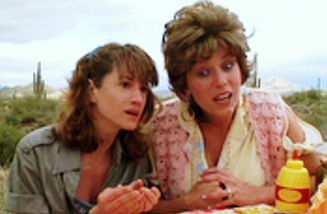 even though she herself is a felon now, albeit a good-intentioned one. Another complication arises with a visit from H.I.'s boss at work, Glen (Sam McMurray), his wife Dot (Frances McDormand) and their seemingly endless stream of diabolical children. "Mind you don't cut yourself, Mordecai" and "Take that diaper off your head and put it back on your sister" are just two of the many things Glen yells as his brood goes wild. While Dot rapidly lectures Ed on the need for insurance, avoiding orthodontic work and making sure the baby stays up to date on his "dip-tet boosters," Glen confides to H.I. that Dot wants another one, because these have grown too big to cuddle, but something has gone wrong with his semen. H.I. tries to lie about how he and Ed got to "adopt" a child so fast, but more trouble arises when Glen suggests to H.I. that they swap wives because he and Dot like to swing. H.I. punches Glen, who takes off like a madman and runs smack into a tree. Glen flees H.I., telling him not to bother coming into work anymore and promising to sue.
From that moment on, Raising Arizona essentially becomes an extended free-for-all chase. Since H.I. figures that Glen will make good on his word and fire him, he finds himself passing by convenience stores again "that weren't on the way home." Ed puts her foot down and wants Gale and Evelle gone. "I'd rather light a candle than curse your darkness," Gale tells H.I., while trying to convince him to help with a bank robbery. H.I. declines, but with Ed and the baby in the car, he does proceed to rob a convenience store for money and Huggies, setting off a loopy, more than five-minute long pursuit sequence. A pissed off Ed drives off with the baby, leaving H.I. to escape on foot. The Coens' hyperkinetic camera doesn't stop for a second as it rolls through groceries, streets and houses while clerks and dogs join the H.I. hunt.

Of course, the deadliest pursuit has yet to occur. H.I. already has had visions of a strange biker who takes no mercy on anyone or anything, and the vision turns out to be Leonard Smalls (Randall "Tex" Cobb), a self-described tracker, "some say hound dog." He meets with Nathan Arizona and offers to find his boy, but for a higher price than the reward the furniture magnate has offered. Arizona refuses, but Smalls insists he'll find the baby anyway and take whatever price "the market will bear." Back at the trailer, the chaos escalates as Glen figures out where H.I. and Ed got the baby and demands they turn the tot over to him and Dot. Before H.I. can even contemplate what to do, Gale and Evelle, who
 overheard the conversation, decide to steal the infant for themselves. Gale and H.I. tear the trailer apart in a residence-wrecking fight that takes place while Evelle shields Nathan Jr. The fugitives prevail and take off with Nathan Jr. with plans to hold him for ransom (and use him as a third man on the bank holdup). When Ed returns home to find H.I. tied up, she frees him and the couple leave to rescue the child, though Ed makes it clear that they aren't good for each other and should split once the baby is safe. The raucous slapstick melees run nearly nonstop after that as the convicts grow too fond of Nathan Jr. to part with him and Smalls arrives to whisk the baby away for his own nefarious purposes, leading to a final showdown with H.I. and Ed. Despite the frenzied pace and over-the-top nonsense, Raising Arizona even manages to conjure some warmth as the film winds down, though perhaps what touched me the most re-watching the film this time is remembering how much I loved the Coen brothers back then, until I felt their career went off the rails beginning with The Hudsucker Proxy. At least their upcoming film, No Country for Old Men, shows some promise as the vehicle marking their return to filmmaking I love instead of just doing variations on the same gags and gimmicks that I still love in their first four films, but has grown old by now.
From top to bottom, all the actors hit exactly the right notes for the movie. Forsythe and Goodman make for a hysterical pair of not-so-swift criminals. Cobb displays just the right amount of menace to remain a cartoon without pushing the film off its comic tone and into a terror mode. The late Parker gets some great material as Nathan Arizona as well as when he yells at the multitude of cops loitering at his house. "Dammit, are you boys gonna chase down your leads or are you gonna sit drinkin' coffee in the one house in the state where I know my boy ain't at?" Even the small roles of bank customers and store owners get priceless moments, especially Charles "Lew" Smith who plays the store owner who utters the response that gives this post its title when Evelle asks a question about some balloons. Cage still was in the early years of his career and Arizona marked the middle film of a three-film run of great Cage performances that started the year before with Peggy Sue Got Married and would concluded later in 1987 with Moonstruck. The breakout actor though was undoubtedly Holly Hunter as Ed. Hunter had appeared in a handful of films and TV movies, but Raising Arizona gave Hunter her biggest exposure so far, but it was just an appetizer for the gourmet meal Hunter would serve fans of great movies and acting in December 1987: Broadcast News.
UPDATE March 17, 2012: As we now know, my hopes for No Country for Old Men ended up being more than fulfilled. That same year, the brothers wrote and directed "Tuileries," one of the best shorts in the great compilation film, Paris, je t'aime . The Coens took a minor step backward with the so-so Burn After Reading that came next. However, the next movie they made ranked as one of their all-time greatest. A Serious Man also introduced me to the great actor Michael Stuhlbarg, who had mostly toiled upon the stage but would go on to impress me in a completely different type of role than his Larry Gopnik in A Serious Man when he became 1920s gangster Arnold Rothstein on HBO's Boardwalk Empire. Most recently, the Coens accomplished that rare feat of remaking a film and producing a greater version. Granted, the original True Grit wasn't a masterpiece, but it did contain John Wayne's Oscar-winning role as Rooster Cogburn which Jeff Bridges took on, easily besting the Duke. What really made the Coens' True Grit exceed the 1969 film version was young Hailee Steinfeld playing Mattie Ross. Yes, the Coens I loved early in their career have matured and returned better than ever. It's good that they can produce great works again and we continue to have their older classics such as Raising Arizona holding up after 25 years.

Tweet
Labels: 80s, Blog-a-thons, Boardwalk Empire, Coens, Guinness, Hanks, Holly Hunter, Jeff Bridges, John Goodman, John Williams, McDormand, Movie Tributes, Nicolas Cage, Oscars, Remakes, Wayne
TO READ ON, CLICK HERE
Wednesday, March 14, 2012
The Forest and Through the Trees

By Adam Ross
Horror movie franchises are typically based around an enduring villain (i.e. Frankenstein, Dracula, Jason Voorhees) but as The Evil Dead series gears up for another installment and celebrates the 25th anniversary of Evil Dead 2: Dead By Dawn, it's worth noting that its popularity is rooted in a constant hero. Played with career-defining conviction by Bruce Campbell, Ash has become one of the most popular modern movie heroes partly because we know he takes as much pain as he gives. When Evil Dead 2 premiered in 1987, it arrived as a sequel to a movie (The Evil Dead) which garnered only a microscopic theatrical release and, to those few who were familiar with the original, the new incarnation seemed more like a remake than a sequel. Even today it's still worth debating whether it's a true sequel or not, but it's undeniable in 2012 that Evil Dead 2 left a lasting fingerprint on the horror genre.
Six years passed between The Evil Dead and its sequel, an eternity in terms of horror follow-ups. Friday the 13th premiered in 1980, and by 1989 we already had Friday the 13th Part VIII: Jason Takes Manhattan. The Halloween franchise was readying its fifth installment by then, and the Nightmare On Elm Street series (which debuted in 1984) released No. 5 that year. While the aforementioned '80s horror standbys preyed on the audience's familiarity with their respective villains (needing only fresh victims or a new plot novelty in each iteration), the team behind The Evil Dead was banking on a returning hero with a plot that wasn't entirely original. Helped by an overly enthusiastic recommendation by author Stephen King, The Evil Dead was a modest box office hit, but thanks to its minuscule budget still turned a tidy profit. Short on budget, but not creativity, the original movie introduced the world to Ash (Bruce Campbell), who helped his friends fight off unseen evil from their isolated forest cabin. Compared to its follow-ups, The Evil Dead is more of a straightforward horror movie, with less emphasis on gross-out effects or slapstick humor. Behind the camera of The Evil Dead was the brotherly duo of Sam and Ted Raimi, along with a band of former Michigan State University students (including Campbell) with an affinity for horror movies.
The international success of The Evil Dead caught the attention of Italian film magnate Dino De Laurentiis, in particular the directing talents of Sam Raimi. Though De Laurentiis initially focused on having Raimi direct an adaptation of a King novel, the producer eventually
 greenlit a $3.6 million budget for Raimi and his crew to start work on Evil Dead 2. Acknowledging that most audiences were not familiar with The Evil Dead, the original script called for a preface with flashbacks to the first film ala The Road Warrior. But since Evil Dead 2 would be financed and distributed by another company, the filmmakers did not have license to use footage from the original movie. This legal setback was the genesis for making Evil Dead 2 more of a reboot plotwise of The Evil Dead. This was a positive for the sequel, because the predecessor's plot was ripe with potential for Raimi and company's larger budget. Writer Scott Spiegel was a utility man of sorts on The Evil Dead, performing a number of roles behind and in front of the camera. Spiegel was well known to the Raimi brothers and Campbell from their days as young amateur filmmakers in Michigan. For Evil Dead 2, he was tapped by Sam Raimi to co-write the script with him, and he is credited with the idea for bringing a more comedic and slapstick element to the movie. Evil Dead 2 would have the same setting and basic horror elements of The Evil Dead, but would include more characters, stunts, monsters, gore, laughs and pain.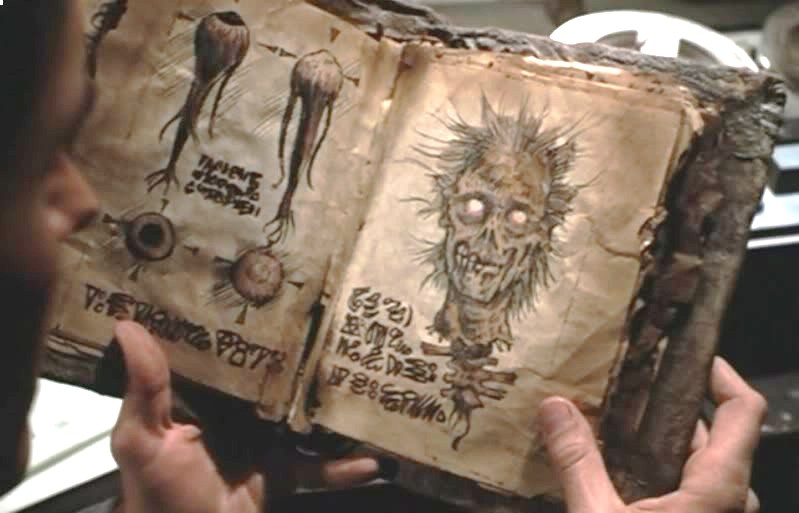
The movie starts again with Ash traveling to a remote cabin, this time with girlfriend Linda in tow. Little time is wasted before the MacGuffin from the original movie is introduced: the Necronomicon, or Book of the Dead. When Ash unwittingly plays a recording from the cabin's previous tenant (an archaeologist) reading from this cursed book, terrible forces start to attack the residence. After his girlfriend is possessed and attacks Ash, the movie briefly becomes a one-man show as our hero is attacked continually by forces ranging from the forest itself, the corpse of his girlfriend and even his own hand. The infamous scene where Ash must amputate his hand is one of the series' lasting images and illustrates the creative gulf between Team Raimi's vision of horror, and the typical slasher fare that populated theaters at the time. In freeing himself of the evil infection, Ash also painfully handicapped himself (however briefly) in a still ongoing fight against murderous forces. Before reinforcements arrive, Ash seemingly hits rock bottom when fountains of blood erupt from the walls and the house itself starts to laugh at him, but the real madness hasn't even begun.
The remaining cast is introduced when the archaeologist's daughter, Annie, and her team arrive at the cabin fresh from a dig, armed with more pages from the Necronomicon. This seemingly good news for Ash soon is spoiled when he promptly gets pummeled by one of Annie's assistants, mistaking him for a murderous lunatic (admittedly not far from the truth). This brief reprieve from paranormal punishment only lets the audience catch their breath for a moment before the intensity is again ratcheted up to new levels. This exhaustive pace is what makes Evil Dead 2 so refreshing compared to many horror movies still being poured into the same old molds. No killers lurk behind doors, no cars refuse to start — our characters barely can sit down in this tiny cabin without some new evil attacking them.

While the basis of the story was ported over from The Evil Dead, near the midpoint of Evil Dead 2 it firmly becomes its own movie, and that's when it merrily jumps off the rails. Raimi even includes a fun callback to the original movie. When Ash is locked in the basement by the new visitors and fights to escape, the action becomes a tribute to the monster in The Evil Dead, which spent many scenes vainly locked in that same room. The ridiculous climax where the forest itself starts to lay siege to the cabin, is a gleeful exercise by Raimi in one-upping every over-the-top gag you've seen so far in the movie. By the time Ash finds himself face down in the dirt in the Middle Ages, it barely even registers as a surprise after all the wild turns the movie has already made.
Even though the cast is larger than its predecessor, Evil Dead 2 undoubtedly belongs to Campbell. While he had been seen in several roles prior to this movie, it was his second turn as Ash that turned an actor with a generic name into Bruce Campbell. Playing a moving target for a myriad of possessed rednecks, invisible spirits and evil forestry, Campbell takes the action on his sharp chin again and again. Campbell famously did most of his stunts in the movie, and the actor forcibly brings you into his corner by charging again and again into the teeth of the titular enemies. The physical comedy Campbell displays would become one of the actor's trademarks: overplaying each dramatic mark with wide-eyed energy, coolly delivering his signature comeback lines and gladly sacrificing his health just to survive one more minute.

When we first see Ash, he's a normal guy with a beat-up Buick. By the end, he's not only lost his hand but he seems to have emerged stronger, aided by a newly installed chainsaw limb and the confidence from surviving an unrelenting attack from beyond the grave. When Ash raises his shotgun to lead his medieval followers, it's hard to doubt they will find victory together. Part of Ash's longevity as an action hero (he's been featured in video games, an iPhone app, comic books and various cameo appearances) has to be attributed to his rare standing as an everyman: he drives a crappy car, his idea of a vacation is a broken down cabin deep in the woods, he has some skills as a handyman, but prefers forcing the issue. Best of all, Ash doesn't run like so many horror movie characters — though it's not like he has a choice since a whole forest seems to be against him — he subscribes to the thinking that a good defense is a really good offense.
Evil Dead 2 became such a star-making turn for Campbell (and his character) that the series' third installment, Army of Darkness, relies more on the momentum and charm of Ash to carry it than simply continuing the previous movie's storyline. Compared to its predecessors, Army of Darkness is more adventure/sword and sorcery than horror, but still plows ahead with the same blunt-edged humor of Evil Dead 2. Featuring painful physicality, winking puns and Clint Eastwood-style one liners, the comedy of Evil Dead 2 and Army of Darkness has lived on in movies like Shaun of the Dead, Hellboy and, most recently, Tucker & Dale Vs. Evil. But Hollywood has yet to find another character with Ash's effortless courage in the face of terror combined with innocent charm. In most of Campbell's roles since the Evil Dead series, it's hard to tell where Ash ends and Campbell begins, or if the character is simply the actor playing it straight.
As the series marches on toward another sequel in the next couple years (with the story rumored to be another spinoff from The Evil Dead's framework), this low budget gross-out horror comedy only has increased in popularity through the decades. What did Evil Dead 2 do so right that so many of its peers could not? The best answer may be the best possible pairing of onscreen and offscreen talent. Sam Raimi has since proved his directing chops many times over with the likes of A Simple Plan, the Spider-Man trilogy and, most recently, Drag Me to Hell, and Campbell began a career as a cult action star with his performance here. When the two came together on screen with a script that pushed the envelope of typical horror conventions, the result was bloody good.
"Groovy."
Tweet
Labels: 80s, Bruce Campbell, Eastwood, Movie Tributes, Raimi, Remakes, Sequels
TO READ ON, CLICK HERE
Saturday, March 10, 2012
“Here’s my hope that we all find our Shangri-La…”

By Ivan G. Shreve, Jr.
With the publication of his novel Goodbye, Mr. Chips in 1934, a book penned by author James Hilton a year earlier, Lost Horizon, also began to garner attention from the public and soon would obtain the similar success of Chips. In fact, it became one of the first and best-selling “mass-market” paperbacks as well as one of the 20th century’s most popular and beloved novels. The story concerns a British diplomat who stumbles onto a utopian paradise known as “Shangri-La” — a civilization free from war and want, where its inhabitants are able to live long, peaceful lives well past the usual life expectancy. The title, “Shangri-La,” refers to the lamasery in the novel but soon was adopted as shorthand for any sort of utopian existence; Franklin D. Roosevelt even borrowed it for the nickname of the presidential retreat in Maryland (that we have come to know as Camp David).
Motion picture director Frank Capra read the novel while he was making his Academy Award-winning comedy It Happened One Night (1934), and vowed that Lost Horizon would be his next picture. Capra knew precisely whom he wanted for the protagonist of the novel: actor Ronald Colman. Colman wasn’t available, so Capra made Mr. Deeds Goes to Town (1936) in the interim and when he finally cemented Colman’s participation he convinced Columbia studio head Harry Cohn to pony up a hefty $1.25 million to finance his production — the largest amount ever allocated to any Columbia film at that time. Beginning in 1936, the filming of the movie that was released to theaters 75 years ago on this date would run over that amount by more than three-quarters of a million dollars and though it would be another five years before the film finally recouped its initial cost, it also provided audiences with another outstanding work from one of the greatest of American film directors.

It is 1935, and in the Chinese city of Baskul, diplomat and foreign secretary candidate Robert Conway (Colman) has been assigned the task of rescuing 90 Westerners before civil war breaks out in the region. Conway manages to catch the last plane out along with his brother George (John Howard) and three disparate passengers: tubercular prostitute Gloria Stone (Isabel Jewell), fussy paleontologist Alexander P. Lovett (Edward Everett Horton) and Henry Barnard (Thomas Mitchell) — whom we later learn is the alias of fugitive embezzler Chalmers Bryant. The plane on which these individuals are traveling is hijacked by an Asian pilot and flown toward the Himalayan Mountains, where it runs out of gas and crashes, killing the man at the controls. The group is rescued by a mysterious man (H.B. Warner) who identifies himself as “Chang”; he and his men take the travelers to a lamasery known as “Shangri-La,” an idyllic paradise remotely separated from the outside world.

Perplexed by their surroundings at first, the members of the group gradually are enchanted by Shangri-La and find themselves becoming as content as its inhabitants — particularly Robert, who learns from Chang that the paradise was founded by a priest named Perrault, who accidentally stumbled upon the lamasery in the 1700s. Conway also is introduced to the de facto leader, the High Lama (Sam Jaffe), who is revealed to be Father Perrault himself! The High Lama announces to Conway that despite the longevity bestowed upon Shangri-La’s inhabitants because of its relaxing atmosphere (temperate climate, healthy diet, etc.) he is dying, and on the recommendation of Sondra Bizet (Jane Wyatt), a native resident who has read many of Conway’s writings, has decided that Robert possesses the wisdom and knowledge of the outside world to continue on as his successor. He then expires in a manner later described by Conway as “peacefully as the passing of a cloud’s shadow.”

The offer to remain in Shangri-La is quite tempting to Robert, who also is in love with Sondra, but there is dissension in the ranks in the form of brother George, who has been distrustful of Shangri-La since the moment he arrived — despite having fallen for young Maria (Margo), a resident who was brought to the lamasery as the survivor of an expedition in the late 1800s. George convinces Robert, who is still a bit shell-shocked from the High Lama’s passing (and is loyal to his brother), that the tales told to him by both Chang and the Lama are lies and that they have an opportunity to escape the confines of Shangri-La with the help of a team of porters if they leave in the morning (the remaining members of their party have elected to stay). Both Conway brothers and Maria experience several days of travel in grueling conditions and, succumbing to the elements, Maria falls face down in the snow and expires. George learns to his horror that what Chang had told his brother — that Maria was much older than she appeared and was “preserved” by the magical properties of life in Shangri-La — is indeed true, Maria’s countenance is that of an old woman…which causes George to go mad and leap into a ravine. Robert manages to continue on through the horrific weather to be rescued by villagers from a nearby hamlet.
In an epilogue to the adventures of Robert Conway, an explorer named Lord Gainsford (Hugh Buckler) relates to members of his club in Old Blighty that Conway’s experiences had been wiped from his memory as a result of amnesia but that the recollection of Shangri-La returned while Conway was returning by boat to England. Jumping ship, Conway obsessively made it his mission to return to the tranquil paradise, and Gainsford informs the club members that his ten month attempt to pursue Conway resulted in failure. But in the film’s final scenes, it is apparent that Conway “has found his Shangri-La.”
The characters of Sondra and Lovett are not present in Hilton’s original novel, but were added merely as romantic interest and comic relief, respectively. In the case of Lovett, the addition of the persnickety academic added a touch of humorous whimsy to what would otherwise be a dreary fantasy excursion; Horton — the silver screen’s embodiment of what was then known as the “sissy” — was a perfect choice for the role, and director Capra wisely let the actor improvise much of his onscreen business (including the scene with the lacquer box mirror). Horton’s rapport with Mitchell’s “Barney” Bernard also is priceless; Bernard refers to him as “Sister” and “Toots” before finally deciding to call Lovett “Lovey,” a nickname that soon is adopted by some of the children in Shangri-La as well.

Capra, as a rule, hated screen tests…and made it a point to develop the characters in his films around actors he already had in mind for the roles. But this wasn’t always set in stone; he tested both Louis Hayward and David Niven for the part of George Conway before deciding upon John Howard two days before shooting was to begin, and he cast the part of the High Lama twice before deciding on Sam Jaffe (the other two actors he had in mind, A.E. Anson and Henry B. Walthall, passed away before he could utilize their services). As stated, Colman was his first and only choice for the movie’s protagonist, Robert Conway (changed from Hugh in the novel), and though Colman was hesitant about Capra’s methods of film direction the two men eventually were able to form a rewarding collaboration.
The final cost to make Lost Horizon was $2,626,620. Its production history was a troubled one, which goes a long way in explaining why Capra went over budget and why ultimately his partnership with Columbia studio head Harry Cohn suffered a tremendous strain (Cohn’s insistence on edits to the film resulted in Capra’s filing suit against the studio that same year, charging “contractual disagreements”). Horizon’s snow scenes and aircraft interiors were shot inside the Los Angeles Ice and Cold Storage Warehouse, where the low temperatures wreaked havoc with the camera equipment; cinematographer Joseph Walker would discover to his horror that the extreme cold often damaged the film stock. The Streamline Moderne sets designed by art director Stephen Goosson had been constructed near the busy thoroughfare known as Hollywood Way, with the daytime activity forcing the production to shoot at night and accelerating overtime expenses. Other film locations included the Mojave Desert and the Sierra Nevada Mountains, and the cost of transporting cast, crew and equipment expanded the budget’s waistline as well.

There also were problems related to casting — Cohn hated Sam Jaffe as the High Lama (he thought Jaffe was too young and the makeup used to make him appear older unsuitable) and demanded that Capra replace Sam with Columbia stock thespian Walter Connolly. Capra succumbed to re-shooting all the Lama’s scenes (an additional expense was added in that Cohn also insisted on constructing an expensive new set to accommodate the switch), only to discover that Connolly-as-Lama simply didn’t work (Capra would remark later that Connolly was too hefty to play the part of a 200-year-old character who was supposed to be an ascetic). So Capra had to re-shoot the High Lama scenes upon the return of Jaffe and of the footage he shot, only 12 minutes of the Lama made it into the actual film. Overall, Capra’s insistence on shooting scenes using multiple cameras to cover multiple angles resulted in multiple zeroes being added to the final budget tally.

Capra’s “director’s cut” originally was six hours long, and though the studio toyed with the idea of releasing Lost Horizon in two parts, it was eventually whittled down to 3½ hours (by Capra and editors Gene Havlick and Gene Milford) for a 1936 preview in Santa Barbara, Calif. The audience reaction to that preview was disastrous (though in all fairness, it followed a showing of the comedy Theodora Goes Wild — a film Capra’s crew worked on during the delays in making Horizon) and Capra continued to hack away at his film, becoming more and more distraught in the process. By the time of its official release, Lost Horizon’s official running time was 132 minutes…and in its early engagements was promoted as a “roadshow release,” meaning that tickets had to be purchased in advance and that presentations were limited to two screenings per day. Capra would later argue that Cohn’s continued slashing of Horizon was perpetuated because the studio head wanted to guarantee more daily showings and generate the needed revenue for the expensive production. In its initial theatrical release, the critical response to Horizon was mostly positive despite its poor showing at the box office; the prestige surrounding the picture allowed it to snag seven Academy Award nominations (including best picture), winning for Goosson’s art direction and the best editing trophy for the team of Havlick and Milford.
Horizon only managed to pay for itself upon its re-issue in 1942, when it was re-titled The Lost Horizon of Shangri-La. Since it was being re-shown during wartime, Columbia cut a scene of Colman’s character drunkenly railing against war and diplomacy on the hijacked airplane — something the studio felt wouldn’t go over well with the pro-war sentiment at the time. A further re-trimming saw a slimmed-down version of the film in 1952 at 92 minutes, with the attitudes displayed toward the film’s Chinese characters muted (due to tension between the U.S. and China following World War II) and the “Communist” elements of the utopian society dissipated. The slicing and dicing of Lost Horizon over the years came back to haunt Columbia in 1967, when the original nitrate camera negative of the film has found to have deteriorated and no copies of the full length version of the film were known to survive.
The American Film Institute, beginning in 1973, conducted an exhaustive combing of film archives from around the world in an attempt to locate the missing elements. Their efforts resulted in the finding of a complete soundtrack of the 132 minute film, and all but seven minutes of the visual portion of Horizon. To compensate for the missing video, Columbia and the UCLA Film and Television archive filled in
 the gaps with freeze-frame images from the movie and surviving production stills, and the resulting product (which was completed in 1986) was made available on DVD in 1999. The disc, in addition to commentary on the preservation of the film, also contained an “alternate ending” which director Capra wisely chose to excise from the finished product (it makes the established ending less ambiguous with regards to Conway’s rediscovery of his paradise, but doesn’t quite “sync” with the rest of the film). Interestingly, in that same year that the AFI's restoration mission began, a musical remake of the movie made the rounds in theaters, produced by Ross Hunter (his final film) and starring Peter Finch, John Gielgud and Liv Ullmann. Despite tuneful songs by Hal David and Burt Bacharach, the production was an unmitigated disaster — its disappointing box-office earned it the nickname “Lost Investment” and film critic John Simon famously suggested that the movie “must have arrived in garbage (cans rather) than in film cans.” Despite its inclusion in Michael Medved’s The 50 Worst Films of All Time, the 1973 Horizon developed a kitschy reputation among moviegoers that a MOD (manufactured on demand) DVD of the film was made available in October 2011.
As for the original, critical acceptance of Lost Horizon is somewhat split in today’s quarters, with classic movie fans on both sides of the fence as to its merits. Speaking only for myself, the realist in me is inclined to dismiss Horizon because I know that the utopian society depicted could never come to pass, owing to man’s innate venality and stupidity. But the idealist in me has an equally powerful opinion, and finds that watching the film is every bit as idyllic as the paradise that is its subject matter; in addition, I love the performances (it’s my favorite Ronald Colman film) and the cinematography, and think screenwriter Robert Riskin is in peak form (Sidney Buchman also worked on Horizon, taking no credit for rewriting much of the High Lama’s dialogue) — it’s a shame that the movie’s problematic history created a rift in the fruitful alliance between he and director Capra. “In these days of wars and rumors of wars — haven’t you ever dreamed of a place where there was peace and security, where living was not a struggle but a lasting delight?” the movie famously posits in an opening title…and each time I visit the cinematic environs of “Shangri-La,” I respond with a most emphatic “yes.”
Tweet
Labels: 30s, Books, Capra, Fiction, Gielgud, Liv Ullmann, Movie Tributes, Musicals, Niven, Oscars, R. Colman, Remakes, T. Mitchell
TO READ ON, CLICK HERE
Tuesday, March 06, 2012
“It’ll get a terrific laugh…”

By Ivan G. Shreve, Jr.
Beginning in the 1930s and continuing well into the mid-'50s on radio (and for a number of years on television afterward), The Jack Benny Program was a “Sunday night at seven” institution for millions of American households. The titular star of the broadcast, a comedian who was practically unique in his insistence on making certain his writing staff received most of the credit for his success, revolutionized humor by, not putting too fine a point on it, becoming the godfather of the modern American situation comedy. His innovations included self-referentially setting the storyline of each week’s show amongst the background of preparing his broadcast, breaking “the fourth wall” and having his “gang” (the program’s supporting characters) get the lion’s share of the laughs poking fun at the star. Above all, Benny masterfully mined humor from pettiness, vanity and miserliness while simultaneous creating a lovable “everyman” that the listening audience couldn’t help but want to hold to its collective bosom.
Benny tried to duplicate his radio and TV success on the silver screen, and though he made a number of entertaining films, the comedian never really was satisfied with the end result. A lot of this had to do with that many of his movies, such as Love Thy Neighbor (1940), Buck Benny Rides Again (1940) and The Meanest Man in the World (1943), were little more than slight variations of the character he played on radio; Neighbor and Buck Benny in particular featuring many of the regulars from his show (Eddie “Rochester” Anderson, Don Wilson, Phil Harris, Dennis Day). On occasion, Jack would get the opportunity to flex his acting muscles in vehicles such as Charley’s Aunt (1941) and George Washington Slept Here (1942) so it shouldn’t be too surprising that Benny considered these movies among his favorites. But Jack — and many others, including myself — always felt his finest hour on film was in a production released to theaters 70 years ago on this date: Ernst Lubitsch’s black comedy classic To Be or Not to Be (1942).
On the eve of the German invasion of Poland in 1939, a Warsaw theater troupe headed up by “that great, great actor” Josef Tura (Benny) rehearses a new anti-Nazi play entitled Gestapo. The troupe’s producer, Dobosh (Charles Halton), is dissatisfied with what he’s watching, arguing that Bronski (Tom Dugan), the actor playing Adolf Hitler, simply ian't convincing as the Fuehrer. In an effort to prove his authenticity, Bronski steps outside to walk among the Warsaw population…and though he gets a few stunned and anxious stares, his cover is blown when a girl timidly asks for his (Bronski’s) autograph.
Later that evening, as the troupe performs Shakespeare’s Hamlet, Josef’s wife Maria (Carole Lombard) entertains a young Polish pilot named Stanislav Sobinski (Robert Stack) in her dressing room. Sobinski is very much in love with Maria, and has been signaled to pay her a nocturnal visit at the moment when husband Josef starts Hamlet’s famed “To be or not to be” soliloquy (naturally, Josef is dismayed when he spots the young airman leaving in the middle of his performance). Maria loves her husband very much but doesn’t dismiss having an innocent flirtation with Stanislav…an “affair” that ends with the news that Germany has invaded Poland and World War II is underway.

Under the thumb of Nazi terror, Warsaw has been reduced to rubble (the theater has been closed and the troupe thrown out of work due to a curfew and other restrictions) but a vibrant Polish underground is determined to throw off the yoke of their oppressors. In England, Sobinski and his fellow pilots spend an evening of singing and revelry in the company of a Polish resistance leader, Professor Alexander Siletsky (Stanley Ridges), who generously offers to get word to the pilots’ families. Stanislav tells Siletsky that while his own family is safely out of Poland, he would like the professor to deliver a message to Maria: “To be or not to be.” But he is troubled by the fact that Siletsky — who claims to be a lifelong resident of Warsaw — is unfamiliar with Maria Tura, and after the professor starts off for Poland, Sobinski relates the incident to his superiors (Halliwell Hobbes, Miles Mander). Both men, having realized that the information on the pilots’ families would be vital to the Nazis even if Siletsky weren’t a spy, instruct Sobinski to fly to Warsaw immediately and stop the professor.
Shot down over Warsaw, Stanislav sends Maria to rendezvous with his contact, a bookseller, while he recuperates after nearly being shot by Nazi soldiers. Josef returns home and finds the young pilot in his bed (and wearing his pajamas), is naturally curious as to what Stanislav is doing there. He receives a hurried (and incomplete) explanation from Maria, who arrives in time to tell the two men that she was picked up by Nazi soldiers and taken to Siletsky’s hotel. Siletsky arrived in Warsaw before Sobinski, and after having delivered the pilot’s message, approaches Maria about joining the Nazi cause. Despite being confused by the events, Josef realizes that he needs to stop Siletsky (by killing him) before the professor delivers the information to the Nazi command: he may be angry about being cuckolded, but he still ia a patriot at heart.
Maria returns to the professor’s hotel, where she pretends to seduce Siletsky…but they are interrupted by a member of the theater troupe (George Lynn) disguised as a Nazi officer. The faux officer informs Siletsky he has an appointment with the head of the Gestapo — who also is a fake: it’s Josef in disguise. His mission is to wrest the information on the Polish underground away from Siletsky and then dispose of him…but learns during the course of their conversation that the professor has a duplicate copy of the information in a trunk back at his hotel. Stanislav and the theater group frantically try to think of a plan to obtain that extra copy but before they can formulate anything Siletsky concludes that he’s been duped by Tura. In his escape attempt from the theater, he is killed by Sobinski.
Josef must now impersonate Siletsky — and returning to the hotel, he attempts to destroy the duplicate information but is interrupted by the arrival of another Nazi officer. Captain Schulz (Henry Victor), adjutant of the Gestapo head Tura impersonated earlier, takes Tura-as-Siletsky to Colonel Ehrhardt (Sig Ruman), the genuine article. Josef is able to do some fast thinking to avoid spilling any information (identifying men who already have been shot as resistance leaders), and during this conversation he learns that Hitler himself will be visiting Warsaw the next day.
The body of the real Professor Siletsky is found in the theater the next morning…which is unfortunate for Josef, as he still is continuing his impersonation. Arriving at Ehrhardt’s office, he is ushered into a room and asked to wait until Ehrhardt has finished an appointment with two other officers. Inside the room is the corpse of Siletsky, but Tura manages to shave off the dead man’s beard and attach a false one…thus making Ehrhardt and his men think the deceased professor actually was an impostor. But when several theater members, led by hammy actor Rawitch (Lionel Atwill) in disguise, burst in and blow Tura’s cover in order to spirit Josef away from his captors, Tura and company realize it will only be a matter of time before they are rounded up by the Germans.
To escape out of Poland, Josef and his actors concoct a diversion, with Bronski in the part of Hitler and his friend Greenberg (Felix Bressart) as a defiant Jew who interrupts the Fuehrer’s appearance at the theater; the theater company and Stanislav then steal the Nazis’ transportation and head for the airport, stopping off at Maria’s just in time to rescue her from the advances of an amorous Ehrhardt. Our heroes are successful in their flight from Warsaw and land safely in Scotland, where that evening, Josef and his fellow thespians put on a production of Hamlet…and all goes well until “To be or not to be…”

The director of To Be or Not to Be, Ernst Lubitsch, was admired and respected by his peers, critics and audiences both when he was making films and long after his death in 1948. Lubitsch specialized in urbane romantic comedies that reeked of elegance and sophistication with just a touch of the risqué (daring but never smutty) that artfully avoided any complications with the Motion Picture Code, and earned his directorial style the nickname “the Lubitsch touch.” Lubitsch didn’t take a writing credit on To Be (the honor goes to Edwin Justus Mayer, based on a story by Melchior Lengel) but he devised the character of Josef Tura with Jack in mind, joking that every comedian’s dream is “to play Hamlet.” Benny would later reminisce about the experience in saying he worked well with Lubitsch because the director told him to forget everything about acting (“which wasn’t too difficult,” he cracked) and just follow his lead as Ernst acted out every gesture and vocal inflection for Benny’s benefit. “He was a lousy actor, but a great director,” was Jack’s final verdict.
What’s wonderful about watching Benny play Tura is that both the character and Jack’s radio persona share some similarities: the vanity, the hamminess (whenever Jack would do a spoof of a current movie on his show he always made sure he got the largest role) and that lovable schlemiel that resides in a world where everything terrible seems to happen to him. And yet there are differences: Tura is way out of his league playing spy, but he’s able to screw up his courage and risk certain death to help Sobinski (the man playing around with his wife) stop a dangerous man who threatens the lives of the people of Warsaw. He’s ready to fight on behalf of his country, and demonstrates tremendous courage in doing so.
The part of Maria Tura was originally conceived as a comeback role for actress Miriam Hopkins — Hopkins had worked with Lubitsch before in the vehicles Trouble in Paradise (1932) and Design for Living (1933), and in the pre-production stages of To Be or Not to Be was anxious to let the director lift her career out of its slump. But Hopkins didn’t want to work with Benny, and so her departure attracted the interest of Carole Lombard…who, despite resistance from Lombard's husband, Clark Gable, wanted very much to work with Lubitsch (and she’d also get to work alongside Robert Stack, who had been a friend of hers for many years since he was a teenager). After completing the film, Lombard would later tell friends that it was the most satisfying experience of her career…and the proof is up on the screen. Her performance as Maria is positively luminous; she simultaneously gives the character both a playful and ethereal quality — a woman deeply in love with her husband and yet naughty enough to stray a little from the fold when opportunity presents itself. Benny had nothing but the utmost affection for his co-star, whom he really got to know during their time on the movie — he later told friends: “She was one of the few gals you could love as a woman, and treasure as a friend.”
Sustaining Benny and Lombard is an outstanding “troupe” of supporting performers that include Stack, Bressart, Atwill, Ridges, Ruman and Dugan — none of these amazing actors hit a false note in their portrayals, and deliver Lubitsch and Mayer’s sparkling dialogue to perfection. Critics at the time of To Be's release lambasted Lubitsch for allowing the heroes to be nothing but a disparate group of actors…but I think it’s a brilliant concept: Josef and his friends are the only ones with ego enough to pull one over on the arrogant Nazis. And that screenplay! So many quotable passages of delicious double entendres that exemplify “the Lubitsch touch”:
MARIA: It's becoming ridiculous the way you grab attention. Whenever I start to tell a story, you finish it. If I go on a diet, you lose the weight. If I have a cold, you cough. And if we should ever have a baby, I'm not so sure I'd be the mother.
JOSEF: I'm satisfied to be the father.
MARIA: Tell me about yourself.
SOBINSKI: Well, there isn't much to tell. I just fly a bomber.
MARIA: Oh, how perfectly thrilling!
SOBINSKI: I don't know about it being thrilling. But it's quite a bomber. You might not believe it, but I can drop three tons of dynamite in two minutes.
MARIA: Really?
SOBINSKI: Does that interest you?
MARIA: It certainly does.
SOBINSKI: You see, sir, the other night Professor Siletsky was addressing us at the camp, and I mentioned the name of Maria Tura…and he never heard of her.
ARMSTONG: Neither have I.
SOBINSKI: Oh, but, he's supposed to be a Pole who lived in Warsaw and she's the most famous actress in Warsaw.
ARMSTONG: Now, look here, young man, there are lots of people who're not interested in the theater. As a matter of fact, there's only one actress I ever heard of…and I certainly hope I'll never hear from her again.
JOSEF: It's unbelievable! Unbelievable! I come home to find a man in the same boat with me and my wife says to me, "What does it matter?"
SOBINSKI: But, Mr. Tura, it's the zero hour!
MARIA: You certainly don't want me to waste a lot of time giving you a long explanation.
JOSEF: No, but I think a husband is entitled to an inkling.
JOSEF: Her husband is that great, great Polish actor, Josef Tura. You've probably heard of him.
EHRHARDT: Oh, yes. As a matter of fact I saw him on the stage when I was in Warsaw once before the war.
JOSEF: Really?
EHRHARDT: What he did to Shakespeare we are doing now to Poland.
That last line caused a little bit of concern among critics, who steadfastly argued that poking fun at a serious situation made Lubitsch guilty of cinematic high crimes and misdemeanors. My favorite line from To Be or Not to Be is one that doesn’t seem particularly funny at first hearing (in fact, it might make some viewers wince): posing as Ehrhardt, Josef responds to flattery from Professor Siletsky with the phrase “So they call me ‘Concentration Camp’ Ehrhardt…?” But as Josef desperately tries to stall for time while Sobinski and the rest of the actors dope out a way to retrieve vital documents from the spy’s hotel room, he begins to nervously repeat the phrase over and over again until it almost becomes a mantra…and it makes me laugh out loud every time I hear it.

With all these elements — solid script, first-rate cast, great director — you’d naturally assume that To Be or Not to Be cleaned up at the box office, correct? Well, it didn’t. Lubitsch’s WW2 satire had the misfortune of being released during World War II, and theatergoers didn’t particularly warm to a film that poked deadpan fun at such a serious conflict. With hindsight, we can see the brilliance of the movie — Lubitsch’s film has witty moments, to be sure, but it also contains sequences of nail-biting suspense (witness Sobinski’s arrival in Warsaw after temporarily escaping his Nazi pursuers, not to mention the tense scenes where Maria is literally being held prisoner in Siletsky’s hotel room). The director’s intention was to satirize both the Nazis and their ideology, but as George S. Kaufman famously observed, “Satire is what closes on Saturday night.” The moviegoing public simply wasn’t ready for a daring film that was able to find humor in a situation that seemed devoid of same — and a prime example of this sort of patron was Jack’s father, Mayer Kubelsky. Kubelsky went to see To Be or Not to Be…and horrified that his son was not only wearing an SS uniform but giving out with a “Heil Hitler!” in the opening scenes; he stormed out of the theater and refused to speak to his Jack. (When Jack finally convinced his father that his character was merely performing in an anti-Nazi play in the movie’s opening and that he was really the film’s hero, Mayer went back to see the movie again and again…and again. Like his famous son, it would become his favorite.)
But theatergoers also found it impossible to laugh when the movie’s female star, Carole Lombard, was killed in a plane crash about two months before the film’s premiere (she was on a World War II bond rally tour with her mother, Bess Peters, and Otto Winkler, husband Clark Gable’s press agent). Co-star Benny was devastated by Lombard’s untimely death, and refused to do his regularly scheduled program that following Sunday, substituting an all-musical half-hour. Because the actress had a line in the film — “What can happen in a plane?” — in response to Stack’s invitation to take a spin in the wild blue with him, the line was cut before the movie’s premiere (it since has been restored).
To Be or Not to Be ranks only behind Twentieth Century (1934) as my favorite Carole Lombard film, but it’s certainly my favorite of Jack Benny’s cinematic output; Jack never got another opportunity to extend his thespic range and after The Horn Blows at Midnight in 1945 (a film that he and his writers lampooned in endless jokes on his radio/TV show despite the fact that it wasn’t that bad) he limited his screen appearances to brief cameos such as It’s a Mad, Mad, Mad, Mad World (1963) and A Guide for the Married Man (1967). (He had planned to return to movies with a substantial part in The Sunshine Boys, but upon his death in 1974 his role was given to his lifelong friend George Burns). To Be is also my favorite Lubitsch film; a work of such maturity and pitch-perfect hilarity that I want to warn you: do not make the same mistake I did in watching the 1983 remake before seeing the Lubitsch version. (In all honesty, I didn’t have a choice — the Lubitsch film rarely got shown in those halcyon days before TCM). The more recent version with Mel Brooks and Anne Bancroft, heartfelt tribute though it may have been, is much too broad and slapsticky in its burlesque approach (it’s almost like watching a stage play)…and most assuredly lacks the subtlety of “the Lubitsch touch.”
Tweet
Labels: 40s, Bancroft, Gable, Jack Benny, Lombard, Lubitsch, Mel Brooks, Movie Tributes, Remakes, Shakespeare
TO READ ON, CLICK HERE
Wednesday, February 08, 2012
Everyone understands the language of a bully

By Edward Copeland
By the same token, hate, bigotry and intolerance also happen to be among the handful of dialects that don't require translation. Susanne Bier's In a Better World touches upon all those topics and raises the question of whether there comes a time when turning the other cheek ceases to be practical or if vengeance can ever be justified because it simply makes a tormentor's victim no better than the tormentor himself. The Danish film took home the 2010 Oscar for best foreign language film, beating such renowned competition as Biutiful, Dogtooth and Incendies, but only received U.S. release in 2011. I wasn't a fan of Biutiful, haven't seen Incendies and it's difficult to compare Dogtooth to just about anything, but In a Better World proves to be far from an embarrassing winner of the prize (as has been the case so often, coming off quite well and avoiding most of the preachiness that could trip up a film venturing into this subject matter if handled purely as a means to sell a message.
In a Better World marked Bier's second nomination for the Oscar for foreign language film. I haven't seen that movie, 2006's After the Wedding, but it would have to be damn good to best that year's winner, Florian Henckel von Donnersmarck's exquisite The Lives of Others with its touching performance by Ulrich Mühe, all the more haunting now since he died so soon after gaining his greatest international fame from the film.
I did, however, really like Bier's 2004 work (released in the U.S. in 2005). Brothers, which was remade in 2009 by director Jim Sheridan with Tobey Maguire, Jake Gyllenhaal and Natalie Portman cast in the roles played so well in Bier's Danish version by Ulrich Thomsen, Nikolaj Lie Kaas and Connie Nielsen. Needless to say, though I usually give more leeway to English language remakes of foreign language remakes, there was no way in hell that I would dare watch the excellent original defiled by the new cast, especially expecting to buy Mr. Bland Gyllenhaal as a believable screwup. Of course, the biggest screwup concerning the original Brothers occurred in 2004 and was committed by the Danish jury picked to select Denmark's entry for the Oscar.
That year, there were two critical (and, coincidentally, box office) successes: Brothers and a film I'm not familiar with titled King's Game. Everyone assumed that one of the two would be chosen as Denmark's entry and would make for a strong contender. Instead, the jury opted for Lars von Trier's The Five Obstructions, really a documentary, which attracted less than 13,000 moviegoers total in Denmark. Critics, scholars and citizens protested to no avail and The Five Obstructions remained Denmark's official entry for the 2004 Oscar foreign language film jury and failed to make the cut. Even if Brothers had made the cut, it wouldn't have been a guaranteed winner, even I were the sole voter because as much as I liked that film, I don't know that I would have voted for it over the winner, the great film The Sea Inside for which Javier Bardem deserved a nomination, and one of the other nominees, Downfall, with Bruno Ganz's overlooked performance as Hitler (and eventually endless source of hilarious YouTube parodies).
Enough digressions. Time to talk In a Better World. The story concerns two 10-year-old boys from families fractured in different ways, transplanted to Copenhagen, Denmark, who gravitate into a friendship spurred by both being bullied. Christian (William Jøhnk Juel Nielsen) moves there with his father Claus (Ulrich Thomsen) after the death of Christian's mother and Claus' wife. The death has shattered Christian, who feels that his father's attempt to be strong for his son really indicates a lack of caring that she died at all.
The other boy, Elias (Markus Rygaard), is the son of a Swedish doctor named Anton (Mikael Persbrandt) and his wife Marianne (Trine Dyrholm), who are separated and considering divorce because Anton divides his time between home and working for Doctors Without Borders at a refugee camp in a wartorn African country. The school assholes have made Elias their favorite punching bag, mainly because he's a "Swede" in their Danish homeland. I found this concept rather shocking since I'd never heard of Danes hating Swedes, so I actually looked it up, but couldn't find any evidence of such a hatred but I did stumble upon an interview Bier gave to Roger Moore of The Orlando Sentinel where she explained this:
"We went to some pains to not deal directly with one clearly defined country or religion. I wanted the movie to be about intolerance in a more general way. We question that lack of desire to understand another person or another culture. Some people are just like that.…
“It’s kind of a joke in the movie, this idea that we don’t like Swedes. OK, maybe a little, but there is not general prejudice against Swedes in Denmark. When we show that in the movie we’re showing how stupid prejudice is, how foolish racism looks. It’s like saying, ‘Come on, we’re all pretty much alike. Swedes and Danes? Exactly alike. Look how stupid in its core racism is.’”
That little joke might be funny, but very little in the movie itself is. While the adults get the top billing (and turn in good and great performances, especially Persbrandt and Dyrholm who both give excellent turns. Thomsen, who was so great in Brothers. almost seems an afterthought at times here.
In a Better World's success rests squarely and superbly on the shoulders of the two young actors, particularly Nielsen as Christian, whose carefully modulated performance begins as a sad young boy, transforms into a heroic kid who wants to help his friend stop being a victim before he turns into someone that scares even Elias and his parents, fearful of what he might be capable of doing.
The parallels established in the screenplay by Anders Thomas Jensen (who has had a hand in most of Bier's major films), from a story devised by him and Bier, nicely matches both visually and otherwise the parallels between suburban bullies and African warlords. It teeters closely at times toward being too obvious in its message, but the script does a good job at making situations gray enough that even the nonviolent advocates begin to question if sometimes the only way to end a bully's reign and make it a "better world" is to follow the Golden Rule literally into a not-so-nice direction.
Tweet
Labels: 10s, Bardem, Documentary, Foreign, J. Gyllenhaal, Natalie Portman, Oscars, Remakes, von Trier
TO READ ON, CLICK HERE


