Wednesday, November 30, 2011
No easy resolutions, but one spectacular performance

By Edward Copeland
It's always difficult to comprehend the sick and twisted minds that would sexually abuse, molest or rape children, whether a disgusting Penn State or Catholic Church scandal is in the news or not. In the movie Trust, which came out earlier this year, it attempts to tackle the particularly sleazy world of Internet predators, but does so in a way that challenges a black-and-white approach to the subject — an attempt that sometimes comes perilously close to crossing lines — not so much into inappropriateness but retreats to formula. Fortunately, it avoids most of those traps, thanks mainly to the magnificent work of the teen actress Liana Liberato whose character the movie revolves around.
Trust marks the second feature film directed by actor David Schwimmer (though I haven't seen his first effort, the Simon Pegg comedy Run, Fatboy, Run) and Schwimmer performs adequately at preventing the screenplay by Andy Bellin and Robert Festinger from veering too far into melodrama and ratcheting up plot points from countless other movies by keeping most of the film's focus on its provocative and complicated nature.
The film stars two of my most welcome screen presences in recent years, Clive Owen and Catherine Keener, as Will and Lynn Cameron, suburban Chicago parents of three — two daughters, 14-year-old Annie (Liberato) and little sister Katie (Aislinn DeButch), and oldest brother Peter (Spencer Curnutt), who has left for his first year at college.
There's hardly a dysfunction to be found in the family as British transplant Will earns kudos for his work in the advertising and marketing field and Lynn serves dutifully as a loving earth mother to the clan. Their lives seem to be ideal except for the part of Annie's life that her parents don't know about, a life taking place in another world that exists within the walls of the Camerons' own home.
Annie has a boyfriend, albeit a virtual one at first, named Charlie that she has met online and grown very attached to through their computer chats. Those chats eventually lead to actual phone conversations. It bothers Annie slightly that Charlie's story keeps changing. When they first talk online, he's 16, though he ups it to 20 soon after. Later, he admits he's actually 25. Annie quizzes him about the lies, but every fabrication that Charlie explains, the teen she chooses to buy the reason he gives for having lied. Why? It's not that Annie is a particularly dumb 14-year-old girl, but she's vulnerable, enjoying the attention she gets from the virtual Charlie that the real boys at school don't give her.
Inevitably, Charlie talks her into a face-to-face meeting, claiming that it might be their only chance since he's told her that he lives on the West Coast and might not be in Chicago again soon. Of course, 25 was a lie as well and Annie feels betrayed, but Charlie (Chris Henry Coffey) charms her enough despite being at least in his mid-30s (if not older) to get her to stay and before Annie knows it, Charlie has taken her to a motel and what he views as seduction, anyone else would call forcible rape. The surprise comes that since Annie denies so much of the truth about Charlie, she claims it was consensual as well even though she fought him as it happened. Her personality changes and she all but brags about experience, which is part of what makes Trust more challenging than you'd expect.

Despite Annie's outward attitude, her best friend Brittany (Zoe Levin) realizes that something bad occurred and she tells school officials, who report it to the police. The film really takes its unusual turn at this point. Her parents, understandably, can't believe this happened without their knowledge. The FBI, in the form of Agent Doug Tate (Jason Clarke), gets in on the case since the assumption is that Charlie, whomever he might be, probably crossed state lines. It's Annie's reaction that proves to be shocking. She feels utterly betrayed — not by Charlie but by Brittany for reporting the incident and getting Charlie in trouble because she's "in love" with him. Then her anger turns on her parents who become overprotective (a bit too late), so she resents them for preventing her from being able to contact him and when she agrees to try with the FBI setting up a trap to try to locate, the cover gets blown and he never calls again. The interference of her ex-friend, her parents and the police have cost her the only person she feels found her special and beautiful.
Liberato, who was 14 when she made the film, gives a phenomenal performance that overpowers everyone else in the film, no minor achievement when the cast not only includes Clive Owen and Catherine Keener but also Viola Davis in the small role as a psychiatrist that Annie is forced to see. The film in no way argues that Charlie and Annie should be allowed to pursue their "love" and eventually Annie gets wise and her breakdown when realizing it is both heartbreaking and harrowing to watch. Liberato truly amazes, giving one of the best performances by an actress that age that I've seen in quite some time.

On the downside of Trust, while it makes Annie so complex and interesting, the screenplay doesn't flesh out her parents or any other characters in the same way, especially poor Keener whose gets a terribly underwritten role. Owen comes off better, especially when he gets some quiet moments toward the end of the film. Unfortunately before he gets there, he's stuck with not one but two clichéd reactions: First, he almost turns into a potential vigilante in the mold of a an infinite number of parents (or siblings or friends, etc.) in an infinite number of films (abetted by yet another portrayal of an inept FBI agent who lets Will steal his computer and files on potential pedophile suspects) that threatens to turn Owen into Liam Neeson in that godawful movie Taken. Second, he gets the ideal career so that he can reassess how he makes his living when he sees how his firm's latest ad campaign peddles young teen girls as sex objects. (The script even gives him a lecherous jerk of a co-worker played by Noah Emmerich to represent the evils of the ad industry.)
Those reservations aside, Trust contains enough thought-provoking material and its avoidance of easy and pat resolutions make up for the parts that border on silly and melodramatic. The credit for smoothing those bumps fall almost entirely on Liberato's young shoulders. I look forward to seeing where this young actress's career goes in the future.
Tweet
Labels: 10s, Clive Owen, Keener, Liam Neeson, Viola Davis
TO READ ON, CLICK HERE


Monday, September 26, 2011
All Things Being Equal

By Josh R
It would be comforting, if more than a little naïve, to imagine that we live in truly equitable society. Certain politicians insist that the existence of what is broadly outlined as “The Welfare State” robs people of the initiative to strive and achieve — an assertion that would only make sense if everyone started out at the same place, with identical advantages and without the kind of obstacles that apply only under given sets of circumstances. That’s a nice way of saying that most people’s futures are predetermined by factors completely beyond their control — for all but a select few, the future is less about choice than the choices that have been made for you.
The Help, based on the controversial best-selling novel by Kathryn Stockett, is a film that examines the imbalances created by a society that insists on keeping all its members in their “proper place,” and the toll such casual dispensation of injustice can take on the human soul. Specifically, the film is dealing with racial inequality in the American South in the early 1960s — but the mere existence of this film testifies to another, perhaps even more startling imbalance of the type that Hollywood usually pretends not to notice. It isn’t difficult to reel off a list of films which not only feature predominantly male casts, but feature strong, complex roles for multiple cast members; I can think of at least five or six films released in the past year which gave as many male actors the chance to shine. There are certainly female-driven ensemble films being made — this summer alone, the vastly overrated Bridesmaids has seemingly tapped into a new market by proving that women can do lame-brained, frat-boy type humor just as successfully as men do — but how many films can you name that furnish fully realized, challenging and provocative female roles for all but a few of its members? How many films have ever featured not one, nor even two, but an entire gallery of great female performances? A handful of classics stand out — Stage Door and The Women remain the gold standard, more than 70 years after their initial releases — but for the most part, great female ensemble pieces have been few and far between. While there have been notable recent exceptions — the films of Rodrigo Garcia have showcased several of our best contemporary actresses to terrific effect — The Help may be the first big-budget, mass-market film in many a year that has made full and glorious use of a large, diverse and extremely talented collection of female performers. It is due to their efforts that The Help — a good film, if hardly a great one — transcends whatever limitations the material may have and provides an eminently satisfying, emotionally rewarding filmgoing experience.
The Help of the title are African-American women employed as domestic servants in the households of young, pampered white socialites in Jackson, Miss., at the dawning of the Civil Rights era. The mistresses — who seem mostly to regard things such as marriage and parenting as tiresome, unwelcome distractions from the unending cycle of events on the Junior League social calendar — regard their maids with equal measures of indifference and suspicion. Skeeter Phelan (Emma Stone), a recent college graduate and aspiring journalist, returns to her childhood home in Jackson to work at a local newspaper. Returning to one’s roots inevitably entails reverting to old patterns; her social life is quickly commandeered by a circle of former high school friends, presided over with an iron fist by Hilly Holbrook (Bryce Dallas Howard), an unctuous queen bee who spends the bulk of her time cheerfully campaigning for the installation of separate toilets in households that employ black servants. Uncomfortable with the behaviors and attitudes she encounters, Skeeter decides to write an expose of Jackson society, as told from the point of view of the help. To that end, she persuades two domestic servants — the cautious, reserved Aibileen Clark (Viola Davis) and feisty, indignant Minny Jackson (Octavia Spencer) — to share their experiences working in various households, providing a glimpse into what happens behind closed doors, drawn curtains and the pretense of Southern gentility. Although the women are initially reluctant to participate, they eventually find a sense of purpose in revealing both the casual indignities and more harrowing instances of degradation and cruelty they witness and experience as second-class citizens in a segregated culture. When the book is published, it creates shockwaves felt both far and wide; once the truth has been dragged out in the open, no one is entirely prepared to deal with the repercussions.
The Help is directed by Tate Taylor, who also penned its screenplay. While the film represents a competent effort, it inevitably feels like the work of a novice filmmaker; it’s not particularly interesting from a visual standpoint, the tone is uncertain throughout (not all of its scenes seem to belong in the same film) and the pacing is slightly off, with certain scenes feeling oddly truncated while others seem hyper-extended. Many cast members have been coaxed in the direction of caricature — making it all the more remarkable how successfully they avoid the trap of existing on a one-dimensional level. There are exaggerated aspects to all but a handful of the performances, but the exaggeration doesn’t upset the balance of characterization — even when Spencer (a previously unheralded talent who is a delight from start to finish) is dispensing cantankerous sass in a manner which may bring to mind Hattie McDaniel, it doesn’t come across as stereotypical behavior — there’s still the sense of a real person behind the bulging eyes and grumbling retorts.
The well-meaning, conscientious Skeeter is the kind of role that almost never works; the character’s unvarying decency is like a salve for liberal guilt. Fortunately, Emma Stone is a creative, resourceful actress capable of projecting genuine personality even in less-than-ideal circumstances; she has some of Debra Winger’s off-the-cuff spontaneity, and invests the role with enough in the way of quirky intelligence to make you (mostly) forget how narrowly conceived the character is. On the other side of the spectrum, the vile, epithetic-spewing Hilly is writ so large, and in such a poisonous hand, that the easy choice for Bryce Dallas Howard would have been to render her as a vessel of pure, unadulterated evil — whereas Stone has to whip up something from nothing, Howard has to avoid the temptation to oversimplify matters. Thankfully, she doesn’t fall into that trap — her Hilly is suitably detestable, but not a cardboard villainess with a one-dimensional pathology. The audience has to want this Southern-fried witch, with her steely beauty-pageant smile and propensity for making people suffer, to get what’s coming to her; at the same time, Howard clues you in to where Hilly’s rottenness originates (racists are made, not born), and what it has cost her to preserve it. The hatred and fear that have been instilled in Hilly from birth, and that she carries around with her day after grinding day without reprieve or relief, is so corrosive that it’s eating her alive. The character may be rendered in very broad strokes, but she’s recognizably, pitiably human. The same holds true for the insecure blonde bombshell Celia Foote (Jessica Chastain), a social pariah who forms an unlikely bond with Minny. The ubiquitous Chastain — whose distant, ethereal quality works much more effectively in this context than in the suspense thriller The Debt — has the sweet, slightly dazed manner of Marilyn Monroe in her post-Strasberg years, and delivers a genuinely affecting performance that appeals to the audience’s sympathy without begging for it. Like Howard, she has a fine line to walk — Celia could easily come across as a pathetic dingaling, all curves and nervous giggles — but the performance, while exaggerated, never feels fake or forced.
The efforts of the younger cast members are nicely offset by the contributions of a trio of scene-stealing veterans. The redoubtable Sissy Spacek, who is no stranger to playing Southern eccentrics (but is usually pitch-perfect no matter what she’s doing), delivers a master class in how to play a smallish role for all it’s worth. As Hilly’s dotty mother, she has some choice bits of comic business, and handles the assignment with unflagging aplomb; so well-enshrined is Spacek’s reputation as a dramatic actress, it’s easy to forget how comfortably comedy falls into her wheelhouse. Allison Janney, who is given considerably more screen time, has a qualified success in the role of Skeeter’s evasive, cancer-riddled mother, a woman too image-conscious to act on the courage of her convictions. The performance is a bit more vivid than it needs to be — while all of the actors flirt dangerously with caricature, Janney is the only who takes it past the tipping point — but she handles the quieter moments well, and she and Stone strike up a crackling combative rhythm in their confrontation scenes. Cicely Tyson has a lovely, heart-rending cameo as Skeeter’s beloved childhood nanny, who is nowhere in evidence when her former charge returns to Jackson; her unexplained absence preys on Skeeter’s thoughts even as she trains her gaze on the goings-on in other peoples’ houses.
As strong as the ensemble work is, one performer deserves (at the very least) a paragraph all to herself. As Aibileen, Viola Davis pushes beyond the film’s comfort zone, bringing the hard, cold realities of its subject matter into razor-sharp focus. It isn’t a noisy, flashy performance; you have only to look in Aibileen’s sad, weary eyes to feel the crushing weight of her circumscribed, hardscrabble life of backbreaking labor and heartbreaking compromise, absorbing daily blows to her dignity in soul-killing silence. Without that anchoring presence, The Help would probably exist on the same level as Beaches or Steel Magnolias — a glossy, feel-good product that deals with big emotions in a facile, airbrushed manner, with swelling musical cues to signal when to reach for the Kleenex. The other actresses (all terrific) lend it tartness and sweetness, but Davis is the one who gives it gravity — she delves deep below the surface to unearth a rawness that feels at once both universal and intensely personal; the sense of hurt and suppressed anger she brings to the part cuts right to the bone. It remains to be seen whether Hollywood will afford her the chance to plumb these depths on a consistent basis — as stated previously, it would be foolish to assume that, even in The Age of Obama, the same range of opportunities are available to everyone. On the evidence of The Help, it is clear that Viola Davis is more than willing to go to those places — if she gets more parts like this, the results will be riveting.
On the merits of the performances, there can be little room for doubt; still, it is probably worth questioning whether an African-American author or filmmaker would have placed the character of Skeeter so firmly at the center of the narrative. For the record, The Help is not the story of a courageous, selfless white woman coming to the aid of helpless black people; nor is fair to say that Stockett and Taylor treat their subject matter with any lack of intelligence and sensitivity. Nevertheless, The Help isn’t really as tough-minded as it pretends to be — it cheats on the side of entertainment. I’m not enough of an authority to say whether or not it qualifies as good history; it certainly provides the occasion for some great ensemble acting. The women of The Help are totally invested in their roles, and thoroughly engaged with one another — that, in and of itself, provides cause for celebration.
Tweet
Labels: 10s, Debra Winger, Marilyn, Spacek, Viola Davis
TO READ ON, CLICK HERE
Wednesday, October 27, 2010
NY Theater Flashbacks: 95-96 Season
By Edward Copeland
As I mentioned in the second installment of this series, while the previous installments covered years, the future ones would cover seasons as my obsession grew and I saw more shows. While my last installment wrapped up in the summer of 1995, this one picks up in October of the same year but in a few months, I'd move from Oklahoma to Florida, making travel to New York easier and more frequent. On the plus side, while what I'd seen in 1995 so far had been a disappointment, the rest of the season turned out to have some of the best productions I would ever see on Broadway, though some dogs remained as well. One unusual thing though: The further ahead in time I go, the harder I'm finding it to locate art or clips to go with my words.
COMPANY
As I wrote in my piece earlier this year marking the 40th anniversary of Stephen Sondheim's landmark show, as with many of his works, the score always proves stronger than the book.
Still, the talented cast of Roundabout Theatre's revival of the show (the first since its original production) gave it their all. Led by Boyd Gaines in the lead role of Bobby, the cast included Debra Monk, La Chanze, Jane Krakowski and, exciting for a Soap fanatic such as myself, Diana Canova — Corinne Tate Flotsky herself.
Veanne Cox got the assignment of doing the frenzied mouthful of "Getting Married Today" and earned a Tony nomination for it, one of the few the revival received. Even as much of a Sondheim worshipper as I am, I found that understandable. Something seemed stillborn about the show. For every great moment — as when La Chanze belted "Another Hundred People" — the musical seemed to stop in its tracks in the silly skits, even when songs surrounded them. Still, it's hard to call it a loss of an afternoon when you get well-sung renditions of "Being Alive," "The Ladies Who Lunch," "The Little Things You Do" and "You Could Drive a Person Crazy."
MASTER CLASS


Much as Sondheim's score propped up the weak book beneath Company, the performances, particularly the powerhouse lead, saved Terrence's McNally's lackluster Master Class. Zoe Caldwell won a well-deserved fourth Tony for her starring role as Maria Callas in McNally's play which showed the grand dame of opera running roughshod over three students who had earned the chance to be taught by the great one, one of whom was played by an equally good Audra McDonald who picked up her second Tony on her way to four total (so far). Interspersed with the class sequences are Callas' recollections of various events and loves throughout her life which might play as nothing more than filler in the rather short play if they were placed in hands less capable than Caldwell's, but she makes them work and helped McNally win his 2nd consecutive Tony for best play following the previous season's Love! Valour! Compassion!, even though Master Class was far from the best in its category but we'll get to my choice later.
VICTOR/VICTORIA
After enduring what had been done when Andrew Lloyd Webber musicalized one of my favorite films of all time, Sunset Blvd., I started to question whether it was a good idea to turn any movies into musicals since more times than not the results turn out badly. You would think though that taking Victor/Victoria to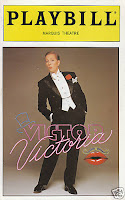 the stage, which was essentially a movie musical to begin with, with the same star, albeit 14 years older than when she originally played the part, and the film's director guiding the production, despite the fact he'd never directed a musical for the stage before, what could possibly go wrong? As it turns out, pretty much everything. First of all, the film's composer, Henry Mancini, died early in the process, so the new songs needed to flesh out the show were composed by theatrical wunderhack Frank Wildhorn, a man I'm thoroughly convinced was invented for the sole purpose of improving Lloyd Webber's own reputation. The YouTube clip above of "Louie Says" is an example of one of Wildhorn's contributions with terrible reaches for rhymes by Leslie Bricusse to the show. I won't feel bad if you don't make it through the whole clip. On top of that, those 14 years did make a bit of a difference for Julie Andrews, who tried her best. The comic timing was terrible. As luck would have it during the show, a man came out of the side exit near my seat in the Marquis Theatre. It was Blake Edwards. It was all I could do to keep myself from getting out of my chair and taking Edwards aside and trying to advise him on some ways to improve the show. The cast tried their best but I didn't even get to see the performer who got the best reviews, Rachel York: She was out the day I went. It remains the worst musical I ever sat through on Broadway.
A FUNNY THING HAPPENED ON THE WAY TO THE FORUM
Now, a much better revival of a classic Sondheim, his first (staged on Broadway anyway) for which he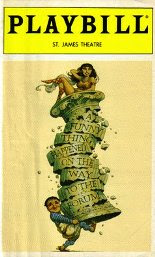 composed both the music and the lyrics. Furthermore, it was a great comic farce with a book by Larry Gelbart and Burt Shevelove. Inspired by the farces of the ancient Roman playwright Plautus, it has proved a Tony success for every actor who took on its lead role as the scheming slave Pseudolus, first for Zero Mostel in the original, then for Phil Silvers in a revival in the 1972 and this time out for Nathan Lane.
Directed by the old pro Jerry Zaks, it's a joy from start to finish with a cast of top-notch musical comedy talents such as Mark Linn-Baker, Mary Testa, Ernie Sabella, Lewis J. Stadlen, William Duell and Cris Groenedall. Unfortunately, the night I saw it, Stadlen, who received a Tony nomination as Senex, wss out but MacIntyre Dixon did a more than adequate job. When I was in grade school, we often visited my grandma during summer and would attend Starlight Musicals in Indianapolis, an outdoor summer stock, and it was there that I first saw Forum and fell in love with it. Being a young autograph hound, I got autographs of the entire cast afterward which included Arte Johnson, Avery Schreiber, Hans Conried and John Carradine. Sadly, Johnson is the only one of the four who still is with us. One word of warning: The clip of "Comedy Tonight" above was filmed very poorly, but the infectious spirit of the song and the production remains.
INHERIT THE WIND

As I mentioned when I marked the 50th anniversary of Stanley Kramer's film version of Inherit the Wind earlier this year, I'm just a sucker for this play in whatever form it takes. So, when Tony Randall's Nationalh!3w~~_12.jpg) Actors Theatre announced it would be staging a revival of Jerome Lawrence and Robert E. Lee's fictionalized take on the Scopes monkey trial with George C. Scott as Henry Drummond and Charles Durning as Matthew Brady, I was as good as there. Needless to say, I was not disappointed as its lines and messages got to me as they always do. If it had a problem, it was Scott. Not because his acting was weak: He was phenomenal. This was toward the end of his life and his ailing nature showed. In fact, he had to leave the play in the middle of one performance because he felt faint. As my dear and much missed friend Jennifer said at the time, Brady is supposed to be the one who seems to be in frail health.
Actors Theatre announced it would be staging a revival of Jerome Lawrence and Robert E. Lee's fictionalized take on the Scopes monkey trial with George C. Scott as Henry Drummond and Charles Durning as Matthew Brady, I was as good as there. Needless to say, I was not disappointed as its lines and messages got to me as they always do. If it had a problem, it was Scott. Not because his acting was weak: He was phenomenal. This was toward the end of his life and his ailing nature showed. In fact, he had to leave the play in the middle of one performance because he felt faint. As my dear and much missed friend Jennifer said at the time, Brady is supposed to be the one who seems to be in frail health.
As I mentioned in the introduction to this installment, I had great difficulty find photos of any of the productions from this season, but I did luck out on this one and by this one I realized for the first time that I had seen Garret Dillahunt on Broadway playing Bertram Cates. Dillahunt was fine, but he didn't make much of an impression on me, but it's funny how much of one he would make many years down the road in not just one but two roles on Deadwood and he now pops up quite frequently in movies such as No Country for Old Men, The Assassination of Jesse James by the Coward Robert Ford and The Road as well as on many TV series. He currently is a regular on the new TV comedy Raising Hope.
A DELICATE BALANCE
Under normal circumstances, you wouldn't hear me expressing relief that a new Sondheim show for which I held a ticket closed before I could see it, but boy am I glad that is what happened to Getting Away With Murder. You see Getting Away With Murder wasn't a Sondheim musical, it was a mystery play that went along with the composer's obsession with puzzles, along the lines of the 1973 screenplay he co-wrote with Anthony Perkins, The Last of Sheila. Anyway, having come all the way to New York with a ticket to a show now closed, I had to exchange and I made one of the greatest decisions of my life by choosing to cash it in for the revival of Edward Albee's Pulitzer Prize-winning A Delicate Balance starring George Grizzard, Rosemary Harris and the incomparable Elaine Stritch. I got to see one of the best afternoons of Broadway theater I ever have. As much as I love Who's Afraid of Virginia Woolf, this may have become my favorite Albee that day with its tale of would-be empty nesters facing suburban angst and a fuller nest than ever with an alcoholic sister, a grown daughter returning home after the breakup of a fourth marriage and a similarly married couple who just suddenly found themselves "scared." The entire cast was brilliant, with Grizzard winning a much deserved Tony. Harris and Stritch unfortunately not only had to compete against each other, they also had to contend with Zoe Caldwell in Master Class, so they couldn't make it to the podium. I didn't even mention the great work of the other three cast members: Mary Beth Hurt, Elizabeth Wilson and John Carter. The show won best revival of the play and its director, the late great Gerald Gutierrez, won director of a play for the second consecutive year after giving The Heiress new life the year before. If not for Angels in America, A Delicate Balance would be the best thing I ever saw on Broadway.
SEVEN GUITARS
Here's one of the plays that was more deserving of the best play Tony than Master Class: Seven Guitars, another of the plays in August Wilson's Pittsburgh cycle which depicts the African-American experience in the U.S. in the 20th century in each decade. This play, set in 1948, takes its title from its seven characters, the six we see and the seventh whose funeral begins and ends the action of the play. Keith David starred as a blues guitarist who squandered an advance from a record label while juggling women and making his way to his mother's funeral.
The excellent cast received Tony nominations for four members of its six-member ensemble: Viola Davis, Michele Shay, Roger Robinson and Ruben Santiago-Hudson, with Santiago-Hudson winning the prize. While Seven Guitars wasn't as solid as other works in Wilson's cycle such as The Piano Lesson and Fences, it still was quite good and provided a great mix of harrowing drama and boisterous comedy.
Its atmospheric scenic design by Scott Bradley also earned a nomination, though it lost to the colorful spectacle of The King and I since this was back in the days before there were separate technical categories for plays and musicals.
A MIDSUMMER NIGHT'S DREAM
I love Shakespeare and while it's a pleasure to read The Bard's plays, I've found it's always much better to see his works performed, either on stage or film. Given that, you would think that no one would prove better at interpreting and staging Shakespeare's plays that a company such as The Royal Shakespeare Company. Then why on earth did their production of one of his most delightful works, A Midsummer Night's Dream, almost bore me to tears?
I seldom laughed as the natural comedy came off to me as the clumsiest of slapstick and many of the performers treated the language the way I hate: so carefully that it seemed as if they feared the iambic pentameter might break if they weren't careful. Looking back at my Playbill to see if any of the company included anyone I came to know better but the only name that leaped out at me was Lindsay Duncan who played Titania and Hippolyta here but would go on to give a wonderful turn as the vengeful Servilia on HBO's Rome.
Apparently, I wasn't alone in having lukewarm memories of this production. While, as I have mentioned, art of these various productions were difficult if not impossible to come by, I could usually guarantee I could find art of the corresponding Playbill. In the case of A Midsummer Night's Dream, even that could not be found. Thankfully, my wireless printer I was given a while back also scans and I used it for the first time to scan my own Playbill because that's the only way I could get art of it.
BIG
If Sunset Boulevard didn't make it a concrete decision and Victor/Victoria didn't cinch it as a rule, the musical version of Big made it a personal principle of mine not to go see a Broadway musical based on a movie. Now I know this means I would have missed, if I'd still been able to go to New York at the time, well- reviewed examples of movies-to-musicals such as The Producers, Billy Elliot, Hairspray and The Full Monty (another acclaimed musical, Grey Gardens, even came from a documentary), but look at some of what I would have avoided: Urban Cowboy, Footloose, Chitty Chitty Bang Bang, High Fidelity, High Society, Saturday Night Fever, Tarzan, The Little Mermaid, 9 to 5, Mary Poppins, Young Frankenstein, Shrek, The Addams Family (I know, based on the cartoons, not the TV show or movie. Uh-huh). Thoroughly Modern Millie, Sweet Smell of Success, Dirty Rotten Scoundrels, The Color Purple, The Wedding Singer and Cry-Baby to name a few too many. I gave a break to a few others that got some passable reviews such as Legally Blonde, Xanadu and A Catered Affair. Before my obsession ended and my ability to go to New York went away I would still see a couple, with qualifications, but enough was becoming enough.
The saddest part about Big is that I saw it on its very first night of previews and I heard it improved slightly later but it was a sign of my mental illness that I went in the first place because I wasn't that crazy about the movie in the first place. I always thought Tom Hanks played the character as far too young for what age Josh was when he grew and the musical didn't fix that. Even worse, they took the sweet simplicity of the moment from the movie when the big Josh and his boss at the toy company played "Chopsticks" on the giant keyboards at F.A.O. Schwarz and transformed it into an overblown production number, sapping it of all its charm.
RENT
What luck did I have getting to see Rent when I did. First, I ordered my ticket the day before it received the Pulitzer Prize for drama, a rare feat for a musical. Secondly, on the day I was to see it, flying in from Florida, I thought I had plenty of time. I'd get to New York, check into the hotel and get to the theater. Unfortunately, flight delays started to push it and when we got to New York, for some reason we were sittingr9sUw5qBMhS0-StQQ~~_3.jpg) on the tarmac, not allowed to get to the gate, for an interminable amount of time. The clock ticked. It got past 7 p.m. Finally, a flight attendant got on the intercom and asked the passengers to sit down and we could finally go to the gate. Some idiot businessman was still rifling through his overhead. I shouted, "Sit the hell down! We have places to be." Thankfully, I only had a carryon. I grabbed the first cab I could and told the driver I would make it worth his while if he got me to the Nederlander Theatre before 8 p.m. I love N.Y. cabbies: I got there at 7:45 p.m. I had to sit through the show with my carryon bag at my feet, but the show, which also happened to have recently received all its Tony nominations, was well worth it. Quite simply, I was enthralled. It's still the best new musical I saw on Broadway and the only one I paid to see twice. It still was as great the second time. I did see a few problems: I knew it would be almost immediately dated, but it was a show I couldn't stop talking about, wanting to spread the word and share it to everyone I knew. Of course, it became a phenomenon and I can always say I saw it with the original cast. It was magical. It also played to my age at the time: It seemed to speak to it and my generation. Who knows? While I still love the music, today as I become an old fogey, I might relate more to Benny the landlord than the squatters. For the record, I never saw the movie version and I never will because it was obvious how they were ruining it. Usually I support using the original cast members, but they were all more than a decade too old for their parts by then. Having Chris Columbus direct? Ugh. Again, with the clip above, the filming isn't the best, but the song, "What You Own," one of my favorites, still comes through fairly well.
on the tarmac, not allowed to get to the gate, for an interminable amount of time. The clock ticked. It got past 7 p.m. Finally, a flight attendant got on the intercom and asked the passengers to sit down and we could finally go to the gate. Some idiot businessman was still rifling through his overhead. I shouted, "Sit the hell down! We have places to be." Thankfully, I only had a carryon. I grabbed the first cab I could and told the driver I would make it worth his while if he got me to the Nederlander Theatre before 8 p.m. I love N.Y. cabbies: I got there at 7:45 p.m. I had to sit through the show with my carryon bag at my feet, but the show, which also happened to have recently received all its Tony nominations, was well worth it. Quite simply, I was enthralled. It's still the best new musical I saw on Broadway and the only one I paid to see twice. It still was as great the second time. I did see a few problems: I knew it would be almost immediately dated, but it was a show I couldn't stop talking about, wanting to spread the word and share it to everyone I knew. Of course, it became a phenomenon and I can always say I saw it with the original cast. It was magical. It also played to my age at the time: It seemed to speak to it and my generation. Who knows? While I still love the music, today as I become an old fogey, I might relate more to Benny the landlord than the squatters. For the record, I never saw the movie version and I never will because it was obvious how they were ruining it. Usually I support using the original cast members, but they were all more than a decade too old for their parts by then. Having Chris Columbus direct? Ugh. Again, with the clip above, the filming isn't the best, but the song, "What You Own," one of my favorites, still comes through fairly well.
THE KING AND I

The above clip is not from the actual revival of The King and I that starred Lou Diamond Phillips and won Donna Murphy her second Tony but of a brief rendition of "Shall We Dance?" the pair performed on the 1996 Tony Awards broadcast. I thought I'd begin with it because the thing I took away most prominently from seeing this show which I'd never noticed before but which I wanted everyone to listen to is how closely the refrain of "Be Our Guest" from Beauty and the Beast resembles "Shall We Dance?" Now, I don't want to accuse Alan Menken of plagiarism, but let your ears decide. As for the production of The King and I itself, it was fine. Murphy was great and Phillips put any skepticism I might have had about his casting to rest. It was a gorgeous production. It also finally made clear to me the lyric about "Eliza on the ice" in "Getting Married Today" in Company. It's a reference to Uncle Tom's Cabin, but I bet Sondheim would have never referenced it if they didn't enact the scene in The King and I by his mentor Oscar Hammerstein II first.
BURIED CHILD
May 22, 1996 marks the date of the best night in terms of entertainment I ever had in Manhattan. On my way to the Brooks Atkinson Theatre to see the Broadway premiere (even though it was really a New York revival) of the Steppenwolf Theatre production of Sam Shepard's Buried Child, I passed The Supper Club and noticed that at the same time, Elvis Costello and Steve Nieve would be performing. I went on in and saw Buried Child, which was absolutely superb. Directed by Gary Sinise, it starred Terry Kinney, Jim True (of Wire fame, before he added the Frost to his last name), and, in their Tony-nominated roles, the great Lois Smith and the late James Gammon. Darkly funny and just as disturbing, Shepard's play remained riveting. Thanks to the ever-changing Tony rules, since it had never played Broadway before, it was eligible and was nominated for best play. It would have been my choice. Both it and Seven Guitars were leaps and bounds better than Master Class. I did not see the fourth nominee, David Hare's Racing Demon. Floating on air after such a stupendous night of theater, I exited the Brooks Atkinson and began the walk back toward my hotel. There were still lines outside The Supper Club. It seems Costello and Nieve were giving two performances that night and someone was selling tickets outside the club:
 at the ticket price no less. I bought one immediately and went straight from Buried Child to Elvis Costello, who gave a great performance, including many songs off his most recent album at the time that I still adore, All This Useless Beauty such as "The Other End of the Telescope": Shall we agree that just this once/I'm gonna change my life/Until it's just as tiny or important as you like?/And in time we won't even recall that we spoke/Words that turned out to be as big as smoke/As smoke that disappears in the air/There's always something that's smoldering somewhere/I know it don't make a difference to you/But oh! It sure made a difference to me/You'll see me off in the distance, I hope/At the other end/At the other end of the telescope. The next morning, I boarded a plane and went back to Florida after my greatest two-day N.Y. jaunt ever: Rent, The King and I, Buried Child and Elvis Costello — all in two days time. Those were the days.
Tweet
TO READ ON, CLICK HERE
As I mentioned in the second installment of this series, while the previous installments covered years, the future ones would cover seasons as my obsession grew and I saw more shows. While my last installment wrapped up in the summer of 1995, this one picks up in October of the same year but in a few months, I'd move from Oklahoma to Florida, making travel to New York easier and more frequent. On the plus side, while what I'd seen in 1995 so far had been a disappointment, the rest of the season turned out to have some of the best productions I would ever see on Broadway, though some dogs remained as well. One unusual thing though: The further ahead in time I go, the harder I'm finding it to locate art or clips to go with my words.
As I wrote in my piece earlier this year marking the 40th anniversary of Stephen Sondheim's landmark show,
 as with many of his works, the score always proves stronger than the book.
Still, the talented cast of Roundabout Theatre's revival of the show (the first since its original production) gave it their all. Led by Boyd Gaines in the lead role of Bobby, the cast included Debra Monk, La Chanze, Jane Krakowski and, exciting for a Soap fanatic such as myself, Diana Canova — Corinne Tate Flotsky herself.
Veanne Cox got the assignment of doing the frenzied mouthful of "Getting Married Today" and earned a Tony nomination for it, one of the few the revival received. Even as much of a Sondheim worshipper as I am, I found that understandable. Something seemed stillborn about the show. For every great moment — as when La Chanze belted "Another Hundred People" — the musical seemed to stop in its tracks in the silly skits, even when songs surrounded them. Still, it's hard to call it a loss of an afternoon when you get well-sung renditions of "Being Alive," "The Ladies Who Lunch," "The Little Things You Do" and "You Could Drive a Person Crazy."


Much as Sondheim's score propped up the weak book beneath Company, the performances, particularly the powerhouse lead, saved Terrence's McNally's lackluster Master Class. Zoe Caldwell won a well-deserved fourth Tony for her starring role as Maria Callas in McNally's play which showed the grand dame of opera running roughshod over three students who had earned the chance to be taught by the great one, one of whom was played by an equally good Audra McDonald who picked up her second Tony on her way to four total (so far). Interspersed with the class sequences are Callas' recollections of various events and loves throughout her life which might play as nothing more than filler in the rather short play if they were placed in hands less capable than Caldwell's, but she makes them work and helped McNally win his 2nd consecutive Tony for best play following the previous season's Love! Valour! Compassion!, even though Master Class was far from the best in its category but we'll get to my choice later.
After enduring what had been done when Andrew Lloyd Webber musicalized one of my favorite films of all time, Sunset Blvd., I started to question whether it was a good idea to turn any movies into musicals since more times than not the results turn out badly. You would think though that taking Victor/Victoria to
 the stage, which was essentially a movie musical to begin with, with the same star, albeit 14 years older than when she originally played the part, and the film's director guiding the production, despite the fact he'd never directed a musical for the stage before, what could possibly go wrong? As it turns out, pretty much everything. First of all, the film's composer, Henry Mancini, died early in the process, so the new songs needed to flesh out the show were composed by theatrical wunderhack Frank Wildhorn, a man I'm thoroughly convinced was invented for the sole purpose of improving Lloyd Webber's own reputation. The YouTube clip above of "Louie Says" is an example of one of Wildhorn's contributions with terrible reaches for rhymes by Leslie Bricusse to the show. I won't feel bad if you don't make it through the whole clip. On top of that, those 14 years did make a bit of a difference for Julie Andrews, who tried her best. The comic timing was terrible. As luck would have it during the show, a man came out of the side exit near my seat in the Marquis Theatre. It was Blake Edwards. It was all I could do to keep myself from getting out of my chair and taking Edwards aside and trying to advise him on some ways to improve the show. The cast tried their best but I didn't even get to see the performer who got the best reviews, Rachel York: She was out the day I went. It remains the worst musical I ever sat through on Broadway.
Now, a much better revival of a classic Sondheim, his first (staged on Broadway anyway) for which he
 composed both the music and the lyrics. Furthermore, it was a great comic farce with a book by Larry Gelbart and Burt Shevelove. Inspired by the farces of the ancient Roman playwright Plautus, it has proved a Tony success for every actor who took on its lead role as the scheming slave Pseudolus, first for Zero Mostel in the original, then for Phil Silvers in a revival in the 1972 and this time out for Nathan Lane.
Directed by the old pro Jerry Zaks, it's a joy from start to finish with a cast of top-notch musical comedy talents such as Mark Linn-Baker, Mary Testa, Ernie Sabella, Lewis J. Stadlen, William Duell and Cris Groenedall. Unfortunately, the night I saw it, Stadlen, who received a Tony nomination as Senex, wss out but MacIntyre Dixon did a more than adequate job. When I was in grade school, we often visited my grandma during summer and would attend Starlight Musicals in Indianapolis, an outdoor summer stock, and it was there that I first saw Forum and fell in love with it. Being a young autograph hound, I got autographs of the entire cast afterward which included Arte Johnson, Avery Schreiber, Hans Conried and John Carradine. Sadly, Johnson is the only one of the four who still is with us. One word of warning: The clip of "Comedy Tonight" above was filmed very poorly, but the infectious spirit of the song and the production remains.

As I mentioned when I marked the 50th anniversary of Stanley Kramer's film version of Inherit the Wind earlier this year, I'm just a sucker for this play in whatever form it takes. So, when Tony Randall's National
h!3w~~_12.jpg) Actors Theatre announced it would be staging a revival of Jerome Lawrence and Robert E. Lee's fictionalized take on the Scopes monkey trial with George C. Scott as Henry Drummond and Charles Durning as Matthew Brady, I was as good as there. Needless to say, I was not disappointed as its lines and messages got to me as they always do. If it had a problem, it was Scott. Not because his acting was weak: He was phenomenal. This was toward the end of his life and his ailing nature showed. In fact, he had to leave the play in the middle of one performance because he felt faint. As my dear and much missed friend Jennifer said at the time, Brady is supposed to be the one who seems to be in frail health.
Actors Theatre announced it would be staging a revival of Jerome Lawrence and Robert E. Lee's fictionalized take on the Scopes monkey trial with George C. Scott as Henry Drummond and Charles Durning as Matthew Brady, I was as good as there. Needless to say, I was not disappointed as its lines and messages got to me as they always do. If it had a problem, it was Scott. Not because his acting was weak: He was phenomenal. This was toward the end of his life and his ailing nature showed. In fact, he had to leave the play in the middle of one performance because he felt faint. As my dear and much missed friend Jennifer said at the time, Brady is supposed to be the one who seems to be in frail health. As I mentioned in the introduction to this installment, I had great difficulty find photos of any of the productions from this season, but I did luck out on this one and by this one I realized for the first time that I had seen Garret Dillahunt on Broadway playing Bertram Cates. Dillahunt was fine, but he didn't make much of an impression on me, but it's funny how much of one he would make many years down the road in not just one but two roles on Deadwood and he now pops up quite frequently in movies such as No Country for Old Men, The Assassination of Jesse James by the Coward Robert Ford and The Road as well as on many TV series. He currently is a regular on the new TV comedy Raising Hope.
Under normal circumstances, you wouldn't hear me expressing relief that a new Sondheim show for which I held a ticket closed before I could see it, but boy am I glad that is what happened to Getting Away With Murder. You see Getting Away With Murder wasn't a Sondheim musical, it was a mystery play that went along with the composer's obsession with puzzles, along the lines of the 1973 screenplay he co-wrote with
 Anthony Perkins, The Last of Sheila. Anyway, having come all the way to New York with a ticket to a show now closed, I had to exchange and I made one of the greatest decisions of my life by choosing to cash it in for the revival of Edward Albee's Pulitzer Prize-winning A Delicate Balance starring George Grizzard, Rosemary Harris and the incomparable Elaine Stritch. I got to see one of the best afternoons of Broadway theater I ever have. As much as I love Who's Afraid of Virginia Woolf, this may have become my favorite Albee that day with its tale of would-be empty nesters facing suburban angst and a fuller nest than ever with an alcoholic sister, a grown daughter returning home after the breakup of a fourth marriage and a similarly married couple who just suddenly found themselves "scared." The entire cast was brilliant, with Grizzard winning a much deserved Tony. Harris and Stritch unfortunately not only had to compete against each other, they also had to contend with Zoe Caldwell in Master Class, so they couldn't make it to the podium. I didn't even mention the great work of the other three cast members: Mary Beth Hurt, Elizabeth Wilson and John Carter. The show won best revival of the play and its director, the late great Gerald Gutierrez, won director of a play for the second consecutive year after giving The Heiress new life the year before. If not for Angels in America, A Delicate Balance would be the best thing I ever saw on Broadway.
Here's one of the plays that was more deserving of the best play Tony than Master Class: Seven Guitars,
 another of the plays in August Wilson's Pittsburgh cycle which depicts the African-American experience in the U.S. in the 20th century in each decade. This play, set in 1948, takes its title from its seven characters, the six we see and the seventh whose funeral begins and ends the action of the play. Keith David starred as a blues guitarist who squandered an advance from a record label while juggling women and making his way to his mother's funeral.
The excellent cast received Tony nominations for four members of its six-member ensemble: Viola Davis, Michele Shay, Roger Robinson and Ruben Santiago-Hudson, with Santiago-Hudson winning the prize. While Seven Guitars wasn't as solid as other works in Wilson's cycle such as The Piano Lesson and Fences, it still was quite good and provided a great mix of harrowing drama and boisterous comedy.
Its atmospheric scenic design by Scott Bradley also earned a nomination, though it lost to the colorful spectacle of The King and I since this was back in the days before there were separate technical categories for plays and musicals.
I love Shakespeare and while it's a pleasure to read The Bard's plays, I've found it's always much better to see his works performed, either on stage or film. Given that, you would think that no one would prove better at interpreting and staging Shakespeare's plays that a company such as The Royal Shakespeare Company. Then
 why on earth did their production of one of his most delightful works, A Midsummer Night's Dream, almost bore me to tears?
I seldom laughed as the natural comedy came off to me as the clumsiest of slapstick and many of the performers treated the language the way I hate: so carefully that it seemed as if they feared the iambic pentameter might break if they weren't careful. Looking back at my Playbill to see if any of the company included anyone I came to know better but the only name that leaped out at me was Lindsay Duncan who played Titania and Hippolyta here but would go on to give a wonderful turn as the vengeful Servilia on HBO's Rome.
Apparently, I wasn't alone in having lukewarm memories of this production. While, as I have mentioned, art of these various productions were difficult if not impossible to come by, I could usually guarantee I could find art of the corresponding Playbill. In the case of A Midsummer Night's Dream, even that could not be found. Thankfully, my wireless printer I was given a while back also scans and I used it for the first time to scan my own Playbill because that's the only way I could get art of it.
If Sunset Boulevard didn't make it a concrete decision and Victor/Victoria didn't cinch it as a rule, the musical version of Big made it a personal principle of mine not to go see a Broadway musical based on a movie. Now I know this means I would have missed, if I'd still been able to go to New York at the time, well-
 reviewed examples of movies-to-musicals such as The Producers, Billy Elliot, Hairspray and The Full Monty (another acclaimed musical, Grey Gardens, even came from a documentary), but look at some of what I would have avoided: Urban Cowboy, Footloose, Chitty Chitty Bang Bang, High Fidelity, High Society, Saturday Night Fever, Tarzan, The Little Mermaid, 9 to 5, Mary Poppins, Young Frankenstein, Shrek, The Addams Family (I know, based on the cartoons, not the TV show or movie. Uh-huh). Thoroughly Modern Millie, Sweet Smell of Success, Dirty Rotten Scoundrels, The Color Purple, The Wedding Singer and Cry-Baby to name a few too many. I gave a break to a few others that got some passable reviews such as Legally Blonde, Xanadu and A Catered Affair. Before my obsession ended and my ability to go to New York went away I would still see a couple, with qualifications, but enough was becoming enough.
 The saddest part about Big is that I saw it on its very first night of previews and I heard it improved slightly later but it was a sign of my mental illness that I went in the first place because I wasn't that crazy about the movie in the first place. I always thought Tom Hanks played the character as far too young for what age Josh was when he grew and the musical didn't fix that. Even worse, they took the sweet simplicity of the moment from the movie when the big Josh and his boss at the toy company played "Chopsticks" on the giant keyboards at F.A.O. Schwarz and transformed it into an overblown production number, sapping it of all its charm.
What luck did I have getting to see Rent when I did. First, I ordered my ticket the day before it received the Pulitzer Prize for drama, a rare feat for a musical. Secondly, on the day I was to see it, flying in from Florida, I thought I had plenty of time. I'd get to New York, check into the hotel and get to the theater. Unfortunately, flight delays started to push it and when we got to New York, for some reason we were sitting
r9sUw5qBMhS0-StQQ~~_3.jpg) on the tarmac, not allowed to get to the gate, for an interminable amount of time. The clock ticked. It got past 7 p.m. Finally, a flight attendant got on the intercom and asked the passengers to sit down and we could finally go to the gate. Some idiot businessman was still rifling through his overhead. I shouted, "Sit the hell down! We have places to be." Thankfully, I only had a carryon. I grabbed the first cab I could and told the driver I would make it worth his while if he got me to the Nederlander Theatre before 8 p.m. I love N.Y. cabbies: I got there at 7:45 p.m. I had to sit through the show with my carryon bag at my feet, but the show, which also happened to have recently received all its Tony nominations, was well worth it. Quite simply, I was enthralled. It's still the best new musical I saw on Broadway and the only one I paid to see twice. It still was as great the second time. I did see a few problems: I knew it would be almost immediately dated, but it was a show I couldn't stop talking about, wanting to spread the word and share it to everyone I knew. Of course, it became a phenomenon and I can always say I saw it with the original cast. It was magical. It also played to my age at the time: It seemed to speak to it and my generation. Who knows? While I still love the music, today as I become an old fogey, I might relate more to Benny the landlord than the squatters. For the record, I never saw the movie version and I never will because it was obvious how they were ruining it. Usually I support using the original cast members, but they were all more than a decade too old for their parts by then. Having Chris Columbus direct? Ugh. Again, with the clip above, the filming isn't the best, but the song, "What You Own," one of my favorites, still comes through fairly well.
on the tarmac, not allowed to get to the gate, for an interminable amount of time. The clock ticked. It got past 7 p.m. Finally, a flight attendant got on the intercom and asked the passengers to sit down and we could finally go to the gate. Some idiot businessman was still rifling through his overhead. I shouted, "Sit the hell down! We have places to be." Thankfully, I only had a carryon. I grabbed the first cab I could and told the driver I would make it worth his while if he got me to the Nederlander Theatre before 8 p.m. I love N.Y. cabbies: I got there at 7:45 p.m. I had to sit through the show with my carryon bag at my feet, but the show, which also happened to have recently received all its Tony nominations, was well worth it. Quite simply, I was enthralled. It's still the best new musical I saw on Broadway and the only one I paid to see twice. It still was as great the second time. I did see a few problems: I knew it would be almost immediately dated, but it was a show I couldn't stop talking about, wanting to spread the word and share it to everyone I knew. Of course, it became a phenomenon and I can always say I saw it with the original cast. It was magical. It also played to my age at the time: It seemed to speak to it and my generation. Who knows? While I still love the music, today as I become an old fogey, I might relate more to Benny the landlord than the squatters. For the record, I never saw the movie version and I never will because it was obvious how they were ruining it. Usually I support using the original cast members, but they were all more than a decade too old for their parts by then. Having Chris Columbus direct? Ugh. Again, with the clip above, the filming isn't the best, but the song, "What You Own," one of my favorites, still comes through fairly well.
The above clip is not from the actual revival of The King and I that starred Lou Diamond Phillips and won Donna Murphy her second Tony but of a brief rendition of "Shall We Dance?" the pair performed on the 1996 Tony Awards broadcast. I thought I'd begin with it because the thing I took away most prominently from seeing this show which I'd never noticed before but which I wanted everyone to listen to is how closely the refrain of "Be Our Guest" from Beauty and the Beast resembles "Shall We Dance?" Now, I don't want to accuse Alan Menken of plagiarism, but let your ears decide. As for the production of The King and I itself, it was fine. Murphy was great and Phillips put any skepticism I might have had about his casting to rest. It was a gorgeous production. It also finally made clear to me the lyric about "Eliza on the ice" in "Getting Married Today" in Company. It's a reference to Uncle Tom's Cabin, but I bet Sondheim would have never referenced it if they didn't enact the scene in The King and I by his mentor Oscar Hammerstein II first.
May 22, 1996 marks the date of the best night in terms of entertainment I ever had in Manhattan. On my
 way to the Brooks Atkinson Theatre to see the Broadway premiere (even though it was really a New York revival) of the Steppenwolf Theatre production of Sam Shepard's Buried Child, I passed The Supper Club and noticed that at the same time, Elvis Costello and Steve Nieve would be performing. I went on in and saw Buried Child, which was absolutely superb. Directed by Gary Sinise, it starred Terry Kinney, Jim True (of Wire fame, before he added the Frost to his last name), and, in their Tony-nominated roles, the great Lois Smith and the late James Gammon. Darkly funny and just as disturbing, Shepard's play remained riveting. Thanks to the ever-changing Tony rules, since it had never played Broadway before, it was eligible and was nominated for best play. It would have been my choice. Both it and Seven Guitars were leaps and bounds better than Master Class. I did not see the fourth nominee, David Hare's Racing Demon. Floating on air after such a stupendous night of theater, I exited the Brooks Atkinson and began the walk back toward my hotel. There were still lines outside The Supper Club. It seems Costello and Nieve were giving two performances that night and someone was selling tickets outside the club:
 at the ticket price no less. I bought one immediately and went straight from Buried Child to Elvis Costello, who gave a great performance, including many songs off his most recent album at the time that I still adore, All This Useless Beauty such as "The Other End of the Telescope": Shall we agree that just this once/I'm gonna change my life/Until it's just as tiny or important as you like?/And in time we won't even recall that we spoke/Words that turned out to be as big as smoke/As smoke that disappears in the air/There's always something that's smoldering somewhere/I know it don't make a difference to you/But oh! It sure made a difference to me/You'll see me off in the distance, I hope/At the other end/At the other end of the telescope. The next morning, I boarded a plane and went back to Florida after my greatest two-day N.Y. jaunt ever: Rent, The King and I, Buried Child and Elvis Costello — all in two days time. Those were the days.
 Tweet
Labels: Albee, Blake Edwards, Deadwood, Durning, Gelbart, George C. Scott, Hammerstein, Hanks, J. Carradine, Julie Andrews, Phil Silvers, Shakespeare, Shepard, Sondheim, The Wire, Tony Randall, Viola Davis
TO READ ON, CLICK HERE
Wednesday, May 12, 2010
Oh, The Plays You Can See

By Hannah W
Now that Tony nominations are out, we might be kicking ourselves for not seeing this play or that play, especially the ones that earned four, five or maybe even six of these honors. How can you predict the Tony winners if you haven’t seen the productions? Luckily, many of the nominated plays are still up and running on Broadway, and you have until June 13 to make your predictions.
Amazingly, every play that opened this season (and therefore is eligible for a Tony) and is still running has been noticed in at least one category. No matter what you decide to see, you’ll see a show that has earned a Tony nod.
As expected, Fences, the August Wilson revival that opened at the Cort Theatre on April 26, is the leader in Tony nominations. With a total of 10 recognitions, including Best Revival of a Play, Best Direction, Best Leading Actor and Actress, one has to assume that there is something to this production.
Though the commercial power of the show stems from its Tony nominated leading stars, Denzel Washington and Viola Davis, the show has also been hailed for its scenic design, costume design, lighting design, sound
 design and original score. Yes, score. Though Fences Branford Marsalis wrote jazz music for the scene breaks that can have you dancing in your seat. This music is seamlessly incorporated into the production so well that you almost forget you’re really waiting for the actors to return.
 Fences is the story of Troy Maxson (Washington), a trash collector in 1975 Pittsburgh. Troy is dreamer with dashed dreams. He constantly tells stories to his wife, Rose (Davis), and his best friend, Bono (played by Best Featured Actor nominee Stephen McKinley Henderson) of amazing things in his life, past and present. However, he is terrified his son, played by Chris Chalk, will go farther and become something more than Troy ever could.
Another leading contender that comes as somewhat of a surprise is Red, John Logan’s play about famed expressionist painter Mark Rothko. As with Fences, Red is up for Leading Actor, Featured Actor, Best Direction, Scenic Design, Lighting Design and Sound Design, but this play’s seven acknowledgements are rounded out by a Best New Play nomination.
Red is about Art. Through the years, we’ve seen a number of Broadway plays and musicals question Art, what it means to create Art and why Art exists. Perhaps the most well known is Stephen Sondheim’s Sunday in the Park with George, last seen on Broadway in 2008.

Though both shows deal with artists struggling with what they want from their art, the Mark Rothko of Red has already achieved his fame. Red takes place during the two years he spent creating a series of murals for the Four Seasons Restaurant in New York City. The discussions that take place between Rothko, played by Alfred Molina, and his fictional assistant, Ken, played by Eddie Redmayne, unveil the two men’s opinions on Art, what Art means and the kinds of people who are able to see Art, versus the ones who should have that privilege.
The play is completely staged in Rothko’s art studio, with red paint on the floor and large expressionist paintings line the walls. During each scene break, a new painting is displayed to the audience, giving an idea for how Rothko wanted these murals to exist. The deep reds, crimsons and blacks of these paintings reflect the growing despair Rothko feels in sharing these murals with diners who can never appreciate them as he does.

Most of the time it seems that the only plays nominators take notice of are heavy dramas. Not this year. Ken Ludwig’s 1986 farce Lend Me a Tenor is up for Best Revival of a Play, among others. Though the cast consists of well known comedians such as Tony Shalhoub (TV’s Monk) and Justin Bartha (The Hangover), the standout performance is giving by Jan Maxwell, for which she has received a Best Featured Actress nod. Maxwell plays Maria, the jealous wife of a famed Italian tenor, who travels with her husband to Cleveland. A comedy of errors ensues in a Cleveland hotel between the opera manager, his assistant, his daughter, the chairwoman of the board, the opera diva and the bellhop. And we cannot forget the costumes in this production. If you remember Roger De Bris’s Anastasia (or Chrysler Building) dress from The Producers, be aware that it makes an encore appearance.

Making its Broadway debut is another comedy, this one dark, starring the Tony nominated Christopher Walken. Martin McDonagh’s new play, A Behanding in Spokane, might be a disappointment to those who loved his earlier work. True McDonagh fans might leave upset over the relatively blood-free stage (though this is not true of body parts). The true genius of Walken, plying a man who has spent half a century looking for his dismembered hand, is evident by his comic timing and dry humor, so that you might not miss the gore.
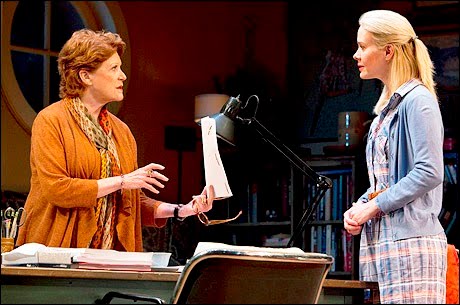
Two of the recognized plays, Collected Stories and Race, are structured to make you deconstruct both sides of an argument that doesn’t have a clear right or wrong answer. While that might sound like it can’t possibly result in entertaining theater, the performances give life to these very wordy plays. Collected Stories, the second Donald Margulies play produced by Manhattan Theatre Club this season, is essentially a series of discussions between two women, a celebrated author and her up-and-coming student. Linda Lavin, who plays the author, is up for Best Leading Actress for this strong performance. Race, the second David Mamet play to be seen on Broadway this season, uses the backdrop of a law firm defending a white man charged with raping a black woman to discuss the difficult topic of race relations. Noticed for Scenic Design, Race also received a Featured Actor nomination for David Alan Grier, playing the black lawyer on the case.

Much more plot-based than either Race or Collected Stories, Geoffrey Nauffts’s Next Fall is extremely
 thought-provoking in a different way. Next Fall presents two different ideas of Christianity and religion in general, seen from both an agnostic and Christian standpoint. The play centers around a gay couple, Adam (agnostic) and Luke (religious), as they try to overcome this major disparity in their relationship. At times funny (Jesse McCartney music makes an appearance) and at times heartbreaking, the struggle of these two men is shown without judgment. The audience members are the judges, most of whom picked a side before entering the theater. Next Fall is recognized for Best Play and Best Direction, due to Geoffrey Nauffts' ability to present different views on religion and write a compelling love story at the same time.
Originally a limited run at Manhattan Theatre Club, Time Stands Still closed March 27, but if you missed this Best New Play contender with Laura Linney, a Best Leading Actress nominee, you’re in luck. The first Donald Margulies play of the season is coming back to Broadway in the fall as a commercial production. Time Stands Still tells the story of photojournalist Sarah (Linney) and what happened to her life after she is injured while on assignment in Iraq. Sarah is so devoted to her job of observing the world that she finds it hard to participate and connect without her camera. We can’t escape the news reports of the war our country is currently engaged in, but rarely do we stop and think about those people who bring us our information. Time Stands Still places them firmly in our consciousness.
Of the eight plays currently running on Broadway, seven are Tony nominees for the 2009/2010 season, and God of Carnage, the only other play, is last year’s Tony winner for Best New Play, though it will close June 27. You have your pick of comedy or drama, new play or revival. The season has been kind to the playgoing theatergoer, as every play has something to offer. Which plays are you going to see?
Tweet
Labels: Awards, Denzel, Laura Linney, Mamet, Sondheim, Theater, Viola Davis, Walken
TO READ ON, CLICK HERE
Friday, January 09, 2009
You never forget the truth; it just gets easier to lie

By Edward Copeland
No matter how well manicured the lawn, how well dressed and behaved the couple, you can never be certain what's going on once the front door is closed, especially in the 1950s suburbia of Sam Mendes' Revolutionary Road, a film some are finding depressing beyond words but which I found riveting and remarkable.
Kate Winslet has compiled an impressive body of work in nearly a decade and a half and she's only 33 and in my opinion Revolutionary Road may be the topper. As April Wheeler, the young '50s housewife whose life hasn't gone in any direction that she'd hoped for or enjoyed, Winslet is magnificent. When I mentioned on Facebook that Winslet has the Oscar in the bag, no matter what degree you like or dislike Revolutionary Road, someone wrote to the effect "unless the viewer had slit their throat first."
While it's certainly true that the film is not a laugh riot, I had nowhere near that reaction and I still think even the film's biggest detractors have to recognize Winslet's brilliance here (plus if she's a double nominee this year bringing her career total to seven, will they want to make her the losingest actress of all time?).
Revolutionary Road is not a film like The Hours, where after a screening a journalist asked, "Cyanide capsules for everyone?" Now, that was a film that made a viewer contemplate ending one's life. Unlike The Hours, Revolutionary Road is well acted, well written and well directed on every level.
As much as I love Winslet, I don't want to leave the impression that she's the whole show because Leonardo DiCaprio gives one of his best performances as well as her husband Frank, similarly given to uncertainty about where he's going and where he wants to be. He's not a faithful husband, but the film doesn't make him guilty for the marital fissure. Alice is equally responsible, yet neither is to blame.
In addition to the great work by the leads, there is solid support from Dylan Baker, Kathy Bates, David Barbour and Kathryn Hahn, among others. The prize among the supporting players though goes to Michael Shannon as Bates' unstable son. If Viola Davis deserves Oscar consideration for her single lengthy scene in Doubt, then Shannon is equally worthy for his two electric appearances in Revolutionary Road.
Sam Mendes beautifully tells the tale through Justin Haythe's adaptation of Richard Yates' novel in his best film since his Oscar-winning debut with American Beauty. While Mendes is again dealing with suburbia, albeit period suburbia, it's not a satiric take and the time period almost is irrelevant because the sadness and truths are universal and heartbreaking.
While I can see why the film would be a depressing time for some, for me Revolutionary Road is one of 2008's best films.
Tweet
Labels: 00s, DiCaprio, K. Bates, Michael Shannon, Viola Davis, Winslet
TO READ ON, CLICK HERE
Monday, January 05, 2009
Unholy Suspicions

By Josh R
The 18th century poet and essayist Samuel Johnson declared that “He is no wise man who will quit a certainty for an uncertainty.” There would seem to be little room for questioning the soundness of that logic — that is, until one considers just what a dangerous thing absolute certainty can be. In a world where most people will never allow themselves to question that which they believe to be true (a condition hardly limited to religious fundamentalists), the very lack of uncertainty can become an impediment to progress and understanding. With all due respect to Mr. Johnson, he is no wise man who will quit uncertainty for rigid inflexibility on all matters he is certain of.
Now that we’ve taken Mr. Johnson to task, it may be time to cut him some slack — after all, he didn’t have to swallow the rationalizations of the Bush administration (even at this late date, Fearless Leader still believes with all his heart and soul that takin’ out Saddam was best for America — and, to be fair, the hundreds of American kids who got shot down or blown up in Iraq might just as easily have died in domestic hunting accidents.) Modern political blunders aside, Johnson might also have amended or qualified his panegyric to the state of unblinking certitude had he lived long enough to cross paths with Sister Aloysius, the central character of John Patrick Shanley’s Doubt and the sort of ironclad dogmatist no 18th century philosopher ever stood a hope in hell of matching swords with.
The imperious headmistress of a Bronx parochial school in the mid-1960s, Sister Aloysius is guided in equal measures by an unshakable faith, unswerving adherence to tradition and an unwavering certainty in her own convictions. Ambiguity has no place in her universe, just as there is no likelihood of her budging one fraction of an inch on any firmly held position — and as played by Meryl Streep, it would seem that she is about as open to persuasion as a rhinoceros in full-on charge mode. Come hell or high water, she will trample everything in her path, only later looking back to survey the damage. You can only proceed with such lack of caution — to say nothing of lack of guilt — when you know that you’re right.
Adapted from his Pulitzer Prize-winning play of the same name, writer-director Shanley has opened up what essentially existed on the stage as an insular chamber piece to a broader consideration of the national mood at a specific moment in America’s turbulent socio-political history. In the wake of the Kennedy assassination and on the brink of Vietnam, postwar confidence had been eroded to the point that nearly every established truth seemed up for grabs; then, as in now, it was often hard to tell the good guys from the bad guys. Viewed from a certain perspective, Doubt has no heroes or villains to speak of — or, to be accurate, either of the two main characters could exist as both, or as neither. At surface value, the adversarial relationship between Sister Aloysius and Father Flynn (Philip Seymour Hoffman), the young parish priest whose progressive attitudes diverge sharply from Aloysius’ traditionalist views on faith and education, represents generational conflict. On the other, it is also a de facto battle between good and evil, righteousness and hypocrisy, truth and folly — as to which person best represents which values, the playwright isn’t about to say.
The guessing game begins with a suspicion — or rather, an uneasy feeling that paves the way for suspicion, and with minimal provocation develops into an accusation. Sister Aloysius’ gut tells her that the popular and charismatic Father Flynn — who relates to the students in a much more informal and personal way than she deems necessary — may be guilty of improper conduct with one or more of the boys in his charge. Without specifying the exact nature of her fears, she instructs her subordinates to be on the lookout for suspicious behavior. When the naïve and impressionable Sister James (Amy Adams) reports an incident of somewhat questionable behavior — perhaps innocent, perhaps not — involving the priest and the school’s only African-American pupil, the grim reaction of Sister Aloysius confirms that she is set on a course from which she will not falter. From this point on, she will broach no contradiction of what she believes to be the truth, and elicit a confession of guilt regardless of what, or who, must be sacrificed in the process.
While Shanley has widened his scope to encompass a broader range of themes, Doubt still functions primarily as an actors’ showcase. Long before casting for the film was announced, it was a given that Meryl Streep would be playing the role of Aloysius; I said as much to my theater companion after the curtain had gone down at Manhattan Theater Club, where Doubt began before moving on to an extended engagement on Broadway. Unless she’s dancing across rooftops lip-synching ABBA standards, Streep may be incapable of giving a bad performance; she certainly creates a forceful impression as the implacable Aloysius, and brings the requisite dramatic fire to scenes that couldn’t work in the absence of theatricality. It must be said, however, that she lacks some of the shading and nuance that Cherry Jones, the role’s originator, brought to the part. This Aloysius verges on the monochromatic, with motives that are much more transparent and easier to place — consequently, there’s a bit of an imbalance at work in the Flynn-Aloysius conflict, which in this context can’t avoid feeling a bit one-sided. Jones tempered her austerity with some welcome flashes of humor and spirit — it makes sense, from a dramatic standpoint, for Aloysius to be tightly wound and joyless, but it doesn’t leave as much room for ambiguity, something Doubt requires by its very definition in order to be compelling. This Aloysius seems to be willing to believe the worst about the priest — who becomes a much more sympathetic character than he perhaps ought to be in Philip Seymour Hoffman’s interpretation — because she just flat-out doesn’t like him; that’s what guides her impulses, and makes it difficult for the audience to trust the validity of her positions. Streep is still something to see, though. Even if, to a certain extent, she misses the boat in terms of what the film is actually about, it is nonetheless a smoothly executed, and eminently entertaining performance.
Better still is Hoffman, who is in every way superior to Brian F. O’Byrne, the Irish-born actor who played the role on Broadway and couldn’t avoid seeming stiff and oratorical while wrestling with a thick Bronx accent that unleashed itself upon Shanley’s dialogue like a team of attack dogs. If Hoffman makes the character a bit more likable than perhaps he should be — again, it’s easy to know which side to pick in this interpretation — it is a beautifully calibrated, deeply felt performance which makes it very clear why people would be naturally drawn to Father Flynn, and allow him a bit more latitude than is his honest due. Less successful is the very pale, frail-looking Amy Adams, who is all tremulous delicacy as the put-upon Sister James. While it is true that the character becomes something of a pawn in the Aloysius-Flynn power struggle, James needs to come across as something more than a deer caught in the headlights. We never really believe that she has it in her to summon the spirit to stand up to Aloysius; for the most part, she looks as she ought to be shivering on street corners with her big saucer eyes selling matches. Standing up to Aloysius — and Meryl Streep, for that matter — is not a problem for Viola Davis, who brings a vivid combination of toughness and emotionalism to the small but pivotal role of the student’s mother.
Perhaps the most marked difference between the stage and film versions of Doubt — and again, part of this can be attributed to Streep’s more dour take on the central role — is that some of the energy and suspense (even, I daresay, the fun) of the original incarnation seems to have been lost in translation. The tone is much darker here than it seemed in the previous context — not in the least because the story takes place under a perpetually gray, drizzling Bronx sky with stern-faced stone angels looking ominously on. Within the confines of a single, contained space — in which the focus seemed limited to the battle-of-the-wills between two shrewd, engaged combatants — there was a crackling energy that the film version doesn’t even really begin to replicate. The impact is further diluted by an opening-up that draws the focus away from the central conflict. Shanley has, perhaps unwisely, added an autobiographical character (introduced to us as the film’s beginning, before any of the other characters have appeared) who was not featured in the play — the story is based on events that actually occurred within the playwright’s childhood, although he’s never said whether or not the real Father Flynn was, in fact, guilty of the crimes with which he was charged. As a director, Shanley doesn’t really have much of a sense of visual style — it’s possible that a more seasoned helmer might have found ways to bring a more varied look to the proceedings, thus avoiding a sense of lugubriousness. That said, the writer’s impulse to protect his vision, without the interference of another party who might try to make Doubt into something a bit more audience-friendly, is understandable. Ultimately, this Doubt is true to its origins, and delivers when it adheres closely to the original script. It is a worthy and interesting cinematic adaptation, even if not quite as successful as it might have been.
But of that I can’t be certain.
Tweet
Labels: 00s, Amy Adams, P.S. Hoffman, Streep, Theater, Viola Davis
TO READ ON, CLICK HERE


