Wednesday, May 29, 2013
"My Rifle, My Pony and Me" (Rio Bravo tribute, Part II)

While Sheriff Chance took on a major task by arresting Joe Burdette and incarcerating him in his small Presidio County jail, with Stumpy left to guard the bad guy most of the time, he still bears the responsibility for maintaining the law elsewhere in his town, something he accomplishes through street patrols and his nights staying at The Hotel Alamo (of all the names to pick) run by Carlos Robante (Pedro Gonzalez Gonzalez) and his wife Consuela (Estelita Rodriguez). One night, a poker game piques his interest as two of the players (Angie Dickinson, Walter Barnes) fit the profile of two hustlers warned about on handbills. After a cursory investigation, Chance arrests the woman, who goes by the name Feathers. She declares her innocence and Chance fails to find the crooked cards on her after she's left the table following a huge winning streak. When he returns though, he does find the stacked deck on the man, who has raked it in since her departure and tells him to return his ill-gotten gains and be on the morning stagecoach. He suggests that Feathers do the same, but she decides to stick around.

That next day, the Burdettes arrive as expected, led by Joe's smooth brother Nathan (John Russell, the gaunt, veteran actor of mostly Westerns where he usually played the villain. His second-to-last film was as the cold-blooded killer in Clint Eastwood's Pale Rider). He asks Chance why the streets appear so full of people. Chance offers no explanation, but suggests that perhaps gawkers came to town, drawn to the possibility that the Burdettes planned to put on a show.

Chance makes his nightly trek to the Hotel Alamo. When he gets there, Spencer pulls him over for a drink. The wagon master has heard of the trouble Chance faces. "A game-legged old man and a drunk. That's all you got?" Spencer asks in disbelief. "That's what I got," Chance responds. Spencer offers himself and his men as help against the Burdettes, but the sheriff expresses reluctance to take responsibility for others. He does ask about the confident young gunman Colorado that Spencer has hired. If he is as good as he thinks he is and lacks the family ties of the older men, Chance would be willing to take him on if Colorado agrees. Spencer calls Colorado over, but the young man politely declines, earning Chance's respect for being smart enough to know when to sit out a fight. Not long afterward, while Feathers flirts again and Chance urges her to get on the morning stage, shots ring out on the street and Spencer falls dead. Later, Nathan Burdette makes his first visit to see his brother Joe, despite Stumpy's withering verbal assaults, at the jail. First, Nathan wants the sheriff to
 explain why his brother looks so beat up. "He didn't take too kindly to being arrested for murder," Chance tells Nathan while Joe denies the shooting was murder. Nathan asks how Chance can be so certain or, at the very least, why Joe isn't being tried where the alleged murder occurred. Chance nixes that idea, content to let the U.S. marshal handle Joe Burdette and try him elsewhere. Nathan silkily makes no overt threats, but certainly implies that Joe might not remain in the Presidio County jail by the time that marshal shows up, especially if the sheriff relies on a drunk and an old man as his backup. Chance isn't in a mood to hide his cards. "You're a rich man, Burdette. Big ranch, pay a lot of people to do what you want 'em to do. And you got a brother. He's no good but he's your brother. He committed 20 murders you'd try and see he didn't hang for 'em," the sheriff spits out. "I don't like that kinda talk. Now you're practically accusing me," Nathan Burdette says, but Chance continues. "Let's get this straight. You don't like? I don't like a lot of things. I don't like your men sittin' on the road bottling up this town. I don't like your men watching us, trying to catch us with our backs turned. And I don't like it when a friend of mine offers to help and 20 minutes later he's dead! And i don't like you, Burdette, because you set it up." If war wasn't brewing before, it was now.
The murder of Spencer fully incorporates the last two major characters more fully into the film and the action. With his boss dead, Colorado at first finds himself content to take his pay from the slain wagon master's possessions and remains determined to mind his own business. Once he witnesses some more of the Burdette brutality, Colorado decides to join up and Chance deputizes him. Colorado becomes part of the team and helps Chance escape an ambush, an ambush for which the sheriff seems prepared to occur, quickly pumping off rounds from his rifle. "You always leave the carbine cocked?" Colorado asks. "Only when I carry it," Chance replies. Originally, Hawks opposed casting Ricky Nelson, though the director admits he probably boosted box office. He had sought someone popular with young viewers, but felt Nelson — who turned 18 during filming — lacked age and experience for the part. Hawks had chased Elvis Presley for the role, but as often was the case, Col. Tom Parker demanded too much money for his client and the Rio Bravo production had to take a pass. The pseudo love affair between Feathers and Chance also heats up, though Wayne's discomfort with the romantic scenes with Dickinson is readily apparent. Wayne felt uneasy about the 25-year age gap between him and Dickinson. On top of that, nervous studio bosses wanted no implication made that Chance and Feathers ever sleep together. Double entendres and innuendos abound, but truthfully more sparks fly in brief scenes between Martin and Dickinson and Nelson and Dickinson than ever produce friction in the Wayne-Dickinson scenes. What becomes most interesting about the relationship between Feathers and Chance is Feathers' transformation into the sheriff's protector, keeping watch over him as he sleeps to make sure that no Burdette makes a move on him.


You don't need to know how the rest of Rio Bravo unfolds. Besides, part of what makes the film so fascinating and more than your ordinary Western comes from the multiple tones Hawks balances. A viewer seeing Rio Bravo for the first time couldn't positively predict what mood shall prevail by the final reel: light-hearted, tragic, heroic, romantic, some combination of those elements. At any given moment, you might change your mind. Most of this uncertainty reflects the nature of the character Dude. With the possible exception of Feathers, almost every other character in the film stays on a static path. Dude captures our attention the most because of the dynamics within him. Will he maintain the upper hand in his battle with booze or will he fall off the wagon again and if he does, what consequences does that
 have for the others? Even sober, he's prone to depression, low self-esteem and self-pity. Still, he can croon a song or be a crack shot. A part this multifaceted requires a talented actor and back when Rio Bravo was made, Dean Martin wouldn't be one of the first names to jump to your mind. However, in the years 1958 and 1959, soon after the end of his partnership with Jerry Lewis, Martin turned in two impressive performances (perhaps three, but I haven't seen 1958's The Young Lions). In 1958, he gave a great turn as a professional gambler Bama Dillert in Vincente Minnelli's adaptation of the James Jones novel Some Came Running starring Frank Sinatra and Shirley MacLaine. He followed that with his astoundingly good work in Rio Bravo. While Martin continue to make entertaining films, for some reason those two years stand out as an aberration and he never got roles as good as Bama Dillert or Dude again.
Hawks' behind-the-scenes collaborators provided as much of the magic of Rio Bravo as its cast. From Russell Harlan's crisp and lush cinematography to Tiomkin's score that complements Hawks' leisurely pacing well. Tiomkin also teamed with lyricist Paul Francis West for the film's songs — "Cindy" and "My Rifle, My Pony and Me" in the extended musical interlude by Dude, Stumpy and
 Colorado as well as the title song. Reportedly, Wayne joined the singing at one point until they decided it inappropriate for the sheriff to take part (and also because the Duke allegedly could not carry a tune). In another instance of borrowing from past work, at Wayne's suggestion, Tiomkin actually reworked the theme to Red River into the song "My Rifle, My Pony and Me." Tiomkin also composed "Degüello," aka "The Cutthroat Song," which the Burdettes play to psych out the good guys guarding Joe. The film claims the music comes from Mexico where Santa Anna's soldiers played it continuously to unnerve those holed up inside the Alamo. Wayne loved the music and the story so much, even though the tale wasn't true, he used it in his film The Alamo the following year. His screenwriting team of Jules Furthman and Leigh Brackett both had worked with Hawks as a team and separately before and after Rio Bravo. Previously, Furthman and Brackett co-wrote Hawks' classic 1946 take on The Big Sleep. Furthman also co-wrote Come and Get It and To Have and Have Not and did a solo turn on Only Angels Have Wings. The legendary Brackett, despite her extensive screenwriting work, made a name for herself as a novelist, largely in the male-dominated field of science fiction. In Schickel's commentary, he refers to Brackett as an example of a real life Hawksian woman. In fact, before her death, the last screenplay she co-wrote was The Empire Strikes Back. In another non-Hawks project, she returned to Philip Marlowe when she wrote the screenplay for Robert Altman's The Long Goodbye. In addition to the Hawks titles already mentioned for Brackett, she also wrote the screenplay for 1962's Hatari! and co-wrote 1970's Rio Lobo. The DVD commentary also includes director John Carpenter, who names Hawks as his favorite director, and paid tribute to Leigh Brackett by naming the sheriff in the original Halloween after her.
Tweet
Labels: 50s, Altman, Angie Dickinson, Blog-a-thons, Dean Martin, Eastwood, Elvis, Hawks, Jerry Lewis, John Carpenter, MacLaine, Movie Tributes, Sinatra, Star Wars, W. Brennan, Wayne
TO READ ON, CLICK HERE


Wednesday, March 14, 2012
The Forest and Through the Trees

By Adam Ross
Horror movie franchises are typically based around an enduring villain (i.e. Frankenstein, Dracula, Jason Voorhees) but as The Evil Dead series gears up for another installment and celebrates the 25th anniversary of Evil Dead 2: Dead By Dawn, it's worth noting that its popularity is rooted in a constant hero. Played with career-defining conviction by Bruce Campbell, Ash has become one of the most popular modern movie heroes partly because we know he takes as much pain as he gives. When Evil Dead 2 premiered in 1987, it arrived as a sequel to a movie (The Evil Dead) which garnered only a microscopic theatrical release and, to those few who were familiar with the original, the new incarnation seemed more like a remake than a sequel. Even today it's still worth debating whether it's a true sequel or not, but it's undeniable in 2012 that Evil Dead 2 left a lasting fingerprint on the horror genre.
Six years passed between The Evil Dead and its sequel, an eternity in terms of horror follow-ups. Friday the 13th premiered in 1980, and by 1989 we already had Friday the 13th Part VIII: Jason Takes Manhattan. The Halloween franchise was readying its fifth installment by then, and the Nightmare On Elm Street series (which debuted in 1984) released No. 5 that year. While the aforementioned '80s horror standbys preyed on the audience's familiarity with their respective villains (needing only fresh victims or a new plot novelty in each iteration), the team behind The Evil Dead was banking on a returning hero with a plot that wasn't entirely original. Helped by an overly enthusiastic recommendation by author Stephen King, The Evil Dead was a modest box office hit, but thanks to its minuscule budget still turned a tidy profit. Short on budget, but not creativity, the original movie introduced the world to Ash (Bruce Campbell), who helped his friends fight off unseen evil from their isolated forest cabin. Compared to its follow-ups, The Evil Dead is more of a straightforward horror movie, with less emphasis on gross-out effects or slapstick humor. Behind the camera of The Evil Dead was the brotherly duo of Sam and Ted Raimi, along with a band of former Michigan State University students (including Campbell) with an affinity for horror movies.
The international success of The Evil Dead caught the attention of Italian film magnate Dino De Laurentiis, in particular the directing talents of Sam Raimi. Though De Laurentiis initially focused on having Raimi direct an adaptation of a King novel, the producer eventually
 greenlit a $3.6 million budget for Raimi and his crew to start work on Evil Dead 2. Acknowledging that most audiences were not familiar with The Evil Dead, the original script called for a preface with flashbacks to the first film ala The Road Warrior. But since Evil Dead 2 would be financed and distributed by another company, the filmmakers did not have license to use footage from the original movie. This legal setback was the genesis for making Evil Dead 2 more of a reboot plotwise of The Evil Dead. This was a positive for the sequel, because the predecessor's plot was ripe with potential for Raimi and company's larger budget. Writer Scott Spiegel was a utility man of sorts on The Evil Dead, performing a number of roles behind and in front of the camera. Spiegel was well known to the Raimi brothers and Campbell from their days as young amateur filmmakers in Michigan. For Evil Dead 2, he was tapped by Sam Raimi to co-write the script with him, and he is credited with the idea for bringing a more comedic and slapstick element to the movie. Evil Dead 2 would have the same setting and basic horror elements of The Evil Dead, but would include more characters, stunts, monsters, gore, laughs and pain.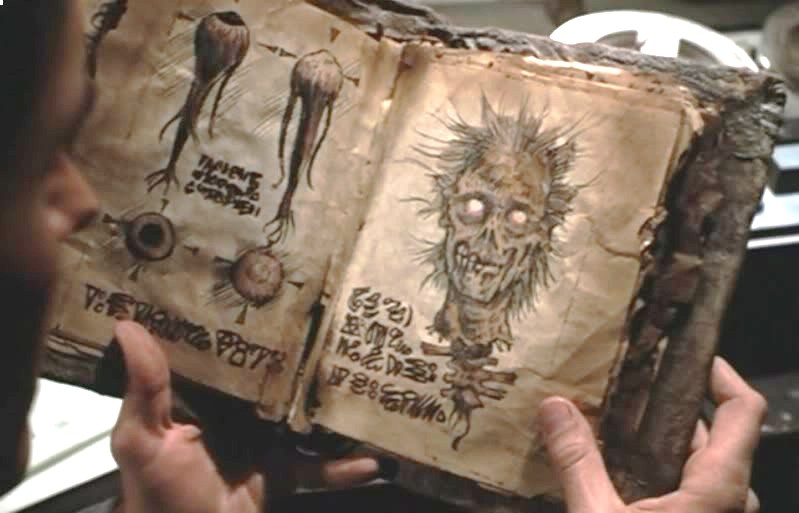
The movie starts again with Ash traveling to a remote cabin, this time with girlfriend Linda in tow. Little time is wasted before the MacGuffin from the original movie is introduced: the Necronomicon, or Book of the Dead. When Ash unwittingly plays a recording from the cabin's previous tenant (an archaeologist) reading from this cursed book, terrible forces start to attack the residence. After his girlfriend is possessed and attacks Ash, the movie briefly becomes a one-man show as our hero is attacked continually by forces ranging from the forest itself, the corpse of his girlfriend and even his own hand. The infamous scene where Ash must amputate his hand is one of the series' lasting images and illustrates the creative gulf between Team Raimi's vision of horror, and the typical slasher fare that populated theaters at the time. In freeing himself of the evil infection, Ash also painfully handicapped himself (however briefly) in a still ongoing fight against murderous forces. Before reinforcements arrive, Ash seemingly hits rock bottom when fountains of blood erupt from the walls and the house itself starts to laugh at him, but the real madness hasn't even begun.
The remaining cast is introduced when the archaeologist's daughter, Annie, and her team arrive at the cabin fresh from a dig, armed with more pages from the Necronomicon. This seemingly good news for Ash soon is spoiled when he promptly gets pummeled by one of Annie's assistants, mistaking him for a murderous lunatic (admittedly not far from the truth). This brief reprieve from paranormal punishment only lets the audience catch their breath for a moment before the intensity is again ratcheted up to new levels. This exhaustive pace is what makes Evil Dead 2 so refreshing compared to many horror movies still being poured into the same old molds. No killers lurk behind doors, no cars refuse to start — our characters barely can sit down in this tiny cabin without some new evil attacking them.

While the basis of the story was ported over from The Evil Dead, near the midpoint of Evil Dead 2 it firmly becomes its own movie, and that's when it merrily jumps off the rails. Raimi even includes a fun callback to the original movie. When Ash is locked in the basement by the new visitors and fights to escape, the action becomes a tribute to the monster in The Evil Dead, which spent many scenes vainly locked in that same room. The ridiculous climax where the forest itself starts to lay siege to the cabin, is a gleeful exercise by Raimi in one-upping every over-the-top gag you've seen so far in the movie. By the time Ash finds himself face down in the dirt in the Middle Ages, it barely even registers as a surprise after all the wild turns the movie has already made.
Even though the cast is larger than its predecessor, Evil Dead 2 undoubtedly belongs to Campbell. While he had been seen in several roles prior to this movie, it was his second turn as Ash that turned an actor with a generic name into Bruce Campbell. Playing a moving target for a myriad of possessed rednecks, invisible spirits and evil forestry, Campbell takes the action on his sharp chin again and again. Campbell famously did most of his stunts in the movie, and the actor forcibly brings you into his corner by charging again and again into the teeth of the titular enemies. The physical comedy Campbell displays would become one of the actor's trademarks: overplaying each dramatic mark with wide-eyed energy, coolly delivering his signature comeback lines and gladly sacrificing his health just to survive one more minute.

When we first see Ash, he's a normal guy with a beat-up Buick. By the end, he's not only lost his hand but he seems to have emerged stronger, aided by a newly installed chainsaw limb and the confidence from surviving an unrelenting attack from beyond the grave. When Ash raises his shotgun to lead his medieval followers, it's hard to doubt they will find victory together. Part of Ash's longevity as an action hero (he's been featured in video games, an iPhone app, comic books and various cameo appearances) has to be attributed to his rare standing as an everyman: he drives a crappy car, his idea of a vacation is a broken down cabin deep in the woods, he has some skills as a handyman, but prefers forcing the issue. Best of all, Ash doesn't run like so many horror movie characters — though it's not like he has a choice since a whole forest seems to be against him — he subscribes to the thinking that a good defense is a really good offense.
Evil Dead 2 became such a star-making turn for Campbell (and his character) that the series' third installment, Army of Darkness, relies more on the momentum and charm of Ash to carry it than simply continuing the previous movie's storyline. Compared to its predecessors, Army of Darkness is more adventure/sword and sorcery than horror, but still plows ahead with the same blunt-edged humor of Evil Dead 2. Featuring painful physicality, winking puns and Clint Eastwood-style one liners, the comedy of Evil Dead 2 and Army of Darkness has lived on in movies like Shaun of the Dead, Hellboy and, most recently, Tucker & Dale Vs. Evil. But Hollywood has yet to find another character with Ash's effortless courage in the face of terror combined with innocent charm. In most of Campbell's roles since the Evil Dead series, it's hard to tell where Ash ends and Campbell begins, or if the character is simply the actor playing it straight.
As the series marches on toward another sequel in the next couple years (with the story rumored to be another spinoff from The Evil Dead's framework), this low budget gross-out horror comedy only has increased in popularity through the decades. What did Evil Dead 2 do so right that so many of its peers could not? The best answer may be the best possible pairing of onscreen and offscreen talent. Sam Raimi has since proved his directing chops many times over with the likes of A Simple Plan, the Spider-Man trilogy and, most recently, Drag Me to Hell, and Campbell began a career as a cult action star with his performance here. When the two came together on screen with a script that pushed the envelope of typical horror conventions, the result was bloody good.
"Groovy."
Tweet
Labels: 80s, Bruce Campbell, Eastwood, Movie Tributes, Raimi, Remakes, Sequels
TO READ ON, CLICK HERE
Tuesday, February 21, 2012
A movie about being someone not doing something

By Edward Copeland
If you're like me, it drives you nuts when the so-called cable news channels continue to call something "breaking news" hours or even days after the initial event occurred. That's why I wonder if I'm wasting space by beginning my review of The Iron Lady heaping praise on Meryl Streep's performance as Margaret Thatcher. Streep Delivers Good Performance isn't exactly a jaw-dropping revelation by now, is it? If it were someone such as Kate Capshaw or Lori Petty turning in a bravura portrayal of the former prime minister of Great Britain, that would be news (as well as a sign of the impending apocalypse). Streep's work though happens to be what's best about The Iron Lady, which otherwise does not offer much worth lauding. Since most of this post consists of brickbats, I may as well begin with something nice.
Actually, I do have something else positive to say about The Iron Lady. The Oscar-nominated makeup job that Mark Coulier and J. Roy Helland performed on Meryl Streep to make her look like Margaret Thatcher at various ages deserves the highest praise. It not only succeeds at its primary goal, but achieves this effect without betraying that it is makeup (as opposed to the horrific prosthetics that Leonardo DiCaprio and Armie Hammer suffered beneath in J. Edgar). Coulier's credits include being involved in the prosthetic makeup on all of the Harry Potter films as well as working with the prosthetics on Star Wars: Attack of the Clones and Star Wars: The Phantom Menace, where Coulier also did work with animatronics. Helland has served as Streep's makeup and hair stylist on practically every film she's made dating back to 1982's Still of the Night.
It seems appropriate that Clint Eastwood's J. Edgar should come up while discussing The Iron Lady because both exemplify the difficulty filmmakers have making biopics. Somewhere, a book must exist on writing the screenplays for movies about historical figures and chapter one must emphasize, "Find a Framing Device." Inevitably, this almost always means having the movie's subject look back at his or her life (unless it's an epic biopic and the protagonist got killed or assassinated — then the film must begin with his death as in Lawrence of Arabia or Gandhi). In both of the 2011 films about Hoover and Thatcher, the results suffer from Cliffs Notes-like summaries of the subject's greatest hits. At least in J. Edgar, despite the hideous makeup, it comes in the form of Hoover dictating memoirs to a series of agents Hoover enlists as typists, which makes that film slightly better than The Iron Lady, which chooses the controversial path of having the current Thatcher, in her 80s and suffering from Alzheimer's, going through old items and believing she's having conversations with her long-dead husband Denis (played with a complete sense of frivolity by Jim Broadbent, who behaves at times as if he's back on the set of Moulin Rouge waiting for his cue to break out into "Like a Virgin.")
If you go by the description of the film put on The Weinstein Company's official website for the movie, it's hard not to laugh since their description doesn't really match what's on the screen, but then the paragraph below that admits how telling a factual story wasn't a top priority either.
"Set in the present day, The Iron Lady finds Margaret Thatcher, now in her 80s, struggling with the confines of her simple domestic life in Chester Square, London. Haunted by visions of her deceased husband Denis, Margaret is swept away by memories of her past — both personal and political — which shaped her life and career. As Margaret traces her rise to political prominence…(she) must come to terms with a legacy that is both admired and reviled, and grapple with the great personal cost that her convictions have exacted on her supporters, her family, and, finally, herself."
Sounds like that would make for a fascinating movie. Unfortunately, The Iron Lady didn't end up being that movie. I do have to ask if there's an implication that Thatcher's convictions somehow led to her Alzheimer's. Myself, a political and history buff, I would have liked to see an exploration of Thatcher's rise to power and the nitty-gritty of her governance with more that explained why her policies drew both admiration and revulsion. Instead, we keep returning to her old-age dementia and occasionally flash back to her young days as a student (where she's played by Alexandra Roach) and the movie seems like a remake of Iris. The Iron Lady though, much like J. Edgar, lacks any sort of attitude toward its subject. Look how that same website describe the film's director's approach (and why on earth would she be the choice for the film in the first place?)
"Combining fact, fiction and poetic flights of imagination into a new breed of biopic, director Phyllida Lloyd (Mamma Mia!) creates a piercing portrait which reveals the many faces of Margaret Thatcher: the hard-nosed conservative; the woman who demolished barriers of gender and class in a male-dominated world; the spirited wife and mother who longed to change her country for the better. Exposing the private life behind the headlines, The Iron Lady is a moving journey into the heart of an extraordinary complex woman."
On the plus side, Law's "poetic flights of imagination" didn't include having Streep crawl across the roof of No. 10 Downing Street singing some appropriate cut from Pink Floyd's "Wish You Were Here" as a group of protesters appear from nowhere and begin crawling toward her. Actually, that might have improved the movie. I can't be certain this portion of The Iron Lady falls into fact, fiction or a poetic flight, but in a flashback to Thatcher (then Roberts) and her first runs for office as a Conservative seeking the strong Labour seat at Dartford in 1950 and 1951, she meets Denis Thatcher, who proposes and they wed in late 1951. After his proposal, the film shows them dancing to "Shall We Dance?" from Rodgers and Hammerstein's musical The King and I, which didn't open on Broadway until March 1951 and didn't mount a West End production until 1953. How soon the original cast recording came out and the song made its way across the ocean, I have no idea.
As if selecting Lloyd as director for her second feature film wasn't an odd enough choice, the screenwriter turns out to be Abi Morgan, co-writer of the overrated, empty-headed Shame so I suppose we should be grateful that we didn't get any scenes of Maggie in bondage gear. Actually, adding Meryl Streep as Margaret Thatcher to Shame might have helped that film — Lord knows all the characters in that film needed a stern talking to. I should say, to Morgan's credit, she also wrote the fine HBO miniseries Tsunami: The Aftermath, so she's eclectic.
Which brings us back to Streep, the best thing The Iron Lady has going for it. She looks and sounds like Margaret Thatcher, though I have to ask — is this truly a great Streep performance or an example of great Streep mimicry? The foundation upon which she must perform isn't sturdy in the least, so how deep can Streep delve into Thatcher when she's in a movie that freely admits it's mixing fact, fiction and "poetic flights of imagination" for some new kind of biopic? Does her work in The Iron Lady really equal or top her performances in Doubt, The Devil Wears Prada, Adaptation, The Bridges of Madison County? I know it doesn't come close to A Cry in the Dark, Out of Africa or Sophie's Choice.
Tweet
Labels: 10s, Broadbent, DiCaprio, Eastwood, Hammerstein, HBO, Musicals, Rodgers, Star Wars, Streep
TO READ ON, CLICK HERE
Wednesday, January 18, 2012
How do you solve a problem like J. Edgar?


By Edward Copeland
After watching J. Edgar, I prepared to write my usual review, assessing the film overall for its direction, writing, performances and other technical qualities, but something kept sticking in my mind, preventing me from focusing on those aspects. My brain kept drifting back to a different question, one that has puzzled me in many movies for a long time but that reared its ugly head — literally — once again as I watched J. Edgar. Why in the 21st century, with all of the advancements that have been made in visual effects, does old age makeup still turn up so often looking so laughably bad as it does? It does such a disservice to the performers trying to act beneath the horrible messes slapped upon their visages. How can you concentrate on the performances of Leonardo DiCaprio, Armie Hammer and Naomi Watts in their characters' later years when their faces have been marred by such silly appliances? It doesn't always hurt — Jennifer Connelly won an Oscar for A Beautiful Mind despite the awful makeup that covered her at the end of that movie (or, more recently, Kate Winslet's awful aging in The Reader). What's more mystifying is when you look back at a film such as Arthur Penn's Little Big Man in 1970 and how great the old-age makeup on Dustin Hoffman was in that film. Enough on that subject. With that off my chest, I believe I'm ready to discuss the rest of J. Edgar now, truly a mixed bag of a movie if ever there were one.
John Edgar Hoover served as the first director of the Federal Bureau of Investigation, an agency whose creation he spearheaded in 1935 after leading its predecessor, the Bureau of Investigation, since 1924. Between the two bureaus, Hoover held the top job for nearly 50 years and in eight presidential administrations from Coolidge to Nixon. Hoover truly defined what it meant to be a man of contradictions. He led the way in modernizing many crucial techniques in criminal investigations such as fingerprinting and forensics but also frequently stepped outside the law to amass information on perceived enemies, either to himself or the country. His private life contained its own secrets, namely his close, perhaps gay, relationship with top assistant Clyde Tolson. At least as the movie portrays it, Hoover's paranoia about being gay stemmed from his mother, who once told him, "I would rather have a dead son than a daffodil for a son."
To compress a life full full of such huge historical events alongside the inner life of a man would be a challenge for any screenwriter and any director. While Dustin Lance Black (Oscar-winning writer of Milk) and two-time Oscar-winning director Clint Eastwood give it the old college try in J. Edgar, the sheer weight of all those years and all that material crushes them, leaving the film somewhat rudderless despite good performances.
Black's screenplay structures Hoover's life around the premise of a 1960s era Hoover (well-played by Leonardo DiCaprio, even beneath the hideous makeup) dictating his version of the events of his life to the first of several young agents, embellishing as he did in real life how much credit he deserved for various FBI triumphs. He practically claims to have shot and killed John Dillinger outside the movie theater himself, though he omits how in a pique he punished the agent who actually ended the '30s era bank robber's crime spree. Hoover, so closed-up and concerned about how he was perceived, would be a difficult role for any actor to pull off, so I don't think everyone realizes what a great job DiCaprio accomplishes here outside of those few rare moments of faint tenderness he allows himself to share with Clyde Tolson (equally well-played by Armie Hammer, so good as the Winklevoss twins in David Fincher's brilliant The Social Network.)
Because so much happened in U.S. history between 1924 and 1972, it would be damn near impossible to hit on everything that Hoover touched so the film concentrates on Communist radicals in the U.S. following the Russian Revolution, the kidnapping of the Lindbergh baby and the war on the criminals such as Dillinger in the 1930s. It also hits upon Hoover's efforts to form the FBI in the first place.
The uncertainty of his relationship with Tolson gives the film some heart. There's one scene where after a dinner together when the two men ride off together, Hoover nervously places his hand on Tolson's that's reminiscent of scenes in Jean-Jacques Annaud's The Lover and Martin Scorsese's The Age of Innocence.
Some of the more unsavory sides of Hoover's nature get short shrift such as his plans to sabotage Martin Luther King with stories of infidelity and Communist associates thinking it will get King to refuse his Nobel Peace Prize. He gets one scene with Robert Kennedy (Jeffrey Donovan) where he shows him evidence of sexual excess he has on his brother but nothing more comes of it until he hears of JFK's assassination, call his brother and tells him the president has been shot and hangs up.
Judi Dench and Naomi Watts turn in solid performances as the two important women in Hoover's life. Dench plays his mother whom Hoover lived with until her death and you see where most of his psychological blocks formed. Watts gives a subtle turn as Helen Gandy, Hoover's lifelong secretary who has as little interest in men or a family life as Hoover does in women. The film also shows her shredding Hoover's secret files upon his death while Nixon's men search frantically for them.
Aside for the dreadful makeup, J. Edgar looks exquisite in terms of cinematography, costumes and production design. Eastwood does his best trying to keep the film moving as it bounces between the various time periods, but the flaws with J. Edgar run deeper. The film lacks a compass, moral or otherwise, and desperately needs a point of view about Hoover. Imagine if this were an Oliver Stone film. Granted, his one brief touch on Hoover in Nixon had Bob Hoskins portraying him French-kissing Wilson Cruz as a pool boy, but that film itself was a surprisingly well-rounded look at Nixon himself.
J. Edgar, while DiCaprio turns in a very good performance in spite of the constraints, doesn't present a well-rounded Hoover. Everything the film has to say about the man seems drawn from quick pencil sketches on a napkin. DiCaprio manages to bring a depth to Hoover that the screenplay itself doesn't supply. In fact, based on the script's portrait, J. Edgar Hoover comes off as a smart but paranoid Forrest Gump who happened to be present at many of the key moments of the U.S. in the 20th century. Someone as consequential and important as he was, for both good and ill, needed a treatment that went beyond a Cliffs Notes version.
Tweet
Labels: 10s, Arthur Penn, Dench, DiCaprio, Dustin Hoffman, Eastwood, Fincher, Jennifer Connelly, Naomi Watts, Oliver Stone, Scorsese, Winslet
TO READ ON, CLICK HERE
Friday, December 30, 2011
"I'm just glad I'm here where it's quiet…" — Straw Dogs Part I

its 40th anniversary Thursday. If you haven't seen it and plan to at some point, best not to read this.)
By Edward Copeland
When Sam Peckinpah's classic The Wild Bunch opened in 1969, its violence drew much controversy, though many critics saw past the bloodshed to recognize the movie's significance and greatness. Two years later, Peckinpah made Straw Dogs — and it received a near-universal greeting of pans, revulsion and diatribes that accused the film of being a one-dimensional attack on intellectuals and, even worse, an endorsement of the idea that rape victims "ask for it." Liking or disliking a movie always comes down to a person's subjective opinion and ideally — I believe anyway — that assessment should be formed by the artistry (or lack thereof) that's on the screen. When you read the reviews of Straw Dogs from 1971, that seldom seemed to be the case. In fact, many critics who despised the film praised Peckinpah's craft simultaneously. Straw Dogs became the victim of cinematic profiling, watched through the prism of real-world events. People projected views formed by outside experiences onto the movie and slammed it because of what they perceived it to be. There's always been a form of film criticism that chooses to judge movies in a political context and that's fine — it's a free country. However, that school of thought tries to apply that model to every movie, sometimes to the point of ridiculousness (I have good friends who believe that Forrest Gump somehow endorses Reaganism. I belong to the camp that believes if you don't think a film's good, just say so — a negative review need not be complicated with an ideological justification. A movie such as Thor sucks, but politics has nothing to do with why I formed that opinion.) I've went way off topic — this post salutes 1971's Straw Dogs. It's ironic, considering the film's title originated as a variation of the term "straw man," roughly defined as a mediocre argument or idea put out so it can be defeated by a better one. Over the decades, more have recognized the major misinterpretation that Straw Dogs received upon release. Its 40th anniversary offers an ideal opportunity for reassessment and analysis of the film as the complex, layered thriller that I believe Peckinpah made in the first place.
While I'm too young to have seen 1971's films in first run, knowing much of the history, events and certainly the movies that year, violence definitely dominated news and entertainment. Vietnam remained front and center as the South, backed by the U.S., invaded Laos and Cambodia while the war's unpopularity grew with larger protest marches (half-a-million people at one in D.C.) and bigger majorities in polls opposing it (60% in a Harris Poll); according to FBI statistics for 1971, the U.S. murder rate jumped to 8.6 people out of every 100,000, continuing the nonstop rise that began in 1964. Stats also showed that about 816,500 were victims of violent crime and there were 46,850 reports of forcible rape — a crime that often goes unreported which it did then more than it does now; Charles Manson and his followers were convicted and sentenced to death in the Tate-LaBianca murders, though a temporary repeal of capital punishment by the California Supreme Court the following year reverted the sentences to life; Wars were taking place beyond Vietnam. East Pakistan fought Pakistan for liberation, eventually becoming Bangladesh. Later, East Pakistan got into a skirmish with India, but the new country quickly surrendered. another "war" began in the U.S. that still continues when Nixon declared the "war on drugs"; Riots weren't uncommon in the U.S., including one in Camden, N.J., that began after police beat a Puerto Rican motorist to death. A more famous riot occurred at the Attica Correctional Facility in New York when nearly half of the more
 than 2,000 inmates seized the prison, taking 33 staff hostages for four days until New York state police retook it. At least 39 people were killed, including 10 hostages; It also was the era of frequent airplane hijackings. Though not a violent one, it was the year the infamous D.B. Cooper got his money and parachuted into oblivion; Coups, usually of the military type, brought down the governments in Turkey, Sudan, Thailand, Bolivia and Uganda, which brought to power Idi Amin. That's not counting the coups that failed. That's just a cursory glance at what an uneasy world it was in 1971. Flowing into this situation were many, many movies, some that played on that fear, others that allowed for a release of that feeling of impotence. A few of the more high-profile examples:
One of my all-time favorite critics is Pauline Kael, though I disagreed with her often, but she was completely off-base in what she wrote about Straw Dogs. I've compiled some of the key things she wrote in her New Yorker review of the film:
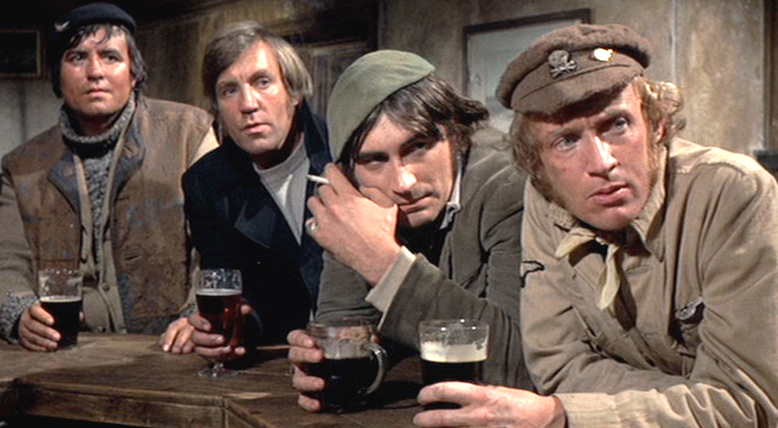
"Peckinpah's view of human experience seems to be no more than the sort of anecdote that drunks tell in bars."…"The actors are not allowed their usual freedom to become characters, because they're pawns in the overall scheme."…"The preparations are not in themselves pleasurable; the atmosphere is ominous and oppressive, but you're drawn in and you're held, because you can feel that it is building purposefully."…"The setting, the music and the people are deliberately disquieting. It is a thriller — a machine headed for destruction."…"What I am saying, I fear, is that Sam Peckinpah, who is an artist, has with Straw Dogs, made the first American film that is a fascist work of art."
While Kael mostly missed the mark, she came so close to acknowledging that she did see what Peckinpah's intentions were and that they were artistic ones, that it's almost sad. Let's look at those sentences separately. "Peckinpah's view of human experience seems to be no more than the sort of anecdote that drunks tell in bars." Mainly, that's Pauline doing what she loved to do best (and I admit I can be guilty of succumbing to myself) — thinking up a funny sentence and using it. In relation to Straw Dogs, Kael either was blinded by other factors as to what was on the screen or she refused to acknowledge that the story being told had more layers and complexity than a mere anecdote. I'll flesh out my rebuttal on that later. "The actors are not allowed their usual freedom to become characters, because they're pawns in the overall scheme." She's absolutely right here, but she's also being dishonest because as avid a moviegoer as she was she knew that not every film acts as a character study full of finely drawn portraits of the people inside. The woman who routinely answered the question, "What's your favorite film?" with 1932's Million Dollar Legs starring Jack Oakie and W.C. Fields isn't looking for that in every type of movie, especially a genre film and Straw Dogs belongs in the thriller family, albeit one with depth, intelligence and things to say. "The preparations are not in themselves pleasurable; the atmosphere is ominous and oppressive, but you're drawn in and you're held, because you can feel that it is building purposefully." Kael contradicts herself in the same sentence. All movies aren't designed to be pleasure rides, but they still can be enriching. It's the scenario I always posit among friends: You've gathered for a fun evening and you feel like watching Spielberg. What do you put in the DVD player — Jaws or Schindler's List? Just because you settle on Jaws doesn't mean that Schindler's isn't good, it's just not the type of movie you watch for a rollicking good time. The contradiction comes when she
 describes the atmosphere as "ominous," which would seem perfectly natural for a thriller and then admitting it held her attention because she could tell it was building toward something with a purpose. As I said, she was so close. That's exactly what Peckinpah was doing and did. "The setting, the music and the people are deliberately disquieting. It is a thriller — a machine headed for destruction." Finally, Pauline acknowledges that Straw Dogs is a thriller and within those two sentences, she doesn't say anything that indicates she thinks Peckinpah violated the rules of a thriller. The last sentence of Kael's that I excerpted shows where she hopped onboard a train to crazytown. "What I am saying, I fear, is that Sam Peckinpah, who is an artist, has with Straw Dogs, made the first American film that is a fascist work of art." Again, she admits Peckinpah's artistry but she claims he has used that gift to make a "fascist work of art." No wonder she prefaced that with "I fear" because one gift Kael always had, even when you disagreed with her (other than great writing skills) is that she made you re-think your opinion. She didn't necessarily change your mind, but she gave you ideas to mull. Her Straw Dogs review provides a rare example where I didn't believe that she believed the words she placed in print. Her review reads as if she wanted Straw Dogs perceived simply as a macho appeal to give in to our violent nature and a screed against intellectuals. That's what she wanted to see, but her heart and her brain seem to be having a wrestling match for control over her writing. The adjective fascist got bandied about a lot in reviews of Straw Dogs. I can see how some slapped that label onto Dirty Harry, even if I think that was an overreaction as well, because Dirty Harry carries political overtones and a point-of-view, but, as I said before, I believe films should be reviewed as films and ideology should stay out of it. What does it say then that a true fascist film such as Leni Riefenstahl's Triumph of the Will is a staple of film studies not because of content but technique? The adjective fascist should appear if a character in the movie has fascist characteristics or is a fascist, but to label a movie one — to me that's nearly as offensive as when Tipper Gore, James Baker's wife and the rest of the PMRC wanted to interpret what songs meant in the 1980s and institute stringent record labeling. As Frank Zappa said about their plans at the time, "It's like treating dandruff with decapitation." It also reminds me of what Jon Stewart said about politicians of both parties comparing opponents to Hitler. By doing that, they do a disservice to Hitler, he said, "who worked long and hard to be that evil." With that out of the way, it's high time I start talking about what actually happens in Straw Dogs. Before I do, I will say this: a bit of a pass can be given to Kael and other critics who shared her opinion and lay siege to Straw Dogs for all its perceived sins since the version that they saw wasn't the one I did. Peckinpah had to cut footage to avoid an X rating but on home media, they restored that scene. Granted, it might have elicited the same reaction, but the fact remains that when I saw Straw Dogs the first time, I literally didn't see the same cut that the critics of 1971 did — and the scene excised in 1971 got removed from the film's most controversial and debated scene, leaving only the ambiguous sexual assault that seems to turn consensual and omitting the second thug who undeniably commits rape.

The opening credits always remind me of parts of the beginning of The Wild Bunch, the titles themselves specifically naming that film's actors in semi-black-and-white (or more accurately, black-and-gray) freezes while they're on horseback. No actors lurk beneath the monochrome credits of Straw Dogs — where we first hear Fielding's foreboding score — but beneath the title cards, blurry images recall the ants overrunning the scorpion at the start of The Wild Bunch. When the picture comes into focus and color, we see that what's scurrying isn't insects but children, singing, dancing and playing with abandon — in a graveyard. Three of the youngsters circle a dog, which some interpret as torture. As someone who despises mistreatment of animals (I always say I've been screwed over by humans far more often than by dogs), it doesn't look that way to me. A few of the kids gaze through the cemetery fence at the activities in the center of the small Cornish village in England. American David Sumner (Dustin Hoffman) walks back toward his car carrying a box of supplies he's picked up while his wife Amy (Susan George), a native of the village, attracts leers as she struts down the street sans bra.


That shot, coming so early in the film, certainly had a lot to do with putting some of the critics in 1971 such as Kael on edge. She admits in her review that part of her reaction to the film probably stemmed from being a woman and if Peckinpah had placed that image of an extreme close-up of the actress's breasts with erect nipples for no apparent reason and it wasn't brought up again, I'd have been offended as well. When I first saw Straw Dogs, the shot took me aback. That looked like something you'd find in a cheap teen sex comedy in the wee hours of the morning on Cinemax, not in a Sam Peckinpah film starring Dustin Hoffman. Eventually though, it is discussed and you see the purpose — and it's not to say "some women want to be raped." We'll get to that later. I'll finish describing the opening sequence first. The teen Hedden siblings, Bobby and Janice (Lem Jones, Sally Thomsett), help Amy by carrying an antique mantrap that she purchased to her car. Charlie Venner (Del Henney) steps out of a phone booth when he catches sight of Amy. He dated Amy when she lived in the town with her father and the sight of her makes Venner salivate. In this very first sequence, Peckinpah and his editing team of Paul Davies, Tony Lawson (who'd go on to edit Kubrick's Barry Lyndon and every Neil Jordan film since Michael Collins) and Roger Spottiswoode (who also edited Peckinpah's Pat Garrett & Billy the Kid before turning to directing) set the quick-cut pattern that will dominate the movie. The director, stereotyped for slow-motion violence, paces much of Straw Dogs with split-second snapshots. Venner makes a beeline for David and Amy's car where Amy introduces Charlie to her husband. David puzzles over the mantrap that Amy bought and tries to place it in the backseat of the car with Bobby's help. David then tells Amy he's going to run into the pub to buy some cigarettes and David leaves her with Charlie, who shamelessly flirts with Amy and tries to get her to re-create old times.

When David steps into the pub, he definitely feels and looks out of place — but it's not because he's wearing a sign that reads BRILLIANT MATHEMATICIAN STUDYING THEORIES YOU PEOPLE COULD NEVER COMPREHEND. No, his clothing, his look, his voice — they all point him out as someone who doesn't hail from that Cornish village as he asks for "Two packs of American cigarettes." However, no one taunts him or mocks him — they have a bigger troublemaker to deal with, one of their own. The burly, bearded Tom Hedden (Peter Vaughan), father to Bobby and Janice and the town drunk, somehow manages to maintain a degree of respect from those younger than him. As David has entered for his smokes, Tom wants another round after
 the pub's owner, Harry Ware (Robert Keegan), announces closing time for the afternoon. Tom slams his mug down, breaking it and cutting Harry's finger. As David witnesses this, Charlie enters the pub and asks how the work on David and Amy's garage is progressing. David complains that the two men working on it seem to be dragging their feet and Charlie volunteers to come up the next day with his cousin to help them pick up the pace. Sitting quietly in the pub, observing everything, happens to be the town's magistrate, Maj. John Scott (T.J. McKenna). Tom isn't going to take no for an answer, so he flips up the opening to the bar and serves himself. Scott warns Tom that he's had his fun, but he best be off or he'll have to bring charges and Charlie and another man help the drunkard out, but not before he apologizes to Harry and leaves money for the damage as well as David's cigarettes. Vaughan plays Tom well, straddling that line between charming old lush and frightening bastard. After they've left, David gives Harry the money for the cigarettes. The pub's owner tells him he's already been paid. "You have now," David says before leaving. Most of the actor's work has been in British television productions, though he did appear in Time Bandits and Brazil for Terry Gilliam and the HBO series Game of Thrones.

It takes a bit of a drive to get to Amy and David's farmhouse and since she's driving, Amy takes her husband on a fast and wild ride to get there, partly as punishment for his queries about her past with Charlie Venner. Before they get to the farm, Amy finally admits that years ago when she lived there, Charlie made a pass at her. David and Amy appear a rather unlikely couple, but in rare moments like this or when they're getting romantic, the two do show signs of sexual compatibility. In other instances, not so much. The screenplay by
 Peckinpah and David Zelag Goodman, based on the novel The Siege of Trencher's Farm by Gordon M. Williams, makes a point of showing that David doesn't respect Amy intellectually and, more than likely, views her as a sex object as much as the leering village thugs do. When the couple arrive at the farm, one of the two workers, Norman Scutt (Ken Hutchison) stands at attention on top of the garage. Amy makes a point of making out with David in the car in full view of Norman, though you can tell it makes her husband uncomfortable. The Sumners get out of the convertible and head separate directions — Amy to the house, David to inform Scutt of his incoming help. When David tells Scutt that Venner and his cousin will be arriving the next day to help him pick up the pace on the garage project, Scutt tells him that he and Mr. Cawsey don't have that much more to do. The name doesn't ring a bell with David, but Amy bumps into Mr. Chris Cawsey (Jim Norton) inside the farmhouse. When Cawsey steps outside, David remembers, "The rat man!" Cawsey helps Scutt on the garage, but his main skill involves exterminating rodents. Scutt asks David if he needs help unloading the mantrap (which really should be referred to as "Chekhov's mantrap" since you know its antique metal teeth shall clamp down on someone before the movie ends) and he gladly accepts. Cawsey explains that the mantraps were set them out in the field to catch poachers. As the three men stand alone outside, Straw Dogs comes as close as it ever will to explicitly discussing current world events occurring in 1971.
NORMAN: I hear it's pretty rough in the States.
CHRIS: Have you seen any of it, sir? Bombing, rioting, sniping, shooting the blacks. I hear it isn't safe to walk the streets, Norman.
NORMAN: Was you involved in it, sir? I mean, did you take part?
CHRIS: See anybody get knifed?
DAVID: Only between commercials. (after some talk concerning the mantrap) No, I'm just glad I'm here where it's quiet and you can breathe air that's clean and drink water that doesn't have to come out of a bottle.
David meekly flashes a peace sign and goes inside where Amy calls for the pet cat, who is nowhere to be found. Though the scene has moved inside, we hear the first line of dialogue between Cawsey and Scutt in the yard. Cawsey asks Scutt if he plans to "have a crack" at
 Amy. "Ten months inside" were enough for him," Norman replies, apparently referring to jail time. He then inquires if Cawsey saw anything in the house worth stealing and Chris answers no except for one item. He then twirls a pair of panties around his finger. Scutt calls him an idiot, but Cawsey assures him she has plenty and won't notice. "Don't you want my trophy?" Cawsey asks. Scutt says he'd rather have what goes in them. Cawsey tells him that Charlie Venner had a go at her when she lived there with her father and Scutt gets testy. "Venner's a bloody liar and so are you." Tensions in the house simmer more subtly. Amy continues her search for the cat and David mutters, "I'll kill her if she's in my study." Amy inquires as to what he said, pretending she didn't hear, but he doesn't repeat it, but she obviously did because she changes a plus sign in the equation on his study's blackboard to a minus sign. Later, Amy comes and annoys David in his study while he's trying to work. Finally getting the hint, she leaves, though David gazes out the window and sees she's laughing with Scutt and Cawsey who just sit on a wall, not working. She warns them that David will think that they're lazy.
When she returns to the study, he asks what the three of them found so funny. "They think you are strange," Amy tells him. "Do you think I'm strange?" David inquires of his wife. "Occasionally," she replies. He says she's acting like she's 14, which prompts her to chomp her gum louder, and he lowers her age to 12. "Want to try for 8?" She leaves him alone to his work, though later she calls to him that she needs some lettuce to prepare dinner. David gets up to fetch some from their tiny greenhouse when he notices the change on the chalkboard. "She's playing games now? What is this — grammar school?" he mumbles as he corrects the equation. When he gets to the greenhouse, Norman Scutt informs him that Riddaway (Donald Webster) has arrived to take he and Cawsey home. Cawsey stops by to share some odd little information with David. "I feel closer to rats than to people, even though I have to kill them to make a living. Their dying is my living," Cawsey declares as he climbs into Riddaway's truck and sings a little ditty, "Smell a rat, see a rat, kill a rat/That's me — Chris Cawsey/I'd be lost without em, I suppose/Cleverest thing I've seen around these parts is a rat." Later, Amy beckons David for dinner, but he seems peeved at being dragged from his work again.
A short scene in the pub gets inserted as night falls and a man comes in. Tom Hedden calls to the man, identifying him as John Niles (Peter Arne). He tells him that his brother Henry has been seen around young girls again and he better watch him or they'll have him put away. Tom's oldest son, Bertie (Michael Mundell), says that Henry only was tossing the ball to them, earning an icy stare from his father. John promises that if Henry starts to make any mistake "like he did before" he'll put him away himself. "If you don't, I will," Norman Scutt speaks up. When Henry shows up later in the film, he will be played by an unbilled David Warner in a part that's a million miles removed from his role in the previous Peckinpah film, The Ballad of Cable Hogue.
All of the major players have been mentioned or introduced and for the first time, I'm having to split the tribute to a single film in half. I don't have anything else ready to run anyway. For Part II, click here.
Tweet
Labels: 70s, Books, Caine, David Warner, Dustin Hoffman, Eastwood, Fiction, Fields, Hackman, HBO, Heston, Kael, Kubrick, Movie Tributes, Oscars, Peckinpah, Spielberg, Tarantino, Terry Gilliam
TO READ ON, CLICK HERE
Friday, December 23, 2011
Now We Know Why They Call Him Dirty Harry

By Damian Arlyn
I don't particularly like television, so I don't really watch a lot of it nowadays. Still, there are a few shows which I enjoy and one of those happens to be Fox's House, M.D. My wife had to turn me onto it because I thought it looked like just another hour-long medical drama in the vein of St. Elsewhere, ER or Chicago Hope. She told me that it was really more of a mystery show (she knows I love mysteries) and informed me that its protagonist, Dr. Gregory House, is a complex, charismatic and provocative character. His antisocial, unethical and misogynistic tendencies are matched only by his brilliant, obsessive and astute mind. Although it jumped the shark a couple seasons ago, I continue to tune in every week. Even through the worst of its outrageously cheesy and absurdly melodramatic plot twists, House himself (superbly played by Hugh Laurie) remains a fascinating character.

Right now, you're probably wondering to yourself why I'm talking so much about House in an article that, given the headline and picture above, is clearly about the 1971 Don Siegel film Dirty Harry, which celebrates its 40th anniversary today. Well, here's my reason. Although it is obvious that House is based on Sherlock Holmes, it occurred to me at a certain point that another fictional character has about equal claim to being a source of inspiration: San Francisco cop Harry Callahan. Harry may not be as brilliant as House, but he has about as much regard for social niceties, can be about as misogynistic and, just as House, always acts in the best interest of those he's trying to help (even if it means disobeying his superiors, putting his own life and career in jeopardy or even tricking, manipulating and sometimes even hurting those he's working to save) in his drive to ensure that justice prevails. The criminals' rights and the rules and regulations that his bosses demand he follow while pursuing those perpetrators concern him less. Harry, like House, just doesn't give a damn and when I realized that in many ways House could be described as "Dirty Harry with a medical degree," I understood not only how iconic Clint Eastwood's brave, tough-talking cop had become but what purpose characters such as Harry, House and their ilk serve for audiences.

Dirty Harry was made in a time when society wasn't feeling particularly safe. This seemed especially true in San Francisco, where the film is set, with the activity of the Zodiac Killer (on whom the movie's psychotic Scorpio Killer, broadly but effectively played by Andy Robinson, clearly is based). Much of that anxiety and frustration ended up being directed at the state and the filmmakers captured it. This anger doesn't seem aimed primarily at cops (indeed the film is even dedicated to San Francisco police officers who have given their lives in the line of duty) but rather to the system for which they work, a system that many people (much like today) felt had gone out of control. It presumed to function in the interests of the innocent but instead came off as more dedicated to preserving itself and/or the rights of the criminals. There is a very strong "anti-authoritarian" attitude present in Dirty Harry.

Throughout the film, Harry's desire to protect civilians from the malevolent force of evil, much to his dismay, constantly gets hindered or thwarted. Consequently, Harry, in essence, becomes a vigilante with a badge. He renounces his oath to serve the law and devotes his efforts to serving justice. In the film's final scene — with the Scorpio Killer in his sights — when he utters those famous lines ("I know what you’re thinking: 'Did he fire six shots, or only five?' Well, to tell you the truth, in all this excitement, I’ve kinda lost track myself., etc.) for the second time in the film, Harry clearly snarls the words with much more rage and menace — his attitude has changed. The bureaucracy's incompetence always annoyed him, but he has become so "fed up" with the whole thing that he wants no part of it. After dispatching Scorpio with his Magnum, Harry removes his badge and tosses it away. Obviously, no one planned any Dirty Harry sequels. This truly ends his character's story, not the subsequent adventures where Harry softens a little more in each new film.

When Dirty Harry was released in 1971, it caused quite a stir. Many critics, including Pauline Kael and Roger Ebert, articulated concern over the ideas and values expressed in it (with Ebert even calling it "fascist"). While I fully understand having such a reaction, I can't help but think that they are somewhat missing the point of what role such an extreme character can play for audiences and why Dirty Harry
 proved to be such a commercial success in its day. We all feel oppressed at times. We all feel abused or maligned and we all secretly wish we could act out the fantasies of retribution we have. Fortunately, we don't (or at least most of us don't) act on these impulses. Still, there is something appropriate about wanting to see good triumph and evil punished. Dirty Harry serves as a vessel for pent-up frustrations with our own impotence, an ideal of the kind of courage and tenacity it takes to do the right thing (regardless of the personal consequences) and watching him do what he has to do proves cathartic. We live vicariously through him as he says and does the things that we can't say and do but wish we could. He understands that the law is merely a man-made institution — it is not sacred — and if he must circumvent it sometimes in the name of the greater good, he'll do it. In fiction, one can get away with this. In reality, we don't have that luxury — reality always turns out to be far more complex, messy and nuanced than the simple black-and-white moral universe represented onscreen. So, we watch the rogue endeavors of vigilante heroes such as Harry, House, Robin Hood, Zorro, Batman or, even on occasion, James Bond (such as in Casino Royale when he just marches into an embassy, grabs a guy by the scruff of the neck and drags him out) and rightfully admire, respect and perhaps even envy them. As long as we don't imitate them, they fulfill their proper role in our lives.
 Sometimes to do good, you gotta get your hands a little dirty.
Tweet
Labels: 70s, Don Siegel, Eastwood, Ebert, House, Kael, Movie Tributes, Sequels, Television
TO READ ON, CLICK HERE
Sunday, December 04, 2011
Re-fighting the Cold War
BLOGGER'S NOTE: This piece originally posted Jan. 3, 2007. I'm re-running it today to mark the 30th anniversary of the release of the movie Reds.
By Edward Copeland
It was with trepidation that I decided to use the occasion of its 25th anniversary DVD release to face off again with one of my old cinematic archenemies, namely Warren Beatty's 1981 film Reds. I'd known for a long time this day would come because through those two-and-a-half decades, I'd carried the scars of enduring the film and it had remained as one of the most boredom-inducing experiences of my filmgoing life. However, I also knew that it probably wasn't fair to the film. I saw Reds in its initial release — when my Oscar obsession was blossoming in seventh grade and deep down, I knew that perhaps a 12-year-old wasn't the movie's ideal audience and I needed to give the film another chance, to watch it with fresh, adult eyes.

Could the Reds I watched again in 2006 possibly be the same Reds that felt like as if a dentist were performing a root canal on me when I saw it decades ago — or is the real truth that the film remains the same but I'm not a different moviewatcher than I was back then? I think the answer is clear — and it would probably be plain stubborness on my part not to acknowledge that conditions must truly be correct for an individual to appreciate some films and a three hour-plus account of early socialists and the Russian revolution isn't really the best material for someone who at the time worshipped the reels Raiders of the Lost Ark unspooled from, especially since over the years Raiders has diminished in my eyes. Re-watching Reds, which initially to me seemed to move slower than Heinz ketchup, surprised the hell out of me when I realized that its pacing seemed exceptional for such a long movie. Sure, no Nazi faces were melting, but Reds' richness finally has become apparent to me. It's also worth noting that in the period between my initial seventh-grade viewing of Reds and my second encounter in 2006, one of my favorite courses at college was called Era of Russian Revolutions.
In many ways, Reds not only plays as a great film to me today in a way it didn't back in the 1980s, it also works as a far more relevant one as well. When you watch as the idealism of those who felt socialism was the answer to capitalism's wrongs inevitably gives way to cynicism as the communists in Russia begin using their power to deny the people rather than to give them a stronger voice, it's hard not
 to see the parallels. Ideology by necessity almost always gives way to disillusionment as true believers, no matter where they fall on the political spectrum, realize that the people whom they've trusted and believed in to realize their ideal dreams either have something else in mind or lack the essential ability to implement their goals. Reds also plays more clearly to me today as a story of the battle between art and politics as Jack Reed (Beatty) tries to balance his love of writing with his political sensibilities. He wants to help fight for his cause, but he still bristles when anyone tries to change his words. Deep down, even if he didn't admit it, he was more writer than revolutionary. Of course, the love that really lies at the heart of Reds is that between Reed and Louise Bryant (Diane Keaton). Keaton's performance resonates much more strongly for me now than it did when I was a bored adolescent. Perhaps, as much as I love Annie Hall, this might be Keaton's best performance as an often-fickle woman whose political views often drift as often as her interest in the men in her life. One of the things that annoyed me the most in junior high were the witness scenes, where the talking heads against the black backgrounds recounted their experiences with Reed and Bryant. I never appreciated the contradictions their stories presented at the time, but they shine through now, especially in the case of Bryant who remains a bit of an enigma.
Keaton hardly is the only actor who comes off even better than I remember from my first viewing. While Oscar winner Maureen Stapleton was my favorite part of the movie at the time, her great work as Emma Goldman actually is a much smaller role than I recalled. The other performance that plays even better now than it did
 then is Jack Nicholson's work as Louise's sometime lover, playwright Eugene O'Neill. It may well be Nicholson's most quiet and reserved work on film ever. I love Jack — and I love when he goes over the top, but there isn't any sign of that Nicholson here. Nicholson's O'Neill is smart, quiet and bitter over his treatment by Louise though still willing to help her in a pinch when she needs it. In the featurettes included on the 25th anniversary DVD, Nicholson recalls asking Beatty why he wanted him for this part and Beatty replied that he wanted someone who could conceivably steal Louise from Jack Reed and Nicholson certainly fills that bill. As for Beatty's work, you almost have to divide it into the four roles he served on the film. As producer, getting Reds made truly seems an impressive accomplishment in hindsight. As co-writer with Trevor Griffiths, his script plays much better than it did for the 12-year-old Edward Copeland. As director, his Oscar win seems deserved to me now, though I might still opt for Spielberg's work on Raiders in a pinch.
Then there is Beatty the actor. Beatty is never bad, but when you really get down to it, most of his performances come off sounding like the same person. The exceptions would be his earlier work as Clyde Barrow for Arthur Penn in Bonnie and Clyde and especially as John McCabe for Robert Altman in McCabe & Mrs. Miller. Close your eyes and listen to Heaven Can Wait's Joe Pendleton, Reds' Jack Reed or Bugsy's Bugsy Siegel, and aside from subject matter, they all sound the same. Even Bulworth to some extent falls prey to this. Perhaps it has something to do with when Beatty directs himself, even though Buck Henry co-directed him in Heaven Can Wait and Barry Levinson helmed Bugsy. Beatty reminds me much of Robert Redford — more star than actor. His range is limited and his directing output has been so scarce, I can't help but wonder if he'd moved more toward Clint Eastwood's later career and did less work in front of the camera and more behind, his film reputation might be held in higher esteem.
Reds as a whole plays as such a great movie to me now (even at 12, I recognized how great Oscar-winning Vittorio Storaro's cinematography was, though it's embarrassing to admit that I wasn't familiar with the movie's composer, a man named Sondheim), and Beatty's role in its success is so essential, that I won't begrudge him scoring high in only three of his four jobs on the film. Critics don't like to admit they were wrong — but I was, but at least I can blame it on my young age at the time. In one of the anecdotes on the great featurettes on the DVD, Beatty admits that when he offered to show Reds to his 13-year-old daughter she seemed completely disinterested, though he claims she saw it and liked it anyway, but would a young teen really want to tell her famous father what she really thought? Besides, even if she were lying, she likely will grow to admire it as she ages.
Tweet
Labels: 80s, Altman, Arthur Penn, B. Levinson, Buck Henry, Diane Keaton, Eastwood, Nicholson, O'Neill, Oscars, Redford, Sondheim, Spielberg, W. Beatty
TO READ ON, CLICK HERE


