Monday, February 13, 2012
"I am a most strange and extraordinary person"

By Michael W. Phillips Jr.
Christopher Isherwood's Sally Bowles, first seen in an eponymous 1937 novella, has been around (if you know what I mean) for 75 years in a variety of media, perpetually on the lookout for a chance to become a star. A young British girl looking for fame and fortune in Berlin in the waning days of the Weimar Republic, just before the rise of the Nazi Party, Sally found her way to the stage with John Van Druten's 1951 play I Am a Camera, then to Broadway with John Kander and Fred Ebb's 1966 musical Cabaret, and finally to the screen with Bob Fosse's film, which turns 40 today. A bewildering array of actresses have inhabited her along the way, I'm sure to varying degrees of success: Julie Harris, Natasha Richardson, Jennifer Jason Leigh, Gina Gershon, Debbie Gibson, Teri Hatcher, Molly Ringwald, Brooke Shields, Lea Thompson, Judi Dench, Jane Horrocks. But perhaps to most people, Sally Bowles is Liza Minnelli and Liza Minnelli is Sally Bowles. Sally got her most memorable actress and Liza got an Oscar.
This wasn't Minnelli's first brush with the material: Darcie Denkert, in her lavish 2005 book A Fine Romance, tells us that Kander and Ebb had wanted Minnelli for the stage back in 1966, but director Harold Prince thought she was too young, too American, and too good a singer to play the young, British, barely talented denizen of the Berlin nightlife. In a way Prince was right: Minnelli is such an astoundingly good singer that Sally's self-confident assurances that she'll make the big time someday don't seem completely groundless. But it's still obvious that Sally won't make it, perhaps for the more subtle reason that her towering talent is unfortunately coupled with an utter lack of judgment, her impetuousness covering a sea of self-doubt.

Sally Bowles may be the focus of the film, but the most interesting character is Joel Grey's Emcee, an androgynous, grease-painted sprite with a wicked grin, which Grey originated on stage. Denkert speculates that the Emcee has his roots in a 1930 Thomas Mann novella called Mario and the Magician, about an Italian mesmerist who uses his powers to control his audience. But he reminded me more of another hypnotist, Dr. Woland (Satan in disguise) in Mikhail Bulgakov's The Master and Margarita, who, like the Emcee, seemed less of a fascist cheerleader than a bringer of chaos. The "decadence" of the Weimar Republic is on full display in the Kit Kat Club, and the Emcee gleefully whips his little corner of the world into increasing levels of the very things that the Nazis claimed to be so upset about. This connection is impossible, of course, since Bulgakov's novel wasn't published in English until after the Broadway run started, but I wouldn't be surprised to discover that Joel Grey had it in mind when he transferred his iconic character to the screen.
Because I've never seen or read any of its sources, questions of faithfulness or relative merit are thankfully not ones I can answer. Fosse and screenwriter Jay Presson Allen made several radical changes in transferring the story to the screen, starting with the music. They cut most of the "book" songs from the stage production, removing most of the secondary characters' vehicles for expression of their emotions, pushing them into the background and foregrounding Sally and the Emcee. Now all the songs (with one stunning exception) take place in the cabaret, and only Sally gets a traditional "book" song, wherein the singer gives voice to an inner monologue. This is the new addition "Maybe This Time," which Kander and Ebb had written for Minnelli back in 1963 and which, despite its magnificence, doesn't feel right in the film because Minnelli is unable to restrain her stupendous voice, and the scene starts to feel like she's making a statement about her talent in relation to her famous mother's instead of doing what's necessary for the character. Kander and Ebb wrote several other new songs, and a quick listen to the original cast recording tells me that I generally agree with the subtractions and additions.

From what I've read, this is less an adaptation than a reconceptualization into something that has roots on Broadway but also looks back to Isherwood's stories and forward into a radical new kind of film musical. It's a thing created from the raw material of the long-running Broadway sensation, but crafted into something that is first and foremost a film. Fosse uses his trademark abrupt editing to do something that would have been impossible on stage: by jarring cross-cutting between the stage and the outside world, he drives home the parallel between the increasing violence and decadence of the Emcee's show and the violence and decadence of the Nazis' rise to power. The boozers and good-time gals who hang out in the Kit Kat Club are there in part to escape reality, but Fosse and editor David Bretherton won't let us forget that the real world is still out there, and it's getting scarier by the measure. Kander and Ebb hated the film at first viewing because it wasn't what they had written, but gradually came to the conclusion that Fosse had created something completely new that was in fact a triumph.
The most triumphant thing for me is how deftly Fosse shrinks and expands the space of the stage. Most adaptations of musicals attempt to shed their "staginess" by setting scenes outdoors or adding new outdoor scenes, and this is no exception. But few, I think, play so adeptly with that staginess. Sometimes the Kit Kat Club seems as big as the Hollywood Bowl, packed to the gills with leering mutton-chopped men and bored women, and the stage seems like it's a tiny thing a mile away. Other times the club feels like it's the size of a telephone booth, and we can almost taste the sour sweat of the patrons and narrowly avoid the swinging limbs of the performers who loom above like giants. Sometimes the stage feels like the whole world. Fosse achieves this through camera placements and movements, use and eschewing of spotlights, and although it's not a perfect technique, it's more often than not a revelation. Much like the film itself: it's not the best musical ever made, and it has its flaws, but it's a wholly original creation that did much to clear away the big-budgeted, uncreative monstrosities that had come to characterize the genre in the late 1960s.
Michael W. Phillips Jr. is a Chicago-based film writer and programmer. He's the webmaster for Goatdog's Movies, and he programs films for the Chicago International Movies & Music Festival and the nonprofit film series South Side Projections.
Tweet
Labels: 70s, Dench, Ebb, Fiction, Fosse, H. Prince, J.J. Leigh, Kander, Liza, Movie Tributes, Musicals, Oscars, Theater
TO READ ON, CLICK HERE


Thursday, January 26, 2012
Most freeborn things would submit to anything for a salary
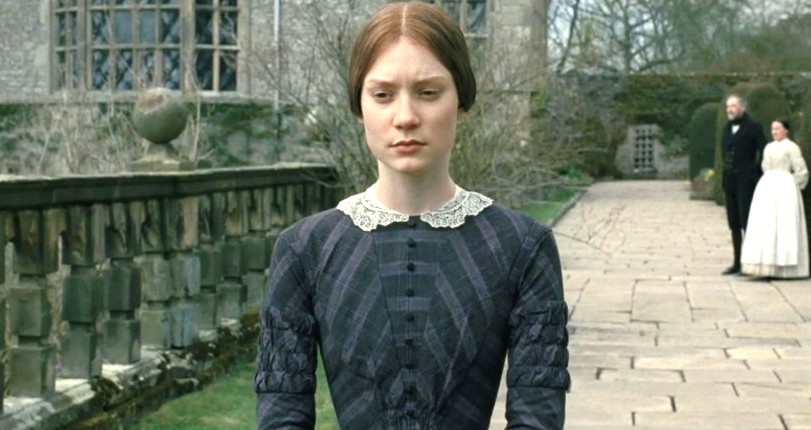
By Edward Copeland
Sometimes I feel like Burgess Meredith at the end of the classic Twilight Zone episode "Time Enough at Last" when he decides being the last man on earth is a small price to pay if that means he'll finally get to catch up on his reading — then he drops his glasses, breaking the spectacles while trying to find them. Fortunately, I'm neither the last man on earth nor, despite my many health problems, do I have bad sight. However, I've never allowed myself enough time to read every book or writer that I've wanted to or should have. One author on that list happens to be Charlotte Brontë. Amazingly, I've never even seen any of the more than two dozen adaptations of Jane Eyre that have been made for movies or TV dating back to 1910 until the 2011 version. Directed by Cary Joji Fukunaga and starring Mia Wasikowska in the title role and the busy Michael Fassbender as Rochester, I can't possibly speak with authority about how it compares with previous incarnations but I can say that this Jane Eyre had me engrossed from the start and wishing I'd read that novel at some point.
What I find funny is that though I've never read Jane Eyre or seen a depiction of the novel, I did see John Duigan's 1993 film of Wide Sargasso Sea, based on Jean Rhys' 1966 novel that imagined the story of Rochester's first wife in the West Indies. At the time I saw it, when the movie finished an audience member commented, "Now it leads to Jane Eyre" so though I really didn't know the story of Jane Eyre, I knew who was in the attic and started that fire.
Enough of that. We should be discussing this sumptuous movie itself, which landed a single Oscar nomination yesterday for Michael O'Connor's costumes. Quite deserving but cases could have been made for the art direction by Will Hughes-Jones, Karl Probert and Tina Jones; the cinematography of Adriano Goldman; and, most especially, Dario Marianelli's luscious and magnificent score.
That only takes into account the tech categories. This marks Fukunaga's fifth film as a director, but I haven't even heard of the other four, let alone seen them, but he does a helluva job with a great cast, particularly Jamie Bell as St. John Rivers, Amelia Clarkson as the young Jane, Sally Hawkins as the spiteful Mrs. Reed, Imogen Poots as Miss Ingram and Dame Judi Dench as Mrs. Fairfax.
Then there are the two leads. I haven't seen Shame or A Dangerous Method yet, but based on Jane Eyre and even X-Men: First-Class, Michael Fassbender probably deserved an Oscar nomination for best actor just for his body of work in 2011. He fills Rochester with the requisite amounts of mystery and romance, longing and guilt.
Finally and best of all we have Mia Wasikowska's work as Jane. This actress seldom disappoints even if her movies do (such as The Kids Are All Right and Alice in Wonderland) or get little notice (That Evening Sun). Jane Eyre provides her finest role yet. She's smart and willful, yet understandably guarded. Wasikowska deserved consideration, but I can't imagine that nominations aren't coming her way eventually.
Jane Eyre might seem to most people like territory that has been plowed before and often. I know that's true by the numbers but I also recognize a very good film when I see one and this Jane Eyre qualifies.
Tweet
Labels: 10s, Books, Burgess Meredith, Dench, Fassbender, Fiction, Oscars, Remakes
TO READ ON, CLICK HERE
Wednesday, January 18, 2012
How do you solve a problem like J. Edgar?


By Edward Copeland
After watching J. Edgar, I prepared to write my usual review, assessing the film overall for its direction, writing, performances and other technical qualities, but something kept sticking in my mind, preventing me from focusing on those aspects. My brain kept drifting back to a different question, one that has puzzled me in many movies for a long time but that reared its ugly head — literally — once again as I watched J. Edgar. Why in the 21st century, with all of the advancements that have been made in visual effects, does old age makeup still turn up so often looking so laughably bad as it does? It does such a disservice to the performers trying to act beneath the horrible messes slapped upon their visages. How can you concentrate on the performances of Leonardo DiCaprio, Armie Hammer and Naomi Watts in their characters' later years when their faces have been marred by such silly appliances? It doesn't always hurt — Jennifer Connelly won an Oscar for A Beautiful Mind despite the awful makeup that covered her at the end of that movie (or, more recently, Kate Winslet's awful aging in The Reader). What's more mystifying is when you look back at a film such as Arthur Penn's Little Big Man in 1970 and how great the old-age makeup on Dustin Hoffman was in that film. Enough on that subject. With that off my chest, I believe I'm ready to discuss the rest of J. Edgar now, truly a mixed bag of a movie if ever there were one.
John Edgar Hoover served as the first director of the Federal Bureau of Investigation, an agency whose creation he spearheaded in 1935 after leading its predecessor, the Bureau of Investigation, since 1924. Between the two bureaus, Hoover held the top job for nearly 50 years and in eight presidential administrations from Coolidge to Nixon. Hoover truly defined what it meant to be a man of contradictions. He led the way in modernizing many crucial techniques in criminal investigations such as fingerprinting and forensics but also frequently stepped outside the law to amass information on perceived enemies, either to himself or the country. His private life contained its own secrets, namely his close, perhaps gay, relationship with top assistant Clyde Tolson. At least as the movie portrays it, Hoover's paranoia about being gay stemmed from his mother, who once told him, "I would rather have a dead son than a daffodil for a son."
To compress a life full full of such huge historical events alongside the inner life of a man would be a challenge for any screenwriter and any director. While Dustin Lance Black (Oscar-winning writer of Milk) and two-time Oscar-winning director Clint Eastwood give it the old college try in J. Edgar, the sheer weight of all those years and all that material crushes them, leaving the film somewhat rudderless despite good performances.
Black's screenplay structures Hoover's life around the premise of a 1960s era Hoover (well-played by Leonardo DiCaprio, even beneath the hideous makeup) dictating his version of the events of his life to the first of several young agents, embellishing as he did in real life how much credit he deserved for various FBI triumphs. He practically claims to have shot and killed John Dillinger outside the movie theater himself, though he omits how in a pique he punished the agent who actually ended the '30s era bank robber's crime spree. Hoover, so closed-up and concerned about how he was perceived, would be a difficult role for any actor to pull off, so I don't think everyone realizes what a great job DiCaprio accomplishes here outside of those few rare moments of faint tenderness he allows himself to share with Clyde Tolson (equally well-played by Armie Hammer, so good as the Winklevoss twins in David Fincher's brilliant The Social Network.)
Because so much happened in U.S. history between 1924 and 1972, it would be damn near impossible to hit on everything that Hoover touched so the film concentrates on Communist radicals in the U.S. following the Russian Revolution, the kidnapping of the Lindbergh baby and the war on the criminals such as Dillinger in the 1930s. It also hits upon Hoover's efforts to form the FBI in the first place.
The uncertainty of his relationship with Tolson gives the film some heart. There's one scene where after a dinner together when the two men ride off together, Hoover nervously places his hand on Tolson's that's reminiscent of scenes in Jean-Jacques Annaud's The Lover and Martin Scorsese's The Age of Innocence.
Some of the more unsavory sides of Hoover's nature get short shrift such as his plans to sabotage Martin Luther King with stories of infidelity and Communist associates thinking it will get King to refuse his Nobel Peace Prize. He gets one scene with Robert Kennedy (Jeffrey Donovan) where he shows him evidence of sexual excess he has on his brother but nothing more comes of it until he hears of JFK's assassination, call his brother and tells him the president has been shot and hangs up.
Judi Dench and Naomi Watts turn in solid performances as the two important women in Hoover's life. Dench plays his mother whom Hoover lived with until her death and you see where most of his psychological blocks formed. Watts gives a subtle turn as Helen Gandy, Hoover's lifelong secretary who has as little interest in men or a family life as Hoover does in women. The film also shows her shredding Hoover's secret files upon his death while Nixon's men search frantically for them.
Aside for the dreadful makeup, J. Edgar looks exquisite in terms of cinematography, costumes and production design. Eastwood does his best trying to keep the film moving as it bounces between the various time periods, but the flaws with J. Edgar run deeper. The film lacks a compass, moral or otherwise, and desperately needs a point of view about Hoover. Imagine if this were an Oliver Stone film. Granted, his one brief touch on Hoover in Nixon had Bob Hoskins portraying him French-kissing Wilson Cruz as a pool boy, but that film itself was a surprisingly well-rounded look at Nixon himself.
J. Edgar, while DiCaprio turns in a very good performance in spite of the constraints, doesn't present a well-rounded Hoover. Everything the film has to say about the man seems drawn from quick pencil sketches on a napkin. DiCaprio manages to bring a depth to Hoover that the screenplay itself doesn't supply. In fact, based on the script's portrait, J. Edgar Hoover comes off as a smart but paranoid Forrest Gump who happened to be present at many of the key moments of the U.S. in the 20th century. Someone as consequential and important as he was, for both good and ill, needed a treatment that went beyond a Cliffs Notes version.
Tweet
Labels: 10s, Arthur Penn, Dench, DiCaprio, Dustin Hoffman, Eastwood, Fincher, Jennifer Connelly, Naomi Watts, Oliver Stone, Scorsese, Winslet
TO READ ON, CLICK HERE
Monday, May 10, 2010
La ballo vuoto o Nein! Nein!

By Edward Copeland
Sometimes the announcement of film projects seem so obviously a bad idea (at least to me) that I can't understand why everyone doesn't see it, particularly the people putting up the money. Be it those who thought a modern remake (or any remake) of The Manchurian Candidate made sense or that casting Tom Hanks as Sherman McCoy in a screen version of The Bonfire of the Vanities was a good idea (before that was followed by bad idea after bad idea like an elaborate attempt by Brian De Palma to break the world record for domino toppling).
So, when a resurgence in film adaptations of musicals led to the announcement that the next Broadway tuner to hit the big screen would be Nine, I greeted the news with a big, "Why?" I've never seen Nine staged, but I know the score and, for the unfamiliar, what it is is a musicalized version of Fellini's masterpiece 8½. Maury Yeston's score is hardly memorable and as much as I love Fellini's film, if they remastered prints and did a large scale re-release of the original film, would great numbers go? Of course, I'm not in the business of reviewing films as financial decisions (even though I was right and they made a bad one), but now that I've seen it, I can review it as a film and can say that it fails as a movie as well.
Daniel Day-Lewis stars as Guido, the director with artistic block and the actor seems to sleepwalk through the entire film as if he's wondering how in the hell he got into this mess. Day-Lewis tends to enjoy disappearing into a role, but Guido is so translucent to begin with that there's no body to inhabit and certainly no scenery to chew. His chance to sing a couple of lackluster songs doesn't offer much in the way of something new either as he basically talk-sings through those, presumably to keep that Italian accent going. I'd much rather have been watching a Gangs of New York musical. Hell, as much as I despised it, a crooning Daniel Plainview in There Will Be Blood the Musical would have offered more entertainment. Just imagine the Act II showstopper "I Drink Your Milkshake!"
Coming from The Weinstein Company, most of Harvey's usual girls are there (apparently Gwyneth Paltrow was unavailable) and the cast boasts more acting Oscar winners than a 1970s disaster movie. Shit, excuse me a second. Sorry, had to stop and clean the vomit off my keyboard when I once again realized those award winners include Marion Cotillard. One of the few non-Academy Award winners or nominees in the cast is Fergie and she sure does look different than she did when she was married to Prince Andrew. Oh, I'm sorry. Different Fergie. Not really sure who she is, but actually she does do one of the best numbers performing "Be Italian," made famous on stage by the late Anita Morris (I remember that from a Tony broadcast).
As I guessed when I saw Penélope Cruz in Pedro Almodóvar's Broken Embraces, she got the Oscar nomination for the wrong movie when she received it for Nine. Cruz does what she can in Nine, but characterization is not a strong suit for any of the film's characters.
When Nine premiered on Broadway, it inexplicably won Tonys for best musical and best score, defeating Dreamgirls, which turned out to be a mixed bag as a movie but at least made sense to be turned into a movie. (Though the show was a flop, Maury Yeston's dull score for Nine defeated Stephen Sondheim's brilliant score for Merrily We Roll Along as well.) The Tony love at the time could mostly be attributed to the involvement of Tommy Tune, whom was worshipped by the Tonys in that era winning in multiple categories, year after year.
Making a musical out of Fellini's 8½ just seemed an odd idea to begin with. R.E.M.'s video for "Everybody Hurts" and its sequence paying homage to the film probably comes closer to the mark than the entire film of Nine does.
Now, I don't want to merely bash Maury Yeston, because years later he won another Tony for score for another best musical, Titanic, which had no connection to James Cameron's behemoth but came out the same year and was much better than the movie with the same name, and had a score infinitely better and more memorable than Nine.
Rob Marshall, who successfully directed the screen adaptation of Chicago, helmed the film Nine and honestly, I have no idea what his strategy for the film was. Some numbers seem to spring as fantasies out of conversations Guido has with the many women in his life while others seem to appear on a theater stage (or is that a movie set? Hard to tell). The dialogue scenes hardly improve the situation. You can't decide which you dread more: Characters breaking out into boring song or into boring conversation.
Though the film had its problems, his nonmusical direction of Memoirs of a Geisha showed much more promise for him as a film director. However, next up for him is yet another Pirates of the Caribbean sequel which one can only hope they subtitle We Really Are Devoid of New Ideas. It's a shame, because had many great choreography credits on Broadway and a co-directing credit with Sam Mendes on the marvelous revival of Cabaret that starred the late Natasha Richardson. Mendes seems to have made the switch in mediums much easier than Marshall.
With the exception of some clearly defined roles (Sophia Loren is the dead mother; Cotillard is the wife; Fergie is the prostitute Guido knew as a child) many of the women sort of exist in a blur without clear delineation. Judi Dench obviously is his agent and I guess Nicole Kidman is his frequent movie star, but I'm still working on Cruz and Kate Hudson, though Cruz obviously is at least a mistress.
The screenplay is credited to Michael Tolkin, author of both the novel and screenplay for The Player, and Anthony Minghella who, despite the fact he died in March 2008, must still be under contract to Harvey Weinstein, even in the afterlife. (IMDb still lists two films in development for him. Take a rest Anthony, you're dead.) In the movie, Guido hasn't written a word for the film he's supposed to start filming and Nine itself is similarly plotless. It's telling that at the Tonys the year Nine premiered on Broadway the book category is one category it did lose to Dreamgirls.
The best I can find myself saying about Nine is that the technical credits are fine from Dion Beebe's cinematography and Colleen Atwood's costumes to John Myhre's production design, but in the end it's just putting lovely wrapping paper on an empty box.
Tweet
Labels: 00s, Almodóvar, Awards, Cameron, Cotillard, Day-Lewis, De Palma, Dench, Fellini, Gwyneth Paltrow, H. Weinstein, Hanks, Musicals, Nicole Kidman, Oscars, Penélope Cruz, Remakes, Sondheim, Theater
TO READ ON, CLICK HERE
Thursday, February 04, 2010
Stiffer than the corsets

By Edward Copeland
Costume dramas need not be well-dressed bores — honest. I know because I've seen them. One of the producers of The Young Victoria, Martin Scorsese, even made one called The Age of Innocence. For some reason though, the sets are dressed, the performers are clothed and instead of a compelling tale resulting, too often rigor mortis sets in, as if everyone fears dramatic action will somehow start tearing seams asunder. Alas, this is the case with The Young Victoria.
Emily Blunt takes on the early years of England's longest-reigning monarch, surrounded by a schemer, Sir John Conroy (Mark Strong), who hopes to usurp her path to the throne, thinking she's too young and longing for the power, aided by Victoria's mother (Miranda Richardson). Meanwhile, the film also depicts the romance between Victoria and Prince Albert (Rupert Friend) that led to marriage and nine children.
With all this story, this cast (which also includes Jim Broadbent and Paul Bettany) and a script by Oscar winner Julian Fellowes (Gosford Park), you'd think it couldn't miss, but boy does it. Aside from some sparks from Strong and Blunt, everything plays at the quietest, slowest, dullest level. As my mind frequently wandered, I kept wanting Blunt to age into Judi Dench-widowhood and meet Billy Connolly so I could watch Mrs. Brown again.
Tweet
Labels: 00s, Broadbent, Dench, Scorsese
TO READ ON, CLICK HERE
Tuesday, October 16, 2007
A Parisian in America

By Josh R
For the past several years at The Primetime Emmy Awards, it has been an annual custom for the winners in the guest acting categories — which are announced during
 a prior ceremony primarily devoted to the technical arts — to present the writing and directing awards. In discussing the highs and lows of last month’s ceremony, some smartass AOL television blogger was given to wonder why The Academy would allow Leslie Caron, a winner for her guest turn on Law & Order: Special Victims Unit, to present an award during the network telecast when, in his words, “nobody had the faintest idea of who she was or what she was doing there.” In the warped mind of this sad and twisted soul, who shall remain nameless mainly to save undue embarrassment (because it isn’t nice to pick on the mentally deranged), Ms. Caron’s presence on the telecast qualified as a “low” point of the evening. It wasn’t that the actress had difficulty reading off the prompter, went off book with some shambling impromptu remarks (paging Elaine Stritch), or wore some outlandishly garish frock so blinding as to cause television sets to go on the fritz. Blogger X, whom I only assume is one of those nutjobs who believes that all black and white movies categorically “suck” and that elderly people who can no longer contribute to society should be kept in detention centers fenced in by chicken wire, simply felt that presentation duties should be reserved for the likes of “real” stars, like Eva Longoria, Adrian Grenier or Hayden Patinierre.
 Forgetting for a moment that people will still be watching films like An American in Paris long after most of today’s top-rated shows have become obscure footnotes in pop cultural history, with names of the actors who starred in them long forgotten, indulge me while I review the credentials of the lady in question — and, hopefully, give Blogger X a lesson in respect. These kids today — you gotta learn `em.
To be fair, it would be difficult to make a case for Leslie Caron as a major star — at least when juxtaposing her career accomplishments with those of her contemporaries. Her rise to prominence in the 1950s, and her years of greatest productivity, coincided with those of Elizabeth Taylor, Audrey Hepburn, Grace Kelly, Marilyn Monroe and Sophia Loren. While a marquee attraction in the prime of her career, Caron never quite achieved — nor ever really earned — the same degree of importance or acclaim as the aforementioned women, either as a performer or as a figure of public fascination. Nevertheless, Blogger X dismisses her too lightly, for her resume is impressive by any standard. Consider these facts:
She is a two-time Academy Award nominee for best actress, and one of only two women to have played leading roles in multiple Best Picture winners. She is perhaps the only French-born actress whose stardom owes itself to work in English-language films, and really the only one who can be said to qualify as a mainstream American movie star; one could rightly argue that Jeanne Moreau and Catherine Deneuve have had more significant careers in the world of global cinema, but neither ever found success in Hollywood to the extent that Caron did (for a bit of perspective, Deneuve’s most prominent American film credits would be Hustle and The Hunger — a far cry from Gigi and An American in Paris). She is one of the few MGM contract players hired as a novelty performer for Arthur Freed’s musical unit to have successfully navigated the transition to dramatic roles, and one of only three “star” dancers, after Cyd Charisse and Vera-Ellen, whose field of specialty was ballet — she is more closely associated with the genre than either of the other two. She is among an elite group of women to have danced opposite both Gene Kelly and Fred Astaire, and quite a few of her films have endured as major and minor classics beyond the period of their initial success. From the group of actresses mentioned in the previous paragraph, she is the only one who is still active as a performer — while the legendary status of Taylor and Loren may eclipse that of the little French ballerina, Caron is the one who’s still working.
The delicate-featured, purse-lipped gamine, often employed as the centerpiece of MGM’s frequent attempts at Gallic pastiche, was born in Boulogne-Bilaincort, France in 1931, the daughter of a chemist. Her mother had been a dancer; Caron was introduced to ballet at an early age. As a teenager, she was performing with a company in Paris when spotted by a vacationing Gene Kelly, who was in town doing preliminary research for An American in Paris. Cyd Charisse, the original choice for the female lead, had become unavailable due to pregnancy, and Kelly and director Vincente Minnelli were in the process of searching for a replacement — no small feat, considering Kelly’s concept required a classically trained ballerina who could meet the rigorous demands of the film’s ambitious choreography. Caron was quickly signed to a contract by MGM, transplanted from Paris to Culver City, given a crash course in English, and cast as Lisa, the Parisian love interest of Kelly’s struggling artist. If the novice made little impression beyond affecting a modest, self-effacing charm in her acting scenes, she more than compensated for it with her exquisite performance in the climatic 20-minute dance sequence. Her look was unusual — as Pauline Kael observed in her discussion of the film, it didn’t appear that MGM had quite yet gotten her makeup exactly right for the purposes of her debut. Her pleasantly quotidian appearance, distinguished by a broad, toothy grin, made her a bit of a challenge from a casting perspective; the 1950s was already shaping up as the decade of goddesses, glamour queens and sex symbols.
She bided her time in a few dull costume pictures — she cited the consummate professionalism of Barbara Stanwyck, with whom she appeared in 1951’s The Man
 with the Cloak, as being of particular inspiration to her — before signing on for her next musical project, Lili, directed by Charles Walters. The sentimental story of an orphaned waif who finds a home with a traveling carnival, it was property that MGM had no particular enthusiasm for. The studio brass underestimated the film’s canny fusion of sweetness and pathos; made on a low budget and with limited expectations, it went on to become one of MGM’s top grossing films of 1953, netting a surprise best actress nomination for its leading lady in the process. Although that accolade seems generous in retrospect, the film did allow Caron to demonstrate an ability to project an appealing vulnerability without resorting to preciousness. She lost the Oscar to Roman Holiday's Audrey Hepburn, with whom she was often compared and occasionally confused; although bearing little facial resemblance, they were a similar physical type — together they popularized the gamine look, making slim-hipped, flat-chested girls with boyish haircuts seem like the height of European sophistication.
 Daddy Long Legs, which found her being romanced by Astaire, and The Glass Slipper, a musical retelling of the Cinderella story, were pleasant diversions; the latter’s ballet-heavy choreography provided her with best opportunity since An American in Paris to demonstrate her prodigious skill as a dancer. Gaby, an unhappy foray into straight drama, was a sodden remake of the 1940 Vivien Leigh weepie Waterloo Bridge concerning an out-of-work dancer who resorts to prostitution as a means of support; the actress was unhappy while making the film, and considered the finished product an embarrassment. While she had been an appealing presence in her musical roles, it was clear that she hadn’t yet experienced her breakthrough as an actress — her unaffected charm, while never less than ingratiating, didn’t communicate an abundance of personality; she didn’t always seem that sure of her bearings in front of the camera, and slightly embarrassed as a result. Her next project — and the film for which she was to become most identified — marked tremendous strides toward that end.
Gigi, Vincente Minnelli’s lavish musical adaptation of Collette’s mildly risqué novella concerning the antics of a sprightly Parisian schoolgirl being groomed for the life of
 a courtesan, has sometimes been unfavorably compared to My Fair Lady — certainly, they were cut from the same cloth. The composer-lyricist team of Alan Jay Lerner and Frederic Loewe adhered very closely to the template set by their previous success; as in their smash musical treatment of Shaw’s Pygmalion, Gigi chronicled the transformation of a rambunctious, unprepossessing girl into an elegant, sophisticated woman — much to the consternation of the male protagonist, who finds himself surprisingly, if somewhat unwillingly, drawn to the altered incarnation. Moreover, in terms of both the structural function and thematic content of the musical numbers, Gigi mirrored its predecessor to an uncanny degree: “The Night They Invented Champagne,” in which the hero, the heroine and her grandmother dance around their apartment in jubilant celebration, is essentially a refurbishment of “The Rain in Spain”; “I Don’t Understand the Parisians” expresses female frustration in the tradition of “Just You Wait, Henry Higgins”; “It’s a Bore,” which outlines the male protagonist’s blithely anti-social outlook, echoes “Let a Woman in Your Life”; the Oscar-winning title song, in which Louis Jourdan’s disaffected playboy (a man who puts limited stock in the notion of romance) begins by disparaging the heroine, only to come to the realization that he has fallen in love, builds in much the same way as “I’ve Grown Accustomed to Her Face” — in both cases, the internal conflict, which progresses from angry denial to stunned epiphany, is made musically and verbally explicit.
 If an inevitable sense of déjà vu accompanied the proceedings, it didn’t prevent Gigi from qualifying as a resounding success on its own terms; in truth, it was a better film than An American in Paris, and Minnelli’s best since Meet Me in St. Louis. The melodic score, coupled with a witty script by Lerner which captured the essence of Collette’s prose while tempering its racier aspects, only accounted for part of the film’s considerable charm — with gorgeous location photography and French actors in the principal roles (including the redoubtable Maurice Chevalier as a septuagenarian bon vivant), the film felt like an authentic reflection of the culture it was attempting to recreate — something of a rarity for MGM, whose version of continental flavor usually wound up seeming more Euro-Disney than European. Moreover, Minnelli’s elegant visual composition brilliantly showcased the sumptuous production design; the director received an Academy Award for his efforts. All around, it was a sparkling entertainment, and the best film in which Caron appeared during her tenure at the studio.
For her part, the actress seemed notably more animated and engaged than she had been in her previous efforts. Too often, there had seemed to be a dark cloud hovering overhead when she took on ingénue roles — her lack of formal training as an actress may have left her feeling somewhat insecure, making the halting, abashed quality that had characterized her other star turns more pronounced than it would have been otherwise. It was nowhere in evidence with her work in Gigi, which revealed a lightness of touch worthy of a polished boulevard comedienne; working with Minnelli, perhaps her greatest champion, brought out her confidence, as well as a previously unsuspected streak of mischief. In the early scenes, she successfully conveyed the exuberance of youth and handled the comic aspects of the role with surprising dexterity; as the transformation took root, she became self-possessed, forthright, and for the first time, genuinely beautiful. As Lili, Gaby and Ella of the Cinders, she had had a tendency to seem pathetic and childlike when the material took a turn for the dramatic — finally, it was possible to see her as a mature actress of genuine spirit, capable of holding the screen without seeming apologetic or ill at ease.
Her last project at MGM was Fanny, another expensively mounted exercise in Gallic frivolity, only one in which the fun seemed forced. The film was successful, earning a best picture nomination and a Golden Globe nomination for its star, but couldn’t help seeming like a step backward — if Gigi had liberated her sense of humor, Fanny seemed determined to reign it back in. But The L-Shaped Room was a genuine triumph; as the ostracized émigré trying to rebuild her life in a seedy London boarding house, she offered an instinctive, insightful account of a stranger in a strange land, struggling to regain her sense of equilibrium. Clearly, the bleak predicament of a foreigner negotiating the uncertainties of survival in a hostile, unfamiliar environment struck a deeply personal chord; plucked out of the corps de ballet at a young age to embark on an acting career she had neither pursued nor conceived of, Caron had spent much of her early years in Hollywood feeling like a fish out of water.
The L-Shaped Room represented a risk for Caron, as it marked a dramatic departure from the kind of films on which she’d made her name. A product of the new vogue
 in British filmmaking which favored the kitchen-sink style of realism, Bryan Forbes’ perceptive character study considers the position of social outcasts, trying to carve out a place for themselves in a world that regards them with suspicion and disapproval. The character of Jane Fosset, in addition to being an immigrant, also has the stigma of being pregnant and unwed — the first friend she makes is an immigrant and a man of color, who feels betrayed when she shows a romantic interest in someone else, and betrays her in turn. The characters are isolated by their outsider status, and ultimately, from each other — their attempts to connect often result in misunderstanding, disappointment and hurt. When an elderly eccentric reveals herself to be a lesbian, you can see in her face the fear of reprisal that such an admission might bring. Staring at the photograph of the woman’s dead companion, whom she had assumed to be a man, Caron’s wordless response is one of sad recognition and empathy — she can relate to what it means to be on the margins, yearning for acceptance but feeling shut out in the cold. It’s an unusual film, and probably ahead of its time in many respects, even though from a modern standpoint its content seems relatively tame.
 Her excellent, moving performance netted Caron a second, well-deserved best actress nomination; in contrast to her first nominated performance, audiences were seeing the insecurities of the character, as opposed to those of the actress. Her naturalistic style, which occasionally seemed out of place in the glossy Hollywood product which had been her stock in trade, meshed well with the new wave sensibility — it’s tempting to wonder what Truffaut, Malle and Godard might have made of her if she’d remained in her native France.

The fruits of success were somewhat less than she might have hoped for. In Father Goose, she played second fiddle to Cary Grant and a gaggle of schoolgirls — as if Gigi were getting her comeuppance. The lame-brained sex comedy Promise Her Anything cast her opposite Warren Beatty, with whom she embarked on an ill-fated affair; the young actor, who had already acquired the reputation of a lothario, was named as a correspondent in Caron’s divorce from British stage director Peter Hall. Later, the actress offered this infamous put-down: “Warren has an interesting pathology; he always goes after women who have either just won or been nominated for an Academy Award”…while not on the level of Carly Simon’s “You’re So Vain,” a withering assessment nonetheless.
She worked out the '60s in a succession of increasingly less interesting roles; in the seventies she devoted more of her energies to rearing her two children by Hall, breaking occasionally for the odd bit of film or television work (in some instances, quite odd indeed). If her work attracted less attention in the years to follow, she did — finally — get to work with Truffaut in The Man Who Loved Women, and with Malle in Damage. Chocolat was a high-profile film, even if she was criminally underutilized in what amounted to a cameo — she might have done wonders with the more prominent role of the village curmudgeon, which in Dame Judi Dench’s hands amounted to a fussy piece of caricature. Her fine, restrained work in Law & Order: SVU, in which she played a victim of sexual assault whose attacker is brought to justice 30 years after the fact, demonstrated that she is still willing and able to take on challenging acting assignments when the opportunity presents itself.
Contrary to what Blogger X and many others may have felt, this year’s Emmy telecast was a depressingly prurient affair — one in which the “high” points were often indistinguishable from the low. Poor taste has been the hallmark of many an awards show, and Emmy `07 didn’t stint in that regard: viewers were treated to Brad Garrett making crude remarks about Joely Fisher’s tits to the approbation of the crowd, the obligatory round of off-color jokes about Charlie Sheen, and an unusually high rate of bleeping (Fox’s censors might want to ease up on the trigger finger — a boob is a boob, but how much hand-wringing is merited by the term “screwing?”). Even Sally Field let a cuss word slip while voicing the tired old Lysistrata line, spoken verbatim at podiums around the world by women who want to make a political statement without saying anything remotely controversial, about how “if all the mothers of the world got together, there would be no goddamn wars” — a sentiment as quixotically naïve as it is stupidly sexist (at this point, I think women have demonstrated that they can be just as self-serving and obtuse when it comes to the politics of violence as men are — just ask Mr. Copeland for his views on Mrs. Clinton). It turns out, after all, that Blogger X has a point: Ms. Caron did seem out-of-place at this year’s Emmy Awards. Her presence provided the one glimpse of class in an evening otherwise distinguished by a lack of it. Perhaps her Emmy victory will bring more opportunities worthy of her talents — time can neither diminish the memory of her triumphs, nor, with luck, prevent her from achieving still more.
Tweet
Labels: A. Hepburn, Astaire, Awards, C. Sheen, Cary, Cyd Charisse, Dench, Gene Kelly, Kael, Lang, Law and Order, Malle, Marilyn, Musicals, Oscars, Stanwyck, Television, Truffaut, W. Beatty
TO READ ON, CLICK HERE
Wednesday, January 17, 2007
With friends like these...
Why didn't I like Notes on a Scandal more? Don't get me wrong — overall I did like the film a lot. In fact, for the first 40 minutes or so, I was positively riveted, by the writing and most especially the great performances of Judi Dench and Cate Blanchett. Then, it began to wear on me and, maybe this sounds silly, but I blame Philip Glass.
I know — we are supposed to worship at the feet of this composer but honestly, when has he composed a film score that didn't leave you with either a splitting headache or in a state of catatonia?
Thankfully, Dench, Blanchett, director Richard Eyre and screenwriter Patrick Marber mostly succeed in waging their war of narrative against Glass' intrusive notes. In other cases, such as the wretched The Hours, Glass only made a bad situation worse.
Enough about Glass — let's discuss what is good about Notes on a Scandal, and there is a lot. At the top of that list is Dench, who seems to me to be making a concerted effort to atone for her Oscar win for the glorified cameo in Shakespeare in Love (where she was admittedly good) and her Harvey Weinstein-purchased nomination for Chocolat, that even she seemed embarrassed about.
Since then, she's done outstanding work in Iris and Mrs. Henderson Presents and I believe Notes on a Scandal to be her finest film work since Mrs. Brown sparked her late career screen stardom. (Though she stays true to the essential whoredom of British actors by continuing to get paychecks for the James Bond films).
Dench's work here as Barbara Covett, a spinster busybody of a school teacher with repressed lesbian and stalking tendencies, is superb. She creates a full-bodied monster, but still lets her humanity shine through. You hate her and you feel sorry for her at the same time.
Blanchett plays Sheba Hart, a younger teacher at the same school who Barbara befriends and hopes to catch in her web once she discovers that Sheba is having an affair with one of her 15-year-old students (Andrew Simpson).
The film never plays the affair for cheap Mary Kay LeTourneau-type thrills and it doesn't excuse Sheba's actions either. She obviously is as troubled as Barbara, but in entirely different ways. She knows what she's doing is wrong, but she can't stop, even when Barbara tries to "help her" end the affair and keep it secret from the school.
Of course, Barbara isn't trying to save her friend — she's stockpiling ammunition in hopes that she can make Sheba her new love obsession since her last one fled to another school to escape the old woman's needy grasp. However, Barbara turns on Sheba when Sheba "fails" her at what she considers a crucial emotional time for her to attend a play in which Sheba's 12-year-old son with Down syndrome is performing and Sheba's older husband (Bill Nighy, good in a rather small role) insists that she attend as he asks why Barbara hangs around all the time.
Soon, Barbara's machinations, motivated by pique, turn all their worlds upside down. Eyre and Marber, working from the novel by Zoe Heller, present the story very efficiently, with little that seems extraneous.
Blanchett performs well (and selling her as supporting is marketing at its finest — she and Dench are equals in the film), but we never get to see enough of what makes Sheba tick to understand why she does they things she does, from pursuing a friendship with Barbara in the first place to the affair with the teen.
In the end, Notes on a Scandal really belongs to Dench and her creation of Barbara, a screen harridan for the ages. Maybe when it comes out on DVD, they'll offer a track where you can delete the Glass score from the soundtrack and the movie will be even better.
Tweet
Labels: 00s, Blanchett, Dench, H. Weinstein, Shakespeare
TO READ ON, CLICK HERE
Friday, February 10, 2006
It's not the size of the role...
With William Hurt's much-deserved (in my opinion) nomination for A History of Violence this year, my thoughts have turned to some of the great single-scene or particularly small roles that were able to grab the viewer's attention in unprecedented ways.
Hurt's brief bit is by no means the Oscar's only instance of short scene-stealers — Beatrice Straight won for basically one monologue in Network and Judi Dench won with very limited screen time in Shakespeare in Love.
Geraldine Page also snagged a nomination for essentially one scene in The Pope of Greenwich Village. Network also produced a great monologue for Ned Beatty that earned him an Oscar nomination. All those nominees were fine by me except for Dench, who was really just getting makeup Oscar love for losing for Mrs. Brown the year before to the wandering accent of Helen Hunt in As Good As It Gets. Then there were also some brief nominations that were a complete puzzlement like Ethel Barrymore's nomination for The Paradine Case, one of Alfred Hitchcock's worst films.
So, as they come to me, some of my favorite brief roles.
Alfred Molina in Boogie Nights. When you get right down to it, the scene is completely extraneous to the movie — the climax of a film about the evolution of the porn industry well into the 1980s should have involved AIDS, not a standard drug deal. Still, Molina is masterful with his drug-addled dialogue set to the tune of Night Ranger's "Sister Christian."
One of my favorite single sequence tour-de-forces is Bill Murray in Little Shop of Horrors. His masochist wouldn't come off as great without Steve Martin's sadistic dentist to play off, but he's great.
Christopher Walken is a master of the monologue, but his one scene telling a child-size version of Bruce Willis about the journey of a gold watch in Pulp Fiction is priceless.
Another role that is essentially a single monologue, Jack Lemmon in Short Cuts. A brief but great role that few besides me remember is Swoosie Kurtz in Against All Odds where she is delightfully flaky as the secretary of a crooked lawyer who decides to help Jeff Bridges.
The year Frances McDormand won lead actress (for what in my opinion was a supporting role, but that's an argument for another time) for Fargo, she also gave a great single scene performance in Lone Star. Throughout the film, Chris Cooper's character's unstable ex-wife is referred to and when the situation requires Cooper to visit her late in the film, McDormand nails the character in a way that brings earlier references to vivid life.
Michael Mann's Collateral offered two great one scene performances: Barry Shabaka Henley as a jazz musician targeted for elimination and Javier Bardem as a crime lord. In another Tom Cruise vehicle, Lois Smith had a memorable one-scene turn in a greenhouse in Minority Report.
For a while last year, there was buzz that Lynn Redgrave might get nominated for her great single-scene at the climax of Kinsey as a woman whose life was profoundly affected by the sex researcher, but when that film folded, only Laura Linney was left standing.
It's more than one scene, but Tony Shalhoub's cab driver of indeterminate origin in Quick Change is a riot. Another short one that cracked me up was Maximilian Schell in The Freshman. "Carmine said one boy, here are two."
The original version of Love Affair and its remake by Warren Beatty produced two great short turns by Maria Ouspenskaya and Katharine Hepburn, respectively. Ouspenskaya even managed an Oscar nomination for her performance. Another one scene wonder that earned an Oscar nomination was Sylvia Miles in Midnight Cowboy, though it's been a long time since I've seen that one.
Most of the ones that are springing to my mind right now are more recent ones, but I'm sure brief turns in older films will come to my mind once the conversation gets going. The ones that immediately occur to me are Leslie Howard, Anton Walbrook and Raymond Massey's brief bits in the Powell/Pressburger masterpiece 49th Parallel aka The Invaders.
I'll leave you with this one: while certainly not a nomination-worthy performance, Garry Marshall's turn as the manager of the Desert Inn in Lost in America always cracks me up. "We're through talking now."
He may be through, but I hope you aren't.
Tweet
Labels: Archers, Bardem, Chris Cooper, Cruise, Dench, Geraldine Page, Hitchcock, Jeff Bridges, K. Hepburn, Laura Linney, Lemmon, McDormand, Michael Mann, Murray, N. Beatty, Steve Martin, W. Beatty, Walken, William Hurt, Willis
TO READ ON, CLICK HERE


