Wednesday, March 14, 2012
The Forest and Through the Trees

By Adam Ross
Horror movie franchises are typically based around an enduring villain (i.e. Frankenstein, Dracula, Jason Voorhees) but as The Evil Dead series gears up for another installment and celebrates the 25th anniversary of Evil Dead 2: Dead By Dawn, it's worth noting that its popularity is rooted in a constant hero. Played with career-defining conviction by Bruce Campbell, Ash has become one of the most popular modern movie heroes partly because we know he takes as much pain as he gives. When Evil Dead 2 premiered in 1987, it arrived as a sequel to a movie (The Evil Dead) which garnered only a microscopic theatrical release and, to those few who were familiar with the original, the new incarnation seemed more like a remake than a sequel. Even today it's still worth debating whether it's a true sequel or not, but it's undeniable in 2012 that Evil Dead 2 left a lasting fingerprint on the horror genre.
Six years passed between The Evil Dead and its sequel, an eternity in terms of horror follow-ups. Friday the 13th premiered in 1980, and by 1989 we already had Friday the 13th Part VIII: Jason Takes Manhattan. The Halloween franchise was readying its fifth installment by then, and the Nightmare On Elm Street series (which debuted in 1984) released No. 5 that year. While the aforementioned '80s horror standbys preyed on the audience's familiarity with their respective villains (needing only fresh victims or a new plot novelty in each iteration), the team behind The Evil Dead was banking on a returning hero with a plot that wasn't entirely original. Helped by an overly enthusiastic recommendation by author Stephen King, The Evil Dead was a modest box office hit, but thanks to its minuscule budget still turned a tidy profit. Short on budget, but not creativity, the original movie introduced the world to Ash (Bruce Campbell), who helped his friends fight off unseen evil from their isolated forest cabin. Compared to its follow-ups, The Evil Dead is more of a straightforward horror movie, with less emphasis on gross-out effects or slapstick humor. Behind the camera of The Evil Dead was the brotherly duo of Sam and Ted Raimi, along with a band of former Michigan State University students (including Campbell) with an affinity for horror movies.
The international success of The Evil Dead caught the attention of Italian film magnate Dino De Laurentiis, in particular the directing talents of Sam Raimi. Though De Laurentiis initially focused on having Raimi direct an adaptation of a King novel, the producer eventually
 greenlit a $3.6 million budget for Raimi and his crew to start work on Evil Dead 2. Acknowledging that most audiences were not familiar with The Evil Dead, the original script called for a preface with flashbacks to the first film ala The Road Warrior. But since Evil Dead 2 would be financed and distributed by another company, the filmmakers did not have license to use footage from the original movie. This legal setback was the genesis for making Evil Dead 2 more of a reboot plotwise of The Evil Dead. This was a positive for the sequel, because the predecessor's plot was ripe with potential for Raimi and company's larger budget. Writer Scott Spiegel was a utility man of sorts on The Evil Dead, performing a number of roles behind and in front of the camera. Spiegel was well known to the Raimi brothers and Campbell from their days as young amateur filmmakers in Michigan. For Evil Dead 2, he was tapped by Sam Raimi to co-write the script with him, and he is credited with the idea for bringing a more comedic and slapstick element to the movie. Evil Dead 2 would have the same setting and basic horror elements of The Evil Dead, but would include more characters, stunts, monsters, gore, laughs and pain.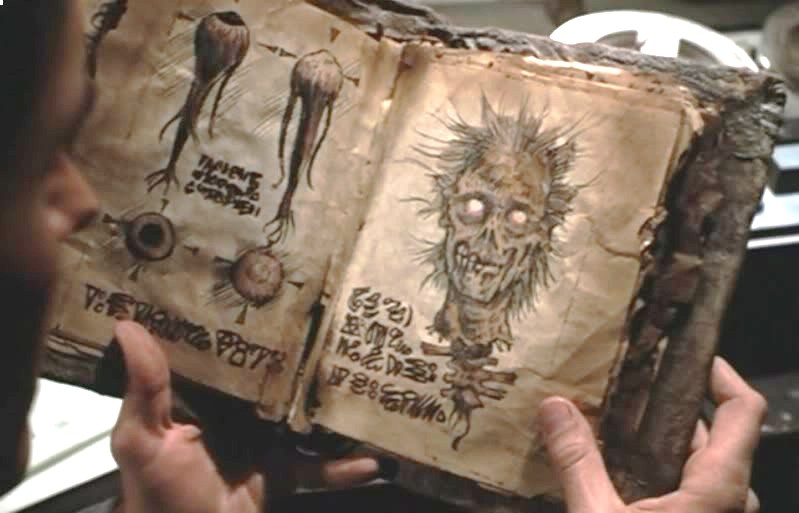
The movie starts again with Ash traveling to a remote cabin, this time with girlfriend Linda in tow. Little time is wasted before the MacGuffin from the original movie is introduced: the Necronomicon, or Book of the Dead. When Ash unwittingly plays a recording from the cabin's previous tenant (an archaeologist) reading from this cursed book, terrible forces start to attack the residence. After his girlfriend is possessed and attacks Ash, the movie briefly becomes a one-man show as our hero is attacked continually by forces ranging from the forest itself, the corpse of his girlfriend and even his own hand. The infamous scene where Ash must amputate his hand is one of the series' lasting images and illustrates the creative gulf between Team Raimi's vision of horror, and the typical slasher fare that populated theaters at the time. In freeing himself of the evil infection, Ash also painfully handicapped himself (however briefly) in a still ongoing fight against murderous forces. Before reinforcements arrive, Ash seemingly hits rock bottom when fountains of blood erupt from the walls and the house itself starts to laugh at him, but the real madness hasn't even begun.
The remaining cast is introduced when the archaeologist's daughter, Annie, and her team arrive at the cabin fresh from a dig, armed with more pages from the Necronomicon. This seemingly good news for Ash soon is spoiled when he promptly gets pummeled by one of Annie's assistants, mistaking him for a murderous lunatic (admittedly not far from the truth). This brief reprieve from paranormal punishment only lets the audience catch their breath for a moment before the intensity is again ratcheted up to new levels. This exhaustive pace is what makes Evil Dead 2 so refreshing compared to many horror movies still being poured into the same old molds. No killers lurk behind doors, no cars refuse to start — our characters barely can sit down in this tiny cabin without some new evil attacking them.

While the basis of the story was ported over from The Evil Dead, near the midpoint of Evil Dead 2 it firmly becomes its own movie, and that's when it merrily jumps off the rails. Raimi even includes a fun callback to the original movie. When Ash is locked in the basement by the new visitors and fights to escape, the action becomes a tribute to the monster in The Evil Dead, which spent many scenes vainly locked in that same room. The ridiculous climax where the forest itself starts to lay siege to the cabin, is a gleeful exercise by Raimi in one-upping every over-the-top gag you've seen so far in the movie. By the time Ash finds himself face down in the dirt in the Middle Ages, it barely even registers as a surprise after all the wild turns the movie has already made.
Even though the cast is larger than its predecessor, Evil Dead 2 undoubtedly belongs to Campbell. While he had been seen in several roles prior to this movie, it was his second turn as Ash that turned an actor with a generic name into Bruce Campbell. Playing a moving target for a myriad of possessed rednecks, invisible spirits and evil forestry, Campbell takes the action on his sharp chin again and again. Campbell famously did most of his stunts in the movie, and the actor forcibly brings you into his corner by charging again and again into the teeth of the titular enemies. The physical comedy Campbell displays would become one of the actor's trademarks: overplaying each dramatic mark with wide-eyed energy, coolly delivering his signature comeback lines and gladly sacrificing his health just to survive one more minute.

When we first see Ash, he's a normal guy with a beat-up Buick. By the end, he's not only lost his hand but he seems to have emerged stronger, aided by a newly installed chainsaw limb and the confidence from surviving an unrelenting attack from beyond the grave. When Ash raises his shotgun to lead his medieval followers, it's hard to doubt they will find victory together. Part of Ash's longevity as an action hero (he's been featured in video games, an iPhone app, comic books and various cameo appearances) has to be attributed to his rare standing as an everyman: he drives a crappy car, his idea of a vacation is a broken down cabin deep in the woods, he has some skills as a handyman, but prefers forcing the issue. Best of all, Ash doesn't run like so many horror movie characters — though it's not like he has a choice since a whole forest seems to be against him — he subscribes to the thinking that a good defense is a really good offense.
Evil Dead 2 became such a star-making turn for Campbell (and his character) that the series' third installment, Army of Darkness, relies more on the momentum and charm of Ash to carry it than simply continuing the previous movie's storyline. Compared to its predecessors, Army of Darkness is more adventure/sword and sorcery than horror, but still plows ahead with the same blunt-edged humor of Evil Dead 2. Featuring painful physicality, winking puns and Clint Eastwood-style one liners, the comedy of Evil Dead 2 and Army of Darkness has lived on in movies like Shaun of the Dead, Hellboy and, most recently, Tucker & Dale Vs. Evil. But Hollywood has yet to find another character with Ash's effortless courage in the face of terror combined with innocent charm. In most of Campbell's roles since the Evil Dead series, it's hard to tell where Ash ends and Campbell begins, or if the character is simply the actor playing it straight.
As the series marches on toward another sequel in the next couple years (with the story rumored to be another spinoff from The Evil Dead's framework), this low budget gross-out horror comedy only has increased in popularity through the decades. What did Evil Dead 2 do so right that so many of its peers could not? The best answer may be the best possible pairing of onscreen and offscreen talent. Sam Raimi has since proved his directing chops many times over with the likes of A Simple Plan, the Spider-Man trilogy and, most recently, Drag Me to Hell, and Campbell began a career as a cult action star with his performance here. When the two came together on screen with a script that pushed the envelope of typical horror conventions, the result was bloody good.
"Groovy."
Tweet
Labels: 80s, Bruce Campbell, Eastwood, Movie Tributes, Raimi, Remakes, Sequels
TO READ ON, CLICK HERE


Tuesday, May 11, 2010
Revenge and Redemption

By J.D.
Ever since Clint Eastwood's film Unforgiven (1992), the western has enjoyed a lucrative revival in Hollywood. That film's success paved the way for a whole slew of new takes on the genre from the traditional (Tombstone) to the gimmicky (Posse), with homages to all the old masters — most notably John Ford. However, no one had tried to pay tribute to Sergio Leone and his colorful Spaghetti Westerns (with the exception of Alex Cox’s surreal ode, Straight to Hell) that were wild, often surreal explorations of the western genre. No one that is, until Sam Raimi's film, The Quick and the Dead (1995) was released.
Raimi, best known for turning the horror genre upside down with his Evil Dead trilogy, was the ideal filmmaker to re-visit the Spaghetti Western. Like Leone, Raimi is not afraid to inject his own unique style into a film with the intention of breathing new life into a tired genre. Leone did this first with the western and later, the gangster film, while Raimi chose the horror film before tackling the western. The result: The Quick and the Dead is a playful, entertaining film that doesn't aspire to do anything more than take the viewer on a thrilling ride.
Essentially a series of shoot-outs, The Quick and the Dead distracts us from this simple concept with a twisted tale of revenge. Enter a mysterious woman (Sharon Stone) who is not only quick with her gun but with her snappy comebacks to snide remarks. She soon finds herself in the sorry excuse of a town named Redemption (you can almost cut the symbolism with a knife) conveniently before the start of its annual quick draw contest.
The competition throws all sorts of colorful characters into the mix: from Ace Handlen (Lance Henriksen), a preening card player and a crack shot, to The Kid (Leonardo DiCaprio), a young upstart who is as cocky as he is fast with a gun. To make the whole spectacle a little more interesting, the town's sheriff forces Cort (Russell Crowe), a lethal killer who used to ride with the lawman, into the contest. However, Cort has given up killing and turned into a repentant preacher with his lack of bloodlust adding a bit of variety to the proceedings.

The contest is run by the town's sheriff, John Herrod (Gene Hackman), a truly evil man who delights in keeping the town under his tyrannical boot heel. It soon becomes apparent, however, that the contest isn't the only reason that Stone's character has arrived in this town. The competition serves as a convenient excuse for her to exact a little revenge and also for us to watch all of these wild personalities square off against one another.
The Quick and the Dead was a refreshing change of pace for filmmaker Sam Raimi. He had just survived an exhausting and often frustrating battle with Universal Studios over Army of Darkness (1993), the last film in his Evil Dead trilogy. His budget had been cut back considerably, to the point where Raimi and the film's star Bruce Campbell were forced to use their own money to finish the film. To make matters worse, critics and audiences alike subsequently panned Army of Darkness. Raimi viewed his new project as a way of putting this horrendous experience behind him.
But he was not the first choice to direct The Quick and the Dead. Simon Moore, a British screenwriter, wrote the script and intended to direct the film himself. However, the producers had other ideas when Sharon Stone came on board as one of the stars and a co-producer as well. She was great admirer of Raimi's work and recommended him as director. "He was the only person on my list. If Sam hadn't made this movie, I don't think I would have made it."
Raimi accepted the job for a number of reasons. Up until that time, he had always been known primarily as an independent filmmaker working outside of the system. Raimi viewed this new project as his first Hollywood film with big name stars. "So it was time to see what it would be like to make a big Hollywood movie. It had always been a dream of mine, but I'd never done it." On another level, he saw this film as his homage to one of the masters of the western, Sergio Leone. No one had attempted to pay tribute to this particular filmmaker and Raimi thought it high time that someone did. As he commented in an interview with Cinescape magazine, "the current genre cycle, the 'Spaghetti Western,' which was Leone's cheesier, less-classy version of the big studio Western, hasn't really been re-explored. This script really hit upon that, updating it with a female lead and a different set of values."
What could have been just another novelty twist on the western is transformed by Raimi's Gonzo style into a slick film filled with dramatic slow motion shots, adrenaline-fueled zooms and tracking shots with unusual perspectives, and extensive usage of deep focus photography that resembles a demented Orson Welles on speed. This rather showy excess of style playfully sets the tone of the film between parody and seriousness to the point where you are never quite sure which side of the fence the film is on. This was Raimi's intention from the beginning as he saw this extravagant approach "as entertainment for the audience. This is a fun, entertaining Western for a '90s crowd."
Raimi's approach also keeps the film interesting to watch. In what is fundamentally a picture built around a series of shoot-outs, he keeps things fresh and exciting by filming each significant showdown in a different style. Raimi’s wild approach also gives The Quick and the Dead an almost surreal quality: we get an unusual perspective shot through a huge bullet hole left in one gunslinger's head that seems almost cartoonish in nature (only to be recycled in the director’s cut of Natural Born Killers). The bad guys are photographed at dramatically low angles as they chew up the scenery with their sneering, dirty looks and obvious contempt for anything decent. Pathetic fallacy also plays a large role in the film. When a fierce storm of biblical proportions hits the town, sure enough something rotten is bound to happen. Of course this all seems like some sort of pat cliché, but there is a playful quality and chutzpah on Raimi's part to use every camera trick and technique in the book, that gives the film real charm and makes it worth watching.

Another reason why The Quick and the Dead is so watchable lies in the fine group of actors that assembled to make this film. It’s a good blend of big name, marquee value stars like Sharon Stone, Leonardo DiCaprio and Gene Hackman, mixed with strong character actors like Lance Henriksen and, at that time, Russell Crowe. Even though most critics admired Stone’s turn as a no-nonsense gunslinger that ably holds her own against any man, I found Crowe’s tortured killer turned preacher to be the real standout performance of the film. You can almost feel the pain and frustration boiling inside Cort as Herrod forces him to kill time and time again, even though he has renounced his violent ways. Crowe doesn’t have nearly the amount of screen time that Stone, DiCaprio or Hackman have, but he makes every scene that he’s in count by playing against type — his character is quiet and reserved when everyone else threatens to go over the top with their performances.
The Quick and the Dead wasn’t all that well-received by mainstream critics when it first came out. Roger Ebert gave it two out of four stars and wrote, “As preposterous as the plot was, there was never a line of Hackman dialogue that didn't sound as if he believed it. The same can't be said, alas, for Sharon Stone, who apparently believed that if she played her character as silent, still, impassive and mysterious, we would find that interesting.” In his review for the Los Angeles Times, Kenneth Turan wrote, “The Quick and the Dead is showy visually, full of pans and zooming close-ups. Rarely dull, it is not noticeably compelling either, and as the derivative offshoot of a derivative genre, it inevitably runs out of energy well before any of its hotshots runs out of bullets.” The New York Times’ Janet Maslin wrote, “Suffice it to say that Ms. Stone's one tactical mistake, in a film she co-produced, is to appear to have gone to bed with Mr. DiCaprio's character … This episode has next to nothing to do with the rest of the story. And a brash, scrawny adolescent who is nicknamed the Kid can make even the most glamorous movie queen look like his mother.” In his review for the Washington Post, Desson Howe also criticized Stone’s performance: “Stone seems to conceive of acting as a series of fixed facial expressions. She goes from one to another — two in all — like someone playing with Peking opera masks … Suffice it to say, there hasn't been acting this mechanical since Speed Racer.” Finally, Entertainment Weekly gave the film a “C” rating and Owen Gleiberman wrote, “Of course, the superficiality of the characters wasn't a problem in Raimi's other films; those pictures reveled in their lurid cartooniness. Perhaps he's trying to outgrow his brazenly adolescent style, but if so, he picked the wrong genre in which to do it.”
Now, The Quick and the Dead may not have anything profound to say about the human condition but so what? That's not the film's goal. It serves as a piece of escapism, to make one forget about the problems of the real world and enter a fantastic realm filled with vivid characters and exotic locales that only the power of film can deliver. And on that level, The Quick and the Dead is a success.
Tweet
Labels: 90s, Bruce Campbell, DiCaprio, Eastwood, Ebert, Hackman, John Ford, Leone, Raimi, Russell Crowe, Sharon Stone, Welles
TO READ ON, CLICK HERE
Monday, December 03, 2007
Portrait of the critic as a young man
By Edward Copeland
The first review I ever wrote was of a television show. In fourth grade, our "gifted and talented" class set out to make a newspaper (and a shitty one it was — everything was handwritten). Originally, I'd planned to do a movie review (of the original Superman), but obsessed with timeliness, I decided it would be too old by the time the mimeographed nightmare came out, so I figured a new TV show would be more timely, so I wrote about Taxi.
It also reminds me that over the course of my public education I benefited from having several very indulgent teachers. In third grade, I got my teacher to let the class stage silly little shows (one of which included a chum and I re-enacting Abbott and Costello's "Who's On First?" routine). My fourth-grade teacher let me stage a play I wrote, a blatant ripoff of Soap that I called "Suds." I even stole some gags from the show, but rehearsals went chaotic before it ever got on its feet. Still, pretty amazing that this teacher was prepared to let us act out a silly show involving adultery and murder in the fourth grade. (I think the all-time record for indulgence by a teacher belongs to one of my eighth-grade teachers, whom some friends and I convinced that taking part of classtime each day to play Risk was a good way to learn geography. That one didn't fall apart until kids started whining because they were losing.)
From my earliest days, I was movie crazy, reared on the classic Universal horror flicks of the 1930s and 1940s as well as Abbott and Costello and the Marx Brothers. By the time fourth grade arrived, I also was a certifiable Oscar nut (which is funny, since I don't think I ever watched an Oscarcast in those days that included many films that I'd seen). Of course, I was a Star Wars obsessive, but I was almost as strongly compulsive about Grease, as were most of the kids in my neighborhood. We'd even re-stage the dances from the film as we played the soundtrack.
One thing I do remember from moviegoing back in the 1970s were the frequency of long lines, which I don't see much anymore (except for free screenings). I remember standing in lines for ages for The Empire Strikes Back, Grease, even the 1976 King Kong. Advance ticketing truly can be a blessing. (By the time Return of the Jedi rolled out, my mom purchased our tickets early in the day for a showing that night.)
In fifth grade, we had one of those rote assignments to "look into our future." I had many delusions of grandeur: wanting to act, write and direct in movies and even to toss my hat into the political ring. (My plan involved being elected president and then resigning immediately so I could live off the pension.) The bitter clincher of that fifth-grade assignment when I re-visited it years later was its closing: "If all else fails, I'll become a movie critic."
As indulgent as some of my teachers were, I also had very indulgent parents. They wouldn't let me see Jaws when it originally came out, but I got to see the re-release a few years later. The real proof of how I ran the show is that I paid my dad to get me in to see the R-rated National Lampoon's Animal House. When I had a sixth-grade birthday/slumber party (and we happened to have an illegal Beta copy of Animal House), my parents had to call all the invitees to see if their parents gave them permission to watch. Almost across the board, the parents said it was OK because it was just sex and not violence. I bet that isn't the case these days.
As I said earlier, I already had a mild Oscar obsession. I remember in 1976 when we were living temporarily in an apartment with a single TV and my dad and I had huge fight because back then they'd televise the Oscars on the same night as the NCAA basketball championship. The Oscar madness didn't kick in completely until after sixth grade, when I spent two years in exile in another state. I stumbled upon an Oscar history book in the junior high library and, instead of thinking about copying parts of it, I thoroughly typed a copy of all the nominees and winners since the beginning (which is one of the main reasons I have such a good memory for Oscar stats). Unfortunately, the volume ended with 1979 and took me awhile to find the missing statistic (in fact for years, I searched in vain for the answer as to which 1980 best actor nominee I was missing).
As much as we all bitch and moan about the Oscars, it needs to be acknowledged that, at least in my life, shared love of Oscar trivia has proved to be the foundation of lasting friendships. This time period was also when I started going to see more serious films by choice: Reds was not made for a 12 year old and I hated it for years until I revisited it last year. Still, my critical faculties were forming.
I remember many an argument with school friends who disagreed with my assessment that Spielberg's Indiana Jones and the Temple of Doom sucked. Flash forward to my sophomore year of high school, when I finally got on a school newspaper and discovered the joys of free movie passes. They were a wondrous new thing: Being able to see films before they opened and for free, but they usually came with a cost: Long lines of other people with free passes from radio promos. There seems to be a law that a movie audience will be obnoxious in direct proportion to the amount they spent on the ticket. Needless to say, the freeloaders weren't ideal for a reviewing experience.
Since the school paper only came out once a month, the reviews were hardly timely, but I got going. The first movie review I wrote and published was of 2010. I continued to review movies throughout the next three years. During those three years, I also got my first celebrity interview. Bruce Campbell came to town promoting Evil Dead II, so I got to meet him and do a story on him. In our senior year, we had a student teacher whose family was big in publishing in my area. As the year was drawing to a close, she asked if I'd be interested in a job reviewing for their weekly shopper. Needless to say, I leaped at it the summer before college, trying to see almost everything in the summer of 1987 and getting paid to boot (though the money really was for office work, not the movies, though I got reimbursed for tickets).
My first full-length review was of The Untouchables. I also found out about the magic of critics' screenings: morning showings where there were just a handful of people who knew how to behave. It was bliss. When I went to college in the fall, I continued to try to keep up as best I could. I also had a very odd coincidence with one of the screenings. In 1988, I went to a critics' screening of John Waters' Hairspray. When I left the theater, got into my car and turned on the radio, one of the first things the DJ said was that Divine had died. Eerie.
Eventually the shopper folded and after some downtime when I decided to be solely a college student, I spotted an ad in the college paper to apply for jobs for the spring semester, so I did. I started as assistant entertainment editor and was back in the land of free movies. I even got to experience my first pseudo-junket. It was a one-day event, exclusively for college students, where the studio flew us to Chicago and back to screen Blue Steel and have a news conference with Jamie Lee Curtis and director Kathryn Bigelow. The freebies didn't stop me from panning that awful movie.
Once ensconced at the college paper, I continued to do my best to review EVERYTHING. Along the way, I got to experience things such as having a small child vomit on me during Teenage Mutant Ninja Turtles. I also had my first encounter with someone in a theater with a cell phone. It came when I went to see My Left Foot. I heard the strange sound of the ring, somewhat normal compared to the multiple ringtones now, and the idiot woman answered, saying, "Nothing. Just sitting here watching a movie." As you all know, it got worse from there.
I continued to do reviews even while moving to other jobs at the newspaper, including editor. Once I graduated, I even did a review of Jungle Fever, where I used the byline "Film Critic Emeritus." Of course, college ended eventually and I joined the ranks of jobseekers. Soon, I heard that the reviewer at the state's main newspaper had been removed, so I showed up and volunteered to do reviews for free to get clips. Soon, that turned into a part-time job in another area of the paper and I did more reviews. I even turned down a full-time copy editing job elsewhere, just because I wanted to feed my film addiction and also because they were going to allow me time off for a three-week tour of Europe by Eurail.
While in London, I got to see one of the showings of the London Film Festival (London Kills Me) and Peter Greenaway's Prospero's Books, which had yet to open in the states. I went to Paris and took the requisite tour of the Pere Lachaise cemetery and saw the lunacy around Jim Morrison's grave. Other tombstones were vandalized with chalk leading you to Morrison's resting place (such as "This way to the Lizard King"), though one said something that made me laugh: "Why did they make the movie?"
I got to go to Cannes, albeit not when the festival was on, and saw the many handprints of film notables lining a walk. Soon after I returned to the states and the paper, I got to go on my first real junket (for the movie Rush, which included a press conference with Jason Patric who was in the middle of his fling with Julia Roberts at the time and had to be protected). The junket allowed my first visit to my beloved New York. I'd never been to Manhattan before but what I expected to happen did: I felt more relaxed than I ever had in my life as if that was where I was meant to be. Anti-New Yorkers think I'm insane when I say that.
After my return, the paper finally hired me, unfortunately not as a critic but as a night-time copy editor. Still, I had a full-time job and I still got to do reviews. My professional career really had begun.
TO BE CONTINUED
Tweet
TO READ ON, CLICK HERE
The first review I ever wrote was of a television show. In fourth grade, our "gifted and talented" class set out to make a newspaper (and a shitty one it was — everything was handwritten). Originally, I'd planned to do a movie review (of the original Superman), but obsessed with timeliness, I decided it would be too old by the time the mimeographed nightmare came out, so I figured a new TV show would be more timely, so I wrote about Taxi.
It also reminds me that over the course of my public education I benefited from having several very indulgent teachers. In third grade, I got my teacher to let the class stage silly little shows (one of which included a chum and I re-enacting Abbott and Costello's "Who's On First?" routine). My fourth-grade teacher let me stage a play I wrote, a blatant ripoff of Soap that I called "Suds." I even stole some gags from the show, but rehearsals went chaotic before it ever got on its feet. Still, pretty amazing that this teacher was prepared to let us act out a silly show involving adultery and murder in the fourth grade. (I think the all-time record for indulgence by a teacher belongs to one of my eighth-grade teachers, whom some friends and I convinced that taking part of classtime each day to play Risk was a good way to learn geography. That one didn't fall apart until kids started whining because they were losing.)
From my earliest days, I was movie crazy, reared on the classic Universal horror flicks of the 1930s and 1940s as well as Abbott and Costello and the Marx Brothers. By the time fourth grade arrived, I also was a certifiable Oscar nut (which is funny, since I don't think I ever watched an Oscarcast in those days that included many films that I'd seen). Of course, I was a Star Wars obsessive, but I was almost as strongly compulsive about Grease, as were most of the kids in my neighborhood. We'd even re-stage the dances from the film as we played the soundtrack.
One thing I do remember from moviegoing back in the 1970s were the frequency of long lines, which I don't see much anymore (except for free screenings). I remember standing in lines for ages for The Empire Strikes Back, Grease, even the 1976 King Kong. Advance ticketing truly can be a blessing. (By the time Return of the Jedi rolled out, my mom purchased our tickets early in the day for a showing that night.)
In fifth grade, we had one of those rote assignments to "look into our future." I had many delusions of grandeur: wanting to act, write and direct in movies and even to toss my hat into the political ring. (My plan involved being elected president and then resigning immediately so I could live off the pension.) The bitter clincher of that fifth-grade assignment when I re-visited it years later was its closing: "If all else fails, I'll become a movie critic."
As indulgent as some of my teachers were, I also had very indulgent parents. They wouldn't let me see Jaws when it originally came out, but I got to see the re-release a few years later. The real proof of how I ran the show is that I paid my dad to get me in to see the R-rated National Lampoon's Animal House. When I had a sixth-grade birthday/slumber party (and we happened to have an illegal Beta copy of Animal House), my parents had to call all the invitees to see if their parents gave them permission to watch. Almost across the board, the parents said it was OK because it was just sex and not violence. I bet that isn't the case these days.
As I said earlier, I already had a mild Oscar obsession. I remember in 1976 when we were living temporarily in an apartment with a single TV and my dad and I had huge fight because back then they'd televise the Oscars on the same night as the NCAA basketball championship. The Oscar madness didn't kick in completely until after sixth grade, when I spent two years in exile in another state. I stumbled upon an Oscar history book in the junior high library and, instead of thinking about copying parts of it, I thoroughly typed a copy of all the nominees and winners since the beginning (which is one of the main reasons I have such a good memory for Oscar stats). Unfortunately, the volume ended with 1979 and took me awhile to find the missing statistic (in fact for years, I searched in vain for the answer as to which 1980 best actor nominee I was missing).
As much as we all bitch and moan about the Oscars, it needs to be acknowledged that, at least in my life, shared love of Oscar trivia has proved to be the foundation of lasting friendships. This time period was also when I started going to see more serious films by choice: Reds was not made for a 12 year old and I hated it for years until I revisited it last year. Still, my critical faculties were forming.
I remember many an argument with school friends who disagreed with my assessment that Spielberg's Indiana Jones and the Temple of Doom sucked. Flash forward to my sophomore year of high school, when I finally got on a school newspaper and discovered the joys of free movie passes. They were a wondrous new thing: Being able to see films before they opened and for free, but they usually came with a cost: Long lines of other people with free passes from radio promos. There seems to be a law that a movie audience will be obnoxious in direct proportion to the amount they spent on the ticket. Needless to say, the freeloaders weren't ideal for a reviewing experience.
Since the school paper only came out once a month, the reviews were hardly timely, but I got going. The first movie review I wrote and published was of 2010. I continued to review movies throughout the next three years. During those three years, I also got my first celebrity interview. Bruce Campbell came to town promoting Evil Dead II, so I got to meet him and do a story on him. In our senior year, we had a student teacher whose family was big in publishing in my area. As the year was drawing to a close, she asked if I'd be interested in a job reviewing for their weekly shopper. Needless to say, I leaped at it the summer before college, trying to see almost everything in the summer of 1987 and getting paid to boot (though the money really was for office work, not the movies, though I got reimbursed for tickets).
My first full-length review was of The Untouchables. I also found out about the magic of critics' screenings: morning showings where there were just a handful of people who knew how to behave. It was bliss. When I went to college in the fall, I continued to try to keep up as best I could. I also had a very odd coincidence with one of the screenings. In 1988, I went to a critics' screening of John Waters' Hairspray. When I left the theater, got into my car and turned on the radio, one of the first things the DJ said was that Divine had died. Eerie.
Eventually the shopper folded and after some downtime when I decided to be solely a college student, I spotted an ad in the college paper to apply for jobs for the spring semester, so I did. I started as assistant entertainment editor and was back in the land of free movies. I even got to experience my first pseudo-junket. It was a one-day event, exclusively for college students, where the studio flew us to Chicago and back to screen Blue Steel and have a news conference with Jamie Lee Curtis and director Kathryn Bigelow. The freebies didn't stop me from panning that awful movie.
Once ensconced at the college paper, I continued to do my best to review EVERYTHING. Along the way, I got to experience things such as having a small child vomit on me during Teenage Mutant Ninja Turtles. I also had my first encounter with someone in a theater with a cell phone. It came when I went to see My Left Foot. I heard the strange sound of the ring, somewhat normal compared to the multiple ringtones now, and the idiot woman answered, saying, "Nothing. Just sitting here watching a movie." As you all know, it got worse from there.
I continued to do reviews even while moving to other jobs at the newspaper, including editor. Once I graduated, I even did a review of Jungle Fever, where I used the byline "Film Critic Emeritus." Of course, college ended eventually and I joined the ranks of jobseekers. Soon, I heard that the reviewer at the state's main newspaper had been removed, so I showed up and volunteered to do reviews for free to get clips. Soon, that turned into a part-time job in another area of the paper and I did more reviews. I even turned down a full-time copy editing job elsewhere, just because I wanted to feed my film addiction and also because they were going to allow me time off for a three-week tour of Europe by Eurail.
While in London, I got to see one of the showings of the London Film Festival (London Kills Me) and Peter Greenaway's Prospero's Books, which had yet to open in the states. I went to Paris and took the requisite tour of the Pere Lachaise cemetery and saw the lunacy around Jim Morrison's grave. Other tombstones were vandalized with chalk leading you to Morrison's resting place (such as "This way to the Lizard King"), though one said something that made me laugh: "Why did they make the movie?"
I got to go to Cannes, albeit not when the festival was on, and saw the many handprints of film notables lining a walk. Soon after I returned to the states and the paper, I got to go on my first real junket (for the movie Rush, which included a press conference with Jason Patric who was in the middle of his fling with Julia Roberts at the time and had to be protected). The junket allowed my first visit to my beloved New York. I'd never been to Manhattan before but what I expected to happen did: I felt more relaxed than I ever had in my life as if that was where I was meant to be. Anti-New Yorkers think I'm insane when I say that.
After my return, the paper finally hired me, unfortunately not as a critic but as a night-time copy editor. Still, I had a full-time job and I still got to do reviews. My professional career really had begun.
Tweet
Labels: 70s, 80s, 90s, Abbott and Costello, Bruce Campbell, Criticism, Julia Roberts, Marx Brothers, Oscars, Spielberg, Star Wars, Television
TO READ ON, CLICK HERE
Wednesday, May 02, 2007
What a tangled web they wove
By Edward Copeland
The first Spider-Man didn't do much for me. The visual effects seemed particularly fake and I just didn't get into it. Then along came Spider-Man 2 and I enjoyed the hell out of it. However, the third time is not the charm, namely because so many villains are piled on and the running time gets extended to such an unnatural extent, that the end result left me dissatisfied.
Not that there isn't a lot to like in Spider-Man 3, particularly in the comic (as in comedic) scenes involving J.K. Simmons as newspaper editor Jameson, a brief cameo by longtime Sam Raimi cohort Bruce Campbell and some great sequences involving the "bad" Peter Parker, infected by some type of organism from outer space.
Peter's college professor tells him that the organism seems to accentuate the attributes of the host it attaches itself to, and Parker already was beginning to have ego problems before his infection. He's enjoying being the toast of the town as Spider-Man, so much so that he fails to notice the career problems of his faithful girlfriend Mary Jane (Kirsten Dunst). (Aside: I know that the New York portrayed in Spider-Man 3 bears only a cursory resemblance to the real city and I shouldn't expect it to follow the rules but Mary Jane's firing from her Broadway show after a slew of bad opening night reviews took me out of the film's reality. There are contracts to consider and surely the show's producers and director would have known there was a problem before opening night and I've never heard of a performer being replaced because of bad reviews while the show kept marching on.)
Peter's self-absorption eventually threatens his relationship with Mary Jane, but he's got plenty of other things to keep him occupied. Harry (James Franco) still blames him for the death of his Green Goblin father (Willem Dafoe) and is trying to repeat his father's experiments.
Meanwhile, a common criminal seeking to help his ailing daughter (a beefed-up Thomas Haden Church) becomes a dangerous adversary thanks to a strange scientific accident. (As Peter asks after his first encounter with the Sandman, "Where do all these guys come from?")
If that weren't enough, the aforementioned outer space goo turns Spidey into a dark-suited megalomaniac, which further alienates him from a rival photographer Eddie Brock (Topher Grace) who has an imaginary relationship with the model daughter (Bryce Dallas Howard) of a city police captain (James Cromwell). Later, once Peter frees himself of the organism, it unfortunately lands on Eddie, turning him into another archvillain named Venom.
As you can imagine from a brief synopsis this complicated, that's exactly how the film plays as well. It's just too much and with so many subplots and subtext (I forgot to mention that Sandman may be the person who killed Peter's uncle in the first film), the film ultimately proves more exhausting than entertaining. It's a shame, because there is a lot to like.
Tobey Maguire actually does some of his best work when Peter transforms from nice guy geek into the epitome of narcissistic self love. Raimi moves some scenes, particularly the funny ones, along well, but the rest get tiresome, especially some of the action sequences.
It's also worth noting that when you see out-of-control cranes bringing down tall New York buildings and clouds of Sandman dust flowing through the streets, the echoes of 9/11 are inescapable and uncomfortable. The script also has some fine ideas lurking beneath the surface involving bad luck versus bad choices and whether it's ever too late to make a new choice, but they get lost in the noise.
By the end, even though the climax telegraphs its payoff, you can see why they may have thought it necessary to include so many characters and elements, but I still think that Spider-Man 3 could have worked much better if the entire Sandman story had been jettisoned.
In the end, I liked Spider-Man 3 better than the first one, but Spider-Man 2 remains the best installment as far as I'm concerned.
Tweet
TO READ ON, CLICK HERE
The first Spider-Man didn't do much for me. The visual effects seemed particularly fake and I just didn't get into it. Then along came Spider-Man 2 and I enjoyed the hell out of it. However, the third time is not the charm, namely because so many villains are piled on and the running time gets extended to such an unnatural extent, that the end result left me dissatisfied.
Not that there isn't a lot to like in Spider-Man 3, particularly in the comic (as in comedic) scenes involving J.K. Simmons as newspaper editor Jameson, a brief cameo by longtime Sam Raimi cohort Bruce Campbell and some great sequences involving the "bad" Peter Parker, infected by some type of organism from outer space.
Peter's college professor tells him that the organism seems to accentuate the attributes of the host it attaches itself to, and Parker already was beginning to have ego problems before his infection. He's enjoying being the toast of the town as Spider-Man, so much so that he fails to notice the career problems of his faithful girlfriend Mary Jane (Kirsten Dunst). (Aside: I know that the New York portrayed in Spider-Man 3 bears only a cursory resemblance to the real city and I shouldn't expect it to follow the rules but Mary Jane's firing from her Broadway show after a slew of bad opening night reviews took me out of the film's reality. There are contracts to consider and surely the show's producers and director would have known there was a problem before opening night and I've never heard of a performer being replaced because of bad reviews while the show kept marching on.)
Peter's self-absorption eventually threatens his relationship with Mary Jane, but he's got plenty of other things to keep him occupied. Harry (James Franco) still blames him for the death of his Green Goblin father (Willem Dafoe) and is trying to repeat his father's experiments.
Meanwhile, a common criminal seeking to help his ailing daughter (a beefed-up Thomas Haden Church) becomes a dangerous adversary thanks to a strange scientific accident. (As Peter asks after his first encounter with the Sandman, "Where do all these guys come from?")
If that weren't enough, the aforementioned outer space goo turns Spidey into a dark-suited megalomaniac, which further alienates him from a rival photographer Eddie Brock (Topher Grace) who has an imaginary relationship with the model daughter (Bryce Dallas Howard) of a city police captain (James Cromwell). Later, once Peter frees himself of the organism, it unfortunately lands on Eddie, turning him into another archvillain named Venom.
As you can imagine from a brief synopsis this complicated, that's exactly how the film plays as well. It's just too much and with so many subplots and subtext (I forgot to mention that Sandman may be the person who killed Peter's uncle in the first film), the film ultimately proves more exhausting than entertaining. It's a shame, because there is a lot to like.
Tobey Maguire actually does some of his best work when Peter transforms from nice guy geek into the epitome of narcissistic self love. Raimi moves some scenes, particularly the funny ones, along well, but the rest get tiresome, especially some of the action sequences.
It's also worth noting that when you see out-of-control cranes bringing down tall New York buildings and clouds of Sandman dust flowing through the streets, the echoes of 9/11 are inescapable and uncomfortable. The script also has some fine ideas lurking beneath the surface involving bad luck versus bad choices and whether it's ever too late to make a new choice, but they get lost in the noise.
By the end, even though the climax telegraphs its payoff, you can see why they may have thought it necessary to include so many characters and elements, but I still think that Spider-Man 3 could have worked much better if the entire Sandman story had been jettisoned.
In the end, I liked Spider-Man 3 better than the first one, but Spider-Man 2 remains the best installment as far as I'm concerned.
Tweet
Labels: 00s, Bruce Campbell, Dafoe, Dunst, Franco, Raimi, Sequels
TO READ ON, CLICK HERE


