Wednesday, January 18, 2012
How do you solve a problem like J. Edgar?


By Edward Copeland
After watching J. Edgar, I prepared to write my usual review, assessing the film overall for its direction, writing, performances and other technical qualities, but something kept sticking in my mind, preventing me from focusing on those aspects. My brain kept drifting back to a different question, one that has puzzled me in many movies for a long time but that reared its ugly head — literally — once again as I watched J. Edgar. Why in the 21st century, with all of the advancements that have been made in visual effects, does old age makeup still turn up so often looking so laughably bad as it does? It does such a disservice to the performers trying to act beneath the horrible messes slapped upon their visages. How can you concentrate on the performances of Leonardo DiCaprio, Armie Hammer and Naomi Watts in their characters' later years when their faces have been marred by such silly appliances? It doesn't always hurt — Jennifer Connelly won an Oscar for A Beautiful Mind despite the awful makeup that covered her at the end of that movie (or, more recently, Kate Winslet's awful aging in The Reader). What's more mystifying is when you look back at a film such as Arthur Penn's Little Big Man in 1970 and how great the old-age makeup on Dustin Hoffman was in that film. Enough on that subject. With that off my chest, I believe I'm ready to discuss the rest of J. Edgar now, truly a mixed bag of a movie if ever there were one.
John Edgar Hoover served as the first director of the Federal Bureau of Investigation, an agency whose creation he spearheaded in 1935 after leading its predecessor, the Bureau of Investigation, since 1924. Between the two bureaus, Hoover held the top job for nearly 50 years and in eight presidential administrations from Coolidge to Nixon. Hoover truly defined what it meant to be a man of contradictions. He led the way in modernizing many crucial techniques in criminal investigations such as fingerprinting and forensics but also frequently stepped outside the law to amass information on perceived enemies, either to himself or the country. His private life contained its own secrets, namely his close, perhaps gay, relationship with top assistant Clyde Tolson. At least as the movie portrays it, Hoover's paranoia about being gay stemmed from his mother, who once told him, "I would rather have a dead son than a daffodil for a son."
To compress a life full full of such huge historical events alongside the inner life of a man would be a challenge for any screenwriter and any director. While Dustin Lance Black (Oscar-winning writer of Milk) and two-time Oscar-winning director Clint Eastwood give it the old college try in J. Edgar, the sheer weight of all those years and all that material crushes them, leaving the film somewhat rudderless despite good performances.
Black's screenplay structures Hoover's life around the premise of a 1960s era Hoover (well-played by Leonardo DiCaprio, even beneath the hideous makeup) dictating his version of the events of his life to the first of several young agents, embellishing as he did in real life how much credit he deserved for various FBI triumphs. He practically claims to have shot and killed John Dillinger outside the movie theater himself, though he omits how in a pique he punished the agent who actually ended the '30s era bank robber's crime spree. Hoover, so closed-up and concerned about how he was perceived, would be a difficult role for any actor to pull off, so I don't think everyone realizes what a great job DiCaprio accomplishes here outside of those few rare moments of faint tenderness he allows himself to share with Clyde Tolson (equally well-played by Armie Hammer, so good as the Winklevoss twins in David Fincher's brilliant The Social Network.)
Because so much happened in U.S. history between 1924 and 1972, it would be damn near impossible to hit on everything that Hoover touched so the film concentrates on Communist radicals in the U.S. following the Russian Revolution, the kidnapping of the Lindbergh baby and the war on the criminals such as Dillinger in the 1930s. It also hits upon Hoover's efforts to form the FBI in the first place.
The uncertainty of his relationship with Tolson gives the film some heart. There's one scene where after a dinner together when the two men ride off together, Hoover nervously places his hand on Tolson's that's reminiscent of scenes in Jean-Jacques Annaud's The Lover and Martin Scorsese's The Age of Innocence.
Some of the more unsavory sides of Hoover's nature get short shrift such as his plans to sabotage Martin Luther King with stories of infidelity and Communist associates thinking it will get King to refuse his Nobel Peace Prize. He gets one scene with Robert Kennedy (Jeffrey Donovan) where he shows him evidence of sexual excess he has on his brother but nothing more comes of it until he hears of JFK's assassination, call his brother and tells him the president has been shot and hangs up.
Judi Dench and Naomi Watts turn in solid performances as the two important women in Hoover's life. Dench plays his mother whom Hoover lived with until her death and you see where most of his psychological blocks formed. Watts gives a subtle turn as Helen Gandy, Hoover's lifelong secretary who has as little interest in men or a family life as Hoover does in women. The film also shows her shredding Hoover's secret files upon his death while Nixon's men search frantically for them.
Aside for the dreadful makeup, J. Edgar looks exquisite in terms of cinematography, costumes and production design. Eastwood does his best trying to keep the film moving as it bounces between the various time periods, but the flaws with J. Edgar run deeper. The film lacks a compass, moral or otherwise, and desperately needs a point of view about Hoover. Imagine if this were an Oliver Stone film. Granted, his one brief touch on Hoover in Nixon had Bob Hoskins portraying him French-kissing Wilson Cruz as a pool boy, but that film itself was a surprisingly well-rounded look at Nixon himself.
J. Edgar, while DiCaprio turns in a very good performance in spite of the constraints, doesn't present a well-rounded Hoover. Everything the film has to say about the man seems drawn from quick pencil sketches on a napkin. DiCaprio manages to bring a depth to Hoover that the screenplay itself doesn't supply. In fact, based on the script's portrait, J. Edgar Hoover comes off as a smart but paranoid Forrest Gump who happened to be present at many of the key moments of the U.S. in the 20th century. Someone as consequential and important as he was, for both good and ill, needed a treatment that went beyond a Cliffs Notes version.
Tweet
Labels: 10s, Arthur Penn, Dench, DiCaprio, Dustin Hoffman, Eastwood, Fincher, Jennifer Connelly, Naomi Watts, Oliver Stone, Scorsese, Winslet
TO READ ON, CLICK HERE


Saturday, June 12, 2010
From the Vault: A Beautiful Mind

Despite his brilliance, Nobel Prize-winning mathematician John Forbes Nash's schizophrenia often prevented him from connecting reality's dots. A Beautiful Mind, Ron Howard's film of Nash's story, suffers from a similar disconnect, bouncing from scene to scene in a choppy and ultimately unsatisfying fashion.
If you don't know Nash's story or don't want to know before seeing the movie, it's best to stop reading now to better enjoy some of the film's best touches.
Nash (Russell Crowe) was an Ivy League whiz kid in the post-World War II era whose possible code-breaking skills caught the attention of a shady government operative (Ed Harris). There was one big problem: The operative didn't exist. He was a byproduct of Nash's condition, a figment of his imagination.
The revelation that Harris' character isn't real is one of the best moments of the movie, but once it's revealed, the screenplay settles into a monotonous routine. After that point, the film, which covers several decades in Nash's life, becomes like a table tennis match: He's sick; he's well; he's sick again.
All of that might be OK, if the movie tackled either mental illness or life in academia with insight or flair, but it's all synopsis. Aside from a great early scene in which Nash discovers a mathematical theory while trying to pick up women in a bar, A Beautiful Mind feels like it's a pebble skipping across the waters of an interesting story.
What A Beautiful Mind does have going for it are its performances, especially from Crowe. He didn't deserve his Oscar for the underwhelming Gladiator, but he deserves praise here.
There are also nice turns by Harris, Paul Bettany and Jennifer Connelly, though Connelly gets hampered in the later scenes by some of the worst old-age makeup ever put on film. A Beautiful Mind isn't a complete misfire, it's just a movie about a troubled mathematician that fails to add up.
Tweet
Labels: 00s, Jennifer Connelly, Russell Crowe
TO READ ON, CLICK HERE
Friday, January 23, 2009
Mrs. Himmler, are you trying to seduce me?

By Edward Copeland
It's always a frequent refrain about how lousy most new movies are, but not enough people are talking about how bad most of the ads for all movies, good and bad, are. Fortunately, I didn't see any TV ads for The Reader before I saw the film itself. This was a good thing, since I saw the annoying TV ad today touting "a twist you'll never see coming" which really can only be true if you are a 16-year-old boy who gets to boink Kate Winslet a lot or if you didn't notice that George W. Bush was a particularly bad president.
While I still prefer Winslet's role in Revolutionary Road, she's good here as well (Honestly, has she ever given a bad performance?) and I'm grateful to the Academy for saving me the trouble of whining about how there's no way to call her supporting in The Reader. The team of director Stephen Daldry and screenwriter David Hare (whom I usually like as a playwright) gave me pause given what they produced with the death-affirming The Hours before I ever saw The Reader, but at least it turned out to be several notches above that even if it still feels as if several different movies have been tossed into a blender.
The first portion quite literally consists of endless scenes of Hanna Schmitz (Winslet) and young Michael Berg (David Kross) behaving as if they are re-enacting Last Tango in Paris minus the butter. Then, Berg ages enough to go to law school (though he's still played by Kross) and attends a German war crimes trial of six death camp guards and is shocked to find that Hanna is one of the defendants.
Ten years later, Michael is suddenly Ralph Fiennes, has a daughter and is getting divorced. While The Reader aims to examine many aspects of guilt and culpability (and not all pertaining to World War II), it is often way too obvious in its approach, especially in the scenes with the law students who spell out the themes in BIG BOLD LETTERS just in case you miss them.
The actors keep the film afloat. Fiennes (in his third solid 2008 supporting role), Kross, Bruno Ganz as the law professor (and he was a magnificent Hitler in Downfall just a few years ago) and, of course, Winslet. She is good, even with handicaps placed on her.
Early on, Hanna is prone to sudden fits of anger and shows a tough exterior at times. When she's on trial, she seems frail and helpless and doesn't seem to be the same woman we saw before, but somehow Winslet makes the sale. In the later scenes, Winslet gets saddled with old-age makeup that's nearly as bad as that put on Jennifer Connelly at the end of A Beautiful Mind, a bit of overkill since her character should only be in her early 60s then.
Then again bad makeup didn't stop Connelly from winning an Oscar and Winslet actually deserves the one she should win next month, even if it's for the wrong role.
Tweet
Labels: 00s, Jennifer Connelly, Ralph Fiennes, Winslet
TO READ ON, CLICK HERE
Monday, January 15, 2007
Hate it, Sorry
By Edward Copeland
The toll has become staggering. Annette Bening. Jill Clayburgh. Those two unknowns in Babel. Peter O'Toole. Ellen Page. Toni Collette (in The Night Listener at least). Leonardo DiCaprio and Jennifer Connelly in Blood Diamond. The number of actors giving good to great performances in poor to mediocre movies in 2006 has been brutal. Add to that list Robin Wright Penn in Sorry, Haters, though in this case the movie is so awful that it's difficult to say that it's worth seeing despite the fact that Wright Penn is so good in it.
Jeff Stanzler's Sorry, Haters aspires to be a provocative take on people's addiction to tragedy, especially in light of 9/11 — at least that's my best guess as to this film's point. What it is really about is a crazy woman (Wright Penn) and it uses the 9/11 attacks as background.
For anyone who thought United 93 or World Trade Center might be exploitative, check out Sorry, Haters — this is exploitation of those events of the worst kind.
The story begins when Wright Penn's character steps into the taxi of a Muslim cab driver (Abdellatif Kechiche) and proceeds to turn the man's life into a nightmare. It's like Misery, only using New York as the setting instead of a snow-bound cabin and without the psychological depth.
Sorry, Haters was such a pain to watch, that I don't really even feel like writing that much about it. It reminds me of the dream I once had for a three word review of a movie I wanted to publish in a newspaper: "It's a turd."
However, I can't deny how good Wright Penn is in it. The question is why waste her talent on such lousy material as this? The Independent Spirit Awards nominated her for best actress and I think she deserves the nomination, but no one deserves to sit through this awful film just to see it. Maybe I was too hard on Running With Scissors.
Tweet
TO READ ON, CLICK HERE
The toll has become staggering. Annette Bening. Jill Clayburgh. Those two unknowns in Babel. Peter O'Toole. Ellen Page. Toni Collette (in The Night Listener at least). Leonardo DiCaprio and Jennifer Connelly in Blood Diamond. The number of actors giving good to great performances in poor to mediocre movies in 2006 has been brutal. Add to that list Robin Wright Penn in Sorry, Haters, though in this case the movie is so awful that it's difficult to say that it's worth seeing despite the fact that Wright Penn is so good in it.
Jeff Stanzler's Sorry, Haters aspires to be a provocative take on people's addiction to tragedy, especially in light of 9/11 — at least that's my best guess as to this film's point. What it is really about is a crazy woman (Wright Penn) and it uses the 9/11 attacks as background.
For anyone who thought United 93 or World Trade Center might be exploitative, check out Sorry, Haters — this is exploitation of those events of the worst kind.
The story begins when Wright Penn's character steps into the taxi of a Muslim cab driver (Abdellatif Kechiche) and proceeds to turn the man's life into a nightmare. It's like Misery, only using New York as the setting instead of a snow-bound cabin and without the psychological depth.
Sorry, Haters was such a pain to watch, that I don't really even feel like writing that much about it. It reminds me of the dream I once had for a three word review of a movie I wanted to publish in a newspaper: "It's a turd."
However, I can't deny how good Wright Penn is in it. The question is why waste her talent on such lousy material as this? The Independent Spirit Awards nominated her for best actress and I think she deserves the nomination, but no one deserves to sit through this awful film just to see it. Maybe I was too hard on Running With Scissors.
Tweet
Labels: 00s, Bening, DiCaprio, Jennifer Connelly, O'Toole, Robin Wright, Toni Collette
TO READ ON, CLICK HERE
Tuesday, December 26, 2006
You can't get blood from a stone

By Edward Copeland
You also can't generate interest from a bore and nothing surprised me more than how uninterested I was watching Blood Diamond, almost to the point that I considered not writing anything at all because I find so little to say. Sure, the performances are good — Leonardo DiCaprio keeps getting better with age — but the story itself left me cold, something that's not helpful for a film that runs about 2 1/2 hours long.
It's puzzling — because the film raises so many interesting issues involving the exploitation of Africans, especially children, to finance the world's diamond trade yet it ends up playing as if it's just an action film, and not a particularly interesting one.
DiCaprio is good. Djimon Hounsou is fine — I've never quite understood all the adoration he's received since Amistad. Every performance of his seems to be the same to me whether he's playing a 19th-century slave, a New York resident suffering from AIDS or the African who finds a valuable gem here and fears for his family's future.
To me, the biggest surprise in Blood Diamond turns out to be Jennifer Connelly. She seems to be working in reverse from the so-called Oscar curse on supporting actress winners. I thought she won for a nothing role in A Beautiful Mind, but since then she's really impressed me, first in House of Sand and Fog, to a lesser extent in this year's Little Children and now in Blood Diamond.
Tweet
Labels: 00s, DiCaprio, Jennifer Connelly
TO READ ON, CLICK HERE
Wednesday, December 20, 2006
Sexual perversity in suburbia
By Edward Copeland
I was a fan of Todd Field's In the Bedroom, especially the performances of Tom Wilkinson and Sissy Spacek, though I understood the criticism some had of it — it was pretty heavy and humorless. I'm glad to say that Little Children raises Field's work as a director another notch and does inject levity into the proceedings.
In fact, for the first hour or so, I was enthralled and thought I might be watching the best 2006 film until I started to fear that various story strands weren't going to come together in a cohesive, satisfying way. I still liked Little Children a great deal, but alas it doesn't tie its story together in a way to really make the whole package work.
Usually, I'm no great fan of voiceover narration, but in Little Children it really works as performed by Will Lyman as an omniscient storyteller, who I assume is lifting passages directly from the novel by Tom Perrotta upon which the film is based (and whose screenplay was co-written by Perrotta and Field). Those passages insert a lot of sardonic humor into the story and serve as elaboration instead of exposition.
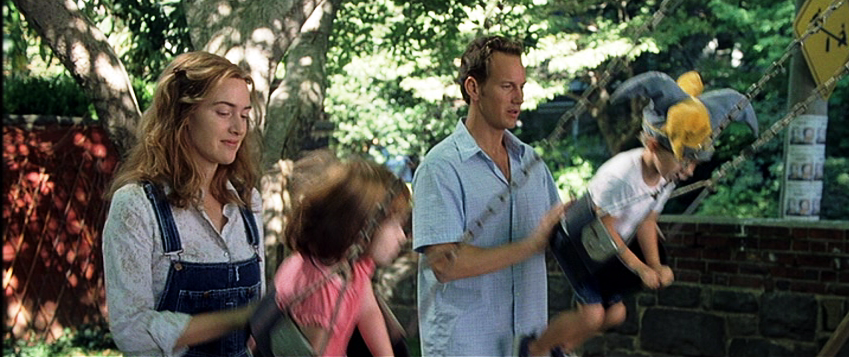
Kate Winslet is the ostensible star as a suburban mom with an unhappy marriage to a man with a secret Internet porn habit and a daughter to whom she can't really connect. She spends most days taking the girl to the park where other stay-at-home moms gather to gossip and chatter, especially about the sudden return of "The Prom King" (Patrick Wilson), a rare father who shows up to the park with his child.
Having failed the Bar Exam twice, Wilson seems unsatisfied as he depends upon his wife (Jennifer Connelly), but he and Winslet develop a friendship. On top of these stories hang the community's concern about the arrival of a released sex offender (Jackie Earle Haley, long absent from movie screens but still recognizable from his days in the original Bad News Bears and Breaking Away), especially a former cop (Noah Emmerich) who develops an obsession with the freed man.
For most of the film, I was entranced, not only by the performances and sharp script, but especially by Field's visual style, which has really grown since In the Bedroom. However, as the film moved along, the feeling that there wasn't a clear destination in mind began to gnaw at me, a feeling that unfortunately proved to be true. The Wilson-Winslet plot and the Emmerich-Haley story, though loosely tied through Wilson's character's connection to Emmerich's, almost feel as if they belong in separate films, though Emmerich and Haley's tale does resolve itself more satisfactorily than the Wilson-Winslet one does.
I don't want to sound too harsh about Little Children — even with its flaws, it's one of the better films I've seen this year and I liked it better than In the Bedroom. Winslet, as usual, turns in a great performance, and it's good to see Haley again, even if I think a lot of the praise his performance has generated can be more attributable to his comeback than to his acting itself.
Still, Field as a director really impressed me and I look forward to seeing what he comes up with next.
Tweet
Labels: 00s, Jennifer Connelly, Spacek, Winslet
TO READ ON, CLICK HERE
Tuesday, December 20, 2005
From the Vault: Career Opportunities

Welcome to the John Hughes Do-It-Yourself Screenplay Kit.
FADE IN: Chicago suburb.
(Pick one of the following)
A
wakes up and
The next step is more difficult. Choose whether or not to make this movie about:
Perhaps if I made millions telling the same stories over and over again, I wouldn't be so quick to attack John Hughes. Still, I would think that pride in one's work would enter the equation. Based on Career Opportunities, that factor obviously doesn't affect Hughes.
Frank Whaley stars as Ferris — I mean Jim Dodge, a 21-year-old who can't hold a job. After being fired for the umpteenth time, Dodge gets a job as night cleanup guy at Target, which gets a 90-minute commercial.
Meanwhile, Jennifer Connelly plays the 21-year-old daughter of the richest man in town and tries to embarrass him any time she can. Her latest attempt involves shoplifting, but she chickens out and hides in the Target dressing room. As she hides and Jim prepares to clean, Jim's psycho supervisor (William Forsythe) locks him in all night.
Jim stumbles upon the young woman and the two engage in Breakfast Club-type truth games followed by the requisite pop drivel-driven dance of discovery. Yes, though Hughes only wrote the script and left Bryan Gordon to direct, it still contains his overused music video sequences. Total for this film: six.
Following the truth game, guess who happens to wander into the store? Why — it's two bumbling burglars! Other traditional Hughesian elements include Jim's family, made up of two sitcom-quality kids (brainy sister, precocious younger brother) and parents (hard-ass dad, optimistic mom) and, of course, a cameo by John Candy.
Gordon shot the film in widescreen, though I don't know why, unless it's for those panoramic shots of the Target store's empty parking lot. David Lean would be proud.
Perhaps all these familiar elements would be forgivable if the film were funny, but it's not. The audience I saw the film with, about 30 people of varying ages, I only heard someone laugh out loud once.
In addition to the Hughes-built cliches, the films ends abruptly and includes inexplicable shots of Jim's dad late-night eating binge. Hughes must be stopped. He can't keep using the same plots over and over again.
His films, even the ones people like the first time, grind on later viewings. His only truly worthwhile effort was Sixteen Candles, but I challenge anyone who liked The Breakfast Club as a teen to be able to endure it now, its noble sentiments killed by an unrealistic ending and the bluster of the ever-annoying Judd Nelson. Watch it now and you'll side with Paul Gleason.
People still flock to these monuments of self-plagiarism. I guess that years of Three's Company, Who's the Boss? and America's Funniest Home Sado-Masochists have shortened the public attention span to the point that they suffer from cinematic amnesia.
So, bumbling burglars are in now and Hughes is certain to use them a lot. Career Opportunities is just as lame as the other recycled Hughes products, but it's even less entertaining than most.
Tweet
Labels: 90s, Jennifer Connelly, John Hughes, Lean
TO READ ON, CLICK HERE


