Tuesday, January 13, 2009
Grade: Incomplete

By Edward Copeland
Usually, if I give up on a film without watching it all the way through, I won't bother to write anything about it. However, the 35 minutes I spent with Alan Ball's Towelhead were so excruciating, that I decided to make an exception.
The only reason I knew of it in the first place was that its young lead, Summer Bishil, had been nominated for an Independent Spirit award for female lead. I didn't even realize Ball wrote and directed it until after I gave up (the dopey fantasy sequences, way too reminiscent of the ones Six Feet Under had to have two or three of an episode after a while, should have been a clue).
I learned of Ball's involvement when I read that it had ranked in the Village Voice/LA Weekly critics poll as the second worst film of 2008, bested only by Mike Myers' The Love Guru.
Bishil plays a 13-year-old half-Lebanese American girl sent from her boozy, blonde mom who goes apeshit when she catches her shaving her legs and turning on her new boyfriend to live with her strict Lebanese father whose fairly modern as far as it goes for him but forbids his daughter from doing things such as using tampons for periods (those are for married women) or wearing makeup (that his new girlfriend puts on her).
Hell, dad locks her out of the house when he discovers the tampon. Towelhead is the medicine for anyone who thinks Revolutionary Road is depressing. Hell, it makes The Hours play like a laugh riot. Wait. It gets worse.
Did I mention that Aaron Eckhart plays the friendly pedophile next door? He has a son that Bishil babysits and hangs out with and constantly harangues her with racial epithets. Then again, every student in her school does the same thing. Now, it's not like she's dressed like a Muslim in a burqa. Except for her darker skin, how would they even know her ethnicity unless they'd read the script?
Thankfully, there's a young African-American teen who befriends her. I left before I saw what horrible ending awaited him. The only glimmer of hope in the part I saw was when Toni Collette appeared as a kind neighbor, but I knew she wouldn't drag the girl into a good movie, so it wasn't worth watching the teen shimmy on her seat as she discovers her sexuality.
I don't know how the film ends, but I know from what I watched the way it should. The girl calls a suicide hotline, tells her story and the sympathetic listener tells her that in this case, perhaps it's best if she calls it a life.
Tweet
Labels: 00s, Toni Collette
TO READ ON, CLICK HERE


Monday, January 15, 2007
Hate it, Sorry
By Edward Copeland
The toll has become staggering. Annette Bening. Jill Clayburgh. Those two unknowns in Babel. Peter O'Toole. Ellen Page. Toni Collette (in The Night Listener at least). Leonardo DiCaprio and Jennifer Connelly in Blood Diamond. The number of actors giving good to great performances in poor to mediocre movies in 2006 has been brutal. Add to that list Robin Wright Penn in Sorry, Haters, though in this case the movie is so awful that it's difficult to say that it's worth seeing despite the fact that Wright Penn is so good in it.
Jeff Stanzler's Sorry, Haters aspires to be a provocative take on people's addiction to tragedy, especially in light of 9/11 — at least that's my best guess as to this film's point. What it is really about is a crazy woman (Wright Penn) and it uses the 9/11 attacks as background.
For anyone who thought United 93 or World Trade Center might be exploitative, check out Sorry, Haters — this is exploitation of those events of the worst kind.
The story begins when Wright Penn's character steps into the taxi of a Muslim cab driver (Abdellatif Kechiche) and proceeds to turn the man's life into a nightmare. It's like Misery, only using New York as the setting instead of a snow-bound cabin and without the psychological depth.
Sorry, Haters was such a pain to watch, that I don't really even feel like writing that much about it. It reminds me of the dream I once had for a three word review of a movie I wanted to publish in a newspaper: "It's a turd."
However, I can't deny how good Wright Penn is in it. The question is why waste her talent on such lousy material as this? The Independent Spirit Awards nominated her for best actress and I think she deserves the nomination, but no one deserves to sit through this awful film just to see it. Maybe I was too hard on Running With Scissors.
Tweet
TO READ ON, CLICK HERE
The toll has become staggering. Annette Bening. Jill Clayburgh. Those two unknowns in Babel. Peter O'Toole. Ellen Page. Toni Collette (in The Night Listener at least). Leonardo DiCaprio and Jennifer Connelly in Blood Diamond. The number of actors giving good to great performances in poor to mediocre movies in 2006 has been brutal. Add to that list Robin Wright Penn in Sorry, Haters, though in this case the movie is so awful that it's difficult to say that it's worth seeing despite the fact that Wright Penn is so good in it.
Jeff Stanzler's Sorry, Haters aspires to be a provocative take on people's addiction to tragedy, especially in light of 9/11 — at least that's my best guess as to this film's point. What it is really about is a crazy woman (Wright Penn) and it uses the 9/11 attacks as background.
For anyone who thought United 93 or World Trade Center might be exploitative, check out Sorry, Haters — this is exploitation of those events of the worst kind.
The story begins when Wright Penn's character steps into the taxi of a Muslim cab driver (Abdellatif Kechiche) and proceeds to turn the man's life into a nightmare. It's like Misery, only using New York as the setting instead of a snow-bound cabin and without the psychological depth.
Sorry, Haters was such a pain to watch, that I don't really even feel like writing that much about it. It reminds me of the dream I once had for a three word review of a movie I wanted to publish in a newspaper: "It's a turd."
However, I can't deny how good Wright Penn is in it. The question is why waste her talent on such lousy material as this? The Independent Spirit Awards nominated her for best actress and I think she deserves the nomination, but no one deserves to sit through this awful film just to see it. Maybe I was too hard on Running With Scissors.
Tweet
Labels: 00s, Bening, DiCaprio, Jennifer Connelly, O'Toole, Robin Wright, Toni Collette
TO READ ON, CLICK HERE
Saturday, January 13, 2007
As if seeing for the first time
By Edward Copeland
One of the great joys of habitual moviegoing comes when a performer you've not seen for a long time suddenly reappears in such an attention-grabbing way that you wonder where he or she has been lately. What's so amazing about The Dead Girl is that the film assembles a cast with nary a weak link and contains surprising turns across the board from supporting performers you've grown accustomed to being excellent.
You know that actresses such as Toni Collette, Mary Steenburgen and Marcia Gay Harden will be up to the task, but you probably aren't prepared for such strong turns from Kerry Washington, Brittany Murphy or Rose Byrne or for invigorating work from actors such as James Franco and Josh Brolin in what should be throwaway roles.
Most of all though, for me at least, I was unprepared to see such strong work from a great actress such as Piper Laurie, who hasn't seen a role this good probably since Twin Peaks went off the air, or, especially, the brilliant performance of a nearly unrecognizable Mary Beth Hurt.
The pleasant surprises of The Dead Girl aren't limited to who is in front of the camera either. Writer-director Karen Moncrieff's first feature, Blue Car, truly underwhelmed me, but The Dead Girl shows strength in every area where her previous work proved weak.
Moncrieff also manages to make what essentially is an anthology succeed in a way that most collections of stories don't. Jean-Luc Godard famously said that the best way to express criticism of a film was to make another movie and in its own way, that is what The Dead Girl does. It connects its five stories in a cohesive way that movies such as last year's Nine Lives or, to a lesser extent since the parallel isn't exact, this year's insipid Babel, don't.
What links the tales in The Dead Girl is the title character (Murphy) and how her life and death affect various women, some who knew her and some who didn't. Its theme of abused women never beats you over the head but instead just lurks ominously in the background as the performers and the story go on, letting the audience pick up on the themes instead.
Moncrieff deserves a lot of credit not only for constructing this script but for assembling this disparate a cast and using them so well, especially Hurt. I keep being drawn back to her. It seems appropriate that I review this film the same day as The Night Listener starring Robin Williams, since my first memory of Hurt was opposite Williams in The World According to Garp. If I didn't know going in that she was in The Dead Girl, I doubt I would have recognized her immediately since her role as the dowdy wife of the manager of storage trailers is so far removed from Helen Holm that you think you're seeing her for the very first time.
Tweet
TO READ ON, CLICK HERE
One of the great joys of habitual moviegoing comes when a performer you've not seen for a long time suddenly reappears in such an attention-grabbing way that you wonder where he or she has been lately. What's so amazing about The Dead Girl is that the film assembles a cast with nary a weak link and contains surprising turns across the board from supporting performers you've grown accustomed to being excellent.
You know that actresses such as Toni Collette, Mary Steenburgen and Marcia Gay Harden will be up to the task, but you probably aren't prepared for such strong turns from Kerry Washington, Brittany Murphy or Rose Byrne or for invigorating work from actors such as James Franco and Josh Brolin in what should be throwaway roles.
Most of all though, for me at least, I was unprepared to see such strong work from a great actress such as Piper Laurie, who hasn't seen a role this good probably since Twin Peaks went off the air, or, especially, the brilliant performance of a nearly unrecognizable Mary Beth Hurt.
The pleasant surprises of The Dead Girl aren't limited to who is in front of the camera either. Writer-director Karen Moncrieff's first feature, Blue Car, truly underwhelmed me, but The Dead Girl shows strength in every area where her previous work proved weak.
Moncrieff also manages to make what essentially is an anthology succeed in a way that most collections of stories don't. Jean-Luc Godard famously said that the best way to express criticism of a film was to make another movie and in its own way, that is what The Dead Girl does. It connects its five stories in a cohesive way that movies such as last year's Nine Lives or, to a lesser extent since the parallel isn't exact, this year's insipid Babel, don't.
What links the tales in The Dead Girl is the title character (Murphy) and how her life and death affect various women, some who knew her and some who didn't. Its theme of abused women never beats you over the head but instead just lurks ominously in the background as the performers and the story go on, letting the audience pick up on the themes instead.
Moncrieff deserves a lot of credit not only for constructing this script but for assembling this disparate a cast and using them so well, especially Hurt. I keep being drawn back to her. It seems appropriate that I review this film the same day as The Night Listener starring Robin Williams, since my first memory of Hurt was opposite Williams in The World According to Garp. If I didn't know going in that she was in The Dead Girl, I doubt I would have recognized her immediately since her role as the dowdy wife of the manager of storage trailers is so far removed from Helen Holm that you think you're seeing her for the very first time.
Tweet
Labels: 00s, Franco, Godard, Josh Brolin, Piper Laurie, Robin, Toni Collette, Twin Peaks
TO READ ON, CLICK HERE
Blurring the lines
By Edward Copeland
I didn't pay much attention to The Night Listener when it originally was released last year and, even though I thought the film essentially was a bore, it did encourage me to do some research before I wrote about it. It said it was based on a novel by Armistead Maupin, whom Robin Williams' character of Gabriel seemed obviously patterned after, but it also alluded to it being based on real-life events.
Once I searched around, I learned about the controversy relating to the story that hit about the same time as the James Frey A Million Little Pieces nonsense. However, I'll leave those thoughts aside and just focus on the film, in case anyone wants to check it out. If they do, there is one main reason: another great performance by Toni Collette.
This odd little film (and a short one — only 80 minutes) tells the story of Gabriel, a gay radio host and author who develops on over-the-phone friendship with an AIDS-stricken teen (Rory Culkin) who was the victim of abuse and is cared for by Donna (Collette).
One day when Gabriel has both of them talking on a speaker phone, his former lover (Bobby Cannavale) remarks that both voices sound similar, putting the idea in Gabriel's head that perhaps he's the victim of a fraud. Soon, Gabriel treks to Wisconsin in search of the sick boy and Donna, though he only finds Donna who turns out to be a blind, mentally unstable woman.
While director Patrick Stettner, who co-wrote the screenplay with Maupin and Terry Anderson, does create some genuinely creepy moods, the film as a whole never bubbles to a fizz except when Collette is on screen. Williams is fine in subdued mode and Cannavale and Sandra Oh also provide some solid support.
In the end, The Night Listener seems undercooked, which may be the reason for the short running time and single scene appearance by John Cullum as Gabriel's father, but Collette is great and really makes sitting through it all seem worthwhile.
Tweet
TO READ ON, CLICK HERE
I didn't pay much attention to The Night Listener when it originally was released last year and, even though I thought the film essentially was a bore, it did encourage me to do some research before I wrote about it. It said it was based on a novel by Armistead Maupin, whom Robin Williams' character of Gabriel seemed obviously patterned after, but it also alluded to it being based on real-life events.
Once I searched around, I learned about the controversy relating to the story that hit about the same time as the James Frey A Million Little Pieces nonsense. However, I'll leave those thoughts aside and just focus on the film, in case anyone wants to check it out. If they do, there is one main reason: another great performance by Toni Collette.
This odd little film (and a short one — only 80 minutes) tells the story of Gabriel, a gay radio host and author who develops on over-the-phone friendship with an AIDS-stricken teen (Rory Culkin) who was the victim of abuse and is cared for by Donna (Collette).
One day when Gabriel has both of them talking on a speaker phone, his former lover (Bobby Cannavale) remarks that both voices sound similar, putting the idea in Gabriel's head that perhaps he's the victim of a fraud. Soon, Gabriel treks to Wisconsin in search of the sick boy and Donna, though he only finds Donna who turns out to be a blind, mentally unstable woman.
While director Patrick Stettner, who co-wrote the screenplay with Maupin and Terry Anderson, does create some genuinely creepy moods, the film as a whole never bubbles to a fizz except when Collette is on screen. Williams is fine in subdued mode and Cannavale and Sandra Oh also provide some solid support.
In the end, The Night Listener seems undercooked, which may be the reason for the short running time and single scene appearance by John Cullum as Gabriel's father, but Collette is great and really makes sitting through it all seem worthwhile.
Tweet
Labels: 00s, Cannavale, Robin, Toni Collette
TO READ ON, CLICK HERE
Saturday, January 06, 2007
These Boots were made for vampin'

By Edward Copeland
Sometimes actors you've been familiar with for awhile but hadn't thought much about can sneak up on you and that's certainly the case with Chiwetel Ejiofor as far as 2006 has been concerned.
I first noticed him in 2002's Dirty Pretty Things and thought he was fine, but didn't think about him much more than that. Since then, he's given solid support in films good (Inside Man), bad (Love, Actually and Melinda and Melinda) and in between (Children of Men).
Then, the waiters and florists that make up the Hollywood Foreign Press Association nominated Ejiofor for best actor in a musical or comedy for Kinky Boots, a title that didn't ring a bell but which did sound familiar once I looked into it and found it was available on DVD, so I quickly added it to my GreenCine queue.
Before it moved up to mailing status, I caught Ejiofor again, this time in the HBO film Tsunami: The Aftermath, another title I wasn't aware of until the HFPA nominated Ejiofor, Sophie Okonedo and Toni Collette for it. While both those actresses were quite good, Ejiofor was the film's standout as a tourist frantically searching for his wife and daughter after the massive disaster hit Indonesia and elsewhere in 2004. Ejiofor's performance will break your heart and really it's an outrage that the Screen Actors Guild both passed him over in their nominations.
I have to give the HFPA credit for bringing Tsunami: The Aftermath to my attention and for remembering Kinky Boots which, while not a great film, does boast a completely different side of Ejiofor than I've ever seen and contains a great performance from the actor that deserves its place among the year's best.
Ejiofor plays Lola, a Northampton, England drag queen who becomes an unlikely footwear designer when Charlie Price (Joel Edgerton) stumbles upon him after inheriting his father's struggling shoe company. His encounter with the fabulous side of life inspires him that a way to save the company might be to manufacture specialty footwear for drag queens that look great, but are sturdy enough to carry men's often more substantial frames.
If that sounds like a slight premise for a film, it is, though director Julian Jarrold does his best to move things along. Kinky Boots belongs to what has almost become a subgenre of U.K.-set films — plucky Brits (or nearly Brits) doing something unorthodox to enliven their lives and livelihoods (Think The Full Monty, Brassed Off, Calendar Girls, Saving Grace, etc.)
None of these films are particularly bad and some are pretty good, but it's beginning to feel like a formula, even if a title card claims that Kinky Boots is "inspired by a true story," but enduring a little formula is worth it just to see Ejiofor's great work as Lola.
Tweet
Labels: 00s, HBO, Toni Collette
TO READ ON, CLICK HERE
Wednesday, December 13, 2006
Let a little Sunshine into your life
By Edward Copeland
The quirky character comedy often proves to be a hard nut to crack and adding the element of a road trip on top really raises the bar for success. That's why I was so pleased to find that once I caught up with Little Miss Sunshine, the film passed both tests with flying colors thanks to a great cast, sharp writing and crisp direction.
So often when titles come roaring out of Sundance with buzz, they end up seeming oversold (think The Blair Witch Project or The Spitfire Grill). Thankfully, Little Miss Sunshine is a Sundance title that deserves its word-of-mouth.

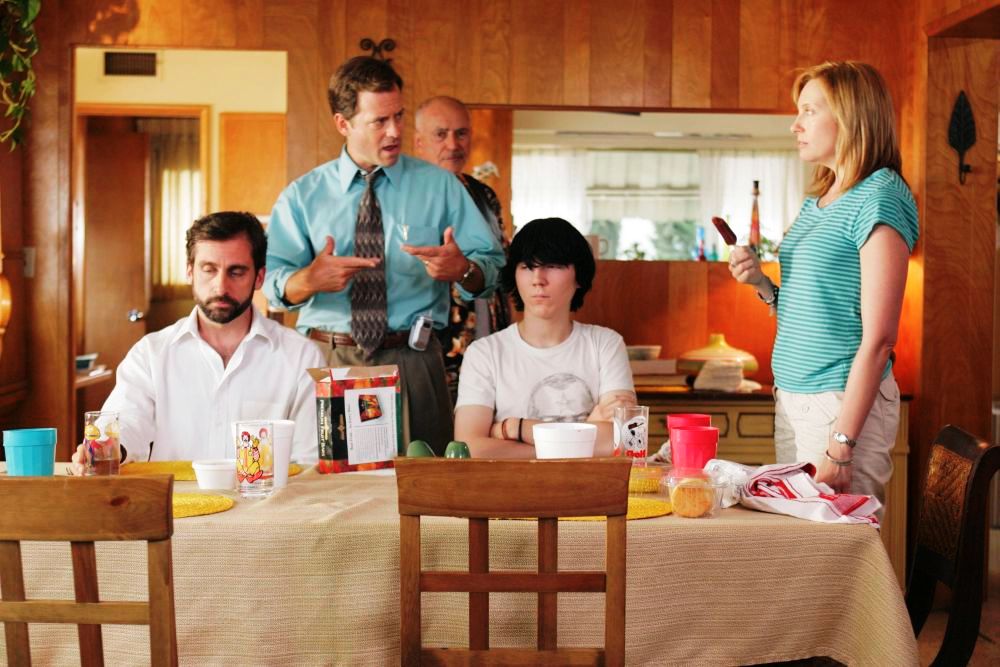
The strong comic ensemble includes Greg Kinnear as a driven-for-success suburban father, Toni Collette as his wife, Steve Carell as his suicidal gay Proust scholar of a brother-in-law and Paul Dano as his silent teenage son. The standouts though in a cast of standouts are Alan Arkin as Kinnear's heroin snortin' father and young Abigail Breslin as the would-be title character, a charming little girl who dreams of winning the Little Miss Sunshine pageant but who really is too smart and too special to be competing against a frightening army of JonBenet clones.
Arkin, who has been so good for so long that he's taken for granted, really deserves some year-end recognition for his work here, getting many of the film's best lines and knowing just the right spin to put on them. Breslin is a find — a child actress who doesn't seem as if she's been manufactured out of a factory or might really be a woman in her 40s pretending to be a child such as Dakota Fanning.
The rest of the cast are great as well. Collette is wonderful as always and Kinnear seems to grow as a performer with each film he's in. Dano also gets nice moments as the surly teen and Carell gives his most deadpan and touching performance as the troubled brother-in-law.
The original script by first-time screenwriter Michael Arndt makes what could play as scenes and situations we've seen before sparkle with wit and pathos. Co-directors Jonathan Dayton and Valerie Faris move Little Miss Sunshine along at a healthy clip that never seems to sag.
I was late getting to see this one, but it certainly was worth the wait. It's one of the most purely enjoyable films I've seen in a while.
Tweet
Labels: 00s, Toni Collette
TO READ ON, CLICK HERE


