Saturday, February 01, 2014
Maximilian Schell (1930-2014)

Schell received two other Oscar nominations in his film career as best actor: in 1975's The Man in the Glass Booth and as supporting actor in 1977's Julia. He also received two Emmy nominations for the TV films Stalin and Miss Rose White in the early '90s. He appeared on Broadway three times, the first time in 1958 in Interlock, the same year his first English-language film, The Young Lions, came out. His third appearance came in 2001 in a stage production of Judgment at Nuremberg, this time playing the role of Dr. Ernst Janning whom Burt Lancaster played in the 1961 film.
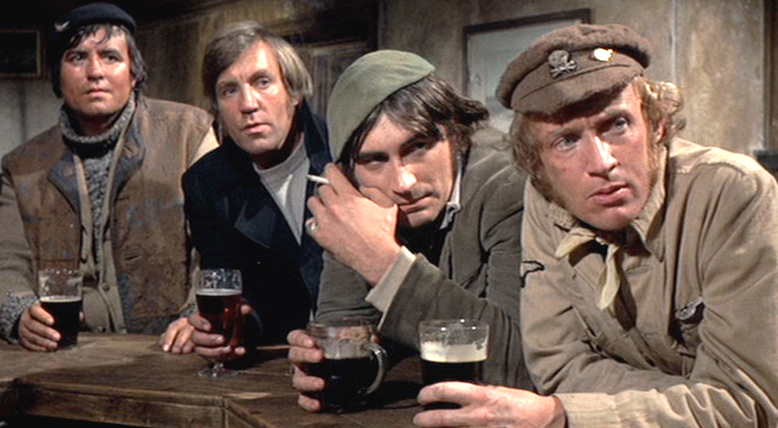
Shortly after his Oscar win, he joined the cast of thieves in Jules Dassin's 1964 Topkapi. The first exposure to Schell's work for many in my generation probably came from silly 1979 sci-fi flick The Black Hole. He also played the erstwhile villain opposite James Coburn in one of the lesser Sam Peckinpah effort, 1977's Cross of Iron. He appeared in many films and roles for television both in the U.S. and abroad, including a six-episode stint on Wiseguy.
He also directed, most notably the remarkable 1984 documentary Marlene, where Marlene Dietrich reflected on her life without ever letting herself be seen in her current state.
Of all Schell's roles though, I always maintain a soft spot in my heart for his role as eccentric chef Larry London in Andrew Bergman's great comedy The Freshman with Marlon Brando doing a pitch-perfect parody of his own Vito Corleone.
RIP Mr. Schell.
Tweet
Labels: Awards, Brando, Dassin, Documentary, James Coburn, Lancaster, Marlene, Obituary, Oscars, Peckinpah, Television, Theater
TO READ ON, CLICK HERE


Monday, May 20, 2013
Prison of My Dreams

By Edward Copeland
As I snap the cuffs on Will Smith's wrists, I try to look stern and sympathetic simultaneously. "I take no pleasure in having to do this, Mr. Smith, but it's for your own good as well as the good of the public. Hopefully, your stay will be a short one." I'm taking Smith to serve his sentence in the Copeland Penitentiary for Bad Film Ideas. The actor received a summary conviction with the recent announcement of his interest of remaking Sam Peckinpah's classic Western The Wild Bunch. We had no choice. Trying to do a new version of such a revered film would be bad enough, but when you read the details that explain it would be a modern version involving the DEA and drug cartels, it sounds as if it's only stealing the title. We couldn't risk this debacle-in-development from getting to pre-production. Smith needed to be jailed until he regained his senses.
Now, if Smith breaks quickly, his sentence should be short since this idea didn't originate with him. Warner Bros. has toyed with the idea of a remake for more than a decade with various names such as the late director Tony Scott and stars such as Tom Cruise mentioned. If it were possible to put an entire studio into permanent solitary confinement, I would do it. Johnny Depp, pictured above being taken the prison to serve his time, had a longer time behind bars when he announced his intention to make a new version of The Thin Man and to take on William Powell's trademark role of Nick Charles. Thankfully, that talk disappeared once we locked up Depp for awhile and he hasn't mentioned it since. It's great that Depp loves The Thin Man — but the original remains and people should watch it. (If only the prison existed before Gus Van Sant got his cuckoo idea of doing a shot-by-shot remake of Hitchcock's Psycho in color.)
Look at the case of something that happened before the Copeland Penitentiary opened when Russell Brand remade Arthur with Brand in the Dudley Moore role and Helen Mirren taking over for John Gielgud. It sounded like a bad idea on paper, looked more horrendous when commercials and trailers appeared and received mostly bad reviews. (I did enjoy that the original in 1981 grossed more than the remake's budget which flopped badly.) What disturbed me was that the original Arthur never received a DVD release in the proper ratio and when the remake came out, they released a Blu-ray that forced you to get it with its awful sequel Arthur 2: On the Rocks.
Therein lies the dangers of remakes of great films. With technology constantly changing and money always an issue, at some point they'll start leaving us with the fresher versions, assuming that younger audiences won't know or care to see the classics. I'd try to talk them into how much money they'd save if they just re-released older films to theaters without having to spend all that money on new movies, but they won't go for it. Besides, making movies cost WAY too much to make and see today and the best stuff gets made on television anyway.
Tweet
Labels: 10s, Cruise, Depp, Gielgud, Hitchcock, Mirren, Peckinpah, Remakes, T. Scott, Television, Van Sant, W. Smith, William Powell
TO READ ON, CLICK HERE
Saturday, May 19, 2012
Centennial Tributes: Richard Brooks Part II

By Edward Copeland
We pick up our tribute to Richard Brooks in 1956. If you missed Part I, click here. Of Brooks' two 1956 releases, I've only seen one of them. The Last Hunt stars Stewart Granger as a rancher who loses all his cattle to a stampeding herd of buffalo. Robert Taylor plays a buffalo hunter who asks him to join in an expedition to slaughter the animals, but the rancher, an ex-buffalo hunter himself, had quit because he'd grown weary of the killing. Brooks may be the auteur of antiviolence. Filmed in Technicolor Cinemascope, I imagine it looked great on the big screen. Bosley Crowther wrote in his New York Times review, "Even so, the killing of the great bulls—the cold-blooded shooting down of them as they stand in all their majesty and grandeur around a water hole—is startling and slightly nauseating. When the bullets crash into their heads and they plunge to the ground in grotesque heaps it is not very pleasant to observe. Of course, that is as it was intended, for The Last Hunt is aimed to display the low and demoralizing influence of a lust for slaughter upon the nature of man." The second 1956 film I did see and given the talents involved and the paths it would take, it's a fairly odd tale. The Catered Affair was the third and last film in Richard Brooks' entire directing career that he also didn't write or co-write.

It began life as a teleplay by the great Paddy Chayefsky in 1955 called A Catered Affair starring Thelma Ritter, J. Pat O'Malley and Pat Henning before its adaptation for the big screen the following year, the same journey Chayefsky's Marty took that ended up in Oscar glory. This time, Chayefsky didn't adapt his work for the movies — Gore Vidal did. Articles of speech changed in its title as well as the teleplay A Catered Affair became The Catered Affair for Brooks' film. (Chayefsky apparently wasn't a particular fan of this work of his — it never was published or appeared in a collection of his scripts.) We're at the point where the project just got screwy. The simple story concerns an overbearing Irish mom in the Bronx determined to give her daughter a ritzy wedding because of the bragging she hears her future in-laws go on about describing the nuptials thrown for their girls. Despite the fact that the Hurley family lacks the funds for it, Mrs. Hurley stays determined while her husband Tom sighs — he's been saving to buy his own cab. On TV, the casting of Ritter and O'Malley for certain sounded appropriate. For the film, which added characters since it had to expand the length, the cast appeared to have been picked out of a hat because they certainly didn't seem related, most didn't register as Irish and as for being from the Bronx — fuhgeddaboudit. Meet Mr. and Mrs. Tom Hurley, better known to you as Ernest Borgnine and
 Bette Davis. Unlikely match though they be, somehow their genes combined and out popped the most Bronx-like of Irish girls — Debbie Reynolds. The new character of Uncle Jack does add a bit of real Irish flavor by tossing in Barry Fitzgerald for no apparent reason. Unbelievably, it made the list of the top 10 films of the year from the National Board of Review who also named Reynolds best supporting actress (nothing against Reynolds in general — just miscast here). You would think that this Affair would fade into oblivion, but you'd be wrong. In 2008, it changed articles again and re-emerged on the Broadway stage as the musical A Catered Affair. Faith
 Prince and Tom Wopat(Yes — that Tom Wopat of Luke Duke fame) earned Tony nominations as the parents, Harvey Fierstein wrote the book and played the uncle (named Winston) and John Bucchino wrote the score. Why did Brooks make this one? Easy. He was under contract. MGM told him to make it, so he had no choice. From Tough as Nails: The Life and Films of Richard Brooks, some of the cast talked on record about how Brooks could be a bit of a prick as a director. "I didn't know it at the time, but Brooks ate and digested actors for breakfast," Borgnine said later. "If things weren't working, he let you know it, and not gently." When a particular scene was not working to his satisfaction, (Brooks) ordered Borgnine and Davis to figure out the problem. Borgnine suggested a different pacing and Davis agreed the scene was better for it — as did (Brooks), though he offered Borgnine not praise but a putdown. 'Goddamn thinking actor.'" Reynolds also tells the author Douglass K. Daniel that from the first day she met Brooks he told her that he didn't want her in the part, but it wasn't his decision. "'He said he was stuck with me and he'd do the best he could with me,' Reynolds recalled. 'He hoped I could come through all right with him, because everybody else was so great, but he wasn't certain I could keep up with the others. He actually said he was stuck with me. And he said so in front of everybody, too. He was so cruel.'" Davis and Borgnine coached Reynolds on the side and Bette, not known to be a shrinking violet, told Reynolds once, according to the book, "'Don't pay any attention to him, the son of a bitch,' Davis told her. 'The only important thing is to work with the greats.'" Davis did get help from Brooks in her fight against the studio that a Bronx housewife shouldn't be wearing movie star costumes they wanted, so he supported her decision to buy clothes at a store like Mrs. Hurley would shop at in real life. Years later, Davis referred to Brooks as one of the greats. This wasn't the first time Brooks had treated a young actress oddly on a set, Anne Francis told Douglass Daniel for his book that he practically ignored her during the filming of Blackboard Jungle and she received no direction at all. Daniel suggests and, given the way Brooks ordered Borgnine and Davis to come up with an idea to fix a scene, that writing had been his greatest gift, he grew into a solid visual storyteller, but Brooks proved limited when it came to directing actors. Daniel wrote, "…(the accounts of Francis and Reynolds) suggested he had a limited ability to communicate what he wanted. He either paid them little attention…or tried to bully a performance from them." Despite that problem, 10 actors in Brooks-directed films earned Oscar nominations and three took home the statuette.
The following year, Brooks made another film that revolved around the hunt of an animal, though that just leads to much bigger issues in Something of Value, sometimes known as Africa Ablaze. Starring Rock Hudson and filmed in Kenya, the film, which I haven't seen, concerns tensions that erupt between formerly friendly colonial white settlers and the Kenyan tribesmen. It also began a run of films that Brooks adapted from serious literary sources. Something of Value had been written by Robert C. Ruark, a former journalist like Brooks, who fictionalized his experiences being present in Kenya during the Mau Mau rebellion. In 1958, the two authors he adapted carried names more prestigious and recognizable. The first movie released derived from a particularly literary source and Brooks didn't do all that heavy lifting alone. Julius and Philip Epstein did the original adaptation, working from the English translation of the novel by Constance Garnett before Brooks began his work writing a worthwhile screenplay that didn't run more than two-and-a-half hours out of Fyodor Dostoyevsky's The Brothers Karamazov. It wasn't easy. Brooks told Daniel that he "wrestled with the book for four months." What surprised me to learn, also according to what Brooks told Daniels, MGM assigned Karamazov to him. Brooks also said that he never initiated any of his films while under contract at MGM. I love Dostoyevsky. Hell, even a master such as Kurosawa couldn't pull off a screen adaptation of The Idiot. The only aspect of this film that holds your attention — actually it would be more accurate to say grabs you by your throat and keeps you awake for his moments — ends up being any scene with Lee J. Cobb playing the Father Karamazov. I don't know if Cobb realized that somebody needed to step up or what, but the brothers, with only Yul Brynner showing much charisma, also include William Shatner. It's almost embarrassing except for Cobb who got a deserved supporting actor Oscar nomination, the first of the 10 from Brooks-directed films.
The actor who Cobb lost that Oscar to that year had a major part in Brooks' other 1958 feature — the film adaptation of Tennessee Williams' Pulitzer Prize-winning play Cat on a Hot Tin Roof. However, Burl Ives didn't win the prize for his great turn as Big Daddy, but for his role as a ruthless cattle baron fighting with another rancher over land and water in The Big Country. As with nearly all of Williams' works, movie versions castrated his plays' subtext (and sometimes just plain text) and this proved true with Cat as well, though the cast and its overriding theme of greed kept it involving enough. The film scored at the box office for MGM, taking in a (big for 1958) haul of $8.8 million — Leo the Lion's biggest hit of the year and third-biggest of the 1950s. It scored six Oscar nominations: best picture, best actress for Elizabeth Taylor as Maggie the Cat, best director for Brooks, best adapted screenplay for Brooks and James Poe best color cinematography for William Daniels and best actor for Paul Newman as Brick, Newman's first nomination and the film that truly cemented him as a star.
After the success of Cat on a Hot Tin Roof, Brooks decided to take an ocean voyage to Europe as a vacation. The writer-director packed the essentials for a lengthy trip: some articles on evangelism, a Gideon Bible a copy of Sinclair Lewis' novel Elmer Gantry and Angie Dickinson. By the time the ship docked in Europe, a first draft of a screenplay, based on the novel by one of the men who stood ready to
 defend Brooks during The Brick Foxhole brouhaha with the Marines, lay finished. Dickinson, on the other hand, departed the cruise quite a while back, having grown annoyed by Brooks ignoring her for Elmer. For many lives, 1960 would prove quite eventful either professionally, personally or both. Brooks filmed the highly entertaining movie version of Elmer Gantry early in the year, directing one of his best friends, Burt Lancaster, for the first time in the title role, which is good since the film got made under the auspices of an independent Burt Lancaster/Richard Brooks Production. Lancaster gives one of his best performances and won his first Oscar. The film co-starred Jean Simmons, giving one of her greatest, most mesmerizing turns as Sister Sharon Falconer, the traveling tent show evangelist who gets Elmer into the biz. She fell for Brooks on the set. Within the calendar year, she ended her unhappy marriage to Stewart Granger and became Brooks' wife. Unfortunately, when the Oscar nominations came out the next year, Simmons got left out of the nominations for Elmer Gantry. It received five total. In addition to Lancaster's nomination and win for best actor, it received nominations for best picture; Shirley Jones as supporting actress, which she won; Andre Previn for best score for a drama or comedy; and Brooks for best adapted screenplay. That cruise paid off. Brooks won an Oscar and found a wife. Below, a bit of Lancaster at work — and singing too.
With his next film, Brooks finally received the key that unlocked the leg shackles that bound him to MGM. The studio once again assigned him to a Tennessee Williams play. Though Sweet Bird of Youth did moderately well on Broadway, it wasn't one of The Glorious Bird's triumphs and took a long time to get to New York, starting as a one-act, premiering as a full-length play with a reviled ending in Florida in 1956 and, finally, the revised version's
 opening in NY in 1959. (The play has yet to be revived on Broadway whereas, in contrast, Cat on a Hot Tin Roof has been revived four times, including twice in this young century, and A Streetcar Named Desire 's eighth Broadway revival currently runs.) Originally, its plot concerned a retired actress and a gigolo with dreams of Hollywood who brings her to his old Southern hometown to get away and runs into trouble with the town's corrupt political boss (Ed Begley) when he woos his daughter (Shirley Knight). Williams said he'd hoped for Brando and Magnani to play the parts on stage. Eventually, she became merely an aging actress and Geraldine Page and Paul Newman played the leads on Broadway. When it came time for the movie, according to legend, MGM desperately wanted Elvis for Newman's part, but the Colonel nixed that because he didn't like the character's morals. Instead, the great Page and Newman repeated their stage roles as did Rip Torn as the son of the political boss. Once again, Hollywood castrated a Williams play or, in this instance, literally didn't castrate it (people who know both the play and movie get that joke. Page and Knight received Oscar nominations in the lead and supporting actress categories, respectively, and Begley won as best supporting actor. In this clip, you can see Newman's Chance try to get a handle on Page's wasted Alexandra in their hotel room.
Now a free agent, Brooks decided to stay that way — in essence becoming an independent filmmaker toward the end of his career instead of the beginning, as the path usually goes. He also defied that typical indie move of starting small — this wasn't John Cassavetes — but beginning this stage of his career more like the final films (and current ones for 1965) of David Lean. He went BIG. He even nabbed Lean's Lawrence to star in his adaptation of Joseph Conrad's Lord Jim, a longtime obsession of Brooks that he bought the rights to in 1958 for a mere $6,500. The filming took place in Hong Kong, Singapore and, dangerously in Cambodia as things grew tense. The movie crew's interpreter happened to be Dith Pran, the man the late Haing S. Ngor won an Oscar for playing in Roland Joffe's 1984 film The Killing Fields. O'Toole hated his time there, complaining about the living conditions — he isn't a fan of mosquitoes and snakes. Later, he also admitted he thought he'd been wrong for the part itself. Portions of the film ended up shot in London's Shepperton Studios as Cambodia became full of anti-American rage. When the film opened, it bombed and badly. Sony put it on DVD briefly, but it's currently out of print so, alas, I've never seen this one. Brooks did make an impression on O'Toole though, who told Variety when he died that Brooks was "the man who lived at the top of his voice."

Having a flop on the scale of Lord Jim the first time you produce your own film could really discourage a guy. However, it sure didn't show in what he produced next because The Professionals turned out to be the most well-made, entertaining film he'd directed up until this point in his career. (His next film swipes the most well-made title, but The Professionals continues to hold the prize for being one hell of a ride.) Based on a novel by Frank O'Rourke, the movie teamed Brooks with his pal Lancaster again. Set soon after the 1917 Mexican Revolution, early in the 20th century when the Old West and modern movement intermingle near the U.S.-Mexican border, it almost plays like a rough draft for Sam Peckinpah's admittedly superior Wild Bunch. Ralph Bellamy plays a rich tycoon who hires a team of soldiers of fortune to go in to Mexico and rescue his daughter who has been kidnapped by a guerrilla bandit (Jack Palance, hysterically funny and good despite making no attempt to appear Mexican). The team consists of Lancaster as a dynamite expert, Lee Marvin as a professional soldier, Robert Ryan as a wrangler and packmaster and Woody Strode as the team's scout and tracker. The film turned out to be a huge hit with audiences and critics alike and earned Brooks Oscar nominations for directing and adapted screenplay. The Academy also cited the cinematography of its director of photography, the master Conrad L. Hall, who would do some of the finest work of his career in Brooks' next film. Below, one of The Professionals' action sequences.
I hoped to complete this in two parts and considered breaking out the next film as a separate review because In Cold Blood stands firmly as Richard Brooks' masterpiece (and then there remain some other films to mention after that). So, another temporary pause.
Tweet
Labels: Angie Dickinson, Bellamy, Bette, Borgnine, Chayefsky, Debbie Reynolds, Geraldine Page, Jean Simmons, Lancaster, Lee J. Cobb, Liz, Marvin, Newman, O'Toole, Peckinpah, Rip Torn, Shatner, Tennessee Williams, Vidal
TO READ ON, CLICK HERE
Thursday, March 29, 2012
Just when you thought you were out…

"If a team of assassins planned to ambush their target at a tollbooth, would it really be deemed necessary that the killers
wear their finest suits and fedoras while hiding before they perform the task? Did murder in the 1940s
require a dress code?" — Edward Copeland
By Edward Copeland
Some movies you love so much, have seen so many times in whole or in part, that when you stop to watch the film with a purpose (such as writing this post as well as the two previous ones, "America's first family" and "Merging art and commerce," to mark the 40th anniversary of The Godfather), you discover things you never noticed before and ideas occur to you for the first time. I still love The Godfather, but haven't watched it this closely in a long time — probably since viewing it in that Midtown Manhattan theater in 1997. When I saw it then, Goodfellas already existed in my life, but the sheer size of Coppola's images filtered through Gordon Willis' magnificent cinematography overwhelmed me so Martin Scorsese's masterpiece, albeit the greater film, didn't intrude on my thoughts then. This time though, I watched The Godfather on DVD on my TV — twice really, once for the movie, once for Coppola's commentary. This screening of rapt attention not only took place semi-horizontally at home, it also marked my first time observing The Godfather closely and in its entirety since The Sopranos entered the world. Because I have a lot to say, this will be a two-part post unlike the first two, which could stand alone. I plan, theoretically, for this final post to flow as a single piece even though I've divided it in half. To be a tease, I'm saving my new observations until the last section of this piece.
This reunion with the Corleones didn't change one aspect that amazed me the first time I viewed the film in a single, uncut setting: its miraculous pacing. Only a few minutes shy of three hours, The Godfather holds its length incredibly well. It never lags and you falsely sense that you've just settled in to the tale when, before you know it, the end credits roll. Coppola and his editing team of William
 Reynolds and Peter Zinner accomplish this without making the movie seem rushed either. While I knew the film incredibly well before I watched it again, the obvious never stood out until I heard what Coppola said on the commentary that I quoted in the first Godfather-related post, "America's first family," when he talked about seeing The French Connection during editing and thinking, "Compared to that, The Godfather is going to be this dark, boring, long movie with a lot of guys sitting around in chairs talking." On the commentary, Coppola follows that with the quote I put at the top of this post. Of course, the director's stress coughed up the adjective boring, but the film indeed does contain many scenes involving men sitting around talking. When you think about The Godfather, what usually springs to mind involves the masterfully choreographed sequences of violence such as the ending baptism montage or other memorable scenes such as the opening "I believe in America" monologue by the undertaker Bonsasera (Salvatore Corsitto). Those scenes with men talking play perfectly well, but you don't think about it. Not when the film containz scenes such as James Caan's Sonny being assassinated at the tollbooth, which Coppola freely acknowledges as his homage to Arthur Penn's finale in Bonnie and Clyde. "Like my dad always said, 'Steal from the best,'" Coppola says.
 The reason all those "talking scenes" work corresponds with the reason all those stylized scenes of violence work: great dialogue. Coppola didn't invent this. From the beginning of the torch Hollywood (and moviegoers) carried for gangsters and the mob, the genre's best examples always brought with them some of the most memorable line in movie history stretching back almost to the beginning of film. Literally, the list extends too long to name all the precursors. Of course, as the years went by, the country allowed more freedom of content in its movies. The Godfather debuted early in the process of those changes, becoming the first gangster film to truly benefit. As you'd expect, the prudes whined about moral decay then — just as many do now. (Those who yell loudest about losing their freedom inevitably also want to take it away from anyone who doesn't believe as they do.) Coppola addresses the issue of violence on the DVD. "The thing about violence in a film like this is you have to try to make every moment be in some way eccentric or have some unusual or memorable aspect so it's not just a bludgeoning or just violence but…there is some sort of context that singles it out," Coppola says. Wwile the big names get the lion's share of praise (deservedly) for their acting in The Godfather, not enough gets said about those in the
 smaller roles because on top of its other positive attributes, The Godfather, despite Coppola's fights with Paramount, turned out to be an exceptionally well-cast movie. Richard Conte not only performs well as the oily and duplicitous rival boss Barzini, his presence provides a crucial link to the history of the genre, as did several other actors, through films such as Joseph L. Mankiewicz's House of Strangers, The Brothers Rico and Jules Dassin's great Thieves' Highway, which includes a memorable truck crash whose shot of rolling apples echoes the strewn oranges when Marlon Brando's Don Vito gets shot in The Godfather. Another link to past noirs come through Sterling Hayden's turn as the crooked cop Capt. McCluskey after roles in classics such as John Huston's The Asphalt Jungle and Stanley Kubrick's The Killing. Leaving his mark, sadly an all too brief one, was Al
 Lettieri as Sollozzo, the Sicilian who wanted to bring narcotics into the city. Lettieri's acting success came late, appearing first on TV in 1957 at 29 but not making a movie until 1965. 1972 truly turned out to be his breakout year, appearing not only in The Godfather but in Sam Peckinpah's The Getaway. He died of a heart attack three years later at 47. One final connection, in a way, to noirs and gangsters of old came in the brief but fun performance of John Marley as movie studio President Jack Woltz with the unfortunate horse. Marley worked since the 1940s, mostly on
 television, but included uncredited work in Kiss of Death and The Naked City and a small credited role in 1951's The Mob. Still, Marley remained one of those familiar faces that no one could name. It wasn't until the 1960s that he began to gain notice with parts in films such as Cat Ballou, a well-received starring role in John Cassavetes' Faces and a 1970 supporting actor nomination as Ali MacGraw's father in Love Story. Woltz's role didn't take up much screentime, but Marley made the most of it, paired mostly with the sublime Robert Duvall as Tom Hagen. The dinner scene between the two men delights every time. Coppola says that Duvall usually only needed a couple of takes to nail a scene, but I don't know how he couldn't crack up since the meal consists mostly of Marley's monologue about why he
 hates Johnny Fontane (Al Martino) and wants to run him out of the business How Duvall sat there and ate without cracking up constantly I can't fathom. His spite stems because Fontane stole a girl that Woltz had from him, so that's why the studio chief seems determined not to give the singer the part in the movie he desires. "She was the greatest piece of ass I ever had — and I've had 'en all over the world," Woltz yells at Tom. This leads to the famous scene of Woltz waking up the next morning to find the head of his prized $400,000 thoroughbred in his bed, That wasn't a fake head either. Part of the crew went to a dog food company and looked over the horses they planned to kill eventually to turn into Fido's fixings. They selected the horse they liked and had the company save the head in dry ice and send it to them when they slaughtered the animal. Needless to say, many people went ballistic, Coppola said. He always thought it was fascinating how upset people got that they used the head of an already dead horse but the film's many human killings didn't bug many. As for Marley, years later he appeared on SCTV Network when they did their spoof of The Godfather with Joe Flaherty's station owner Guy Caballero as the title character, only Marley played Leonard Bernstein.
Of the larger supporting roles in The Godfather, the actor and character I come away admiring and enjoying more each time I see the film in whole or in part continues to be Richard Castellano as Pete Clemenza, one of Don Corleone's capos and best killers. He also happens to be the funniest character in the movie. If any of the creations in The Godfather universe reminds me of someone who could turn up working on Tony Soprano's crew, Clemenza would be the one. Castellano gets so many classic bits, whether he's teasing Michael (Al Pacino) about not being able to tell Kay (Diane Keaton) he loves her on the phone in the kitchen full of Corleone soldiers. "Mikey, why don't you tell that nice girl you love her? I love you with all-a my heart, if I don't see-a you again soon, I'm-a gonna die," Clemenza needles him with a mock girl's voice while he makes a huge pot of "gravy." Among Clemenza's other duties, he teaches well. Not only does he try to pass on the recipe to Michael, he's the one who instructs him how to pull off the hit on Sollozzo and McCluskey. Castellano worked wonders grabbing a laugh before or after whacking someone. When Carlo (Gianni Russo), the no-good husband of Corleone sister Connie (Talia Shire), gets in a car, believing Michael when he says that he's only exiling him to Vegas and kicking him out of the family business as punishment for
 setting up Sonny, Clemenza sounds perfectly friendly as he greets him with, "Hello Carlo" from the back seat before throttling him to death. According to Coppola, Castellano also improvised his most famous line (and one of the most repeated from the film as well). After a brief scene where Clemenza leaves his house to head to work, his wife (Adelle Sheridan) yells to him to remember to pick up cannolis. The top item on Clemenza's work schedule that day, by Sonny's orders, involvee killing Paulie (John Martino), the don's usual driver/bodyguard who conveniently was out ill the day before when Vito was ambushed. As Paulie drives Clemenza and Rocco (Tom Rosqui), one of
 Clemenza's crew, Clemenza asks Paulie to pull over so he can take a piss. As Clemenza gets out of the car, Rocco kills Paulie. Clemenza returns and utters those immortal words that Castellano improvised, "Leave the gun. Take the cannoli." Later, in that kitchen scene where Clemenza cooks and ribs Michael, Sonny comes in and asks him simply, "How's Paulie?" "Oh, Paulie…won't see him no more," Clemenza states matter-of-factly, never pausing in his stirring of the sauce. One thing I noticed this time that slipped by me before is that Clemenza actually supplied me with the origin of the phrase "going to the mattresses." It's so obvious in meaning I don't know how it escaped me, especially since Tony and his men did exactly that in the penultimate Sopranos episode. In the Godfather sequel, Bruno Kirby played the young Clemenza, but Castellano's presence was sorely missed. They couldn't reach a deal on a contract. In a rarity, the issue had nothing to do with pay. Castellano insisted that a friend of his had to be hired to write all his dialogue personally for The Godfather Part II. That request proved way too easy for Coppola to refuse and that's how Michael V. Gazzo's character of Frank Pentangeli got created for Part II, earning Gazzo a supporting actor Oscar nomination. Castellano received a supporting actor nomination, but not for The Godfather. His came for the 1970 comedy Lovers and Other Strangers. The actor died in 1988.
Another good supporting performance brings with it a great story. As I mentioned before, throughout his DVD commentary Coppola offers advice to new directors. One tip he gives repeatedly, actually he suggests it for directors at all levels of experience: Always hold at least a day or two of open auditions. He did this on The Godfather and filled several roles this way, but his best find (according to Coppola and I agree) turned out to be Abe Vigoda as Sal Tessio, Corleone's other main capo. Vigoda turned in a great performance, especially at the end when it's figured out that Tessio betrayed the Corleones and he knows he's being taken off to his death and makes a quiet plea to Duvall's Hagen to get him out of it "for old time's sake." Vigoda went on to become such a cult figure after playing Fish on Barney Miller and his short-lived spinoff Fish to getting much mileage out of premature reports of his death, especially through frequent appearances on Late Night With Conan O'Brien. Vigoda continues to work, having turned 91 in February and, according to the Inaccurate Movie Database, in pre-production for a feature comedy called The Mobster Movie co-starring Alice Cooper to be released next year. Vigoda's final moment in The Godfather should be a lesson to all directors to hold at least a day or two of open auditions because "you never know who is out there," Coppola said.
Tweet
Labels: 70s, Arthur Penn, Brando, Caan, Cassavetes, Coppola, Dassin, Diane Keaton, Duvall, Huston, Kubrick, Mankiewicz, Movie Tributes, Pacino, Peckinpah, Scorsese, The Sopranos
TO READ ON, CLICK HERE
Saturday, December 31, 2011
"I never claimed to be one of the 'involved'" — Straw Dogs Part II

its 40th anniversary Thursday. If you haven't seen it and plan to at some point, best not to read this.)
By Edward Copeland
We left off Part I of my Straw Dogs tribute as I was setting up the main players. If you're starting here by accident, click here to go back to Part I first. I also should note, which I failed to do in Part I (though I doubt its specific omission confused any reader) that I'm writing about Sam Peckinpah's 1971 original, not the recent remake which I haven't seen and don't plan to since it violates my rule on remakes: Don't remake films unless the original contained such big flaws that it allowed for improvement, but people seldom remake the bad or the mediocre. Two rare examples where filmmakers remade mediocre or OK originals and ended up with superior versions are Steven Soderbergh's Ocean's Eleven and the Coens' True Grit. Of course, the most famous case belongs to The Maltese Falcon which they didn't get right until the third try directed by John Huston after the awful 1931 version and the strange 1936 adaptation called Satan Met a Lady that changed nearly every detail of the story. Warren Beatty redid Here Comes Mr. Jordan as Heaven Can Wait and it ended up almost as a draw. The most unique case of all happens to be when a very good movie, 1931's The Front Page, got transformed by Howard Hawks into one of greatest comedies of all-time, His Girl Friday. I have to admit — I've enjoyed immensely watching the unnecessary remakes of great films such as Arthur and Fright Night sink like a stone this year. You're probably wondering why I'm wasting so much space in an article about Straw Dogs discussing these other films. That's because despite the spoiler warning at the beginning, some of the art will give things away as well and I wanted to put as much distance between the beginning of Part II and the important stuff as I could since I know how hard it is for some people to use willpower to avoid ruining things they shouldn't know about in a film before they've seen it. Now, I feel I can get back to Straw Dogs after the jump. (FYI: According to IMDb, the 1971 Straw Dogs had an estimated budget of $3,251,794 and worldwide gross of $11,148,828 (and that's largely 1971-72 ticket prices); the 2011 Straw Dogs, according to Box Office Mojo, had a production budget of $25 million and a worldwide gross (at 2011 ticket prices) of $10,324,441.)
Straw Dogs contains few light-hearted moments as it is, but as the film progresses they grow scarce as the tension tightens. The players have arrived, but we aren't sure how they figure in the game yet. Who is Henry Niles and how will he figure into
 anything when he shows up in the form of actor David Warner? Should we be wary of more of the villagers than just Norman Scutt, Chris Cawsey and perhaps Tom Hedden? Is Charlie Venner trying to be friendly or does he want to rekindle whatever he used to have with Amy? That will happen, but for that first night, the Sumners continue to have a playful marriage as Amy yells for David to come to bed already, since he has spent hours at work in his study. He doesn't notice that outside the study window, Janice Hedden spies on him, The teenage girl gets surprised by her brother Bobby, who wraps his arms around her. (The two have an unusually close relationship it seems to me.) "Do you fancy him?" Bobby asks his sister, who admits she thinks David is "sweet in a way." As David takes a cup and teapot to the kitchen, the Hedden siblings hike onto the roof. In what may be the most purely comical bit of physical acting Dustin Hoffman (or anyone for that matter) gets to do in Straw Dogs. As David shouts up to Amy, inquiring if she wants him to bring her anything, he throws, tosses and flings fruits and tomatoes at their cat who he clearly disdains. Some pieces he rolls as if he's bowling and as he's leaving the kitchen, he even lobs one behind his back. It's funny since the cat never gets hurt and Hoffman's expression never changes while he's doing it.


The cat beats David to the bedroom, taking refuge in her bed. Amy lies under the covers, a miniature chessboard on her lap and a book on chess tips in her hands, contemplating what move she should make next against David. He bets her that he can get undressed and do his bedtime exercises (which consists of jumping rope 100 times) before she makes her next move. As she notices how fast he strips, Amy accuses him of cheating so he speeds through his rope jumping and leaps into bed. Amy doesn't believe he did 100, but David says he was using binary numbers. It doesn't matter because Amy makes her move and puts David in check. His response is to close the chess set and start some foreplay — unaware that the Hedden brother and sister hold each other creepily close as they act as voyeurs. David disappears beneath the covers, telling Amy he's looking for a chess piece. "I think I found a rook," he tells her. Peckinpah does another quick insert here as we very briefly pay a visit to the pub where Scutt taunts Venner with the panties that Cawsey stole. We then return to Amy and David's bedroom where they continue their love play, which Amy certainly seems to be enjoying.
Starting at this point in Straw Dogs, characters begin to act without confirmation while the film deprives others crucial information that the audience knows, but they don't. Peckinpah seems to echo this in the editing style as well as events begin to happen that make the viewer feel as if he or she has missed some scenes. The night before, when we last saw Amy and David, they were enjoying each other when the screen faded to black. The next morning, we find them arguing in the studying. "I was just trying to help," Amy tells her
 husband. David's tone indicates the fight has been going on awhile as he suggests that if Amy wants to help, she'll get her friends to finish the work on the garage and leave him to his work. She gets up and draws a line with a piece of chalk through his formula, pissing David off further. "Don't play games with me. Don't do it, Amy," David threatens as she finally sticks a glob of gum on the board and leaves. The scene comes as a shock since nothing seems to have foreshadowed it, but the fragmentation has a purpose as we will see as more things develop. For we'll see that pretty much everyone plays a game of some sort. The movie goes from that scene to yet another cut of omission with Amy driving back to the farmhouse. No setup had been given to explain when she left or why — she just storms out of the study and then returns to the farmhouse. What occurred in between remains a mystery, but the scene does call back to the opening one with that inexplicable close-up of her walking braless down a village street. When she parks the car, we get a scene that could be interpreted two ways. Amy notices that her panty hose have developed a run and examines them, unwittingly giving Venner, Scutt, Cawsey and Riddaway a glimpse of her panties. Then again, perhaps she showed her legs and underwear purposely. It earns a tip of the hat from Cawsey, but it causes her to go inside and complain to David in a very important piece of dialogue.
AMY: They were practically licking my body.
DAVID: Who?
AMY: Venner and Scutt
DAVID: I congratulate them on their taste.
AMY: Damn rat catcher staring at me.
DAVID: Why don't you wear a bra?.
AMY: Why should I?
DAVID: You shouldn't go around without one and not expect that kind of stare.
It's illustrative in this case only of the Sumners, but all the characters in Straw Dogs want to have it both ways. Those who viewed the film as being about how men must embrace their inner beast to be real men got the underlying message wrong. People who thought that
 because Amy parades around without a bra and does other exhibitionist activities meant she secretly wanted to be raped got that wrong as well. First and foremost, Straw Dogs is a thriller, but it is a thriller with a message — that everyone's a hypocrite. Each character — from Dustin Hoffman's math professor to Susan George as his flirtatious wife, from the mischievous teen Janice to the various thuggish locals — wants to have it both ways on almost everything. The figurative straw dogs in Straw Dogs believe that's what's good for the goose is only good for the goose and the gander should back the hell off. That's how a thug such as Norman Scutt can rape Amy, but then help lead a lynch mob to find Henry Niles because they suspect he has molested or hurt Janice Hedden. The David-Amy argument goes on, as Amy accuses David of refusing to commit to anything, though they eventually make up but then, as if she hasn't learned a thing, she goes upstairs to take a shower, dropping her shirt down to David. He tells her to shut the curtains, but she doesn't, given Venner and the other workers a nice look at her naked bosom.
It isn't really mocking intellectuals either because every character belittles someone to prove their superiority. In one scene, Amy asks David what binary numbers are and he starts to give an explanation, but she figures out the rest, to which he responds, "You're not so dumb." With the exception of Henry Niles, who is mentally challenged in some way, every character in the movie finds someone to taunt. Even Reverend Hood (Colin Welland) takes a potshot at Tom Hedden during the church social.
REVEREND HOOD: And now for my next trick, the piece de resistance, I present to you an empty glass. I will now fill this glass with milk.
CAWSEY: Would it work better with whiskey, Vicar?
REVEREND HOOD: Nothing works better with whiskey.
TOM: I do.
REVEREND HOOD: You've never worked a day in your life, Tom.
That really, I believe, was Peckinpah's intention in using the title. Everyone selects their weaker argument (in this case, person) to knock down so they substitute themselves as the superior. Occasionally, it takes the actual form of arguments as when Maj. Scott bring Rev. Hood and his wife to the Sumners and David tries to describe his work and it turns into a discussion of the bloody record of the church that gets them to leave quickly.

DAVID: I'm an astral mathematician.
HOOD: Never heard of it.
DAVID: That's because I just made it up. I have a grant to study possible structures in stellar interiors and the implications regarding their radiation characteristics.
HOOD: Radiation. That's an unfortunate dispensation.
DAVID: Surely is. Yes, indeed.
HOOD: As long as it's not another bomb.
[beat]
HOOD: You're a scientist — can you deny the responsibility?
DAVID: Can you?
[beat]
DAVID: After all, there's never been a kingdom given to so much bloodshed as that of Christ.


Peckinpah's direction and his editing team ratchet the tension up to a boiling point, especially during the film's most controversial sequence. Venner and the other workers take David out on his first hunt (though you have to ask why he's willing to go since at this point he knows that one of them hung their pet cat to death and left her in their bedroom closet.


While David sits bored silly out in the country alone like a fool holding a shotgun, Charlie Venner sneaks back to the farmhouse to see Amy. The scene definitely begins as a rape as Amy resists Venner who smacks her around and rips her clothing. Somehow during the course of this, her attitude changes — they did have a past after all — and she even seizes part of the initiative. (It's interesting though that while they have their encounter, she has flashbacks to her encounter with her husband.)


The sequence becomes a sexual assault when Scutt enters with a shotgun. Venner shakes his head, silently urging him not to do it, but Scutt forces him to pin Amy's arms as Scutt sodomizes her, What's happening to Amy gets intercut with David who actually successfully kills a bird, but the act repulses him and he tries wiping the blood off. After they left him stranded, David decides to fire them all the next day — Amy never tells him what happened, so David doesn't realize what an inconsiderate asshole he comes home and starts attacking her over the conduct of her "friends," the workers.


They go to the church social where Amy starts having flashbacks and David decides to take her home. At the same time, Janice, who constantly teases Henry Niles, has left with him, causing an uproar. She takes him to a place and asks if he's ever kissed a girl and he says no and she kisses him. Henry gets frightened when he hears the mob searching for him and accidentally kills Janice, in a way reminiscent of Lennie with Curly's wife in Of Mice and Men and Frankenstein and the little girl by the pond. Niles flees and what brings everything together happens when David strikes Henry with his car. Feeling responsible, he takes the injured man back to the
 farmhouse and tries to find the doctor. The lynch mob laid siege to the farmhouse (even though they have no idea about Janice's fate) and Maj. Scott arrives to try to bring things to an end but gets shot to death by Tom instead. What's truly amazing about the climactic siege is that it lasts 35 minutes. As great as Jerry Fielding's score is, most of the climax actually plays without any music. David doesn't have any usual weapons (except Chekhov's mantrap hanging on the wall) and as the mathematician begins thinking of ways to fight back, it's difficult not to think of Walter White and Breaking Bad. At one point, as Scutt tries to break in through a window, David puts a knife to his throat as he binds his hands to the window with wire. He asks Scutt if he's hurting him. My neck's on some glass," Scutt tells him. "Good. I hope you slit your throat," David tells him. He boils alcohol on the stove and flings it on some of the marauders. When you see some of the villager's actions, especially when Cawsey takes to wearing a fake red nose, it's difficult not to picture them as droogs out of A Clockwork Orange. Amy stays torn, wanting to just give Niles to them.
AMY: David, give Niles to them. That's what they want. They just want him. Give them Niles, David!
DAVID: They'll beat him to death.
AMY: I don't care! Get him out!
DAVID: You really don't care, do you?
AMY: No, I don't.
DAVID: No. I care. This is where I live. This is me. I will not allow violence against this house.
When, against the odds, David has offed all the intruders, he looks at Amy and says, "Jesus. I got 'em all!" It's clear though that he and Amy probably are finished. As a viewer, you breathe a sigh of relief that one of tensest 30+ minute sequences on film have come to an end. David gathers Niles and puts him in his car to drive him to a doctor and lead to a perfect summation.

DAVID: "It's OK. I don't either.
While The Wild Bunch remains Peckinpah's lasting achievement, it's unfortunate that Straw Dogs, which may be his second best film, languished so long as a turkey, not because the movie failed to meet basic standards of good filmmaking but rather because Straw Dogs became a victim of its time. It was attacked unfairly for having attributes it didn't but those diatribes prevented its assessment purely as a film instead of a polemic. If I'd had more time, I'd be curious if Dustin Hoffman ever spoke at length about the film. Can anyone imagine that he would have agreed to appear in Straw Dogs if it truly were the film its 1971 critics accused it of being?
Tweet
Labels: 70s, Breaking Bad, Coens, David Warner, Dustin Hoffman, Hawks, Huston, Movie Tributes, Peckinpah, Remakes, Soderbergh, W. Beatty
TO READ ON, CLICK HERE
Friday, December 30, 2011
"I'm just glad I'm here where it's quiet…" — Straw Dogs Part I

its 40th anniversary Thursday. If you haven't seen it and plan to at some point, best not to read this.)
By Edward Copeland
When Sam Peckinpah's classic The Wild Bunch opened in 1969, its violence drew much controversy, though many critics saw past the bloodshed to recognize the movie's significance and greatness. Two years later, Peckinpah made Straw Dogs — and it received a near-universal greeting of pans, revulsion and diatribes that accused the film of being a one-dimensional attack on intellectuals and, even worse, an endorsement of the idea that rape victims "ask for it." Liking or disliking a movie always comes down to a person's subjective opinion and ideally — I believe anyway — that assessment should be formed by the artistry (or lack thereof) that's on the screen. When you read the reviews of Straw Dogs from 1971, that seldom seemed to be the case. In fact, many critics who despised the film praised Peckinpah's craft simultaneously. Straw Dogs became the victim of cinematic profiling, watched through the prism of real-world events. People projected views formed by outside experiences onto the movie and slammed it because of what they perceived it to be. There's always been a form of film criticism that chooses to judge movies in a political context and that's fine — it's a free country. However, that school of thought tries to apply that model to every movie, sometimes to the point of ridiculousness (I have good friends who believe that Forrest Gump somehow endorses Reaganism. I belong to the camp that believes if you don't think a film's good, just say so — a negative review need not be complicated with an ideological justification. A movie such as Thor sucks, but politics has nothing to do with why I formed that opinion.) I've went way off topic — this post salutes 1971's Straw Dogs. It's ironic, considering the film's title originated as a variation of the term "straw man," roughly defined as a mediocre argument or idea put out so it can be defeated by a better one. Over the decades, more have recognized the major misinterpretation that Straw Dogs received upon release. Its 40th anniversary offers an ideal opportunity for reassessment and analysis of the film as the complex, layered thriller that I believe Peckinpah made in the first place.
While I'm too young to have seen 1971's films in first run, knowing much of the history, events and certainly the movies that year, violence definitely dominated news and entertainment. Vietnam remained front and center as the South, backed by the U.S., invaded Laos and Cambodia while the war's unpopularity grew with larger protest marches (half-a-million people at one in D.C.) and bigger majorities in polls opposing it (60% in a Harris Poll); according to FBI statistics for 1971, the U.S. murder rate jumped to 8.6 people out of every 100,000, continuing the nonstop rise that began in 1964. Stats also showed that about 816,500 were victims of violent crime and there were 46,850 reports of forcible rape — a crime that often goes unreported which it did then more than it does now; Charles Manson and his followers were convicted and sentenced to death in the Tate-LaBianca murders, though a temporary repeal of capital punishment by the California Supreme Court the following year reverted the sentences to life; Wars were taking place beyond Vietnam. East Pakistan fought Pakistan for liberation, eventually becoming Bangladesh. Later, East Pakistan got into a skirmish with India, but the new country quickly surrendered. another "war" began in the U.S. that still continues when Nixon declared the "war on drugs"; Riots weren't uncommon in the U.S., including one in Camden, N.J., that began after police beat a Puerto Rican motorist to death. A more famous riot occurred at the Attica Correctional Facility in New York when nearly half of the more
 than 2,000 inmates seized the prison, taking 33 staff hostages for four days until New York state police retook it. At least 39 people were killed, including 10 hostages; It also was the era of frequent airplane hijackings. Though not a violent one, it was the year the infamous D.B. Cooper got his money and parachuted into oblivion; Coups, usually of the military type, brought down the governments in Turkey, Sudan, Thailand, Bolivia and Uganda, which brought to power Idi Amin. That's not counting the coups that failed. That's just a cursory glance at what an uneasy world it was in 1971. Flowing into this situation were many, many movies, some that played on that fear, others that allowed for a release of that feeling of impotence. A few of the more high-profile examples:
One of my all-time favorite critics is Pauline Kael, though I disagreed with her often, but she was completely off-base in what she wrote about Straw Dogs. I've compiled some of the key things she wrote in her New Yorker review of the film:
"Peckinpah's view of human experience seems to be no more than the sort of anecdote that drunks tell in bars."…"The actors are not allowed their usual freedom to become characters, because they're pawns in the overall scheme."…"The preparations are not in themselves pleasurable; the atmosphere is ominous and oppressive, but you're drawn in and you're held, because you can feel that it is building purposefully."…"The setting, the music and the people are deliberately disquieting. It is a thriller — a machine headed for destruction."…"What I am saying, I fear, is that Sam Peckinpah, who is an artist, has with Straw Dogs, made the first American film that is a fascist work of art."
While Kael mostly missed the mark, she came so close to acknowledging that she did see what Peckinpah's intentions were and that they were artistic ones, that it's almost sad. Let's look at those sentences separately. "Peckinpah's view of human experience seems to be no more than the sort of anecdote that drunks tell in bars." Mainly, that's Pauline doing what she loved to do best (and I admit I can be guilty of succumbing to myself) — thinking up a funny sentence and using it. In relation to Straw Dogs, Kael either was blinded by other factors as to what was on the screen or she refused to acknowledge that the story being told had more layers and complexity than a mere anecdote. I'll flesh out my rebuttal on that later. "The actors are not allowed their usual freedom to become characters, because they're pawns in the overall scheme." She's absolutely right here, but she's also being dishonest because as avid a moviegoer as she was she knew that not every film acts as a character study full of finely drawn portraits of the people inside. The woman who routinely answered the question, "What's your favorite film?" with 1932's Million Dollar Legs starring Jack Oakie and W.C. Fields isn't looking for that in every type of movie, especially a genre film and Straw Dogs belongs in the thriller family, albeit one with depth, intelligence and things to say. "The preparations are not in themselves pleasurable; the atmosphere is ominous and oppressive, but you're drawn in and you're held, because you can feel that it is building purposefully." Kael contradicts herself in the same sentence. All movies aren't designed to be pleasure rides, but they still can be enriching. It's the scenario I always posit among friends: You've gathered for a fun evening and you feel like watching Spielberg. What do you put in the DVD player — Jaws or Schindler's List? Just because you settle on Jaws doesn't mean that Schindler's isn't good, it's just not the type of movie you watch for a rollicking good time. The contradiction comes when she
 describes the atmosphere as "ominous," which would seem perfectly natural for a thriller and then admitting it held her attention because she could tell it was building toward something with a purpose. As I said, she was so close. That's exactly what Peckinpah was doing and did. "The setting, the music and the people are deliberately disquieting. It is a thriller — a machine headed for destruction." Finally, Pauline acknowledges that Straw Dogs is a thriller and within those two sentences, she doesn't say anything that indicates she thinks Peckinpah violated the rules of a thriller. The last sentence of Kael's that I excerpted shows where she hopped onboard a train to crazytown. "What I am saying, I fear, is that Sam Peckinpah, who is an artist, has with Straw Dogs, made the first American film that is a fascist work of art." Again, she admits Peckinpah's artistry but she claims he has used that gift to make a "fascist work of art." No wonder she prefaced that with "I fear" because one gift Kael always had, even when you disagreed with her (other than great writing skills) is that she made you re-think your opinion. She didn't necessarily change your mind, but she gave you ideas to mull. Her Straw Dogs review provides a rare example where I didn't believe that she believed the words she placed in print. Her review reads as if she wanted Straw Dogs perceived simply as a macho appeal to give in to our violent nature and a screed against intellectuals. That's what she wanted to see, but her heart and her brain seem to be having a wrestling match for control over her writing. The adjective fascist got bandied about a lot in reviews of Straw Dogs. I can see how some slapped that label onto Dirty Harry, even if I think that was an overreaction as well, because Dirty Harry carries political overtones and a point-of-view, but, as I said before, I believe films should be reviewed as films and ideology should stay out of it. What does it say then that a true fascist film such as Leni Riefenstahl's Triumph of the Will is a staple of film studies not because of content but technique? The adjective fascist should appear if a character in the movie has fascist characteristics or is a fascist, but to label a movie one — to me that's nearly as offensive as when Tipper Gore, James Baker's wife and the rest of the PMRC wanted to interpret what songs meant in the 1980s and institute stringent record labeling. As Frank Zappa said about their plans at the time, "It's like treating dandruff with decapitation." It also reminds me of what Jon Stewart said about politicians of both parties comparing opponents to Hitler. By doing that, they do a disservice to Hitler, he said, "who worked long and hard to be that evil." With that out of the way, it's high time I start talking about what actually happens in Straw Dogs. Before I do, I will say this: a bit of a pass can be given to Kael and other critics who shared her opinion and lay siege to Straw Dogs for all its perceived sins since the version that they saw wasn't the one I did. Peckinpah had to cut footage to avoid an X rating but on home media, they restored that scene. Granted, it might have elicited the same reaction, but the fact remains that when I saw Straw Dogs the first time, I literally didn't see the same cut that the critics of 1971 did — and the scene excised in 1971 got removed from the film's most controversial and debated scene, leaving only the ambiguous sexual assault that seems to turn consensual and omitting the second thug who undeniably commits rape.

The opening credits always remind me of parts of the beginning of The Wild Bunch, the titles themselves specifically naming that film's actors in semi-black-and-white (or more accurately, black-and-gray) freezes while they're on horseback. No actors lurk beneath the monochrome credits of Straw Dogs — where we first hear Fielding's foreboding score — but beneath the title cards, blurry images recall the ants overrunning the scorpion at the start of The Wild Bunch. When the picture comes into focus and color, we see that what's scurrying isn't insects but children, singing, dancing and playing with abandon — in a graveyard. Three of the youngsters circle a dog, which some interpret as torture. As someone who despises mistreatment of animals (I always say I've been screwed over by humans far more often than by dogs), it doesn't look that way to me. A few of the kids gaze through the cemetery fence at the activities in the center of the small Cornish village in England. American David Sumner (Dustin Hoffman) walks back toward his car carrying a box of supplies he's picked up while his wife Amy (Susan George), a native of the village, attracts leers as she struts down the street sans bra.


That shot, coming so early in the film, certainly had a lot to do with putting some of the critics in 1971 such as Kael on edge. She admits in her review that part of her reaction to the film probably stemmed from being a woman and if Peckinpah had placed that image of an extreme close-up of the actress's breasts with erect nipples for no apparent reason and it wasn't brought up again, I'd have been offended as well. When I first saw Straw Dogs, the shot took me aback. That looked like something you'd find in a cheap teen sex comedy in the wee hours of the morning on Cinemax, not in a Sam Peckinpah film starring Dustin Hoffman. Eventually though, it is discussed and you see the purpose — and it's not to say "some women want to be raped." We'll get to that later. I'll finish describing the opening sequence first. The teen Hedden siblings, Bobby and Janice (Lem Jones, Sally Thomsett), help Amy by carrying an antique mantrap that she purchased to her car. Charlie Venner (Del Henney) steps out of a phone booth when he catches sight of Amy. He dated Amy when she lived in the town with her father and the sight of her makes Venner salivate. In this very first sequence, Peckinpah and his editing team of Paul Davies, Tony Lawson (who'd go on to edit Kubrick's Barry Lyndon and every Neil Jordan film since Michael Collins) and Roger Spottiswoode (who also edited Peckinpah's Pat Garrett & Billy the Kid before turning to directing) set the quick-cut pattern that will dominate the movie. The director, stereotyped for slow-motion violence, paces much of Straw Dogs with split-second snapshots. Venner makes a beeline for David and Amy's car where Amy introduces Charlie to her husband. David puzzles over the mantrap that Amy bought and tries to place it in the backseat of the car with Bobby's help. David then tells Amy he's going to run into the pub to buy some cigarettes and David leaves her with Charlie, who shamelessly flirts with Amy and tries to get her to re-create old times.

When David steps into the pub, he definitely feels and looks out of place — but it's not because he's wearing a sign that reads BRILLIANT MATHEMATICIAN STUDYING THEORIES YOU PEOPLE COULD NEVER COMPREHEND. No, his clothing, his look, his voice — they all point him out as someone who doesn't hail from that Cornish village as he asks for "Two packs of American cigarettes." However, no one taunts him or mocks him — they have a bigger troublemaker to deal with, one of their own. The burly, bearded Tom Hedden (Peter Vaughan), father to Bobby and Janice and the town drunk, somehow manages to maintain a degree of respect from those younger than him. As David has entered for his smokes, Tom wants another round after
 the pub's owner, Harry Ware (Robert Keegan), announces closing time for the afternoon. Tom slams his mug down, breaking it and cutting Harry's finger. As David witnesses this, Charlie enters the pub and asks how the work on David and Amy's garage is progressing. David complains that the two men working on it seem to be dragging their feet and Charlie volunteers to come up the next day with his cousin to help them pick up the pace. Sitting quietly in the pub, observing everything, happens to be the town's magistrate, Maj. John Scott (T.J. McKenna). Tom isn't going to take no for an answer, so he flips up the opening to the bar and serves himself. Scott warns Tom that he's had his fun, but he best be off or he'll have to bring charges and Charlie and another man help the drunkard out, but not before he apologizes to Harry and leaves money for the damage as well as David's cigarettes. Vaughan plays Tom well, straddling that line between charming old lush and frightening bastard. After they've left, David gives Harry the money for the cigarettes. The pub's owner tells him he's already been paid. "You have now," David says before leaving. Most of the actor's work has been in British television productions, though he did appear in Time Bandits and Brazil for Terry Gilliam and the HBO series Game of Thrones.

It takes a bit of a drive to get to Amy and David's farmhouse and since she's driving, Amy takes her husband on a fast and wild ride to get there, partly as punishment for his queries about her past with Charlie Venner. Before they get to the farm, Amy finally admits that years ago when she lived there, Charlie made a pass at her. David and Amy appear a rather unlikely couple, but in rare moments like this or when they're getting romantic, the two do show signs of sexual compatibility. In other instances, not so much. The screenplay by
 Peckinpah and David Zelag Goodman, based on the novel The Siege of Trencher's Farm by Gordon M. Williams, makes a point of showing that David doesn't respect Amy intellectually and, more than likely, views her as a sex object as much as the leering village thugs do. When the couple arrive at the farm, one of the two workers, Norman Scutt (Ken Hutchison) stands at attention on top of the garage. Amy makes a point of making out with David in the car in full view of Norman, though you can tell it makes her husband uncomfortable. The Sumners get out of the convertible and head separate directions — Amy to the house, David to inform Scutt of his incoming help. When David tells Scutt that Venner and his cousin will be arriving the next day to help him pick up the pace on the garage project, Scutt tells him that he and Mr. Cawsey don't have that much more to do. The name doesn't ring a bell with David, but Amy bumps into Mr. Chris Cawsey (Jim Norton) inside the farmhouse. When Cawsey steps outside, David remembers, "The rat man!" Cawsey helps Scutt on the garage, but his main skill involves exterminating rodents. Scutt asks David if he needs help unloading the mantrap (which really should be referred to as "Chekhov's mantrap" since you know its antique metal teeth shall clamp down on someone before the movie ends) and he gladly accepts. Cawsey explains that the mantraps were set them out in the field to catch poachers. As the three men stand alone outside, Straw Dogs comes as close as it ever will to explicitly discussing current world events occurring in 1971.
NORMAN: I hear it's pretty rough in the States.
CHRIS: Have you seen any of it, sir? Bombing, rioting, sniping, shooting the blacks. I hear it isn't safe to walk the streets, Norman.
NORMAN: Was you involved in it, sir? I mean, did you take part?
CHRIS: See anybody get knifed?
DAVID: Only between commercials. (after some talk concerning the mantrap) No, I'm just glad I'm here where it's quiet and you can breathe air that's clean and drink water that doesn't have to come out of a bottle.
David meekly flashes a peace sign and goes inside where Amy calls for the pet cat, who is nowhere to be found. Though the scene has moved inside, we hear the first line of dialogue between Cawsey and Scutt in the yard. Cawsey asks Scutt if he plans to "have a crack" at
 Amy. "Ten months inside" were enough for him," Norman replies, apparently referring to jail time. He then inquires if Cawsey saw anything in the house worth stealing and Chris answers no except for one item. He then twirls a pair of panties around his finger. Scutt calls him an idiot, but Cawsey assures him she has plenty and won't notice. "Don't you want my trophy?" Cawsey asks. Scutt says he'd rather have what goes in them. Cawsey tells him that Charlie Venner had a go at her when she lived there with her father and Scutt gets testy. "Venner's a bloody liar and so are you." Tensions in the house simmer more subtly. Amy continues her search for the cat and David mutters, "I'll kill her if she's in my study." Amy inquires as to what he said, pretending she didn't hear, but he doesn't repeat it, but she obviously did because she changes a plus sign in the equation on his study's blackboard to a minus sign. Later, Amy comes and annoys David in his study while he's trying to work. Finally getting the hint, she leaves, though David gazes out the window and sees she's laughing with Scutt and Cawsey who just sit on a wall, not working. She warns them that David will think that they're lazy.
When she returns to the study, he asks what the three of them found so funny. "They think you are strange," Amy tells him. "Do you think I'm strange?" David inquires of his wife. "Occasionally," she replies. He says she's acting like she's 14, which prompts her to chomp her gum louder, and he lowers her age to 12. "Want to try for 8?" She leaves him alone to his work, though later she calls to him that she needs some lettuce to prepare dinner. David gets up to fetch some from their tiny greenhouse when he notices the change on the chalkboard. "She's playing games now? What is this — grammar school?" he mumbles as he corrects the equation. When he gets to the greenhouse, Norman Scutt informs him that Riddaway (Donald Webster) has arrived to take he and Cawsey home. Cawsey stops by to share some odd little information with David. "I feel closer to rats than to people, even though I have to kill them to make a living. Their dying is my living," Cawsey declares as he climbs into Riddaway's truck and sings a little ditty, "Smell a rat, see a rat, kill a rat/That's me — Chris Cawsey/I'd be lost without em, I suppose/Cleverest thing I've seen around these parts is a rat." Later, Amy beckons David for dinner, but he seems peeved at being dragged from his work again.
A short scene in the pub gets inserted as night falls and a man comes in. Tom Hedden calls to the man, identifying him as John Niles (Peter Arne). He tells him that his brother Henry has been seen around young girls again and he better watch him or they'll have him put away. Tom's oldest son, Bertie (Michael Mundell), says that Henry only was tossing the ball to them, earning an icy stare from his father. John promises that if Henry starts to make any mistake "like he did before" he'll put him away himself. "If you don't, I will," Norman Scutt speaks up. When Henry shows up later in the film, he will be played by an unbilled David Warner in a part that's a million miles removed from his role in the previous Peckinpah film, The Ballad of Cable Hogue.
All of the major players have been mentioned or introduced and for the first time, I'm having to split the tribute to a single film in half. I don't have anything else ready to run anyway. For Part II, click here.
Tweet
Labels: 70s, Books, Caine, David Warner, Dustin Hoffman, Eastwood, Fiction, Fields, Hackman, HBO, Heston, Kael, Kubrick, Movie Tributes, Oscars, Peckinpah, Spielberg, Tarantino, Terry Gilliam
TO READ ON, CLICK HERE


