Wednesday, May 09, 2012
Such a little word, but oh, the difference it makes!

As people who pay attention to these sorts of things know, for quite some time the Broadway season, and by that I mean in terms of Tony Award eligibility, usually ends toward the end of April with the awards given in June. However, that hasn't always been the case. For example, though A Funny Thing Happened on the Way to the Forum opened May 8, 1962, when it received its Tony nominations they belonged to the crop of 1963 Tony nominations with winners handed out nearly a year later on April 28, 1963. Furthermore, Forum's May 8 opening came a mere nine days after the previous Tony Awards held April 29, 1962 for 1961's Broadway season. On the musical side,
 Frank Loesser's How to Succeed in Business Without Really Trying, which had just opened Oct. 14, 1961, hauled away the most awards. It won best musical, best actor (Robert Morse), best featured actor (Charles Nelson Reilly), best director of a musical (Abe Burrows), best authors of a musical (Burrows, Jack Weinstock and Willie Gilbert), best producers of a musical (Cy Feuer and Ernest Martin) and best conductor and musical director (Elliot Lawrence). In fact, the only nomination that How to Succeed lost was Loesser's as best composer. Richard Rodgers won for No Strings, his first solo effort since Oscar Hammerstein's death. Loesser did receive the consolation of a Pulitzer Prize for his work — one of several parallels between his career and Stephen Sondheim's, one of which we'll be coming upon shortly. As far as when the Tonys switched their eligibility dates and started holding the awards in June, as near as I can determine (cross your fingers, I'm forced to use Wikipedia as a source), the first time that happened was 1977, the year before CBS began carrying the broadcast which it has ever since, heaven help theater fans (at least as far as the past decade or so has gone). I must note, as I return to the subject at hand, that the photo at the top as well as the one inset in this lead both came from the camera of Tony Walton, the scenic and costume designer of the 1962 production. The inset photo shows his model of what the set should look like when complete. Both come courtesy of Walton via an interview he did with examiner.com.
 When those 1963 Tony nominations did come out, A Funny Thing Happened on the Way to the Forum, despite having opened so long ago, did very well. It received a nomination for best musical, competing against Little Me, Oliver!, and Stop the World — I Want to Get Off. Sondheim might have felt guilty about lying to David Merrick but he produced the latter two musicals that would be competing against Forum. Merrick also garnered a nomination as best producer of a musical with Donald Albery for their work on Oliver! where the duo faced off against Hal Prince for Forum as well as last year's winners, Cy Feuer and Ernest Martin, for Little Me. Larry Gelbart and Burt Shevelove picked up a nomination as best authors of a musical for Forum and one of the competition happened to be another veteran from the days of writing for Sid Caesar on television like Gelbart once did — Neil Simon for Little Me. which Simon happened to
 write specifically for Caesar, who would face off against Zero Mostel's Pseudolus in Forum, Anthony Newley in Stop the World — I Want to Get Off and Clive Revill in Oliver! for lead actor in a musical. Lionel Bart (Oliver!) and Leslie Bricusse and Newley (Stop the World — I Want to Get Off) rounded out the author of a musical category. The venerable George Abbott's work on Forum earned him a best director of a musical nomination and he also landed a nomination as best director of a play for Never Too Late, a comedy that actually ran longer than Forum. In the musical direction category, others receiving recognition were Peter Coe (Oliver!), John Fearnley (Brigadoon) and Feuer and Bob Fosse (Little Me). (At right, we see Abbott at the 1994 Tony Awards at the age of 106 braced by Gwen Verdon and Jean Stapleton. He died in January 1995 at 107.) David Burns as the leering, patrician Senex and Jack Gilford as the nervous slave Hysterium took half the nominations in featured actor in a musical for Forum. Filling out the category were a young David Jones as the Artful Dodger in Oliver! The recently passed Jones became better known when he changed his first name to Davy and became part of The Monkees. Sven Svenson in Little Me took the fourth slot. The final nomination that A Funny Thing Happened on the Way to the Forum garnered was for Ruth Kobart, who played Senex's suspicious wife Domina, as featured actress in a musical alongside Virginia Martin (Little Me), Anna Quayle (Stop the World — I Want to Get Off) and Louise Troy (Tovarich). Sondheim's score got snubbed and wasn't nominated in the category for best composer and lyricist. The composers of the other three nominated best musicals made the cut but the fourth slot went to Milton Schafer and Ronny Graham for Bravo Giovanni, a musical that ran only 76 performances and received only two other nominations for choreography and conductor and musical director. Sondheim, who didn't get nominations for his lyrics for West Side Story or Gypsy either, remained in the ranks of those never nominated for Broadway's top honor. Boy, would he make up for that later.
When Tony night 1963 arrived, A Funny Thing Happened on the Way to the Forum won almost every award for which it was nominated. Mostel defeated Gelbart's former boss. Gilford lost — but he lost to co-star Burns. Abbott won for director of a musical, though he didn't take the prize in the play category. Gelbart and Shevelove took the prize for their book, so Gelbart beat his former co-worker as well. Prince won as producer. The American Theatre Wing crowned the show best musical meaning David Merrick went 0 for 2 in that category. Other than Gilford, the only Forum nominee that didn't score was Ruth Kobart, who lost to Anna Quayle for Stop the World — I Want to Get Off. (Shown in the photo at left are the 1963 winners in the lead acting categories. From left, Mostel, Vivien Leigh, lead actress in a musical for Tovarich; Uta Hagen, lead actress in a play and Arthur Hill, lead actor in a play, both for Who's Afraid of Virginia Woolf?) In Meryle Secrest's biography, Stephen Sondheim: A Life, the composer described watching the ceremony from home. Secrest writes, "Prince…thanked Abbott, Gelbart and Shevelove. Gelbart and Shevelove, who won book, thanked each other, Abbott and Prince. 'Nobody mentioned me on the program at all. As far as they were all concerned, my friends, my colleagues, I did not exist. That's what really hurt,' Sondheim said. 'Hal was the only one — Hal called me the next day and apologized. He said, 'I'm sorry, kid. I should have mentioned you and I didn't.'" The lack of acknowledgment did lead to some rifts such as when the hurt Sondheim confronted Shevelove and Shevelove lashed out at him, saying his songs almost killed the show before it ever got to New York. In an anecdote that appears in Secrest's book and Sondheim's Finishing the Hat, Sondheim shares the tale of a special letter he received that lifted his spirits, though it's unclear when Sondheim got the correspondence. Secrest's book says he received the letter shortly after Forum opened, but places the story right after the Tony story. Sondheim doesn't date it at all, though he adds the detail that Frank Loesser told him in the letter that he commiserated with him because he remembered the reception for his first Broadway musical, Where's Charley?, and wanted to let Sondheim know how good he thought the score of Forum was. Specifically quoted in both books, Loesser wrote, "Sometimes even a composer's working partners, to say nothing of the critics, fail to dig every level and facet of what he is doing. But I know, and I wanted you to know that I know."
Before I discuss the revivals, I've been looking for a place to work in talk of the song "Love, I Hear" somewhere and failed to accomplish my mission. Now, I adore "Comedy Tonight" and "Everybody Ought to Have a Maid" but I can't believe that no one mentions "Love, I Hear" anywhere. Hell, "Bring Me My Bride" found its way into a review. While Sondheim criticizes himself for being clever instead of funny, I love his wordplay (and he can't hide his pride in Finishing the Hat about the alliterative string of double consonants that he pulled off in one line of the song, "Today I woke too weak to walk." Links: First "Love, I Hear" from 1962 original cast recording; Second "Love, I Hear" and "Bring Me My Bride" both from 1996 revival original cast recording.

Like most Sondheim shows, Forum tends to add and subtract songs in later versions. After missing out on the original production because they wouldn't let him wear his glasses, that didn't seem to be a problem anymore and Phil Silvers took the role of Pseudolus in the show's first major revival, directed by Burt Shevelove himself. It actually started in October 1971 for a 47 performance run at the Ahmanson Theater in Los Angeles. I mentioned in the last part that Reginald Owen played Erronius. The cast also included Larry Blyden as Hysterium, veteran comic actor Carl Ballantine as Marcus Lycus and, the second biggest name in the show after Silvers, Nancy Walker in the role of Domina. In fact, she felt she needed another solo so Sondheim wrote "Farewell" for her. One of the courtesans happened to be Ann Jillian. The only song dropped was Philia's "That'll Show Him" and "Echo Song" put in its place. When they made the move to Broadway and opened March 30, 1972, Walker and Jillian didn't travel with them and another song got the axe. This time, they excised "Pretty Little Picture." Whatever the Tony eligibility dates were for the 1972 awards were, Forum must have cut it close since the awards were given April 23. Shevelove received a nomination for directing but, ironically, lost to Prince and Michael Bennett for their work on Follies. Silvers won lead actor in a musical and Blyden won featured actor as Hysterium. The revival won two of its three nominations. (They hadn't added a revival category yet.) The show seemed to be doing well until Silvers got sick, reportedly because of "food poisoning." An understudy filled in as they hurried to rehearse Tom Poston as a replacement, but ticket sales fell fast. The show only ran 156 performances and it turned out that Silvers had suffered a stroke. Links: "Farewell" info beneath video; "That'll Show Him" and "Pretty Little Picture" from 1962 cast recording.

When the next Broadway revival arrived in 1996, it did so during the era when the Broadway bug had bitten me badly so I actually got to see it soon after its April 18 opening. I had pretty good orchestra seats — I swear at one point it appeared as if Nathan Lane addressed me personally and we locked eyes at one point. Quite different from the couple of times I bumped into Lane accidentally in Manhattan when he always seemed to be the most annoyed, pissed-off man in the universe. Sure, he hammed it up like crazy as Pseudolus but that's a role that doesn't require nuance and it still won him his first Tony Award. Mark Linn-Baker did fine as Hysterium and, as I mentioned earlier, I got to see the late William Duell as Erronius. Ernie Sabella took on the role of Marcus Lycus and the long-cut song of "The House of Marcus Lycus" finally made the show. Lewis J. Stadlen received a Tony nomination for his portrayal of Senex, but he was out the night I was there so I saw Macintyre Dixon in the role. Mary Testa played Domina. The songs followed the 1962 set with the exception of the addition I mention and continuing to keep "Pretty Little Picture" out of the show, though Lane recorded it for the cast album. Jerry Zaks received a nomination for directing the musical, but lost to George C. Wolfe for Bring in 'da Noise, Bring in 'da Funk. By now, the Tonys did have revival categories but Forum lost to The King & I. The revival made a bit of history when it recast Pseudolus
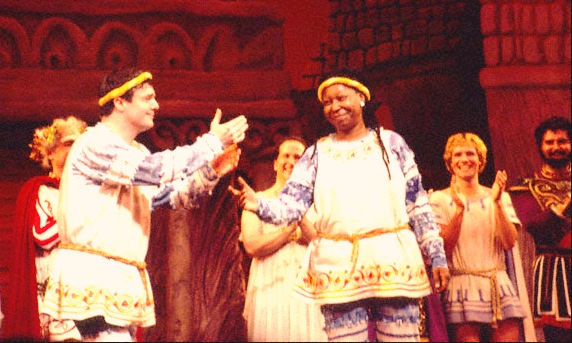 as Lane exited the show by installing Whoopi Goldberg in his place. Casting a woman, let alone an African-American one with Goldberg's reputation, made people wonder what she'd do. Ben Brantley wrote in The New York Times, "The work's authors, Burt Shevelove and Larry Gelbart, and its composer and lyricist, Stephen Sondheim, have always said they made a point of constructing a show true to its ancient sources and free of distracting anachronisms. But the leading role of Pseudolus, the wily slave in pursuit of freedom and a part that demands a manic comic spirit, has inevitably gone to wild-card performers unlikely to resist opportunities for their own shtick. As Mr. Gelbart said, in a recent interview with The Sondheim Review, 'after seeing Zero Mostel recite baseball scores in front of the House of Senex, there's not too much that would surprise me.' So there is Ms. Goldberg, queen of the devilish aside, firmly reminding you of just who she is in the production's opening moments. She finds comic fodder not only in her present personal life, but in her professional life in Hollywood as well.…That this occurs early raises delighted expectations that many audience members have brought with them: Just how bad, as in naughty, is their Whoopi going to be? Of course, others — that nasty breed of theatergoers who find Schadenfreude in seeing big stars blow it — are asking the same question with a different emphasis: Can this movie star-comedian possibly carry a musical? Sorry, guys, she can." Following Goldberg, David Alan Grier took on the role. The second revival ran for 715 performances.
The wreckage in that photo in 1993 represents the remains at the time of the outdoor amphitheater of Butler University in Indianapolis
 that for decades hosted Starlight Musicals every summer. Other cities around the Midwest also received visits from the touring program that would bring concerts, plays and musicals featuring celebrities. From
 the time I was a young child, each summer when we visited my grandma we would take in some shows. Many of the early things we saw tended to be concerts by people such as Mitzi Gaynor, Liberace and the tag team of Jim Nabors and Florence Henderson. In 1979 when I was 10, I got to see my first actual musical. I wish I could locate the program so I'd remember what songs were in that production of A Funny Thing Happened on the Way to the Forum. As a youngster, I tended to be an autograph hound so if we got there early, I'd either stake out the entrance to the backstage or I'd assault the performers after the show. For me, Forum boasted an all-star cast. Playing Pseudolus was none other than Arte Johnson from Rowan and Martin's
 Laugh-In. I'd see him again when I grew up and he appeared in the Broadway revival of Candide. Avery Schreiber portrayed Hysterium, but to me — unfamiliar with his comedy work with Jack Burns — he was the Doritos guy. When I got his autograph after the show, I even brought Doritos with me so when he
 stepped out I had one ready to take a big crunchy bite out of for him. Schreiber raised his hands and said to me, "You got me" then signed my autograph. John Carradine played the role he originated on Broadway, Marcus Lycus. I didn't know that at the time nor did I realize the breadth of his career, but at 73, he looked frail to me, though he'd live another eight years. The final big name belonged to Hans Conried who was cast as Senex. I didn't know at the time that he supplied the voice of Captain Hook in Disney's Peter Pan and I hadn't heard of The 5,000 Fingers of Dr. T. I knew Conried as Wrongway Feldman from an episode of Gilligan's Island. He died less than three years later. Johnson alone remains alive. Schreiber passed away in 2002. That same summer, I saw Rodgers and Hammerstein's Carousel starring a drunk-as-a-skunk Robert Goulet, who exited his limi when he arrived bellowing, "Nobody owns me!" However, that's another story. Tragedy tomorrow, comedy tonight.
Tweet
Labels: Awards, Books, Disney, Fosse, Frank Loesser, Gelbart, Hammerstein, J. Carradine, Music, Musicals, Neil Simon, Phil Silvers, Rodgers, Sid Caesar, Sondheim, Television, Theater Tribute, V. Leigh
TO READ ON, CLICK HERE


Tuesday, May 08, 2012
Something familiar, something peculiar, something for everyone


By Edward Copeland
If I'd located one, a photo of the number "Everybody Ought to Have a Maid" from the first Broadway revival of A Funny Thing Happened on the Way to the Forum in 1972 that starred Phil Silvers as Pseudolus would be resting between the still from the original 1962 production starring (from left to right) John Carradine as Marcus Lycus, Jack Gilford as Hysterium, David Burns as Senex and the magnificent Zero Mostel as Pseudolus, which opened 50 years ago tonight, and the photo below it showing the cast of the second Broadway revival in 1996 that starred (from left to right) Nathan Lane as Pseudolus, Mark Linn-Baker as Hysterium, Ernie Sabella as Marcus Lycus and Lewis J. Stadlen as Senex. (Sadly, not only could I only find two black-and-white photos from the 1972 revival, they
 never made a cast recording either, so we can't hear what Silvers sounded like singing the part. The song link takes you to the 1962 original Broadway cast recording) This musical comedy registers as a theatrical landmark on many levels, the most significant being that it marked the first time Stephen Sondheim wrote both the lyrics and the music for a Broadway musical. Stellar support surrounded Sondheim on all levels: I just named some of the cast, the future director of his landmark 1970s musicals, Harold Prince, produced Forum and the legendary George Abbott (then 75) directed. Jack Cole, currently undergoing a bit of a resurrection in terms of his reputation, choreographed the show and the book, based on three works by Plautus, famed playwright of ancient Rome (c. 254-184 B.C.). came from the pens of Burt Shevelove, a writer-director from early TV, and Larry Gelbart, whose best known credit at the time was as part of the many talented writers working for Sid Caesar on Your Show of Shows but who would go on to turn Robert Altman's MASH into the hit TV series M^A*S*H, be one of the Oscar-nominated (and credited) co-writers of Tootsie, writer of one of the first great HBO movies, Barbarians at the Gate, and author of the book for the Cy Coleman/David Zippel musical City of Angels. On a personal level, Forum holds a special place in my heart because it happens to be the first musical that I ever saw performed live — and Carradine played Marcus Lycus in the production. No, I'm not much older than you thought. I was only 10 at that time and it happened to be a touring summer stock production 17 years after he created the role in the original Broadway show. Somehow, it seems only appropriate that both the first Broadway musical and the last Broadway show I saw featured scores by Sondheim (Passion and Assassins, if you're curious) and so did my irst live musical, even if at 10 I hadn't the slightest notion who Sondheim was.
 Anyone who knows me personally or has read this blog for any length of time realizes what a devoted Sondheim acolyte I am and, without question, A Funny Thing Happened on the Way to the Forum certainly must be considered the most entertaining and crowd-pleasing of all musicals for which he composed the score. As much as I love his music, it's also sadly true in far too many cases that Sondheim's scores often end up being vastly superior to the books of his musicals. With Forum, that cannot be said. When you read what Sondheim wrote in his book Finishing the Hat or heard what others said in reviews, Forum may stand as the rare instance of a Sondheim musical where the book actually supersedes the score in quality. Hey, it was Sondheim's first produced show as composer as well as lyricist after all. Before that, he'd only served both functions on his unproduced musical Saturday Night. His Broadway experiences had been limited to being the lyricist (to Leonard Bernstein's music) on West Side Story and (to Jule Styne's music) on Gypsy. As we begin, I should tell you that if you see a link, by all means click on it. For example, at the top the first link on a song title takes you to the original Broadway cast recording of that song from the 1962 production. Sometimes the links direct you to videos, other times just to the songs, but I wanted to get as much comparison in as I could.
Now, a lot of funny things did occur on the way to the Forum (though, technically speaking, no character in the show ever discusses a trip to that famous location in ancient Rome), but getting the musical to Broadway proved to be an entirely different matter. That trip encountered many bumps that threatened to scuttle the production before Forum ever crossed the New York state line, let alone landed on a Broadway stage. Those associated with the show who still walk among us might be able to look back with some relief now (though in Finishing the Hat, Sondheim does deal himself some heavy self-criticism about his work on the show even now, despite the fact that Forum remains the biggest hit of his career). Sondheim writes that he, Gelbart and Shevelove wrote Forum over a four-year period and that the show went through two major producers, two major directors and a major star before getting to the rehearsal stage. Meryle Secrest's biography, Stephen Sondheim: A Life, spells out the specifics of his statement.
 Secrest quotes Sondheim about the dogged pursuit of Jerome Robbins, who would never settle on a decision about whether to direct the show or not. "The problem was we went to numbers of producers and directors. Jerry Robbins kept saying yes, then no, and then yes, and then no. We went to Joshua Logan and he wanted more naked boys and things like that. I went to Hal (Prince) and he said, 'Listen, kid, you know me. I hate farce.'…David Merrick agreed to produce. Then we were trying to get Jerry Robbins again. And Jerry said, 'OK, I'll tell you what. I'll do it, but I won't do it with David Merrick. You have to get it away from him." In Secrest's book, Sondheim expresses guilt for making up a lie to Merrick about the show not happening and returning an advance to Merrick but it did convince Prince to sign on though Robbins bailed again. Evemtually, they got George Abbott on board as director, but Robbins would return to play a pivotal role. The search for a lead also proved difficult. Their first choice, Phil Silvers, who eventually would portray Marcus Lycus in Richard Lester's 1966 film version and Pseudolus in the 1972 revival, rejected it out of hand because he couldn't perform while wearing his glasses and he'd be unable to navigate without them. Milton Berle agreed to star but when Gelbart and Shevelove turned in a draft of the book that would have run about four hours and received orders to make cuts (which they did), Berle claimed they removed his best stuff and quit. That's how Mostel got the part. In Secrest's book, Sondheim said that years later Mostel would claim that he didn't want to do Forum, but the truth was he needed the work badly and leaped at the part. Mostel's career, as had many others, had suffered during the McCarthy era, the House Un-American Activities Committee hearings and the Hollywood blacklist. One hitch: When Robbins returned to help the troubled show later, he'd face the glare of Mostel because Robbins had served as a friendly witness at the HUAC hearings. To make things worse, one of the names he named was Madeline Gilford, wife of Jack Gilford, who was playing Hysterium. Sondheim though sensed other problems.
Sondheim sought the advice of his friend James Goldman, who at this point in his career had written an original play that made it to Broadway and later would pen both the play and movie of The Lion in Winter as well as the book for Sondheim's Follies. Goldman also did some songwriting, so Sondheim let him look at the book for Forum and listen to the songs he had at that point, when the opening number was a song called "Love Is in the Air." According to what Sondheim wrote in Finishing the Hat, Goldman labeled Gelbart and Shevelove's book as "brilliant" and expressed enthusiasm about Sondheim's score. "The problem," Goldman said, "is they don't go together." Sondheim knew what Goldman meant, but he didn't start doing anything about it right then. Sondheim wrote that he'd been "trained by (Oscar) Hammerstein to think of a song as a one-act play which either intensifies a moment or moves the story the forward.…Prodded by my academic musical training as well as by Oscar, I had become accustomed to thinking of songs as being structured in sonata form: statement, development and recapitulation. For Oscar, it was first act, second act, third act. He tried to avoid writing lyrics that confined themselves to one idea, the traditional approach of every lyricist in the theater and the standard function of songs before he came along and revolutionized the way writers thought about musicals. Show Boat hadn't convinced them but once Oklahoma!, Carousel and South Pacific had become enormous hits, most songwriters converted. The success of those were not entirely beneficial however." In Finishing the Hat, Sondheim noted something Gelbart wrote in his introduction to the published libretto of Forum. "Broadway in its development of musical comedy had improved the quality of the former at the expense of a great deal of the latter," Gelbart wrote.

At one point — frustrated as he tried to unlearn all he knew about composing and fearing he did the show more harm than good — Sondheim even suggested Forum should just be a straight play, but Shevelove said it would be too frenetic and the audience would have no space to breathe (without songs). He informed the composer that the few surviving plays by Plautus sll had songs. Sondheim did end up composing an opening song more in keeping with the spirit of the show that would follow called "Invocation." That also would be dropped but would return in a 1974 farce that Shevelove "freely adapted" from Aristophanes called The Frogs and to which Sondheim added "Instructions to the Audience," which is the only way you can listen to that number now, as in this cut from its 2004 Broadway debut sung by Nathan Lane, Roger Bart and the ensemble. Sondheim writes honestly in his book that he didn't think much of George Abbott's talent or sense of humor — saying they had to explain a joke to the old man once, but Abbott's reputation for saving shows had achieved legendary status and as the show suffered in Washington to scathing reviews and small audiences in big houses (50 people filling 1,000 seats) not laughing a bit, Sondheim described to Secrest the only time Abbott made him laugh "when he said, 'I dunno. You had better call in George Abbott.'" Obviously, that wasn't an option, but given Robbins' worship of Abbott, that made it easier to call him in, though they worried about Mostel's reaction. Part of this can be seen in a clip from a one-man show called Zero Hour written and performed by Jim Brochu and presented at the West Coast Jewish Theatre.
At the time Robbins named names before the House Un-American Activities Committee, he didn't really have a career beyond New York, so his motives always have proved puzzling and he never settled the question before his death, The most pervasive theory, as seen on an American Masters profile on PBS a couple of years ago and detailed in biographies such as this one on The Official Masterworks Broadway Site that he got blackmailed into testifying out of fear that the rather open secret of his homosexuality would be revealed. (He felt secure
 enough to declare himself gay to get out of service in World War II.) The site says, "Robbins was booked for an appearance on Ed Sullivan’s Sunday night variety show (The Toast of the Town), but three weeks before the event, Sullivan, convinced that Robbins was a Communist (he had attended the notorious Scientific and Cultural Conference for World Peace at the Waldorf-Astoria in 1949), canceled the contract. It was Sullivan — threatening at one point to expose him as a homosexual if he did not deliver (directly to Sullivan himself!) a list of names of leftists in show business — who set the machinery in motion that brought Robbins under investigation by the FBI and landed him, two years later, before the House Un-American Activities Committee." Whatever the truth might be, Robbins' uncredited contributions to Forum not only saved the musical, they also changed the way new musicals got their starts forever.
 Earlier in the flirtation process, before tryouts had started and Robbins continued to flirt with the idea of directing the show, he demanded that the principals cast the show, get them all in a room to read the script for him while Sondheim performed the songs. In essence, Robbins invented the theater workshop. Prince and Sondheim actually found it helpful at pointing out flaws in the show and repeated the process with their classic collaborations in the 1970s, though Sondheim doesn't like what the practice ended up evolving into later. "What had begun as a learning experience for the authors became transmogrified into thinly disguised backers' auditions," he wrote in Finishing the Hat. As for his contributions to Forum, as soon as he saw "Invocation," Robbins recognized the problem. Secrest wrote in her biography of Sondheim, According to Sondheim, (Robbins) said, "The opening
 number is killing the show. You open with a charming number and the audience does not know what it's in for, that it's a real farce. You've got to write an opening number that says baggy pants." Sondheim went back to the drawing board and the show's most famous song, "Comedy Tonight," was born and Robbins did the staging, specifically telling Sondheim to leave the jokes to him. Sondheim wrote in Finishing the Hat that Robbins also staged the massive Act II chase, meaning that though he received no official credit, Robbins essentially choreographed the two most important pieces of movement in the show. Still, it isn't as if no one realizes he did it. When Robbins directed his own tribute show, Jerome Robbins' Broadway, re-creating his most famous stage creations the show included "Comedy Tonight" with Jason Alexander taking on the Pseudolus role for that number. In fact, three men have been nominated for Tonys for playing Pseudolus in the three Broadway productions of Forum and a fourth inhabited the role for one scene in another show and all four — Zero Mostel, Phil Silvers, Jason Alexander and Nathan Lane — took home Tony Awards. No other part in theater history can make that claim. The song has attained a level of such popularity you'd be amazed by the permutations you can find on the Internet. In fact, I did a separate post on those alone. Unfortunately, no visual record of the 1962 version exists. Instead, we'll start with a poorly shot bootleg of the 1996 revival starring Nathan Lane as Pseudolus (and Prologus, the character the lead actor plays when introducing the show.) If unfamiliar with the show or what I'm talking about, the song spells it out pretty clearly. I actually got to see the 1996 revival.
After the disastrous runs in Washington and New Haven, Conn., once Robbins had put the bug in Sondheim's ear about the opening number, he writes in Finishing the Hat that "Comedy Tonight" was composed over the course of a weekend. What is it about pressure
 and/or inspiration that some of the greatest works seem to be created when it gets to be crunch time? Most people know the story of Arthur Miller writing the first act of Death of a Salesman in less than a day. Forum opened 50 years ago tonight at The Alvin Theatre where it played through March 7, 1864 when it transferred to The Mark Hellinger Theatre for two months before completing its run through Aug. 29, 1965 at The Majestic Theatre for a total of eight previews and 964 performances. In 1966, a film version with Mostel and Gilford repeating their stage roles and featuring future Phantom of the Opera Michael Crawford opened. Richard Lester, hot off directing The Beatles' films A Hard Day's Night and Help!, helmed the Forum movie. The film eliminated some songs but it also gave Sondheim his first opportunity to design a song specifically for a movie. In Finishing the Hat, he writes about penning a different version of "Free," heard here from the 1962 cast album. He confesses to being a lifelong movie buff and having made some home movies where he especially enjoyed the editing process. (Who doesn't want to see some of these as long as they're suitable for general audiences?) Lester told Sondheim, the composer wrote, that he approved and that his idea would work but Lester never filmed the sequence. "(A)lthough in the finished print, there's a curiously clumsy cut at the place where I'd cued the song, which makes me think it was at least planned. Rereading it now, I wish he had. I didn't get the chance to design another for 26 years, when I wrote two sequences for the movie of A Little Night Music, one of which was filmed the way I wrote it, one of which was not." This clip shows Mostel doing the song during the movie's opening credits.
While Sondheim accepted Shevelove's notion that the musical numbers allowed the audience a chance to take a breath from the chaos consuming the stage, he still disagrees to this day about the suitability of stopping a farce for a song. In Finishing the Hat, he wrote, "Although I do think that the book of Forum is the tightest, most satisfyingly plotted and gratifyingly written farce I've ever encountered, I don't think that farces can be transformed into musicals without damage — at least, not good musicals. The tighter the plotting, the better the farce, but the better the farce the more the songs interrupt the flow and pace. Farces are express trains; musicals are locals." We can't see what Mostel looked like onstage singing "Comedy Tonight" in 1962, but we do have a clip of him performing a condensed version of the song at the 1971 Tony Awards.
"I had to write one-joke songs so I picked spots for them where the situations would supply substance: Songs like 'Impossible' and the drag version of 'Lovely,' which were dramatically static but theatrically funny. My mistake was that in trying to unlearn everything Oscar (Hammerstein) had taught me and write static songs which were nothing more than playful, I felt I had to justify them with cleverness, by juggling with words, leaning on rhymes, puns, alliteration and all the other boilerplate devices of light verse," Sondheim wrote. (Links: "Impossible" and "Lovely (Reprise)" both from 1962 original cast album.) Both in his own book and Secrest's, Sondheim praises producer Hal Prince's faith in the show, saying that most producers who endured the tryouts that Forum did in New
 Haven and Washington would have closed the show down and never brought it to New York. Prince didn't — and it paid off. The show would turn out to be a blockbuster, admittedly one with a few more hurdles to clear before it reached that point. When Robbins came in to help, everyone worried about the volatile Mostel's reaction. However, he'd behaved as a complete professional with nary an explosion up to this point in the chaotic production, according to Secrest's book. As they hurriedly rehearsed "Comedy Tonight" in New York, the stress weighed on the actors as Sondheim recounted in Secrest's book. "'We got to the afternoon of the first preview with our opening number, the one we hoped would change the show. And we were rehearsing and Zero kept screwing up his lines.' So once when Robbins stopped to consult with Tony Walton, the set designer, Sondheim went down to the footlights — 'I never, never give an actor a critical note in front of other people' — to correct one of Mostel's lines. 'Right, right, right,' Mostel said impatiently. They began again, and again Robbins stopped. Mostel was still making mistakes. 'And I said, "Please, I know you've got a lot on your mind, but it's the plural, not the singular." "Yeah. Yeah." The third time, Jerry stops again — 'Zero, it's the plural!' — and Mostel says in a booming voice that fills the entire theater and makes everyone start and turn around, he says, "Well, maybe if you'd write me a funny line, you cocksucker!" In front of everybody.' There was a silence that lasted for about four seconds. 'And in the back of the house, Mr. Abbott went, "All right, from the top please" and clapped his hands." Sondheim goes on to describe how Abbott defuse the tension that quickly and he realized that was part of the man's greatness. He also believes that Mostel made him the scapegoat for the anger he wanted to hurl in Robbins' direction.
In wrapping up this tribute's first half, I must praise the invention of Twitter, which introduced me to a man who not only witnessed the original production of Forum (as well as other original Broadway shows such as South Pacific with Mary Martin and Ezio Pinza, Fiddler on the Roof, also starring Mostel and featuring Bea Arthur, Bert Convy, Leonard Frey and Austin Pendleton and, the one that makes me green with envy, Ethel Merman in Gypsy — with Jack Klugman along as Herbie), but whose father became Mostel's doctor and, because of similar backgrounds, eventually the actor's good friend. Pietr Hitzig, also a doctor, wrote me briefly about his memories of those days. "I am 70 years old and as a NYC child had no idea what fantastic theater I was seeing.…Zero died at only 62 years old and had his most productive years destroyed by the witch hunters at the HUAC but is immortal for Fiddler, Forum and The Producers.…Nobody can play any of those roles today without remembering the bushy eyebrows and satanic leer," Hitzig wrote. On Twitter, Hitzig tweeted that his father saw Fiddler on the Roof at least 100 times. Imagine how inexpensive Broadway tickets cost to allow that back in the 1960s. I only paid to see one Broadway show twice (Rent) and saw another a second time because one ticket came to me as a freebie (Ragtime). (Piotr corrected me after I posted this that his father didn't pay all those times. He got free tickets.) "My father was a renowned Park Avenue doctor but lonely as hell as was Zero. They, children of the shtetl loved each other like brothers. Both were funny but had an angry side that alienated their families. After a busy day, rather than come home, my dad would head for Broadway and stand backstage as his idealized childhood in Fiddler was played out once again," Hitzig wrote. In The New York Times archives, I found a funny story that did illustrate Mostel's tendency to get riled. The British comedian Frankie Howerd, who would play Pseudolus in the London premiere of Forum in fall 1963, came to see the U.S. version earlier in 1963. Seated in the front row, Howerd tended to cover his mouth when amused so Mostel misinterpreted that he wasn't laughing at the show at all. "He is not laughing." the article says Mostel complained between numbers. The next day, Howerd, in an apologetic tone, insisted that he enjoyed the show. "I'm not a laugher. I don't lean back and flash my teeth. Actually, if anyone was frightened that night it was me, seeing how good Mostel was," Howerd told Louis Calta at The Times.
Tweet
Labels: Altman, Arthur Miller, Awards, Beatles, blacklist, Books, Gelbart, H. Prince, Hammerstein, HBO, J. Carradine, J. Robbins, Merman, Music, Musicals, Phil Silvers, Sid Caesar, Sondheim, Theater Tribute
TO READ ON, CLICK HERE
Tuesday, February 21, 2012
A movie about being someone not doing something

By Edward Copeland
If you're like me, it drives you nuts when the so-called cable news channels continue to call something "breaking news" hours or even days after the initial event occurred. That's why I wonder if I'm wasting space by beginning my review of The Iron Lady heaping praise on Meryl Streep's performance as Margaret Thatcher. Streep Delivers Good Performance isn't exactly a jaw-dropping revelation by now, is it? If it were someone such as Kate Capshaw or Lori Petty turning in a bravura portrayal of the former prime minister of Great Britain, that would be news (as well as a sign of the impending apocalypse). Streep's work though happens to be what's best about The Iron Lady, which otherwise does not offer much worth lauding. Since most of this post consists of brickbats, I may as well begin with something nice.
Actually, I do have something else positive to say about The Iron Lady. The Oscar-nominated makeup job that Mark Coulier and J. Roy Helland performed on Meryl Streep to make her look like Margaret Thatcher at various ages deserves the highest praise. It not only succeeds at its primary goal, but achieves this effect without betraying that it is makeup (as opposed to the horrific prosthetics that Leonardo DiCaprio and Armie Hammer suffered beneath in J. Edgar). Coulier's credits include being involved in the prosthetic makeup on all of the Harry Potter films as well as working with the prosthetics on Star Wars: Attack of the Clones and Star Wars: The Phantom Menace, where Coulier also did work with animatronics. Helland has served as Streep's makeup and hair stylist on practically every film she's made dating back to 1982's Still of the Night.
It seems appropriate that Clint Eastwood's J. Edgar should come up while discussing The Iron Lady because both exemplify the difficulty filmmakers have making biopics. Somewhere, a book must exist on writing the screenplays for movies about historical figures and chapter one must emphasize, "Find a Framing Device." Inevitably, this almost always means having the movie's subject look back at his or her life (unless it's an epic biopic and the protagonist got killed or assassinated — then the film must begin with his death as in Lawrence of Arabia or Gandhi). In both of the 2011 films about Hoover and Thatcher, the results suffer from Cliffs Notes-like summaries of the subject's greatest hits. At least in J. Edgar, despite the hideous makeup, it comes in the form of Hoover dictating memoirs to a series of agents Hoover enlists as typists, which makes that film slightly better than The Iron Lady, which chooses the controversial path of having the current Thatcher, in her 80s and suffering from Alzheimer's, going through old items and believing she's having conversations with her long-dead husband Denis (played with a complete sense of frivolity by Jim Broadbent, who behaves at times as if he's back on the set of Moulin Rouge waiting for his cue to break out into "Like a Virgin.")
If you go by the description of the film put on The Weinstein Company's official website for the movie, it's hard not to laugh since their description doesn't really match what's on the screen, but then the paragraph below that admits how telling a factual story wasn't a top priority either.
"Set in the present day, The Iron Lady finds Margaret Thatcher, now in her 80s, struggling with the confines of her simple domestic life in Chester Square, London. Haunted by visions of her deceased husband Denis, Margaret is swept away by memories of her past — both personal and political — which shaped her life and career. As Margaret traces her rise to political prominence…(she) must come to terms with a legacy that is both admired and reviled, and grapple with the great personal cost that her convictions have exacted on her supporters, her family, and, finally, herself."
Sounds like that would make for a fascinating movie. Unfortunately, The Iron Lady didn't end up being that movie. I do have to ask if there's an implication that Thatcher's convictions somehow led to her Alzheimer's. Myself, a political and history buff, I would have liked to see an exploration of Thatcher's rise to power and the nitty-gritty of her governance with more that explained why her policies drew both admiration and revulsion. Instead, we keep returning to her old-age dementia and occasionally flash back to her young days as a student (where she's played by Alexandra Roach) and the movie seems like a remake of Iris. The Iron Lady though, much like J. Edgar, lacks any sort of attitude toward its subject. Look how that same website describe the film's director's approach (and why on earth would she be the choice for the film in the first place?)
"Combining fact, fiction and poetic flights of imagination into a new breed of biopic, director Phyllida Lloyd (Mamma Mia!) creates a piercing portrait which reveals the many faces of Margaret Thatcher: the hard-nosed conservative; the woman who demolished barriers of gender and class in a male-dominated world; the spirited wife and mother who longed to change her country for the better. Exposing the private life behind the headlines, The Iron Lady is a moving journey into the heart of an extraordinary complex woman."
On the plus side, Law's "poetic flights of imagination" didn't include having Streep crawl across the roof of No. 10 Downing Street singing some appropriate cut from Pink Floyd's "Wish You Were Here" as a group of protesters appear from nowhere and begin crawling toward her. Actually, that might have improved the movie. I can't be certain this portion of The Iron Lady falls into fact, fiction or a poetic flight, but in a flashback to Thatcher (then Roberts) and her first runs for office as a Conservative seeking the strong Labour seat at Dartford in 1950 and 1951, she meets Denis Thatcher, who proposes and they wed in late 1951. After his proposal, the film shows them dancing to "Shall We Dance?" from Rodgers and Hammerstein's musical The King and I, which didn't open on Broadway until March 1951 and didn't mount a West End production until 1953. How soon the original cast recording came out and the song made its way across the ocean, I have no idea.
As if selecting Lloyd as director for her second feature film wasn't an odd enough choice, the screenwriter turns out to be Abi Morgan, co-writer of the overrated, empty-headed Shame so I suppose we should be grateful that we didn't get any scenes of Maggie in bondage gear. Actually, adding Meryl Streep as Margaret Thatcher to Shame might have helped that film — Lord knows all the characters in that film needed a stern talking to. I should say, to Morgan's credit, she also wrote the fine HBO miniseries Tsunami: The Aftermath, so she's eclectic.
Which brings us back to Streep, the best thing The Iron Lady has going for it. She looks and sounds like Margaret Thatcher, though I have to ask — is this truly a great Streep performance or an example of great Streep mimicry? The foundation upon which she must perform isn't sturdy in the least, so how deep can Streep delve into Thatcher when she's in a movie that freely admits it's mixing fact, fiction and "poetic flights of imagination" for some new kind of biopic? Does her work in The Iron Lady really equal or top her performances in Doubt, The Devil Wears Prada, Adaptation, The Bridges of Madison County? I know it doesn't come close to A Cry in the Dark, Out of Africa or Sophie's Choice.
Tweet
Labels: 10s, Broadbent, DiCaprio, Eastwood, Hammerstein, HBO, Musicals, Rodgers, Star Wars, Streep
TO READ ON, CLICK HERE
Tuesday, February 14, 2012
Truth be told, you two are both dragging me down

By Edward Copeland
By the time I finally found myself in a position to watch Shame, my expectations rested on two separate planes. The first, for the film itself, had settled on not anticipating being wowed, based not only on what I'd heard but also because (I must admit) I never managed to make it all the way through director Steve McQueen's first film, Hunger. The other plane existed on a much higher level, formed solely on what I'd witnessed of Michael Fassbender in 2011, giving great performances in movies that couldn't be more different — X-Men: First Class and Jane Eyre. I haven't even had a chance to catch him as Carl Jung in David Cronenberg's A Dangerous Method. However, I've witnessed many an actor or actress rise above mediocre material and I expected that if Shame turned out to be a subpar film, Fassbender still could deliver a superb performance. Unfortunately, thespians can do only so much with scripts as aimless, pointless and devoid of meaning as Shame. While Fassbender lets it all hang out in service to this lackluster screenplay, Carey Mulligan delivers the film's best performance, far better than Shame deserves, as Fassbender's character's sister.
Fassbender plays Brandon Sullivan, an Irish transplant to the U.S. who works as an executive in Manhattan. For what kind of business, it's never clearly stated, but it allows Brandon enough free time to leave the office for hours during the day to go to a hotel and have vigorous sex with multiple women. Now, sometimes Brandon does have to stay in the office. You might not be able to smoke inside public buildings in New York anymore, but masturbation breaks seem to be OK. At night, Brandon occasionally carouses with his married boss, David Fisher (James Badger Dale), who doesn't even try to hide his adultery from his employees. However, when loads of particularly nasty paid porn sites turn up on the hard drive of Brandon's work computer, Fisher immediately assumes that someone has hacked into Brandon's account or been using his computer when Brandon isn't there.
Based on the portrait painted in Shame, it seems that nearly all currently living in New York — including the women — carry attitudes toward sex that's more likely to be found in 14-year-old boys, only real 14-year-olds aren't getting laid at this high a percentage and the teens probably display more maturity and hold fewer fears of long-lasting relationships. Yes, I understand that Brandon is a sex addict, but the screenplay by director McQueen and Abi Morgan may depict the life of a sex addict but it never deals with the subject of sex addiction. Imagine a film about a heroin addict and the entire movie consists of the addict shooting up or snorting the drug, showing little in the way of consequence and no discussion of the addiction before the film finishes. That's almost what Shame amounts to as a film. Hell, the TV sitcom Cheers treated sex addiction more seriously and with laughs when in a later season Sam sought treatment for it.

The film's complication, i.e. Brandon's complication, stems from the arrival of his estranged younger sister, Sissy (Mulligan), who crashes at Brandon's apartment because she and her boyfriend are on the outs. Her arrival, according to the production notes and a couple of dialogue scenes inserted to break up the monotony of Brandon's boffing, throws his world into "chaos." As near as I can tell from the movie, chaos for Brandon (as well as McQueen and Morgan) equals having Sissy living in his apartment meaning he must go elsewhere to fuck. Poor baby. What also upsets Brandon is that Sissy gets a booking to sing at a New York club, which Brandon's boss David hears about, forcing Brandon to reluctantly accompany Fisher to see her show. The scene actually ends up being one of the film's few highlights as Mulligan performs the most downbeat version of Kander & Ebb's "New York, New York" you'll ever hear. It's reminiscent of the scene in Georgia when Jennifer Jason Leigh performs Elvis Costello's "Almost Blue." It certainly bears no resemblance to Liza Minnelli's version in Martin Scorsese's film of the same name that introduced the song or Sinatra's recording that immortalized it. Rubbing salt in Brandon's wound about Sissy interfering in his nightlife and his apartment, she and David end up going back to Brandon's place and having loud, boisterous sex, forcing a pissy Brandon to leave.
While visually, cinematographer Sean Bobbitt provides a cool blue tint that comes across as wholly appropriate to the film, Shame suffers from being overscored — not just by the original music composed by Harry Escott but the misuse of lots of Bach, mostly taken from Glenn Gould's recording of "The Goldberg Variations," alongside John Coltrane's instrumental cover of Rodgers & Hammerstein's "My Favorite Things" from The Sound of Music, Chet Baker's "Let's Get Lost" and Blondie's "Rapture" — all of which get played at near deafening levels at times to compensate for the largely dialogue-free sections. In a way, Shame sounds as if it's trying to be one of those late-night Skin-emax movies, only employing a classier soundtrack to play over the continuous coitus.
When Shame finally comes to a stopping place, they do allow Brandon and Sissy to have a conversation (more like a fight) to pretend that a point might have been hiding all along. Brandon has had it not being able to screw strangers in his own bed so he orders his sister out, telling Sissy that he's not responsible for her. He didn't give birth to her. "I'm trying to help you," Sissy tells him. "How are you helping me,
 huh? How are you helping me? How are you helping me? Huh? Look at me. You come in here and you're a weight on me. Do you understand me? You're a burden. You're just dragging me down. How are you helping me? You can't even clean up after yourself. Stop playing the victim," Brandon responds bitterly. I have to agree with Brandon there. The film hasn't given any indication that Sissy has arrived to stage some sort of intervention. Hell, aside for her stumbling upon some live sex chat woman calling out for Brandon on his laptop and walking in on him beating off once, nothing indicates that Sissy has clued in on her brother's lifestyle. Then again, I don't notice much of a mess. "I'm not playing the victim. If I left, I would never hear from you again. Don't you think that's sad? Don't you think that's sad? You're my brother," Sissy declares. No, what's truly sad about this situation is watching talented actors such as Michael Fassbender and Carey Mulligan attempt to squeeze some sort of emotional truth from a movie that contained nothing but artifice up until that point. Fassbender tries his best, but he's burdened with the heavy lifting since he's in every scene and the shallow script leaves him rudderless. Carey Mulligan comes off looking so much better because her part takes up less time on screen so it's easier to give Sissy life even if the screenplay doesn't provide her any more depth than it does Brandon.
That scene between the siblings toward the end of the movie reinforces what we got a slight glimpse of in an earlier scene where Brandon takes a co-worker named Marianne (Nicole Beharie) out for dinner. She's separated from her husband. While Brandon behaves meek and pliable at the restaurant, accepting every suggestion that either Marianne or the waiter (Robert Montano) makes, relationship talk brings out the opinionated side of him. He tells her that he doesn't believe in relationships — sees no point in them. When Marianne asks him how long his longest relationship lasted, Brandon answers four months. The two part for the night at her subway stop. The next day at work, we see what kind of universe Shame resides in. Marianne expressed a bit of dismissive judgment about Brandon the night before, but he takes her into the break room and kisses her passionately and Marianne willingly skips off from work with him to a hotel for a sexual tryst. This exemplifies the filmmakers' attitude toward pretty much every character in the movie.
The longer I think about Shame, the worse the film gets. If you set out to make a provocative film, it helps to have something to say. Your aim should be to provoke thought, not anger about the time wasted by talents such as Fassbender and Mulligan making it and movie lovers such as me watching it.
Tweet
Labels: 10s, Carey Mulligan, Cronenberg, Ebb, Fassbender, Hammerstein, J.J. Leigh, Kander, Liza, Music, Rodgers, Scorsese, Sinatra
TO READ ON, CLICK HERE
Tuesday, November 22, 2011
A Timeless Love Story

By Damian Arlyn
I was recently playing the board game Loaded Questions with my wife, her brother and his wife. It was my brother-in-law's turn to guess. The card asked the rest of us to name our favorite animated feature film. His wife picked Beauty and the Beast. I selected The Hunchback of Notre Dame (although I could just as easily have gone with Pinocchio, The Secret of NIMH, The Prince of Egypt or The Nightmare Before Christmas). Being fairly familiar with my wife's tastes in animated films, I suspected she would name either Sleeping Beauty, The Lion King or Hunchback of Notre Dame as well. To my surprise, she also named Beauty and the Beast. I knew she loved the film, but was not aware that it was her favorite. After her brother correctly guessed all of our answers, I told her I was surprised by her choice because I always was under the impression she favored these other animated films. "I admire aspects of the other ones," she informed me. "I think the backgrounds and music in Sleeping Beauty are beautiful and I like the story and themes of Hunchback, but with Beauty and the Beast, I just love the whole package." I not only learned something new about my wife that day, I was reminded of something that I guess I had forgotten: namely, that Beauty and the Beast (which celebrates its 20th anniversary today) is deservedly one of Disney's most beloved animated features because, unlike numerous others (which can be very uneven), it excels in ALL of its areas. It is arguably the perfect Disney movie.
Beauty and the Beast came at a time when Disney was experiencing a real renaissance in animation. Throughout the '70s and early '80s, some decent movies such as The Fox and the Hound, The Great Mouse Detective and The Black Cauldron were produced, but they failed to achieve the kind of critical or commercial success that had come to be expected from a Disney product. To make matters worse, the live-action arm of the studio (which was churning out such "clunkers" as The Black Hole, Tron and Return to Oz) wasn't faring much better. The studio was finding it tremendously difficult reaching contemporary audiences with its somewhat antiquated material. Their attempt to produce something more "modern" and "cool" with the pop song-heavy Oliver and Company only reeked of desperation. Meanwhile Disney's competitors (including former Disney animator Don Bluth's An American Tail and The Land Before Time) were gaining a lot of ground. So, in the mid-1980s some "new blood," in the guise of former Paramount executives Michael Eisner and Jeffrey Katzenberg, was brought in to change things at the struggling studio and special attention was paid to the once-great animation department. Their plan was to try to recapture the essential elements of Disney's golden age: good stories simply but expertly told with gorgeous animation, interesting characters and memorable music.

The result was The Little Mermaid, an enormously entertaining creation that seemed to include all of the classic characteristics of Disney fairy tales as well as a few new qualities that made it resonate with both children and adults alike. I remember seeing it in the theater with my family in junior high and just being utterly charmed by it. It even went on to win two Academy Awards: one for the score and one for that catchy little tune "Under the Sea," proving that the music was a major ingredient for the film's success. That music came for the imaginative minds of the composer Alan Menken and his lyricist Howard Ashman, the team responsible for the subversive yet immensely melodic off-Broadway hit-turned 1986 movie Little Shop of Horrors. Thus, when Mermaid earned hundred of millions of dollars (much of it from the home video release, the first time a current Disney animated feature appeared in that format) and marked a real return to form for the endangered studio, it seemed only natural that its successor would try to build on the same foundation that it had laid (including the Menken/Ashman songs). Expectations were understandably high and whatever it was to be, they would have to make it something really special.

Disney decided to go with the well-known French fable of a beautiful woman (whose name was wisely changed from "Beauty" to "Belle") who stays in an enchanted castle run by a monstrous beast. Although she is repulsed by him initially, she eventually learns to see the kind, tormented and beautiful person hidden beneath the hideous veneer and in the process warms his own cold heart. In the end, she declares her love for him which transforms him back into the handsome prince that he was before being bewitched by an evil spell and the two live happily ever after. The story had been told onscreen before (most famously in Jean Cocteau's stunning 1946 adaptation La Belle et la Bête) but never in feature-length animation. Borrowing several elements from the Cocteau film (such as furniture within the castle coming to life) but adding quite a few touches of their own (including the heroine's rescue from a pack of wolves by the beast), the animators fashioned a colorful, sweet, funny and at times scary product. Not surprisingly the animation is gorgeous. The design of the beast is a particular standout. Whereas in other incarnations the beast usually resembles a really hairy human, this beast is fully animal with equal parts buffalo, lion, bear and various other carnivorous creatures. Despite all this, an undeniable humanity still comes through loud and clear in the character's facial expressions and body language.
This is no doubt due to the fact that his design was supervised by the eminent animator Glen Keane who has a track record of making huge, lumbering creatures look strangely graceful (see the bear in The Fox and the Hound and Professor Ratigan in The Great Mouse Detective). In fact, all of the characters in Beauty and the Beast, from the leads right down to the minor characters, are beautifully rendered with with distinct looks and interesting personalities. This is especially impressive when one considers that most of the characters in the film are sentient household objects such as clocks, teapots, candelabras, etc. The only other animated film I can think of that so effectively turns inanimate objects into living, breathing beings (not including the Toy Story trilogy) is the woefully underrated Brave Little Toaster. Of course, the believability of the characters is aided in no small way by the bravura vocal performances of the excellent cast. Beauty and the Beast followed another wise Disney tradition in that they decided to hire talented actors to give voice to these characters and not A-list movie stars. At the time I saw it, the only voice I really recognized was Angela Lansbury. Even though I was somewhat of a teenage movie buff, I had no idea who Jerry Orbach, Paige O'Hara, David Ogden Stiers and Robby Benson were and I suspect most audience members were like myself. Their ignorance of the actors working behind the scenes helped make it easier to merely accept the characters on screen at face value. Unfortunately, ever since Robin Williams was cast as the Genie in Disney's next animated blockbuster Aladdin, this turned into a practice that seemed no longer viable. Feature animation now appears to be populated primarily with celebrities (which is no doubt why so many distinguished voice actors such as Maurice LaMarche, Frank Welker and Rob Paulsen all have to work in television) and it creates a bizarre disconnect between the figures we see moving on screen and the voice we hear coming out of their mouths. We know that it's Cameron Diaz we are hearing but it is not Cameron Diaz that we are seeing (at least Pixar is trying to continue the tradition of casting the right actors for the roles regardless of their celebrity status).

Another significant development in the history of animation that occurred in Beauty and the Beast was the combination of hand-drawn characters with a completely three-dimensional CGI environment in the now iconic ballroom sequence. It wasn't the first time such a thing was attempted (the climactic clock tower scene from The Great Mouse Detective did the same thing) but this was the first time such a feat was accomplished so seamlessly. Though it may not be quite as impressive to us now, the sight of the "camera" gliding around the characters, swooping down toward them from above and even moving between them as they danced (almost as if we are dancing right along with them) really helped draw audiences even further into what was already an emotionally-charged scene a) because of what was happening in the story at that point and b) because of the lovely title song that was being sung by Angela Lansbury's matronly Mrs. Potts during it. As corny as it may sound, it really is a magical sequence that somehow seems to transcend all of the numerous technical achievements that helped make it so. One would have to be pretty jaded and heartless to not find themselves in some way touched by it.
Like The Little Mermaid, the songs that Howard Ashman and Alan Menken collaborated on for Beauty and the Beast are superb. Clearly modelling their work on Broadway showtunes, every song just pops. There is not a weak tune in the bunch. Also, every song either furthers the story or develops character. The opening number "Belle," for example, introduces the protagonist, establishes how the townspeople feel about her, acquaints us with handsome but obnoxious Gaston who is pursuing her and just generally sets the "stage" perfectly for everything that follows. Gaston even gets his own song wherein the townsfolk sing about how great he is and he in turn
 agrees with them mentioning all of his accomplishments and hilariously pointing out that every last inch of him is "covered with hair." The big show-stopping number of the piece, however, is "Be Our Guest," a massive extravaganza showcasing a parade of food and cutlery led by a spotlight-hogging candelabra named Lumiere (voiced and sung by the multi-gifted Jerry Orbach). Seriously, Joel Grey's Master of ceremonies from Cabaret has got nothing on him. Finally, the darker and more sinister "Kill the Beast," wherein Gaston reveals his true colors, rounds out an already impressive collection of melodies. It was a no-brainer that the film would receive Oscar nods for its music. The songs "Belle," "Be Our Guest" and "Beauty and the Beast" were all nominated but it was the title song that took home the statuette. What was unexpected, however, was that Beauty and the Beast would become the first animated feature film to ever be nominated for best picture. It was a milestone in the history of animation and made everyone who worked on it very proud. Alas, one individual who never got to see the awards, the critical acclaim or the commercial success that the film garnered was Howard Ashman. During production of Beauty and the Beast it became painfully clear that Howard was dying of AIDS and although he continued to work very hard on the film (helping with the script as well as with the music), on March 14, 1991, Howard died and what was perhaps the most auspicious musical teams since Rodgers and Hammerstein came to a sudden and tragic end. The film's final credits featured one of the most poetic dedications I've ever seen: "To our friend Howard, who gave a mermaid her voice and a beast his soul, we will be forever grateful."
Although some could argue it was The Lion King that represented the pinnacle of Disney's "renaissance period" (a time when Disney seemed to have the Midas touch, well before Eisner drove Katzenberg away and then proceeded to wreck the very company he had once saved), I think Beauty and the Beast is the true supreme achievement from that era. Everything just came together in such a way that the film managed to catch that ever elusive lighting in a bottle. Twenty years later it still looks, sounds and feels great. Recently it was released on DVD/Blu-ray in a "special edition" which included such notable features as a newly animated music number which was excised before the film's original release (the song was called "Human Again" and it's a charming little tune but I think they made the right decision cutting it as it sounds to my ears too similar to "Be Our Guest") as well as the "work-in-progress" version which the studio courageously premiered at the New York Film Festival. Though it gave birth to several inferior direct-to-video sequels and a successful Broadway show, its true legacy will be as one of the greatest (if not arguably the greatest) animated features that Disney ever produced. The word "masterpiece" gets thrown around a lot, but I feel it truly is a masterpiece, not just of animation but of cinematic storytelling. It is also the last time that a genuine fairy tale was depicted on the big screen. In our increasingly cynical culture, feel-good stories of princesses, monsters, villains, magic and, most of all, happy endings are becoming increasingly rare. Even when a film does attempt to bring a fairy tale to theaters it has to be done in a very sarcastic, self-aware manner (a la Shrek, Enchanted and Tangled); more of a "meta" fairy tale than an honest-to-God "true" fairy tale. Beauty and the Beast is a timeless love story with an enduring message, but it is also in some ways a relic of a bygone era. Unless Pixar's upcoming Brave can reinvigorate the genre, it may be a long, long time before we see another bona fide fairy tale told with such unapologetic enthusiasm and sincerity.

Tweet
Labels: 90s, Animation, Disney, Hammerstein, Lansbury, Movie Tributes, Musicals, Orbach, Oscars, Pixar, Robin, Rodgers, Theater
TO READ ON, CLICK HERE


