Tuesday, March 06, 2012
“It’ll get a terrific laugh…”

By Ivan G. Shreve, Jr.
Beginning in the 1930s and continuing well into the mid-'50s on radio (and for a number of years on television afterward), The Jack Benny Program was a “Sunday night at seven” institution for millions of American households. The titular star of the broadcast, a comedian who was practically unique in his insistence on making certain his writing staff received most of the credit for his success, revolutionized humor by, not putting too fine a point on it, becoming the godfather of the modern American situation comedy. His innovations included self-referentially setting the storyline of each week’s show amongst the background of preparing his broadcast, breaking “the fourth wall” and having his “gang” (the program’s supporting characters) get the lion’s share of the laughs poking fun at the star. Above all, Benny masterfully mined humor from pettiness, vanity and miserliness while simultaneous creating a lovable “everyman” that the listening audience couldn’t help but want to hold to its collective bosom.
Benny tried to duplicate his radio and TV success on the silver screen, and though he made a number of entertaining films, the comedian never really was satisfied with the end result. A lot of this had to do with that many of his movies, such as Love Thy Neighbor (1940), Buck Benny Rides Again (1940) and The Meanest Man in the World (1943), were little more than slight variations of the character he played on radio; Neighbor and Buck Benny in particular featuring many of the regulars from his show (Eddie “Rochester” Anderson, Don Wilson, Phil Harris, Dennis Day). On occasion, Jack would get the opportunity to flex his acting muscles in vehicles such as Charley’s Aunt (1941) and George Washington Slept Here (1942) so it shouldn’t be too surprising that Benny considered these movies among his favorites. But Jack — and many others, including myself — always felt his finest hour on film was in a production released to theaters 70 years ago on this date: Ernst Lubitsch’s black comedy classic To Be or Not to Be (1942).
On the eve of the German invasion of Poland in 1939, a Warsaw theater troupe headed up by “that great, great actor” Josef Tura (Benny) rehearses a new anti-Nazi play entitled Gestapo. The troupe’s producer, Dobosh (Charles Halton), is dissatisfied with what he’s watching, arguing that Bronski (Tom Dugan), the actor playing Adolf Hitler, simply ian't convincing as the Fuehrer. In an effort to prove his authenticity, Bronski steps outside to walk among the Warsaw population…and though he gets a few stunned and anxious stares, his cover is blown when a girl timidly asks for his (Bronski’s) autograph.
Later that evening, as the troupe performs Shakespeare’s Hamlet, Josef’s wife Maria (Carole Lombard) entertains a young Polish pilot named Stanislav Sobinski (Robert Stack) in her dressing room. Sobinski is very much in love with Maria, and has been signaled to pay her a nocturnal visit at the moment when husband Josef starts Hamlet’s famed “To be or not to be” soliloquy (naturally, Josef is dismayed when he spots the young airman leaving in the middle of his performance). Maria loves her husband very much but doesn’t dismiss having an innocent flirtation with Stanislav…an “affair” that ends with the news that Germany has invaded Poland and World War II is underway.

Under the thumb of Nazi terror, Warsaw has been reduced to rubble (the theater has been closed and the troupe thrown out of work due to a curfew and other restrictions) but a vibrant Polish underground is determined to throw off the yoke of their oppressors. In England, Sobinski and his fellow pilots spend an evening of singing and revelry in the company of a Polish resistance leader, Professor Alexander Siletsky (Stanley Ridges), who generously offers to get word to the pilots’ families. Stanislav tells Siletsky that while his own family is safely out of Poland, he would like the professor to deliver a message to Maria: “To be or not to be.” But he is troubled by the fact that Siletsky — who claims to be a lifelong resident of Warsaw — is unfamiliar with Maria Tura, and after the professor starts off for Poland, Sobinski relates the incident to his superiors (Halliwell Hobbes, Miles Mander). Both men, having realized that the information on the pilots’ families would be vital to the Nazis even if Siletsky weren’t a spy, instruct Sobinski to fly to Warsaw immediately and stop the professor.
Shot down over Warsaw, Stanislav sends Maria to rendezvous with his contact, a bookseller, while he recuperates after nearly being shot by Nazi soldiers. Josef returns home and finds the young pilot in his bed (and wearing his pajamas), is naturally curious as to what Stanislav is doing there. He receives a hurried (and incomplete) explanation from Maria, who arrives in time to tell the two men that she was picked up by Nazi soldiers and taken to Siletsky’s hotel. Siletsky arrived in Warsaw before Sobinski, and after having delivered the pilot’s message, approaches Maria about joining the Nazi cause. Despite being confused by the events, Josef realizes that he needs to stop Siletsky (by killing him) before the professor delivers the information to the Nazi command: he may be angry about being cuckolded, but he still ia a patriot at heart.
Maria returns to the professor’s hotel, where she pretends to seduce Siletsky…but they are interrupted by a member of the theater troupe (George Lynn) disguised as a Nazi officer. The faux officer informs Siletsky he has an appointment with the head of the Gestapo — who also is a fake: it’s Josef in disguise. His mission is to wrest the information on the Polish underground away from Siletsky and then dispose of him…but learns during the course of their conversation that the professor has a duplicate copy of the information in a trunk back at his hotel. Stanislav and the theater group frantically try to think of a plan to obtain that extra copy but before they can formulate anything Siletsky concludes that he’s been duped by Tura. In his escape attempt from the theater, he is killed by Sobinski.
Josef must now impersonate Siletsky — and returning to the hotel, he attempts to destroy the duplicate information but is interrupted by the arrival of another Nazi officer. Captain Schulz (Henry Victor), adjutant of the Gestapo head Tura impersonated earlier, takes Tura-as-Siletsky to Colonel Ehrhardt (Sig Ruman), the genuine article. Josef is able to do some fast thinking to avoid spilling any information (identifying men who already have been shot as resistance leaders), and during this conversation he learns that Hitler himself will be visiting Warsaw the next day.
The body of the real Professor Siletsky is found in the theater the next morning…which is unfortunate for Josef, as he still is continuing his impersonation. Arriving at Ehrhardt’s office, he is ushered into a room and asked to wait until Ehrhardt has finished an appointment with two other officers. Inside the room is the corpse of Siletsky, but Tura manages to shave off the dead man’s beard and attach a false one…thus making Ehrhardt and his men think the deceased professor actually was an impostor. But when several theater members, led by hammy actor Rawitch (Lionel Atwill) in disguise, burst in and blow Tura’s cover in order to spirit Josef away from his captors, Tura and company realize it will only be a matter of time before they are rounded up by the Germans.
To escape out of Poland, Josef and his actors concoct a diversion, with Bronski in the part of Hitler and his friend Greenberg (Felix Bressart) as a defiant Jew who interrupts the Fuehrer’s appearance at the theater; the theater company and Stanislav then steal the Nazis’ transportation and head for the airport, stopping off at Maria’s just in time to rescue her from the advances of an amorous Ehrhardt. Our heroes are successful in their flight from Warsaw and land safely in Scotland, where that evening, Josef and his fellow thespians put on a production of Hamlet…and all goes well until “To be or not to be…”

The director of To Be or Not to Be, Ernst Lubitsch, was admired and respected by his peers, critics and audiences both when he was making films and long after his death in 1948. Lubitsch specialized in urbane romantic comedies that reeked of elegance and sophistication with just a touch of the risqué (daring but never smutty) that artfully avoided any complications with the Motion Picture Code, and earned his directorial style the nickname “the Lubitsch touch.” Lubitsch didn’t take a writing credit on To Be (the honor goes to Edwin Justus Mayer, based on a story by Melchior Lengel) but he devised the character of Josef Tura with Jack in mind, joking that every comedian’s dream is “to play Hamlet.” Benny would later reminisce about the experience in saying he worked well with Lubitsch because the director told him to forget everything about acting (“which wasn’t too difficult,” he cracked) and just follow his lead as Ernst acted out every gesture and vocal inflection for Benny’s benefit. “He was a lousy actor, but a great director,” was Jack’s final verdict.
What’s wonderful about watching Benny play Tura is that both the character and Jack’s radio persona share some similarities: the vanity, the hamminess (whenever Jack would do a spoof of a current movie on his show he always made sure he got the largest role) and that lovable schlemiel that resides in a world where everything terrible seems to happen to him. And yet there are differences: Tura is way out of his league playing spy, but he’s able to screw up his courage and risk certain death to help Sobinski (the man playing around with his wife) stop a dangerous man who threatens the lives of the people of Warsaw. He’s ready to fight on behalf of his country, and demonstrates tremendous courage in doing so.
The part of Maria Tura was originally conceived as a comeback role for actress Miriam Hopkins — Hopkins had worked with Lubitsch before in the vehicles Trouble in Paradise (1932) and Design for Living (1933), and in the pre-production stages of To Be or Not to Be was anxious to let the director lift her career out of its slump. But Hopkins didn’t want to work with Benny, and so her departure attracted the interest of Carole Lombard…who, despite resistance from Lombard's husband, Clark Gable, wanted very much to work with Lubitsch (and she’d also get to work alongside Robert Stack, who had been a friend of hers for many years since he was a teenager). After completing the film, Lombard would later tell friends that it was the most satisfying experience of her career…and the proof is up on the screen. Her performance as Maria is positively luminous; she simultaneously gives the character both a playful and ethereal quality — a woman deeply in love with her husband and yet naughty enough to stray a little from the fold when opportunity presents itself. Benny had nothing but the utmost affection for his co-star, whom he really got to know during their time on the movie — he later told friends: “She was one of the few gals you could love as a woman, and treasure as a friend.”
Sustaining Benny and Lombard is an outstanding “troupe” of supporting performers that include Stack, Bressart, Atwill, Ridges, Ruman and Dugan — none of these amazing actors hit a false note in their portrayals, and deliver Lubitsch and Mayer’s sparkling dialogue to perfection. Critics at the time of To Be's release lambasted Lubitsch for allowing the heroes to be nothing but a disparate group of actors…but I think it’s a brilliant concept: Josef and his friends are the only ones with ego enough to pull one over on the arrogant Nazis. And that screenplay! So many quotable passages of delicious double entendres that exemplify “the Lubitsch touch”:
MARIA: It's becoming ridiculous the way you grab attention. Whenever I start to tell a story, you finish it. If I go on a diet, you lose the weight. If I have a cold, you cough. And if we should ever have a baby, I'm not so sure I'd be the mother.
JOSEF: I'm satisfied to be the father.
MARIA: Tell me about yourself.
SOBINSKI: Well, there isn't much to tell. I just fly a bomber.
MARIA: Oh, how perfectly thrilling!
SOBINSKI: I don't know about it being thrilling. But it's quite a bomber. You might not believe it, but I can drop three tons of dynamite in two minutes.
MARIA: Really?
SOBINSKI: Does that interest you?
MARIA: It certainly does.
SOBINSKI: You see, sir, the other night Professor Siletsky was addressing us at the camp, and I mentioned the name of Maria Tura…and he never heard of her.
ARMSTONG: Neither have I.
SOBINSKI: Oh, but, he's supposed to be a Pole who lived in Warsaw and she's the most famous actress in Warsaw.
ARMSTONG: Now, look here, young man, there are lots of people who're not interested in the theater. As a matter of fact, there's only one actress I ever heard of…and I certainly hope I'll never hear from her again.
JOSEF: It's unbelievable! Unbelievable! I come home to find a man in the same boat with me and my wife says to me, "What does it matter?"
SOBINSKI: But, Mr. Tura, it's the zero hour!
MARIA: You certainly don't want me to waste a lot of time giving you a long explanation.
JOSEF: No, but I think a husband is entitled to an inkling.
JOSEF: Her husband is that great, great Polish actor, Josef Tura. You've probably heard of him.
EHRHARDT: Oh, yes. As a matter of fact I saw him on the stage when I was in Warsaw once before the war.
JOSEF: Really?
EHRHARDT: What he did to Shakespeare we are doing now to Poland.
That last line caused a little bit of concern among critics, who steadfastly argued that poking fun at a serious situation made Lubitsch guilty of cinematic high crimes and misdemeanors. My favorite line from To Be or Not to Be is one that doesn’t seem particularly funny at first hearing (in fact, it might make some viewers wince): posing as Ehrhardt, Josef responds to flattery from Professor Siletsky with the phrase “So they call me ‘Concentration Camp’ Ehrhardt…?” But as Josef desperately tries to stall for time while Sobinski and the rest of the actors dope out a way to retrieve vital documents from the spy’s hotel room, he begins to nervously repeat the phrase over and over again until it almost becomes a mantra…and it makes me laugh out loud every time I hear it.

With all these elements — solid script, first-rate cast, great director — you’d naturally assume that To Be or Not to Be cleaned up at the box office, correct? Well, it didn’t. Lubitsch’s WW2 satire had the misfortune of being released during World War II, and theatergoers didn’t particularly warm to a film that poked deadpan fun at such a serious conflict. With hindsight, we can see the brilliance of the movie — Lubitsch’s film has witty moments, to be sure, but it also contains sequences of nail-biting suspense (witness Sobinski’s arrival in Warsaw after temporarily escaping his Nazi pursuers, not to mention the tense scenes where Maria is literally being held prisoner in Siletsky’s hotel room). The director’s intention was to satirize both the Nazis and their ideology, but as George S. Kaufman famously observed, “Satire is what closes on Saturday night.” The moviegoing public simply wasn’t ready for a daring film that was able to find humor in a situation that seemed devoid of same — and a prime example of this sort of patron was Jack’s father, Mayer Kubelsky. Kubelsky went to see To Be or Not to Be…and horrified that his son was not only wearing an SS uniform but giving out with a “Heil Hitler!” in the opening scenes; he stormed out of the theater and refused to speak to his Jack. (When Jack finally convinced his father that his character was merely performing in an anti-Nazi play in the movie’s opening and that he was really the film’s hero, Mayer went back to see the movie again and again…and again. Like his famous son, it would become his favorite.)
But theatergoers also found it impossible to laugh when the movie’s female star, Carole Lombard, was killed in a plane crash about two months before the film’s premiere (she was on a World War II bond rally tour with her mother, Bess Peters, and Otto Winkler, husband Clark Gable’s press agent). Co-star Benny was devastated by Lombard’s untimely death, and refused to do his regularly scheduled program that following Sunday, substituting an all-musical half-hour. Because the actress had a line in the film — “What can happen in a plane?” — in response to Stack’s invitation to take a spin in the wild blue with him, the line was cut before the movie’s premiere (it since has been restored).
To Be or Not to Be ranks only behind Twentieth Century (1934) as my favorite Carole Lombard film, but it’s certainly my favorite of Jack Benny’s cinematic output; Jack never got another opportunity to extend his thespic range and after The Horn Blows at Midnight in 1945 (a film that he and his writers lampooned in endless jokes on his radio/TV show despite the fact that it wasn’t that bad) he limited his screen appearances to brief cameos such as It’s a Mad, Mad, Mad, Mad World (1963) and A Guide for the Married Man (1967). (He had planned to return to movies with a substantial part in The Sunshine Boys, but upon his death in 1974 his role was given to his lifelong friend George Burns). To Be is also my favorite Lubitsch film; a work of such maturity and pitch-perfect hilarity that I want to warn you: do not make the same mistake I did in watching the 1983 remake before seeing the Lubitsch version. (In all honesty, I didn’t have a choice — the Lubitsch film rarely got shown in those halcyon days before TCM). The more recent version with Mel Brooks and Anne Bancroft, heartfelt tribute though it may have been, is much too broad and slapsticky in its burlesque approach (it’s almost like watching a stage play)…and most assuredly lacks the subtlety of “the Lubitsch touch.”
Tweet
Labels: 40s, Bancroft, Gable, Jack Benny, Lombard, Lubitsch, Mel Brooks, Movie Tributes, Remakes, Shakespeare
TO READ ON, CLICK HERE


Saturday, September 10, 2011
Garry called me up and asked if I would write this 25th anniversary tribute

By Edward Copeland
My memories of "It's Garry Shandling's Show." (yes, the title used quotes and a period) have always been fond ones, but have usually been of isolated moments and, of course, the hysterical opening theme song. When I started re-watching the series for this tribute, I realized that I probably hadn't seen any episodes since they originally aired. I don't remember it ever airing in syndication. Though it was heavily edited, even The Larry Sanders Show spent time in late-night syndication. So in the case of "It's Garry Shandling's Show.", that means I hadn't seen some of these episodes in 25 years (and some I'm not sure I saw the first time around). Another amazing SHOUT! Factory DVD box set not only provided the complete series but so many worthwhile extras that I felt it necessary to do two posts. Then, discussing the best episodes took up so much space that I had to split the tribute to the show's best episode into two parts, making for three total posts. This one briefly discusses the show's origin and then waxes nostalgic about my favorite moments in season one. The second post details the best of seasons two and three. The third part goes deeper into its development; the amazing behind-the-scenes talents that worked on the comedy and what shows they worked on before or after; and, more disappointingly, analyzes the show's slide in quality that began somewhere during its third season before it became an almost complete, unmitigated disaster in its fourth season — something its former writers are brutally honest about on commentary tracks. First, I celebrate what still makes me fond of "It's Garry Shandling's Show.", and what better way to begin than with that memorable theme song in a YouTube clip taken from one of the best episodes of the first season, "The Graduate."
After having success with a very funny Showtime special in January 1986 called The Garry Shandling Show 25th Anniversary Special, which pretended that Shandling had hosted a talk show for 25 years (with his sidekick Pete, played by Paul Willson, who would play Leonard Smith on "It's Garry Shandling's Show."), Shandling and original Saturday Night Live writer Alan Zweibel developed "It's Garry Shandling's Show." after friends suggested to Shandling that Zweibel would be his ideal collaborator, despite the two having never met. The only idea Shandling originally had in terms of what he wanted to do with the series was to break the fourth wall, meaning he would speak directly to the audience much in the way George Burns did on The George Burns and Gracie Allen Show. However, as they developed the show, they took the idea further than Burns ever did — through the course of the show, it wasn't just the fourth wall that would be broken, it would be the ceiling, the floor and just about everything else. It also wouldn't just be Shandling acknowledging that they were on a TV show, but all the characters and the studio audience would get to play along as well. (Though in instances when individual audience members spoke, they had to plant actors because of union rules and the fact that the person would then have to be paid.) Showtime loved the idea and agreed to a six-episode commitment of "It's Garry Shandling's Show.", with the show premiering 25 years ago today.
The first episode, "Garry Moves In," establishes the basic premise of the show. Shandling plays Garry Shandling, a fictionalized version of himself and also a standup comic, and he's moving into his new condo in Sherman Oaks, California. The division is called Happy Pilgrim Estates, (I don't recall the series ever revealing its name until an episode in the third season), though this isn't any ordinary condominium he's living in, you see, as it is set up very specifically, because Garry's life is televised (not constantly like The Truman Show, just once a week) and
 everyone knows about it — in Happy Pilgrim Estates anyway, and probably Sherman Oaks, and hell, wherever they need someone to be at home watching. Shandling planned to break the fourth wall, and it was done literally as his condo only has three walls. Where the fourth wall would go, it's left wide open for the cameras, with the audience's bleachers behind them. Garry began "Garry Moves In" as he did almost all of the 72 episodes, with an opening monologue explaining that he had sold his old place for $85,000, which really angered his landlord since he had been renting. What prompted his move was a breakup with his girlfriend who moved in with another guy. We meet the core original players. His next-door neighbor happens to be his longtime platonic female friend Nancy (Molly Cheek). Also living nearby (and I'm being vague because in some episodes their home appears to be in another part of Sherman Oaks and at other times they appear to live in Happy Pilgrim Estates) is Garry's best friend Pete Schumaker (Michael Tucci), the area representative for Hush Puppies shoes, and his 12-year-old son Grant (Scott Nemes). When we meet Pete's wife Jackie in the second episode, Garry will explain that we didn't meet her in this episode because she hadn't been cast yet. Like Jackie, other ensemble members would be introduced later.
In the premiere, after Garry has left for awhile, he returns home to discover that all of his belongings, which the movers had finished unpacking earlier in the day, have been stolen. "This is the ultimate insult. First my girlfriend moves in with another guy. Now my stuff moves in with another guy," Garry complains. He also has
 found himself smitten with the attractive cable installer (played by Shawn Southwick, who would later marry Larry King in 1997) and has been debating whether to ask her out. There is a very funny appearance by the late character actor Jason Bernard as Officer Sweeney who investigates the burglary. He asks if the condo's former owner might still have a key, but they decide it's unlikely that Vanna White stole Garry's stuff leading to Garry imagining an episode of Wheel of Fortune where contestants, back in the days they used their winnings to buy cheap crap, instead purchased Shandling's belongings (including his lucky underwear — which are briefs with a horseshoe on the front). Officer Sweeney doesn't just give advice about home protection: He also tells Garry that he shouldn't rush into anything with the cable installer until he's completely over his ex-girlfriend. When Garry gives his closing monologue, there is a man knocking on his
 patio doors. Garry explains that he is Lewis (Geoffrey Blake), however they ran out of time to introduce him in the premiere, but the audience would see more of him next week. Garry also tells him he's not sure yet if they've decided to keep his character, which seems prophetic but was probably truthful, because after those initial six episodes, Lewis disappears, never to be mentioned again. While "Garry Moves In" is pretty funny and a good start, as are the next two — "Grant Gets Broken," which does introduce Bernadette Birkett as Jackie Schumaker, and "Garry Throws a Surprise Party," which adds the late Barbara Cason to the ensemble as Garry's mom Ruth — there must be some unwritten television rule that it's the fourth episode when a new series takes off, and that was the case with "It's Garry Shandling's Show." Before we discuss that fourth episode, a couple of notes on the second and third installments, each with moments that up the show's eccentricities and increase the involvement of the studio audience. In "Grant Gets Broken," when Pete, Jackie and Nancy are discussing whether Garry is responsible enough to watch Grant while the Schumakers go on a trip, the couple wonder where he is. Nancy tells them he is hiding behind the cameraman, talking to him. In "Garry Throws a Surprise a Party," Garry is planning a surprise birthday party for his mom and he gets the entire audience in on the act so that when Ruth comes in and the lights come on, the 500 audience members join the characters in shouting, "Surprise!" Unfortunately, Ruth collapses from a heart attack. This also is the episode where we first hear that Ruth prefers to call Garry "Bubba."
That fourth episode, "Foul Ball," surprised me. Not because I enjoyed it so much or that it was the point where the series really hit its stride, but because watching it again felt as if I was seeing it for the first time. My other favorite episodes had stayed with me for the past two decades, but "Foul Ball" played as if it were a lost gem I'd missed somehow, though I don't think that can be possible as it marked Paul Willson's first appearance as Leonard Smith, the annoying president of the condo owner's association and the last of the original core ensemble. Leonard enters, as he often did, asking Garry what the story of that week's episode was going to be. When Garry informs him that he and Pete are going to take Grant and his scout troop to a baseball game, Leonard criticizes the idea and suggests that he's going in for a vasectomy, and that would make for a more riveting
 episode. "Sounds like a two parter," Garry responds sarcastically. Then, in the biggest use of the audience yet, Garry invites them to come down to his condo while he's gone to the game and enjoy themselves, saying he's left snacks. Once they're gone, a woman gingerly steps on to the set and then motions for the others to join her. Soon, audience members are wrecking the place, dancing to loud music and making out on the couch until the first woman, who has been keeping watch at the patio doors, tells everyone that they are coming back and the audience hurry backs to their seats. Garry has to give them a talking to later when he learns that they also went into other condos, and some of his stuff is missing. First though, they must deal with the big concern: A foul ball came Pete's way but not only didn't he catch it, it smacked him in the face, making him a laughingstock for TV sportscasters and embarrassing Grant, who takes a ribbing from his fellow scouts. It's the first episode that's funny from beginning to end and marked its ascendancy to its own form of quirky perfection.
Following "Foul Ball" came the show's first undisputed classic and its first parody of a movie or TV show in "The Graduate." The episode starts with an unnamed network executive announcing the news that "It's Garry Shandling's Show." had been picked up for 12 more episodes, so the cast members open bottles of champagne (though I don't know why Lewis is so happy since after the next episode, he's gone) and have a mini-party, which includes Garry's mom Ruth's friend Mrs. Robertson (the late Bibi Besch). Garry, however, is having what he calls "a midseries crisis" (which you can tell from the YouTube clip at the top of his post) and lets the others celebrate while he goes to his bedroom to stare at his plastic fish and listen to the theme song. When it's over, Mrs. Robertson comes in and asks if Garry could drive her home because her husband is out of town for an indefinite period of time. He's reluctant, but she tosses her keys in the fish tank. What this means in the larger sense for the series is that this is the episode where
 they introduce Garry's car, whose license plate reads IT'S GARRY SHANDLING'S CAR. In fact, throughout the course of the series, I had forgotten how many things had his possessive label on them. There were IT'S GARRY SHANDLING'S CAMERAS used to tape the series, he'll sometimes wear IT'S GARRY SHANDLING'S APRON, etc. He drives Mrs. Robertson home where he just walks into her living room through the missing wall while Mrs. Robertson unlocks her front door and enters the set that way, causing Garry to go around and enter through the door. Once inside,
 Mrs. Robertson tosses her keys into her own fish tank. Soon, the seduction starts. ("I haven't felt this uncomfortable since my high school gym teacher hit on me," Garry tells us.) We get an homage to the famous shot from The Graduate where Anne Bancroft arches her leg, showing her garter to a shocked and nervous Dustin Hoffman, only in this version Garry informs the audience that we're lucky he's looking at us, given the options he has at that moment. Later, Ruth informs her son that Mrs. Robertson's daughter Elaine (Bader Howar) is coming back from Berkeley and he should ask her out. Garry always found Elaine cute, but Mrs. Robertson makes a point of warning Garry that he better not ask out Elaine or she'll tell her about them. He asks Nancy what he should do when he gets an expected visitor — Norman Fell. Fell says he was watching at home and thought that since he was in The Graduate, he might
 be able to help. Garry and Nancy both express skepticism since they don't recall him in the movie and Garry asks who he played. "I was Dustin's landlord," he answers. Garry tells Fell he's confused — Fell was the landlord on Three's Company. Fell puts in the video of his scene and proves it to Garry who decides he's going to go out with Elaine anyway and they have a great time. Later though, he can't get Elaine on the phone and he drives to her house (his car breaking down on the way as you'd expect) and runs there but no one is home. He stops and asks the stage manager where Elaine is, who then checks the script and says that she is with Mrs. Robertson at Garry's place. They cut to Garry's living room where Nancy is trying to stick up for Garry and Elaine refuses to believe her mother's lies, when Garry appears at his patio doors, rapping on the glass and calling Elaine's name. As Elaine runs to him, Mrs. Robertson yells, "But he's a comic!" She tries to stop Elaine, but Nancy tackles Mrs. Robertson and Elaine goes out the patio doors and kisses Garry. Elaine asks Garry to forget about her mom: "She got burned by The Smothers Brothers." Norman Fell reappears carrying a large wooden cross, telling them that everyone in the movie got one after filming wrapped, so Garry uses it to jam the patio doors as he and Elaine drive off in the sunset. If you ever get a chance to see this episode, stay through the end credits — they save a final punchline for then as well. Flawless from beginning to end.
The last of the initial six was another great one. Called "It's Garry's Problem But It's Jo-Jo's Show," it stemmed from a contest Showtime held where someone won a chance to appear on the show, only Garry got distracted by Nancy's visiting friend Morgan (Christine Kellogg) who tried to seduce everyone in sight. The final seven minutes of the episode are in this YouTube clip and pretty much sum up the highlights I would have written about. Stay through the credits.
Now, nearly all of the episodes for the remainder of the first season, all of the second and several in the third remain either wonderful examples of the show’s innovative and loony nature or at least had moments worth mentioning. However, if I devoted as much space to all of them as I’ve done to the first six, this could be the longest piece ever. (At least what little I have to say about the fourth season I’m saving for the third post.) So, from here on out, I’m going with highlights, some longer than others.

 psychic cousin (Christian Clemenson of Boston Legal) makes ominous predictions about the date Nancy is set to go on in scene four, so Garry does all he can to prevent the episode from getting to that scene.
The first season finale played with the show-within-the-show concept even further. Garry, tired of being a one-dimensional comic character, decides to move to New York to play the title character in a new police drama which gives the episode its name, "Force Boxman." He invites his friends
 over to watch previews for the show before he begins his cross-country drive. He doesn't sell the condo — just in case Force Boxman doesn't last — but instead sublets it to Red Buttons, which means, you guessed it, the series transforms to "It's Red Buttons' Show." The problem for the always insecure Garry, who stops at a diner as he's driving to New York, is that Red proves to be more popular in terms of both ratings and among Garry's friends. As Garry watches sadly how much Nancy, the Schumakers — even his mother — seem to enjoy being with Red, he gets so homesick that he decides to quit Force Boxman before it ever airs and rushes back to Sherman Oaks. Everyone is surprised to see him, but glad nonetheless. Garry takes Red aside and sheepishly asks if there might be a role for him on the show, but Red tells him not to be silly; this was his show to begin with, if he wants to come back. "You started it," Red says. "All I did was come in and make it funny." "It's Garry Shandling's Show." is saved to return for a second season.
As I mentioned, I couldn't cover all the best in one post, so we're heading to another for seasons two and three. One first season episode I didn't mention because it was one of the weaker ones, "Sarah," did have another great moment that played with the medium, so that's where the art below comes from. As Garry ends his closing monologue, comedian Blake Clark enters through the patio doors in fatigues with a rifle and says he's there to kill Garry. The picture freezes as you see below with the words TO BE CONTINUED, until Garry breaks the freeze and says that they can't stretch this show's story over another episode and that it's not like he's going to be killed because that would end the show. But in the case of this post, the TO BE CONTINUED is accurate.

Tweet
Labels: 80s, Bancroft, Curb Your Enthusiasm, Dustin Hoffman, Larry Sanders, R. Reiner, Shandling, TV Tribute, Twin Peaks
TO READ ON, CLICK HERE
Wednesday, September 29, 2010
Arthur Penn (1922-2010)

Arthur Penn, like many of our greatest directors, accomplished many fine works, in his case on stage, screen and television, but one landmark film proved so extraordinary it will inevitably tower among the rest as those of us who write about film try to pay tribute to the man who died Tuesday night, one day after turning 88. In case any of you might be uncertain what that film might be, it came out in 1967, polarized critics and has sparked countless imitators and influenced many more ever since. Its title was Bonnie and Clyde.

Trying to list all the films — good, bad and mediocre — that came in the wake of Bonnie and Clyde and owe a debt to Penn would take up more space than a large metropolitan city's white pages, so I'll spare you the list. Still, it took a director with Penn's talent to turn Robert Benton and David Newman's screenplay about two famous Depression-era outlaws and transform into a work of art that seemed to play as something new each time you watched it. It was a chase film, a romance, a dark comedy, a slapstick comedy all while offering new statements on movie violence and asking questions we still wrestle with today such as who are bigger thieves: bank robbers or the corporations that own the banks? He gave us what arguably is Warren Beatty's best acting work, ably supported by superb turns by Faye Dunaway, Gene Hackman, Estelle Parsons and Michael J. Pollard. He managed to make a movie set in the Depression that plays as fresh today as it would have in 1967 while films made much more recently already seem dated.
Though, as I said in the beginning, one film alone does not tell the Arthur Penn story. He directed frequently on Broadway, most recently a revival of Larry Gelbart's play Sly Fox in 2004 starring Richard Dreyfuss, Eric Stoltz and even Professor Irwin Corey. He first directed on Broadway in 1956. He received three Tony nomination as director of a play for Two for the Seesaw (1958), The Miracle Worker (1960) and All the Way Home (1961), winning for The Miracle Worker. He also directed the original production of Wait Until Dark in 1966. He also directed the Broadway show that really gave life to the comic teaming of Mike Nichols and Elaine May. In connection with his theater roots, he served as president of The Actors Studio from 1995 to 1998.
Even before he began working on Broadway, he got his directing start on television on the many showcases for plays that flourished in the 1950s. He made his feature debut in 1958 with the story of another famous outlaw when Paul Newman portrayed Billy the Kid in The Left Handed Gun.
Four years later, he adapted his Broadway success The Miracle Worker for movies with original cast members Anne Bancroft and Patty Duke. Bancroft, who won the Tony as Annie Sullivan, repeated the win at the Oscars. Duke also won an Oscar and Penn received his first Oscar nomination as director.
Two years later, he was fired from the movie The Train and replaced with John Frankenheimer. The next year, he teamed with Warren Beatty for the first time in Mickey One. The year after that, Lillian Hellman wrote the adaptation of the Horton Foote novel and play The Chase which Penn directed Marlon Brando, Jane Fonda and Robert Redford in, but again had disatisfying results with studio meddling.
He received his second Oscar nomination for directing for Bonnie and Clyde and rounded out the 1960s with a third one for the joyous Alice's Restaurant, a loose and entertaining film based on Arlo Guthrie's epic folk hit that starred Guthrie himself.
The 1970s began with what I think is his second-best film, the great satirical Western Little Big Man starring Dustin Hoffman as a man torn between his lives as a white man and an unofficial Native American. It also reunited him with Faye Dunaway in a hysterical supporting role and featured Richard Mulligan, best known as Burt on Soap, in an awesome turn as Custer. He also directed one of the segments of the legendary documentary about the 1972 Olympics in Munich, Visions of Eight.
He re-teamed with Hackman for the 1975 detective film Night Moves and put Brando and Jack Nicholson together for 1976's The Missouri Breaks. In 1981, he made a favorite of mine, a real sleeper called Four Friends written by Steve Tesich. Hackman joined him again along with Matt Dillon for 1985's Target. He followed that with the 1987 thriller Dead of Winter and 1989's one-of-a-kind Penn and Teller Get Killed.
His final film projects were TV movies, an episode of a short-lived TV series and he was one of a huge list of directors such as Spike Lee, Liv Ullmann, Wim Wenders, Zhang Yimou, Michael Haneke, James Ivory, Ismail Merchant, David Lynch and many more, who contributed segments for a film called Lumiere and Company .
RIP Mr. Penn.
Tweet
Labels: Bancroft, Brando, Dunaway, Dustin Hoffman, Gelbart, Hackman, Haneke, J. Fonda, Liv Ullmann, Lynch, Merchant Ivory, Newman, Nichols, Nicholson, Obituary, Redford, Richard Mulligan, Spike Lee, W. Beatty, Zhang Yimou
TO READ ON, CLICK HERE
Thursday, December 25, 2008
Harold Pinter (1930-2008)

By Edward Copeland
It was announced this Christmas morning that Nobel Prize-winning playwright and screenwriter Harold Pinter has succumbed to cancer after a long battle at age 78. Pinter always evoked mixed reactions from both critics and audiences with his often challenging works, where what wasn't said was often as important as what was.
Eleven of his plays were performed on Broadway, with several being revived, the most recent being The Homecoming last season, which our own Josh R hailed as sensational in his review.
The first Pinter play to ever hit the Great White Way was The Caretaker in 1961. He managed to win a Tony only once, for the original 1967 production of The Homecoming but he also was nominated for directing Robert Shaw's play The Man in the Glass Booth.
The only Pinter play I had the pleasure of seeing was a 1990s off-Broadway revival of The Hothouse, an oblique farce set in an institution that shows more of Pinter's wit than he's usually given credit for.
Pinter began writing screenplays about the same time as his plays began to hit Broadway, though some never played Broadway and were written exclusively for television. Among the notables: The Pumpkin Eater, which earned Anne Bancroft an Oscar nomination; Accident and The Go-Between, both directed by Joseph Losey; and The Comfort of Strangers.
He earned two Oscar nominations for adapted screenplay. One for adapting the novel The French Lieutenant's Woman and one for adapting his own brilliant play Betrayal. The story about a romance told in reverse chronological order starred Jeremy Irons and Ben Kingsley and remains one of my favorite films. It even inspired the great backward Seinfeld episode called "The Betrayal" where a character was named Pinter in further homage. He was knighted by Queen Elizabeth and received the Nobel Prize in Literature in 2005.
RIP Sir Harold.
To read The New York Times obit, click here
Tweet
Labels: Awards, Bancroft, Harold Pinter, Jeremy Irons, Kingsley, Obituary, Oscars, Seinfeld, Television, Theater
TO READ ON, CLICK HERE
Sunday, January 20, 2008
Suzanne Pleshette (1937-2008)

That smoky voice is what I always think of when I think of Suzanne Pleshette. The years of cigarettes that produced that though claimed the actress in the end, less than a year after her husband, Tom Poston, passed away. Actually, the voice isn't really what I remember: It's her part in perhaps the greatest TV series finale ever: Reprising Emily Hartley, her character in the great sitcom The Bob Newhart Show, on the last episode of Newhart.
Her role there alone would be worth paying tribute to, but Pleshette did other things as well.
She appeared in Alfred Hitchcock's The Birds. She acted in not one, but two canine-themed Disney live-action films: The Ugly Dachsund and The Shaggy D.A.
She was a mom concerned about her daughter's mental health in Oh, God! Book II. Her extensive TV work included an Emmy-nominated turn as Leona Helmsley in The Queen of Mean.
Her distinctive voice also was one of the many used in the English-language version of Hayao Miyazaki's Spirited Away. She, along with James Garner, was one of the old pros called in to try to save 8 Simple Rules after John Ritter's untimely death.
On Broadway, she followed Anne Bancroft in the role of Annie Sullivan in The Miracle Worker. Still, it's Emily Hartley that will hold her place in most people's memories, and deservedly so.
RIP Ms. Pleshette.
Tweet
Labels: Animation, Awards, Bancroft, Disney, Hitchcock, Obituary, Television, Theater
TO READ ON, CLICK HERE
Friday, December 21, 2007
A helluva good age to be

By Edward Copeland
Of all the films on my various best lists over the years, The Graduate seems to be the one that moves the most. Sometimes, I don't like it as much as others, but on my most recent viewing, everything I loved was present and accounted for on this, the 40th anniversary of its release.
It's worth noting that The Graduate, which won Mike Nichols the Oscar for best director of 1967, marks its anniversary on the same day as Nichols' latest film, Charlie Wilson's War, opens. Watching The Graduate again, you remember the techniques Nichols employed that now seem old hat, but were quite unusual in its day. (In a bit of completely extraneous Oscar trivia, with the recent passing of director Delbert Mann, Nichols now holds the title of the earliest Oscar-winning director still living.)

Nichols' use of various closeups and points-of-view were quite remarkable for their time. Right from the film's opening, close on the face of Benjamin Braddock (Dustin Hoffman) as he sits on the plane, beginning his descent not only to the airport, but to the uncertainty of what will happen with the rest of his life. He's helpless, riding along the moving sidewalk, just the way his suitcase travels down the baggage chute. On my latest viewing, I'd forgotten one of my favorite shots when Benjamin attempts to beat Mrs. Robinson (Anne Bancroft) to the punch of telling her daughter Elaine (Katharine Ross) about their affair by telling Elaine herself. Elaine erupts, as expected, and as Mrs. Robinson says, "Goodbye Benjamin," the camera pulls back from a closeup of Bancroft to show her literally in a corner.
The opening airport sequence also illustrates how vital the now legendary songs of Simon & Garfunkel were to the whole movie. The Academy of Motion Pictures Arts & Sciences' list of travesties is a long and illustrious one, but the failure to nominate ANY of the songs from The Graduate still boggles the mind. I suppose the music branch was hearing without listening. (To make the outrage even worse, the Oscar for best song in 1967 went to "Talk to the Animals" from Doctor Doolittle, perhaps the worst film ever nominated for best picture.)
Try to imagine the sequence where Ben is racing to find the church where Elaine is going to get married without hearing "Mrs. Robinson" in your mind, sputtering out just as his engine does. Just as pivotal to the film's success as the songs and Nichols' direction are the performances. Hoffman burst on to the scene with this film for a good reason, even if he is playing 10 years younger than he really was (The great William Daniels who plays Ben's father was only 10 years older than Hoffman.) Hoffman is hysterical as the recent college grad (who for some reason, hasn't turned 21 yet though he was away for four years) who feels alienated by everyone and everything at the same time he just acquiesces to any adult's wishes. His entire affair with Mrs. Robinson seems to start out of boredom more than anything else, even though Ben insists that of all his parents' friends, he always thought Mrs. Robinson was the most attractive.

When he's forced to take Mrs. Robinson's daughter Elaine out on a date, he purposely tries to be aloof, taking her to a strip club (unlike Travis Bickle who dragged Cybill Shepherd to a porno in Taxi Driver, Ben knows what he's doing is mean). Ross' face as the stripper twirls her tassles over her head is heartbreaking and it breaks Ben as well, who tries to explain that he just has this compulsion that he needs to be rude to everyone. Of course, Ben falls for Elaine, telling her that she's the only person he can stand to be around (after one forced date mind you) and that he feels as if his whole life is a waste and the rules are being made by the wrong people. When he suddenly decides after Elaine has turned on him over the affair (made worse by her mother's lies), that he's going to marry Elaine, his parents are initially excited until they realize he hasn't let Elaine in on the plan. His father rightfully thinks his plan sounds half-baked, but Ben insists, "It's completely baked."

In addition to the aforementioned Daniels, The Graduate is chock full of great character actors in role large and small such as Buck Henry (who co-wrote the screenplay with Calder Willingham) as a hotel clerk, Murray Hamilton as the cuckolded Mr. Robinson and Elizabeth Wilson as Ben's mother. Look quick for early work by Mike Farrell (as a hotel bellhop) and Richard Dreyfuss (as a tenant in Ben's boarding house in Berkeley). For TV fans, you can see Norman Fell tests the waters as a landlord in his pre-Mr. Roper days and for Bewitched fans, a priceless chance to see Aunt Clara
 (Marion Lorne) and Esmeralda (Alice Ghostley) share the same frame. Then there is Mrs. Robinson, what may well be Bancroft's most famous role. I go back and forth on whether she should really have been considered a lead here (after the first hour, she only has three scenes, albeit great ones), but whether she is lead or supporting, she is great. Even in her first appearance, nearly hidden in the crowd at Ben's graduation party, she leans in and makes her presence known. Bancroft's timing of just about everything is exquisite. I particularly love Ben's rushed kiss before she has a chance to exhale her cigarette smoke. The Graduate, while definitely a product of its time period, also proved to be a template for many films, both good and bad. Even though Ben is in his 20s, you could say this created the blueprint for most teen sex comedies, with the clueless parents and thwarted love. As time went on, the age of the protagonists got younger, but many of the ideas remained the same, even if most of the later descendants didn't have the guts to ends their films with as uncertain ending as the one here.
Tweet
Labels: 60s, Bancroft, Buck Henry, Cybill Shepherd, Dustin Hoffman, Movie Tributes, Nichols, Oscars
TO READ ON, CLICK HERE
Saturday, June 24, 2006
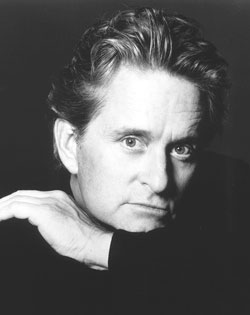
Is Michael Douglas a Male Chauvinist Pig?
By Josh R
Did that get your attention?
When Mr. Copeland enlisted me as a contributor to this forum, he probably didn’t anticipate a post such as this — I think I’m supposed to be more informative than confrontational (trusting sort that he is, he overestimates my better instincts). Well, I can’t always take the classy route. This piece may contain some actual information, but it’s mostly just an old-fashioned hatchet job. Sometimes I like to get up on my high horse and kick up a little mud in people’s faces, especially when I feel such a response is merited.
I guess we’re at the point now where we can legitimately (if somewhat grudgingly) refer to Michael Douglas as a Hollywood legend. So maybe the guy doesn’t have the acting chops of a Dustin Hoffman or a Robert De Niro — or the sex appeal and glamour of a Robert Redford or Warren Beatty. Perhaps he can’t rival any of these gentlemen in terms of old-fashioned movie star charisma. OK, he definitely can’t. Still, one can make the fair argument that he’s earned his place in the pantheon. He is an Academy Award-winning actor and producer whose career spans more than 30 years. In a business where the careers of many actors of his generation have fallen by the wayside, he has weathered an unusual number of flops and misfires to retain his status as an A-List marquee attraction. His résumé also has included its fair share of hits, of both the critical and commercial variety. If the bulk of his work hasn’t demonstrated much beyond a solid professionalism, he has, on occasion, shown himself to be a talented and resourceful actor. He is a mainstay of Hollywood social circles, a mover-and-a-shaker, son of Kirk, and husband to Catherine Zeta-Jones. Whether you like the guy or not, he is, without question, a star.
Which is why it may come as something of a surprise that the man has been rejected by more women than any other man in the history of Hollywood.
It’s not his love life I’m referring to — in fact, reputation holds that he’s done fairly well in that department (to the point that his pre-nuptial agreement with Ms. Zeta-Jones is known to include an infidelity clause). The rejection that Mr. Douglas has suffered at the hands of Hollywood’s female acting elite has been of a professional nature — and, on at least three (and possibly four) occasions, it appears to have been deserved.
The lead role in One Flew Over the Cuckoo’s Nest, produced by Mr. Douglas and for which he received the Academy Award for best picture, was turned down by (in alphabetical order) Anne Bancroft, Ellen Burstyn, Colleen Dewhurst, Faye Dunaway, Jane Fonda, Angela Lansbury, Jeanne Moreau and Geraldine Page. Most of the actresses cited personal reasons for their refusal, ostensibly because of the nature of the material.
Ken Kesey’s novel had ignited a firestorm of controversy upon its publication in 1963, mainly due to its depiction of the character often referred to only as "Big Nurse," the sadistic ogre who presides over a mental ward populated by male patients. In Nurse Ratched, whose ugly countenance was described in almost as much detail (if not as frequently referenced) as her large, fleshy tits, Kesey had fashioned an interpretation of the female authority figure as an emasculating control freak, with no attempt to understand or get to the root of her behavior. As written by Kesey, critics observed that the character had about as much dimension as the Wicked Witch of the West. Since the novel’s debut on the best seller list coincided with the advent of the women’s movement, feminist activists had a field day denouncing what they (correctly) perceived as a monstrous disservice to the cause of women’s advancement in the professional arena. At the end of the novel, Ratched is raped by McMurphy — as imagined by Kesey, the assault is less an act of violence than an act of justice, retribution for her "rape" of the inmates in her charge. It’s a rape that the reader is supposed to cheer for.
Needless to say, by 1975, this wasn’t going to fly, so Douglas and his collaborators had to soften the material considerably. The character’s fiendish, subhuman bullying (with accompanying grunting) was replaced with a more subtle form of villainy, and the rape was jettisoned in favor of strangulation. Nevertheless, no major actress of the period was willing to go anywhere near it — some demurring politely, others expressing
 indignation that the film was being made in the first place. Joanne Woodward was never offered the role of Nurse Ratched — the story goes that she’d already taken herself out the running with a preemptive strike before the production team had even had the chance to approach her. Having gotten wind of the fact that her name had been bandied about in a casting session, she reportedly told Douglas that not only had she no intention of taking the role, she had no desire of even seeing the finished product. The role eventually was filled by an unknown, Louise Fletcher, who won an Academy Award for her performance before promptly returning to obscurity. The previous year’s winner, Ellen Burstyn (who had been among the first to take a pass on the film), went on television and asked Academy members not to vote in the best actress category to protest the lack of good roles for women. Fletcher later related to The New York Times, in reference to a conversation she’d had with Burstyn after the latter’s comments, “She hadn’t even seen Cuckoo’s Nest because she thought it would be too painful an experience. I told her that I thought it would have been nicer if she’d said what she said in a year when she had been nominated.”
Fatal Attraction is perhaps Mr. Douglas’ best-known and most influential film as an actor — for you young’uns out there, it’s about a basically decent guy who cheats on his angelic, idealized homemaker wife with a high-powered cosmopolitan book editor who turns out to be a raving psychopath. General chaos ensues — knives are wielded, children are kidnapped, cars are splashed with acid and beloved household pets are tossed into the crock pot. The role was turned down by Isabelle Adjani, Barbara Hershey, Miranda Richardson and Debra Winger. Richardson, a relative unknown whose involvement with the film might have propelled her to stardom, publicly stated that she found the script “regressive in its attitudes.” While the LA Reader’s John Powers was among those who saw the film as being “about men’s fear and hatred of women,” The New Yorker’s Pauline Kael went a step further in declaring “the film is about men seeing feminists as witches, and the way she’s presented here, the woman is a witch…she parrots the aggressively angry, self-righteous statements that have become commonplaces of feminist fiction, and they’re so inappropriate to the circumstances that they’re proof she’s loco.”
Unlike Cuckoo’s Nest (and Basic Instinct, which I’ll discuss presently), the producers didn’t have to resort to drafting an unknown actress to fill their star role. Glenn Close, who found herself in a bit of a career cul-de-sac after being typecast as the virgin mother (The World According to Garp), the nurturing, all-giving earth mother (The Big Chill), and quite literally, a glowing Madonna (the living embodiment of goodness and decency in The Natural), was desperate to break out of the holding pattern. She aggressively courted the role in a calculated risk that paid big dividends, earning an Oscar nomination for the performance. She’s been happily playing bitches ever since.

The impetus for this piece was seeing Basic Instinct again fairly recently — Douglas’ next monster hit after Fatal Attraction. I’m not sure what I was expecting, although it seemed diverting enough way back in good old 1992. For anyone who hasn’t had the “pleasure,” it’s basically the same deal as Fatal Attraction, only with an S&M twist and a cold-blooded gal who has no ability to love instead of a pathetic one who loves too much. Once again, audiences encountered a high-powered professional woman (in this case, a best-selling author) who is a sexual predator and sick as all get-out. Sharon Stone deservedly became an overnight sensation on the strength of her performance as Catherine Tramell, the ice-pick-wielding loony/white-hot fuck machine who inspired a thousand beaver jokes, thanks to the infamous and oft-parodied scene where director Paul Verhoeven invites the audience to rubberneck his leading lady’s privates. The actress had been knocking around Hollywood for many years, getting regular work without getting anywhere in particular, until she landed the role that would vault her into the bigtime.
As good as she was, her casting probably represented the last resort of an increasingly desperate production team. Kim Basinger, Michelle Pfeiffer, Julia Roberts, Demi Moore, Meg Ryan, Virginia Madsen, Lena Olin, Greta Scacchi and Emma Thompson all said no — whether their reluctance had more to do with the copious amount of female nudity the job required than the quality of the script and the nature of the character remains to be seen. In any event, the film became the subject of much protest as the result the character’s sexual orientation — which could be more accurately described as pansexual than bi. The film’s detractors claimed that the filmmakers not only viewed bisexuality as a perversion, but went so far as to equate it with sociopathic behavior. Gay and lesbian activists picketed while the film was shooting on location in San Francisco, requiring the deployment of police riot squads, and the controversy had already gotten a great deal of coverage before the film had even opened.
Having seen the film again recently, I do not find that it is offensive to gay people. I believe that it is offensive to all people. Not surprisingly, given the participation of Mr. Douglas, it is particularly insulting to women, particularly of the white-collar working variety. In addition to its insistence that there is something inherently evil about female sexuality, the film presents us with a secondary female character, a psychologist played by Jeanne Tripplehorn, who is not only completely incompetent in a professional capacity but a total doormat in her off hours. Her irrational attachment to Douglas’ character, who treats her like shit even when he’s making love to her (if that’s what it can be called, given the rough and graphic nature of their sex scenes), not only overrules her judgment and professional code of ethics, but leads to her eventual demise. And, yeah, turns out she also swings both ways. Dude…it’s hot!

If these three films provide us with a virtual who’s who of Hollywood actresses (at least in terms of who had the good sense not to bite), they don’t represent the only contribution Mr. Douglas has made to advancement of women’s rights during his long tenure as a leading man. As far as I know, Demi Moore was the first choice for the lead in Disclosure, which would serve to reason given her status as the top female box office attraction of the early '90s, after Julia Roberts. As such, there is no list of conscientious objectors to report, which might create the false impression that the film’s content is of a less incendiary nature than the other films discussed here. Actually, it’s probably the most corrosive of the bunch. Barry Levinson’s adaptation of the Michael Crichton novel plays to the popular male paranoia that not only are women trying to take away their jobs, they want to rip off their balls in the process. Once again, Douglas plays a basically decent guy who is passed over for a promotion in favor of the castrating bitch essayed by Ms. Moore, who becomes his new boss. Prowling through the corridors of power in stiletto heels and leaving a tiny trail of stab wounds in her wake, this dragon lady has no sooner started lashing the whip than she initiates an aggressive campaign to get into Mr. Douglas’ pants…much to his discomfort and embarrassment. It’s an exercise in role reversal that actually serves to trivialize the issue of workplace sexual harassment rather than shed any new light on the subject. The scene in which Ms. Moore throws Douglas up against a desk and starts shoving his cock in her mouth above his protests would be ludicrously funny in a high-camp way if it didn’t leave such a foul aftertaste (no pun intended).
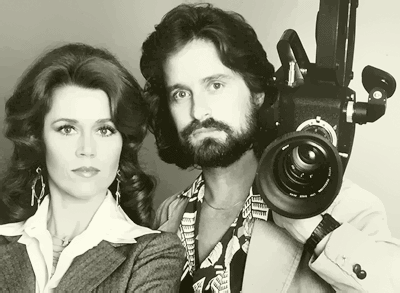
The tenor of this piece might suggest that I nurse a deep and abiding hatred for Michael Douglas — as both an actor and as a member of the human race. This is not the case — I have nothing against the guy. He has made some highly enjoyable films — Romancing the Stone and The War of the Roses always have been particular favorites of mine — and his turn as a rumpled professor experiencing a midlife crisis in Curtis Hanson’s Wonder Boys probably represents his best acting work to date (although his performance as greed incarnate in Oliver Stone’s Wall Street still commands a devoted following). I’m not really even trying to suggest that Michael Douglas actually is sexist. Putting aside the content of these films, there really isn’t anything to indicate that, as a private citizen, the man has a lack of respect for women and isn’t sympathetic to the issues that affect them. In his defense, it should be noted that he also produced The China Syndrome, which showed a strong, sympathetic female protagonist who refuses to accept the limitations imposed upon her by the powers-that-be, and proves her mettle and her integrity as a journalist.
That said, there’s no denying the fact that Michael Douglas has been involved with some of the most blatant exercises in anti-woman propaganda that the modern cinema has produced. I’m not one of those watchdogs who goes into a tizzy over any perceived instance of political incorrectness — frankly, I think most people are waaaay oversensitive about that kind of thing — but when you look at the kinds of films Michael Douglas has done, you’ve gotta wonder what’s going on in his head (beyond “Damn, I’m married to Catherine Zeta-Jones!”). If he had made just one of these films, I probably wouldn’t think much of it, but the fact is, he was involved with all four of them — and you’d be hard-pressed to find any four films made in the last 30 years which provoked more outrage on the part of feminist advocates. Whether this particular feature of Mr. Douglas’s career is the result of bad judgment or simply bad taste is open to debate, but in any event, it does seem to indicate a certain level of insensitivity (or at least lack of consideration) on his part. He seems to have been on his best behavior for the past decade or so…maybe Catherine managed to get some veto power to go along with the infidelity clause.
Tweet
Labels: B. Levinson, Bancroft, Barbara Hershey, Burstyn, Debra Winger, Demi, Dunaway, Emma Thompson, Geraldine Page, Glenn Close, J. Fonda, Julia Roberts, Kael, Lansbury, Pfeiffer, Sharon Stone
TO READ ON, CLICK HERE
Tuesday, February 14, 2006
Lead or supporting?
It's a debate that's been going on almost from the moment the Academy Awards instituted the supporting acting categories in 1936. Most often, people get put in the "wrong" category for marketing purposes. For example, the producers of Ordinary People had to know in 1980 that Timothy Hutton was a long shot to win lead in a year with Robert De Niro's Jake La Motta in Raging Bull, so they followed the old young performer conceit and stuck him in supporting actor where he won. Here are some examples through the history of the Oscars where I though people were in the wrong category. At the Tony Awards the use the criteria (though it can be overturned) that if you are above the title you are a lead, if you are below you are featured. This had led to cases where Joel Grey got left out of a nomination for the Broadway revival of Chicago and when the same role can be featured some years and leads others (such as the King in The King & I and the M.C. in Cabaret. Feel free to agree or disagree or add your own.
1936: In the very first year, they really sort of messed up by putting Luise Rainer up as lead in The Great Ziegfeld. She won anyway.
1937: Even though Roland Young was as much a lead as Cary Grant and Constance Bennett in Topper, he got relegated to supporting actor where he lost.
1939: An insanely strong years for movies and performances, somehow Greer Garson made the cut as lead in Goodbye Mr. Chips when she shows up late in the film and disappears soon after.
1940: Walter Brennan won his third supporting actor Oscar in five years for his great performance in The Westerner, but he was as much a lead as Judge Roy Bean in that film as Gary Cooper was.
1944: The Oscars themselves got screwy this year nominated Barry Fitzgerald's turn in Going My Way in both the lead and the supporting categories. He won supporting and they changed the rules after that so the same performance couldn't pop up in both. In the same year, they relegated the great Claude Rains to supporting actor for his title role in Mr. Skeffington, where he is barely off screen for most of the movie.
1947: Many people argue over this one but I think that Edmund Gwenn's Santa Claus in Miracle on 34th Street is a lead, but he won in supporting.
1950: Some people think that Anne Baxter was supporting in All About Eve, but I think they were right to put both her and Bette Davis in lead.
1956: I think the great James Dean was clearly supporting in Giant and who knows — if they'd stuck him there, he might have won.
1958: Really the entire cast of Separate Tables was supporting, which made David Niven's win all the more ridiculous. The same year, it can also be argued that Shirley MacLaine was really supporting in Some Came Running, though she snagged her first lead nomination for it.
1959: Practically the entire field of best actress contenders could have been considered supporting. Only Doris Day and Audrey Hepburn were true leads. Neither Katharine Hepburn nor Elizabeth Taylor can really be called a lead in Suddenly Last Summer and that year's winner, Simone Signoret in A Room at the Top, is definitely supporting — though she is great.
1962: One of the first instances of sticking the young in supporting. Mary Badham's Scout is really the lead of To Kill a Mockingbird, but she got stuck in supporting with another arguable young lead — Patty Duke in The Miracle Worker.
1963: Patricia Neal deserved an Oscar for her work in Hud — but it should have been in supporting actress. There really is no question here — she's not a lead.
1967: Both Anne Bancroft's turn in The Graduate and Katharine Hepburn's in Guess Who's Coming to Dinner are arguably supporting turns.
1968: Ron Moody's delightful Fagin in Oliver! is yet another supporting role that sneaked in the lead field. In the same year, Gene Wilder's Leo Bloom in The Producers was on screen nearly as much as Zero Mostel's Max Bialystock, though he got stuck in supporting. When the musical version hit Broadway decades later, both Max and Leo were nominated as leads. When the musical was turned into a lame movie, Matthew Broderick's Leo was campaigned as supporting, to no avail.
1970: Again, they were reaching to fill out the lead actress slate and that's how Glenda Jackson got nominated there for Women in Love and won.
1972: Many people believe that Marlon Brando and Al Pacino are in the wrong categories for The Godfather, that Pacino is the true lead and Brando supporting. I go back and forth on what I think and I've never settled on a decision. That same year, Paul Winfield and Cicely Tyson were both nominated as leads for Sounder when young Kevin Hooks is the real star. Winfield is especially out of place, since he spends much of the film off-screen in prison.
1984: Haing S. Ngor won supporting actor for The Killing Fields, but I say he is a co-lead with Waterston, since the second half of the movie focuses on his character almost exclusively.
1988: Again, a young actor gets stuck in the supporting ghetto by virtue of his age. There can be no argument that Running on Empty was about River Phoenix's character, but he didn't get a shot at lead.
1989: To my eyes, Dead Poets Society is an ensemble about the kids and Robin Williams' teacher was supporting. The same year, I think a case can be made that Martin Landau was the lead of Crimes and Misdemeanors.
1991: We get to probably the most obvious of all cases of mistaken categorization: Anthony Hopkins in The Silence of the Lambs. Hannibal Lecter is in the 2-hour film for less than 30 minutes, he doesn't enter right away and once he escapes, he's never heard from again until the film's coda. There is no doubt in my mind — Hopkins is supporting here and he should have won supporting.
1996: A less-argued case here, but one I feel strongly about. Frances McDormand should have been in supporting for Fargo. She doesn't enter the movie for 30 minutes and then she disappears for significant stretches. William H. Macy who was nominated for supporting actor actually has more screen time than McDormand. When you time it, the film is almost equally divided between McDormand, Macy and Steve Buscemi, so they are either all lead or all supporting in my book and I say supporting. Also in 1996, Geoffrey Rush's work in Shine is really more limited than you'd think for a lead performance. I've never timed it (because I didn't want to sit through it again) but I bet Noah Taylor has almost as much screen time as the younger David Helfgott.
2001: Another case where marketing trumpeted facts and Ethan Hawke got put in supporting actor for Training Day when he's in the movie before Denzel Washington and after him as well with no significant absences.
2002: A mess of issues involving The Hours, where there again is really no lead and it sure seems like the supporting-nominated Julianne Moore and the non-nominated Meryl Streep have as much if not more screen time than lead winner Nicole Kidman.
2004: One of the biggest miscategorizations and unnecessary nominations of all time: Jamie Foxx in Collateral. He's so clearly the lead in that movie, in it before and after Tom Cruise shows up. It's not like Foxx wasn't going to win lead for Ray, so this nomination boggles my mind.
2005: This year has one glaring questionable categorizations Is Jake Gyllenhaal any less a lead in Brokeback Mountain than Heath Ledger? I don't think so. Of course, I also think Gyllenhaal's work is noticeably weaker than Ledger's, but that's not part of this discussion.
Tweet
Labels: Bancroft, Bette, Brando, Denzel, Garson, Hawke, Hopkins, James Dean, K. Hepburn, Landau, Liz, Luise Rainer, MacLaine, McDormand, Niven, Pacino, Patricia Neal, Rains, Robin, W. Brennan
TO READ ON, CLICK HERE



