Wednesday, December 28, 2011
An antidote for the emptiness of existence — at least for 90 minutes

By Edward Copeland
Seventeen years later…
Woody Allen makes another good movie. That's not entirely true. Since Bullets Over Broadway's release in 1994, I have liked two of his films — Match Point in 2005 and Whatever Works in 2009. However, Midnight in Paris definitely deserves the label as the first great Woody Allen film since Bullets. As Donald Rumsfeld said of the Iraq war, it's been a long, hard slog for Woody fans who used to anxiously anticipate each new Allen offering before his films turned into retreads of previous works and tasted like a fifth night of leftovers. With Midnight in Paris, his muse returns and blesses us with a fully formed, funny, thoughtful piece of cinematic inspiration.
Most people heard the news that Midnight in Paris stood tall in the Allen canon months ago when the film opened, earning raves and becoming his highest-grossing film ever. I had to wait for DVD and retain a healthy skepticism until I saw it. I simply had no other choice. During the nearly two decades that Woody toiled in the artistic wilderness, people burned me far too often by insisting Allen's latest belonged in his win column only to discover the opposite when I viewed the film. After I finished watching Midnight in Paris, it seemed as if those 17 years had been erased magically. I actually had to check IMDb because my brain couldn't conjure the titles of some of the forgettable films he churned out in those years — Small Time Crooks, Melinda and Melinda, Scoop, Cassandra's Dream, You Will Meet a Tall Dark Stranger. That doesn't even take into account the ones so bad I couldn't bleach the stain they left on my cerebrum such as Celebrity, Curse of the Jade Scorpion and Hollywood Ending. Midnight in Paris washes away those transgressions, clears the slate and renews my hope that inside the 76-year-old filmmaker there still exists things worth saying and movies worth making.
As many of Allen's films that he doesn't star in do, Midnight in Paris features a Woody surrogate and, in what might appear to be an unlikely casting choice, Owen Wilson gets to be his stand-in here. Selecting Wilson as the Woody Allen substitute turns out to be the first of many grand decisions the writer-director makes. In fact, I'll go further and declare that Owen Wilson makes the best faux screen Woody yet (and let's hope we never endure one worse than Kenneth Branagh's in Celebrity). Wilson plays Gil Pender, a successful Hollywood screenwriter with an attractive fiancée named Inez (Rachel McAdams). The couple tag along with Inez's ultra-conservative parents (Kurt
 Fuller, Mimi Kennedy) on a trip to Paris where Inez plans to be lazy and sight-see while Gil hopes the City of Lights ignites his first attempt at writing a novel. Paris casts a spell on Pender almost immediately, even though it's raining at the time, something that annoys Inez. "Why does every city have to be in the rain? What's so wonderful about being wet?" asks Inez, a woman Gil unconvincingly describes to strangers as charming but who looks to outsiders as a high-maintenance, judgmental snob. It doesn't take long in France for Gil to suggest that they should move there, but Inez doesn't understand what's so terrible about living in Malibu and being a rich screenwriter, especially with as much trouble as Gil tells her he's having with his novel. "I'm having trouble because I'm a Hollywood hack who never gave literature a real chance until now," he replies. Pender hates his job because he doesn't write anything of value and before we even get to Allen's major themes in Midnight in Paris, he appears to be submitting himself for some self-criticism over his output in recent years. When he made the atrocious Hollywood Ending, the movie was a one-joke notion that the industry had devolved to the point that a director no one realized had gone blind could make a movie and still deliver a box-office smash. In Midnight in Paris, (at least I hope this is the case) he's taken the same complaint and aimed it inward and disposed of it in pieces of dialogue as appetizers to a bigger and better cinematic dinner. (Besides, as far as Hollywood Ending goes, I'd submit Kurosawa and Ran as a counterargument for what blind directors can accomplish.) Gil's novel's plot teases us as to what the main course will be as it tells the story of a man who owns a nostalgia shop, selling memorabilia relating to bygone days.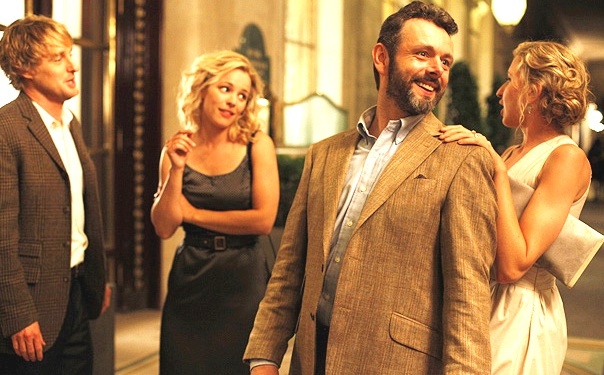
While Gil and Inez wander the city with her parents, they bump into Inez's old friends Paul and Carol (Michael Sheen, Nina Arianda) and soon the two couples visit all the sites together where Paul, an unctuous know-it-all on all subjects makes it a point to show off his expertise to anyone and everyone, even telling the tour guide at the Rodin museum (played by French first lady Carla Bruni) that she has her facts wrongs). Paul embodies a 21st century representation of the man pontificating in a movie line in Annie Hall that Alvy fantasizes about bringing Marshall McLuhan out to chastise. Watching the laid-back Wilson do the annoyed Woody dance at this character type not only proves hilarious but a refreshing twist on the familiar routine. Every word Paul utters, of course, enthralls Inez, who believes he's as brilliant as he thinks he is. It's also a nice change of pace for Sheen to play a fictional creation for a change instead of impersonating famous British people. Paul probes Gil about the subject of his novel and at first, Gil resists discussing it, but Inez spills the beans and the movie's argument gets rolling — namely, is the grass really greener in the other era? Gil romanticizes the Paris of the 1920s, when so many great artists from America and elsewhere flocked there. Paul pooh-poohs the notion immediately. "Nostalgia is denial. Denial of the painful present," Paul declares. Inez, the woman who allegedly loves Gil and wants to spend the rest of her life with him, takes Paul's side in the browbeating. "Gil is a complete romantic. I mean he would be more than happy living in a complete state of denial," she says of her fiancé. Paul isn't able to discuss any topic unless he does it at length and in long-winded lectures, so he has to show everyone what he knows of this "syndrome." "The name for this fantasy is Golden Age thinking. The erroneous notion that a different time period is better than the one one's living in now," he pronounces.

Having had enough of being a foursome one night as Paul suggests they all go dancing, Gil begs off, choosing to return to the hotel and perhaps work on his novel. Instead, he walks the streets. As he sits on some steps, a clock strikes midnight and an old yellow Peugeot pulls up as if it's the pumpkin that turned into Cinderella's carriage. The antique automobile bears '20s-era Frenchmen and Frenchwomen (who may have been mice once — who can say?) drinking champagne and beckoning Gil to climb in for a ride. That's when the real sparkle of Midnight in Paris begins and it involves another Woody Allen venture into a magical realm. Gil doesn't speak French, so he's clueless as to what his fellow passengers might be saying as they take him to a party where everyone dresses decidedly retro. Fortunately, most of the other guests appear to be American or at least speak English, so communication isn't a problem. A young man (Yves Heck) sits at a piano, playing and singing, "Let's Do It, Let's Fall in Love." He mentions to one guest that he's a writer and they introduce him to Scott (Tom Hiddleston) and his wife Zelda (Alison Pill) — the Fitzgeralds. Gil finally realizes that
 somehow, that mysterious Peugeot took him on a very long drive — one that traveled nearly 100 years in reverse to his ideal Golden Age where he could mix and mingle with his long-dead artistic inspirations. In the past, when Allen employed these fantastical devices it began to feel as if, to paraphrase one of his oldest jokes, he'd resorted to cheating by looking into the soul of the guy sitting next to him, only in these instances, he wasn't seeing another person but staring at himself in a mirror. Magic tricks which first played a key role in the "Oedipus Wrecks" short of New York Stories would return in Curse of the Jade Scorpion and Scoop or, to a lesser extent, assume the form of magical herbs in Alice. Actual Greek choruses would arrive to comment on the action in Mighty Aphrodite or see-through characters would pop up in the form of Robin Williams in Deconstructing Harry. This is a well that Woody drinks from often except that it works best when he employs it in service of larger ideas such as in Zelig, The Purple Rose of Cairo (which I still consider his best film), and, now added to that list, Midnight in Paris. As Midnight in Paris enthralled me, a small detail leaped out early on. In both Purple Rose and Midnight, he names one of the leads Gil. In the case of Purple Rose, most tellingly, the actor that Jeff Daniels plays who creates the role of Tom Baxter, the movie character who steps off the screen and into 1930s New Jersey, bears the name Gil Shepherd, only that Gil embraces his burgeoning stardom and hopes a B-picture such as "The Purple Rose of Cairo" raises his stature high enough to nab the lead in a Charles Lindbergh biopic — as long as his doppelganger in the pith helmet doesn't wreck his career. Gil Pender in Midnight in Paris may work in the same industry, but he fears he's sold his soul to it and he wants out.
The first night that Gil takes his trip back to the 1920s he also encounters Ernest Hemingway (played by Corey Stoll in the film's most entertaining performance). Fitzgerald introduces them and Gil gets the envious position of talking writing with Papa in the movie's best exchange on writing that'll appeal to anyone who has ever put pen to paper. It begins with Gil being self-deprecating about the subject of his novel (of course, no one in the 1920s has the faintest idea what a nostalgia shop is), calling it a terrible idea. "No subject is terrible if the story is true and if the prose is clean and honest, and if it affirms grace under pressure," Hemingway tells him. Gil then works up the nerve to ask if the author would look at what he's written and offer suggestionss.
HEMINGWAY: My opinion is I hate it.
GIL: But you haven't read it yet.
HEMINGWAY: If it's bad, I'll hate it because it's bad writing. If it's good, I'll be envious and hate it all the more. You don't want the opinion of another writer.
Hemingway does offer to give Gil's manuscript to Gertrude Stein (Kathy Bates) to read, because he's always trusted her opinion. They agree to meet the following night and Gil leaves but suddenly remembers he forgot to ask Hemingway where to meet him, but when he turns back the coffeehouse has turned into a laundromat and Gil finds himself in 2010 again.
In the morning at his hotel, he attempts to explain his adventure to Inez, asking her what she'd think if he told her he met Zelda Fitzgerald and she's exactly like they had read and Scott really loves her and worries endlessly, but she hates Hemingway because he's right that she's standing in the way of his writing. When Gil completes his enthusiastic rambling, Inez replies, "I'd think you had a brain tumor." Gil manages to convince Inez to go back with him the next night to wait for the Peugeot, but she grows impatient and takes off before the clock strikes midnight. After Inez has left, the Peugeot arrives and takes him to Gertrude Stein's apartment where Hemingway awaits and Pablo Picasso (Marcial Di Fonzo Bo) paints his current mistress Adriana (Marion Cotillard), who catches the eye of both Gil and Hemingway. Despite the many larger-than-life figures than circle Adriana's world, she finds herself just as drawn to Gil — until she learns of his engagement. She also shares Gil's Golden Age thinking, While he thinks that she lives in the greatest time period, she thinks it's awful and wishes she could have been in Paris during the Belle Epoque of the late 19th century. Meanwhile Gil's behavior in the 21st century becomes so bizarre that his father-in-law-to-be hires a private eye to tail him on his midnight walks to see what Gil does on them, since he doesn't trust anyone who says such nasty things about the Tea Party.

Even when Allen had fallen into his long slump, he still had the ability to attract some pretty solid ensembles, not that they were given much to do. In Midnight in Paris, the casting shines with a mix of lesser-known performers and bigger names, all bring their A game to Allen's greatest screenplay in 17 years. In addition to Wilson and Stoll who I've mentioned, the cast's standouts include a zany single scene by Adrien Brody as Salvador Dali, Kathy Bates, Michael Sheen, Rachel McAdams, Marion Cotillard in the first performance she's given that I've enjoyed and, most worth noting, Alison Pill as Zelda Fitzgerald. Pill to me proves again she's an actress just waiting to break out. She's funny and touching here after giving a good dramatic turn in Milk and being part of the fun ensemble in Scott Pilgrim vs. the World. Given how many great lines Woody's script for Midnight in Paris delivers, it's tempting to rattle them all off, but I'm resisting the urge for those who have yet to see this charmer, but I have to mention one of my favorite gags when Gil runs into a young Luis Buñuel (Adrien de Van) and gives him an idea for a movie — basically the plot of his film
If there has been any debate about Midnight in Paris, it's been where Allen comes down in the end on the question of nostalgia and Golden Age thinking. It seems pretty obvious to me based on what Gil's last line to Adriana is, even though he sends mixed signals by having Paul, the film's most pompous character, ridicule the idea of Golden Age thinking first. Also, as others have pointed out, throughout most of Allen's career his choices in music and references have screamed nostalgia, but Midnight in Paris plays as one of the most entertaining self-critical works any artist has ever made. At the same time, Allen does acknowledge the natural reflex to long for an earlier, better time — if not in another era, at least in one's own life.
Tweet
Labels: 10s, Branagh, Buñuel, Cotillard, Fitzgerald, Hemingway, Jeff Daniels, K. Bates, Kurosawa, O. Wilson, Robin, Woody
TO READ ON, CLICK HERE


Tuesday, November 22, 2011
A Timeless Love Story

By Damian Arlyn
I was recently playing the board game Loaded Questions with my wife, her brother and his wife. It was my brother-in-law's turn to guess. The card asked the rest of us to name our favorite animated feature film. His wife picked Beauty and the Beast. I selected The Hunchback of Notre Dame (although I could just as easily have gone with Pinocchio, The Secret of NIMH, The Prince of Egypt or The Nightmare Before Christmas). Being fairly familiar with my wife's tastes in animated films, I suspected she would name either Sleeping Beauty, The Lion King or Hunchback of Notre Dame as well. To my surprise, she also named Beauty and the Beast. I knew she loved the film, but was not aware that it was her favorite. After her brother correctly guessed all of our answers, I told her I was surprised by her choice because I always was under the impression she favored these other animated films. "I admire aspects of the other ones," she informed me. "I think the backgrounds and music in Sleeping Beauty are beautiful and I like the story and themes of Hunchback, but with Beauty and the Beast, I just love the whole package." I not only learned something new about my wife that day, I was reminded of something that I guess I had forgotten: namely, that Beauty and the Beast (which celebrates its 20th anniversary today) is deservedly one of Disney's most beloved animated features because, unlike numerous others (which can be very uneven), it excels in ALL of its areas. It is arguably the perfect Disney movie.
Beauty and the Beast came at a time when Disney was experiencing a real renaissance in animation. Throughout the '70s and early '80s, some decent movies such as The Fox and the Hound, The Great Mouse Detective and The Black Cauldron were produced, but they failed to achieve the kind of critical or commercial success that had come to be expected from a Disney product. To make matters worse, the live-action arm of the studio (which was churning out such "clunkers" as The Black Hole, Tron and Return to Oz) wasn't faring much better. The studio was finding it tremendously difficult reaching contemporary audiences with its somewhat antiquated material. Their attempt to produce something more "modern" and "cool" with the pop song-heavy Oliver and Company only reeked of desperation. Meanwhile Disney's competitors (including former Disney animator Don Bluth's An American Tail and The Land Before Time) were gaining a lot of ground. So, in the mid-1980s some "new blood," in the guise of former Paramount executives Michael Eisner and Jeffrey Katzenberg, was brought in to change things at the struggling studio and special attention was paid to the once-great animation department. Their plan was to try to recapture the essential elements of Disney's golden age: good stories simply but expertly told with gorgeous animation, interesting characters and memorable music.

The result was The Little Mermaid, an enormously entertaining creation that seemed to include all of the classic characteristics of Disney fairy tales as well as a few new qualities that made it resonate with both children and adults alike. I remember seeing it in the theater with my family in junior high and just being utterly charmed by it. It even went on to win two Academy Awards: one for the score and one for that catchy little tune "Under the Sea," proving that the music was a major ingredient for the film's success. That music came for the imaginative minds of the composer Alan Menken and his lyricist Howard Ashman, the team responsible for the subversive yet immensely melodic off-Broadway hit-turned 1986 movie Little Shop of Horrors. Thus, when Mermaid earned hundred of millions of dollars (much of it from the home video release, the first time a current Disney animated feature appeared in that format) and marked a real return to form for the endangered studio, it seemed only natural that its successor would try to build on the same foundation that it had laid (including the Menken/Ashman songs). Expectations were understandably high and whatever it was to be, they would have to make it something really special.

Disney decided to go with the well-known French fable of a beautiful woman (whose name was wisely changed from "Beauty" to "Belle") who stays in an enchanted castle run by a monstrous beast. Although she is repulsed by him initially, she eventually learns to see the kind, tormented and beautiful person hidden beneath the hideous veneer and in the process warms his own cold heart. In the end, she declares her love for him which transforms him back into the handsome prince that he was before being bewitched by an evil spell and the two live happily ever after. The story had been told onscreen before (most famously in Jean Cocteau's stunning 1946 adaptation La Belle et la Bête) but never in feature-length animation. Borrowing several elements from the Cocteau film (such as furniture within the castle coming to life) but adding quite a few touches of their own (including the heroine's rescue from a pack of wolves by the beast), the animators fashioned a colorful, sweet, funny and at times scary product. Not surprisingly the animation is gorgeous. The design of the beast is a particular standout. Whereas in other incarnations the beast usually resembles a really hairy human, this beast is fully animal with equal parts buffalo, lion, bear and various other carnivorous creatures. Despite all this, an undeniable humanity still comes through loud and clear in the character's facial expressions and body language.
This is no doubt due to the fact that his design was supervised by the eminent animator Glen Keane who has a track record of making huge, lumbering creatures look strangely graceful (see the bear in The Fox and the Hound and Professor Ratigan in The Great Mouse Detective). In fact, all of the characters in Beauty and the Beast, from the leads right down to the minor characters, are beautifully rendered with with distinct looks and interesting personalities. This is especially impressive when one considers that most of the characters in the film are sentient household objects such as clocks, teapots, candelabras, etc. The only other animated film I can think of that so effectively turns inanimate objects into living, breathing beings (not including the Toy Story trilogy) is the woefully underrated Brave Little Toaster. Of course, the believability of the characters is aided in no small way by the bravura vocal performances of the excellent cast. Beauty and the Beast followed another wise Disney tradition in that they decided to hire talented actors to give voice to these characters and not A-list movie stars. At the time I saw it, the only voice I really recognized was Angela Lansbury. Even though I was somewhat of a teenage movie buff, I had no idea who Jerry Orbach, Paige O'Hara, David Ogden Stiers and Robby Benson were and I suspect most audience members were like myself. Their ignorance of the actors working behind the scenes helped make it easier to merely accept the characters on screen at face value. Unfortunately, ever since Robin Williams was cast as the Genie in Disney's next animated blockbuster Aladdin, this turned into a practice that seemed no longer viable. Feature animation now appears to be populated primarily with celebrities (which is no doubt why so many distinguished voice actors such as Maurice LaMarche, Frank Welker and Rob Paulsen all have to work in television) and it creates a bizarre disconnect between the figures we see moving on screen and the voice we hear coming out of their mouths. We know that it's Cameron Diaz we are hearing but it is not Cameron Diaz that we are seeing (at least Pixar is trying to continue the tradition of casting the right actors for the roles regardless of their celebrity status).

Another significant development in the history of animation that occurred in Beauty and the Beast was the combination of hand-drawn characters with a completely three-dimensional CGI environment in the now iconic ballroom sequence. It wasn't the first time such a thing was attempted (the climactic clock tower scene from The Great Mouse Detective did the same thing) but this was the first time such a feat was accomplished so seamlessly. Though it may not be quite as impressive to us now, the sight of the "camera" gliding around the characters, swooping down toward them from above and even moving between them as they danced (almost as if we are dancing right along with them) really helped draw audiences even further into what was already an emotionally-charged scene a) because of what was happening in the story at that point and b) because of the lovely title song that was being sung by Angela Lansbury's matronly Mrs. Potts during it. As corny as it may sound, it really is a magical sequence that somehow seems to transcend all of the numerous technical achievements that helped make it so. One would have to be pretty jaded and heartless to not find themselves in some way touched by it.
Like The Little Mermaid, the songs that Howard Ashman and Alan Menken collaborated on for Beauty and the Beast are superb. Clearly modelling their work on Broadway showtunes, every song just pops. There is not a weak tune in the bunch. Also, every song either furthers the story or develops character. The opening number "Belle," for example, introduces the protagonist, establishes how the townspeople feel about her, acquaints us with handsome but obnoxious Gaston who is pursuing her and just generally sets the "stage" perfectly for everything that follows. Gaston even gets his own song wherein the townsfolk sing about how great he is and he in turn
 agrees with them mentioning all of his accomplishments and hilariously pointing out that every last inch of him is "covered with hair." The big show-stopping number of the piece, however, is "Be Our Guest," a massive extravaganza showcasing a parade of food and cutlery led by a spotlight-hogging candelabra named Lumiere (voiced and sung by the multi-gifted Jerry Orbach). Seriously, Joel Grey's Master of ceremonies from Cabaret has got nothing on him. Finally, the darker and more sinister "Kill the Beast," wherein Gaston reveals his true colors, rounds out an already impressive collection of melodies. It was a no-brainer that the film would receive Oscar nods for its music. The songs "Belle," "Be Our Guest" and "Beauty and the Beast" were all nominated but it was the title song that took home the statuette. What was unexpected, however, was that Beauty and the Beast would become the first animated feature film to ever be nominated for best picture. It was a milestone in the history of animation and made everyone who worked on it very proud. Alas, one individual who never got to see the awards, the critical acclaim or the commercial success that the film garnered was Howard Ashman. During production of Beauty and the Beast it became painfully clear that Howard was dying of AIDS and although he continued to work very hard on the film (helping with the script as well as with the music), on March 14, 1991, Howard died and what was perhaps the most auspicious musical teams since Rodgers and Hammerstein came to a sudden and tragic end. The film's final credits featured one of the most poetic dedications I've ever seen: "To our friend Howard, who gave a mermaid her voice and a beast his soul, we will be forever grateful."
Although some could argue it was The Lion King that represented the pinnacle of Disney's "renaissance period" (a time when Disney seemed to have the Midas touch, well before Eisner drove Katzenberg away and then proceeded to wreck the very company he had once saved), I think Beauty and the Beast is the true supreme achievement from that era. Everything just came together in such a way that the film managed to catch that ever elusive lighting in a bottle. Twenty years later it still looks, sounds and feels great. Recently it was released on DVD/Blu-ray in a "special edition" which included such notable features as a newly animated music number which was excised before the film's original release (the song was called "Human Again" and it's a charming little tune but I think they made the right decision cutting it as it sounds to my ears too similar to "Be Our Guest") as well as the "work-in-progress" version which the studio courageously premiered at the New York Film Festival. Though it gave birth to several inferior direct-to-video sequels and a successful Broadway show, its true legacy will be as one of the greatest (if not arguably the greatest) animated features that Disney ever produced. The word "masterpiece" gets thrown around a lot, but I feel it truly is a masterpiece, not just of animation but of cinematic storytelling. It is also the last time that a genuine fairy tale was depicted on the big screen. In our increasingly cynical culture, feel-good stories of princesses, monsters, villains, magic and, most of all, happy endings are becoming increasingly rare. Even when a film does attempt to bring a fairy tale to theaters it has to be done in a very sarcastic, self-aware manner (a la Shrek, Enchanted and Tangled); more of a "meta" fairy tale than an honest-to-God "true" fairy tale. Beauty and the Beast is a timeless love story with an enduring message, but it is also in some ways a relic of a bygone era. Unless Pixar's upcoming Brave can reinvigorate the genre, it may be a long, long time before we see another bona fide fairy tale told with such unapologetic enthusiasm and sincerity.

Tweet
Labels: 90s, Animation, Disney, Hammerstein, Lansbury, Movie Tributes, Musicals, Orbach, Oscars, Pixar, Robin, Rodgers, Theater
TO READ ON, CLICK HERE
Tuesday, September 20, 2011
Gilliam's Other Holy Grail Movie

By Damian Arlyn
In a perfect world, not only would I see every film on the big screen but I would know absolutely nothing about them beforehand. Once in a while I am reminded that the best way to see a movie is with no foreknowledge whatsoever as to the film's genre, cast or plot. To go in having no preconceived notions about how one ought to feel or what one ought to think about it — no expectations for how impressed one is supposed to be by the performances, sets, costumes, budget, etc. — but to simply approach the work on its own terms and be either carried away by the reality it creates for itself or be alienated from that reality based solely on the competence with which it weaves its tale would be my ideal. Of course, I realize that we do not live in such a world. Even if it were possible to see every film in the theater (which, for many people it is not, due to physical limitations or economic difficulties) I'm not sure I'd want to given how awful so many movies are nowadays. If I could somehow be guaranteed ahead of time of a film's quality, I'd be willing to go into every film-viewing experience completely "pure" and uncorrupted by any outside information or influence. As it is, I can recount the exact number of times I went to a movie under such circumstances. It has happened precisely twice. The first was The Fisher King. The second was The Usual Suspects. Since the former celebrates its 20th anniversary today, it is that title with which I will be concerning myself.
My dad took me to see The Fisher King when I was 15 and, as I've said, I knew very little about it outside of its enigmatic title and the fact that it starred Robin Williams and Jeff Bridges (a fact I was able to glean from the marquee poster on the outside of the theater). I had no idea that the story involved a cynical, egotistical Manhattan radio "shock jock" named Jack Lucas (Bridges) whose careless on-air remarks prompt a disturbed caller to open fire with a shotgun in a restaurant full of yuppies before turning the gun on himself.

Racked with guilt, Jack descends into a deep depression and alcoholism for three years during which time he shacks up with a self-assured New York woman named Anne (Mercedes Ruehl) who owns a video store. On a particularly bleak night, Jack attempts suicide but two young hoodlums who find him and start pouring gasoline on him intending to set him ablaze interrupt him when he is saved by Parry (Williams) a homeless man who believes he's a knight sent on a quest from God to find the Holy Grail. Jack soon learns that Parry's insanity stems from his traumatic experience in the restaurant the night of the shooting when his wife was one of the seven people killed. Feeling responsible and, in a desperate attempt to ease his conscience, Jack resolves to help Parry in some way and thinks he may have discovered how when he notices Parry pining from afar for a mousy woman named Lydia (Amanda Plummer). I didn't know any of this going in.
Despite (or perhaps because of) my ignorance of the film prior to seeing it, I was positively captivated by it from beginning to end. Somehow it weaved a magical spell over me. As the cliche goes, I had never seen anything like it before. It quickly became my favorite film and remained so for a couple of years. I bought the soundtrack, which featured segments from the wonderful score by George Fenton, and even found a copy of the novelization to help enrich my understanding of the story and its themes, all of which resonated quite strongly with me: love, loss, forgiveness and especially redemption.
I also did not know who Terry Gilliam was. I didn't even really know about Monty Python yet, so I certainly didn't know that The Fisher King wasn't his first cinematic foray into the subject of the Holy Grail (though I was at least acquainted with the Grail having seen Indiana Jones search for the thing two years prior). I didn't know that this was a rare occasion where Gilliam, who normally writes his own screenplays, was really a director-for-hire. After the debacle that was The Adventures of Baron Munchausen, Gilliam was looking for a smaller and more intimate story to tell and he found it in the unique and spellbinding screenplay written by Richard LaGravenese (who would go on to pen The Ref, Beloved and The Bridges of Madison County). Interestingly, when I watch the film now — having seen the rest of Gilliam's oeuvre and being a big admirer of his work — it seems like a project tailor-made for Gilliam and his personal pet interests such as reality versus fantasy, imagination as an escape from tragedy, medieval knights in shining armor, etc.

The film is filled with dozens of entrancing and unforgettable scenes. The sweet and hilarious double date that begins with Lydia clumsily knocking things over (with Parry doing the same in an attempt to make her feel less awkward) and ends with everyone in hysterics before Williams sings a sweet and simple rendition of "Lydia the Tattooed Lady," the frightening chases involving the Red Knight, the climactic sequence where Jack attempts to retrieve the Grail from its "castle" (all the while commenting to himself on how crazy it is), the nightmarish flashbacks to the murders at the restaurant and Michael Jeter's audacious Ethel Merman-style musical number delivered to a flabbergasted Lydia are just a few. However, my all-time favorite sequence from the film occurs in Grand Central Station. It begins with Parry looking through the crowd for Lydia. When he finally glimpses her, he smiles and the music starts. She walks right past him and suddenly a couple dances by in the background as the cute little ditty that was playing transitions into a beautiful waltz. Soon that couple is followed by another and another until everyone in Grand Central is waltzing around Parry as he follows Lydia across the floor. It's a charming sequence and apparently was not in the original script but was the brainchild of Gilliam, who needed a way to visually capture how bewitched Parry is with his fair maiden. It's sublime.
The performances by all the actors are excellent. Jeff Bridges may be enjoying somewhat of a rejuvenation in his career currently, but at the time of The Fisher King he was just another solid, respected but somewhat underrated actor (like Johnny Depp before Pirates of the Caribbean or Robert Downey Jr. before Iron Man). His portrayal of the selfish, cynical jerk is actually the emotional anchor of the story.
 He's the straight man off of whom Williams can play his performance as Parry, a variation on his usual manic screen persona, though here it is put to good use in the guise of an insane, but brilliant, former history professor who even in madness has an entire library of references from which to draw upon in his ravings (one can almost imagine that had Williams' character from Dead Poets Society lost his mind, the results might look something like this). What makes Williams' performance superior to his usual fare are the quieter, more sensitive moments such as when he finally confesses to Lydia that he loves her. Williams earned a best actor nomination for his turn as Parry, but alas he would not receive that Oscar until years later for his stellar supporting work in Good Will Hunting. Mercedes Ruehl, however, did take the best supporting actress statuette home that year for her indelible turn as Jeff Bridges' sassy girlfriend and it was well-deserved. She embodies the self-assured, no-nonsense New York Italian woman perfectly. Amanda Plummer plays Lydia with just the right amount of sweetness and eccentricity and the late Michael Jeter as a gay cabaret singer does what is perhaps the best Ethel Merman impression I've ever heard in a film (except perhaps for Lt. Hurwitz in Airplane!). Also, David Hyde Pierce, Harry Shearer, Kathy Najimy and John de Lancie all play supporting roles.
Generally speaking, The Fisher King was well-received by critics and did respectable business at the box office (making $42 million on a $24 million budget). In the 20 years that have elapsed since I first walked into that theater completely unaware of what I was about to experience, other films have gone on to replace it as my "favorite," but it will always have a special place in my heart. Its story still moves me, its music still delights me, its action scenes still thrill me and its characters still charm me. To this day when I watch it I want to believe that Parry is not totally crazy, that he really is "the janitor of God" and that the chalice they retrieve truly is the Holy Grail, "the symbol of God's divine grace." It may not be Terry Gilliam's best film (I tend to be unoriginal and go with Brazil on that point) but it is probably his most enchanting and more than any other film, shows off his gift as a romantic, honest-to-God storyteller and not just an eye-dazzling satirist/rebel.

Tweet
Labels: 90s, Depp, Jeff Bridges, Merman, Movie Tributes, Robert Downey Jr., Robin, Terry Gilliam
TO READ ON, CLICK HERE
Friday, November 19, 2010
Finally: Back to Larry Part 1: Season 1

By Edward Copeland
My long national nightmare is over. Given any excuse or opportunity, I've whined for years that a complete set of HBO's first great series, the comedy The Larry Sanders Show, wasn't available on DVD. Years ago, when the first season came out on DVD, I snatched it up immediately, but no further seasons followed. Then, about three years back. they released a boxed set called Not Just the Best of The Larry Sanders Show that included a sampling of episodes from all six seasons plus many bonus features produced just for the set. Other fans urged me to get it, but I remained a stubborn asshole, especially since it included several first season episodes I already had on DVD.
I heard a myriad of excuses: the lack of interest in the first season made them reluctant to release the rest, problems with the musical rights pertaining to the performers who played themselves and even that Garry Shandling's own neurotic tendencies made him believe that no one would be interested in ALL of the episodes. One time on Facebook, I even bitched to SHOUT! Factory, even though I knew they didn't have the rights to the show, but knowing what great jobs they did preserving Freaks & Geeks and Undeclared I complained to them anyway. I don't know if I put a bug in someone's ear, but now SHOUT! Factory has released a 17-disc boxed set of the complete Larry Sanders Show that contains all the bonus features from Not Just the Best of The Larry Sanders Show plus some more new features. Since I ordered it off the SHOUT! Web site, I got a discount (It is pricey) as well as a Larry Sanders baseball cap.
Now, as I slowly make my way through the series again, I plan to review it, season by season, starting with the 13 episodes of the first season. Of course, this time of year also bubbles over with new movies to review, so I probably won't finish all six seasons until well into next year.

For some mysterious reason, a lot of TV's best shows don't hit their strides until about their fourth episode. This was definitely the case with Deadwood. I mention this because on the commentary for this episode by Shandling and writer-producer Peter Tolan, they admit to the same truism and acknowledge that this episode actually was the fourth one filmed (or, more accurately, filmed and taped) though it was the first episode aired. The decision was a good one as it launched the series with a memorable outing when its three main characters: Larry Sanders (Shandling), Artie (Rip Torn) and Hank Kingsley (Jeffrey Tambor) all were well-formed.
This episode focuses on one of the most frequent and recurring conflicts that would pop up throughout the course of the show's six seasons: network hassles. Larry's talk show supposedly airs on a network, though since through the course of the show they mention ABC, CBS, NBC and even FOX as competition, we presume it's a fictional one. Given that The Larry Sanders Show stands as one of the best not to mention the longest-running, satires on television, I always liked to fantasize that it airs on UBS, the network Paddy Chayefsky created for his prescient skewering of television in 1976's Network.
Larry runs into conflict with the exec in charge of late night programming, Melanie Parrish (Deborah May), a hard-ass who Artie swears "he killed in the Korean war." When Artie says it to Larry a second time, Larry tells him he's used that line before. "It's not a line, it's a real concern," Artie tells him. The focus of the conflict between Larry and Melanie concerns one of his sponsors, the maker of The Garden Weasel, who want him to do live commercials for their product during the show. Larry hates the idea and tries to sell them on the idea of having Hank do it, since Hank basically never has met a product he wouldn't endorse, however, feel that Hank suffers from overexpoure. When Larry raises the issue of the ethics of the idea to Artie, Artie responds, "Don't start pulling on that thread. Our whole world will unravel." Though they didn't do it when the series was on the air, someone should have published a book called The Wit and Wisdom of Artie because you could just read all the great lines Rip Torn got and laugh for hours. (I do want to know if Harrison Ford does impressions, particularly Carol Channing.)
Larry caves and does it, but he ends up making jokes the company doesn't appreciate, escalating the conflict. The entire episode is funny and perfectly sets the tone of a behind-the-scenes look at a late-night talk show. It also establishes its unusual technical approaches such as filming all the off-show scenes while videotaping all the scenes of the talk show. It's also the first show to really use the tracking shot of people carrying on a conversation while walking down a hall.
In the DVD commentary, Tolan, who wrote this episode, and Shandling agreed how much they hated having to write the monologue parts of the show and those are the only parts that do seem really dated. There are other cultural references that indicate the time of the episode, but the jokes in the talk show's monologue do definitely trap it in a certain era. It doesn't matter though, the entire show is so brilliantly funny, that that's a tiny part of it. The laughs are so frequent that I think this is the comedy that finally killed my ability to watch new comedies that had laugh tracks or studio audiences where every joke seemed to get the same laugh, with no variance in size in relation to the joke.

Shandling and his creative collaborators couldn't have picked a more ideal time to launch The Larry Sanders Show than when they did. It was at the height of the talk show wars, when NBC pushed Johnny Carson out to an early retirement, Jay Leno stole his throne, a peeved David Letterman jumped networks, an unknown named Conan O'Brien leaped into the fray, Arsenio Hall had syndicated success and Chevy Chase had a Fox talk show for about a minute-and-a-half. Part of the fallout of all these shows were fierce competition for guests and booking wars and that guided the premise of "The Promise."
A pre-Saturday Night Live David Spade still eking out a living as a stand-up is preparing to make his fifth appearance on Larry's show and Sanders feels as if he sort of discovered him. Unfortunately, the night before his scheduled appearance, Larry and Artie are surprised to see Spade doing the same jokes on Leno's show. Making the matter worse, he was doing his pre-interview with Paula (the great Janeane Garofalo, who didn't really come into her own until the second season) AFTER he'd taped Leno, but he didn't tell anyone at The Larry Sanders Show. Larry's hurt, but it's also against protocol with some shows making guests sign contracts that they won't appear on other shows within a certain time span. Artie convinces Larry to give Spade the boot.

The episode also includes a very funny sideplot involving Hank taking the regional presidents of The Hank Kingsley Fan Club on a tour of the studio. There's also an underlying theme involving the general false front that Larry always puts on. When Spade is running through his act with Paula, he stops by and off-handedly tells him to stop by when he's finished. When Spade actually does come into his office to see him, Larry is horrified. He realizes he'd told him to drop in, but he didn't expect him to actually do it. At the show's beginning, Dana Delany is a guest on the talk show and as the show ends, he explains that they are supposed to pretend like they are still talking until the cameras stop rolling. Larry asks Delany how her house is coming and she starts to tell him about a lawsuit that she's had to file against the contractor, but then the cameras stop and Sanders disappears midconversation leaving Delany looking puzzled. "The Promise" has plenty of laughs and priceless Torn and Tambor moments, but it's a bit of letdown after the series premiere.

The third episode aired became what may be the first classic episode of The Larry Sanders Show, the first to have a big star doing a guest appearance and the one that made people who only liked the show become rabid fans like I was. It's generally thought that in movies, the more names credited with writing the film, the more likely it was a troubled production that will suck. That certainly isn't the case with "The Spider Episode" which credits four writers: Shandling, Tolan, Paul Simms and Rosie Shuster. The episode and all four writers were nominated for an Emmy for outstanding writing in a comedy series. The guest star in question, Carol Burnett, also would earn a nomination as outstanding guest actress in a comedy series.
The storyline completely revolves around Larry's skittishness about a bug handler set as a guest for the next night who is going to place tarantulas on each of Larry's arms in a race to see who can get to a dead fly on Larry's head first. Needless to say, Larry is less than excited at the prospect, despite Artie's urging. "It's a showbiz tradition. Gigantic fuzzy insects crawling on your body. Lions crapping in your lap. Great television."
He carries his worries home where he's taken that night's guest, Jon Lovitz, and his girlfriend for dinner with Larry and his wife Jeannie (Megan Gallagher). I haven't had the chance to mention the domestic side of Larry's life yet. In the commentary side on the first episode, Tolan says that most of the writers didn't want Larry to have a wife but Shandling insisted. Jeannie's annoyance at the intrusion of the talk show on their married life will grow as the season does.
The one plus of the episode that has Larry excited is that they he is going to get a chance to perform in a skit with Burnett, though the sketch is badly written and he's so distracted by the spiders that he can't even concentrate during rehearsals. He tries to pawn the stunt of on Hank, who's always grateful to be in the spotlight until the spider handler informs him that the worst thing that could happen is a slight allergic reaction and he always carries something with him to counteract the effects should one occur, though he didn't this time. Needless to say, they scrap the lousy skit and the spider stunt goes out of control in a scene of hilarious chaos.

Hank Kingsley, without exaggeration or embellishment, is quite simply one of the greatest creations in the history of television comedies thanks to the magnificent performance of Jeffrey Tambor. We've already seen parts of what makes Hank so wonderful in the first three episodes, but in "The Guest Host" we really get a glimpse into the full-fledged, dark side of Hank Kingsley.
As it happens, this doesn't even occur in an episode where the focus is on Hank. The story concerns Larry taking a week off for a vacation and Dana Carvey (nominated for outstanding guest actor in a comedy series) coming in to guest host. From the very first night, Carvey is a resounding success, which, of course, brings out Larry's always-near-the-surface insecurity. It's quite telling when you consider, with the exception of the time David Letterman was off for an extended time having and recovering from his heart surgery, NO talk show hosts today use guest hosts. Call it The Leno Factor. (Or would that be The Joan Rivers Factor, since she was Carson's first permanent guest host who went off to do her own talk show.)
Larry gets so nervous, he wants to call off his vacation and come back early. It gets further complicated by rumors that Carvey might be developing a late-night talk show deal at another network as Larry's competition. Artie, for the second time in the episode, says he saw it coming and Larry asks why he didn't say anything. "If I said I saw this coming every time I saw something coming, we'd never get anything done."
What makes Hank so great is that he's always believed that he should guest host when Larry is gone, going so far as to force the network president and Artie watch him do a fake interview with one of the writers, Phil (Wallace Langham). When that goes nowhere, he keeps trying to intimidate Carvey in the form of "tips." Kingsley is an idiot and asshole, but you still somehow always end up liking him thanks to Tambor's deft portrayal. The fact that he never won an Emmy is another in that award's long history of outrages.

Re-watching these episodes for the first time in a long time, I'm surprised by how well I remember them. I'm also surprised that of the first season's batch of episode, the one I liked best isn't one that I remember as my favorites from before. Shandling gets story credit but the script itself is credited to Dick Blasucci, Paul Simms, Howard Gewirtz and Chris Thompson.
Inspired by an event few of the younger readers out there even remember known simply as "The Katzenberg Memo," the story actually starts when an emergency appendectomy puts Artie out of commission for awhile and Jonathan Litman (Ian Buchanan), an old friend of Larry's, has come in to serve as acting producer, only he has plans to take the job on a permanent basis. Working with one of the network suits, he even has a higher-up co-conspirator and he writes a memo with his suggestions about changes that could be made in all the various aspects of the show to lure a younger audience and boost ratings. Somehow a copy of the memo gets carelessly left out and the entire staff sees it and makes copies, going ballistic.
The scenes with the pissed and fearful staff are funny enough as Larry, without Artie there to comfort him, tries to calm them all down assuring them that the memo does not reflect his views. Larry's been kept in the dark and, quite on purpose, was not criticized in Jonathan's memo. Larry is just worried that Artie will see the memo, but he should know better, because Artie knows everything.
One of the funniest reactions, as you'd expect, comes from Hank, who gets an earring to try to appeal to that youngest area. Larry, having fun with his sidekick, tells him he has it in the ear that means you're gay and that he better be certain a professional did the job or he might get a serious infection and teases Hank that he thinks he might see pus.
As Hank makes a beeline for his office, telling his assistant Darlene (Linda Doucett) to call an ambulance, he finds a drunk Artie waiting inside with a copy of the memo in his hand, convinced that he's out. Hank asks how he found out. "If someone farts in the Xerox room, I hear it."
Artie rants about show business (but honestly, he could be talking about any industry: newspapers, Web sites) that it's all change for the sake of change. Hank can't focus because he's still obsessing about his ear. "I can hear something inside my head," Hank tells Artie. "I can guarantee you that there's nothing in there."
Artie then insists that Hank drink with him. Hank's reluctant, because he's certain he'll be on several antibiotics later. "Drink it or I'll knock you down on the floor, put my foot on your neck and piss in your good ear," Artie shouts.
Rip Torn's drunk scenes are always a highlight and this one with the added plus of a drunken Hank as they burst into Larry's office, is a keeper, as is the entire episode.

This is really the first episode where Jeannie plays a major role. It all starts when Mimi Rogers guests on the show and very openly flirts with Larry, who gets so wrapped up in the flirting he returns the banter. He even makes the unprecedented move of inviting her back for the next night's show, despite the fact that because her segment ran over they had to bump Michael Richards.
One of the running gags on the show in the home scenes is that Larry is so obsessed with himself that he has to watch himself every night, even though he taped the show just a few hours earlier, much to the annoyance of his wife Jeannie. That night, of course, is a bit different. He's not so eager to watch, but Jeannie wants to see it and when she watches him invite Rogers back, she's naturally concerned.
Larry already had been feeling guilty since immediately after the show wrapped, since frequent affairs broke up his first marriage and he'd been working hard to make this one work. He tries to reassure Jeannie that she has nothing to worry about. "Larry, I trust you. I just don't know if I trust him," she says as she points to the TV set.
At the second show, he tries to cool things down, even having Paula tell Mimi Rogers not to flirt, but others such as Hank try to tempt him as in the old days by dangling the keys to Kingsley's Malibu pad in front of him in case he needs it for a tryst.

Another Jeffrey Tambor showcase as Larry's sidekick's contract is set to expire and Hank, always convinced that he's more vitally important to the show than he is, has engaged in very public negotiations with the network, making huge demands that no one takes seriously because no one ever takes Hank seriously in general.
At one point, he even blows up at Larry asking about why people find things he do so funny (as when Wynonna Judd appeared solo and he introduced her as "The Judd") "What about the time I broke a tooth on a urinal? Tell me what was so funny about that?" "It was a back tooth, Hank." He even lies and says he has an offer to be Dick Cavett's sidekick on his new CNBC show. Artie asks what CNBC is and Hank says it's on cable. "My TV stops at 13 the way it's supposed to," Artie tells him.
Eventually, Larry has to step in and save Hank from himself to save his job and get him some of what he wants.

Head writer Jerry (Jeremy Piven) is carrying on a torrid affair with a new intern on the show and he can't keep his hands off her, boinking her anywhere, anytime, even in the sacred land behind Larry's talk show desk. Everyone knows about this, except for Larry and when he finds out, he decides that he needs to be more "in the loop." Artie advises him against it, but Larry insists and soon everyone feels free to come to him with their problems such as Paula with her relationship problems and her indecision over whether to place her mother in a nursing home. Still, it's Jerry's fling that dominates, especially when they go at it on a platform above the studio audience during taping, distracting guest Peter Falk. Eventually, Larry's begging Artie to remove him from the loop once again.
This is by far the most Jeannie-centric episode, only it takes place at the office rather than home. Shortly before airtime, Larry and Jeannie are having a rather subdued fight and she hits him with the news that she's planning to go home to Chicago. Larry goes into panic mode, but the show must go on, so at every break, he's rushing backstage to try to continue the conversation, though he's either getting interrupted there bumping into guests such as Catherine O'Hara or being so distracted on the show with guests such as Billy Crystal that instead of asking him about his new movie he's going back to old SNL skits and Jack Palance at the Oscars. It's quite a change-of-pace episode and while certainly interesting in terms of playing wth the series form, not big in the area of laughs and not one you really want to return to to that often. They use this format much better in a comic mode when Larry spends an entire taping tryng to get to a bathroom during every break.

This continues the Jeannie problems, but moves it to the home setting and in a much more entertaining context. Jeannie complains to Larry that they never have anyone over, so Larry invites Artie and his wife over to dinner, but somehow it metastasizes into a large-scale party with the entire office coming as well as next-door neighbor Martin Mull dropping by to see why there are so many cars.
It's another occasion for a great Rip Torn drunk scene (Really, any episode with an Artie drunk scene should be watched while you drink salty dogs). During the middle of the party, Larry and Jeannie end up in a huge fight and she locks herself in the bedroom with all the guests' coats. It's a fairly funny outing.

A new demographic report the network hits Larry's desk rating personalities' likability and it puts him into a panic. He runs through the list comparing himself to everyone. "Where's Rush Limbaugh? Oh, he's below Mengele." He even asks Jeannie if he's likable and she responds that he is, in a way. "People watch your show because you're partly an asshole."
Despite Artie warning him that he'll drive himself crazy like Arsenio does in trying to please everyone, Larry agrees to hold a focus group. In another subplot, Hank is doing an on-air weight loss challenge which prompts a visit by the always hyper Richard Simmons.

My other favorite episode of the first season perfectly encapsulates the ability of the media to make a mountain out of a molehill, something that has only grown worse in the 18 yaars since the episode aired. Larry, suffering from tunnel vision and a bad headache, goes to a grocery store to buy some over-the-counter medicine and artichoke hearts and because he doesn't see her, knocks another shopper in the checkout line into the magazine stand, an incident caught on video tape and which becomes a media juggernaut.

Larry feels awful because he really didn't see her while a network P.R. guy (delightfully played by David Paymer) sees it as a wonderful opportunity for publicity that they can milk into ratings gold, suggesting that they invite the shopper onto the show so Larry can apologize to her in person. The idea excites him so much that he tells them, "I think I'm wetting myself," which becomes his catchphrase. Even Artie can see the wisdom of his plan while Larry just wants it all to go away. At one point, Larry calls Paymer's character "a sick fuck" and he takes it as a compliment.
Larry grows so despondent that he locks himself in his office, just sighing and pacing. Another great member of the ensemble I haven't praised yet is Penny Johnson as his no-nonsense assistant Beverly who tells Artie that Larry has even refused an Excedrin. They finally get him to unlock the door by bringing Jeannie in and having her threaten to tell everyone his pet name for his penis. It's a hysterical episode that's even timelier now that it was then.
The final episode of the season is actually the first one that was shot and the only other episode that season to earn an Emmy nomination for outstanding writing in a comedy series for Shandling and co-creator Dennis Klein. It concerns friction between Larry and Hank, when Larry catches Hank napping during the middle of the show.
Larry and Artie blame it on Hank overextending himself by playing pitchman to anything to the detriment of the talk show, so much so that Larry takes it out on Hank's trademark catchphrase "Hey now" and tells him to stop using it. The tension is so palpable, it even makes guest Robin Williams feel nervous.
By show's end, they've reconciled and Larry admits that he's turned into a real asshole the past few years. Hank adds that he's become a real moron and he should just go with it. It was a great start for a classic comedy, but the best was yet to come.
At the Emmys, it scored a lot of nominations, but lost comedy to the fourth and best season of Seinfeld, Shandling lost lead actor to Ted Danson on Cheers, Tambor and Torn both lost to Michael Richards on Seinfeld, Dana Carvey lost to David Clennon on another HBO comedy, Dream On, Carol Burnett lost to Tracey Ullman on the long-forotten series Love and War and "The Spider Episode" and "The Hey Now Episode" lost comedy writing to Larry David for writing the Seinfeld classic "The Contest," which no one can really argue about. The Emmys do get some things right.
Tweet
Labels: 90s, Awards, Carson, Chayefsky, Deadwood, Harrison Ford, HBO, Larry David, Larry Sanders, Letterman, Rip Torn, Robin, Seinfeld, Shandling, Tambor, TV Recap
TO READ ON, CLICK HERE
Friday, October 15, 2010
He Speaks! O, Speak Again...

By Jonathan Pacheco
Hearing a Charlie Chaplin character crack a quick quip to cap off a conversation can take some getting used to. It's a somewhat jarring experience, and it's understandable why The Great Dictator, Chaplin's first true talkie, feels a bit awkward as it starts out, as if it's trying to find its footing in an attempt to balance the new norms of sound pictures with the classical, timeless techniques and traditions of Chaplin's best silent and physical comedies. But the 70-year-old film doesn't struggle for long.
Partially to blame, I suppose is the viewer (or maybe just this viewer), trying to adjust his past biases and expectations of what a Chaplin film should be to allow the comedian to showcase something different. After all, Chaplin didn't go easily into the sound era, still insisting on making silents well after others had ditched that style of filmmaking, so when he finally decided to make a full-fledged talkie, it was for a reason — that being the rise of Adolf Hitler and the Nazi Party in the 1920s and '30s. Chaplin felt compelled to respond to their methods and beliefs. His satirical 1940 comedy chronicles the reign of a fictional dictator, Adenoid Hynkel (played by Chaplin), paralleled with the struggles of an unnamed Jewish barber (also played by Chaplin).
The introduction of sound and talking slightly diminishes a certain charm of Chaplin's silent comedy. In past films, The Tramp's silence made him somewhat childlike, even a little naive. He could get so angry and upset, or so surprised and joyous, but his inability to express that with noise (at least to our ears) was endearing, like a cute puppy that doesn't quite know how to harness its frustration or excitement. In The Great Dictator, we get a little bit of that old style with a little bit of a new one. There are still many silent reactions by Chaplin's characters, occasionally feeling out of place (Why are they so quiet? Don't they know they're allowed to talk, to make noise?), though many work just as well as they did in the silents. But there's now the added element of quick spoken reactions in The Great Dictator — quips and witty punch-lines to finish conversations.(Not to say Chaplin never employed audible gags in the past, in fact reusing in this film one such bit from City Lights in which his character swallows a particularly noisy object.)
However, it's in the monologues and longer forms of speaking that Chaplin shows his new prowess (or rather, new to his audiences). When Hynkel speaks to the masses (or when he's particularly upset), he employs a kind of German-gibberish amalgam (Gerberish?) in a virtuoso display of the actor's lips, tongue and throat the likes of which we're only accustomed to hearing and seeing from, say, Robin Williams. Imagine my surprise, after all those silent comedies, to behold Chaplin improvising this rapid-fire dialect, incorporating random English, German, and Yiddish words in an otherwise nonsensical (yet somehow calculated) sea of sounds — never fumbling over his tongue, always in control. Chaplin absolutely mesmerizes in these scenes.
Still, his most important and most renowned speech isn't as Hynkel, but rather as the humble Jewish barber dressed as the great dictator during the film's climax. In a speech directed not only toward the characters in the film but to the viewer beyond the fourth wall, the barber passionately pleads with humanity to overcome greed with compassion, love, and understanding. Greed is what causes hate, persecution, and a machine mindset. It causes wars and strife and neglects understanding. Chaplin loses himself in the speech, delivering with such force and real passion; he's no longer performing as a character for the camera, but rather imploring us as a humanitarian, begging the world to let go of these destructive, horrendously selfish ideals. The speech is just as captivating as Hynkel's, but for much more profound reasons.
What's interesting about Chaplin's Hynkel is that he's not so much hateful as he is simply greedy. His discrimination against the Jews isn't quite out of contempt but out of strategy. When he needs something from them, he eases up. When he's advised to speak out more violently against them, he does. Later, he's informed that brunettes are "proven" to be more troublesome people, leading him to logically conclude that, to mold the world to his wanting, he needs to get rid of those pesky, feisty brunettes and just keep the blonds. Simple.
Chaplin has said that while he was making the film, he didn't know the full extent of Hitler's actions; if he had, he probably wouldn't have gone through with The Great Dictator. I'm glad he did, though, because his satirical portrayal of the dictator falls in line with the message of the barber's speech; there's no hatred toward the character of Hynkel. A film such as Quentin Tarantino's Inglourious Basterds seeks to tear down Hitler's aura of dominance and imposition by portraying him as a weak, red-faced weasel, whiny, insecure, and frightened, but Chaplin's take is much less venomous. Hynkel is silly, sometimes oblivious, occasionally naive. Sure, it's a de-mything of Hitler all the same, but one can see this as Chaplin's way of taking a higher road, choosing to show understanding toward those that seem beyond understanding.
Tweet
Labels: 40s, Chaplin, Movie Tributes, Robin, Tarantino
TO READ ON, CLICK HERE
Monday, March 01, 2010
He's Fictional, But You Can't Have Everything

By Jonathan Pacheco
It's no tall order to write a tragedy set during the Great Depression, but I imagine it takes some restraint to write one where the era's circumstances aren't the immediate sources of distress. The Purple Rose of Cairo, turning 25 today, tells a heartbreaking story that's sadness comes not from the Depression's difficult times, but from one person's antidote to these hardships. This gives the relatively simple tale much more depth, for the filmmaking occupies itself not with plot and historical accuracy, but with understanding its themes — namely, reality versus fantasy, cinematic escapism, and perhaps a slight warning against this defense mechanism. And it's because of this that, though I often cite Annie Hall as my favorite Woody Allen film, I have to side with Edward: The Purple Rose of Cairo is the director at his most masterful, focused, and wise.
I would argue that it's not Cecilia's (Mia Farrow) abusive marriage to Monk (Danny Aiello) that saddens the viewer as much as her fear of doing anything about it. She'll pack a suitcase and walk out on her husband, only to return later that night. She's a naive, submissive, meek mouse of a woman, fragile physically as well as emotionally and psychologically. Her only escape from the disheartening New Jersey world around her is the local cinema. Many people turn to movies to distract them from personal troubles, but Cecilia carries it further, captivated by the film world for days at a time. She can barely function at work without breaking plates or forgetting orders due to her enraptured state.
Imagine her excitement when, after an emotionally damaging day, she watches three straight showings of the newest film in the theater, "The Purple Rose of Cairo," only to have one of the minor characters on screen take notice of her in the audience. Tom Baxter (Jeff Daniels) literally leaps off the screen and runs out of the theater with Cecilia, hopelessly in love.
Every time I watch the film, I'm impressed by Jeff Daniels' performance as Tom, straightly playing the pitch-perfect innocence the adventurer-poet is meant to embody. I'm even more amazed when Daniels shows up again as the actor who played Tom, Gil Shepherd (in town trying to convince his character to jump back into the limboed film on screen). Gil's a man desperately reaching for Hollywood stardom, making him susceptible to anyone willing to flatter him. Watch the scene where he meets Cecilia at her house to inquire about Tom's whereabouts. Gil starts the conversation with one purpose, and the next thing you know, he's taking Cecilia out for a meal, completely smitten with her; the turnaround is nothing short of astonishing, and Daniels plays it brilliantly. Every compliment Gil receives turns his character's attitude a few more degrees, and oh, how fluidly Daniels performs this transition.
Daniels' dual roles and Tom's self-aware existence aren't new to anyone who knows their Woody Allen (more recently, think of Melinda and Melinda and the literally out-of-focus Robin Williams character in Deconstructing Harry), but it's in this film that the director simply nails all of it. It's been widely quoted that this is one of the few films Allen feels turned out closest to his original vision, and I believe it. The Purple Rose of Cairo is a taut 82 minutes — always focused, even while on tangents, like when Tom unknowingly wanders into a bordello, nearly roped into an orgy. In this seemingly unrelated scene, Tom turns down sexual offers because he's completely in love with and loyal to Cecilia, and the sequence becomes an emphasis on Allen's idea that women, even working girls, desperately want to believe in the romanticism that Tom personifies. In this film, everything falls in line with the greater narrative.
Allen has often toyed with the idea of shooting films through the mind of the protagonist. Annie Hall's original cut was heavier on this concept, but the final film still supports this idea, from Alvy's words to the audience to his literal trips down memory lane. After the dead rabbit moment in the kitchen, the rest of Stardust Memories is intended to be filmed from the mind of Sandy. And everything in Deconstructing Harry, from the events to the editing, represent Harry's state of mind, not necessarily his reality. Although I never considered this during my initial viewing, I now see the events of The Purple Rose of Cairo as taking place almost exclusively in Cecilia's mind. This viewpoint takes a sad love story and turns it into a depressing tale of what this poor woman resorts to to deal with her terrible life.
Think of the film's title: "The Purple Rose of Cairo," described in the film-within-the-film as an Egyptian rose painted purple. It takes something commonly associated with romance, and perverts it to make it even more exotic. In the same way, Cecilia takes the romantic notion of escaping through movies, and one-ups it: what about escaping from a movie, or escaping into a movie? Tom relays a legend that claims the purple rose of Cairo now grows naturally within the Egyptian tomb, and so Cecilia wishes that her altered, unlikely, and unrealistic romance (first with Tom, then with Gil) can blossom into something true and natural.
When she chooses between the character of Tom and Gil the actor, she's choosing between fantasy and reality. But try to imagine her heartbreak when she realizes that her "reality," in this state of mind, is still a fantasy, as Gil jets for Hollywood the moment Tom hops back onto the screen. Cecilia's become so far removed from true reality — the reality of her trapping marriage, the reality of the depression that surrounds her — that it takes the loss of two lovers to bring her crashing back. But Allen still doesn't let us off the hook, because instead of fully accepting her true reality, Cecilia once more chooses to escape through the movies, "the true love of her life" as Edward puts it. Yes, it's sort of a beautiful tragedy when you think of it that way, but by not dealing with or fully accepting her reality, by alleviating the pain from her fantasy letdown by trying to escape into fantasy once again, Cecilia refuses to heal. She perpetuates the cycle that caused her mental breakdown to begin with. As the film fades to black, Cecilia has the same look on her face that she had shortly before Tom Baxter stepped off the screen and indulged her fantasies, and it's only a matter of time until it happens again.
While the film boasts countless laughs and even a bit of Hollywood satire, Allen firmly holds onto this one, never letting it fly apart in a wild mess. Instead, a tragic air permeates even the laughter of nearly every scene as the director crafts a balanced, cohesive film with such an emotionally important message.
Tweet
Labels: 80s, Jeff Daniels, Mia Farrow, Movie Tributes, Robin, Woody
TO READ ON, CLICK HERE


