Thursday, October 03, 2013
Sirota already did it: Bye bye 'Bad' Part II
that STILL has yet to watch Breaking Bad in its entirety, close this story now.

By Edward Copeland
When envisioning the epic farewell I felt I must write upon the conclusion of Breaking Bad, I didn't anticipate an important section of the tribute would begin with a South Park reference to The Simpsons. (If, by chance, you missed Part I, click here.)
Now, anyone with even a smidgeon of understanding of the basic tenets of comedy knows that if you need to explain a joke, you've failed somewhere in the telling. Despite this rule of humor, forgive me for explaining the title of the second part of my Breaking Bad tribute, but I can't assume that all Breaking Bad fans reading this also hold knowledge of specific South Park episodes. Way back in that animated series' sixth season in 2002, poor Butters' alter ego, Professor Chaos (six years before any of us knew Walter White and his inhabiting spirit Heisenberg), finds every scheme he devises greeted by some variation of the episode's title: "The Simpsons Already Did It." I just spent a long way to travel to the point of my headline, which refers to the great columnist David Sirota's article, posted by Salon on Sept. 28, the day before "Felina" aired, titled "Walter White's sickness mirrors America." (If you didn't understand before, I imagine you comprehend now how explaining a joke tends to kill its punchline.) In his piece, Sirota posits:
the specific pressures and ideologies that make America exceptional at the very moment
the country is itself breaking bad.
The most obvious way to see that is to look at how Walter White’s move into the drug trade
was first prompted, in part, by his family’s fear that he would die prematurely for lack
of adequate health care. It is the kind of fear most people in the industrialized world
have no personal connection to — but that many American television watchers no doubt do.
That’s because unlike other countries, Walter White’s country is exceptional for being a place
where 45,000 deaths a year are related to a lack of comprehensive health insurance coverage.
That’s about ten 9/11′s worth of death each year because of our exceptional position
as the only industrialized nation without a universal public health care system
(and, sadly, Obamacare will not fix that)."
Aside from the fact the Sirota misses the mark a bit concerning Walt’s original motives for entering the meth-making business and makes it sound as if his family encouraged the idea and raised money concerns before he even started to cook (more specifics on that later), Sirota’s piece covers ground that I always planned to discuss as well. Sirota might not be the first person to voice this hypothesis, but I’ve only seen and read his article (post finale, as I purposely tried to avoid other pieces to make mine my own as much as possible). I also saw the funny package envisioning how Walter's tale would play out if set in Canada. Health care costs in the U.S., significant in Breaking Bad, secured itself as a crucial aspect of my retrospective since the first half of season five given that I’ve
 existed as a permanent patient for nearly the exact same time period as Breaking Bad’s television run. Unfortunately, my experiences give me much in the way of first-hand knowledge on the subject through which to view the series' take. While Sirota argues that Walt began his criminal career to pay for his exceedingly costly cancer treatments and White indeed used his ill-gotten gains toward those bills, he never expressed a desire to make a load of money to keep himself alive. Walter White already resigned himself to the idea of his impending death. The meth money’s only purpose originally, according to Walt, merely meant leaving behind a nest egg for Skyler, Walt Jr. and his as-of-then unborn child. He said as much in the great scene from the first season episode “Gray Matter” (written by Patty Lin, directed by Tricia Brock) where the entire family gathers at Skyler’s behest to stage a pseudo-intervention of the health care variety, passing around the “talking pillow” to take the floor and address Walt as to why he should accept the Schwartzes’ offer to pay for his treatments. The scene turns particularly grand
 when Marie surprises (and pisses off) her sister by agreeing with Walt about not wanting to suffer through the chemo treatments and succeeds at changing Hank’s mind as well. A wonderful example of how the show (as all the best dramas do) successfully mixed levity with tragedy. One of the funniest moments in the history of The Sopranos came in its fourth season episode “The Strong, Silent Type” (story by David Chase, written by Terence Winter, Robin Green & Mitchell Burgess, directed by Alan Taylor) when Tony’s crew attempts a drug intervention on Christopher with disastrous and hilarious results. The night that episode aired, the premiere of “The Grand Opening” episode of Curb Your Enthusiasm (directed by Robert B. Wiede) followed it, with Larry David’s own singular attempt at an emergency intervention for his new restaurant’s chef (Paul Sand) who had Tourette syndrome. My stomach hurt from laughing so hard that night. What makes interventions so easily comical? When Walt agrees to treatments and uses his meth money to pay (while lying to Skyler that he accepted Elliot and Gretchen’s offer to help), what motivates him isn’t (at least consciously) a sudden desire to fight the cancer but the need to live longer and build up a bigger bequest for his family. While the insanity of medical costs floats around the series at this time, this isn’t where Breaking Bad truly takes aim on our broken system.
As I wrote in my sole previous piece on Breaking Bad prior to this post-series wake/celebration, I came to the series late and only began watching it live in the third season that premiered March 21, 2010, and ended with Gale Boetticher opening his apartment door to an emotionally fragile and gun-wielding Jesse Pinkman on June 13. As
 proved to be the case with each season of Breaking Bad, each new season topped the one that preceded it, even though no bad seasons or mediocre episodes exist. Breaking Bad tackled the high price of medicine, if not as an overriding concern, or motivation, in the first two seasons not only through the obvious costs of Walt’s cancer treatments, but also when Heisenberg first appeared and marched into the headquarters of the psychotic Tuco, demanding not only advance payment for his “product” but reparations as well to cover Jesse’s hospital bills from Tuco beating poor Pinkman within an inch of his life. For myself (and, admittedly, this came from overidentifying with someone losing the use of his legs, albeit not because of an assassination attempt by vengeance-seeking lookalike cousins), the series’ most direct discussion of the flaws in this country’s health care system came in the hospital scenes dealing with the aftermath of Hank’s shooting. In the early days, when Walt coughed up cashier’s checks for cancer bills
 since his health insurance coverage through his school district didn’t approach the needed benefits to pay for his treatments, viewers saw some of the costs, but we never received a final bill, especially after Walt went the surgical option, handled by Dr. Victor Bravenec, played by Sam McMurray. McMurray also played Uncle Junior’s arrogant oncologist, Dr. John Kennedy, in the classic Sopranos episode “Second Opinion” (written by Lawrence Konner, directed by Tim Van Patten), where Tony and Furio used some not-so-friendly persuasion on the golf course to convince Kennedy to treat Junior right. (When McMurray showed up on Breaking Bad as an oncologist, part of me wondered if his character wasn’t Kennedy, having relocated under a new name to Albuquerque out of fear of mob repercussions, unaware that his new patient might be deadlier than anyone in that northern New Jersey crew could be.) Back to Hank. We know the extra needed to get Schrader on his feet again. That even came up again in the final eight episodes: $177,000. Pretty pathetic that a loyal public servant such as Hank Schrader, whose job constantly required him to put his life on the line, didn’t get the kind of catastrophic coverage he required when he needed it. For all the times, she could annoy him and cause him grief with that little kleptomania problem, Hank Schrader could not have chosen a better mate than the former Marie Lambert. Marie might only work as an X-ray technician, but she spoke the truth as she yelled at the various people in the hospital that Hank had to begin work on regaining the use of his legs immediately because a delay of even two weeks would be too late. I actually cried when I watched the episode where Betsy Brandt spoke those lines as Marie because I’d yelled those words myself at people in the hospital when I went in there in May 2008. (For those unfamiliar with my personal plight, click here.) I already had limited use of my legs because of my primary progressive multiple sclerosis. Two weeks stuck in bed can do irreparable damage to a marathon runner. Quite some time ago, I was able to make contact with Ms. Brandt and shared my tale with her about how I wish that I’d had someone like Marie back then to fight on my side. She graciously wrote back, “Edward, Marie would have definitely been your champion…and we all need a champion at times.”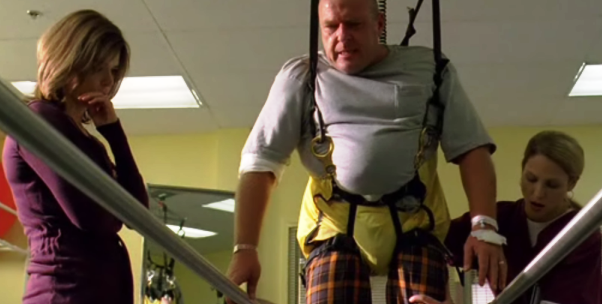
So much more to say. Who knows when I will get them posted? As I posted on Facebook, odds are this is psychosomatic or coincidental, but my M.S. symptoms have spread to parts of my body they had avoided before since Breaking Bad ended. Perhaps sheer force of will held them at bay until I saw the series until its conclusion. I haven't written all I planned to yet, but this makes for a good stopping point for Part II.
Tweet
Labels: Breaking Bad, Curb Your Enthusiasm, David Chase, Larry David, South Park, The Simpsons, The Sopranos, TV Tribute
TO READ ON, CLICK HERE


Saturday, June 02, 2012
Kathryn Joosten (1939-2012)

After an 11-year battle against lung cancer, character actress Kathryn Joosten died Saturday at 72. Joosten became one of the most recognizable faces on television following her two-season role as the president's secretary, Mrs. Landingham, on The West Wing. Eventually, she won two of her three Emmy nominations as guest actress in a comedy for her recurring role on Desperate Housewives. The amount of work and identification she garnered truly was remarkable given that she didn't pursue acting until she was 42 and didn't arrive in Hollywood until 1983 and did so without an agent.

Joosten relocated to the West Coast from Illinois where she worked with the acclaimed Steppenwolf Theatre Company. Her first television appearance came on the short-lived cop drama Lady Blue in 1985. The shows she landed small roles on in the early days of her career included Family Matters, Picket Fences, Chicago Hope, Grace Under Fire, 3rd Rock From the Sun, ER, Roseanne, Murphy Brown, Seinfeld, Frasier, NYPD Blue, Just Shoot Me, The Nanny, Tracey Takes On, Home Improvement, Buffy the Vampire Slayer, Becker, Ally McBeal, Spin City, The X-Files and a recurring role on Dharma and Greg. Then she landed Mrs. Landingham on The West Wing and if her name wasn't immediately a household one, her face certainly was. Unfortunately, it was soon after Mrs. Landingham reached her untimely end in a car accident at 10th and Potommac, Joosten received her cancer diagnosis. If anything, that increased her workload instead of lightening it. She did a few episodes of General Hospital then she began popping up all over prime time in series such as Judging Amy, The Drew Carey Show, Charmed, The King of Queens, Curb Your Enthusiasm, Will & Grace, Gilmore Girls, Grey's Anatomy, Malcolm in the Middle, The Closer, Monk, The Mentalist and a recurring role on Joan of Arcardia as "Old Lady God."

Two of my favorite Joosten appearances came in NBC comedies. The first, in the first season Scrubs episode "My Old Lady" as Mrs. Tanner, J.D.'s patient with the failing kidneys who chooses death over dialysis and whom Dorian (Zach Braff) tries to talk out of her decision only she ends up having to comfort him. She even appeared two more times, once when J.D. envisioned patients who died and wondered if any of the deaths were his fault, and in the show's finale as one of the many past character and guest stars who appear in the hallway to bid farewell to J.D. as he leaves Sacred Heart for the last time. The other series was an episode of My Name Is Earl when Earl makes it up to a former friend who went to jail for a crime he committed. Earl thinks his list item has been completed but the friend's mother (Joosten) knocks Earl out, demanding the years with her son back that Earl stole from her. I never watched Desperate Housewives, so I can't attest to her work there, but given all the other examples I've seen, I'm certain she delivered stellar work. Be it comedy or drama, Joosten demonstrated a modern example of the kind of old-style pro that you could plug into any character situation and end up with a better result.
RIP Ms. Joosten.
Tweet
Labels: Awards, Curb Your Enthusiasm, Obituary, Seinfeld, Television, Theater
TO READ ON, CLICK HERE
Monday, May 21, 2012
"Tests take time. Treatment's quicker."

By Edward Copeland
Sigh…if only Gregory House were my doctor. I think we'd get along well. We're actually very much alike, minus the Vicodin addiction, but I am willing to learn. (In truth, most every pill and patch I've been prescribed over the years to deal with my various pains, anything that works on the excruciating torture my nonworking legs inflict on me I eventually build up a tolerance t0, so I've wondered why that hasn't happened to House at some point. As you all know, very shortly (about 90 minutes), we'll be getting our last new visit with him. First, an hour-long retrospective then the last episode titled "Everybody Dies," a play on one of his favorite truisms "Everybody lies." I haven't seen it. I've heard rumors that many former cast members will pop up somehow, perhaps even Kal Penn as the late Dr. Kutner.

I didn't watch House, M.D. from the beginning. (Does anyone really use the M.D. in the title? We know what show we're talking about.) In fact, I became addicted to the show, or more accurately Hugh Laurie's character, while stuck in two hospitals for a total of three-and-a-half-months in 2008 when USA seemed to show House marathons most days and at least one day of the weekend. I didn't get to see the show in order so it took a long time before I ever saw the episode that even explained what happened to his leg. Whenever anyone describes Gregory House as a jerk, I feel like Larry David does on Curb Your Enthusiasm whenever anyone tells him that the George character on Seinfeld was a loser and Larry gets all defensive. At least when it comes to how he treats the medical side of things, he's being a jerk for the right reasons. As I lay in my hospital bed watching him defy the Princeton-Plainsboro's evil new corporate owner Edward Vogler (Chi McBride) while I endured the cost-cutting tactics of real-life hospital administrators for whom patient care ranks low on their priority list, how could I not cheer House? If only more doctors valued their patients above their portfolios the way Gregory House does.
Admittedly, House the show hasn't lived up to the quality of its early seasons for quite some time, but I've stayed with it because of Laurie. He's created a character too great not to watch. It isn't the same as it was with Homicide: Life on the Street, a series I watched past its prime solely because of Andre Braugher's Frank Pembleton. However, when Braugher decided to leave the show, I followed him right out the door. If Laurie left House, no conceivable scenario would allow the show to carry on without him — especially since, as of a couple weeks ago, Omar Epps' Foreman and Robert Sean Leonard's Wilson serve as the only other original cast members standing.

I wanted to write a bigger advance piece before the finale aired but, as you can tell, I ran out of time. Hopefully, after I see how it ends I can comment on the ending itself as well as talking a bit more in detail about the show as a whole and picking my favorite episodes. Until then, a fun YouTube package I found that built a montage of some of the best House clinic moments.
Tweet
Labels: Braugher, Curb Your Enthusiasm, Homicide, House, Larry David, Seinfeld, Television
TO READ ON, CLICK HERE
Tuesday, April 10, 2012
Untold Stories of Robert Altman's The Player or Who the Hell is Thereza Ellis?

"When you really get down to who made the difference, who made this thing better instead of just ordinary, I don't think we'll ever find out." — Robert Altman on collaboration in making The Player on its DVD commentary
By Edward Copeland
Not everyone does great commentary tracks for DVDs (or laserdiscs or Blu-rays), but one man you could depend on to provide candid and informative listening experiences was the late great and much-missed Robert Altman. When it came to The Player, Altman either did the exercise twice or the version on the DVD of The Player was edited down to allow room for the comments of producer/screenwriter Michael Tolkin, who also wrote the novel upon which the film was based. I know I recall things from the long-gone Criterion laserdisc edition, I just can't be certain if the DVD commentary contains Altman anecdotes that weren't there before. Damn these ever-changing formats. Ironically, The Player DVD, now a New Line Platinum Series edition, recalls those Paleozoic days of laserdisc players: You have to flip the disc to access the special features. I knew going into the tribute to the 20th anniversary of The Player, that one post wouldn't do, that's why I set aside this one for those extra details about the film.
One instance that I know for certain Altman mentioned on the Criterion laserdisc that can't be found anywhere on the New Line DVD concerns the screenwriter that stalks studio executive Griffin Mill (Tim Robbins) — even after Mill unintentionally kills the wrong writer, David Kahane (Vincent D'Onofrio), that he believes to be responsible. I remember at the time when I heard it on the laserdisc, it provided another laugh because unless you happened to be a voice recognition expert with a tremendous memory, you likely wouldn't have gleaned
 this from the movie itself. Kahane's failed screenwriter buddy Phil (Brian Brophy) eulogizes his dead friend at a graveside service and turns it into a tirade about Hollywood, which he pronounces guilty of "assault with intent to kill" though he blames society for Kahane's actual murder. "And the next time we sell a million dollar script and nail some shitbag producer, we'll say that's another one for David Kahane." At the end of the film, as Griffin drives home, fellow exec Larry Levy (Peter Gallagher) tells him he just has to hear this movie pitch. Another voice gets on the speakerphone and reminds Griffin that he used to be in the postcard business. He then pitches the events in Griffin's life (and the movie you've just watched to him) and it's Brian Brophy's voice again as Phil, though the name Phil never comes up. Without Altman mentioning it on that Criterion laserdisc, I wouldn't know that. Since it's not on New Line's version, fewer people will. During Tolkin's portion of the commentary on the New Line DVD, he regrets that "Altman lost the sense of the writer and the police stalking Griffin. You really lost the sense of the writer stalking Griffin. I tried to maintain that in the script, but Altman lost it completely. I think that's a loss because it takes away something that was right about the book." While I agree in the sense that you'd never get that connection on your own, Altman never drops either strand completely. Griffin still gets postcards while attending the benefit dinner and the Lyle Lovett character literally stalks him and you don't know immediately that he's a police detective and the investigation keeps coming back right until the final scene where the witness bungles the lineup and clears him.
While The Player remains as good as it ever was, perhaps deeper even than I remember, watching the non-Criterion DVD of it made me mournful for the laserdisc collection I once owned. Sure, it could be a pain to have to get up a turn a disc over every half-hour or hour in the middle of a movie and purchase prices ran obscenely high, but when DVD came around, studios didn't let Criterion keep all the titles it had on laserdisc. Laserdisc players also had a function that DVD players don't (not having a Blu-ray, I can't speak for that device). Criterion has been able to release another Altman film, Short Cuts on DVD, but it lacks a feature that the laserdisc had that made for interesting viewing experiments. Since you could program the chapters you wanted to play on the laserdisc player, the Criterion Short Cuts laserdisc listed which chapter numbers went with which Raymond Carver story so you could set the machine up to watch a single one straight through. It also included a section of reviews of the film that you could read, including one by a young critic out of Dallas named Matt Zoller Seitz. This didn't just apply to Altman's films either. The Criterion laserdiscs for Martin Scorsese's Taxi Driver and Raging Bull both contained superior extras and full Scorsese commentaries. I don't think any of the zillion DVD and Blu-ray versions of Casablanca have yet included the fun Criterion laserdisc treasure of the story treatment for Brazzaville, the proposed sequel.

The major weakness of the New Line DVD of The Player versus the Criterion laserdisc (RIP) resides with their guides to the film's numerous cameo appearances. First, the New Line DVD omits some names listed on the Criterion laserdisc while it includes names that could have been on Criterion's but I have no clue concerning their identities now so they might have been on the laserdisc and I didn't know them almost two decades ago either. Of course, if you attempt to find the answer online, ha! The Inaccurate Movie Database contains a list of people playing themselves that matches neither list, including Patrick Swayze who filmed a cameo but was cut and appears in deleted scenes on both the DVD and the laserdisc alongside David Brown, Seymour Cassel, John Considine, Tim Curry, Joe Dallesandro, Jeff Daniels, Richard Edson, Franco Nero, Martha Plimpton and Lori Singer. Wikipedia provides a list as well, but it doesn't correspond with any of the three lists we have going so far. I decided that the only fair way to count the cameos is to go by the credits on the film itself — those listed as playing themselves. However, the movie actually sort of screws us on that one too because it counts Annie Ross (who plays the boozy torch singer in Short Cuts) as a cameo though when she appears in the opening unbroken shot, she's clearly playing the part of a studio executive discussing the studio's situation with fictional exec Frank Murphy, played by Frank Barhydt, co-screenwriter of Altman's Quintet, HealtH, Short Cuts and Kansas City and an actor in Tanner '88. Altman even says on the commentary that Ross plays an executive, yet the movie's credits call her a cameo. Using that logic,
 every single person in the film makes a cameo. Admittedly, my memory could be fuzzy on the mechanics of the cameo guide on the laserdisc, but it seemed to me that if you clicked on a name, it took you directly to the scene and pointed them out somehow, since some of the cameos can be particularly difficult to find. On the New Line version, good luck. You click on the name and it takes you to the scene, but just lets the sequence run. Trying to locate the late Brad Davis would become the DVD equivalent of Where's Waldo? — if New Line had remembered to include him as Criterion and the credits did. Lord help you when you get to the Habeas Corpus climax (the film-within-a-film) trying to sort out the guards. Don't blink or you'll miss Dennis Franz's mustache. In the spirit of helping, I'm going to try to guide readers to the film's officially sanctioned cameos where I can. I've taken care of Annie Ross (though I don't think she should count) so let's try to take care of the other 64 guest appearances. Before I delve into the cameo genealogy, I thought I'd share other details from the DVD commentary.
One piece of information I don't remember hearing or reading about Robert Altman and The Player (unless my steel-trap memory finally shows signs of metal fatigue following decades of overloading it) concerns how Altman became involved in the first place. Altman and co-writer Frank Barhydt had completed the screenplay for Short Cuts, Altman's planned movie that would interweave several tales based on short stories by the great Raymond Carver, but financing for the film remained elusive. In a video interview on the reverse side of the
 New Line DVD, Altman admits that some of the pointed barbs aimed at anxious writers and directors in The Player applied to him. "You can't do a satire unless it's mostly about yourself, unless you recognize all those things that you hate in yourself," Altman says. "When I was trying to sell Short Cuts, I sounded very much like one of those guys pitching. 'This is very much like Nashville but you've got to think it's more like blah blah blah.'" As Altman waited for money to come his way, someone showed him Tolkin's screenplay for The Player and offered Altman the chance to direct the movie — and Altman grabbed the job. The director's casting for Short Cuts largely had been completed so that explains why so many of that film's performers also appear in The Player. He'd hired Robbins for the other movie first before the character of Griffin Mill entered both of their lives. He'd locked in Annie Ross as well. Altman also had settled on singer-songwriter Lyle Lovett, an acting novice, to play the baker in Short Cuts' take on Carver's story "A Small, Good Thing." In order to give Lovett some on-the-job-training ahead of that film's shoot, Altman created the character of Detective DeLongpre for him. Altman also claims on the commentary track that Vincent D'Onofrio already had secured a part in Short Cuts before selecting him to be doomed writer David Kahane in The Player, but I find no evidence to back that up though I know Altman cut at least one story from Short Cuts.
In a film such as The Player filled with so many memorable scenes, one of its standouts exemplifies the brilliance that could result when Robert Altman's preferred way of working came together and flourished. It involved chance, luck, casting and the director's willingness to let his actors collaborate. Altman received a phone call from Whoopi Goldberg, begging to be in the movie. At the time, Altman didn't see any roles for her and told her she could appear as herself but Goldberg thought differently, She wanted to play Susan Avery, the Pasadena police detective who suspects Griffin of murder. Altman originally sought Joan Cusack for the role, but the actress was unavailable so Goldberg got the part. The film ran into a problem when everyone realized it lacked a scene where a completely paranoid Griffin had to travel to the Pasadena police station where the detectives toy with him. They had a set, but not a scene. Goldberg, Robbins and the other actors spent a day bouncing ideas off each other and then came up with this gem involving a fly swatter, off-color personal jokes, cracks about Rodney King, the infamous tampon talk and use as a prop and discussion of the horror classic Freaks. On the DVD commentary, Altman says that in reality, you could say that Goldberg wrote and directed this scene, showed in the YouTube clip below.
We're almost ready to leap into the cameo appearance search, but first I thought we'd stop for a good chuckle. A really good chuckle. I realize that the YouTube clip of the Pasadena police station scene provided quite a few, but this starts with the film and then gets its big
 laugh from the real world, which once again proves how truly clueless it can be. As you know, since we're celebrating The Player today, the movie got its release on April 10, 1992. The main character works at a fictional yet unnamed Hollywood movie studio. During filming, director Robert Altman asked his son Stephen, who served as the film's production designer, to try to come up with a slogan for the studio, preferably something as dumb and banal as he could. Stephen Altman came through, branding Griffin Mill's studio with the meaningless phrase "Movies — now more than ever!" Needless to say, he pleased his father, who admits on the DVD that The Player "has more contrivance in it than probably any film I've ever made." Now comes the funny part. Leap forward four years in the future to 1996. It's a presidential election year. NBC News, looking to rebrand itself and apparently having never seen The Player, chooses the slogan — yes, you guessed it — NBC News Now More Than Ever. We're not done. This slogan isn't new either. Click here to see who used that same slogan for a political campaign in 1972. I wouldn't put it past Altman for having known the connection and liking the link, but what the hell was NBC News' excuse, especially in a presidential campaign year?
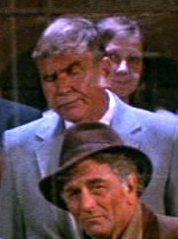
First, some sympathy for poor Guy Remsen. "Who is Guy Remsen?" you might ask. His late older brother was the Altman regular repertory player Bert Remsen (I know — Bert Remsen probably isn't ringing bells for many of you either. How about Jack Riley? If the name doesn't cut, his face would or perhaps the name of his most famous character — Mr. Carlin on The Bob Newhart Show. When they get to end and show the climax of the movie within The Player, Habeas Corpus, all three actors make cameo appearances. If you read closely (here's one helpful item the DVD players have that laserdisc players didn't: zooms), you see that in Habeas Corpus, Riley plays "Hap" Harlow, one of the reporters covering the execution; Bert Remsen's name gets listed as executioner, since he's the guard who starts the gas pellets dropping into the chamber; and Guy Remsen portrays The Attorney General. On both the Criterion laserdisc version and the New Line DVD version, they managed to misidentify Guy Remsen in their respective cameo guides. In the Criterion, they just got the Remsen brothers confused. Bad, but I guess we could call that an understandable mistake. In the New Line edition, somehow they swapped Guy Remsen and Jack Riley. So I've included photos of all three to avoid confusion. Bert Remsen throws open the blinds, Guy Remsen stands behind Peter Falk (who has the role of Harry Levin in
 Habeas Corpus) and Jack Riley takes notes at the very edge of the chamber window (if the full picture were there, you would see Susan Sarandon to Riley's left in the part of another reporter, Ellen Walsh. I suppose this serves as good as a place as any to point out the three credited cameos I couldn't locate (for certain). The first actor I know very well. He's Richard Anderson, a character since the 1940s whose best-known role probably would be Oscar Goldman on both The Six-Million Dollar Man and The Bionic Woman. Where Anderson has hidden in The Player remains a mystery to me. He's not on the New Line DVD and I don't recall him on the Criterion laserdisc either. The mystery actress, whom I couldn't even find a photo for to try to search out her location, is named Maxine John-James. The Inaccurate Movie Database lists three features and one episode of the television series Acapulco H.E.A.T. Personally, I must track down her dual role in the 1997 film Pterodactyl Woman from Beverly Hills. The third incognito cameo belongs to an actress named Jennifer Nash. Unlike Ms. John-James, she cites an extensive list of credits, mostly on television, and photographic proof of her existence can be obtained. In The Player, I couldn't find her unless that's her holding a dog and accompanying Malcolm McDowell in the lobby of The St. James Club. However, no matter how I tried to play with her image, I never succeeded in making it discernible enough to match against other photos of Nash.
Since they count Ross and she appears in the opening eight-minute shot, I'm going to attempt to get through the remainder of the cameos in the order that they appear in the film. Writer-director Adam Simon steps up first, pitching to Griffin as soon as Mill gets out of his Range Rover at the unnamed studio. Griffin pushes Simon off on his D-Girl (and girlfriend) Bonnie Sherow (Cynthia Stevenson) while he has his secretary Jan (Angela Hall) call security to figure out who let Simon on the lot. His first official pitch comes from Buck Henry who tries to sell him the idea of a sequel to The Graduate. Henry reappears later at a benefit dinner for the Los Angeles County Museum of Art's film program. Griffin meets next with two women screenwriters: Patricia Resnick and Joan Tewksbury. Resnick co-wrote Altman's A Wedding and Quintet. Tewksbury wrote Altman's Nashville and co-wrote Thieves Like Us. Alan Rudolph throws out the final pitch of the unbroken shot (after first being mistaken as Martin Scorsese by Jimmy the bike messenger, played by Paul Hewitt) and serves as the segment's final cameo. The writer-director's long relationship Altman includes Altman producing five of the feature films that Rudolph directed. On the DVD, Altman says, "I'm as interested in getting Alan Rudolph's new films going as I am my own."

Most of the film's cameos occur in group situations. I hadn't thought of this before but, in its own way, it mirrors the various settings that keep uniting all the characters in Altman's Nashville, which I still consider his greatest work. Only in The Player, the same characters do not cross paths but instead enter a location stocked with a new group of celebrities. This scene even gets a nice aural to visual segue. Griffin hovers over Claire (Dina Merrill), the studio president's powerful all-knowing executive secretary, trying to learn what she knows about rival movie executive Larry Levy. Claire ducks his queries long enough until the phone rings and she tells whoever is on the line, "No, we
 couldn't sign Anjelica Huston for that. She's booked for two years." Her utterance cuts immediately to Huston's face eating lunch on the patio of an outside restaurant with John Cusack and Levy. Soon, we see Griffin walking up the path to the restaurant where he bumps into Joel Grey on the steps. Mill introduces himself and says he knows his daughter Jennifer and is a big fan. Grey notes that the two have similar ties and moves on. Griffin joins the large table across Levy, Cusack and Huston where Bonnie and others who work at the studio await (including Jeremy Piven, who has a small role in the film). At a table for two next to the studio contingent's large round table sits Martin Mull. The remaining cameo in this scene happens to be the hardest to spot as well as the saddest. Actor Brad Davis, best known for the lead role in Midnight Express, eats at a table on the patio on the other side of the eatery's entryway. You don't get a good look at him, but what you can see gives an indication of his illness. Davis was dying of AIDS and succumbed on Sept. 8, 1991, seven months before the movie's release. I've cropped a larger frame so you can see where he sat and then enlarged Davis from that screenshot to give you an idea.
The mixture of celebrities mingling at the pool party of Griffin's attorney, noted entertainment lawyer Dick Mellon (Sydney Pollack), proves quite eclectic, to say the least. When Griffin and Bonnie arrive at Dick's place, they first encounter Marlee Matlin and Bonnie — through Matlin's interpreter — discusses a script that she read and thinks would be great for Matlin. Dick spots Griffin's arrival and excuses himself
 from a conversation with Harry Belafonte and his daughter Shari concerning network news figures. Griffin and Mellon's conversation offered more evidence that Pollack might be a better actor than director, this time playing it straight. Griffin starts to tell Mellon about the threatening postcards when his white whale — Larry Levy — crashes the party, arriving as a guest of Jeff Goldblum. Mill complains to Dick that Levy keeps getting in his face. "He's a comer. That's what comers do — they get in
 your face. You're a comer, too. You can handle it," Mellon reassures him. "So, the rumors are true," Griffin replies. "Rumors are always true. You know that," Mellon tells him. "I'm always the last to hear about them," Griffin sighs. "No, you're always the last one to believe them," Dick corrects his client. Today, seeing Sydney Pollack play a character in a scene surrounded by celebrity cameos throws you off-kilter, the way some actors do when they appear on Curb Your Enthusiasm and it takes a few minutes to realize that they aren't playing themselves, but Pollack's role in The Player was the director's first acting job since 1982's Tootsie. Later in 1992, he took another part, this time in Woody Allen's Husbands and Wives, but Pollack didn't start acting regularly until 1998. In fact, in that final decade of his life (he died in 2008), Pollack only directed two films and mostly acted and produced. Pollack's relative anonymity to audiences in 1992 prompted Altman to cast him in the first place, though Altman originally pursued director Blake Edwards for the part of Dick Mellon. In addition to those named so far and the two couples and Sally Kellerman (who appears again later at a gala benefit) pictured in the photograph above, the remaining attendees included Kathy Ireland, Jill St. John and Robert Wagner and last, but certainly not least, Rod Steiger, saying not a word as he holds a plate of food and stares at what appears to be a vertical fish tank, though it might just be bubbling water as I see no fish.
Our next stop on the virtual bus tour of Player cameos takes us another patio restaurant, this time for breakfast the next morning. Larry Levy just completed his meeting with studio head Joel Levison (Brion James), who can be spotted eating alone near the railing between the foreground figures of Burt Reynolds and entertainment columnist and critic Charles Champlin. Altman says he cast James as the studio head specifically because he'd been typecast as a villain in so many films such as Blade Runner, Tango & Cash and Another 48 Hrs. While looking over Brion James' filmography, I may have solved part of the Maxine John-James cameo mystery. Brion James also appeared in
 Pterodactyl Woman from Beverly Hills and served as an associate producer of this Troma release. Looking further, Brion and Maxine John-James were married at the time of The Player. I still can't find a photo of her, but there you go. Levy makes a point of apologizing to Reynolds on the way out, hoping there are no hard feelings over some incident that Reynolds apparently doesn't recall since he has to ask Champlin who Levy was. Reynolds' cameo turns out to be one of the funniest once Griffin drops by. He remembers him. After Mill exits, Reynolds mutters to Champlin, "Asshole." The columnist responds, "One of a breed" which launches Reynolds into a monologue that we only hear the start of before they cut away. "No, actually they are a breed, In fact, they're breeding them" Reynolds begins but the sound fades out as we move to Levison's table. Reynolds' bit scored because, like all who appeared for Altman (accepting scale payment or no payment at all), they had no scripted dialogue. In Altman's way of thinking, if the celebrities show up to play themselves, he couldn't very well tell them what they would do in real life. As a result, every line or use of prop by a cameo artist came from that person. They also could choose to say nothing at all, but Altman and his editor Geraldine Peroni got to pick the best ones to use. (Peroni received the film's third Oscar nomination along with Altman's direction and Tolkin's adapted screenplay.) When Griffin threatens to quit over Levy coming to the studio, Levison tells him that he's under contract and he'd sue. Then, the third cameo becomes easier to see as Cathy Lee Crosby sits right behind him. In the wide picture above, Crosby appears as the blonde across from Levison.

That night, Griffin had his fatal encounter with David Kahane in Pasadena, but first the two went to a Japanese karaoke bar where actor Brian Tochi, perhaps best known as Takashi in Revenge of the Nerds or as the voice of Leonardo in the live-action Teenage Mutant Ninja Turtles movies, performed. The next day at work, Griffin and others watched the dailies from a noirish detective film called The Lonely Room starring Scott Glenn and Lily Tomlin. The purposeful flubs induce enough laughs, but the deleted scenes comes off as being even funnier as Tomlin complains about having to smoke so much when she doesn't and expresses concern about the message being sent. Then, in another cut take, Glenn asks that someone make sure that he gets his per diem when the day's shooting ends. Tomlin whines that she gets penalized because she lives in Los Angeles while Glenn lives in another state, flies in and stays at the Chateau Marmont and receives extra pay for it.

Now comes the moment we've been waiting for since the headline of this post: Who the hell is Thereza Ellis? Thanks to the New Line cameo guide, I know what she looks like and where she appears, but that answers no questions whatsoever. It's later that night when Griffin's stalker,
 who has surprised Griffin by not being dead, had told him to meet him alone at The St. James Club. In the hotel lobby, Griffin first encounters Malcolm McDowell (who is accompanied by a young blonde woman with a dog that might be that Jennifer Nash. Who knows?) McDowell smiles as he shakes Mill's hand and then tells the studio executive, "The next time you want to badmouth me, have the courage to do it to my face. You guys are all the same." Griffin looks stunned as the actor leaves (though he'll pop up again at that gala benefit). In a lounge area, Andie MacDowell has been cornered by the film's two most over-the-top characters: screenwriter Tom Oakley (Richard E. Grant) and Andy Civella (Dean Stockwell). Geena Davis originally was going to do this cameo, but some emergency happened so MacDowell flew in from her home in Montana at the last minute to pitch hit. That makes the conversation all the funnier since Oakley and Civella are trying to convince the actress the Montana always ends up being bad luck for people in the movie business, citing as their only evidence Michael Cimino's Heaven's Gate. When the hyper pair spot Griffin, they start trying to pitch a movie idea at him and MacDowell takes the opportunity to escape, being led off by *(drumroll please)* THEREZA ELLIS. My search for information on Ellis has taken me to the far corners of the World Wide Web but the only sign that seems to point to the existence of a Thereza Ellis comes from universal agreement that she played herself in The Player. I could find no other credits, no other photographs, no other lines of work. Someone must track down Andie MacDowell. She could be the only person who knows the truth!
 When the studio holds a black-and-white gala benefit for the Los Angeles County Museum of Art, the scene overflows with cameos both famous and curious. Buck Henry, Sally Kellerman and Malcolm McDowell put in repeat appearances, though the first cameo exists only as a voice as Leeza Gibbons narrates the arrivals at the event for Entertainment Tonight. Griffin uses the occasion to take the late David Kahane's girlfriend June Gudmundsdottir (Greta Scacchi) out on their first public date after having sent Bonnie to New York to check out the new Tom Wolfe novel. Mostly, it's a sea of face in quick glances with the exception of Cher, who comes wearing red at Altman's behest. Later, he learned that Cher never wears red. The remaining attendees in alphabetical order: Karen Black, Gary Busey, James Coburn, Kasia Figura (who apparently has a huge career in Europe), Teri Garr, Elliott Gould, Sally Kirkland, Nick Nolte, Alexandra Powers (who appears to have been stuck sitting next to Fred Ward's Walter Stuckle), Mimi Rogers and Marvin Young, known better by his recording name Young MC of "Bust a Move" fame. Finally, we come to cameo payoff — the star-studded cast of the movie-within-the-movie Habeas Corpus. I already named some earlier, but I'll point them out again as art alone places these actors in order.


ABOVE LEFT: Guard No. 6 (Michael Bowen) stands in the hallway leading to the gas chamber in Habeas Corpus. ABOVE RIGHT: Reporters and other witnesses await the execution in the viewing room outside the gas chamber. (Front row, left to right) Reporters "Hap" Harlow (Jack Riley), Ellen Walsh (Susan Sarandon) and Harry Levin (Peter Falk) take notes for their stories. Standing directly behind Levin wearing a gray suit is The Attorney General (Guy Remsen). BELOW LEFT: Warden Lowe (Paul Dooley) appears at the witness window and taps his watch, indicating the execution should proceed. BELOW RIGHT: Following the warden's orders, Guard No. 3 (Robert Carradine, left) and Guard No. 4 (Steve James) head toward the cell to retrieve the condemned prisoner.
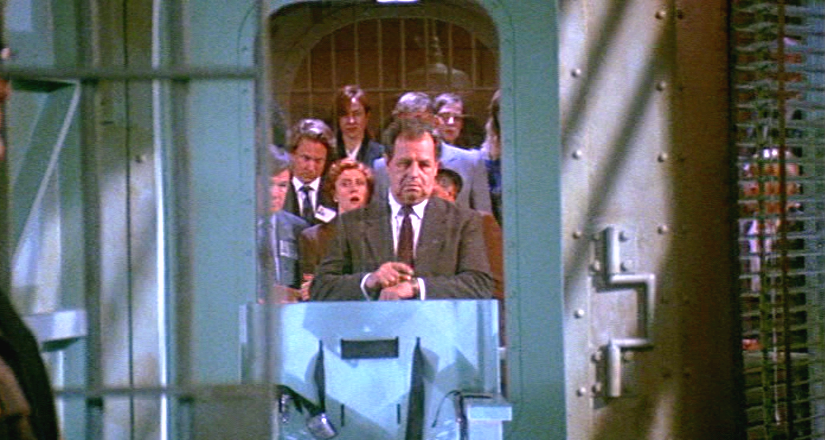


ABOVE LEFT: Condemned murderer Marsha Kent (Julia Roberts) sits on her cot listening to Father Pratt (Ray Walston) read from The Bible. Matron Cole (Louise Fletcher) stands speaking with Dr. Besh (Rene Auberjonois) by the cell door. Marsha gets removed and taken to the gas chamber where they strap her in the chair and drop the gas pellets. (not pictured) ABOVE RIGHT: Assistant D.A. Dave Williams (Bruce Willis) bursts into the unit preparing to execute Marsha, the woman he convicted for murdering her husband and whom he loves, upon learning that Marsha's husband faked his death. Williams passes Guard No. 4 (David Alan Grier) on his way. BELOW LEFT: Williams (Bruce Willis) grabs a shotgun from Guard No. 1 (Dennis Franz). Williams blasts the glass of the gas chamber, releasing fumes everywhere.(not pictured) BELOW RIGHT: Williams (Bruce Willis) carries Marsha (Julia Roberts) to safety while inside the gas chamber (from left to right) Guard No. 4 (Steve James), the Executioner (Bert Remsen) and Guard No. 3 (Robert Carradine) shield their faces from the fumes.


Tweet
Labels: A. Huston, Altman, Blake Edwards, Burt Reynolds, Curb Your Enthusiasm, Dean Stockwell, Fiction, Geena Davis, Lily Tomlin, Malcolm McDowell, Oscars, Scorsese, Sydney Pollack, Tim Robbins, Woody
TO READ ON, CLICK HERE
Friday, January 27, 2012
I'd rather be lucky than smart

By Edward Copeland
More than two years after it was announced that Michael Mann would direct the pilot for a possible new HBO series written by Deadwood mastermind David Milch and starring two-time Oscar winner Dustin Hoffman (Kramer Vs. Kramer, Rain Man) and three-time Oscar
 nominee Nick Nolte (The Prince of Tides, Affliction, Warrior), that series — Luck — makes its official debut Sunday on HBO at 9 p.m. EST/PST, 8 p.m. CST. The premiere episode of Luck's nine-episode inaugural season actually debuted in December following the second season finale of Boardwalk Empire. Mann and Milch both serve as two of the series’ executive producers and Hoffman bears the title of producer as well. Thanks to my good friends of HBO, I've seen all nine episodes of Luck and will be able to post full-fledged recaps the moment each episode has finished airing. For now, I offer this brief, spoiler-free preview of the series that I've found to be a nice addition to the HBO family of dramas. Having that unmistakable rhythm of Milchian language resonating in my ears again certainly pleases me. On top of that, Luck captures the excitement of horse racing, particularly in a Mann-directed/Milch-written sequence in the premiere, like nothing I've seen before. As someone who enjoyed going to the track (even being clueless as far as handicapping horses goes), watching Luck made me miss being able to go. With only its brief run of nine episodes as a barometer, the show's forecast looks good with its future chance at greatness hovering around 75%. Luck isn't there yet. It's no Deadwood — but few things are. More importantly, it's no John From Cincinnati either. As I write this, the first two episodes are the only installments I've watched more than once but, unless I missed others, viewers will get through all nine episodes with only two utterances of cocksucker.
What makes that racing sequence in the Luck premiere mimic the experience of a real race parallels the premise of this new drama. The race gets shown from the various perspectives of those involved in horse racing and Luck tells those sides outside of race scenes as well. Its large cast encompasses owners, trainers, jockeys at different points in their careers, jockeys' agents, track veterinarians and the serious gamblers — and those just include regulars. The world David Milch has created also will cross paths with other track officials and employees. In their own ways, the horses develop distinct personalities as well. While scenes occur away from the fictionalized Santa Anita Park that serves as the focal point of the series, all stories lead back there in some way. As for that race sequence, much of the credit for it has to fall to Michael Mann's direction and the editing team of Michael Brown, Hank Corwin and Kelley Dixon. The cutting of that race should earn the pilot next year's Emmy in that category now.
Mann steered two of the '80s most influential crime dramas to the airwaves — Miami Vice and Crime Story — though he hasn't produced for television since the short-lived Robbery Homicide Division in the 2002-2003 season and he last directed for TV when he helmed the 1989 telefilm L.A. Takedown. It's not that Mann has been loafing — he's directed and/or produced several feature films including Heat, The Insider, Ali, The Aviator and Hancock. The Insider brought Mann three Oscar nominations for producing, directing and co-writing the film. He also was nominated for producing The Aviator.
Milch created Luck, which marks his first new work to air since John From Cincinnati. He wrote a pilot for a series called Last of the Ninth in 2009, but no one picked it up. Milch forever holds a place in the hearts of quality television fans as the maestro behind the prematurely ended Deadwood, whose two two-hour wrap-up movies never came to be. Milch has received an astounding 24 Emmy nominations for writing or producing for Deadwood, Hill Street Blues, Murder One and NYPD Blue. He won four Emmys, two for writing NYPD Blue episodes and one as a producer of that series when it won outstanding drama. He earned his fourth Emmy (actually his first) for writing a Hill Street Blues episode.
In addition to Mann and Milch serving as executive producers and Hoffman as producer, Luck's behind-the-scenes producing team also includes Carolyn Strauss (Game of Thrones, Treme) as executive producer; Henry J. Brochtein (The Sopranos, where he also directed) as co-executive producer; and Eric Roth (Oscar-winning screenwriter of Forrest Gump and Oscar-nominated writer of The Insider, Munich and The Curious Case of Benjamin Button) as co-executive producer.

Hoffman is the series' ostensible lead, though Luck boasts 13 regulars in its opening credits who all get screen time as well as many recurring characters. In fact, in the premiere, some of the other character get more scenes than Hoffman's character, Chester "Ace" Bernstein. We meet Bernstein first as he leaves federal prison after serving three years. The audience won't learn why Ace, a wealthy man who has spent his life operating around gambling enterprises and organized crime, ended up incarcerated in the first episode other
 than the fact he took the fall for other people. While imprisoned, he spent $2 million to buy an Irish race horse, using his faithful driver/bodyguard Gus "The Greek" Demitriou (Dennis Farina, star of Mann's Crime Story) as a front, acting as the thoroughbred's owner. One of Luck's strongest assets proves to be that chemistry between Hoffman and Farina, especially in the duo's late-night bull sessions in the hotel suite that Bernstein calls home. They board the horse, named Pint of Plain, at Santa Anita, the race track located in Arcadia, Calif., about 14 miles northeast of downtown L.A. Bernstein's motivation for picking Santa Anita turns out to have two purposes. The first figures in with long-term plans he's had to purchase the track and add casino gambling while getting even with some of his shady business associates, played by guest star Alan Rosenberg in the premiere who's joined in later episodes by Ted Levine and Sir Michael Gambon, returning to a character closer to his Thief in The Cook, the Thief, His Wife & Her Lover than Dumbledore in the Harry Potter films. The second reason resides closer to Ace's heart. Santa Anita serves as the home track for a talented and temperamental Peruvian-born trainer, Turo Escalante (John Ortiz).
In my eyes, Escalante — and Ortiz — could prove to be the breakout character and actor on Luck. Ortiz's name may not be as recognizable as Hoffman, Nolte or even Farina, but he's worked with some big name American directors since making his film debut in Brian De Palma's Carlito's Way in 1993. He also appeared in Ron Howard's Ransom, Steven Spielberg's Amistad and Ridley Scott's American Gangster. Luck's
 premiere doesn't mark Ortiz's first time being directed by Mann either — he acted in the 2006 film adaptation of Miami Vice as well as Public Enemies. Ortiz also executive produced and repeated his stage role in Philip Seymour Hoffman's directing debut, Jack Goes Boating. The play originated as an off-Broadway production by the theater troupe LAByrinth, where Ortiz served as co-artistic director. It's impressive, but if Luck succeeds,
 Turo Escalante will be the vehicle that launches Ortiz's career to the next level. Not only does Ortiz give a phenomenal performance, but Escalante, by far, shows himself to be the most fascinating part of the series as well as the character that interacts with more of the other players than anyone else, including the track's head veterinarian Jo Carter (Jill Hennessy), who turns out to be Turo's secret girlfriend. As with everything created and written by David Milch, he implies key things as much as he verbalizes them. Viewers will get the distinct impression that Escalante may be covered in infinite layers that could be peeled and examined in future seasons. In the meantime, Turo will be there, lashing out at jockeys for not following his instructions on how to run a horse during a race — even if the horse won anyway or acting as if he's a polite servant to a new horse's owner. Ortiz, as the best performers on a Milch show must know how to do, is as adept at making Escalante funny as frightening and even touching when needed.
Nick Nolte, whose stardom took flight on television in the 1976 miniseries Rich Man, Poor Man, returns to the medium for the first time since for Luck — just days after receiving his third Oscar nomination (his first as a supporting actor) in Warrior. As Walter Smith, the
 grizzled veteran horse trainer-turned-owner from Kentucky, Nolte's role on Luck plays as a supporting one as well. In fact, he's absent from one of the nine episodes. Called "The Old Man" by many at the track, Smith shares something in common with Ace
 Bernstein: the first episode plants seeds of a mystery surrounding his story. In Walter's case, it has nothing to do with a prison sentence, but questions concerning the origin of his "big horse," Gettn'up Morning, that will be resolved rather quickly though the issue will hover over Smith and Gettn'up Morning through the show's short season. Walter also has an important decision to make about the horse — picking the jockey who will ride Gettn'up Morning once he's ready. The two main contenders are his exercise girl, Irish lass Rosie Shanahan (Kerry Condon), who longs to be a jockey, and Ronnie Jenkins (real-life National Museum of Racing and Hall of Fame jockey Gary Stevens), who used to be a great but has moved into a universe of drink and drugs. Condon should be familiar to longtime viewers of HBO dramas from her role as Octavia on Rome or to moviegoers as Tolstoy's daughter in The Last Station. While acting isn't Stevens' first career, Luck isn't his first role. He played the famous 1930s and '40s jockey George Woolf (who happened to be based out of Santa Anita) in Seabiscuit.
Trying to keep Ronnie Jenkins sober and secure him the mount on Gettn'up Morning is his stuttering agent Joey Rathburn (Richard Kind) who also represents an apprentice jockey at the track, Leon Micheaux (Tom Payne), also
 known as Bug, the name given to most beginning jockeys because the asterisk by their names in racing forms resembles an insect. Joey's career as an agent isn't going well and we get hints that his personal life has crumbled into disarray as well. Leon hails from Louisiana and has problems maintaining the weight he needs to qualify for races. He also doesn't know when to keep his mouth shut — so he manages to keep pissing off Escalante, much to Joey's annoyance. Leon also has a mutual attraction with a certain red-haired girl — who may become a professional competitor down the road. Kind's a familiar face from film and television including his regular role on Spin City, his recurring role as Larry's cousin Andy on Curb Your Enthusiasm and as troubled Uncle Arthur in the Coens' great A Serious Man. Leon may be from Louisiana but Payne hails from England and most of his credits so far come from British TV. Payne's best-known work in the U.S. may be the film Miss Pettigrew Lives for a Day.
The final quartet of regulars belongs to a syndicate, but it's not the kind of syndicate that's crossing your mind. It's just the name given to a group of serious gamblers who
 pool their money so they can make bigger bets that cover more options and, hopefully, reap big benefits such as the more than $2 million payout that would go to someone lucky enough to correctly handicap the races involved in the Pick Six contest in Luck's premiere. The four men make for a colorful group, to say the least. The unofficial ringleader, Marcus Becker (Kevin Dunn), suffers from a variety of health conditions that force him to use a wheelchair and take frequent hits of oxygen from the tank attached to it. He's rude to everyone and seems as if he were born in a cranky mood. The true brain of the group belongs to Jerry Boyle (Jason Gedrick), who possesses a true gift for picking the right horses. Unfortunately, he likes to gamble all
 the time so anything he wins at the track he's liable to lose that night playing poker at a casino — and when Jerry gets tapped out, he becomes easy prey for a track security guard (Peter Appel), who works as a loan shark on the side. Marcus calls Jerry a degenerate, but the two of them have a special relationship that's almost
 like a father and son or two close brothers. The other two members of the group truly are misfits and you have to wonder how Marcus has let them hang around. The first is Renzo Calagari (Ritchie Coster), who lives on disability checks that he takes straight to the track. The newest member that Renzo has recruited is Lonnie McHinery (Ian Hart), a man who never gets the point of what's going on and has stumbled upon a bankroll supposedly from two women who are paying him to be their personal gigolo. Dunn has been a familiar face in lots of movies and TV shows since the mid-1980s. Even though he didn't have any scenes with Nolte, he also appeared in Warrior. Gedrick has appeared in a lot of television series either as a guest or in shows that didn't last long. He was the murder defendant in the first season of Murder One and one of the police officers in Boomtown, the NBC series that started out great until they mucked with its premise and destroyed it. Coster and Hart, like Payne, are Englishmen playing Americans. Name any crime procedural on TV and Coster has more than likely played a role on it. On the big screen, his films include Let Me In, The Dark Knight and American Gangster. Early in his career, Hart took on the role of John Lennon in two films in a row: The Hours and the Times and Backbeat. He's also made four films with director Neil Jordan including The End of the Affair, where Hart was especially good as a private detective with problems of his own.
Even with such a short season, Luck — already full of award winners and nominees in front of and behind the camera — attracted even more for recurring guest roles including Oscar nominees Joan Allen and Bruce Davison and Oscar winner Mercedes Ruehl. There's also guest appearances by Barry Shabaka Henley, Jurgen Prochnow and W. Earl Brown (Deadwood's Dan Dority).
When the credits roll for the first time on Luck, in case you don't recognize the song playing beneath the images and artists' names, it's a trimmed version of "Splitting the Atom" by Massive Attack. Below are the lyrics, the show uses. Click here and you can see the video on YouTube for the complete song. Every listing of the lyrics (including the captions) insists that the band sings "eternited leave." I find no evidence of such a word as "eternited" and almost changed it automatically to eternal, assuming it was a misprint but apparently songwriters Robert Del Naja and Damon Albarn invented a word for their song.
The evening it chokes, the candle, it burns
This disguise covers bitter lies
Repeating the joke, the meaning it dies
It's easy, don't let it go
Don't lose it
The bankers have bailed, the mighty retreat
The pleasure it fails at the end of the week
You take it or leave or what you receive
To what you receive is eternited leave
It's easy, don't let it go
It's easy, don't let it go
It's easy, don't let it go
Don't lose it
As readers who have followed any of my previous series recaps know, my format has evolved. The first show I covered was the great fourth season of The Wire, but I basically just regurgitated what happened with a little criticism tossed in. I didn't go crazy and learn all I could about Baltimore.
My recaps for the first seasons of Treme and Boardwalk Empire pretty much followed the same pattern until I noted historical moments on Boardwalk Empire I suspected casual viewers wouldn't get, so I added explanatory links. For the second season of Treme, I started seeking explanations to references that I didn't get and each recap became like a puzzle, adding the context of real New Orleans events, info on the music — I even began to learn the geography of that city without ever having been there. When the second season of Boardwalk Empire premiered, I beefed up those recaps as well, not only on historical points and characters but even the origins of words and phrases.
Now, I start the nine-episode run of Luck. The recaps will evolve as I write them, but I suspect that if you didn't know the ins and outs of horse racing and betting before the show premiered and parts of the series leave you in the dark, I'll do my best to help fill in those gaps as I learn as well. The first recap ended up in two parts, but that had to do with exposition I believe. I do have to say it's probably a good thing that AMC didn't think me worthy enough to receive Breaking Bad screeners or I probably would know how to make crystal meth.
Luck premieres on HBO Sunday at 9 p.m. EST/PST, 8 p.m. CST with each of the subsequent eight episodes in the nine-episode first season airing at the same time.
Tweet
Labels: Boardwalk Empire, Breaking Bad, Coens, Curb Your Enthusiasm, De Palma, Deadwood, Dustin Hoffman, Farina, Gambon, HBO, Luck, Michael Mann, Milch, Nolte, P.S. Hoffman, R. Scott, Spielberg, The Sopranos, The Wire, Treme
TO READ ON, CLICK HERE


