Friday, August 03, 2012
Edward Copeland's Top 100 of 2012 (80-61)

People like to mock Frank Capra as simple-minded at times and this film especially, but it remains a rousing indictment of corruption in Washington that echoes to this very day. It's too bad that a filibuster doesn't still mean that a senator has to do what Jefferson Smith did and hold the floor for as long as he can instead of the procedural gimmick it's turned into today that prevents legislation from moving out of the Senate. Still, whenever I catch Mr. Smith, no matter how long it has been on, I have to watch until the end. It's the curse of being both a movie buff and a political junkie. In a way, with recent events, it seems to have a bit of timeliness beneath the treacle and idealistic love of how this country should work.
When people think Ingmar Bergman, they think heavy, but here flows one of his lightest and most enjoyable concoctions. In an introduction made for the Criterion edition of the film, Bergman remarks how Smiles changed everything for him. At the time, he was broke and living off the actress Bibi Andersson when his studio entered the film at Cannes and it won a prize (best poetic humor) and became an international success. Bergman says it was a turning point for both him and his studio, earning him free rein to go on and make even more of the greatest films of all time. The film contains obvious echoes of The Rules of the Game, though Smiles more than stands on its own with its tale of love and adultery, male vanity and female cunning, aging and youth. It's not only a delight as a film but inspired the great Stephen Sondheim to write one of his earliest great scores as composer and lyricist in A Little Night Music. Isn't it rich?
The Weinstein P.R. machine spun so much press off this film's twist that I think it takes away from how great a movie had developed before that plot turn even happens. I was fortunate enough to see it early, before the hype went into overdrive, so I thought another story turn was the "twist" and relaxed and the real twist took me by complete, wonderful surprise. I hope someday new viewers will be able to see the film without knowing what lies ahead. Even if they don’t though, they will see a great study in human nature as well as great performances from Stephen Rea, Forest Whitaker, Miranda Richardson and Jaye Davidson.
While Spike Lee still has talent to spare, he has yet to come close to equaling the power of his third film and its study of one hot day in Bedford Stuy. His strongest work has flourished in his documentaries, especially his pair of post-Katrina films When the Levees Broke: A Requiem in Four Acts and If God Is Willing and Da Creek Don’t Rise and the feature Inside Man. Something tells me he’ll come back eventually. More than 20 years later, Do the Right Thing retains the power it unleashed in 1989 as that breed of film that has become rarer and rarer: the conversation starter.
The film marketed as Bergman's "last feature" truly is one of his best, painting a vast semiautobiographical canvas of two children from a large theatrical family who find their lives upended when their mother weds an authoritarian monster of a minister. Beyond the narrative, Sven Nykvist's photography, Anna Asp’s art direction, Susanne Lingheim’s sets and Marik Vos’ costumes present a sumptuous feast for the eyes. Its three-hour running time flies by and watching the 312-minute cut Bergman originally made for Swedish television proves even more rewarding.

Bogie got one of his best roles, John Huston made one of his greatest films (winning his only two Oscars for writing and directing) and his old man got a supporting actor Oscar in the deal as well. When you see Walter Huston do his mocking, triumphant little dance, you want to join in. Sierra Madre wasn’t John Huston’s only classic starring Humphrey Bogart released in 1948 either. The two also collaborated on Key Largo, While it’s good, it’s this film with its prospecting south of the border that’s the real keeper.
Here comes Howard Hawks again and Cary Grant (playing a nerd, believe it or not) as well. (I haven't added it up, but I suspect Grant appears in more movies on this list than any other actor). Katharine Hepburn's most inspired performance powers this screwiest of screwball comedies as her flighty socialite wreaks havoc on the world of Grant’s mild-mannered paleontologist. All of this and a leopard or two, too.
Salieri may consider himself the "patron saint of mediocrity," but little can be called mediocre about Forman's adaptation of Peter Shaffer's play. F. Murray Abraham and Tom Hulce were both brilliant and you can't really argue against its musical score. The unitiated might suspect slowgoing in a period costume drama such as this, but they haven't seen enough and certainly not Amadeus which overflows with humor and light as well as its darker elements.
There wouldn't be a Breakfast Club without a Virginia Woolf, but I don't hold that against Edward Albee or his great play turned into a superb movie by Mike Nichols. Elizabeth Taylor and Richard Burton were never better and while the truth games and verbal battles make you cringe, you can't avert your eyes from their power. Albee's play marks its 50th anniversary this year and it still packs a punch a half-century later.
To me, one of the crimes of both versions of the AFI list is that Psycho is the only representation of black-and-white Hitchcock, as if no one noticed him until he started working in color, but nothing is further from the truth and Notorious is one of the best examples of that. The kiss between Ingrid Bergman and Cary Grant remains one of the most sensual images ever put on celluloid and Claude Rains is superb as the conflicted heavy of the piece.

This film shouldn't work and it probably wouldn't if its stellar cast hadn't saved it. Kazan and Budd Schulberg's attempt to justify their actions during the McCarthy hearings doesn't quite work as an allegory, but the film itself works as a powerful story thanks to the indelible performances it contains. Brando earns the big kudos but the solid work of Eva Marie Saint, Rod Steiger, Karl Malden and especially Lee J. Cobb shouldn't be forgotten.
As digital projection sounds the death knell for celluloid, I feel even more grateful that when I saw Lawrence of Arabia for the first time, I saw the restored, 70mm print in a theater released for its 25th anniversary. I never could watch the cropped, pan-and-scan versions on TV. It’s a shame that more classics fail to get re-released outside major markets, but with the digital future, it’s almost moot. As for the film itself, if it weren't for the weaker second half, this movie that almost defines epic would have landed higher on this list. Still, with its stunning cinematography, gorgeous score and great Peter O'Toole performance, it belongs on the list nonetheless.
When I made my 2007 list, I admitted being torn between including 8½ or Nights of Cabiria to represent Fellini and I ended up opting for 8½. In the intervening five years, I’ve watched both films again and my preference clearly leans to Cabiria. While Giulietta Masina's remarkable performance as the title character might break your heart at times, more often than not, she'll leave you smiling, even if it's a sad smile. While Masina initially wins you over when seeing the film the first few times, on later viewings I've found the movie itself richer. It's constructed almost as a perfect circle, a ring of hell if you will, from which Cabiria would like to escape. "Everyone has a secret agony," a character tells her at one point and as much as Cabiria might try to avoid it, she hopes to abandon her life. First, she sees fun in a brief sojourn with a celebrated movie star (Amedeo Narrazi) that in a way predicts Pretty Woman some 30 years down the road, though without the manufactured happy ending. Fellini grounds Nights of Cabiria in reality, a world where the poor are forced to live in caves and anyone can be a victim. In another incident, when Cabiria realizes that once again she's been gypped, it leads to an ending that manages to be touching, magical and inspiring, all at the same time, ending with one of film's greatest close-ups.
Kirk Douglas probably was miscast, but this early Kubrick doesn't get the kudos it deserves and it certainly bears up better over the years than some of his later works such as A Clockwork Orange. Paths of Glory centers on one particular battle between the French and the German, where the poor French troops are outmanned and outgunned, but that's no excuse for disobeying orders in the eyes of one general. Kubrick often tackled the futility of war and its inherent contradictions, but he really knocked it out of the park with this one.
Of the many collaborations between Zhang Yimou and Gong Li, this one remains my favorite, even though it's less heralded than many of his others. Gong and Ge You portray a married couple and we follow their lives in a kaleidoscopic tour of Chinese history, beginning with the civil war in the 1940s and passing through The Great Leap Forward, the Cultural Revolution and a few years beyond. Epic while staying focused and personal in the telling, if you haven't seen To Live, you should. This might end up being Zhang’s masterpiece.

Another instance of the all-too-rare occurrence of a sequel that's better the film that spawned it. Whale's funny follow-up to his own Frankenstein contains most of the classic moments you probably associate with the story: the blind hermit, "She's alive!" and much more. It also adds some pure wackiness such as Ernest Thesiger’s Dr. Pretorius, with madder plans than Colin Clive’s original Dr. Frankenstein himself. We also get to hear Boris Karloff speak his first words as the monster and Elsa Lanchester play a dual role: Mary Shelley in a funny prologue setting up the sequel and as the bride herself. It’s a hoot from start to finish — and even manages to toss in a scare or two amidst the laughs.
Just as McCabe & Mrs. Miller isn't exactly a Western, it's not strictly a character study either. First and foremost, it's a Robert Altman film, one of those times when the late director got a hold of financing, cameras, actors, a crew and the things he needed for what intrigued him at that moment and did his cinematic dance, part strictly thought out, much improvised and lots that came about by happy accident. That style didn't always work throughout his long career, but when it did, magic resulted. As Pauline Kael wrote in her July 3, 1971, review of the film in The New Yorker, "Though Altman's method is a step toward a new kind of movie naturalism, the technique may seem mannered to those who are put off by the violation of custom — as if he simply didn't want to be straightforward about his storytelling.…He can't be straightforward in the old way, because he's improvising meanings and connections, trying to find his movie in the course of making it…" It took me about three viewings to warm to McCabe. Now, it stands as one of my very favorite Altman films and I can see it climbing higher in the future the more I watch it.
Even with a distance of more than a decade, I find it difficult deciding where to place newer films amid the established classics, but Memento continues to excite me more than any other new movie I saw between 1998 and 2002. The film surpasses the accusations of detractors who see it as merely a gimmick. It also manages to be both funny and heartbreaking as it spins the tale of Leonard Shelby (Guy Pearce), a man suffering from short-term memory loss that prevents him from remembering anything after a single day. Not helpful when you’re trying to solve your wife’s murder. The film that put Nolan on the map remains my favorite of his works. Pearce gives a great performance as do Joe Pantoliano and Carrie-Anne Moss. It feels as if in the wake of Nolan’s Batman films and Inception, Memento has slipped from many long-term memories. It shouldn’t be forgotten.
When I first saw de Sica's masterpiece, English speakers knew it as The Bicycle Thief. It's only been recently that we've learned the more correct English translation. I guess his film still has things to teach us today. De Sica mastered the art of making films that plucked on a viewer’s heart strings without being so sentimental that it bred resentment. Shoeshine plays like a rough draft for Bicycle Thieves and he later made the great Umberto D., but I have to opt for the simple heartbreaking beauty of Bicycle Thieves and that unforgettable final shot.
A meditation on life, the universe and everything and, for a film whose story begins with a chess game between a knight back from the Crusades and Death for the knight's life as the Black Plague spreads chaos around them, it has a bit more humor than you'd expect. The film also marked the first teaming of Bergman with Max von Sydow, who portrays the knight. It sets the stage for many of the themes Bergman would return again and again throughout his career dealing with God, faith and so much more.
Tweet
Labels: Albee, Altman, Capra, Christopher Nolan, De Sica, Fellini, Hawks, Hitchcock, Huston, Ingmar Bergman, Kazan, Kubrick, Lean, Lists, Nichols, Sondheim, Spike Lee, Whale, Zhang Yimou
TO READ ON, CLICK HERE


Edward Copeland's Top 100 of 2012 (60-41)

Perhaps the crowning achievement of the Italian neorealist movement. This story of Italians fighting back against fascism and the Nazis during World War II plays as powerful and moving today as it ever did, with a great cast led by Anna Magnani, who appears in one of the film's most memorable sequences. Despite being generally hard on the film, Manny Farber declared Open City the best film released in the U.S. in 1946 and called Magnani’s performance “the most perfect job by an actress in years and years.”
A breathtaking debut that launched a mostly great film series about Truffaut's screen alter ego, Antoine Doinel, and containing perhaps the most famous freeze frame in film history. It's not bad as a coming-of-age picture either. While The 400 Blows stands alone as the best of the Antoine Doinel films, it’s fascinating to watch Jean-Pierre Leaud play the character from an adolescent to an adult. In its own way, the film resembles the first installment of a fictional version of Michael Apted’s Up documentary series only focusing on a single character.
Pollack didn't just direct and act in this comic masterpiece, he really played tailor as well, stitching together multiple versions of its screenplay to come up with the exquisite finished garment. Dustin Hoffman's brilliant performance as perfectionist pain-in-the-ass actor Michael Dorsey and Dorothy Michaels, the female persona he creates to get work, stands as the crowning achievement of his acting career. It doesn't hurt to be surrounded by an equally solid ensemble that includes Teri Garr, Dabney Coleman, Charles Durning, George Gaynes, Doris Belack, Geena Davis and a nearly all-improvised role by Bill Murray.
Preminger’s crowning achievement could be a routine noirish mystery if it weren’t for its great ensemble of Dana Andrews, Gene Tierney, Judith Anderson, Vincent Price and, most of all, Clifton Webb delivering its wry and witty dialogue by Jay Dratler, Samuel Hoffenstein and Betty Reinhardt (with alleged uncredited contributions from Ring Lardner Jr.). A couple of examples: Price as Laura’s cad of a fiancé Shelby Carpenter declaring ,"I can afford a blemish on my character, but not on my clothes" and Webb as bitchy newspaper columnist Waldo Lydecker describing his work, "I don't use a pen. I write with a goose quill dipped in venom." Laura could be called the All About Eve of film noir mysteries.
Every time I hear that a friend or acquaintance is going to have a baby, I make the same simple request: Do everything in their power to keep all knowledge of this movie away from them until they see it. I would have loved to have seen it without knowing that the shower scene was coming or the truth about Norman Bates. I hope others can have that experience.

One of the biggest jumps of any films from the last list. When revisiting The Last Picture Show for its 40th anniversary last year after having not seen the movie in years, it truly captivated me with its stark beauty. Despite its setting in 1951 in a small Texas town, it contains a universality that resonates today both in human and economic terms. Plot doesn't drive the story — character, not only of the people but of the town itself, does. While you watch the movie, you aren't concerned with what happens next or how the film ends because you realize that life will go on for most of these fictional folks you've come to know. It's telling a coming-of-age story — several in fact — and not all concern the teen characters in the tale. It's also about love and loss, not always in the present tense.
Not only does Broadcast News hold up to repeated viewings, it holds such a special place in my heart that I almost can’t view it rationally. I overidentify with Albert Brooks’ character of Aaron Altman and I’ve known a couple of women with similarities to Holly Hunter’s Jane Craig. More importantly, James L. Brooks wrote and directed a very funny and touching valentine to the decline in television news standards and set it against an unrequited love triangle (with William Hurt’s Tom Grunick filling the third point as well as representing TV news’s deterioration). The supporting cast also aids the entertaining proceedings with the likes of Robert Prosky, Joan Cusack, Lois Chiles, Peter Hackes, Christian Clemenson and Jack Nicholson as the anchor of the network’s evening news.
Even people who view Capra as a sentimental sap tend to like this great madcap romantic romp thanks to the great chemistry of Clark Gable and Claudette Colbert. The first film to sweep the top five categories at the Oscar continues to hold up thanks in no small part to the chemistry between Gable and Colbert. Memorable scenes pile up one after another involving great character actors such as Roscoe Karns and Alan Hale Sr. Perhaps the most magical scene comes when Colbert’s Ellie asks Gable’s Peter if he's ever been in love while on opposite sides of the blanket and he momentarily gets serious, wistfully describing his ideal woman while Ellie slowly melts on the other side of the blanket. May the walls of Jericho always fall.
Here comes Hitch again with his most personal and, in many ways, disturbing film about love and obsession and the need to replace what one has lost. It also happens to be another of my great moviegoing experiences, having been able to see the 1996 restoration at the Ziegfeld Theater in New York. Robert Burks’ cinematography never came across as vividly, especially the reds in the scenes set at Ernie’s. James Stewart delivered one of his best performances as a former cop, already damaged psychologically, pushed further to the edge when he falls for a woman named Madeline (Kim Novak) that he’s been hired to follow and later when he meets her doppelganger and attempts to make her over in Madeline’s image.
As the years roll by, many find themselves less enthused by Tarantino's film. I am not among their ranks, finding that I'm as enthralled, entertained and as giddy as I was the first time I saw it whenever I see any part of it again. Similarly, my faith in Quentin remains strong as well, especially in the wake of Inglourious Basterds, which I definitely could see on a list like this once it reaches its eligibility if it holds up as well as it has so far.

Billy Wilder made so many great comedies with varying levels of pathos that it's hard to pick just one. I considered Some Like It Hot and One, Two Three, but this one remains for me his best film among the ones played primarily for laughs. In the wake of Mad Men, the film proves particularly interesting to watch (even if Roger Sterling thinks female elevator operators defy reality).
Even before the recent passing of Andy Griffith, I had decided that I had to make a spot for A Face in the Crowd on this list. As far as I’m concerned, it undoubtedly stands as Kazan’s best film and as a bit of a prescient one. Without this film, I’m not sure Paddy Chayefsky would have been inspired nearly 20 years later to write Network. Budd Schulberg deserves the bulk of the credit, adapting A Face in the Crowd from a short story he wrote called “Arkansas Traveler.” The film broke ground in its depiction of the convergence and intermingling of the media, corporate and political worlds. In addition to Griffith’s stellar performance as Lonesome Rhodes, the cast includes exemplary work from Patricia Neal, Walter Matthau and Tony Franciosa. Mike Wallace, John Cameron Swayze and Walter Winchell even make cameos as themselves. The film’s reputation should only grow.
When one of the early moments of a movie shows Edward Norton squeezed against the man breasts of a sobbing Meat Loaf, it boggles my mind how many people who saw Fight Club when it came out didn’t immediately recognize the film as a satire. Every time I’ve watched this film, I’ve loved it more than I did originally. To further emphasize its strength, the first time I saw it, I already knew the twist because of an out-of-nowhere comment by David Thomson in a completely unrelated article in The New York Times. Based on Chuck Palahniuk’s novel, Jim Uhl’s screenplay and David Fincher’s direction spin a funhouse tour of the consumer culture, self-help groups and machismo. Norton turns in a great performance as always as do Brad Pitt as the devil on his shoulder and Helena Bonham-Carter as a twisted kindred spirit.
A running gag between Wagstaff and I in recent years is that I believe Die Hard is the greatest film ever made. OK, I don't really believe that, but this is one of the best, especially as far as action goes and Alan Rickman remains one of the all-time great movie villains. In addition to having a great bad guy, what sets Die Hard apart from other action films is that its hero, John McClane (Bruce Willis) isn't superhuman. By the end of the movie, he looks as if he's been through hell.
This film doesn't get mentioned as often as it should, but its portrait of the perils of vigilante justice comes through as strongly today as I imagine it did when it was originally released. Henry Fonda and Harry Morgan try to speak for calm and rationality against the horde ready to inflict mob violence.

The time is over for the debate as to whether the Oscar this classic silent won in the Academy's first year was the equivalent of "best picture." All that needs to be said is that is a great film, Academy seal of approval or not. It remains both heartbreaking and beautiful 85 years after its debut.
The Godfather Part II may have won best picture in 1974, but for my money it wasn't even the best Coppola film that year, let alone the best picture (not that it isn't good). This simple tale of an eavesdropping expert (Gene Hackman giving one of his best, most restrained performances) experiencing sudden moral qualms remains riveting and thoughtful to this day.
Supposedly, Hitchcock often named this gem as his personal favorite of his films and it certainly remains one of his best with its dry, mordant wit and a great lead in Joseph Cotten as Uncle Charlie, worshipped by Teresa Wright as his niece Charlie. Much comic relief gets provided by Henry Travers as young Charlie's father and Hume Cronyn as his murder mystery-loving friend.
I'm not talking to you Travis, but about you, and Scorsese and Paul Schrader's dark, modern spin on The Searchers only grows more stunning as the years roll on. Robert De Niro gives one of his greatest performances and, for my money, this may remain Jodie Foster's finest work.
Jean Renoir made a lot of great films and at least two unquestionable masterpieces, including this one, yet you seldom hear his name come up unless you are talking with real cinephiles. Shameful — because his films don't belong to elite tastes: They belong to everyone. This vivid portrait of WWI prisoners of war proves that since it was the very first time the Academy bothered to nominate a foreign language film for best picture. It should have won too.
Tweet
Labels: Bogdanovich, Capra, Chayefsky, Coppola, Fincher, Hitchcock, Kazan, Lists, Murnau, Preminger, Renoir, Scorsese, Sydney Pollack, Tarantino, Truffaut, Wellman
TO READ ON, CLICK HERE
Edward Copeland's Top 100 of 2012 (40-21)

Fritz Lang made a lot of good movies, but nothing equaled this tale told in his native language. Peter Lorre made his mark as the hunted child killer in a film filled with atmosphere, suspense and thought.
Kept from the public for years after its initial release, the one plus to its exile was that I experienced this masterpiece of a political thriller — 50 years old this year — for the first time on the big screen in a crisp, black-and-white print. I hope that Jonathan Demme’s misguided idea of trying to remake this classic didn’t sour the original or scare younger viewers away from seeking out Frankenheimer’s version. The 1962 Manchurian Candidate contains many attributes that make it worth recommending, but every film lover must witness Angela Lansbury’s portrayal of Mrs. Iselin, a contender for the top 10 screen villains of all time.
My much-missed dog Leland Palmer Copeland didn’t usually watch TV, but whenever this classic came on, she was drawn to it. One time, Leland even seemed to sit on the couch and watch it from beginning to end. Maybe it was the music, maybe it was the colors. The sad side effect of Leland’s affection for this film that no one truly ever outgrows is that now that she isn’t here to watch it Dorothy and her friends with me any longer, Oz sometimes proves too painful for me to revisit.
No one gives this film the credit for its darkness that it really deserves. This isn't sappy sentimental drivel; this is about a man who feels as if he's been pissed on all his life and finally reaches the end of his rope. James Stewart's talent, Capra's gifts and the script by Frances Goodrich & Albert Hackett make George Bailey's journey plausible and touching. Only a Mr. Potter could hate this film.
Howard Hawks directed John Wayne to his second-greatest performance in this thrilling tale of a cattle drive and bitter rivalries. It also contains the perfect example of a Hawksian woman as Joanne Dru keeps talking, even with an arrow protruding from her body. I feel as if Hawks has slipped some in esteem among the old masters as far as the younger critics out there go. This master of nearly all genres seems long overdue for resurgence.

I wrote in my 2007 list that The Graduate and Bonnie and Clyde constantly swap slots for my choice as the best film of 1967 and damn if they haven’t done it again five years later. One of the many great lines in 2009’s (500) Days of Summer comes when the narrator, in describing Joseph Gordon-Levitt’s character, says that an early exposure to sad British pop music and a misreading of The Graduate led him to believe that the search for love always leads to The One. (If I’m still around to make another top 100 in 2019, I suspect you’ll find (500) Days of Summer there — after multiple viewings I believe it’s the 21st century Annie Hall.) Back to The Graduate itself, Nichols’ direction looks better with each viewing and the cast remains remarkable. It’s just that my reaction to the story itself that waxes and wanes. It’s never bad – it’s just that sometimes I find myself loving it a bit less than the last time.
The history of movies doesn’t lack for great teamings of directors and actors and the man who more or less made John Wayne an icon with the way he introduced him as The Ringo Kid in Stagecoach also directed the Duke to his best acting performance here. Wayne always worked as a good guy, but he proved his acting chops when someone inserted an element of darkness into his characters. The Searchers also has proved to be a useful template for many other films, most notably Taxi Driver and Paul Schrader’s Hardcore. Ford brought a lot of great imagery to this story and it arguably contains the greatest closing shot of his long career.
As I foretold a couple notches back when writing about The Graduate, Bonnie and Clyde holds the higher esteem in my heart in this snapshot in time. Perhaps it’s a side effect of the journey I took through Penn’s entire filmography following his death, but it’s a great film regardless. Each time I watch it again I become more convinced — harrowing moments of violence aside — this truly plays as much as a comedy as The Graduate. At the time I re-visited it, watching how the Depression-era bank robbers became folk heroes to the masses, the resonance with the destruction 21st century Wall Street bankers wreaked on our nation’s economy was easier to identify with than ever before.
In the 1927-28 contest for "Artistic Quality of Production" at the Oscars, this film faced off against Sunrise and Chang: A Drama of the Wilderness. While Sunrise won and I wouldn’t argue against its status as a superb film (It’s not that far back on this list after all), I admit to preferring Vidor's film and its tale of striving to succeed as everything in the world appears to conspire to keep you down.
There's a good reason that so many cite Robert Towne's screenplay as one of the great examples of writing for film. If only all scripts (including some of Towne’s) were this superb. It remains one of the best examples of a modern noir, filmed in color, as well as Polanski’s best work. Jack Nicholson’s Jake Gittes came in his unbelievable and unforgettable run of great 1970s performances that began with 1969’s Easy Rider. It also gives us one of the sickest screen villains in Noah Cross, played so well by John Huston. Chinatown always will live on in the pantheon of film’s with last lines so memorable even people who’ve never seen it know the words.

You know 1950 was a great year for movies released in the United States when a picture as great as All About Eve only finishes third on my list for that year (behind The Third Man and Sunset Blvd.). That takes nothing away from All About Eve though with its brittle and brilliant dialogue and multiple great performances, including Bette Davis’ best, Celeste Holm, Thelma Ritter and, most especially, George Sanders as Addison DeWitt.
Death comes in large doses in The Wild Bunch, but its violence, despite Peckinpah turning the carnage into quasi-ballet-like imagery, isn’t what makes the film so remarkable. The film delivers its true eulogy not for its human characters but for the death of an era and a way of life. As with so many of Peckinpah’s great films, too many misunderstood the film’s intent but The Wild Bunch only grows more evocative and timeless with age, thanks in large part to its ensemble of acting veterans who display the film’s themes through every crease and line on their faces. With the recent death of Ernest Borgnine, Jaime Sanchez (Angel) remains the last living actor who belonged to the bunch.
Billy Wilder (like Howard Hawks) had the talent to soar in almost any genre and this quintessential film noir is a supreme example. How it lost the Oscar to Going My Way and Fred MacMurray and Edward G. Robinson failed to get nominations still puzzles me. Wait — no it doesn't. The Academy picks wrong much more often than they pick right. Barbara Stanwyck gave a lot of great performances, but Phyllis Dietrichson may have topped them all — and if she didn’t, the others better look out.
Kurosawa gets routinely mentioned by many as a master (and deservedly so), thanks mainly to his great sword-laden epics, but for me this "modern" film stands high as one of his strongest, telling the sad story of a long suffering bureaucrat who seeks meaning in life when he's diagnosed with terminal cancer. A truly touching, remarkable film.
Has there ever been a more touching image placed on film that the ending of this silent film, made well after silent films were dead, when the newly sighted blind girl realizes her benefactor was a little tramp? I don't think so either.

The film that marked Woody’s leap from pure comedy to something more still stands as one of his very best 35 years later. With a structure that deserves comparisons to Citizen Kane in that you’re never quite sure what comes next that guarantees a perpetual freshness no matter how many times you’ve seen it. Allen threw almost every trick he could think of into Annie Hall — animated sequences, subtitles to translate what characters really thought, split screens (even if they actually filmed scenes in a room with a divider — and produced an instant classic. Diane Keaton delights as the title character, the film overflows with priceless lines and timeless sequences and the first great Christopher Walken monologue.
It's almost become shorthand to argue that Part II bests Part I in The Godfather trilogy, but I disagree. The original still takes the top spot in my book. I don't think the crosscutting of Michael and young Vito ever quite meshes and instead interrupts the rhythm of Part II. No such problem in the original, an example of making a movie masterpiece out of a pulpy novel. Examining the film more closely again earlier this year for its 40th anniversary while I enjoyed and admired it as much as ever, for the first time I had to acknowledge that unlike later mob classics such as Goodfellas or TV’s Sopranos, The Godfather does romanticize the Corleones. You never see innocents suffer from their line of work — Vito even denies they’re killers. It doesn’t change the film’s status as a fine piece of cinematic art, but it did make me think harder about it than I had before.
Many directors deliver great one-two punches in terms of brilliant consecutive films and Lumet pulled off one of the best of them in 1975 and 1976, beginning with this masterpiece based on a true bank robbery. Al Pacino delivers what may be one of his top two or three performances. It also contains the best work of the sadly too brief career of John Cazale and a peerless ensemble. Lumet’s direction aided by the editing of Dede Allen produced one of the most re-watchable films of all time. If I run across it on TV, even cut up, I stay glued to the end.
After more than 70 years, John Huston’s directing debut still sizzles. Watching Bogart embrace his first real role as a good guy exhilarates the viewer as he thrusts and parries with the delightful supporting cast of Mary Astor, Ward Bond, Elisha Cook Jr., Gladys George, Sydney Greenstreet, Peter Lorre, Barton McClane and Lee Patrick. What many forget about the film comes in that unforgettable climax that basically consists of five characters talking to each other for nearly 30 minutes — and it’s riveting.
The film that really put Spielberg on the pop culture map remains to me his greatest accomplishment. Two distinct and perfect halves: Terror on the beach followed by the brilliance of three men on a boat. It's also an example of how sometimes trashy novels can be turned into true works of film art in a way great novels usually miss the mark in translation (though Peter Benchley's novel at least killed Hooper off as well leaving nonexpert waterphobe Brody as the victor and sole survivor, which would have made for a slightly better ending but I'm nitpicking).
Tweet
Labels: Arthur Penn, Capra, Chaplin, Coppola, Hawks, John Ford, kinpah, Kurosawa, Lang, Lists, Lumet, Mankiewicz, Nichols, Polanski, Schrader, Spielberg, Towne, Wilder, Woody
TO READ ON, CLICK HERE
Friday, May 18, 2012
Centennial Tributes: Richard Brooks Part I

By Edward Copeland
"First comes the word, then comes the rest" might be the most famous quote attributed to Richard Brooks, who began his life 100 years ago today in Philadelphia as Ruben Sax, son of Jewish immigrants Hyman and Esther Sax. He wrote a lot of words too — sometimes using only images. In fact, too many to tell the story in a single post. so it will be three. His parents came from Crimea in 1908 when it belonged to the Russian Empire. Like the parents of a great director of a much later generation and an Italian Catholic heritage, Hyman and Esther Sax also worked in the textile and clothing industry. Sax's entire adult working life revolved around the written word — even while he busied himself with other tasks. “I write in toilets, on planes, when I’m
 walking, when I stop the car. I make notes. If I am working at a studio, I work at the studio in the morning, then come home. I am really writing two days instead of one. After the studio, I have my second day (at home). I write whenever I can,” Brooks said in an interview with Patrick McGilligan for his book Backstory 2: Interviews with Screenwriters of the 1940s and 1950s. After high school, he entered Temple University where he majored in journalism, though he left early when he realized the financial hardship that his tuition put on his parents. After drifting around the eastern half of the U.S. for a while by train, Sax returned to Philadelphia and got a job as s sports reporter at The Philadelphia Record where he first adopted the name of Richard Brooks. When he later got hired by The Atlantic City Press-Union, he met another reporter with an independent streak who would eventually make his way to Hollywood by the name of Samuel Fuller. Shortly after moving to New York for a job with that city's World Telegram newspaper, only leaving the sports beat behind for crime reporting. Brooks discovered that radio jobs provided bigger paychecks so he took a job at the 24-hour radio station WNEW, first as a disc jockey. "Played records 23 of those hours," McGilligan described in the introduction to his interview. Later, the station promoted him to news where he edited four news broadcasts a day newspaper jobs and wrote one. His work there led to a news job at NBC Radio's Blue Network where he also got to do commentary. At the same time, in 1938, Brooks tried his hand at playwriting, which led in 1940 to co-founding The Mill Pond Theater in Roslyn, N.Y., with David Loew. It's on that stage that Brooks made his debut as a director, taking turns with Loew helming productions at the summer theater. A falling out with other members of the theater sent Brooks to California where he worked for NBC Radio from the other coast. Among his duties was writing and directing the broadcast Richard Sands. Brooks also began writing a short story every day and reading it on air. “I’d written some short stories before, but none was published. Anyway, every day, another short story. Everything became grist for a short story. It began to drive me crazy…a different plotline every day. My ambition: write one story a week instead of a different story every day. In about 11 months, I wrote over 250 stories. I even devised a system whereby on Fridays I wouldn't have to write a short story. I called that day 'Heels of History.' I would take a fable and convert it. As a matter of fact, I used one afterwards in The Blackboard Jungle,” Brooks told McGilligan. Brooks gave the example of how he took the story of "Jack and the Beanstalk," citing how while he's portrayed as a hero, Jack's actually a dumb, bad kid who ignores his mother's order, shows little concern for an ailing fire and steal, even if it's from a giant. Granted, it doesn't appear to have been broadcast nationally but I wonder if Stephen Sondheim and James Lapine came across this when
 conceiving Into the Woods?. Witches can be right, giants can be good… Brooks, like what happened when he learned radio paid more than newspapers, discovered in California that screenwriters earned bigger paychecks than broadcasters. He set up a meeting with George Waggner at Universal, where Waggner — who later would direct The Wolf Man and much episodic TV including many installments of The Man from U.N.C.L.E. and Batman — was the assistant producer of White Savage, a Maria Montez film directed by Arthur Lubin. Waggner asked if Brooks wrote because they desperately needed a rewrite. It was his first movie job and Brooks made "$100 (weekly) plus a day or two prorated, and they put my name on (the screen) as 'additional dialogue,'" Brooks told McGilligan. White Savage wasn't the first film Brooks worked on to be released though — two others and a serial came first. He also hung on to the NBC gig and got the chance to write for Orson Welles' Mercury Theatre. Brooks produced countless sentences and paragraphs and but still lacked a "written by" credit on a screenplay credit. Once he did and, later, when he directed, he'd impact filmmaking both during and beyond his life, often with social themes few would touch (though occasionally in a heavy-handed way). He also managed to write some novels on the side — while with the Marines during World War II, where he'd also crank out a couple of screenplays (including his first credited one on Cobra Woman, directed by Robert Siodmak and again starring Montez) and report for Stars & Stripes as well while learning about filmmaking from Frank Capra's motion picture unit and eventually on his own editing combat footage into documentaries while attached to the 2nd Marines, Photographic Unit. If the Allies only needed a typewriter to defeat the Axis, Brooks might have been a good option for the weapon. First comes the word…
Though Brooks' legend derives predominantly from his film legacy, he experienced his first rush of acclaim with the publication of his debut novel, written while stationed at Quantico at night in the bathroom, according to the account in Tough as Nails: The Life and Films of Richard Brooks by Douglass K. Daniel. Several publishers rejected it until Edward Aswell at Harper & Brothers, who also edited Thomas Wolfe, agreed to take it — and he shocked Brooks further by telling him (after a few suggestions) they planned to publish in May 1945. This news flabbergasted Brooks who obtained a weekend pass to go to New York because Aswell insisted on informing him in person. Now Brooks had to return to Quantico where the top officers of the Corps about shit bricks when The New York Times published a big review of The Brick Foxhole soon after it hit shelves. (Orville Prescott's take was mixed, assessing it as compulsively readable but weak on characterization.) Its story of hate and intolerance within the Marines brought threats of court-martialing Brooks, since he'd ignored procedure and never submitted the novel to Marine officials for approval ahead of time. They wanted to avoid bad publicity, especially with all the good feelings as the war wound down. "There was nothing in that book that violated security, but their rules and regulations were not for that purpose alone," Brooks told Daniel. Aswell prepared to launch a P.R. counteroffensive with literary giants such as Sinclair Lewis and Richard Wright ready to stand by Brooks. In case you don't know the story of the novel, it concerns a Marine unit in its barracks and on leave in Washington. Through their wartime experiences, some of the men truly turned ugly, suspecting cheating wives and tossing hate against any non-white Christian. It turns out, though the real Marines let the matter drop, what bothered them
 about the book wasn't the anti-Semitism or racist tendencies of the characters but the murder of a Marine some of the other Marines learn is gay. The U.S. Marines didn't want to promote the idea there might be homosexuals serving in the military. Ironically, they got their wish when The Brick Foxhole transferred to the big screen in 1947 as Crossfire. Brooks wasn't involved in the film version, but they made the murdered Army (The Marines even got to toss it off to another military branch entirely) soldier Jewish in the film. The film actually happens to be very good and was nominated for best picture and earned Robert Ryan his only Oscar nomination ever as supporting actor. What's even sadder is that Crossfire ends up being a much more powerful film against anti-Semitism than the creaky Gentleman's Agreement that took on the same subject that year and won best picture. If there weren't already enough ironic twinges in that story for you, Gentleman's Agreement, probably the grandfather of that tried-and-true staple "let a white guy be the hero of a story about another ethnic group" with Gregory Peck playing a Christian going undercover as a Jew to learn about anti-Semitism, won Elia Kazan his first directing Oscar. Edward Dmytryk, one of The Hollywood Ten, directed Crossfire, which dealt straight on with anti-Semitism and the effects of warfare on men. Then again, once Dmytryk served his jail time, he became the only one of the 10 to name names to HUAC because he wanted to work again.
While he didn't want to make a movie of The Brick Foxhole himself, another former newspaperman turned socially conscious film artist met with Brooks about working with his independent production company. At first, Mark Hellinger tried to lure Brooks away from Universal with the promise of doubling his salary if he'd adapt a play he liked into a movie, but before Brooks could consider that offer, Hellinger called with a more pressing matter. He was producing an adaptation of Ernest Hemingway's famous short story The Killers. The problem: someone had to dream up what happened after the brief tale ends because it certainly wouldn't last 90 minutes otherwise. Hellinger flew Brooks out to meet Papa himself, but he didn't get much out of him but he did come up with an idea for what would happen after the story ends. Hellinger liked it and sent it to John Huston, who wrote the screenplay as a favor. Since both Brooks and Huston had contracts at other studios, neither got screen credits, so Ernest Hemingway's The Killers' official screenplay credit goes to Anthony Veiller, who received an Oscar nomination for best screenplay. He'd previously shared a nomination in the same category for Stage Door. The film also made a star out of Burt Lancaster, who would work with Brooks several times and be his lifelong friend. In fact, Lancaster would star in the next screenplay that Brooks wrote, a Mark Hellinger production directed by one of those people Edward Dmytryk eventually would name before the House Un-American Activities Committee. The film, of course, would be the still-powerful Brute Force, the director, Jules Dassin.


John Huston wasn't happy. Producer Jerry Wald called him, excitement in his voice, to tell him he'd secured the rights to Maxwell Anderson's Broadway play Key Largo for Huston to direct. This didn't thrill Huston, who thought the play gave new meaning to the word awful. Written in blank verse, Anderson's play concerned a deserter from the Spanish-American War. People at a hotel do get taken hostage, but by Mexican hostages. Essentially, Huston tossed the play in the trash bin. Huston hired Brooks to co-write an in-title only version and, still pissed at Wald, barred him from the set. Part of Huston's anger stemmed from the HUAC nonsense, (His outrage would drive him to move to Ireland for a large part of the 1950s.) so he couldn't stomach adapting a play by Anderson whom he considered a reactionary because of his hate of FDR. Despite Huston's distaste for the project, he
 turned it into a classic film with a little help from Humphrey Bogart, Lauren Bacall, Lionel Barrymore, Claire Trevor in her Oscar-winning role and, last but certainly not least, Edward G. Robinson as exiled mobster Johnny Rocco, who likes to brag about the power he used to wield. "I made 'em — like a tailor makes a suit of clothes," he tells a former associate. Knowing the story of what happened prior to filming makes you chuckle when you see the credit that reads, "As Produced on the Spoken Stage." It's great to watch Robinson and Bogart go toe-to-toe. Rocco makes a particularly memorable first appearance, lounging upstairs in a hotel bathtub, looking in a way like a prediction of that famous photo of Dalton Trumbo that would be taken decades later. Bogart, updated to a returning WWII veteran, perfectly plays his role of Frank McCloud so that you never know if he's being savvy or scared of the crimnals terrorizing them. "You don't like it, do you Rocco, the storm? Show it your gun, why don't you? If it doesn't stop, shoot it," Frank says at one point, but when he gets a chance to grab a gun and take him out (though Rocco's men would certainly finish Frank afterward), he nonchalantly declares, "One Rocco more or less isn't worth dying for." The script's dialogue crackles and for additional fun touches we get a great Max Steiner score and the multitalented German émigré Karl Freund as cinematographer. The most remarkable thing that Huston did though was to invite Brooks to stay on the set during the film's shooting, something he'd never done as a writer and that he talked about in this YouTube video in 1985.
While I would have liked to have viewed more of Brooks' work that I've never seen (and to re-visit some which I have), time and availability, combined with his prolific nature and the industry's increasingly cavalier willingness to let both old and recent films fade into oblivion, proved to be a problem. After Huston's generosity, Brooks' directing debut would arrive two years later. Four films where Brooks worked
 solely as a writer remained — the Paris-set spy thriller To the Victor; Any Number Can Play with Clark Gable as an underground casino owner advised by his doctor to get out of the business because of his heart disease; Mystery Street with detectives Ricardo Montalban and Wally Maher consult a Harvard forensics expert (Bruce Bennett) to solve a mystery when a decomposed body washes ashore; and Storm Warning, where model Ginger Rogers goes to visit her sister in a particularly unfriendly town and secretly witnesses a mob lynch a man that her sister (Doris Day) tells her was a reporter who denounced the KKK. Rogers' character gets a bigger shock when she realizes baby sis' husband participated in the lynching. After 1951, every film Brooks worked on he at least held the title of director, beginning with 1950's Crisis with Cary Grant as a doctor vacation with his wife in a small country when the dictator (José Ferrer) kidnaps them to force the doctor to treat his life-threatening condition. The doctor's ethics get tested by his oath and the idea that if he lets the man die, life for the country's people will improve. For a writing-directing debut, Brooks makes a pretty good start even if it doesn't come close to some of the films he wrote. His next four films as director and writer or co-writer I haven't seen, though I tried to watch the last one. The next film, The Light Touch (1952). starred George Sanders and Stewart Granger a collector of stolen art and an art thief, respectively, trying to get their hands on the masterpiece Granger stole and that his wife Pier Angeli stays busy counterfeiting
 enters their lives. At the time, Granger was married in real life to Jean Simmons, who would become Brooks' second wife about 10 years later. The next two films both starred Bogart. First came Deadline-U.S.A. with Bogie playing an investigative reporter trying to expose a gangster as his paper faces imminent closing followed by Battle Circus co-starring June Allyson where they played medical personnel at a MASH unit during the Korean War. The final film, which I almost watched, was The Last Time I Saw Paris, based on a story by F. Scott Fitzgerald and co-written by Brooks and the Epstein brothers, Van Johnson plays a former soldier returning to the city he liberated in the war, now despondent over his attempts to be a writer. He gets invited to parties with the city's beautiful people and finds one (Elizabeth Taylor) who enchants him. Unfortunately, the DVD transfer on Netflix’s rental copy proved abysmal. The Technicolor has faded beyond belief and it was filmed in an odd 1:75:1 spherical ratio, so every image looked distorted because they just flattened it full screen. After a few minutes, I had to shut it off. Apparently, it's a Warners Archive title now, but of course, they don't offer those for rental so the shitty DVDs will remain for people who don't believe in buying blind. I haven't caught his next two directing efforts either, but they stand out because they marked the first two times (and it only occurred three times) that Brooks directed screenplays written by someone else. In 1953, he directed Richard Widmark as a Korean War vet now serving as a tough drill instructor for new GIs bound for Korea while he's bitter that his request to return to Korea keeps being denied in Take the High Ground! In 1954, Brooks helmed Flame and the Flesh with Lana Turner as unlucky woman trying to get what she can for nothing visiting Europe who finds herself wooed by a gigolo.
With 1955, Brooks wrote and directed the first film that truly garnered him an identity as more than a writer who directs but as a director with Blackboard Jungle, a film that admittedly manages to look both dated and timely simultanouesly, First, as so many old films did, it had to start with a long scroll explaining that American schools maintain high standards, but we need to worry about these juvenile
 deliquents before this gets out of hand. It gets off to a rockin' start — literally — with opening credits that can't help but make you think of the original beginning to TV's Happy Days as Bill Haley and the Comets get everything moving to "Rock Around the Clock" as new English teacher Richard Dadier (Glenn Ford) arrives to work at all-boys high school North Manual Street. Most of the school overflows with miscreants, especially his class who start calling him "Daddy-O" to avoid pronouncing his name. (Though it's never been confirmed, many assume that the movie inspired Leiber & Stoller's lyric "Who called the English teacher Daddy-O?" in The Coasters' huge late '50s hit "Charlie Brown.") The ensemble Brooks assembled, including some of the "teens" who would make their names much later included Anne Francis as Dadier's pregnant (and, quite frankly, neurotic) wife; Louis Calhern as a veteran teacher left with nothing but cynicism and a
 desire to beat the crap out of the punks; Richard Kiley as a nerdy math teacher with a love for jazz; Margaret Hayes as another new teacher who doesn't think about how she's dressing and nearly pays for it; Sidney Poitier as a student who appears to be one of the delinquents yet practices playing the piano and singing hymns; and Vic Morrow as the worst kid in the school, a downright criminal. Also, look for appearances by future writer-director Paul Mazursky as a student, Richard Deacon as a teacher and Jamie Farr as another student when he acted using the name Jameel Farah. While Blackboard Jungle offers much to praise, at times it comes off as too simplistic. It did dare to tackle bigotry and use the epithets. Sometimes, it feels eerily like the awful 1984 film Teachers. I kept expecting Calhern to turn out to be like the Royal Dano character and drop dead at his desk. I wonder what Brooks would have thought if he'd seen The Wire's fourth season. Blackboard Jungle earned Brooks his first Oscar nomination for best screenplay. Brooks' competition consisted of Millard Kaufman (who wrote Take the High Ground!) for Bad Day at Black Rock, Paul Osborn for East of Eden, Daniel Fuchs and Isobel Lennart for Love Me or Leave Me and Paddy Chayefsky, who wrote the teleplay that would be the basis for one of Brooks' 1956 films, for Marty. Chayefsky won his first Oscar. Nearly the entire cast excels in spite of some of the weaker parts of Blackboard Jungle (except Francis, burdened with a thankless role) but Morrow stands out in the ensemble as the worst punk.
 Tweet
Labels: blacklist, Bogart, Capra, Cary, Dassin, Doris Day, Edward G., Fiction, Fitzgerald, Fuller, Ginger Rogers, Glenn Ford, Hemingway, Huston, Lancaster, Liz, Mazursky, Poitier, Robert Ryan, Widmark
TO READ ON, CLICK HERE
Tuesday, May 08, 2012
Puttering all around the house

It occurs to me that I haven't bothered to even attempt to summarize the plot of A Funny Thing Happened on the Way to the Forum, Partly, that's because Stephen Sondheim's song "Comedy Tonight" spells out most of the characters pretty well, but mainly it's because the shenanigans that Larry Gelbart and Burt Shevelove cooked up out of surviving Plautus works contain so many complications that it would
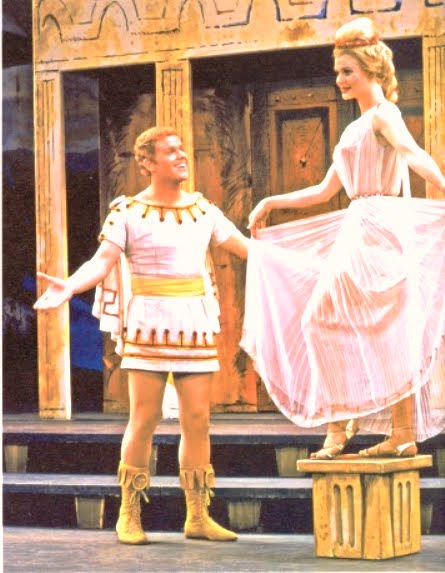
 prove damn difficult to synopsize. However, I do feel that one character in particular — Erronius — deserves separate mention since he didn't get a song of his own. In Finishing the Hat, Sondheim provides the lyrics for a cut song that had been intended for the character called "A Gaggle of Geese," which referred to his family's crest that appears on rings worn by his long-lost children, kidnapped decades earlier by pirates. He, however, persists in searching for his son and daughter. In the original Broadway production, Raymond Walburn, who made his Broadway debut in 1914 and his film debut in 1916, played the role. He played the butler Walter in Frank Capra's Mr. Deeds Goes to Town. In the 1972 revival, the part went to Reginald Owen, who first appeared on Broadway in 1925, though he started making movies in 1911 where his most famous role probably remains Scrooge in the 1938 version of A Christmas Carol. In the 1966 film version, the Erronius role found a masterful custodian in the great Buster Keaton, making his final film appearance. The reason I chose the photo above from the 1996 revival wasn't based solely on availability but because it shows its Erronius, William Duell, who just passed away in December. A very recognizable character actor of stage and screen, Duell appeared in both the original production, revival and film of 1776 as well as one of the patients in One Flew Over the Cuckoo's Nest. For many though, he'll always remain Johnny the shoeshine boy from TV's Police Squad!
 After all the excised songs and subplots, the restoration of said subplots, tensions causing everyone to blame each other for the problems (such as when Shevelove yelled at Sondheim, pointing to his songs as the main reason for the show's failings) and strained relations leftover from the blacklist, the audiences loved it and most reviews praised it. Looking back at those 1962 New York reviews, thanks to a friend with access to them since The New York Times alone provides easy
 online access to its archives, not only do the critics provide interesting insight into the show's reception but it's amazing to see how many newspapers that city supported in 1962. Few of the critics, while acknowledging A Funny Thing Happened on the Way to the Forum entertained them immensely, wrote much — if anything — about Sondheim's score. The morning after it premiered, Howard Taubman, chief drama critic for The Times since Brooks Atkinson's retirement in 1960, wrote, "Know what they found on the way to the forum? Burlesque, vaudeville and a cornucopia of mad, comic hokum. The phrase for the title of the new musical comedy that arrived at the Alvin last night might be, caveat emptor. A Funny Thing Happened on the Way to the Forum indeed! No one gets to the forum; no one even starts for it. And nothing really happens that isn't older than the forum, more ancient than the agora in Athens. But somehow, you keep laughing as if the old sight and sound gags were as good as new. As for the score, Taubman said, "Mr. Sondheim's songs are accessories to the pre-meditated offense. With the Messrs. Mostel, Gilford, Burns and Carradine as a coy foursome, 'Everybody Ought to Have a Maid' recalls the days when delirious farceurs like the Marx Brothers could devastate a number. When Mr. Mostel, the slave with a nimble mind and a desire to be free, persuades Mr. Gilford, the nervous straw boss of the slaves, to don virgin's white, the two convert the show's romantic and pretty 'Lovely' into irresistible nonsense." Taubman penned one of the kinder notices to Sondheim's songs though he appears to have missed the point that even the first version of "Lovely" sung by the story's virginal courtesan Philia comes steeped in satire as the beauty sings an ode to superficiality and her own bubbleheadedness. (The first link takes you to Preshy Marker's version from 1962, the second to Jessica Boevers' from the 1996 revival; since I used the 1962 recording of "Everybody Ought to Have a Maid" at the beginning of the first half, this link goes to the BBC Proms rendition by Daniel Evans, Julian Ovendon, Simon Russell Beale and Bryn Terfel.) The score's assessment changes over the years and as of today, Sondheim may remain the toughest critic. In his book, he again wrote, "I made the subtle, though thankfully not fatal, error of being witty instead of funny." Below, watch a quite different take on "Lovely" from Putting It Together as performed by Carol Burnett and Ruthie Henshall.
Let's skip quickly through some excerpts from the other opening night reviews. Remember: Each of these came from New York newspapers and many no longer exist. Still, today, when some major cities fail to support one daily newspaper to think that this many could thrive in a single city, albeit one as large as New York, makes an old ex-journalist such as myself fill with both wonder and sadness. Walter Kerr for The New York Herald Tribune: "The funny thing about A Funny Thing Happened on the Way to the Forum is that it's
 funny. I'm not going to tell you it's anything more than that, but maybe I don't have to. For all I know, you like funny musicals. You may even like classical funny musicals, and this one is very classic.…Composer Stephen Sondheim begins by giving his lightfooted fools some rather odd recitative as substitute for melody and same vaguely Oriental wood-block effects as substitute for lively accompaniment. You wonder. Then, with a foursome in which Mr. Mostel, Mr. Burns, Mr. Gilford and a borrowed scarecrow named John Carradine, take off to a tune called 'Everybody Ought to Have a Maid,' the odd figurations Mr. Sondheim is attracted to begin to pay off. There's a faint edge of musical sarcasm to be dealt with here, and it crops up again — most effectively — in 'I'm Calm,' 'Impossible,' 'That Dirty Old Man,' and in Mr, Mostel's swooning reprise of a number that was mocking in the first place, "Lovely." The score is in and out, but wins out. The lyrics are fine. Is it me or does it seem as if Kerr keeps changing his mind as he's writing? Though a Broadway theater remains named after the critic today, I've always been leery of Kerr since he actively participated in the industry as a writer, director and lyricist at the same time he worked regularly as a critic. At least he recognized the humor in the first version of "Lovely" though, I'll give him that. (Isn't it fascinating to imagine that Broadway theater owners sometimes honor critics this way? A theater bears Brooks Atkinson's name as well and they even awarded him a special Tony after he retired. When will we see The Frank Rich Theater? Can you imagine and honorary Oscar to a film critic?) The links: "Everybody Ought to Have a Maid" from 1966 film; "Impossible" from the 1996 revival recording; "I'm Calm" and "That Dirty Old Man" both from the 1962 original cast recording. Below we have the clip from the poorly shot bootleg of the "Lovely" (reprise) from the 1996 revival performed by Nathan Lane and Mark Linn-Baker.
Others who opined about opening night. Unless they took contrarian views on the show itself, I'm limiting the comments to the score.: Except for calling Forum a musical comedy in his lead, the only other reference to the score Richard Watts Jr. made in The New York Post comes as part of the review's penultimate sentence. "…and Stephen Sondheim’s score is modest but pleasant." John McClain wrote in The Journal American, "Zero Mostel, a very animated blimp, will personally defy you not to like A Funny Thing Happened on the Way to the Forum…The clients laughed and seemed to enjoy themselves, but there was always the suggestion that had they not, Mr. Mostel would have passed among them and belabored them with a baseball bat. He is quite largely the whole show… The book by Burt Shevelove and Larry Gelbart (claiming some debt to Plautus) is a wispy affair, and Stephen Sondheim's score is less than inspired,
 but under George Abbott's slick direction the show moves and the audience roars. I should think it would succeed." At The New York Daily News, John Chapman chimed in, "(The performers) are grand muggers, leerers and slapstickers, and any old vaudeville fan will be happy to see them in operation.…The songwriter, Stephen Sondheim, comes up with an occasional bright and funny number, such as the four burlesquers song 'Everybody Ought to Have a Maid,' and Miss Kobart’s venomous hymn to Burns, 'That Dirty Old Man of Mine.'" Did he not look at his Playbill? How did he get the song title wrong? Links: "Everybody Ought to Have a Maid" performed by Carol Burnett and Bronson Pinchot in Putting It Together; "That Dirty Old Man" from 1996 revival cast recording. Another critic who didn't find it important to check song titles was Norman Nadel in The New York World Telegram, who delivered the harshest review I read. "But too high a price must be paid for entertaining moments in A Funny Thing… Much of the comedy repeats itself. Some of the players work so hard to exploit their thin materials that they generate more sympathy than laughter. The show is slow starting and sometimes heavy-footed. Stephen Sondheim’s music would have been a second-rate score even in 1940, but he has come up with some catchy lyrics. One is “All I Know is Lovely,” sung by Ms. Marker and Mr. Davies. Another is 'Bring Me My Bride,' in which Miles proclaims his own glory; this is done resonantly by baritone Holgate.…There are indications at the Alvin that A Funny Thing might have been an earthy, boisterous delight. From time to time, it is. For the most part, however, it strains too hard to achieve too little." Link: "Bring Me My Bride" from original 1962 cast recording; I've run out of versions of "Lovely." Finally, we get to Robert Colman reviewing at The New York Mirror with the nicest words for Sondheim's score. "Stephen Sondheim has supplied a score that falls pleasantly on the ears. Jack Cole has choreographed dances that would have delighted Billy Minsky’s. We suspect that A Funny Thing will prove the most controversial song-and-dancer of the season. You’ll either love it or loathe it. In our book, it looms as a hot ticket. A riotous and rowdy hit." The retired Brooks Atkinson filed a "critic at large" piece for The New York Times in July where he barely mentions that Forum contains music and Sondheim's name never appears, though the "low comedy" delights him to no end. Since "Everybody Ought to Have a Maid" comes up so often, I've reserved two video clips for you to watch. The first comes from the 1996 revival.
Before I get to the final clip of "Everybody Ought to Have a Maid," I thought it would be interesting to point out how quickly critics began to re-evaluate Sondheim's score for Forum. Granted, in these reviews I was limited to The New York Times and most come after the one-two punch of Company and Follies supersized his reputation, but the reconsideration started as early as the 1966 film version. Vincent Canby wrote in his review of the film, "Stephen Sondheim's music and lyrics hold up well, especially 'Comedy Tonight,' by which Mr. Mostel introduces the characters at the start, and the slightly bawdy 'Everybody Should Have A Maid' ('sweeping out, sleeping in')." When Clive Barnes assessed the 1972 revival for The Times, he said, "Mr. Sondheim's music is original and charming, with considerable musical subtlety but a regard for down-to-earth show-biz vigor that is precisely what is needed. And, as always, his lyrics are a joy to listen for. The American theater has not had a lyricist like this since Hart or Porter." By the time the 1996 revival arrived, Canby's beat had switched from film to theater. "This brazenly retro Broadway musical, inspired by Plautus, is almost as timeless as comedy itself. Here's a glorious, old-fashioned farce that, with its vintage Stephen Sondheim score and its breathless book by Burt Shevelove and Larry Gelbart, celebrates everything that man holds least dear but can't deny himself: lust, greed, vanity, ambition; in short, all of those little failings that make man human. Yet for all of its disguises, mistaken identities, pratfalls and leering jokes, A Funny Thing is as sophisticated as anything now on Broadway. In its own lunatic way, it's both wise and rigorously disciplined. Easy sentimentality is nowhere to be found here; in its place: the kind of organized chaos that leads to sheer, extremely contagious high spirits," Canby wrote. Now, that other clip of "Everybody Ought to Have a Maid" features original 1962 cast member Jack Gilford performing with two (well, at least one) other surprising performers in a television appearance.
I'd hoped to avoid this situation, but I got so caught up with the behind-the-scenes history that what I intended as a short tribute grew to be massive. I still need to write about the original production's performance at the Tony Awards and some tidbits concerning the two revivals, the second of which I saw, not to mention that version I saw in 1979 when I was 10. That won't be coming today I'm afraid. So, I'll leave you with the sequence for "Bring Me My Bride" from Richard Lester's film version.
Labels: blacklist, Books, Capra, Criticism, Gelbart, J. Carradine, J. Robbins, Keaton, Marx Brothers, Music, Musicals, Sondheim, Television, Theater Tribute, Welles
TO READ ON, CLICK HERE


