Friday, May 18, 2012
Centennial Tributes: Richard Brooks Part I

By Edward Copeland
"First comes the word, then comes the rest" might be the most famous quote attributed to Richard Brooks, who began his life 100 years ago today in Philadelphia as Ruben Sax, son of Jewish immigrants Hyman and Esther Sax. He wrote a lot of words too — sometimes using only images. In fact, too many to tell the story in a single post. so it will be three. His parents came from Crimea in 1908 when it belonged to the Russian Empire. Like the parents of a great director of a much later generation and an Italian Catholic heritage, Hyman and Esther Sax also worked in the textile and clothing industry. Sax's entire adult working life revolved around the written word — even while he busied himself with other tasks. “I write in toilets, on planes, when I’m
 walking, when I stop the car. I make notes. If I am working at a studio, I work at the studio in the morning, then come home. I am really writing two days instead of one. After the studio, I have my second day (at home). I write whenever I can,” Brooks said in an interview with Patrick McGilligan for his book Backstory 2: Interviews with Screenwriters of the 1940s and 1950s. After high school, he entered Temple University where he majored in journalism, though he left early when he realized the financial hardship that his tuition put on his parents. After drifting around the eastern half of the U.S. for a while by train, Sax returned to Philadelphia and got a job as s sports reporter at The Philadelphia Record where he first adopted the name of Richard Brooks. When he later got hired by The Atlantic City Press-Union, he met another reporter with an independent streak who would eventually make his way to Hollywood by the name of Samuel Fuller. Shortly after moving to New York for a job with that city's World Telegram newspaper, only leaving the sports beat behind for crime reporting. Brooks discovered that radio jobs provided bigger paychecks so he took a job at the 24-hour radio station WNEW, first as a disc jockey. "Played records 23 of those hours," McGilligan described in the introduction to his interview. Later, the station promoted him to news where he edited four news broadcasts a day newspaper jobs and wrote one. His work there led to a news job at NBC Radio's Blue Network where he also got to do commentary. At the same time, in 1938, Brooks tried his hand at playwriting, which led in 1940 to co-founding The Mill Pond Theater in Roslyn, N.Y., with David Loew. It's on that stage that Brooks made his debut as a director, taking turns with Loew helming productions at the summer theater. A falling out with other members of the theater sent Brooks to California where he worked for NBC Radio from the other coast. Among his duties was writing and directing the broadcast Richard Sands. Brooks also began writing a short story every day and reading it on air. “I’d written some short stories before, but none was published. Anyway, every day, another short story. Everything became grist for a short story. It began to drive me crazy…a different plotline every day. My ambition: write one story a week instead of a different story every day. In about 11 months, I wrote over 250 stories. I even devised a system whereby on Fridays I wouldn't have to write a short story. I called that day 'Heels of History.' I would take a fable and convert it. As a matter of fact, I used one afterwards in The Blackboard Jungle,” Brooks told McGilligan. Brooks gave the example of how he took the story of "Jack and the Beanstalk," citing how while he's portrayed as a hero, Jack's actually a dumb, bad kid who ignores his mother's order, shows little concern for an ailing fire and steal, even if it's from a giant. Granted, it doesn't appear to have been broadcast nationally but I wonder if Stephen Sondheim and James Lapine came across this when
 conceiving Into the Woods?. Witches can be right, giants can be good… Brooks, like what happened when he learned radio paid more than newspapers, discovered in California that screenwriters earned bigger paychecks than broadcasters. He set up a meeting with George Waggner at Universal, where Waggner — who later would direct The Wolf Man and much episodic TV including many installments of The Man from U.N.C.L.E. and Batman — was the assistant producer of White Savage, a Maria Montez film directed by Arthur Lubin. Waggner asked if Brooks wrote because they desperately needed a rewrite. It was his first movie job and Brooks made "$100 (weekly) plus a day or two prorated, and they put my name on (the screen) as 'additional dialogue,'" Brooks told McGilligan. White Savage wasn't the first film Brooks worked on to be released though — two others and a serial came first. He also hung on to the NBC gig and got the chance to write for Orson Welles' Mercury Theatre. Brooks produced countless sentences and paragraphs and but still lacked a "written by" credit on a screenplay credit. Once he did and, later, when he directed, he'd impact filmmaking both during and beyond his life, often with social themes few would touch (though occasionally in a heavy-handed way). He also managed to write some novels on the side — while with the Marines during World War II, where he'd also crank out a couple of screenplays (including his first credited one on Cobra Woman, directed by Robert Siodmak and again starring Montez) and report for Stars & Stripes as well while learning about filmmaking from Frank Capra's motion picture unit and eventually on his own editing combat footage into documentaries while attached to the 2nd Marines, Photographic Unit. If the Allies only needed a typewriter to defeat the Axis, Brooks might have been a good option for the weapon. First comes the word…
Though Brooks' legend derives predominantly from his film legacy, he experienced his first rush of acclaim with the publication of his debut novel, written while stationed at Quantico at night in the bathroom, according to the account in Tough as Nails: The Life and Films of Richard Brooks by Douglass K. Daniel. Several publishers rejected it until Edward Aswell at Harper & Brothers, who also edited Thomas Wolfe, agreed to take it — and he shocked Brooks further by telling him (after a few suggestions) they planned to publish in May 1945. This news flabbergasted Brooks who obtained a weekend pass to go to New York because Aswell insisted on informing him in person. Now Brooks had to return to Quantico where the top officers of the Corps about shit bricks when The New York Times published a big review of The Brick Foxhole soon after it hit shelves. (Orville Prescott's take was mixed, assessing it as compulsively readable but weak on characterization.) Its story of hate and intolerance within the Marines brought threats of court-martialing Brooks, since he'd ignored procedure and never submitted the novel to Marine officials for approval ahead of time. They wanted to avoid bad publicity, especially with all the good feelings as the war wound down. "There was nothing in that book that violated security, but their rules and regulations were not for that purpose alone," Brooks told Daniel. Aswell prepared to launch a P.R. counteroffensive with literary giants such as Sinclair Lewis and Richard Wright ready to stand by Brooks. In case you don't know the story of the novel, it concerns a Marine unit in its barracks and on leave in Washington. Through their wartime experiences, some of the men truly turned ugly, suspecting cheating wives and tossing hate against any non-white Christian. It turns out, though the real Marines let the matter drop, what bothered them
 about the book wasn't the anti-Semitism or racist tendencies of the characters but the murder of a Marine some of the other Marines learn is gay. The U.S. Marines didn't want to promote the idea there might be homosexuals serving in the military. Ironically, they got their wish when The Brick Foxhole transferred to the big screen in 1947 as Crossfire. Brooks wasn't involved in the film version, but they made the murdered Army (The Marines even got to toss it off to another military branch entirely) soldier Jewish in the film. The film actually happens to be very good and was nominated for best picture and earned Robert Ryan his only Oscar nomination ever as supporting actor. What's even sadder is that Crossfire ends up being a much more powerful film against anti-Semitism than the creaky Gentleman's Agreement that took on the same subject that year and won best picture. If there weren't already enough ironic twinges in that story for you, Gentleman's Agreement, probably the grandfather of that tried-and-true staple "let a white guy be the hero of a story about another ethnic group" with Gregory Peck playing a Christian going undercover as a Jew to learn about anti-Semitism, won Elia Kazan his first directing Oscar. Edward Dmytryk, one of The Hollywood Ten, directed Crossfire, which dealt straight on with anti-Semitism and the effects of warfare on men. Then again, once Dmytryk served his jail time, he became the only one of the 10 to name names to HUAC because he wanted to work again.
While he didn't want to make a movie of The Brick Foxhole himself, another former newspaperman turned socially conscious film artist met with Brooks about working with his independent production company. At first, Mark Hellinger tried to lure Brooks away from Universal with the promise of doubling his salary if he'd adapt a play he liked into a movie, but before Brooks could consider that offer, Hellinger called with a more pressing matter. He was producing an adaptation of Ernest Hemingway's famous short story The Killers. The problem: someone had to dream up what happened after the brief tale ends because it certainly wouldn't last 90 minutes otherwise. Hellinger flew Brooks out to meet Papa himself, but he didn't get much out of him but he did come up with an idea for what would happen after the story ends. Hellinger liked it and sent it to John Huston, who wrote the screenplay as a favor. Since both Brooks and Huston had contracts at other studios, neither got screen credits, so Ernest Hemingway's The Killers' official screenplay credit goes to Anthony Veiller, who received an Oscar nomination for best screenplay. He'd previously shared a nomination in the same category for Stage Door. The film also made a star out of Burt Lancaster, who would work with Brooks several times and be his lifelong friend. In fact, Lancaster would star in the next screenplay that Brooks wrote, a Mark Hellinger production directed by one of those people Edward Dmytryk eventually would name before the House Un-American Activities Committee. The film, of course, would be the still-powerful Brute Force, the director, Jules Dassin.


John Huston wasn't happy. Producer Jerry Wald called him, excitement in his voice, to tell him he'd secured the rights to Maxwell Anderson's Broadway play Key Largo for Huston to direct. This didn't thrill Huston, who thought the play gave new meaning to the word awful. Written in blank verse, Anderson's play concerned a deserter from the Spanish-American War. People at a hotel do get taken hostage, but by Mexican hostages. Essentially, Huston tossed the play in the trash bin. Huston hired Brooks to co-write an in-title only version and, still pissed at Wald, barred him from the set. Part of Huston's anger stemmed from the HUAC nonsense, (His outrage would drive him to move to Ireland for a large part of the 1950s.) so he couldn't stomach adapting a play by Anderson whom he considered a reactionary because of his hate of FDR. Despite Huston's distaste for the project, he
 turned it into a classic film with a little help from Humphrey Bogart, Lauren Bacall, Lionel Barrymore, Claire Trevor in her Oscar-winning role and, last but certainly not least, Edward G. Robinson as exiled mobster Johnny Rocco, who likes to brag about the power he used to wield. "I made 'em — like a tailor makes a suit of clothes," he tells a former associate. Knowing the story of what happened prior to filming makes you chuckle when you see the credit that reads, "As Produced on the Spoken Stage." It's great to watch Robinson and Bogart go toe-to-toe. Rocco makes a particularly memorable first appearance, lounging upstairs in a hotel bathtub, looking in a way like a prediction of that famous photo of Dalton Trumbo that would be taken decades later. Bogart, updated to a returning WWII veteran, perfectly plays his role of Frank McCloud so that you never know if he's being savvy or scared of the crimnals terrorizing them. "You don't like it, do you Rocco, the storm? Show it your gun, why don't you? If it doesn't stop, shoot it," Frank says at one point, but when he gets a chance to grab a gun and take him out (though Rocco's men would certainly finish Frank afterward), he nonchalantly declares, "One Rocco more or less isn't worth dying for." The script's dialogue crackles and for additional fun touches we get a great Max Steiner score and the multitalented German émigré Karl Freund as cinematographer. The most remarkable thing that Huston did though was to invite Brooks to stay on the set during the film's shooting, something he'd never done as a writer and that he talked about in this YouTube video in 1985.
While I would have liked to have viewed more of Brooks' work that I've never seen (and to re-visit some which I have), time and availability, combined with his prolific nature and the industry's increasingly cavalier willingness to let both old and recent films fade into oblivion, proved to be a problem. After Huston's generosity, Brooks' directing debut would arrive two years later. Four films where Brooks worked
 solely as a writer remained — the Paris-set spy thriller To the Victor; Any Number Can Play with Clark Gable as an underground casino owner advised by his doctor to get out of the business because of his heart disease; Mystery Street with detectives Ricardo Montalban and Wally Maher consult a Harvard forensics expert (Bruce Bennett) to solve a mystery when a decomposed body washes ashore; and Storm Warning, where model Ginger Rogers goes to visit her sister in a particularly unfriendly town and secretly witnesses a mob lynch a man that her sister (Doris Day) tells her was a reporter who denounced the KKK. Rogers' character gets a bigger shock when she realizes baby sis' husband participated in the lynching. After 1951, every film Brooks worked on he at least held the title of director, beginning with 1950's Crisis with Cary Grant as a doctor vacation with his wife in a small country when the dictator (José Ferrer) kidnaps them to force the doctor to treat his life-threatening condition. The doctor's ethics get tested by his oath and the idea that if he lets the man die, life for the country's people will improve. For a writing-directing debut, Brooks makes a pretty good start even if it doesn't come close to some of the films he wrote. His next four films as director and writer or co-writer I haven't seen, though I tried to watch the last one. The next film, The Light Touch (1952). starred George Sanders and Stewart Granger a collector of stolen art and an art thief, respectively, trying to get their hands on the masterpiece Granger stole and that his wife Pier Angeli stays busy counterfeiting
 enters their lives. At the time, Granger was married in real life to Jean Simmons, who would become Brooks' second wife about 10 years later. The next two films both starred Bogart. First came Deadline-U.S.A. with Bogie playing an investigative reporter trying to expose a gangster as his paper faces imminent closing followed by Battle Circus co-starring June Allyson where they played medical personnel at a MASH unit during the Korean War. The final film, which I almost watched, was The Last Time I Saw Paris, based on a story by F. Scott Fitzgerald and co-written by Brooks and the Epstein brothers, Van Johnson plays a former soldier returning to the city he liberated in the war, now despondent over his attempts to be a writer. He gets invited to parties with the city's beautiful people and finds one (Elizabeth Taylor) who enchants him. Unfortunately, the DVD transfer on Netflix’s rental copy proved abysmal. The Technicolor has faded beyond belief and it was filmed in an odd 1:75:1 spherical ratio, so every image looked distorted because they just flattened it full screen. After a few minutes, I had to shut it off. Apparently, it's a Warners Archive title now, but of course, they don't offer those for rental so the shitty DVDs will remain for people who don't believe in buying blind. I haven't caught his next two directing efforts either, but they stand out because they marked the first two times (and it only occurred three times) that Brooks directed screenplays written by someone else. In 1953, he directed Richard Widmark as a Korean War vet now serving as a tough drill instructor for new GIs bound for Korea while he's bitter that his request to return to Korea keeps being denied in Take the High Ground! In 1954, Brooks helmed Flame and the Flesh with Lana Turner as unlucky woman trying to get what she can for nothing visiting Europe who finds herself wooed by a gigolo.
With 1955, Brooks wrote and directed the first film that truly garnered him an identity as more than a writer who directs but as a director with Blackboard Jungle, a film that admittedly manages to look both dated and timely simultanouesly, First, as so many old films did, it had to start with a long scroll explaining that American schools maintain high standards, but we need to worry about these juvenile
 deliquents before this gets out of hand. It gets off to a rockin' start — literally — with opening credits that can't help but make you think of the original beginning to TV's Happy Days as Bill Haley and the Comets get everything moving to "Rock Around the Clock" as new English teacher Richard Dadier (Glenn Ford) arrives to work at all-boys high school North Manual Street. Most of the school overflows with miscreants, especially his class who start calling him "Daddy-O" to avoid pronouncing his name. (Though it's never been confirmed, many assume that the movie inspired Leiber & Stoller's lyric "Who called the English teacher Daddy-O?" in The Coasters' huge late '50s hit "Charlie Brown.") The ensemble Brooks assembled, including some of the "teens" who would make their names much later included Anne Francis as Dadier's pregnant (and, quite frankly, neurotic) wife; Louis Calhern as a veteran teacher left with nothing but cynicism and a
 desire to beat the crap out of the punks; Richard Kiley as a nerdy math teacher with a love for jazz; Margaret Hayes as another new teacher who doesn't think about how she's dressing and nearly pays for it; Sidney Poitier as a student who appears to be one of the delinquents yet practices playing the piano and singing hymns; and Vic Morrow as the worst kid in the school, a downright criminal. Also, look for appearances by future writer-director Paul Mazursky as a student, Richard Deacon as a teacher and Jamie Farr as another student when he acted using the name Jameel Farah. While Blackboard Jungle offers much to praise, at times it comes off as too simplistic. It did dare to tackle bigotry and use the epithets. Sometimes, it feels eerily like the awful 1984 film Teachers. I kept expecting Calhern to turn out to be like the Royal Dano character and drop dead at his desk. I wonder what Brooks would have thought if he'd seen The Wire's fourth season. Blackboard Jungle earned Brooks his first Oscar nomination for best screenplay. Brooks' competition consisted of Millard Kaufman (who wrote Take the High Ground!) for Bad Day at Black Rock, Paul Osborn for East of Eden, Daniel Fuchs and Isobel Lennart for Love Me or Leave Me and Paddy Chayefsky, who wrote the teleplay that would be the basis for one of Brooks' 1956 films, for Marty. Chayefsky won his first Oscar. Nearly the entire cast excels in spite of some of the weaker parts of Blackboard Jungle (except Francis, burdened with a thankless role) but Morrow stands out in the ensemble as the worst punk.
 Tweet
Labels: blacklist, Bogart, Capra, Cary, Dassin, Doris Day, Edward G., Fiction, Fitzgerald, Fuller, Ginger Rogers, Glenn Ford, Hemingway, Huston, Lancaster, Liz, Mazursky, Poitier, Robert Ryan, Widmark
TO READ ON, CLICK HERE


Sunday, December 18, 2011
Centennial Tributes: Jules Dassin Part II

By Edward Copeland
As we dive into the second half of this tribute to Jules Dassin, we're on an uphill climb artistically and a downhill slide personally as we talk about when he made his best films, including two out-and-out masterpieces, and when the witch-hunting politicians froze him out of movie work by getting Hollywood to blacklist him because of his youthful flirtation with communism. Never mind that he resigned from the Communist Party soon after joining when Stalin signed his 1939 pact with Hitler, once a commie, always a commie, right? At least that was the attitude then. We haven't reached that point yet. First, following making the great Brute Force, Dassin re-teams with producer Mark Hellinger for The Naked City, a landmark because it was the first sound film to shoot entirely in New York. Henry Hathaway had filmed some scenes of 1945's The House on 92nd Street on the streets of New York, but not the entire movie. Another film had shot partly on the streets of New York, but The Naked City became the first movie to film its entire production there. If you started here accidentally and missed Part I, click here.

Hellinger's role in The Naked City extended beyond producing — he also narrated the film which, to me at least, turns out to be a demerit at times. In his 1948 New York Times review, Bosley Crowther, mixed on the movie overall, referred to the narration as "a virtual Hellinger column on film." Not all the narration is cringeworthy (Two examples: "How many things this sky has seen that man has done to man"; "Milk! Isn't there anything else for ulcers except for milk?") Some come off fine such as when
 Hellinger notes, "There's a pulse to a city that never stops beating." When the narration grates the most are the times when it sounds like a talkative moviegoer asking their companion annoying questions such as, "Is Henderson the murderer? Did a taxicab take him to the Pennsylvania Railroad Station? Who is Henderson? Where does he live? Who knows him?" The movie itself starts with an overhead shot of the city skyline as Hellinger waxes on about the city as the daytime shots turn into nighttime images and he tells us, "This is the city when it's silent or asleep, as if it ever really is." After his narration introduces us to various inhabitants of the city who work nights, he also shows us people resting at home or out on the town (cleverly introducing people who will be major characters later without pointing that out) "And while some people work and most sleep, others are at the close of an evening of relaxation — " We see a night club getting ready to close and its attendees departing before the camera switches to a young woman's apartment where we see her being murdered by two men. "And still another — is at the close of her life." The killers try to fake her death as a bathtub drowning and we see the movie's destination at last. After some more wandering around the city the next morning (including one killer getting drunk and nervous about the crime and his co-conspirator offing him and dumping his body in the river), once the dead woman's maid discovers her body, they show a particularly nice sequence of the chain of calls through switchboard operators going from hospital to a police precinct to the medical examiner before finally ending up at the homicide squad.
The Naked City follows the investigation of that young lady's murder in an almost documentary style. Originally, Hellinger intended to use Homicide as the title but then decided to borrow The Naked City from the books of photographs by famous crime scene photographer Weegee, whose life was fictionalized in the 1992 film The Public Eye starring Joe Pesci, because he wanted the movie to have the feel of Weegee's photos. Playing the men leading the investigation were Barry Fitzgerald as Det. Lt. Dan Muldoon, the veteran with two decades of experience, and Don Taylor as Det. Jimmy Halloran, the greenhorn who'd only been working homicide for three months. Muldoon always has to explain to Halloran the right way to solve a case such as the one they are in, giving Fitzgerald the chance to say things like "That's the way you run a case, lad — step by step" and sound even more Irish than usual as he does it. When
 they determine that the murder had to be committed by two people, Muldoon pins it on "Joseph P. MacGillicuddy," his version of John Doe. Since The Naked City strives for realism, one thing sticks out that I tend not to notice in other pre-1966 police movies or TV shows: There were no such things as Miranda rights so you never hear anyone told, "You have the right to remain silent, etc." The fine cast also includes Howard Duff, reuniting with Dassin from Brute Force, as a compulsive liar who was involved with both the dead woman and her best friend (Dorothy Hart). If you look closely, the film overflows with familiar faces in brief, mostly uncredited roles including Paul Ford, John Marley, Arthur O'Connell, David Opatoshu and, making their film debuts, Kathleen Freeman, James Gregory and John Randolph. There also is a very funny scene where Halloran seeks information from a sidewalk store clerk selling soda on the whereabouts of the suspected killer and the vendor is played by the comic great Molly Picon. However, the film's true star is New York.

While The Naked City gets lumped into the noir category, personally I don't think it belongs there. While The Naked City turns out mostly fine, the film doesn't approach the greatness of Brute Force or Dassin's films that follow. What makes The Naked City stand out from other films has little to do with its story or acting, but its landmark use of New York — and I mean the real New York, not Toronto. Dassin employed several tricks to film on the streets without crowds getting in the way because word always leaked as to where they would be shooting. In one of the Criterion interviews, he tells of a fake portable newsstand they had to conceal the camera as well as a flower delivery van with a mirror on the side that they could see out of but outsiders couldn't see in. They also employed jugglers to distract onlookers so they wouldn't disrupt shooting.


On the DVD interview, Dassin said his favorite method was to place this guy a bit down the street from where they were shooting, have him climb up a pole, wave a flag and give patriotic speeches. While he mesmerized crowds, the film crew got their work done. Some of that location shooting still amazes. Taylor as Halloran does most of the running throughout the city, on and off subways and buses, past landmarks still familar today and, most especially, the climactic foot chase after the killer that leads to awesome shots on the Williamsburg Bridge. The movie ended up winning the Oscar for best black & white cinematography for William H. Daniels and best film editing for Paul Weatherwax. Now, Dassin contended that elements of the films that put more of an emphasis on class differences within the city and other social issues were cut from the film before release. In many interviews, he said that by the time filming had been completed, rumor already had begun to swirl that he might be called before HUAC to testify about his former membership in the Communist Party. He also didn't believe Hellinger would make those cuts, mainly because Universal didn't want to release The Naked City because they didn't know how to market it. However, Hellinger's contract with the studio had a clause requiring them to release it — and a good thing that it did because three months before The Naked City finally did reach theaters, Hellinger died of a heart attack at 44, another reason Dassin doubted the cuts were his. To paraphrase the film's famous closing line of Hellinger narration, "There are eight million stories from the Hollywood blacklist. This just leads to a much bigger one."
Before Dassin found a new home in Hollywood, he finally got that chance to direct some theater again, staging two Broadway productions in 1948. First, he directed the original play Joy to the World by Allan Scott, the screenwriter of six Astaire-Rogers musicals including Top Hat and Swing Time as well as other films. The comedy takes aim at Hollywood and the difficulty one has maintaining his integrity in the movie business. The play, which ran from March 18 to July 3 at the Plymouth Theatre, also has a strong plea for intellectual freedom and against censorship. Produced by John Houseman, its cast included Morris Carnovsky, who would appear in Dassin's next film and on the blacklist, being named by both Elia Kazan and Sterling Hayden; Bert Freed, TV's first Columbo; and Marsha Hunt, who starred in two of Dassin's MGM films — The Affairs of Martha and A Letter to Evie. The second production was the musical Magdalena which ran from Sept. 20 through Dec. 4. The songs were by lyricists Robert Wright and George Forrest and composer Heitor Villa-Lobos. It was John Raitt's first show following Carousel and choreographed by the most influential yet least-known dance master Jack Cole, subject of an in-development musical project with its eye on Broadway today. One of his two assistant choreographers on Magdalena was Gwen Verdon.
When Dassin headed back west, Darryl F. Zanuck and 20th Century Fox came calling, seeking to sign him to direct A.I. Bezzerides' adaptation of his own novel Thieves' Market, renamed Thieves' Highway. Before that project got rolling, Dassin received an urgent phone call from Zanuck with a very important question: "Are you now or were you ever familiar with the fundamentals of playing baseball?" Dassin told him yes. In an interview recorded in New York in 2000 and on the Criterion Collection DVD of Rififi, shared this fun little anecdote. It seems that the MGM vs. Fox baseball game was coming up the following weekend and Fox was short a player and Zanuck wanted to see if Dassin could be the one. According to Dassin, he turned out to be the MVP of the game as Fox beat MGM, which apparently was an unusual occurrence. Dassin's agent called him in a rush, wanting to know if Dassin had signed the contract for Thieves' Highway yet. Dassin told him that he had. The agent told him that was too bad — after his performance in the ballgame, he could have negotiated him a higher salary for the film.
While The Naked City didn't really seem like noir to me, Thieves' Highway most definitely does, though it's noir in a setting I never imagined before — crooks run amok among those who sell fresh fruit and vegetables. Richard Conte stars as Nick "Nico" Garcos, a veteran who traveled the world following the war and brings home gifts from everywhere to his proud Greek family. His father Yanko (Morris
 Carnovsky) is even joyfully singing a Greek song when his boy shows up unannounced, surprising him. (Interesting that as important as Greece will become in Dassin's life later that it's a distinct element of this film.) While the mood overflows with happiness in the Garcos house, Nick discovers that things haven't gone well during his absence when one of his presents turns out to be a special pair of shoes for his father and he urges him to try them on. There's a problem — Yanko can't wear shoes anymore. He rolls away from the table to reveal to his son that he no longer has legs. His father tells him the story about how he had a huge load of the season's first crop of juicy tomatoes and one of the biggest produce dealers on the San Francisco market Mike Figlia (Lee J. Cobb) had agreed to buy them but as he asked for his money, Figlia insisted they have a drink to celebrate first. That drink turned into more drinks and the next thing Yanko knew, he was on the side of the road under his wrecked truck minus his legs. Figlia claims he paid him and someone must have taken the money from the truck. To make matters worse, since he couldn't use the truck anymore, he sold it and the man he sold it to has stiffed him on payment as well. While Nick's mom (Tamara Shayne) tries to calm things down and argues that perhaps Figlia told the truth, Nick can tell that Figlia was lying and his dad never got paid. First though, he's getting the truck back.
When he finds Ed Kinney (Millard Mitchell), the man who bought the truck, Nick demands the keys to the truck or the money. Kinney complains that he can't pay right now because the truck has been giving him fits but he needs it to pick up a load of golden delicious apples. Nick makes a deal that he'll be his partner to pick up the apples and take them to San Francisco for the sale. The one hitch — Kinney already had a deal set with two guys Slob and Pete (Jack Oakie, Joseph Penney) so Kinney has to make up a story about how he can't make the run. The men go away disappointed — but they also tail him and see that he's lying and make it a point to harass them. If Mitchell looks familiar, he's probably best known for his role three years later as movie exec R.F. Simpson in Singin' in the Rain. Mitchell's career was cut short. A heavy smoker, lung cancer claimed his life at the age of 50 in 1953. Another interesting tale that comes out of the Dassin interviews on DVD is that Oakie, the longtime comic actor who scored an Oscar nod for his Mussolini spoof in Chaplin's The Great Dictator, was completely deaf when he made Thieves' Highway, something that Dassin didn't realize for weeks because Oakie was so good at picking up cues from other actors and never missed his mark or messed up a take. After Kinney and Nick team up, the first portion of the film concentrates on the long haul to San Francisco after they pick up the apples with Nick driving the decrepit truck, Kinney following in another and Slob and Pete harassing them along the way. As Dassin said, the enemy for these men is fatigue and drivers employed many tricks to stay wake on the roads at night.

After a near disaster, Kinney decides it's best if he and Nick switch trucks, letting him, the more experienced driver, try to hold it together while Nick takes the better rig with the first half of the load on to San Francisco. As in The Naked City, Dassin breaks some ground here by doing some amazing location shooting in San Francisco's market area with crowded streets and lots of activity. When we
 arrive there, that's when Cobb appears playing the most diabolical produce salesman in the history of film. Cobb's centennial was Dec. 8, but I got so backed up with other projects I wasn't able to do a proper salute to this towering actor. In the 2005 interview on the DVD, Dassin said that Cobb truly "enjoyed his villainy." During the work on this piece, I uncovered more and more names of actors and directors who named names before HUAC that I had never known about before. I mentioned Sterling Hayden earlier, which was news to me. I also didn't know about Cobb. It's odd
 how all the ire and bile aimed at people who did name names seemed to be reserved for Elia Kazan. In Cobb's case, the pressure on the actor when he was called to testify before HUAC had nearly brought his wife to a nervous breakdown so Cobb felt compelled to name names to preserve his wife's sanity. Regardless, that doesn't take away from the fact that Cobb was a great actor and not just anyone can turn a produce dealer into a plausible bad guy. Conte matches him well as the good guy without turning Nick into a bland opponent. When things heat up between Nick and Figlia and Figlia suggests they go off to his office, one man comments that Figlia will "eat that kid alive." A buyer named Midge who's seeking golden delicious apples and is played by Hope Emerson, who will be a memorable villain herself the following year as the women's prison matron in Caged, responds, "I'll take odds on the kid." One of Figlia's deceptive tricks against Nick involves utilizing a local hooker named Rica (played by Valentina Cortese, best known for her Oscar-nominated turn in Truffaut's Day for Night, in only her second English-language film and her first shot in the U.S, though her last name is spelled Cortesa). Rica keeps Nick occupied while his truck, which is stuck in front of Figlia’s stand because of flat tires, gets raided and has its apples sold off by Figlia. In the 2005 interview, Dassin told of how Zanuck was a very hands-on producer. Since Rica would inevitably turn out to be the proverbial hooker with a heart of gold who would end up aiding Nick, Zanuck insisted that they write in a part of "a bourgeois fiancée who betrays Nick" to justify the hero falling for the hooker. Barbara Lawrence played that role, Polly Faber.

In addition to Thieves' Highway's noirish elements, which basically get segregated to San Francisco once Nick arrives and Figlia and Rica join the film, the movie's other half covers Kinney's treacherous drive in the truck that's barely holding together. Dassin builds genuine suspense in these scenes, aided by Alfred Newman's score. His journey isn't helped by the constant taunting by Slob and Pete, but as he steers the truck through curvy, mountainous highways, the sequences seem to foreshadow what would come several years later in Henri-Georges Clouzot's The Wages of Fear. When the drive finally goes fatally wrong, the truck crashes and rolls down an embankment, apples going everywhere. Even Slob and Pete rush down, but it's too late as the truck bursts into flames. "From that angle, apples rolling down the hill into the camera. I said to myself, 'That's a good shot.' I think that's one of the shots I've enjoyed most in films I've made," Dassin said in 2005. One thing in Thieves' Highway that didn't particularly please Dassin was that Zanuck shot an entirely new ending that he didn't know about because he already was in London prepping Night and the City. When Nick finally gets his physical revenge on Figlia, Zanuck's ending added police coming in to make the point that people "shouldn't take the law into their own hands." However, given what Zanuck did for Dassin overall when the witchhunters came calling, he couldn't complain that much. When the shit really started to hit the fan, it didn't sound as if Zanuck was someone who would be as helpful as he was during Dassin's crisis. In 1949, word came down that HUAC was going to call Dassin to testify and Zanuck and other Fox executives had a meeting about "the problem." In the 2004 L.A. County Museum of Art interview, Dassin said that Zanuck told him, "He was going to step on my neck because I was a dirty red."
is to be a nice guy, but you can't make it.'" — Jules Dassin
As Dassin went on to tell in that 2004 interview, after Zanuck's "threat," he was surprised to find the producer at his front door — not something you'd expect from someone at Zanuck's level. He informed Dassin that he was flying to London the next day and handed him the novel Night and the City by Gerald Kersh. Dassin told Zanuck he couldn't rush off on a moment's notice like that — he had family
 problems. Zanuck disagreed with the director, saying that he also had family needs and this could end up being the last film he ever made. Zanuck advised him to get shooting on the film as fast as he could and to do the most expensive scenes first so the studio wouldn't have an excuse to shut the production down. Dassin followed Zanuck's advice and was in London readying the shoot when he learned that he'd been called to
 appear before the House Un-American Activities Committee. Zanuck informed the panel that he was abroad and got his scheduled hearing postponed. When Dassin was about two weeks away from the start of shooting on the film, Zanuck called. He asked Dassin if he agreed that he owed him one. Yes, he did owe him, Dassin said in the 2004 interview. Zanuck requested a favor — he wanted Dassin to cast Gene Tierney in a role. Dassin was confused, since there wasn't a role in the movie that she could really play, but Zanuck explained that a love affair had just ended very badly for the actress and she was almost suicidal. When she got in those states, Zanuck said, the only thing that snaps her out of it is work. Quickly, the role of Mary Bristol was written into the script of Night and the City and Tierney joined Richard Widmark and the rest of the talented cast in one of the two best films Dassin ever made. Kersh, the author of the novel the film was based on, did not agree. Dassin never admitted it until an interview in 2005, but Zanuck had encouraged him to everything in such a rush, he never read the book. Many years later, when he did, he could see why Kersh got mad — Night and the City the movie had no resemblance to Night and the City the novel whatsoever.
I haven't read the novel but if the godawful 1992 film with the same title starring Robert De Niro and Jessica Lange hewed closer to its narrative, I'm glad that I haven't. If, on the other hand, the 1992 Night and the City just provides more evidence that nine times out of 10, when you try to remake a classic film, you only end up with the celluloid equivalent of diarrhea, Kersh should be grateful he died in 1968. I actually saw the disaster of a remake before I ever saw the original and once I saw the original, I couldn't believe that they were supposed to have come from the same source material. When ranking Dassin's films, I'm always torn between Night and the City and Rififi as to which I think is the greatest. Preparing for this tribute, I watched the films on consecutive nights. It's such a close call, but for today anyway, I give Rififi the slight edge. However, that doesn't mean I love Night and the City any less. What a script. What a cast. Every detail done to perfection. "Night and the city. The night is tonight, tomorrow night or any night. The city is London." Those are the words that open the film then we see Widmark's Harry Fabian running like hell through a square — and running will be what he's doing for a lot of the movie when he doesn't slow down long enough to try to make his Greco-Roman wrestling scheme work or to make time for Mary or listen to offers from the likes of Francis L. Sullivan's Philip Nosseross, a nightclub owner who resembles a more genial Jabba the Hutt, or his wife Helen (the wonderful Googie Withers, who just passed away in July), who wants her own action and to escape her husband.

When Night and the City opened in 1950, it depended where you lived what music accompanied Fabian's film-opening sprint. Britain, still recovering from the damage of World War II, had laws in place to ensure that it kept a certain amount of the profits of films made there
 and provide workers jobs as well. As a result, there were two versions of Night and the City, and Dassin wasn't allowed to participate in the editing of either one — one because he wasn't British, the other because when he returned to the United States, he was banned from the 20th Century Fox lot. The British cut runs longer, adding some more character scenes, and contains a moodier score by Benjamin Frankel, who would go on to score John Huston's Night of the Iguana and Ken Annakin's Battle of the Bulge. The American cut, which Dassin says he prefers, has music composed by the great and prolific Franz Waxman, who composed many scores for Hitchcock
 including Rear Window as well as Billy Wilder's Sunset Blvd., and previously wrote the music for Dassin's Reunion in France. Waxman uses a variety of styles throughout Night and the City, parts with a jazz tinge, other moments matching the kinetic nature of various chase sequences. I've not seen the entire British version to know how it works, but I know that Nick De Maggio edited the American cut superbly. He also edited Thieves' Highway and would go on to cut another classic Widmark noir, Samuel Fuller's Pickup on South Street. Max Greene was responsible for the great cinematography. Some of the greatest movies seem as if they come into existence by accident. When you consider what a rush job Night and the City was, how Dassin didn't even read the book (though presumably the credited screenwriter Jo Eisinger had), how a role for Gene Tierney had to be created out of thin air and shoehorned into the story at the last minute, how a lot of the roles had to be cast with British actors by law and Dassin didn't know any (one of his casting directors turned out to be Douglas Fairbanks Jr.) and that Zanuck, who liked to meddle with his directors' pictures, didn't reshoot anything or change the editing when he really could have since Dassin was barred from the editing room because of the blacklist, it's a fucking miracle how brilliantly Night and the City turned out. Some things are just fucking meant to be. Even with the character of the huge old Greco-Roman wrestler Gregorious. Dassin drew a picture of a wrestler he'd seen once and said that's how he envisioned the person they got to play the part. Someone recognized the drawing as Stanislaus Zbyszko, but thought he was dead. Another person knew that Zbyszko actually was not only alive but had a farm in Missouri. They contacted him and he ended up playing the part of Gregorious. At a moment of professional and personal crisis for Jules Dassin, the stars truly aligned when it came to Night and the City.
The ensemble does the best job at selling the movie, foremost Widmark as the smooth yet smarmy Fabian. You can see how some people buy into his dreams just as you easily as others see right through him. As Mary's friend Adam (Hugh Marlowe) so accurately describes him, "Harry's an artist without an art." Tierney does fine given that she's playing a role that really has no reason for being there. Herbert Lom manages to be both frightening and unctuous as a crooked wrestling promoter who still has concerns about his father, Gregorious (Zbyszko) when Fabian manages to bring him into the machinations. Above them all though are Sullivan and Withers as Philip and Helen, the husband and wife who don't quite know how they got together but can't figure out a way to split up. When Helen makes plans to pin her exit on Fabian's scheme, Philip warns, "You don't know what you're getting into." Helen knows deep down, but she doesn't care. "I know what I'm getting out of," she tells him. Night and the City, despite the turmoil going on on the outside, is by far the best film Dassin had made until that point. Some good ones will still come, but now he'll face the toughest time of the blacklist.
Tweet
Labels: Astaire, blacklist, Chaplin, D. Zanuck, Dassin, De Niro, Fuller, G. Tierney, Ginger Rogers, Hayden, Hitchcock, Huston, J. Lange, Kazan, Lee J. Cobb, Remakes, Truffaut, Widmark, Wilder
TO READ ON, CLICK HERE
Monday, August 29, 2011
"There is a vast difference between curing an ailment and making a sick person well"


By Edward Copeland
Joseph L. Mankiewicz accomplished something in 1949 and 1950 that has never been equaled in Oscar history: He won the awards for directing and writing in two consecutive years. John Ford also had won directing Oscars in consecutive years, but no one had won for both directing and writing as Mankiewicz did for A Letter to Three Wives and the incomparable All About Eve. That would be an impressive one-two punch for any filmmaker (and between those two films he co-wrote and directed the solid 1950 suspense drama No Way Out starring Richard Widmark and Sidney Poitier in his film debut) but in 1951, Mankiewicz made another great film, one that gets better each time I see it. Adapted from the play Dr. Praetorius by Curt Goetz, Mankiewicz wrote and directed People Will Talk, which was released 60 years ago today. It didn't receive any Oscar love, but it does contain one of Cary Grant's very best performances and aches to be re-discovered by film buffs or seen for the very first time by those who haven't.
Compared to Mankiewicz's previous two films, People Will Talk defies categorization at just about every step of its story. Though those title cards shown in screenshots above indicate that this will be the story of Dr. Noah Praetorius, we won't meet him in the form of Cary Grant right away. The first person we see is none other than the Wicked Witch of the West herself, Margaret Hamilton, sitting on a bench in a hallway. A man (Hume Cronyn) comes walking down the hall when the woman addresses him as Professor Elwell. He responds, though he doesn't know who she is. It soon becomes clear that she is Sarah Pickett, a woman he's been expecting from a detective agency. Professor Rodney Elwell unlocks his office door and invites her inside. The dialogue between the pair implies that we're definitely in store for a comedy.

PICKETT: If I come in, does the door stay closed?
ELWELL: Naturally.
PICKETT: Then I don't come in.
ELWELL: Why not?
PICKETT: You know why not. You're grown up.
ELWELL: My dear Mrs. Pickett —
PICKETT: Miss Pickett — and don't butter me up.
ELWELL: I have conducted my affairs behind closed doors for 20 years.
PICKETT: Not with me.
ELWELL: You overestimate both of us.
Miss Pickett joins Elwell in his office and the door remains open as the medical professor begins quizzing Miss Pickett about whether she knew a man named Praetorius in her hometown of Goose Creek. Yes, Pickett says, "He was a doc.…He healed people," Dr. Elwell asks how he did that. "If I knew how I'd be a doc myself," she replies, telling Elwell that he saved her grandmother. Elwell assumes that the old woman must have passed by now, but Miss Pickett says she's still alive. He asks her grandmother's age. "103, but I think she's lying," Pickett responds. "She's 108 if she's a day." She tells Elwell that her grandmother lay down to die four times and each time, Dr. Praetorius got her back up on her feet. Elwell inquires about the methods of this "miracle man." "Well, some healers use one thing, some use another, but Doc Praetorius used 'em all," she tells him. Elwell shows her a book of faculty members and points to a photo of Praetorius (our first glimpse of Grant) and Pickett positively identifies him, though she says he looked younger then. He asks Miss Pickett if Praetorius was a university-trained doctor.
PICKETT: When you say doctor, do you mean school doctor, out of books?
ELWELL: That is precisely what I mean.
PICKETT: Can't say. For my part I wouldn't get caught dead in a room with one of 'em.
ELWELL: Miss Pickett, I am a school doctor, out of books.
PICKETT: That's one reason why the door is open.
A student (George Offerman Jr.) interrupts the meeting to remind the professor that he's late for his anatomy class that Elwell asked Dr. Praetorius to attend. Elwell tells him to deliver the message that he's been
 unavoidably delayed. After the student leaves, he asks Miss Pickett what more she knows. Suddenly, Pickett looks around and she shuts the door. "You're a professor. It's hard to make you understand anything that ain't in the books. Well, most of what goes on in the world ain't in books." Elwell's skepticism is quite palpable. He then asks what she knows of a man named Shunderson. "I didn't know very much. Nobody did," she says with a shiver, though she admits they used to call him "The Bat" before she changes the subject, reminding him that Sergeant Canton of the detective agency that found her mentioned Elwell might have a job for her. This is a rare dropped ball in People Will Talk. It's implied that Elwell wants to plant Pickett as a housekeeper to spy on Praetorius, but her character never appears again. We really have no idea where this film is heading at this point. Is it a comedy? A mystery? As usual in a Joseph L. Mankiewicz screenplay, the dialogue comes full of gems, but since it's not an original screenplay, how much originated in the play, though it was written in German?

As we finally leave Elwell and Miss Pickett, we arrive in the lecture room of Professor Elwell's anatomy class. The infamous Dr. Noah Praetorius stands playing with the class' skeleton with his mysterious friend Shunderson (Finlay Currie) standing behind him. Praetorius keeps moving the jaw of the skull and wonders out loud, "Why should a man die and then laugh for the rest of eternity?" The student who had interrupted Elwell's meeting comes in and the doctor addresses him as Uriah and asks what he knows about Elwell. "He regrets exceedingly that he is unavoidably detained," Uriah tells him. "A meaningless phrase which could signify anything from oversleeping to being arrested for malpractice," Praetorius replies. The doctor walks to a table at the center
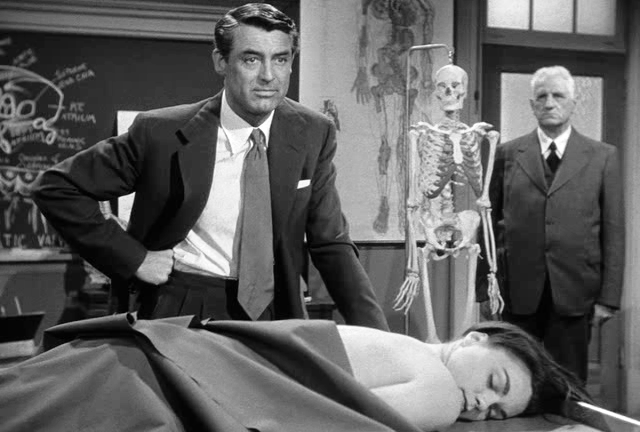 of the room where a corpse lies under a sheet. "I would be quite unable to give the lecture you came to hear and I'm not sure you should hear the lecture I'd like to give," Praetorius tells the students who all clamor, fearful he's going to leave without saying anything. Obviously, the doctor's reputation has made him a figure of fascination among the aspiring physicians and they'd be willing to hear him talk about anything. He asks them to get out their notebooks and uncovers the body, which turns out to be that of a very young woman. He gingerly strokes her long brown hair as he explains to the class, "Anatomy is more or less the study of the human body. The human body is not necessarily the human being. Here lies a cadaver. The fact that she was, not long ago, a living, warm, lovely young girl is of little consequence in this classroom. You will not be required to dissect and examine the love that was in her — or the hate. All the hope, despair, memories and desires that motivated every moment of her existence. They ceased to exist when she ceased to exist. Instead, for weeks and months to come, you will dissect, examine and identify her organs, bones,
 muscles, tissues and so on, one by one. These you will faithfully record in your notebooks and when the notebooks are filled, you will know all about this cadaver that the medical profession requires you to know." Following the doctor's introduction, a young lady (Jeanne Crain, one of the wives in Mankiewicz's A Letter to Three Wives) sitting among the students starts to flutter before she falls into the aisle. The students swarm her until Praetorius clears them away, saying, "A group of Cub Scouts would know better than to crowd like this." He asks if she's ever fainted before, but she says no. She says she's feeling better and the doctor gives her a piece of hard candy and asks another female student to escort her to the bathroom to splash some water on her face. Praetorius has grown impatient and decides to leave, bumping into Professor Elwell at the door. Elwell again apologizes for his delay. Praetorius says that Elwell wanted to ask him something about a tumor. "A malignant dysgerminoma," Elwell responds. "Professor Elwell, you are the only man I know who can say 'malignant' the way other people say 'Bingo!'" Praetorius tells his tardy colleague, unaware of Elwell's investigation into his past. The doctor and Shunderson leave with Praetorius' clinic as their destination.
At this point, a viewer still would be unclear where this story is heading, especially with the added presence of the large, mostly silent Shunderson usually near Praetorius' side. However, once we get to Praetorius' private
 clinic, which really functions more like a full-fledged hospital, the plot will start spinning in more directions. As I wrote earlier, I have no familiarity with the Curt Goetz play upon which it was based. Goetz began his career in Germany as a performer in silent films, including one directed by Ernst Lubitsch in 1918. He also began writing plays. In 1939, he went to Hollywood to try to get into filmmaking there, but got frustrated by the system and moved to Switzerland in 1945 (since he was Swiss by birth) and wrote some novels. His play Dr. Praetorius originally was written in Germany in 1934. The first English translation was called How to Die Laughing, was in seven acts and while it has some similarities to People Will Talk, the synopsis sounds quite different and even brings Sherlock Holmes and Dr. Watson into the tale. In 1949, Goetz co-directed with Karl Peter Gillmann a German-language version called Frauenarzt Dr. Prätorius that sounds exactly like People Will Talk, has Goetz himself playing the title role and is described as a "melodramatic comedy." That's probably as good a description as any of Mankiewicz's People Will Talk, which may be as idiosyncratic a film as he (or Cary Grant for that matter) ever made.
When we do get to the clinic, we do get more of a sense of what kind of doctor Noah Praetorius is and what the opening title cards meant when they said if he didn't exist, he should. If that were the case in the early 1950s, it's been multiplied exponentially by 2011. No sooner does he walk in the door that he starts getting hit by nurses and other staff with problems. One nurse informs him that a woman about to be discharged wants to take her gall bladder home with her. Praetorius finds that sweet and tells her to let her. The nurse says he knows they don't keep them after they are removed but the doctor guesses that the woman has no idea what her gall bladder looked like so just get another and "send her home happy." A bean counter talks to him about the costs of the hours for the kitchen staff and they should consider cutting back in terms of the patients' food. (That one is out of my life experience where one for-profit hospital I stayed at wanted to get their kitchen staff out early and served horrendous food out of a box for dinner.) Praetorius tells her that he has "the firm conviction that patients are sick people, not inmates." He then checks in on an older patient (Julia Dean) who doesn't look well and obviously is depressed about her condition.

PATIENT: I was thinking it's not much fun when you get old.
PRAETORIUS: It's even less fun if you don't get to be old.
PATIENT: I want to die.
PRAETORIUS: You'd like that, wouldn't you? Lie around in a coffin all day with nothing to do.
A nurse brings the good doctor a report on the final patient of the day and he asks her to show Mrs. Higgins into his office. She enters and it is the woman who fainted in class. Praetorius tells her the good news that
 there's absolutely nothing wrong with her and she can continue her studies, at least for a while. She confesses that she's not a medical student. She was just sitting in on the class to see him. Mrs. Higgins, who tells him to call her Deborah, shows signs of relief until Praetorius asks if she'll make a follow-up appointment or would she be getting her own obstetrician. Deborah breaks down, confusing the doctor, until he realizes that while she may be pregnant, he'd been mistaken to assume she was married. He inquires about the father, but she tells him that he's out of the picture. It seems he was called up to serve in Korea, which led to their coupling, and promptly got himself killed soon after arriving overseas. The doctor attempts to calm her, but Deborah isn't just worried about the shame unwed mothers faced at that time but she's convinced the news will kill her father. Praetorius tells her that parents can surprise you and be very understanding when you least expect it. Deborah insists her father is the most gentle, understanding man in the world, but his heart would be unable to take it.
After Praetorius has at least dammed the flow of Deborah's tears, she hastily exits. His receptionist returns and he asks if Deborah made another appointment but she informs her boss that she did not. The words have
 barely left her mouth when a shot is heard. Shunderson joins Praetorius in the hallway as does a nurse where they find a sprawled Deborah, derringer in hand. Miss Higgins is rushed into surgery and after much work, appears to be out of danger. Shunderson enters the operating room as Praetorius removes his surgical garb. "It's a good thing that most people don't have the foggiest notion where the heart is," the doctor says. "She missed it by a mile." Shunderson takes that to mean that her suicide attempt failed which Praetorius confirms. "Then she'll try again," Shunderson declares, giving Praetorius pause and a look of concern. At any rate, Miss Higgins will be out for awhile and Praetorius has an appointment to make. As if the doctor didn't have enough on his plate, he's also the conductor for the university's student-faculty orchestra and it's practice night.
Among the members of the orchestra is Praetorius' closest friend on the university's faculty — physics Professor Lyonel Barker (Walter Slezak) — who plays the bass violin in the orchestra, often to Praetorius' frustration. After the practice has finished, Barker asks Praetorius to stay behind because he needs to speak with him.
 Despite their playful bickering during rehearsal, Barker asks Noah if he considers him a trusted friend. Of course, Praetorius says. "Therefore I have the right to point out to you that there are occasions when you behave like a cephalic idiot," Barker tells him. He warns Praetorius that he's heard that Professor Elwell has been snooping around his past in the hopes of making a case with the university out of it. Praetorius doesn't seem concerned, but Barker admits that there are things about his past that even he doesn't know. Noah asks the physics professor if he told him everything there was to know about him, would it affect their friendship? Barker says not in the least. Noah pats Barker on the knee. "I know it's not much to have a friend who knows all about you but one who's afraid he's not quite sure, that's worth having," Praetorius smiles. He tells Barker not to worry, but he needs to drop by the clinic to check on a patient but tells his friend to drop by his house for a late supper when he returns from the clinic.

With Shunderson's words still echoing in his mind, Praetorius pays a visit to the recovering Deborah and tells her a whopper of a lie. He says they discovered that a lab error accidentally switched labels on two pregnancy tests being run at the same time and hers actually was negative while another woman's was positive. She therefore has no reason to be concerned. It still turns on the waterworks anyway. He asks her why she's crying now, but she says he wouldn't understand. He wishes her goodnight and tells her to rest because she has nothing to worry about now. When he gets home, he tells Barker what he did. The physics professor says he has to know that it's just a stall and she will learn the truth eventually. Noah says that he realizes that, but if he can ease her mind until perhaps he can talk to her father, things will be better. Barker's mind wanders off subject as he raves about how good the sauerkraut is, saying it reminds him of home. Praetorius lets him on his secret: He has his housekeeper make it. "Sauerkraut needs to come from a barrel, not a can," the doctor declares. He promises to send some home
 with Barker, but it's taken Praetorius' mind off subject as well to a pet peeve of his. He grabs a stick of paper-wrapped butter. "Our American mania for sterile packages has removed the flavor from most of our foods. Butter is no longer sold out of wooden buckets and a whole generation thinks butter tastes like paper," Praetorius complains. "There was never a perfume like an old-time grocery store. Now they smell like drug stores which don't even smell like drug stores even more." Before his tirade can go much further, the phone rings. It's the night matron at the clinic (Maude Wallace). It seems that Deborah has disappeared. She tells the doctor she doesn't know how she slipped out. Praetorius tells her that she probably walked past her and out the front door just as he did about an hour ago. When he hangs up, Barker guesses that the missing patient is the one that Noah lied to and now the doctor finds himself in a bit of a quandary.

Now as you probably can ascertain, as usually happens in films of this period and earlier, romance sparks insanely fast between Deborah and Noah, though to the film's credit you can't be certain at first if Praetorius truly has fallen for Deborah or if he simply proposes to her as a way of saving her reputation and rescuing her father Arthur (Sidney Blackmer) who lives under the thumb of his ultraconservative brother John (Will Wright) on his farm. Mr. Higgins describes himself as "an indifferent journalist, a minor poet, an ineffective teacher, a wretched businessman unable to provide for my wife and my child and then not even for my child" who ended up as his brother's dependent. In another classic Mankiewicz exchange after Praetorius has heard about all he can from Deborah's Uncle John, he and Deborah's father share this dialogue.
PRAETORIUS: How old were you when you learned to walk?
ARTHUR: I did pretty well by the time I was 4.
PRAETORIUS: When did you leave the farm?
ARTHUR: When I was 16.
PRAETORIUS: It couldn't have taken you 12 years to make up your mind.
We've got several plates spinning in the air now: A sudden marriage, a pregnant woman who doesn't know she's pregnant, a mysterious man, a professor secretly crusading against a popular doctor — no wonder if you peruse reviews written recently or when People Will Talk came out in 1951, many scratch their head because
 it doesn't fall into any standard formula. People criticize it for not being a good romance, but that's the weakest element and least interesting part of what's going on here. Praetorius admits to Deborah that he didn't marry her just to stop her from committing suicide and to save her reputation because that wouldn't be a very practical solution should a similar case arise. He can't marry all his patients. Deborah also finds the reality of the man once she lives with him and for his 42nd birthday buys him an elaborate toy train set which he sets up with her father running a line from one bedroom, Barker from another and Noah serving as chief conductor in another. Of course, there's a spectacular crash causing the three men to yell at each other and it coincides with the delivery of a message from Professor Elwell that the dean is assembling a hearing of faculty members to hear charges against Praetorius (set for the same night as the big orchestra concert no less). Deborah goes to their bedroom and collapses to the bed in tears. Noah assumes she's upset about the letter but she tells him, "It's just that I love you so much and I went and put all those candles on that cake when you're really only 9-years-old."
I think the reason People Will Talk confuses so many people comes down to three main factors: 1) Expectations for a Joe Mankiewicz film based on A Letter to Three Wives and All About Eve; 2) Expectations for a Cary Grant movie; and 3) Viewers lumping their own ideological baggage onto the film. With his two previous films, Mankiewicz truly established himself as a master of sharp, witty dialogue and that's present again in People Will Talk, only it doesn't always take the form of comedy. He has some points
 to make and I think that makes some feel uneasy, especially since the opening scene between Hume Cronyn and Margaret Hamilton sets the audience up to expect another pure comedy is on the way. When we switch to the anatomy class, though there are laughs to be found, he's subtly switching the tone to be more multi-faceted, particularly when he speaks of the cadaver's former life. By the time we get to the clinic, he's driven the point home that different approaches to medicine are what he's after here. It shouldn't have been a surprise: That's why I used the screenshots of those two title cards that start the film to start the post. There was a third, praising doctors in general, but given some of the doctors I've run across in my hellish journey through the health care system, that title card reads as hopelessly out of date because while there are good doctors today there also are a lot of greedy and incompetent bastards who don't give a shit as well. People Will Talk often is called ahead of its time because of its treatment of Deborah's out-of-wedlock pregnancy, but what really makes the film prophetic is how it pits Dr. Praetorius' commitment to healing the patient as the priority above everything else while doctors such as Professor Elwell want less to do with them and accountants try to cut costs on things such as food service for hospitals. This was made 60 years ago and it's only worse now. Imagine if the issues of billing and health insurance came into play.
By 1951, Cary Grant had been a star for a long time so most moviegoers had come to expect a certain type of role from him. Whether it be a fast-talking smoothie in a screwball comedy such as His Girl Friday, a more
 refined romancer in The Philadelphia Story, an adventurer in Gunga Din, a serious romantic with a mission that takes precedence in Notorious or even a fretful father in the weepy Penny Serenade, he always seemed to be in charge or at least care about the outcome. The only possible exception would be Bringing Up Baby where he's at Katharine Hepburn's mercy. As Praetorius, he certainly goes above and beyond when it comes to caring about his patients, but he plays the doctor at a distance from the audience, something quite unusual for him, and Praetorius seems indifferent to the investigation by Elwell. The real switch, which really I can only think of happening in Baby, is that Deborah figures out rather quickly what he's up to when he pursues her at the farm and she starts stalking him around the dairy. It's unusual to see Cary Grant be the prey and it’s to Jeanne Crain’s credit that she makes Deborah’s transition believable. Grant gave a lot of great performances and is one of Oscar's biggest crimes that he only was nominated twice, both for tear jerkers. While I love Walter Burns, I have to admit that Dr. Noah Praetorius might be the best work he ever did on film.
Now little can be done to control what people think they see in things. We live in a world where TV preachers thought certain Teletubbies were gay for crying out loud. Admittedly, the film does have some unmistakably liberal viewpoints, particularly in the scenes where Uncle John spouts his views at the farm, but I think far too
 many people mistake Professor Elwell's campaign against Praetorius as some sort of metaphor for McCarthyism. (This was based on a play originally written in Germany in 1934 after all.) People Will Talk's only concern is comparing medical philosophies. Elwell's only interested in one admittedly unusual faculty member who has an odd friend who always stands by his side. I won't give away the details of the hearing because I want more people to see this movie. It's not a perfect movie and it's certainly no All About Eve, but I think it's better than A Letter to Three Wives and I like that film a lot. The performances across the board are great and that sparkling Mankiewicz dialogue is as quotable as ever. Time and again I'm amazed how many early films addressed problems with our health care system in different ways such as 1931's Night Nurse and Mankiewicz's own No Way Out the year before, even though racism was its bigger issue. The Brits even exposed their own failings in 1938's The Citadel before they reformed their system. We in the U.S. should be ashamed. I think one great quote that Praetorius delivers during his hearing proves particularly prescient.
"The issue is whether the practice of medicine will become more intimately involved with the human being it treats or whether it is to continue to go on in its present way to become more and more a thing of pills, serums and knives until it eventually will undoubtedly evolve an electronic doctor."
Honestly, given some of the M.D.s I've encountered, I'm not so sure an electronic doctor would be worse. I do know though that what makes me like People Will Talk more each time I see it falls along the same lines as many new films that captivate me: They dare to be different and to eschew formula while employing talented casts to tell unusual stories well.
Tweet
Labels: 50s, Cary, Cronyn, John Ford, K. Hepburn, Lubitsch, Mankiewicz, Movie Tributes, Oscars, Poitier, Widmark
TO READ ON, CLICK HERE


