Friday, May 18, 2012
Centennial Tributes: Richard Brooks Part I

By Edward Copeland
"First comes the word, then comes the rest" might be the most famous quote attributed to Richard Brooks, who began his life 100 years ago today in Philadelphia as Ruben Sax, son of Jewish immigrants Hyman and Esther Sax. He wrote a lot of words too — sometimes using only images. In fact, too many to tell the story in a single post. so it will be three. His parents came from Crimea in 1908 when it belonged to the Russian Empire. Like the parents of a great director of a much later generation and an Italian Catholic heritage, Hyman and Esther Sax also worked in the textile and clothing industry. Sax's entire adult working life revolved around the written word — even while he busied himself with other tasks. “I write in toilets, on planes, when I’m
 walking, when I stop the car. I make notes. If I am working at a studio, I work at the studio in the morning, then come home. I am really writing two days instead of one. After the studio, I have my second day (at home). I write whenever I can,” Brooks said in an interview with Patrick McGilligan for his book Backstory 2: Interviews with Screenwriters of the 1940s and 1950s. After high school, he entered Temple University where he majored in journalism, though he left early when he realized the financial hardship that his tuition put on his parents. After drifting around the eastern half of the U.S. for a while by train, Sax returned to Philadelphia and got a job as s sports reporter at The Philadelphia Record where he first adopted the name of Richard Brooks. When he later got hired by The Atlantic City Press-Union, he met another reporter with an independent streak who would eventually make his way to Hollywood by the name of Samuel Fuller. Shortly after moving to New York for a job with that city's World Telegram newspaper, only leaving the sports beat behind for crime reporting. Brooks discovered that radio jobs provided bigger paychecks so he took a job at the 24-hour radio station WNEW, first as a disc jockey. "Played records 23 of those hours," McGilligan described in the introduction to his interview. Later, the station promoted him to news where he edited four news broadcasts a day newspaper jobs and wrote one. His work there led to a news job at NBC Radio's Blue Network where he also got to do commentary. At the same time, in 1938, Brooks tried his hand at playwriting, which led in 1940 to co-founding The Mill Pond Theater in Roslyn, N.Y., with David Loew. It's on that stage that Brooks made his debut as a director, taking turns with Loew helming productions at the summer theater. A falling out with other members of the theater sent Brooks to California where he worked for NBC Radio from the other coast. Among his duties was writing and directing the broadcast Richard Sands. Brooks also began writing a short story every day and reading it on air. “I’d written some short stories before, but none was published. Anyway, every day, another short story. Everything became grist for a short story. It began to drive me crazy…a different plotline every day. My ambition: write one story a week instead of a different story every day. In about 11 months, I wrote over 250 stories. I even devised a system whereby on Fridays I wouldn't have to write a short story. I called that day 'Heels of History.' I would take a fable and convert it. As a matter of fact, I used one afterwards in The Blackboard Jungle,” Brooks told McGilligan. Brooks gave the example of how he took the story of "Jack and the Beanstalk," citing how while he's portrayed as a hero, Jack's actually a dumb, bad kid who ignores his mother's order, shows little concern for an ailing fire and steal, even if it's from a giant. Granted, it doesn't appear to have been broadcast nationally but I wonder if Stephen Sondheim and James Lapine came across this when
 conceiving Into the Woods?. Witches can be right, giants can be good… Brooks, like what happened when he learned radio paid more than newspapers, discovered in California that screenwriters earned bigger paychecks than broadcasters. He set up a meeting with George Waggner at Universal, where Waggner — who later would direct The Wolf Man and much episodic TV including many installments of The Man from U.N.C.L.E. and Batman — was the assistant producer of White Savage, a Maria Montez film directed by Arthur Lubin. Waggner asked if Brooks wrote because they desperately needed a rewrite. It was his first movie job and Brooks made "$100 (weekly) plus a day or two prorated, and they put my name on (the screen) as 'additional dialogue,'" Brooks told McGilligan. White Savage wasn't the first film Brooks worked on to be released though — two others and a serial came first. He also hung on to the NBC gig and got the chance to write for Orson Welles' Mercury Theatre. Brooks produced countless sentences and paragraphs and but still lacked a "written by" credit on a screenplay credit. Once he did and, later, when he directed, he'd impact filmmaking both during and beyond his life, often with social themes few would touch (though occasionally in a heavy-handed way). He also managed to write some novels on the side — while with the Marines during World War II, where he'd also crank out a couple of screenplays (including his first credited one on Cobra Woman, directed by Robert Siodmak and again starring Montez) and report for Stars & Stripes as well while learning about filmmaking from Frank Capra's motion picture unit and eventually on his own editing combat footage into documentaries while attached to the 2nd Marines, Photographic Unit. If the Allies only needed a typewriter to defeat the Axis, Brooks might have been a good option for the weapon. First comes the word…
Though Brooks' legend derives predominantly from his film legacy, he experienced his first rush of acclaim with the publication of his debut novel, written while stationed at Quantico at night in the bathroom, according to the account in Tough as Nails: The Life and Films of Richard Brooks by Douglass K. Daniel. Several publishers rejected it until Edward Aswell at Harper & Brothers, who also edited Thomas Wolfe, agreed to take it — and he shocked Brooks further by telling him (after a few suggestions) they planned to publish in May 1945. This news flabbergasted Brooks who obtained a weekend pass to go to New York because Aswell insisted on informing him in person. Now Brooks had to return to Quantico where the top officers of the Corps about shit bricks when The New York Times published a big review of The Brick Foxhole soon after it hit shelves. (Orville Prescott's take was mixed, assessing it as compulsively readable but weak on characterization.) Its story of hate and intolerance within the Marines brought threats of court-martialing Brooks, since he'd ignored procedure and never submitted the novel to Marine officials for approval ahead of time. They wanted to avoid bad publicity, especially with all the good feelings as the war wound down. "There was nothing in that book that violated security, but their rules and regulations were not for that purpose alone," Brooks told Daniel. Aswell prepared to launch a P.R. counteroffensive with literary giants such as Sinclair Lewis and Richard Wright ready to stand by Brooks. In case you don't know the story of the novel, it concerns a Marine unit in its barracks and on leave in Washington. Through their wartime experiences, some of the men truly turned ugly, suspecting cheating wives and tossing hate against any non-white Christian. It turns out, though the real Marines let the matter drop, what bothered them
 about the book wasn't the anti-Semitism or racist tendencies of the characters but the murder of a Marine some of the other Marines learn is gay. The U.S. Marines didn't want to promote the idea there might be homosexuals serving in the military. Ironically, they got their wish when The Brick Foxhole transferred to the big screen in 1947 as Crossfire. Brooks wasn't involved in the film version, but they made the murdered Army (The Marines even got to toss it off to another military branch entirely) soldier Jewish in the film. The film actually happens to be very good and was nominated for best picture and earned Robert Ryan his only Oscar nomination ever as supporting actor. What's even sadder is that Crossfire ends up being a much more powerful film against anti-Semitism than the creaky Gentleman's Agreement that took on the same subject that year and won best picture. If there weren't already enough ironic twinges in that story for you, Gentleman's Agreement, probably the grandfather of that tried-and-true staple "let a white guy be the hero of a story about another ethnic group" with Gregory Peck playing a Christian going undercover as a Jew to learn about anti-Semitism, won Elia Kazan his first directing Oscar. Edward Dmytryk, one of The Hollywood Ten, directed Crossfire, which dealt straight on with anti-Semitism and the effects of warfare on men. Then again, once Dmytryk served his jail time, he became the only one of the 10 to name names to HUAC because he wanted to work again.
While he didn't want to make a movie of The Brick Foxhole himself, another former newspaperman turned socially conscious film artist met with Brooks about working with his independent production company. At first, Mark Hellinger tried to lure Brooks away from Universal with the promise of doubling his salary if he'd adapt a play he liked into a movie, but before Brooks could consider that offer, Hellinger called with a more pressing matter. He was producing an adaptation of Ernest Hemingway's famous short story The Killers. The problem: someone had to dream up what happened after the brief tale ends because it certainly wouldn't last 90 minutes otherwise. Hellinger flew Brooks out to meet Papa himself, but he didn't get much out of him but he did come up with an idea for what would happen after the story ends. Hellinger liked it and sent it to John Huston, who wrote the screenplay as a favor. Since both Brooks and Huston had contracts at other studios, neither got screen credits, so Ernest Hemingway's The Killers' official screenplay credit goes to Anthony Veiller, who received an Oscar nomination for best screenplay. He'd previously shared a nomination in the same category for Stage Door. The film also made a star out of Burt Lancaster, who would work with Brooks several times and be his lifelong friend. In fact, Lancaster would star in the next screenplay that Brooks wrote, a Mark Hellinger production directed by one of those people Edward Dmytryk eventually would name before the House Un-American Activities Committee. The film, of course, would be the still-powerful Brute Force, the director, Jules Dassin.


John Huston wasn't happy. Producer Jerry Wald called him, excitement in his voice, to tell him he'd secured the rights to Maxwell Anderson's Broadway play Key Largo for Huston to direct. This didn't thrill Huston, who thought the play gave new meaning to the word awful. Written in blank verse, Anderson's play concerned a deserter from the Spanish-American War. People at a hotel do get taken hostage, but by Mexican hostages. Essentially, Huston tossed the play in the trash bin. Huston hired Brooks to co-write an in-title only version and, still pissed at Wald, barred him from the set. Part of Huston's anger stemmed from the HUAC nonsense, (His outrage would drive him to move to Ireland for a large part of the 1950s.) so he couldn't stomach adapting a play by Anderson whom he considered a reactionary because of his hate of FDR. Despite Huston's distaste for the project, he
 turned it into a classic film with a little help from Humphrey Bogart, Lauren Bacall, Lionel Barrymore, Claire Trevor in her Oscar-winning role and, last but certainly not least, Edward G. Robinson as exiled mobster Johnny Rocco, who likes to brag about the power he used to wield. "I made 'em — like a tailor makes a suit of clothes," he tells a former associate. Knowing the story of what happened prior to filming makes you chuckle when you see the credit that reads, "As Produced on the Spoken Stage." It's great to watch Robinson and Bogart go toe-to-toe. Rocco makes a particularly memorable first appearance, lounging upstairs in a hotel bathtub, looking in a way like a prediction of that famous photo of Dalton Trumbo that would be taken decades later. Bogart, updated to a returning WWII veteran, perfectly plays his role of Frank McCloud so that you never know if he's being savvy or scared of the crimnals terrorizing them. "You don't like it, do you Rocco, the storm? Show it your gun, why don't you? If it doesn't stop, shoot it," Frank says at one point, but when he gets a chance to grab a gun and take him out (though Rocco's men would certainly finish Frank afterward), he nonchalantly declares, "One Rocco more or less isn't worth dying for." The script's dialogue crackles and for additional fun touches we get a great Max Steiner score and the multitalented German émigré Karl Freund as cinematographer. The most remarkable thing that Huston did though was to invite Brooks to stay on the set during the film's shooting, something he'd never done as a writer and that he talked about in this YouTube video in 1985.
While I would have liked to have viewed more of Brooks' work that I've never seen (and to re-visit some which I have), time and availability, combined with his prolific nature and the industry's increasingly cavalier willingness to let both old and recent films fade into oblivion, proved to be a problem. After Huston's generosity, Brooks' directing debut would arrive two years later. Four films where Brooks worked
 solely as a writer remained — the Paris-set spy thriller To the Victor; Any Number Can Play with Clark Gable as an underground casino owner advised by his doctor to get out of the business because of his heart disease; Mystery Street with detectives Ricardo Montalban and Wally Maher consult a Harvard forensics expert (Bruce Bennett) to solve a mystery when a decomposed body washes ashore; and Storm Warning, where model Ginger Rogers goes to visit her sister in a particularly unfriendly town and secretly witnesses a mob lynch a man that her sister (Doris Day) tells her was a reporter who denounced the KKK. Rogers' character gets a bigger shock when she realizes baby sis' husband participated in the lynching. After 1951, every film Brooks worked on he at least held the title of director, beginning with 1950's Crisis with Cary Grant as a doctor vacation with his wife in a small country when the dictator (José Ferrer) kidnaps them to force the doctor to treat his life-threatening condition. The doctor's ethics get tested by his oath and the idea that if he lets the man die, life for the country's people will improve. For a writing-directing debut, Brooks makes a pretty good start even if it doesn't come close to some of the films he wrote. His next four films as director and writer or co-writer I haven't seen, though I tried to watch the last one. The next film, The Light Touch (1952). starred George Sanders and Stewart Granger a collector of stolen art and an art thief, respectively, trying to get their hands on the masterpiece Granger stole and that his wife Pier Angeli stays busy counterfeiting
 enters their lives. At the time, Granger was married in real life to Jean Simmons, who would become Brooks' second wife about 10 years later. The next two films both starred Bogart. First came Deadline-U.S.A. with Bogie playing an investigative reporter trying to expose a gangster as his paper faces imminent closing followed by Battle Circus co-starring June Allyson where they played medical personnel at a MASH unit during the Korean War. The final film, which I almost watched, was The Last Time I Saw Paris, based on a story by F. Scott Fitzgerald and co-written by Brooks and the Epstein brothers, Van Johnson plays a former soldier returning to the city he liberated in the war, now despondent over his attempts to be a writer. He gets invited to parties with the city's beautiful people and finds one (Elizabeth Taylor) who enchants him. Unfortunately, the DVD transfer on Netflix’s rental copy proved abysmal. The Technicolor has faded beyond belief and it was filmed in an odd 1:75:1 spherical ratio, so every image looked distorted because they just flattened it full screen. After a few minutes, I had to shut it off. Apparently, it's a Warners Archive title now, but of course, they don't offer those for rental so the shitty DVDs will remain for people who don't believe in buying blind. I haven't caught his next two directing efforts either, but they stand out because they marked the first two times (and it only occurred three times) that Brooks directed screenplays written by someone else. In 1953, he directed Richard Widmark as a Korean War vet now serving as a tough drill instructor for new GIs bound for Korea while he's bitter that his request to return to Korea keeps being denied in Take the High Ground! In 1954, Brooks helmed Flame and the Flesh with Lana Turner as unlucky woman trying to get what she can for nothing visiting Europe who finds herself wooed by a gigolo.
With 1955, Brooks wrote and directed the first film that truly garnered him an identity as more than a writer who directs but as a director with Blackboard Jungle, a film that admittedly manages to look both dated and timely simultanouesly, First, as so many old films did, it had to start with a long scroll explaining that American schools maintain high standards, but we need to worry about these juvenile
 deliquents before this gets out of hand. It gets off to a rockin' start — literally — with opening credits that can't help but make you think of the original beginning to TV's Happy Days as Bill Haley and the Comets get everything moving to "Rock Around the Clock" as new English teacher Richard Dadier (Glenn Ford) arrives to work at all-boys high school North Manual Street. Most of the school overflows with miscreants, especially his class who start calling him "Daddy-O" to avoid pronouncing his name. (Though it's never been confirmed, many assume that the movie inspired Leiber & Stoller's lyric "Who called the English teacher Daddy-O?" in The Coasters' huge late '50s hit "Charlie Brown.") The ensemble Brooks assembled, including some of the "teens" who would make their names much later included Anne Francis as Dadier's pregnant (and, quite frankly, neurotic) wife; Louis Calhern as a veteran teacher left with nothing but cynicism and a
 desire to beat the crap out of the punks; Richard Kiley as a nerdy math teacher with a love for jazz; Margaret Hayes as another new teacher who doesn't think about how she's dressing and nearly pays for it; Sidney Poitier as a student who appears to be one of the delinquents yet practices playing the piano and singing hymns; and Vic Morrow as the worst kid in the school, a downright criminal. Also, look for appearances by future writer-director Paul Mazursky as a student, Richard Deacon as a teacher and Jamie Farr as another student when he acted using the name Jameel Farah. While Blackboard Jungle offers much to praise, at times it comes off as too simplistic. It did dare to tackle bigotry and use the epithets. Sometimes, it feels eerily like the awful 1984 film Teachers. I kept expecting Calhern to turn out to be like the Royal Dano character and drop dead at his desk. I wonder what Brooks would have thought if he'd seen The Wire's fourth season. Blackboard Jungle earned Brooks his first Oscar nomination for best screenplay. Brooks' competition consisted of Millard Kaufman (who wrote Take the High Ground!) for Bad Day at Black Rock, Paul Osborn for East of Eden, Daniel Fuchs and Isobel Lennart for Love Me or Leave Me and Paddy Chayefsky, who wrote the teleplay that would be the basis for one of Brooks' 1956 films, for Marty. Chayefsky won his first Oscar. Nearly the entire cast excels in spite of some of the weaker parts of Blackboard Jungle (except Francis, burdened with a thankless role) but Morrow stands out in the ensemble as the worst punk.
 Tweet
Labels: blacklist, Bogart, Capra, Cary, Dassin, Doris Day, Edward G., Fiction, Fitzgerald, Fuller, Ginger Rogers, Glenn Ford, Hemingway, Huston, Lancaster, Liz, Mazursky, Poitier, Robert Ryan, Widmark
TO READ ON, CLICK HERE


Wednesday, October 26, 2011
“I live in a perpetual state of optimism…”

By Ivan G. Shreve, Jr.
Artist and activist Harry Belafonte turned 84 in March of this year…and has lost none of his expertise for making headlines. On a recent edition of The Joy Behar Show, he was extremely critical of former Godfather’s Pizza CEO and now GOP presidential candidate Herman Cain, labeling him “a bad apple” — and later remarked to Newsweek, “I’m pretty sure African Americans don’t take Cain seriously, but I’m not sure about white people. They believe this black man is the real deal. He isn’t. Anyone who says what he says isn’t.” Cain volleyed back, remarking “He’s been on that banana boat too long” — a reference to the actor-singer’s million-selling record in 1956, “The Banana Boat Song (Day-O).”
At the risk of getting into a political urination contest…Herman Cain can’t carry Harry Belafonte’s jockstrap. While Cain was content to shuck and jive in the back of the bus during the Civil Rights struggle, Belafonte was at the forefront of that movement…as a confidant to Martin Luther King, Jr., and an organizer/supporter of many of the landmark events during that era (the Freedom Rides, the March on Washington, etc.). Long before celebrities such as Sean Penn and Angelina Jolie stretched beyond their chosen professions with defiant political stands and causes, Harry was one of the first to walk the walk and talk the talk…and as a new HBO documentary, Sing Your Song, demonstrates — he is “the real deal.”

The running time of Sing Your Song (1 hour and 45 minutes) can’t scratch the surface in documenting Belafonte’s remarkable career — in fact, the presentation is but one portion of a retrospective look at the actor-singer’s life; a memoir entitled My Song was published recently and allows Belafonte to take a more detailed and anecdotal look into his amazing past. Sing Your Song acts as a primer for those individuals whose only familiarity with the performer-activist boils down to asking the boss man to count his bananas. The documentary offers rich, rewarding archival footage of Harry’s TV appearances and clips from his movies, supplemented with Belafonte’s narration and on-camera interviews with the likes of Diahann Carroll, the late Coretta Scott King, Julian Bond, Rep. John Lewis and Sidney Poitier, to name just a few. Directed by Susanne Rostock and co-produced by his daughter Gina, Song tells the story of Belafonte’s triumph over a life of hardscrabble poverty to become a Emmy, Grammy and Tony Award-winning performer whose dedication to the cause of social justice was prompted by his mother once telling him “that I should never, ever awaken in a day where there wasn’t something in our agenda that would help set the course for the undermining of injustice.”
Harold George Belafonte, Jr. was born in Harlem in 1927 to immigrant parents — and when his father left his mother shortly after his birth, she was forced to compensate in a one-parent household by working as a domestic, sending Harry and his brother to live with their grandparents in Jamaica. His early life (1932-40) in that country would have a profound effect on his future profession. That career direction was decided one night back in New York when he attended a performance of Home is the Hunter at the American Negro Theatre in Harlem (he was working as a janitor’s assistant and received tickets to the play as a gratuity). He joined the theater company (his fellow students included Brock Peters and lifelong friend Poitier), and soon after became a pupil under the tutelage of German director Erwin Piscator at the Dramatic Workshop of the New School of Social Research. (Among Harry’s classmates: Marlon Brando, Tony Curtis, Walter Matthau, Bea Arthur and Rod Steiger.)

To pay for his acting classes, Belafonte worked as a nightclub singer in New York — his first gig found the likes of Charlie Parker, Max Roach and Miles Davis playing as his “back-up band.” Belafonte had started out singing pop tunes in 1949, but he became interested in folk music after seeing a performance by Huddie Ledbetter and studied the history of that music at the archives of the Library of Congress. He soon became a regular at New York’s Village Vanguard, and it was there that the legendary actor-singer-activist Paul Robeson made Harry’s acquaintance, advising him: “Get them to sing your song and they will want to know you are.” (Hence the title of the documentary.) Robeson would become one of the many mentoring influences in Belafonte’s meteoric rise to fame, which all began with a Tony Award for his participation in a Broadway production of John Murray Anderson’s Almanac. With his first single released in 1953 and first LP a year later (Mark Twain and Other Folk Favorites), Belafonte’s breakthrough album came in 1956, entitled Calypso — the first LP certified as a million seller. In clips from variety shows hosted by Ed Sullivan, Dinah Shore and Steve Allen, Sing Your Song features snippets of Harry’s popular hits such as “Jamaica Farewell,” “Mama Look at Bubu” and “Man Smart, Woman Smarter.”
Achieving success with a gold record album was not all peaches and cream for Belafonte, who was also carving out a niche in motion pictures beginning with his first film for MGM, Bright Road (1953), co-starring Dorothy Dandridge. During production on this film, Harry was staying with friends at a house in Beverly Hills when he decided to take a fresh air stroll one night and found himself stopped by the local constabulary, whose interest in him seemed to center around the fact that he was “walking around Beverly Hills while being black.” It wouldn’t be the first time the actor-singer would be on the receiving end of the cold water splash of prejudice; he details in Song how he wasn’t able to stay in the same hotels as co-stars Marge and Gower Champion when they toured with their revue 3 For Tonight (his encounter with a state trooper after attempting to relieve himself in a “whites only” restroom is particularly memorable) and how his protest over similar conditions at a Las Vegas hotel (he was the headliner but wasn't expected to use the main entrance or eat in the hotel’s main dining facilities) earned him a warning “that the only way I would leave Las Vegas if I didn’t fulfill that contract would be in a box.” (Harry gets the last laugh; Fran Scott Attaway, the wife of Belafonte’s bandleader, relates an incident in which Harry summons up the stones to take a dip in the hotel’s lily-white swimming pool.)
Despite motion picture success in films such as Carmen Jones (1954; which re-teamed him with Dandridge), Belafonte encountered similar hostile racial attitudes in the movie industry — controversy arose from his performance in the 1957 film Island in the Sun, which
 intimated that there was a romance going on between his character and that of Joan Fontaine’s — something that was anathema to Southern audiences (his publicist, Mike Merrick, observes that the ticklish situation nevertheless made curious onlookers more determined to see the film). Belafonte’s struggle to find good roles free of negative black stereotypes led him to start his own production company in HarBel — which produced movies such as The World, The Flesh and the Devil (an “end of the world” film whose ending was tampered with by MGM when the touchy issue of a romance between Harry and white Inger Stevens once again caused Southern audiences to revolt) and Odds Against Tomorrow (both 1959). (In an interview with The Daily Beast, Belafonte cited the last movie — a noir that mixes a heist film with a searing examination of racial prejudice — as “the centerpiece of my work in cinema.”) Everywhere Harry seemed to turn he would confront the specter of intolerance; his television specials Tonight with Belafonte and Belafonte, New York 19, despite winning critical and ratings accolades (Tonight won Harry a Emmy for outstanding performance in a variety or musical program or series) earned him enmity from the sponsors for his insistence on using racially integrated casts.
Belafonte recently related to an interviewer: “I was an activist before I was an actor. I was aware of all happening around me that was wrong in the midst of getting into this career. All of us did during those times, and we couldn’t sit back and worry about the consequences of doing something. We had to speak out about what was wrong in this country, and we did.” It is this portion of Harry’s
 life that makes much of Sing Your Song fascinating viewing; the audience learns that his friendships with Robeson and later Martin Luther King, Jr. earned him the unwelcome intrusion of the FBI (who was convinced back then that anyone fighting for the cause of equal rights must be some sort of Commie) — Belafonte’s first marriage to wife Marguerite Byrd suffered the severe strain of J. Edgar’s interest in the activist; Byrd simply couldn’t reconcile that the stories being handed to her about Belafonte by the bureau were complete bullshit. His closeness with Dr. King is even more remarkable and is choc-a-bloc with anecdotes; it was Belafonte who lobbied presidential candidate John F. Kennedy (then a senator) to intervene on King’s behalf when King was sentenced to work on a Georgia chain gang for a minor traffic violation. Later, Harry was needed to put the Kennedy administration’s fears to rest about the unrest that they believed would result from the 1963 March on Washington. Belafonte proudly relates how he persuaded the Kennedy people to eventually side with those in the civil rights movement, and in particular the part he played in educating Robert Kennedy, who may have been his brother’s attorney general but was still quite conservative in his politics (he had worked for Sen. Joseph McCarthy early in his career). (King once said to Belafonte about Bobby Kennedy: “In that mind resides good; go out and find that man’s moral center and win him to our cause.”)
Sing Your Song provides telling details about Belafonte’s humanitarian efforts on behalf of Haiti, South Africa and other nations, particularly as one of the organizers behind USA for Africa and as goodwill ambassador to UNICEF …and comes full circle to the actor-singer’s struggle to make individuals aware of the growing problem with at-risk and incarcerated black/Latino gang youth (his palpable rage at seeing television news footage of a 9-year-old girl being handcuffed because she was “unruly” is not something easily forgotten). If there are any weak areas in Song, it’s that Belafonte’s controversial stance on the Iraq War (with headline-grabbing remarks directed toward its architects U.S. Secretaries of State Colin Powell and Condoleezza Rice, not to mention President George W. Bush) is sort of glossed over, but then much of the material from later in his life (including some of his film work from the '70s up to today) is telescoped to fit the demands of the documentary’s running time.
“How could it be that the world is in the chaos and disorder and the consuming violence that we are all experiencing after so many had invested so much to change that fact?” Harry Belafonte asks the interviewer’s camera close to the end of Sing Your Song. The struggle against injustice is a constant one, and while Harry Belafonte was able to temper the fight on occasion through his music and acting, he would pay a price for his activism; several of his children and second wife Julie Robinson (the two of them later divorced and Belafonte married his third wife, Pamela in April 2008) relate in Song that while Harry wasn’t a bad father it was often a trial serving two families (his own and his activism) making demands on his time. The release of this documentary and his memoir My Song comes at a most opportune time when the U.S. is in a current state of upheaval over the issues of unemployment, health care and poverty. It is one thing to allow individuals to do the heavy lifting addressing the ills of the system in order for you to reap financial benefits (and perhaps run for president), it is another to commit yourself to a mindset that “from the time I go to sleep till the time I get up, I seek out the injustices done to humankind.” Harry Belafonte continues to sing his song…and we are all richer for his having done so.
The original HBO documentary Sing Your Song has an encore performance today at 11:30 a.m. EDT (10:30 a.m. Central) and also can be viewed later at 2:30 p.m. on HBO West. It will continue to air at various time and dates on various HBO channels through Nov. 22. The documentary also is available on HBO On Demand (where applicable) until Nov. 13. It will be accessible to HBO subscribers on HBO GO until Dec. 31, 2012. For more details, check out its entry on HBO’s website here.
Tweet
Labels: 10s, Awards, Belafonte, Brando, Documentary, HBO, Jolie, Matthau, Music, Musicals, Nonfiction, Poitier, Sean Penn, Television, Theater, Tony Curtis, Twain
TO READ ON, CLICK HERE
Monday, August 29, 2011
"There is a vast difference between curing an ailment and making a sick person well"


By Edward Copeland
Joseph L. Mankiewicz accomplished something in 1949 and 1950 that has never been equaled in Oscar history: He won the awards for directing and writing in two consecutive years. John Ford also had won directing Oscars in consecutive years, but no one had won for both directing and writing as Mankiewicz did for A Letter to Three Wives and the incomparable All About Eve. That would be an impressive one-two punch for any filmmaker (and between those two films he co-wrote and directed the solid 1950 suspense drama No Way Out starring Richard Widmark and Sidney Poitier in his film debut) but in 1951, Mankiewicz made another great film, one that gets better each time I see it. Adapted from the play Dr. Praetorius by Curt Goetz, Mankiewicz wrote and directed People Will Talk, which was released 60 years ago today. It didn't receive any Oscar love, but it does contain one of Cary Grant's very best performances and aches to be re-discovered by film buffs or seen for the very first time by those who haven't.
Compared to Mankiewicz's previous two films, People Will Talk defies categorization at just about every step of its story. Though those title cards shown in screenshots above indicate that this will be the story of Dr. Noah Praetorius, we won't meet him in the form of Cary Grant right away. The first person we see is none other than the Wicked Witch of the West herself, Margaret Hamilton, sitting on a bench in a hallway. A man (Hume Cronyn) comes walking down the hall when the woman addresses him as Professor Elwell. He responds, though he doesn't know who she is. It soon becomes clear that she is Sarah Pickett, a woman he's been expecting from a detective agency. Professor Rodney Elwell unlocks his office door and invites her inside. The dialogue between the pair implies that we're definitely in store for a comedy.

PICKETT: If I come in, does the door stay closed?
ELWELL: Naturally.
PICKETT: Then I don't come in.
ELWELL: Why not?
PICKETT: You know why not. You're grown up.
ELWELL: My dear Mrs. Pickett —
PICKETT: Miss Pickett — and don't butter me up.
ELWELL: I have conducted my affairs behind closed doors for 20 years.
PICKETT: Not with me.
ELWELL: You overestimate both of us.
Miss Pickett joins Elwell in his office and the door remains open as the medical professor begins quizzing Miss Pickett about whether she knew a man named Praetorius in her hometown of Goose Creek. Yes, Pickett says, "He was a doc.…He healed people," Dr. Elwell asks how he did that. "If I knew how I'd be a doc myself," she replies, telling Elwell that he saved her grandmother. Elwell assumes that the old woman must have passed by now, but Miss Pickett says she's still alive. He asks her grandmother's age. "103, but I think she's lying," Pickett responds. "She's 108 if she's a day." She tells Elwell that her grandmother lay down to die four times and each time, Dr. Praetorius got her back up on her feet. Elwell inquires about the methods of this "miracle man." "Well, some healers use one thing, some use another, but Doc Praetorius used 'em all," she tells him. Elwell shows her a book of faculty members and points to a photo of Praetorius (our first glimpse of Grant) and Pickett positively identifies him, though she says he looked younger then. He asks Miss Pickett if Praetorius was a university-trained doctor.
PICKETT: When you say doctor, do you mean school doctor, out of books?
ELWELL: That is precisely what I mean.
PICKETT: Can't say. For my part I wouldn't get caught dead in a room with one of 'em.
ELWELL: Miss Pickett, I am a school doctor, out of books.
PICKETT: That's one reason why the door is open.
A student (George Offerman Jr.) interrupts the meeting to remind the professor that he's late for his anatomy class that Elwell asked Dr. Praetorius to attend. Elwell tells him to deliver the message that he's been
 unavoidably delayed. After the student leaves, he asks Miss Pickett what more she knows. Suddenly, Pickett looks around and she shuts the door. "You're a professor. It's hard to make you understand anything that ain't in the books. Well, most of what goes on in the world ain't in books." Elwell's skepticism is quite palpable. He then asks what she knows of a man named Shunderson. "I didn't know very much. Nobody did," she says with a shiver, though she admits they used to call him "The Bat" before she changes the subject, reminding him that Sergeant Canton of the detective agency that found her mentioned Elwell might have a job for her. This is a rare dropped ball in People Will Talk. It's implied that Elwell wants to plant Pickett as a housekeeper to spy on Praetorius, but her character never appears again. We really have no idea where this film is heading at this point. Is it a comedy? A mystery? As usual in a Joseph L. Mankiewicz screenplay, the dialogue comes full of gems, but since it's not an original screenplay, how much originated in the play, though it was written in German?

As we finally leave Elwell and Miss Pickett, we arrive in the lecture room of Professor Elwell's anatomy class. The infamous Dr. Noah Praetorius stands playing with the class' skeleton with his mysterious friend Shunderson (Finlay Currie) standing behind him. Praetorius keeps moving the jaw of the skull and wonders out loud, "Why should a man die and then laugh for the rest of eternity?" The student who had interrupted Elwell's meeting comes in and the doctor addresses him as Uriah and asks what he knows about Elwell. "He regrets exceedingly that he is unavoidably detained," Uriah tells him. "A meaningless phrase which could signify anything from oversleeping to being arrested for malpractice," Praetorius replies. The doctor walks to a table at the center
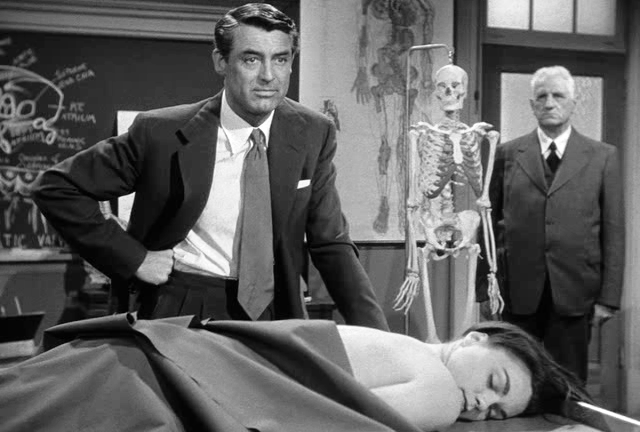 of the room where a corpse lies under a sheet. "I would be quite unable to give the lecture you came to hear and I'm not sure you should hear the lecture I'd like to give," Praetorius tells the students who all clamor, fearful he's going to leave without saying anything. Obviously, the doctor's reputation has made him a figure of fascination among the aspiring physicians and they'd be willing to hear him talk about anything. He asks them to get out their notebooks and uncovers the body, which turns out to be that of a very young woman. He gingerly strokes her long brown hair as he explains to the class, "Anatomy is more or less the study of the human body. The human body is not necessarily the human being. Here lies a cadaver. The fact that she was, not long ago, a living, warm, lovely young girl is of little consequence in this classroom. You will not be required to dissect and examine the love that was in her — or the hate. All the hope, despair, memories and desires that motivated every moment of her existence. They ceased to exist when she ceased to exist. Instead, for weeks and months to come, you will dissect, examine and identify her organs, bones,
 muscles, tissues and so on, one by one. These you will faithfully record in your notebooks and when the notebooks are filled, you will know all about this cadaver that the medical profession requires you to know." Following the doctor's introduction, a young lady (Jeanne Crain, one of the wives in Mankiewicz's A Letter to Three Wives) sitting among the students starts to flutter before she falls into the aisle. The students swarm her until Praetorius clears them away, saying, "A group of Cub Scouts would know better than to crowd like this." He asks if she's ever fainted before, but she says no. She says she's feeling better and the doctor gives her a piece of hard candy and asks another female student to escort her to the bathroom to splash some water on her face. Praetorius has grown impatient and decides to leave, bumping into Professor Elwell at the door. Elwell again apologizes for his delay. Praetorius says that Elwell wanted to ask him something about a tumor. "A malignant dysgerminoma," Elwell responds. "Professor Elwell, you are the only man I know who can say 'malignant' the way other people say 'Bingo!'" Praetorius tells his tardy colleague, unaware of Elwell's investigation into his past. The doctor and Shunderson leave with Praetorius' clinic as their destination.
At this point, a viewer still would be unclear where this story is heading, especially with the added presence of the large, mostly silent Shunderson usually near Praetorius' side. However, once we get to Praetorius' private
 clinic, which really functions more like a full-fledged hospital, the plot will start spinning in more directions. As I wrote earlier, I have no familiarity with the Curt Goetz play upon which it was based. Goetz began his career in Germany as a performer in silent films, including one directed by Ernst Lubitsch in 1918. He also began writing plays. In 1939, he went to Hollywood to try to get into filmmaking there, but got frustrated by the system and moved to Switzerland in 1945 (since he was Swiss by birth) and wrote some novels. His play Dr. Praetorius originally was written in Germany in 1934. The first English translation was called How to Die Laughing, was in seven acts and while it has some similarities to People Will Talk, the synopsis sounds quite different and even brings Sherlock Holmes and Dr. Watson into the tale. In 1949, Goetz co-directed with Karl Peter Gillmann a German-language version called Frauenarzt Dr. Prätorius that sounds exactly like People Will Talk, has Goetz himself playing the title role and is described as a "melodramatic comedy." That's probably as good a description as any of Mankiewicz's People Will Talk, which may be as idiosyncratic a film as he (or Cary Grant for that matter) ever made.
When we do get to the clinic, we do get more of a sense of what kind of doctor Noah Praetorius is and what the opening title cards meant when they said if he didn't exist, he should. If that were the case in the early 1950s, it's been multiplied exponentially by 2011. No sooner does he walk in the door that he starts getting hit by nurses and other staff with problems. One nurse informs him that a woman about to be discharged wants to take her gall bladder home with her. Praetorius finds that sweet and tells her to let her. The nurse says he knows they don't keep them after they are removed but the doctor guesses that the woman has no idea what her gall bladder looked like so just get another and "send her home happy." A bean counter talks to him about the costs of the hours for the kitchen staff and they should consider cutting back in terms of the patients' food. (That one is out of my life experience where one for-profit hospital I stayed at wanted to get their kitchen staff out early and served horrendous food out of a box for dinner.) Praetorius tells her that he has "the firm conviction that patients are sick people, not inmates." He then checks in on an older patient (Julia Dean) who doesn't look well and obviously is depressed about her condition.

PATIENT: I was thinking it's not much fun when you get old.
PRAETORIUS: It's even less fun if you don't get to be old.
PATIENT: I want to die.
PRAETORIUS: You'd like that, wouldn't you? Lie around in a coffin all day with nothing to do.
A nurse brings the good doctor a report on the final patient of the day and he asks her to show Mrs. Higgins into his office. She enters and it is the woman who fainted in class. Praetorius tells her the good news that
 there's absolutely nothing wrong with her and she can continue her studies, at least for a while. She confesses that she's not a medical student. She was just sitting in on the class to see him. Mrs. Higgins, who tells him to call her Deborah, shows signs of relief until Praetorius asks if she'll make a follow-up appointment or would she be getting her own obstetrician. Deborah breaks down, confusing the doctor, until he realizes that while she may be pregnant, he'd been mistaken to assume she was married. He inquires about the father, but she tells him that he's out of the picture. It seems he was called up to serve in Korea, which led to their coupling, and promptly got himself killed soon after arriving overseas. The doctor attempts to calm her, but Deborah isn't just worried about the shame unwed mothers faced at that time but she's convinced the news will kill her father. Praetorius tells her that parents can surprise you and be very understanding when you least expect it. Deborah insists her father is the most gentle, understanding man in the world, but his heart would be unable to take it.
After Praetorius has at least dammed the flow of Deborah's tears, she hastily exits. His receptionist returns and he asks if Deborah made another appointment but she informs her boss that she did not. The words have
 barely left her mouth when a shot is heard. Shunderson joins Praetorius in the hallway as does a nurse where they find a sprawled Deborah, derringer in hand. Miss Higgins is rushed into surgery and after much work, appears to be out of danger. Shunderson enters the operating room as Praetorius removes his surgical garb. "It's a good thing that most people don't have the foggiest notion where the heart is," the doctor says. "She missed it by a mile." Shunderson takes that to mean that her suicide attempt failed which Praetorius confirms. "Then she'll try again," Shunderson declares, giving Praetorius pause and a look of concern. At any rate, Miss Higgins will be out for awhile and Praetorius has an appointment to make. As if the doctor didn't have enough on his plate, he's also the conductor for the university's student-faculty orchestra and it's practice night.
Among the members of the orchestra is Praetorius' closest friend on the university's faculty — physics Professor Lyonel Barker (Walter Slezak) — who plays the bass violin in the orchestra, often to Praetorius' frustration. After the practice has finished, Barker asks Praetorius to stay behind because he needs to speak with him.
 Despite their playful bickering during rehearsal, Barker asks Noah if he considers him a trusted friend. Of course, Praetorius says. "Therefore I have the right to point out to you that there are occasions when you behave like a cephalic idiot," Barker tells him. He warns Praetorius that he's heard that Professor Elwell has been snooping around his past in the hopes of making a case with the university out of it. Praetorius doesn't seem concerned, but Barker admits that there are things about his past that even he doesn't know. Noah asks the physics professor if he told him everything there was to know about him, would it affect their friendship? Barker says not in the least. Noah pats Barker on the knee. "I know it's not much to have a friend who knows all about you but one who's afraid he's not quite sure, that's worth having," Praetorius smiles. He tells Barker not to worry, but he needs to drop by the clinic to check on a patient but tells his friend to drop by his house for a late supper when he returns from the clinic.

With Shunderson's words still echoing in his mind, Praetorius pays a visit to the recovering Deborah and tells her a whopper of a lie. He says they discovered that a lab error accidentally switched labels on two pregnancy tests being run at the same time and hers actually was negative while another woman's was positive. She therefore has no reason to be concerned. It still turns on the waterworks anyway. He asks her why she's crying now, but she says he wouldn't understand. He wishes her goodnight and tells her to rest because she has nothing to worry about now. When he gets home, he tells Barker what he did. The physics professor says he has to know that it's just a stall and she will learn the truth eventually. Noah says that he realizes that, but if he can ease her mind until perhaps he can talk to her father, things will be better. Barker's mind wanders off subject as he raves about how good the sauerkraut is, saying it reminds him of home. Praetorius lets him on his secret: He has his housekeeper make it. "Sauerkraut needs to come from a barrel, not a can," the doctor declares. He promises to send some home
 with Barker, but it's taken Praetorius' mind off subject as well to a pet peeve of his. He grabs a stick of paper-wrapped butter. "Our American mania for sterile packages has removed the flavor from most of our foods. Butter is no longer sold out of wooden buckets and a whole generation thinks butter tastes like paper," Praetorius complains. "There was never a perfume like an old-time grocery store. Now they smell like drug stores which don't even smell like drug stores even more." Before his tirade can go much further, the phone rings. It's the night matron at the clinic (Maude Wallace). It seems that Deborah has disappeared. She tells the doctor she doesn't know how she slipped out. Praetorius tells her that she probably walked past her and out the front door just as he did about an hour ago. When he hangs up, Barker guesses that the missing patient is the one that Noah lied to and now the doctor finds himself in a bit of a quandary.

Now as you probably can ascertain, as usually happens in films of this period and earlier, romance sparks insanely fast between Deborah and Noah, though to the film's credit you can't be certain at first if Praetorius truly has fallen for Deborah or if he simply proposes to her as a way of saving her reputation and rescuing her father Arthur (Sidney Blackmer) who lives under the thumb of his ultraconservative brother John (Will Wright) on his farm. Mr. Higgins describes himself as "an indifferent journalist, a minor poet, an ineffective teacher, a wretched businessman unable to provide for my wife and my child and then not even for my child" who ended up as his brother's dependent. In another classic Mankiewicz exchange after Praetorius has heard about all he can from Deborah's Uncle John, he and Deborah's father share this dialogue.
PRAETORIUS: How old were you when you learned to walk?
ARTHUR: I did pretty well by the time I was 4.
PRAETORIUS: When did you leave the farm?
ARTHUR: When I was 16.
PRAETORIUS: It couldn't have taken you 12 years to make up your mind.
We've got several plates spinning in the air now: A sudden marriage, a pregnant woman who doesn't know she's pregnant, a mysterious man, a professor secretly crusading against a popular doctor — no wonder if you peruse reviews written recently or when People Will Talk came out in 1951, many scratch their head because
 it doesn't fall into any standard formula. People criticize it for not being a good romance, but that's the weakest element and least interesting part of what's going on here. Praetorius admits to Deborah that he didn't marry her just to stop her from committing suicide and to save her reputation because that wouldn't be a very practical solution should a similar case arise. He can't marry all his patients. Deborah also finds the reality of the man once she lives with him and for his 42nd birthday buys him an elaborate toy train set which he sets up with her father running a line from one bedroom, Barker from another and Noah serving as chief conductor in another. Of course, there's a spectacular crash causing the three men to yell at each other and it coincides with the delivery of a message from Professor Elwell that the dean is assembling a hearing of faculty members to hear charges against Praetorius (set for the same night as the big orchestra concert no less). Deborah goes to their bedroom and collapses to the bed in tears. Noah assumes she's upset about the letter but she tells him, "It's just that I love you so much and I went and put all those candles on that cake when you're really only 9-years-old."
I think the reason People Will Talk confuses so many people comes down to three main factors: 1) Expectations for a Joe Mankiewicz film based on A Letter to Three Wives and All About Eve; 2) Expectations for a Cary Grant movie; and 3) Viewers lumping their own ideological baggage onto the film. With his two previous films, Mankiewicz truly established himself as a master of sharp, witty dialogue and that's present again in People Will Talk, only it doesn't always take the form of comedy. He has some points
 to make and I think that makes some feel uneasy, especially since the opening scene between Hume Cronyn and Margaret Hamilton sets the audience up to expect another pure comedy is on the way. When we switch to the anatomy class, though there are laughs to be found, he's subtly switching the tone to be more multi-faceted, particularly when he speaks of the cadaver's former life. By the time we get to the clinic, he's driven the point home that different approaches to medicine are what he's after here. It shouldn't have been a surprise: That's why I used the screenshots of those two title cards that start the film to start the post. There was a third, praising doctors in general, but given some of the doctors I've run across in my hellish journey through the health care system, that title card reads as hopelessly out of date because while there are good doctors today there also are a lot of greedy and incompetent bastards who don't give a shit as well. People Will Talk often is called ahead of its time because of its treatment of Deborah's out-of-wedlock pregnancy, but what really makes the film prophetic is how it pits Dr. Praetorius' commitment to healing the patient as the priority above everything else while doctors such as Professor Elwell want less to do with them and accountants try to cut costs on things such as food service for hospitals. This was made 60 years ago and it's only worse now. Imagine if the issues of billing and health insurance came into play.
By 1951, Cary Grant had been a star for a long time so most moviegoers had come to expect a certain type of role from him. Whether it be a fast-talking smoothie in a screwball comedy such as His Girl Friday, a more
 refined romancer in The Philadelphia Story, an adventurer in Gunga Din, a serious romantic with a mission that takes precedence in Notorious or even a fretful father in the weepy Penny Serenade, he always seemed to be in charge or at least care about the outcome. The only possible exception would be Bringing Up Baby where he's at Katharine Hepburn's mercy. As Praetorius, he certainly goes above and beyond when it comes to caring about his patients, but he plays the doctor at a distance from the audience, something quite unusual for him, and Praetorius seems indifferent to the investigation by Elwell. The real switch, which really I can only think of happening in Baby, is that Deborah figures out rather quickly what he's up to when he pursues her at the farm and she starts stalking him around the dairy. It's unusual to see Cary Grant be the prey and it’s to Jeanne Crain’s credit that she makes Deborah’s transition believable. Grant gave a lot of great performances and is one of Oscar's biggest crimes that he only was nominated twice, both for tear jerkers. While I love Walter Burns, I have to admit that Dr. Noah Praetorius might be the best work he ever did on film.
Now little can be done to control what people think they see in things. We live in a world where TV preachers thought certain Teletubbies were gay for crying out loud. Admittedly, the film does have some unmistakably liberal viewpoints, particularly in the scenes where Uncle John spouts his views at the farm, but I think far too
 many people mistake Professor Elwell's campaign against Praetorius as some sort of metaphor for McCarthyism. (This was based on a play originally written in Germany in 1934 after all.) People Will Talk's only concern is comparing medical philosophies. Elwell's only interested in one admittedly unusual faculty member who has an odd friend who always stands by his side. I won't give away the details of the hearing because I want more people to see this movie. It's not a perfect movie and it's certainly no All About Eve, but I think it's better than A Letter to Three Wives and I like that film a lot. The performances across the board are great and that sparkling Mankiewicz dialogue is as quotable as ever. Time and again I'm amazed how many early films addressed problems with our health care system in different ways such as 1931's Night Nurse and Mankiewicz's own No Way Out the year before, even though racism was its bigger issue. The Brits even exposed their own failings in 1938's The Citadel before they reformed their system. We in the U.S. should be ashamed. I think one great quote that Praetorius delivers during his hearing proves particularly prescient.
"The issue is whether the practice of medicine will become more intimately involved with the human being it treats or whether it is to continue to go on in its present way to become more and more a thing of pills, serums and knives until it eventually will undoubtedly evolve an electronic doctor."
Honestly, given some of the M.D.s I've encountered, I'm not so sure an electronic doctor would be worse. I do know though that what makes me like People Will Talk more each time I see it falls along the same lines as many new films that captivate me: They dare to be different and to eschew formula while employing talented casts to tell unusual stories well.
Tweet
Labels: 50s, Cary, Cronyn, John Ford, K. Hepburn, Lubitsch, Mankiewicz, Movie Tributes, Oscars, Poitier, Widmark
TO READ ON, CLICK HERE
Wednesday, November 11, 2009
Centennial Tributes: Robert Ryan
 By Ivan G. Shreve, Jr.
(Warning: Spoilers contained herein…)
Robert Bushnell Ryan was born 100 years ago on this date and he’s one of only a handful of actors who I’ll take the time to watch in anything. But since confession is good for the soul, I thought I’d start this essay out with an admission of guilt…
I used to get actors Robert Ryan and Sterling Hayden confused.
Thankfully, I don’t do that anymore. They’re both still favorites of mine, of course, but I’ve probably seen more Ryan films than those of Hayden’s. My preference for Ryan is due to the fact that the celebrated actor — a man who, off screen, was a pacifist, a tireless campaigner for civil rights and a dedicated foe of McCarthyism — excelled at portraying sadistic villains who were more often than not thoroughly despicable, possessing not the slightest shred of human decency.
And what’s more — he did these roles in such a way that made these “bad guys” oddly endearing…
Born to Timothy and Mabel Bushnell Ryan in 1909, young Robert’s dream was to become a playwright — but since that noble profession can sometimes lead to starvation, he decided to study acting in order to support himself. He had attended and graduated from Dartmouth in 1932, distinguishing himself as the school’s heavyweight boxing champion during all four years of his attendance. He then latched onto a series of odd jobs, including ship’s stoker, ranch hand (in Montana) and a stint with the WPA before signing up to study alongside the great Max Reinhardt. It was during his time with Reinhardt that he met his future wife Jessica Cadwalader, whom he wed in March of 1939 and stayed married until her death in 1972 (he died a year later).
Ryan’s big break on stage came when he was appearing alongside “Viennese Teardrop” Luise Rainer in A Kiss for Cinderella in 1941; her ex-husband Clifford Odets offered him the juvenile role of Joe Doyle alongside Tallulah Bankhead in Odets’ Clash by Night. (In 1952, Ryan would appear in the film version but because of his age was cast in the lead role of Earl Pfeiffer.) It was at this juncture that Ryan began getting small parts in films like The Ghost Breakers (1940) and Queen of the Mob (1940); he received his first screen credit in a B-quickie entitled Golden Gloves (1940), which capitalized on his boxing prowess. From then on, he began to get noticed for his roles in North West Mounted Police (1940), Bombardier (1943), The Sky's the Limit (1943) and Tender Comrade (1943). Upon signing a secure contract with R-K-O in January 1944, Ryan enlisted in the U.S. Marine Corps and served as a drill instructor there until 1947. It was while he was in the Corps that he took up painting and, hearkening back to his halcyon college days, won a boxing championship as well.
While in the Marines, Ryan befriended a writer (and future director) named Richard Brooks, who had written a novel that the actor very much admired entitled The Brick Foxhole. Back in Hollywood, R-K-O adapted Brooks’ novel into Crossfire (1947), a down-and-dirty film noir directed by Edward Dmytryk and produced by Adrian Scott (with an adapted screenplay by John Paxton). Ryan portrayed Montgomery, a recently demobilized American soldier who kills a fellow G.I. named Joseph Samuels (Sam Levene) simply because Samuels is Jewish; two other soldiers, Keeley (Robert Mitchum) and Finlay (Robert Young) investigate the murder and ultimately bring Montgomery to justice. Ryan’s portrayal of the anti-Semitic Montgomery was nothing short of astonishing; he literally oozed hatred and intolerance from every pore. The role earned him the only Oscar nomination he would ever receive (for best supporting actor) — but unfortunately typecast him as the silver screen’s resident bigot; he would play similar parts in films like Bad Day at Black Rock (1954) and Odds Against Tomorrow (1959).
Because roles like Black Rock’s Reno Smith and Odds’ Earle Slater were completely at odds with his real-life persona, Ryan accepted the fact that these parts presented to him as an actor a real challenge — but not one with which he was necessarily happy; he was quite reluctant to discuss Crossfire in later years because he thoroughly detested the Montgomery character. Indeed, Crossfire sort of scarred his film career — though he would get an occasion to be a “good guy” every now and then (Berlin Express [1948], The Boy with Green Hair [1948]), he continued to play the reliable “heavy” in films like Caught (1949), The Racket (1951), Beware, My Lovely (1952), House of Bamboo (1955), Billy Budd (1962) and The Dirty Dozen (1967). When he was once complimented on being one of the silver screen’s best heavies, Ryan remarked: “I guess they never saw me in most of my pictures. Still, I've never stopped working so I can't complain.”
But Ryan’s talent was such that even when he was required to be the "baddie" he was able to add subtle nuances to each character that made them three-dimensional, flesh-and-blood human beings. A good example of this is his portrayal of ex-POW Joe Parkson in Act of Violence (1949) — from the moment the movie gets underway he menacingly stalks his former commanding officer Frank Enley (Van Heflin), a seemingly nice middle-class businessman who’s completely flummoxed as to why the embittered Parkson is obsessed with meting out revenge. As the story unfolds, however, we learn that while Parkson’s elevator may not go all the way to the top it’s entirely the fault of Enley, who sold out his fellow soldiers during their internment in the POW camp.
In The Woman on Pier 13 (1950, a.k.a. I Married a Communist), Ryan plays a former stevedore who’s just starting to make good in his company when his past comes back to haunt him in the form of Communist agitators eager to exploit his former affiliation with the Party. Though the film presents the Commies as little more than “gangsters,” Ryan’s Brad Collins character is actually played in a sympathetic fashion; a tragic noir hero whose fate cannot be altered because of his youthful indiscretion. Another noir from that period, On Dangerous Ground (1952), features Ryan on the right side of the law — but as big city cop Jim Wilson, he’s often no better than the “garbage” he deals with on a day-to-day basis…roughing up suspects and seeming on the verge of a nervous breakdown. Assigned by his commander (Ed Begley) to assist locals in a murder investigation in a small town upstate, he comes face-to-face with his doppelganger (Ward Bond) and is redeemed by the love of the murderer’s blind sister (Ida Lupino).
As I stated in the opening lines of this essay, I am such a huge fan of Robert Ryan that I’ll watch anything he’s in…and admittedly, there are a large number of his movies that I can easily pick out as favorites. But the film I keep coming back to — and the one that I personally feel contains his finest performance onscreen — is The Set-Up (1949); a short-and-sweet boxing saga (written by Art Cohn and directed by Robert Wise) that stars Ryan as a worn and faded pugilist named “Stoker” Thompson who’s scheduled for just another bout in his thirty-five years participating in “the sweet science.” Stoker is washed up, a has-been — and his crooked manager Tiny (George Tobias) is so certain that Stoker is going to tank that he takes money from mobster Little Boy (Alan Curtis) for his man to “take a dive”…but decides not to clue Stoker in on the deal, in order to keep more of the kitty for himself.
Stoker is definitely mismatched: he’s fighting the much younger and heavily favored “Tiger” Nelson (Hal Baylor), but somehow has a feeling that he’s “just one punch away” from reversing his misfortune in the ring. His ever-patient wife Julie (Audrey Totter) has heard this all before, and vows to herself that she won’t be at his bout that evening because she can’t bear to see him take another beating. (She later changes her mind.) But the angel who looks after fools, drunks and children is in Stoker’s corner that evening; Stoker’s actually giving Nelson a good scrap — and even when Tiny finally tells him about the fix, he refuses to give up. He soundly beats Nelson to a pulp, and emerges victorious — but Little Boy has the final say when his goons break Stoker’s right hand, taking him out of the fight game forever.
The Set-Up runs a total of 72 minutes and takes place in “real time” — and Ryan is nothing short of sensational. His early career as a boxer no doubt helped in this role, but Ryan clearly has the chops to convince the viewer that he is that washed-up pug who daydreams of a comeback and gets that one-in-a-million opportunity to show that he “could have been a contendah.” The haunting finale of the film — where an anguished Stoker cries out to Julie “I can’t fight no more” — is both heart-breaking and bittersweet; Totter’s performance as the supportive spouse will convince you that although Stoker’s career has ended due to tragedy, she is just the woman who can inspire him to carry on.
One thing that has always fascinated me about Robert Ryan is how he managed to emerge unscathed from the period of paranoia prevalent in the 1950s despite his defiant liberalism; when the House Un-American Activities Committee was discovering “subversives” under every bush and many actors and actress who had even the tiniest tinge of “pink” (read liberal) in their politics found themselves out of work. Ryan once commented: “I was involved in the things he [McCarthy] was throwing rocks at but I was never a target. Looking back, I suspect my Irish name, my being a Catholic and an ex-Marine sort of softened the blow.” Ryan walked the walk and talked the talk (he intensely disliked his Flying Leathernecks co-star John Wayne because the Duke was in favor of the blacklist): he was an extremely vocal supporter of the group known as “The Hollywood Ten” and donated his time and money to groups like the American Civil Liberties Union, American Friends Service Committee, and United World Federalists. He also founded the Hollywood chapter (along with entertainer Steve Allen) of The Committee for a SANE Nuclear Policy in September of 1959. In the 1960s, he volunteered to serve in the cultural division of the Committee to Defend Martin Luther King and with other actors like Bill Cosby and Sidney Poitier, founded the short-lived Artists Help All Blacks. He even became a vociferous supporter for Sen. Eugene McCarthy’s quixotic Presidential campaign in 1968.
Toward the end of his life, Ryan continued to do outstanding work in films, including The Professionals (1966), The Wild Bunch (1969), Lawman (1971) — he even went out with a winner in his last film, The Iceman Cometh (1973), in which he played the terminally ill political activist Larry Slade. Ironically, Ryan was himself was diagnosed at the same time with lung cancer, a condition that he publicly denounced (in the manner of actor William Talman) as being caused by his heavy use of cigarettes. He died on July 11, 1973.
(Ivan G. Shreve, Jr. blogs at Thrilling Days of Yesteryear, where Robert Ryan is often referred to as “one of the most delectable rat bastards of the silver screen”…and in all honesty is meant to be a compliment.)
Tweet
Labels: blacklist, Hayden, Luise Rainer, Lupino, Mitchum, Poitier, R. Brooks, Robert Ryan, Van Hefiin, Wayne
TO READ ON, CLICK HERE


