Wednesday, July 17, 2013
What he really wanted to do was be an actor
BLOGGER'S NOTE: This post is part of The Sydney Pollack Blogathon occurring through July 22 at Seetimaar — Diary of a Movie Lover

By Edward Copeland
For 40 years, from 1965 to 2005, Sydney Pollack directed 19 feature films. His last directing effort appeared as an installment of PBS' American Masters series on the architect Frank Gehry. Prior to that, he directed lots of episodic television. As Pollack reached the end of his life (and beyond it) he produced projects more than he directed and toward the end he also resumed the artistic endeavor where he started, acting more
 and more often. When he ventured into show business, he aimed toward acting. His father hoped that Pollack would pursue a career in dentistry, but after catching the theater bug in high school in South Bend, Ind., he left for New York following graduation and studied with legendary acting teacher Sanford Meisner at Meisner's Neighborhood Playhouse (The same year he directed the American Masters special on Frank Gehry, he executive produce another episode of the series on Meisner). Eventually, he became an assistant to Meisner and even taught acting to others, though in a 2006 interview with Venice Magazine, Pollack resisted calling the technique he learned and passed on "The Method." "People call a lot of things 'The Method,' but there really isn’t one Method," Pollack said, "but it’s all derived from Stanislavsky. It’s all derived from Stanislavsky, but Stella Adler taught it different than Sandy Meisner and Strasberg taught it differently from both of them, and Harold Clurman taught it differently than the three of them, and Bobby Lewis took it in his own direction, as well. They each took The Moscow Art Theater of Stanislavsky and basic principles, and then developed their own approach. The goal was always the same: to find a way to analyze the construction of truthful behavior within imaginary circumstances."
As he acted a lot in television of the 1950s, Pollack's interest turned to directing. While Pollack directed and produced some great and good films (my favorite being 1982's Tootsie, where he took his first substantial acting role since an episodic television appearance on a 1964 episode of the crime drama Brenner starring Edward Binns and James Broderick), after Tootsie, he acted or did voicework in more films and TV shows than his entire filmography. In many ways, I found Pollack more interesting at times as an actor than as a filmmaker, and that's where his career in the arts began, with his single Broadway role in 1955's The Dark Is Light Enough by Christopher Fry and starring Katharine Cornell, Tyrone Power and featuring Christopher Plummer.

Pollack began directing episodic television in 1961 and had ceased television acting in 1964 with that appearance on Brenner. As he jettisoned acting to concentrate on directing, he made a single movie: the 1962 Korean War drama War Hunt. The film starred John Saxon and Charles Aidman, but in addition to Pollack's supporting role, the movie offered appearances by Gavin MacLeod, Tom Skerritt and uncredited work by another future director, Francis Ford Coppola, as an Army truck driver. The biggest name among the ranks (at least he would be eventually) turned out to be a young Robert Redford. Pollack would direct Redford in seven films: This Property Is Condemned, Jeremiah Johnson, The Way We Were, Three Days of the Condor, The Electric Horseman, Out of Africa and Havana. Redford served as one of the producers of A Civil Action which featured Pollack in an acting role.
The headline at the top of this piece isn't quite true. Pollack return to acting in 1982's Tootsie (aside from a brief cameo in 1979's The Electric Horseman) proved to be quite a reluctant one. He already had cast Dabney Coleman to play George Fields, agent to prima donna/unemployed actor Michael Dorsey (Dustin Hoffman) but Hoffman pushed Pollack into taking the role himself, seeing the dynamic they had in their disagreements over the script. Pollack didn't want to leave Coleman in the cold so he cast him in the role of movie's fictional soap opera's director instead. Hoffman's instincts didn't fail him or the film as his scenes with Pollack provide many of the movie's comic highlights. You get that in the scene above, in the scene in the Russian Tea Room where Michael surprises George by showing up as his new alter ego Dorothy Michaels and, in perhaps my favorite scene between the two of them, when Michael shows up at George's home late one night to try to explain the romantic complications, including the fact that the father (Charles Durning) of the woman he loves (Jessica Lange) bought Dorothy an engagement ring. Forgetting for a moment what this all means, Pollack's reaction to news of the proposal comes off as priceless.
Following Tootsie, Pollack returned to the directing-producing track for a decade. During this decade he won his two Oscars for Out of Africa, but looking at the projects in that decade on which he worked solely as a producer or executive producer actually look more interesting than most of the movies he directed in that time. Some examples of his producing output from 1982 to 1991: Songwriter, The Fabulous Baker Boys, Presumed Innocent, White Palace, (surprisingly) King Ralph and Dead Again. With Tootsie, Pollack displayed a grounded, realistic comic side, but when 1992 arrived and he began to act up a storm, his range
 widened, even if for the most part Pollack got pigeonholed as either a lawyer or a doctor, he played distinct members of each profession. Ten years after Tootsie, he managed roles in three films (and found time to executive produce two movies as well: HBO's A Private Matter and Leaving Normal, which had the misfortune of being too similar to Thelma & Louise and coming out a few months after the other film). The photo at the top of this post shows Pollack in his first 1992 role, Dick Mellon, business lawyer to besieged studio exec Griffin Mill (Tim Robbins) in Robert Altman's The Player. As Mellon, Pollack plays a no-nonsense Hollywood figure who has seen it all and never changes his vocal tone, no matter how serious the situation becomes, and doles out truisms such as in this exchange with Mill. "Rumors are always true. You know that," Mellon tells Mill. "I'm always the last to hear about them," Griffin sighs. "No, you're always the last one to believe them," Dick corrects his client. Pollack, as in the case of his casting in Tootsie, hadn't been the first choice of the director. Of course, Pollack had helmed Tootsie and opposed casting himself as George Fields. With The Player, Altman tried to cast as many of the character parts with lesser-known faces because his film contained so many star cameos and he wanted to avoid as much audience
 confusion as possible. Initially, Altman sought writer-director Blake Edwards, who also started his career as an actor, though he hadn't appeared on screen since 1948, for the part of Mellon, but it didn't work out and he went with Pollack, who only had that one role in Tootsie in 30 years. While The Player offers darker, satirical laughs than Tootsie did and Pollack doesn't get the laughs out of Dick Mellon that he did out of George Fields, he garnered more laughs in his most dramatic, deepest film role yet as Jack, the divorcing best friend of Gabe Roth (Woody Allen) in Husbands and Wives. I wasn't as crazy about the film as others, but Pollack delivered one of his greatest acting jobs, ranging from the at-ease midlife divorced man finding renewed vigor with a twentysomething aerobics instructor (Lysette Anthony) and then turning downright nasty on her at a party when she doesn't meet his standards for intellectual heft. He literally drags her from the soiree and tosses her toward his car, accusing her of being an "infant." It's a scary side of Pollack that we'll see more of in other roles. His third on-screen role of 1992 didn't receive a credit, but the cameo in Death Becomes Her provides what could be Pollack's funniest moments as an ER doctor examining Meryl Streep. The clip below leaves out his character's final punch line.
Until his death from cancer in May 2008, seeing Pollack act became a much more common sight than spotting his directing credit. He turned up in legal entanglements again in films such as A Civil Action, Michael Clayton and Changing Lanes. He guided Tom Cruise into the sexual netherworld of the rich and powerful in Stanley Kubrick's final film, Eyes Wide Shut. He took roles in the last two films he directed, Random Hearts and The Interpreter. Pollack even provided the voice for the studio executive in The Majestic and the French film Avenue Montaigne. His final film role was in the romantic comedy Made of Honor where he played the father of the male maid of honor (Patrick Dempsey). On television, he did more voice work on comedies such as Frasier and King of the Hill. He also played a doctor on an episode of Mad About You and had a recurring role as Will's father on Will & Grace. He even played himself on an episode of Entourage, his last TV or movie appearance. Of all his late appearances though, the one that stands out to me also came in 2007 and put him in the role of another doctor. In the batch of the last nine episodes of The Sopranos, Pollack played jailed oncologist Warren Feldman, incarcerated with the dying Johnny Sac (Vincent Curatola) in the great episode "Stage 5." This scene I believe gives a great example of how talented Pollack truly could be as an actor.
Tweet
Labels: Altman, Blake Edwards, Coppola, Cruise, Dabney Coleman, Durning, Dustin Hoffman, J. Lange, Kubrick, Plummer, Redford, Streep, Sydney Pollack, The Sopranos, Tim Robbins, Woody
TO READ ON, CLICK HERE


Monday, July 01, 2013
What acting is all about — unemployment
BLOGGER'S NOTE: This post originally appeared Dec. 17, 2007. I'm re-posting it as part of The Sydney Pollack Blogathon occurring through July 22 at Seetimaar — Diary of a Movie Lover

By Edward Copeland
Film directing isn't often compared to completing a jigsaw puzzle, but that analogy seems most apt in describing exactly what Sydney Pollack accomplished with Tootsie, which opened 25 years ago today. What began with a story by Don McGuire and Larry Gelbart and a screenplay by Gelbart became the center of a fight between the film's star, Dustin Hoffman, and Pollack, and ended up with countless other notable scribes (among them Barry Levinson and Elaine May) taking shots at the script. In the end, the final screen credit went to McGuire and Gelbart for story and Gelbart and Murray Schisgal for screenplay, but Pollack's ability to weave the best parts of all those drafts and spin them into cinematic and comic gold deserved a credit all its own. If that feat of wizardry weren't enough, Pollack also turns in a fine supporting role as well, playing Hoffman's character's agent.

When originally released, while I loved Tootsie, being 13, my 1982 heart still belonged to E.T.: the Extra-Terrestrial, released months earlier. However, as the years went by, Tootsie grew in my estimation while E.T. became almost too schmaltzy to watch, so much so that I haven't returned to it in nearly 20 years. Perhaps my view would change again now. What makes Tootsie soar, like many other films, comes from the fact that its greatness proves impermeable to even a picky, critical mind such as mine. I mean, how exactly does "Dorothy Michaels" (Hoffman's drag alter ego) get paid when she doesn't exist and wouldn't have a Social Security number? Of course, the finale, involving an accident that forces the soap to redo a show live at the last minute seemed ridiculous to me even upon first viewing, but why question the logic of a scene that uproariously funny and with a payoff so huge? The brilliant ensemble cast, in addition to Pollack's patch job, holds Tootsie together.
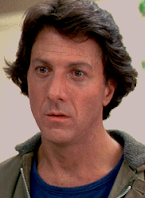 Hoffman, deservedly, gets a lot of credit for his drag creation, but I don't think he gets the kudos for Michael Dorsey that are due him. It might seem as if Hoffman's reputation for being difficult, makes Michael a cakewalk, but he not only plumbs
 Dorsey's depths for comedy and pathos, but convincingly depicts his transformation from a horny prima donna to a more sensitive man (At one point, Michael acknowledges that he thinks Dorothy is smarter than he is). The opening sequences, depicting his problems as an actor who hasn't had a job in two years, come stocked full of laughs, such as the scene where his agent George Fields (Pollack) explains the reasons he his client can't get work while Michael insists in his own defense "that nobody does vegetables like me" to justify his firing from a commercial where he played a tomato. Hoffman and Pollack don't carry the film alone. Ironically, the weakest link in the cast, Jessica Lange, was the only person to win an Oscar, a consolation prize for losing lead actress in Frances that year to Meryl Streep in Sophie's Choice. Frankly though, Lange wasn't even the best supporting actress in Tootsie, though her character provides the key to the film's serious undercurrent of exploring the way men sometimes treat women in all ranges from employment discrimination to out-and-out misogyny, but the message never interferes with the laughs.
Teri Garr's great turn as Michael's acting colleague and friend Sandy did earn an Oscar nomination, but she lost to Lange, as did my personal choice for 1982, Glenn Close in The World According to Garp. Garr, however, clearly led the field of women in Tootsie (hell, I could make a case for Doris Belack as the soap's producer over Lange). Always clandestinely stuffing food into her purse at parties, having Michael "enrage" her for an audition and her go-for-broke rage explosion when she learns Michael has been deceiving her provide some of the film's most priceless moments. The ensemble contains so many great supporting turns by the men in the film, I'm almost afraid to single anyone out. In addition to Pollack, viewers receive the gifts of George Gaynes as the soap's aging star, wholly dependent on cue cards and
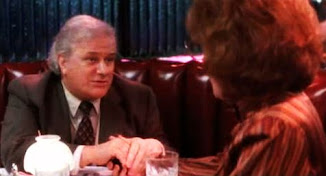 prompters, who hits on every new cast member; Dabney Coleman doing the chauvinistic asshole character he practically patented in the early 1980s as the soap's director; the great Charles Durning, who earned an Oscar nomination that year, albeit for The Best Little Whorehouse in Texas with his single but memorable scene singing and dancing a little "Sidestep," as Lange's widowed father who falls for Hoffman's Dorothy and longs for the days when men and women "were what they were." His proposal scene proves both funny and touching (though the comic gem resulting from this sequence comes later when Michael tells his agent about the offer and Pollack asks him what he said, with genuine happiness that makes him forget about the truth of the situation for a moment. Along with Belack, another fine supporting female in the cast happens to be a young Geena Davis who plays another actress on the soap and shares a dressing room with Dorothy.
The prize for the best of the supporting men though goes to the great Bill Murray, in a role that legend says he improvised completely and I believe it. He plays Jeff, Michael's playwright roommate, and if he truly did come up with all his own dialogue, what a treasure trove he unleashed. (My personal favorite: When he says he wishes he had a theater that was only open when it rained.) Even though Tootsie lags a bit when it takes a detour to Durning's farm, it's forgivable since those scenes give the film part of its heft and allows for even more comic grace notes. How Tootsie lost to the noble but limp Gandhi (including for original screenplay, patch job or no patch job) still baffles me.
Tweet
Labels: 80s, B. Levinson, Dabney Coleman, Durning, Dustin Hoffman, Geena Davis, Gelbart, Glenn Close, J. Lange, Movie Tributes, Murray, Streep, Sydney Pollack
TO READ ON, CLICK HERE
Friday, August 03, 2012
Edward Copeland's Top 100 of 2012 (60-41)

Perhaps the crowning achievement of the Italian neorealist movement. This story of Italians fighting back against fascism and the Nazis during World War II plays as powerful and moving today as it ever did, with a great cast led by Anna Magnani, who appears in one of the film's most memorable sequences. Despite being generally hard on the film, Manny Farber declared Open City the best film released in the U.S. in 1946 and called Magnani’s performance “the most perfect job by an actress in years and years.”
A breathtaking debut that launched a mostly great film series about Truffaut's screen alter ego, Antoine Doinel, and containing perhaps the most famous freeze frame in film history. It's not bad as a coming-of-age picture either. While The 400 Blows stands alone as the best of the Antoine Doinel films, it’s fascinating to watch Jean-Pierre Leaud play the character from an adolescent to an adult. In its own way, the film resembles the first installment of a fictional version of Michael Apted’s Up documentary series only focusing on a single character.
Pollack didn't just direct and act in this comic masterpiece, he really played tailor as well, stitching together multiple versions of its screenplay to come up with the exquisite finished garment. Dustin Hoffman's brilliant performance as perfectionist pain-in-the-ass actor Michael Dorsey and Dorothy Michaels, the female persona he creates to get work, stands as the crowning achievement of his acting career. It doesn't hurt to be surrounded by an equally solid ensemble that includes Teri Garr, Dabney Coleman, Charles Durning, George Gaynes, Doris Belack, Geena Davis and a nearly all-improvised role by Bill Murray.
Preminger’s crowning achievement could be a routine noirish mystery if it weren’t for its great ensemble of Dana Andrews, Gene Tierney, Judith Anderson, Vincent Price and, most of all, Clifton Webb delivering its wry and witty dialogue by Jay Dratler, Samuel Hoffenstein and Betty Reinhardt (with alleged uncredited contributions from Ring Lardner Jr.). A couple of examples: Price as Laura’s cad of a fiancé Shelby Carpenter declaring ,"I can afford a blemish on my character, but not on my clothes" and Webb as bitchy newspaper columnist Waldo Lydecker describing his work, "I don't use a pen. I write with a goose quill dipped in venom." Laura could be called the All About Eve of film noir mysteries.
Every time I hear that a friend or acquaintance is going to have a baby, I make the same simple request: Do everything in their power to keep all knowledge of this movie away from them until they see it. I would have loved to have seen it without knowing that the shower scene was coming or the truth about Norman Bates. I hope others can have that experience.

One of the biggest jumps of any films from the last list. When revisiting The Last Picture Show for its 40th anniversary last year after having not seen the movie in years, it truly captivated me with its stark beauty. Despite its setting in 1951 in a small Texas town, it contains a universality that resonates today both in human and economic terms. Plot doesn't drive the story — character, not only of the people but of the town itself, does. While you watch the movie, you aren't concerned with what happens next or how the film ends because you realize that life will go on for most of these fictional folks you've come to know. It's telling a coming-of-age story — several in fact — and not all concern the teen characters in the tale. It's also about love and loss, not always in the present tense.
Not only does Broadcast News hold up to repeated viewings, it holds such a special place in my heart that I almost can’t view it rationally. I overidentify with Albert Brooks’ character of Aaron Altman and I’ve known a couple of women with similarities to Holly Hunter’s Jane Craig. More importantly, James L. Brooks wrote and directed a very funny and touching valentine to the decline in television news standards and set it against an unrequited love triangle (with William Hurt’s Tom Grunick filling the third point as well as representing TV news’s deterioration). The supporting cast also aids the entertaining proceedings with the likes of Robert Prosky, Joan Cusack, Lois Chiles, Peter Hackes, Christian Clemenson and Jack Nicholson as the anchor of the network’s evening news.
Even people who view Capra as a sentimental sap tend to like this great madcap romantic romp thanks to the great chemistry of Clark Gable and Claudette Colbert. The first film to sweep the top five categories at the Oscar continues to hold up thanks in no small part to the chemistry between Gable and Colbert. Memorable scenes pile up one after another involving great character actors such as Roscoe Karns and Alan Hale Sr. Perhaps the most magical scene comes when Colbert’s Ellie asks Gable’s Peter if he's ever been in love while on opposite sides of the blanket and he momentarily gets serious, wistfully describing his ideal woman while Ellie slowly melts on the other side of the blanket. May the walls of Jericho always fall.
Here comes Hitch again with his most personal and, in many ways, disturbing film about love and obsession and the need to replace what one has lost. It also happens to be another of my great moviegoing experiences, having been able to see the 1996 restoration at the Ziegfeld Theater in New York. Robert Burks’ cinematography never came across as vividly, especially the reds in the scenes set at Ernie’s. James Stewart delivered one of his best performances as a former cop, already damaged psychologically, pushed further to the edge when he falls for a woman named Madeline (Kim Novak) that he’s been hired to follow and later when he meets her doppelganger and attempts to make her over in Madeline’s image.
As the years roll by, many find themselves less enthused by Tarantino's film. I am not among their ranks, finding that I'm as enthralled, entertained and as giddy as I was the first time I saw it whenever I see any part of it again. Similarly, my faith in Quentin remains strong as well, especially in the wake of Inglourious Basterds, which I definitely could see on a list like this once it reaches its eligibility if it holds up as well as it has so far.

Billy Wilder made so many great comedies with varying levels of pathos that it's hard to pick just one. I considered Some Like It Hot and One, Two Three, but this one remains for me his best film among the ones played primarily for laughs. In the wake of Mad Men, the film proves particularly interesting to watch (even if Roger Sterling thinks female elevator operators defy reality).
Even before the recent passing of Andy Griffith, I had decided that I had to make a spot for A Face in the Crowd on this list. As far as I’m concerned, it undoubtedly stands as Kazan’s best film and as a bit of a prescient one. Without this film, I’m not sure Paddy Chayefsky would have been inspired nearly 20 years later to write Network. Budd Schulberg deserves the bulk of the credit, adapting A Face in the Crowd from a short story he wrote called “Arkansas Traveler.” The film broke ground in its depiction of the convergence and intermingling of the media, corporate and political worlds. In addition to Griffith’s stellar performance as Lonesome Rhodes, the cast includes exemplary work from Patricia Neal, Walter Matthau and Tony Franciosa. Mike Wallace, John Cameron Swayze and Walter Winchell even make cameos as themselves. The film’s reputation should only grow.
When one of the early moments of a movie shows Edward Norton squeezed against the man breasts of a sobbing Meat Loaf, it boggles my mind how many people who saw Fight Club when it came out didn’t immediately recognize the film as a satire. Every time I’ve watched this film, I’ve loved it more than I did originally. To further emphasize its strength, the first time I saw it, I already knew the twist because of an out-of-nowhere comment by David Thomson in a completely unrelated article in The New York Times. Based on Chuck Palahniuk’s novel, Jim Uhl’s screenplay and David Fincher’s direction spin a funhouse tour of the consumer culture, self-help groups and machismo. Norton turns in a great performance as always as do Brad Pitt as the devil on his shoulder and Helena Bonham-Carter as a twisted kindred spirit.
A running gag between Wagstaff and I in recent years is that I believe Die Hard is the greatest film ever made. OK, I don't really believe that, but this is one of the best, especially as far as action goes and Alan Rickman remains one of the all-time great movie villains. In addition to having a great bad guy, what sets Die Hard apart from other action films is that its hero, John McClane (Bruce Willis) isn't superhuman. By the end of the movie, he looks as if he's been through hell.
This film doesn't get mentioned as often as it should, but its portrait of the perils of vigilante justice comes through as strongly today as I imagine it did when it was originally released. Henry Fonda and Harry Morgan try to speak for calm and rationality against the horde ready to inflict mob violence.

The time is over for the debate as to whether the Oscar this classic silent won in the Academy's first year was the equivalent of "best picture." All that needs to be said is that is a great film, Academy seal of approval or not. It remains both heartbreaking and beautiful 85 years after its debut.
The Godfather Part II may have won best picture in 1974, but for my money it wasn't even the best Coppola film that year, let alone the best picture (not that it isn't good). This simple tale of an eavesdropping expert (Gene Hackman giving one of his best, most restrained performances) experiencing sudden moral qualms remains riveting and thoughtful to this day.
Supposedly, Hitchcock often named this gem as his personal favorite of his films and it certainly remains one of his best with its dry, mordant wit and a great lead in Joseph Cotten as Uncle Charlie, worshipped by Teresa Wright as his niece Charlie. Much comic relief gets provided by Henry Travers as young Charlie's father and Hume Cronyn as his murder mystery-loving friend.
I'm not talking to you Travis, but about you, and Scorsese and Paul Schrader's dark, modern spin on The Searchers only grows more stunning as the years roll on. Robert De Niro gives one of his greatest performances and, for my money, this may remain Jodie Foster's finest work.
Jean Renoir made a lot of great films and at least two unquestionable masterpieces, including this one, yet you seldom hear his name come up unless you are talking with real cinephiles. Shameful — because his films don't belong to elite tastes: They belong to everyone. This vivid portrait of WWI prisoners of war proves that since it was the very first time the Academy bothered to nominate a foreign language film for best picture. It should have won too.
Tweet
Labels: Bogdanovich, Capra, Chayefsky, Coppola, Fincher, Hitchcock, Kazan, Lists, Murnau, Preminger, Renoir, Scorsese, Sydney Pollack, Tarantino, Truffaut, Wellman
TO READ ON, CLICK HERE
Tuesday, April 10, 2012
Untold Stories of Robert Altman's The Player or Who the Hell is Thereza Ellis?

"When you really get down to who made the difference, who made this thing better instead of just ordinary, I don't think we'll ever find out." — Robert Altman on collaboration in making The Player on its DVD commentary
By Edward Copeland
Not everyone does great commentary tracks for DVDs (or laserdiscs or Blu-rays), but one man you could depend on to provide candid and informative listening experiences was the late great and much-missed Robert Altman. When it came to The Player, Altman either did the exercise twice or the version on the DVD of The Player was edited down to allow room for the comments of producer/screenwriter Michael Tolkin, who also wrote the novel upon which the film was based. I know I recall things from the long-gone Criterion laserdisc edition, I just can't be certain if the DVD commentary contains Altman anecdotes that weren't there before. Damn these ever-changing formats. Ironically, The Player DVD, now a New Line Platinum Series edition, recalls those Paleozoic days of laserdisc players: You have to flip the disc to access the special features. I knew going into the tribute to the 20th anniversary of The Player, that one post wouldn't do, that's why I set aside this one for those extra details about the film.
One instance that I know for certain Altman mentioned on the Criterion laserdisc that can't be found anywhere on the New Line DVD concerns the screenwriter that stalks studio executive Griffin Mill (Tim Robbins) — even after Mill unintentionally kills the wrong writer, David Kahane (Vincent D'Onofrio), that he believes to be responsible. I remember at the time when I heard it on the laserdisc, it provided another laugh because unless you happened to be a voice recognition expert with a tremendous memory, you likely wouldn't have gleaned
 this from the movie itself. Kahane's failed screenwriter buddy Phil (Brian Brophy) eulogizes his dead friend at a graveside service and turns it into a tirade about Hollywood, which he pronounces guilty of "assault with intent to kill" though he blames society for Kahane's actual murder. "And the next time we sell a million dollar script and nail some shitbag producer, we'll say that's another one for David Kahane." At the end of the film, as Griffin drives home, fellow exec Larry Levy (Peter Gallagher) tells him he just has to hear this movie pitch. Another voice gets on the speakerphone and reminds Griffin that he used to be in the postcard business. He then pitches the events in Griffin's life (and the movie you've just watched to him) and it's Brian Brophy's voice again as Phil, though the name Phil never comes up. Without Altman mentioning it on that Criterion laserdisc, I wouldn't know that. Since it's not on New Line's version, fewer people will. During Tolkin's portion of the commentary on the New Line DVD, he regrets that "Altman lost the sense of the writer and the police stalking Griffin. You really lost the sense of the writer stalking Griffin. I tried to maintain that in the script, but Altman lost it completely. I think that's a loss because it takes away something that was right about the book." While I agree in the sense that you'd never get that connection on your own, Altman never drops either strand completely. Griffin still gets postcards while attending the benefit dinner and the Lyle Lovett character literally stalks him and you don't know immediately that he's a police detective and the investigation keeps coming back right until the final scene where the witness bungles the lineup and clears him.
While The Player remains as good as it ever was, perhaps deeper even than I remember, watching the non-Criterion DVD of it made me mournful for the laserdisc collection I once owned. Sure, it could be a pain to have to get up a turn a disc over every half-hour or hour in the middle of a movie and purchase prices ran obscenely high, but when DVD came around, studios didn't let Criterion keep all the titles it had on laserdisc. Laserdisc players also had a function that DVD players don't (not having a Blu-ray, I can't speak for that device). Criterion has been able to release another Altman film, Short Cuts on DVD, but it lacks a feature that the laserdisc had that made for interesting viewing experiments. Since you could program the chapters you wanted to play on the laserdisc player, the Criterion Short Cuts laserdisc listed which chapter numbers went with which Raymond Carver story so you could set the machine up to watch a single one straight through. It also included a section of reviews of the film that you could read, including one by a young critic out of Dallas named Matt Zoller Seitz. This didn't just apply to Altman's films either. The Criterion laserdiscs for Martin Scorsese's Taxi Driver and Raging Bull both contained superior extras and full Scorsese commentaries. I don't think any of the zillion DVD and Blu-ray versions of Casablanca have yet included the fun Criterion laserdisc treasure of the story treatment for Brazzaville, the proposed sequel.

The major weakness of the New Line DVD of The Player versus the Criterion laserdisc (RIP) resides with their guides to the film's numerous cameo appearances. First, the New Line DVD omits some names listed on the Criterion laserdisc while it includes names that could have been on Criterion's but I have no clue concerning their identities now so they might have been on the laserdisc and I didn't know them almost two decades ago either. Of course, if you attempt to find the answer online, ha! The Inaccurate Movie Database contains a list of people playing themselves that matches neither list, including Patrick Swayze who filmed a cameo but was cut and appears in deleted scenes on both the DVD and the laserdisc alongside David Brown, Seymour Cassel, John Considine, Tim Curry, Joe Dallesandro, Jeff Daniels, Richard Edson, Franco Nero, Martha Plimpton and Lori Singer. Wikipedia provides a list as well, but it doesn't correspond with any of the three lists we have going so far. I decided that the only fair way to count the cameos is to go by the credits on the film itself — those listed as playing themselves. However, the movie actually sort of screws us on that one too because it counts Annie Ross (who plays the boozy torch singer in Short Cuts) as a cameo though when she appears in the opening unbroken shot, she's clearly playing the part of a studio executive discussing the studio's situation with fictional exec Frank Murphy, played by Frank Barhydt, co-screenwriter of Altman's Quintet, HealtH, Short Cuts and Kansas City and an actor in Tanner '88. Altman even says on the commentary that Ross plays an executive, yet the movie's credits call her a cameo. Using that logic,
 every single person in the film makes a cameo. Admittedly, my memory could be fuzzy on the mechanics of the cameo guide on the laserdisc, but it seemed to me that if you clicked on a name, it took you directly to the scene and pointed them out somehow, since some of the cameos can be particularly difficult to find. On the New Line version, good luck. You click on the name and it takes you to the scene, but just lets the sequence run. Trying to locate the late Brad Davis would become the DVD equivalent of Where's Waldo? — if New Line had remembered to include him as Criterion and the credits did. Lord help you when you get to the Habeas Corpus climax (the film-within-a-film) trying to sort out the guards. Don't blink or you'll miss Dennis Franz's mustache. In the spirit of helping, I'm going to try to guide readers to the film's officially sanctioned cameos where I can. I've taken care of Annie Ross (though I don't think she should count) so let's try to take care of the other 64 guest appearances. Before I delve into the cameo genealogy, I thought I'd share other details from the DVD commentary.
One piece of information I don't remember hearing or reading about Robert Altman and The Player (unless my steel-trap memory finally shows signs of metal fatigue following decades of overloading it) concerns how Altman became involved in the first place. Altman and co-writer Frank Barhydt had completed the screenplay for Short Cuts, Altman's planned movie that would interweave several tales based on short stories by the great Raymond Carver, but financing for the film remained elusive. In a video interview on the reverse side of the
 New Line DVD, Altman admits that some of the pointed barbs aimed at anxious writers and directors in The Player applied to him. "You can't do a satire unless it's mostly about yourself, unless you recognize all those things that you hate in yourself," Altman says. "When I was trying to sell Short Cuts, I sounded very much like one of those guys pitching. 'This is very much like Nashville but you've got to think it's more like blah blah blah.'" As Altman waited for money to come his way, someone showed him Tolkin's screenplay for The Player and offered Altman the chance to direct the movie — and Altman grabbed the job. The director's casting for Short Cuts largely had been completed so that explains why so many of that film's performers also appear in The Player. He'd hired Robbins for the other movie first before the character of Griffin Mill entered both of their lives. He'd locked in Annie Ross as well. Altman also had settled on singer-songwriter Lyle Lovett, an acting novice, to play the baker in Short Cuts' take on Carver's story "A Small, Good Thing." In order to give Lovett some on-the-job-training ahead of that film's shoot, Altman created the character of Detective DeLongpre for him. Altman also claims on the commentary track that Vincent D'Onofrio already had secured a part in Short Cuts before selecting him to be doomed writer David Kahane in The Player, but I find no evidence to back that up though I know Altman cut at least one story from Short Cuts.
In a film such as The Player filled with so many memorable scenes, one of its standouts exemplifies the brilliance that could result when Robert Altman's preferred way of working came together and flourished. It involved chance, luck, casting and the director's willingness to let his actors collaborate. Altman received a phone call from Whoopi Goldberg, begging to be in the movie. At the time, Altman didn't see any roles for her and told her she could appear as herself but Goldberg thought differently, She wanted to play Susan Avery, the Pasadena police detective who suspects Griffin of murder. Altman originally sought Joan Cusack for the role, but the actress was unavailable so Goldberg got the part. The film ran into a problem when everyone realized it lacked a scene where a completely paranoid Griffin had to travel to the Pasadena police station where the detectives toy with him. They had a set, but not a scene. Goldberg, Robbins and the other actors spent a day bouncing ideas off each other and then came up with this gem involving a fly swatter, off-color personal jokes, cracks about Rodney King, the infamous tampon talk and use as a prop and discussion of the horror classic Freaks. On the DVD commentary, Altman says that in reality, you could say that Goldberg wrote and directed this scene, showed in the YouTube clip below.
We're almost ready to leap into the cameo appearance search, but first I thought we'd stop for a good chuckle. A really good chuckle. I realize that the YouTube clip of the Pasadena police station scene provided quite a few, but this starts with the film and then gets its big
 laugh from the real world, which once again proves how truly clueless it can be. As you know, since we're celebrating The Player today, the movie got its release on April 10, 1992. The main character works at a fictional yet unnamed Hollywood movie studio. During filming, director Robert Altman asked his son Stephen, who served as the film's production designer, to try to come up with a slogan for the studio, preferably something as dumb and banal as he could. Stephen Altman came through, branding Griffin Mill's studio with the meaningless phrase "Movies — now more than ever!" Needless to say, he pleased his father, who admits on the DVD that The Player "has more contrivance in it than probably any film I've ever made." Now comes the funny part. Leap forward four years in the future to 1996. It's a presidential election year. NBC News, looking to rebrand itself and apparently having never seen The Player, chooses the slogan — yes, you guessed it — NBC News Now More Than Ever. We're not done. This slogan isn't new either. Click here to see who used that same slogan for a political campaign in 1972. I wouldn't put it past Altman for having known the connection and liking the link, but what the hell was NBC News' excuse, especially in a presidential campaign year?
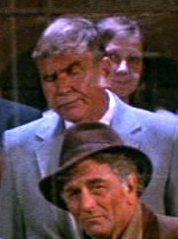
First, some sympathy for poor Guy Remsen. "Who is Guy Remsen?" you might ask. His late older brother was the Altman regular repertory player Bert Remsen (I know — Bert Remsen probably isn't ringing bells for many of you either. How about Jack Riley? If the name doesn't cut, his face would or perhaps the name of his most famous character — Mr. Carlin on The Bob Newhart Show. When they get to end and show the climax of the movie within The Player, Habeas Corpus, all three actors make cameo appearances. If you read closely (here's one helpful item the DVD players have that laserdisc players didn't: zooms), you see that in Habeas Corpus, Riley plays "Hap" Harlow, one of the reporters covering the execution; Bert Remsen's name gets listed as executioner, since he's the guard who starts the gas pellets dropping into the chamber; and Guy Remsen portrays The Attorney General. On both the Criterion laserdisc version and the New Line DVD version, they managed to misidentify Guy Remsen in their respective cameo guides. In the Criterion, they just got the Remsen brothers confused. Bad, but I guess we could call that an understandable mistake. In the New Line edition, somehow they swapped Guy Remsen and Jack Riley. So I've included photos of all three to avoid confusion. Bert Remsen throws open the blinds, Guy Remsen stands behind Peter Falk (who has the role of Harry Levin in
 Habeas Corpus) and Jack Riley takes notes at the very edge of the chamber window (if the full picture were there, you would see Susan Sarandon to Riley's left in the part of another reporter, Ellen Walsh. I suppose this serves as good as a place as any to point out the three credited cameos I couldn't locate (for certain). The first actor I know very well. He's Richard Anderson, a character since the 1940s whose best-known role probably would be Oscar Goldman on both The Six-Million Dollar Man and The Bionic Woman. Where Anderson has hidden in The Player remains a mystery to me. He's not on the New Line DVD and I don't recall him on the Criterion laserdisc either. The mystery actress, whom I couldn't even find a photo for to try to search out her location, is named Maxine John-James. The Inaccurate Movie Database lists three features and one episode of the television series Acapulco H.E.A.T. Personally, I must track down her dual role in the 1997 film Pterodactyl Woman from Beverly Hills. The third incognito cameo belongs to an actress named Jennifer Nash. Unlike Ms. John-James, she cites an extensive list of credits, mostly on television, and photographic proof of her existence can be obtained. In The Player, I couldn't find her unless that's her holding a dog and accompanying Malcolm McDowell in the lobby of The St. James Club. However, no matter how I tried to play with her image, I never succeeded in making it discernible enough to match against other photos of Nash.
Since they count Ross and she appears in the opening eight-minute shot, I'm going to attempt to get through the remainder of the cameos in the order that they appear in the film. Writer-director Adam Simon steps up first, pitching to Griffin as soon as Mill gets out of his Range Rover at the unnamed studio. Griffin pushes Simon off on his D-Girl (and girlfriend) Bonnie Sherow (Cynthia Stevenson) while he has his secretary Jan (Angela Hall) call security to figure out who let Simon on the lot. His first official pitch comes from Buck Henry who tries to sell him the idea of a sequel to The Graduate. Henry reappears later at a benefit dinner for the Los Angeles County Museum of Art's film program. Griffin meets next with two women screenwriters: Patricia Resnick and Joan Tewksbury. Resnick co-wrote Altman's A Wedding and Quintet. Tewksbury wrote Altman's Nashville and co-wrote Thieves Like Us. Alan Rudolph throws out the final pitch of the unbroken shot (after first being mistaken as Martin Scorsese by Jimmy the bike messenger, played by Paul Hewitt) and serves as the segment's final cameo. The writer-director's long relationship Altman includes Altman producing five of the feature films that Rudolph directed. On the DVD, Altman says, "I'm as interested in getting Alan Rudolph's new films going as I am my own."

Most of the film's cameos occur in group situations. I hadn't thought of this before but, in its own way, it mirrors the various settings that keep uniting all the characters in Altman's Nashville, which I still consider his greatest work. Only in The Player, the same characters do not cross paths but instead enter a location stocked with a new group of celebrities. This scene even gets a nice aural to visual segue. Griffin hovers over Claire (Dina Merrill), the studio president's powerful all-knowing executive secretary, trying to learn what she knows about rival movie executive Larry Levy. Claire ducks his queries long enough until the phone rings and she tells whoever is on the line, "No, we
 couldn't sign Anjelica Huston for that. She's booked for two years." Her utterance cuts immediately to Huston's face eating lunch on the patio of an outside restaurant with John Cusack and Levy. Soon, we see Griffin walking up the path to the restaurant where he bumps into Joel Grey on the steps. Mill introduces himself and says he knows his daughter Jennifer and is a big fan. Grey notes that the two have similar ties and moves on. Griffin joins the large table across Levy, Cusack and Huston where Bonnie and others who work at the studio await (including Jeremy Piven, who has a small role in the film). At a table for two next to the studio contingent's large round table sits Martin Mull. The remaining cameo in this scene happens to be the hardest to spot as well as the saddest. Actor Brad Davis, best known for the lead role in Midnight Express, eats at a table on the patio on the other side of the eatery's entryway. You don't get a good look at him, but what you can see gives an indication of his illness. Davis was dying of AIDS and succumbed on Sept. 8, 1991, seven months before the movie's release. I've cropped a larger frame so you can see where he sat and then enlarged Davis from that screenshot to give you an idea.
The mixture of celebrities mingling at the pool party of Griffin's attorney, noted entertainment lawyer Dick Mellon (Sydney Pollack), proves quite eclectic, to say the least. When Griffin and Bonnie arrive at Dick's place, they first encounter Marlee Matlin and Bonnie — through Matlin's interpreter — discusses a script that she read and thinks would be great for Matlin. Dick spots Griffin's arrival and excuses himself
 from a conversation with Harry Belafonte and his daughter Shari concerning network news figures. Griffin and Mellon's conversation offered more evidence that Pollack might be a better actor than director, this time playing it straight. Griffin starts to tell Mellon about the threatening postcards when his white whale — Larry Levy — crashes the party, arriving as a guest of Jeff Goldblum. Mill complains to Dick that Levy keeps getting in his face. "He's a comer. That's what comers do — they get in
 your face. You're a comer, too. You can handle it," Mellon reassures him. "So, the rumors are true," Griffin replies. "Rumors are always true. You know that," Mellon tells him. "I'm always the last to hear about them," Griffin sighs. "No, you're always the last one to believe them," Dick corrects his client. Today, seeing Sydney Pollack play a character in a scene surrounded by celebrity cameos throws you off-kilter, the way some actors do when they appear on Curb Your Enthusiasm and it takes a few minutes to realize that they aren't playing themselves, but Pollack's role in The Player was the director's first acting job since 1982's Tootsie. Later in 1992, he took another part, this time in Woody Allen's Husbands and Wives, but Pollack didn't start acting regularly until 1998. In fact, in that final decade of his life (he died in 2008), Pollack only directed two films and mostly acted and produced. Pollack's relative anonymity to audiences in 1992 prompted Altman to cast him in the first place, though Altman originally pursued director Blake Edwards for the part of Dick Mellon. In addition to those named so far and the two couples and Sally Kellerman (who appears again later at a gala benefit) pictured in the photograph above, the remaining attendees included Kathy Ireland, Jill St. John and Robert Wagner and last, but certainly not least, Rod Steiger, saying not a word as he holds a plate of food and stares at what appears to be a vertical fish tank, though it might just be bubbling water as I see no fish.
Our next stop on the virtual bus tour of Player cameos takes us another patio restaurant, this time for breakfast the next morning. Larry Levy just completed his meeting with studio head Joel Levison (Brion James), who can be spotted eating alone near the railing between the foreground figures of Burt Reynolds and entertainment columnist and critic Charles Champlin. Altman says he cast James as the studio head specifically because he'd been typecast as a villain in so many films such as Blade Runner, Tango & Cash and Another 48 Hrs. While looking over Brion James' filmography, I may have solved part of the Maxine John-James cameo mystery. Brion James also appeared in
 Pterodactyl Woman from Beverly Hills and served as an associate producer of this Troma release. Looking further, Brion and Maxine John-James were married at the time of The Player. I still can't find a photo of her, but there you go. Levy makes a point of apologizing to Reynolds on the way out, hoping there are no hard feelings over some incident that Reynolds apparently doesn't recall since he has to ask Champlin who Levy was. Reynolds' cameo turns out to be one of the funniest once Griffin drops by. He remembers him. After Mill exits, Reynolds mutters to Champlin, "Asshole." The columnist responds, "One of a breed" which launches Reynolds into a monologue that we only hear the start of before they cut away. "No, actually they are a breed, In fact, they're breeding them" Reynolds begins but the sound fades out as we move to Levison's table. Reynolds' bit scored because, like all who appeared for Altman (accepting scale payment or no payment at all), they had no scripted dialogue. In Altman's way of thinking, if the celebrities show up to play themselves, he couldn't very well tell them what they would do in real life. As a result, every line or use of prop by a cameo artist came from that person. They also could choose to say nothing at all, but Altman and his editor Geraldine Peroni got to pick the best ones to use. (Peroni received the film's third Oscar nomination along with Altman's direction and Tolkin's adapted screenplay.) When Griffin threatens to quit over Levy coming to the studio, Levison tells him that he's under contract and he'd sue. Then, the third cameo becomes easier to see as Cathy Lee Crosby sits right behind him. In the wide picture above, Crosby appears as the blonde across from Levison.

That night, Griffin had his fatal encounter with David Kahane in Pasadena, but first the two went to a Japanese karaoke bar where actor Brian Tochi, perhaps best known as Takashi in Revenge of the Nerds or as the voice of Leonardo in the live-action Teenage Mutant Ninja Turtles movies, performed. The next day at work, Griffin and others watched the dailies from a noirish detective film called The Lonely Room starring Scott Glenn and Lily Tomlin. The purposeful flubs induce enough laughs, but the deleted scenes comes off as being even funnier as Tomlin complains about having to smoke so much when she doesn't and expresses concern about the message being sent. Then, in another cut take, Glenn asks that someone make sure that he gets his per diem when the day's shooting ends. Tomlin whines that she gets penalized because she lives in Los Angeles while Glenn lives in another state, flies in and stays at the Chateau Marmont and receives extra pay for it.

Now comes the moment we've been waiting for since the headline of this post: Who the hell is Thereza Ellis? Thanks to the New Line cameo guide, I know what she looks like and where she appears, but that answers no questions whatsoever. It's later that night when Griffin's stalker,
 who has surprised Griffin by not being dead, had told him to meet him alone at The St. James Club. In the hotel lobby, Griffin first encounters Malcolm McDowell (who is accompanied by a young blonde woman with a dog that might be that Jennifer Nash. Who knows?) McDowell smiles as he shakes Mill's hand and then tells the studio executive, "The next time you want to badmouth me, have the courage to do it to my face. You guys are all the same." Griffin looks stunned as the actor leaves (though he'll pop up again at that gala benefit). In a lounge area, Andie MacDowell has been cornered by the film's two most over-the-top characters: screenwriter Tom Oakley (Richard E. Grant) and Andy Civella (Dean Stockwell). Geena Davis originally was going to do this cameo, but some emergency happened so MacDowell flew in from her home in Montana at the last minute to pitch hit. That makes the conversation all the funnier since Oakley and Civella are trying to convince the actress the Montana always ends up being bad luck for people in the movie business, citing as their only evidence Michael Cimino's Heaven's Gate. When the hyper pair spot Griffin, they start trying to pitch a movie idea at him and MacDowell takes the opportunity to escape, being led off by *(drumroll please)* THEREZA ELLIS. My search for information on Ellis has taken me to the far corners of the World Wide Web but the only sign that seems to point to the existence of a Thereza Ellis comes from universal agreement that she played herself in The Player. I could find no other credits, no other photographs, no other lines of work. Someone must track down Andie MacDowell. She could be the only person who knows the truth!
 When the studio holds a black-and-white gala benefit for the Los Angeles County Museum of Art, the scene overflows with cameos both famous and curious. Buck Henry, Sally Kellerman and Malcolm McDowell put in repeat appearances, though the first cameo exists only as a voice as Leeza Gibbons narrates the arrivals at the event for Entertainment Tonight. Griffin uses the occasion to take the late David Kahane's girlfriend June Gudmundsdottir (Greta Scacchi) out on their first public date after having sent Bonnie to New York to check out the new Tom Wolfe novel. Mostly, it's a sea of face in quick glances with the exception of Cher, who comes wearing red at Altman's behest. Later, he learned that Cher never wears red. The remaining attendees in alphabetical order: Karen Black, Gary Busey, James Coburn, Kasia Figura (who apparently has a huge career in Europe), Teri Garr, Elliott Gould, Sally Kirkland, Nick Nolte, Alexandra Powers (who appears to have been stuck sitting next to Fred Ward's Walter Stuckle), Mimi Rogers and Marvin Young, known better by his recording name Young MC of "Bust a Move" fame. Finally, we come to cameo payoff — the star-studded cast of the movie-within-the-movie Habeas Corpus. I already named some earlier, but I'll point them out again as art alone places these actors in order.


ABOVE LEFT: Guard No. 6 (Michael Bowen) stands in the hallway leading to the gas chamber in Habeas Corpus. ABOVE RIGHT: Reporters and other witnesses await the execution in the viewing room outside the gas chamber. (Front row, left to right) Reporters "Hap" Harlow (Jack Riley), Ellen Walsh (Susan Sarandon) and Harry Levin (Peter Falk) take notes for their stories. Standing directly behind Levin wearing a gray suit is The Attorney General (Guy Remsen). BELOW LEFT: Warden Lowe (Paul Dooley) appears at the witness window and taps his watch, indicating the execution should proceed. BELOW RIGHT: Following the warden's orders, Guard No. 3 (Robert Carradine, left) and Guard No. 4 (Steve James) head toward the cell to retrieve the condemned prisoner.
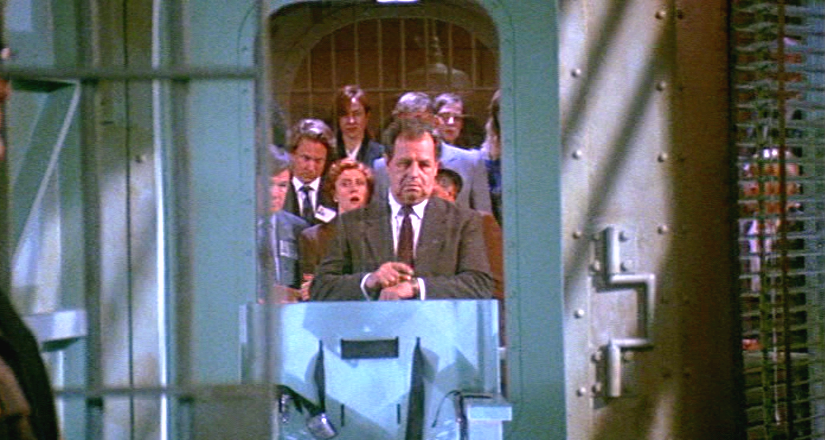


ABOVE LEFT: Condemned murderer Marsha Kent (Julia Roberts) sits on her cot listening to Father Pratt (Ray Walston) read from The Bible. Matron Cole (Louise Fletcher) stands speaking with Dr. Besh (Rene Auberjonois) by the cell door. Marsha gets removed and taken to the gas chamber where they strap her in the chair and drop the gas pellets. (not pictured) ABOVE RIGHT: Assistant D.A. Dave Williams (Bruce Willis) bursts into the unit preparing to execute Marsha, the woman he convicted for murdering her husband and whom he loves, upon learning that Marsha's husband faked his death. Williams passes Guard No. 4 (David Alan Grier) on his way. BELOW LEFT: Williams (Bruce Willis) grabs a shotgun from Guard No. 1 (Dennis Franz). Williams blasts the glass of the gas chamber, releasing fumes everywhere.(not pictured) BELOW RIGHT: Williams (Bruce Willis) carries Marsha (Julia Roberts) to safety while inside the gas chamber (from left to right) Guard No. 4 (Steve James), the Executioner (Bert Remsen) and Guard No. 3 (Robert Carradine) shield their faces from the fumes.


Tweet
Labels: A. Huston, Altman, Blake Edwards, Burt Reynolds, Curb Your Enthusiasm, Dean Stockwell, Fiction, Geena Davis, Lily Tomlin, Malcolm McDowell, Oscars, Scorsese, Sydney Pollack, Tim Robbins, Woody
TO READ ON, CLICK HERE
Tuesday, August 30, 2011
From the Vault: Husbands and Wives

Into every life a little rain must fall and in Husbands and Wives, Woody Allen summons a sizable storm. The inclement weather take many forms in Allen's new and much talked-about film and Rain (Juliette Lewis) is just one of the cloud formations in this documentary-style look at the aftermath of one couple's decision to split.
Jack and Sally (Sydney Pollack and Judy Davis) start a chain reaction when they tell their longtime friends Gabe and Judy (Allen and Mia Farrow) that, after 15 years of marriage, they plan to separate.
That announcement causes upheaval for all involved, forcing Jack and Sally to re-enter the singles scene and Gabe and Judy to re-evaluate their own relationship. Jack pursues a relationship with a New Age aerobics instructor (Lysette Anthony) while Sally gets fixed up with Judy's co-worker Michael (Liam Neeson).
Secretly, Judy pines for Michael herself while Gabe becomes attracted to one of his students at Columbia, the 20-year-old Rain who reminds him of a long lost love.
While similar to other Allen works, Husbands and Wives diverges from his usual path in terms of its language and, at times, its harsh, unblinking ugliness. The film chronicles these events not only by showing them but through conversations the characters conduct with an off-screen interviewer. The movie never explains this device and much of the film begs questions about the movie's intentions as well.
Allen films most of Husbands and Wives with a hand-held camera that darts around rooms like a camcorder being used for the first time by a technologically inept man after the birth of a grandchild. The desired effect doesn't quite work because instead of the jerky movements subliminally mimicking the chaos on screen, it simply distracts from the content.
While few screenwriters produce as much good dialogue as Allen and he's shown success at varying script structures, each time he embarks on something adventurous in terms of direction, it comes off more as a stunt than as the proper way to convey his story.
As usual, Allen wears his symbolism on his sleeve. He not only creates a lightning storm for a pivotal scene but makes a point of explaining its significance to the audience. When he delicately suggests that time is the true enemy of all relationships, Husbands and Wives works. Too often though he beats the audience over the head with his points. The subtle moments though work, especially those dealing with truths and half-truths that cause people to be uncertain of what they know.
Pollack delivers a solid performance as the blustery Jack who finds himself drowning in his own midlife crisis. Lewis fulfills much of the promise she displayed in Cape Fear as the tempestuous Rain, getting many of the film's best lines and scenes, especially in a sequence that visualizes what she thinks as she reads Gabe's unpublished novel.
Without question, the remarkable Judy Davis earns the prize for cast MVP as the hyper and aggressive Sally. She was robbed of Oscar nominations last year for solid supporting work in David Cronenberg's Naked Lunch and the Coens' Barton Fink and for her lead role in Impromptu, but hopefully this performance will garner a stream of awards.
As for Allen and Farrow, Woody is, as always, Woody, and Farrow, who has done her best work with Allen, comes off as somewhat sad and pitiful in a role that makes her unsympathetic. Given recent events in Allen and Farrow's real life, it's impossible not to read things into much of the dialogue and situations. Despite that, Husbands and Wives hits some universal nerves. Though it fails to live up to Allen's best works, it still deserves a look.
Tweet
Labels: 90s, Coens, Cronenberg, Judy Davis, Liam Neeson, Mia Farrow, Oscars, Sydney Pollack, Woody
TO READ ON, CLICK HERE


