Sunday, January 12, 2014
Love Hurts

Why do we always hurt the ones we love?
Anyone who’s been a part of any kind of significant relationship, whether of the familial or romantic variety, has been given to ponder the paradoxical nature of those thorny, forged-in-fire entanglements. As evidenced by the brutal, bruising verbal brickbats the family members of August: Osage County lob at each other’s heads like hand grenades, no one can inflict quite as much damage as one’s nearest and dearest. This axiom may be most commonly applied in reference to human interaction, but it holds equally true when considering a writer and his work.
Anyone who’s ever put pen to paper — or, in this modern age, spent hours staring at a blinking monitor — knows that the peculiar bond between a scribe and his prose can be as complex and as intimate as that of any of the human variety. Many playwrights and novelists have likened their labors to the birthing process, and discuss their work in the same way that parents talk about their children. By that definition, writers who do harm to their own creations can be charged — at least, on some metaphysical plane — with child abuse.
This is not to cast aspersions on the character of Tracy Letts, who has adapted his Pulitzer Prize-winning play for the screen, and whom I suspect is only minimally to blame for what has happened to it (nothing good) en route. Still and all, it begs the eternal question: Why do we hurt the ones we love? As far as selling a book or a play to the movies is concerned, nine times out of ten, the road to perdition is paved with good intentions.
Rather than veering too far off course into the realm of psychoanalytic introspection, it may be best to consider the history of the property in question. August: Osage County premiered in the summer of 2007 at The Steppenwolf Theatre in Chicago. The production subsequently moved to Broadway in the fall of 2008, with most of its original cast intact. It remained ensconced on The Beltway for a year and a half — a rare feat for a non-musical production not featuring a movie or TV star — picking up virtually every major award along the way. I saw the production three times over the course of its run — anyone familiar with Broadway pricing will recognize that this represents a sacrifice — and reviewed it for this site in 2009. It is not an overstatement to say that, then as now, I regard it as one of the highlights of my life’s theatergoing experience. Admittedly, I am not the ideal person to review the film adaptation, since I cannot approach the material with any kind of objectivity. Nor would I want to. Even if it’s a fundamental part of our nature to hurt the ones we love, it doesn’t follow that we enjoy doing it.
Nevertheless, when the owner and proprietor of this blog calls me up for active duty, I do my best to answer the call. In interest of full disclosure, I must state that while I tried to approach the assignment with an open mind, personal prejudice (did I mention how much I loved the show on Broadway?) has gotten the better of me to some degree. Oddly enough, without that pre-existing prejudice, my response toward the film might have been even less felicitous than it is now.
It’s bad form when reviewers reference other critics’ opinions to reinforce and/or validate their own position. The mere act of doing so suggests lack of confidence in one’s opinion. That said, one of the things I’ve been struck (and depressed) by is the manner in which many non-theatergoing critics have suggested, based solely on their reaction to the film version, that August: Osage County is not, and in fact never could have been, much of a play. The critic for The New York Times, while allowing that that the material may have been “mishandled…(in its) transition from stage to screen,” pondered whether that transition may have “exposed weak spots in (Letts’) dramatic architecture and bald spots in his writing.” On the opposite coast, the scribe for The Los Angeles Times took it a step further in declaring that while he had not seem the stage incarnation, “nothing about this film version makes me regret that choice.”
I suspect many people on the receiving end of years’ worth of glowing testimonials will react in much the same fashion. Anyone experiencing director John Wells’ hamfisted, ultimately rather conventional Hollywood treatment of family dysfunction without a suitable frame of reference may well be given to wonder, “Is this what all the fuss was about?” Advance reports suggested that the filmmakers made a deliberate effort to brighten things up, even going so far as to tack on a happy ending. That’s not the case. While truncated, the play has not been radically revised. In a certain sense, that’s good news. The bad news is that fundamental fidelity to the text doesn’t bring this baby snugly into port. You could rewrite every line and still arrive at something that felt closer in spirit and purpose to what Letts created for the stage than what Wells and company have come up with. As played for cozy camp by a cast of Hollywood heavyweights, the material has not been softened as much as it has been neutered.
For a sharp-fanged predator used to trolling the wild with confidence, this has an effect of bland domestication, despite the fact that its path through the jungle remains essentially the same. What sets the plot in motion is the mysterious disappearance of Beverly Weston (Sam Shepard), the craggy, alcoholic patriarch of an extended clan that includes three daughters, one grandchild and an assortment of in-laws. A noted poet whose output didn’t extend beyond one fledgling success, Beverly has a habit of going missing without so much a heads up to his nearest and dearest. This time, however, his absence has an unmistakable air of finality. No one can be quite certain whether he’s alive or dead, but the likelihood of his coming back seems slim to none. One by one, the far-flung Weston children, two of whom have wisely chosen to get themselves as far away from Mom and Dad as humanly possible, descend upon the family homestead en masse to try to piece together exactly what happened to Dad, and what in hell to do about mother Violet (Meryl Streep), a chain-smoking, pill-popping, cancer-riddled gorgon who shows no signs of becoming more manageable now that her chief antagonist has vanished without a trace. Leading the charge is pragmatic, sardonic Barbara (Julia Roberts, keeping that million-dollar smile firmly under wraps), who isn’t about to let Mom off the hook without answering a few questions. Of course, when you start digging for the truth, there’s no telling what sort horrors you may uncover. As it turns out, there are good and plenty festering away in the crypt of family secrets, and Violet is perfectly willing to invite them out to dance.
Even as I lavished praise upon the play and the production in my original review, I did so with the caveat that August: Osage County was not a revolutionary work of theater, nor even a particularly original one. Borrowing liberally from Eugene O’Neill, Lillian Hellman and Sam Shepard, among others, the play harks back to the classic traditions of American drama while reinvigorating the tried-and-true machinery of melodrama with brazen, jolting theatricality. The chief mistake Wells has made for the purposes of the film version – besides some critically misjudged casting choices — is in his confusion of theatricality with camp. He encourages his cast members to go for the easy laughs whenever they can, and irons out the characters’ idiosyncrasies to the point that their behavior seems almost quaint. When Violet and Barbara literally come to blows in the climatic dinner table scene, it’s like watching Joan Collins and Linda Evans wrestling on the marble foyer at Carrington Manor. It’s outrageous, to be sure, but not particularly shocking. Without the emotional resonance that original stage players Deanna Dunagan and Amy Morton brought to the proceedings, under the skillful direction of Anna D. Shapiro, what you’re left with feels more along the lines of a live action cartoon.
While the sins of the director shouldn't be heaped at feet of the playwright, Letts' screenplay adaptation doesn’t help matters much. The clunky efforts at opening up the piece for the screen, taking the action out of doors at select intervals, never feel like an organic extension of the action. The element of claustrophobia that contributed so much to the proceedings onstage, in the rambling Pawhuska, Okla., farmhouse with its shades drawn tight to keep out light and air, has been jettisoned in favor of woebegone glimpses of parched prairies. Certain nuances inevitably fall by the wayside when condensing a 3 hour play into a 2 hour film, and while the cuts do not fundamentally alter the dramatic structure, the action occasionally feels rushed, as if the filmmakers were working on a limited budget and needed to hit all the major plot points before running out of film stock. Some characters have been whittled down to near non-existence (the Native American housekeeper, here played by Misty Upham, has been reduced to a virtual extra), while the participation of others has been severely curtailed so as not to distract from the main event of the Streep-Roberts smackdown.
About that smackdown. Judging by the posters for the film, which flaunt a scrunch-faced, teeth-baring Ms. Roberts wrestling a very harassed-looking Ms. Streep to the ground, the battle royal between two living legends already has been designated as the chief selling point for this film. I won’t argue the point. The tattered Baby Jane template still has some blood coursing through its skeletal remains, and I suspect it isn’t just camp-starved audiences who will pony up the cash to see the two biggest female stars of their respective generations going at each other like a pair of fabulously plumed Japanese fighting fish. Both actresses seem to have taken their cues from that WWE poster aesthetic, and while the ham they serve up may be to many people’s taste, the meal as a whole is less than nourishing.
At this point, we’re really not supposed to say anything bad about Meryl Streep, since certain things are to be accepted without questioning. Remember that thing they taught us in school about Democracy being the best form of government? Well, even if a few dozen Tea Party crackpots can force a complete shutdown of the entire federal shebang, you can’t fault the model, God dammit. Likewise, I’ve discovered that in certain quarters, if you broach any contradiction to the edict that Meryl Streep is The Greatest Actress Who Ever Was, people will react as if you said something bad about America. I’ve spoken this blasphemy before, and I’ve been unfriended on Facebook for doing it. I’m not exactly sure why certain folks seem to have so little sense of proportion when it comes to Our Lady of the Accents, but this is not to imply that their insistence upon her genius is entirely lacking in merit. Ms. Streep is unquestionably great. She has given some of the best and most memorable performances of the last 30-odd years. That her talent level is through the roof, residing somewhere in the stratosphere, is beyond reproof. I suspect she’s abundantly aware of this.
It isn’t that Streep has become complacent as a performer; she doesn’t just coast on her abilities, though at times, she seems to be responding more to her characters as Great Acting Opportunities than as flesh-and-blood human beings. By default, she is undoubtedly the best thing in August: Osage County. Her performance is the most finely honed and easily the most convincing of the bunch, even if the favored mannerisms and inflections are starting to look so precise and polished that they might as well be kept under glass at Tiffany’s. Where the performance loses credibility (and probably, this is the director’s fault as much as hers) is in her rendering of Violet as a lip-smacking Diva turn. Part of the fun of watching Deanna Dunagan onstage was the slow reveal of Violet’s true nature; behind the drug-induced haze and tortured insecurities lie an ineffably shrewd, twisted, Machiavellian mind, sharp as a tack and ready to do battle. By contrast, Streep takes to the screen like she’s warming up to play Eleanor of Aquitaine. When it’s crystal clear from the outset exactly who’s pulling the strings, a vital element of suspense is lost. Frankly, given who’s she up against, it isn’t as though she has much in the way of competition, anyway.
Lest anyone misunderstand my intentions, I must duly assert that I am not a snob when it comes to acting pedigree. Range and/or skill set, whether acquired by classical or method training, does not necessarily place one person on a higher pedestal than anyone else. Talent is talent, and I’ve always had a soft spot for performers who can make assembly-line crap compulsively watchable by sheer force of personality. Julia Roberts has her limitations as an actor, and her fair share of detractors (and boy, are they emphatic), but she’s also given some of the great movie star performances of her era. It’s not a knock on Audrey Hepburn to say that she probably didn’t have the chops for Albee, or that Barbra Streisand might have been absolutely disastrous in Pinter. Nor should it be perceived as a negative reflection on Ms. Roberts to say that what is required of her in this context is simply beyond her abilities. Unfortunately, that negative balance takes a lot of the charge out of the material, and gives the mother-daughter skirmish the appearance of a lopsided battle.
On stage, Amy Morton’s cornhusk-dry delivery, powerful physicality and searing emotional transparency went a long way towards revealing the deep reserves of anger and pain which informed Barbara’s metamorphosis from defeated, resentful onlooker to fully engaged combatant. While Barbara is nominally the protagonist, she’s not really the hero. That she is very much her mother’s daughter, as damaged and damaging as Violet and with the same capacity for unleashing icy torrents of cold, hard fury, is made abundantly clear as soon as Mama starts turning up the heat. You have to believe, as one character asserts, that in spite of surface appearances, there’s “no difference” between the two. Roberts endeavors diligently to embody the complexities and contradictions of the role, but going to the dark places is not the most comfortable place to be when one has made a career out of flooding the screen with sunshine. She overcompensates by punching up her sassy, feisty Erin Brockovich shtick, but what worked like gangbusters in a miniskirt and push-up-bra does not here dimension make. It’s an uncharacteristically flat, colorless performance. There’s never any risk of Barbara turning into her mother, not does it ever seems as though she is willing or able to take Violet to the mats.
No one else meandering through the din makes much of an impression, although a few of the performers — notably Chris Cooper, Margo Martindale and Juliette Lewis, who brings some nice flashes of hysteria to her marginalized role as the most clueless and least functional of the three sisters — are at least better suited to the material. While Benedict Cumberbatch has carved out a nice niche for himself in recent years as the thinking girl’s sex symbol, and Ewan McGregor likely will remain boyishly handsome well into his 60s, their presence here as, respectively, a sad-sack, slow-witted underachiever and an unprepossessing middle-age college professor, defies all measure of reason. Julianne Nicholson, Dermot Mulroney and Abigail Breslin are among those also caught in the cross-hairs, although everyone not named Meryl or Julia is essentially treated as window-dressing. While it’s something we’ve come to expect of the movies, casting so many extremely photogenic performers was probably a mistake. Quiet desperation, romantic neglect and midlife crisis have never looked more red-carpet-ready.
That red carpet will doubtless unfurl in the months to come for at least one member, and possibly more, of August: Osage County’s creative team. Tracy Letts may reap some of the rewards for his contribution here. Of course, nominations are nice, and so is the money…but reading between the lines of the playwright’s recent comments to The New York Times, he’s not entirely satisfied with the finished product. A writer’s life is one of compromise when the camera comes into the picture, and based on Letts’ statements, he probably realized that trying to maintain too much control over the film version would have been fighting a losing battle. At least, by doing the adaptation himself, he could still score a few points and protect some of what needed to be preserved. Why do we hurt the ones we love? If August: Osage County is any indication, the answer may be to prevent others from hurting them instead.
Tweet
Labels: 10s, A. Hepburn, Albee, Chris Cooper, Ewan McGregor, Harold Pinter, Julia Roberts, O'Neill, Shepard, Streep, Streisand, Theater
TO READ ON, CLICK HERE


Wednesday, July 17, 2013
What he really wanted to do was be an actor
BLOGGER'S NOTE: This post is part of The Sydney Pollack Blogathon occurring through July 22 at Seetimaar — Diary of a Movie Lover

By Edward Copeland
For 40 years, from 1965 to 2005, Sydney Pollack directed 19 feature films. His last directing effort appeared as an installment of PBS' American Masters series on the architect Frank Gehry. Prior to that, he directed lots of episodic television. As Pollack reached the end of his life (and beyond it) he produced projects more than he directed and toward the end he also resumed the artistic endeavor where he started, acting more
 and more often. When he ventured into show business, he aimed toward acting. His father hoped that Pollack would pursue a career in dentistry, but after catching the theater bug in high school in South Bend, Ind., he left for New York following graduation and studied with legendary acting teacher Sanford Meisner at Meisner's Neighborhood Playhouse (The same year he directed the American Masters special on Frank Gehry, he executive produce another episode of the series on Meisner). Eventually, he became an assistant to Meisner and even taught acting to others, though in a 2006 interview with Venice Magazine, Pollack resisted calling the technique he learned and passed on "The Method." "People call a lot of things 'The Method,' but there really isn’t one Method," Pollack said, "but it’s all derived from Stanislavsky. It’s all derived from Stanislavsky, but Stella Adler taught it different than Sandy Meisner and Strasberg taught it differently from both of them, and Harold Clurman taught it differently than the three of them, and Bobby Lewis took it in his own direction, as well. They each took The Moscow Art Theater of Stanislavsky and basic principles, and then developed their own approach. The goal was always the same: to find a way to analyze the construction of truthful behavior within imaginary circumstances."
As he acted a lot in television of the 1950s, Pollack's interest turned to directing. While Pollack directed and produced some great and good films (my favorite being 1982's Tootsie, where he took his first substantial acting role since an episodic television appearance on a 1964 episode of the crime drama Brenner starring Edward Binns and James Broderick), after Tootsie, he acted or did voicework in more films and TV shows than his entire filmography. In many ways, I found Pollack more interesting at times as an actor than as a filmmaker, and that's where his career in the arts began, with his single Broadway role in 1955's The Dark Is Light Enough by Christopher Fry and starring Katharine Cornell, Tyrone Power and featuring Christopher Plummer.

Pollack began directing episodic television in 1961 and had ceased television acting in 1964 with that appearance on Brenner. As he jettisoned acting to concentrate on directing, he made a single movie: the 1962 Korean War drama War Hunt. The film starred John Saxon and Charles Aidman, but in addition to Pollack's supporting role, the movie offered appearances by Gavin MacLeod, Tom Skerritt and uncredited work by another future director, Francis Ford Coppola, as an Army truck driver. The biggest name among the ranks (at least he would be eventually) turned out to be a young Robert Redford. Pollack would direct Redford in seven films: This Property Is Condemned, Jeremiah Johnson, The Way We Were, Three Days of the Condor, The Electric Horseman, Out of Africa and Havana. Redford served as one of the producers of A Civil Action which featured Pollack in an acting role.
The headline at the top of this piece isn't quite true. Pollack return to acting in 1982's Tootsie (aside from a brief cameo in 1979's The Electric Horseman) proved to be quite a reluctant one. He already had cast Dabney Coleman to play George Fields, agent to prima donna/unemployed actor Michael Dorsey (Dustin Hoffman) but Hoffman pushed Pollack into taking the role himself, seeing the dynamic they had in their disagreements over the script. Pollack didn't want to leave Coleman in the cold so he cast him in the role of movie's fictional soap opera's director instead. Hoffman's instincts didn't fail him or the film as his scenes with Pollack provide many of the movie's comic highlights. You get that in the scene above, in the scene in the Russian Tea Room where Michael surprises George by showing up as his new alter ego Dorothy Michaels and, in perhaps my favorite scene between the two of them, when Michael shows up at George's home late one night to try to explain the romantic complications, including the fact that the father (Charles Durning) of the woman he loves (Jessica Lange) bought Dorothy an engagement ring. Forgetting for a moment what this all means, Pollack's reaction to news of the proposal comes off as priceless.
Following Tootsie, Pollack returned to the directing-producing track for a decade. During this decade he won his two Oscars for Out of Africa, but looking at the projects in that decade on which he worked solely as a producer or executive producer actually look more interesting than most of the movies he directed in that time. Some examples of his producing output from 1982 to 1991: Songwriter, The Fabulous Baker Boys, Presumed Innocent, White Palace, (surprisingly) King Ralph and Dead Again. With Tootsie, Pollack displayed a grounded, realistic comic side, but when 1992 arrived and he began to act up a storm, his range
 widened, even if for the most part Pollack got pigeonholed as either a lawyer or a doctor, he played distinct members of each profession. Ten years after Tootsie, he managed roles in three films (and found time to executive produce two movies as well: HBO's A Private Matter and Leaving Normal, which had the misfortune of being too similar to Thelma & Louise and coming out a few months after the other film). The photo at the top of this post shows Pollack in his first 1992 role, Dick Mellon, business lawyer to besieged studio exec Griffin Mill (Tim Robbins) in Robert Altman's The Player. As Mellon, Pollack plays a no-nonsense Hollywood figure who has seen it all and never changes his vocal tone, no matter how serious the situation becomes, and doles out truisms such as in this exchange with Mill. "Rumors are always true. You know that," Mellon tells Mill. "I'm always the last to hear about them," Griffin sighs. "No, you're always the last one to believe them," Dick corrects his client. Pollack, as in the case of his casting in Tootsie, hadn't been the first choice of the director. Of course, Pollack had helmed Tootsie and opposed casting himself as George Fields. With The Player, Altman tried to cast as many of the character parts with lesser-known faces because his film contained so many star cameos and he wanted to avoid as much audience
 confusion as possible. Initially, Altman sought writer-director Blake Edwards, who also started his career as an actor, though he hadn't appeared on screen since 1948, for the part of Mellon, but it didn't work out and he went with Pollack, who only had that one role in Tootsie in 30 years. While The Player offers darker, satirical laughs than Tootsie did and Pollack doesn't get the laughs out of Dick Mellon that he did out of George Fields, he garnered more laughs in his most dramatic, deepest film role yet as Jack, the divorcing best friend of Gabe Roth (Woody Allen) in Husbands and Wives. I wasn't as crazy about the film as others, but Pollack delivered one of his greatest acting jobs, ranging from the at-ease midlife divorced man finding renewed vigor with a twentysomething aerobics instructor (Lysette Anthony) and then turning downright nasty on her at a party when she doesn't meet his standards for intellectual heft. He literally drags her from the soiree and tosses her toward his car, accusing her of being an "infant." It's a scary side of Pollack that we'll see more of in other roles. His third on-screen role of 1992 didn't receive a credit, but the cameo in Death Becomes Her provides what could be Pollack's funniest moments as an ER doctor examining Meryl Streep. The clip below leaves out his character's final punch line.
Until his death from cancer in May 2008, seeing Pollack act became a much more common sight than spotting his directing credit. He turned up in legal entanglements again in films such as A Civil Action, Michael Clayton and Changing Lanes. He guided Tom Cruise into the sexual netherworld of the rich and powerful in Stanley Kubrick's final film, Eyes Wide Shut. He took roles in the last two films he directed, Random Hearts and The Interpreter. Pollack even provided the voice for the studio executive in The Majestic and the French film Avenue Montaigne. His final film role was in the romantic comedy Made of Honor where he played the father of the male maid of honor (Patrick Dempsey). On television, he did more voice work on comedies such as Frasier and King of the Hill. He also played a doctor on an episode of Mad About You and had a recurring role as Will's father on Will & Grace. He even played himself on an episode of Entourage, his last TV or movie appearance. Of all his late appearances though, the one that stands out to me also came in 2007 and put him in the role of another doctor. In the batch of the last nine episodes of The Sopranos, Pollack played jailed oncologist Warren Feldman, incarcerated with the dying Johnny Sac (Vincent Curatola) in the great episode "Stage 5." This scene I believe gives a great example of how talented Pollack truly could be as an actor.
Tweet
Labels: Altman, Blake Edwards, Coppola, Cruise, Dabney Coleman, Durning, Dustin Hoffman, J. Lange, Kubrick, Plummer, Redford, Streep, Sydney Pollack, The Sopranos, Tim Robbins, Woody
TO READ ON, CLICK HERE
Monday, July 01, 2013
What acting is all about — unemployment
BLOGGER'S NOTE: This post originally appeared Dec. 17, 2007. I'm re-posting it as part of The Sydney Pollack Blogathon occurring through July 22 at Seetimaar — Diary of a Movie Lover

By Edward Copeland
Film directing isn't often compared to completing a jigsaw puzzle, but that analogy seems most apt in describing exactly what Sydney Pollack accomplished with Tootsie, which opened 25 years ago today. What began with a story by Don McGuire and Larry Gelbart and a screenplay by Gelbart became the center of a fight between the film's star, Dustin Hoffman, and Pollack, and ended up with countless other notable scribes (among them Barry Levinson and Elaine May) taking shots at the script. In the end, the final screen credit went to McGuire and Gelbart for story and Gelbart and Murray Schisgal for screenplay, but Pollack's ability to weave the best parts of all those drafts and spin them into cinematic and comic gold deserved a credit all its own. If that feat of wizardry weren't enough, Pollack also turns in a fine supporting role as well, playing Hoffman's character's agent.

When originally released, while I loved Tootsie, being 13, my 1982 heart still belonged to E.T.: the Extra-Terrestrial, released months earlier. However, as the years went by, Tootsie grew in my estimation while E.T. became almost too schmaltzy to watch, so much so that I haven't returned to it in nearly 20 years. Perhaps my view would change again now. What makes Tootsie soar, like many other films, comes from the fact that its greatness proves impermeable to even a picky, critical mind such as mine. I mean, how exactly does "Dorothy Michaels" (Hoffman's drag alter ego) get paid when she doesn't exist and wouldn't have a Social Security number? Of course, the finale, involving an accident that forces the soap to redo a show live at the last minute seemed ridiculous to me even upon first viewing, but why question the logic of a scene that uproariously funny and with a payoff so huge? The brilliant ensemble cast, in addition to Pollack's patch job, holds Tootsie together.
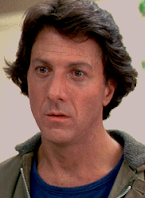 Hoffman, deservedly, gets a lot of credit for his drag creation, but I don't think he gets the kudos for Michael Dorsey that are due him. It might seem as if Hoffman's reputation for being difficult, makes Michael a cakewalk, but he not only plumbs
 Dorsey's depths for comedy and pathos, but convincingly depicts his transformation from a horny prima donna to a more sensitive man (At one point, Michael acknowledges that he thinks Dorothy is smarter than he is). The opening sequences, depicting his problems as an actor who hasn't had a job in two years, come stocked full of laughs, such as the scene where his agent George Fields (Pollack) explains the reasons he his client can't get work while Michael insists in his own defense "that nobody does vegetables like me" to justify his firing from a commercial where he played a tomato. Hoffman and Pollack don't carry the film alone. Ironically, the weakest link in the cast, Jessica Lange, was the only person to win an Oscar, a consolation prize for losing lead actress in Frances that year to Meryl Streep in Sophie's Choice. Frankly though, Lange wasn't even the best supporting actress in Tootsie, though her character provides the key to the film's serious undercurrent of exploring the way men sometimes treat women in all ranges from employment discrimination to out-and-out misogyny, but the message never interferes with the laughs.
Teri Garr's great turn as Michael's acting colleague and friend Sandy did earn an Oscar nomination, but she lost to Lange, as did my personal choice for 1982, Glenn Close in The World According to Garp. Garr, however, clearly led the field of women in Tootsie (hell, I could make a case for Doris Belack as the soap's producer over Lange). Always clandestinely stuffing food into her purse at parties, having Michael "enrage" her for an audition and her go-for-broke rage explosion when she learns Michael has been deceiving her provide some of the film's most priceless moments. The ensemble contains so many great supporting turns by the men in the film, I'm almost afraid to single anyone out. In addition to Pollack, viewers receive the gifts of George Gaynes as the soap's aging star, wholly dependent on cue cards and
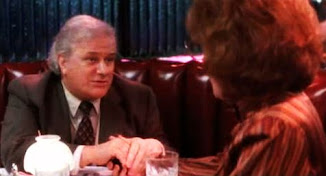 prompters, who hits on every new cast member; Dabney Coleman doing the chauvinistic asshole character he practically patented in the early 1980s as the soap's director; the great Charles Durning, who earned an Oscar nomination that year, albeit for The Best Little Whorehouse in Texas with his single but memorable scene singing and dancing a little "Sidestep," as Lange's widowed father who falls for Hoffman's Dorothy and longs for the days when men and women "were what they were." His proposal scene proves both funny and touching (though the comic gem resulting from this sequence comes later when Michael tells his agent about the offer and Pollack asks him what he said, with genuine happiness that makes him forget about the truth of the situation for a moment. Along with Belack, another fine supporting female in the cast happens to be a young Geena Davis who plays another actress on the soap and shares a dressing room with Dorothy.
The prize for the best of the supporting men though goes to the great Bill Murray, in a role that legend says he improvised completely and I believe it. He plays Jeff, Michael's playwright roommate, and if he truly did come up with all his own dialogue, what a treasure trove he unleashed. (My personal favorite: When he says he wishes he had a theater that was only open when it rained.) Even though Tootsie lags a bit when it takes a detour to Durning's farm, it's forgivable since those scenes give the film part of its heft and allows for even more comic grace notes. How Tootsie lost to the noble but limp Gandhi (including for original screenplay, patch job or no patch job) still baffles me.
Tweet
Labels: 80s, B. Levinson, Dabney Coleman, Durning, Dustin Hoffman, Geena Davis, Gelbart, Glenn Close, J. Lange, Movie Tributes, Murray, Streep, Sydney Pollack
TO READ ON, CLICK HERE
Tuesday, May 08, 2012
Bring on the lovers, liars and clowns!

By Edward Copeland
Without a doubt, one song stands heads and shoulders above all others written by Stephen Sondheim for A Funny Thing Happened on the Way to the Forum and "Comedy Tonight" holds that perch. Even people unaware of the movie or the stage show of Forum probably know that infectious number that opens and closes both versions. No more proof need be delivered to back this claim than the sheer number of performances, spoofs and use of the song as background music for clips and slideshows that I stumbled upon on the World Wide Web. Who knows how many more are out there? One used the song to back scenes from The West Wing, but the quality of the video was so poor, I wasn't going to use it until I stumbled upon a better version. Another person did three separate Bewitched montages, two of which employed identical moments only one used Zero Mostel's 1962 original cast recording version while the other took Nathan Lane's 1996 revival recording. I chose not to toss those in this collection because each montage only lasts 42 seconds, cutting off the song early. Never fear though, that still left me with plenty of options. Before I "open up the curtain," I thought I'd start with a clip of "Invocation and Instructions to the Audience" from The Frogs, a 1974 musical staged and "freely adapted" by Burt Shevelove (co-author of Forum) from the play by Aristophanes (written in 405 B.C.) and staged in the Yale University Swimming Pool with a cast of Ivy League students whose ranks included one Meryl Streep. Sondheim originally composed "Invocation" as the opening number for Forum when his first attempt ("Love Is in the Air") wasn't working during out-of-town tryouts. The show's legendary director George Abbott, according to Sondheim's Finishing the Hat, didn't find "Invocation" "hummable enough" — no doubt inspiring the producer's complaint in Merrily We Roll Along. Thankfully, that led to the blessing of "Comedy Tonight" and "Invocation" returned with the addition of the hysterical "Instructions to the Audience" when Sondheim and Shevelove collaborated on The Frogs. The clip below comes from the BBC Proms program given July 31, 2010, to celebrate Sondheim's 80th birthday. With the backing of The BBC Concert Orchestra conducted by David Charles Abell, Daniel Evans, a Tony nominee for best actor in the 2008 revival of Sunday in the Park with George, and Simon Russell Beale, a Tony nominee for best actor in the 2004 revival of Tom Stoppard's Jumpers, perform the number.
As I mentioned, people love to use "Comedy Tonight" as a backdrop to scenes from their favorite television shows or, in one instance, a series' cast actually performed the song themselves. I thought I'd start with TV and go chronologically from the oldest to the newest. First, this variety show's ensemble performed the number in the show's third episode ever on Oct. 18, 1976. Honestly, it's pure coincidence that I led into this with the number from The Frogs.
Anyone recall the last time they saw a rerun of this hit 1980s detective series with romantic banter between the leads? No, not Moonlighting. I refer to Remington Steele, the series that made Pierce Brosnan a star during its run from 1982-1987. What did happen to Stephanie Zimbalist?
The English certainly aren't immune to the charms of A Funny Thing Happened on the Way to the Forum. Five major productions of the musical have played London since 1963 (with its original Pseudolus, Frankie Howerd, reprising the role in a 1986 revival) and a company that toured throughout the United Kingdom. Some enterprising fan of the musical combined the song with the long-running British spy series MI-5 (originally titled Spooks) that ran 10 seasons beginning in 2002.
This West Wing fan not only sets scenes to a version of "Comedy Tonight" but tosses in some of "Love Is in the Air," the first opening song that Sondheim wrote for Forum as well.
Finally, since in some ways the farcical elements of Forum almost make it a cartoon, its final television salute should, most appropriately, pair it with an animated work, namely Avatar: The Last Airbender, which ran from 2005-2008.
The song brings out the fun in everyday folk as well as we see here where "Comedy Tonight" underscores a year-end slideshow presentation for players, coaches and fans of the Long Beach State track and field team.
What happens in Vegas doesn't stay in Vegas if you post it on YouTube as with this parody of "Comedy Tonight" performed by the master of ceremonies (officially named MC Vegas) for an annual Edwardian Ball.
Now, I haven't heard much of them lately but the concept of flash mobs shouldn't be an unfamiliar one to most reading this. Apparently, at University of Western Ontario, you might be able to get course credits for participating in them since they appear to do them so often. The campus' improv broke out once into Handel's "Messiah." They interrupted this lecture with — you guessed it — "Comedy Tonight" Impressively, they choreographed some moves as well as learning the words.
I'm not sure what's funnier: That this boy named Ben (I believe his last name is Lerner) would perform this spoof of "Comedy Tonight" at his bar mitzvah (interrupted by his younger sister Nina) or that the explanatory note by his father informs us that when dad posted it years ago, the video and audio had problems, so we're watching a corrected version that he has labeled Take 2. I didn't try to track down the promised one that Nina later sang at her bat mitzvah.
Also on YouTube sits, as you'd expect, the song playing against photos of various Republican presidential contenders. I almost included it, but that's really like shooting water in a barrel, isn't it? Why waste the space? They make the point so much more brilliantly when they open their mouths than when we just look at them, even if we do see Rick Santorum chowing down on a very phallic-looking food item. Instead, we'll skip to the movies. As with television, I'm going to do this chronologically, starting with the oldest and we're going way back to 1928 and one of the last gasps of silent German Expressionism, Paul Leni's The Man Who Laughs starring Conrad Veidt as the creepy villain Gwynplaine, 14 years before Veidt became best known as Major Strasser in Casablanca.
For pure ambition, you have to give it to the students at The College of New Jersey Musical Theatre staged at the Ewing, N.J., campus a full-fledged musical based on the original Star Wars trilogy spoofing songs from a wide variety of musicals. The show opens with "Trilogy Tonight."
The title for the single best-edited video that I found involving a single subject probably deserves to go to the true identity of puddleglum128 for mating Zero Mostel's version to scenes from Jonathan Demme's The Silence of the Lambs. I'd call it perfect if it didn't contain the strange audio splice in the middle, but the right moments of Anthony Hopkins, Jodie Foster and the rest get used.
Christopher Nolan's second take on Batman, The Dark Knight, earns two takes of "Comedy Tonight!" The first, staged by The Pauper Players of the University of North Carolina at Chapel Hill as part of the group's annual Broadway Melodies in 2009 where they parody different works. (The other two that year were Lost and Super Mario Bros.) The second video features photos from Nolan's film set to Nathan Lane singing the finale version of the song and also includes stills of Gerard Way.
For the last montage, which must have required a tremendous amount of time and effort by CRAIGSWORLD1427, he asked people about what movies throughout film history tickled their funny bones the most and then assembled various bits and pieces (including dialogue) with the song for this nearly 10-minute long package. It's worth it though. Chuck Workman, be damned.
Tweet
Labels: Animation, Books, Christopher Nolan, Demme, Hopkins, Jodie Foster, Lost, Music, Musicals, Sondheim, Star Wars, Stoppard, Streep, Television, Theater
TO READ ON, CLICK HERE
Thursday, March 29, 2012
…I pull you back in

By Edward Copeland
Among film buffs and people coming of mature moviegoing age in the 1970s, the name John Cazale engenders sadness in many of them. Featured in prominent roles in five features between 1972 and 1978, each received a nomination for the best picture Oscar and three of them won. However, by the time The Deer Hunter, the fifth of those films, was nominated along with Cazale's fiancée, Meryl Streep, getting her first supporting actress nomination for that film, Cazale had been dead for almost a year, having lost his battle with cancer on March 12, 1978, at the age of 42, leaving behind one helluva legacy in a short span of time. In addition to The Deer Hunter, Fredo in both parts of The Godfather; Stan, the assistant to eavesdropping expert Harry Caul (Gene Hackman), in another Francis Ford Coppola masterpiece, The Conversation and, Cazale's greatest performance, in my opinion, as Sal, bank robbing partner of Sonny Wortzik (Al Pacino) in Sidney Lumet's magnificent Dog Day Afternoon. This piece concerns The Godfather, so let's talk Fredo.

Cazale does fine as Fredo in The Godfather but, truth be told, his time on screen doesn't add up to a lot. His role increases in Part II, but he actually has less to do in the 1972 film than many of the non-Corleones. Fredo though has acquired a legacy almost removed from the film itself. The name has become synonymous with a ne'er do, usually a ne'er do well brother. I imagine people who can't name John Cazale as the actor who portrayed Fredo recognize what someone means if they refer to someone as a Fredo. The Urban Dictionary includes multiple definitions such as the simple "family's black sheep" to having sex with two waitresses simultaneously as Moe Greene claimed he caught Fredo doing and Vince Vaughn's character reference in Swingers. The truth of the matter just happens to be that Fredo Corleone, the middle son, can't stop fucking up. It's sad, because you see in Cazale's portrayal that Fredo wants to be a good son, but he's messed up so many times that even he understands why his family can't rely on him. His big, heartbreaking scene comes when rival gangsters make their assassination attempt on his father and Fredo bobbles his own gun, unable to shoot back. He ends up sitting on the curb, next to his critically wounded dad, the gun dangling from his hand, weeping like a child.
You'd think that Talia Shire had the easiest path to landing her role as Corleone daughter Connie, given that her brother Francis was directing the film, but Coppola says he almost didn't consider her for the part because he thought his kid sister was "too beautiful." Connie isn't much more than a plot point in The Godfather — a Corleone daughter to get wed, beaten and, finally, to lash out at her brother for killing her no-good husband. Shire and Connie don't get to grow into interesting characters until the sequels, for certain Part II and, reportedly, a re-edited Part III on DVD and Blu-ray that drastically improves that misfire, including her character's motivations. Walter Murch is said to have led the restoration and re-cutting of Part III, which was rushed in 1990 in order to qualify for the Oscars. Reported rumors that the new cut of Part III replaces Sofia Coppola with Andy Serkis have not been verified. The other major female role in The Godfather got more to do but, like Connie, developed even further in Part II. This was Diane Keaton's second feature film after Lovers and Other Strangers co-starring Richard Castellano (Clemenza). While Keaton proved often that she's adept at drama, she's always better in comedies as Woody Allen utilized with great success.

The don's oldest son and his adopted one represent fire and ice, and James Caan and Robert Duvall excel at those elemental levels as Sonny Corleone and Tom Hagen. One moment I noticed this time that I'd never observed before occurs when Sonny, after finding Connie beaten and bruised by Carlo, beats the hell out of his brother-in-law in the street. When Carlo grabs hold of a railing, Sonny actually bites into
 Carlo's hands to make him let go (in front of a Thomas Dewey campaign poster no less). Going back to Coppola's concern about guys sitting around talking, you don't get tired of these two doing that, especially in scenes such as debating what actions to take following the attempt on their father's life. When Michael comes home with a swollen jaw courtesy of the crooked police captain, it sets Sonny off again, ready to go to war against Sollozzo. Tom, functioning as the levelheaded consigliere, tries to explain to his adopted brother that even the man upstairs recovering from his bullet wounds would understand that it wasn't personal.
TOM: Your father wouldn't want to hear this, Sonny. This is business, not personal.
SONNY: They shoot my father and it's business, my ass!
TOM: Even shooting your father was business not personal, Sonny!
Caan dances through the movie, all energy, sometimes comic, sometimes violent, sometimes sexual. When brother Michael (Al Pacino) decides he doesn't want to be the straight-arrow civilian anymore, Sonny laughs at his kid brother, even using Hagen's words. "Hey,
 whaddya gonna do, nice college boy, eh? Didn't want to get mixed up in the family business, huh? Now you wanna gun down a police captain. Why? Because he slapped ya in the face a little bit? Hah? What do you think this is the Army, where you shoot 'em a mile away? You've gotta get up close like this and — bada-BING! — you blow their brains all over your nice Ivy League suit. You're taking this very personal. Tom, this is business and this man is taking it very, very personal," Sonny teases. Of course, Duvall's path to success had been forming prior to The Godfather, but this did earn him his first Oscar nomination as supporting actor. Caan, Duvall and Pacino all earned supporting nominations, one of the rare times a single film grabbed three slots in an acting category. The Godfather Part II repeated the feat in the same category. It also had been achieved by On the Waterfront. The movie Tom Jones accomplished it in supporting actress and the 1935 Mutiny on the Bounty did it in best actor (out of four nominees), but this was prior to the creation of the supporting categories.

Which leaves us with the film's two most important characters who also happen to be its most important actors as well. One of the first practitioners of the Method who had set the world on fire and a brash newcomer with a new generation's take on the same style meeting together. The old master Marlon Brando, showing the world that he still had power, while the rising star Al Pacino makes his presence known loudly (back in the days when Pacino did this without being literally loud). Before watching the movie this time, I read someone commenting how as Michael shifts into Vito's role, Pacino subtly transforms physically. That swollen jaw from McCluskey's punch starts to resemble those cotton-stuffed jowls Brando gave Vito. When I did watch it, especially when you really pay attention to that great contribution from Robert Towne, it's as if Vito and Michael undergo a Persona-like transference. I believe the key moment of Michael's switch happens when he protects his father at the hospital, hiding his bed in the stairwell and
 clutching his hand, whispering, "I'm with you now, pop." The don, who hasn't regained consciousness since the shooting, does then and gives his son the sweetest smile. It's a touching moment — if you forget the family business. Everyone debates whether Brando has the movie's lead role or if that title really belongs to Pacino. I always swear that I'm gonna add up minutes of screentime, but I can never do it because I get too involved. To me, it feels more or less as if it's an ensemble piece. Brando disappears for awhile after he's shot, but so does Pacino immediately after he flees the country. (It's worth pointing out that even the greatest films ever made have flaws. As I feel the Paris flashbacks in my beloved Casablanca come off as hokey, Michael's Sicily scenes and sudden marriage may be The Godfather's Achilles' heel.) What I know for certain is that both actors deliver great performances. You see very little of the Brando silliness that sometimes pop up with the most obvious example being when singer Johnny Fontane (Al Martino) seeks his help at the wedding at the don unmercifully mocks him as Fontane practically cries acting what he can do to get that movie part. Corleone shakes him vigorously and shouts, "You can act like a man!" He then slaps him and ridicules him further. "What's the matter with you? Is this what you've become, a Hollywood finocchio who cries like a woman?" Then the funny Brando comes out as he does a little girl voice, "'Oh, what do I do? What do I do?' What is that nonsense? Ridiculous!" You spot Tom Hagen laughing in the background, but part of me suspects that really was Duvall trying not to crack up. Other than that, Brando plays things remarkably straight and truthfully as when he calls in the favor the undertaker Bonasera owes him to clean up Sonny for his funeral. "Look how they massacred my boy," he cries.
Looking at the young Pacino engenders the same kind of sadness that recent appearances by Robert De Niro do — did their love of the craft give way totally to monetary concerns? Pacino actually hasn't been quite as bad as De Niro, but to see his Michael, when Pacino knew the word subtlety…sigh. My God — I didn't see it, but what in the hell was he doing playing himself opposite Adam Sandler in Jack and Jill? To Pacino's credit, at least I can believe he appears in that kind of shit so he can keep returning to the stage. Michael Corleone's arc allows viewers to see a master class in screen acting over the first two movies. You can accomplish this with the first film alone, watching as he slinks further into the darkness. Another thing I've always loved that I'm grateful I found a YouTube clip to use is the strut Michael develops once he's completed his turn and just watched Carlo ride off to his demise. What an evocative, physical symbol of a man's change.
At the beginning of this post (I apologize that happened so long ago) I promised that I would be discussing things new to me about The Godfather. That time has arrived. In case it's slipped your mind, what I began this piece by saying was that sometimes you know a movie so well that when you actually watch it closely and purposefully, you'll notice things or have ideas that haven't occurred to you before.


Don't get me wrong. The reason I've spent so much space talking about the acting, writing and directing after the setup before I got to the crux of this assessment was meant to reassure those out there that The Godfather remains one of my favorite films of all time before I described a shift in my outlook on it. Back in the previous posts, as I detailed all the chaos endured to get the film made, I mentioned briefly how Paramount pursued some of the top directors at that time but all turned the project down, citing a fear of glamorizing or glorifying the Mafia. That's a criticism that gets hurled at most mob-related entertainments. Some said that about Martin Scorsese's Goodfellas. Even larger numbers lodged that complaint against The Sopranos. Reflexively, I've always responded that those accusations were nothing but a load of crap — and they are when it comes to Goodfellas and The Sopranos, which don't try to hide the fact that these people steal, kill and basically don't contribute to a civil society. Watching The Godfather this time, a light suddenly illuminated its depiction of the Corleones as whitewashed, to say the least. It starts from the very first scene when the undertaker Bonasera asks the don to kill the men who attacked his daughter, but Vito refuses. When Bonasera leaves, Vito even says to Tom Hagen, "We're not murderers, no matter what he thinks." Except mobsters are murderers. That line only marks the first example of the film turning the criminal family into reputable heroes. These photos are just for contrast. At left, we have Corleone family soldier Luca Brasi (Lenny Montana) being strangled in an ambush set up by the "bad gangsters"
 Sollozzo (Al Lettieri) and Bruno Tattaglia (Tony Giorgio). In the photo on the right, the star of The Sopranos, James Gandolfini as Tony, personally throttles Fabian Petrulio (Tony Ray Rossi), who used to be a gangster but became a "rat" when he testified for the feds and went into the Witness Protection Program. This took place in "College," the heralded fifth episode of the series. They wasted no time showing that Tony would commit a hands-on murder. Examine Goodfellas in comparison to The Godfather. Goodfellas came from Nicholas Pileggi's well-researched nonfiction book Wiseguys. While Mario Puzo's novel played the guessing game of "Who could this character be based on?", Puzo never asserted it to be anything but a fictionalized portrait and the film version watered down the Corleones even further. Coppola openly admits he wanted to use the story to be less about organized crime but a comment on American capitalism as well as being about a family in the generic sense. While corporate businessmen may not call their mistresses goomahs, they have them. You'd have to watch very closely to notice that a wife exists that Sonny cheats on (You never see a ring on his finger). They show him having a vigorous sex life, but certainly downplay that it's an adulterous one. We get a few brief shots of his spouse and one comment from his dad when Sonny comes into his father's office following a sexual encounter and his dad talks with Fontane. When Vito sees Sonny enter, he asks the singer but looks pointedly at his son, "Are you good to your family?" In Goodfellas, the girlfriends existed as part of the gangster lifestyle with, separate nights set aside for them at the Copacabana. By the era of The Sopranos, the wives know they exist and accept them somewhat as long as they keep the benefits of their lifestyle.
I don't know how this could come as such a shock to me now, having seen The Godfather so many times over so many years other than my love for Goodfellas superseding it and subliminally planting seeds in my mind which The Sopranos watered, allowing the realization to blossom. The recent Blu-ray release The Godfather Coppola Restoration includes a special feature in which Sopranos creator David Chase says he intended his series to be about the first generation of gangsters actually influenced by Coppola's film. I'm sure that's true (the characters made lots of references to the trilogy), but their lives more closely resemble those of the real gangsters in Henry Hill's universe in Goodfellas than they do the Corleones, with their huge family compound. Even Paulie (Paul Sorvino), the boss in Goodfellas, lived a
 more middle-class-looking lifestyle, at least in terms of appearance. The fictional Tony got to move into upper middle-class suburbs, but those who worked for him lived much more meagerly. Hell, when you compare them, the brief shot in The Godfather of the home where Clemenza lives looks much nicer than the Belleville, N.J. residence of Corrado Soprano (Dominic Chianese). While not a gangster, even Walter White (Bryan Cranston) lived in a much nicer house when his salary came solely from teaching chemistry than Uncle Junior's or most of Tony's crew's places did, but the cost-of-living in Albuquerque probably is a lot less expensive than New Jersey. What's more relevant than the living arrangements of the various fictional and nonfictional criminals comes from my recognition of the unwillingness to show the true nature of the Corleone family unlike Scorsese did with the criminals in Goodfellas, Chase showed with his characters on The Sopranos and Vince Gilligan does on Breaking Bad charting, as he's said often, "Mr. Chips turning into Scarface." In Goodfellas and the TV shows, you see the innocent who pay the price for their crimes. In The Godfather, we don't see a single instance of how the Corleones conduct their criminal enterprises. The Godfather board game that I mentioned having in the first post, "America's first family," explicitly references bookmaking, extortion, bootlegging, loan sharking and hijacking though those activities never cross the lips of the Corleones or anyone who works for them (though it's doubtful that by 1945, bootlegging draws much revenue for the New York-based family). Are we to presume the Corleones actually built the mansion with profits from selling Genco Olive Oil?
you got whacked. Everybody knew the rules. But sometimes, even if people didn't get out of line, they got whacked.
I mean, hits just became a habit for some of the guys. Guys would get into arguments over nothing and before you knew it,
one of them was dead. And they were shooting each other all the time. Shooting people was a normal thing. It was no big deal."
— Ray Liotta as Henry Hill in Goodfellas
Where The Godfather goes to the greatest length to make the Corleones "good gangsters" can be viewed by the people they do kill. Every single one of them has wronged them first and/or been shown as someone worthy of elimination. You never see any incident such as in Goodfellas where psycho Tommy (Joe Pesci) kills the waiter Spider (Michael Imperioli) because he told him to "go fuck himself" (since Spider justifiably nurses a grudge after Tommy shot him in the foot before for not serving him a drink fast enough). You don't see
 anything like on The Sopranos where a waiter follows Paulie (Tony Sirico) and Christopher (Imperioli again) out to the parking lot to ask why he didn't get a tip and they smash him in the head, causing convulsions and then shoot him to finish him off. Don Vito plays the peacemaker, despite being nearly killed and losing a son. The movie perpetuates the myth that the American Mafia likes to perpetuate that they stayed hands off narcotics trafficking (even Paulie Cicero in Goodfellas, based on the real-life Paulie Vario, peddles that line though, like the fictional Corleone, it isn't so much a moral objection as a fear of losing friends in high positions). It sounds particularly ridiculous since Lucky Luciano and Meyer Lansky already had started dealing heroin in the 1920s, something being depicted in the TV series Boardwalk Empire which may be set prior to the time period of The Godfather but by far pays the most obvious homages to the movie. This sudden realization raises questions in my mind: Does it matter? Should it matter? If The Godfather glamorizes gangsters, does that mean I should consider it a lesser movie? My answer has to be no to all of the above. It doesn't change its artistry and I already loved Goodfellas more anyway (and it only glamorizes their food). How can I really penalize a fictional film for not being more truthful? In the wake of The Godfather, did organized crime grow and get a bunch of new recruits eager to join mob ranks? Hardly. It's just interesting that it took me this long to notice this, but the film hasn't changed, I have.
Besides, it's a damn great movie that gets referenced constantly. Chase should make something for the Blu-ray given the amount of times The Sopranos references Coppola's films. They did it so many times, I couldn't even begin to recall them all. I remember my personal favorite: Paulie Walnut's car horn which plays The Godfather theme instead of beeping. As I mentioned, Boardwalk Empire might take place in the 1920s, but it seems to me to pay the most homages even if they can't be specific. Look at the character of Nucky Thompson's brother Eli (Shea Whigham) and tell me he doesn't have Fredo written all over him. In the final episode of the second season, they did an explicit reference with their version of the baptism scene with prosecutor Esther Randolph (Julianne Nicholson) preparing her opening statement as Nucky (Steve Buscemi) and Margaret (Kelly Macdonald) get married and Jimmy and Richard (Michael Pitt, Jack Huston) take care of one of Nucky's enemies.
Most of The Sopranos' references tended to be verbal, but they did do a visual one that I loved in the second episode of the third season "Proshai, Livushka" dealing with the death of the incomparable character of Tony's mom Livia Soprano (the late, great Nancy Marchand). The image below on the left comes from The Godfather when Don Vito and Tom visit Bonasera about fixing up Sonny for his funeral. Below on the right, Tony and his sisters Barbara and Janice (Danielle Di Vecchio, Aida Turturro) go to Coscarelli's to discuss arrangement for Livia, who didn't even want a service.


The fact remains, no matter the dubious way they tried to steer audience sympathy to the Corleones without acknowledging the truth of their dark dealings, The Godfather always will be a damn well-made piece of motion picture art. My philosophy always has been to judge movies on their artistic and entertainment grounds and to try to forego extraneous concerns. I've managed to do that for this long with The Godfather. I'm not changing my mind now, especially since, when it comes to film criticism, I'm about as far from a moralist as you'll find. Besides, we started these posts with that brilliant opening. "I believe in America." You think I wouldn't close with one of the all-time best endings in cinema?
Tweet
Labels: 70s, Boardwalk Empire, Brando, Breaking Bad, Buscemi, Caan, Coppola, De Niro, Diane Keaton, Duvall, Hackman, Liotta, Lumet, Pacino, Pesci, Scorsese, Streep, The Sopranos, Towne, Woody
TO READ ON, CLICK HERE
Saturday, March 24, 2012
America's first family

KATIE COURIC: What is your favorite movie?
SEN. BARACK OBAMA: Oh, I think it would have to be The Godfather. One and two. Three not so much. So — so — but that — that saga I love that movie.…It's all about family. So it's a great movie.
From CBS News interview during 2008 campaign
"I always felt it was a film about a family made by a family." — Francis Ford Coppola

"When we were editing…, The French Connection came out and I went to see it. It was this great, dynamic, exciting filmmaking…and I remember thinking, 'Compared to that, The Godfather is going to be this dark, boring, long movie with a lot of guys sitting around in chairs talking." — Francis Ford Coppola on the DVD commentary for The Godfather
By Edward Copeland
I swear I remember seeing The Godfather in the theater in its original run. Never mind that I didn't turn 3 until a little more than three weeks after its debut. (My parents cast no light on the veracity of my claim. My dad thinks I'm right because he says, "We took him to everything" but my mom doubts the story, given my age and the film's content.) Who's to say when The Godfather actually surfaced in our city anyway? They didn't hit thousands of screens simultaneously as they do now — movies had different release patterns then, more staggered. Honestly, I can't say I remember specifics from that early viewing, but I do recall other things. We bought and played The Godfather board game, which can be described best as sort of a Mafia-theme hybrid of Risk and Monopoly where players try to take over eight Manhattan neighborhoods — Upper West Side, Harlem, Park West, The Docks, The Bowery, Midtown, Wall Street and
 Lower East Side — by controlling them with one of these rackets: Bookmaking, Extortion, Bootlegging, Loan Sharking or Hijacking. Like houses and hotels in Monopoly, each of the racket pieces came at a different price with Bookmaking being the most expensive, Hijacking the least. Building your rackets also cost more in some neighborhoods than others. I played this game before I started kindergarten, but we didn't play much because even adults found it complicated. (Read the rules in detail here.) I just wish I knew if we still had the game
 somewhere. I do remember we owned the boring, rectangular box edition, not the edition that came in a case shaped like a violin. The first time I remember scenes from The Godfather relate to NBC's 1977 airing of the film, complete with its disclaimers assuring viewers of Italian descent that the Corleones in no way represented all Italian Americans, not that Italians were mentioned by name (something prompted by the protests launched by the Italian-American Civil Rights League, an organization founded and funded by real-life mob boss Joe Colombo Sr.). I’m not certain when I viewed the film uncut for the first time and had aged to the point where I could appreciate it. I know I read Mario Puzo's novel around seventh or eighth grade and realized, as I had when I read Peter Benchley's Jaws in sixth grade, that sometimes the trashiest, most awful novels translate into the best movies. When The Godfather turned 25 in 1997, fortuitous timing placed me in New York for a theater trip at the same time the movie played at a midtown cinema. Hearing the first few notes of that theme — heaven. You could say that The Godfather, which opened to the public 40 years ago today after previous premieres in New York and L.A., has occupied a more constant presence in my life for most of my years than my real godfather. What I find harder to fathom: That Paramount Pictures originally intended this film to be a quickie with a budget of around $2½ million and the studio only hired that 31-year-old director who never had helmed a hit because the suits figured Francis Ford Coppola would be easy to push around. The worst-laid plans of mice and studio executives…

For the 40 years since its release, the imbedding of The Godfather in our culture borders on the astounding. In college, when I foolishly reviewed any damned thing for which I had a free pass, I endured 1989's awful Troop Beverly Hills with Shelley Long (when was the last time you heard a reference to that film?) Edd "Kookie" Byrnes (we're going to put your pop culture knowledge to the test today) played the father of one of Long's young girl scouts, a struggling actor. As Shelley solves all her troop's problems by the end, Edd gets a job of some sort and the big payoff joke turns out to be when he turns around with cotton in his cheeks doing a bad impression of Marlon Brando's Vito Corleone. I even noted in my college paper how timely a joke that was, 17 years after the film's release. Of course, the following year, Brando showed him how you really spoof Vito Corleone when he did it brilliantly himself in
 Andrew Bergman's terrific comedy The Freshman. Now, those two films and the board game and recent video games hardly represent the only, best or worst influences the 1972 film had on our culture (Actually, The Freshman, might be among the best). I'm saving The Sopranos and Goodfellas for a different section later, but it should be noted that long before Tony started seeing Dr. Melfi (or De Niro sat down with Billy Crystal in Analyze This the same month), Saturday Night Live produced a sketch on Jan. 10, 1976, where John Belushi played Vito Corleone attended group therapy to discuss his feelings about the Tattaglia family. Guest host Elliott Gould assumed the role of the therapist. Hell, variations on "make him an offer he can't refuse" by itself
 have been heard, said and repeated so often that it's taken a place among all those familiar phrases that you wonder where they originated only to learn that Shakespeare penned them. Offhand though, I can't think of any other film that cuts across generations and classes and races with its impact. Many popular films have come and gone in the four decades since The Godfather premiered, but when you start listing the titles where references to them can be recognized by nearly anyone, even those born well after they came out, maybe Star Wars comes to mind as another film like that (the original trilogy anyway — can anyone quote something from the prequels?) Glancing at the practically meaningless Top 10 grossing films at the domestic box office right now, few injected themselves as deeply into daily lives as The Godfather with the exception of Star Wars and maybe E.T.: the Extra-Terrestrial, though I don't hear the references to it as I once did. (For the record: 1. Avatar, 2. Titanic, 3. The Dark Knight, 4. The Phantom Menace, 5. Star Wars, 6. Shrek 2, 7. E.T., 8. Pirates of the Caribbean: Dead Man's Chest (bonus points to anyone who knows which one that is), 9. The Lion King, 10. Toy Story 3.) Can anyone recall anything about the No. 1 grossing film except the colors blue and green? Even today, The Godfather, using mostly 1972 dollars, comes in at No. 279 with its gross of $134,966,411 (wedged between, Lord help the Corleones, Patch Adams and the 2006 Incredible Hulk). Of course, when you adjust ticket prices for inflation, The Godfather would rank No. 23 and its haul would total $617,963,700. As has been the case for a long time, the leader of the adjusted box office remains Gone With the Wind with a take of $1,582,009,400.
COURIC: Do you have a favorite scene?
OBAMA: Love — love those movies. I — you know — so many of them. I think my favorite has to be — you know, the opening scene of the first Godfather where, you know, the opening scene of the first Godfather where the caretaker comes in and, you know, Marlon Brando is sitting there and he's saying "you disrespected me. You know and now you want a favor." You know it sets the tone for the whole movie.…I mean there's this combination of old world gentility and you know, ritual with this savagery underneath.
Many movies start impressively. Even more come up with "wow endings" — the kind a drunk Rick Blaine lashes out at Ilsa about in Casablanca. Both Casablanca and The Godfather deliver those sort of conclusions and Casablanca tosses in one of the most memorable
 closing lines in film history. You could name lots of films that ended with terrific last lines. "Louis, I think this is the beginning of a beautiful friendship."; "The stuff that dreams are made of."; "Mother of Mercy! Is this the end of Rico?"; "Oh, no! It wasn't the airplanes. It was Beauty killed the Beast."; "I'll go home, and I'll think of some way to get him back! After all, tomorrow is another day!"; "All right, Mr. De Mille, I'm ready for my close-up."; "Well, nobody’s perfect."; "Shut up and deal."; "I'm not even gonna swat that fly. I hope they are watching. They'll see. They'll see and they'll know and they'll say, 'Why, she wouldn't even harm a fly.’"; "Never you mind, honey, never you mind."; "What do we do now?" What I do is stop because I think you got my point several last lines ago. My destination for this section on The Godfather isn't that the movie contains a brilliant closing bit of dialogue because that happens to be one of the few things it doesn't possess. Then again, it doesn't need one because instead we get the pleasure of viewing one of the best closing images of all time. Back to the above clip, the scene President Obama cited as his favorite. While I consulted some lists to see if I suffered from cinematic amnesia, I couldn't think of a lot of movies that open with great lines. Shockingly, most of these lists I found didn't remember The Godfather but included movies as recent as Black Swan and Million Dollar Baby, where I barely recall details from the films let alone opening lines and others included what really weren't opening lines, the memorable bit coming after some other chatter. (I love Goodfellas to death. I love Goodfellas more than The Godfather, but enry, Tommy and Jimmy say other things in the
 car before Henry in voice-over speaks those great words, "All my life, I always wanted to be a gangster.") Others cited Annie Hall with Alvy's great joke about the lousy food "and such small portions" but to me, that's opening joke, not a line. Great opening to a film, but not exactly line. (Brief aside, isn't it odd to think that in the early 1970s, while making The Godfather, Diane Keaton started dating Al Pacino, but they broke up eventually and she went from him to Woody Allen?) As always, there's "Rosebud" in Citizen Kane, but don't you think Orson Welles would feel sort of insulted if anyone really stay tuned to his film based on Charles Foster's last word? If you haven't played that YouTube clip above yet or if you have, play it again. You could play it for her — you can play it for me! Pardon me. What? You didn't know Rick Blaine was an inhabiting spirit? Don't worry — he hails from the White Lodge. You back? Good. Four simple words, said in darkness. "I believe in America." What a pithy, magnificent way to begin this small-scale epic and emphasize its overarching themes at the same time, As the image comes in to view and the viewer meets the undertaker Bonasera (Salvatore Corsitto) and listens to him to tell Don Vito Corleone about the attack on his daughter, we slowly start to see parts of Brando, first his hand. In the DVD commentary track that Francis Ford Coppola recorded, Coppola explains how that beginning came to be. Originally, he'd planned to just dive in to that 25-minute wedding sequence so he could introduce all the characters. (Another aside: Why does it seem that directors who had their breakthroughs in the 1970s do the best commentaries? Coppola, Scorsese, the much-missed Altman. A better question: Why the hell don't Woody or Spielberg do them?) After Coppola had written a few pages of the screenplay, he showed it to a friend. At
 the 1970 Oscars, Coppola won the adapted screenplay prize for co-writing Patton, which had that very memorable opening in front of that American flag (YouTube only has the audio) so the friend suggested Coppola should come up with an unusual opening along those lines. Coppola thought about it and went back to Puzo's novel, recalling that what struck him about the wedding opening had been the idea of the Sicilian tradition that the don had a duty to grant people's requests on his daughter's wedding day. OF the stories in the book that stood out to him the most was that of Bonasera, the undertaker, so that's how "I believe in America" the words were born. Coppola also tells how, for 1971, the way they pulled off the opening camera move was considered "high-tech." Slow pullbacks as utilized there just weren't done. They had to program a computerized zoom lens for the exact length of time Bonasera's monologue would last in order for the shot to work. Pretty damn amazing. The bigger issue working its way through the scene contrasts the lives two Italian immigrants made for themselves in American, already, in a way, setting up for The Godfather Part II, though that thought hadn't crossed
 Coppola's mind since throughout the commentary he discusses his constant fear of being fired. The undertaker made an honest living, raised a family and went to the police for justice, as he thought good Americans should do. Instead, he gets slapped in the face when the boys who attacked his daughter, disfiguring her in some way, while found guilty and sentenced to three years receive a suspended sentence and walk out of the courtroom back on the streets. We don't know the story of young Vito Andolini yet — and we won't in this film. However, basically arriving alone, he soon learned to help himself and that's what he did — through illegal enterprises rising
 to a power base of fear and respect. The American dream worked out very differently for him. His oldest son Santino, or Sonny (James Caan), can't keep a lid on his temper and by all rights should be Vito's successor. The next son, Fredo, sickly as a child, weak and rootless, the family doesn't know where he belongs. (Played by the gone-too-soon John Cazale, an actor who must hold the distinction of only making five feature films and having all five nominated for the Oscar for best picture with three winning. He died of cancer at 42 and was engaged to Meryl Streep at the time.) The youngest son, Michael (Pacino), just returned from fighting in World War II and also got higher education. He's been kept removed from the family business, because his father never wanted this life for him. Things change. Finally, they have baby sister Connie (Talia Shire,
 Coppola's real-life sister and Jason Schwartzman's real-life mom) whose wedding all the opening ceremony concerns as she weds Carlo Rizzi (Gianni Russo), who Vito warns everyone to keep out of family business. Last but not least, the Corleones embrace Tom Hagen (Robert Duvall) as an adopted son, now the family lawyer and consigliere. Michael courts Kay Adams (Keaton), a teacher whom he shocks with tales from his family such as when she asks about one man sitting and talking to himself. That's Luca Brasi, he tells her. Lenny Montana, a professional wrestler, played Brasi and that scene where he rehearses his speech to the don came out of necessity because Montana couldn't get through his scene with the legendary Brando because of his nerves. Coppola quickly added the practice scene to go before the scene between Vito and Luca, something Brando didn't help by taping a card to his forehead that read, "Fuck You." Montana kept trying to get that line out though. "Don Corleone, I am honored and grateful that you have invited me to your daughter…'s wedding…on the day of your daughter's wedding. And I hope
 their first child be a masculine child. I pledge my ever-ending loyalty." Shew. The story that Michael shares with Kay about Luca and his father and the pop-singing sensation Johnny Fontane (Al Martino) who arrives at the wedding to sing, surprising even Kay, sets her back a bit.
 MICHAEL: Well, when Johnny was first starting out, he was signed to a personal services contract with this big-band leader. And as his career got better and better, he wanted to get out of it. But the bandleader wouldn't let him. Now, Johnny is my father's godson. So my father went to see this bandleader and offered him $10,000 to let Johnny go, but the bandleader said no. So the next day, my father went back, only this time with Luca Brasi. Within an hour, he had a signed release for a certified check of $1000.
KAY: How did he do that?
MICHAEL: My father made him an offer he couldn't refuse.
KAY: What was that?
MICHAEL: Luca Brasi held a gun to his head, and my father assured him that either his brains or his signature would be on the contract. That's a true story. That's my family Kay, that's not me.


Kay eventually shows more strength than Karen Hill did in her life with Henry Hill in Goodfellas. Bobby Vinton sent champagne to their table at the Copacabana and impressed her. Of course, the Hills were real. The arc of The Godfather (What — you haven't seen it? Why the hell are you reading this? All these cats have been out of the bag for a long time.) As far as America goes, I've always loved this scene late in the film when Michael suddenly reappears to Kay after hiding in Italy for a few years AND having been back in the U.S. for a year or so. The movie does lack a proper sense of keeping straight how many years have passed. We know it's the 1940s because the war has ended and can narrow it to 1945 when Michael and Kay leave Radio City Music Hall after seeing The Bells of St, Mary's, a second unit shot filmed by George Lucas who worked on the film and owned part of Coppola's nearly bankrupt production company/fledgling dream studio American Zoetrope. As they walk and talk, Michael professes his love and informs her that he's working for his father now, which upsets her. She reminds him that he told her he wasn't part of that world and then Michael tries to make the case.
MICHAEL: My father's no different than any other powerful man. Any other man who is responsible for other people. Like a senator or a president.
KAY: Do you know how naive you sound?
MICHAEL: Why?
KAY: Senators and presidents don't have men killed.
MICHAEL: Oh. Who's being naive, Kay?
I love that. "Who's being naive, Kay?" Then he makes the promise that makes all the wackiness with year counting seem odd: He swears the Corleone family will be completely legitimate in five years. He even adds that his father knows that old ways don't work anymore. Here lies the million-dollar question: Do you think Michael believes that or is he just feeding her a line?
I have to say about Coppola, assuming he's being forthright in his commentary and that his job hung by a thread during most of the filming of The Godfather, that 31-year-old man held major cajones swinging between his legs. He had made no films of note, as far as Paramount could see (he believes his 1969 feature The Rain People that starred Caan, Shirley Knight and Duvall and featured future
 Carmela Soprano dad Tom Aldredge got him the job), yet he began the movie with a 25-minute-long wedding sequence — a sequence that didn't get shot until about midway through the production schedule. The studio, production headed then by the infamous Robert Evans, made life even more difficult for the complicated shoot by telling Coppola that the entire wedding had to be done in 2½ days, so the direct felt as if everything was rushed. The problem, you see, The Godfather wasn't your ordinary trashy hit novel. In fact, when Paramount acquired it, the book wasn't even a best seller. Of course, that's because the studio didn't acquire it exactly — they commissioned it. Paramount paid Mario Puzo to write this novel and worked in conjunction with him all the way down the line. That's why they were looking to make a quick, cheap feature to hit theaters just as the novel had been arriving. Unfortunately for Paramount, The Godfather turned out to be its literary equivalent of Springtime for Hitler and the studio suddenly got renamed Bialystock and Bloom. The studio couldn't go the cheap route and had tied this blazing bonanza to someone who they no longer found suitable. Unfortunately for them, all the big-name directors they approached turned them down, because they didn't want to be seen as glorifying the Mafia. The budget jumped, but only slightly. From $2.5 million to around $6.5 million dollars. (Here's a fun statistic: Convert those 1971 dollars to 2011 dollars and The Godfather would have had a budget of $36,101,320.99. Adam Sandler's Jack and Jill had a production budget of $79 million. I tried to see what that equaled in 1971 dollars, but Bureau of Labor Statistics inflation calculator doesn't accept figures greater than $10 million. The total domestic gross, as has been the case with most recent Sandler comedies, came in under the budget at $74,158,157. Who keeps funding these comedies for these insane figures?) Oh, but the casting wars. Writing about the behind-the-scenes turmoil involved with this film almost becomes more interesting than just talking about what's on the screen. That's why this is the first of several posts I'll be parceling out over the next couple of days. They don't need to be read in order, so we won't have to worry about that. Before I wrap this one, which tended to focus on the wedding, I felt I did need to mention that cat. Coppola just found it wandering around the set and threw it into Brando's lap at the last minute on a whim. Of course, Brando loved it and loved playing with it. He hadn't gone way off course to cuckoo town to wear he might have tried to wear it as a hat. Later today (I hope), the fight at the beginning between Coppola and Paramount.
 Tweet
Labels: 70s, Altman, Brando, Caan, Coppola, De Niro, Diane Keaton, Duvall, Fiction, Lucas, Movie Tributes, Pacino, Scorsese, Shakespeare, Spielberg, Star Wars, Streep, The Sopranos, Welles, Woody
TO READ ON, CLICK HERE


