Sunday, July 14, 2013
Summer of '88: Die Hard

“People get involved here, and that’s the thing. If people are patronized, if a film is geared toward a short attention span, then it’ll have a short shelf life. Films that involve that audience and embrace that ‘once upon a time’ principle have a chance of lasting…We’re storytellers and we forget that at our peril.” — Alan RickmanBy Edward Copeland
That Rickman quote appears on the text commentary on one of the many DVD versions circulating for the movie Die Hard. When Die Hard exploded into theaters in the summer of 1988, I didn't rush to see it. The reviews were mostly mixed to negative, and the action films of that era were low on my priority list (especially since, back then, I had to pay to see movies). When I finally ventured out to see it, it had moved to a dollar theater and a group of my bored friends and I decided to check it out for lack of better options. We arrived late, so it wasn't until seeing the film again on video that I caught the foreshadowing of the airplane passenger advising John McClane (Bruce Willis), as they're arriving in L.A., that the best way to readjust to Earth after a long flight involves removing your shoes and socks and making fists with your toes in carpeting. It takes more than one viewing of Die Hard to truly appreciate how much work and thought went into its construction and composition and to catch all the allusions (not just the obvious ones) to classic films.
Labels: 80s, Movie Tributes, Rickman, Willis
TO READ ON, CLICK HERE


Wednesday, April 11, 2012
"If we can just get rid of these actors and directors, maybe we've got something here."
"It's just a satire on the way people behave in the movie studios. There was such a fuss started about it. People started saying, 'Oh people are afraid you are going to do this and do this.' So the more afraid they got, the more ideas they gave me. Looking back on this whole picture, it's a pretty tame satire. It's no big indictment. Things are much, much worse than this picture seems to say." — Robert Altman on the DVD commentary for The Player
By Edward Copeland
To begin a post on the 20th anniversary of Robert Altman's film The Player by showing the clip of his fabled eight-minute, one-take opening and then waxing rhapsodic about all manners of ingenuity in that shot puts me at risk of sounding like Fred Ward's character in that sequence, railing about how everything in movies these days is "cut cut cut cut" and teaching Jimmy the bike messenger (Paul Hewitt) about Orson Welles' famous tracking shot that started Touch of Evil (Unlike Ward's studio security head Walter Stuckel though, I would recognize Absolute Beginners when Jimmy brings it up). Despite any negative connotation I may endure for choosing the most obvious part of Altman's 1992 film to launch my tribute to The Player, I stand by my decision and commence my piece discussing those eight glorious minutes, not only because the work that went into creating that sequence still amazes me two decades later, but because that bite-size morsel of cinematic art serves as a microcosm of the entire film. As Altman himself said in a video interview on the DVD, "The film actually is like a snail — it kind of turns in on itself and becomes itself." When Francis Ford Coppola held a news conference at the Cannes Film Festival to tout Apocalypse Now, he famously declared, "My film is not about Vietnam. It is Vietnam." You could say that Altman's film isn't about Hollywood either — it is Hollywood — and who truly can determine on which battleground more blood has been shed. Watching The Player now, you discover (as you find in many Altman films) that wily director had been operating on several planes at the same time during filming and, as funny and dead-on as its humor may be, The Player doesn't exist exclusively as a satire. An audience's boisterous laughter distracts a viewer from noticing Altman's use of some directorial sleight-of-hand. When the humor subsides, a surprised viewer realizes that the film now plumbs much darker depths. That Altman successfully coordinated all these disparate instruments into the orchestral composition we know as The Player remains miraculous. Now, about that opening shot…

Assuming anyone reading this watched the clip or has seen The Player, the actual preparations that Altman, his crew and the actors involved in the sequence took required planning — lots of meticulous planning. Often, you hear people mistakenly
 refer to this eight-minute take as a tracking shot when that isn't the case. A camera didn't run on rails as Akira Kurosawa did for The Woodcutter's long walk in Rashomon and isn't exactly equivalent to the move Martin Scorsese loves to do as in Raging Bull and Goodfellas, to name just two of his. Even a casual observer, seeing how the camera moves in those eight minutes, would realize that laying down tracks for all those angles and positions without any being caught on film by the camera as it switched heights and directions would be damn near impossible. No crews could remove or replace tracks that fast. On the DVD commentary track, Altman explains the steps he went through to achieve the scene. The director actually built a scale model of the studio set along with a scale-size crane that allowed him to see where he would be able to travel and reach and where he couldn't go. Using the model, he visualized roughly how the crane would circulate based on which characters and cameo players should appear in what order. "I had to set up the movie studio
 and I wanted to set up the characters that we were going to be dealing with and I wanted to get the audience's attention," Altman said. The director went to the real set with the real crane and choreographed the take. While he knew who would be in the scene, Altman hadn't the slightest idea what words would emanate from their mouths as everyone with a speaking part in the opening improvised his or her dialogue. The amount of time on a single reel of film determined the take's total length, so they had to plan how much time to spend at each spot. Altman said everyone rehearsed for a day while the actual filming took half a day, employing 11 microphones and a mere 15 takes. For such a complicated undertaking, while it required intricate preparations, they managed to lock it down rather quickly. It's far from the only time The Player displays a self-reflexive moment — that happens in the film's first image as a hand enters the frame with a clapboard (and if that's an honest clapboard, it means take 10 ended up being used in the film) as you hear offscreen voices asking for quiet on the set, marking the scene and, finally, calling, "Action" so the film can begin — and similar instances occur all the way to its final frame. For his part, Altman emphasized the show in his showpiece. "It's a very conceited thing — this shot with no cuts in it.…It draws attention to it. It's showing off.…It got attention to the picture," he admits.
What Altman set out to do in that scene — the setting-up-the-characters-and-the-studio part, not the garnering-attention-for-the-film part — he accomplished quite efficiently. We begin with the woman who, truth-be-told, keeps the studio running through who knows how many regimes, the studio president's executive secretary Claire (Dina Merrill) telling the studio president's receptionist Sandy (Leah Ayres) the proper things to say about the boss's whereabouts; we hear the first mention of a name of a rival that will haunt our protagonist, Larry Levy; Speaking of our protagonist, he arrives. One of the top executives, Griffin Mill (Tim Robbins) pulls on to the lot in his Range Rover and we get an immediate sense of his importance as he gets a movie pitch from real-life writer-director Adam Simon before he's even closed the vehicle's door. Griffin tells Simon to talk to his assistant, Bonnie Sherow; next we see Walter and Jimmy have their tracking shot discussion and pass Griffin's office window where he gets updates from his secretary Jan (Angela Hall) and receives his first official pitch from Buck Henry and we get our first reference to a possible part for Julia Roberts; Adam Simon reappears and we meet Bonnie (Cynthia Stevenson) who begs him to slow down and write it down for her. A shriek is heard and they run over to find that a man driving a golf cart has run over Jimmy on his bicycle, scattering a huge pile of mail. On top of one stack, a postcard with drawings of old movie stars and the words YOUR [SIC] HOLLYWOOD IS DEAD; a young man (Randall Batinkoff) in a sports car pulls up to a young blonde sitting on the hood of a car and purposely mistakes her as Rebecca De Mornay in an attempt to pick her up; a low level exec (Jeremy Piven) sucks up to a group of Japanese visitors touring the studio; studio president Joel Levison (Brion James) arrives, driving to the door of his office and asking Sandy
 to park his car for him; three other executives talk about the bank that owns much of the studio "putting the screws" to them and sending the owner's son out from Boston. They talk about how it happens at all studios every few years and rumors that Griffin may be replaced by someone else, maybe even Larry Levy; Griffin hears his second pitch of the day; Director Alan Rudolph asks Jimmy where Griffin's office is and Jimmy tells him and also mistakes him as Martin Scorsese. Rudolph goes in the door as Jan comes out and collects Griffin's mail from Jimmy; Walter now bends Buck Henry's ear, this time going on about Hitchcock's Rope while continuing to gripe about all those cuts. Henry brings up Bernardo Bertolucci's great tracking shot to Debra Winger in The Sheltering Sky. Walter, of course, hasn't seen it; Bonnie chastises her assistant Whitney Gersh (Gina Gershon) for having coffee with Alan Rudolph; Rudolph sees Griffin and gives him his final pitch of the opening scene as well as the film's first mention of Bruce Willis. Mill receives his mail, including that postcard which reads on the other side, "I HATE YOUR GUTS ASSHOLE!" Rudolph hasn't stopped pitching about his cynical political thriller comedy that's "got heart in the right spot" but he gets the last line of that bravura opening, "Of course someone dies in the end. They always do in thrillers." Beyond the technical virtuosity displayed in that opening
 take, what an efficient introduction of most of the important characters and plot strands for the film. The single take goes beyond being a clever filmmaking stunt and prepares a viewer for most of what will be coming. If they didn't know what a movie pitch was, now they do. The film establishes the basic hierarchy of the studio's power structure. We know that shaky financial times embroil the studio and that its top development executive, Griffin Mill, could lose his job over it, perhaps to an executive who works elsewhere named Larry Levy. We've learned that someone representing the bank that owns most of the studio will be arriving to look things over. Griffin also has to contend with someone sending him threatening postcards. The movie even has laid the groundwork for the joke that leads to the final punchline. More ominously, as Rudolph says in the context of his movie idea, "Of course someone dies in the end. They always do in thrillers" as Griffin stares out the window after receiving his hate mail, the first scene of The Player doesn't end on a satirical note, but a suspenseful one, indicating the thriller blood flowing through its celluloid veins. Rudolph's description of the movie he wants to make inspires laughter, but it comes damn close to describing The Player as well: a cynical political thriller with its heart in the right spot, only its office politics and while the film does have heart in the right spot, the right spots occur only in isolated moments and not in the film overall.
One final paragraph related to the opening, since it affords me the opportunity to share an anecdote from my days long past as a pseudo-professional film critic as well as illustrates that some of the funniest dialogue that just screams satire — well, as animated Springfield mob boss Fat Tony (voiced by Joe Mantegna) once said on The Simpsons, "It's funny 'cause it's true." Altman says in his commentary that the performers improvised all the dialogue in that sequence, including creating their own movie pitches. It shouldn't be surprising then that Buck Henry delivers the funniest one with his idea for a sequel to The Graduate. The other two pitches speak the ridiculous language that most assume has to be exaggerated. In Griffin's second meeting, he listens to writer-directors Patricia Resnick (on left in photo), and
 Joan Tewksbury try to sell an idea about a television actress who takes a trip to Africa where a local tribe begins to worship her as an idol. "Kind of like The Gods Must Be Crazy, only instead of a Coke bottle, you have a television actress," Griffin says when he finally catches on to their concept. "It's like Out of Africa meets Pretty Woman," Resnick sums up. When Alan Rudolph spells out the basics of his story concerning a senator who develops the power to see what's inside a person's mind, his pithy summation of the film describes it as "Ghost meets The Manchurian Candidate." On Jan. 31, 1992, less than four months before The Player opened, another film finally made it to movie theaters. Originally scheduled as one of its studio's big year-end releases, the studio punted it to the January dumping ground because even they recognized how bad it was. If you review films outside of major markets, studios either contract local agencies to handle publicity and press relations or use regional offices, if they have one in close proximity. (At least, they did this once upon a time. Now, smaller markets get frozen out, if their newspapers haven't axed their film critics first.) In late summer 991, this studio's regional rep drove up to give me and my paper's other reviewer a preview of the studio's fall and winter releases. As he flipped through large photos featuring images from the films, he came to Shining Through starring Melanie Griffith and Michael Douglas. After a brief synopsis, the man described Shining Through in a way that forced me to summon every ounce of strength in my 21-year-old body not to burst into tears of laughter. "It's like Working Girl goes to war," he said with a straight face. Yes Virginia, movie folk do talk this way.

"As a screenwriter, one gets used to sitting in the backseat on a film. One reason the writer is usually banned from the set by directors is so the writer's screams aren't heard on the soundtrack when they listen to all the changes being made," said Michael Tolkin, who wrote the screenplay for The Player, on the DVD commentary. Tolkin wasn't just writing the script for The Player, he was adapting it from his own novel and serving as one of the film's producers as well. Neither Altman nor Tolkin mention a Tolkin ban from The Player set on the DVD (in fact, he appears late in the movie with his brother Stephen as screenwriting siblings trying to make a deal). I guess Michael Mann kicking David Milch off the Luck set wasn't that unusual, but they both held executive producer titles, so how did that work? Oh well — horses under the tarp. While Hollywood at large goes beneath the microscope in The Player, how the film industry treats writers garners the bulk of the feature's focus — somewhat ironic given how often
 Altman allows improvisation or creates scenes on the fly. (I just noticed how easily I slip into present tense when I write about what Altman "does." He died more than five years ago, but when you watch his best films again, the man seems so vibrant, vital and alive.) In the sidebar I posted Tuesday called Untold Stories of Robert Altman's The Player or Who the Hell is Thereza Ellis?, I covered many details of this, especially concerning the great scene at the Pasadena police station between the police (Whoopi Goldberg, Lyle Lovett and Susan Emshwiller) and Griffin that Altman acknowledges the actors worked out on their own and that Goldberg should be credited as the scene's writer and director. Despite the fact that Griffin keeps getting threatening notes from a pissed-off screenwriter whose calls he didn't return, his reputation has earned the label of "the writer's executive" in Hollywood. Though Griffin ends up physically killing a screenwriter, the rival executive, Larry Levy (Peter Gallagher) plays the role of the man who would kill them all symbolically if he could. One fateful night, Griffin drives to Pasadena looking for screenwriter David Kahane (Vincent D'Onofrio), the man he believes to be behind the threats. Mill learns he's gone to a movie theater to see The Bicycle Thief from his girlfriend June Gudmundsdottir (Greta Scacchi), who Griffin shares an odd and
 voyeuristic phone call where he watches her through her windows while talking on his unbelievably large 1990s-era cell phone. He asks why she didn't go with David, but June doesn't go to movies. "Why?" Mill truly wants to know. "Life's too short," she answers. Griffin tries to calm Kahane after he locates him, dangling the possibility of deals and apologizing for not calling him back. Kahane won't allow Griffin's belated asskissing — June told Griffin on the phone his nickname for him was The Dead Man. Since Griffin found Kahane at the movie theater, he deduces June told Mill where he went. "Talk to the Ice Queen? You'd like her Mill — she's a lot like you — all heart," Kahane says before walking out on Griffin. Mill gives up and heads toward his Range Rover when Kahane, pissing in a corner, calls to him and taunts him about Larry Levy, who he has heard will make meaningful films again, and the impending loss of Griffin's job. His paranoia drives Griffin to follow Kahane to his parking lot in an attempt to get him not to tell anyone at the studio they spoke and to stop the postcards. "I don't write postcards! I write scripts!" Kahane yells when Griffin grabs his car door and Kahane shoves him, sending him sailing over a railing onto a loading ramp. Kahane checks to see if Griffin is OK, but Mill snaps and starts bashing Kahane's head into the cement, holding it beneath the water until the bubbles stop, quietly sneering, "Keep it to yourself! Keep it to yourself!" As Griffin snaps back into focus, realizing what he did and trying to fake a robbery, dialogue from the next scene, which takes place the following morning, bleeds into the murder cleanup. "Who wrote the new ending to Fatal Attraction?" Larry Levy asks. "The audience did," he responds to his own question.
Levy's conversation turn out to come from his first meeting as a newly hired executive at the studio. It hasn't quite started as Levison waits in his office and Griffin hasn't shown up on the lot. Claire tells Levison that with or without Griffin, they should begin and he agrees, telling Walter, whom we've learned by now runs the studio's security department to "keep our noses clean, Walter." Levy complains to everyone about the high fees paid to writers and how they should make pictures the people want not the type writers want to give them when Griffin shows up. Levy asks everyone when was the last time they paid to see a movie. "Last night. The Bicycle Thief," Griffin replies. "It's an art movie. It doesn't count. We're talking movie movies," Levy says dismissively. As an exercise, Levy passes a newspaper to different executives and tells them to pick a story. Steve Reeves (Jeremy Piven) reads, "Immigrants protest budget cuts in literacy program." "Human spirit overcoming human adversity. Sounds like Horatio Alger in the barrio. Put Jimmy Smits in it and you've got a sexy Stand and Deliver," Levy smiles. It goes on for a while, but a headline that says “Man Found Dead in Theater Parking Lot” distracts Griffin. When
 they capture his attention, he focuses enough to zing Levy back at least. "I was just thinking what an interesting concept it is to eliminate the writer from the artistic process. If we can just get rid of these actors and directors, maybe we've got something here," Mill suggests sardonically. The frightening thing to me comes from the possibility that with the state of digital effects now, getting rid of the actors could be highly plausible. After the meeting, when Griffin returns to his office where Walter confronts him about David Kahane, he receives a fax with bad news. "SURPRISE!" it reads. Kahane wasn't
 the screenwriter sending him the postcards. At another time, Griffin again shows himself to be a bit of a writer's defender when he sends Bonnie to New York to look at the new Tom Wolfe novel and discern if it could be a movie. If it does, he tells her to offer $1 million, which makes Levy choke over the price. "It's Tom Wolfe," Griffin says, as if that's the only explanation needed. There's a catch that comes with Griffin's "writer's executive" reputation. The script still must fall within the proper parameters. He isn't a risk taker. When he becomes involved with June, she asks him what he needs to make a good movie and he rattles off a list of attributes. "Suspense, laughter, violence, hope, heart, nudity, sex, happy endings. Mostly happy endings," he tells her. Damn if Altman — the maverick, the Hollywood outsider — doesn't manage to include every single one of those elements in The Player. "When people ask me, 'How much did Altman change the script into the movie?' I would honestly say if anyone betrayed me, it was me. As the screenwriter, I betrayed the novel much more than the director," Tolkin admits on the DVD. Altman also offers some words on his reputation as an outsider.
and the kind of movies that I can make and like to make and make are not the type of films they know how to distribute.
So basically, we aren't in the same business. There's no point in calling me to make a pair of gloves for you when I make shoes."
Labels: 90s, Altman, Buck Henry, Coppola, Debra Winger, Fiction, Hitchcock, Julia Roberts, Kurosawa, Luck, M. Douglas, Michael Mann, Milch, Movie Tributes, Scorsese, The Simpsons, Tim Robbins, Welles, Willis
TO READ ON, CLICK HERE
Saturday, March 10, 2012
Bringing Up Babs

By Damian Arlyn
I remember working in the video store one day when a regular customer came in to check out a few titles. He glanced at the enormous flat screen we had behind the counter, saw Barbra Streisand belting out some catchy show tune and uttered a question I got asked a lot in those days. "What are you watching?" he said. "Hello, Dolly!" I answered. He smiled, shook his head and exclaimed, "See, now, here's where I break with the stereotype. I'm a gay guy who doesn't like Barbra Streisand." I just laughed and replied, "That's OK. I'm a straight guy who does."
And it's true. Although she is by no means my favorite actress (nor would I ever see a film simply because she's in it), I happen to enjoy watching her onscreen. Funny Girl, Meet the Fockers and the aforementioned Hello, Dolly! are all films I love, but my favorite movie of hers would have to be the hilarious What's Up, Doc? which celebrates its 40th anniversary today. Nowhere is Babs' gift for comedy and sheer charisma on display better than in this film. They even find an excuse to show off her incredible voice once or twice: namely, in the film's opening and ending credits where she sings Cole Porter's "You're The Top" as well as the scene at the piano when she croons a few lines of "As Time Goes By."

It also doesn't hurt that What's Up, Doc? happens to be a really great movie. Hot off of his success with The Last Picture Show, Peter Bogdanovich originally conceived it as a remake of Howard Hawks' Bringing Up Baby, but wisely decided (much as Lawrence Kasdan would do later with his film noir tribute Body Heat) to use Hawks' film merely as an inspiration rather than a template and to give What's Up, Doc? its own identity. As a result, it comes off more as a love letter to screwball comedies in general as well as to iconic Warner Bros. feature films (such as Casablanca) and classic animated shorts. Hence, when Barbra's character, Judy Maxwell, is introduced first to Ryan O'Neal's nerdy Howard Bannister, she's seen munching on a carrot a la Bugs Bunny and/or Clark Gable from It Happened One Night. With her brash, fast-talking, trouble-making personality and his stiff, bespectacled, long-suffering demeanor, the two leads clearly are based on Baby's Cary Grant and Katharine Hepburn. (Interestingly, Streisand shared a best actress Oscar with Ms. Hepburn only four years earlier in one of the Academy's rare ties. Streisand won for her film debut in Funny Girl while Hepburn earned her third best actress trophy for The Lion in Winter. Hepburn's prize was her second consecutive win in the category having taken the 1967 Oscar for Guess Who's Coming to Dinner.) Aside from Judy constantly getting Howard into trouble and a reminiscent coat-tearing gag, the similarities between Doc and Baby essentially end there.
Also, What's Up, Doc? lacks a leopard. Instead the chaos revolves around four identical carrying cases containing such varied items as clothes, rocks, jewels and classified government documents. When moviegoers first see the quartet of cases at the start of Doc, it's the filmmakers signaling audiences that much confusion and hilarity awaits. At this point I have to confess that, although I've seen the film at least a dozen times, I cannot to this day follow which case is which throughout the course of the film. Every time I sit down to watch, I swear I'm going to keep track of the cases, but I always give up about 20 minutes into it. I take some comfort, however, from the fact that even the great Buck Henry, in the process of re-writing the screenplay, reportedly phoned Bogdanovich to say, "I've lost one of the suitcases. It's in the hotel somewhere, but I don't know where I put it."

The gags come fast and furious in What's Up, Doc? More than a decade before Bruce Willis and Bogdanovich's ex-girlfriend Cybill Shepherd resurrected rapid-fire banter on TV's Moonlighting, Streisand and O'Neal fire a barrage of zingers at each other so quickly that you're almost afraid to laugh for fear you'll miss the next one. The behind-the-scenes team also populates the What's Up, Doc? universe with a whole host of kooky characters, each bringing his or her unique comic flair to those roles. There isn't a single boring person in What's Up, Doc? Everyone (right down to the painter who drops his cigar into the bucket) amuses. At the top of the heap resides the great Madeline Kahn in her feature film debut as Howard's frumpy fiancée Eunice Burns. Two years before she joined Mel Brooks' cinematic comedy troupe, she proved to the world her status as one of the funniest women ever to grace the silver screen. Another Mel Brooks' regular, Kenneth Mars, plays Hugh Simon, providing yet one more strangely accented flamboyant nutball to his immense repertoire. A very young Randy Quaid, a brief M. Emmet Walsh and a very annoyed John Hillerman also show up in hilarious bit parts.

All of this anarchy culminates in a spectacular car chase through the streets of San Francisco that actually rivals the one from Bullitt. Apparently it took four weeks to shoot, cost $1 million (¼ of the film's budget) and even managed to get the filmmakers in trouble with the city for destroying some of its property without permission. Nevertheless, Bogdanovich pulls out all the stops in creating this over-the-top action/slapstick set piece that overflows with both thrills and laughs. When watching it, one can't help but be reminded that physical comedy on this grand of a scale doesn't even get attempted anymore. One wishes another director would resurrect the kind of awesome stunt-comedy on display here and in The Pink Panther series.
The film's dénouement takes place in a courtroom where an embittered, elderly judge (the brilliant Liam Dunn) hears the arguments of everyone involved and tries to make sense of it all. Howard's attempt to explain only serves to frustrate and confuse the judge further and results in this gem of an exchange that owes more than a little bit to Abbott & Costello's "Who's on First?":
HOWARD: First, there was this trouble between me and Hugh.
JUDGE: You and me?
HOWARD: No, not you. Hugh.
HUGH: I am Hugh.
JUDGE: You are me?
HUGH: No, I am Hugh.
JUDGE: Stop saying that. [to bailiff] Make him stop saying that!
HUGH: Don't touch me, I'm a doctor.
JUDGE: Of what?
HUGH: Music.
JUDGE: Can you fix a hi-fi?
HUGH: No, sir.
JUDGE: Then shut up!
The tag line for What's Up, Doc? read: "A screwball comedy. Remember them?" Well, whether people remembered screwball comedy or simply discovered it for the first time, they certainly embraced the film as it was an enormous success upon its release. It took in $66 million in North America alone and became the third-highest grossing film of the year. Since The Last Picture Show was released in late '71 and Doc came out in early '72, Bogdanovich had two hugely successful films playing in theaters at the same time. Unfortunately, his career, which had just started to rise, also had neared its peak. Although he would follow Doc with Paper Moon his directing career would only see sporadic critical successes after that such as Saint Jack and Mask. He even filmed Texasville, the sequel to The Last Picture Show, but he'd never again see the kind of commercial or critical success he had achieved in the early 1970s. Bogdanovich would eventually end up working in television, often as an actor such as his long recurring role as Dr. Elliot Kupferberg, psychiatrist to Dr. Melfi (Lorraine Bracco) on The Sopranos. The most recent feature film he directed was 2001's fairly well-received The Cat's Meow starring Kirsten Dunst as Marion Davies and Edward Herrmann as William Randolph Hearst. Based on a play of the same name, The Cat's Meow concerned a real-life mystery in 1924 Hollywood involving the shooting death of writer/producer/director Thomas Ince (Cary Elwes) on Hearst's yacht.
When Bogdanovich was good, he was great and What's Up, Doc? is, in my opinion, the jewel in his crown. It made a once-forgotten genre popular again, it jump-started a lot of comic careers and it reminded us all that love meaning never having to say we're sorry is the dumbest thing we've ever heard.

Tweet
Labels: 70s, Abbott and Costello, Bogdanovich, Buck Henry, Cary, Cole Porter, Cybill Shepherd, Dunst, Gable, Hawks, K. Hepburn, L. Kasdan, Mel Brooks, Movie Tributes, R. Quaid, Streisand, The Sopranos, Willis
TO READ ON, CLICK HERE
Tuesday, March 06, 2012
How terrible is wisdom when it brings no profit to the wise

By Edward Copeland
When contemplating possible headlines for my 25th anniversary tribute to Alan Parker's thriller Angel Heart, I almost considered using the words SPOILER ALERT. The 1987 movie is one of the first films released in my moviegoing lifetime in which an essential part of its appeal comes from the plot twist revealed near the end, though I had guessed it earlier in the film and the gimmick doesn't distract from the solid atmospherics, the great lead performance by Mickey Rourke and several supporting performances including one credited as "Special Appearance by Robert De Niro." If by chance you have not seen Angel Heart, move along now because it's difficult to discuss without giving away its secrets, even 25 years later. Some other titles containing twists might come up as well. It reminds me of a very early post on this blog about twists in films. You have been warned. It also makes me recall my dream that when any friends become new parents I beg them to keep all knowledge about Psycho away from the child until they see it since by the time I saw it, I knew what was coming. Then again, in the original 1960 trailer, Alfred Hitchcock points out the shower and the top of the steps, shows Janet Leigh screaming and suggests something's wrong with Anthony Perkins' character, so Hitch didn't try to hide it much himself.
Though Alan Parker's filmography always glowed eclectically, 1987's Angel Heart marked yet another turn in the British director's career as he helmed his first unabashed mystery thriller — and one with supernatural and voodoo undercurrents at that. In an introduction recorded for the 2004 special edition DVD, Parker discussed watching Angel Heart for the first time in many years. "It's strange seeing it at a distance because you kinda see it for the first time," Parker said. "Actually, seeing it again, I'm very proud of it. I think it holds up."

I found myself much in the same position as Parker when I revisited Angel Heart for this anniversary tribute, though the film left such an impression on me when I originally saw it in 1987 and a few more times in years soon after that it surprised me how well its specifics had stayed with me, thanks to the craftsmanship, the
 screenplay (which Parker also wrote, adapting it from the novel Falling Angel by William Hjortsberg) and the acting. Parker admits changing the novel quite a bit. While the novel took its setting exclusively certain parts of New York, primarily Brooklyn, Parker expanded it to Harlem and added the New Orleans element entirely. Parker also created characters, dialogue and shifted the time period backward from 1959 to 1955 because he wished to keep it further away from the 1960s and closer to the 1940s as a period piece. What, perhaps, startled me the most — seeing how young Mickey Rourke looked back when he was at the peak of his powers, though from a 2004 interview with Rourke on the DVD, you wouldn't get that. Rourke says he was close to losing his house when Angel Heart came his way and had been weighing quitting acting. The chance to work with Alan Parker attracted Rourke to Angel Heart more than the film itself. Thankfully, Rourke made his comeback after his flirtation with boxing, first in Sin City and then in The Wrestler (don't know if I should count Iron Man 2 or not), but I wonder how many great roles we lost while he was lost.
Of course, Angel Heart also includes that great supporting performance by Robert De Niro that reminds you of the days when he seemed to take parts for more than just a paycheck. In an interview on the DVD, Parker says he originally sought De Niro to play Harry Angel (Rourke's role), but De Niro expressed more interest in the Louis Cyphre role. Parker had been chasing Jack Nicholson for Cyphre, but Jack got to be devilish in a different 1987 film, as Darryl Van Horne in the in-title only adaptation of John Updike's The Witches of Eastwick. The process of nabbing De Niro, according to Parker, was an arduous game of back-and-forth until one day De Niro finally phoned and told Parker, "I'm of a mind to do the film." I gave you the spoiler warning up top, so, as the song goes, I hope you guessed De Niro's character's name and since he's a punny devil — Louis Cyphre…Lou-Cyphre…Lucifer. As Cyphre explains, "Mephistopheles is such a mouthful in Manhattan." Also like the lyrics of The Rolling Stones' classic, De Niro portrays Cyphre as a man of wealth and taste, well-dressed with frighteningly long fingernails, always playing with his cane. Many sources claim that De Niro's performance actually is a wicked impersonation of Martin Scorsese. Physically, he might resemble how Scorsese looks at times but that certainly isn't Marty's vocal style. De Niro's Angel Heart character speaks too deliberately without a shred of accent and never sounds as if he's on fast-forward as Scorsese does. I've said this many times about great actors and probably about De Niro, but his excellence extends to masterful manipulation of props. In Angel Heart, De Niro displays it with the cane and, later, with an egg. Like Rourke, 1987 gave moviegoers two memorable De Niro turns. He also preached "teamwork" as Al Capone in Brian De Palma's The Untouchables.

Angel Heart opens by getting the audience in a properly creepy mood opening on a dark street where a dog barks wildly on the pavement while way above the canine a cat hisses on a fire escape. At the bottom of the fire escape, where the pooch continues to make noise lays the violently slain body of a woman. Honestly, the movie never gets back around to telling us who she was or how she relates to rest of the story but the tableau combines with Trevor Jones' slightly sinister score and the proper look provided by d.p. Michael Seresin, who served as cinematographer on many Parker films including Midnight Express, Fame and Birdy. Seresin's work goes far in creating Angel Heart's atmosphere and accomplishing Parker's stated goal of making "a black-and-white film in color." After that opening, we appear to be on the same street, knowing now that it's Brooklyn 1955 as Mickey Rourke pops a bubble and then lights a cigarette as a faceless voice greets him as "Harry." Soon, he's sitting behind his desk in his disheveled office when he gets a phone call. "Harold Angel. Middle initial R. Just like in the phone book," he answers. "Of course I know what an attorney is. It's like a lawyer only their bills are higher," he tells the person on the phone. He scrounges for pen and paper, passing a gun in his desk drawer, and scrawls Winesap and McIntosh. Harry then adds Louis Cyphre and sets up a meeting, a bit out of his usual stomping grounds in Harlem, but Angel pledges to be there.
The best running gag in Angel Heart, since the film never tries too hard to conceal Louis Cyphre's true identity, has half of his meetings with Harry Angel taking place in churches — and Cyphre gets on the private detective when he uses unsavory language.
 Their first meeting takes place at a Harlem church. Harry climbs to the church's second level where he meets Herman Winesap (Dann Florek, who we now know best as Captain Kragen on the original Law & Order and Law & Order: SVU but always will be L.A. Law 's Dave Meyer to me). As Winesap prepares to take Harry to meet Cyphre, Angel notices a shrouded woman furiously scrubbing blood off the wall of a room. "An unfortunate husband of one of Pastor John's flock took a gun to his head," Winesap explains. "Most unpleasant." When Winesap opens the door to another room, we see
 that hand and those long fingernails playing with the handle of his cane before we see Louis Cyphre himself. Though De Niro makes no attempt at any sort of accent, he's introduced as "Monsieur Louis Cyphre." Without getting up, he shakes Harry's hand. In fact, Cyphre never stands in the entire film. He asks to see Angel's identification. "Nothing personal. I'm a little overcautious," Cyphre admits. De Niro's performance displays such control that it really makes me nostalgic for that De Niro. Harry asks how they came up with his name, assuming it was the phone book since most of his clients pick him since his last name starts with an A and they are lazy. As Harry spins his theory, Cyphre silently and definitely shakes his head no. That's a gesture most humans could make, but the De Niro of that time conveys so much with that small motion. He and Winesap then explain the case they want Angel to take. "Do you by chance remember the name Johnny Favorite?" Cyphre inquires.
The name Johnny Favorite doesn't ring a bell with Harry Angel, but Cyphre explains that Favorite was a crooner prior to the war. "Quite famous in his way," Louis adds. "I usually don't get involved in anything very heavy. I usually handle insurance jobs, divorces, things of that nature. If I'm lucky sometimes I handle people, but I don't know no crooners or anybody famous," Harry tells the mysterious Cyphre and his attorney. They inform the detective that Favorite’s real last name was Liebling, but Harry doesn’t know that name either. He asks the pair if this Johnny owes them money and that’s why they’re looking for him. “Not quite. I helped Johnny at the beginning of his career,” Cyphre says, leading Angel to ask if he was the singer’s agent. “No! Nothing so…,” the bearded man semi-smiles, not bothering to complete his thought. “Monsieur Cyphre has a contract. Certain collateral was to be forfeited in the event of his death,” Winesap steps in to explain. That takes Harry back a bit. “You're talking about a guy that's dead?” he asks. Cyphre and Winesap go on to tell Angel the story of how they lost track of Johnny Favorite. In 1943, the entertainer was drafted to aid the U.S. war effort in North Africa as part of the special entertainment services. Soon after his arrival, an attack severely disfigured Favorite, both physically and mentally. “Amnesia. I think you call it,” Cyphre tells Harry, who tosses out, “Shell shock.” Cyphre concurs with Angel’s description and his interest gets piqued when the private eye admits to knowing how that condition feels. He asks Harry if he was in the military. ‘I was in for a short time, but I got a little fucked up, excuse my language. They shipped me home, and I missed the whole shebang — the war, the medals, everything. I guess you could say I was lucky,” Harry declares. Louis continues Johnny Favorite’s story, telling Harry that Johnny wasn’t lucky. “He returned home a zombie. His friends had him transferred to a private hospital upstate. There was some sort of radical psychiatric treatment involved. His lawyers had the power of attorney to pay the bills, things like that, but you know how it is. He remained a vegetable, and my contract was never honored…I don't want to sound mercenary. My only interest in Johnny is in finding out if he's alive or dead,” Cyphre insists. “Each year, my office receives a signed affidavit confirming that Johnny Liebling is indeed among the living, but last weekend Monsieur
 Cyphre and I, just by chance, were near the clinic in Poughkeepsie. We decided to check for ourselves, but we got misleading information,” Winesap informs Harry. “I didn't want to cause a scene, I hate any sort of fuss. I thought, perhaps you could subtly and in a quiet manner…,” Cyphre doesn't have to finish his sentence. “You want me to check it out,” Angel surmises as he accepts the case. He rises and shakes Cyphre’s hand. ”I have a feeling I've met you before,” Cyphre tells Harry, but Harry doesn’t think so. Admittedly, the first time I saw Angel Heart, I figured out the twist before its reveal, but not this early though it’s so obvious in retrospect that I don’t see how I missed it. With two more recent films with twists, Fight Club and The Sixth Sense, I knew their secrets before I saw them. In the case of David Fincher’s satiric masterpiece, I don’t think I would have figured out its twist on my own, but knowing that going in allowed me to watch more closely as I watched the film and admire it all the more. As for The Sixth Sense, I honestly don’t get why it wasn’t obvious to everyone who saw it that Bruce Willis’ character was dead all along. I also could watch that film more closely for the signs, but it didn't prevent dissatisfaction with the whole. Lots of movies stick pivotal scenes at the very start, be it another 1987 release such as No Way Out with Kevin Costner or Evil Under the Sun, the second Agatha Christie adaptation that had Peter Ustinov play Hercule Poirot, hoping that the scene slips the audience’s mind so when the film finally comes back to it, they are surprised. That’s the curse of my good memory. I remembered that odd scene of Costner in the room yelling at a two-way mirror, asking when they were going to come out, and guessed early that he indeed worked as a Russian mole. The entire time I watched the overrated Sixth Sense, I kept coming back to the first scene and wondering, “What happened to that deal with the patient that shot Willis in his bedroom?” Angel Heart lacks any scene like that, but the clues get placed before the moviegoer early and often and it’s a tribute to the skills of all involved that it engaged me to the point that I didn’t catch the hints until much later than I should have otherwise.
So Harry Angel embarks on his investigation to find out what happened to Johnny Liebling nee Favorite after the war. He starts his search where Cyphre and Winesap got the "run-around" — The Sarah Dodds Harvest Memorial Clinic in Poughkeepsie. Pretending to be from the National Institute [sic] of Health, Harry inquires if they have Jonathan Liebling. The nurse (Kathleen Wilhoite) at the reception window tells Harry that he can't see a patient without an appointment, but Angel explains he just needs to know if he's "on the right track."
 Checking the files, the nurse informs Harry that Liebling once was a patient there but was transferred to another hospital. Spinning the file around so that Harry can see, the transfer date, written in pen, reads 12/31/43 and an Albert Fowler signed the form. Harry points out to the nurse that whoever wrote the transfer note did it with a ballpoint pen — and ballpoints weren't around in the U.S. in 1943. He asks her if this Dr. Fowler still works at the clinic, but she says he only does part-time now. Harry finds Fowler's house, but the old doctor isn't there, so he breaks in and waits. Snooping in the meantime, he discovers a huge stash of morphine in Fowler's refrigerator. When Fowler (Michael Higgins) returns home, he threatens to call the police but Harry doubts he'll do that with his "opium den" and grills him about Johnny Favorite. The doctor lies and says he transferred him to a VA hospital in Albany, but Angel shoots that theory down. Fowler obviously needs a fix, but Harry won't let him have one until he gives him something he can
 use, like where Johnny is now. "Some people came one night years ago. He got in the car with them and left," Fowler confesses. Harry inquires how a man who reportedly was in a vegetative state managed to get into a car. "At first, he was in a coma, but he quickly recovered," Fowler tells him, adding that Valentine still had amnesia. Harry pumps him for details about the friends. The doctor says the man was named Edward Kelley, but he didn't know about the woman because she stayed in the car. He believes they went Down South. They paid Fowler off to keep up the charade that Valentine remained in the clinic. Harry decides he could use some food and Fowler could clear his head so he helps the doctor to his bedroom, promising a fix when he returns, locking the doc in his room in the meantime. After a cheeseburger in a diner, Harry returns to Fowler's, grabs a bottle of morphine from the fridge and heads upstairs. He unlocks the bedroom door and finds Fowler dead, apparently a suicide, clutching a photograph and a Bible. Harry strikes a match off Fowler's shoe and wipes his prints off everything. When he wipes off the Bible, it opens and turns out to be hollowed out with bullets inside. Fowler will be just the first of many stiffs that cross Harry's path on what one could call the ultimate journey to find yourself.
As Harry told Cyphre and Winesap, his cases usually involved divorces and insurance, nothing heavy — and nothing weighs heavier than a corpse such as Dr. Fowler's. Harry's prepared to tell Cyphre what he knows when he meets him at a tiny Brooklyn eatery and then wash his hands of this case. He informs Cyphre, who plays with a dish of hard-boiled eggs, about what he learned concerning this Edward Kelley taking Johnny Favorite away while paying Fowler all these years to make it appear as if he still resided in the Poughkeepsie clinic. It's that great scene I alluded to earlier involving De Niro's manipulation of the egg. YouTube has the clip but, alas, embedding isn't allowed so click here and watch, then return. Of course, Cyphre convinces Harry to stay on the case. Besides — what would happen with the rest of the
 movie if he quit? I've never read Falling Angel but despite the changes that Parker acknowledges, I imagine the essential plot remains the same. Harry Angel hunts for Johnny Valentine and in a standard thriller, you could say that Valentine really serves as the MacGuffin, but Angel Heart pulls off something that not even Hitchcock tried. Sure, Norman assume his mother's identity in Psycho and Judy pretended to be Madeleine in Vertigo, but both are a far cry from Angel Heart where the MacGuffin actually is the main character, Harry Angel. He's hunting down himself and he's not aware of it. De Niro's Devil knows the whole time, but the people who aided Jonathan Liebling must pay a price and who better to deliver the bill than Johnny himself, unaware of what he's doing. Of course, selling your soul to the devil is an old story, but an innocent whose life becomes possessed by someone malevolent, even though Johnny Valentine appears just to be a rotten human being, foreshadows the inhabiting spirits, specifically BOB, of Twin Peaks who would commit heinous acts while in control of poor Leland Palmer, but Leland would have no memory until BOB exits and Leland's dying. When Harry gets together for a sexualromp with Epiphany Proudfoot (Lisa Bonet), the offspring of Johnny Valentine and a voodoo-practicing woman, he doesn't realize until it's after the fact — just like Leland — that he raped and murdered his own daughter. In a lot of ways, looking at Angel Heart now, it seems to portend some of the Lynchian trademarks that wouldn't really come to fruition until Twin Peaks and Wild at Heart. Blue Velvet debuted almost six months before Angel Heart, but for me it looks like a rough draft for the David Lynch template that he'd start perfecting in the '90s, especially with the large menagerice of eccentric characters.
Those characters start coming to the forefront as Harry makes his way to New Orleans. Even before that, we encounter the blatant "give me" preaching of Pastor John (Gerald L. John) who opens tells his parishioners that if they love God, he shouldn't be driving a Cadillac, he should be driving a Rolls-Royce. Harry's investigative trail takes him to old musician Spider Simpson (Charles Gordons), whose band Johnny used to play with, in a resting home (providing some of those doddering old folks that Lynch would revel in) who sends him to Coney Island chasing a gypsy fortune teller named Madame Zora. Despite Parker's insistence that he wanted to make a black and white film in color, Michael Seresin paints some bright and beautiful beach scenes when he meets with two more leads, Izzy (George Buck) and his wife (Judith Drake) who stands in the ocean in the belief it helps her varicose veins, even though Izzy says she hates the water. The Izzy conversation proves hysterical as he likes to give away nose shields from a box he found beneath the Boardwalk. Harry notes there isn't much sun. "Yeah, but it keeps the rain off too," Izzy tells him. He remembers Zora and his Baptist wife knew her well. Toward the end of their talk, Harry asks Izzy what he does in the summertime. "Bite the heads off of rats," he answers. "What do you do in the winter?" Harry inquires. "Same," Izzy replies, scratching his balls. His wife lets him know that Madame Zora is the same person as a Louisiana heiress named Margaret Krusemark. "She wasn't a gypsy, she was a debutante," the wife informs Angel. The wonderful but woefully underused Charlotte Rampling plays Margaret.

The cast of interesting characters stretches further than those. There's Stocker Fontelieu as Ethan Krusemark, Margaret's wealthy and connected daddy who ends up explaining the whole situation to Harry. We even get an early role by Pruitt Taylor Vince as one of the
 detectives aggravating Harry about the bodies that keep popping up connected to him. I made a reference earlier to Lisa Bonet's role. Harry first meets Epiphany with her infant son as she visits the grave of her mother, Evangeline Proudfoot, Johnny's secret lover. "Your mom left you with a very pretty name, Epiphany," Harry tells her. "And not much else," she replies. It seems so funny now how controversial it was at the time that she made this movie and ended up getting her booted off The Cosby Show because of her heavy duty sex scene with Mickey Rourke, soiling Denise Huxtable's
 innocent image. Apparently, the elaborate voodoo dance number where she appears to sacrifice a chicken and bathe her breasts in its blood was OK. (Interestingly enough, the same person staged the elaborate voodoo dance ritual as did the dance numbers in Fame — the late Louis Falco.) I wonder what would have happened if the story of Bill Cosby paying for the child of his former mistress had been revealed while the show had been on the air. Would he have kicked himself off the show? On the DVD, Parker admits that coming from England, he knew nothing of The Cosby Show or who Bonet was when he cast her. He said they all took great care to protect Bonet, then 19, when time came to film the explicit scene, but she exhibited fewer nerves than anyone else. Bonet, like most of the cast, got some good dialogue. Parker didn't write many of his films (and other than Bugsy Malone, the ones he did tended to be his lesser ones such as Come See the Paradise, The Road to Welville and Evita), but if he's telling the truth and he didn't take that much dialogue from the novel, he came up with a lot of keepers here. Before Harry and Epiphany couple, he asks her what her mother said about Valentine. "She once said that Johnny Valentine was as close to true evil as she ever wanted to be," Epiphany answers, adding that Evangeline called Johnny the best lover she ever had to which Harry shrugs as if to say, "That figures." Epiphany recognizes his reaction and tells him, "It's always the badass that makes a girl's heart beat faster."
As I mentioned early on, Parker said that rewatching the film for him was like seeing it for the first time. Parts of it did play like that for me with the exception of one character and the person who played him, who wasn't even an actor by trade. I forget who spoke the words but I remember a critic once saying that the mark of a memorable character was when the character's name stayed with you long after you'd finished watching the movie. It's 25 years, give or take, since I don't recall how soon I saw Angel Heart after its opening, and Toots Sweet remains vivid in my mind. It's a small role, a musician who played with Johnny Valentine and takes part in the voodoo rituals, portrayed by a real blues legend, Brownie McGhee. In real life, McGhee was known both for his solo work and his longtime musical partnership with blind harmonica player Sonny Terry. Harry offers to buy Toots a drink when he takes a break from his set,
 but Toots gets his drinks comped and takes a very special order. "Two Sisters cocktails. I don't know what's in it but gives a bigger kick than six stingers," Toots tells him. When Harry reminds him of Spider Simpson, Toots recalls, "I remember Spider. He used to play his drums like jack rabbits fuckin'." He then excuses himself for the rest room before has to play again. "A piss and a spit and back to work," the musician says, but Harry follows him and pushes for information and Toots finds the warning of a chicken foot in the toilet. He'll eventually become one of the string of bodies, dying in a particularly graphic way, but in his brief time in the movie, McGhee's Toots Sweet has stayed with me for a long
 time. There's another supporting player that I've neglected to honor with the plaudits he deserves for his essential role in Angel Heart. His work shows up in every scene of the movie despite the fact that his corporeal form doesn't appear. I'm referring to Gerry Hambling, whose superb film editing controls every aspect of Angel Heart, especially once Harry's memories mixed with Johnny's begin to come back to him with recurring images of fans that stop and switch directions, the shadows of those fans, soldiers in 1943 Times Square, a building with a single lit window, gazing down upon a long spiral staircase with various figures and steel elevators descending to somewhere you probably don't wish to go. Hambling and Parker's collaboration began with two short films in 1974 and has continued through 14 feature films, earning Hambling Oscar nominations for Parker's Midnight Express, Fame, Mississippi Burning, The Commitments and Evita. Hambling earned another nominated for editing Jim Sheridan's In the Name of the Father and his additional credits include Absolute Beginners and the infamous Bill Cosby bomb Leonard Part 6.
When boiled down, it's merely four great scenes by De Niro and a helluva performance by Rourke that gives Angel Heart its power a quarter-century after its release. The actors' third scene together, in the pews of a church, may be my favorite. Look for yourself. De Niro's Cyphre gets great lines (as usual) such as "The future isn't what it used to be, Mr. Angel" and "They say there's just enough religion in the world to make men hate one another but not enough to make them love." Cyphre via De Niro also gets to do a great wink and smile of the "Tsk, tsk" sort when Harry curses, reminding
 him they're in a church to which Angel indicates he doesn't care. "Are you an atheist?" Cyphre asks him. "Yeah, I'm from Brooklyn," Harry replies. What prompted his profanity was Cyphre's continued politician-like way to skirt straight answers to direct questions. "I'm a little fed up with fuckin' 'vaguely.' 'Vaguely' is starting to put a noose around my neck and it's starting to choke," Harry barks at him. Rourke performs superbly as a hardened private eye who slowly unravels as he realizes that everything he thought he knew wasn't true and he'd just traveled across the country obliviously chasing his own tail. Once Harry learns the truth about himself and Cyphre, he returns to his New Orleans hotel room, shocking the detectives that he'd come back to the scene of Epiphany's murder. The lead detective tells him that he's going to burn and he calmly responds, "I know — in hell." Alan Parker has a funny line in his interview on the DVD when he insists that he considers the story in Angel Heart doesn't get enough credit for its realism. "I think people sell their souls to the devil every day of the week. In Hollywood, even more regularly," Parker says.
Perhaps what turns out to be most shocking about Angel Heart concerns the course of Mickey Rourke's career. That it took until The Wrestler for Rourke to be recognized with an Oscar nomination. Snubbed in 1987 for both Angel Heart and Barfly when the weak actor field consisted of two essentially supporting roles (Michael Douglas in Wall Street and William Hurt in Broadcast News); a performance in an Italian film few people have seen even now, 25 years later (Marcello Mastroianni in Dark Eyes); an Oscar favorite in a deadly dull prestige picture (Nicholson in Ironweed); and a manic comic doing his shtick in the form of a war biopic (Robin Williams in Good Morning, Vietnam). Rourke also was overlooked in previous years for The Pope of Greenwich Village and, especially, Diner. On the other hand, they did get around to nominating Rourke sooner than they did Gary Oldman.
As for Angel Heart, the movie certainly has detractors — as most films that hinge on major twists do. In my mind, what raises it above other films with surprising turns — or for that matter makes any "twist" film that works such as The Crying Game or Fight Club — stems from the fact that Angel Heart provides solid filmmaking prior to the twist. I don't know if a great Angel Heart could have been made without that story turn, but the film Alan Parker made prior to the revelation was a damn good one and the secret kicked it to an even higher level of success.
Tweet
Labels: 80s, A. Parker, Books, Costner, De Niro, De Palma, Fiction, Fincher, Hitchcock, Law and Order, Lynch, Mickey Rourke, Movie Tributes, Nicholson, Oldman, Rampling, Scorsese, Twin Peaks, Updike, Willis
TO READ ON, CLICK HERE
Tuesday, September 13, 2011
"I get paid for killing and this town is full of people who deserve to die."

By Edward Copeland
The title of Akira Kurosawa's Yojimbo fills nearly the entire expanse of its Tohoscope 2.35: 1 image in Japanese characters while mountains stand in the distance beyond the letters in Kazuo Miyagawa's crisp, stark
 black-and-white cinematography. Then he enters the frame behind the continuing credits, seen only from the back, though his sword is visible. He scratches his hair and proceeds to walk as the credits go on, still viewed from behind, accompanied by the drum-dominated pulsating portion of Masaru Satô's magnificent score. The samurai turns and we briefly see him in profile and, as if we didn't know already, we recognize the great Toshiro Mifune. Soon, Kurosawa films Mifune solely from the back again, only this time moving in closer, letting us see him only from the shoulders up. Every so often, Mifune does a little shoulder shrug reminiscent of the move people doing bad Cagney imitations make when they say, "You dirty rat." As he keeps moving on, the camera pans
 down to his feet and his sandals as he passes some markers. The credits end, the music stops and we see him in his entirety — he's come to a crossroads where he could take one of four paths. The samurai picks up a stick and tosses it in the air. letting it decide for him. That stick certainly selects a path that will prove challenging for the samurai but that piece of bark (a symbolic Kurosawa surrogate) also chose one helluva entertaining journey for the moviegoer when 50 years ago today, Yojimbo opened in the U.S., one of the rare times in Kurosawa's career when one of his films was released in the United States in the same calendar year as in Japan.
Technically, Mifune's samurai isn't a samurai since he no longer has a master, which means he should be called a ronin. He hasn't been on the path the stick chose for him that long when he comes across a farmer (Yoshio Tsuchiya) and his son (Yosuke Natsuki) arguing in the middle of the road. The son, probably in his late teens, insists to his father that something "could be chance for the battle of a lifetime." His father calls him a crazy fool, saying it's only going to be a chance to get killed and that a farmer's place is in the fields. The son tells him that if that means a lifetime of eating gruel, he can have it, adding that he's determined "to live well and die young" before he takes off. The ronin hasn't said a word this whole time, but when the son leaves, he
 asks the farmer if he can have a drink from his well. The farmer gives him a dirty look, but doesn't object as he goes into his house and blames his wife (Yoko Tsukasa) for not stopping the boy. She asks what she could have done. Gambling have driven all kids these days crazy, she declares. Besides, she worries about her and her husband's future. Who knows if there will ever be another silk market where they can sell their goods anyway as long as the gamblers fight for control of the town. The ronin moves on. When he arrives in the town the farmer's wife mentioned, the streets have emptied of any evidence of people, though as he walks, people spy through blinds on their windows. The only sign of life — and death — comes prancing down the dusty street in the form of a dog, a severed human hand clutched in his mouth. It's a more grotesque image than the panting, overheated dog that Kurosawa used to open his 1949 film Stray Dog, but somehow it comes off as more comical even this early in Yojimbo just as the Stray Dog image set the more serious tone for that film. David Lynch paid a kind of dark comic homage to the Yojimbo scene in Wild at Heart when a robbery goes wrong.
Though Yojimbo opened in the U.S. three years before Sergio Leone translated it into his spaghetti Western A Fistful of Dollars (which didn't open in the U.S. until 1967) and recast Mifune's mysterious ronin into Clint Eastwood's Man With No Name, more moviegoers even today probably have seen Leone's film, which is a shame. Not that A Fistful of Dollars isn't fine, but Leone's other spaghetti Westerns — the other two with Eastwood and Once Upon a Time in the West — are vastly superior to Fistful and Yojimbo leaves Fistful in the dust. Also, while there is much plot to comprehend in Yojimbo, for those who still frown on films with subtitles, Yojimbo actually can be followed fairly easily if you miss a few without losing the essential enjoyment of
 the film (Plus, it offers good practice for those who lack the subtitle reading skill required to truly appreciate movies in a language not their own). What many miss (mainly those who haven't seen Yojimbo) is that in essence, it is a Western. It contains mostly swords and merely one revolver, but it is set in the 1860s as opposed to Kurosawa's The Seven Samurai, which took place in the 16th century and the town's design purposely echoes the American West of that time more than it does Japan. Should it be called a sake Western? The funny thing about Leone's remake: It wasn't official and Kurosawa and co-writer Ryûzô Kikushima sued for copyright infringement, winning 15 percent of Fistful's worldwide gross in addition to distribution rights for Leone's film in Japan, Taiwan and South Korea. Later, Kurosawa said he made more money off A Fistful of Dollars than Yojimbo. Ironically, while the style of Yojimbo definitely shows the influence of Western movies Kurosawa had seen, some say he lifted its plot from Dashiell Hammett's 1929 detective novel Red Harvest, where a nameless private eye is hired by the president of a mining company to clean up a mining town overrun by mobsters the company had hired to break the union there. It's from that novel that the term Blood Simple originated.
As the ronin returns to his survey of the street after the dog with the unusual treat has moved along, he tries not to be obvious about all the gawkers hiding behind their windows. From behind a door, a small grinning man, eagerly rubs his hands together and practically dances over to the stranger in the street. He is Hansuke (Ikio Sawamura), the town's constable, and immediately tries to ascertain how much the ronin wants to be a bodyguard and asks whose side he's going to take. Mifune's ronin stays silent and ignores Hansuke, continuing to walk up the street,
 failing to notice the constable as he ducks inside a building behind him. Suddenly, a large group of swordsmen (they aren't all swordsmen — one carries a large mallet). No one says a word or makes a move until one of the group finally speaks up, "It's a public road — even dogs pass safely." The men all laugh and return inside as the ronin switches directions. The cagey constable comes out of hiding, criticizing the ronin's approach, telling him that no one will hire him that way. Those guys aren't that tough, he insists. You have to show them what you can do, cut an arm off or something, Hansuke suggests. The ronin continues to ignore him, especially when he spots a sign that the subtitle reads as RESTAURANT, though in all the reference sources they refer to it as a tavern. The tavern's owner, Gonji (Eijiro Tono) sticks his head out. Hansuke keeps babbling. "Mind your own business, you bastard," Gonji says as he allows the ronin inside and closes the door.
The tavern owner asks the ronin if he wants sake, but he seeks only food. Gonji informs him because of the way business has been, he doesn't have anything except for rice and it's cold. The ronin tells him that it will be fine, but that he doesn't have any money so he offers his services in exchange. This sets Gonji off. He tells his
 visitor that he'll feed him for free, but that this town has seen enough fighting, blood and death so he has to promise to leave afterward. The ronin asks what happened to turn this town into this cesspool. "One boss in a town we can tolerate, but two is a disaster," Gonji says. For a scene of exposition, Kurosawa, through the vehicle of the actor Eijoro Tono, handles it quite efficiently and makes it visually interesting. Instead of just sitting next to Mifune and spilling the entire story, the tavern's design comes with shutters on most sides that Gonji can slide up quickly with a zipper-like sound to point out not just the plot points and the characters but the town's geography as well. First, before the details begin, a pounding from next door gets to Gonji. Only the casket maker prospers now, he says. What started the trouble was when Seibei (Seizaburo Kawazu), who ran the gambling and the brothel, decided to step back a bit from the day-to-day running of all his territory. His right-hand man Ushitora (Kyu Sazanka) assumed he'd be the natural successor,
 but Seibei passed a large part of his territory on to his son Yoichiro (Hiroshi Tachikawa). A furious Ushitora left and started his own regime, taking about half of Seibei's men with him and the fighting began. Gonji ceases his tale as he hears an arrival next door greeting the casket maker (Atsushi Watanabe). Gonji's tavern has an open window that looks directly into the neighboring business and they watch as a rotund fighter with three other men gets the body count for his side and the other. When they leave, Gonji explains that the man doing the talking was Inokichi (Daisuke Kato), Ushitora's brother. Inokichi means wild boar, Gonji says, and never has a name been more appropriate. "He's a half-wit and he's brought three more fighters back with him," the tavern owner sighs. "Instead of buying silk, they're buying thugs." Hearing talk, Gongi peeks outside and sees Hansuke laughing and bowing to Inokichi. Gonji despises the constable,
 who should be arresting these people, he spits. When they've moved on, he raises the shutters all the way and points to the building across the street. Tazaemon (Kamatari Fujiwara) is the mayor, but a silk merchant by trade, he tells the increasingly intrigued ronin, but when the split occurred, he sided with Seibei. Gonji leads his guest to the opposite side of the tavern and raises those shutters. As a result, the sake merchant Tokuemon (Takashi Shimura) took Ushitora's side and declared himself mayor. Now, Gonji says, "Tazaemon beats on his prayer drum all day, hoping Seibei wins." Gonji sits down next to the ronin. "This town is doomed," he laments. "You gain nothing getting sucked into this evil." His patron puts down his rice bowl. "I like it here. I think I'll stay," he declares. Gonji asks if he didn't just hear what he told him. He'd be nuts to want to stay. Mifune, who I once argued may be the greatest screen actor of all time, explains why in a nice, pithy speech.
"That's why I'm staying. Listen, old man. Think about it. I get paid for killing and this town is full of people who deserve to die. Seibei, Ushitora, the gamblers and drifters — with them gone, the town could have a new start."
Gonji calls him crazy again — it's not as if he has nine lives. The ronin says he's not going to do it alone. Gonji asks who would help. He responds, "Sake. I think while I drink." The ronin and the audience now know the players (for the most part: a major one will appear later and lesser roles will be introduced), so the game can begin. Basically, the ronin with no name will use the town as a chessboard, Seibei's gang vs. Ushitora's, only he will be the one moving their pieces. (Actually, he will give a name, though obviously a fake one, when Seibei asks what it is when hiring him as a bodyguard. The ronin sees something out the window and calls himself Sanjuro Kuwabatake, though he tells Seibei it doesn't matter since he doesn't know him. Sanjuro, of course, became the title of the 1962 sequel.) Yojimbo (which translates to the bodyguard) has the look and feel of a Western set in Japan, but it also carries elements of gangster films since what are Seibei and Ushitora, who
 make their livings off vice and destroy people through their weaknesses, but mobsters. It's as if more than 40 years ahead of time, Kurosawa told the story of the blood grudge between New York and New Jersey in the last year of The Sopranos , only an entire town of innocent people pay a price and both families are headed by Phil Leotardo. When you get down to it though, the genre that Yojimbo belongs to is that of the dark comedy. While preparing to write this tribute, I stumbled upon a well-sourced article on the Web called "Yojimbo: Study of a Disintegrating Society" written by Joaquín da Silva in 2004. It makes a reasoned case that Yojimbo represents Kurosawa's criticism of changes in Japan in both the 1860s when the film is set and the late 1950s and early 1960s when Yojimbo was written and made and how they led to the breakdown of traditional Japanese society and values, and that every character in the film essentially is disreputable or evil and that Seibei and Ushitora actually are just henchmen for the silk and sake merchants, respectively. Since I know next to nothing about Japanese history in that sort of detail, I can't argue for or against the case but just watching and enjoying Yojimbo as many times as I have, I don't sense a message movie lurking beneath the surface and given the portrayal of the cowardly silk merchant, beating his prayer drum all day, he doesn't strike me as someone who's capable of pulling anyone's strings. It is an interesting read though if you have the time. What I do see in Yojimbo is a great filmmaker indulging himself in a masterful romp following more than a decade of cinematic
 excellence that, for the most part, dwelled in darkness. Remember, this followed films dating back to his first international hit in 1950, Rashomon, and others such as The Idiot, Ikiru, Throne of Blood, The Lower Depths and The Bad Sleep Well. The Seven Samurai came in this period as well, but it freely mixed the dark with the light. In an essay called "West Meets East" by the late Alexander Sesonske in the booklet that accompanies the Criterion DVD of Yojimbo, Sesonske wrote, "Kurosawa, often called the most Western of Japanese directors, now seems to have thought, 'Enough moral fervor, I'll show you how Western I can be.'" In The Films of Akira Kurosawa by Donald Richie, Kurosawa is quoted as saying about his inspiration for Yojimbo, "The idea is about rivalry on both sides, and both sides are equally bad. We all know what that is like. Here we are, weakly caught in the middle, and it is impossible to choose between evils. Myself, I've always wanted to somehow or other stop these senseless battles of bad against bad, but we're all more or less weak — I've never been able to. And that is why the hero of this picture is different from us. He is able to stand squarely in the middle and stop the fight. And it is this — him — that I thought of first. That was the beginning of the film in my mind."
 While Mifune has given some of the best performances in the history of film, with Yojimbo he also has a part that lets him have fun. He's a thinker surrounded by idiots, carrying a perpetual look of bemusement on his
 face, usually with a toothpick dancing in his mouth. When it comes time to fight, his skills border on the supernatural, quick and deadly, but later in the film, when his sympathy for a broken family gets the better of him and the sharpest of the bad guys — Tatsuya Nakadai as Unosuke, Ushitora's younger brother who has returned from a long trip elsewhere — learns of his deception, they savagely beat and torture our ronin, who shows the effects of the pummeling, until he manages to escape and gets help from Gonji and the casket member to spend time in a faraway temple to heal for awhile. It makes him reminiscent in a way of Bruce Willis' John McClane in Die Hard who achieves the amazing when outnumbered, but shows the lumps for
 it. A piece in the Criterion booklet describes Unosuke's outfit as well as I possibly could. "Unosuke makes his screen entrance with a Springfield revolver stuck in the breast of his kimono and a red plaid scarf wrapped around his neck." Though Yojimbo was shot in black-and-white, his costume is so vivid you can almost tell that the scarf is red, much in the same way you saw the red in Bette Davis' dress in William Wyler's black-and-white Jezebel in 1938. That same article in the booklet recounts a reporter asking Kurosawa about the outfit's accuracy for its era, he replied, "Unosuke spent time in the international port town of Yokohama, so it's not all that unbelievable. Besides, a costume works when an audience looks at it and — wham! — something about the character sinks in. It's a mistake to get too caught up in whether it's historically accurate or not." The Criterion booklet also contains a 2002 conversation with Nakadai, who played Unosuke, and he shared how Kurosawa explained the relationship between his character and Mifune's and how
 heroes and villains should be portrayed generally. "'Mifune's Sanjuro and your Unosuke are like a stray dog and a snake' Kurosawa told me. 'Some films place the hero above the villain from the beginning, but that's just boring. If you're going to set two characters against each other they should be equal strength…No, the bad guy should be made to look even stronger,'" Nakadi retold. "Kurosawa flashed me a really cool smile when he said that." That always has been the case, no matter what type of genre. The film is only as good as its villain. Die Hard wouldn't be the classic it is without Alan Rickman's Hans Gruber (You have 60 seconds — without using any sort of reference material, name or describe the villain in Renny Harlin's godawful Die Hard 2. Thought so.) and you can go down the list of Bond films and the best ones inevitably have the greatest bad guys, which is why nearly everyone loves Goldfinger the most.
While Yojimbo has its share of action scenes, by today's ADD generation's standards, there aren't that many. This isn't Michael Bay explosion-filled building-crushing nonsense with a brain the size of a gnat (all the better to match the audience's attention span). More than an endless series of skirmishes, Yojimbo's greatness lies in its embrace
 of strategizing over mindless killing. When Mifune's ronin says, "I drink while I think" the strength of the line doesn't lie in its humor but in the fact that he thinks. That's something getting excised further and further from action films as filmmaking goes on. As recently as Die Hard in 1988, while it's a different breed of film than Yojimbo, it still slowed down long enough for McClane to contemplate what his next move should be against Hans and his gang. Twenty-two years later, we get crap such as Taken which should carry a warning label that logic and rationality will not be allowed during viewing of the film. What’s funny about that is that Mifune’s character, until the late arrival of Unosuke, truly exists as the only character in Yojimbo who uses his brain (unless you count the previous ronin that Seibei employed, Homma (Susumu Fujita), who gets offended that Seibei hires Sanjuro at such a higher rate and hightails it out of town
 before a planned face-off between the gangs). As Sesonske wrote, "Sanjuro is a supersamurai, a whirlwind in combat; the village gangs are so grotesquely wicked they become ludicrous and enlist neither our sympathy nor our belief. By the film's end, most are dead, but we feel no regret at the slaughter nor do we cringe at its execution. The exaggerated evil of the gangs leaves them no other appropriate fate, and theirs is achieved with such style and cinematic verve that we are exhilarated by the spectacle and not at all dismayed by its content." While you can't disagree with Sesonske's assessment that the two groups of villains that Sanjuro so skillfully plays off each other are absurd to the point of silliness at times, Kurosawa compensates by distinguishing so many of them. Seibei and Ushitora are quite distinct from one another. You won't confuse Ushitora's brother Inokichi with the giant Kannuki (Tsunagoro Rashomon), who resembles a Japanese Richard Kiel. They may be cartoons, but they aren't just blank slates biding time until termination.
We shouldn't neglect the cinematic magic that Akira Kurosawa's collaborators behind the camera brought to the film. Upon this viewing, what stood out more strongly than it ever had before was Masaru Satô's eclectic and multifaceted musical score. For every sequence and emotion, Satô composes themes that perfectly
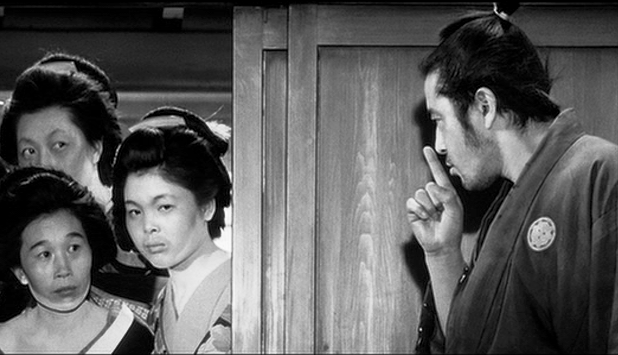 complement the action without overwhelming or undercutting them. From comical or suspenseful, to lush and portentous, it's as if Satô wrote scores for a dozen films yet they all fit. As I mentioned in the beginning, there's also the vivid black-and-white cinematography of Kazuo Miyagawa who, in a 1993 conversation also in the Criterion booklet, spoke of the difficulties he had with the pan focus that Kurosawa insisted upon for Yojimbo. "Everything had to be in perfect focus, whether it was right in front of you or at the very rear of the shot," the d.p. said. "So we decided to work in a spectrum of tones that would accentuate that would accentuate the contrast as much as possible and give objects a hard, metallic edge. We aimed at the kind of atmosphere you get at high noon, when shadows are at their most intense.…it was what we needed to match Yojimbo's hard-boiled subject matter."
 In the end, Yojimbo offers as its greatest strength Mifune and Kurosawa, arguably the greatest actor-director team in film history with Mifune clearly relishing his role as the cleverest and bravest character in the film, and Kurosawa delivering many astounding shots and unique framing of scenes. Together, the vitality this duo brings to Yojimbo makes it play as fresh today as it must have 50 years ago.
Tweet
Labels: 60s, Bette, Cagney, Eastwood, Fiction, Foreign, Kurosawa, Leone, Lynch, Mifune, Movie Tributes, Ray Top 100, Remakes, Rickman, Sequels, The Sopranos, Willis, Wyler
TO READ ON, CLICK HERE


