Sunday, July 14, 2013
Summer of '88: Die Hard

“People get involved here, and that’s the thing. If people are patronized, if a film is geared toward a short attention span, then it’ll have a short shelf life. Films that involve that audience and embrace that ‘once upon a time’ principle have a chance of lasting…We’re storytellers and we forget that at our peril.” — Alan RickmanBy Edward Copeland
That Rickman quote appears on the text commentary on one of the many DVD versions circulating for the movie Die Hard. When Die Hard exploded into theaters in the summer of 1988, I didn't rush to see it. The reviews were mostly mixed to negative, and the action films of that era were low on my priority list (especially since, back then, I had to pay to see movies). When I finally ventured out to see it, it had moved to a dollar theater and a group of my bored friends and I decided to check it out for lack of better options. We arrived late, so it wasn't until seeing the film again on video that I caught the foreshadowing of the airplane passenger advising John McClane (Bruce Willis), as they're arriving in L.A., that the best way to readjust to Earth after a long flight involves removing your shoes and socks and making fists with your toes in carpeting. It takes more than one viewing of Die Hard to truly appreciate how much work and thought went into its construction and composition and to catch all the allusions (not just the obvious ones) to classic films.
Labels: 80s, Movie Tributes, Rickman, Willis
TO READ ON, CLICK HERE


Tuesday, September 13, 2011
"I get paid for killing and this town is full of people who deserve to die."

By Edward Copeland
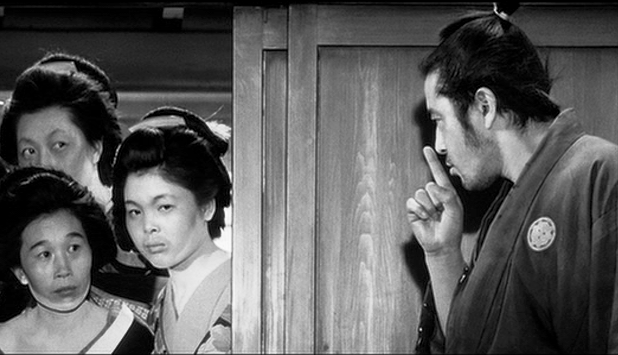
The title of Akira Kurosawa's Yojimbo fills nearly the entire expanse of its Tohoscope 2.35: 1 image in Japanese characters while mountains stand in the distance beyond the letters in Kazuo Miyagawa's crisp, stark
 black-and-white cinematography. Then he enters the frame behind the continuing credits, seen only from the back, though his sword is visible. He scratches his hair and proceeds to walk as the credits go on, still viewed from behind, accompanied by the drum-dominated pulsating portion of Masaru Satô's magnificent score. The samurai turns and we briefly see him in profile and, as if we didn't know already, we recognize the great Toshiro Mifune. Soon, Kurosawa films Mifune solely from the back again, only this time moving in closer, letting us see him only from the shoulders up. Every so often, Mifune does a little shoulder shrug reminiscent of the move people doing bad Cagney imitations make when they say, "You dirty rat." As he keeps moving on, the camera pans
 down to his feet and his sandals as he passes some markers. The credits end, the music stops and we see him in his entirety — he's come to a crossroads where he could take one of four paths. The samurai picks up a stick and tosses it in the air. letting it decide for him. That stick certainly selects a path that will prove challenging for the samurai but that piece of bark (a symbolic Kurosawa surrogate) also chose one helluva entertaining journey for the moviegoer when 50 years ago today, Yojimbo opened in the U.S., one of the rare times in Kurosawa's career when one of his films was released in the United States in the same calendar year as in Japan.
Technically, Mifune's samurai isn't a samurai since he no longer has a master, which means he should be called a ronin. He hasn't been on the path the stick chose for him that long when he comes across a farmer (Yoshio Tsuchiya) and his son (Yosuke Natsuki) arguing in the middle of the road. The son, probably in his late teens, insists to his father that something "could be chance for the battle of a lifetime." His father calls him a crazy fool, saying it's only going to be a chance to get killed and that a farmer's place is in the fields. The son tells him that if that means a lifetime of eating gruel, he can have it, adding that he's determined "to live well and die young" before he takes off. The ronin hasn't said a word this whole time, but when the son leaves, he
 asks the farmer if he can have a drink from his well. The farmer gives him a dirty look, but doesn't object as he goes into his house and blames his wife (Yoko Tsukasa) for not stopping the boy. She asks what she could have done. Gambling have driven all kids these days crazy, she declares. Besides, she worries about her and her husband's future. Who knows if there will ever be another silk market where they can sell their goods anyway as long as the gamblers fight for control of the town. The ronin moves on. When he arrives in the town the farmer's wife mentioned, the streets have emptied of any evidence of people, though as he walks, people spy through blinds on their windows. The only sign of life — and death — comes prancing down the dusty street in the form of a dog, a severed human hand clutched in his mouth. It's a more grotesque image than the panting, overheated dog that Kurosawa used to open his 1949 film Stray Dog, but somehow it comes off as more comical even this early in Yojimbo just as the Stray Dog image set the more serious tone for that film. David Lynch paid a kind of dark comic homage to the Yojimbo scene in Wild at Heart when a robbery goes wrong.
Though Yojimbo opened in the U.S. three years before Sergio Leone translated it into his spaghetti Western A Fistful of Dollars (which didn't open in the U.S. until 1967) and recast Mifune's mysterious ronin into Clint Eastwood's Man With No Name, more moviegoers even today probably have seen Leone's film, which is a shame. Not that A Fistful of Dollars isn't fine, but Leone's other spaghetti Westerns — the other two with Eastwood and Once Upon a Time in the West — are vastly superior to Fistful and Yojimbo leaves Fistful in the dust. Also, while there is much plot to comprehend in Yojimbo, for those who still frown on films with subtitles, Yojimbo actually can be followed fairly easily if you miss a few without losing the essential enjoyment of
 the film (Plus, it offers good practice for those who lack the subtitle reading skill required to truly appreciate movies in a language not their own). What many miss (mainly those who haven't seen Yojimbo) is that in essence, it is a Western. It contains mostly swords and merely one revolver, but it is set in the 1860s as opposed to Kurosawa's The Seven Samurai, which took place in the 16th century and the town's design purposely echoes the American West of that time more than it does Japan. Should it be called a sake Western? The funny thing about Leone's remake: It wasn't official and Kurosawa and co-writer Ryûzô Kikushima sued for copyright infringement, winning 15 percent of Fistful's worldwide gross in addition to distribution rights for Leone's film in Japan, Taiwan and South Korea. Later, Kurosawa said he made more money off A Fistful of Dollars than Yojimbo. Ironically, while the style of Yojimbo definitely shows the influence of Western movies Kurosawa had seen, some say he lifted its plot from Dashiell Hammett's 1929 detective novel Red Harvest, where a nameless private eye is hired by the president of a mining company to clean up a mining town overrun by mobsters the company had hired to break the union there. It's from that novel that the term Blood Simple originated.
As the ronin returns to his survey of the street after the dog with the unusual treat has moved along, he tries not to be obvious about all the gawkers hiding behind their windows. From behind a door, a small grinning man, eagerly rubs his hands together and practically dances over to the stranger in the street. He is Hansuke (Ikio Sawamura), the town's constable, and immediately tries to ascertain how much the ronin wants to be a bodyguard and asks whose side he's going to take. Mifune's ronin stays silent and ignores Hansuke, continuing to walk up the street,
 failing to notice the constable as he ducks inside a building behind him. Suddenly, a large group of swordsmen (they aren't all swordsmen — one carries a large mallet). No one says a word or makes a move until one of the group finally speaks up, "It's a public road — even dogs pass safely." The men all laugh and return inside as the ronin switches directions. The cagey constable comes out of hiding, criticizing the ronin's approach, telling him that no one will hire him that way. Those guys aren't that tough, he insists. You have to show them what you can do, cut an arm off or something, Hansuke suggests. The ronin continues to ignore him, especially when he spots a sign that the subtitle reads as RESTAURANT, though in all the reference sources they refer to it as a tavern. The tavern's owner, Gonji (Eijiro Tono) sticks his head out. Hansuke keeps babbling. "Mind your own business, you bastard," Gonji says as he allows the ronin inside and closes the door.
The tavern owner asks the ronin if he wants sake, but he seeks only food. Gonji informs him because of the way business has been, he doesn't have anything except for rice and it's cold. The ronin tells him that it will be fine, but that he doesn't have any money so he offers his services in exchange. This sets Gonji off. He tells his
 visitor that he'll feed him for free, but that this town has seen enough fighting, blood and death so he has to promise to leave afterward. The ronin asks what happened to turn this town into this cesspool. "One boss in a town we can tolerate, but two is a disaster," Gonji says. For a scene of exposition, Kurosawa, through the vehicle of the actor Eijoro Tono, handles it quite efficiently and makes it visually interesting. Instead of just sitting next to Mifune and spilling the entire story, the tavern's design comes with shutters on most sides that Gonji can slide up quickly with a zipper-like sound to point out not just the plot points and the characters but the town's geography as well. First, before the details begin, a pounding from next door gets to Gonji. Only the casket maker prospers now, he says. What started the trouble was when Seibei (Seizaburo Kawazu), who ran the gambling and the brothel, decided to step back a bit from the day-to-day running of all his territory. His right-hand man Ushitora (Kyu Sazanka) assumed he'd be the natural successor,
 but Seibei passed a large part of his territory on to his son Yoichiro (Hiroshi Tachikawa). A furious Ushitora left and started his own regime, taking about half of Seibei's men with him and the fighting began. Gonji ceases his tale as he hears an arrival next door greeting the casket maker (Atsushi Watanabe). Gonji's tavern has an open window that looks directly into the neighboring business and they watch as a rotund fighter with three other men gets the body count for his side and the other. When they leave, Gonji explains that the man doing the talking was Inokichi (Daisuke Kato), Ushitora's brother. Inokichi means wild boar, Gonji says, and never has a name been more appropriate. "He's a half-wit and he's brought three more fighters back with him," the tavern owner sighs. "Instead of buying silk, they're buying thugs." Hearing talk, Gongi peeks outside and sees Hansuke laughing and bowing to Inokichi. Gonji despises the constable,
 who should be arresting these people, he spits. When they've moved on, he raises the shutters all the way and points to the building across the street. Tazaemon (Kamatari Fujiwara) is the mayor, but a silk merchant by trade, he tells the increasingly intrigued ronin, but when the split occurred, he sided with Seibei. Gonji leads his guest to the opposite side of the tavern and raises those shutters. As a result, the sake merchant Tokuemon (Takashi Shimura) took Ushitora's side and declared himself mayor. Now, Gonji says, "Tazaemon beats on his prayer drum all day, hoping Seibei wins." Gonji sits down next to the ronin. "This town is doomed," he laments. "You gain nothing getting sucked into this evil." His patron puts down his rice bowl. "I like it here. I think I'll stay," he declares. Gonji asks if he didn't just hear what he told him. He'd be nuts to want to stay. Mifune, who I once argued may be the greatest screen actor of all time, explains why in a nice, pithy speech.
"That's why I'm staying. Listen, old man. Think about it. I get paid for killing and this town is full of people who deserve to die. Seibei, Ushitora, the gamblers and drifters — with them gone, the town could have a new start."
Gonji calls him crazy again — it's not as if he has nine lives. The ronin says he's not going to do it alone. Gonji asks who would help. He responds, "Sake. I think while I drink." The ronin and the audience now know the players (for the most part: a major one will appear later and lesser roles will be introduced), so the game can begin. Basically, the ronin with no name will use the town as a chessboard, Seibei's gang vs. Ushitora's, only he will be the one moving their pieces. (Actually, he will give a name, though obviously a fake one, when Seibei asks what it is when hiring him as a bodyguard. The ronin sees something out the window and calls himself Sanjuro Kuwabatake, though he tells Seibei it doesn't matter since he doesn't know him. Sanjuro, of course, became the title of the 1962 sequel.) Yojimbo (which translates to the bodyguard) has the look and feel of a Western set in Japan, but it also carries elements of gangster films since what are Seibei and Ushitora, who
 make their livings off vice and destroy people through their weaknesses, but mobsters. It's as if more than 40 years ahead of time, Kurosawa told the story of the blood grudge between New York and New Jersey in the last year of The Sopranos , only an entire town of innocent people pay a price and both families are headed by Phil Leotardo. When you get down to it though, the genre that Yojimbo belongs to is that of the dark comedy. While preparing to write this tribute, I stumbled upon a well-sourced article on the Web called "Yojimbo: Study of a Disintegrating Society" written by Joaquín da Silva in 2004. It makes a reasoned case that Yojimbo represents Kurosawa's criticism of changes in Japan in both the 1860s when the film is set and the late 1950s and early 1960s when Yojimbo was written and made and how they led to the breakdown of traditional Japanese society and values, and that every character in the film essentially is disreputable or evil and that Seibei and Ushitora actually are just henchmen for the silk and sake merchants, respectively. Since I know next to nothing about Japanese history in that sort of detail, I can't argue for or against the case but just watching and enjoying Yojimbo as many times as I have, I don't sense a message movie lurking beneath the surface and given the portrayal of the cowardly silk merchant, beating his prayer drum all day, he doesn't strike me as someone who's capable of pulling anyone's strings. It is an interesting read though if you have the time. What I do see in Yojimbo is a great filmmaker indulging himself in a masterful romp following more than a decade of cinematic
 excellence that, for the most part, dwelled in darkness. Remember, this followed films dating back to his first international hit in 1950, Rashomon, and others such as The Idiot, Ikiru, Throne of Blood, The Lower Depths and The Bad Sleep Well. The Seven Samurai came in this period as well, but it freely mixed the dark with the light. In an essay called "West Meets East" by the late Alexander Sesonske in the booklet that accompanies the Criterion DVD of Yojimbo, Sesonske wrote, "Kurosawa, often called the most Western of Japanese directors, now seems to have thought, 'Enough moral fervor, I'll show you how Western I can be.'" In The Films of Akira Kurosawa by Donald Richie, Kurosawa is quoted as saying about his inspiration for Yojimbo, "The idea is about rivalry on both sides, and both sides are equally bad. We all know what that is like. Here we are, weakly caught in the middle, and it is impossible to choose between evils. Myself, I've always wanted to somehow or other stop these senseless battles of bad against bad, but we're all more or less weak — I've never been able to. And that is why the hero of this picture is different from us. He is able to stand squarely in the middle and stop the fight. And it is this — him — that I thought of first. That was the beginning of the film in my mind."
 While Mifune has given some of the best performances in the history of film, with Yojimbo he also has a part that lets him have fun. He's a thinker surrounded by idiots, carrying a perpetual look of bemusement on his
 face, usually with a toothpick dancing in his mouth. When it comes time to fight, his skills border on the supernatural, quick and deadly, but later in the film, when his sympathy for a broken family gets the better of him and the sharpest of the bad guys — Tatsuya Nakadai as Unosuke, Ushitora's younger brother who has returned from a long trip elsewhere — learns of his deception, they savagely beat and torture our ronin, who shows the effects of the pummeling, until he manages to escape and gets help from Gonji and the casket member to spend time in a faraway temple to heal for awhile. It makes him reminiscent in a way of Bruce Willis' John McClane in Die Hard who achieves the amazing when outnumbered, but shows the lumps for
 it. A piece in the Criterion booklet describes Unosuke's outfit as well as I possibly could. "Unosuke makes his screen entrance with a Springfield revolver stuck in the breast of his kimono and a red plaid scarf wrapped around his neck." Though Yojimbo was shot in black-and-white, his costume is so vivid you can almost tell that the scarf is red, much in the same way you saw the red in Bette Davis' dress in William Wyler's black-and-white Jezebel in 1938. That same article in the booklet recounts a reporter asking Kurosawa about the outfit's accuracy for its era, he replied, "Unosuke spent time in the international port town of Yokohama, so it's not all that unbelievable. Besides, a costume works when an audience looks at it and — wham! — something about the character sinks in. It's a mistake to get too caught up in whether it's historically accurate or not." The Criterion booklet also contains a 2002 conversation with Nakadai, who played Unosuke, and he shared how Kurosawa explained the relationship between his character and Mifune's and how
 heroes and villains should be portrayed generally. "'Mifune's Sanjuro and your Unosuke are like a stray dog and a snake' Kurosawa told me. 'Some films place the hero above the villain from the beginning, but that's just boring. If you're going to set two characters against each other they should be equal strength…No, the bad guy should be made to look even stronger,'" Nakadi retold. "Kurosawa flashed me a really cool smile when he said that." That always has been the case, no matter what type of genre. The film is only as good as its villain. Die Hard wouldn't be the classic it is without Alan Rickman's Hans Gruber (You have 60 seconds — without using any sort of reference material, name or describe the villain in Renny Harlin's godawful Die Hard 2. Thought so.) and you can go down the list of Bond films and the best ones inevitably have the greatest bad guys, which is why nearly everyone loves Goldfinger the most.
While Yojimbo has its share of action scenes, by today's ADD generation's standards, there aren't that many. This isn't Michael Bay explosion-filled building-crushing nonsense with a brain the size of a gnat (all the better to match the audience's attention span). More than an endless series of skirmishes, Yojimbo's greatness lies in its embrace
 of strategizing over mindless killing. When Mifune's ronin says, "I drink while I think" the strength of the line doesn't lie in its humor but in the fact that he thinks. That's something getting excised further and further from action films as filmmaking goes on. As recently as Die Hard in 1988, while it's a different breed of film than Yojimbo, it still slowed down long enough for McClane to contemplate what his next move should be against Hans and his gang. Twenty-two years later, we get crap such as Taken which should carry a warning label that logic and rationality will not be allowed during viewing of the film. What’s funny about that is that Mifune’s character, until the late arrival of Unosuke, truly exists as the only character in Yojimbo who uses his brain (unless you count the previous ronin that Seibei employed, Homma (Susumu Fujita), who gets offended that Seibei hires Sanjuro at such a higher rate and hightails it out of town
 before a planned face-off between the gangs). As Sesonske wrote, "Sanjuro is a supersamurai, a whirlwind in combat; the village gangs are so grotesquely wicked they become ludicrous and enlist neither our sympathy nor our belief. By the film's end, most are dead, but we feel no regret at the slaughter nor do we cringe at its execution. The exaggerated evil of the gangs leaves them no other appropriate fate, and theirs is achieved with such style and cinematic verve that we are exhilarated by the spectacle and not at all dismayed by its content." While you can't disagree with Sesonske's assessment that the two groups of villains that Sanjuro so skillfully plays off each other are absurd to the point of silliness at times, Kurosawa compensates by distinguishing so many of them. Seibei and Ushitora are quite distinct from one another. You won't confuse Ushitora's brother Inokichi with the giant Kannuki (Tsunagoro Rashomon), who resembles a Japanese Richard Kiel. They may be cartoons, but they aren't just blank slates biding time until termination.
We shouldn't neglect the cinematic magic that Akira Kurosawa's collaborators behind the camera brought to the film. Upon this viewing, what stood out more strongly than it ever had before was Masaru Satô's eclectic and multifaceted musical score. For every sequence and emotion, Satô composes themes that perfectly
 complement the action without overwhelming or undercutting them. From comical or suspenseful, to lush and portentous, it's as if Satô wrote scores for a dozen films yet they all fit. As I mentioned in the beginning, there's also the vivid black-and-white cinematography of Kazuo Miyagawa who, in a 1993 conversation also in the Criterion booklet, spoke of the difficulties he had with the pan focus that Kurosawa insisted upon for Yojimbo. "Everything had to be in perfect focus, whether it was right in front of you or at the very rear of the shot," the d.p. said. "So we decided to work in a spectrum of tones that would accentuate that would accentuate the contrast as much as possible and give objects a hard, metallic edge. We aimed at the kind of atmosphere you get at high noon, when shadows are at their most intense.…it was what we needed to match Yojimbo's hard-boiled subject matter."
 In the end, Yojimbo offers as its greatest strength Mifune and Kurosawa, arguably the greatest actor-director team in film history with Mifune clearly relishing his role as the cleverest and bravest character in the film, and Kurosawa delivering many astounding shots and unique framing of scenes. Together, the vitality this duo brings to Yojimbo makes it play as fresh today as it must have 50 years ago.
Tweet
Labels: 60s, Bette, Cagney, Eastwood, Fiction, Foreign, Kurosawa, Leone, Lynch, Mifune, Movie Tributes, Ray Top 100, Remakes, Rickman, Sequels, The Sopranos, Willis, Wyler
TO READ ON, CLICK HERE
Tuesday, July 19, 2011
Putting Harry Back on the Shelf
BLOGGER'S NOTE: If you have yet to see Harry Potter and the Deathly Hallows, Part 2 or have not read the books and plan to, be warned this piece is LOADED WITH SPOILERS.

By Matt Zoller Seitz
My daughter Hannah is a ninth-grader, and my favorite person to see movies with. Sometimes we'll see a film and instant message each other about it later, or tape ourselves talking and do a transcript, then post the result here as we did on Cinderella and Fantasia. This latest conversation is on the final Harry Potter film, Harry Potter and the Deathly Hallows, Part 2. I was really looking forward to seeing this movie with Hannah, not just because it's the final installment in a franchise that's been around nearly as long as she has, but also because Hannah has read all the books and I've read exactly none, which makes her an ideal explainer.
MATT: So here's what I was thinking going into Harry Potter and the Deathly Hallows, Part 2. I was 8 years old when the original Star Wars came out in 1977 — the movie that your generation calls Episode IV: A New Hope. The time span between that film and the conclusion of the original Star Wars trilogy, Return of the Jedi, was six years. That carried me from fourth grade through freshman year of high school. Those movies dominated my imagination during that six-year period, and were almost as much a part of my life as any person I actually knew. Do the Harry Potter films seem like a comparably big deal to you? Has there been anything during your childhood — a movie series or a book series or a combination — that seemed like as big a deal as the Harry Potter phenomenon? To me, it looks as though everything else would be a distant second.
HANNAH: The Hunger Games, Percy Jackson…those are the only two I can think of. And they are nowhere near as big as Harry Potter. But they're both fantasy saga-type things.
MATT: Do you see these movies as movies first and foremost, or as movies based on books?
HANNAH: Movies based on books, definitely. After the first three movies, it's really hard to follow the plot unless you've read the books. Seeing the movies after reading the books is just the icing on top of the cake.
MATT: I have seen all of the Harry Potter films, but I've only read the first 40 pages of the first novel. I remember watching the first movie when it came out and not liking it because it felt too much like an illustration of a book rather than a freestanding movie, and thinking, "I should get on track with this series of
 books, otherwise I won't be able to judge the films as adaptations." But then the second movie came out a year later, and I didn't like that one either, and I decided that I wouldn't read the books after all, because a film has to have a life apart from the book, no matter how good or poor it is as an adaptation. In the end I feel like their track record as movies is mixed. I think a couple of the films are terrific, a couple are bad, the rest are pretty good. But I should also confess that I have trouble keeping the story straight over the entire saga. I am tempted to give the films the benefit of the doubt and say it's all my fault. But I follow much more complicated stories on long-form TV series and in movie franchises such as The Lord of the Rings, so maybe the filmmakers are at least partly to blame. I don't know. That's a tough call, honestly. There were definitely moments in this The Deathly Hallows, Part 2 where I was thinking, "Who is that guy?" and "What the heck is going on?" Not too many, but a few.
HANNAH: I agree when you say that a movie has to take a different life apart from the book. But if you really enjoyed the movies and want to truly respect the invention of the insanely imaginative world that is Harry Potter, the books should be read. I think the key thing to have when you're creating a culturally defining saga/franchise is the ability to create a world unlike our own, and create parallels to what we know in our lives, such as education, career, government, etc. Along with that, I think that it's also key to place human traits in the characters living there, so that it's easy to lose yourself in the universe. The books have all that. I think that the thousands of pages of the Harry Potter books trump the movie adaptations, since the films tend to leave out a lot of the parts that make the books interesting.
MATT: Oh, I definitely agree, and that's true for almost any film adaptation of a book. A book has a subtlety, a delicacy, that most movies can't match. Plus a book just feels more personal, because you're creating images in your mind as you read. It's as if you're the director, and you have an unlimited budget and unlimited running time. There's just no comparison. But I feel like the movies were only partly successful — for this
 viewer — at capturing the essence of the books. I only read The Hobbit and part of The Fellowship of the Ring, yet I was tremendously involved with, and excited by, the Lord of the Rings films. And I never read Mario Puzo's The Godfather until right before the third movie came out, yet I didn't feel I'd been cheated as an audience member. These were substantial experiences that were equal to, but different from, the books they were based on. The Harry Potter books, though…I don't know. I always felt there was something missing from the movies, that that there was something incomplete or slightly flat about them. There were only two Potter films that I thought were really terrific as cinema, the third and fifth ones. The sixth had its moments. But the rest only grabbed me in fits and starts. A scene here, an action sequence there, a bit of acting that moved me. For the most part I felt like I was seeing a transcription of something that was absolutely beloved in its original form — and that the incredible intensity of the love that people felt for the source was kind of carrying over into the movies, and sort of filling them out, or giving them an extra kick. There were definitely times when I felt my attention beginning to wander a bit during one of the movies, and then suddenly the crowd would laugh or applaud as one, because they had obviously read the books and were feeling a great rush of emotion, and I felt it, too, although the rush was secondhand, or once removed.
HANNAH: I know exactly what you mean. When it comes to adapting a 700 page book into two- or two-and-a-half hour movie, you needn't have read the book previously to know that there were parts that were off, or flat, or like something was missing. It's hard to devote yourself to a book and come to love certain scenes, characters, etc., and see them changed, altered, or cut on the big screen. The point of the movies is to bring the book to life, and it always sucks when you can't see the entire book come to life exactly as it should. For that reason I think that the people who make the movies based on great books are really lucky, because they get to share their interpretation with millions of people. I wish that I could have gotten a chance to go to a midnight showing of Harry Potter at some point in my life, but it's slipped past me.
MATT: I know! Sorry! I guess it's a pointless exercise to find anything analogous to the Harry Potter phenomenon. There is nothing else like it — no other examples of a series of books coming out just a few years ahead of a series of films, and having the books and the films be really intimately intertwined from start to finish, so that it's almost as if you are seeing two different versions of the same story unfold in two different media almost, but not quite, simultaneously. The closest thing I can think of is the James Bond series. But there, the books were fairly loose adaptations of tales of a character whose adventures were more or less self-contained. With some exceptions, you could read Bond books or watch Bond movies out-of-sequence, and not feel you were missing anything. And after a certain point — sometime in the '70s — the films based on the Bond books stopped having anything in common with the Ian Fleming novels and short stories except for the titles and the fact that they were about a guy named James Bond. They weren't at all like the Potter books, which have a richness of characterization and are also very densely plotted, with every book linking to every other.
HANNAH: Another thing that makes the Potter movies hard to follow is the constant foreshadowing. I can't think of an example off the top of my head, but there were times in a Potter movie where one character mentioned a person, place, magical object, etc, and another character said, "Gee, I met that guy/went to that place/learned about that object briefly a few years ago! Who knew that information would be helpful now?" It's easy to constantly foreshadow in books when you're the person creating the story, but when you're a filmmaker adapting that story, I can see how you would look at a script and go, "Crap, we should have mentioned this in a previous movie, because now it's a crucial to the plot!"
MATT: Well, I'm glad you mentioned that, because that phenomenon is one of the clunkiest things about the Potter films — their tendency to say, "Here is this really important character who is right at the center of the ongoing narrative and whose fate is of absolutely critical significance," yet this is the first time you've ever
 heard them mentioned. There was a moment like that in the final movie, actually — the appearance of Dumbledore's brother. Harry says something like — and I'm paraphrasing because this is a rare film where I took no notes, because my pen was defective! — "You're Dumbledore's brother? He never mentioned you to me." And the brother says something that's almost like a self-deprecating joke, like, "Yeah, that sounds like him." The Godfather films and the various seasons of The Sopranos did this, too, as you will eventually see when you watch them. "Hey, Tony Soprano, say hello to your beloved cousin who was like a brother to you growing up." And it's season five, and you never heard a syllable about that guy until now! At least when the movie series or TV show is completely original, the filmmakers have a bit of an excuse. They're flying by the seats of their pants, just kind of making things up and hoping it all fits and make sense with hindsight. But the Potter films were based on pre-existing books, so the clunkiness there seems strange to me.
 HANNAH: Are you saying that scripts that have been written directly for the screen have an excuse to spontaneously introduce a new character that's supposedly important?
MATT: Oh, no. not in a single, stand-alone film. But in a series, yes, if the scripts are all original, and not based on pre-existing material. It's just a fact that sometimes the makers of a sequel have to figure out a way to extend a story that seemed to end in a satisfying way at the end of the original film. The public says, "What happens next?" and the filmmaker has to come up with something. That leads them to invent new characters or situations that were never mentioned in the original film. The Star Wars films are an example of that. You really have to stretch to find foreshadowing of Darth Vader being Luke's father in the original 1977 movie. I think that was because the filmmaker, George Lucas, originally wrote Star Wars as an entire series, or a very long film, then had to eliminate a lot of the more novelistic flourishes. When the 1977 film became a hit and the studio wanted sequels, he had to re-integrate a lot of the things he'd cut, and create stuff that wasn't there previously in any form. And that led to some narrative awkwardness.
HANNAH: OK, that makes sense. But I'm talking about seven books that are released about a year-and-a-half apart from each other. The makers of the first Harry Potter movie only had the first two or three books to work with, as far as foreshadowing goes. Sometimes in Harry Potter, the foreshadowing is subtle, and the time between when something is foreshadowed and when it happens is short. With the movies being three books behind, it may have gotten hard to take every move of foreshadowing into account.
MATT: Fair enough. OK, since you have read all the books and I've read only a tiny part of the first one, I want you to play expert witness and explain some things that I found confusing, OK?
HANNAH: Yes sir, fire away. I am prepared with my geeky answers.
MATT: I am confused about the ownership of the wand that Harry uses to kill Voldemort. Can you walk me through that?
HANNAH: Do you mean the Elder Wand? Because that's the one Voldemort used, not Harry.
MATT: I'm talking about the wand that Harry used to kill Voldemort, which I guess was not actually Voldemort's wand? Voldemort took it from Snape, right? What was the line of succession before that? And what are the rules, exactly, governing the possession of wands and how it affects one's ability to do magic?

HANNAH: The wands in Harry Potter are pretty complicated, and even I'm not crystal-clear on how it works. Voldemort is a part of Harry. When Harry got his wand in his first year, rather than him picking out a wand, a
 wand chose him. The wand had a twin that chose Voldemort when he first got a wand when he started at Hogwarts. So there were two identical wands, one possessed by Voldemort and one possessed by Harry. When Voldemort tried to kill Harry in his fourth year, it didn't work because their wands were the same. So Voldemort set off to find a new wand. Dumbledore possessed the Elder Wand. The night that Dumbledore died in the sixth year, Draco Malfoy disarmed Dumbledore and took the Elder Wand against Dumbledore's will. Shortly after, Snape killed Dumbledore. Dumbledore was buried with the Elder Wand. But, little did anyone know, Draco Malfoy was truly the owner of the Elder Wand. Whoever takes the wand from the owner against his will is the new owner. Voldemort takes the Elder Wand from Dumbledore's tomb. When the wand doesn't work for him, he assumes
 it's because it belongs to Snape, because Snape killed Dumbledore, the previous owner. So Voldemort kills Snape. But Voldemort still is not the master of the Elder Wand. Meanwhile, in the showdown at Malfoy Manor at the end of Harry Potter and the Deathly Hallows, Part One, Harry disarms Malfoy and takes the wand Draco received when he started Hogwarts (made of Hawthorn). But since Harry took a wand from Malfoy against his will, that makes Harry the master of the Elder Wand. Harry uses Malfoy's wand for a while because his original wand broke. When Harry is fighting Voldemort, he uses Malfoy's Hawthorn wand to kill Voldemort, who is using the Elder Wand, despite the fact that Harry is the true master. Sorry, that took awhile. But I wanted to give a thorough explanation. Now my brain hurts. Harry Potter can be quite confusing. Any more questions?
 MATT: That was amazing, and I'm not sure it helped. It kind of reminds me of when a friend asked me to explain the relationship between the Corleone family, the Rosato brothers, Clemenza, Hyman Roth and Frankie Five Angels in The Godfather, Part II. When I got to the end, even I was confused.
HANNAH: Maybe my explanation will make sense if you read it over 20 more times. But I wouldn't count on it.
MATT: I'm also not sure what to make of the whole Snape evolution. So he's a good guy pretending to be a bad guy pretending to be a good guy? Was he ever really working for Voldemort? Or was he always a triple agent working for the forces of good?
HANNAH: Oh, Snape. I liked how the scene in the movie where we dove into Snape's dying memories was sort of eerie and dreamlike, but the way it was set up was kind of confusing and unclear, so it was hard to get all your questions answered.
MATT: That part definitely felt rushed and confusing to this non-Potter reader.
HANNAH: Snape knew he was a wizard since he was born. He was a half-blood. His mother was a witch and his father was a muggle. He was very poor, and his parents fought a lot. He lived near Lily, Harry's future mother, and her muggle parents and her muggle sister, Petunia. He recognized that Lily was a witch and filled her in about the wizarding world when they were growing up. He fell in love with her. But when they got to Hogwarts, Lily was sorted into Gryffindor, and Snape was sorted into Slytherin. They remained friends through
 their earlier school years. Even in his beginning years at Hogwarts, Snape detested Harry's future father, James, because James used to bully Snape and was rather arrogant, and also because Snape knew James had a crush on Lily. Snape was worried about Lily eventually falling for James. But Snape and Lily drifted apart as Snape befriended his fellow Slytherins who were interested in the dark arts and becoming Death Eaters. When they left school, Lily got together with James and married him, and Snape went off to become a death eater. And yet Snape was still in love with Lily. When the prophecy was told, Snape knew that Voldemort (at this point, his master) would set off to kill baby Harry and anyone that got in his way, such as James and Lily, Harry's parents. Snape begged Voldemort to spare Lily, but Voldemort ignored him and killed her anyway. Dumbledore told Snape that he had been foolish instilling his trust in Voldemort, and that the best way to pledge his love for Lily would be to protect her son. Snape agreed, but begged Dumbledore not to tell. Dumbledore said "Fine. I will hide the best of you." When Harry started Hogwarts, despite the fact that Snape was protecting him, he couldn't stand to be around Harry because he was reminded so much of James, who he hated. Snape went on to be a triple agent as Voldemort rose to power. Then in the sixth year, Dumbledore was cursed by a ring that was made into a Horcrux by Voldemort. He only had a year to live. Dumbledore was aware of a plan that Voldemort had to make Draco Malfoy kill him. But Dumbledore knew Draco wouldn't be able to do it, so he told Snape that when Draco failed, Snape must kill Dumbledore. And he did, at the end of the sixth year. Then he continued to carry out the tasks that Dumbledore asked of him before his death, despite the fact that many of the good characters in the book distrusted him. That took a long time! I hope you understand now. Conclusion: Snape is the awesomest character in Harry Potter. (faints)
MATT: OK, that was truly epic. Now I really regret not having read the books. I missed a lot of the nuances. But even so, I agree with you about Snape. He's my favorite character. Nobody else can come close to his complexity. And Alan Rickman is the acting MVP of the whole series, in my opinion. It is really, really hard to play a character like that and not either give the game away early or mislead the audience in a way that seems unfair in retrospect. In degree of difficulty, that performance is at least a nine. The only thing that could've kicked it up to a 10 is if he'd given the entire performance in Spanish or French or something.
HANNAH: Did I answer your questions with as much enthusiasm and detail as you would if I asked you about a major plot point in the Star Wars movies?
MATT: Oh, absolutely. And this is as good a place as any to admit that while the Potter books and films would not exist without the Star Wars films paving the way, they are clearly superior to Lucas' saga in terms of narrative and character. Maybe the only area where Lucas has the edge is visually: the films are more daring in how they are composed and edited. But that's small consolation considering what a big steaming mess a lot of them are. And like you said, the movies aren't at the heart of the phenomenon, the novels are. And judged purely as a pop culture event, the novels are huge. There's nothing else like them. I think if we look at this in terms of a generation's relationship to a defining piece of popular culture, I think your generation definitely got the better deal.
HANNAH: Yes, I think we did.
Matt Zoller Seitz is the television critic for Salon.com and curator of the blog PressPlay at indieWIRE.
Tweet
Labels: 10s, Books, Fiction, Ian Fleming, Lucas, Rickman, Sequels, Star Wars, The Sopranos
TO READ ON, CLICK HERE
Tuesday, May 31, 2011
Harry Potter and the Deadly Huhs?, Part I

By Edward Copeland
When this blog first began (actually before it began, when I would just jot short movie musings on my long defunct political blog the Copeland Institute for Lower Learning), one of the first films I wrote about was Harry Potter and the Goblet of Fire under the title "Harry Potter and the Defiance of Sequel Expectations." It could hardly be called a review, as short as it was, but one thing I wrote was "How is it that a film series can keep getting better as it goes on instead of worse?" I fear I jinxed it with those words about the fourth in the series, because the fifth slipped just a bit, while the sixth installment flummoxed this viewer who'd never read a word of any of J.K. Rowlings' books. Now, I've caught up with Harry Potter and the Deathly Hallows, Part I and it seemed to me as if I'd walked into a four-hour movie after missing the first two hours. It's a tiring befuddlement missing any sense of fun, suspense of consequence or, most importantly considering its realm, magic.
One thing that's interesting in Deathly Hallows — but just briefly — is seeing Harry, Hermione and Ron (Daniel Radcliffe, Emma Watson and Rupert Grint) running around London for a change instead of their usual Hogwarts haunts. It did again raise the question I've always had throughout the series: If these kids head off to this wizardry school to matriculate their magical skills, but they aren't supposed to practice their powers back among the muggles, what exactly is the point once they graduate? Do they automatically get stuck in careers as teachers of future young wizards? I take it none of them head back to the regular world and embark on normal careers and retire their wands. (As an aside, Hogwarts always has professors for subjects such as Defense Against the Dark Arts, but does anyone there bother to teach the students math, English or science?)
Anyway, Hogwarts isn't part of the equation in Deathly Hallows anyway. It seems to concern "the ministry" which I'm guessing is the Harry Potter equivalent of Buffy Summers' Watchers' Council and that evil Lord Voldemort, the blank-faced bad guy with some sort of shared memories with Harry (who is supposed to be Ralph Fiennes, hidden somewhere beneath that pasty, featureless makeup) has destroyed it much as The Council got itself blown up. At least I think that's what Bill Nighy's character, dressed as if he accidentally got teleported to the set from a production of Arthur Miller's The Crucible, tells us.
Most of the adult characters are absent or make just cursory appearances here. There's very little of Alan Rickman's Professor Snape and a nice but all-too-brief appearance by Brendan Gleeson's Mad-Eye Moody. I do admit I did get excited when Imelda Staunton reappeared as Dolores Umbridge, since I believe her performance in Order of the Phoenix remains the best given by any actor in the entire series and an argument could have been seriously made for nominating her for supporting actress. Unfortunately, we get a bit of Dolores' little giggle and then she's gone again.
Of course, the sequence she appears in lacks the coherence that most of this overlong and tedious film does. Near the beginning, the good guys, worried about keeping Harry's location secret from Voldemort, take time out to attend a wedding but for the life of me, I can't tell you who the hell was getting married or why it should have mattered.
I don't know why the producers of the series have remained glued to director David Yates. Once Chris Columbus thankfully exited after the first two bland installments, that's when the series started getting better, first with Alfonso Cuaron and then with Mike Newell. They turned to Yates starting with Order of the Phoenix, which Staunton basically saved, but that film overall and two since have taken the series into a downhill spiral instead of up toward a rousing conclusion.
Many years ago, a bunch of my friends and I went out to see David Lynch's film of Frank Herbert's Dune the weekend it opened. As with the Harry Potter books, I'd never read any of the Dune books either. I knew I was in trouble when at the theater they handed each ticketholder a sheet with a long list of definitions for terms that would be used in the movie. What was I supposed to have done — bring along a flashlight so I could look things up as the movie played in case I got confused or lost?
I saw Harry Potter and the Deathly Hallows, Part I at home on DVD. I sort of wish it had come with one of those lists to help me understand what the hell was going on. Then again, a good movie doesn't require supplements to explain itself. If it's any good, the film stands on its own and speaks for itself.
Tweet
Labels: 00s, Arthur Miller, Books, Fiction, Lynch, Ralph Fiennes, Rickman, Sequels
TO READ ON, CLICK HERE
Tuesday, June 08, 2010
When logic and proportion have fallen sloppy dead

By Edward Copeland
Honest — I hadn't planned to bash more on Avatar, especially this soon after I wrote my review lambasting Cameron's Folly last week, but I really see little way to avoid bringing it up as I discuss Tim Burton's Alice in Wonderland. Godard famously said that the best way to criticize a film was to make another one and since that option is not available to me, I often find that it's illustrative to compare what one film does well to show how another film fails and that is the case here, even though I can't truly say that Alice in Wonderland itself is a good movie, but it did excel for me at most of the things for which I feel Avatar earned undeserved praise.
Don't get me wrong: Overall, I don't think Burton's film is a particularly good movie, but it held my interest because somehow he found the formula to make his style-over-substance approach mesmerizing in a way that I found Avatar just tedious. Though, as in the case with all 3-D features, I'm unable to see them that way, Alice in Wonderland is the first case where I could visualize what that would have been like even though I didn't have glasses, special equipment and I wasn't in a movie theater.
Part of the reason for this I believe is the vibrancy of Burton's imagery, where he uses a vast array of colors and imaginative characters and sets to bring his fantasy world to vivid life. It seems to leap off my television in a way that the monotonous color schemes of Pandora and the military headquarters did not in Avatar.
Still, despite my praise for that part of Alice in Wonderland, I can't say the film itself really works. The premise of this finds a much older Alice (Mia Wasikowska) escaping a boring matchmaking garden party in London and once again falling down the rabbit hole where she finds herself in Underland with no memory of her previous visit as a little girl. All the same characters are there: The Mad Hatter (Johnny Depp), The Red Queen (Helena Bonham Carter), etc., but she doesn't seem to recall any of them.
The plot seems to be a bit of a muddle, a mixture of the original tale with an expansion of new strands, as Alice must don armor to face off against the Jabberwocky to restore the crown from the evil Red Queen to the White Queen (Anne Hathaway). In fact, the battle may be better staged than any of the by-rote scenes in Avatar only with the added plus of wonderful color schemes beyond the eventually dull blue, green and camouflage. It's also helped by having characters such as the Hatter, the Queens and the others (some voiced by greats such as Alan Rickman and Stephen Fry) usually assorted with the story, even though Lewis Carroll takes the credit. There's a reason those characters have stood the test of time since the 19th century. I doubt people will even know who Jake Sully is next year, let alone decades from now (I had to consult IMDb just to remember the Avatar character's name).
While I can't say I'd want to sit through Alice in Wonderland again, I can't deny it held my interest thanks to its phenomenal look. It gave me wondrous things to gaze upon and a sense of a truly vital imagination at work behind the camera, even if my mind began to wander elsewhere.
Tweet
Labels: 10s, Anne Hathaway, Cameron, Depp, Godard, H.B. Carter, Rickman, Tim Burton
TO READ ON, CLICK HERE
Tuesday, January 19, 2010
Harry Potter and the half-baked script

By Edward Copeland
With the arrival of each new Harry Potter film, I've made it clear that I've never read any of the books yet I've been amazed how each installment grew in depth and quality once they got rid of director Chris Columbus from the first two installments. The previous entry, Order of the Phoenix, slipped a little and was the first of the films that felt to me as if it had been condensed to the point that a lot had been left out from the book. However, Imelda Staunton's delightful performance, the best in the entire series, more than made up for that film's flaws. This time, with director David Yates returning to helm Harry Potter and the Half-Blood Prince was the first time, even including the Columbus efforts, where I watched most of the time bored and dumbfounded.
As with all the other adaptations, the Half-Blood Prince was written by Steve Kloves, the man whose great work as writer-director on The Fabulous Baker Boys inspired J.K. Rowling to select him to adapt her books to the screen in the first place. However, the Half-Blood Prince plays like a muddle. By the time it reveals who the Half-Blood Prince is, I still had no (and still don't have any) idea what that really meant and what its significance was.
As in Goblet of Fire, Harry's friends Ron and Hermione (Rupert Grint, Emma Watson) stay pretty much segregated to the sidelines except for one sequence where Grint proves quite charming and funny when Ron becomes enchanted by a love potion. Daniel Radcliffe still does fine as Harry, but this time out the heavy lifting seems to be handled even more than usual by the veteran British pros such as Michael Gambon, Maggie Smith and Alan Rickman.
The actor who shines the most in this outing is the series' newcomer, Jim Broadbent, playing a former potions professor that Dumbledore (Gambon) lures back to Hogwarts because of the connection he had to Lord Voldemort back when he was just a student named Tom Riddle and hadn't turned to evil. Every note Broadbent strikes — fear, guilt, excitement — seems just right. He's really the only aspect of the Half-Blood Prince that saves it from being a complete bore.
Director Yates' pacing is way off here. The atmospherics are solid as usual, but I don't know why this chapter came off as seeming so messy. The final book in the series is being broken up into two movies, so perhaps that will eliminate some of the problems of leaving things out, but it concerns me that Yates has been entrusted with the reins once again since his two efforts have been the weakest non-Columbus outings in the film series.
Tweet
Labels: 00s, Broadbent, Gambon, Maggie Smith, Rickman, Sequels
TO READ ON, CLICK HERE
Monday, December 24, 2007
Those above will get served down below

By Edward Copeland
It was with the greatest of trepidation that I faced the prospect of Tim Burton filming Stephen Sondheim's greatest musical, especially with the casting of actors who admitted their lack of vocal skills. It's with some relief that I can report that the film of Sweeney Todd: The Demon Barber of Fleet Street is neither as bad as I feared nor as good as it could have been.
Burton's direction moves the action along nicely and the sets and atmospherics are beyond reproach, making the musical even more intimate for film and resisting the urge to "open" it up for the movies. The musical cuts didn't bother me that much: I fully understand why the great "Ballad of Sweeney Todd" wouldn't quite transfer to a film version.
However, the most pleasant surprise for me is Johnny Depp. Is he the strongest of singers? Hardly. Still, he manages to pull Sweeney off, even if his look appears to be a cross between Edward Scissorhands and Beetlejuice. His somewhat soft voice belies the intensity he delivers in the nonmusical parts, but Depp pulls the part off and deserves to be commended.
The same cannot be said for his Mrs. Lovett (Helena Bonham Carter). Supposedly, Sondheim had final casting approval so he's got some explaining to do in regards to how he let this disastrous casting of the director's girlfriend go through. I hope Sondheim got a check big enough to make him forget his betrayal of his own material.
When Mrs. Lovett sings of herself as a woman of "limited wind," she ain't kidding when Bonham Carter is inhabiting her role. I found myself in the surprising position of wishing they'd cut more of the music, because when Bonham Carter sings Lovett's wistful fantasy "By the Sea," it brings the film to a dead halt, saved only by the fact that Depp keeps Sweeney's intensity in silence throughout Lovett's colorful dream sequence. If only Depp had a partner who could really deliver.
Unfortunately, a lot of the laughs of the great "A Little Priest" get lost in Bonham Carter's delivery. Burton in general has chosen to emphasize the bleak and the bloody over the dark humored throughout the adaptation, but this Sweeney Todd still could have worked and, in fact, mostly does.
It's just Helena Bonham Carter who sticks out like a sore thumb. The other casting choices are quite good. Alan Rickman and Timothy Spall as Judge Turpin and his faithful Beadle Bamford are more sinister than in any stage version I've seen. Bamford usually comes off as more oaf than bad guy on stage, but he's a true villain here.
Jamie Campbell Bower and Jayne Wisner as the thwarted lovers Anthony and Johanna perform quite well and don't interfere much with the action. The real find and the best decision made for the movie is by casting the role of Toby with a boy (Edward Sanders) instead of as a slow-witted young adult, so it makes his eventual actions all the more horrifying.
Even better, this kid who I've never seen before saves "Nothing's Gonna Harm You," his duet with Lovett, and shows once again what a poor choice Bonham Carter is.
Tweet
Labels: 00s, Depp, H.B. Carter, Musicals, Rickman, Sondheim, Tim Burton
TO READ ON, CLICK HERE
Wednesday, September 05, 2007
Trilby, the forgotten melodrama

By EscutcheonBlot
George du Maurier (1834-1897) careened through numerous vocations, including opera singer and Latinist, before settling upon the life of an artist. After a long and successful career in London working as an illustrator and writer for the satirical weekly Punch, du Maurier, his eyesight beginning to fail, sat down and wrote a novel, Peter Ibbetson. He, naturally, illustrated it himself.

In 1894, he followed his successful debut with the serialized Trilby in Harper's Weekly. It was an immediate and overwhelming success. At the end of that year, more than 300,000 copies in the English-speaking world had been sold, and presumably, read. A town in Florida was named after the heroine (it's still there), as well as a man's hat, and various other items to be eaten or otherwise enjoyed (sausages, shoes, silver pins, etc..). After a few years, the mania faded, and died away quickly after du Maurier himself passed away at the age of 62. He left behind a daughter, Sylvia Llewellen Davies, whose children inspired J.M. Barrie's Peter Pan, and a son Gerald du Maurier (a prominent actor) whose daughter, Daphne du Maurier, became an important novelist in her own right. Trilby had its own descendants, spawning the potboiler The Phantom of the Opera in 1910, as well as numerous stage and screen adaptations of the book itself.

Trilby's fascination for its public lay in its being what I consider one of the first, and only truly cinematic novels. Du Maurier, as an illustrator first and novelist only a distant second, conceived of characters on a startlingly visual rather than textual basis. Trilby is one of those few integrated wholes in all of literature (William Blake's Songs of Innocence and Experience being the most famous exemplar in this narrow field). The immortal evil of Svengali, whose many graphic portraits in the book, both as man and as spider(!) were so convincing as to cement his character firmly in the psyche of fin-de-siecle Western Civilization. Indeed, the first film adaptation of the novel was a 1922 effort entitled Svengali.
Du Maurier was one of the 19th century's great polymaths (a breed which has all but ceased to exist in this age of specialization), and his experiences in music, art, and literature combined helped him create a novel which rollicks through all the great art forms (excluding ballet — where rollicking can get you injured). While theater is not specifically dealt with in the novel, the story itself is so theatrically, visually created that to read the 1894 edition with du Maurier's 120 illustrations is an evening at the theater in and of itself.

The story centers around the love triangle of Trilby O'Ferrall, an English girl born and raised in Paris, who works as a model for the many artists of the left bank. In 1850s Paris, while the artists themselves could often move at the periphery of the best society, an artist's model was considered to be little better than a prostitute — and du Maurier more than hints that Trilby has shared her favours rather more than befits a 19th century lady. The second of this triangle is he whom many consider to be the actual protagonist of the novel, Little Billee, an extraordinarily gifted young English artist, studying his craft with a pair of his countrymen in the various ateliers of Paris. The third, sinister antagonist is pianist, teacher and mesmerist, Svengali.
An aspect of the novel that is truly difficult to swallow is the fervid anti-Semitism with which du Maurier paints the portait of Svengali. His Jewishness is an essential part of his evil for du Maurier, although the author himself straddles that peculiar line of bigotry that praises aspects of the hated people to the sky: Svengali is a great musician and a genius; no attempt is made by du Maurier to denigrate his abilities, just his character. Indeed, he is accepted into the English expatriate circle primarily because of his extraordinary playing; his filthy personality, and indeed, person (du Maurier is not the most subtle of racists) are tolerated rather than accepted by the upper-middle class, clean Englishmen.

Trilby is a physically large, but beautiful girl with an extraordinary speaking voice. Svengali, entranced by the voice, wishes to hear her sing. She, obligingly, caterwauls her way through an English folk song (Ben Bolt). The girl with the most magnificent voice in Europe can't carry a tune! She laughing admits to it, but Svengali stores away this information in his darkest of dark hearts. He falls in love with Trilby, just as Little Billee, his polar opposite in all but talent, also succumbs to the unknowing spell of the wholly inappropriate artist's model.
Little Billee, English, upper-middle-class, respectable, sweet, honest-if-a-bit-priggish, is set up as the counterweight to Svengali's mittel-European, Jewish, lower-class, dirty, scandalous, cruel and dishonest spectre. Like I said, subtle, it ain't.
After 20 fruitless proposals, Trilby, knowing she can never be accepted in Little Billee's world, against her better judgement agrees to become his wife. Immediately the mother, sister, and vicar uncle of Little Billee swoop down upon Paris, convincing the overwhelmed Trilby to vanish from Billee's life — for both his and her own good. Little Billee, in the best tradition of Victorian fiction, falls deathly ill with a "nervous fever." He recovers, of course, but is left unable to love; a painting machine — intent on becoming the greatest painter of his time.


Years pass, and we find our Little Billee in London, famous, successful, and unhappily unmarried. He hears of a great singer, currently making her rounds on the continent. "La Svengali" piques his interest — figuring that Svengali finally found a pupil he could impart his immense knowledge of music and of singing; all the while pitying the poor hapless victim of this bearded monster. Seizing the chance to visit his old friends, he goes to Paris to see this wonder of singing. They all go to a highly publicized concert where they are astonished to see an expressionless, gaunt Trilby, first singing simple songs, absolutely beautifully, but then with an ever increasingly difficult program, ends by singing the Chopin "Impromptu in A-flat" — a piano work — as a wordless vocalise (an almost incomprehensible feat of vocal virtuousity). Trilby bows mechanically to tumultuous applause.


Later Trilby and Svengali (whom she has married, according to the newspapers) see Little Billee walking on a Paris street. They cut him mercilessly. Crushed, Little Billee flees Paris for the comfort of London, but the Svengalis appear in London, to great fanfare. Having been injured in a fight with his first violinist, the cringing Gecko, Svengali must watch the concert from a box above the stage, rather than conduct as was his constant wont. Svengali sees Little Billee sit down in one of the first rows. A grin of hatred spreads his face, and he leans back in his chair.
The orchestra begins but Trilby doesn't sing. As if waking up from a deep sleep, she asks in French where she is and why she is on this stage. She doesn't remember anything about singing ... indeed when the crowd demands she sing, she rather reluctantly complies with the horribly atonal folksong she sang in the artists atelier years ago in Paris. The conductor appeals to Svengali, who stays seated, his face still in the rictus of a horrible grimace. He is dead! The hatred he felt for Little Billee was too much for his dark ,dark heart — and it failed him.

Trilby, unable to remember anything about her great singing career, goes into a rapid decline, although she reaffirms her love for Billee, and explains that she had never married Svengali. She is nursed in her final days by Little Billee's grieving mother, who finally sees the worth of this Bohemian girl. When she happens to see a photo of Svengali in his uniform, she goes into a trance and suddenly starts singing the Chopin Impromptu. Higher and higher she goes, ending on a pianissimo high E, then leaning back in her bed, with the words "Svengali, Svengali, Svengali" on her lips, dies. Trilby is followed in death shortly therafter by Little Billee, unable to withstand losing her twice, and unable to tolerate the fact that she died with the monster's name on her lips. His fever returns, and this time is too strong for the little painter.

Years later, Billee's sister and her husband, one of Billee's best friends, meet a dying Gecko in Paris (the Victorians were big on dying). He then explains what had happened — how Trilby miraculously became the greatest singer in Europe. Svengali had mesmerized her before every lesson, later, before every concert. With his conducting, he controlled every phrase, every note, playing the unconscious Trilby, rather like Rosencrantz and Guildenstern wishing to play Hamlet as a flute. When Svengali died, the connection was broken, and Trilby was Trilby again, but so broken by those few cruel years, that death must quickly follow.

This is not a great book, from the standpoint of literary quality, but it is a great story. The illustrations (which I have photographed out of my copy, please forgive the quality) make this a truly visual novel. (Henry James, who despised the illustrated novel, felt nevertheless compelled to praise du Maurier.) In short, one ideally suited for a screen adaptation. There have in fact been several, as well as a very popular stage adaptation at the beginning of the 20th century. These adaptations have always been limited by the fact that no mortal can sing the Chopin Impromptu. As du Maurier himself states, it is a very difficult piece which most pianists can't even play. The earlier films were apparently not particularly memorable, and the last effort, with Jodie Foster as a pop-singing Trilby, I would rather bite my own eyes out than watch.
With the advent of digital manipulation of recorded voices (like the blue alien in Bruce Willis' The Fifth Element, and rather less successfully, Farinelli), it is possible to create vocal performances impossible in real life, including the un-singable Impromptu. Anna Netrebko is quite beautiful, a very acceptable singer, and a good actress (one of the problems with Farinelli was that the actor was no singer, and looked, frankly, ridiculous in his gyrations). She could be joined by Elijah Wood as Little Billee. Wood is perfect for the soulful little prig-er-painter ... as long as he refrains from being so face-slappingly sweet (his Frodo ruined Lord of the Rings for me). And I can think of no one better for Svengali than Alan Rickman.
Aspects of the book, particularly the blatant anti-Semitism, would have to be excised, naturally, but that is done all the time with Dickens, so why not du Maurier? The whole film is there in the 1894 edition. If you wish to see all of the illustrations (they are nowhere to be found online), then go to abebooks.com or alibris.com and type in title, author, and the keyword 1894. There were more than a quarter of a million copies printed in that year ... they're not expensive ($3 or $4 at most). Just a thought.
Tweet
Labels: Books, Dickens, Fiction, Jodie Foster, Rickman, Willis
TO READ ON, CLICK HERE


