Saturday, March 17, 2012
Round is funny
This post originally ran as part of The Slapstick Blog-a-Thon held at Film of the Year in September 2007. I've revised the piece slightly to mark the 25th anniversary of the release of the Coen brothers' second feature on March 13, 1987.

They say he's a decent man, so maybe his advisers are confused." — H.I. McDunnough
By Edward Copeland
The frenetic slapstick nature of Raising Arizona doesn't kick in immediately. As it begins, the movie restricts most of its wackiness to wordplay. The first (and I still think the best) instance of the Coen brothers milking laughs by creating dimwitted characters that spout purple prose in thickly painted-on accents, churning out phrases that people such as these never would utter if they existed in the real world. The Coens would recycle that formula many times in films such as Fargo, O Brother, Where Art Thou? and the ill-advised remake of The Ealing Studios classic The Ladykillers, having Tom Hanks assume Alec Guinness' memorable turn by impersonating Colonel Sanders. However, the Coens never would go that route with as much hilarious and charming success as they did in Raising Arizona, which holds up strongly 25 years later.

What impressed me first when I saw Raising Arizona a quarter-century ago was its opening prologue, which lasts a full 11 minutes before the title even appears. It's an amazingly efficient 11 minutes as well, setting up nearly all the main characters and situations. We meet habitual convenience store robber H.I. McDunnough (Nicolas Cage), whose parole board he frequently visits (and which frequently frees him) warns that he's only hurting himself with this "rambunctious behavior." We also meet his prison friends Gale and Evelle Snoats (John Goodman, William Forsythe). Most importantly, we meet the police officer who takes H.I.'s mugshot and prints each time he returns to prison. The
 officer goes by the name Ed, short for Edwina (Holly Hunter). We get to see the attraction grow between her and H.I., especially after Ed's fiancé dumps her and, during one of his releases, H.I. finally works up the courage to ask Ed to be his bride, even though he'd previously said, referring to his chosen profession of armed robbery, that "sometimes your career comes before family." Unfortunately, family doesn't seem to be in the offing for the McDunnoughs as they learn from doctors that Ed's "insides were a rocky place where my seed could find no purchase." That bit of narration from H.I. perfectly illustrates what I mean about the contrast between the characters' character and their speech. In Raising Arizona, the Coens excel at crafting this type of incongruous dialogue. The brothers followed up with two completely different films — Miller's Crossing and Barton Fink. After that, they tended to keep returning to a formula of dumb characters speaking flowery language in plots usually involving kidnapping and/or murder.
All that comes later. Today, we're praising when it worked in what was just their second feature. At the same time that the childless McDunnoughs are beginning married life, furniture kingpin Nathan Arizona (the late Trey Wilson) and his wife, thanks to fertility drugs, end up having quintuplets which prompts Nathan to remark is
 "more than they can handle." It gives Ed the idea that perhaps it would be OK if she and H.I. just took one of the five off the Arizonas' hands so she and H.I. would have a little one to raise as their own while they eased the Arizonas' burden at the same time. That's where the madness truly begins. What's remarkable about the Coens' work in Raising Arizona is that it's not just pure slapstick, but a brilliant blending of slapstick and suspense, beginning with the first outright slapstick sequence as H.I. climbs through the window of the Arizona household to try to snatch one of the infants, setting off a tense comic scene of toddlers gone wild. Set to Carter Burwell's musical score, which has more than a passing resemblance in this scene to John Williams' theme from Jaws, the babies roam, one perilously approaching the steps leading downstairs. You can't decide whether to laugh uproariously or in fright. Once the stolen baby rests comfortably in the McDunnoughs' trailer, things get really complicated.
 H.I.'s prison buddies Gale and Evelle literally burst through the mud outside the prison and escape, or as Evelle puts it, they released themselves "on their own recognizance." After briefly cleaning themselves up in a gas station rest room (Dr. Strangelove fans, check the
 acronym that's been spray-painted on the bathroom stall's door), the brothers arrive at H.I.'s trailer, looking for a place to stay and insisting to Ed that they "don't always smell this way." The police officer in Ed doesn't like fugitives in her family's home,
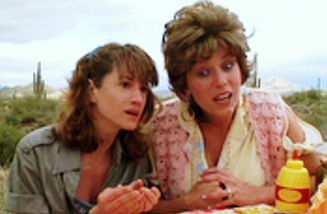 even though she herself is a felon now, albeit a good-intentioned one. Another complication arises with a visit from H.I.'s boss at work, Glen (Sam McMurray), his wife Dot (Frances McDormand) and their seemingly endless stream of diabolical children. "Mind you don't cut yourself, Mordecai" and "Take that diaper off your head and put it back on your sister" are just two of the many things Glen yells as his brood goes wild. While Dot rapidly lectures Ed on the need for insurance, avoiding orthodontic work and making sure the baby stays up to date on his "dip-tet boosters," Glen confides to H.I. that Dot wants another one, because these have grown too big to cuddle, but something has gone wrong with his semen. H.I. tries to lie about how he and Ed got to "adopt" a child so fast, but more trouble arises when Glen suggests to H.I. that they swap wives because he and Dot like to swing. H.I. punches Glen, who takes off like a madman and runs smack into a tree. Glen flees H.I., telling him not to bother coming into work anymore and promising to sue.
From that moment on, Raising Arizona essentially becomes an extended free-for-all chase. Since H.I. figures that Glen will make good on his word and fire him, he finds himself passing by convenience stores again "that weren't on the way home." Ed puts her foot down and wants Gale and Evelle gone. "I'd rather light a candle than curse your darkness," Gale tells H.I., while trying to convince him to help with a bank robbery. H.I. declines, but with Ed and the baby in the car, he does proceed to rob a convenience store for money and Huggies, setting off a loopy, more than five-minute long pursuit sequence. A pissed off Ed drives off with the baby, leaving H.I. to escape on foot. The Coens' hyperkinetic camera doesn't stop for a second as it rolls through groceries, streets and houses while clerks and dogs join the H.I. hunt.

Of course, the deadliest pursuit has yet to occur. H.I. already has had visions of a strange biker who takes no mercy on anyone or anything, and the vision turns out to be Leonard Smalls (Randall "Tex" Cobb), a self-described tracker, "some say hound dog." He meets with Nathan Arizona and offers to find his boy, but for a higher price than the reward the furniture magnate has offered. Arizona refuses, but Smalls insists he'll find the baby anyway and take whatever price "the market will bear." Back at the trailer, the chaos escalates as Glen figures out where H.I. and Ed got the baby and demands they turn the tot over to him and Dot. Before H.I. can even contemplate what to do, Gale and Evelle, who
 overheard the conversation, decide to steal the infant for themselves. Gale and H.I. tear the trailer apart in a residence-wrecking fight that takes place while Evelle shields Nathan Jr. The fugitives prevail and take off with Nathan Jr. with plans to hold him for ransom (and use him as a third man on the bank holdup). When Ed returns home to find H.I. tied up, she frees him and the couple leave to rescue the child, though Ed makes it clear that they aren't good for each other and should split once the baby is safe. The raucous slapstick melees run nearly nonstop after that as the convicts grow too fond of Nathan Jr. to part with him and Smalls arrives to whisk the baby away for his own nefarious purposes, leading to a final showdown with H.I. and Ed. Despite the frenzied pace and over-the-top nonsense, Raising Arizona even manages to conjure some warmth as the film winds down, though perhaps what touched me the most re-watching the film this time is remembering how much I loved the Coen brothers back then, until I felt their career went off the rails beginning with The Hudsucker Proxy. At least their upcoming film, No Country for Old Men, shows some promise as the vehicle marking their return to filmmaking I love instead of just doing variations on the same gags and gimmicks that I still love in their first four films, but has grown old by now.
From top to bottom, all the actors hit exactly the right notes for the movie. Forsythe and Goodman make for a hysterical pair of not-so-swift criminals. Cobb displays just the right amount of menace to remain a cartoon without pushing the film off its comic tone and into a terror mode. The late Parker gets some great material as Nathan Arizona as well as when he yells at the multitude of cops loitering at his house. "Dammit, are you boys gonna chase down your leads or are you gonna sit drinkin' coffee in the one house in the state where I know my boy ain't at?" Even the small roles of bank customers and store owners get priceless moments, especially Charles "Lew" Smith who plays the store owner who utters the response that gives this post its title when Evelle asks a question about some balloons. Cage still was in the early years of his career and Arizona marked the middle film of a three-film run of great Cage performances that started the year before with Peggy Sue Got Married and would concluded later in 1987 with Moonstruck. The breakout actor though was undoubtedly Holly Hunter as Ed. Hunter had appeared in a handful of films and TV movies, but Raising Arizona gave Hunter her biggest exposure so far, but it was just an appetizer for the gourmet meal Hunter would serve fans of great movies and acting in December 1987: Broadcast News.
UPDATE March 17, 2012: As we now know, my hopes for No Country for Old Men ended up being more than fulfilled. That same year, the brothers wrote and directed "Tuileries," one of the best shorts in the great compilation film, Paris, je t'aime . The Coens took a minor step backward with the so-so Burn After Reading that came next. However, the next movie they made ranked as one of their all-time greatest. A Serious Man also introduced me to the great actor Michael Stuhlbarg, who had mostly toiled upon the stage but would go on to impress me in a completely different type of role than his Larry Gopnik in A Serious Man when he became 1920s gangster Arnold Rothstein on HBO's Boardwalk Empire. Most recently, the Coens accomplished that rare feat of remaking a film and producing a greater version. Granted, the original True Grit wasn't a masterpiece, but it did contain John Wayne's Oscar-winning role as Rooster Cogburn which Jeff Bridges took on, easily besting the Duke. What really made the Coens' True Grit exceed the 1969 film version was young Hailee Steinfeld playing Mattie Ross. Yes, the Coens I loved early in their career have matured and returned better than ever. It's good that they can produce great works again and we continue to have their older classics such as Raising Arizona holding up after 25 years.

Tweet
Labels: 80s, Blog-a-thons, Boardwalk Empire, Coens, Guinness, Hanks, Holly Hunter, Jeff Bridges, John Goodman, John Williams, McDormand, Movie Tributes, Nicolas Cage, Oscars, Remakes, Wayne
TO READ ON, CLICK HERE


Monday, January 16, 2012
It's about which master you've been serving

By Edward Copeland
I've never read a single novel by John le Carré and I remember when the TV miniseries Tinker, Tailor, Soldier, Spy aired starring Alec Guinness, who was Obi-Wan to me at the time (as well as the blind butler from Murder By Death — I was starting sixth grade — sue me!), but I didn't see it. In college, I did see the movie adaptation of le Carré's novel The Russia House starring Sean Connery and Michelle Pfeiffer, which I thought might be an aberration. I liked it quite a bit, but movies reared me to think spies meant James Bond. Now, that I've seen the outstanding new film version of Tinker Tailor Soldier Spy (no commas please), I'm getting the impression that, like Rick and the waters in Casablanca, I was misinformed as to the nature of le Carré's novels. Looking at the film adaptations of his books, I wish I had time to read them now. I can't compare the new film to the TV miniseries or Gary Oldman's performance as George Smiley to Guinness', but I can say that Oldman and the new movie both are damn good.
Tomas Alfredson directed this version of le Carré's tale, marking the Swedish filmmaker's first English-language movie and his first feature since 2008's creepy and moving vampire film Let the Right One In, remade in the U.S. two years later as Let Me In.
Tinker Tailor Soldier Spy takes place in the early 1970s in the upper echelons of British intelligence (referred to as "The Circus.") The top man, known as Control (John Hurt, in an excellent performance), receives word that a Soviet operative in Budapest wants to switch sides so Control sends agent Jim Prideaux (Mark Strong) to Hungary, but the operation goes awry and in the fallout, Control is forced to retire and so is Smiley. Control, already ailing, dies soon afterward. Word gets to Oliver Lacon (Simon McBurney), the civil servant in charge of British intelligence via Ricki Tarr, a discredited agent in hiding (Tom Hardy, unrecognizable when compared to his role in Warrior) that the Hungarian mission's objective truly had been to ferret out the truth about Control's suspicions that one of the top men in The Circus actually works for the Soviets as a mole.
Lacon approaches the retired Smiley and asks him to lead a secret probe to determine if the mole exists and, if so, who he is. Smiley enlists the help of a young, still-working agent, Peter Guillam (Benedict Cumberbatch), and another retired intelligence official Mendel (Roger Lloyd-Pack). Their search of Control's flat uncovers the code names he had given to his suspects, based on the old rhyme, attached to photos taped to chess pieces. Percy Alleline (Toby Jones), who took Control's job as chief, was called Tinker. Bill Haydon (Colin Firth), now Alleline's deputy, was christened Tailor. His close allies Roy Bland (Ciaran Hinds) and Toby Esterhase (David Dencik) were Soldier and Poorman, respectively. Smiley, whom Control also suspected, had been named Beggarman.


Bridget O'Connor wrote most of the screenplay until her death from cancer and it was completed by Peter Straughn. Through the taut direction by Alfredson and the carefully constructed screenplay that doesn't always play out in strictly chronological order and lacks major action sequences, Tinker Tailor drips with suspense, helped in no small part by the great ensemble assembled. If the film contains a weakness, it's that the four potential moles aren't developed well enough, particularly Hinds' character. Toby Jones acts his part very well, especially considering that they almost try too hard to make him look guilty. It's interesting to see Jones in a fictional role for a change after playing Karl Rove in W., Swifty Lazar in Frost/Nixon and being the best screen Truman Capote in Infamous. In addition to those already mentioned, there is a brief but memorable appearance by Kathy Burke as another operative who was purged. Burke just doesn't appear in enough movies, but her most memorable performance might be Queen Mary Tudor in Elizabeth opposite Cate Blanchett. If you look closely, you'll spot le Carré himself playing a drunk in a Christmas party scenes. The most amazing thing for viewers of Boardwalk Empire is the chance to hear Stephen Graham use his actual British accent in his role as Jerry Westerby, an intelligence officer monitoring the teletype the night of the Hungarian mission. His look also doesn't remind you remotely of Al Capone. Interestingly enough, one of the film's more important characters, Smiley's wife, never actually appears. The two performances that deserve the most praise are Hurt's brief work as Control, which frankly I'm surprised hasn't been mentioned much in awards talk. The MVP prize undoubtedly goes to Oldman's quiet, reserved work as Smiley.
Since Oldman took the film world by storm in 1986 in Sid & Nancy, he's made some bad movies and been over-the-top at times but he's also done a lot of great work yet his performances seem resistant to recognition from his peers. Granted, I haven't seen all of the top 2011 best actor contenders as of yet, but of what I have, Oldman belongs in that list. Tinker Tailor Soldier Spy deserves more notice than it's been receiving as well.
Tweet
Labels: 10s, Blanchett, Boardwalk Empire, Books, Capote, Colin Firth, Connery, Fiction, Guinness, John Hurt, Oldman, Pfeiffer
TO READ ON, CLICK HERE
Tuesday, November 15, 2011
A "Kafka-esque" Tribute

By Damian Arlyn
Today marks the 20th anniversary of the release of Kafka, the first film Steven Soderbergh directed after his award-winning sex, lies, and videotape. I saw it many years ago on VHS and, although I didn't completely understand it, really enjoyed it. It was a tense, atmospheric thriller that starred Jeremy Irons in the title role and included a cast of such distinguished actors as Jeroen Krabbé, Ian Holm, Joel Grey, Armin Mueller-Stahl and Alec Guinness to support him. It was shot entirely in black and white (with only one brief color interlude near the end) and served as my introduction to Steven Soderbergh, a filmmaker who would later become one of my personal favorites. I was looking forward to watching it again for the purposes of writing this article. Unfortunately, it was not to be.
After much searching (and in a strange turn of events which perhaps Kafka himself would have appreciated), I discovered that the film has yet to be released on DVD here in the U.S. and there are apparently no plans to do so anytime soon. Since I am unable to revisit it and my memory of the film is somewhat sketchy, I fear I am unable to compose a proper tribute for it. However, it occurred to me that, in a strange way, this might perhaps be the most fitting tribute that could be done for a film that features the isolated and misunderstood Franz Kafka as its protagonist. I do hope that the film eventually gets released on DVD/Blu-ray someday (it deserves it) and if it does, I can highly recommend checking it out. In the meantime, I'll simply end this piece with a quote from the famed Prague-born writer:
"Life's splendor forever lies in wait about each one of us in all its fullness, but veiled from view, deep down, invisible, far off. It is there, though, not hostile, not reluctant, not deaf. If you summon it by the right word, by its right name, it will come."
Tweet
Labels: 90s, Guinness, Ian Holm, Jeremy Irons, Movie Tributes, Soderbergh
TO READ ON, CLICK HERE
Friday, August 19, 2011
You have to have faith for this to work on you
BLOGGER'S NOTE: This appreciation of the 1985 film Fright Night was originally part of the October 30, 2006 Vampire Blog-a-Thon coordinated by Nathaniel R. at The Film Experience.

By Edward Copeland
NEW INTRO FOR AUG. 19, 2011: At theaters today (in 3-D no less), they will be opening yet another example of a needless remake of a film that was great to begin with, isn't that old (26 years) and didn't need to be done over except for the complete lack of originality in Hollywood. I'm sure the CG effects will be impressive and some of the performances (particularly Colin Farrell, though I bet Chris Sarandon still will be preferable) might be good, but there's no way that an actor younger than I am such as David Tennant can
 bring the same background and depth to the Peter Vincent character that Roddy McDowall did (I take it this Peter Vincent isn't a retired actor of Grade B horror films from the past who introduces those movies on late night TV). Needless to say, I will not be seeing the remake because I stick by my principle: If the original was great, it's a bad bet to see the remake. Sure, there have been notable exceptions. The winning Front Page of 1931 turned into the even greater His Girl Friday of 1940, but the two subsequent remakes, 1973's The Front Page and especially 1988's Switching Channels, missed the mark or just plain stunk. Here Comes Mr. Jordan proved winning and its 1978 remake Heaven Can Wait equaled it (and surpassed it in many areas. The third try, Chris Rock in Down to Earth, should have stayed buried. The remakes that really work are the ones where the originals left lots of room for improvement such as Ocean's 11 and True Grit and Steven Soderbergh and the Coens did just that when they remade them, though the Coens also have a bad remake on their resume when they tried to redo Alexander Mackendrick's The Ladykillers starring Alec Guinness. So, in my pointless protest, I'm re-running the tribute to the real Fright Night that I wrote in 2006.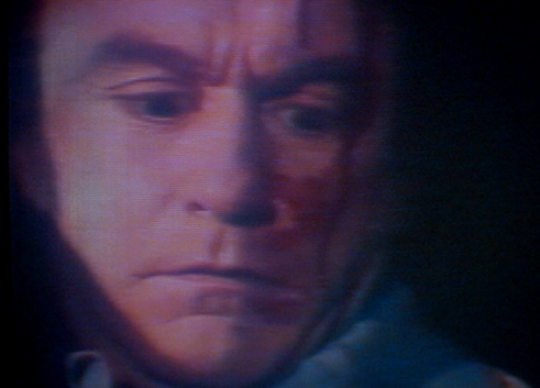
Sinking my teeth into today's vampire blog-a-thon, I thought I'd give long overdue appreciation to the best example of a cinematic tale of the undead from the mid-1980s. No, not Joel Schumacher's bore The Lost Boys. Not even Kathryn Bigelow's overpraised Near Dark. No, for my money the best vampire tale of the mid-1980s was Tom Holland's scary and funny Fright Night from 1985. Thanks in no small part to two great performances: Chris Sarandon as Jerry Dandridge, the vampire next door, and an Oscar-worthy turn by Roddy McDowall as a ham B-movie actor reduced to hosting horror flicks on local TV who finds himself fighting vampires. For real.
This is that era's vampire film that's worth inviting into your home. (I'm not joking about McDowall and Oscar either. Klaus Maria Brandauer in Out of Africa and William Hickey in Prizzi's Honor earned their supporting
 actor nominations, but McDowall deserved recognition over Don Ameche in Cocoon, Robert Loggia in Jagged Edge and Eric Roberts in Runaway Train.) As the notes in the Fright Night DVD indicate, the movie is a variation on "The Boy Who Cried Wolf" and the boy in this question is high school student Charley Brewster (William Ragsdale, before he vanished into the Fox sitcom world of Herman's Head). He's a huge fan of the horror movie TV show hosted by Peter Vincent (McDowall), has a girlfriend named Amy (Amanda Bearse, also in her pre-Fox sitcom days before Married…With Children) and a goofy friend named Evil Ed (Stephen Geoffreys, whose post-1980s credits, according to IMDb, consist mainly of hardcore porn). Charley also has a new neighbor moving in next door.
One night while fooling around with Amy in his bedroom, Charley notices the new neighbor, Jerry Dandridge, and his Renfield-esque handyman Billy (Jonathan Stark) carrying what appears to be a coffin into the house. Amy, who finally was ready to surrender her virginity to Charley, leaves the house in a huff. You would think that a horny teen about to get laid wouldn't have been paying attention to what's going on in the yard next door with a willing woman lying in wait, but all vampire films require some suspension of disbelief. What Charley saw convinces him to turn voyeur and while he misses his chance to see Amy nude, he happens to catch Jerry in the window of his house about to have a sexual tête-à-tête with a hot topless woman — something that reignites the libido he so easily abandoned earlier. Only in this case, the penetration that Charley almost witnesses isn't sexual — it's Jerry's fangs about to plunge into the young woman's neck. Unfortunately, Jerry spots Charley as well and quickly closes the shade before finishing his kill.
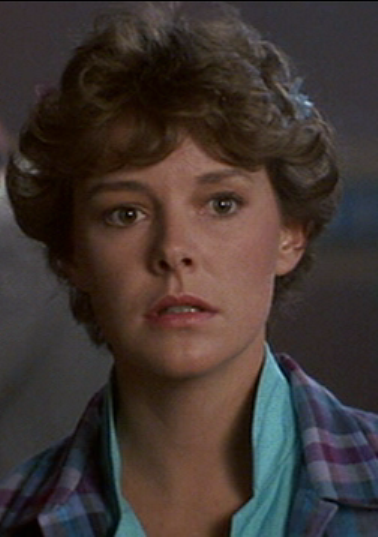
Needless to say, Charley's friends and his mom don't buy Charley's story — Amy even thinks that it may be a ploy to win her back into his good graces. Charley doesn't have better luck with the police either, who can't believe they fell for this kid's story about a murder when he's really claiming it's the work of a vampire. Jerry, however, knows what Charley saw and that he's a threat. Easily finagling an invitation into Charley's house from his man-hungry single mom, Jerry pops in for a visit — laying the groundwork for his plan to take care of Charley. When he arrives later that evening, whistling — "Strangers in the Night" no less — he insists to Charley that he doesn't want to kill him and he's going to give him something Jerry didn't have — a choice. Charley doesn't agree to stay mum and manages to escape Jerry's murderous intentions and decides to turn to Peter Vincent for help.
Charley catches the actor on a particularly bad day. He's just been fired from his TV job because his ratings have dropped. As he laments to Charley, kids don't want to watch vampire killers anymore. They prefer
 "watching demented men in ski masks hacking up young virgins." Vincent feels sorry for Charley, but he's also convinced that the kid needs psychiatric help. When Ed and Amy discover Charley setting up his bedroom for defense and sharpening stakes for a planned assault on Jerry's house, they decide to give Peter Vincent another try, hoping he can talk sense into their friend. Vincent agrees to help prove to Charley that Jerry isn't a vampire — for a $500 savings bond. The actor and the three teens visit Jerry with the intention of faking a vampire test so that Charley will back off — only something happens that manages to convince Peter that perhaps Charley is telling the truth.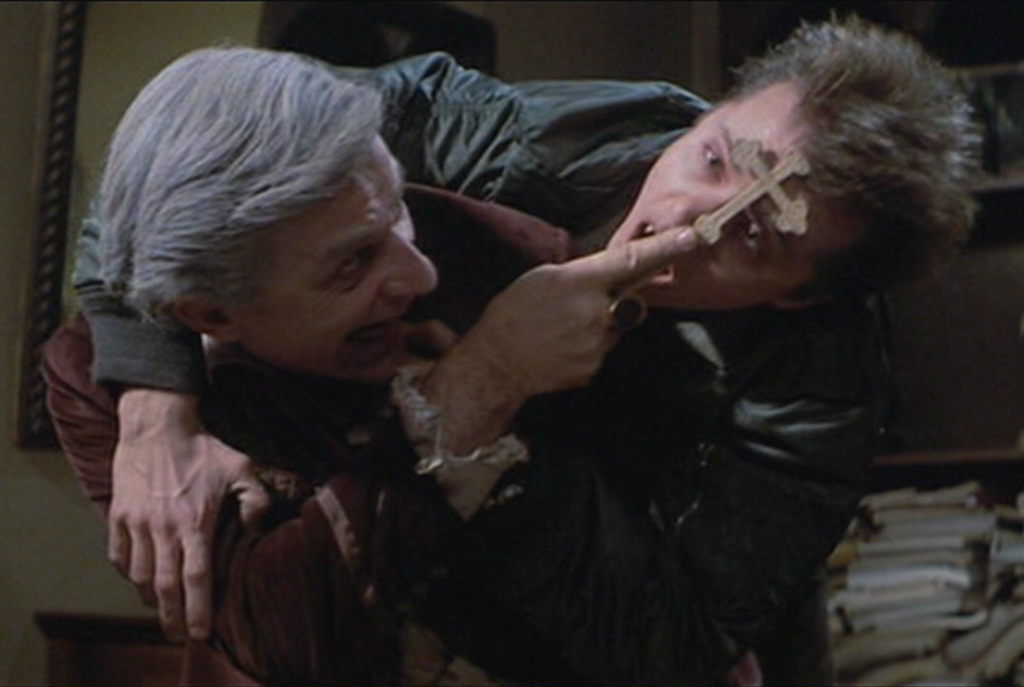
Peter — a coward at heart — hastily makes plans to leave town, but not before Jerry has abducted Amy, who bears a startling resemblance to a past love, and turned Evil Ed into a vampire, who stops by Vincent's for a visit. Later, Charley shows up and convinces Peter that they are Amy's only hope and it leads to the nearly 30-minute climax that takes place almost exclusively inside Dandridge's house as Charley and the ham actor prepare to battle the undead. What makes Fright Night such a hoot to this day, on top of the great performances, is the deft blending of humor and suspense that Holland manages to build in his story. Peter's lament about what kind of horror movies kids want to watch in the 1980s seems a direct criticism of the endless Friday the 13th installments and similar films that seemed to be Hollywood's main attempts at horror in the 1980s. Those dreadful wastes of celluloid about Jason helped to make Fright Night such a refreshing change of pace.
What also set Fright Night apart from other mid-1980s horror efforts is that it didn't look cheap. It had an estimated budget of merely $9 million, but it looks as if it was much larger with sharp visuals, effects and sets. It also has a great techno score by Brad Fiedel aided by some typical 1980s technopop-type songs that certainly date the film but don't in any way diminish from the film's fun.
The film also manages to revitalize many cliches, from a fallen hero's redemption (in the case of Peter Vincent) to brief asides to teen sex comedies and truly modernizing the role of the charismatic vampire through Sarandon's witty and wicked performance. While Ragsdale, Bearse and Geoffreys are serviceable, Fright Night wouldn't work at all if it weren't for Sarandon and McDowall, two old pros who could have phoned it in for a paycheck but who raise the film to the level of a true, if underappreciated, classic of the horror and vampire genres.

The one question I sought to answer when I decided to select Fright Night for today's vampire blog-a-thon (and still have no answer for years later) was what happened to Tom Holland. He later wrote and directed the original Child's Play, another film that blended horror and humor, though not nearly as well as Fright Night. Since then, most of his credits on IMDb consist of writing and directing many of the TV adaptations of Stephen King works. As a sidenote: He had nothing to do with the sequel, Fright Night Part II, which should be avoided at all costs.
Tweet
Labels: 80s, Blog-a-thons, Coens, Guinness, Movie Tributes, Remakes, Soderbergh
TO READ ON, CLICK HERE
Friday, June 24, 2011
Peter Falk (1927-2011)

One more thing…before I get started talking about the great Peter Falk, who died Thursday at 83 after a long battle with Alzheimer's disease, as memorable as his creation of Lt. Columbo was in the pantheon of iconic television characters, he needs to be remembered for far more than just that role, even if it may have been his most famous — maybe even his best — and earned him four Emmys and 10 Emmy nominations. He also did considerable screen work and some Broadway. He was capable of the most searing drama of John Cassavetes and the broadest of comedy. He was a talent.
As with many actors of his generation, he began his career on live television in the 1950s, appearing in many of the shows that featured theatrical productions staged for viewers at home as well as the occasional guest appearance in an episode of a recurring series. According to IMDb, his first television appearance came in 1957 on Robert Montgomery Presents in a presentation of Return Visit. This came shortly after his Broadway debut in 1956 in a revival of George Bernard Shaw's Saint Joan where Falk played an English guard. Also in the cast as a member of the ensemble was none other than Robert Ludlum, before he abandoned acting to become a novelist. Also in 1956 on Broadway, Falk appeared as a servant in the comedy Diary of a Scoundrel whose cast included Roddy McDowall, Howard da Silva, Margaret Hamilton, Jerry Stiller and future killer on multiple episodes of Columbo, Robert Culp. Falk didn't return to Broadway for about seven years, concentrating on television and movies.
In 1960, he made his film debut in Pretty Boy Floyd. The same year, he also appeared in Murder, Inc. as a violent hit man for the notorious crime syndicate of Jewish gangsters run by Louis "Lepke" Buchalter in the 1930s. It earned Falk his first Oscar nomination as best supporting actor. He still stuck mainly to TV after that, though an appearance on a 1961 episode of The Law and Mr. Jones won him an Emmy. He hit most of the big series of the time at some point: The Twilight Zone, Alfred Hitchcock Presents, The Untouchables, Have Gun — Will Travel.
In 1961, he made another big feature, this time with some big names. He co-starred with Bette Davis and Glenn Ford in Frank Capra's remake of his own Lady for a Day, retitled A Pocketful of Miracles. Falk played gangster Ford's none-too-swift sidekick and it earned him his second consecutive Oscar nomination for supporting actor. Movie roles started to come easier after that, though he still did a lot of television, including an appearance on a 1962 episode of The Dick Powell Theatre called "The Price of Tomatoes" that garnered Falk another Emmy nomination.
As the film roles started coming more frequently, he took advantage. In 1963, he was one of the two cab drivers caught up in the chase for the money buried under that big W in It's a Mad, Mad, Mad, Mad World. The next year, he appeared in The Rat Pack vehicle Robin and the 7 Hoods when it was released. He did take time off to return to Broadway in 1964 to star as Stalin in The Passion of Josef D. by Paddy Chayefsky. In 1965, he joined Jack Lemmon and Tony Curtis for The Great Race. That same year, he tried his hand as the lead of his first television series, The Trials of O'Brien, but it only lasted one season.
Heading back to the big screen, he made the comedy Penelope with Natalie Wood in 1966; Clive Donner's adaptation of the play Luv in 1967, again with Lemmon and with Elaine May; and Anzio in 1968 featuring a cast that included Robert Mitchum and Robert Ryan. Falk also made a TV movie in 1968 called Prescription for Murder that introduced the world to a homicide detective named Lt. Columbo, even though he would not reappear again until 1971.

In 1970, Falk made his first collaboration with John Cassavetes in Husbands. Cassavetes' films remain an acquired taste for just about everyone, film lovers included, but he brought out sides and shadings in Falk that you never saw anywhere else. He directed Falk again opposite his wife Gena Rowlands in 1975's A Woman Under the Influence and his portrait of a blue collar Italian husband trying to deal with a mentally unbalanced wife really is a thing of wonder. Falk and Cassavetes worked again on screen together in 1976's Mikey and Nicky, a very unusual portrait of a friendship, only it was Elaine May in the director's chair in that case. Cassavetes even appeared as one of the killers on an installment of Columbo. He made a cameo as himself in Cassavetes' underrated Opening Night. He worked for Cassavetes on his final film, Big Trouble in 1986, which reunited Falk with Alan Arkin and Andrew Bergman, Falk's co-star and writer of The In-Laws, but I haven't seen that one since word was not good.
In March 1971, Lt. Columbo appeared again in a television movie called Ransom for a Dead Man, but that fall, Columbo became a regular series — or as regular a series can be when it's on irregularly. It was part of NBC's rotating lineup of Mystery of the Week and would share its time slot with McMillan & Wife and McCloud. Columbo stayed on the air until 1978. Then, in 1989, ABC brought the rumpled detective with the broken-down car back. They tried an alternating format, but their other series sucked so they just continued doing occasional Columbo movies until 2003, only Falk also was the executive producer now. He also wrote an episode. He directed two outings back in 1972.
In early 1971, Falk made his last appearance on Broadway in the original production of Neil Simon's The Prisoner of Second Avenue. He and Simon must have been good partners, because Falk later appeared in two original spoofs that Simon wrote for the big screen. The first was 1976's delightful Murder By Death with
 a truly all-star cast: Eileen Brennan, James Coco, Alec Guinness, Elsa Lanchester, David Niven, Peter Sellers, Maggie Smith, Nancy Walker, Estelle Winwood and, of course, Truman Capote. Also playing a small role, and up until then probably most recognizable as Stretch Cunningham on All in the Family, a younger James Cromwell. The premise had the stars playing spoofs of famous literary detectives and Falk plays Sam Diamond, which means Sam Spade which to most people means Bogart and Falk does a hilarious Bogart satire. So funny in fact that Simon resurrected it in the 1978 film The Cheap Detective where Falk did Lou Peckinpaugh with another all-star cast in a spoof of all Bogart films. It wasn't as good as Murder By Death, but Falk was just as great.
Falk had another release in 1978, now largely forgotten, that I haven't seen in years but that I do remember enjoying when I was a lot younger and that was The Brink's Job. Directed by William Friedkin, it told the true story of a hard-luck would-be criminal who manages to rip off an armored car for a sizable amount of cash. He's surprised to find that the robbery doesn't even make the news and after some snooping, he discovers it's because Brink's has such poor security they didn't want it reported. Of course, it goes to his head so he and his gang plot an even bigger score. In 1979, Falk made what's probably one of the purest comic pleasures put on film, a movie so funny that even having Arthur Hiller as director didn't screw it up. Of course, I'm referring to The In-Laws where, frankly, I think Falk's off-the-wall portrayal of Vincent Ricardo and Alan Arkin's work as dentist Sheldon Kornpett, his flabbergasted, unwilling partner in hijinks, both deserved Oscar consideration in this crazy farce written by Andrew Bergman. If you've never seen it, you owe it to yourself to do so, but don't get the recent remake by mistake. Serpentine!
The remainder of Falk's film credits contained two certified gems and a lot of misses such as 1981's All the Marbles, where he managed female wrestlers; a cameo in the underwhelming The Great Muppet Caper the same year; 1987's Happy New Year, where the makeup was the star; Cyndi Lauper's try at screen fame in 1988's Vibes; a mobster in the dumb 1989 comedy Cookie; and 2001's Corky Romano. However, he did appear in some films that earned some good notices that I didn't see such as Joe Mantegna's directing debut of a David Mamet script called Lakeboat in 2000. He also made a very funny appearance in the first season of The Larry Sanders Show. The two film classics he made post-1979 were Wim Wenders' exquisite Wings of Desire, where he played himself but he had the ability to talk to the angels (click here to see the scene), and The Princess Bride, where he played the kindly grandfather reading the story to his sick grandson (Fred Savage) and us.

He wasn't done with the stage yet either. In 1998, he earned raves appearing off-Broadway in Arthur Miller's Mr. Peters' Connections.
What a range and I can't even add up the hours of enjoyment this man has given me through his work all my life. Thankfully, the work still remains to enjoy.
Rest in peace, Mr. Falk.
Tweet
Labels: Arthur Miller, Awards, Bette, Capote, Capra, Cassavetes, Chayefsky, Glenn Ford, Guinness, Hitchcock, Larry Sanders, Lemmon, Maggie Smith, Mitchum, Neil Simon, Niven, Obituary, Robert Ryan, Sellers, Tony Curtis
TO READ ON, CLICK HERE
Wednesday, February 09, 2011
Not the same old song

By Edward Copeland
That was the definition, according to the famous mystery writer, who made the phrase common vernacular in his novel Red Harvest and which the Coen brothers gave new life to in their feature debut Blood Simple. The great Chinese filmmaker Zhang Yimou specifically cites Hammett's definition in the trailer for his remake of the Coens' film, A Woman, a Gun and a Noodle Shop, which opened in the U.S. last year. As big a fan as I am of both Zhang and the Coen original, I'm afraid that the adjective addled turns out to be very appropriate, both for most of the characters in Noodle Shop and in Zhang's approach to the film as well.
Obviously, the setting for A Woman, a Gun and a Noodle Shop no longer takes place in Texas, but its time period has been transferred as well, to an nonspecific feudal period in China's past where the title weapon actually is a novelty that comes into the hands of the noodle shop owner's wife (Yan Ni) by a Persian merchant (Julien Gaudfroy) passing through their village selling his wares. Yan Ni's character, who never gets a first name as is credited merely as Wang's wife — Wang (Ni Dahong) being the noodle shop owner — bears absolutely no resemblance to Frances McDormand's Abby in Blood Simple.
While the women in both films may be cheating on brutish, abusive husbands with their spouses' employees, Wang's wife's portrayal comes off as scheming, loud and boisterous and shows little regard for anyone, including her lover Li (Xiao Shenyang), one of the most addled of the addled characters I referenced in the lead.
In fact, the entire tone of Zhang's film plays a lot like the portrayal of Wang's wife: It's a frenzied, manic farce that seems more like Zhang is paying homage to the Coens' style in Raising Arizona more than Blood Simple, except Raising Arizona works.
It takes about a third of the 90-minute film before Noodle Shop begins to resemble Blood Simple's plot very closely. After a group of policemen arrive to investigate the cannon that was fired by the Persian merchant (who looked about as Persian as Eddie Albert in the film version of Oklahoma!, though it might have been more interesting to follow his character and see Zhang try to adapt that Rodgers & Hammerstein musical landmark to a Chinese setting).
Instead of Wang hiring a private eye to find out if his wife is cheating on him, one of the policemen, Zhang (Sun Honglei), informs him that he's being cuckolded because he stumbled upon Li and Wang's wife accidentally. Wang explodes, furious at the news, and offers Zhang some money if he'll kill the both of them for him. Wang will leave town on a fishing trip for an alibi.
Unlike the great M. Emmet Walsh's investigator in Blood Simple, who was as entertaining as he was sleazy and dangerous, Zhang's demeanor remains stoic throughout. So much so that he seems out of step with all the loony characters and farcical goings-on that surround him.
The plot details don't make sense either. Since there aren't photos in the era depicted, he has to prove he "killed them" with pieces of Li and Wang's wife's clothing with slash marks. Why he panics to retrieve these for fear they'd implicate him doesn't compute the way the doctored photos and dropped lighter did in Blood Simple, let alone cause Zhang to kill a minor secondary character and forget his pipe where he buried him, making him fear that losing that will finger him as Wang's killer.
At the film's very end, which tries to duplicate Blood Simple's ending exactly with Wang's wife telling Zhang to tell Wang she's not afraid of him anymore, Zhang lets out a laugh that seems completely out of place for his character in Noodle Shop when it was the perfect punchline in the Coens' film. To make matters worse, Zhang keeps laughing as he sees the approaching drop of water as opposed to the look of horror on Walsh's face in the original.
The visuals, especially scenes shot outside, contain very vibrant colors, so vibrant in fact that it makes the film look artificial, which might be appropriate since its slapstick approach and one-dimensional characters seem just as fake. Also, as much as I complain about film scores that step on the dialogue and action, this film actually could have used one. It doesn't have one and perhaps if it had some music to match its zaniness, all its disparate elements wouldn't seem so incongruous.
I've never been more disappointed by a film made by Zhang Yimou, even though when I first heard of this idea it excited me, I should have stuck to my usual rule: Don't remake great films. It hardly ever pays off. Perhaps this is karmic payback to the Coens for when they made the unnecessary and terrible remake of the classic Alec Guinness comedy The Ladykillers.
Don't try to make a new version of a film that was damn near perfect in the first place. It seems odd that it happens to the Coens now when they remake a flawed but hardly untouchable film such as True Grit and end up with a remake that exceeds the earlier version in every conceivable way.
I realize that Zhang Yimou operates under terrible repression, but I so wish he could (or would) escape and get back to making those films that earned him his reputation such as Ju Dou, Raise the Red Lantern and To Live and abandon the Crouching Tiger-type films such as Hero and Curse of the Golden Flower and especially complete misfires such as A Woman, a Gun and a Noodle Shop.
Tweet
Labels: 00s, Coens, Foreign, Guinness, Hammerstein, McDormand, Movie Tributes, Musicals, Remakes, Rodgers, Zhang Yimou
TO READ ON, CLICK HERE
Friday, May 21, 2010
When the son bested the father
— Horace, "Odes," III, 6, l. 1.
— George Lucas, talking about his father, 2008
They may not mean to, but they do."
— Philip Larkin, This Be The Verse

By Ali Arikan
The interwebs was abuzz last week with the news of a letter George Lucas sent to the producers of TV’s Lost. In it, Lucas apparently stated that he had made up the whole story of the Star Wars saga as he went along — a nonadmission, really, but one on which the fanboys pounced anyway, as if a meticulously detailed trope from the start were automatically greater than a naturally evolving one in service of its characters (it isn’t). Since Lucas is the great pariah when it comes to genre fiction, the backlash — such as it was — was hardly unexpected, but most definitely unfair.
The unjustly despised prequel trilogy has had such a retroactive fallout on the original three and their reputation that Lucas’ involvement in the Star Wars saga (and, to an extent, the Indiana Jones films) can be boiled down, by many, to ultimate responsibility for all the saga’s missteps, and none whatsoever for its triumphs. Spectacularly unfair, this claim, nonetheless, has become a shibboleth amongst the most ardent fans of the saga, as well as its saner aficionados. One doesn’t need to be well versed in Star Wars lore or Lucas’ biography, however, to see how major an influence the latter had on the former (and, naturally, vice versa) — even in the two films that he did not direct. In fact, it is in the beloved first sequel that the saga reached its philosophical apex, and it was because of Lucas’ direct involvement. The Empire Strikes Back is not just the finest chapter of the Star Wars saga, it is also the most personal.
On this day in 1980, Star Wars Episode V: The Empire Strikes Back was unleashed on movie screens in the United States to almost universal acclaim (for the sake of brevity, and sanity, from this point on I shall abbreviate the film’s full title to the colloquial ESB). Coming on the heels of the previous film’s unprecedented — and unexpected — success, the second chapter of the saga (retconned to serve as the fifth within the in-movie chronology) had a completely different feel from its predecessor, and this narrative contrast was hammered home during the film’s first few minutes.

Whereas 1977’s Star Wars (re-titled Star Wars Episode IV: A New Hope in 1978) opens on the desert planet of Tattooine (after the initial space age shenanigans, natch), ESB sets the action on the ice planet of Hoth. Even though both environments are extreme wastelands, the direness of the situation is made more explicit by the expository opening crawl (“It’s a dark time for the rebellion”) as well as the dialogue: there is almost no life on this planet, and what there is of it, is hostile. On the run from the Empire following the destruction of the Death Star at the end of the first film, the Rebel Alliance has taken refuge here, but they are soon discovered by Darth Vader (body by David Prowse, voice by James Earl Jones) and the Empire, and have to flee for their lives. The heroes are separated: Luke Skywalker (Mark Hamill) goes to the swamp planet of Dagobah to train under the tutelage of the impish Jedi Master Yoda (Frank Oz), while Han Solo (Harrison Ford) and Princess Leia (Carrie Fisher) end up going to Cloud City, where the betrayal of Han’s old friend Lando Calrissian (Billy Dee Williams – Billy Dee! Billy Dee! Billy Dee! Billy Dee Klump!) will have dire consequences for everyone involved.
The first Star Wars was admittedly more a cacophonous, albeit endearing, hodgepodge of boys’ own and pulp stories of yesteryear than a holistic tale. Auteurist touches were sprinkled like fairy dust, haphazardly, and not
 coherently. It was in ESB that this earlier promise was fulfilled: multifaceted and rich, George Lucas’ sequel, directed by his film school mentor Irvin Kershner, implied to the world just how personal an affair these films would end up being, from a philosophical as well as psychological standpoint. I recently struggled through the film while suffering from a particularly bad spell of food poisoning (not that there are good spells of this messiest of ailments), and was struck by the fiendishly systematic way themes and motifs are built up to culminate in one of the most depressing, yet hopeful, finales in the history of genre storytelling. One fully comprehends the gravity, and sheer precision, of both those notes only after seeing ESB’s 1983 sequel, Star Wars Episode VI: Return of the Jedi; but to contextualise it, appreciation — or, at least, experience — of the Prequel Trilogy is also equally crucial.
Of all the movie brats, George Lucas is commercially the most successful one and also the most maligned; and I doubt the two are completely unrelated. Even though people with short memory spans tend to make a direct connection to the auteur’s general deprecation with the prequels, they are wrong: as far back as 1977, people were upset with Lucas for daring to opt for levity rather than portent. Recently, the inimitable Girish Shambu published on his Facebook feed a quote he discovered of Lucas, which originally appeared in Jonathan Rosenbaum’s Sight and Sound review of the first film:
“Rather than do some angry, socially relevant film, I realized there was another relevance that is even more important — dreams and fantasies, getting children to believe there is more to life than garbage and killing and all that real stuff like stealing hubcaps — that you could still sit and dream about exotic lands and strange creatures.”
Then came a number of comments that chastised Lucas, some going as far as pitching him as some sort of a modern Pied Piper, leading an unsuspecting audience to piffle (because, obviously, if it weren’t for Lucas, we’d all be lining around the block for the new Kiarostami); until Glenn Kenny The Wise sagely offered these words of observation:
“Let us remember, however, that 'angry' and 'socially relevant' do not automatically equal 'good.' In fact, more often than not, in art they tend to equal 'strident,' 'obvious,' 'condescending,' etc.”
This conversation was nothing new. Lucas was ostracized by a bunch of his contemporaries, and a fair few of the critical establishment, in 1977, for breaking from the pact, and having the audacity to discover edge, and profundity, through subtext rather than text. Art is subjective, and if any work of art, be it a film, or a book, or a piece of music, doesn’t work for one, it just doesn’t work for one, but secondguessing the reasons why is silly, and is a direct road to mind-numbing vacuity and conformism. It wasn’t the Ewoks wot killed Lucas’ reputation, and it wasn’t Jar Jar. It was because he did not make THX-1138: he made Star Wars.
Even though disapprobation of Lucas is relatively old news, a recent trend, which could be dated back to the lukewarm (boom, boom) reception of 1999’s Star Wars Episode I: The Phantom Menace, is the attribution of the saga’s failures to Lucas, while crediting its triumphs to his collaborators. Since ESB is generally regarded as the finest chapter, it’s no wonder this oversimplification applies to it the most.
A period of De-Lucasisation began around 1999, the gist of which was, “Irvin Kershner and Lawrence Kasdan (ESB’s writer) did all the hard work, and made the film what it is while Lucas crunched numbers in Marin County.” It is unfair to downplay the importance of Kershner and Kasdan, but to completely write Lucas off is egregious. However, blame, in this case, also rests with Lucas.
According to Laurent Bouzerau’s 1997 book Star Wars: The Annotated Screenplays, work began on a sequel to the first film almost right away. Lucas put together a number of story conferences with friends, and then hired Leigh Brackett to write the first draft of the script (which was recently leaked on the interwebs).
These initial conferences show some major diversions from the final film. First of all, Darth Vader and Luke’s father, by the later drafts that bear at least a modicum of resemblance to ESB, are two very separate people. In fact, records show that Lucas came up with the idea of their being one and the same well into the development of Empire. From the first transcript of the story conferences between Lucas and Leigh Brackett, entitled Chapter II: The Empire Strikes Back, through to the two subsequent treatments written by Lucas, to the imaginatively titled first draft, Star Wars Sequel, Vader is most definitely not Luke’s father (in fact, even the concept of Ben Kenobi’s (Alec Guinness) Force-ghost only appears in the first draft — in all the previous treatments, Luke uses a talisman that used to belong to Ben to find out about Yoda).

The notion of Vader’s being Luke’s father appears in the second draft. Lucas nowadays argues that that was the idea all-along, and that he kept it quiet. Through five separate treatments and a full first draft of the script? OK, from Leigh Brackett maybe, but from himself? Eh? That’s either bullshit, or batshit insane. Besides, it makes no sense whatsoever as, in the earlier treatments and the first draft, Luke contacts Ben during his training, and the latter brings along with him Luke’s father from the netherworld for an interplenary father and son tête-à-tête.

Hell, the possibility of romance between Luke and Leia, already pretty icky, is full-on in the earlier drafts. And even though Yoda says, in ESB, that “there is another,” Irvin Kershner explains in the DVD commentary that it was a later addition to unsettle the audience with regards to Luke’s apparent invulnerability. It’s clear that Lucas never thought ahead to the third film, and this, too, attests to Lucas’ aversion to coming up with an overall storyline (even though Star Wars lore argues otherwise).
Fans have used this to wag their fingers at Lucas, for not having figured out the plot to the saga when he first sat down to write it in 1972. I’d like to invoke a favorite quote here from Stephen King: “Plot is, I think, the good writer’s last resort and the dullard’s first choice. The story that results from it is apt to feel artificial and labored. I lean more heavily on intuition, and have been able to do that because my books tend to be based on situation rather than story.” Plot, obviously, is different from story — and while Lucas worked out the plot as he went along, he must have known the story, subconsciously, from the start. And that’s because the films have all been so deeply personal to him. And, albeit directed by Kershner, in retrospect, ESB is the most personal film in the saga, and betrays a true auteurist touch.
First of all, certain motifs are delicately worked in to the narrative like subtle melodies in a symphony. Take, for example, the cave motif, one that figures out in all drafts going as far back as the first story conferences. Earlier in the film, Luke gets attacked by a Wampa, and is dragged into its cave. When he comes to, he is suspended, head down, from the ceiling: it is in this cave that his world is turned upside down for the first time. Luke’s lightsabre has fallen off his belt, resting gently on the snow a few feet away. Luke can’t reach it. Finally, he closes his eyes; and as the “Force Theme” — the true leitmotif of John Williams’ Star Wars scores — begins, Luke starts to concentrate, uses the Force, and, for the first time, wills an object to his hand. The transformation to his true self has begun.
Later, Luke confronts the image of Darth Vader in a cave in Dagobah, and, after a brief clash, decapitates the mirage, as the exploding mask reveals Luke’s own face underneath. Similarly, Han and Leia first kiss while hiding from the Imperials in a cave (which turns out, literally, to be the belly of the beast), and what is the Carbonite Chamber in Bespin but a metallic cave: one where both Luke and Han pay the heaviest price. Cave allegories go all the way back to Plato, and Lucas, having immersed himself in the Campbellian idea of the monomyth, employs it to splendid thematic use in this film.
Further, Lucas (and Kershner) play around with masks, scars and revelations: when we first see Luke, he has his face covered to protect him from the blizzard: he looks like an outlaw. After the attack, as he heals in the Bacta tank, an iron lung of sorts is attached to his face, and, in hindsight, gives Luke a sort of proto-Vaderesque look. On a practical level, masks not only act as a way of hiding one’s identity, but also as protection against damage. Or, once that damage is done, to conceal its effects. The way Darth Vader’s helmet is lowered over his scarred, corpse-like head, and the way Luke gets pulled out of the bacta tank, work as mirror images: in the former the helmet hides Vader’s scars, and, as we know from the next film, his true identity. The latter learns from his scarring experience, and has an epiphany to set off on his journey. The Wampa attack leads Luke on his way to Damascus.
Of course, there is a more obvious reason why Lucas went to all that trouble to underline the contrast: in one of the most memorable scenes in the history of cinema, Darth Vader reveals to Luke that he is, in fact, his father. The revelation comes after Vader bests Luke in a lightsabre fight (“The Force is with you, young Skywalker, but you are not a Jedi yet”), and chops off his right hand. For all intents and purposes, this is emasculation at the hands of the father. Lucas’ uneasy relationship with his own father, especially as he was growing up, rears its head.
Lucas said in an interview in 2008 that, “(My father) wanted me to go into his business. I said, 'I'm absolutely not going to do it. He sold office equipment in a store. I said, 'I will never go to work every day doing the same thing day in and day out.'” As Anthony Breznican of USA Today noted at the time, “It sort of gives a new perspective to all Darth Vader's talk of, "Join me and together we can rule the galaxy!" Lucas’ father hated his love of fast cars, and chastised him when he got into an almost-fatal accident. Later, he was less than enthusiastic when his son decided to become a filmmaker, and not a businessman (though he ended up being both, which is also interesting).
Unable to receive support from his father, Lucas sought other paternal figures, fathers, if you like, by proxy. Francis Coppola was one of them, and their master-apprentice relationship is analogous to that of both the Jedi and the Sith. Kershner was another paternal influence: Lucas’ hiring of his old mentor to make a film about rising up against the legacy, the sins, of the father was no coincidence.
Nonetheless, ESB never offers a true black-and-white view of Luke and Vader’s relationship — the dichotomy of good father vs. bad father is not clear in any of the films, especially with regard to Luke. For one, Luke’s proxy parents all lie to him, from his aunt and uncle in the first film, to Obi Wan and Yoda in this one. They, too, want to use him for their own ends: to destroy Vader and to destroy the Empire. The latter is also Vader’s ultimate objective. Both parties want power, and they want Luke to help them get it. But, Luke is not the only one to suffer from the sins of his father. In Star Wars Episode III: Revenge of the Sith, Darth Vader becomes a slave to the Emperor (Ian McDiarmid), his “bad father,” but only after being betrayed — according to him — Obi Wan and the Jedi Order (his “good father”). And Obi Wan is forsaken by his “father,” Qui Gon Jinn (Liam Neeson), who, in The Phantom Menace, takes on the responsibility to train Anakin Skywalker (Jake Lloyd) when the Jedi Council refuses to do so. It is only after the murder of Qui Gon that Obi Wan is handed the burden to train Anakin, something he’d initially protested. “Man hands on misery to man. It deepens like a coastal shelf.” Indeed.
ESB shows that the old guard, good or bad, are intrinsically manipulative: that the children live with their parents’ sins, and end up having to atone for them. By the end of Return of the Jedi, Luke becomes a tragic figure; as Robin Cross put it in his 1985 book Science Fiction Films, “Like John Wayne’s Ethan Edwards in The Searchers (1956), he has saved those around him, but can find no peace for himself.” Since Lucas identifies so much with Luke (Luke-Lucas, etc), is this how he sees himself? I wonder. Even when taking a stand against his father, and redeeming himself through his actions, does he, nonetheless, become a slave to his past? The answer is ambiguous.
Note: Some parts of this essay were appropriated from the author’s previous writings on Star Wars.
Tweet
Labels: 80s, Coppola, Criticism, Guinness, Harrison Ford, J.E. Jones, John Williams, L. Kasdan, Liam Neeson, Lost, Lucas, Movie Tributes, Sequels, Star Wars, Television, Wayne
TO READ ON, CLICK HERE
Monday, March 01, 2010
Centennial Tributes: David Niven

By Liz Hunt
It’s easy to celebrate the late actor David Niven’s life.
Today, Niven would have been 100. Had he lived, the Oscar-, British Academy Award- and Golden Globe-winning actor probably would have been a dapper, urbane gent with wavy white hair, a pencil-thin moustache and, as always, be 100 percent British.
He died July 29, 1983, at his home in Chateau-d’Oex, Switzerland, after a battle with amyotrophic lateral sclerosis (ALS or Lou Gehrig’s disease). He is buried there.

His 112 movies include best picture winner Around the World in 80 Days, the film that won him the Oscar, Separate Tables, The Guns of Navarone, the 007 farce Casino Royale and the original Pink Panther.
He was known for his gentle, self-deprecating manner, his light-hand with comedy, his depth as a dramatic actor, his friendships with screen stars Cary Grant, Clark Gable and Roger Moore, and his charming wit — whether aimed at Errol Flynn or a streaker dashing behind him during the 1974 Oscar ceremony.
James David Graham Niven was born in London in 1910. For years, his biography said he was born in Kirriemuir, Scotland, because he thought it sounded more romantic than London.
His father was Scottish, a British military officer who died at Gallipoli on Aug. 21, 1915. He was a landowner who left his wife Henrietta with four children, David, Max, Joyce and Grizel.
Niven’s wit emerged early. He said as a child he felt superior to others because when reciting the Lord’s Prayer in church, he thought it was written “Our Father, who art a Niven…”
When his mother remarried, Niven attended several boarding schools. He hated them, and his grades showed it, but his soldier father’s reputation helped him get into the Royal Military College at Sandhurst. He left there as a second lieutenant. He was asked where he wanted to serve and he wrote he’d be fine anywhere but the Highland Light Infantry, which was where he was posted. He later transferred to the Rifle Brigade. During his service, he was posted to Malta and charmed a number of highly placed people with his devil-may-care attitude and his dashing looks, a precursor of many of his future film roles.
After his military service, Niven took a number of odd jobs, including by his account, a gunnery instructor for Cuban revolutionaries. He arrived in Hollywood in the early 1930s had bit parts in films such as There Goes the Bride, Eyes of Fate and Cleopatra.

Samuel Goldwyn took an interest in the engaging young man in 1935, adding him to a group of attractive young contract players. He had several small roles for Goldwyn and was loaned to 20th Century Fox for the 1936 Thank You, Jeeves!
It was then he started making friends with fellow actors Flynn and several other British actors in Hollywood, and also made quite a splash with the ladies of the film world.
He had a few supporting roles and carried a few movies before 1939, when he returned to Britain to reenlist in the army’s Rifle Brigade. He left World War II to make two movies to rally British morale, Spitfire and The Way Ahead. Fellow actor Peter Ustinov served as his valet in the army.
Niven married Primula Rollo in 1940 and they had two children. Despite his fighting for six years, he came in second in the 1945 Popularity Poll of British film stars. When he returned to Hollywood, he was made a Legionnaire of the Order of Merit, the highest American order a non-American can earn. It was presented to Niven by Gen. Dwight D. Eisenhower.

His first major post-war film was working with Powell and Pressburger in Stairway to Heaven (known as A Matter of Life and Death in the U.K.) about a British aviator who after surviving a certain death must argue for his life before a celestial court.
His life changed when his wife died in an accident during a dinner party at Tyrone Power’s home in 1946. During a game of hide and seek, she opened a door and walked in, thinking it was a closet. It was the basement, and she fell downstairs, landed on concrete and died.
It was a low point in his life. In a 2009 biography of the actor, David Niven: The Man Behind the Balloon by Michael Munn, the author recalls an interview with Niven when he remembered one moment he toyed with suicide. The story was reported in U.S. tabloid the Globe and says that after his first wife died, he decided to shoot himself.
In that report, Niven said, “I took a gun and put the barrel in my mouth and with barely a thought for my children, which was unforgiveable, I pulled the trigger. And the bloody thing didn’t fire.” The act shocked Niven, and while he never knew why the gun didn’t fire, he knew he would live to take care of his children. Gable, who had dealt with the accidental death of his wife Carole Lombard, was able to help Niven with his loss as well.

In 1947, he made The Bishop’s Wife with Loretta Young and Cary Grant, now a holiday classic. He played the title role (the bishop, not the wife). Niven said Grant was a great actor because he pursued perfection in himself.
His comments about friend Flynn were more pointed. “You can count on Errol Flynn, he’ll always let you down.
“Flynn was a magnificent specimen of the rampant male. Outrageously good looking, he was a great natural athlete who played tennis with Donald Budge and boxed with ‘Mushy’ Calahan. The extras, among who I had many friends, disliked him intensely.”
Niven married Hjodis Genberg in early 1948. They adopted two children, (one was his by a Swedish model) and they were married until his death.
After his contract with Goldwyn ended in 1949, Niven could only get small roles, and he joined Dick Powell, Charles Boyer and Ida Lupino to form the television production company “Four Star.” In Four Star Playhouse’s 33 episodes between 1952 and 1956, Niven was able to play the strong dramatic roles he had wanted. While working with “Four Star,” Niven met Blake Edwards, who would hire him years later for another famous role.
For the rest of his career, he switched between big and small screens with ease. He enjoyed the meatier dramatic roles, but the public liked his lighter-hearted roles better.
Twice in the 1950s he teamed with director Otto Preminger, once in the then-controversial 1953 The Moon Is Blue where he and William Holden competed for the affections of "virgin" Maggie McNamara and again in 1958's Bonjour Tristesse where he played a widower whose scheming daughter (Jean Seberg) tried to thwart any potential romantic interests, especially Deborah Kerr.


His luck in film changed forever in 1956, when he played globetrotter Phileas Fogg in Around the World in 80 Days, his most successful film and 1956's Oscar winner for best picture. His biggest break came when Laurence Olivier dropped out of Separate Tables. Scheduled for a 1958 release, Niven was tapped to play an elderly and disgraced British military man. He played down his part, saying, “They gave me very good lines and then cut to Deborah Kerr while I was saying them.” His modesty wasn’t necessary. He took home an Oscar, a BAFTA and a Golden Globe award for best actor for his reading of Major Angus Pollock.
 Hollywood’s recognition of Niven as a serious actor made him a highly paid professional in films and television throughout the 1960s. It was then that Niven began his long flirtation with British super spy James Bond. Ian Fleming recommended that Niven play Bond in Dr. No in 1962. Sadly, producer Albert "Cubby" Broccoli thought Niven too old for the part. Niven was not totally ignored. In the Bond novel You Only Live Twice, Fleming refers to Niven and a pet bird in the story is named after the actor. Three years after the book was released, Niven played Bond in the spy send-up, 1967’s Casino Royale, a Fleming Bond novel to which Broccoli didn't own the rights.
Niven wasn’t only an actor. During breaks, he wrote two autobiographies, The Moon’s a Balloon in 1972, and Bring on the Empty Horses in 1975. His novels include Round the Ragged Rocks and Go Slowly, Come Back Quickly, both published posthumously.
In 1976, he joined a great ensemble of actors including Peter Sellers, Alec Guinness, Maggie Smith and Peter Falk among others in Neil Simon's spoof of both film and literary detectives in Murder By Death, giving Niven a chance to play a variation on William Powell's Nick Charles from The Thin Man films. Two years later, he got to reunite with his war-time valet when he and Ustinov co-starred in the Agatha Christie adaptation Death on the Nile.
Niven created one of his more lasting characters, the suave jewel thief Sir Charles Lytton for Edwards’ skewed heist picture that brought Sellers' Inspector Clouseau, 1964's The Pink Panther. The movie spawned multiple sequels and Niven reprised Lytton in two, 1982’s Trail of the Pink Panther and Curse of the Pink Panther in 1983.

The public was not aware that Niven had been diagnosed with ALS early in the 1980s. By the time filming began on the final two films, Niven could physically appear, but his speech was slurred. Impressionist Rich Little was brought in to do Niven’s lines.

Niven underplayed his strengths with gentle humor, which made him popular on television shows and for witty quotes for newspapers.
“I’ve been lucky enough to win an Oscar and write a best seller — my other dream would be to have a painting in the Louvre,” he said. “The only way that’s going to happen is if I paint a dirty one on the wall of the gentleman’s lavatory.”
As a naked man ran behind him at the 1974 Oscars, very calmly he said, “Isn’t it fascinating to think that probably the only laugh that man will ever get in his life is by stripping off and showing his shortcomings?”
Finally, some thoughts on acting current performers might keep in mind.
“This isn’t work. It’s fun. The whole thing is fun. I hear actors say, ‘I have to go to work tomorrow.’ Nonsense. Work is eight hours in a coal mine or a government office,” he explained. “Getting up in the morning and putting on a funny moustache and dressing up and showing off in front of the grown-ups, that’s play, and for which we’re beautifully overpaid. I’ve always felt that way. After all, how many people in the world are doing things they like to do?”
One final thought for the man who would have been 100 years old. It’s something he never had to worry happening to him.
“Actors don’t retire. They just get offered fewer roles.”
Tweet
Labels: Archers, Blake Edwards, Cary, Deborah Kerr, Erroll Flynn, Falk, Gable, Guinness, Holden, Ian Fleming, Lombard, Lupino, Maggie Smith, Neil Simon, Niven, Olivier, Oscars, Preminger, Sellers, William Powell
TO READ ON, CLICK HERE


