Wednesday, May 29, 2013
"A game-legged old man and a drunk. That's all you got?" "That's what I got."
BLOGGER'S NOTE: This post is part of The Howard Hawks Blogathon occurring through May at Seetimaar — Diary of a Movie Lover

By Edward Copeland
After the opening credits end, Howard Hawks begins Rio Bravo with a sequence somewhat unusual for a Western, or, for that matter, any film made in 1959. On the other hand, beneath the surface of Rio Bravo
 you'll find many more layers than your typical Western. The scene almost plays as if it hails from the silent era as a haggard-looking Dean Martin tentatively enters a large establishment providing libations, meals and even barber services. Martin's character's face tells you that he wants to resist liquor's siren call, but he's weak and he struggles. A man at the bar (Claude Akins) spots him after purchasing his own drink. He flashes Martin a smile, gestures at his glass and asks with his eyes whether Martin desires one. Aside from the film score and the ambient noise of the establishment's environs, no dialogue emanates from any of the characters that Hawks' camera focuses upon in this scene that's practically choreographed in mime. Martin's character replies with an eager but wordless "yes" and Akins
 tosses a coin — into a spittoon — laughing with his buddies (the closest thing to a human voice heard in this building) as Martin's character's desperation outweighs his pride and he
 gets down on his hands and knees, prepared to retrieve the money from the spit-out tobacco. Before he can, a foot kicks the spittoon out of the way and he looks up to see John Wayne towering above him in a great low-angle shot looking up at The Duke and giving him one of his many great screen entrances. His character's arrival also sets several of the story's strands into motion. You see, the man (Akins) taunting Dude (Martin) happens to be Joe Burdette, the blackest sheep of a powerful clan that gets away with practically anything it wants to do. Joe oversteps this time though as he continues to tease Dude after a brawl that includes the man who kicked over the spittoon, Sheriff John T. Chance (Wayne), Dude's boss when he's sober enough to carry out duties as deputy. Joe and his buddies keep harassing Dude when a sympathetic patron (Bing Russell) steps in, urging Joe to cut it out — still through gestures, not words. Joe Burdette doesn't take criticism well and shoots the unarmed man to death and exits the building to stagger to another saloon. Chance soon enters behind and speaks the film's first line, "Joe, you're under arrest."
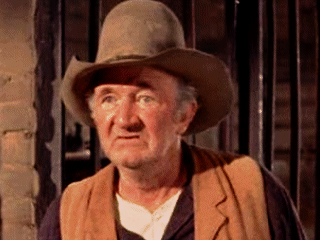
Burdette and his buddies don't take the sheriff seriously and seem intent to mow the lawman down when a still-shaky Dude arrives as backup, having composed himself enough to shoot the guns out of a couple of bad guys' hands. Seems Dude might have a drinking problem, but he's also Chance's deputy, and the lawmen take Joe into custody where the movie's waiting game begins. Can Chance, Duke (always battling the battle) and Chance's other deputy, Stumpy (Walter Brennan), aging and falling apart physically, keep Joe locked up until the U.S. marshal's arrival several days later to take Joe into custody for trial before Burdette's clan tries to free him In a few short minutes of screentime, the main story that drives most of Rio Bravo's 2 hours and 20 minutes has been set. Sideplots await, but all basically will converge in the main thread. Though nearly 2½ hours long, Hawks doesn't rush his film along, yet somehow he still keeps it moving and it holds its length incredibly well.
I'm not reporting earth-shattering news when I inform readers that Howard Hawks belongs to that select group of directors who excelled in every genre he attempted. One thing that sets Rio Bravo apart from Hawks' other works is that, while it resides in the Western genre, it snatches from many others — romantic comedies, war tales, detective stories, social dramas, even musicals. As film critic Richard Schickel says on a commentary track for Rio Bravo, Hawks liked saying
 that he loved to steal from himself. He'd do it again by practically remaking Rio Bravo as El Dorado eight years later, once again starring Wayne but with Robert Mitchum in the Dean Martin role. The plots diverge enough, as do the characters, (Mitchum plays a drunken sheriff as opposed to deputy while Wayne took on the role of gunfighter for hire helping a rancher's family get even with the rival rancher who killed their patriarch) to prevent it from being an exact facsimile. (Another shared aspect between the two films: screenwriter Leigh Brackett, who co-wrote Rio Bravo with Jules Furthman and wrote El Dorado by herself.) In the case of Rio Bravo, dialogue in the romantic sparring between Chance (Wayne) and possibly shady lady Feathers (Angie Dickinson) sounds lifted directly from To Have and Have Not, which Furthman co-wrote with William Faulkner. The relationship between Chance and Stumpy seems like a continuation of the one Wayne's Dunson and Brennan's Groot had in Red River, only minus Dunson's darkness. Part of Howard Hawks' greatness grew from his gift of swiping things from his previous films while changing the recipe just enough to make it fresh — a skill other self-plagiarists such as John Hughes never pulled off since they lacked Hawks' inherent talent, skill and imagination.
Hawks originally intended the action and imagery that runs beneath the opening credits to be its own sequence in the film, but later decided just to use it to accompany the list of cast and crew to a quieter piece of Dimitri Tiomkin's score before the set piece in the bar officially launches Rio Bravo. He films the footage of a wagon train caravan at such a distance that you can't readily identify its contents or characters, but a careful viewer connects it later as being the approach of the wagon train of Pat Wheeler
 (Ward Bond), who turns up shortly after the opening incident. At first, the audience can't be certain how to take the arrival of this man and his large crew, which includes a young gunman named Colorado (played by Ricky Nelson, teen idol and sitcom star at the time, who turns in a solid performance). For all the audience knows, these could be people sent to break Joe Burdette out of the jail where Stumpy handles most of his supervision. Dude, by then sobered up and handling more of his duties as deputy to Chance's Presidio County Texas sheriff, stops the wagon train in the middle of the town's main thoroughfare and insists that Wheeler and all of his men remove their weapons and hang them on a fence. They'll be free to collect the firearms when they depart the town again. (Wouldn't you love to watch Rio Bravo with the National Rifle Association's head flunky Wayne LaPierre and see how he reacts to law enforcement working for John Wayne in a Western that enforcing those rules?) Wheeler and those in his employ grumble at first, but soon comply. When Chance shows up, we realize he and Wheeler go way back on friendly terms, though Wheeler advises the sheriff they need to be careful where they store their cargo — it contains a large amount of dynamite. (Paging Chekhov if you don't think that's going to pay off somewhere down the road.)
 Labels: 50s, Angie Dickinson, Blog-a-thons, Dean Martin, Faulkner, Hawks, John Hughes, Mitchum, Movie Tributes, W. Brennan, Wayne
TO READ ON, CLICK HERE


"My Rifle, My Pony and Me" (Rio Bravo tribute, Part II)

While Sheriff Chance took on a major task by arresting Joe Burdette and incarcerating him in his small Presidio County jail, with Stumpy left to guard the bad guy most of the time, he still bears the responsibility for maintaining the law elsewhere in his town, something he accomplishes through street patrols and his nights staying at The Hotel Alamo (of all the names to pick) run by Carlos Robante (Pedro Gonzalez Gonzalez) and his wife Consuela (Estelita Rodriguez). One night, a poker game piques his interest as two of the players (Angie Dickinson, Walter Barnes) fit the profile of two hustlers warned about on handbills. After a cursory investigation, Chance arrests the woman, who goes by the name Feathers. She declares her innocence and Chance fails to find the crooked cards on her after she's left the table following a huge winning streak. When he returns though, he does find the stacked deck on the man, who has raked it in since her departure and tells him to return his ill-gotten gains and be on the morning stagecoach. He suggests that Feathers do the same, but she decides to stick around.

That next day, the Burdettes arrive as expected, led by Joe's smooth brother Nathan (John Russell, the gaunt, veteran actor of mostly Westerns where he usually played the villain. His second-to-last film was as the cold-blooded killer in Clint Eastwood's Pale Rider). He asks Chance why the streets appear so full of people. Chance offers no explanation, but suggests that perhaps gawkers came to town, drawn to the possibility that the Burdettes planned to put on a show.

Chance makes his nightly trek to the Hotel Alamo. When he gets there, Spencer pulls him over for a drink. The wagon master has heard of the trouble Chance faces. "A game-legged old man and a drunk. That's all you got?" Spencer asks in disbelief. "That's what I got," Chance responds. Spencer offers himself and his men as help against the Burdettes, but the sheriff expresses reluctance to take responsibility for others. He does ask about the confident young gunman Colorado that Spencer has hired. If he is as good as he thinks he is and lacks the family ties of the older men, Chance would be willing to take him on if Colorado agrees. Spencer calls Colorado over, but the young man politely declines, earning Chance's respect for being smart enough to know when to sit out a fight. Not long afterward, while Feathers flirts again and Chance urges her to get on the morning stage, shots ring out on the street and Spencer falls dead. Later, Nathan Burdette makes his first visit to see his brother Joe, despite Stumpy's withering verbal assaults, at the jail. First, Nathan wants the sheriff to
 explain why his brother looks so beat up. "He didn't take too kindly to being arrested for murder," Chance tells Nathan while Joe denies the shooting was murder. Nathan asks how Chance can be so certain or, at the very least, why Joe isn't being tried where the alleged murder occurred. Chance nixes that idea, content to let the U.S. marshal handle Joe Burdette and try him elsewhere. Nathan silkily makes no overt threats, but certainly implies that Joe might not remain in the Presidio County jail by the time that marshal shows up, especially if the sheriff relies on a drunk and an old man as his backup. Chance isn't in a mood to hide his cards. "You're a rich man, Burdette. Big ranch, pay a lot of people to do what you want 'em to do. And you got a brother. He's no good but he's your brother. He committed 20 murders you'd try and see he didn't hang for 'em," the sheriff spits out. "I don't like that kinda talk. Now you're practically accusing me," Nathan Burdette says, but Chance continues. "Let's get this straight. You don't like? I don't like a lot of things. I don't like your men sittin' on the road bottling up this town. I don't like your men watching us, trying to catch us with our backs turned. And I don't like it when a friend of mine offers to help and 20 minutes later he's dead! And i don't like you, Burdette, because you set it up." If war wasn't brewing before, it was now.
The murder of Spencer fully incorporates the last two major characters more fully into the film and the action. With his boss dead, Colorado at first finds himself content to take his pay from the slain wagon master's possessions and remains determined to mind his own business. Once he witnesses some more of the Burdette brutality, Colorado decides to join up and Chance deputizes him. Colorado becomes part of the team and helps Chance escape an ambush, an ambush for which the sheriff seems prepared to occur, quickly pumping off rounds from his rifle. "You always leave the carbine cocked?" Colorado asks. "Only when I carry it," Chance replies. Originally, Hawks opposed casting Ricky Nelson, though the director admits he probably boosted box office. He had sought someone popular with young viewers, but felt Nelson — who turned 18 during filming — lacked age and experience for the part. Hawks had chased Elvis Presley for the role, but as often was the case, Col. Tom Parker demanded too much money for his client and the Rio Bravo production had to take a pass. The pseudo love affair between Feathers and Chance also heats up, though Wayne's discomfort with the romantic scenes with Dickinson is readily apparent. Wayne felt uneasy about the 25-year age gap between him and Dickinson. On top of that, nervous studio bosses wanted no implication made that Chance and Feathers ever sleep together. Double entendres and innuendos abound, but truthfully more sparks fly in brief scenes between Martin and Dickinson and Nelson and Dickinson than ever produce friction in the Wayne-Dickinson scenes. What becomes most interesting about the relationship between Feathers and Chance is Feathers' transformation into the sheriff's protector, keeping watch over him as he sleeps to make sure that no Burdette makes a move on him.


You don't need to know how the rest of Rio Bravo unfolds. Besides, part of what makes the film so fascinating and more than your ordinary Western comes from the multiple tones Hawks balances. A viewer seeing Rio Bravo for the first time couldn't positively predict what mood shall prevail by the final reel: light-hearted, tragic, heroic, romantic, some combination of those elements. At any given moment, you might change your mind. Most of this uncertainty reflects the nature of the character Dude. With the possible exception of Feathers, almost every other character in the film stays on a static path. Dude captures our attention the most because of the dynamics within him. Will he maintain the upper hand in his battle with booze or will he fall off the wagon again and if he does, what consequences does that
 have for the others? Even sober, he's prone to depression, low self-esteem and self-pity. Still, he can croon a song or be a crack shot. A part this multifaceted requires a talented actor and back when Rio Bravo was made, Dean Martin wouldn't be one of the first names to jump to your mind. However, in the years 1958 and 1959, soon after the end of his partnership with Jerry Lewis, Martin turned in two impressive performances (perhaps three, but I haven't seen 1958's The Young Lions). In 1958, he gave a great turn as a professional gambler Bama Dillert in Vincente Minnelli's adaptation of the James Jones novel Some Came Running starring Frank Sinatra and Shirley MacLaine. He followed that with his astoundingly good work in Rio Bravo. While Martin continue to make entertaining films, for some reason those two years stand out as an aberration and he never got roles as good as Bama Dillert or Dude again.
Hawks' behind-the-scenes collaborators provided as much of the magic of Rio Bravo as its cast. From Russell Harlan's crisp and lush cinematography to Tiomkin's score that complements Hawks' leisurely pacing well. Tiomkin also teamed with lyricist Paul Francis West for the film's songs — "Cindy" and "My Rifle, My Pony and Me" in the extended musical interlude by Dude, Stumpy and
 Colorado as well as the title song. Reportedly, Wayne joined the singing at one point until they decided it inappropriate for the sheriff to take part (and also because the Duke allegedly could not carry a tune). In another instance of borrowing from past work, at Wayne's suggestion, Tiomkin actually reworked the theme to Red River into the song "My Rifle, My Pony and Me." Tiomkin also composed "Degüello," aka "The Cutthroat Song," which the Burdettes play to psych out the good guys guarding Joe. The film claims the music comes from Mexico where Santa Anna's soldiers played it continuously to unnerve those holed up inside the Alamo. Wayne loved the music and the story so much, even though the tale wasn't true, he used it in his film The Alamo the following year. His screenwriting team of Jules Furthman and Leigh Brackett both had worked with Hawks as a team and separately before and after Rio Bravo. Previously, Furthman and Brackett co-wrote Hawks' classic 1946 take on The Big Sleep. Furthman also co-wrote Come and Get It and To Have and Have Not and did a solo turn on Only Angels Have Wings. The legendary Brackett, despite her extensive screenwriting work, made a name for herself as a novelist, largely in the male-dominated field of science fiction. In Schickel's commentary, he refers to Brackett as an example of a real life Hawksian woman. In fact, before her death, the last screenplay she co-wrote was The Empire Strikes Back. In another non-Hawks project, she returned to Philip Marlowe when she wrote the screenplay for Robert Altman's The Long Goodbye. In addition to the Hawks titles already mentioned for Brackett, she also wrote the screenplay for 1962's Hatari! and co-wrote 1970's Rio Lobo. The DVD commentary also includes director John Carpenter, who names Hawks as his favorite director, and paid tribute to Leigh Brackett by naming the sheriff in the original Halloween after her.
Tweet
Labels: 50s, Altman, Angie Dickinson, Blog-a-thons, Dean Martin, Eastwood, Elvis, Hawks, Jerry Lewis, John Carpenter, MacLaine, Movie Tributes, Sinatra, Star Wars, W. Brennan, Wayne
TO READ ON, CLICK HERE
Friday, May 17, 2013
Enough beef for hungry cinephiles
BLOGGER'S NOTE: This post originally appeared Sept. 30, 2008. I'm re-posting it as part of The Howard Hawks Blogathon occurring through May 31 at Seetimaar — Diary of a Movie Lover

By Edward Copeland
Has any filmmaker shown mastery in more genres than Howard Hawks? Sixty years ago today, Hawks released one of his best Westerns (not a motel) in Red River, which also gave John Wayne one of his best roles and Montgomery Clift a notable early screen appearance.

Hawks made other great Westerns (most notably Rio Bravo, which also featured Wayne and Walter Brennan), but Red River, despite its abrupt climax, remains my favorite with its tale of a long cattle drive, surrogate father-son conflict and unmistakable gay subtext. Wayne admittedly was a limited actor, but he always was at his best when he played a character steeped in darkness and obsession such as Thomas Dunson here or Ethan Edwards in John Ford's The Searchers. He's helped immeasurably by getting to act opposite the young Clift, the antithesis of acting style when compared to Wayne. Hawks' direction of the film itself truly amazes, especially in the many scenes of the huge numbers of cattle, all done in the days without the easy out of CGI (A scene of the drive even earned a shoutout in Peter Bogdanovich's great 1971 film The Last Picture Show). He also manages to include plenty of his trademark humor, mostly through the ensemble of supporting character actors led by Brennan (whose character loses his false teeth in a poker game) and including Hank Worden (the decrepit waiter in Twin Peaks for those unfamiliar with the name) who gets plenty of throwaway lines such as how he doesn't like when things go good or bad, he just wants them to go in between.
Hawks even manages to toss in what may be an example of the ultimate Hawksian woman with Joanne Dru as Tess Millay, who doesn't let a little thing such as an arrow stop her from nagging a man with questions. Hawks astounds viewers to this day with his versatility among genres: Westerns, screwball comedies, musicals, war films, noirs, sci-fi — pick a genre and Hawks probably took it on and scored. It's a mystery to me why his name isn't brought up more by people other than the most obsessive film buffs. Red River isn't my favorite Hawks, but it's one of his many great ones and continues to entertain after 60 years.
Tweet
Labels: 40s, Bogdanovich, Clift, Hawks, John Ford, Movie Tributes, Twin Peaks, W. Brennan, Wayne
TO READ ON, CLICK HERE
Sunday, May 29, 2011
You can't hurt a dead man

By Edward Copeland
Fritz Lang already was known as one of the world's greatest directors before he came to Hollywood. In fact, when Hitchcock was starting out, Lang's reputation for making masterful suspense films in Germany such as M, Spies and the Mabuse series earned Hitchcock the early label of "the English Fritz Lang." Hitler's rise to power led his propaganda chief Joseph Goebbels to offer Lang the job as head of the Third Reich's film industry. Instead, Lang fled Germany (losing his wife, who divorced him, in the process), first going to France, where he made one film, and then to America where his first effort produced the classic Fury, which premiered 75 years ago today. For his first time working in Hollywood, Fritz Lang made one helluva film.
Though critically well received upon its release, Fury didn't make a big splash or earn the revered status it holds today. Its release in 1936 also coincided with the year its male lead, Spencer Tracy, finally came into his own. Tracy had been kicking around Hollywood for several years, but hadn't achieved star status yet. In Fury, he was second-billed behind Sylvia Sidney, who was a bigger draw at the time. With 1936, not only
 did Tracy get his great role here (though he hated Lang and refused to ever work with him again), it followed Tracy's second-billed role to another bigger female star, Jean Harlow, in Riffraff, but his status climbed with his next two films that year. Almost exactly a month later, he was third-billed behind Clark Gable and Jeanette MacDonald, but Tracy's turn as a priest trying to reform a childhood friend turned gambler in San Francisco, the year's top-grossing film, really raised his profile. The part would earn Tracy his first Oscar nomination as best actor. He wrapped up 1936 as the fourth in the quartet of Harlow, William Powell and Myrna Loy in the comedy Libeled Lady. By year's end, Tracy truly had become a well-known quantity on his own, something set in cement when he went on to win the next two best actor Oscars in a row for Boys Town and Captains Courageous. While Tracy delivers fine work in San Francisco, his performance in Fury was the one that deserved that nomination.
Fury, even today, remains a powerful film and, as Peter Bogdanovich points out in the DVD commentary, seems quite unusual coming from MGM, a studio not known for making this sort of hard-boiled movie. Fury had elements of noir, but more accurately belongs in the school of tough social commentary with a lot of the expressionistic touches that Lang brought with him from his German filmmaking days, shots and styles that you wouldn't see in a film by an American director at that time, let alone an MGM release. Fury plays closer to something that might have come from Warner Bros., but truly, though the studio and even Tracy viewed it as nothing more than a "B" picture, Fury would have been unique for that time no matter who released it. On the commentary, Bogdanovich says he thinks it's the least likely film MGM ever made, but I have to differ with him on that point — I still think Tod Browning's Freaks holds that distinction.
The story for Fury, originally titled Mob Rule, was written by Norman Krasna (who earned the film's only Oscar nomination in the category of best motion picture story) while the screenplay was written by Bartlett Cormack and Lang. Joseph L. Mankiewicz served as producer. One of the best parts of the DVD's commentary is that you don't just get Bogdanovich, but get Lang himself, taken from an undated interview he recorded about the film, excerpts of which also are included on the commentary track, though Lang died in 1976 long before anyone had even thought of such a thing as a commentary track (Hell, few had video tapes by then). Lang addresses the subject of how he could have co-written the script when at the time, he barely spoke English. According to the Austrian-born director, he'd spent a lot of time just hanging around with regular, non-show biz Americans, trying to get a feel for how their syntax and really contributed more in the way of scenes while the co-writer MGM gave him, Cormack, turned it into dialogue. One change MGM insisted on, which I think actually was a good one, was they changed the character Tracy plays, Joe Wilson, from being a lawyer as he was in Krasna's story to being a man just trying to make ends meet. MGM's argument was that audiences would relate to Joe more if he were a "man of the people" and I think they were correct.
Fury takes places in 1936, but even when Lang made period pieces he approached them with the same attitude. "Every movie should be sort of a documentary of its time. Only then do you get a sense of its truth," Lang said. Fury starts out as a romance of sorts, but by its end it will have traveled as far from romance as you can imagine
 and Lang will have shown a lot of that sense of truth that he aimed for in his films. Joe loves Katherine Grant (Sidney) and wants to marry her, but he lacks the money for them to start a life together. As the film opens, Joe and Katherine are bidding each other farewell as Katherine is catching a bus back to her hometown. They stare longingly at a window display of wedding dresses that Joe wishes he could afford. While waiting at the bus station, Joe's coat gets caught, tearing the pocket. Katherine says they have enough time for her to sew it. As she opens her suitcase and retrieves her sewing kit, Joe even playfully fondles her delicates, slightly daring for the time. Joe also isn't as refined as Katherine, as she always has to correct him on words, such as when he gives her a "mementum." Katherine tells him she got him a memento as well and presents him with her mother's wedding ring which was inscribed Frank to Katherine (which also was her mom's name) and Katherine added "to Joe." Due to his large hands, Joe can only wear it on his pinky as they say goodbye.
Joe holds high principles and tries to pass them on to his two younger brothers, Charlie and Tom (Frank Albertson, George Walcott), that he rooms with in Chicago, which isn't easy since Charlie is involved with the rackets and a gangster named Donelli. That night after saying goodbye to Katherine, Joe gets particularly peeved and righteous when Charlie returns home with Tom as drunk as he is. Joe also has taken in a stray dog who followed him home, whom he names Rainbow (played by Terry). Joe and Katherine maintain a relationship via mail until Joe surprises her with the news that he and his the brothers saved enough money to open a garage/gas station. Charlie has given up his shady life and with the three in business together and it doing fairly well, Wilson's earning a steady income now. Joe is even able to purchase a car, which he plans to drive on a trip to see Katherine, now that that wedding day seems like a real possibility to him. That's when the story takes its dark turn and things go terribly wrong.
A cheery Joe hardly needs the car to get to Capitol City to see Katherine (with Rainbow at his side, who he's since learned was girl when she gave him of litter a puppies) — because Joe's practically floating on air and in anticipation of being reunited with his girl. Even though living is a bit easier for Joe now, he still sticks to his
 frugality, choosing to camp out on the sides of the highway rather than finding a motel. When he's nearly completed his journey, trying to find shortcuts on back roads, a man (Walter Brennan) holds up a badge and stops his car with a shotgun trained on Joe. Wilson cooperates fully, but his answers still strike the deputy as suspicious so he takes Joe to the sheriff for further questioning, even though the confused Wilson still has no idea of what he's being accused. 1936 not only marked the year when Spencer Tracy really made his mark, it also moved Brennan to the front ranks of character actors. He'd been working since the 1920s, almost entirely in uncredited roles, but in addition to Fury, 1936 brought him notable parts in Capra's Mr. Deeds Goes to Town, the many times remade Three Godfathers and Howard Hawks' Come and Get It, which would win Brennan the Academy's very first supporting actor Oscar, a prize Brennan would win a total of three times between 1936 and 1940.
Once Joe gets taken to the sheriff's office in Strand, he finally gets an idea of what's going on when Sheriff Hummell (Edward Ellis) asks him the seemingly innocent question of whether he'd like some peanuts. Joe graciously accepts, admitting he's had a weakness since he was a boy. That's when the sheriff shows him a newspaper headline about the ransom delivered to the kidnappers of a young girl from a family named Peabody and how peanut shells were discovered near the abduction scene. (As a former newspaperman, it's amazing to me just to see how wide broadsheets used to be.) Joe insists he's innocent and has people who can prove it. He wants to call Katherine, but when he notices the headline says the kidnappers were three men and a woman, he fears getting her involved and asks for his brothers instead. First, the sheriff wants him to empty his pockets, which he does, and they include peanuts and some cash which Deputy Bugs (Brennan) takes to check against the serial numbers of the money that was delivered to the kidnappers. Somehow, a five dollar bill with a matching serial number found itself in Joe's possession so the sheriff locks him up until the district attorney can question him further. Even poor Rainbow is stuck barking around the jailhouse.

It's at this point when Fury really starts rising toward its greatness on multiple levels and Lang delivers sequence after sequence, shot after shot that would wow first-time viewers today. The town of Strand already had been up in arms over the girl's kidnapping, but the sheriff actually displays a degree of professionalism in keeping Joe under wraps. Granted, he doesn't allow him to call his brothers, but he doesn't let the news leak out either. Would that his deputy had such impulse control. While Bugs hangs out at the barber's shop, one of the customers complain that the sheriff's department isn't doing its job or they'd have caught the kidnappers by now. His pride wounded, Bugs asks the man what he would think if he told him that they have a man in custody right then that they suspect could be involved. It sets up the first of many brilliant sequences by Lang as he films a rumor-filled small-town variation of the telephone game. First, the barber calls his wife to let her know what
 he just heard. She reaches across the way to knock on the window of a neighbor in the next building to tell her. As the news spreads far and wide, you even get women who will preface their comments with words such as "It was told to me in the strictest of confidence." As the story spreads, it gets embellished along the way. The man was caught with $5,000 — no $10,000 of the ransom money. There's a funny shot that Lang inserts during a run of gossiping women of a bunch of clucking chickens. You also get a sense of the small town's attitudes, foretelling how this could go bad and quickly. When one woman actually points out that the man in custody hasn't been convicted of anything yet, another woman responds with, "My dear young lady, in this country, people don't land in jail unless they are guilty." The gossiping men say that the first thing he asked for was a lawyer, so they can complain about those attorneys "that get these skunks off" and how if people had more guts, they'd settle matter themselves. Not everyone in town responds to the news with anger. The Chamber of Commerce anticipates the revenue and p.r. a trial like that could bring to Strand.
For the most part. that entire sequence plays for comic effect. Within the words of some of the citizens of Strand lie an undercurrent of undemocratic ideas and support for vigilante justice, but for now it's just played for laughs. The audience still has reason to be concerned for Joe regardless of how the town feels — we know that he's an innocent man locked up in a jail and that no one knows he's there, but the case against him is
 weak, even the sheriff has admitted that, so Lang hasn't tightened the screws on the tension yet, aside from Katherine, sitting alone at a diner where she expected to meet him by now. All it takes is a single ingredient to get the men of Strand riled up — a healthy supply of liquor. As many of the men in town get pie-eyed, including the town's well-known troublemaker Kirby Dawson (Bruce Cabot), they all agree that it's high time the sheriff start providing them answers about this man he's holding. Soon, they find the next best thing when Bugs wanders by and they pull him in and grill him to tell them what he knows. Unfortunately, Bugs tells them the truth: They searched Joe's car from top to bottom but all he had on him was a five dollar bill related to the ransom money. It doesn't make the men very happy because they, like all who have vested beliefs in a lie such as Birthers or Truthers, don't want to hear that their rumors aren't true. It's not that they can't handle the truth, it's that the truth doesn't interest them in the first place, not when compared to the lies they've come to love. Kirby and some of the town's businessmen decide they'll demand answers from the sheriff himself the next day.
When Kirby and the business leaders meet with Sheriff Hubbell the following day, he's honest with them: The case against Joe Wilson is at most weak and circumstantial and he's waiting to let the district attorney question him and sort it out, but for now there's nothing for them to worry about and they all should simmer down. The businessmen accept his word but Kirby won't go that easy, insisting that the sheriff let him see Wilson which Hubbell, of course, won't let him do. With the undertone of a threat in his voice, Kirby tells the sheriff that, "An attack on a girl hits ordinary people where we live and we're gonna see that politics" don't get in the way of justice. The sheriff shoots right back, "And I'm gonna see that a bunch of half-baked rumors don't either." Hubbell then orders Kirby to "hightail it" out of his office or he'll take his entire family off the dole. You can tell the incident does disturb the sheriff though as he tells one of his deputies that he's gonna make up a new list of names to deputize and get out guns and tear gas while he calls the governor to ask him to send the National Guard if he needs them. He talks to the governor (Howard Hickman) who promises the sheriff that the guard will be at the ready should things get out of hand.
It only takes another night at the bar for that to happen — and for the media and politics to get involved as well. As the drunks in the bar start rabble-rousing, creating new fictions such as the idea that maybe Joe gave the sheriff his ransom money in exchange for his freedom, the talk turns more into taking matters into their
 own hands, something spurred on by an out-of-town visitor just passing through after working to break a union strike in a neighboring town. One Strand citizen actually dares to call for calm, but he's quickly pushed away as Lang, in one great long pan moves along the angry faces populating the bar. He follows that up with an even more interesting shot where the camera takes the point-of-view of the approaching mob as it moves in closer and closer to the sheriff's building where Hubbell and his men stand ready on the steps, armed and warning them not to start trouble. For awhile, it's just a loud, noisy standoff, but the news gets out and soon newsreel cameras arrive, eager to film any melees. The sheriff anxiously awaits for the backup of the National Guard, not realizing that a sleazy power broker of the governor's party called them back when he heard that the governor had authorized them, telling the governor that no town likes to see itself invaded by troops, especially in an election year.

Lang's closeups of the crowd out for blood truly are frightening, managing to be distinct and indistinct at the same time. The standoff gets tenser and tenser as Kirby and the other ringleaders hurl insults at the sheriff who shouts back while Joe moves the cot in his cell to beneath the barred window so he stand on it and look out and personally see the horror gathering, probably not the best idea since it gives the mob another target to focus their hate on, yelling and throwing things at him. Joe pleads to the jailer to give him the keys and let him out — he knows he's not safe. At the diner, Joe Wilson's name finally
 has hit the airwaves. When Katherine realizes no more buses are leaving, she pleads with the owners to borrow a car so she can get to Joe. When they have none to spare, she literally runs to Strand on foot, arriving as the sheriff, having been struck with a tomato, has retreated inside with his men and barricaded the door. The scene of Katherine working her way through the crowd is quite telling. At the back, the people seem more shocked by what is happening, but as she moves forward, the mood changes. Around the middle she gets to the spectators there just to attend a good show, happily chomping on hot dogs as they watch. When Katherine finally reaches, the front, that's when she finds the ones truly gleeful with bloodlust and can see Joe through his bars. Inside, Joe still pleads for help, but no one's listening except Rainbow who comes and joins him in his cell.
The natural instinct of Katherine, horrified by what she's witnessing, is to call to Joe and try to reach out to him somehow, but with the crowd's mood, that obviously isn't the safest position to take. Inside, Sheriff Hummell, trying to stand his ground with the few deputies who haven't abandoned him, notice that it seems to have become eerily quiet. Soon they realize why. Led by Kirby, a large group of the men have fashioned a makeshift battering ram to force their way inside, in another example of one of those Lang visual touches you wouldn't expect to find in an American film of that time. The door comes down and the sheriff's office and jail is breached. The mob immediately head to the jailer, demanding the keys to Joe's cell.


The jailer denies that the keys are in his possession and the angry hooligans start practically choking the poor man to death trying to get him to cough them up. Then, one of the vigilantes spots the keys past the bars, beyond their reach. They try to use a long piece of wood to reach it to no avail and then Kirby hits upon the idea: They'll smoke him out. The mob gathers all things that will burn that they can and place them near the entrance to the jail cells and set them ablaze. The mob then return outside to joyously
 watch as Wilson waits to die. Kirby, no longer viewed as the town joke, beams with pride. Lang films the other faces in similar, eerie angles and lighting. Other films have depicted mob violence on film before (William Wellman's The Ox-Bow Incident, Arthur Penn's The Chase to name just two off the top of my head), but I don't know if anyone has combined great film artistry at the same time he's getting his point across about its madness as well as Lang, not only here but in what he told Bogdanovich he thought was the best film he ever made, M. A staunch opponent of capital punishment, Lang felt the case against capital punishment should always be made by using the example of someone who is guilty.

Katherine can't believe her eyes as a terrified Joe screams against the bars of his cell's window while the flames and smoke grow. She finally faints. A voice in the crowd yells that the National Guard is coming and the mob scatters. Before they do, a pair of them have a special cherry to place on the vigilante sundae. They light two sticks of dynamite and toss them at the building. They also spot the unconscious Katherine and, as if they were humanitarians, help carry her out of the way. Lang only lets you hear the explosion, but the camera does look back to cast its gaze upon the flaming wreckage that once was the sheriff's department and the jailhouse before going to a fade out.
When an image returns, we're back in the governor's office, where he's beating himself up for letting the political hack talk him into calling off the Guard. We could have prevented all that, he tells the man. The adviser tries to defend his position, reading congratulatory telegrams. The governor asks what kind of
 telegrams they will be getting now that the world knows Joe Wilson was innocent, showing him a newspaper headline touting the capture of the Peabody kidnappers. The adviser says that of course, he didn't know he was innocent at the time. "Now, this is on every wire," the governor tells him, showing another headline: INNOCENT MAN LYNCHED. In Chicago, Joe's brothers Charlie and Tom can't believe the gall as they read the headline. "Sure, now he's innocent," Charlie says. As they talk, one of Rainbow's pups peeks its head out from beneath a bed and Tom asks if they still have any milk and takes the dog to the other room to give it a sip as the brothers continue to talk about how they will get revenge on the people of Strand who killed their brother. A familiar voice suddenly speaks up behind them, "That's five-and-ten cent store talk." Tom and Charlie turn with a start to see Joe standing in the doorway, very much alive.
Needless to say, the Wilson brothers are shocked to see their supposedly dead older brother standing before them, but this isn't the Joe Wilson of before. This Joe is dark, hurt and angry as he takes a seat to start telling his brothers what happened.
"Know where I've been all day? In a movie — watching a newsreel of myself getting burned alive. I watched it 10 times. Or 20 maybe. Over and over again — I don't know how many. The place was packed. They like it. They get a big kick out of seeing a man burned to death. A big kick!"

Tracy really makes Joe's transition believable, from the upstanding, self-righteous man we first met to the embittered person we see before us now. He explains that poor little Rainbow did perish in the blaze, but the only way that he made it out was by sliding down a drain pipe, burning his whole left side in the process. Tom asks if he got burned bad, and Joe's answer proves more complicated than a simple yes. "Yeah, but that don't hurt me. Because you can't hurt a dead man and I'm dead. Everybody knows that. The whole country knows it," Joe spits. He tells his brothers that his murderers will pay and shows them something he tore from a law book indicating that lynching equals first-degree murder. Of course, Joe needs Charlie and Tom to pursue this for him, because he wants his killers legally tried and be given a legal death penalty and he can't very well bring that about, being dead and all. He also gives his brother another lecture about what this experience has taught him.
"Remember me preaching to you to be decent and to live right? Live right, ha! I tried it. Tried to like it and people, but they won't let you. Charlie, you were right. Donelli was right. Everybody was right and I was wrong, but I know now."
In Strand, District Attorney Adams (Walter Abel) investigates the case, but finds himself getting nowhere because the entire town is stonewalling him and trying to forget the incident ever happened, only referring to it in whispers, especially since they have their own guilt once they learned of Wilson's innocence. For now
 though, Adams can't find anyone who will even admit that they saw Wilson in the jail cell window. When Tom and Charlie hear that the D.A. needs an eyewitness, they go to visit Katherine, who basically has slipped into a catatonic state since the incident. When Charlie lights his cigarette, the flame of the match freaks her out and she has a flashback of Joe in the burning jail. It does bring her back enough that she recognizes Charlie and Tom and they explain to her what they need from her if they want to see the people who killed Joe face justice. When the Wilson brothers return to the room where they've been staying in Strand, they aren't very happy to find Joe there, telling their brother what risk he's taking by being there should anyone spot him. Joe doesn't care. He wants to be close if there's a trial. "I want to see them squirm like they made me squirm. I want to see their necks at the end of a rope," Joe tells them. Meanwhile, the same political idiot who talked the governor out of sending the
 National Guard tries to stop D.A. Adams from pursuing the lynching case, again citing the effect on the party in an election year. Adams tells him he doesn't care about the election — he must follow the oath he took first and enforce the law. The party hack tries to sinisterly remind Adams that he doesn't want to risk taking food out of the mouths of his wife and kids to which Adams responds, "Sure Will, but some of the things people have to had eat lately haven't set well in their stomachs." The discussion of the case turns into another one of Lang's bravura sequences where what starts as what he's telling the hack turns into his opening statement in the courtroom of the trial where the camera pans past the 22 defendants until it sees the radio mic and we still hear the D.A.'s speech, first with people listening to it at a bar, then by businessmen, then by a women in a bathroom somewhere (where we can see a man tying his tie in a reflection and finally to Joe listening in the room where he's hiding before we return to the D.A. in the courtroom.
I'm gonna assume that more people haven't seen Fury than have and therefore, I'm not going to tell you how the rest of the story turns out. You'll have to watch Fury and find out if the D.A. manages to break through Strand's wall of silence prove which citizens were guilty and, even if he does, if the fact that Joe's alive will be revealed making the case moot in the first place. You'll also have to see if Joe remains the bitter man he is and if Katherine ever learns that he never died. However, I do want to toss out a couple of moments that I always find particularly memorable.
First, a really odd one. During a brief break in the trial, the radio announcers remind their listeners that the broadcast is sponsored by "No-Make-a-Me-Fat, the magic dessert." It reminds me of the antacid commercial that Edward G. Robinson's character hears during Lang's The Woman in the Window years later.
I also liked how subtly the groundwork is laid for things early that will prove important later, but that's all I'll say. I don't know if this was factually correct in 1936, but the D.A. says that 6,010 lynchings had occurred in the past 49 years without punishment, though it did make me wonder how many actually were punished. There also are many great quotes, but they would give away things to come if I gave them away with the exception of one that Joe Wilson says at one point, that he really could have said at any point after his escape to anyone and it's so essential, I really must end on it.
"The law doesn't know about things that were very important to me, silly things maybe, like a belief in justice and an idea that men were civilized and a feeling of pride that my country was different from all others. The law doesn't know that those things were burned to death within me that night."
It's amazing how contemporary Fury feels 75 years after its release and how many angles it was able to cover concisely in a short, 90 minute running time. Fritz Lang maintains his reputation as one of the all-time great directors, but people don't mention Fury nearly enough when listing his best.
Tweet
Labels: 30s, Arthur Penn, Bogdanovich, Browning, Capra, Edward G., Gable, Harlow, Hawks, Hitchcock, Lang, Loy, Mankiewicz, Movie Tributes, Oscars, Sylvia Sidney, Tracy, W. Brennan, Wellman, William Powell
TO READ ON, CLICK HERE
Tuesday, May 03, 2011
The world's been shaved by a drunken barber

By Edward Copeland
After a montage of workers in all walks of life set to tunes ranging from "Roll Out the Barrel" to "Take Me Out to the Ballgame" that wraps with newborns in a nursery, we see men removing the sign from The Bulletin newspaper, including its motto, "A free press means a free people" and replacing it with THE NEW BULLETIN. The images would seem to be sending a warning (or at least ammunition for his critics) that Frank Capra was about to lean on his worst tendencies in Meet John Doe, which opened 70 years ago today, and Capra displays his weaknesses in the film, though frequently they get averted thanks to his sharp cast, led by the wonderful Barbara Stanwyck who in 1941 had one helluva year.

The newspaper building's sign isn't the only change afoot. A new managing editor named Henry Connell (the great James Gleason) has been handed the reins and his first duty requires him to clear out "the dead weight," which basically means firing a lot of the staff, 40 people total, including columnist Ann Mitchell (Barbara Stanwyck). She pleads her case for staying on, even offering to cut her $30 a week salary to $20 a week, since her mother (Spring Byington) and two sisters depend on her. Connell isn't moved since the paper doesn't need her column of "lavender and old lace." He was brought in to boost circulation and "wants fireworks." Connell tells Ann she
 owes them a final column and then she can pick up her final check. Stanwyck, always good, but great as a brassy newspaper woman scorned, goes back to her office and tosses the column she'd written when the typesetter informs her it's a little short and makes up an entirely fabricated column about a letter she received from an unemployed man, so dispirited by what they "laughingly call a civilized world." She signs "his" letter John Doe, who blames slimy politics for unemployment and threatens to commit suicide by jumping off City Hall on Christmas Eve. In Ann's own commentary portion of the column she adds that in her opinion "the wrong people are jumping of roofs." Needless to say, Connell eats it up and gives it big play in the next day's paper starting a chain reaction among the populace and political leaders.
Governor Jackson (Vaughan Glaser) and his associates are convinced that John Doe is a creation of the Bulletin's new owner, D.B. Norton (Edward Arnold), to make the governor look bad. The editor of competing newspaper The Daily Chronicle (Stephen Toombes) concurs that it's an old gag and promises to expose them. The town's mayor (Gene Lockhart) seems more upset that John Doe would pick his building for his suicide
 leap. Connell's panicking because he wants to keep this thing going and find John Doe, but he's got people out and they can't even find Ann. When she finally turns up, she's completely honest about her fraud. Connell is prepared to admit that they were duped until The Chronicle runs a story accusing them of making it up. Ann sells him on the whole idea of hiring a John Doe so they don't prove the other paper right, provided she gets her job back with a raise. On the other hand, she shows him a document she's made up admitting she made it all up that she bets The Chronicle would pay her plenty to make them look like fools. Connell tells Ann they've already been besieged with job offers and marriage proposals for John Doe and the mayor practically wants to adopt him. Ann suggests John Doe columns through Christmas all about man's inhumanity to man. Connell wants to know where she thinks they'll find someone to assume the John Doe role. She happens to open the office door and finds the outer office overflowing with down-on-their-luck men all claiming to be John Doe. Connell's right hand man says, "Show me an American who can keep his mouth shut and I'll eat him."
Forgive me for a brief, unrelated tangent. Having seen so many films from the eras of the 1930s and 1940s with their less-than-flattering portraits of the press and then compare it to that brief moment in the 1970s around the time of All the President's Men when journalists actually became the heroes of films and were viewed admirably and to now be stuck when cable news is a disgrace and what little real journalism remains dies slowly with the newspapers run by publishers who don't know what the hell they are doing and have behaved like chickens with their heads cut off for more than a decade, why aren't we getting any movies, serious, comic or satirical that really address the situation? State of Play came closest, though it seemed as if it were from another era, while Nothing But the Truth addressed a serious issue and ruined it with one of the most absurd plot twists I've seen. Surely, after these weeks when the NBC entertainment division has run its network and cable news divisions by giving Donald Trump ample air time to spread lies and veiled racism, some screenwriter can think of a movie out there — and I write these things as a former working journalist who is ashamed and disgusted by what's become of his former profession. I've digressed, back to Meet John Doe.
Most of the homeless, bums and tramps who parade into Connell's office fail to leave much of a positive impression on Ann, Connell or any of the other Bulletin employees — that is until he walks in. It's Gary Cooper. Of course, his name isn't really John Doe, but John Willoughby, though he was known as Long John Willoughby when he pitched in bush league baseball until an injury to his arm ended his possible Major League career and set him to riding the rails with a friend he made known only as The Colonel
 (Walter Brennan). Cooper received his first Oscar nomination as best actor working for Capra on Mr. Deeds Goes to Town. Cooper would win the Oscar in 1941 and Brennan would get his final nomination (3 wins out of 4 nominations in six years is something no one likely will ever match), but they weren't for Meet John Doe but Howard Hawks' Sergeant York. When Ann starts talking to Willoughby, she knows she's found her John Doe and Connell sets out to make the deal with him to be the face of daily columns and keep the suspense going until Christmas Eve as to whether he will go through with his plan to jump off City Hall. At one point during the conversation, John gets weak and faints because he hasn't eaten in awhile, so they bring some lunch up for both he and the Colonel. The delightful Colonel thinks all the plotting sounds like the work of "helots" and doesn't buy the argument the newspaper people try to sell John on that he would be improving the world. "You couldn't improve the world if a building was jumping on you," the Colonel declares. Connell explains the details of the deal to John. They will pay him $50 a week and put up in a hotel through Christmas Eve. On Dec. 26, they give him a train ticket out of town and pay to have his arm fixed. John insists that the surgery must be performed by "Bonesetter" Brown and he wants the Colonel to stay with him.
They install John and the Colonel in a plush hotel suite (and make sure they have bodyguards not only to keep the public from John but to keep him from making an escape as well). When the duo enter the hotel room, both are offered a paper to read, but the Colonel wants no part of it. "I don't read no papers, and I don't listen to radios either. I know the world's been shaved by a drunken barber, and I don't have to read it," the Colonel declares. Soon, Ann has joined them with a phalanx of photographers to start documenting their new
 populist hero, though he needs a lot of coaching, having to be reminded that he's disgusted with civilization. He thinks that means she wants "crabby guy" but it comes off looking to her as if he's trying to smell the world. She finally gets what she wants by telling him to think about an ump making a bad call. Though Meet John Doe had its origin in a story, it was written, as was Mr. Deeds Goes to Town, by Robert Riskin and part of it plays as if he's trying to impose the Deeds template. (This was so much the case that the original 1941 ad campaign read ALL AMERICA WANTS TO MEET THE "MR. DEEDS" OF 1941!) John Doe might not be suddenly rich like Longfellow Deeds, but he's similarly stifled by keepers and used by a newswoman who comes to fall for him. Despite this, for the early portion of the film, Meet John Doe works remarkably well when it's Stanwyck's Ann leading the way. The supporting cast also helps — and they have to late in the overlong film, which runs a full two hours — when instead of just telling a story of political corruption and yellow journalism, Capra and Riskin opt to make it a warning against fascism in America and, on top of that, try to equate John Doe with Jesus Christ.
It had been quite some time since I'd seen Meet John Doe and my memories of it had never placed it as one of my favorite Capras. I probably wouldn't have bothered with an anniversary tribute if it weren't part of Barbara Stanwyck's 1941 triumvirate. She's very good here, even better in Preston Sturges' The Lady Eve and magnificent in her crowning achievement for 1941 — as Sugarpuss O'Shea in Hawks' Ball of Fire which featured a screenplay by Billy Wilder & Charles Brackett from a story by Wilder and Thomas Monroe. Ball of Fire was the role that earned her an Oscar nomination that year and also displayed much better comic chemistry between her and Gary Cooper than you'll find in Meet John Doe. Stanwyck does give a great turn in Meet John Doe, especially in the film's early scenes where she's a schemer, plotting to keep her job and inventing the entire John Doe scam. Perhaps it's best exemplified when Ann and Connell are summoned to D.B. Norton's estate to meet with him. Connell has grown jittery and thinks they should pull
 the plug on the John Doe fraud while Ann suggests to D.B. to make it even bigger by using his radio network to have John appear and speak to the public in person for the first time, making the phenomenon metastasize. Norton, played as an ethics-free tycoon as only the great Edward Arnold could, dismisses Connell so he can speak with Ann alone. "What do you want out of this?" he asks her. "Money," Ann responds bluntly. "Glad to hear someone admit it for a change," D.B. smiles, telling her that she should work directly with him from now on and if she plays
 her cards right, she'll never have to worry about money again. What's even more interesting about Stanwyck's performance is that she doesn't immediately fall for Cooper's Long John Willoughby. For the longest time, Ann falls for the John Doe that doesn't exist, the one she created from thin air, so she's really engaged in a form of self love. The only times in the film when Stanwyck runs into trouble as an actress is when the script lets her down by suddenly turning Ann into mush by having her fall for Cooper and begging him not to kill himself when things turn sour. The screenplay forces her to try, through tears, to tout the idea that Cooper's John Doe is "like the first John Doe" — Jesus. That'd be a hard sell for any actress, even one of Stanwyck's caliber. Besides, as much as I worship Stanwyck, I've never thought she was at her best when playing vulnerable. She's greatest when she's fun or mean or manipulative, whether comically as in Ball of Fire or deadly as in Double Indemnity or even a later film such as the Western The Violent Men.
As I said, it had been a long time since I watched Meet John Doe before I looked at it again for this piece and, while I enjoyed the bulk of it, even when it lays its harmless but corny message on a little thick, when it takes its turn toward deifying the Cooper character and transforming Arnold's character from a tycoon who wants to gain political power into someone who practically wants to be an American Hitler, I almost canceled plans for writing this piece altogether. I decided to perservere, but this shouldn't be mistaken as the usual anniversary tribute I write for a film because I've got to be much more critical of it than I expected to be. The screenplay truly is a mess. Early on, it creates the conflict between Norton and the governor character, but then after two scenes, the governor vanishes from the
 movie, never to be heard from again. Despite that hole, the film rolls along nicely for awhile when everyone wants to use John Doe for their own selfish purposes and though Cooper gives a performance even stiffer than usual, it's nice when Willoughby finds himself genuinely conflicted about what to do or who has his best interests at heart. Brennan steals most of the scenes out from under him just basically doing the usual Brennan shtick. When John does take to the radio, his speech does have its moments, such as when he suggests (though Ann wrote his speech) that even the average guy "has a streak of larceny in his
 heart." Spontaneously, his message of "love your neighbor" resonates and people start John Doe Clubs which Norton capitalizes on to sponsor more of them across the country to use as the start of a third party. However, he's not planning to challenge the Democrats and the Republicans with a normal independent party but a John Doe Party, at whose convention Norton expects John to endorse D.B. as the party's candidate for president. I guess that's why the governor part of the story vanishes. However, as Norton plots with other political bosses and
 labor leaders about how he would win (and why they would back this plan is beyond me) Norton complains that the government has been making too many "concessions" and America must be ruled by an "iron hand." Huh? Where in the hell did this come from? John hears it though and plans to expose D.B.'s plan, but Norton instead exposes John as a phony, figuring if he can't use the John Doe Clubs for his nefarious purposes, he'll destroy them instead. It's where we get our first flat-out Christ allusion as Connell says, "Chalk up another one to the Pontius Pilates." Of course, all the John Doe fans turn on him and Willoughby decides he will kill himself by jumping off City Hall on Christmas Eve to resurrect the John Doe Clubs. It all goes as predictably and plays as maudlin as you'd expect. When people speak of Frank Capra with derision, Meet John Doe may be why. The man did make some great films though: It Happened One Night, Mr. Smith Goes to Washington and It's a Wonderful Life being the very best with some other good ones as well. Meet John Doe does not belong on the list.
However, Meet John Doe contains one scene that displays the ability of a good actor to use his talent to overcome hackneyed material. Before John has learned the truth about what D.B. Norton is plotting, The Bulletin's managing editor Henry Connell (James Gleason), already drunk, sneaks John away from his bodyguards to take to a bar. He notes that John is too young to have served in the Great War (not renamed
 World War I yet), but that as soon as the U.S. entered, he signed up at the age of 17. His father did as well and they both ended up in the same unit. Connell saw his father killed, right before his eyes. Connell got out of the war without a scratch, just an ulcer, which reminds him that he shouldn't be drinking booze. "I should be drinking milk, you know. This stuff is poison," he tells John as he orders another. "Yes, sir. I'm a sucker for this country. I'm a sucker for the Star Spangled Banner and I'm a sucker for this country. I like what we got here! I like it! A guy can say what he wants — and do what he wants — without having a bayonet shoved through his belly," Connell tells John. He then goes on to talk about people who would like to see what makes it great destroyed. He doesn't name Norton, but John guesses that is who he is speaking about. "Lighthouses, John. Lighthouses in a foggy world," he says. A subtle speech it ain't, but the veteran character actor Gleason pulls it off while playing (and most tellingly, not overplaying) drunk. It's a triumph of man over material. Unfortunately, there's not enough power to overcome all the material in Meet John Doe.
Tweet
Labels: 40s, Capra, Cooper, Hawks, Movie Tributes, Oscars, P. Sturges, Stanwyck, W. Brennan, Wilder
TO READ ON, CLICK HERE


