Monday, July 22, 2013
Dennis Farina (1944-2013)

Dennis Farina tended to be typecast as a cop or a crook — and having served 18 years on Chicago's police force before turning to acting had a lot to do with that, but like so many who come to performing from other lines of work, you'd hardly notice the difference. By the premature end of his 31-year acting career, just seeing his name brought a smile to my face because I knew that he'd provide some good moments in the movie or TV show I was about to watch, even if the production itself didn't turn out to be that great. He garnered two acting nominations in his film career, both for Get Shorty. The American Comedy Awards nominated him as Funniest Supporting Actor in Motion Picture and he joined the other members of the ensemble up for the 1995 Screen Actors Guild Cast Award, including James Gandolfini.

Farina made his film debut in 1981 in Michael Mann's often overlooked gem Thief. He did many guest shots and small roles in movies until he teamed with Mann again as the original screen incarnation of the FBI's Jack Crawford in Manhunter, based on Thomas Harris' novel Red Dragon, which introduced the world to Hannibal Lecter. That same year, Mann gave Farina the short-lived starring role in the 43-episode run of the period TV series Crime Story as Lt. Mike Torello. Atmospheric, vibrant and wonderfully scored — Crime Story couldn't last back then, but imagine if it had premiered a decade or so later on cable. The year Crime Story ended its run, Farina played memorable comic bad guy Jimmy Serrano in the great buddy movie Midnight Run, which just marked its 25th anniversary. Other comic bad guys would follow such as Ray Barboni in the film adaptation of Elmore Leonard's Get Shorty and the hit man Henry De Salvo in the underrated Big Trouble, based on the novel by Dave Barry.
On the good guy side of things he played Marshal Sisco, father of Jennifer Lopez's Karen Sisco in Steven Soderbergh's adaptation of Leonard's Out of Sight. He turned up briefly as one of the recognizable faces fighting World War II, in this case as Lt. Col. Anderson, in Steven Spielberg's Saving Private Ryan. He also
 put in two seasons as Detective Joe Fontana on Law & Order following Jerry Orbach's departure. His other television work includes the short-lived, quirky detective series Buddy Faro created by Mark Frost, which I enjoyed but ended quickly. Farina also put in a nice turn as an annoying fitness center owner in HBO's adaptation of Richard Russo's novel Empire Falls. Finally, in another case of a series that ended prematurely (and unnecessarily) he landed the great role of Gus Demetriou, right-hand man and aging strong arm for horse racing-obsessed prison parolee Chester "Ace" Bernstein (Dustin Hoffman) in HBO's Luck, an ill-conceived partnership between Mann and David Milch whose cancellation got blamed on the unfortunate deaths of three racing horses in the same sort of incidents that happen at real race tracks across the U.S. daily. It's a shame, because the nine episodes of Luck that aired were excellent. HBO should have had the guts to buy either Mann or Milch out and let the series proceed. (My vote would have been to keep Milch).
RIP Mr. Farina. Another gone too soon.
Tweet
Labels: Dustin Hoffman, Farina, Gandolfini, Hannibal Lecter, HBO, Michael Mann, Milch, Obituary, Soderbergh, Spielberg, Television
TO READ ON, CLICK HERE


Friday, August 03, 2012
Edward Copeland's Top 100 of 2012 (100-81)
With the release of the latest Sight & Sound poll, conducted every 10 years to determine the all-time best films, The House Next Door blog of Slant Magazine invited some of us not lucky enough to contribute to the S&S list to submit our own Top 10s to The House, which posted mine today. Sight & Sound magazine, a publication of the British Film Institute, began its survey in 1952, using only critics. Its 2002 list boasted its largest sample yet, receiving ballots from 145 film critics, writers and scholars as well as 108 directors. The results can be found here, though a note claims the page isn't actively maintained, though it appears complete to me. Since I planned to revise my personal Top 10, posted as part of my Top 100 in 2007, I figured I owed it to my entire Top 100 to redo my entire list. As before, my rule is simple: A film must be at least 10 years old to appear on my list. Therefore, movies released between 1998 and 2002 might appear on this list whereas they couldn't on the 2007 version. The most difficult part of assembling these lists always involves determining rankings. It's an arbitrary process and once you get past the Top 10 or 20, not only do the placements seem rather meaningless but inclusion and exclusions of films begin to weigh on you. In fact, selecting No. 1 remains easy but if I could, I'd have tied Numbers 2 through 20 or so at No. 2. A lot of great films didn't make this 100 through no fault of their own, falling victim to my whim at the moment I made the decision of what made the cut and where it went. In parentheses after a director's name, you'll find a film's 2007 rank or, if it's new to the list, you'll see NR for not ranked or NE for not eligible. I also should note that this does not mean the return of this blog. I had committed to taking part in The House's feature prior to pulling the plug and completed most of this before signing off.

Part of the arbitrary nature of this list (and from the very first all-time 10-best list I compiled in high school) was to try to make sure I represented my favorite directors while still allowing for those films that might be a more singular achievement. (For example, my first high school list had to be sure to include a Woody Allen, a Huston, a Hitchcock, a Wilder, a Truffaut, an Altman.) The more great cinema you see, the harder it becomes to justify that since lots of directors deserve recognition and many films might be a filmmaker's strongest work. As I've caught up with a lot of Werner Herzog's work over the years, I felt he'd earned inclusion. I was torn between choosing Nosferatu or Aguirre: The Wrath of God to represent him, but opted for the vampire tale because Herzog's "reversioning" of Murnau's silent classic manages to be both a masterpiece of atmospherics and the best version of the Dracula tale put on screen.
Pedro Almodóvar’s career evolution has taken an arc that I imagine few could have anticipated. I know I certainly didn’t back in the 1980s, when his films mainly consisted of camp, color and sexual obsession. Around the time of 1997’s Live Flesh, the Spanish filmmaker’s style took an abrupt change, filtering genres through his unique perspective to exhilarating results that continue through last year’s The Skin I Live In. The greatest of this run of seven features happens to be the most recent film to make this new Top 100 list. Telling the story of two men caring for women they love, both of whom happen to be comatose, Almodóvar’s Oscar-winning screenplay manages to balance humor, pathos and even outlandish touches you’d never expect to make one helluva movie and the writer-director’s best film so far.
Littered along the highways of film history lie multiple tales of adversity breeding triumphs of cinema. As director Jules Dassin faced a possible subpoena from the House Un-American Activities Committee, presumably followed by blacklisting, at the end of the 1940s, producer Darryl Zanuck gave him an exit strategy. Dassin flew to London to hurriedly begin filming an adaptation of the novel Night and the City, which he’d never read, and as a result produced one of the greatest noirs of all time. Not only did he make the movie on the fly, Zanuck even stuck him with creating a role for Gene Tierney, nearly suicidal after a bad love affair. The novel’s author, Gerald Kersh, hated the movie about hustler Harry Fabian (Richard Widmark) scheming to bring Greco-Roman wrestling to London while ducking all sorts of colorful characters played by wonderful actors such as Francis L. Sullivan, Googie Withers, Herbert Lom, Hugh Marlowe and Mike Mazurki. Of course, Kersh’s gripe was understandable — the film bore no resemblance whatsoever to his novel other than the title. However, that didn’t prevent it from being a damn fine film.
It takes a lot to fool me and, in retrospect, I should have seen the final twist coming, but I didn't because Sayles crafted in his best film a compelling story in which the plot turn was unexpected and the movie’s story didn't hinge on it. Even if the secret never had been revealed, this portrait of skeletons from the past and their influence on the lives of people in the present still would resonate. Sayles assembles a helluva ensemble including Chris Cooper, Elizabeth Peña, Matthew McConaughey, Kris Kristofferson, Joe Morton and, in one great single scene, Frances McDormand, to name but a few. Sayles has made some good films since Lone Star, but none come close to equaling the artistry, vitality and humanity of this one. I await another great one from him.
Set piece after set piece, Hitchcock puts Cary Grant through the paces and pulls the viewer along to his most purely entertaining offering. Grant never loses his cool as he's hunted by everyone, James Mason makes a suave bad guy and Martin Landau a perfectly sinister hired thug. With cameos by four former U.S. presidents. There's not much else to say about it: It's not an exercise in style or filled with layers and depth, it's just damn fun. In fact, it’s as much a comedy as a thriller.

There's something to be said for quitting while you're ahead and Charles Laughton, one of the finest screen actors ever, certainly did with the only film he ever directed. The film's influences seem more prevalent than people who have actually seen this disturbing thriller with the great Robert Mitchum as the creepy preacher with love on one hand and hate on the other and the legendary Lillian Gish as the equivalent of the old woman who lived in a shoe, assuming the old woman was well armed.
In describing the film that put Kurosawa on the world’s radar as a major filmmaker, I’m going to let Robert Altman speak for me. This quote comes from his introduction to the Criterion Collection edition of the movie. "Rashomon is the most interesting, for me, of Kurosawa's films.…The main thing here is that when one sees a film you see the characters on screen.…You see very specific things — you see a tree, you see a sword — so one takes that as truth, but in this film, you take it as truth and then you find out it's not necessarily true and you see these various versions of the episode that has taken place that these people are talking about. You're never told which is true and which isn't true which leads you to the proper conclusion that it's all true and none of it's true. It becomes a poem and it cracks this visual thing that we have in our minds that if we see it, it must be a fact. In reading, in radio — where you don't have these specific visuals — your mind is making them up. What my mind makes up and what your mind makes up…is never the same."
For years, my standard response when asked about Raging Bull was that it was a film easier to admire than love. Each time that I’d see the movie again though, that point-of-view became less satisfactory because, as any great film should, the film kept rising higher in my esteem. In the film's opening moments, when Robert De Niro plays the older, fat Jake preparing for his lounge act in 1964 before it cuts to the ripped fighter in 1941, even though I consciously know both versions of La Motta were played by the same actor and that De Niro was that actor, the performance so entrances that I actually ask, "Who is this guy and why hasn't he made more movies?" To gaze at the way he sculpted his body into the shape of a believable middleweight boxer, sweat glistening in Michael Chapman's gorgeous black-and-white cinematography, truly makes an impressive achievement. Acting isn't the proper word for what De Niro does here. He doesn't portray Jake La Motta, he becomes Jake La Motta, or at least the screen version, and leaves all vestiges of Robert De Niro somewhere else. Even when De Niro turns in good or great work in other roles, they never come as close to complete immersion as his La Motta does.
"Out of the worst crime novels I have ever read, Jules Dassin has made the best crime film I've ever seen," François Truffaut wrote about Rififi in his book The Films in My Life. I haven't read the Auguste Le Breton novel, but I don't doubt Truffaut's word. Dassin structures the film like a solid three-act play. Act I: Planning the heist. Act II: Carrying it out. Act III: The aftermath. Dassin fine-tunes each of the film's element to the point that Rififi practically runs as a machine all its own. The various characters behave more as chess pieces to be moved around as the story's game requires than as representatives of people. One single sequence though makes Rififi a landmark both in films and particularly heist movies: the robbery itself. Dassin films this in a 32-minute long silent sequence. No one speaks. Keeping everything as quiet as possible becomes the thieves' No. 1 priority. It's absolutely riveting. You'll be holding your breath as if you were involved in the crime yourself.
Howard Hawks appears for the first time on the list with a Western starring John Wayne that turned out to be so much fun they remade it (more or less) seven years later as El Dorado. I’ll stick with the original where the Duke’s allies include a great Dean Martin as a soused deputy sheriff, young Ricky Nelson and the always wily Walter Brennan. Wayne even gets to romance Angie Dickinson. No deep themes hidden here, though it's more layered than your typical Western. Still, that doesn't mean you can't kick up your spurs and enjoy.
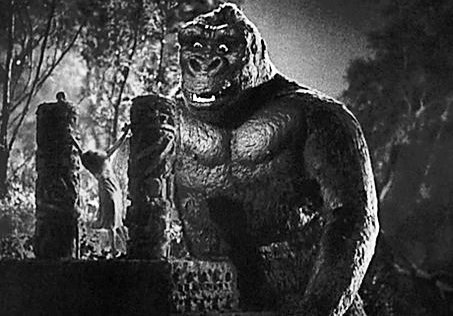
The first time was the charm. One of the few insightful comments I heard on the 2007 AFI special was when Martin Scorsese said that in many ways he finds the primitive stop-motion effects of the original King Kong more impressive than later CGI versions. He's absolutely right. The 1933 version also offers more thrills and emotions (and in half the time) than Peter Jackson's technically superior but dramatically inferior and unnecessary remake. Let’s not even discuss the 1976 version.
When L.A. Confidential debuted on this list in its first year of eligibility in 2007, I wrote, “Of the films of fairly recent vintage, this is one that grows stronger each time I see it, earning comparisons to the great Chinatown…Well acted (even if Kim Basinger's Oscar was beyond generous), well written and well directed, I believe L.A. Confidential’s reputation will only grow greater as the years go on — yet it lost the Oscar (and a spot on the AFI list) to the insipid Titanic.” When I re-watched the film recently, my prediction proved to be spot-on as it only deepens as an experience and an entertainment as time passes. It still boggles my mind that with Russell Crowe, Guy Pearce, Kevin Spacey and James Cromwell (just to name four) delivering impeccable work that only Basinger landed a nomination, but losing best picture and director to James Cameron and Titanic remains the bigger crime.
Simply put: The tensest comedy ever made and perhaps Scorsese's most underrated film. Griffin Dunne plays the perfect beleaguered straight man enveloped by a universe of misfits and oddballs in lower Manhattan when all he wanted to do was get laid. It’s hard to imagine that this movie nearly became a Tim Burton project, but thanks to the many setbacks Scorsese endured attempting to make The Last Temptation of Christ, the film ended up being his — and recharged his batteries as well. While Scorsese has made great films since, I’d love to see him step back sometime and make another indie feature like After Hours on the fly just to see what happens. Joseph Minion wrote an excellent script and this represents one case where I think the changed ending actually proves superior to the originally intended one. By the way, whatever happened to Joseph Minion?
Watchability often gets undervalued when rating a film's worth, but I never tire of sitting through this thrill ride. One aspect that has impressed me since I first saw it as a teen back in 1985 (and I went two nights in a row, dragging my parents to it on the second) was its attention to detail such as Marty arriving in 1955 and mowing down a pine tree on the farm of the deranged man trying to “breed pines.” Then, when he returns to 1985, Twin Pines Mall now bears the sign Lone Pine Mall. It’s just a quiet sight gag in the background without any overt attempt to call attention to the joke. You either catch it or you don’t. I always admire films that respect audiences like that, especially when they happen to be this much fun. With equal touches of satire, suspense and genuine emotion, Back to the Future elicits pure joy. No matter how many times I see it, the final sequence where they prepare to send Marty back to 1985 holds me in rapt attention as I wonder if this time might be the time he doesn't actually make it.
A comedy about the Vietnam War that's full of blood and set in Korea, just as a matter of subterfuge. The film that put Altman on the map and inspired one of TV's best comedies (until it got too full of itself), MASH still holds up with its brilliant ensemble and wicked wit. I still wish the TV show had kept that theme song with its lyrics. Through early morning fog I see/visions of the things to be/the pains that are withheld for me/I realize and I can see.../That suicide is painless/It brings on many changes/and I can take or leave it if I please.

Back in 1985, before Goodfellas and The Sopranos really mixed mob stories with jet black comedy, the great director John Huston, in his second-to-last film, brought to the screen an adaptation of Richard Condon's Mafia satire Prizzi's Honor, complete with great performances and some of the most memorable lines ever collected in a single film. Huston may have been in the twilight of his days, but his filmmaking prowess was as strong as ever. Jack Nicholson disappeared into the role of Charley Partanna more than he had any role in recent memory. Kathleen Turner matched well with Nicholson as Charley's love whose work outside the house causes problems. William Hickey gave an eccentric and indelible portrait of the aging don. Finally, John's daughter Anjelica made up for a misfire of an acting debut decades earlier with her brilliant performance as the scheming Maerose and took home one of the most deserved supporting actress Oscars ever given.
Before Zhang Yimou started being obsessed with spectacle and martial arts, film after film, he produced some of the greatest personal stories in the history of movies, especially when his muse was the great and beautiful Gong Li. This film was their first truly flawless effort as Gong plays the young bride of a powerful lord who already has multiple wives and who encourages the sometimes brutal competition between the women.
"The film actually is like a snail — it kind of turns in on itself and becomes itself," Altman describes his film in an interview on its DVD. One of the many "comebacks" of Robert Altman's career, this brilliant Hollywood satire holds up viewing after viewing because it's so much more than merely a satire. Thanks to Tim Robbins' superb performance as the sympathetic heel of a Hollywood executive and the cynical yet deeper emotional punch of Michael Tolkin's script, Altman wows from the opening eight-minute take to one of the greatest final punchlines in movie history. However, the more times you see it, the more you discover to see. While some specific references have aged, the movie's relevance remains — now more than ever.
Schindler’s List marked an important moment in Spielberg’s development as a filmmaker: Peter Pan finally grew up. It’s a harrowing, well-made movie that everyone should see. At the same time, I can foresee a time when it slips off this list entirely. It isn’t the fault of the film — I find it nearly flawless. However, if someone placed a gun to my head and ordered me to choose to watch either Schindler’s or one of Spielberg’s best post-1993 films such as Catch Me If You Can or Minority Report, I’d opt for one of the latter two. Are they better films than Schindler’s List? I can’t say that. However, the epic holocaust tale isn’t a film you find yourself wanting to pop a bowl of popcorn and watching on a whim. As I said earlier, for me at least, rewatchability remains an important factor. I’ve seen Schindler’s List three times but I haven’t reached the point where I want to go through that wrenching experience again.
Bergman once said that by the time he was done making Wild Strawberries, the film really belonged more to Victor Sjöström, who played Borg, the renowned professor and lauded physician about to receive an honorary degree. The film marked Sjöström 's return from semi-retirement, but he already was a legend as the first true Swedish acting-directing star. Borg decides to drive his old Packard to the event instead of flying to meet his son. The journey becomes more than just a road trip for the professor, but a metaphysical trek through his past as he questions what led him to this moment. As the car winds closer to the ceremony, Borg's inner journey does as well as he comes to realize that for all his scientific training, the only thing he can't analyze is himself. "The day's clear reality dissolves into even clearer remnants of memory," he says. Wild Strawberries represents Bergman growing into his powers as a filmmaker and while it may concern a 78-year-old man examining his life, the subject proves as timeless for people of any age as the film itself.
Tweet
Labels: Almodóvar, Altman, D. Zanuck, Dassin, Hawks, Herzog, Hitchcock, Huston, Ingmar Bergman, Kurosawa, Laughton, Lists, Murnau, Sayles, Scorsese, Spielberg, Tim Burton, Truffaut, Zemeckis, Zhang Yimou
TO READ ON, CLICK HERE
Edward Copeland's Top 100 of 2012 (40-21)

Fritz Lang made a lot of good movies, but nothing equaled this tale told in his native language. Peter Lorre made his mark as the hunted child killer in a film filled with atmosphere, suspense and thought.
Kept from the public for years after its initial release, the one plus to its exile was that I experienced this masterpiece of a political thriller — 50 years old this year — for the first time on the big screen in a crisp, black-and-white print. I hope that Jonathan Demme’s misguided idea of trying to remake this classic didn’t sour the original or scare younger viewers away from seeking out Frankenheimer’s version. The 1962 Manchurian Candidate contains many attributes that make it worth recommending, but every film lover must witness Angela Lansbury’s portrayal of Mrs. Iselin, a contender for the top 10 screen villains of all time.
My much-missed dog Leland Palmer Copeland didn’t usually watch TV, but whenever this classic came on, she was drawn to it. One time, Leland even seemed to sit on the couch and watch it from beginning to end. Maybe it was the music, maybe it was the colors. The sad side effect of Leland’s affection for this film that no one truly ever outgrows is that now that she isn’t here to watch it Dorothy and her friends with me any longer, Oz sometimes proves too painful for me to revisit.
No one gives this film the credit for its darkness that it really deserves. This isn't sappy sentimental drivel; this is about a man who feels as if he's been pissed on all his life and finally reaches the end of his rope. James Stewart's talent, Capra's gifts and the script by Frances Goodrich & Albert Hackett make George Bailey's journey plausible and touching. Only a Mr. Potter could hate this film.
Howard Hawks directed John Wayne to his second-greatest performance in this thrilling tale of a cattle drive and bitter rivalries. It also contains the perfect example of a Hawksian woman as Joanne Dru keeps talking, even with an arrow protruding from her body. I feel as if Hawks has slipped some in esteem among the old masters as far as the younger critics out there go. This master of nearly all genres seems long overdue for resurgence.

I wrote in my 2007 list that The Graduate and Bonnie and Clyde constantly swap slots for my choice as the best film of 1967 and damn if they haven’t done it again five years later. One of the many great lines in 2009’s (500) Days of Summer comes when the narrator, in describing Joseph Gordon-Levitt’s character, says that an early exposure to sad British pop music and a misreading of The Graduate led him to believe that the search for love always leads to The One. (If I’m still around to make another top 100 in 2019, I suspect you’ll find (500) Days of Summer there — after multiple viewings I believe it’s the 21st century Annie Hall.) Back to The Graduate itself, Nichols’ direction looks better with each viewing and the cast remains remarkable. It’s just that my reaction to the story itself that waxes and wanes. It’s never bad – it’s just that sometimes I find myself loving it a bit less than the last time.
The history of movies doesn’t lack for great teamings of directors and actors and the man who more or less made John Wayne an icon with the way he introduced him as The Ringo Kid in Stagecoach also directed the Duke to his best acting performance here. Wayne always worked as a good guy, but he proved his acting chops when someone inserted an element of darkness into his characters. The Searchers also has proved to be a useful template for many other films, most notably Taxi Driver and Paul Schrader’s Hardcore. Ford brought a lot of great imagery to this story and it arguably contains the greatest closing shot of his long career.
As I foretold a couple notches back when writing about The Graduate, Bonnie and Clyde holds the higher esteem in my heart in this snapshot in time. Perhaps it’s a side effect of the journey I took through Penn’s entire filmography following his death, but it’s a great film regardless. Each time I watch it again I become more convinced — harrowing moments of violence aside — this truly plays as much as a comedy as The Graduate. At the time I re-visited it, watching how the Depression-era bank robbers became folk heroes to the masses, the resonance with the destruction 21st century Wall Street bankers wreaked on our nation’s economy was easier to identify with than ever before.
In the 1927-28 contest for "Artistic Quality of Production" at the Oscars, this film faced off against Sunrise and Chang: A Drama of the Wilderness. While Sunrise won and I wouldn’t argue against its status as a superb film (It’s not that far back on this list after all), I admit to preferring Vidor's film and its tale of striving to succeed as everything in the world appears to conspire to keep you down.
There's a good reason that so many cite Robert Towne's screenplay as one of the great examples of writing for film. If only all scripts (including some of Towne’s) were this superb. It remains one of the best examples of a modern noir, filmed in color, as well as Polanski’s best work. Jack Nicholson’s Jake Gittes came in his unbelievable and unforgettable run of great 1970s performances that began with 1969’s Easy Rider. It also gives us one of the sickest screen villains in Noah Cross, played so well by John Huston. Chinatown always will live on in the pantheon of film’s with last lines so memorable even people who’ve never seen it know the words.

You know 1950 was a great year for movies released in the United States when a picture as great as All About Eve only finishes third on my list for that year (behind The Third Man and Sunset Blvd.). That takes nothing away from All About Eve though with its brittle and brilliant dialogue and multiple great performances, including Bette Davis’ best, Celeste Holm, Thelma Ritter and, most especially, George Sanders as Addison DeWitt.
Death comes in large doses in The Wild Bunch, but its violence, despite Peckinpah turning the carnage into quasi-ballet-like imagery, isn’t what makes the film so remarkable. The film delivers its true eulogy not for its human characters but for the death of an era and a way of life. As with so many of Peckinpah’s great films, too many misunderstood the film’s intent but The Wild Bunch only grows more evocative and timeless with age, thanks in large part to its ensemble of acting veterans who display the film’s themes through every crease and line on their faces. With the recent death of Ernest Borgnine, Jaime Sanchez (Angel) remains the last living actor who belonged to the bunch.
Billy Wilder (like Howard Hawks) had the talent to soar in almost any genre and this quintessential film noir is a supreme example. How it lost the Oscar to Going My Way and Fred MacMurray and Edward G. Robinson failed to get nominations still puzzles me. Wait — no it doesn't. The Academy picks wrong much more often than they pick right. Barbara Stanwyck gave a lot of great performances, but Phyllis Dietrichson may have topped them all — and if she didn’t, the others better look out.
Kurosawa gets routinely mentioned by many as a master (and deservedly so), thanks mainly to his great sword-laden epics, but for me this "modern" film stands high as one of his strongest, telling the sad story of a long suffering bureaucrat who seeks meaning in life when he's diagnosed with terminal cancer. A truly touching, remarkable film.
Has there ever been a more touching image placed on film that the ending of this silent film, made well after silent films were dead, when the newly sighted blind girl realizes her benefactor was a little tramp? I don't think so either.

The film that marked Woody’s leap from pure comedy to something more still stands as one of his very best 35 years later. With a structure that deserves comparisons to Citizen Kane in that you’re never quite sure what comes next that guarantees a perpetual freshness no matter how many times you’ve seen it. Allen threw almost every trick he could think of into Annie Hall — animated sequences, subtitles to translate what characters really thought, split screens (even if they actually filmed scenes in a room with a divider — and produced an instant classic. Diane Keaton delights as the title character, the film overflows with priceless lines and timeless sequences and the first great Christopher Walken monologue.
It's almost become shorthand to argue that Part II bests Part I in The Godfather trilogy, but I disagree. The original still takes the top spot in my book. I don't think the crosscutting of Michael and young Vito ever quite meshes and instead interrupts the rhythm of Part II. No such problem in the original, an example of making a movie masterpiece out of a pulpy novel. Examining the film more closely again earlier this year for its 40th anniversary while I enjoyed and admired it as much as ever, for the first time I had to acknowledge that unlike later mob classics such as Goodfellas or TV’s Sopranos, The Godfather does romanticize the Corleones. You never see innocents suffer from their line of work — Vito even denies they’re killers. It doesn’t change the film’s status as a fine piece of cinematic art, but it did make me think harder about it than I had before.
Many directors deliver great one-two punches in terms of brilliant consecutive films and Lumet pulled off one of the best of them in 1975 and 1976, beginning with this masterpiece based on a true bank robbery. Al Pacino delivers what may be one of his top two or three performances. It also contains the best work of the sadly too brief career of John Cazale and a peerless ensemble. Lumet’s direction aided by the editing of Dede Allen produced one of the most re-watchable films of all time. If I run across it on TV, even cut up, I stay glued to the end.
After more than 70 years, John Huston’s directing debut still sizzles. Watching Bogart embrace his first real role as a good guy exhilarates the viewer as he thrusts and parries with the delightful supporting cast of Mary Astor, Ward Bond, Elisha Cook Jr., Gladys George, Sydney Greenstreet, Peter Lorre, Barton McClane and Lee Patrick. What many forget about the film comes in that unforgettable climax that basically consists of five characters talking to each other for nearly 30 minutes — and it’s riveting.
The film that really put Spielberg on the pop culture map remains to me his greatest accomplishment. Two distinct and perfect halves: Terror on the beach followed by the brilliance of three men on a boat. It's also an example of how sometimes trashy novels can be turned into true works of film art in a way great novels usually miss the mark in translation (though Peter Benchley's novel at least killed Hooper off as well leaving nonexpert waterphobe Brody as the victor and sole survivor, which would have made for a slightly better ending but I'm nitpicking).
Tweet
Labels: Arthur Penn, Capra, Chaplin, Coppola, Hawks, John Ford, kinpah, Kurosawa, Lang, Lists, Lumet, Mankiewicz, Nichols, Polanski, Schrader, Spielberg, Towne, Wilder, Woody
TO READ ON, CLICK HERE
Saturday, March 24, 2012
America's first family

KATIE COURIC: What is your favorite movie?
SEN. BARACK OBAMA: Oh, I think it would have to be The Godfather. One and two. Three not so much. So — so — but that — that saga I love that movie.…It's all about family. So it's a great movie.
From CBS News interview during 2008 campaign
"I always felt it was a film about a family made by a family." — Francis Ford Coppola

"When we were editing…, The French Connection came out and I went to see it. It was this great, dynamic, exciting filmmaking…and I remember thinking, 'Compared to that, The Godfather is going to be this dark, boring, long movie with a lot of guys sitting around in chairs talking." — Francis Ford Coppola on the DVD commentary for The Godfather
By Edward Copeland
I swear I remember seeing The Godfather in the theater in its original run. Never mind that I didn't turn 3 until a little more than three weeks after its debut. (My parents cast no light on the veracity of my claim. My dad thinks I'm right because he says, "We took him to everything" but my mom doubts the story, given my age and the film's content.) Who's to say when The Godfather actually surfaced in our city anyway? They didn't hit thousands of screens simultaneously as they do now — movies had different release patterns then, more staggered. Honestly, I can't say I remember specifics from that early viewing, but I do recall other things. We bought and played The Godfather board game, which can be described best as sort of a Mafia-theme hybrid of Risk and Monopoly where players try to take over eight Manhattan neighborhoods — Upper West Side, Harlem, Park West, The Docks, The Bowery, Midtown, Wall Street and
 Lower East Side — by controlling them with one of these rackets: Bookmaking, Extortion, Bootlegging, Loan Sharking or Hijacking. Like houses and hotels in Monopoly, each of the racket pieces came at a different price with Bookmaking being the most expensive, Hijacking the least. Building your rackets also cost more in some neighborhoods than others. I played this game before I started kindergarten, but we didn't play much because even adults found it complicated. (Read the rules in detail here.) I just wish I knew if we still had the game
 somewhere. I do remember we owned the boring, rectangular box edition, not the edition that came in a case shaped like a violin. The first time I remember scenes from The Godfather relate to NBC's 1977 airing of the film, complete with its disclaimers assuring viewers of Italian descent that the Corleones in no way represented all Italian Americans, not that Italians were mentioned by name (something prompted by the protests launched by the Italian-American Civil Rights League, an organization founded and funded by real-life mob boss Joe Colombo Sr.). I’m not certain when I viewed the film uncut for the first time and had aged to the point where I could appreciate it. I know I read Mario Puzo's novel around seventh or eighth grade and realized, as I had when I read Peter Benchley's Jaws in sixth grade, that sometimes the trashiest, most awful novels translate into the best movies. When The Godfather turned 25 in 1997, fortuitous timing placed me in New York for a theater trip at the same time the movie played at a midtown cinema. Hearing the first few notes of that theme — heaven. You could say that The Godfather, which opened to the public 40 years ago today after previous premieres in New York and L.A., has occupied a more constant presence in my life for most of my years than my real godfather. What I find harder to fathom: That Paramount Pictures originally intended this film to be a quickie with a budget of around $2½ million and the studio only hired that 31-year-old director who never had helmed a hit because the suits figured Francis Ford Coppola would be easy to push around. The worst-laid plans of mice and studio executives…

For the 40 years since its release, the imbedding of The Godfather in our culture borders on the astounding. In college, when I foolishly reviewed any damned thing for which I had a free pass, I endured 1989's awful Troop Beverly Hills with Shelley Long (when was the last time you heard a reference to that film?) Edd "Kookie" Byrnes (we're going to put your pop culture knowledge to the test today) played the father of one of Long's young girl scouts, a struggling actor. As Shelley solves all her troop's problems by the end, Edd gets a job of some sort and the big payoff joke turns out to be when he turns around with cotton in his cheeks doing a bad impression of Marlon Brando's Vito Corleone. I even noted in my college paper how timely a joke that was, 17 years after the film's release. Of course, the following year, Brando showed him how you really spoof Vito Corleone when he did it brilliantly himself in
 Andrew Bergman's terrific comedy The Freshman. Now, those two films and the board game and recent video games hardly represent the only, best or worst influences the 1972 film had on our culture (Actually, The Freshman, might be among the best). I'm saving The Sopranos and Goodfellas for a different section later, but it should be noted that long before Tony started seeing Dr. Melfi (or De Niro sat down with Billy Crystal in Analyze This the same month), Saturday Night Live produced a sketch on Jan. 10, 1976, where John Belushi played Vito Corleone attended group therapy to discuss his feelings about the Tattaglia family. Guest host Elliott Gould assumed the role of the therapist. Hell, variations on "make him an offer he can't refuse" by itself
 have been heard, said and repeated so often that it's taken a place among all those familiar phrases that you wonder where they originated only to learn that Shakespeare penned them. Offhand though, I can't think of any other film that cuts across generations and classes and races with its impact. Many popular films have come and gone in the four decades since The Godfather premiered, but when you start listing the titles where references to them can be recognized by nearly anyone, even those born well after they came out, maybe Star Wars comes to mind as another film like that (the original trilogy anyway — can anyone quote something from the prequels?) Glancing at the practically meaningless Top 10 grossing films at the domestic box office right now, few injected themselves as deeply into daily lives as The Godfather with the exception of Star Wars and maybe E.T.: the Extra-Terrestrial, though I don't hear the references to it as I once did. (For the record: 1. Avatar, 2. Titanic, 3. The Dark Knight, 4. The Phantom Menace, 5. Star Wars, 6. Shrek 2, 7. E.T., 8. Pirates of the Caribbean: Dead Man's Chest (bonus points to anyone who knows which one that is), 9. The Lion King, 10. Toy Story 3.) Can anyone recall anything about the No. 1 grossing film except the colors blue and green? Even today, The Godfather, using mostly 1972 dollars, comes in at No. 279 with its gross of $134,966,411 (wedged between, Lord help the Corleones, Patch Adams and the 2006 Incredible Hulk). Of course, when you adjust ticket prices for inflation, The Godfather would rank No. 23 and its haul would total $617,963,700. As has been the case for a long time, the leader of the adjusted box office remains Gone With the Wind with a take of $1,582,009,400.
COURIC: Do you have a favorite scene?
OBAMA: Love — love those movies. I — you know — so many of them. I think my favorite has to be — you know, the opening scene of the first Godfather where, you know, the opening scene of the first Godfather where the caretaker comes in and, you know, Marlon Brando is sitting there and he's saying "you disrespected me. You know and now you want a favor." You know it sets the tone for the whole movie.…I mean there's this combination of old world gentility and you know, ritual with this savagery underneath.
Many movies start impressively. Even more come up with "wow endings" — the kind a drunk Rick Blaine lashes out at Ilsa about in Casablanca. Both Casablanca and The Godfather deliver those sort of conclusions and Casablanca tosses in one of the most memorable
 closing lines in film history. You could name lots of films that ended with terrific last lines. "Louis, I think this is the beginning of a beautiful friendship."; "The stuff that dreams are made of."; "Mother of Mercy! Is this the end of Rico?"; "Oh, no! It wasn't the airplanes. It was Beauty killed the Beast."; "I'll go home, and I'll think of some way to get him back! After all, tomorrow is another day!"; "All right, Mr. De Mille, I'm ready for my close-up."; "Well, nobody’s perfect."; "Shut up and deal."; "I'm not even gonna swat that fly. I hope they are watching. They'll see. They'll see and they'll know and they'll say, 'Why, she wouldn't even harm a fly.’"; "Never you mind, honey, never you mind."; "What do we do now?" What I do is stop because I think you got my point several last lines ago. My destination for this section on The Godfather isn't that the movie contains a brilliant closing bit of dialogue because that happens to be one of the few things it doesn't possess. Then again, it doesn't need one because instead we get the pleasure of viewing one of the best closing images of all time. Back to the above clip, the scene President Obama cited as his favorite. While I consulted some lists to see if I suffered from cinematic amnesia, I couldn't think of a lot of movies that open with great lines. Shockingly, most of these lists I found didn't remember The Godfather but included movies as recent as Black Swan and Million Dollar Baby, where I barely recall details from the films let alone opening lines and others included what really weren't opening lines, the memorable bit coming after some other chatter. (I love Goodfellas to death. I love Goodfellas more than The Godfather, but enry, Tommy and Jimmy say other things in the
 car before Henry in voice-over speaks those great words, "All my life, I always wanted to be a gangster.") Others cited Annie Hall with Alvy's great joke about the lousy food "and such small portions" but to me, that's opening joke, not a line. Great opening to a film, but not exactly line. (Brief aside, isn't it odd to think that in the early 1970s, while making The Godfather, Diane Keaton started dating Al Pacino, but they broke up eventually and she went from him to Woody Allen?) As always, there's "Rosebud" in Citizen Kane, but don't you think Orson Welles would feel sort of insulted if anyone really stay tuned to his film based on Charles Foster's last word? If you haven't played that YouTube clip above yet or if you have, play it again. You could play it for her — you can play it for me! Pardon me. What? You didn't know Rick Blaine was an inhabiting spirit? Don't worry — he hails from the White Lodge. You back? Good. Four simple words, said in darkness. "I believe in America." What a pithy, magnificent way to begin this small-scale epic and emphasize its overarching themes at the same time, As the image comes in to view and the viewer meets the undertaker Bonasera (Salvatore Corsitto) and listens to him to tell Don Vito Corleone about the attack on his daughter, we slowly start to see parts of Brando, first his hand. In the DVD commentary track that Francis Ford Coppola recorded, Coppola explains how that beginning came to be. Originally, he'd planned to just dive in to that 25-minute wedding sequence so he could introduce all the characters. (Another aside: Why does it seem that directors who had their breakthroughs in the 1970s do the best commentaries? Coppola, Scorsese, the much-missed Altman. A better question: Why the hell don't Woody or Spielberg do them?) After Coppola had written a few pages of the screenplay, he showed it to a friend. At
 the 1970 Oscars, Coppola won the adapted screenplay prize for co-writing Patton, which had that very memorable opening in front of that American flag (YouTube only has the audio) so the friend suggested Coppola should come up with an unusual opening along those lines. Coppola thought about it and went back to Puzo's novel, recalling that what struck him about the wedding opening had been the idea of the Sicilian tradition that the don had a duty to grant people's requests on his daughter's wedding day. OF the stories in the book that stood out to him the most was that of Bonasera, the undertaker, so that's how "I believe in America" the words were born. Coppola also tells how, for 1971, the way they pulled off the opening camera move was considered "high-tech." Slow pullbacks as utilized there just weren't done. They had to program a computerized zoom lens for the exact length of time Bonasera's monologue would last in order for the shot to work. Pretty damn amazing. The bigger issue working its way through the scene contrasts the lives two Italian immigrants made for themselves in American, already, in a way, setting up for The Godfather Part II, though that thought hadn't crossed
 Coppola's mind since throughout the commentary he discusses his constant fear of being fired. The undertaker made an honest living, raised a family and went to the police for justice, as he thought good Americans should do. Instead, he gets slapped in the face when the boys who attacked his daughter, disfiguring her in some way, while found guilty and sentenced to three years receive a suspended sentence and walk out of the courtroom back on the streets. We don't know the story of young Vito Andolini yet — and we won't in this film. However, basically arriving alone, he soon learned to help himself and that's what he did — through illegal enterprises rising
 to a power base of fear and respect. The American dream worked out very differently for him. His oldest son Santino, or Sonny (James Caan), can't keep a lid on his temper and by all rights should be Vito's successor. The next son, Fredo, sickly as a child, weak and rootless, the family doesn't know where he belongs. (Played by the gone-too-soon John Cazale, an actor who must hold the distinction of only making five feature films and having all five nominated for the Oscar for best picture with three winning. He died of cancer at 42 and was engaged to Meryl Streep at the time.) The youngest son, Michael (Pacino), just returned from fighting in World War II and also got higher education. He's been kept removed from the family business, because his father never wanted this life for him. Things change. Finally, they have baby sister Connie (Talia Shire,
 Coppola's real-life sister and Jason Schwartzman's real-life mom) whose wedding all the opening ceremony concerns as she weds Carlo Rizzi (Gianni Russo), who Vito warns everyone to keep out of family business. Last but not least, the Corleones embrace Tom Hagen (Robert Duvall) as an adopted son, now the family lawyer and consigliere. Michael courts Kay Adams (Keaton), a teacher whom he shocks with tales from his family such as when she asks about one man sitting and talking to himself. That's Luca Brasi, he tells her. Lenny Montana, a professional wrestler, played Brasi and that scene where he rehearses his speech to the don came out of necessity because Montana couldn't get through his scene with the legendary Brando because of his nerves. Coppola quickly added the practice scene to go before the scene between Vito and Luca, something Brando didn't help by taping a card to his forehead that read, "Fuck You." Montana kept trying to get that line out though. "Don Corleone, I am honored and grateful that you have invited me to your daughter…'s wedding…on the day of your daughter's wedding. And I hope
 their first child be a masculine child. I pledge my ever-ending loyalty." Shew. The story that Michael shares with Kay about Luca and his father and the pop-singing sensation Johnny Fontane (Al Martino) who arrives at the wedding to sing, surprising even Kay, sets her back a bit.
 MICHAEL: Well, when Johnny was first starting out, he was signed to a personal services contract with this big-band leader. And as his career got better and better, he wanted to get out of it. But the bandleader wouldn't let him. Now, Johnny is my father's godson. So my father went to see this bandleader and offered him $10,000 to let Johnny go, but the bandleader said no. So the next day, my father went back, only this time with Luca Brasi. Within an hour, he had a signed release for a certified check of $1000.
KAY: How did he do that?
MICHAEL: My father made him an offer he couldn't refuse.
KAY: What was that?
MICHAEL: Luca Brasi held a gun to his head, and my father assured him that either his brains or his signature would be on the contract. That's a true story. That's my family Kay, that's not me.


Kay eventually shows more strength than Karen Hill did in her life with Henry Hill in Goodfellas. Bobby Vinton sent champagne to their table at the Copacabana and impressed her. Of course, the Hills were real. The arc of The Godfather (What — you haven't seen it? Why the hell are you reading this? All these cats have been out of the bag for a long time.) As far as America goes, I've always loved this scene late in the film when Michael suddenly reappears to Kay after hiding in Italy for a few years AND having been back in the U.S. for a year or so. The movie does lack a proper sense of keeping straight how many years have passed. We know it's the 1940s because the war has ended and can narrow it to 1945 when Michael and Kay leave Radio City Music Hall after seeing The Bells of St, Mary's, a second unit shot filmed by George Lucas who worked on the film and owned part of Coppola's nearly bankrupt production company/fledgling dream studio American Zoetrope. As they walk and talk, Michael professes his love and informs her that he's working for his father now, which upsets her. She reminds him that he told her he wasn't part of that world and then Michael tries to make the case.
MICHAEL: My father's no different than any other powerful man. Any other man who is responsible for other people. Like a senator or a president.
KAY: Do you know how naive you sound?
MICHAEL: Why?
KAY: Senators and presidents don't have men killed.
MICHAEL: Oh. Who's being naive, Kay?
I love that. "Who's being naive, Kay?" Then he makes the promise that makes all the wackiness with year counting seem odd: He swears the Corleone family will be completely legitimate in five years. He even adds that his father knows that old ways don't work anymore. Here lies the million-dollar question: Do you think Michael believes that or is he just feeding her a line?
I have to say about Coppola, assuming he's being forthright in his commentary and that his job hung by a thread during most of the filming of The Godfather, that 31-year-old man held major cajones swinging between his legs. He had made no films of note, as far as Paramount could see (he believes his 1969 feature The Rain People that starred Caan, Shirley Knight and Duvall and featured future
 Carmela Soprano dad Tom Aldredge got him the job), yet he began the movie with a 25-minute-long wedding sequence — a sequence that didn't get shot until about midway through the production schedule. The studio, production headed then by the infamous Robert Evans, made life even more difficult for the complicated shoot by telling Coppola that the entire wedding had to be done in 2½ days, so the direct felt as if everything was rushed. The problem, you see, The Godfather wasn't your ordinary trashy hit novel. In fact, when Paramount acquired it, the book wasn't even a best seller. Of course, that's because the studio didn't acquire it exactly — they commissioned it. Paramount paid Mario Puzo to write this novel and worked in conjunction with him all the way down the line. That's why they were looking to make a quick, cheap feature to hit theaters just as the novel had been arriving. Unfortunately for Paramount, The Godfather turned out to be its literary equivalent of Springtime for Hitler and the studio suddenly got renamed Bialystock and Bloom. The studio couldn't go the cheap route and had tied this blazing bonanza to someone who they no longer found suitable. Unfortunately for them, all the big-name directors they approached turned them down, because they didn't want to be seen as glorifying the Mafia. The budget jumped, but only slightly. From $2.5 million to around $6.5 million dollars. (Here's a fun statistic: Convert those 1971 dollars to 2011 dollars and The Godfather would have had a budget of $36,101,320.99. Adam Sandler's Jack and Jill had a production budget of $79 million. I tried to see what that equaled in 1971 dollars, but Bureau of Labor Statistics inflation calculator doesn't accept figures greater than $10 million. The total domestic gross, as has been the case with most recent Sandler comedies, came in under the budget at $74,158,157. Who keeps funding these comedies for these insane figures?) Oh, but the casting wars. Writing about the behind-the-scenes turmoil involved with this film almost becomes more interesting than just talking about what's on the screen. That's why this is the first of several posts I'll be parceling out over the next couple of days. They don't need to be read in order, so we won't have to worry about that. Before I wrap this one, which tended to focus on the wedding, I felt I did need to mention that cat. Coppola just found it wandering around the set and threw it into Brando's lap at the last minute on a whim. Of course, Brando loved it and loved playing with it. He hadn't gone way off course to cuckoo town to wear he might have tried to wear it as a hat. Later today (I hope), the fight at the beginning between Coppola and Paramount.
 Tweet
Labels: 70s, Altman, Brando, Caan, Coppola, De Niro, Diane Keaton, Duvall, Fiction, Lucas, Movie Tributes, Pacino, Scorsese, Shakespeare, Spielberg, Star Wars, Streep, The Sopranos, Welles, Woody
TO READ ON, CLICK HERE
Thursday, March 15, 2012
"I'm just one of the Master's robes. He can put me on or he can take me off."

By Edward Copeland
That face. That gorgeous image of Gong Li not only exposed to me to her for the first time but to my first viewing of a Zhang Yimou film as well. Wait! I confess — factually speaking, clips of Raise the Red Lantern and its star crossed my eyesight before I saw the movie, but I prefer to remember it the other way and I hadn't seen Red Sorghum or Ju Dou yet. Besides, the scenes shown on Siskel & Ebert couldn't really do justice to that remarkable face or film, particularly that opening scene that consisted only of a young Chinese girl named Songlian (Gong) speaking to her offscreen mother (voice of Ding Weimin).
SONGLIAN: Mother, stop. You’ve been talking for three days. I’ve thought it over. Alright, I’ll get married
MOTHER'S VOICE: Good. What sort of man is he?
SONGLIAN: What sort of man? Is it up to me? You always speak of money. Why not marry a rich man?
MOTHER'S VOICE: Rich man? If you marry a rich man, you will only be his concubine.
SONGLIAN: Let me be a concubine. Isn't that the fate of a woman?
Songlian talks to her mother in a voice that's strong and defiant and that makes the silent streams of tears that fall down her cheeks even more powerful, just as the film that follows that scene will be.

When Gong Li and Zhang Yimou collaborated (onscreen and off), it turned out to be one of the most fruitful actress/director relationships in cinema history, even though it lasted a mere six features, the last of which, 1995's Shanghai Triad, ended the teaming on a mixed note (Gong and Zhang reunited for 2006's Curse of the Golden Flower, but it didn't come close to matching their work in the '90s). Raise the Red Lantern marks my second favorite of the Gong/Zhang films (topped only by 1994's To Live). Lantern immediately followed Ju Dou and, like that film, received an Oscar nomination for best foreign language film. However, one major difference separated the two films in terms of Oscar submission. China submitted Ju Duo as its official entry when it received its nomination in 1990, the first Chinese film ever nominated. Ju Dou did face some controversy and the communist government banned it for a few years, though eventually they lifted the ban. Lantern proved even more provocative to the Chinese officials, who viewed the film as a veiled allegory for the contemporary Chinese government and similarly banned it (and later lifted it) so it was submitted to the Academy Awards by Hong Kong, which hadn't been handed over to the China yet.

Like Ju Dou, Raise the Red Lantern takes place in 1920s China during what was known as the country's warlord era, not that anything on the screen specifically tells you the date of the film, aside for a phonograph player that narrows the time period down. Songlian does marry a rich man as she told her mother she would. Soon after she arrives at the ancient fortress that the Chen family has held for generations, she'll learn how right her mother was when telling her that she'd be a concubine since she would become the fourth wife (or Fourth Mistress, as she's formally referred) to Master Chen (Ma Jingwu). Screenwriter Zhen Ni adapted Lantern from the 1990 novel Wives and Concubines by Tong Su. After the brief prologue where Songlian speaks directly to the camera, Zhang divides the film by seasons, beginning with SUMMER when Songlian shows up at the massive, Chen castle grounds dressed like a schoolgirl, wearing long pigtails and carrying a single suitcase. Her unexpected appearance panics the old, longtime servant Chen Baishun (Zhou Qi) who asks her why she didn't take the bridal sedan they sent for her. Songlian tells him that she insisted on walking and when he reaches to take her
 suitcase, she refuses. She's determined to be self-sufficient. Baishun doesn't argue and begins to lead Songlian toward her new residence. After her long walk, Songlian feels slightly grimy so before she enters the interior of her home, she spots a servant woman (Lin Kong), who must be around her age, sitting on the ground of the stone courtyard, washing clothes by hand. Songlian asks if she might borrow a bit of the clean water from her basin to rinse her arms and hands and the servant, whose name is Yan'er, reluctantly acquiesces but doesn't hide her bitterness toward this new arrival — through glares, tone and words. Realizing quickly what the pecking order in the Chen household will be, Songlian drops any pretense of politeness and orders Yan'er to bring her suitcase into the house. When I rewatched Raise the Red Lantern, for the first time in several years, while many of its most potent and devastating details had remained seared in my memory, I'd forgotten how many surprises the film springs on you via its talented cast, Zhang's directing choices and Zhen's script. I don't mean twists in the conventional sense that we think of when it comes to movies such as Angel Heart, which I discussed just last week, or Fight Club but in characters and situations where things don't turn out to be quite the way they appear at first glance.


Songlian entered this multiple marriage with a decidedly cynical attitude, but the attention a new wife gets shown on her first day overwhelms the 19-year-old. Baishun shows her into her home, which isn't particularly spacious but comes adorned with nice looking furnishings. What takes Songlian's breath away is when the battalion of servants begins appearing to equip residence, both inside and outside. Men hurry into place pushing rolling racks of bulbous red lanterns that they light and hang on hooks leading to her door. One man comes into the house, lowers a ring holding several of the lanterns above her bed, methodically lights each one and then raises them back toward the ceiling again. This section of the film brings the moment, as in Ju Dou when those dye machines began working overtime, that absolutely gorgeous cinematography consumes the screen. Unlike Ju Dou, which splashed wide array of vivid color across its canvas using the long abandoned Technicolor process, Red Lantern's cinematographer Zhao Fei utilizes the color in the film's title as his hue of choice (and won awards from both the Los Angeles and National Society of Film Critics groups for his work. The Inaccurate Movie Database credits Zhao correctly on the movie's awards page, but claims he and Yang Lun, one of the two d.p.'s on Ju Dou, teamed up on Lantern's cinematography on the film's main page. Zhao removes other virtual crayons besides red from his box to create vibrant and striking images for such as a startling icy blue shade at one point. He even manages to make winter's grays and whites sparkle somehow amidst the dullness of the grayer ancient surroundings. While the pampering flatters Songlian, who likes to consider herself smarter and worldlier than many around her, the audience shouldn't forget her age either.


We eventually learn that Songlian attended a university but her father's death forced her to drop out since her family no longer could afford the tuition. That's what led her mother to pressure her into marriage but it's also why she warned her daughter against the type of marriage she enters. That first day though seems pretty good to Songlian — the new wife gets to decide the dinner menu and receives a foot massage, which brings another group of servants (all female) to her residence to prepare her for that ritual. What Songlian doesn't realize is that every day isn't like this and the Master picks which of his wives receives the "honor" of having
 him sleep with her that night along with the other perks (foot massage, dinner menu, etc.) This pits the wives against one another on a daily basis, competing and scheming daily to be the chosen one. If this were played for laughs, they'd call it "Desperate Concubines." Raise the Red Lantern tells its story on so many levels simultaneously (if one happens to be veiled criticism of the Chinese government, so be it; the movie did come out just a little more than
 two years after Tiananmen Square), but at its core, the lanterns being lit shine upon the tragic history not only of women in China, but women everywhere — a battle being waged frighteningly on state and national levels in the U.S. today over issues thought settled long ago. (And Songlian tried to pursue a higher education — what a snob!) The wives learn to covet the foot massages that, while not as awful as the practice of foot binding, don't look particularly relaxing. One of the oldest servants, Aunt Cao (Cao Zhengyin), explains to Songlian that "a woman's feet are very important" so she can serve her master well. That's why the wives get the "privilege" of this ritual where servants as the servants stretch out the wife's legs, resting the feet on a stool and wrapping a piece of linen around them. Then Aunt Cao takes two hard looking implements that make sounds like rattles and beat them repeatedly against the souls of the wife's feet. In an issue of Senses of Cinema by David Neo on the film called "The 'Confusion Ethics' of Raise the Red Lantern," Neo writes extensively about the history of fetishism of women's feet by men in China, saying, "It was a Chinese myth that the smaller a woman’s feet, the smaller her vagina — therefore, the better for the man."
Songlian gets an idea of the games wives play that first night, what should be her "honeymoon." The young woman expresses nerves as it is, hiding her nakedness beneath the covers and asking her husband if they can turn out the lights, but he likes the
 lanterns lit, so he can see her. It doesn't matter much because before they can consummate their union, a servant knocks on the door to interrupt. He apologizes but tells the Master the Third Mistress (He Caifei) has fallen ill and is asking for him. At first, the Master orders him to call for a doctor and to tell her he'll see her in the morning, but the servant says she's insistent. The annoyed Master says he's sorry to Songlian, but if he doesn't go, she'll keep this up all night. so he leaves Songlian alone. (This isn't fun for the servants either who have to extinguish the lanterns and Songlian's home and light them at the home of Meishan, the Third Mistress. Someone, presumably Zhang, made a very interesting decision concerning Master Chen in the film: The moviegoer never gets a clear view of his face. The first time I saw Raise the Red Lantern, I thought perhaps Zhang was withholding the moment the audience sees what he looks like for a dramatic purpose much as Spielberg didn't let you see the shark right away in Jaws. That doesn't turn out to be the case though. While Master Chen certainly can be viewed as a villain, it's more like evil spreads out from him and his family's "rules" while in most cases you don't see him committing the acts himself. The Master really serves as a pawn in this game where the women are the victims as well as the villains. Then as the saying goes, you can’t judge a book by its cover.
When I knew at the end of last year that the anniversary of the U.S. release of Raise the Red Lantern occurred this year, the prospect of
 writing about this great film excited me. I wanted to detail the surprises and turns the film takes and how what could have been a staid period tale of oppression turns into a moving, riveting and entertaining motion picture all at the same time, but when I watched it again, a protective feeling awoke in me. Sure, I could utilize the silly SPOILER ALERT, but it isn't that important to tell you in specifics who does what to whom. If you haven't seen the film, you must experience these events for yourself to truly appreciate Zhang's masterful direction, Zhen's great screenplay and, most especially, the wondrous ensemble of actresses. I love Gong but, unlike most of her films, she's not the only actress with chops. All the characters that matter are women and two of the other actresses give performances as downright superb as Gong's. He as Third Mistress Meishan and Cao Cuifen as Zhuoyun, the second mistress also do brilliant work. Giving a fine turn in a smaller role is Lin as Yan'er, the spiteful servant who becomes Songlian’s personal maid and spits in her laundry. We eventually learn her attitude comes from her feeling that she should have been the Fourth Mistress. Playing the First Wife, Yuru, is Jin Shuyuan, an older woman who keeps quiet most of the time since Master Chen shows little interest in her anymore. (Given her age, that's one reason I though they kept his face hidden — to shock us with how old he looks.)

He Caifei and Cao Cuifen stand out in what really end up being the film's most difficult roles since the movie places the audience in the same position as Songlian in that we don't know how to read them. He's Third Mistress Meishan definitely comes on the scene as the troublemaker, interrupting Songlian's first night and when the same tactic fails the second night, she
 uses her skills as a former opera singer to sing all night on the roof of the castle and keep everyone awake. Cao's Second Mistress Zhuoyun
 doesn't seem duplicitous at all at first, going out of her way to be friendly to Songlian and give her gifts. She even acts as if she's happy for her when she gets picked as the mistress for the night. It's only when Songlian uncovers secrets that Yan'er hides in her quarters that she realizes that the maid works as a spy for Zhuoyun. The situation that persists in the Chen household infects everyone in the end and soon Songlian plays the same sort of games and schemes in the same ways to try to monopolize the master's attention. Eventually this chain of events leads to horrifying results for most of the people who live there. After someone dies, Songlian actually says that she is lucky to be dead because that is a better fate than being alive in the Chen household. A lot of lines prove to be very telling, but I'm going to give them to you as blind quotes to preserve the film's surprises. During a dinner of the wives, one complains about another and vows how different things will be when she's in charge prompting another to say, "When you're in charge, the Chen household will perish." One mistress on another: "She has the face of Buddha and the heart of a scorpion. She's the truly wicked one. I'm no match for her." Even though Master Chen has a grown son Feipu (Xiao Chu) by his first wife and has another by Meishan, Zhuoyun regrets only giving him a daughter and Songlian gets warned, "If you don't give him a son, you're in for hard times." Both actresses give simply superb performances, but I haven't heard much of either since. Not that you can trust the Inaccurate Movie Database, but it lists very few titles for He Caifei (I'm going with the spelling of her name I find everywhere else, that's how little I trust IMDb these days) except for some Chinese TV series, though it says her last feature was Ang Lee's Lust, Caution. Cao Cuifen's IMDb filmography ends up even sparser, showing a single TV series and four feature films in her entire career. Then again, who know what can happen to artists in China?
As for Gong Li, Raise the Red Lantern might have been one of her earliest performances, but it showed what a gifted actress she was even then in her mid-20s. She has continued to work steadily in China as well as some American productions such as Memoirs of a Geisha and Michael Mann's film version of Miami Vice. In Red Lantern, what she has to accomplish and does truly amazes. Every emotion you can think of, Songlian expresses — and she gets a drunk scene and gets to go mad as well. It's too bad the performance wasn't eligible for an Oscar nomination. When you think of the Academy's tendency to bestow best actress on twentysomething actresses constantly, few of whom approach what Gong did.

Zhang Yimou provides a lot of great camera moves in the movie both in terms of composition and motion. He has one sequence that pulls back from a scene (I don't want to say of what) to give you the bigger picture that's quite remarkable. As I said earlier, the wondrous
 cinematography combined with the production design just produces a stunningly beautiful film, even if it's a heartbreaking one in the end when you see a Fifth Mistress arrive who looks like the youngest yet. Zhang often ran into trouble in China, but he has stuck it out there. Part of me always has wished that he made the leap as other directors did when fleeing totalitarian states such as Fritz Lang and Billy Wilder. Then again, who's to say that Hollywood wouldn't have ruined him as they did Jean Renoir who had to return to Europe to make good films again? China has done their own damage. I miss the Zhang Yimou who made the personal, intriguing films before he got caught up in the Hero-House of Flying Daggers-Curse of the Golden Flower-type of filmmaking. Riding Alone for a Thousand Miles certainly went in the right direction and there are a frustrating number of his works that just never make it here at all. The Flowers of War makes me curious, but after the disaster of A Woman, a Gun and a Noodle Shop, I don't know what to expect from him. Whatever he does, we'll always have that great period of work that lasted through about The Road Home in 2000. More importantly, we'll always have Raise the Red Lantern.
Tweet
Labels: 90s, Books, Ebert, Fiction, Foreign, Gong Li, Lang, Michael Mann, Movie Tributes, Oscars, Ray Top 100, Renoir, Spielberg, Wilder, Zhang Yimou
TO READ ON, CLICK HERE


