Monday, July 01, 2013
What acting is all about — unemployment
BLOGGER'S NOTE: This post originally appeared Dec. 17, 2007. I'm re-posting it as part of The Sydney Pollack Blogathon occurring through July 22 at Seetimaar — Diary of a Movie Lover

By Edward Copeland
Film directing isn't often compared to completing a jigsaw puzzle, but that analogy seems most apt in describing exactly what Sydney Pollack accomplished with Tootsie, which opened 25 years ago today. What began with a story by Don McGuire and Larry Gelbart and a screenplay by Gelbart became the center of a fight between the film's star, Dustin Hoffman, and Pollack, and ended up with countless other notable scribes (among them Barry Levinson and Elaine May) taking shots at the script. In the end, the final screen credit went to McGuire and Gelbart for story and Gelbart and Murray Schisgal for screenplay, but Pollack's ability to weave the best parts of all those drafts and spin them into cinematic and comic gold deserved a credit all its own. If that feat of wizardry weren't enough, Pollack also turns in a fine supporting role as well, playing Hoffman's character's agent.

When originally released, while I loved Tootsie, being 13, my 1982 heart still belonged to E.T.: the Extra-Terrestrial, released months earlier. However, as the years went by, Tootsie grew in my estimation while E.T. became almost too schmaltzy to watch, so much so that I haven't returned to it in nearly 20 years. Perhaps my view would change again now. What makes Tootsie soar, like many other films, comes from the fact that its greatness proves impermeable to even a picky, critical mind such as mine. I mean, how exactly does "Dorothy Michaels" (Hoffman's drag alter ego) get paid when she doesn't exist and wouldn't have a Social Security number? Of course, the finale, involving an accident that forces the soap to redo a show live at the last minute seemed ridiculous to me even upon first viewing, but why question the logic of a scene that uproariously funny and with a payoff so huge? The brilliant ensemble cast, in addition to Pollack's patch job, holds Tootsie together.
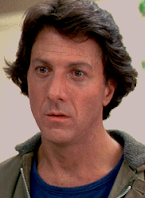 Hoffman, deservedly, gets a lot of credit for his drag creation, but I don't think he gets the kudos for Michael Dorsey that are due him. It might seem as if Hoffman's reputation for being difficult, makes Michael a cakewalk, but he not only plumbs
 Dorsey's depths for comedy and pathos, but convincingly depicts his transformation from a horny prima donna to a more sensitive man (At one point, Michael acknowledges that he thinks Dorothy is smarter than he is). The opening sequences, depicting his problems as an actor who hasn't had a job in two years, come stocked full of laughs, such as the scene where his agent George Fields (Pollack) explains the reasons he his client can't get work while Michael insists in his own defense "that nobody does vegetables like me" to justify his firing from a commercial where he played a tomato. Hoffman and Pollack don't carry the film alone. Ironically, the weakest link in the cast, Jessica Lange, was the only person to win an Oscar, a consolation prize for losing lead actress in Frances that year to Meryl Streep in Sophie's Choice. Frankly though, Lange wasn't even the best supporting actress in Tootsie, though her character provides the key to the film's serious undercurrent of exploring the way men sometimes treat women in all ranges from employment discrimination to out-and-out misogyny, but the message never interferes with the laughs.
Teri Garr's great turn as Michael's acting colleague and friend Sandy did earn an Oscar nomination, but she lost to Lange, as did my personal choice for 1982, Glenn Close in The World According to Garp. Garr, however, clearly led the field of women in Tootsie (hell, I could make a case for Doris Belack as the soap's producer over Lange). Always clandestinely stuffing food into her purse at parties, having Michael "enrage" her for an audition and her go-for-broke rage explosion when she learns Michael has been deceiving her provide some of the film's most priceless moments. The ensemble contains so many great supporting turns by the men in the film, I'm almost afraid to single anyone out. In addition to Pollack, viewers receive the gifts of George Gaynes as the soap's aging star, wholly dependent on cue cards and
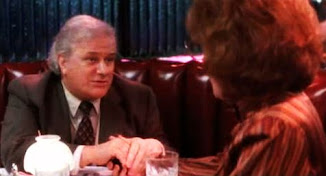 prompters, who hits on every new cast member; Dabney Coleman doing the chauvinistic asshole character he practically patented in the early 1980s as the soap's director; the great Charles Durning, who earned an Oscar nomination that year, albeit for The Best Little Whorehouse in Texas with his single but memorable scene singing and dancing a little "Sidestep," as Lange's widowed father who falls for Hoffman's Dorothy and longs for the days when men and women "were what they were." His proposal scene proves both funny and touching (though the comic gem resulting from this sequence comes later when Michael tells his agent about the offer and Pollack asks him what he said, with genuine happiness that makes him forget about the truth of the situation for a moment. Along with Belack, another fine supporting female in the cast happens to be a young Geena Davis who plays another actress on the soap and shares a dressing room with Dorothy.
The prize for the best of the supporting men though goes to the great Bill Murray, in a role that legend says he improvised completely and I believe it. He plays Jeff, Michael's playwright roommate, and if he truly did come up with all his own dialogue, what a treasure trove he unleashed. (My personal favorite: When he says he wishes he had a theater that was only open when it rained.) Even though Tootsie lags a bit when it takes a detour to Durning's farm, it's forgivable since those scenes give the film part of its heft and allows for even more comic grace notes. How Tootsie lost to the noble but limp Gandhi (including for original screenplay, patch job or no patch job) still baffles me.
Tweet
Labels: 80s, B. Levinson, Dabney Coleman, Durning, Dustin Hoffman, Geena Davis, Gelbart, Glenn Close, J. Lange, Movie Tributes, Murray, Streep, Sydney Pollack
TO READ ON, CLICK HERE


Monday, March 05, 2012
Just for a Smile

By VenetianBlond
Director Barry Levinson, just starting out as a filmmaker, turned his camera on a group of guys in their 20s who hang out in a diner. What he captured was part coming-of-age story, part Altmanesque conversation flood, and part elegy for times gone by. With an Oscar-nominated screenplay, he directed terrific performances from his cast, all of whom later became household names. Given all the high concept or high production (or both) fare that’s usually greenlit these days, it’s refreshing to see a good old-fashioned character study and wonder whatever happened to those guys in the diner.
It’s the holiday season of 1959, and during a party, Modell (Paul Reiser) pulls Boogie (Mickey Rourke) away to help with a situation. Fenwick (Kevin Bacon) is smashing out the basement windows and won’t quit. “It’s just for a smile,” he drunkenly says. But Boogie has the heft to convince him to stop and come back upstairs. Eventually they meander to their favorite hangout, the diner, joined by Shrevie (Daniel Stern) and Eddie (Steve Guttenberg). There, they can shoot the breeze, razz each other, brag and even declare their unending annoyance with each other.
They’re joined the next morning by Billy (Tim Daly), who‘s in town for Eddie’s wedding. There’s some question whether or not it actually will occur, because the girl in question must pass a football quiz or the nuptials are off. Billy’s got his own problems: After a one night stand with a good friend, she’s pregnant but won’t marry him. Boogie’s in debt to gangsters, Fenwick is perpetually drunk and Shrevie has no idea how to relate to his wife Beth (Ellen Barkin). It’s a coming-of-age story in that these guys must grow up and figure out how to deal with things, but they’re not 14 anymore.

Mickey Rourke, just off of Body Heat and on his way to Rumble Fish and The Pope of Greenwich Village, pulls a lot of the focus. Boogie is the alpha male without a doubt, even though he has a soft, high voice and works as a stylist in a beauty salon. His plan to make the money to pay off the debt is to gamble more — with his friends about what sexual exploits he can manage. They are more than happy to go along. Boogie has a strong sense of who he is, but he has no idea what to do with that knowledge. When he has an opportunity to rekindle things with Beth, whom he dated before she married Shrevie, he can’t go through with it. He tells her that she and Shrevie need to work out their “thing,” which he knows is right, but he doesn’t know how to find that “thing” for himself. Mickey Rourke already shows all the charm and danger in lethal combination that would become his stock in trade.
Levinson allowed a certain amount of improvisation on the set, and that allowed for some great work, particularly from Steve Guttenberg and Paul Reiser. Modell is constantly cadging from Eddie, whether it’s a ride home or the rest of his sandwich, and it makes Eddie immediately see red. “Just say the words!” he yells, trying to get Modell to admit he’s a moocher, but he won’t It’s a hilarious recognition of the fact that our best friends can be the ones who get on our last nerve.
Kevin Bacon, looking younger than all the rest, is a surprise as the alcoholic Fenwick, who’s the polar opposite of his Chip Diller in National Lampoon's Animal House. Levinson gives him a terrific scene in which he’s watching the college quiz show on TV and he knows all the answers. He’s got potential, but it’s lost in a sterile upbringing and a loss of focus. He decides to spend Christmas in his boxers in the Baby Jesus’ manger in front of the Catholic Church, and when his friends come to get him, he punches out all the Wise Men.
Diner doesn’t have a lot of narrative drive, because the characters don’t either. They have a certain amount of faith that things eventually will work out in the end, even if they don’t know how to help them along. What they do know is that they’ve had their best friends to either support them or distract them from their troubles — even if they eventually get married and their wives “will make you get all new friends.”
As in American Graffiti, Diner looked back at the 1950s as the end of an era and a turning point for the young people in America. But where American Graffiti had a sense of urgency, Diner takes a more contemplative bent. Shrevie can’t understand why his records get misplaced, and Beth can’t understand what the big deal is. In a tour de force monologue, Shrevie explains why Charlie Parker is not filed with the rock ‘n’ roll. It sounds silly, but Beth is devastated, and both characters see that they are talking past each other, but they can’t fix it. That’s what we can relate to, whether it’s 1959, or 1982, or now.
Tweet
Labels: 80s, Altman, B. Levinson, Barkin, Kevin Bacon, Mickey Rourke, Movie Tributes
TO READ ON, CLICK HERE
Saturday, February 11, 2012
If anyone believes these two families should not join together…

By Edward Copeland
Has a movie wedding ever gone off without a hitch? Now, some can turn out to be enjoyable messes from the old (It Happened One Night, The Philadelphia Story) to the more recent (My Best Friend's Wedding, I Love You, Man). In the past few years, even when arguably taking the form of "dark" comedy, dysfunction or worse has tended to be the main dish served at the reception ranging from the blahs of Jonathan Demme's Rachel Getting Married, the blech of Noah "Just go see your shrink" Baumbach's Margot at the Wedding and the boneheaded bombast of Lars von Trier's Melancholia. NOTE: I've purposely omitted the turd that goes by the title of Bridesmaids from either category because it belongs in a separate one called Overlong, Poorly Written Movies That Claim to Be Comedies but Wouldn't Have Any Laughs If They Didn't Cast Melissa McCarthy. All of this preamble brings us to the film I'm actually writing about in this post, Another Happy Day. Ellen Barkin produced the film and leads a strong ensemble in another tale of tensions that erupt when severed and estranged members of a large melded family must intermingle for the wedding of a shared son. What differentiates Another Happy Day from others of its ilk is that, while it's not a great film, most of the cast and the screenplay succeed at being engaging enough that the movie manages to earn laughs and rip scabs off old wounds at the same time.
It's easy to see why Barkin would help see this film get made so she could play Lynn — it's easily the best part she's had since probably This Boy's Life in 1993 (other than the just-for-kicks Ocean's 13). Barkin plays the perpetually frazzled Lynn, mother of the groom Dylan (Michael Nardelli), the oldest of her four children and one of two from her first marriage by her ex-husband Paul (Thomas Haden Church) and raised by his second wife, a real piece of work named Patty (Demi Moore).
Paul and Lynn's daughter Alice (Kate Bosworth) has been away at college, doing what she can to avoid both parents, though rumors have circulated throughout the extended family that Alice has been cutting herself. As her goofy aunts (Diana Scarwid, Siobhan Fallon) discuss it, they suspect it's some kind of new generational thing and wonder what happened to anorexia — they understood anorexia: Who doesn't want to look good?
Then again, Lynn's second brood presents a handful of its own. Her second husband Lee (a delightful, but underused Jeffrey DeMunn, who also is the best part of The Walking Dead as Dale) seems quite pleasant and at ease with the fact that their 17-year-old son Elliot (Ezra Miller, as wry and funny here as he was frightening in We Need to Talk About Kevin) just finished his second stint in rehab and can be quite rude and nasty to anyone, and their youngest son Ben (Daniel Yelsky), just beginning adolescence, who has a mild form of Asperger's syndrome and constantly videotapes most moments of their lives.
Even before Lynn and the boys arrive in Annapolis for the wedding events, Lynn is second-guessing most of her decisions in life and battling depression. She blames many of her problems on her parents, the bottled-up Doris (Ellen Burstyn), who doesn't recall depression running in her family though Lynn's grandfather did shoot himself to death, and her now-ailing father Joe (George Kennedy). Lynn feels they didn't support her during her divorce, siding with the idea that Paul should get custody of Dylan and Alice.
Another Happy Day marks the directing debut of Sam Levinson (son of Barry), who also wrote the screenplay and won the Sundance Film Festival's 2011 Waldo Salt Screenwriting Award for his script. What separates it from other recent films that tapped into this area is that Levinson manages to earn both his laughter and his pathos whereas everything, especially in Baumbach's film, just plays flat and maudlin. Levinson must be eternally grateful that he was able to assemble the cast he did, because they're key.
Barkin obviously relishes having this juicy a part for the first time in a long time, so much so that her histrionics do go overboard at times. She's at her best when she's grounded in scenes of truth with other talents such as the always brilliant Burstyn or selected scenes with Church and DeMunn. When she has to go one-on-one with Moore, things gets out of hand since Demi Moore only knows one note to play and it looks as if Barkin instinctively tries to play down to her level. Demi Moore can play "one dimensional bitch in heels" and that's it. That's pretty much how it always has been.
The two who really hold the film up are Ezra Miller and Daniel Yelsky as Lynn's younger sons, particularly Miller as Elliot. Between his work here as the constantly sarcastic addict (so much so that he keeps lifting grandpa's Fentanyl patches and licking the pain medicine off them to get high) and as the demon spawn in We Have to Talk About Kevin, this 19-year-old actor (surprise from all the other sources I checked, IMDb's birth month and year are wrong) definitely is someone to keep your eye on.
Levinson's career also will be of interest to monitor. While Another Happy Day isn't perfect, it's worlds away from something his father Barry would make, though it's interesting that the son gives Ellen Barkin her best part in more than a decade while his father gave her her first credited feature film role in his feature directing debut 30 years ago in the great Diner.
Tweet
Labels: 10s, B. Levinson, Barkin, Burstyn, Demi, Demme, G. Kennedy, von Trier
TO READ ON, CLICK HERE
Sunday, December 04, 2011
Re-fighting the Cold War
BLOGGER'S NOTE: This piece originally posted Jan. 3, 2007. I'm re-running it today to mark the 30th anniversary of the release of the movie Reds.
By Edward Copeland
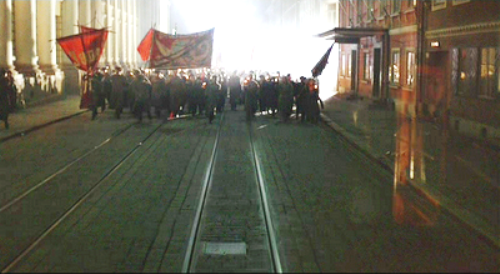
It was with trepidation that I decided to use the occasion of its 25th anniversary DVD release to face off again with one of my old cinematic archenemies, namely Warren Beatty's 1981 film Reds. I'd known for a long time this day would come because through those two-and-a-half decades, I'd carried the scars of enduring the film and it had remained as one of the most boredom-inducing experiences of my filmgoing life. However, I also knew that it probably wasn't fair to the film. I saw Reds in its initial release — when my Oscar obsession was blossoming in seventh grade and deep down, I knew that perhaps a 12-year-old wasn't the movie's ideal audience and I needed to give the film another chance, to watch it with fresh, adult eyes.

Could the Reds I watched again in 2006 possibly be the same Reds that felt like as if a dentist were performing a root canal on me when I saw it decades ago — or is the real truth that the film remains the same but I'm not a different moviewatcher than I was back then? I think the answer is clear — and it would probably be plain stubborness on my part not to acknowledge that conditions must truly be correct for an individual to appreciate some films and a three hour-plus account of early socialists and the Russian revolution isn't really the best material for someone who at the time worshipped the reels Raiders of the Lost Ark unspooled from, especially since over the years Raiders has diminished in my eyes. Re-watching Reds, which initially to me seemed to move slower than Heinz ketchup, surprised the hell out of me when I realized that its pacing seemed exceptional for such a long movie. Sure, no Nazi faces were melting, but Reds' richness finally has become apparent to me. It's also worth noting that in the period between my initial seventh-grade viewing of Reds and my second encounter in 2006, one of my favorite courses at college was called Era of Russian Revolutions.
In many ways, Reds not only plays as a great film to me today in a way it didn't back in the 1980s, it also works as a far more relevant one as well. When you watch as the idealism of those who felt socialism was the answer to capitalism's wrongs inevitably gives way to cynicism as the communists in Russia begin using their power to deny the people rather than to give them a stronger voice, it's hard not
 to see the parallels. Ideology by necessity almost always gives way to disillusionment as true believers, no matter where they fall on the political spectrum, realize that the people whom they've trusted and believed in to realize their ideal dreams either have something else in mind or lack the essential ability to implement their goals. Reds also plays more clearly to me today as a story of the battle between art and politics as Jack Reed (Beatty) tries to balance his love of writing with his political sensibilities. He wants to help fight for his cause, but he still bristles when anyone tries to change his words. Deep down, even if he didn't admit it, he was more writer than revolutionary. Of course, the love that really lies at the heart of Reds is that between Reed and Louise Bryant (Diane Keaton). Keaton's performance resonates much more strongly for me now than it did when I was a bored adolescent. Perhaps, as much as I love Annie Hall, this might be Keaton's best performance as an often-fickle woman whose political views often drift as often as her interest in the men in her life. One of the things that annoyed me the most in junior high were the witness scenes, where the talking heads against the black backgrounds recounted their experiences with Reed and Bryant. I never appreciated the contradictions their stories presented at the time, but they shine through now, especially in the case of Bryant who remains a bit of an enigma.
Keaton hardly is the only actor who comes off even better than I remember from my first viewing. While Oscar winner Maureen Stapleton was my favorite part of the movie at the time, her great work as Emma Goldman actually is a much smaller role than I recalled. The other performance that plays even better now than it did
 then is Jack Nicholson's work as Louise's sometime lover, playwright Eugene O'Neill. It may well be Nicholson's most quiet and reserved work on film ever. I love Jack — and I love when he goes over the top, but there isn't any sign of that Nicholson here. Nicholson's O'Neill is smart, quiet and bitter over his treatment by Louise though still willing to help her in a pinch when she needs it. In the featurettes included on the 25th anniversary DVD, Nicholson recalls asking Beatty why he wanted him for this part and Beatty replied that he wanted someone who could conceivably steal Louise from Jack Reed and Nicholson certainly fills that bill. As for Beatty's work, you almost have to divide it into the four roles he served on the film. As producer, getting Reds made truly seems an impressive accomplishment in hindsight. As co-writer with Trevor Griffiths, his script plays much better than it did for the 12-year-old Edward Copeland. As director, his Oscar win seems deserved to me now, though I might still opt for Spielberg's work on Raiders in a pinch.
Then there is Beatty the actor. Beatty is never bad, but when you really get down to it, most of his performances come off sounding like the same person. The exceptions would be his earlier work as Clyde Barrow for Arthur Penn in Bonnie and Clyde and especially as John McCabe for Robert Altman in McCabe & Mrs. Miller. Close your eyes and listen to Heaven Can Wait's Joe Pendleton, Reds' Jack Reed or Bugsy's Bugsy Siegel, and aside from subject matter, they all sound the same. Even Bulworth to some extent falls prey to this. Perhaps it has something to do with when Beatty directs himself, even though Buck Henry co-directed him in Heaven Can Wait and Barry Levinson helmed Bugsy. Beatty reminds me much of Robert Redford — more star than actor. His range is limited and his directing output has been so scarce, I can't help but wonder if he'd moved more toward Clint Eastwood's later career and did less work in front of the camera and more behind, his film reputation might be held in higher esteem.
Reds as a whole plays as such a great movie to me now (even at 12, I recognized how great Oscar-winning Vittorio Storaro's cinematography was, though it's embarrassing to admit that I wasn't familiar with the movie's composer, a man named Sondheim), and Beatty's role in its success is so essential, that I won't begrudge him scoring high in only three of his four jobs on the film. Critics don't like to admit they were wrong — but I was, but at least I can blame it on my young age at the time. In one of the anecdotes on the great featurettes on the DVD, Beatty admits that when he offered to show Reds to his 13-year-old daughter she seemed completely disinterested, though he claims she saw it and liked it anyway, but would a young teen really want to tell her famous father what she really thought? Besides, even if she were lying, she likely will grow to admire it as she ages.
Tweet
Labels: 80s, Altman, Arthur Penn, B. Levinson, Buck Henry, Diane Keaton, Eastwood, Nicholson, O'Neill, Oscars, Redford, Sondheim, Spielberg, W. Beatty
TO READ ON, CLICK HERE
Wednesday, April 06, 2011
He's got the world on a string

By Edward Copeland
To be perfectly honest, if you asked the average person or even some fairly knowledgeable film buffs what exactly it is that a producer does, they wouldn't be able to give an adequate definition, especially when the list and types on some movies and TV shows has grown so long. Watching Douglas McGrath's highly entertaining documentary His Way about Jerry Weintraub and his rise in the entertainment industry won't necessarily give you a better idea of a producer's role, because Weintraub's portrait as a one-of-a-kind self-made man amazes on a professional level and his private life will make your jaw drop in disbelief at the charmed and unorthodox life he lives.
His Way, which premiered Monday night on HBO, opens with quick shots of some of the luxury items Weintraub surrounds himself with, many emblazoned with the monogram JW while Sinatra sings, "I've Got the World on a String." Then a series of famous figures, including most of the major stars of the Ocean's 11 remake and its sequels which Weintraub produced, as well as others, try to describe Weintraub in a few words. Among those quotes:
Out of high school, Weintraub entered the Air Force, serving in Alaska, where his drive for success led him to get the midnight to 8 a.m. shift so during the day he could go into Fairbanks and work at a Woolworth's where his ingenuity eventually got him promoted to manager.
He had an early failed marriage to a high school sweetheart, but moved back to his native New York where he started his climb in the entertainment industry, beginning as an NBC page, then to the fabled William Morris mailroom and before moving on to the television division of MCA before transferring to its night clubs division. Eventually, he left to manage talent on his own, taking about any act and providing one of the main inspirations for the title character in Woody Allen's Broadway Danny Rose, which makes writer-director McGrath's involvement somewhat ironic since he co-wrote Bullets Over Broadway with Allen.
Weintraub's constant pursuit of more talent to manage led him to the well-known (in certain circles) singer Jean Morgan. Much of her success she gained in Europe, but she'd been performing since she was a child, including in Kennebunkport, Maine, which is how the elder Bushes came to know Weintraub. Weintraub not only became her manager, he also wooed her away from her husband and remains married to her to this date, but to say it's a conventional marriage would not be truthful, but more on that later.
As his acts grew, Weintraub decided he wanted to promote a tour of Elvis Presley. After a year of calling Col. Tom Parker every day and being rejected, Parker changed his tune one day and told Weintraub to show up in Vegas with a check for $1 million and they'd talk. With much scrambling, Weintraub managed to get a cashier's check for $1 million by promising a radio exec he knew that he'd give him half of his concert proceeds for all acts. So Weintraub set up a tour for Elvis, with Weintraub getting 50% of the profits and the Colonel and Elvis getting the other half. Elvis had only two demands: No empty seats and only fans in the front rows, no big shots. When his show sold out so fast in Miami Beach, Weintraub proposed adding a matinee, and Elvis said yes and the venue manager told him it was sold out.
However, when Weintraub arrived, there were all these rows of tickets for the matinee. He asked the venue manager why he lied and he said he told him what he wanted to hear. Weintraub told Parker they had a problem, but the Colonel corrected him that they didn't, he did. In a stroke of genius, Weintraub got the officials at the neighboring Dade County prison to have inmates move the empty 5,000 seats into the parking lot for the matinee and cover them with a tarp and put them back for the evening show. Elvis never said they had to sell out, he just didn't want any empty seats, though later he said they should rethink the matinees because the crowd wasn't as loud and excited as the one at night.
After the evening performance, Parker took Weintraub into a room with two locked briefcases. He unlocked them both which were filled with cash which the Colonel said were from the concessions. Weintraub said that didn't belong to him, but Parker insisted and after making an even pile of cash on a table, used his cane to divide it equally saying that half was Weintraub's. After that, Weintraub was a multimillionaire. It boosted his reputation to the point that Frank Sinatra came calling, saying he'd grown bored with what he was doing and he wanted Jerry to do for him what he did for Elvis.
Weintraub's stable of big music talent grew to include Bob Dylan, Led Zeppelin, Neil Diamond, The Carpenters and John Denver, but as successful as he was with the music management business, he always wanted to make movies. One day, Robert Altman met with him, wanting Weintraub to manage him, but Weintraub surprised him by saying he didn't want to manage him, he wanted to produce his next movie and he did. That movie was Nashville.
Other films Weintraub produced include Oh, God!, Cruising, All Night Long, The Karate Kid and, as mentioned, Ocean's 11, 12 and 13 (those films' director, Steven Soderbergh, is both an interview subject in and an executive producer of His Way). One of his biggest hassles came when he made Barry Levinson's Diner for troubled studio chief David Begelman. Weintraub warned him not to call during the screening, knowing that it had been turned down by all the studios in town, and within seconds of it ending, the phone began ringing. Weintraub ignored it, went to the projection booth and took the print.
He then arranged a special screening for Pauline Kael (after the studio had done a test screening in Phoenix, which obviously was the wrong audience) who loved it and penned a rave. Weintraub took the review back to Begelman and his minions and showed them Kael's review that she planned to run whether they released the film or not, so it was up to them if they wanted to look like idiots or not. Diner was saved.
The one misstep that Weintraub has seemed to have made in his career was when he opened his own independent film studio, the Weintraub Entertainment Group, but his skills weren't suited to be an executive and the company ended up losing him $30 million.
The most iconoclastic aspect about Weintraub actually concerns his family life. Throughout his life, Weintraub has been nothing if not honest. He tells the story of a good-looking young woman who walked into his office one day and told him she wanted to have sex with him. Jean was out of town, so Jerry took the young lady home when Jean unexpectedly showed up. He tried to keep her out of the bedroom, but she figured out what was going on. He tried to call Jean for hours and when she did talk to him, he offered her a divorce, half of everything, whatever she wanted. Jean made a different offer. She didn't want a divorce. She just asked him to open an account for her and deposit $1 million in it. From then on, he could sleep with any bimbo he wanted, but each time, she'd get $1 million.
That's not the strangest part. Later, while making the film Pure Country, Weintraub met a woman named Susie Elkins and they fell in love. Again, Jane didn't feel the need for a divorce and in fact, she and Susie have become good friends and the three can often be seen together. Weintraub's daughter Julie says that it's other people who are more uncomfortable with the unusual situation than they are, and most of the interview subjects seem to back that up such as Barbara Bush who says she'd have killed George if he had ever tried to pull something like that on her.
As George Clooney says, Jerry Weintraub may be 72, but everything about him acts as if he's 15. Brad Pitt closes by guessing, "I'm sure he has his funeral arranged and it will be a great show."
His Way certainly is, if not a great show, a tremendously entertaining one. I've just mentioned a handful of the anecdotes. It will air again on HBO at 1 p.m. EDT/noon CDT Saturday, 7:30 p.m./6:30 p.m. April 15, 11 a.m./10 a.m. April 17, 11 a.m./10 a.m. April 21 and midnight/11 p.m. April 25. It also airs on HBO2 at 10 a.m./9 a.m. and 8 p.m./7 p.m. April 13.
Tweet
Labels: 10s, Altman, B. Levinson, Brad Pitt, Documentary, Dylan, Elvis, George Clooney, HBO, Julia Roberts, Kael, Music, Sinatra, Soderbergh, Television, Willis, Woody
TO READ ON, CLICK HERE
Wednesday, August 04, 2010
Whose right is it anyway?

By Edward Copeland
Granted, I'm late to the game when it comes to reviewing HBO Films' You Don't Know Jack, but my living situation delays my access to HBO products since I can't receive the channel in my room and it sometimes takes awhile for me to either get my hands on a copy of an HBO program or be able to be in the living room long enough to enjoy one. In the case of this film, with Al Pacino portraying Dr. Jack Kevorkian, it was well worth the wait.
Directed by Emmy nominee Barry Levinson, You Don't Know Jack, with an Emmy-nominated script by Adam Mazer, takes an almost documentary approach to the infamous assisted suicide advocate. It certainly doesn't paint Kevorkian as a saint, but it doesn't advocate euthanasia either, even though the few opponents to euthanasia do come off looking like the irrational ones. (Of course, I'd argue, "How could they not?")
Pacino, making his second appearance in an HBO production, again turns in one of his best performances in years as he did when he won an Emmy as Roy Cohn in HBO's Angels in America. Perhaps the small screen calms down the over-the-top tendencies the actor has developed in his later years in most of his movies. Then again, maybe he's still doing penance for Scent of a Woman. Whatever the reason, Pacino disappears into the role of Kevorkian and delivers one of his finest turns.
Since the Michigan legal battles of the 1990s that eventually sent the "unemployed" pathologist to jail for his part in helping the terminally ill end their suffering, voters in Washington, Oregon and Montana have all approved measures legalizing physician-assisted suicide. Kevorkian himself has been released from prison but can no longer practice his cause because he'd be sent right back to a cell.
The movie starts pretty much at the beginning of Kevorkian's cause when he first really witnessed the unmerciful way the health care system handles end-of-life care and began to develop the idea of assisting people himself, first with the help of his sister Margo (Emmy nominee Brenda Vaccaro's best work in ages) and longtime friend and med tech turned medical supplier Neal Nicol (John Goodman, who also earned an Emmy nomination though he was snubbed as were many others for their great work in Treme, grumble grumble).
Later, they are joined by Janet Good, the at-first skeptical head of the local chapter of The Hemlock Society (Emmy nominee Susan Sarandon), who looks down upon Kevorkian's threadbare clothing for such a serious mission.
If the film's casting has an imperfection (and unfortunately it does) it's the still mystifyingly employable Danny Huston, as bad as he always is but also trapped beneath a particularly unsightly wig, as Kevorkian's grandstanding and politically ambitious attorney Geoffrey Fieger. If Fieger in reality argued the doctor's many cases as badly as Huston does playing Fieger, Kevorkian wouldn't have been able to go on with his work as long as he did.
Huston aside, the performances are excellent across the board and it does present a warts-and-all portrait of Kevorkian. Though the doctor does come off as a prickly eccentric, his arguments do make sense at time. Why should a lucid person in pain not have the right to end their suffering while the government will allow an unconscious person to be taken off feeding and breathing tubes to essentially starve to death? Which is more merciful? It's really hypocrisy since it's an open secret that for the most part families do get doctors to help hasten their suffering and dying relatives' ends anyway, though none of these people serve jail time. As with so many issues in this country, it's the unfortunate price we pay for living in a country where the majority of adults aren't grownups.
For me, some of the key scenes are the ones when Kevorkian tells people he won't help them, recognizing that their suffering isn't of the physical kind and showing that Kevorkian is not a "Dr. Death" getting off on ending lives. He'll turn down requests. We'd be so much better off if more people recognize the distinction between the someone who is living a life of physical suffering that is only going to worse and would rather choose their own means of peaceful exit and someone who has the blues because their girlfriend dumped them.
It's doubtful that You Don't Know Jack would change opinions on assisted suicide one way or the other but beyond the issue it is a well-made telefilm with some excellent performances led by the astonishing one by Pacino as Kevorkian.
Tweet
Labels: 10s, B. Levinson, HBO, John Goodman, Pacino, Susan Sarandon, Television, Treme
TO READ ON, CLICK HERE
Sunday, October 25, 2009
Lou Jacobi (1913-2009)

His face is much more familiar than his name, but to some extent that is to be expected for a character actor with as lengthy a career as Lou Jacobi, who has died at 95.
He made his Broadway debut in 1955 in The Diary of Anne Frank as Mr. Van Daan, a role he repeated in the 1959 film version. His other Broadway work included Woody Allen's play Don't Drink the Water. He worked with Allen again on film playing the secret transvestite in Everything You Always Wanted to Know About Sex But Were Afraid to Ask.
The size of Jacobi's roles varied from single scenes to more significant parts in film and on television. In movies, he appeared in Irma la Douce, Cotton Comes to Harlem, Little Murders, Next Stop, Greenwich Village, Arthur, My Favorite Year and I.Q. Perhaps his best or most notable recent film role was as the cranky and stubborn uncle in Barry Levinson's Avalon, holding a grudge over when a Thanksgiving meal was served.
Jacobi's episodic television work was fairly prolific ranging from multiple appearances on the anthologies Love, American Style and The Alfred Hitchcock Hour as well as series such as Barney Miller, That Girl, St. Elsewhere, Cagney & Lacey, The Dick Van Dyke Show and many others. One of my personal favorites is an episode of Sanford & Son titled "Steinberg & Son" where Fred sues when a TV series appears obviously modeled on his life about a junk dealer and his son only the junk dealer is Jewish and played by Jacobi. In one memorable scene, Redd Foxx's Fred gives Jacobi's Steinberg tips on how he should react to the sitcom's version of Aunt Esther.
RIP Mr. Jacobi.
Tweet
Labels: B. Levinson, Hitchcock, Obituary, Woody
TO READ ON, CLICK HERE
Tuesday, March 04, 2008
From the Vault: Disclosure
Even worse, that climactic twist merely serves as the coup de grace of the countless unintentionally comic moments of this extremely silly adaptation of the Michael Crichton best seller about sexual harassment.
In the tradition of his work in Fatal Attraction, Basic Instinct and Falling Down, Michael Douglas stars as yet another persecuted heel, only this time his characters acts even more like an irresponsible twit than usual.
Douglas plays Tom Sanders, an executive at DigiCom, a Seattle high-tech computer firm who finds that an ex-girlfriend, Meredith Johnson (Demi Moore) has been given the promotion he feels he deserves. On her first day on the job, Meredith invites Tom to her office for an after-hours drink and brain-storming session.
Once there, Tom realizes Meredith isn't interested in his mind but wants to engage in some carnal nostalgia. At first, Tom seems powerless to resist, despite his happy marriage to a lawyer (Caroline Goodall) and two children. After repeated shouts of "No," Tom gets away and Meredith vows corporate vengeance.
When Tom learns Meredith has lied to their boss (played by an entertaining Donald Sutherland) and claims that Tom came on to her, Tom forces her hand by filing a sexual harassment suit of his own.
The rest of the film revolves around the legal and corporate maneuvering between both sides, all of which takes place in the space of a single work week. Thanks to Barry Levinson's draggy pacing, it seems more like an eternity.
The few moments of wit in Paul Attanasio's script and provided by the supporting players make this would-be topical exercise watchable, but too often the dialogue drifts into platitudes. It's a disappointment from the screenwriter who gave us the sharp and witty Quiz Show.
When Tom muses to his wife that he fears becoming another "ghost with a resume," you realize that lines that might work as prose sink like a stone when they come out of the mouth of an actor like Douglas.
In fact, Douglas ends up being the film's biggest negative. His intrinsic unlikability as an actor makes Tom a shrill buffoon. Despite the fact that Tom's right, you still want to see him kicked around a bit.
Moore does OK by her part, bringing the necessary mix of vivaciousness and venom to Meredith, but she's as much a cartoon as Douglas' character. Their names should be Tom and Jerry instead of Tom and Meredith.
No moment makes more clear how wrong this movie goes than the virtual reality sequence. Leaving aside the fact that a virtual reality file room defeats the purpose of having a database at your fingertips and makes the information age more cumbersome not less, the sequence evokes laughs by its ridiculous setup.
Tom breaks into the hotel room of the CEO of a company planning to merge with DigiCom, where the virtual file room prototype has been assembled for the corporate bigwig to play with. As Tom nervously searches for the papers he needs, Meredith logs on at the office and becomes represented by Demi Moore's head on a Lawnmower Man-type graphic body. It looks even sillier than it sounds.
Sexual harassment could be a fascinating topic for a movie, but Disclosure is not that film. At times it looks as if it might take a detour into satire or suspense, but both avenues prove to be dead ends.
In the end, the virtual reality subplot seems an apt metaphor for this misfire. Occasionally you get the sensation of being in on the action but when you remove the goggles, you find yourself back in the real world.
Tweet
Labels: 90s, B. Levinson, D. Sutherland, M. Douglas
TO READ ON, CLICK HERE
Friday, June 29, 2007
Still full of arsenic after 50 years

Sally: But Sidney, you make a living. Where do you want to get?
Sidney Falco: Way up high, Sam, where it’s always balmy. Where no one snaps his fingers and says, “Hey, Shrimp, rack the balls!” Or, “Hey, mouse, mouse, go out and buy me a pack of butts.” I don’t want tips from the kitty. I’m in the big game with the big players … In brief, from now on, the best of everything is good enough for me.

By Wagstaff
Fifty years on, Sweet Smell of Success looks better than ever. Every time I watch it, I forget where it is going. It seems to move irrevocably toward tragedy almost until the end, when disaster is narrowly avoided. Susan and Steve may have escaped the maniacal J.J. Hunsecker’s clutches to start a new life together, but Sidney Falco’s fate isn’t so lucky. This one-of-a-kind movie is hard to categorize: it’s too flamboyant and funny to be just drama. It’s certainly not a comedy. Satiric noir comes nearest but it’s not even that exactly. What it really is is a seething cauldron of big city cynicism. Here are a few quick reasons to watch it again.

Alexander Mackendrick didn’t direct many movies, but he made the ones he did direct count. A veteran from Britain’s Ealing Studios with such films to his credit as The Man in the White Suit and The Ladykillers, his good eye and sure touch is evident throughout. The details are wonderful, such as the way a paper sign reading “Sidney Falco — Press Agent" is taped to his office/living quarters door, establishing his hungry, low rent status, or the way he doesn’t wear a coat because he can’t afford to tip every hat check girl in town.

The superb composer Elmer Bernstein contributes another score in a career filled with great film scores. It’s big, loud, and jazzy with more than a hint of urban raunch. It kicks into high gear when J.J. overlooks the city from his apartment balcony; he’s an emperor surveying his dominion.

The brilliant cinematographer James Wong Howe’s on location photography is some of the best I’ve ever seen. He could shoot nighttime exteriors like nobody else. Whether the locale is inside or out, his Manhattan is a bustling ant hive of activity that overflows with the lives of millions trying to climb that golden ladder.

Our first intimation of J.J. Hunsecker is painted on the side of a newspaper delivery truck. “Read the Globe” it says. “The Eyes of Broadway.” Above it the eyes of J.J. Hunsecker stare out from behind a pair of thick glasses, like the eyes of Dr. T. J. Eckleburg in Fitzgerald’s The Great Gatsby. We hear enough to know he’s powerful, and when we first meet him, the columnist is holding court at 21 Club. Burt Lancaster, in a role modeled after the famous gossip columnist Walter Winchell, shines darkly as the demented Hunsecker. He’s so duplicitous and diabolical that his right hand hasn’t seen his left hand in 30 years. Burt is menacing as hell. One character asks, “Why does everything you say sound like a threat?” “I don’t know,” he replies, “because I never threaten friends.”

The criminally underrated Tony Curtis plays the press agent Sidney Falco. He jumps through hoops for Hunsecker for little reward. Every dog will have his day, and Sidney wants his. When he fails to break up a romance between Hunsecker’s sister Susan and jazz guitarist Steve Dallas, he knows that J.J. will be pissed. “If he puts 2 and 2 together I’m a chicken in a pot.” Curtis’ amazing performance is a repertoire of nervous tics and desperation. He has a remarkable ability to deliver the rapid-fire dialogue in a way that feels effortless and natural. Actingwise, this is Tony’s movie. All hail Tony Curtis.

Ernest Lehman and Clifford Odets’ script, based on Lehman’s novel, has some of the most quotable, over-the-top dialogue this side of a Billy Wilder film. There’s a reason one character in Barry Levinson’s Diner speaks only in lines from Sweet Smell of Success. Just read this page of memorable quotes, or better yet, watch the movie.
A chance to watch Martin Milner as Steve Dallas in a pre-Adam-12 role.
Tweet
Labels: 50s, B. Levinson, Lancaster, Movie Tributes, Tony Curtis, Wilder
TO READ ON, CLICK HERE
Wednesday, August 16, 2006
Bruno Kirby (1949-2006)
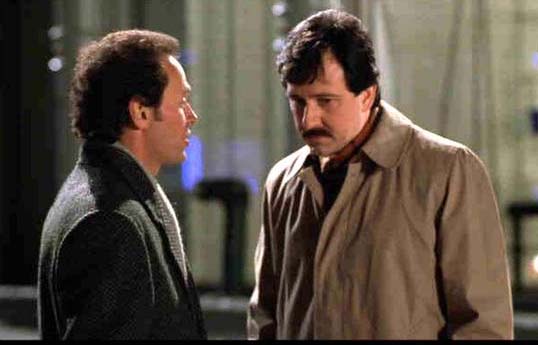
Some celebrity deaths take you by surprise and that is certainly the case with Bruno Kirby, who died Monday from leukemia. It seems as if Kirby has been around forever, popping up in various movies and TV shows (sometimes credited as Bruce Kirby Jr. or B. Kirby in his early days).
One of his first credits at the Internet Movie Database is the pilot episode of TV's M*A*S*H but he was also a semi-regular on Room 222 and appeared on other 1970s series such as Columbo, Kojak and Emergency! However, it's his film work that most people, including myself will recall.
From his appearance as one of the students in the supremely goofy and dated The Harrad Experiment in 1973 to his role as the young Clemenza opposite Robert De Niro's young Vito Corleone in The Godfather Part II. Still, Kirby didn't really hit his film stride until the 1980s, appearing in Albert Brooks' Modern Romance, This Is Spinal Tap and Birdy among others. He also worked three times in films with director Barry Levinson in Sleepers, Tin Men and Good Morning Vietnam. He teamed twice with Billy Crystal in When Harry Met Sally and City Slickers, the films that cemented his sardonic screen persona.
He wasn't just about comedy though — he also played the closeted coach in The Basketball Diaries and appeared in Donnie Brasco as well. For me, my favorite film role of Kirby's is as Marlon Brando's nephew in the great comedy The Freshman, so in a way you can say Kirby played opposite both Vito Corleones.
Still the strongest memories for me of Kirby may very well be his work in two television series. First, in the "Gas Man" episode of Homicide: Life on the Street, also directed by Levinson, where he played a man newly released from prison for causing an accidental poisoning death and determined to get revenge on Detective Frank Pembleton (Andre Braugher), the cop who put him behind bars, with the reluctant help of his friend (Richard Edson).
His first television work with Garry Shandling came in the last two seasons of "It's Garry Shandling's Show." where he played Garry's manager Brad Brillnick, but the more lasting and hysterical collaboration with Shandling came with Kirby frequently playing himself on The Larry Sanders Show as a guest who constantly gets bumped when the show goes long.
Tweet
Labels: Albert Brooks, B. Levinson, Brando, Braugher, De Niro, Homicide, Larry Sanders, Obituary, Shandling, Television
TO READ ON, CLICK HERE
Saturday, June 24, 2006
Is Michael Douglas a Male Chauvinist Pig?
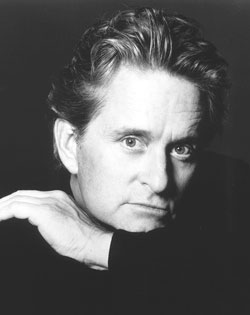
By Josh R
Did that get your attention?
When Mr. Copeland enlisted me as a contributor to this forum, he probably didn’t anticipate a post such as this — I think I’m supposed to be more informative than confrontational (trusting sort that he is, he overestimates my better instincts). Well, I can’t always take the classy route. This piece may contain some actual information, but it’s mostly just an old-fashioned hatchet job. Sometimes I like to get up on my high horse and kick up a little mud in people’s faces, especially when I feel such a response is merited.
I guess we’re at the point now where we can legitimately (if somewhat grudgingly) refer to Michael Douglas as a Hollywood legend. So maybe the guy doesn’t have the acting chops of a Dustin Hoffman or a Robert De Niro — or the sex appeal and glamour of a Robert Redford or Warren Beatty. Perhaps he can’t rival any of these gentlemen in terms of old-fashioned movie star charisma. OK, he definitely can’t. Still, one can make the fair argument that he’s earned his place in the pantheon. He is an Academy Award-winning actor and producer whose career spans more than 30 years. In a business where the careers of many actors of his generation have fallen by the wayside, he has weathered an unusual number of flops and misfires to retain his status as an A-List marquee attraction. His résumé also has included its fair share of hits, of both the critical and commercial variety. If the bulk of his work hasn’t demonstrated much beyond a solid professionalism, he has, on occasion, shown himself to be a talented and resourceful actor. He is a mainstay of Hollywood social circles, a mover-and-a-shaker, son of Kirk, and husband to Catherine Zeta-Jones. Whether you like the guy or not, he is, without question, a star.
Which is why it may come as something of a surprise that the man has been rejected by more women than any other man in the history of Hollywood.
It’s not his love life I’m referring to — in fact, reputation holds that he’s done fairly well in that department (to the point that his pre-nuptial agreement with Ms. Zeta-Jones is known to include an infidelity clause). The rejection that Mr. Douglas has suffered at the hands of Hollywood’s female acting elite has been of a professional nature — and, on at least three (and possibly four) occasions, it appears to have been deserved.
The lead role in One Flew Over the Cuckoo’s Nest, produced by Mr. Douglas and for which he received the Academy Award for best picture, was turned down by (in alphabetical order) Anne Bancroft, Ellen Burstyn, Colleen Dewhurst, Faye Dunaway, Jane Fonda, Angela Lansbury, Jeanne Moreau and Geraldine Page. Most of the actresses cited personal reasons for their refusal, ostensibly because of the nature of the material.
Ken Kesey’s novel had ignited a firestorm of controversy upon its publication in 1963, mainly due to its depiction of the character often referred to only as "Big Nurse," the sadistic ogre who presides over a mental ward populated by male patients. In Nurse Ratched, whose ugly countenance was described in almost as much detail (if not as frequently referenced) as her large, fleshy tits, Kesey had fashioned an interpretation of the female authority figure as an emasculating control freak, with no attempt to understand or get to the root of her behavior. As written by Kesey, critics observed that the character had about as much dimension as the Wicked Witch of the West. Since the novel’s debut on the best seller list coincided with the advent of the women’s movement, feminist activists had a field day denouncing what they (correctly) perceived as a monstrous disservice to the cause of women’s advancement in the professional arena. At the end of the novel, Ratched is raped by McMurphy — as imagined by Kesey, the assault is less an act of violence than an act of justice, retribution for her "rape" of the inmates in her charge. It’s a rape that the reader is supposed to cheer for.
Needless to say, by 1975, this wasn’t going to fly, so Douglas and his collaborators had to soften the material considerably. The character’s fiendish, subhuman bullying (with accompanying grunting) was replaced with a more subtle form of villainy, and the rape was jettisoned in favor of strangulation. Nevertheless, no major actress of the period was willing to go anywhere near it — some demurring politely, others expressing
 indignation that the film was being made in the first place. Joanne Woodward was never offered the role of Nurse Ratched — the story goes that she’d already taken herself out the running with a preemptive strike before the production team had even had the chance to approach her. Having gotten wind of the fact that her name had been bandied about in a casting session, she reportedly told Douglas that not only had she no intention of taking the role, she had no desire of even seeing the finished product. The role eventually was filled by an unknown, Louise Fletcher, who won an Academy Award for her performance before promptly returning to obscurity. The previous year’s winner, Ellen Burstyn (who had been among the first to take a pass on the film), went on television and asked Academy members not to vote in the best actress category to protest the lack of good roles for women. Fletcher later related to The New York Times, in reference to a conversation she’d had with Burstyn after the latter’s comments, “She hadn’t even seen Cuckoo’s Nest because she thought it would be too painful an experience. I told her that I thought it would have been nicer if she’d said what she said in a year when she had been nominated.”
Fatal Attraction is perhaps Mr. Douglas’ best-known and most influential film as an actor — for you young’uns out there, it’s about a basically decent guy who cheats on his angelic, idealized homemaker wife with a high-powered cosmopolitan book editor who turns out to be a raving psychopath. General chaos ensues — knives are wielded, children are kidnapped, cars are splashed with acid and beloved household pets are tossed into the crock pot. The role was turned down by Isabelle Adjani, Barbara Hershey, Miranda Richardson and Debra Winger. Richardson, a relative unknown whose involvement with the film might have propelled her to stardom, publicly stated that she found the script “regressive in its attitudes.” While the LA Reader’s John Powers was among those who saw the film as being “about men’s fear and hatred of women,” The New Yorker’s Pauline Kael went a step further in declaring “the film is about men seeing feminists as witches, and the way she’s presented here, the woman is a witch…she parrots the aggressively angry, self-righteous statements that have become commonplaces of feminist fiction, and they’re so inappropriate to the circumstances that they’re proof she’s loco.”
Unlike Cuckoo’s Nest (and Basic Instinct, which I’ll discuss presently), the producers didn’t have to resort to drafting an unknown actress to fill their star role. Glenn Close, who found herself in a bit of a career cul-de-sac after being typecast as the virgin mother (The World According to Garp), the nurturing, all-giving earth mother (The Big Chill), and quite literally, a glowing Madonna (the living embodiment of goodness and decency in The Natural), was desperate to break out of the holding pattern. She aggressively courted the role in a calculated risk that paid big dividends, earning an Oscar nomination for the performance. She’s been happily playing bitches ever since.

The impetus for this piece was seeing Basic Instinct again fairly recently — Douglas’ next monster hit after Fatal Attraction. I’m not sure what I was expecting, although it seemed diverting enough way back in good old 1992. For anyone who hasn’t had the “pleasure,” it’s basically the same deal as Fatal Attraction, only with an S&M twist and a cold-blooded gal who has no ability to love instead of a pathetic one who loves too much. Once again, audiences encountered a high-powered professional woman (in this case, a best-selling author) who is a sexual predator and sick as all get-out. Sharon Stone deservedly became an overnight sensation on the strength of her performance as Catherine Tramell, the ice-pick-wielding loony/white-hot fuck machine who inspired a thousand beaver jokes, thanks to the infamous and oft-parodied scene where director Paul Verhoeven invites the audience to rubberneck his leading lady’s privates. The actress had been knocking around Hollywood for many years, getting regular work without getting anywhere in particular, until she landed the role that would vault her into the bigtime.
As good as she was, her casting probably represented the last resort of an increasingly desperate production team. Kim Basinger, Michelle Pfeiffer, Julia Roberts, Demi Moore, Meg Ryan, Virginia Madsen, Lena Olin, Greta Scacchi and Emma Thompson all said no — whether their reluctance had more to do with the copious amount of female nudity the job required than the quality of the script and the nature of the character remains to be seen. In any event, the film became the subject of much protest as the result the character’s sexual orientation — which could be more accurately described as pansexual than bi. The film’s detractors claimed that the filmmakers not only viewed bisexuality as a perversion, but went so far as to equate it with sociopathic behavior. Gay and lesbian activists picketed while the film was shooting on location in San Francisco, requiring the deployment of police riot squads, and the controversy had already gotten a great deal of coverage before the film had even opened.
Having seen the film again recently, I do not find that it is offensive to gay people. I believe that it is offensive to all people. Not surprisingly, given the participation of Mr. Douglas, it is particularly insulting to women, particularly of the white-collar working variety. In addition to its insistence that there is something inherently evil about female sexuality, the film presents us with a secondary female character, a psychologist played by Jeanne Tripplehorn, who is not only completely incompetent in a professional capacity but a total doormat in her off hours. Her irrational attachment to Douglas’ character, who treats her like shit even when he’s making love to her (if that’s what it can be called, given the rough and graphic nature of their sex scenes), not only overrules her judgment and professional code of ethics, but leads to her eventual demise. And, yeah, turns out she also swings both ways. Dude…it’s hot!

If these three films provide us with a virtual who’s who of Hollywood actresses (at least in terms of who had the good sense not to bite), they don’t represent the only contribution Mr. Douglas has made to advancement of women’s rights during his long tenure as a leading man. As far as I know, Demi Moore was the first choice for the lead in Disclosure, which would serve to reason given her status as the top female box office attraction of the early '90s, after Julia Roberts. As such, there is no list of conscientious objectors to report, which might create the false impression that the film’s content is of a less incendiary nature than the other films discussed here. Actually, it’s probably the most corrosive of the bunch. Barry Levinson’s adaptation of the Michael Crichton novel plays to the popular male paranoia that not only are women trying to take away their jobs, they want to rip off their balls in the process. Once again, Douglas plays a basically decent guy who is passed over for a promotion in favor of the castrating bitch essayed by Ms. Moore, who becomes his new boss. Prowling through the corridors of power in stiletto heels and leaving a tiny trail of stab wounds in her wake, this dragon lady has no sooner started lashing the whip than she initiates an aggressive campaign to get into Mr. Douglas’ pants…much to his discomfort and embarrassment. It’s an exercise in role reversal that actually serves to trivialize the issue of workplace sexual harassment rather than shed any new light on the subject. The scene in which Ms. Moore throws Douglas up against a desk and starts shoving his cock in her mouth above his protests would be ludicrously funny in a high-camp way if it didn’t leave such a foul aftertaste (no pun intended).
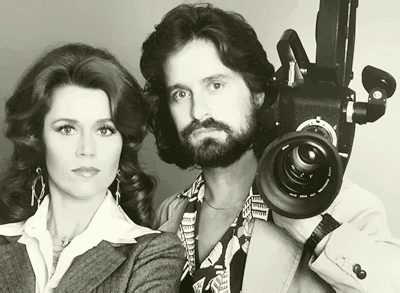
The tenor of this piece might suggest that I nurse a deep and abiding hatred for Michael Douglas — as both an actor and as a member of the human race. This is not the case — I have nothing against the guy. He has made some highly enjoyable films — Romancing the Stone and The War of the Roses always have been particular favorites of mine — and his turn as a rumpled professor experiencing a midlife crisis in Curtis Hanson’s Wonder Boys probably represents his best acting work to date (although his performance as greed incarnate in Oliver Stone’s Wall Street still commands a devoted following). I’m not really even trying to suggest that Michael Douglas actually is sexist. Putting aside the content of these films, there really isn’t anything to indicate that, as a private citizen, the man has a lack of respect for women and isn’t sympathetic to the issues that affect them. In his defense, it should be noted that he also produced The China Syndrome, which showed a strong, sympathetic female protagonist who refuses to accept the limitations imposed upon her by the powers-that-be, and proves her mettle and her integrity as a journalist.
That said, there’s no denying the fact that Michael Douglas has been involved with some of the most blatant exercises in anti-woman propaganda that the modern cinema has produced. I’m not one of those watchdogs who goes into a tizzy over any perceived instance of political incorrectness — frankly, I think most people are waaaay oversensitive about that kind of thing — but when you look at the kinds of films Michael Douglas has done, you’ve gotta wonder what’s going on in his head (beyond “Damn, I’m married to Catherine Zeta-Jones!”). If he had made just one of these films, I probably wouldn’t think much of it, but the fact is, he was involved with all four of them — and you’d be hard-pressed to find any four films made in the last 30 years which provoked more outrage on the part of feminist advocates. Whether this particular feature of Mr. Douglas’s career is the result of bad judgment or simply bad taste is open to debate, but in any event, it does seem to indicate a certain level of insensitivity (or at least lack of consideration) on his part. He seems to have been on his best behavior for the past decade or so…maybe Catherine managed to get some veto power to go along with the infidelity clause.
Tweet
Labels: B. Levinson, Bancroft, Barbara Hershey, Burstyn, Debra Winger, Demi, Dunaway, Emma Thompson, Geraldine Page, Glenn Close, J. Fonda, Julia Roberts, Kael, Lansbury, Pfeiffer, Sharon Stone
TO READ ON, CLICK HERE



