Wednesday, March 14, 2012
The Forest and Through the Trees

By Adam Ross
Horror movie franchises are typically based around an enduring villain (i.e. Frankenstein, Dracula, Jason Voorhees) but as The Evil Dead series gears up for another installment and celebrates the 25th anniversary of Evil Dead 2: Dead By Dawn, it's worth noting that its popularity is rooted in a constant hero. Played with career-defining conviction by Bruce Campbell, Ash has become one of the most popular modern movie heroes partly because we know he takes as much pain as he gives. When Evil Dead 2 premiered in 1987, it arrived as a sequel to a movie (The Evil Dead) which garnered only a microscopic theatrical release and, to those few who were familiar with the original, the new incarnation seemed more like a remake than a sequel. Even today it's still worth debating whether it's a true sequel or not, but it's undeniable in 2012 that Evil Dead 2 left a lasting fingerprint on the horror genre.
Six years passed between The Evil Dead and its sequel, an eternity in terms of horror follow-ups. Friday the 13th premiered in 1980, and by 1989 we already had Friday the 13th Part VIII: Jason Takes Manhattan. The Halloween franchise was readying its fifth installment by then, and the Nightmare On Elm Street series (which debuted in 1984) released No. 5 that year. While the aforementioned '80s horror standbys preyed on the audience's familiarity with their respective villains (needing only fresh victims or a new plot novelty in each iteration), the team behind The Evil Dead was banking on a returning hero with a plot that wasn't entirely original. Helped by an overly enthusiastic recommendation by author Stephen King, The Evil Dead was a modest box office hit, but thanks to its minuscule budget still turned a tidy profit. Short on budget, but not creativity, the original movie introduced the world to Ash (Bruce Campbell), who helped his friends fight off unseen evil from their isolated forest cabin. Compared to its follow-ups, The Evil Dead is more of a straightforward horror movie, with less emphasis on gross-out effects or slapstick humor. Behind the camera of The Evil Dead was the brotherly duo of Sam and Ted Raimi, along with a band of former Michigan State University students (including Campbell) with an affinity for horror movies.
The international success of The Evil Dead caught the attention of Italian film magnate Dino De Laurentiis, in particular the directing talents of Sam Raimi. Though De Laurentiis initially focused on having Raimi direct an adaptation of a King novel, the producer eventually
 greenlit a $3.6 million budget for Raimi and his crew to start work on Evil Dead 2. Acknowledging that most audiences were not familiar with The Evil Dead, the original script called for a preface with flashbacks to the first film ala The Road Warrior. But since Evil Dead 2 would be financed and distributed by another company, the filmmakers did not have license to use footage from the original movie. This legal setback was the genesis for making Evil Dead 2 more of a reboot plotwise of The Evil Dead. This was a positive for the sequel, because the predecessor's plot was ripe with potential for Raimi and company's larger budget. Writer Scott Spiegel was a utility man of sorts on The Evil Dead, performing a number of roles behind and in front of the camera. Spiegel was well known to the Raimi brothers and Campbell from their days as young amateur filmmakers in Michigan. For Evil Dead 2, he was tapped by Sam Raimi to co-write the script with him, and he is credited with the idea for bringing a more comedic and slapstick element to the movie. Evil Dead 2 would have the same setting and basic horror elements of The Evil Dead, but would include more characters, stunts, monsters, gore, laughs and pain.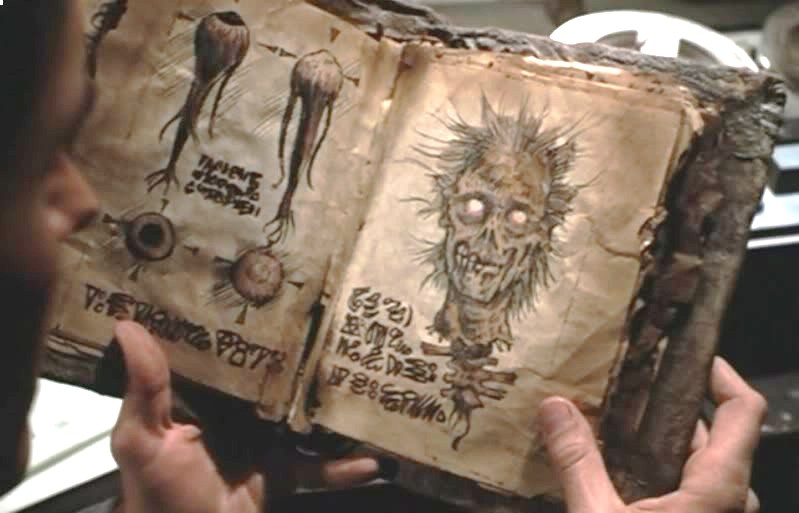
The movie starts again with Ash traveling to a remote cabin, this time with girlfriend Linda in tow. Little time is wasted before the MacGuffin from the original movie is introduced: the Necronomicon, or Book of the Dead. When Ash unwittingly plays a recording from the cabin's previous tenant (an archaeologist) reading from this cursed book, terrible forces start to attack the residence. After his girlfriend is possessed and attacks Ash, the movie briefly becomes a one-man show as our hero is attacked continually by forces ranging from the forest itself, the corpse of his girlfriend and even his own hand. The infamous scene where Ash must amputate his hand is one of the series' lasting images and illustrates the creative gulf between Team Raimi's vision of horror, and the typical slasher fare that populated theaters at the time. In freeing himself of the evil infection, Ash also painfully handicapped himself (however briefly) in a still ongoing fight against murderous forces. Before reinforcements arrive, Ash seemingly hits rock bottom when fountains of blood erupt from the walls and the house itself starts to laugh at him, but the real madness hasn't even begun.
The remaining cast is introduced when the archaeologist's daughter, Annie, and her team arrive at the cabin fresh from a dig, armed with more pages from the Necronomicon. This seemingly good news for Ash soon is spoiled when he promptly gets pummeled by one of Annie's assistants, mistaking him for a murderous lunatic (admittedly not far from the truth). This brief reprieve from paranormal punishment only lets the audience catch their breath for a moment before the intensity is again ratcheted up to new levels. This exhaustive pace is what makes Evil Dead 2 so refreshing compared to many horror movies still being poured into the same old molds. No killers lurk behind doors, no cars refuse to start — our characters barely can sit down in this tiny cabin without some new evil attacking them.

While the basis of the story was ported over from The Evil Dead, near the midpoint of Evil Dead 2 it firmly becomes its own movie, and that's when it merrily jumps off the rails. Raimi even includes a fun callback to the original movie. When Ash is locked in the basement by the new visitors and fights to escape, the action becomes a tribute to the monster in The Evil Dead, which spent many scenes vainly locked in that same room. The ridiculous climax where the forest itself starts to lay siege to the cabin, is a gleeful exercise by Raimi in one-upping every over-the-top gag you've seen so far in the movie. By the time Ash finds himself face down in the dirt in the Middle Ages, it barely even registers as a surprise after all the wild turns the movie has already made.
Even though the cast is larger than its predecessor, Evil Dead 2 undoubtedly belongs to Campbell. While he had been seen in several roles prior to this movie, it was his second turn as Ash that turned an actor with a generic name into Bruce Campbell. Playing a moving target for a myriad of possessed rednecks, invisible spirits and evil forestry, Campbell takes the action on his sharp chin again and again. Campbell famously did most of his stunts in the movie, and the actor forcibly brings you into his corner by charging again and again into the teeth of the titular enemies. The physical comedy Campbell displays would become one of the actor's trademarks: overplaying each dramatic mark with wide-eyed energy, coolly delivering his signature comeback lines and gladly sacrificing his health just to survive one more minute.

When we first see Ash, he's a normal guy with a beat-up Buick. By the end, he's not only lost his hand but he seems to have emerged stronger, aided by a newly installed chainsaw limb and the confidence from surviving an unrelenting attack from beyond the grave. When Ash raises his shotgun to lead his medieval followers, it's hard to doubt they will find victory together. Part of Ash's longevity as an action hero (he's been featured in video games, an iPhone app, comic books and various cameo appearances) has to be attributed to his rare standing as an everyman: he drives a crappy car, his idea of a vacation is a broken down cabin deep in the woods, he has some skills as a handyman, but prefers forcing the issue. Best of all, Ash doesn't run like so many horror movie characters — though it's not like he has a choice since a whole forest seems to be against him — he subscribes to the thinking that a good defense is a really good offense.
Evil Dead 2 became such a star-making turn for Campbell (and his character) that the series' third installment, Army of Darkness, relies more on the momentum and charm of Ash to carry it than simply continuing the previous movie's storyline. Compared to its predecessors, Army of Darkness is more adventure/sword and sorcery than horror, but still plows ahead with the same blunt-edged humor of Evil Dead 2. Featuring painful physicality, winking puns and Clint Eastwood-style one liners, the comedy of Evil Dead 2 and Army of Darkness has lived on in movies like Shaun of the Dead, Hellboy and, most recently, Tucker & Dale Vs. Evil. But Hollywood has yet to find another character with Ash's effortless courage in the face of terror combined with innocent charm. In most of Campbell's roles since the Evil Dead series, it's hard to tell where Ash ends and Campbell begins, or if the character is simply the actor playing it straight.
As the series marches on toward another sequel in the next couple years (with the story rumored to be another spinoff from The Evil Dead's framework), this low budget gross-out horror comedy only has increased in popularity through the decades. What did Evil Dead 2 do so right that so many of its peers could not? The best answer may be the best possible pairing of onscreen and offscreen talent. Sam Raimi has since proved his directing chops many times over with the likes of A Simple Plan, the Spider-Man trilogy and, most recently, Drag Me to Hell, and Campbell began a career as a cult action star with his performance here. When the two came together on screen with a script that pushed the envelope of typical horror conventions, the result was bloody good.
"Groovy."
Tweet
Labels: 80s, Bruce Campbell, Eastwood, Movie Tributes, Raimi, Remakes, Sequels
TO READ ON, CLICK HERE


Friday, December 23, 2011
Now We Know Why They Call Him Dirty Harry

By Damian Arlyn
I don't particularly like television, so I don't really watch a lot of it nowadays. Still, there are a few shows which I enjoy and one of those happens to be Fox's House, M.D. My wife had to turn me onto it because I thought it looked like just another hour-long medical drama in the vein of St. Elsewhere, ER or Chicago Hope. She told me that it was really more of a mystery show (she knows I love mysteries) and informed me that its protagonist, Dr. Gregory House, is a complex, charismatic and provocative character. His antisocial, unethical and misogynistic tendencies are matched only by his brilliant, obsessive and astute mind. Although it jumped the shark a couple seasons ago, I continue to tune in every week. Even through the worst of its outrageously cheesy and absurdly melodramatic plot twists, House himself (superbly played by Hugh Laurie) remains a fascinating character.

Right now, you're probably wondering to yourself why I'm talking so much about House in an article that, given the headline and picture above, is clearly about the 1971 Don Siegel film Dirty Harry, which celebrates its 40th anniversary today. Well, here's my reason. Although it is obvious that House is based on Sherlock Holmes, it occurred to me at a certain point that another fictional character has about equal claim to being a source of inspiration: San Francisco cop Harry Callahan. Harry may not be as brilliant as House, but he has about as much regard for social niceties, can be about as misogynistic and, just as House, always acts in the best interest of those he's trying to help (even if it means disobeying his superiors, putting his own life and career in jeopardy or even tricking, manipulating and sometimes even hurting those he's working to save) in his drive to ensure that justice prevails. The criminals' rights and the rules and regulations that his bosses demand he follow while pursuing those perpetrators concern him less. Harry, like House, just doesn't give a damn and when I realized that in many ways House could be described as "Dirty Harry with a medical degree," I understood not only how iconic Clint Eastwood's brave, tough-talking cop had become but what purpose characters such as Harry, House and their ilk serve for audiences.

Dirty Harry was made in a time when society wasn't feeling particularly safe. This seemed especially true in San Francisco, where the film is set, with the activity of the Zodiac Killer (on whom the movie's psychotic Scorpio Killer, broadly but effectively played by Andy Robinson, clearly is based). Much of that anxiety and frustration ended up being directed at the state and the filmmakers captured it. This anger doesn't seem aimed primarily at cops (indeed the film is even dedicated to San Francisco police officers who have given their lives in the line of duty) but rather to the system for which they work, a system that many people (much like today) felt had gone out of control. It presumed to function in the interests of the innocent but instead came off as more dedicated to preserving itself and/or the rights of the criminals. There is a very strong "anti-authoritarian" attitude present in Dirty Harry.

Throughout the film, Harry's desire to protect civilians from the malevolent force of evil, much to his dismay, constantly gets hindered or thwarted. Consequently, Harry, in essence, becomes a vigilante with a badge. He renounces his oath to serve the law and devotes his efforts to serving justice. In the film's final scene — with the Scorpio Killer in his sights — when he utters those famous lines ("I know what you’re thinking: 'Did he fire six shots, or only five?' Well, to tell you the truth, in all this excitement, I’ve kinda lost track myself., etc.) for the second time in the film, Harry clearly snarls the words with much more rage and menace — his attitude has changed. The bureaucracy's incompetence always annoyed him, but he has become so "fed up" with the whole thing that he wants no part of it. After dispatching Scorpio with his Magnum, Harry removes his badge and tosses it away. Obviously, no one planned any Dirty Harry sequels. This truly ends his character's story, not the subsequent adventures where Harry softens a little more in each new film.

When Dirty Harry was released in 1971, it caused quite a stir. Many critics, including Pauline Kael and Roger Ebert, articulated concern over the ideas and values expressed in it (with Ebert even calling it "fascist"). While I fully understand having such a reaction, I can't help but think that they are somewhat missing the point of what role such an extreme character can play for audiences and why Dirty Harry
 proved to be such a commercial success in its day. We all feel oppressed at times. We all feel abused or maligned and we all secretly wish we could act out the fantasies of retribution we have. Fortunately, we don't (or at least most of us don't) act on these impulses. Still, there is something appropriate about wanting to see good triumph and evil punished. Dirty Harry serves as a vessel for pent-up frustrations with our own impotence, an ideal of the kind of courage and tenacity it takes to do the right thing (regardless of the personal consequences) and watching him do what he has to do proves cathartic. We live vicariously through him as he says and does the things that we can't say and do but wish we could. He understands that the law is merely a man-made institution — it is not sacred — and if he must circumvent it sometimes in the name of the greater good, he'll do it. In fiction, one can get away with this. In reality, we don't have that luxury — reality always turns out to be far more complex, messy and nuanced than the simple black-and-white moral universe represented onscreen. So, we watch the rogue endeavors of vigilante heroes such as Harry, House, Robin Hood, Zorro, Batman or, even on occasion, James Bond (such as in Casino Royale when he just marches into an embassy, grabs a guy by the scruff of the neck and drags him out) and rightfully admire, respect and perhaps even envy them. As long as we don't imitate them, they fulfill their proper role in our lives.
 Sometimes to do good, you gotta get your hands a little dirty.
Tweet
Labels: 70s, Don Siegel, Eastwood, Ebert, House, Kael, Movie Tributes, Sequels, Television
TO READ ON, CLICK HERE
Saturday, November 26, 2011
"It's a miracle these people ever got out of the 20th century"

By Edward Copeland
Conventional wisdom about the Star Trek films considers Star Trek II: The Wrath of Khan the movie franchise's best offering. While Wrath of Khan certainly remains a very good film (and what wouldn't have looked great following that bore called Star Trek: The Motion Picture?), I've long held that finest film featuring the original crew happens to be Star Trek IV: The Voyage Home, which was released 25 years ago today. It may be my general bias toward genre series: I gravitate toward the installments packed with humor and Star Trek IV is damn funny. If you disagree, well — double dumb ass on you!
By no means could you ever call me a Trekkie (or Trekker, if you prefer). When I was in my earliest years of grade school, I would watch reruns of the original Star Trek, but I doubt I've seen every episode. I do remember standing in a line with my parents at a Toys 'R' Us when I was in first grade, waiting to briefly shake hands with "Captain Kirk" William Shatner. I think I watched two complete episodes of the Next Generation series and none of its spinoffs. (Though, to be truthful, of all the Star Trek movies I've seen — and I skipped Insurrection and Nemesis — I think the best of the films actually is Star Trek: First Contact with the Next Generation cast.) On the commentary track for the Star Trek IV DVD, Leonard Nimoy, who directed the film and helped come up with its story in addition to playing Spock, says, "The idea going in was to do an adventure film that was funny. We had just finished a couple of films where a lot of
 people died…there was a lot of pain and suffering. We decided it was time to lighten up…There was to be no heavy in this movie…" For some reason, when sci-fi, horror or fantasy series go the humor route, those end up being my favorite episodes or seasons. That's why season six was my favorite of The X-Files and I loved seasons three and six of Buffy, the Vampire Slayer the most. That's also why Star Trek IV, which starts firing one-liners and gags almost from the first frame, still cracks me up today. Actually, The Voyage Home doesn't immediately start out on a farcical level and while it doesn't present a villain per se, the story still requires a conflict to resolve. First, and unintentionally, the movie ended up being the final chapter in a trilogy they never set out to make. Nimoy talks on the commentary, which he shares with Shatner, that it had never been planned that way, but had developed naturally. In fact, sets that were destroyed after Star Trek III had to be rebuilt but, as Nimoy says, "We were used to being canceled." Wrath of Khan developed the Genesis Project story that leads to Spock's resurrection in Part III as well as the destruction of the Enterprise, whose crew takes over a Klingon bird of prey vessel, killing a Klingon crew that beams over to the Enterprise as it self-destructs. Part IV picks up with a new plot — a mysterious probe that sends out signals no one can translate and saps all the power from any ship in its path. Meanwhile, a Klingon ambassador (John Schuck) goes before the Federation Council and, standing before an enlarged photo of Kirk, demands his head for "war crimes" related to those events in Star Trek III. Spock's father, Ambassador Sarek (Mark Lester), arrives to defend Kirk's actions. "Vulcans are well known as the intellectual puppets of the Federation," the Klingon ambassador insists. Sarek reminds the Klingon that one of his vessels destroyed a Federation starship and his men killed Kirk's son. "Do you deny this?" Sarek asks. "We deny nothing. We have the right to preserve our race," the Klingon replies. Later, the Klingon ambassador threatens the body, telling them, "Remember this well — there shall be no peace as long as Kirk lives."
Meanwhile, the crew of the Enterprise has been exiled on the planet Vulcan for three months, trying to repair the Klingon ship so they can return to Earth to face court-martial charges and to get Spock re-energized back to his old self. It's really once we get to Vulcan and meet up with the regulars, that the comedy takes over. Even the Oscar-nominated score by Leonard Rosenman, with its bouncy, vibrant rhythm, seems to have been composed for a screwball farce. As most episodes of the series began, we get Kirk recording a captain's log, catching us up, including the fact that McCoy (the late, great De Forest Kelley, who always managed to get laughs whether they were embarking on a comic story or not) had given the Klingon ship an "appropriate name" and we see spray-painted on its side the words "H.M.S. Bounty."
 Kirk, who has been promoted to an admiral by now in the movie series, assembles his crew, which consists only of the regulars since they stole the Enterprise in the last film (one of the Federation's main charges against them for which they are facing court-martial) to find Spock's physical essence and restore his mind which he conveniently implanted in McCoy's brain before he sacrificed his life (for a little while at least) in Wrath of Khan. The only extra character along for the ride was the Star Trek movies' creation — the Vulcan Lt. Saavik (played by Robin Curtis here and in Part III but created by Kirstie Alley in Wrath of Khan). Kirk quizzes Scotty (the late James Doohan) on how much long it will be until the Klingon ship can fly again. When he tells Kirk that it shouldn't take more than another day or so, the admiral wants to know why it is taking so long. Scotty replies, "Damage control is easy — reading Klingon, that's hard." As everyone gets to work, McCoy takes Kirk aside and starts bitching that they have to return to Earth in the Klingon ship — he thinks the Federation should have sent a ship for them. "It's bad enough to be court-martialed and spend the rest of our lives mining borite, but to have to go home in this Klingon flea trap," Bones complains. "We could learn a thing or two from this flea trap. It's got a cloaking device that cost us a lot," Jim argues. "Just wish we could cloak the stench," McCoy replies.
Spock isn't pitching in with his crewmates yet, as he still is getting up to speed, wearing Vulcan robes and spending time with a computer that's testing his brain. He has no difficulty answering questions relating to history or scientific knowledge. (As an example,
 the computer asks, "What was Kiri-Kin-Tha's first law of metaphysics?" to which Spock answers, "Nothing unreal exists.") Where Spock runs into trouble is when his human side gets tested and the computer asks, "How do you feel?" and Spock can't conceive of a possible response. As Spock puzzles over the question, he's surprised by his human mother Amanda (the late veteran actress Jane Wyatt), who tries to explain that the half of him comes from her will return as well. Since only the all-logical Vulcan side has developed at this point, both the question and his mother's words remain incomprehensible. (I know the recent Star Trek movie starts with the fabled original
 characters at younger ages, but it still boggles my mind to see poor Winona Ryder, who just turned 40 a month or so ago, cast as Amanda and then knocked off in a muddled resolution that destroys the planet Vulcan.) Echoing the question that was asked repeatedly both ways in Wrath of Khan, his mother inquires, "Spock, does the good of the many outweigh the good of the one?" He tells her that he "would accept that as an axiom." His mother tries to break through by explaining, "Then you stand here alive because of a mistake made by your flawed, feeling, human friends. They have sacrificed their futures because they believed that the good of the one — you — was more important to them." Spock replies, "Humans make illogical decisions." "They do indeed," Amanda says. (I've always wondered, not being a serious Star Trek aficionado how an all-logic, emotionless Vulcan such as Sarek and a human such as Amanda would have hooked up in the first place.) That scene really is about as serious as Star Trek IV gets. Thankfully, Spock doesn't instantly find his human side because the fact that he isn't all there provides a great many of the laughs in the film. In the DVD commentary, Nimoy shares an interesting fact about the making of the film and Wyatt's longevity in Hollywood. One of her earliest films was Frank Capra's 1937 movie Lost Horizon. Working on the set as a second assistant director the day Wyatt's scenes were shot was his grandson, Frank Capra III.
The Klingon ship finally has been restored to a condition that allows the crew to leave Vulcan and fly back to Earth for their trial. Spock rejoins them but since there aren't any extra uniforms lying around, he remains cloaked in Vulcan robes. One person who doesn't come along is Lt. Saavik, who stays behind on Vulcan. On the commentary, Nimoy says there had been plans that, since Saavik had helped Spock through the rapid aging process of his regeneration, she would turn up pregnant with Spock's child from his second adolescence, but that plot never was pursued. Even if you're not an obsessive fan of Star Trek, it's always nice to see the entire cast when they're assembled on the
 bridge, even if it's a Klingon bridge as in this case, which might as well be the stage of a comedy club. "Cloaking device available on all flight modes," Chekov (Walter Koenig) reports to Kirk. "I'm impressed. That's a lot of work for a short journey," Kirk compliments him. "We are in an enemy wessel. I did not wish to be shot down on our way to our own funeral," Chekov replies. It would be a funny line, even if it didn't have the added laugh that comes from Chekov's supposed Russian accent that makes vessel come out as "wessel," a running gag throughout the film. McCoy tries to engage Spock in conversation and immediately notices that the Spock they knew literally is not all there. He tries to warn Kirk. "I don't know if you've got the whole picture, but he's not exactly working on all thrusters," Bones tells him, but Kirk isn't concerned since the scientific side of Spock seems to be functional. Of course, they have no idea about the probe that has claimed more ships and now threatens Earth. Uhura (Nichelle Nichols) gets the first clue about the problem as she hears overlapping distress calls and the probe's strange signals. The crew gets a message from the Federation Council president (Robert Ellenstein) urging all ships to avoid Earth and informing those listening that the mystery probe has ionized almost all of Earth's atmosphere and vaporized two-thirds of its oceans. Spock shows that his mind definitely fires on all thrusters, having Uhura isolate the signal from the probe. From his memory, he believes it is making the sound of the humpback whale, a species native to Earth that went extinct in the 21st century. Kirk hits upon an idea: They will take the ship back in time when the sea mammals did exist, bring two back to the 23rd century so they can speak with the probe and begin to repopulate. Admittedly, the mission would be a long shot, but it might be the only hope Earth has for survival. McCoy thinks Kirk has gone bonkers.
McCOY: You're going to try time traveling in this rust bucket?
KIRK: Well, we've done it before.
McCOY: Sure, you slingshot around the sun, pick up enough speed — you're in time warp. If you don't, you're fried.
KIRK:I prefer it to nothing.
McCOY: I prefer a dose of common sense. You're proposing that we go backwards in time, find humpback whales, then bring them forward in time, drop 'em off and hope to hell they tell this probe what to do with itself.
KIRK: That's the general idea.
McCOY: Well, that's crazy!
KIRK: You've got a better idea? Now's the time.
Kirk sends a garbled signal to the Federation about their plan and they set a course for the late 20th century — and that's when the fun really begins. Parts of the DVD back-and-forth between Shatner and Nimoy comes off nearly as funny as the scenes set in "the past,"
 particularly the exchange where Shatner tells how he hated the idea for Star Trek IV when Nimoy and producer Harve Bennett, who shared the story credit with Nimoy and was one of the film's four credited screenwriters, brought it to him. "I never abided time travel — it was too easy to solve things by time travel. You could get out of the deus ex machina by saying, 'Oh well, we corrected that,'" Shatner says on the DVD. "The alarm clock rings and the hero wakes up and it's all been a bad dream. So I said to Leonard and to Harve that I didn't think time travel was a good idea and was quite adamant in my opinion. Luckily, they paid no attention to me whatsoever." That prompts Nimoy to interject, "We actually said that to each other, 'Let's not pay him any attention whatsoever.'" Shatner reminds Nimoy, "And add the word 'again.' Let's not pay him any attention whatsoever again." Nimoy then explains a general principle, "If Bill says, 'Don't do it,' you just do it." Given how Star Trek V: The Final Frontier turned out when they allowed Shatner to direct, you can't help feeling that Nimoy wasn't necessarily joking. With two people credited with the story on Star Trek IV and four with the screenplay, the movie provides a rare example of a film with multiple names credited with its script that doesn't turn out to be a disaster.
 After the disorientation that comes with a time warp, Kirk awaits confirmation as to whether or not they arrived in the past. "Judging by the pollution content of the atmosphere, I believe we have arrived at the late 20th century," Spock reports. Almost immediately, Uhura picks up whale songs. Once they enter the 20th century atmosphere, Spock suggests tracking devices might detect them so, thanks to Klingon technology, they turn on the cloaking device. When they hone in on where the whale songs are strongest, it leads them to San
 Francisco, which puzzles them at first wondering why whales would be in a city, speculating that the whales could be in captivity. Scotty calls to the bridge with a bigger problem — those damn dilithium crystals! They're breaking up and Scotty doesn't think they can keep the ship cloaked for more than a day and certainly won't have enough power left to get them out of orbit, let alone back to the 23rd century. Kirk asks if there is any way to recrystallize dilithium crystals, but Scotty doesn't know any, but Spock has a suggestion available in the 20th century. "If memory serves, there was a dubious flirtation with nuclear fission reactors resulting in toxic side effects. By the beginning of the fusion era, these reactors had been replaced, but at this time, we should be able to find some," Spock suggests, theorizing they could rig a device to collect the high energy protons safely and inject them into the dilithium chamber, hopefully causing recrystallization. Kirk asks
 where they would find them and Spock recalls nuclear-powered Naval vessels. As they descend into San Francisco, Sulu (George Takei) mentions that he was born there. That's the last remnant of a story they had to scratch because they ran out of time shooting in San Francisco. Nimoy says on the DVD that originally Sulu was to aid a young Japanese boy in trouble only to discover that the kid was his own great great grandfather. That might explain why of all the crew members, Sulu seems to have the least San Francisco story of the 23rd century visitors. Kirk gives his crew what amounts to a coach's halftime speech, warning them about what they'll encounter in 1986. "Many of their customs will doubtless take us by surprise," Kirk tells the crew. "This is an extremely primitive and paranoid culture." When Star Trek was on TV, Gene Roddenberry incorporated topical issues but framed them within the sci-fi format. The movies had avoided this approach so far, but not only was The Voyage Home funny, it was satirical, taking pot shots at the year it came out without being specific, and adding an environmental message as well. Kirk also realizes that no one in 1986 would have encountered an extra-terrestrial before so Spock tears off part of his robe, fashions it into a headband and wraps it around his skull to mask those distinctive ears. "We talked endlessly about should these people change clothes when they get out on the streets of San Francisco," Nimoy says on the commentary. "After a couple of location scouting trips, I saw people wearing such outlandish things I said, 'Forget it — they'll go as they are.'" When they venture out of the ship for the first time, Kirk says, "Everybody remember where we parked." They are divided into three teams: Uhura and Chekov will try to find the uranium, Sulu, McCoy and Scotty will construct a whale tank and Kirk and Spock will find those humpbacks.
When daytime comes and they hit the streets, The Voyage Home practically becomes bedroom farce without the bedroom, even with horndog Kirk leading the way. The crew assembles in busy downtown San Francisco to discuss their plans of action. Kirk notes a newspaper machine where the headline reads Nuclear Arms Talks Stalled, which prompts Kirk to speak the title of this post, "It's a miracle these people ever got out of the 20th century." He also sees a man inserting coins to get the paper out and realizes that they still use money. He tells the rest to wait when he spots an antique store with a sign that says it buys and sells. It starts the movie's premier running gag on profanity as Kirk darts in front of a cab (Spock tagging along), nearly getting run over and the driver yells, "Watch where you're going, you dumb ass!" A flustered Kirk responds with "And double dumb ass on you!" Kirk gets to the antique shop and sells a pair of 18th century spectacles for $200. Spock asks Kirk if those weren't a present from Dr. McCoy. "And they will be again, Spock. That's the beauty of it," Kirk tells him. They return to their shipmates, divide the money and go on their separate adventures. While Spock tries to use his logical
 mind and massive internal warehouse of information to transfer the coordinates for those whale signs to a street map they find at a bus stop, Kirk stumps the Vulcan by finding the answer when the bus shows up bearing an ad for humpback whales named George and Gracie on display at the Cetacean Institute in Sausalito (once they conquer the problem of exact change). A sign helps McCoy and Scotty as well as they see one for yellow pages to find a manufacturer to help construct the 20th century equivalent of transparent aluminum, which won't exist for 150 years. The biggest comedy comes from Uhura and Chekov, who also use a phone book to find the location of a Naval station, but have less luck getting people to explain to them where it is. The funniest encounter comes when they ask a stoic motorcycle cop how to get to the Naval base in Alameda. "Where they keep the nuclear wessels," Chekov adds, forgetting he's in a time where Russians looking for nuclear anything don't go over well. The sequence goes on as everyone they ask tell them the same information they asked.

Perhaps the funniest extended sequence of the film comes once Kirk and Spock get that exact change for the bus and take it out to Sausalito to meet George and Gracie. First, they try to talk on the bus but an obnoxious teen (Kirk Thatcher) blasting his punk rock makes it impossible. Kirk tries being polite, asking him to please turn it down, but the kid ignores him. Kirk tries a second time and the punk turns it up, Finally, Kirk yells, "Excuse me! Would you mind stopping that damn noise?" The punk flips Kirk off. Without much fanfare, Spock leans across and gives him the Vulcan nerve-pinch, rendering him unconscious to the applause of the entire bus. Now that they can talk, Spock seeks permission to ask Admiral Kirk a question, which annoys him. "Spock, don't call me Admiral. You used to call me
 Jim. Don't you remember?" The blank look convinces Kirk this isn't worth going into so he let's Spock proceed with his question. "Your use of language has altered since our arrival. It is currently laced with, shall we say, more colorful metaphors, 'double dumb ass on you' and so forth," Spock says. "Oh, you mean the profanity…Well that's simply the way they talk here. Nobody pays any attention to you unless you swear every other word. You'll find it in all the literature of the period," Kirk explains. Spock seeks examples. "Oh, the collected works of Jacqueline Susann, the novels of Harold Robbins," Kirk cites. Then Spock brings it home for the final punchline: "Ah, the giants." In a way, Star Trek IV reminds me of Airplane!, not that it tosses something that might earn a laugh against the wall every second just to see if it sticks, but that you never know where it will veer off for a joke next. It could have simply limited itself to the fish (or, more accurately, whale)-out-of-water style of comedy, but it's ready to go everywhere. It has jokes at the expense of the 20th century and with the Star Trek characters as the targets. The film may not have a villain, but Earth's future is at stake, yet the light tone in which most everything is played makes the whole probe-may-wipe-out-the-human-race backstory seem as if it's merely a MacGuffin. They never bother to explain where the probe comes from or what it needed to hear from the whales. In its simpler, less mysterious, more accessible way, it almost can be viewed like the monolith in 2001, though we get that the monolith shows up at significant moments in man's history. Why the probe shows up — who knows? If it's merely to save the whales, it sure took its sweet time (two centuries) to do it.
As tempting as it is to detail the entire film or give away every gag or joke (what Spock would call "a story with a humorous climax"), it would eat up too much space and perhaps some haven't seen it. Not that it will come as a shock that they succeed in their mission — after all, this is a series that subtitled Star Trek III: The Search for Spock as if they weren't going to find him. Nimoy succeeds at every role
 he attempts in this film. His direction proves sharp and clever as does his new take on Spock, especially when Spock tries to start integrating those "colorful metaphors" into his language and doesn't quite have a handle on them yet. The one major character introduced in the film is Dr. Gillian Taylor (Catherine Hicks), the whale expert at the aquarium who doesn't understand what these strange men are up to and eventually helps them in their plan to take George and Gracie to the future. She first meets up with Kirk and Spock when they come see her show and she delivers all the sad facts about the species' fight for survival against whalers and how they are being hunted to extinction. "To hunt a species to extinction is illogical," Spock says. "Who ever said the human race is logical?" Gillian responds. Later, Spock dives into their tank to talk to George and Gracie personally. When he gets back out, she wants to know what he's doing with "her whales." Spock replies, "They like you very much, but they are not the hell 'your' whales." Kirk, excited being near a female, tries to assure her that Spock is no one to fear, but he can't get his words quite right either. "He's harmless. Part of the free speech movement at Berkeley in the '60s. I think he did a little too much LDS." When Kirk and Gillian have dinner, she jokingly says to him, "Don't tell me, you're from outer space." Kirk answers, "No, I'm from Iowa. I only work in outer space."
Of the other crew members, Scotty, Chekov and especially McCoy all get their moments. McCoy and Scotty go to a plastics manufacturer and Scotty describes to the boss there what he would think of a substance with the attributes of his transparent aluminum. The man thinks it would be impossible, but Scotty asks for a computer so he could show him. "Computer! Computer?" Scotty talks at it. Trying to be helpful, McCoy hands him the mouse and Scotty speaks into it, "Hello, computer." The man suggests that Scotty just use the keyboard. "Keyboard? How quaint," he responds, but for not using one, he types out a three-dimensional diagram for the formula pretty damn fast, astounding the man. Bones takes Scotty aside while the man looks at his work. "You realize that by giving him the formula you're altering the future," McCoy warns. "Why? How do we know he didn't invent the thing?" Scotty says. Uhura and Chekov find the nuclear "wessel" (appropriately, the Enterprise) and beam aboard and grab their protons, but Scotty's losing power fast, so he only can beam back one at a time. They decide to let Uhura go back with the protons. Unfortunately, before they can get power restored and get a read on Chekov, he's captured, leading to some hysterical interrogation scenes by officials wanting to know how a Russian breached security and a man from the 23rd century completely puzzled by their inquiries. When Chekov finally gets a clue that he might be in real trouble, he tries to use his phaser, but the radiation affects it and he makese a run for it, taking a huge fall that leaves him seriously injured. When word gets back to the crew, McCoy yells, "Don't leave him in the hands of 20th century medicine!" That leads to a wild set piece where they disguise themselves as doctors to get into the hospital and save him.
Having endured 21st century medicine myself, McCoy's prejudices hit home to me even more now. The entire sequence showcases Kelley's finesse at playing the grumpy doc. As he walks down the hall and notices an elderly woman (Eve Smith) groaning on a gurney, he stops to ask what's wrong. "Kidney. Dialysis," she answers weakly. "Dialysis? What is this, the Dark Ages?" he asks and starts to move along,
 but he turns back and gives her a big pill. "Here. You swallow that, and if you have any more problems, just call me!" he tells her, giving her a pat on the cheek. As subterfuge, he and Kirk put Gillian on a gurney to try to get to Chekov. On the way, he overhears doctors joking about treatments such as chemotherapy, horrifying McCoy. When they get to where Chekov is, he's being guarded. Kirk tries to force their way in and Gillian moans, but the guard insists he has orders. Finally, Bones tells him, "My God, man. Do you want an acute case on your hands? This woman has immediate postprandial, upper-abdominal distention. Now, out of the way! Get out of the way!" and the guard lets them pass. Kirk asks what he said she had. "Cramps." Inside, he has to fight with the doctor who wants to relieve the cranial pressure on Chekov's brain by drilling holes. "My God, man. Drilling holes in his head isn't the answer," McCoy insists. Kirk takes the medical team aside, pretending he's on their side and needs to talk with them, but instead uses his phaser to lock them in an adjoining room until McCoy can work his magic. As they wheel Chekov out, the guard asks how the patient is doing. "He's gonna make it," Kirk tells him. "He? You came in with a she," the guard says, sounding the alarm. "One little mistake," Kirk quips as the chase begins. As they flee, they pass the elderly woman who is telling everyone, "The doctor gave me a pill, and I grew a new kidney!"
When I decided at the beginning of the year what anniversary tributes I wanted to write, I hesitated about Star Trek IV: The Voyage Home. I had not seen the film almost since its original release and this was the fourth film in a series, after all, based on a TV show. Could it possibly hold up? I was prepared to chunk this piece if once I re-watched it, my memories turned out to be more glowing than the reality. (It also glows literally thanks to Donald Peterman's luscious cinematography which managed to snag an Oscar nomination.) Thankfully, that wasn't the case and it even included an entertaining and informative commentary track as well. If anything, I appreciate Star Trek IV more now than I did then. I remembered how funny it was, but I'd forgotten how many levels it played on. There are two parts I haven't squeezed in that I must. The classic Scotty line when he successfully beams George and Gracie onto the Klingon ship, "Admiral, there be whales here!" Also, the resolution of the court-martial where pretty much all is forgiven except that no one likes calling him Admiral Kirk, so they demote him to Captain Kirk again and then they get that moment when the crew sees their new starship for the first time. So, I end with two photos: George and Gracie free in the 23rd century and the sight of the crew's new starship.


Tweet
Labels: 80s, Capra, Movie Tributes, Nimoy, Oscars, Sequels, Shatner, Television, Winona
TO READ ON, CLICK HERE
Monday, November 21, 2011
It's Still Alive

By Damian Arlyn
When the 18-year-old Mary Shelley decided to participate in a competition involving her husband and two other colleagues (including the famous British poet Lord Byron) centered on who could write the best horror story, she probably had very little notion that her story, which was reportedly based on a dream she had experienced, would be not only the obvious winner of the competition but go on to become one of the most celebrated and oft-imitated horror stories in Western Civilization. First published in 1818, Frankenstein, or the Modern Prometheus told the terrible tale of a scientist who created a monster and then suffered the disastrous consequences of such an action. Though it has been adapted for stage, screen and radio numerous times (including the campy but highly enjoyable Kenneth Branagh version made in 1994), there is one incarnation that stands above the rest: James Whale's 1931 masterpiece, which celebrates its 80th anniversary today. Released by the same studio as Tod Browning's Dracula and in the same year (a seminal one for monster movies it would seem), Universal's Frankenstein became a Hollywood classic for a variety of reasons, not the least of which was turning the unknown actor playing the large, mostly mute creature (an actor so obscure they didn't even include his name in the film's opening credits) into a major motion picture star. That actor's name was Boris Karloff.
Initially, Bela Lugosi was cast as the monster but he turned out to dislike the part so much that he soon quit the picture and Karloff stepped in. Karloff's performance is the heart of Frankenstein. His stiff, lumbering movements and vast emotional mood swings (from innocent curiosity to angry, maniacal rages) perfectly captures the early development of a newborn infant. One of the most heartbreaking
 sequences of the film also is one of the most memorable: his tragic encounter with a young girl. Though despised by everyone he comes into contact with, the child is the first and only person not to respond with fear or antagonism to his frightening appearance. She invites him to sit and play with her, tossing flowers into a nearby lake and watching them float. The giddy expression on the monster's face betrays the first real feelings of joy he's experienced since his creation, but it is short-lived. Once the flowers are all gone he stupidly picks up the girl and tosses her in the lake, drowning her in the process (a scene whose second half actually was censored upon original release). He quickly realizes he's done wrong and runs off with a look of fear, panic and confusion on his face, like a toddler who's just broken his mother's favorite vase and knows he's in trouble. It's a tremendously sad moment and not just because of the death of the child but because of the pathetic nature of the monster. Through his ignorance and foolishness, he destroyed the one thing in his life that offered him genuine unconditional love. Karloff's creature is one of the saddest and most sympathetic monsters ever put on screen. Some have speculated in recent years that the monster's lonely and persecuted existence served as a metaphor for director James Whale's own feelings of isolation as a homosexual.
The cast surrounding Karloff also is quite good. Colin Clive's portrayal of the obsessed scientist is as equally memorable as Karloff's performance (his declaration of "It's alive!" is forever etched in cinematic history). Dwight Frye plays Frankenstein's hunchbacked assistant Fritz with the same gleeful malevolence with which he played Renfield in Browning's film (it's almost as common to mistake Fritz's name for Igor as it is to assume Frankenstein is the name of the monster rather than the doctor). Another Dracula alumnus is Edward Van Sloan (Van Helsing) who once again plays a scientist in Whale's film, though one who meets a far more inauspicious end. Van Sloan also appears in a prologue warning more sensitive audience members of what they're about to see. Interestingly, Van Sloan performed a similar act at the conclusion of Dracula in its initial run.

Like the prior Dracula film, Frankenstein was based not primarily on the author's original novel but on a theatrical adaptation by John L. Balderston. Unlike Browning's film, however, it bore very little resemblance to its source material. Beside the essential premise and the names of a few of the characters, this Frankenstein was a work of total imagination. For example, details about how the creature is brought to life in the book are exceptionally few. This makes the legendary birthing sequence (brilliantly parodied in Mel Brooks' affectionate 1974 spoof Young Frankenstein), wherein Dr. Frankenstein uses the natural elements such as thunder and lightning to animate the lifeless corpse lying flat on the platform being lifted up high into the air while sparks of electricity fly noisily from various mechanical apparatuses all the more impressive. Likewise, the creature's appearance is radically different from that described in the book but no less creative and memorable. The now instantly recognizable look of the monster (the bolts on the neck, the flat head, the green skin, etc) was designed by make-up artist Jack Pierce, the man also responsible for yet another Universal monster a decade later — Lon Chaney Jr.'s Wolf Man. Needless to say, Frankenstein was a huge hit upon its release, but unlike a number of other Hollywood classics which now are dated terribly, Whale's film still holds up incredibly well.
One of the qualities that makes it so watchable are the amazing visuals. Clearly inspired by German expressionism, the stark and at times surreal look of the film contributes to the dark Caligari-like atmosphere. Whale was a theater director before he did cinema and he brings a theatricality to the film that helps make it more chilling and captivating. Whale would go on to direct the sequel Bride of Frankenstein (considered by many to be ever better than its predecessor but still unseen by me) and Universal's The Invisible Man. Whale tried to distance himself from his horror films later in his life but his career faltered and he eventually committed suicide in 1957. He even got his own film in 1998 in the form of Gods and Monsters where he was was played by openly gay actor Ian McKellen, who has admitted that he identifies very strongly with the struggles of the talented filmmaker. Regardless, however, of the obscurity or notoriety of Whale's more "serious" output, his horror work is among the best of the genre and Frankenstein wouldn't be the celebrated classic it is today without him. It also makes sense that the story of Frankenstein itself (as originally conceived by Shelley) wouldn't be as remembered today as it is without Whale's film. It's ironic that a story which warns against the dangers of man trying to achieve immortality shows no signs of "dying" anytime soon.

Tweet
Labels: 30s, Books, Branagh, Browning, Fiction, Karloff, Lon Chaney Jr., Lugosi, McKellen, Mel Brooks, Movie Tributes, Remakes, Sequels, Theater, Whale
TO READ ON, CLICK HERE
Friday, October 28, 2011
X's and evil

By Edward Copeland
I've never read a single X-Men comic book, but I loved the first two films, especially the second, though I thought the third was a miss and I skipped the Wolverine standalone movie. Of course, I doubt I'm alone in thinking that Magneto (as played by the marvelous Ian McKellen) wasn't a villain: He just argued for self-defense against those out to destroy mutants as opposed to the always conciliatory Professor X (Patrick Stewart). X-Men: First Class gives the series a welcome boost by going back and telling the story of how the group first started, when Magneto and Professor X were just young men named Charles and Erik and actually fought together.
What may be what I found most surprising about X-Men: First Class is that I think it's the first time I've enjoyed a performance by James McAvoy, who plays the young Charles Xavier who becomes Professor X. He displays a lightness and range that was missing in films such as The Last King of Scotland or Atonement. It's also fun to see the young Xavier as a partying college student in the early '60s using his telepathic powers to try to get laid as opposed to the serious man he will develop into as Professor X.
Michael Fassbender also does well as Erik Lehnsherr, the eventual Magneto, showing the World War II events that scarred him as a Jew and a tool of experimentation by the film's villain Sebastian Shaw (Kevin Bacon), who begins the film working with the Nazis but turns out to be a mutant himself intent on starting a nuclear war by engineering the Cuban Missile Crisis.
Bacon clearly enjoys chewing the scenery in his World War II scenes with his over-the-top German accent, but Shaw has some anti-aging abilities so when we meet him again in 1962 he speaks in his regular voice, which in a way might be one of the few points of shame in the otherwise other kicky ride.
Director Matthew Vaughn, who helmed Kick-Ass which got some favorable reviews but which I never saw, keeps X-Men: First Class moving at a good pace and handles both the action scenes and the quieter ones with equal aplomb.
The second biggest surprise for me was the character of Mystique. Not being familiar with her origin, I never realized that the blue shape shifter that Rebecca Romijn played in the original trilogy, began as Xavier's adopted sister and went by the name Raven. Even more startling, X-Men: First Class accomplishes something that none of the other films did: It makes her a sympathetic character, helped in no small part by having the young adult Mystique played by the talented Jennifer Lawrence, who is about as far removed from her Oscar-nominated role in Winter's Bone that you can imagine, but flexes more acting muscles in this movie than all the metal the two Magnetos have bent on film.
Others delivering fine performances include Oliver Platt as the only man in the CIA who believes in the mutant and their potential as a positive asset and Nicholas Hoult, who was so great as a kid in About a Boy and good in A Single Man, as a lab geek who turns out to be a mutant and turns himself into The Beast.
On the other hand, it can be a bit frightening to see January Jones as Sebastian Shaw's mutant partner in the 1960s, Emma Frost. The thought of Mad Men harridan Betty Draper Francis possessing special powers sends shivers down my spine.
The movie also has a priceless two-word cameo that comes when Charles and Erik travel the world recruiting mutants for their program. There's a single scene with the great Ray Wise as the secretary of state, but it's not enough. You can never give me enough Ray Wise.
While X-Men: First Class isn't as great as X-Men or X2: X-Men United, the movie provides a fun ride. My one major criticism is the explanation of the split between Professor X and Magneto and how Erik becomes the so-called "bad mutant." The explanation doesn't seem to fly.
In the other films, his explanation made sense to me since there were humans out to destroy or cure the mutants. Here, in the crucial moment that starts him on that path, it simply comes from the suggestion made by the Shaw character who he has hunted down for killing his mom and experimenting on him.
Other than that, X-Men: First Class turns out to be quite an enjoyable ride.
Tweet
Labels: 10s, Kevin Bacon, Mad Men, McAvoy, McKellen, Ray Wise, Sequels
TO READ ON, CLICK HERE
Saturday, October 22, 2011
"A person can't sneeze in this town without someone offering them a handkerchief"

How come you treat me like a worn-out shoe?
My hair's still curly and my eyes are still blue
Why don't you love me like you used to do?
•••
Well, why don't you be just like you used to be?
How come you find so many faults with me?
Somebody's changed so let me give you a clue
Why don't you love me like you used to do?
By Edward Copeland
Even if Hank Williams Sr. weren't well represented with songs that play throughout Peter Bogdanovich's film adaptation of Larry McMurtry's novel The Last Picture Show, somehow I think the movie would play as if it were a cinematic evocation of the music legend. Despite the fact that today marks the 40th anniversary of the film's release and The Last Picture Show took as its setting a small, depressed Texas town in 1951 and 1952 (even going so far as to have cinematographer Robert Surtees shoot it in glorious black & white), it contains a universality that resonates today both in human and economic terms. Williams' hit "Why Don't You Love Me (Like You Used to Do)?" that I quote partially above are the first words we hear, before any character speaks a line. In the movie's context, the lyrics could be describing the first person we see — high school senior Sonny Crawford (Timothy Bottoms). With the way the U.S. has been going of late, I know very few people who don't feel like a "worn-out shoe" and wish fondly for past, better days and these feelings stretch from one end of the ideological spectrum to the other. Fortunately, The Last Picture Show itself hasn't changed. Age has served the film well, helped in no small part by its amazing cast.
McMurtry, who based the town in the novel on his own small north Texas hometown of Archer City, co-wrote the screenplay with Bogdanovich, the former film critic who was directing his second credited feature film after the fun and tawdry thriller Targets that gave Boris Karloff a great, late career role. (Under the name Derek Thomas, he had filmed a sci-fi feature called Voyage to the Planet of Prehistoric Women in 1968 starring Mamie Van Doren.) In the novel, McMurtry renamed the town Thalia, but the film gave it another moniker — Anarene.
The movie opens on Anarene's main stretch of road and passes the Royal movie theater. The wind howls ferociously, blowing dust, leaves, trash and anything that isn't tied down through the air and down the street. The flying debris leads us to Sonny and that Hank Williams song, which comes from the radio of his old pickup that he's having a helluva time getting started. Actually, the pickup only half belongs to
 Sonny — he shares it with his best friend Duane Moore (Jeff Bridges), who always seems to get it first on date nights so he can neck with his girlfriend, Jacy Farrow (Cybill Shepherd in her film debut), widely considered the best-looking teen in town. Once Sonny gets that old pickup running, he spots young Billy (the late Sam Bottoms, Timothy's real-life younger brother) standing in the middle of the street with his broom, trying to sweep up the dust. Sonny honks at him and Billy smiles and climbs in the pickup with him. As he usually does, Sonny affectionately turns the mentally challenged boy's cap around backward and the two head to the pool hall owned by Sam the Lion (Ben Johnson). Sonny pays for what looks like a sticky bun and a bottle of pop, prompting Sam to shake his head. "You ain't ever gonna amount to nothing. Already spent a dime this morning, ain't even had a decent breakfast," Sam tells Sonny, but not in a mean-spirited way. "Why don't you comb you hair, Sonny? It sticks up…I'm surprised you had the nerve to show up this morning after that stomping y'all took last night." Sam's referring to Anarene High School's final football game of the year, where the team took a real beating. "It could've been worse," Sonny replies. "You could say that just about everything," Sam says.
 "It could've been worse" applies to most of the situations in The Last Picture Show, which can be described accurately by the overused phrase "slice of life." Plot doesn't drive the story — character, not only of the people but of the town itself, does. While you watch the movie, you aren't concerned with what happens next or how the film ends because you realize that life will go on for most of these fictional folks you've come to know even after the lights come up in the theater and the projector shuts off. Wherever the movie finishes will resemble a chapter stop more than a finale. (As if to prove the point, McMurtry returned to Thalia in four more novels, though Duane becomes the main character in the followups as opposed to Sonny, who decidedly takes the lead here. Bogdanovich even filmed the first sequel, Texasville, in 1990 with mixed results.)

Sam's reference to the previous night's football debacle displays an excellent example of what captivates the citizens in a so-called "one-stoplight" town such as Amarene, as the team's players (mainly Sonny and Duane, since they are the teammates we know best) get repeatedly berated by their elders the day after the loss. A common refrain becomes variations of the question, "Have you ever heard of tackling?" That even continues when Abilene (Clu Gulager), one of the many oil-field workers who live in Amarene, when he comes straight from work to Sam's pool hall, changes clothes and takes billiards so seriously that he has his own cue stick that he keeps in a case and assembles. While he's there, he collects on a bet he had with Sam on the game. Abilene isn't faithful in most areas of his life and that's telegraphed right away when we see that he'd bet against the hometown high school football team. "You see? This is what I get for bettin' on my own hometown ballteam. I ought'a have better sense," Sam says as he forks over the cash. "Wouldn't hurt to have a better hometown," the emotionless Abilene declares. Soon enough, football will fade from the town's collective memory as they move into basketball season. While sports may be important in holding this dying town
 together, we never see an actual game of any kind. The closest we come is one instance of basketball practice in the school gym. That's because high school sporting events aren't what The Last Picture Show wants to show us. It's telling a coming-of-age story — several in fact — and not all concern the teen characters in the tale. It's also about love and loss, not always in the present tense. Of course, at its core, The Last Picture Show also deals with community and by community, I mean gossip. In this small a town, very few secrets can be kept, yet at the same time its citizens seem fairly discreet about what they know and staying out of other people's business. I've never read the novel, but I can see how easily it would work in book form. There's a story that Bogdanovich, who was then married to multi-hyphenate Polly Platt, who died earlier this year, read the jacket cover of the book and didn't see a way it could work as a film until Platt outlined it for him in chronological form. She must have done a brilliant job since she not only changed Bogdanovich's mind but led him to the road where he ended up directing and co-writing one of the best films of all time. the balancing act needed to transfer The Last Picture Show to the screen would have been very tricky for anyone to pull off, but I think the reason it worked boiled down to two key elements: its look and its cast.
Platt, in addition to being the person who gave Bogdanovich the vision to turn McMurtry's novel into a feature film also served as the film's production designer and its uncredited costume designer, seamlessly taking the actors and Archer City, Texas, back in time nearly 20 years. Her work was helped in no small part by the legendary director of photography Robert Surtees' exquisite black & white images, which earned one of The Last Picture Show's eight Oscar nominations. Surtees received a total of 15 Oscar nominations for
 cinematography in his career and won three: for King Solomon's Mines, The Bad and the Beautiful and Ben-Hur. He actually lost twice in 1971 — he was nominated for Summer of '42 as well as The Last Picture Show. He earned four consecutive nominations from 1975-78, when he made his last film before he retired. Other nominations included The Sting, The Graduate and Oklahoma! He showed a strong gift for using both color and black & white and his stark look in The Last Picture Show perfectly captured the time and place of the setting without letting any nostalgia sneak into the proceedings, which it really shouldn't. No one is looking back at the events from the future, so that element shouldn't be there. In a way, it's interesting to compare it to George Lucas' American Graffiti two years later. Both films look at high school seniors and eschew musical scores in favor of soundtracks full of the pop hits of the era. The difference is that Graffiti, while good, revels in a "good old days" spirit with barely a mention of sexual curiosity let alone activity while The Last Picture Show depicts an entirely different economic class that's having very few good times, but certainly getting drunk and laid. Of course, adults didn't exist in Graffiti whereas their roles prove integral in The Last Picture Show. Admittedly, I haven't seen American Graffiti in some time — Lucas hasn't re-edited it to make the drag race CGI and digitally replaced all the cars out cruising with hybrids, has he?
Despite the film's ensemble nature, Sonny truly serves as the center of this movie's universe. Timothy Bottoms wears such deep, soulful eyes that it made him a natural to play a role that required deadpan humor as well heartbreaking drama. While the other younger cast members mostly continue to flourish in the industry if we can still count Randy Quaid, who made his film debut as Lester Marlow, a rich kid from Wichita Falls who lures Shepherd's Jacy to a nude swimming party, but has now transformed himself from a talented character actor into a fugitive from justice on the run with his wife and being pursued by Dog the Bounty Hunter), Bottoms' star never seemed to take off after such a promising start. The Last Picture Show was his second feature following Dalton Trumbo's Johnny Got His Gun and in 1973 he starred in The Paper Chase, but it has been mostly TV. low budget movies and downhill since then. (I suppose his most recent highlight was playing the title character in Trey Parker and Matt Stone's short-lived Comedy Central sitcom That's My Bush!) It's a shame because he's the key to so much of The Last Picture Show. Of those eight Oscar nominations that I mentioned it received, four went to acting and two won. All were much deserved, but Bottoms deserved a slot as well. I didn't add it up, but I imagine he appears in a great majority of the movie's scenes and a case could have easily been made for pushing him for lead — not that he stood a chance to win against Gene Hackman in The French Connection, but I would have nominated him before Walter Matthau in Kotch, George C. Scott in The Hospital or Topol in Fiddler on the Roof. However, I don't know if I could have evicted Peter Finch in Sunday Bloody Sunday for him.

Bottoms' Sonny though really serves as the line upon which so much of the movie's clothing hangs to dry. He's the first character we meet, introducing us to Billy, whose origin never gets explained, and more importantly Johnson's Oscar-winning Sam the Lion, who not only owns the pool hall but the diner and the Royal movie theater as well. Sonny takes us to the Royal for the first time, arriving late because of his delivery job. Miss Mosey (Jessie Lee Fulton), the kindly manager of the place who never has popcorn since she long ago forgot how the machine worked, tells Sonny that he already missed the newsreel and the comedy and the feature has started, so she only charges him 30 cents for admission. Imagine being able to see a movie for that cheap — and I imagine it wasn't that much more to get two movies and a newsreel, Now, the prices go up and up and up while, in general, the quality goes down further and
 further. Once inside, he hooks up with his girlfriend Charlene Duggs (Sharon Taggart), who gets annoyed that he doesn't realize what an important day it is. It seems it's their one-year anniversary of going steady. With that perfect deadpan aplomb I mentioned earlier, Bottoms as Sonny simply says, "Seems longer." The main feature playing that night is Father of the Bride starring Spencer Tracy and Elizabeth Taylor. Though Sonny and Charlene have relocated to the back row so they can make out, it's clear that Sonny finds the giant image of Liz Taylor more alluring than the girl who is kissing him, While we met Duane earlier when he got off work from the oil field and went to the diner with Sonny, he and Jacy show up and take the seats in front of them and it's clear that Duane finds it very satisfying to be kissing Jacy because they don't seem to be watching the movie at all. When the movie is over and all the kids exit, they tell Miss Mosey they enjoyed it, but I bet they wouldn't want to take a quiz on it. However, that wind still howls giving the older woman trouble putting up the poster for the next attraction so Sam gives her a hand teasing the return of Sands of Iwo Jima starring John Wayne. The town can boast having a movie theater, but it certainly isn't first run. After the show, Duane lets Sonny have the pickup, so he drives Charlene out by the lake and they begin to make out. You can tell this is a choreographed routine for the teens because Charlene immediately unhooks her bra and hangs it from the rearview mirror, which is followed immediately by Sonny's hands going to her bare breasts as if they were magnets and her chest was built out of metal. Charlene complains that something's wrong
 with Sonny — that he's acting as if he's bored or would rather be somewhere else. However, when Sonny does venture to place his hand somewhere else, Charlene goes nuts. "You cheapskate — you didn't even get me an anniversary present. Now, you want to get me pregnant," she barks as she starts to put her top back on. Sonny argues that it was only his hand, but she says she knows how one thing leads to another and she's waiting until she gets married. Sonny, a hangdog expression on his face, tells her that they should break up then. This shocks Charlene, but she gets mad, not upset. "Now don't go tellin' all the boys how hot I was," she warns him. "You wasn't that hot," Sonny sighs sadly in a monotone. He can't decide if he's depressed or relieved to be rid of Charlene when he shows up at the diner and tells the ever faithful manager/waitress Genevieve (the great Eileen Brennan) about it. "Jacy's the only pretty girl in town and Duane's got her," Sonny tells her. "Jacy will bring you more misery than she'll ever be worth," Genevieve declares. What a font of wisdom her character will turn out to be. Sonny remembers hearing the news that Genevieve's husband Dan finally is able to return to work, so he figures that means she won't be working much longer. In another moment from a 1971 film set in 1951 that could be taking place in 2011, she responds, "We've got four thousand dollars in doctor bills to pay. I'll probably be making cheeseburgers for your grandkids." If the bills are that high in 1951, calculate them now.
You will have to forgive me for saying so much — I have an unfortunate tendency to ramble about films I love — but I also needed to get you to this point so we could talk about the most important part of film dealing with Sonny, something that begins with doing a simple favor for Coach Popper (Bill Thurman). The coach asks Sonny if he will drive his wife Ruth (Cloris Leachman in her Oscar-winning performance) to her doctor's appointment. In exchange, he'll get Sonny out of physics lab. Sonny will take any excuse to get out of that class so he agrees. Mrs. Popper is surprised when Sonny shows up at her door — her husband didn't tell her that he wasn't taking her. It's all quiet and above board on that trip. However, when Sonny sees her again at the town's sad Christmas dance, she asks him if he could help her take out the trash from the refreshment stand. He does and the two share their first kiss. Ruth asks the teen if he'd be able to drive
 her to the clinic again next week. "You bet!" Sonny replies. Many movies and works of fiction have told stories of affairs between older married women and younger men of high school or college age, but none have done so with as much meaning or affection as The Last Picture Show does in its depiction of Sonny and Ruth, which tosses most of those clichés out. Ruth isn't some oversexed seductress — she's a lonely, needy woman of 40 trapped in a miserable marriage. The movie doesn't spell it out directly, but in the commentary on the DVD, Bogdanovich says that Coach Popper is supposed to be gay. To me what's so stunning about Leachman's performance is that I can't think of her in any other dramatic roles. She's a comic actress extraordinaire. but she's so frighteningly good as Ruth I wonder why we never saw her explore really juicy drama. When Ruth and Sonny make love for the first time, it's such a mixture of elements when you have the overanxious boy rushing to lose his virginity while the 40-year-old married woman cries because she feared she never know that feeling again. As their affair continues, she actually seems to grow younger. Sonny also finds himself surprised to learn how many people are aware of what's going on between the two of them.
As great as Leachman is, she didn't win that Oscar in a walk. Her toughest competition came from the same film. Ellen Burstyn scored her first Oscar nomination in the same category, supporting actress, for playing Lois Farrow, Jacy's mother. Burstyn always is brilliant, but she
 manages to make us have sympathy for Lois at the same time we realize that her somewhat crazy ways have rubbed off on her daughter and turned her into the superficial cocktease that she is. Jacy claims she loves Duane, but her parents won't ever permit her to marry a boy like him without a future. The Farrows are one of the few well-off families in town, thanks to her husband striking oil. Not that it has saved the marriage any because Lois has been having an on again-off again affair with Abilene for quite some time. Jacy tries to convince her mother that she married her father when he wasn't rich. "I scared your daddy into getting rich, beautiful," Lois tells her daughter. Jacy insists that if Daddy could do it, so could Duane. "Not married to you. You're not scary enough," her mother replies. Later, when Lois informs Jacy about Sonny and Ruth's affair, Jacy's shocked, "She is 40 years old." Her mother quickly says, "So am I, honey. It's an itchy age." The big scenes for Burstyn (and Leachman) don't come until after other developments.
The fourth performer to earn an acting nod from the film was the great Jeff Bridges as Duane. It was his very first. He's good, but Duane actually isn't that large a part despite the fact he becomes the central figure in the book sequels. Duane's love for Jacy goes beyond reason. When she ditches him at the dance to go to the nude swim party in Wichita Falls, he takes it. When she finally agrees to put out,
 he can't perform (though Bridges' facial expression when she exposes her breasts to him is priceless). They try again and he comes out all smiles and she cuts him down, telling him, "Oh, quit prissing. I don't think you done it right, anyway." Finally, as she ducks him more often, he leaves town to take another job elsewhere, but gives Sonny explicit orders to watch if anyone starts seeing her. One night, Abilene stops by the Farrow house to tell her dad that a well came in, but he isn't home. He ends up taking Jacy to the pool hall and having sex with her on a pool table, her hands grabbing hold of the corner pockets. After awhile, when the boy she'd been dating from Wichita Falls runs off and gets married, she pursues Sonny, who is powerless to resist, no matter how it hurts Ruth. When Duane returns and finds out that Sonny and Jacy are dating, he breaks a beer bottle against his face, injuring his eye. "Jacy's just the kind of girl that brings out the meanness in men," Genevieve tells Sonny when she sees him with the patch on his eye. Soon after, he and Jacy drive to Oklahoma to elope, only Jacy left a long detailed note so the Oklahoma state troopers detain them until her parents arrive and get the marriage annulled. Sonny rides back with Lois who tells him he's lucky they saved him from her.
In a way, I have saved the best for last, except it isn't really the last. If Timothy Bottoms' Sonny provides the line from which all the characters and stories dangle, Ben Johnson's Sam the Lion provides the posts that anchors his line. The story goes that Johnson didn't want to take the part because he thought it was too wordy and Bogdanovich, who had just completed a documentary on John Ford asked Ford to talk him into it. Ford reportedly asked Johnson if he wanted to be the Duke's sidekick all his life and told him that if he played the part,
 he'd win the Oscar for supporting actor and that's just what happened. There are so many moments in Johnson's performance that I'd love to pick, but so I don't go on forever, I'm concentrating on one, which also happens to be my favorite part of the film. Sam takes Sonny and Billy fishing at this reservoir on land he once owned and it opens him up about the past. He talks about this crazy girl he was involved with about 20 years ago after his wife had lost her mind and his sons had died and how they always came out there. She challenged him to ride horses across the water. He didn't think they'd make it, but somehow she did it. Sonny asks why he never married her, but Sam tells him she already was married — one of those young marriages people get into that makes them miserable. He figured some day it would end, but it never did. "If she was here I'd probably be just as crazy now as I was then in about five minutes. Ain't that ridiculous? Naw, it ain't really. 'Cause being crazy about a woman like her is always the right thing to do. Being an old decrepit bag of bones, that's what's ridiculous. Gettin' old," Sam declares. What makes the whole sequence and monologue even better is the way Bogdanovich films it. He starts out in a medium shot where you can see all three characters, but as the tale grows more romantic he slowly moves the camera in on Johnson's face. As he starts to tell how they never ended up together, the camera pulls back out again.

The Last Picture Show has so many great moments, big and small, that I want to talk about them all but I do have to mention one final Sam moment before wrapping up Lois and Ruth. Earlier in the film, before Duane beats him up (they reconcile anyway) Duane and Sonny drown separate sorrows in sundaes at the diner when Duane decides that he just wants to get out of town — that night — at least for the weekend. He suggests to
 Sonny that they go to Mexico. The two friends check their cash reserves and decide they can do it and get up and leave. Genevieve asks where they are going. "Mexico," they tell her. "Mexico?" As they drive the pickup down the street, they notice Sam sitting on the curb outside the theater. They tell him of their plans. He gives them some money, telling them that Mexico has a way of swallowing your money. Wistfully, he even says that if he were younger, he might go with them. There's something odd in the town — as if he has something else to say, but he just tells them he'll see them around and gives them a wave. Somehow though, even when you're watching The Last Picture Show for the first time, you know that will be the last time in the movie you'll see Sam. When Sonny and Duane come back, they go to the pool room and find it locked. They find that odd. They ask a man what's going on. He remembers that they've been gone so they don't know. Sam died. "Keeled over one of the snooker tables. Had a stroke," the man says. He adds the Sam left the diner to Genevieve, the theater to Miss Mosey and the pool hall to Sonny.
Back to that ride home from Oklahoma between Lois and Sonny. Before they get in the car, Lois tells him that he should have stayed with Ruth Popper. "Does everyone know about that?" he asks annoyed. She says yes. "I guess I treated her badly," Sonny admits. "Guess you did," Lois concurs. As she drives, Sonny says, "Nothin's really been right since Sam the Lion died." No, they really haven't, Lois agrees. Sonny guesses that she must have liked him a lot, but Lois says no, she loved him. Sonny mentions the story Sam told him about the girl and she's surprised. "He told you that? You know, I'm the one who started calling him Sam the Lion," Lois confesses as Sonny realizes that she was the girl that Sam talked about. She apologizes for getting slightly teary. "It's terrible to meet only one man in your life who knows what you're worth," Lois admits. "I guess if it wasn't for Sam, I'd have missed it, whatever it is. I'd have been one of them amity types that thinks that playin' bridge is about the best thing that life has to offer."
When Sonny gets back to town, he learns Duane, who has enlisted in the Army, is in town for a short visit. He asks if he wants to go with him to the Royal. Miss Mosey has to close the picture show. Duane agrees. The final movie is Howard Hawks' Red River. "No one wants to come to shows no more. Kid baseball in the summer, television all the time," Miss Mosey tells them. Imagine now. Out-of-sight prices, out-of-control crowds, declining quality of product, more at-home convenience, everything digital so there is in essence no difference between theaters and home. The next day, Duane boards a bus to his base to ship off for Korea. "I'll see you in a year or two if I don't get shot," he tells Sonny.
As Sonny works the pool hall, the scene mirrors the opening with the howling wind and blowing dust, only this time he hears a commotion. He runs outside and sees that a truck hauling cattle struck and killed Billy who, as usual was sweeping the middle of the street. A bunch of gawkers try to console the driver, explaining that the kid was "simple" and continuously asking why he had that broom. Sonny snaps. "He was sweeping you sons of bitches, he was sweeping!" he yells as he picks Billy's broken body up and lays it on the sidewalk.

Eventually, he works up the nerve to knock on Ruth's door and asks if he can have a cup of coffee with her. She apologizes for still being in her bathrobe this late in the day. Then, as she's starting to pour coffee, it's her turn to explode and she throws the cup and the coffee pot against the wall.
"What am I doing apologizing to you? Why am I always apologizing to you, you little bastard? Three months I've spent apologizing to you without you even being here. I haven't done anything wrong. Why can't I quit apologizing? You're the one ought to be sorry. I wouldn't still be in my bathrobe. I would've had my clothes on hours ago. It's because of you I quit caring if I got dressed or not. I guess because your friend got killed you want me to forget what you did and make it alright. I'm not sorry for you. You'd have left Billy too just like you left me. I bet you left him plenty of nights, whenever Jacy whistled. I wouldn't treat a dog that way. I guess I was so old and ugly it didn't matter how you treated me — you didn't love me."
Ruth sits down at the kitchen table across from Sonny. "You shouldn't have come here. I'm around that corner now. You've ruined it and it's lost completely. Just your needing me won't make it come back," Ruth tells him. He reaches out and takes her hand. She takes it and puts it to her face. He never says a word. The two of them just sit holding hands across the table.


Lots of people can quote the last lines of movies, but when you think about it, there aren't as many famous final ones as you would think. The Last Picture Show belongs in that exclusive company.
Tweet
Labels: 70s, B. Johnson, Bogdanovich, Burstyn, Cybill Shepherd, George C. Scott, Hackman, Hawks, Jeff Bridges, John Ford, Karloff, Liz, Lucas, Matthau, Movie Tributes, Oscars, R. Quaid, Sequels, Tracy, Wayne
TO READ ON, CLICK HERE


