Friday, December 30, 2011
"I'm just glad I'm here where it's quiet…" — Straw Dogs Part I

its 40th anniversary Thursday. If you haven't seen it and plan to at some point, best not to read this.)
By Edward Copeland
When Sam Peckinpah's classic The Wild Bunch opened in 1969, its violence drew much controversy, though many critics saw past the bloodshed to recognize the movie's significance and greatness. Two years later, Peckinpah made Straw Dogs — and it received a near-universal greeting of pans, revulsion and diatribes that accused the film of being a one-dimensional attack on intellectuals and, even worse, an endorsement of the idea that rape victims "ask for it." Liking or disliking a movie always comes down to a person's subjective opinion and ideally — I believe anyway — that assessment should be formed by the artistry (or lack thereof) that's on the screen. When you read the reviews of Straw Dogs from 1971, that seldom seemed to be the case. In fact, many critics who despised the film praised Peckinpah's craft simultaneously. Straw Dogs became the victim of cinematic profiling, watched through the prism of real-world events. People projected views formed by outside experiences onto the movie and slammed it because of what they perceived it to be. There's always been a form of film criticism that chooses to judge movies in a political context and that's fine — it's a free country. However, that school of thought tries to apply that model to every movie, sometimes to the point of ridiculousness (I have good friends who believe that Forrest Gump somehow endorses Reaganism. I belong to the camp that believes if you don't think a film's good, just say so — a negative review need not be complicated with an ideological justification. A movie such as Thor sucks, but politics has nothing to do with why I formed that opinion.) I've went way off topic — this post salutes 1971's Straw Dogs. It's ironic, considering the film's title originated as a variation of the term "straw man," roughly defined as a mediocre argument or idea put out so it can be defeated by a better one. Over the decades, more have recognized the major misinterpretation that Straw Dogs received upon release. Its 40th anniversary offers an ideal opportunity for reassessment and analysis of the film as the complex, layered thriller that I believe Peckinpah made in the first place.
While I'm too young to have seen 1971's films in first run, knowing much of the history, events and certainly the movies that year, violence definitely dominated news and entertainment. Vietnam remained front and center as the South, backed by the U.S., invaded Laos and Cambodia while the war's unpopularity grew with larger protest marches (half-a-million people at one in D.C.) and bigger majorities in polls opposing it (60% in a Harris Poll); according to FBI statistics for 1971, the U.S. murder rate jumped to 8.6 people out of every 100,000, continuing the nonstop rise that began in 1964. Stats also showed that about 816,500 were victims of violent crime and there were 46,850 reports of forcible rape — a crime that often goes unreported which it did then more than it does now; Charles Manson and his followers were convicted and sentenced to death in the Tate-LaBianca murders, though a temporary repeal of capital punishment by the California Supreme Court the following year reverted the sentences to life; Wars were taking place beyond Vietnam. East Pakistan fought Pakistan for liberation, eventually becoming Bangladesh. Later, East Pakistan got into a skirmish with India, but the new country quickly surrendered. another "war" began in the U.S. that still continues when Nixon declared the "war on drugs"; Riots weren't uncommon in the U.S., including one in Camden, N.J., that began after police beat a Puerto Rican motorist to death. A more famous riot occurred at the Attica Correctional Facility in New York when nearly half of the more
 than 2,000 inmates seized the prison, taking 33 staff hostages for four days until New York state police retook it. At least 39 people were killed, including 10 hostages; It also was the era of frequent airplane hijackings. Though not a violent one, it was the year the infamous D.B. Cooper got his money and parachuted into oblivion; Coups, usually of the military type, brought down the governments in Turkey, Sudan, Thailand, Bolivia and Uganda, which brought to power Idi Amin. That's not counting the coups that failed. That's just a cursory glance at what an uneasy world it was in 1971. Flowing into this situation were many, many movies, some that played on that fear, others that allowed for a release of that feeling of impotence. A few of the more high-profile examples:
One of my all-time favorite critics is Pauline Kael, though I disagreed with her often, but she was completely off-base in what she wrote about Straw Dogs. I've compiled some of the key things she wrote in her New Yorker review of the film:
"Peckinpah's view of human experience seems to be no more than the sort of anecdote that drunks tell in bars."…"The actors are not allowed their usual freedom to become characters, because they're pawns in the overall scheme."…"The preparations are not in themselves pleasurable; the atmosphere is ominous and oppressive, but you're drawn in and you're held, because you can feel that it is building purposefully."…"The setting, the music and the people are deliberately disquieting. It is a thriller — a machine headed for destruction."…"What I am saying, I fear, is that Sam Peckinpah, who is an artist, has with Straw Dogs, made the first American film that is a fascist work of art."
While Kael mostly missed the mark, she came so close to acknowledging that she did see what Peckinpah's intentions were and that they were artistic ones, that it's almost sad. Let's look at those sentences separately. "Peckinpah's view of human experience seems to be no more than the sort of anecdote that drunks tell in bars." Mainly, that's Pauline doing what she loved to do best (and I admit I can be guilty of succumbing to myself) — thinking up a funny sentence and using it. In relation to Straw Dogs, Kael either was blinded by other factors as to what was on the screen or she refused to acknowledge that the story being told had more layers and complexity than a mere anecdote. I'll flesh out my rebuttal on that later. "The actors are not allowed their usual freedom to become characters, because they're pawns in the overall scheme." She's absolutely right here, but she's also being dishonest because as avid a moviegoer as she was she knew that not every film acts as a character study full of finely drawn portraits of the people inside. The woman who routinely answered the question, "What's your favorite film?" with 1932's Million Dollar Legs starring Jack Oakie and W.C. Fields isn't looking for that in every type of movie, especially a genre film and Straw Dogs belongs in the thriller family, albeit one with depth, intelligence and things to say. "The preparations are not in themselves pleasurable; the atmosphere is ominous and oppressive, but you're drawn in and you're held, because you can feel that it is building purposefully." Kael contradicts herself in the same sentence. All movies aren't designed to be pleasure rides, but they still can be enriching. It's the scenario I always posit among friends: You've gathered for a fun evening and you feel like watching Spielberg. What do you put in the DVD player — Jaws or Schindler's List? Just because you settle on Jaws doesn't mean that Schindler's isn't good, it's just not the type of movie you watch for a rollicking good time. The contradiction comes when she
 describes the atmosphere as "ominous," which would seem perfectly natural for a thriller and then admitting it held her attention because she could tell it was building toward something with a purpose. As I said, she was so close. That's exactly what Peckinpah was doing and did. "The setting, the music and the people are deliberately disquieting. It is a thriller — a machine headed for destruction." Finally, Pauline acknowledges that Straw Dogs is a thriller and within those two sentences, she doesn't say anything that indicates she thinks Peckinpah violated the rules of a thriller. The last sentence of Kael's that I excerpted shows where she hopped onboard a train to crazytown. "What I am saying, I fear, is that Sam Peckinpah, who is an artist, has with Straw Dogs, made the first American film that is a fascist work of art." Again, she admits Peckinpah's artistry but she claims he has used that gift to make a "fascist work of art." No wonder she prefaced that with "I fear" because one gift Kael always had, even when you disagreed with her (other than great writing skills) is that she made you re-think your opinion. She didn't necessarily change your mind, but she gave you ideas to mull. Her Straw Dogs review provides a rare example where I didn't believe that she believed the words she placed in print. Her review reads as if she wanted Straw Dogs perceived simply as a macho appeal to give in to our violent nature and a screed against intellectuals. That's what she wanted to see, but her heart and her brain seem to be having a wrestling match for control over her writing. The adjective fascist got bandied about a lot in reviews of Straw Dogs. I can see how some slapped that label onto Dirty Harry, even if I think that was an overreaction as well, because Dirty Harry carries political overtones and a point-of-view, but, as I said before, I believe films should be reviewed as films and ideology should stay out of it. What does it say then that a true fascist film such as Leni Riefenstahl's Triumph of the Will is a staple of film studies not because of content but technique? The adjective fascist should appear if a character in the movie has fascist characteristics or is a fascist, but to label a movie one — to me that's nearly as offensive as when Tipper Gore, James Baker's wife and the rest of the PMRC wanted to interpret what songs meant in the 1980s and institute stringent record labeling. As Frank Zappa said about their plans at the time, "It's like treating dandruff with decapitation." It also reminds me of what Jon Stewart said about politicians of both parties comparing opponents to Hitler. By doing that, they do a disservice to Hitler, he said, "who worked long and hard to be that evil." With that out of the way, it's high time I start talking about what actually happens in Straw Dogs. Before I do, I will say this: a bit of a pass can be given to Kael and other critics who shared her opinion and lay siege to Straw Dogs for all its perceived sins since the version that they saw wasn't the one I did. Peckinpah had to cut footage to avoid an X rating but on home media, they restored that scene. Granted, it might have elicited the same reaction, but the fact remains that when I saw Straw Dogs the first time, I literally didn't see the same cut that the critics of 1971 did — and the scene excised in 1971 got removed from the film's most controversial and debated scene, leaving only the ambiguous sexual assault that seems to turn consensual and omitting the second thug who undeniably commits rape.

The opening credits always remind me of parts of the beginning of The Wild Bunch, the titles themselves specifically naming that film's actors in semi-black-and-white (or more accurately, black-and-gray) freezes while they're on horseback. No actors lurk beneath the monochrome credits of Straw Dogs — where we first hear Fielding's foreboding score — but beneath the title cards, blurry images recall the ants overrunning the scorpion at the start of The Wild Bunch. When the picture comes into focus and color, we see that what's scurrying isn't insects but children, singing, dancing and playing with abandon — in a graveyard. Three of the youngsters circle a dog, which some interpret as torture. As someone who despises mistreatment of animals (I always say I've been screwed over by humans far more often than by dogs), it doesn't look that way to me. A few of the kids gaze through the cemetery fence at the activities in the center of the small Cornish village in England. American David Sumner (Dustin Hoffman) walks back toward his car carrying a box of supplies he's picked up while his wife Amy (Susan George), a native of the village, attracts leers as she struts down the street sans bra.


That shot, coming so early in the film, certainly had a lot to do with putting some of the critics in 1971 such as Kael on edge. She admits in her review that part of her reaction to the film probably stemmed from being a woman and if Peckinpah had placed that image of an extreme close-up of the actress's breasts with erect nipples for no apparent reason and it wasn't brought up again, I'd have been offended as well. When I first saw Straw Dogs, the shot took me aback. That looked like something you'd find in a cheap teen sex comedy in the wee hours of the morning on Cinemax, not in a Sam Peckinpah film starring Dustin Hoffman. Eventually though, it is discussed and you see the purpose — and it's not to say "some women want to be raped." We'll get to that later. I'll finish describing the opening sequence first. The teen Hedden siblings, Bobby and Janice (Lem Jones, Sally Thomsett), help Amy by carrying an antique mantrap that she purchased to her car. Charlie Venner (Del Henney) steps out of a phone booth when he catches sight of Amy. He dated Amy when she lived in the town with her father and the sight of her makes Venner salivate. In this very first sequence, Peckinpah and his editing team of Paul Davies, Tony Lawson (who'd go on to edit Kubrick's Barry Lyndon and every Neil Jordan film since Michael Collins) and Roger Spottiswoode (who also edited Peckinpah's Pat Garrett & Billy the Kid before turning to directing) set the quick-cut pattern that will dominate the movie. The director, stereotyped for slow-motion violence, paces much of Straw Dogs with split-second snapshots. Venner makes a beeline for David and Amy's car where Amy introduces Charlie to her husband. David puzzles over the mantrap that Amy bought and tries to place it in the backseat of the car with Bobby's help. David then tells Amy he's going to run into the pub to buy some cigarettes and David leaves her with Charlie, who shamelessly flirts with Amy and tries to get her to re-create old times.

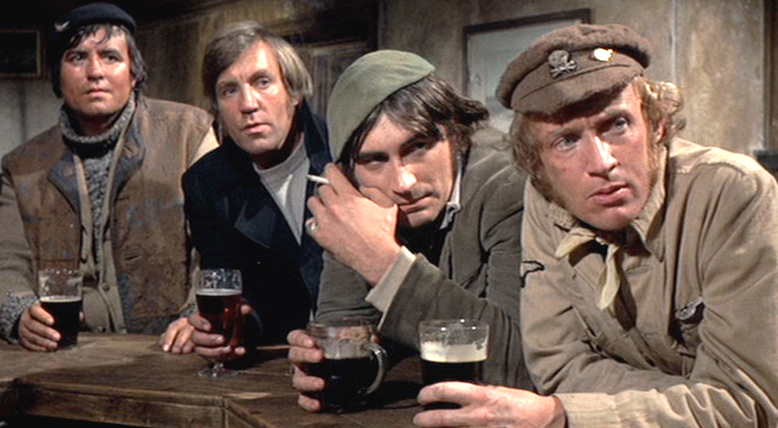
When David steps into the pub, he definitely feels and looks out of place — but it's not because he's wearing a sign that reads BRILLIANT MATHEMATICIAN STUDYING THEORIES YOU PEOPLE COULD NEVER COMPREHEND. No, his clothing, his look, his voice — they all point him out as someone who doesn't hail from that Cornish village as he asks for "Two packs of American cigarettes." However, no one taunts him or mocks him — they have a bigger troublemaker to deal with, one of their own. The burly, bearded Tom Hedden (Peter Vaughan), father to Bobby and Janice and the town drunk, somehow manages to maintain a degree of respect from those younger than him. As David has entered for his smokes, Tom wants another round after
 the pub's owner, Harry Ware (Robert Keegan), announces closing time for the afternoon. Tom slams his mug down, breaking it and cutting Harry's finger. As David witnesses this, Charlie enters the pub and asks how the work on David and Amy's garage is progressing. David complains that the two men working on it seem to be dragging their feet and Charlie volunteers to come up the next day with his cousin to help them pick up the pace. Sitting quietly in the pub, observing everything, happens to be the town's magistrate, Maj. John Scott (T.J. McKenna). Tom isn't going to take no for an answer, so he flips up the opening to the bar and serves himself. Scott warns Tom that he's had his fun, but he best be off or he'll have to bring charges and Charlie and another man help the drunkard out, but not before he apologizes to Harry and leaves money for the damage as well as David's cigarettes. Vaughan plays Tom well, straddling that line between charming old lush and frightening bastard. After they've left, David gives Harry the money for the cigarettes. The pub's owner tells him he's already been paid. "You have now," David says before leaving. Most of the actor's work has been in British television productions, though he did appear in Time Bandits and Brazil for Terry Gilliam and the HBO series Game of Thrones.

It takes a bit of a drive to get to Amy and David's farmhouse and since she's driving, Amy takes her husband on a fast and wild ride to get there, partly as punishment for his queries about her past with Charlie Venner. Before they get to the farm, Amy finally admits that years ago when she lived there, Charlie made a pass at her. David and Amy appear a rather unlikely couple, but in rare moments like this or when they're getting romantic, the two do show signs of sexual compatibility. In other instances, not so much. The screenplay by
 Peckinpah and David Zelag Goodman, based on the novel The Siege of Trencher's Farm by Gordon M. Williams, makes a point of showing that David doesn't respect Amy intellectually and, more than likely, views her as a sex object as much as the leering village thugs do. When the couple arrive at the farm, one of the two workers, Norman Scutt (Ken Hutchison) stands at attention on top of the garage. Amy makes a point of making out with David in the car in full view of Norman, though you can tell it makes her husband uncomfortable. The Sumners get out of the convertible and head separate directions — Amy to the house, David to inform Scutt of his incoming help. When David tells Scutt that Venner and his cousin will be arriving the next day to help him pick up the pace on the garage project, Scutt tells him that he and Mr. Cawsey don't have that much more to do. The name doesn't ring a bell with David, but Amy bumps into Mr. Chris Cawsey (Jim Norton) inside the farmhouse. When Cawsey steps outside, David remembers, "The rat man!" Cawsey helps Scutt on the garage, but his main skill involves exterminating rodents. Scutt asks David if he needs help unloading the mantrap (which really should be referred to as "Chekhov's mantrap" since you know its antique metal teeth shall clamp down on someone before the movie ends) and he gladly accepts. Cawsey explains that the mantraps were set them out in the field to catch poachers. As the three men stand alone outside, Straw Dogs comes as close as it ever will to explicitly discussing current world events occurring in 1971.
NORMAN: I hear it's pretty rough in the States.
CHRIS: Have you seen any of it, sir? Bombing, rioting, sniping, shooting the blacks. I hear it isn't safe to walk the streets, Norman.
NORMAN: Was you involved in it, sir? I mean, did you take part?
CHRIS: See anybody get knifed?
DAVID: Only between commercials. (after some talk concerning the mantrap) No, I'm just glad I'm here where it's quiet and you can breathe air that's clean and drink water that doesn't have to come out of a bottle.
David meekly flashes a peace sign and goes inside where Amy calls for the pet cat, who is nowhere to be found. Though the scene has moved inside, we hear the first line of dialogue between Cawsey and Scutt in the yard. Cawsey asks Scutt if he plans to "have a crack" at
 Amy. "Ten months inside" were enough for him," Norman replies, apparently referring to jail time. He then inquires if Cawsey saw anything in the house worth stealing and Chris answers no except for one item. He then twirls a pair of panties around his finger. Scutt calls him an idiot, but Cawsey assures him she has plenty and won't notice. "Don't you want my trophy?" Cawsey asks. Scutt says he'd rather have what goes in them. Cawsey tells him that Charlie Venner had a go at her when she lived there with her father and Scutt gets testy. "Venner's a bloody liar and so are you." Tensions in the house simmer more subtly. Amy continues her search for the cat and David mutters, "I'll kill her if she's in my study." Amy inquires as to what he said, pretending she didn't hear, but he doesn't repeat it, but she obviously did because she changes a plus sign in the equation on his study's blackboard to a minus sign. Later, Amy comes and annoys David in his study while he's trying to work. Finally getting the hint, she leaves, though David gazes out the window and sees she's laughing with Scutt and Cawsey who just sit on a wall, not working. She warns them that David will think that they're lazy.
When she returns to the study, he asks what the three of them found so funny. "They think you are strange," Amy tells him. "Do you think I'm strange?" David inquires of his wife. "Occasionally," she replies. He says she's acting like she's 14, which prompts her to chomp her gum louder, and he lowers her age to 12. "Want to try for 8?" She leaves him alone to his work, though later she calls to him that she needs some lettuce to prepare dinner. David gets up to fetch some from their tiny greenhouse when he notices the change on the chalkboard. "She's playing games now? What is this — grammar school?" he mumbles as he corrects the equation. When he gets to the greenhouse, Norman Scutt informs him that Riddaway (Donald Webster) has arrived to take he and Cawsey home. Cawsey stops by to share some odd little information with David. "I feel closer to rats than to people, even though I have to kill them to make a living. Their dying is my living," Cawsey declares as he climbs into Riddaway's truck and sings a little ditty, "Smell a rat, see a rat, kill a rat/That's me — Chris Cawsey/I'd be lost without em, I suppose/Cleverest thing I've seen around these parts is a rat." Later, Amy beckons David for dinner, but he seems peeved at being dragged from his work again.
A short scene in the pub gets inserted as night falls and a man comes in. Tom Hedden calls to the man, identifying him as John Niles (Peter Arne). He tells him that his brother Henry has been seen around young girls again and he better watch him or they'll have him put away. Tom's oldest son, Bertie (Michael Mundell), says that Henry only was tossing the ball to them, earning an icy stare from his father. John promises that if Henry starts to make any mistake "like he did before" he'll put him away himself. "If you don't, I will," Norman Scutt speaks up. When Henry shows up later in the film, he will be played by an unbilled David Warner in a part that's a million miles removed from his role in the previous Peckinpah film, The Ballad of Cable Hogue.
All of the major players have been mentioned or introduced and for the first time, I'm having to split the tribute to a single film in half. I don't have anything else ready to run anyway. For Part II, click here.
Tweet
Labels: 70s, Books, Caine, David Warner, Dustin Hoffman, Eastwood, Fiction, Fields, Hackman, HBO, Heston, Kael, Kubrick, Movie Tributes, Oscars, Peckinpah, Spielberg, Tarantino, Terry Gilliam
TO READ ON, CLICK HERE


Tuesday, December 27, 2011
Sex, Drugs and Quivering Holes: Cronenberg Puts Burroughs in a Straitjacket
BLOGGER'S NOTE: Naked Lunch was released 20 years ago today. Spoilers start in this essay’s first 25 words, so beware.

By Jeff Ignatius
When a rubbery former typewriter humps two lovers in David Cronenberg’s Naked Lunch, and when a grinning Roy Scheider emerges from his woman suit and shouts, “Benway!” near the film’s end, it’s so excessive that the movie seems to jump the rails. Of course, that must be impossible, because the tracks don’t exist, and if there aren’t at least a few Dada moments, something has gone awry. I haven’t read William Burroughs’ 1959 classic, but I imagine one of the great appeals of attempting any adaptation is that it offers a really long leash — just make sure it isn’t conventional, comfortable, boring, straightforward, or coherent.
Cronenberg seems incapable of making conventional or comfortable films, and Naked Lunch is in no way boring or straightforward. It is, however, coherent. The rails do exist — often to the movie’s benefit but finally to its detriment.
The writer/director genetically combined elements of the seminal book with people and events from its author’s life — Burroughslunch instead of Brundlefly — and the result is an uneasy fusion; the chaos of id has been organized and annotated, and the central character has been reduced to a pawn of his addictions and his unconscious mind. The movie is, on reflection, significantly more ambiguous and textured than that, but it’s hard to escape its central contradiction: One of the 20th century’s most important and innovative writers has bizarrely been stripped of ownership.

Burroughs is presented in Cronenberg’s movie as William/Bill Lee (Peter Weller), whose drug use leads to the accidental shooting death of his wife Joan (Judy Davis) and then escalates, sending him fleeing into the fantasy world of Interzone — a place of exotic hallucinogens and fluid sexuality and ever-shifting corporate intrigue and living typewriters and…. Bill’s “reports” as an agent become the novel Naked Lunch, and as he shifts from the roach powder stolen from his exterminator job to “black meat” to alien semen, he drifts further from recognizable reality. “I feel so — oh — severed,” he says at his most wretched. At heart, Cronenberg’s adaptation riffs on the idea of the artist as vessel — a mere conduit for the work. Lee’s art here bursts from a potent potion of drugs, grief, drugs, paranoia, drugs, buried desires, drugs and guilt — although any regret he feels has to be inferred from the convoluted conspiracy built to explain his wife’s death. This conceptual choice — more about the book and author than a presentation of the novel itself — gives the film its structure and narrative resonance. William Lee sheds tears twice, recognizing what he’s done to become and later prove he’s a writer, and it’s a solid story. Yet it’s far too neat and easy, especially for this movie.
Lest it sound as if I don’t like or admire Naked Lunch, let me be clear on a few points.

First, the movie is as repulsively, giddily transgressive as one could hope for from these idiosyncratic artists. Somewhat shockingly, the most obvious barrier to bringing the script to the screen was apparently not much of a problem. Despite unmistakable erections and orifices, blowjobs and cum shots, the damned thing got financed, made, and released — with an R rating, no less. (In the MPAA’s eyes, penises and anuses aren’t penises and anuses if they belong to bugs, typewriters or Mugwumps.)
Second (and largely given), the production design — by longtime Cronenberg collaborator Carol Spier — is sharp and lovingly realized, from the mid-20th century detail to the tactile creature effects to the slightly fake/unreal look of Interzone.
Third, the movie’s eccentricity is balanced by masterful restraint of tone; the strangeness mostly just exists. Howard Shore’s score feels too ripe — the aggressive, digressive jazz sax highlights the oddness — but Naked Lunch’s otherwise-matter-of-fact presentation of outré material reflects William’s accepting mind.

So does Weller’s focused deadpan. The actor creates an aloofness that situates him as both pliant participant and hungry observer — detached but never blank, alternating between downcast eyes and keen attention. Some might see it as a one-note lead performance, but watch each of Weller’s smiles and you’ll begin to see the shadings. And notice the moment he fully surrenders to his hallucinations, when he sells his homosexual “cover” after saying the word “queer” aloud several times — trying it on — before launching into a bravura bit of storytelling. He has become an agent.
Fourth, the movie is surprisingly funny, loaded with perfect touches: the sound of a carriage-return bell when Bill’s scurrying typewriter runs into a door; the casual way a cigarette-smoking Mugwump in a bar is plainly visible but goes unnoticed by William (and likely the audience); the cheeky foreshadowing of Scheider’s reveal — “And he’s obviously got sensational cover,” “She and Benway are…intimates.”
Other humor is dark and pathetic. Bill is fully aware of and barely trying to conceal his true self, for instance offering a lame but clever excuse to an exterminator colleague whose bug powder he tried to steal: “The centipedes are getting downright arrogant.” After Scheider’s Benway suggests that Lee came to him to score dope instead of treatment, Weller fills his response to the doctor with arch insincerity: “I came here for help.” And William downplays his months-long binge and ragged mental state to friends (“Naturally, I’ve had a few odd moments”) and another Joan, also played by Judy Davis (“I suffer from, um, sporadic hallucinations”).
Then there are the careful phrases lightly reinforcing the grip of drugs. Benway describes the side effects of a roach-powder-habit treatment as “nothing that will surprise the addict”; what goes unsaid is that nothing can surprise a roach-powder junkie. A sleazy operator offers “rare services to the arts,” adding: “I have found that writers are a particularly needy group.”

Another strain of humor subtly reflects characters’ acquiescence to the ridiculousness of what’s happening — full submission to the drugs. Early in the movie, a giant bug says, “Say, Bill, do you think you could rub some of this powder on my lips?” Bill replies: “Uh, yeah. Sure.” (You can luxuriate in Peter Boretski’s bug/typewriter/Mugwump line readings. In the example above, just listen to the word “pow-der.”) When Lee’s typewriter attacks a borrowed one, he only considers the awkward social situation this puts him in: “Holy shit! That machine doesn’t belong to me.” Cronenberg’s characters assign great personality to those machines, with language more appropriate to sexual partners. “I wouldn’t use a Clark Nova myself,” says Interzone acquaintance Tom Frost (Ian Holm), the husband of the second Joan. “Too demanding.” He then suggests that William borrow his Martinelli: “Her inventiveness will surprise you.” And it would be impossible not to smile at both the writing and delivery when Bill offers an exchange of writing machines. “I’ve brought you a new typewriter which conveniently dispenses two types of intoxicating fluids when it likes what you’ve written,” he says brightly and casually.
Despite these abundant strengths, Cronenberg’s Naked Lunch feels too processed and too sane.

Least damaging is the tidy, linear progression of Bill’s visions, with each successive drug creating stronger hallucinations. Similarly, periods of lucidity are explicitly marked by the absence or scarcity of narcotics, and trips are immediately preceded by drug use. As weird as the movie is, it clings too tightly to logic, refusing to ever give itself over chaos, depravity, or even narrative messiness. This is obvious in the way the conspiracy finally comes together — in Lee’s dope-dictated universe, it makes sense — and in a pair of related over-expository bits. What William thinks is his ticket to Interzone is shown to be drugs (a touch that just barely works), and a bag that Bill thinks holds the remains of a ruined typewriter is shown to be full of spent drug paraphernalia (too much). These two disclosures serve a secondary purpose through the character of Martin (which I’ll address later in this section), but they’re primarily blunt and unnecessary reminders that drugs are transporting and expressive tools.
Where Cronenberg’s typically thoughtful and rigorous approach really fails him, though, is in his conceit. In fairness, he made a choice between two inherently problematic formulations. He could have been more faithful to the by-all-accounts fragmentary source (“with apparently no cinematic structure,” Burroughs wrote), and he would have likely ended up with something bordering on unwatchable. (I imagine this is the tack a filmmaker such as Terry Gilliam would have taken.) He instead chose to contextualize the book with Burroughs’ life, and in so doing he forces a facile reading of both the man and his novel.
It works on a basic story level, and it can be interpreted several ways — as buying into the Burroughs mythology or as undermining it (the latter requiring a little excavation). Still, it is undoubtedly an imposition, one that makes it nearly impossible to either feel the movie or empathize with Lee/Burroughs. The audience is always outside, and always mindful of Cronenberg’s presence.
Oh, he tries to have it both ways. The movie’s first epigraph promises: “Nothing is true; everything is permitted.” Early in the movie, Bill utters the movie’s tagline: “Exterminate all rational thought.”
And yet…Cronenberg’s Naked Lunch offers a clear narrative “truth,” and — despite all its drug-induced imagery — it is unabashedly rational. This is a partly a result of the essential conflict between an art that can be and often is spontaneous (writing, in this case) and an art that cannot be except in minute details (commercial filmmaking). But it’s also a function of the essential conflict between the brains and methods of Burroughs and Cronenberg, despite their clear artistic kinship.

The writer/director tackles this issue directly in an early exchange between Hank (based on Jack Kerouac) and Martin (based on Allen Ginsberg). “To rewrite is to deceive and lie and you betray your own thoughts,” Hank (Nicholas Campbell) asserts, by extension damning movies. Martin (Michael Zelniker) counters by arguing for refinement, saying that revision allows for “writing the best that I can…considering everything from every possible angle. Balancing everything.” Hank says that level of conscious analysis amounts to “censoring your best thoughts. Your most honest, primitive, real thoughts.” This exchange sounds like the movie’s built-in defense mechanism. It’s as if Cronenberg is saying that he understands the objections to his structural and thematic choices — that they’re “censoring” and confining Burroughs — but that his heart and brain are more in line with Martin’s philosophy.
Martin stands as the movie’s ineffectual moral center; he’s the only person who questions, however gently and tentatively, Bill’s increasing disconnection. When Lee claims that somebody else must be writing Naked Lunch under his name, Martin jokingly replies, “For God’s sake, Bill, play ball with this conspiracy!” But other times he speaks seriously and sincerely, and it’s only when he’s present that Bill’s hallucinations are peeled away to allow glimpses of concrete reality. “I think it’s time to discuss your, uh, philosophy of drug use as it relates to artistic endeavor,” Martin says, quickly rebuffed. And as he and Hank are preparing to leave Interzone for the real world, he implores Bill: “Stay until you finish the book. But then come back to us.” Most tellingly, when Bill is adamant that he’s never before heard the words being read to him from his in-progress novel, Martin’s face falls; he’s clearly heartbroken.
Martin’s presence and singularity — he’s the only clear-eyed person in the picture — and how he seems to stand in for Cronenberg make me skeptical that the movie accepts that Bill is only the nominal author of Naked Lunch. It appears to be saying that he’s not responsible, deserving neither credit (for his novel) nor blame (for killing his wife).
The talking, bossy, drug-taking, orgasmic, violent typewriters are this artist’s excuse made literal. Writing tools are, of course, important, but William’s Clark Nova gives him orders and composes all by itself. An Interzone companion hopefully tells Bill, “If we fix the typing machine, we also fix the life”; he turns out to be right. And after both of his typewriters are destroyed, Tom Frost warns Lee: “A lot of people have tried to silence me. All have failed.” It’s a funny line, and almost a joke: How could one possibly write without a typewriter?
The opening credits reinforce the central concept: The artists (the names in the credits) are defined by circumstances (moving color blocks) and don’t otherwise exist.
Yet I think it’s a mistake to take all of this at face value. One could reasonably say, for example, that the movie is aping Bill’s denials without lending them credence. And digging deeper reveals tantalizing nuance.

The movie opens with a shot of a red door, then darkened by William’s shadow. “Exterminator,” he says. The character’s entrance is not as a human being — what we see initially is the result of him blocking light — and his introduction is as a killer, somebody who takes life rather than a creator. And the movie underscores that a killer he remains, with the shooting of his wife ending the first act and of her replacement closing the movie. There’s subtle judgment here, a refusal to let William off the hook. Perhaps, then, the film is not denying Bill as the author so much as a person. Lee wrote the novel but he lacks a certain moral validity. His tears — over what he has lost or sacrificed for art — represent the cost, and that price negates (or maybe offsets) the work. What the movie bleakly posits — literally and hyperbolically, yes, but I think truthfully — is that the writing life feeds off death; art requires suicide and murder.
That basic idea is echoed by Burroughs himself, who of course accidentally shot and killed his common-law wife Joan in 1951. “I am forced to the appalling conclusion that I would have never become a writer but for Joan’s death,” he wrote in 1985, mimicking the movie’s surface argument but with a welcome sense of repulsion. That death “brought me into contact with the invader, the Ugly Spirit, and maneuvered me into a lifelong struggle, in which I had no choice except to write my way out.”
The movie is open to other possibilities that probably feel more natural. Maybe Naked Lunch is a portrait more of an addict than an artist, saying that Bill’s substance abuse rules his writing and his life, and that he therefore has little control over either of them.
The film also makes sense in the context of Cronenberg’s other work, particularly the consumption of identity that recurs in nearly all of his movies, most obviously the physical transformation in The Fly. Bill’s mesmerizing talking-asshole routine articulates the idea that an artist might birth and nurture something that eventually becomes fully independent: “After a while, the ass started talking on its own. He would go in without anything prepared and his ass would ad-lib and toss the gags back at him every time.” The asshole finally became parasitic, and then stronger than its host; the art can eventually devour the artist.
Or Cronenberg might be purposefully taking the construct of the absent artist to an extreme. Most of us understand that there are unconscious and subconscious aspects to art — that things beyond intent seep in — and Beats such as Burroughs not only embraced these but sought to give voice to them above all else. Cronenberg carries that to its logical conclusion.
While there’s no doubt that, on a superficial textual level, the movie casts its central character as a mere tool, it’s crucial that Bill rejects that easy defense, or perhaps just the relevance of the concept of accountability. The Clark Nova explains to Lee that he wasn’t responsible for his wife’s death: “It was not an act of free will on your part.” William brushes him off: “Who the fuck asked you?” Then he adds, to the typewriter (and Cronenberg and me), “Save the psychoanalysis for your grasshopper friends.”
Lee would certainly agree that parsing the film and the character like this is beside the point. But it also proves the point, that Cronenberg’s dense, multifaceted treatment ultimately is constricting and reductive. However you choose to read it, it’s for good and ill a cerebral text with a narrow scope, irreconcilable with Naked Lunch’s raw material.

Jeff Ignatius is a writer and editor who runs CultureSnob.net, which he has steadfastly neglected for 15 months.
Tweet
Labels: 90s, Books, Cronenberg, Fiction, Ian Holm, Judy Davis, Movie Tributes, Roy Scheider, Terry Gilliam
TO READ ON, CLICK HERE
Monday, December 19, 2011
Eyes Pried Open

By John Cochrane
The movie begins with a shade of bright orange flooding the screen. The music kicks in — sounding stately and somewhat familiar, but it’s played through a moog synthesizer with ominous effects and echoes — causing a mechanical feeling of impending doom. After three title cards in alternating orange and blue that announce the distributor, filmmaker and title of the film, we are confronted with one of the most unnerving close-ups in movie history — Alex DeLarge gazing back at the camera. Alex DeLarge — charismatic gang leader, Beethoven aficionado, rapist and murderer. He does not talk. He does not blink. The camera pulls back to reveal him sitting with his friends — known as “droogs” — in the back of the Korova Milk Bar — a surreal bistro with alabaster tables and statues resembling naked women. The Korova specializes in serving its patrons drug-laced milk called “milk plus.” As Wendy Carlos’ arrangement of Henry Purcell’s “Music for the Funeral of Queen Mary” continues to play over the soundtrack, Alex begins to tell his story in voice-over — presiding over his territory like a modern day Richard III. Like most nights, he and his droogs are gearing up for a night of terrorizing the community — or as Alex would put it “a bit of the old “ultra-violence.” By the end of this first zoom-out, the audience knows it’s in for one hell of a ride.
The film is Stanley Kubrick’s A Clockwork Orange (1971), still to this day one of the most controversial movies ever released by a major motion picture studio. Based on the 1962 novella by Anthony Burgess about freedom of choice and the inherent evil in human nature, it tells the story of an intelligent but unrepentant juvenile sociopath in a dystopian future England, who is imprisoned for murder. Scientifically conditioned by the government using the new Ludovico Technique to be become physically ill at the sight or thought of sex and violence, he is then released back into society — helpless to defend himself against potential attacks from former victims and associates looking to settle old scores — and also with an unfortunate aversion to Beethoven’s Ninth Symphony. A Clockwork Orange celebrates its 40th anniversary of its U.S. release today. Some people might argue that it has lost its ability to shock viewers to the same degree, through its entrance into the mainstream — demonstrated by numerous cultural references. But for many others the movie retains all its visceral power due to its iconic elements, expert craftsmanship and timeless storytelling.
When A Clockwork Orange is brought up in conversation, the response usually tends to be either one of high praise or revulsion. So why is the film considered so disturbing by so many people? First, is Malcolm McDowell’s tour de force performance as Alex. McDowell is in almost
 every frame of the movie, and he runs the gamut from being persuasively likable to bone chillingly frightening to pathetically sad. His frequent, spirited narration greatly helps the audience to understand Burgess’ created language of Nadsat, which is a combination of Russian, Slavic, invented words and cockney slang. The role of Alex also is a very physically grueling one. McDowell endured a scratched cornea from the lid locks that held his eyes open during Alex’s Pavlovian conditioning, as well as a broken rib from being stomped on during the Ludovico demonstration after the character has been cured. Alex is often reprehensible — an unreliable narrator and lead character who is a vicious criminal. But because he is the only real constant presence in the film, the audience is forced to identify with him — creating conflicting feelings when he appears sympathetic, particularly in the film’s third act. Kubrick first saw Malcolm McDowell as one of the rebels in Lindsay Anderson's …if (1968), a harsh and sometimes avant-garde critique of the English boarding school system, and couldn’t imagine anyone else playing Alex. After seeing the film, most people would agree Kubrick was right. It’s a career role, securing McDowell’s place in film history as one of its great villains.
 Second are the acts of violence, and the sequences that show forced sex as an act of power. Everyone remembers them — particularly in the movie’s very stylized first 40 minutes — but in reality Kubrick deceptively cuts away from most of the payoffs. The audience sees a naked woman getting pulled back and forth during an attack by a rival gang, but she’s forgotten and quickly runs off when Alex and his
 droogs show up. The deeply unsettling home invasion sequence, where Alex sings “Singin' in the Rain,” ends before the rape of the author’s wife actually takes place. The murder of the cat lady cuts away to what looks like a painted clown face, just as Alex bludgeons her. The threesome in Alex’s bedroom is more hedonistic than an act of power, but it is sped up and complemented by a comically fast electronic rendition of the "William Tell Overture." The Ludovico films that Alex is forced to watch while nauseous drugs are pumped into his system show violence that is almost cartoon-like, when they aren’t cutting away to World War II footage. These moments remain uncomfortable to watch because the scenes are either edited or choreographed to music that creates in the audience the feeling of euphoria that Alex feels during his conquests. Or in the case of the home invasion and Ludovico scenes, they psychologically play off of the viewers’ fear of helplessness — being attacked at home, which is supposed to be a refuge — or being paralyzed and unable to move. The audience struggles to retain its objectivity, while being invited in as a participant or a witness. Compared to more recent torture porn, A Clockwork Orange probably does show a lot less — but like Hitchcock shooting the shower scene in Psycho (1960), Kubrick understands that the audience will fill in the gaps of what they see with their imagination, and that will be much more powerful than explicitly showing it on screen.
Third, A Clockwork Orange is in many ways a black comedy — with many bizarre jokes and details in it that some audiences are afraid to laugh at. The gang’s strong but slow-witted droog Dim (an excellent Warren Clarke) has a conversation with one of the Korova Milk Bar’s statues before dispensing milk from its breasts. Sexualized artwork seems to be pervasive in society — even in the homes of respectable people. The two girls Alex meets at the Chelsea Drugstore before taking them home enjoy very suggestively shaped popsicles. Alex kills the cat lady by smashing her in the head with a large porcelain phallus, after she reprimands him for playing with it. Alex’s 60-year old mom, whose personality is weak and conservative, walks around in brightly colored wigs, skirts and go-go boots. Both the performances of Alex’s truant officer (Aubrey Morris) and the head guard (Michael Bates) at the prison are ridiculously over the top. Bates in particular seems to be channeling Michael Palin from Monty Python. Also exaggerated is the character of author Frank Alexander (Patrick Magee) who is now a widower and quite insane when Alex unwittingly comes to his home (clearly marked HOME on the outside) a second time after being let out of prison. When Alex returns to his parents after his release only to find they’ve rented his room, what should be a touchingly sad scene is complimented with the Erika Eigen’s chipper ditty “I Want to Marry a Lighthouse Keeper.” Alex comes out of his coma at the hospital, interrupting a doctor and nurse mid-coitus behind a partition. And when Alex’s parents offer their bedside apologies to him, the frame also contains a food basket containing a box with the words “EAT ME” prominently displayed. Sick, but funny.
Fourth, the film darkly addresses human nature, with an ending that leaves Alex more or less as we found him at the beginning. The movie seems to say that free will is essential to human existence — that we must be able to choose to be good or bad, otherwise we cease to be little more than slaves or robots. Some people are inherently good, or evil, or weak — and there’s not always an explanation or solution for it. The government does not fare much better, in the film’s eyes. They try to fix Alex, not because it is the right or humane thing to do, but to control him. When Alex’s torture and suicide attempt are publicized and the government criticized for their actions, they reverse the treatment and cure him to remain popular. Principle is not involved. Even Frank Alexander has plans to use Alex for his own left-wing political objectives until he realizes who he really is, and seeks retribution.
In the final scene, the Minister of the Interior offers to help Alex get a good job, if he works together with them in their façade of public relations. In the book’s last chapter, Alex grows tired of his violent way of life. Upon a chance encounter with one of his old droogs Pete, who is now married and a quiet member of society, Alex decides that he too should grow up and find a wife to start a family with. This epiphany in the book seems somewhat rushed, but Burgess preferred it — saying Alex’s change of heart at the end made the story a novel, whereas Kubrick’s omission of the chapter made the movie a fable — and considerably more pessimistic. Burgess’ ending may make sense for the novella, but it’s pretty hard to imagine the movie finishing any other way than Alex in the hospital, hearing Beethoven’s “Ode to Joy” while he imagines himself fornicating with a young girl in the dead of winter — with an approving crowd looking on.
A Clockwork Orange was released at a time when movie studios weren’t afraid of distributing more adult-minded, but artistic fare such as Midnight Cowboy, Straw Dogs and Last Tango in Paris. Like Cowboy and Tango, A Clockwork Orange originally received the X rating before being later downgraded to an R after brief cuts, but the X classification wasn’t automatically associated with pornography like it in today’s industry of double-standards. The movie was one of the biggest hits of Kubrick’s career, but polarized audiences and critics. Vincent Canby of The New York Times raved about it, while Roger Ebert, Andrew Sarris and Pauline Kael all disliked the film. Garnering seven BAFTAs and four Academy Award nominations among other accolades, it also was by some estimates, Warner Bros.’ biggest moneymaker to date at that time, with the exception of My Fair Lady (1964).

Further controversy would envelope the film later on in the United Kingdom though, when a number of copycat crimes were pinned to the movie. The British press had a field day, pointing fingers at Stanley Kubrick and his picture — placing blame on its seeming glamorization of rape and violence, while overlooking the picture’s obvious themes, and irony of the situation. After several death threats and increasing pressure upon his family, Kubrick asked Warners in 1974 to withdraw their very profitable film from British distribution — which they did. It was a remarkable display of artistic power. A Clockwork Orange played in London’s West End for 61 weeks and in outer markets only briefly before disappearing. It would not be legitimately shown again in England for another 26 years, after Kubrick’s death. But the seeds were sown — breaking cinematic taboos and influencing such later striking social commentaries as Terry Gilliam’s Brazil (1985), Peter Greenaway’s The Cook, The Thief, His Wife & Her Lover (1990 in the U.S.), and Pier Paolo Pasolini’s frequently banned critique of fascism, Salo (1975).
Stanley Kubrick (1928-1999) only made 13 features in a career that spanned 46 years, but even with that small output, it was enough to place him in the upper echelons of great directors. At least two of his movies, Dr. Strangelove or How I Learned to Stop Worrying and Love the Bomb (1964) and 2001: A Space Odyssey (1968) are usually considered among the greatest films ever made. A perfectionist who never repeated himself, he made movies slowly, overseeing most aspects of production like a master chess player. Kubrick is often called a cold, detached filmmaker — which is not entirely true. His films are realistic — perhaps pessimistic when compared to someone more upbeat like Steven Spielberg — who took over Kubrick’s unfinished project A.I.: Artificial Intelligence (2001) and made one of the most beautiful and underrated films of his career. But most of Stanley Kubrick’s movies do make you feel strong emotions — either when the characters are involving — like Kirk Douglas’ impassioned Colonel Dax in the anti-war masterpiece Paths of Glory (1957), James Mason’s Humbert Humbert in Lolita (1962), and Malcolm McDowell in A Clockwork Orange — or through the iconic marriage of great visuals and music. Great directors such as Martin Scorsese and Quentin Tarantino are often celebrated for their stylish use of soundtracks, but who can forget the use of “Thus Spoke Zarathustra” or “The Blue Danube” in 2001, Vera Miles’ “We’ll Meet Again” at the end of Dr. Strangelove, Wendy Carlos reimagining Purcell, Beethoven and Rossini or the ad-libbed use of “Singin' in the Rain” in A Clockwork Orange, or the prostitute swaggering down the street to Nancy Sinatra’s “These Boots Are Made for Walking” in Full Metal Jacket (1987)? Are these music cues sometimes dark, ironic or provocative? Yes. But the audience is too involved in the moment to write off the filmmaking as cold or detached. (2001 and Barry Lyndon (1975) actually are detached pieces of cinema, but that remoteness was a large part of the point of 2001, and the character Barry Lyndon, as seen in that film, is not an enlightened protagonist.)
Stanley Kubrick’s style isn’t for everyone, but to his admirers his films are rich tapestries of impeccable technique that improve on successive viewings. In many ways A Clockwork Orange may be his most quintessential film — sometimes beautiful and exhilarating, sometimes strangely funny, often thought-provoking, and still disturbing after all these years. Burgess grew tired of defending what he considered one of his minor works, and he eventually resented being known primarily for the film — instead of his prolific career as an author, composer, critic and linguist. Journalists granted a rare interview with Kubrick were instructed not to bring A Clockwork Orange up unless the director did first. But it remains an unforgettable combination of visuals, music, ideas and performances. For many Kubrick fans, it is almost like we are Alex strapped into the chair — sometimes fascinated, nauseated, or frightened. But we can’t look away.
Tweet
Labels: 70s, Ebert, Hitchcock, K. Douglas, Kael, Kubrick, Malcolm McDowell, Mason, Movie Tributes, Oscars, Scorsese, Spielberg, Tarantino, Terry Gilliam
TO READ ON, CLICK HERE
Sunday, November 06, 2011
Stealing History

By Damian Arlyn
Time Bandits, which celebrates its 30th anniversary today, marked a significant turning point in Terry Gilliam's career. Gilliam first made his mark as the co-writer and animator for the now iconic British comedy troupe known as Monty Python. His directorial debut, which he shared with fellow Python member Terry Jones, was the hilarious Monty Python and the Holy Grail. His second film (the abysmal Jabberwocky) was another medieval spoof which featured Python members Michael Palin and Terry Jones as well as a whole host of typical Python gags. His third film, however, though it still has "Python-esque" moments (and features Michael Palin and John Cleese in small roles), was the first time Gilliam attempted to put on the big screen an actual story full of drama, action, horror and emotion as well as comedy. It was an important transitional point between Gilliam "the American Python member" and Gilliam "the serious filmmaker who tells stories such as Brazil and The Imaginarium of Doctor Parnassus." Time Bandits was Gilliam's "breaking out" work. Naturally I didn't know any of this as a kid when I used to watch the film often. I didn't know about Monty Python and I certainly didn't know who Terry Gilliam was. All I knew is that it was a dark and imaginative fantasy adventure that I loved. Needless to say, I still do.
It tells the story of an intelligent young British boy named Kevin (played with a refreshing lack of precociousness by Craig Warnock) whose parents would rather sit on their plastic-encased furniture watching game shows on TV and lusting after the latest electrical appliances than spend time with their son. Kevin, on the other hand, occupies his time reading history books about ancient warriors and great
 adventurers. One night, while sleeping peacefully in his bed, six strangely dressed dwarfs emerge from Kevin's wardrobe (as if it were Lewis' gateway to Narnia) and drag him with them on an arduous trek through time and space. Kevin soon discovers that these dwarfs were former employees of the Supreme Being who helped assist in the process of creation (specifically designing things such as trees and shrubs), but eventually grew tired of their job and wanted to use their knowledge of the flaws inherent in the fabric of the space-time continuum to their financial advantage. Stealing from God the only map that charts the location of all the holes in existence (which can be used as doorways leading from one time to another), the dwarfs inform Kevin of their plan to rob some of the wealthiest and most famous figures in human history and invite him to join them, which he agrees to do. This endeavor brings them into contact with the likes of Napoleon Bonaparte (portrayed by Ian Holm who had previously played the famous Frenchman in the 1974 TV miniseries Napoleon and Love and would play him again in 2001's The Emperor's New Clothes), legendary Greek ruler Agamemnon (Sean Connery) and even Robin Hood (played as a jolly nice fellow by John Cleese) before ending up on the RMS Titanic (although they mistakenly refer to it as the S.S. Titanic in the film) where they get a little more ice in their drinks than they requested.
What they don't realize is that they are being watched by none other than Evil himself (played with delicious wickedness by David Warner). Incidentally, this is apparently a point of confusion for some critics. Warner does not play Satan. He is not the "father of evil." He is evil incarnate, a personification of the abstract concept. His plan is to overthrow creation itself with the intent of fashioning a world based solely on technology, which allows for his character to make some great speeches ("God isn't interested in technology. He knows nothing of the potential of the microchip or the silicon revolution. Look how he spends his time. Forty-three species of parrots. Nipples for men. Slugs! He created slugs? They can't hear. They can't speak. They can't operate machinery. I mean, are we not in the hands of a lunatic? If I had created a world I wouldn't mess about with butterflies and daffodils. I would've started with lasers. Eight o'clock. Day one!"). Although it is never made exactly clear how or why this is the case, Evil presumably needs the map to accomplish all of this. Using their own greed against them, he lures the seven mini-explorers to the Fortress of Ultimate Darkness where he dwells. He steals the map and imprisons them, but they manage to escape.
All of this builds to a colossal climactic showdown between the forces of good and evil where each of the dwarfs (with the aid of reinforcements they gathered from numerous historical eras) attempt to destroy Evil once and for all only to be humiliatingly thwarted each and every time. In the end, it is God himself who shows up and defeats Evil, freezing him in stone. He then manifests himself in the form of a fastidious old Brit in a three-piece suit (a marvelous Ralph Richardson). Just as Evil had some wonderful lines elaborating on his
 own nature, God has some humdingers of his own ("I am the supreme Being. I'm not entirely dim."). As he enlists the help of the little thieves to help him clean up the disarray, ("If there's one thing I can't stand, it's mess.") he informs them that, in spite of their attempts to escape him, he was in full control of everything that was happening the whole time. In reality, they didn't steal his map. He gave it to them, because he needed a way of testing his own handiwork and, as he observes, "Evil turned out rather well." In the end, he invites them all back to creation again ("We mustn't waste anymore time. They'll think I lost control again and put it all down to evolution.") but leaves Kevin behind along with one overlooked piece of Evil which starts to smoke. As the smoke starts to engulf Kevin, he cries repeatedly for help only to awaken in his own bed still surrounded by smoke. Two firemen burst through the door and drag him from his burning home. His parents are already outside debating whether to run in and retrieve their beloved appliances. Kevin concludes it must all have been a dream until he discovers photographs he took during his adventure in his bag and realizes that one of the firemen looks exactly like Agamemnon. Eventually the cause of the fire is discovered. What looks like a burnt piece of charcoal is revealed cooking in their toaster oven. Although his parents are confused, Kevin recognizes it as a chunk of Evil and warns his parents not to touch it. Ignoring him, they both reach in to touch it and immediately explode leaving Kevin alone to fend for himself.
Terry Gilliam ostensibly wrote the script to Time Bandits over a weekend and it is a work of incredible originality. Filled with memorable sequences (the giant with the ship on his head, the magic act performed for King Agamemnon, the large disembodied head of God chasing the dwarfs down the long corridor) and combining dry, satirical British humor (or "humour" rather) with exciting action sequences and some fairly nightmarish images, Time Bandits is a truly unique film. Gilliam clearly made the film for children (even shooting it, as Spielberg would do a year later in E.T., from low angles to capture the diminutive perspective of the film's main characters) and as a child I absolutely loved it. I may not have understood or appreciated a lot of the social commentary or philosophical/theological dialogue in it, but I enjoyed the madcap ride through various lavish set pieces and familiar faces including Shelley Duvall, Katherine Helmond and Sean Connery (whose appearance in the screenplay was written simply as a joke until someone sent him the script and he, astoundingly, wanted to do it). It actually reminded me a lot of the kind of dreams I used to have as a youngster, with the outrageously random associations, the "stream-of-consciousness" storytelling and arbitrary transitions that seem to make total sense at the time. Time Bandits was Gilliam's first foray into putting dream-like imagery onscreen and he proved so proficient at it that he has duplicated that practice throughout his career. He is, in my mind, one of the few filmmakers who does that convincingly.
Another one of Gilliam's intentions in making the film was to, for a change, prominently feature dwarf actors. In this regard, Time Bandits was ahead of its time. Years before Warwick Davis did Willow or Peter Dinklage did The Station Agent, Gilliam recognized that it was rare in big-budget studio movies that dwarfs were made the leads. Instead they were usually relegated to minor roles in sci-fi/fantasy films (usually as fairies, goblins, elves or other mythical creatures). Although Time Bandits is a fantasy film, the dwarfs are not buried under mounds of make-up nor are included just for the sake of "bizarreness." They are fully fleshed-out, flawed, interesting characters. Each one has a distinct personality and distinguishing appearance. Particular standouts are David Rappaport as the unofficial leader Randall (who sadly committed suicide years later), Jack Purvis as the angry but athletic Wally and Kenny Baker as the lovable Fidget. To this day, roles in movies and TV are relatively scarce for dwarfs, but Gilliam still proves to be one of the most consistent directors in casting dwarf actors in his movies.
Time Bandits was very successful upon its release, earning $40 million at the box office and establishing Gilliam as a uniquely creative and visionary artist with enormous potential ahead of him. Time Bandits has also been referred to as the first entry in what is considered Gilliam's "fantasy" trilogy, a series of stories that highlights the pros and cons of the different periods of a person's life/maturity: the first (Time Bandits) being about childhood, the second (Brazil) focusing on adulthood and the third (The Adventures of Baron Munchausen) dealing with old age. In the 30 years that have elapsed since the release of Time Bandits, Gilliam has become a very significant (if very divisive) filmmaker whose work has been at times inspired (12 Monkeys, The Fisher King) and at other times embarrassing (The Brothers Grimm, Fear and Loathing in Las Vegas). While it may not be his best film (that honor I would probably award to Brazil), it is in some ways his "purest" movie. It is arguably his least pretentious, his most fun and entertaining and, by far, his most innocent and least cynical. Made by a director who barely grew up himself, it is (as the cliché goes) a film for the child in everyone…especially if that child happens to be a somewhat naughty or troubled kid.

Tweet
Labels: 80s, Cleese, Connery, David Warner, Ian Holm, Movie Tributes, Spielberg, Terry Gilliam
TO READ ON, CLICK HERE
Tuesday, September 20, 2011
Gilliam's Other Holy Grail Movie

By Damian Arlyn
In a perfect world, not only would I see every film on the big screen but I would know absolutely nothing about them beforehand. Once in a while I am reminded that the best way to see a movie is with no foreknowledge whatsoever as to the film's genre, cast or plot. To go in having no preconceived notions about how one ought to feel or what one ought to think about it — no expectations for how impressed one is supposed to be by the performances, sets, costumes, budget, etc. — but to simply approach the work on its own terms and be either carried away by the reality it creates for itself or be alienated from that reality based solely on the competence with which it weaves its tale would be my ideal. Of course, I realize that we do not live in such a world. Even if it were possible to see every film in the theater (which, for many people it is not, due to physical limitations or economic difficulties) I'm not sure I'd want to given how awful so many movies are nowadays. If I could somehow be guaranteed ahead of time of a film's quality, I'd be willing to go into every film-viewing experience completely "pure" and uncorrupted by any outside information or influence. As it is, I can recount the exact number of times I went to a movie under such circumstances. It has happened precisely twice. The first was The Fisher King. The second was The Usual Suspects. Since the former celebrates its 20th anniversary today, it is that title with which I will be concerning myself.
My dad took me to see The Fisher King when I was 15 and, as I've said, I knew very little about it outside of its enigmatic title and the fact that it starred Robin Williams and Jeff Bridges (a fact I was able to glean from the marquee poster on the outside of the theater). I had no idea that the story involved a cynical, egotistical Manhattan radio "shock jock" named Jack Lucas (Bridges) whose careless on-air remarks prompt a disturbed caller to open fire with a shotgun in a restaurant full of yuppies before turning the gun on himself.

Racked with guilt, Jack descends into a deep depression and alcoholism for three years during which time he shacks up with a self-assured New York woman named Anne (Mercedes Ruehl) who owns a video store. On a particularly bleak night, Jack attempts suicide but two young hoodlums who find him and start pouring gasoline on him intending to set him ablaze interrupt him when he is saved by Parry (Williams) a homeless man who believes he's a knight sent on a quest from God to find the Holy Grail. Jack soon learns that Parry's insanity stems from his traumatic experience in the restaurant the night of the shooting when his wife was one of the seven people killed. Feeling responsible and, in a desperate attempt to ease his conscience, Jack resolves to help Parry in some way and thinks he may have discovered how when he notices Parry pining from afar for a mousy woman named Lydia (Amanda Plummer). I didn't know any of this going in.
Despite (or perhaps because of) my ignorance of the film prior to seeing it, I was positively captivated by it from beginning to end. Somehow it weaved a magical spell over me. As the cliche goes, I had never seen anything like it before. It quickly became my favorite film and remained so for a couple of years. I bought the soundtrack, which featured segments from the wonderful score by George Fenton, and even found a copy of the novelization to help enrich my understanding of the story and its themes, all of which resonated quite strongly with me: love, loss, forgiveness and especially redemption.
I also did not know who Terry Gilliam was. I didn't even really know about Monty Python yet, so I certainly didn't know that The Fisher King wasn't his first cinematic foray into the subject of the Holy Grail (though I was at least acquainted with the Grail having seen Indiana Jones search for the thing two years prior). I didn't know that this was a rare occasion where Gilliam, who normally writes his own screenplays, was really a director-for-hire. After the debacle that was The Adventures of Baron Munchausen, Gilliam was looking for a smaller and more intimate story to tell and he found it in the unique and spellbinding screenplay written by Richard LaGravenese (who would go on to pen The Ref, Beloved and The Bridges of Madison County). Interestingly, when I watch the film now — having seen the rest of Gilliam's oeuvre and being a big admirer of his work — it seems like a project tailor-made for Gilliam and his personal pet interests such as reality versus fantasy, imagination as an escape from tragedy, medieval knights in shining armor, etc.

The film is filled with dozens of entrancing and unforgettable scenes. The sweet and hilarious double date that begins with Lydia clumsily knocking things over (with Parry doing the same in an attempt to make her feel less awkward) and ends with everyone in hysterics before Williams sings a sweet and simple rendition of "Lydia the Tattooed Lady," the frightening chases involving the Red Knight, the climactic sequence where Jack attempts to retrieve the Grail from its "castle" (all the while commenting to himself on how crazy it is), the nightmarish flashbacks to the murders at the restaurant and Michael Jeter's audacious Ethel Merman-style musical number delivered to a flabbergasted Lydia are just a few. However, my all-time favorite sequence from the film occurs in Grand Central Station. It begins with Parry looking through the crowd for Lydia. When he finally glimpses her, he smiles and the music starts. She walks right past him and suddenly a couple dances by in the background as the cute little ditty that was playing transitions into a beautiful waltz. Soon that couple is followed by another and another until everyone in Grand Central is waltzing around Parry as he follows Lydia across the floor. It's a charming sequence and apparently was not in the original script but was the brainchild of Gilliam, who needed a way to visually capture how bewitched Parry is with his fair maiden. It's sublime.
The performances by all the actors are excellent. Jeff Bridges may be enjoying somewhat of a rejuvenation in his career currently, but at the time of The Fisher King he was just another solid, respected but somewhat underrated actor (like Johnny Depp before Pirates of the Caribbean or Robert Downey Jr. before Iron Man). His portrayal of the selfish, cynical jerk is actually the emotional anchor of the story.
 He's the straight man off of whom Williams can play his performance as Parry, a variation on his usual manic screen persona, though here it is put to good use in the guise of an insane, but brilliant, former history professor who even in madness has an entire library of references from which to draw upon in his ravings (one can almost imagine that had Williams' character from Dead Poets Society lost his mind, the results might look something like this). What makes Williams' performance superior to his usual fare are the quieter, more sensitive moments such as when he finally confesses to Lydia that he loves her. Williams earned a best actor nomination for his turn as Parry, but alas he would not receive that Oscar until years later for his stellar supporting work in Good Will Hunting. Mercedes Ruehl, however, did take the best supporting actress statuette home that year for her indelible turn as Jeff Bridges' sassy girlfriend and it was well-deserved. She embodies the self-assured, no-nonsense New York Italian woman perfectly. Amanda Plummer plays Lydia with just the right amount of sweetness and eccentricity and the late Michael Jeter as a gay cabaret singer does what is perhaps the best Ethel Merman impression I've ever heard in a film (except perhaps for Lt. Hurwitz in Airplane!). Also, David Hyde Pierce, Harry Shearer, Kathy Najimy and John de Lancie all play supporting roles.
Generally speaking, The Fisher King was well-received by critics and did respectable business at the box office (making $42 million on a $24 million budget). In the 20 years that have elapsed since I first walked into that theater completely unaware of what I was about to experience, other films have gone on to replace it as my "favorite," but it will always have a special place in my heart. Its story still moves me, its music still delights me, its action scenes still thrill me and its characters still charm me. To this day when I watch it I want to believe that Parry is not totally crazy, that he really is "the janitor of God" and that the chalice they retrieve truly is the Holy Grail, "the symbol of God's divine grace." It may not be Terry Gilliam's best film (I tend to be unoriginal and go with Brazil on that point) but it is probably his most enchanting and more than any other film, shows off his gift as a romantic, honest-to-God storyteller and not just an eye-dazzling satirist/rebel.

Tweet
Labels: 90s, Depp, Jeff Bridges, Merman, Movie Tributes, Robert Downey Jr., Robin, Terry Gilliam
TO READ ON, CLICK HERE


