Sunday, February 02, 2014
Philip Seymour Hoffman (1967-2014)

Boogie Nights marked Hoffman's second film with Anderson following Hard Eight. They would team again in Magnolia, Punch-Drunk Love and The Master, which earned Hoffman an Oscar nomination as best supporting actor, his fourth overall. He also received supporting nods for Doubt and Charlie Wilson's War and won on his first try, his only nomination in the lead category, for Capote.
Though his film career only began in 1991, it proved to prolific. Once his fame and reliability grew, even if some of the films he appeared in weren't so great, I never saw him give a bad performance. A cattle call of some of my favorite Hoffman performances: Happiness, The Talented Mr. Ripley, 25th Hour, The Savages, Before the Devil Knows You're Dead, Moneyball and The Ides of March.
The performance perhaps closest to my heart was his turn as legendary rock journalist Lester Bangs in Cameron Crowe's Almost Famous. I also loved his work in two less well-known films: Owning Mahowny and Jack Goes Boating, a role he originated in the off-Broadway production and he also directed the film.
He appeared on Broadway three times and received a Tony nomination each time. His first came in the inaugural Broadway production of Sam Shepard's True West, where he and John C. Reilly alternated the lead roles at different performances. He earned a featured actor nod in the star-studded, highly praised revival of O'Neill's Long Day's Journey Into Night starring Brian Dennehy and Vanessa Redgrave. His third nomination came for taking on Willy Loman in a revival of Arthur Miller's Death of a Salesman.
RIP Mr. Hoffman.
Tweet
Labels: Arthur Miller, O'Neill, Obituary, Oscars, P.S. Hoffman, Shepard, Theater, Vanessa Redgrave
TO READ ON, CLICK HERE


Sunday, January 12, 2014
Love Hurts

Why do we always hurt the ones we love?
Anyone who’s been a part of any kind of significant relationship, whether of the familial or romantic variety, has been given to ponder the paradoxical nature of those thorny, forged-in-fire entanglements. As evidenced by the brutal, bruising verbal brickbats the family members of August: Osage County lob at each other’s heads like hand grenades, no one can inflict quite as much damage as one’s nearest and dearest. This axiom may be most commonly applied in reference to human interaction, but it holds equally true when considering a writer and his work.
Anyone who’s ever put pen to paper — or, in this modern age, spent hours staring at a blinking monitor — knows that the peculiar bond between a scribe and his prose can be as complex and as intimate as that of any of the human variety. Many playwrights and novelists have likened their labors to the birthing process, and discuss their work in the same way that parents talk about their children. By that definition, writers who do harm to their own creations can be charged — at least, on some metaphysical plane — with child abuse.
This is not to cast aspersions on the character of Tracy Letts, who has adapted his Pulitzer Prize-winning play for the screen, and whom I suspect is only minimally to blame for what has happened to it (nothing good) en route. Still and all, it begs the eternal question: Why do we hurt the ones we love? As far as selling a book or a play to the movies is concerned, nine times out of ten, the road to perdition is paved with good intentions.
Rather than veering too far off course into the realm of psychoanalytic introspection, it may be best to consider the history of the property in question. August: Osage County premiered in the summer of 2007 at The Steppenwolf Theatre in Chicago. The production subsequently moved to Broadway in the fall of 2008, with most of its original cast intact. It remained ensconced on The Beltway for a year and a half — a rare feat for a non-musical production not featuring a movie or TV star — picking up virtually every major award along the way. I saw the production three times over the course of its run — anyone familiar with Broadway pricing will recognize that this represents a sacrifice — and reviewed it for this site in 2009. It is not an overstatement to say that, then as now, I regard it as one of the highlights of my life’s theatergoing experience. Admittedly, I am not the ideal person to review the film adaptation, since I cannot approach the material with any kind of objectivity. Nor would I want to. Even if it’s a fundamental part of our nature to hurt the ones we love, it doesn’t follow that we enjoy doing it.
Nevertheless, when the owner and proprietor of this blog calls me up for active duty, I do my best to answer the call. In interest of full disclosure, I must state that while I tried to approach the assignment with an open mind, personal prejudice (did I mention how much I loved the show on Broadway?) has gotten the better of me to some degree. Oddly enough, without that pre-existing prejudice, my response toward the film might have been even less felicitous than it is now.
It’s bad form when reviewers reference other critics’ opinions to reinforce and/or validate their own position. The mere act of doing so suggests lack of confidence in one’s opinion. That said, one of the things I’ve been struck (and depressed) by is the manner in which many non-theatergoing critics have suggested, based solely on their reaction to the film version, that August: Osage County is not, and in fact never could have been, much of a play. The critic for The New York Times, while allowing that that the material may have been “mishandled…(in its) transition from stage to screen,” pondered whether that transition may have “exposed weak spots in (Letts’) dramatic architecture and bald spots in his writing.” On the opposite coast, the scribe for The Los Angeles Times took it a step further in declaring that while he had not seem the stage incarnation, “nothing about this film version makes me regret that choice.”
I suspect many people on the receiving end of years’ worth of glowing testimonials will react in much the same fashion. Anyone experiencing director John Wells’ hamfisted, ultimately rather conventional Hollywood treatment of family dysfunction without a suitable frame of reference may well be given to wonder, “Is this what all the fuss was about?” Advance reports suggested that the filmmakers made a deliberate effort to brighten things up, even going so far as to tack on a happy ending. That’s not the case. While truncated, the play has not been radically revised. In a certain sense, that’s good news. The bad news is that fundamental fidelity to the text doesn’t bring this baby snugly into port. You could rewrite every line and still arrive at something that felt closer in spirit and purpose to what Letts created for the stage than what Wells and company have come up with. As played for cozy camp by a cast of Hollywood heavyweights, the material has not been softened as much as it has been neutered.
For a sharp-fanged predator used to trolling the wild with confidence, this has an effect of bland domestication, despite the fact that its path through the jungle remains essentially the same. What sets the plot in motion is the mysterious disappearance of Beverly Weston (Sam Shepard), the craggy, alcoholic patriarch of an extended clan that includes three daughters, one grandchild and an assortment of in-laws. A noted poet whose output didn’t extend beyond one fledgling success, Beverly has a habit of going missing without so much a heads up to his nearest and dearest. This time, however, his absence has an unmistakable air of finality. No one can be quite certain whether he’s alive or dead, but the likelihood of his coming back seems slim to none. One by one, the far-flung Weston children, two of whom have wisely chosen to get themselves as far away from Mom and Dad as humanly possible, descend upon the family homestead en masse to try to piece together exactly what happened to Dad, and what in hell to do about mother Violet (Meryl Streep), a chain-smoking, pill-popping, cancer-riddled gorgon who shows no signs of becoming more manageable now that her chief antagonist has vanished without a trace. Leading the charge is pragmatic, sardonic Barbara (Julia Roberts, keeping that million-dollar smile firmly under wraps), who isn’t about to let Mom off the hook without answering a few questions. Of course, when you start digging for the truth, there’s no telling what sort horrors you may uncover. As it turns out, there are good and plenty festering away in the crypt of family secrets, and Violet is perfectly willing to invite them out to dance.
Even as I lavished praise upon the play and the production in my original review, I did so with the caveat that August: Osage County was not a revolutionary work of theater, nor even a particularly original one. Borrowing liberally from Eugene O’Neill, Lillian Hellman and Sam Shepard, among others, the play harks back to the classic traditions of American drama while reinvigorating the tried-and-true machinery of melodrama with brazen, jolting theatricality. The chief mistake Wells has made for the purposes of the film version – besides some critically misjudged casting choices — is in his confusion of theatricality with camp. He encourages his cast members to go for the easy laughs whenever they can, and irons out the characters’ idiosyncrasies to the point that their behavior seems almost quaint. When Violet and Barbara literally come to blows in the climatic dinner table scene, it’s like watching Joan Collins and Linda Evans wrestling on the marble foyer at Carrington Manor. It’s outrageous, to be sure, but not particularly shocking. Without the emotional resonance that original stage players Deanna Dunagan and Amy Morton brought to the proceedings, under the skillful direction of Anna D. Shapiro, what you’re left with feels more along the lines of a live action cartoon.
While the sins of the director shouldn't be heaped at feet of the playwright, Letts' screenplay adaptation doesn’t help matters much. The clunky efforts at opening up the piece for the screen, taking the action out of doors at select intervals, never feel like an organic extension of the action. The element of claustrophobia that contributed so much to the proceedings onstage, in the rambling Pawhuska, Okla., farmhouse with its shades drawn tight to keep out light and air, has been jettisoned in favor of woebegone glimpses of parched prairies. Certain nuances inevitably fall by the wayside when condensing a 3 hour play into a 2 hour film, and while the cuts do not fundamentally alter the dramatic structure, the action occasionally feels rushed, as if the filmmakers were working on a limited budget and needed to hit all the major plot points before running out of film stock. Some characters have been whittled down to near non-existence (the Native American housekeeper, here played by Misty Upham, has been reduced to a virtual extra), while the participation of others has been severely curtailed so as not to distract from the main event of the Streep-Roberts smackdown.
About that smackdown. Judging by the posters for the film, which flaunt a scrunch-faced, teeth-baring Ms. Roberts wrestling a very harassed-looking Ms. Streep to the ground, the battle royal between two living legends already has been designated as the chief selling point for this film. I won’t argue the point. The tattered Baby Jane template still has some blood coursing through its skeletal remains, and I suspect it isn’t just camp-starved audiences who will pony up the cash to see the two biggest female stars of their respective generations going at each other like a pair of fabulously plumed Japanese fighting fish. Both actresses seem to have taken their cues from that WWE poster aesthetic, and while the ham they serve up may be to many people’s taste, the meal as a whole is less than nourishing.
At this point, we’re really not supposed to say anything bad about Meryl Streep, since certain things are to be accepted without questioning. Remember that thing they taught us in school about Democracy being the best form of government? Well, even if a few dozen Tea Party crackpots can force a complete shutdown of the entire federal shebang, you can’t fault the model, God dammit. Likewise, I’ve discovered that in certain quarters, if you broach any contradiction to the edict that Meryl Streep is The Greatest Actress Who Ever Was, people will react as if you said something bad about America. I’ve spoken this blasphemy before, and I’ve been unfriended on Facebook for doing it. I’m not exactly sure why certain folks seem to have so little sense of proportion when it comes to Our Lady of the Accents, but this is not to imply that their insistence upon her genius is entirely lacking in merit. Ms. Streep is unquestionably great. She has given some of the best and most memorable performances of the last 30-odd years. That her talent level is through the roof, residing somewhere in the stratosphere, is beyond reproof. I suspect she’s abundantly aware of this.
It isn’t that Streep has become complacent as a performer; she doesn’t just coast on her abilities, though at times, she seems to be responding more to her characters as Great Acting Opportunities than as flesh-and-blood human beings. By default, she is undoubtedly the best thing in August: Osage County. Her performance is the most finely honed and easily the most convincing of the bunch, even if the favored mannerisms and inflections are starting to look so precise and polished that they might as well be kept under glass at Tiffany’s. Where the performance loses credibility (and probably, this is the director’s fault as much as hers) is in her rendering of Violet as a lip-smacking Diva turn. Part of the fun of watching Deanna Dunagan onstage was the slow reveal of Violet’s true nature; behind the drug-induced haze and tortured insecurities lie an ineffably shrewd, twisted, Machiavellian mind, sharp as a tack and ready to do battle. By contrast, Streep takes to the screen like she’s warming up to play Eleanor of Aquitaine. When it’s crystal clear from the outset exactly who’s pulling the strings, a vital element of suspense is lost. Frankly, given who’s she up against, it isn’t as though she has much in the way of competition, anyway.
Lest anyone misunderstand my intentions, I must duly assert that I am not a snob when it comes to acting pedigree. Range and/or skill set, whether acquired by classical or method training, does not necessarily place one person on a higher pedestal than anyone else. Talent is talent, and I’ve always had a soft spot for performers who can make assembly-line crap compulsively watchable by sheer force of personality. Julia Roberts has her limitations as an actor, and her fair share of detractors (and boy, are they emphatic), but she’s also given some of the great movie star performances of her era. It’s not a knock on Audrey Hepburn to say that she probably didn’t have the chops for Albee, or that Barbra Streisand might have been absolutely disastrous in Pinter. Nor should it be perceived as a negative reflection on Ms. Roberts to say that what is required of her in this context is simply beyond her abilities. Unfortunately, that negative balance takes a lot of the charge out of the material, and gives the mother-daughter skirmish the appearance of a lopsided battle.
On stage, Amy Morton’s cornhusk-dry delivery, powerful physicality and searing emotional transparency went a long way towards revealing the deep reserves of anger and pain which informed Barbara’s metamorphosis from defeated, resentful onlooker to fully engaged combatant. While Barbara is nominally the protagonist, she’s not really the hero. That she is very much her mother’s daughter, as damaged and damaging as Violet and with the same capacity for unleashing icy torrents of cold, hard fury, is made abundantly clear as soon as Mama starts turning up the heat. You have to believe, as one character asserts, that in spite of surface appearances, there’s “no difference” between the two. Roberts endeavors diligently to embody the complexities and contradictions of the role, but going to the dark places is not the most comfortable place to be when one has made a career out of flooding the screen with sunshine. She overcompensates by punching up her sassy, feisty Erin Brockovich shtick, but what worked like gangbusters in a miniskirt and push-up-bra does not here dimension make. It’s an uncharacteristically flat, colorless performance. There’s never any risk of Barbara turning into her mother, not does it ever seems as though she is willing or able to take Violet to the mats.
No one else meandering through the din makes much of an impression, although a few of the performers — notably Chris Cooper, Margo Martindale and Juliette Lewis, who brings some nice flashes of hysteria to her marginalized role as the most clueless and least functional of the three sisters — are at least better suited to the material. While Benedict Cumberbatch has carved out a nice niche for himself in recent years as the thinking girl’s sex symbol, and Ewan McGregor likely will remain boyishly handsome well into his 60s, their presence here as, respectively, a sad-sack, slow-witted underachiever and an unprepossessing middle-age college professor, defies all measure of reason. Julianne Nicholson, Dermot Mulroney and Abigail Breslin are among those also caught in the cross-hairs, although everyone not named Meryl or Julia is essentially treated as window-dressing. While it’s something we’ve come to expect of the movies, casting so many extremely photogenic performers was probably a mistake. Quiet desperation, romantic neglect and midlife crisis have never looked more red-carpet-ready.
That red carpet will doubtless unfurl in the months to come for at least one member, and possibly more, of August: Osage County’s creative team. Tracy Letts may reap some of the rewards for his contribution here. Of course, nominations are nice, and so is the money…but reading between the lines of the playwright’s recent comments to The New York Times, he’s not entirely satisfied with the finished product. A writer’s life is one of compromise when the camera comes into the picture, and based on Letts’ statements, he probably realized that trying to maintain too much control over the film version would have been fighting a losing battle. At least, by doing the adaptation himself, he could still score a few points and protect some of what needed to be preserved. Why do we hurt the ones we love? If August: Osage County is any indication, the answer may be to prevent others from hurting them instead.
Tweet
Labels: 10s, A. Hepburn, Albee, Chris Cooper, Ewan McGregor, Harold Pinter, Julia Roberts, O'Neill, Shepard, Streep, Streisand, Theater
TO READ ON, CLICK HERE
Wednesday, October 27, 2010
NY Theater Flashbacks: 95-96 Season
As I mentioned in the second installment of this series, while the previous installments covered years, the future ones would cover seasons as my obsession grew and I saw more shows. While my last installment wrapped up in the summer of 1995, this one picks up in October of the same year but in a few months, I'd move from Oklahoma to Florida, making travel to New York easier and more frequent. On the plus side, while what I'd seen in 1995 so far had been a disappointment, the rest of the season turned out to have some of the best productions I would ever see on Broadway, though some dogs remained as well. One unusual thing though: The further ahead in time I go, the harder I'm finding it to locate art or clips to go with my words.
As I wrote in my piece earlier this year marking the 40th anniversary of Stephen Sondheim's landmark show,
 as with many of his works, the score always proves stronger than the book.
Still, the talented cast of Roundabout Theatre's revival of the show (the first since its original production) gave it their all. Led by Boyd Gaines in the lead role of Bobby, the cast included Debra Monk, La Chanze, Jane Krakowski and, exciting for a Soap fanatic such as myself, Diana Canova — Corinne Tate Flotsky herself.
Veanne Cox got the assignment of doing the frenzied mouthful of "Getting Married Today" and earned a Tony nomination for it, one of the few the revival received. Even as much of a Sondheim worshipper as I am, I found that understandable. Something seemed stillborn about the show. For every great moment — as when La Chanze belted "Another Hundred People" — the musical seemed to stop in its tracks in the silly skits, even when songs surrounded them. Still, it's hard to call it a loss of an afternoon when you get well-sung renditions of "Being Alive," "The Ladies Who Lunch," "The Little Things You Do" and "You Could Drive a Person Crazy."


Much as Sondheim's score propped up the weak book beneath Company, the performances, particularly the powerhouse lead, saved Terrence's McNally's lackluster Master Class. Zoe Caldwell won a well-deserved fourth Tony for her starring role as Maria Callas in McNally's play which showed the grand dame of opera running roughshod over three students who had earned the chance to be taught by the great one, one of whom was played by an equally good Audra McDonald who picked up her second Tony on her way to four total (so far). Interspersed with the class sequences are Callas' recollections of various events and loves throughout her life which might play as nothing more than filler in the rather short play if they were placed in hands less capable than Caldwell's, but she makes them work and helped McNally win his 2nd consecutive Tony for best play following the previous season's Love! Valour! Compassion!, even though Master Class was far from the best in its category but we'll get to my choice later.
After enduring what had been done when Andrew Lloyd Webber musicalized one of my favorite films of all time, Sunset Blvd., I started to question whether it was a good idea to turn any movies into musicals since more times than not the results turn out badly. You would think though that taking Victor/Victoria to
 the stage, which was essentially a movie musical to begin with, with the same star, albeit 14 years older than when she originally played the part, and the film's director guiding the production, despite the fact he'd never directed a musical for the stage before, what could possibly go wrong? As it turns out, pretty much everything. First of all, the film's composer, Henry Mancini, died early in the process, so the new songs needed to flesh out the show were composed by theatrical wunderhack Frank Wildhorn, a man I'm thoroughly convinced was invented for the sole purpose of improving Lloyd Webber's own reputation. The YouTube clip above of "Louie Says" is an example of one of Wildhorn's contributions with terrible reaches for rhymes by Leslie Bricusse to the show. I won't feel bad if you don't make it through the whole clip. On top of that, those 14 years did make a bit of a difference for Julie Andrews, who tried her best. The comic timing was terrible. As luck would have it during the show, a man came out of the side exit near my seat in the Marquis Theatre. It was Blake Edwards. It was all I could do to keep myself from getting out of my chair and taking Edwards aside and trying to advise him on some ways to improve the show. The cast tried their best but I didn't even get to see the performer who got the best reviews, Rachel York: She was out the day I went. It remains the worst musical I ever sat through on Broadway.
Now, a much better revival of a classic Sondheim, his first (staged on Broadway anyway) for which he
 composed both the music and the lyrics. Furthermore, it was a great comic farce with a book by Larry Gelbart and Burt Shevelove. Inspired by the farces of the ancient Roman playwright Plautus, it has proved a Tony success for every actor who took on its lead role as the scheming slave Pseudolus, first for Zero Mostel in the original, then for Phil Silvers in a revival in the 1972 and this time out for Nathan Lane.
Directed by the old pro Jerry Zaks, it's a joy from start to finish with a cast of top-notch musical comedy talents such as Mark Linn-Baker, Mary Testa, Ernie Sabella, Lewis J. Stadlen, William Duell and Cris Groenedall. Unfortunately, the night I saw it, Stadlen, who received a Tony nomination as Senex, wss out but MacIntyre Dixon did a more than adequate job. When I was in grade school, we often visited my grandma during summer and would attend Starlight Musicals in Indianapolis, an outdoor summer stock, and it was there that I first saw Forum and fell in love with it. Being a young autograph hound, I got autographs of the entire cast afterward which included Arte Johnson, Avery Schreiber, Hans Conried and John Carradine. Sadly, Johnson is the only one of the four who still is with us. One word of warning: The clip of "Comedy Tonight" above was filmed very poorly, but the infectious spirit of the song and the production remains.

As I mentioned when I marked the 50th anniversary of Stanley Kramer's film version of Inherit the Wind earlier this year, I'm just a sucker for this play in whatever form it takes. So, when Tony Randall's National
h!3w~~_12.jpg) Actors Theatre announced it would be staging a revival of Jerome Lawrence and Robert E. Lee's fictionalized take on the Scopes monkey trial with George C. Scott as Henry Drummond and Charles Durning as Matthew Brady, I was as good as there. Needless to say, I was not disappointed as its lines and messages got to me as they always do. If it had a problem, it was Scott. Not because his acting was weak: He was phenomenal. This was toward the end of his life and his ailing nature showed. In fact, he had to leave the play in the middle of one performance because he felt faint. As my dear and much missed friend Jennifer said at the time, Brady is supposed to be the one who seems to be in frail health.
Actors Theatre announced it would be staging a revival of Jerome Lawrence and Robert E. Lee's fictionalized take on the Scopes monkey trial with George C. Scott as Henry Drummond and Charles Durning as Matthew Brady, I was as good as there. Needless to say, I was not disappointed as its lines and messages got to me as they always do. If it had a problem, it was Scott. Not because his acting was weak: He was phenomenal. This was toward the end of his life and his ailing nature showed. In fact, he had to leave the play in the middle of one performance because he felt faint. As my dear and much missed friend Jennifer said at the time, Brady is supposed to be the one who seems to be in frail health. As I mentioned in the introduction to this installment, I had great difficulty find photos of any of the productions from this season, but I did luck out on this one and by this one I realized for the first time that I had seen Garret Dillahunt on Broadway playing Bertram Cates. Dillahunt was fine, but he didn't make much of an impression on me, but it's funny how much of one he would make many years down the road in not just one but two roles on Deadwood and he now pops up quite frequently in movies such as No Country for Old Men, The Assassination of Jesse James by the Coward Robert Ford and The Road as well as on many TV series. He currently is a regular on the new TV comedy Raising Hope.
Under normal circumstances, you wouldn't hear me expressing relief that a new Sondheim show for which I held a ticket closed before I could see it, but boy am I glad that is what happened to Getting Away With Murder. You see Getting Away With Murder wasn't a Sondheim musical, it was a mystery play that went along with the composer's obsession with puzzles, along the lines of the 1973 screenplay he co-wrote with
 Anthony Perkins, The Last of Sheila. Anyway, having come all the way to New York with a ticket to a show now closed, I had to exchange and I made one of the greatest decisions of my life by choosing to cash it in for the revival of Edward Albee's Pulitzer Prize-winning A Delicate Balance starring George Grizzard, Rosemary Harris and the incomparable Elaine Stritch. I got to see one of the best afternoons of Broadway theater I ever have. As much as I love Who's Afraid of Virginia Woolf, this may have become my favorite Albee that day with its tale of would-be empty nesters facing suburban angst and a fuller nest than ever with an alcoholic sister, a grown daughter returning home after the breakup of a fourth marriage and a similarly married couple who just suddenly found themselves "scared." The entire cast was brilliant, with Grizzard winning a much deserved Tony. Harris and Stritch unfortunately not only had to compete against each other, they also had to contend with Zoe Caldwell in Master Class, so they couldn't make it to the podium. I didn't even mention the great work of the other three cast members: Mary Beth Hurt, Elizabeth Wilson and John Carter. The show won best revival of the play and its director, the late great Gerald Gutierrez, won director of a play for the second consecutive year after giving The Heiress new life the year before. If not for Angels in America, A Delicate Balance would be the best thing I ever saw on Broadway.
Here's one of the plays that was more deserving of the best play Tony than Master Class: Seven Guitars,
 another of the plays in August Wilson's Pittsburgh cycle which depicts the African-American experience in the U.S. in the 20th century in each decade. This play, set in 1948, takes its title from its seven characters, the six we see and the seventh whose funeral begins and ends the action of the play. Keith David starred as a blues guitarist who squandered an advance from a record label while juggling women and making his way to his mother's funeral.
The excellent cast received Tony nominations for four members of its six-member ensemble: Viola Davis, Michele Shay, Roger Robinson and Ruben Santiago-Hudson, with Santiago-Hudson winning the prize. While Seven Guitars wasn't as solid as other works in Wilson's cycle such as The Piano Lesson and Fences, it still was quite good and provided a great mix of harrowing drama and boisterous comedy.
Its atmospheric scenic design by Scott Bradley also earned a nomination, though it lost to the colorful spectacle of The King and I since this was back in the days before there were separate technical categories for plays and musicals.
I love Shakespeare and while it's a pleasure to read The Bard's plays, I've found it's always much better to see his works performed, either on stage or film. Given that, you would think that no one would prove better at interpreting and staging Shakespeare's plays that a company such as The Royal Shakespeare Company. Then
 why on earth did their production of one of his most delightful works, A Midsummer Night's Dream, almost bore me to tears?
I seldom laughed as the natural comedy came off to me as the clumsiest of slapstick and many of the performers treated the language the way I hate: so carefully that it seemed as if they feared the iambic pentameter might break if they weren't careful. Looking back at my Playbill to see if any of the company included anyone I came to know better but the only name that leaped out at me was Lindsay Duncan who played Titania and Hippolyta here but would go on to give a wonderful turn as the vengeful Servilia on HBO's Rome.
Apparently, I wasn't alone in having lukewarm memories of this production. While, as I have mentioned, art of these various productions were difficult if not impossible to come by, I could usually guarantee I could find art of the corresponding Playbill. In the case of A Midsummer Night's Dream, even that could not be found. Thankfully, my wireless printer I was given a while back also scans and I used it for the first time to scan my own Playbill because that's the only way I could get art of it.
If Sunset Boulevard didn't make it a concrete decision and Victor/Victoria didn't cinch it as a rule, the musical version of Big made it a personal principle of mine not to go see a Broadway musical based on a movie. Now I know this means I would have missed, if I'd still been able to go to New York at the time, well-
 reviewed examples of movies-to-musicals such as The Producers, Billy Elliot, Hairspray and The Full Monty (another acclaimed musical, Grey Gardens, even came from a documentary), but look at some of what I would have avoided: Urban Cowboy, Footloose, Chitty Chitty Bang Bang, High Fidelity, High Society, Saturday Night Fever, Tarzan, The Little Mermaid, 9 to 5, Mary Poppins, Young Frankenstein, Shrek, The Addams Family (I know, based on the cartoons, not the TV show or movie. Uh-huh). Thoroughly Modern Millie, Sweet Smell of Success, Dirty Rotten Scoundrels, The Color Purple, The Wedding Singer and Cry-Baby to name a few too many. I gave a break to a few others that got some passable reviews such as Legally Blonde, Xanadu and A Catered Affair. Before my obsession ended and my ability to go to New York went away I would still see a couple, with qualifications, but enough was becoming enough.
 The saddest part about Big is that I saw it on its very first night of previews and I heard it improved slightly later but it was a sign of my mental illness that I went in the first place because I wasn't that crazy about the movie in the first place. I always thought Tom Hanks played the character as far too young for what age Josh was when he grew and the musical didn't fix that. Even worse, they took the sweet simplicity of the moment from the movie when the big Josh and his boss at the toy company played "Chopsticks" on the giant keyboards at F.A.O. Schwarz and transformed it into an overblown production number, sapping it of all its charm.
What luck did I have getting to see Rent when I did. First, I ordered my ticket the day before it received the Pulitzer Prize for drama, a rare feat for a musical. Secondly, on the day I was to see it, flying in from Florida, I thought I had plenty of time. I'd get to New York, check into the hotel and get to the theater. Unfortunately, flight delays started to push it and when we got to New York, for some reason we were sitting
r9sUw5qBMhS0-StQQ~~_3.jpg) on the tarmac, not allowed to get to the gate, for an interminable amount of time. The clock ticked. It got past 7 p.m. Finally, a flight attendant got on the intercom and asked the passengers to sit down and we could finally go to the gate. Some idiot businessman was still rifling through his overhead. I shouted, "Sit the hell down! We have places to be." Thankfully, I only had a carryon. I grabbed the first cab I could and told the driver I would make it worth his while if he got me to the Nederlander Theatre before 8 p.m. I love N.Y. cabbies: I got there at 7:45 p.m. I had to sit through the show with my carryon bag at my feet, but the show, which also happened to have recently received all its Tony nominations, was well worth it. Quite simply, I was enthralled. It's still the best new musical I saw on Broadway and the only one I paid to see twice. It still was as great the second time. I did see a few problems: I knew it would be almost immediately dated, but it was a show I couldn't stop talking about, wanting to spread the word and share it to everyone I knew. Of course, it became a phenomenon and I can always say I saw it with the original cast. It was magical. It also played to my age at the time: It seemed to speak to it and my generation. Who knows? While I still love the music, today as I become an old fogey, I might relate more to Benny the landlord than the squatters. For the record, I never saw the movie version and I never will because it was obvious how they were ruining it. Usually I support using the original cast members, but they were all more than a decade too old for their parts by then. Having Chris Columbus direct? Ugh. Again, with the clip above, the filming isn't the best, but the song, "What You Own," one of my favorites, still comes through fairly well.
on the tarmac, not allowed to get to the gate, for an interminable amount of time. The clock ticked. It got past 7 p.m. Finally, a flight attendant got on the intercom and asked the passengers to sit down and we could finally go to the gate. Some idiot businessman was still rifling through his overhead. I shouted, "Sit the hell down! We have places to be." Thankfully, I only had a carryon. I grabbed the first cab I could and told the driver I would make it worth his while if he got me to the Nederlander Theatre before 8 p.m. I love N.Y. cabbies: I got there at 7:45 p.m. I had to sit through the show with my carryon bag at my feet, but the show, which also happened to have recently received all its Tony nominations, was well worth it. Quite simply, I was enthralled. It's still the best new musical I saw on Broadway and the only one I paid to see twice. It still was as great the second time. I did see a few problems: I knew it would be almost immediately dated, but it was a show I couldn't stop talking about, wanting to spread the word and share it to everyone I knew. Of course, it became a phenomenon and I can always say I saw it with the original cast. It was magical. It also played to my age at the time: It seemed to speak to it and my generation. Who knows? While I still love the music, today as I become an old fogey, I might relate more to Benny the landlord than the squatters. For the record, I never saw the movie version and I never will because it was obvious how they were ruining it. Usually I support using the original cast members, but they were all more than a decade too old for their parts by then. Having Chris Columbus direct? Ugh. Again, with the clip above, the filming isn't the best, but the song, "What You Own," one of my favorites, still comes through fairly well.
The above clip is not from the actual revival of The King and I that starred Lou Diamond Phillips and won Donna Murphy her second Tony but of a brief rendition of "Shall We Dance?" the pair performed on the 1996 Tony Awards broadcast. I thought I'd begin with it because the thing I took away most prominently from seeing this show which I'd never noticed before but which I wanted everyone to listen to is how closely the refrain of "Be Our Guest" from Beauty and the Beast resembles "Shall We Dance?" Now, I don't want to accuse Alan Menken of plagiarism, but let your ears decide. As for the production of The King and I itself, it was fine. Murphy was great and Phillips put any skepticism I might have had about his casting to rest. It was a gorgeous production. It also finally made clear to me the lyric about "Eliza on the ice" in "Getting Married Today" in Company. It's a reference to Uncle Tom's Cabin, but I bet Sondheim would have never referenced it if they didn't enact the scene in The King and I by his mentor Oscar Hammerstein II first.
May 22, 1996 marks the date of the best night in terms of entertainment I ever had in Manhattan. On my
 way to the Brooks Atkinson Theatre to see the Broadway premiere (even though it was really a New York revival) of the Steppenwolf Theatre production of Sam Shepard's Buried Child, I passed The Supper Club and noticed that at the same time, Elvis Costello and Steve Nieve would be performing. I went on in and saw Buried Child, which was absolutely superb. Directed by Gary Sinise, it starred Terry Kinney, Jim True (of Wire fame, before he added the Frost to his last name), and, in their Tony-nominated roles, the great Lois Smith and the late James Gammon. Darkly funny and just as disturbing, Shepard's play remained riveting. Thanks to the ever-changing Tony rules, since it had never played Broadway before, it was eligible and was nominated for best play. It would have been my choice. Both it and Seven Guitars were leaps and bounds better than Master Class. I did not see the fourth nominee, David Hare's Racing Demon. Floating on air after such a stupendous night of theater, I exited the Brooks Atkinson and began the walk back toward my hotel. There were still lines outside The Supper Club. It seems Costello and Nieve were giving two performances that night and someone was selling tickets outside the club:
 at the ticket price no less. I bought one immediately and went straight from Buried Child to Elvis Costello, who gave a great performance, including many songs off his most recent album at the time that I still adore, All This Useless Beauty such as "The Other End of the Telescope": Shall we agree that just this once/I'm gonna change my life/Until it's just as tiny or important as you like?/And in time we won't even recall that we spoke/Words that turned out to be as big as smoke/As smoke that disappears in the air/There's always something that's smoldering somewhere/I know it don't make a difference to you/But oh! It sure made a difference to me/You'll see me off in the distance, I hope/At the other end/At the other end of the telescope. The next morning, I boarded a plane and went back to Florida after my greatest two-day N.Y. jaunt ever: Rent, The King and I, Buried Child and Elvis Costello — all in two days time. Those were the days.
 Tweet
Labels: Albee, Blake Edwards, Deadwood, Durning, Gelbart, George C. Scott, Hammerstein, Hanks, J. Carradine, Julie Andrews, Phil Silvers, Shakespeare, Shepard, Sondheim, The Wire, Tony Randall, Viola Davis
TO READ ON, CLICK HERE
Saturday, July 17, 2010
James Gammon (1940-2010)

The great character actor James Gammon is another one of those performers whose name is unknown but whose face (and gravelly voice) are instantly recognizable. I had the good fortune of seeing Gammon in his Tony-nominated role as Dodge in the 1996 Broadway production of Sam Shepard’s Buried Child and he was phenomenal, especially opposite fellow nominee Lois Smith. For most people though, Gammon probably is most familiar for his role as Lou Brown in the Major League films or his role on TV's Nash Bridges.
Much of Gammon’s work took place on episodic television and in both TV and movies, many of his roles had a Western tinge to them. His first IMDb credit was an episode of The Wild, Wild West in 1966. Other TV Westerns whose paths he crossed: Bonanza, The Virginian, Lancer, The High Chaparral, The Young Riders and Gunsmoke. He also appeared in the Western miniseries The Sacketts and Streets of Laredo. On the big screen, he appeared in A Man Called Horse, Urban Cowboy, Any Which Way You Can, The Ballad of Gregorio Cortez, Sylvester, Silverado, The Milagro Beanfield War, Wyatt Earp, Wild Bill and Appaloosa.
Other notable television work included regular roles on the TV version of Bagdad Café, Homefront and Nash Bridges. He also had a recurring role on The Waltons, played Ulysses S. Grant in the miniseries of Gore Vidal’s Lincoln, Sam Rayburn opposite Gary Sinise’s Truman and Teddy Roosevelt on an episode of The Young Indiana Jones Chronicles.
Other notable film work included Macon County Line, Silver Bullet, Made in Heaven, Ironweed, I Love You to Death, Cabin Boy, The Cell, Cold Mountain and several voices in The Iron Giant.
Still, I’m grateful for his part in one of the best nights in New York I ever had. RIP Mr. Gammon.
Tweet
Labels: Obituary, Shepard, Television, Theater, Vidal
TO READ ON, CLICK HERE
Tuesday, October 21, 2008
Let them write the history, let the pilot fly the plane

By Edward Copeland
After some fellow fliers mocked Gus Grissom (Fred Ward) following his landing mishap, test pilot extraordinaire Chuck Yeager (Sam Shepard) silences them by saying, "It takes a special kind of man to volunteer for a suicide mission, especially when it's on TV." It takes a special kind of filmmaker to make a film as great as The Right Stuff, even if Philip Kaufman never has come close to equaling it again 25 years later.
It seems as if too many films these days are too long which makes it all the more amazing to re-watch The Right Stuff and feel how fleetly its 3-hour-plus running time flies by. It's a remarkable feat that its pacing holds up so well for someone pushing 40 and watching it on DVD from a bed as it did when he was 14 and saw it in a theater.

Part of this can be attributed to Kaufman's approach to the material. In an extra on the DVD, Kaufman says he attempted to adapt Tom Wolfe's stylized nonfiction book with a similarly stylized film (going so far as to hire an acrobatic comedy troupe as the slapsticky press corps). It's easy to forget what a cast the movie has, especially if it's been awhile since you've seen it. Fans of Robert Altman's Tanner '88 will enjoy seeing Pamela Reed and Veronica Cartwright interact as astronauts' wives years before their work in the great HBO series. Harry Shearer and Jeff Goldblum provisws fun comic relief as NASA recruiters. It's difficult to forget Donald Moffat's LBJ, shaking his limo in anger because John Glenn's wife won't cave to his PR desires. "Isn't there anyone that can deal with a housewife?" LBJ shouts in frustration. Of course, there are the movie's version of the Mercury astronauts and pilots themselves. I'd forgotten Lance Henriksen played Wally Schirra, though he has few lines. Ed Harris works wonders as John Glenn, seemingly imbued with a light and decency seldom seen in Harris' subsequent roles. Dennis Quaid oozes charm as Gordo Cooper and Scott Glenn lends a solid presence as Alan Shepard.
Watching The Right Stuff now, you can't help but compare it to Apollo 13. Ron Howard's fine film thatlacks so much depth when compared to Kaufman's movie. The astronauts of The Right Stuff ccertainly come off as heroic, but they're also multidimensional — human and flawed, prone to hard drinking and hard living. You also get a sense of the manipulation and politics surrounding the Mercury program that's completely absent from Howard's film. One thing both films do have in common is the amazing ability to create suspense out of real-life events whose resolution the viewer already knows. Both films also amaze when you think that we were ever able to get into space with the technology available at the time.
However, of all the great aspects of The Right Stuff, to me the real star remains cinematographer Caleb Deschanel. Deschanel belongs on the short list of great directors of photography, yet amazingly he doesn't have an Oscar despite five nominations (in addition to The Right Stuff, he earned nods for The Natural, Fly Away Home, The Patriot and The Passion of the Christ. Other credits include Being There, The Black Stallion and the forthcoming Abraham Lincoln Vampire Killer as well as directing the films The Escape Artist, Crusoe and several episodes of Twin Peaks). Deschanel should have won here, though it's hard to argue with Sven Nykvist's win for Ingmar Bergman's Fanny and Alexander.
Tweet
Labels: 80s, Altman, Books, D. Quaid, HBO, Ingmar Bergman, Jeff Goldblum, Movie Tributes, Nonfiction, Shepard, Twin Peaks
TO READ ON, CLICK HERE
Monday, March 24, 2008
(Mother's) Day of Reckoning

By Josh R
Have you told your mother you love her lately? With Mother’s Day looming on the horizon, mass-market treacle merchants like The Hallmark Company will be looking to do a brisk business in mass-produced declarations of filial affection; even in the midst of a recession, there’s no denying the profits to be made off of love and guilt. When it comes to how people feel about their aging parents, those two particular emotions mix more smoothly than vodka and orange juice.
If you think some cozy article of stationery sugared with precious poetry will be enough to keep mom appeased for the next 12 months, I wish you the best of luck; experience has taught me that the dear old things require more attention than can be neatly tucked into a six by eight inch envelope. Now, I must state for the record that my mother is a wonderful, beautiful, extraordinary human being whom I love more dearly than anyone on the planet … but she does get cranky if I don’t call, and crankiness can lead to acting out. Leaving the nest doesn’t automatically extricate you from those apron strings, and no matter how far you roam, there really isn’t anywhere to hide. A mother will always make her presence known, one way or another. Ignore her at your own peril.
In the case of Violet Weston, the cancer-riddled, chain-smoking, pill-popping matriarch of August: Osage County, ignoring Mom isn’t really much of an option. Coming anywhere within a mile radius of her toxic force field is the equivalent of getting sucked into a tornado, and it’s perfectly understandable why the kids would choose to send a card as opposed to having to spend a minute longer than necessary in her poisonous presence. As played by the wiry, petite Deanna Dunagan, Violet has the angelic, porcelain doll-like features of Lillian Gish, the shrill crack-voice of The Beverly Hillbillies’ Granny Clampett, a pixie haircut and a deceptively charming smile; she’s adorable right up until the point when she opens her mouth. “Nothing gets by me,” she declares with an air of chipper self-satisfaction, and she ain’t just whistling Dixie; possessed of an uncanny knack for sussing out where others' Achilles heels are, she always knows exactly where to plant the knife. Even through her chemically induced haze, there’s something alive and alert in those beady little eyes, like a cat ready to pounce on a mouse — and pounce she does, usually without warning and with a deadly sense of accuracy. Certain species have been known to eat their young, but never in a fashion so gleefully sadistic; they don’t all enjoy toying with their prey to the same extent Violet does. When one of her three daughters tells her she loves her — mainly as a preemptive maneuver to shield herself from mother’s wrath — Violet murmurs “Oh, that’s sweet,” but there’s a hint of wary implacability in her voice. Letting Mom know she’s loved doesn’t really change the object of the game, which is to see how far she can push her nearest and dearest until she pushes them over the edge. The Weston family ship may be going down in flames, but Violet won’t be handing out life preserver rings to any of her imperiled brood — nasty, prankish little demon that she is, she’s taking everyone else down with her.
You see, Mom doesn’t believe in sparing people’s feelings, regardless of what the consequences may be. A self-professed lover of “truth-telling,” she’ll drag family skeletons into the open without much heed for the fallout. In Tracy Letts’ savagely funny black comedy of family dysfunction, by far the most devilishly entertaining new American play to come down the pike in many a year, there are plenty of skeletons tucked into the dark recesses of the rambling Pawhuska, Okla., house which serves as the launching pad for the Weston family fireworks. When they come flying out of the closet, in projectile Raiders of the Lost Ark fashion, it’s all too clear who’s pulling the strings. If this sounds as tortuous for an audience as it does for the onstage characters being put through the ringer, think again. Improbable as it may seem, there may be no more heartening, riotously engaging spectacle on Broadway right now than the sight of those bones in flight.
Now that I’ve showered it with superlatives, let’s pause for a mild reality check. August: Osage County, which wraps up its limited run at The Imperial Theatre on April 20 before transferring to the adjacent Music Box Theatre on April 29, is not a revolutionary work of theater, or even a particularly deep one. Even when the catalog of horrors on display pushes beyond the norm (a little incest, anyone?), it isn’t really breaking any new ground, and it doesn’t offer substantially more insight into the human condition than a particularly great episode of Tales from the Crypt. Even when it’s not particularly original, the traditions it harks back to are oldies but goodies; the playwright borrows liberally from, among others, Sam Shepard, Eugene O’Neill and Lillian Hellman — there’s even a touch of Ibsen’s Ghosts in the mix. What makes it such a triumphant feat of entertainment is the way in which the playwright reinvigorates the tried-and-true machinery of melodrama with such brazen, jolting theatricality. August is Letts’ fourth effort as a playwright — Killer Joe and Bug having also been produced on the New York stage — and even more so than in his earlier efforts, he displays a canny understanding of how to go for the jugular without resorting to heavy-handedness. What happens onstage is harrowing — heck, a lot of it is downright unsavory — but it’s also scabrously funny. More remarkably still, Letts’ most fully realized work to date is the rare three act, three hour-plus play that positively flies by, courtesy of dialogue just as wickedly sharp as any of the verbal brickbats Albee’s George and Martha ever hurled at one another’s heads, and a crackerjack plot that twists and turns with the breakneck velocity of a hard-charging roller coaster. Like any great thrill ride, it careens violently, prompting screams of horror and delight, but such is the soundness of its engineering that there is never any danger of it going off the rails. There’s something incredibly satisfying — even life-affirming — that comes in hearing an audience of 1,400 people strong gasp in collective shock when a startling revelation comes to light, or laugh uproariously at words and behavior so appalling that no other response seems quite appropriate. When I saw the play for the second time, the gasps were blessedly still firmly in place, and the laughter was enthusiastic to the point of seeming celebratory. When theater is at its very best — and August: Osage County belongs in that category — it exists as a participatory experience. Over the course of three fleet-footed hours, August fires on all cylinders — and it takes its audience along for the ride.
What sets the ride in motion is the mysterious disappearance of Beverly Weston, the craggy, alcoholic patriarch of an extended clan that includes three daughters, one grandchild and an assortment of in-laws. A noted poet whose output didn’t extend beyond one fledgling success, Beverly has a habit of going missing without so much a heads up to his nearest and dearest (given what he has to deal with at home, it’s not hard to understand why). This time, however, his absence has an unmistakable air of finality; no one can be quite certain whether he’s alive or dead, but the likelihood of his coming back seems slim to none. One by one, the far-flung Weston children, two of whom have wisely chosen to get themselves as far away from Mom and Dad as humanly possible, descend upon the family homestead en masse to try to piece together exactly what happened to Dad, and what in hell to do about Mom, an ailing gorgon who shows no signs of becoming more manageable now that her chief antagonist has vanished without a trace. Of course, when you start digging for answers, there’s no telling what sort of horrors you may uncover; as it turns out, there are good and plenty festering away in the crypt of family secrets, and dear Violet is perfectly willing to invite them out to dance.
Violet is, naturally, a full-blown meal of a part, and Dunagan digs into it with carnivorous relish. That she does not, as one might be inclined to expect, blow everyone else off the stage and into the orchestra pit is a testament to how strong and balanced director Anna D. Shapiro’s 14-member cast is. All but two, it must be noted, are members of Chicago’s esteemed The Steppenwolf Theatre Company, where the production began in the summer of 2007. When I originally saw the play back in the fall, the role of Beverly was played (beautifully) by the wry and weathered Dennis Letts, the playwright’s father; Mr. Letts died a few months into the run, and has been succeeded by Michael McGuire, a performer who captures much of the grizzled, laconic charm of the role’s originator. Sally Murphy expertly communicates the quiet resolve that informs the willful detachment of the middle child, Ivy, while as her younger sister Karen, Maryann Mayberry talks as if she’s read over a hundred self-help books and taken the wrong things from each one, mining her character’s cheerful obliviousness for well-deserved laughs. Funnier still is the bellowing, doughy-featured Rondi Reed, as the vulgar, overbearing Aunt Mattie Fae; she is well-matched with the stolidly submissive Francis Guinan as her henpecked husband, who can put up with his wife's insensitivity as long as he remains its sole object. Best of all is Amy Morton as the pragmatic, sardonic Barbara, the oldest of the Weston sisters, and the only one prepared to stand toe to toe with Mama in a knockdown, drag-out fight. The actress offers a brilliant study in rueful exasperation, and gets many of the show’s choicest comic lines, made even sharper by the hilariously deadpan spin she places on each one (looking out over the Oklahoma prairie from the front porch, she wonders “Who was the asshole who took a look at this flat, hot nothing and planted his flag? We fucked the Indians for this?”). As the sisters’ male companions — estranged husband, shady fiancé and sad sack suitor — Jeff Perry, Brian Kerwin and Ian Barford each convincingly register the discomfort and horror of having wandered into the middle of hornet’s nest. Rounding out the cast are Madeleine Martin as the 14 year-old pot-smoking granddaughter too precocious for her own good, Troy West as the town sheriff and the bearer of bad tidings, and Kimberly Guerrero as the Native American housekeeper navigating the extremes of life with the warring Westons while trying not to get caught in the crossfire.
As to which one will be the last man (or woman) standing when Violet starts doing what she does best — namely pulling people apart, limb by limb — I’m not going to give anything away…although I will say that, once she gets the ball rolling, not even Violet herself has complete control over the circuitous path it travels or who gets crushed in its wake. Irish playwright Martin McDonagh, who has cited Letts’ Killer Joe as one of his early influences, supplied Broadway with a monstrous maternal figure 10 years ago with The Beauty Queen of Leenane; in retrospect, the goings-on in that blood-stained mother/daughter smackdown look like a quaint form of child’s play. Even Euripides’ Medea could probably learn a few things from Violet Weston — a woman who doesn’t even have to resort to literal infanticide to reduce her offspring to rubble. "Thank God we don't know what's coming," one character observes; "we'd never get out of bed in the morning."
In a perverse sort of way, it seems somehow fitting that Broadway performance schedules have now been expanded to include Sunday matinees, meaning there will in fact be a 3 p.m. performance of August: Osage County this coming Mother’s Day. Instead of sending Mom that generic card this year, why not treat her to a deliciously warped afternoon in the company of the Westons?
Just pray to God it doesn’t give her any ideas.
Tweet
Labels: Albee, Shepard, Theater
TO READ ON, CLICK HERE
Friday, February 22, 2008
The best Malick film Malick never made

By Edward Copeland
I've never made it a secret that the films of Terrence Malick aren't my cup of tea. So when many reviews of Andrew Dominik's The Assassination of Jesse James By the Coward Robert Ford compared the film to Malick last fall, it dampened my enthusiasm for rushing out to see this 160 minute movie. That was a mistake, because now that I've caught up with it on DVD, I wish I could have seen it in a theater, not only because it is as beautiful as most Malick films, but because it's a near-great film with solid writing and acting that wears its length spectacularly well, something Malick films haven't done for me.
First and foremost, I have to cite the greatest asset of Jesse James: Roger Deakins' remarkable cinematography, for which he received an Oscar nomination alongside his separate nomination for No Country for Old Men.
This year's crop of cinematography nominees may be the strongest in the category I've seen in a long time. In addition to Deakins' nominations, there also is great work by Janusz Kaminski for The Diving Bell and the Butterfly, Seamus McGarvey for Atonement and Robert Elswit's magnificent work in the otherwise blah There Will Be Blood.
I think Elswit likely will win Sunday, but Deakins' work on Jesse James really deserves the prize, especially since Deakins now holds seven Oscar nominations without a win. I hope I'm wrong Sunday, because his work on The Assassination of Jesse James By the Coward Robert Ford stands heads and shoulders above the others in this brutally strong field.
However, unlike your typical Malick feature, there is more than meets the eye in Jesse James. Director Dominik adapted the script from the novel by Ron Hansen, and he uses a free-flowing narrative, punctuated frequently by an omniscient yet unidentified narrator, to tell the story of the man who killed the famous outlaw.
As the first title character, Brad Pitt gives one of his best performances, an alternately charming and chilling turn that is as tightly coiled as Joe Pesci as Tommy in Goodfellas.
Casey Affleck does well as the title's other name as well, though the Academy's decision to place him in supporting is questionable at best, though not nearly one of its worst lead/supporting categorization mistakes. Affleck nicely mixes the naive and calculating parts of the young Robert Ford, who, as Jesse points out, is either a lot like James or merely wants to be the legend.
The rest of the ensemble does equally well, including Paul Schneider, Jeremy Renner and Sam Rockwell as various members of the James gang and Sam Shepard as Jesse's older brother Frank.
What makes The Assassination of Jesse James by the Coward Robert Ford so compelling is its entire construction. For a film that runs 2 hours and 40 minutes, it never lags and its stylistic flourishes only enhance the tale, never distracting from the narrative itself.
Also, unlike most Westerns of the past few decades, the film's mission doesn't seem to include deconstructing the myths to say something larger about the genre. Instead, it just dazzles the eye, entrances the viewer and tells a fine, oft-told tale.
One final note about a great aspect of the film: In a time where more often than not, musical scores tend to stomp on the movies they serve, the music by Nick Cave and Warren Ellis is subtle, evocative and one of the finest movie scores I've heard in some time.
Tweet
Labels: 00s, B. Affleck, Brad Pitt, C. Affleck, Malick, Pesci, Sam Rockwell, Shepard, Zemeckis
TO READ ON, CLICK HERE
Tuesday, December 11, 2007
Going Gently (if not very Happily) into That Good Night
When it comes to aging parents and the grown children who have to care for them, whose position is the less enviable? When failing health enters into the equation, there are no easy choices — and even fewer prospects for a happy ending. This would be the case in even the most loving, well-adjusted of families. When the people in question are of the dysfunctional variety — both individually and collectively — it’s not exactly conducive to heroics. Even if the brother-and-sister pair memorably delineated by Philip Seymour Hoffman and Laura Linney in The Savages weren’t faced with the challenges of dealing with a dying father, they wouldn’t be rolling in clover; since misery loves company, Dad’s infirmities only add to the weight of their already troubled existences. Entering the home stretch is no picnic — and as Tamara Jenkins’ darkly comic film suggests, groping one’s way through middle age isn’t that much better.
The family is, in fact, called the Savages. Even though its junior members belong to the rarefied world of academia and high culture — conversations are peppered with references to Bertholt Brecht and Josef von Sternberg — they’re living up to their name in other ways. The trouble begins — or rather, intensifies — when Wendy, a self-professed playwright who supports herself by doing temp work, gets the distressing news that her estranged father (Philip Bosco) has been acting out by smearing his feces on the walls of his Arizona home. Although her brother John — a sad sack college professor who cries when his girlfriend, a Polish scholar who will be leaving him as soon as her visa expires, fixes him eggs — dryly advises his distraught sibling that they’re “not in a Sam Shepard play,” matters quickly progress from bad to worse; they’re not exactly bound for Shepard country, but for someplace just as difficult to negotiate. Figuring out what to do with Dad — an ornery old cuss rapidly sinking into dementia due to the onslaught of Parkinson’s disease — is a tricky proposition, offering no comfortable solutions. It doesn’t help that as a father, Lenny Savage was neglectful at best and abusive at worst; in addition to the guilt his children feel about being unable and unwilling to care for him properly, neither is insensible to the bitter irony of taking on responsibility for someone who never really took care of them.
If the film sounds lugubrious to an extreme, writer-director Jenkins provides enough flashes of sharp gallows humor to keep the proceedings from becoming unrelentingly bleak. Not that the approach is always entirely successful. There are times when The Savages’ systemic morbidity makes for a rather plodding affair — even though Jenkins is able to bring out the humor in pathos in unexpected ways (and vice versa), the film as a whole could have used more in the way of variety. It also smacks of some of the pretensions that are particular to the world of independent filmmaking; while a fine example of the genre, there is a sense of ennui that comes with witnessing the trials and tribulations of yet another batch of quirky dysfunctionals muddling their way through life in dysfunctionally quirky fashion. The plonkety-plonking score, which suggests both a sad brand of whimsy and a crestfallen synthesizer comparing notes with a clinically depressed xylophone, seems to have been a feature of every indie-family-drama of the past ten years; it’s practically a prerequisite. Those reservations aside, the film is well-written and ultimately very moving — it grows on one as the action progresses, handling its sensitive subject matter in a way that is never less than believable. Whatever minor flaws the film has are compensated for by the performances of the principals, who are uniformly excellent. With his rumpled, hangdog look and bone-dry delivery, Hoffman subtly suggests the deep-seated anger and inability to forgive that informs his character’s seeming passivity; while I sometimes find his whiny monotone and consistent underplaying a bit too method-actorish for my taste, in this, as in Owning Mahowny, the approach pays off. Laura Linney’s triumphs usually come in twos — in 2004 she scored twin knockouts with Kinsey and P.S., and in 2007, she repeats the feat. Jindabyne, a little-seen film which can (and should) be seen in its recent DVD release, cast her in a more darkly dramatic mode, while The Savages allows her to display a brittle, defensive humor that makes her character’s neuroticism all the more compelling. In both films, the bracing intelligence which has distinguished her best work is present and accounted for (and when you factor in her well-received supporting turns in Breach and The Nanny Diaries, she’s probably broken some record of Julianne Moore’s). Bosco, a veteran stage actor, is pitch-perfect as the regressed tyrant who, through the fog of his hazy confusion, can glean just enough of his offspring’s unspoken recrimination to understand just how friendless his predicament is. When Dylan Thomas famously urged his ailing father “Do not go gentle into that good night; Rage, rage against the dying of the light,” he wasn’t speaking of a parent who was made acutely aware of the extent to which he’d failed in respect to those duties. Sometimes, the light provides the only comfort that there is — in The Savages, the departure from the world of the living is ultimately a gentle one, if inescapably colored by bitter shades of regret.
Tweet
Labels: 00s, Julianne Moore, Laura Linney, P.S. Hoffman, Shepard, von Sternberg
TO READ ON, CLICK HERE
Thursday, August 17, 2006
Altman meets Sam Shepard
By Edward Copeland
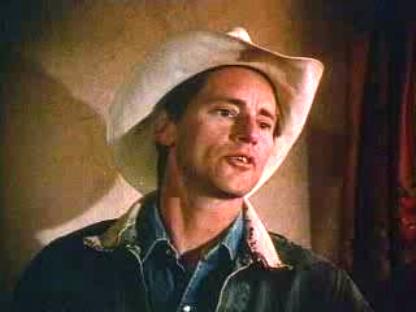
Seinfeld always was classified as a show about "nothing" and for the first hour and 15 minutes, I was prepared to give that label to Robert Altman's film version of Sam Shepard's Fool for Love, minus the consistent laughs. Then, suddenly in the final 30 minutes, the movie comes to life — though it's still unclear what it's about and it's too late to save it.
Based on Shepard's play, in simple terms, Fool for Love concentrates on four characters at a desolate New Mexico motel. There is Eddie (Sam Shepard), a cowboy who seems intent on causing trouble for May, one of the hotel's tenants (Kim Basinger). There also is the old man who runs the motel (Harry Dean Stanton) and Martin (Randy Quaid), who arrives expecting a date with May.
I've enjoyed Shepard's plays, particularly Buried Child and True West, but Fool for Love seems particularly aimless. At one point, as Eddie is trying to finish a story about him and May (which may or may not be true), May accuses him of repeating himself. Eddie insists he never repeats himself, but May begs to differ, saying he always goes around in circles, never getting anywhere.
That's pretty much how the movie works, spinning forward without any sense of direction. May asks Eddie what the point of his story is and Eddie even admits it's pointless.
Fool for Love came out in 1985, when Altman was in a cycle of filming plays for both film and television. I haven't seen Come Back to the Five and Dime, Jimmy Dean, Jimmy Dean or his network production of The Caine Mutiny Court-Martial, but Fool for Love certainly pales next to Streamers, Secret Honor and The Laundromat for HBO.
Shepard, Stanton and Quaid are all good, but Basinger struggles mightily with her southwestern accent.
In a note on the DVD, Altman tells viewers he always was puzzled by people's reaction to stage versions of Fool for Love, asking if they saw the same play he saw. The movie begs the question what exactly it was that Altman saw.
The last half hour has its moments, but it's slowgoing getting there and the final product really doesn't add up to much.
Tweet
Labels: 80s, Altman, HBO, R. Quaid, Seinfeld, Shepard, Theater
TO READ ON, CLICK HERE


