Wednesday, June 29, 2011
Centennial Tributes: Bernard Herrmann Part I
”As a composer I might class myself as a Neo-Romantic, inasmuch as I have always regarded music as a highly personal and emotional form of expression. I like to write music which takes its inspiration from poetry, art and nature. I do not care for purely decorative music. Although I am in sympathy with modern idioms, I abhor music which attempts nothing more than the illustration of a stylistic fad. And in using modern techniques, I have tried at all times to subjugate them to a larger idea or a grander human feeling.”
Bernard Herrmann in Bernard Herrmann: Hollywood’s Music-Dramatist by Edward Johnson
By Edward Copeland
Our centennial tributes tend to be of actor, actresses, directors and writers. We were honored when lyricist Bill Russell wrote a tribute to composer Frank Loesser, but he was a songwriter, providing both music and lyrics, who penned many memorable songs for stage and screen. We've never attempted to salute a composer known for his instrumental scores, particularly ones he wrote for movies, but Bernard Herrmann born 100 years ago today (exactly one year younger than Loesser), didn't like to be pigeonholed as a film composer since his musical work spanned opera, symphonies, concerts, radio and television in addition to some of the most memorable film scores of all time. That's why instead of just starting this post with a photo of the man and some words, I figured it's more fitting to use clips or links to clips to demonstrate his works such as his score that accompanied the Saul Bass title sequence for Alfred Hitchcock's Vertigo, an example of one of his very best. Movie titles and still photographs don't do Bernard Herrmann justice, that's why I'm going to write less than usual in this tribute and let his music do the talking. However, the man was so prolific, I've had to divide the post in half so it doesn't grow so long anyway that it knocks other posts off the front page. While there will be some biography, mainly it will be about his music and I'm going to try to be chronological and, in a couple of occasions, show his influence. We even have a clip of the master musician discussing his craft relating to his scoring to a particular film. If you are reading this at work, I hope you have headphones.
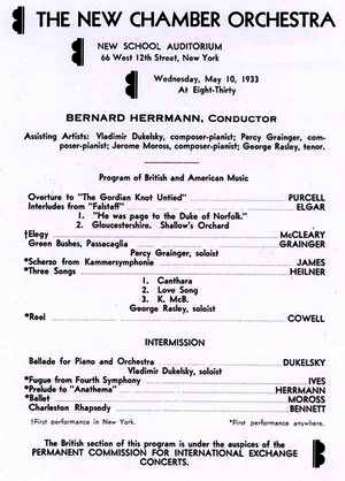
His father encouraged his interest in music and he took up the violin, winning a $100 prize for one of his own compositions at the age of 13. Herrmann's interest in composition became more serious sometime around 1927 while he attended DeWitt Clinton High School and studied with Gustav Heine. His first notable work is considered to be a tone poem called "The Forest" he wrote in January 1929. He enrolled at New York University (while still in high school) and studied composition with Philip James and conducting with Albert Stoessel. Stoessel later headed the opera and orchestra at Juilliard and Herrmann landed a fellowship there in 1930 where he studied conducting and composition with Bernard Wagenaar. He officially finished high school in 1931 around the time he formed his own orchestra, The New York Chamber Orchestra. This was before he was 20. He left Juilliard in 1932 but without a degree. That fall, he attended lectures in advanced composition and orchestration at NYU by Percy Grainger. Herrmann also worked as a music editor and arranger at the Harms music publishing company around this period. That same fall, some dancers he knew from Juilliard asked him to arrange ballet music for a musical revue called +New Americana, which inadvertently led to his professional composing, conducting, and Broadway debuts when he went on to direct the orchestra during his arrangement of The Shakers and his own piece, "Amour à la Militaire," when it opened Oct. 5, 1932. It ran 77 performances.*
By 1934, he was a staff conductor with CBS radio. He seriously began his prolific composing work during this period, writing many scores to accompany CBS radio programs including "The City of Brass" which accompanied David Ross' narration of one of the tales from One Thousand and One Nights or The Arabian Nights. In 1935, he composed the orchestral piece the Currier and Ives Suite. It was described as a short, five-movement piece on the Film Score website which has been running a series all year on Herrmann's centennial. The site notes that its composition occurred while he was employed by CBS because one of the pages of the composition was on CBS paper. Other than that, it says the origin of the piece is largely a mystery. There is a YouTube clip set against classic Currier and Ives drawings that has the orchestral piece.
Herrmann was named chief conductor of the CBS Symphony Orchestra in 1943 (a title he held until the orchestra disbanded in 1951 as TV began to displace radio), where it was said he introduced American audiences to more new musical works than any conductor in history. He particularly championed the American composer Charles Ives. Even before getting that post, Herrmann's output beyond the network and for mediums other than radio or orchestra bloomed. During the 1937-38 period, Herrmann got his feet wet for the first time in composing opera with a 45-minute cantata of Moby Dick. It didn't receive a world premiere until 1940 with The New York Philharmonic under the direction of Sir John Barbirolli. The cantata had never received a live performance in the United States since until April of this year when John Kendall Bailey conducted a 40-voice men's chorus and four soloists to perform it with the American Philharmonic-Sonoma County. Below are excerpts from the score, though it doesn't indicate from what recording it is taken and though it includes stills from John Huston's film of Moby Dick, note that Herrmann did not score that film.

While still just a staff conductor at CBS, the musical prodigy Herrmann would meet another young wunderkind making waves in New York named Orson Welles. He composed and arranged scores for Welles' Mercury Theater broadcasts, including the infamous 1938 War of the Worlds . While working at CBS, Welles lured Herrmann to Hollywood with him and when Welles made his astounding debut as the actor, writer and director of Citizen Kane in 1941, Herrmann had an equally impressive first year as a film composer. Not only did he make an impressive first showing with Citizen Kane and Welles' 1942 followup The Magnificent Ambersons, in between he composed the score for director William Dieterle's 1941 film The Devil and Daniel Webster aka All That Money Can Buy. In 1941, both the scores for Kane and Daniel Webster earned Herrmann Oscar nominations. His Daniel Webster score won (and there were 20 nominees). Though some of his greatest work still was to come, many for Hitchcock. He would receive another nomination in 1946 for director John Cromwell's Anna and the King of Siam but would not receive another nomination until he received two posthumous nominations in 1976. As is unfortunately the case with many YouTube clips, the embedding has been disabled, click here and listen to his lovely piece as the reporter reads Thatcher's diary leading into the flashback to Kane's childhood. Also, two pieces from Ambersons: Herrmann's subtle score running beneath Welles' narration of George's comeuppance and a much bouncier, holiday-theme Herrmann piece accompanying the snowride scene. I couldn't find a sample for The Devil and Daniel Webster/All That Money Can Buy.
In 1943, Herrmann composed the score for Jane Eyre directed by Robert Stevenson but involving many Mercury Theater players including Welles starring as Rochester, Agnes Moorehead as Mrs. Reed and John Houseman co-writing the script. Joan Fontaine starred in the title role. This is Herrmann's main title theme. He didn't score another film for two years when he did director John Brahm's 1945 psychological thriller Hangover Square, which I've never seen but certainly sounds interesting. It stars Laird Cregar as a composer suffering lapses in his memory who thinks he may have killed someone and seeks help from his doctor (George Sanders). Even though the composer is engaged, he somehow finds himself involved with a music hall dancer (Linda Darnell) and his temporary memory losses are threatening the concerto he has a deadline to finish. The following year, he composed the score for Anna and King of Siam, which earned him that third Oscar nomination.
In 1947, Herrmann penned the score for The Ghost and Mrs. Muir directed by Joseph L. Mankiewicz, a film that's very popular on YouTube, only for some reason people like to use scenes and stills from the movie and place modern songs over them. The next year, Herrmann made his first foray into composing for television, making music for many installments of Studio One which went by about a half-dozen different titles during its run. That kept him busy until 1951 when he debuted his first full-fledged opera Wuthering Heights. In the clip below, Yves Saelens sings "Now art thou dear, my golden June" (Edgar Linton's aria) in a concert performance of the opera at the Festival de Radio France et Montpellier 2010. Alain Altinoglu conducts the Orchestre National de Montpellier.
Directed by Robert Wise; Piece: Prelude/Outer Space/Radar
On Dangerous Ground (1952)
Directed by Nicholas Ray (Ida Lupino uncredited)
The Snows of Kiliminjaro (1952)
Directed by Henry King (Roy Ward Baker uncredited)
White Witch Doctor (1953) directed by Henry Hathaway
Now, I'm not going to list EVERY film or television show Herrmann scored, because it would grow too long. It's still going to be so long, that's why I've had to divide it into two posts so everything doesn't get knocked off the page. I'm tempted to leave out lesser titles or even bigger names if there isn't a music sample I can't find. Sometimes though, I'll find some other compelling reason to include a title figure anyone can click on his credits themselves.
Shower of Stars TV series (1954) Episode: "A Christmas Carol"
In 1955 when Burt Lancaster directed the first of the only two films he ever would helm, The Kentuckian, and he chose Herrmann for the score. Of course, that year was auspicious for another reason: It marked the first teaming of one of the most important director-composer partnerships in film history: Herrmann and Alfred Hitchcock. What brought The Master of Suspense and Herrmann together for the first time actually wasn't one of Hitchcock's tense masterpieces but his dark comedy The Trouble With Harry about the small Vermont town with the problem of a body that just won't stay put. It also marked the film debut of Shirley MacLaine.
Directed by Nunnally Johnson; Pieces: Prelude, The Children's Hour
So this is where we will leave part I. Click here just in case Part II still doesn't show on the main page.
*Much of the information in this section comes from the Herrmann biography found on Artists Direct.
Tweet
Labels: Agnes M., Books, Curtiz, Frank Loesser, Gregory Peck, Herrmann, Hitchcock, Huston, Lancaster, Lupino, MacLaine, Mankiewicz, Music, N. Ray, Oscars, Sanders, Television, Theater, Welles, Wise
TO READ ON, CLICK HERE


Monday, June 13, 2011
A nightingale sang in Berkeley Square

By Ivan G. Shreve, Jr.
The film opens on British hunter Captain Alan Thorndike (Walter Pidgeon), as he finds himself in Germany — in an area presumed to be Berchtesgarten, the Bavarian retreat of Adolf Hitler — with an opportunity to rid the world of a monster and prevent the Second World War. Thorndike has the Fuehrer lined up in the sights of his precision rifle and, pulling the trigger, there is an audible click…no bullet in the chamber. Giving his would-be target a friendly wave, we’re left to ponder as to whether it was his intention to assassinate Hitler. He firmly believes it was a “sporting stalk,” but the audience notices that he’s had second thoughts when he takes a bullet from his jacket and loads the rifle for a second go. Of course, our friend does not succeed at this encore; he’s tackled by a German soldier and captured by the Gestapo.
In 1941, debate raged on in America as to whether or not the U.S. should get involved in World War II…but perhaps the most anti-interventionist faction was based in the country’s motion picture industry. Hollywood took special pains to sit on the fence because they were anxious to not jeopardize the lucrative take from the rentals generated from U.S. films worldwide. Occasionally there would be a picture released that dared to take an anti-isolationist stance — Confessions of a Nazi Spy (1939) is considered by many to have started the ball rolling, followed by such features as Alfred Hitchcock's Foreign Correspondent (1940), The Mortal Storm (1940) and Charlie Chaplin’s The Great Dictator (1940). Seventy years ago on this date, a film was released to theaters that was directed by a man who had a little first-hand knowledge about the politics of Germany (having fled the country in 1934) and who no doubt identified with the protagonist of a film based on Rogue Male, a novel written by author Geoffrey Household shortly before war broke out in 1939. The director to whom I’m coyly referring is Fritz Lang…and the movie is his classic 1941 suspense thriller Man Hunt.
Captured by the Gestapo, Captain Thorndike is questioned by Major Quive-Smith (George Sanders)…who finds Thorndike’s “sporting stalk” defense to be a pile of manure, and tries to convince his prisoner to sign a
 confession that he attempted to assassinate the Fuehrer on behalf of the British government. Thorndike refuses and is worked over by goons in the Gestapo’s employ — but because the good captain is made of sterner stuff, Quive-Smith decides to silence him by arranging his death in a “hunting accident.” Thorndike escapes his captors and gradually makes his way aboard a British sailing vessel, where he is kept out of sight by a young cabin boy named Vaner (Roddy McDowall). Thorndike, you see, is not out of the jungle yet because also onboard is a sinister hired gun (John Carradine) who answers to “Mr. Jones” and is masquerading as Thorndike with the help of Thorndike’s passport.
Arriving on his home turf of London, Thorndike is convinced he’s safe and sound but, like many a protagonist in Lang’s films, he’s in a nightmare from which he can’t awaken. He’s being stalked by Jones and several other Nazi swine, and his request to his brother, Lord Gerald Risborough (Frederick Worlock), for assistance goes unheeded because Risborough doesn’t want to risk an international incident that could plunge Britain into war with Germany. (The fact that Thorndike no longer has a valid passport on him certainly doesn’t help matters either.) Thorndike’s only salvation is a young Cockney girl named Jerry Stokes (Joan Bennett), who helps him get to his brother’s home the night he arrives in London and later hides him out in her flat when he’s hunted by the police — the gendarmes find the mangled body of Jones in the London Underground and, locating Thorndike’s credentials on the corpse, assume that it’s Thorndike who has been murdered.
Thorndike contacts his solicitor (Holmes Herbert) and arranges to get enough money to enable him to hide out from his pursuers and to make certain that Jerry is repaid for her kindness and assistance as well. He provides Jerry with the address at a post office in Lyme Regis to allow her to get in touch with him and let him know when the heat has died down. Thorndike’s trip to the Lyme Regis post office, however, allows Quive-Smith to learn of his hiding place…and institutes a final showdown between the two men from which Thorndike emerges as the victor. There follows a passage of time and having enlisted in the RAF once World War II is underway, Thorndike bails out of a bomber over Germany with hunting rifle in his hand…the implication being that he’ll be damned if he misses his intended target (Hitler) this time.
Serialized in Atlantic Monthly before being published in novel form in 1939, Gregory Household’s Rogue Male would soon become a best seller and later one of the classic thriller novels of all time. The book, having been written before World War II, never specifically states that the unnamed European dictator was the man mockingly nicknamed “Schickelgruber,” but the book-buying public wasn’t fooled for a second. Rogue Male was a perfect candidate for a movie adaptation despite its controversial (for the U.S.) pro-intervention stance and screenwriter Dudley Nichols (a longtime collaborator of director John Ford — in fact, Ford was originally assigned to direct Man Hunt) was assigned the task. The movie also would find its perfect director to handle the subject material in German émigré Fritz Lang.
Because Lang approached Man Hunt with not entirely clean hands — namely, his fervent anti-Nazism — the movie attracted the attention of the Hays Office, and was one of the first war films to do so. Hays head Joseph Breen objected to the fact that the film depicted all Germans as evil, and was no doubt instrumental in making sure that there were enough “nice” Germans in the movie to counteract this (the character of the jeweler, for instance). The censors also insisted that the director soft-pedal the “enhanced interrogation techniques” used by Sanders’ Gestapo to get Pidgeon’s hero to confess — which actually worked in the movie’s favor, since the sequences were more effective with the torture implied as opposed to visually spelled out. As if Lang didn’t have enough trouble, the head of the studio producing Man Hunt, Darryl F. Zanuck, also was not too crazy about Fritz’s anti-Nazi enthusiasm and forbid the director to go anywhere near the editing room during the movie’s final stages. (Lang and assistant Gene Fowler, Jr. did an end run around Zanuck, however, and worked on the movie in secret.)
What makes Man Hunt both a classic Hollywood thriller and one of Lang’s best works is its pitch-perfect casting. Walter Pidgeon would establish himself onscreen as the epitome of British stiff-upper-lipness (though Pidgeon himself was Canadian) in films such as Mrs. Miniver (1942) and The Miniver Story (1950), and the part of Captain Thorndike in this film is one of his best movie roles. He’s a very engaging hero and the audience is with him every step of the way — especially in the rousing final sequence where Thorndike parachutes out of the plane with rifle in hand and loaded for bear. Pidgeon is fine with the he-man heroics but what really makes this movie strong is the tender relationship his Thorndike enjoys with leading lady Joan Bennett, who plays the part of the plucky Jerry.
It’s not too hard for audiences to decipher that Jerry practices the world’s oldest profession (and I’m not referring to farming) despite the Hays Office’s insistence that a sewing machine take prominent space in her flat in an effort to convince moviegoers that she was doing freelance seamstress work. Jerry is more or less accosted by Thorndike when the two characters meet in the film (he puts his hand over her mouth to keep her from screaming and cluing the thugs on his trail as to his whereabouts) and though she’s frightened and intimidated by him at first, she gradually develops an affection that quickly blossoms into infatuation and then love. Thorndike is a right guy because he doesn’t judge Jerry on her social station or background (unlike his sister-in-law when the two try to get help in the House of Risborough); he treats her with an commendable degree of kindness and respect. There’s a wonderful and subtle sequence set inside Jerry’s apartment the morning after their visit to Thorndike’s relatives where Jerry has ventured out and secured breakfast (fish and chips!) and Thorndike pulls a chair up to the table, insisting that Jerry sit down. The expression on her face is that of an indescribable reverence at his thoughtfulness; she then tells him: “You act like a gent but you ain’t…I mean…you really acts like a gent.”
Bennett is so luminescent and lovely in the part of Jerry that I often marvel at how she is so much different from the femme fatales she plays in later Lang films such as The Woman in the Window (1944) and Scarlet Street (1945). (Joan is so appealing in the part that I’m even willing to overlook the fact that she has one of the most unconvincing Cockney accents in the history of the cinema.) Her Jerry has become so taken with Thorndike that she’s prepared to travel to the four ends of the earth with him — something Thorndike vetoes only because he fears for her safety, and not due to any social stigma. In fact, when he tells her that he’ll arrange for her to be financially compensated by his solicitor for helping him in his hour of need she gets upset because she’s concerned that Thorndike is going to treat her in the same manner as her other “gentlemen.” Instead, all she wants from him is what he promised her earlier in the film — she’s lost a pin that adorned her hat and he’s agreed to furnish her with a new one. He’s as good as his word in doing so, because as he informs her: “Every good soldier needs a crest for his cap.”
The brooch that Thorndike purchases for Jerry is a little chromium arrow — a trinket that will take on significance later in the film because in the climactic mano-a-mano between Thorndike and Quive-Smith, the major presents Jerry’s hat with the arrow attached to make his adversary aware Jerry has been disposed of, but the quick-thinking Thorndike, just when it appears that he’s up against it and at the mercy of the contemptible Quive-Smith, is able to fashion his lady love’s souvenir into something that brings about the Nazi’s downfall. Sanders, an actor whose picture you would find in the dictionary if you searching for a definition of “cad,” gives a performance as one of the silver screen’s most delectably villainous rat bastards, deftly mixing his patented brand of suavity with appropriate sinister menace.
The supporting performances in Man Hunt are equally worthy of praise, including Carradine as a ruthless killer (whose demise in the London subway is particularly memorable) and McDowall (in his American film debut) as the resourceful cabin boy who’s got Pidgeon’s back. McDowall would also re-team that same year for Fox’s How Green Was My Valley, exhibiting a similar surrogate-father-and-son relationship. Other familiar faces in Man Hunt include Ludwig Stossel, Heather Thatcher (as Lady Risborough — her interactions with Bennett’s Cockney gal are priceless), Egon Brecher, Roger Imhof and Frederick Vogeding. The music score is one of my favorites from any film — composed by Lionel Newman, it’s an enchanting melody that uses “A Nightingale Sang in Berkeley Square” as a continuing motif.
Fritz Lang’s dedicated moviemaking mission against the Nazi menace would resurface in three additional films in the wake of Man Hunt: Hangmen Also Die! (1943), Ministry of Fear (1944) and Cloak and Dagger (1946) — the last released after the end of World War II, of course, but using the final days of the war as background for its subject matter. But Man Hunt was the first and best, thanks to first-rate casting, direction and scripting…and not to mention the source material; author Household’s Rogue Male would see additional adaptations (including a critically acclaimed TV movie in 1976 starring Peter O’Toole) and a sequel, Rogue Justice, that sadly has not been adapted for either film or television to my knowledge. When the U.S. entered World War II on Dec. 7, 1941, with the attack on Pearl Harbor, they were not only prepared to fight in the theater of war but the ones at audiences’ local movie houses as well…and 70 years later, Man Hunt remains a textbook example of how Hollywood was committed to the fight.
Tweet
Labels: 40s, Chaplin, D. Zanuck, Fiction, Hitchcock, J. Carradine, Joan Bennett, John Ford, Lang, Movie Tributes, O'Toole, Sanders
TO READ ON, CLICK HERE
Wednesday, October 13, 2010
All the world's a stage

By Edward Copeland
Many elements can contribute to a classic film: stylish or revolutionary direction, a unique or powerfully told tale, a performance so great it raises the quality of an entire production. While bits of most of those appear in All About Eve, in the end its status in the stratosphere of cinematic greatness gets set in cement by Joseph L. Mankiewicz's brilliant screenplay and, more specifically, its dialogue. You could close your eyes and just listen to it and be blown away by his work. Maybe it's because I worship the written word that it holds such appeal because All About Eve celebrates the witty rendering of language and does so through the vehicle of some of movie's most memorable characters.

No matter how different all my greatest (or favorite) films are, the singular thing they have in common is that each time I re-watch them, I discover something new. In the case of All About Eve, I put something together for the first time in this visit: several of my very favorite films not only contain voiceover narration but multiple voiceover narrators. Both Henry and Karen Hill narrate portions of Goodfellas. Rashomon tells its tale from several points of view. Woody Allen's Hannah and Her Sisters offers the voices of the three sisters plus Allen and Michael Caine's characters. Citizen Kane's structure consists of interviews with different subjects and, in one case, the reporter reading a witness's papers. Here, in All About Eve, we alternate between the takes of theater star Margo Channing (Bette Davis), her good friend Karen (Celeste Holm) and acerbic theater critic/columnist Addison DeWitt (George Sanders). The technique is not a magic bullet, however, because it only made The Thin Red Line even more unbearable than it already was.
Addison, wonderful wry Addison, bats first in terms of the film's narration and who better to guide us into this backstage drama since he lives and breathes theater, though he does it through his writing, not through any actual participation in the theatrical arts himself. In a way, he's the theatrical version of the title of Howard Cosell's autobiography: I Never Played the Game. Of course, while DeWitt may not act in, write, direct or produce plays, he's definitely into gamesmanship. Toying with those who do contribute to theater, that is Addison's sport of choice.
As All About Eve opens, we watch as Eve Harrington (Anne Baxter) receives the Sarah Siddons Award for Distinguished Achievement in the theater. This event's description that Addison deciphers for us begins with an
 introductory speech by an older actor of some renown. DeWitt explains, "Being an actor, he'll go on speaking for some time." The camera also pans down to show all the empty spaces where the evening's previous awards used to reside. Addison runs down the meaning of that for us as well as those awards' relative meaninglessness in comparison to the one Eve receives. "The minor awards are for such as the writer and director since their function is to merely construct a tower so the world can applaud a light which flashes on top of it," DeWitt tells us as we briefly see dour-looking playwright Lloyd Richards (Hugh Marlowe) and sour-looking director Bill Simpson (Gary Merrill). That night that light belongs to Eve, who Addison informs us, has become the youngest person ever to win the Sarah Siddons honor. Also present in the audience, looking none too pleased at Eve's good fortune, is that great actress Margo. DeWitt informs us that she made her theatrical debut at the age of 4 as a fairy in A Midsummer Night's Dream when she strode on to the stage stark naked and she's been a star ever since.
It's at the point where Mankiewicz's camera switches its focus to the audience, specifically to Karen Richards (Holm), wife of the playwright and best friend of Margo, that the voiceover narration gets handed over to let Karen tell the beginnings of the story, namely how she's responsible for bringing Eve Harrington into Margo's
 life in the first place. Karen had noticed the poor, dowdy Eve hanging by the stage door night after night, performance after performance, during the run of Margo's latest hit play. The kind-hearted Karen finally takes it upon herself to ask Eve what she does during the beginning and end of each show and Eve tells her she goes and sees the show, that she hasn't missed a performance of the play yet. Karen finds this so impressive that she decides that Margo just must meet this woman who goes beyond the definition of a mere fan and takes her backstage to meet the star. Knowing how mercurial Margo can be at time, Karen enters alone at first where she finds Margo with her dresser Birdie (the sublime Thelma Ritter) and her husband Lloyd. She's currently haranguing the playwright about plays written about Southern women such as the one she's starring in right now. She wants to know why playwrights insist on depicting all these romantically challenged women in the South.
 Coming from the region herself, Margo declares, "Love is the one thing we were never starved for in the South." Karen tries to ease in to her introduction of Eve by talking about fans in general, but this only launches Margo into a rant about the mobs waiting for autographs outside the stage door. "Autograph fiends — they're not people," Margo spits. "Those little beasts that run around in packs like coyotes." Karen tries to get Margo more charitable, but she's on a roll and can't be stopped. "They're nobodies! Fans! They're juvenile delinquents! They're mental deficients! They never see a play or movie. They're never inside long enough," Margo's monologue continues. Karen breaks in long enough to tell her there's one of those fans she wants her to meet. When she describes Eve and how she's always there and has seen every performance, Margo knows immediately who Karen is talking about and is game enough to allow her into the dressing room. Eve enters meekly and after prodding, shares her tale
 about how she lived in San Francisco with her husband who was killed in the war, but she saw Margo give a performance and after a brief detour for a job at a midwest brewery, she came to New York with nothing, just to watch Margo perform. It's as if Channing is The Grateful Dead and Eve is a Deadhead. The entire room is touched except for the suspicious and cynical Birdie who adds at the end of Eve's story that it has "Everything but the bloodhounds snapping at her rear end." Margo makes Birdie apologize, though she's the only one whose instincts will be on the mark from the beginning. Unfortunately, at some point in the film, her character just sort of vanishes without explanation, which is too bad because I love Thelma Ritter and it denies Birdie her deserved moment of "I told you so." Sometime during this sequence, they are joined by Bill, who not only directed the play but is Margo's significant other. It also signals that soon we'll be switching to our third narrator, Margo herself.
 Something in Eve though appeals to Margo and she invites her to accompany them to dinner after they drop Bill at the airport for his flight to Hollywood to direct his first film. Interestingly enough, Darryl Zanuck, the producer of All About Eve, is named as the producer of Bill's fictional film as well. It's funny to listen to
 successful Broadway director Bill discuss his shot at directing film as if he's abandoning a medium for the masses for a chance to make movies "which mean something." Was there ever this perception? It's also funny to remember how income tax rates used to be. They don't mention what Bill will make for directing his film, but presumably the salary was a lot lower than directors make today, but it still must have been a heady paycheck. So, the next time you hear a millionaire whining about possibly having to have his tax rate rise 3% to 39% show him All About Eve when Bill tells Eve that "80% of his salary" for directing the movie will go to taxes. Then they can shut the hell up. Since this is the portion of the film where Eve bends over backward to ingratiate herself with her newfound theater companions, she volunteers to check Bill's luggage and then bring his ticket to the gate so that he and Margo can have some private goodbye time. Bill comments that he "forgot they grew them that way." Eve has such a lack of pretense. Margo feels she must watch out for her as if she's "a loose lamb in the jungle." Margo continues to be the narrator and takes Eve under her wing as an all-purpose assistant, though Birdie still remains the sole person with qualms about this "lamb."
As I alluded to at the beginning of the piece, great actors delivering 40-karat dialogue powers my love for All About Eve. As many times as I've seen this film in whole or in part, if you asked me to name a particularly great shot or an interesting camera move than Mankiewicz employs to tell his story, I'd come up blank. This isn't a negative criticism: The film might be chock full of them but the words he wrote produce such magic that I'm mesmerized by them to the exclusion of the technical aspects. The only shot I can really recall is not a good one: it sticks out like a sore thumb. Late in the film, when Eve has landed the lead in a play written by Lloyd and directed by Bill, it's receiving an out-of-town tryout in New Haven, Conn. She and Addison go for a walk on the street from the theater and the marquee can be seen behind them in a horribly obvious back-projection shot that I can't understand the necessity of using. Couldn't the conversation have been staged elsewhere or the theater marquee set up simply somewhere? Still, a minor criticism for a film that's such a verbal masterpiece, even if it's not also the visual wonder that the bounty of other great 1950 releases are such as Wilder's Sunset Blvd., Reed's The Third Man or Huston's The Asphalt Jungle.
Having written about Sunset Blvd., so recently for its 60th anniversary, its interesting what it and All About Eve have in common. Though Bette Davis' Margo Channing isn't insane like Gloria Swanson's Norma Desmond,
 both are actresses involved with younger men worrying about their age. Granted, Margo's Bill is only eight years her junior and he's her willing love interest not part of a con that has turned into emotional blackmail such as William Holden's Joe Gillis. Also, Norma is 50, 10 years older than Margo and gave up working when sound came to the movies. Margo, being a creature of the stage, has kept working steadily, but having hit the dreaded 40, worries about her future, especially in regards to future employment. Karen tries to reassure Margo that eight years isn't that big a difference, but Margo tells her that, "Those years stretch as more years go by." It also can be an easy sore to puncture should there be a lovers' spat as when she and Bill fight once and he says, though in a tone indicating he means to be funny, that he always denies the rumor that she was starring in Our American Cousin the night Abraham Lincoln was shot.
Speaking of age, writer Matt Zoller Seitz pointed out a flaw in All About Eve that I've always chosen to ignore, but that I really couldn't any longer once he wrote his piece "Trash-talking nine classic movies" for Salon. The article wasn't a contrarian view out to tear down classics of cinema — he admits he adores the movie — just that some of the greats bear significant flaws and he finds that Mankiewicz's movie's weakness turns out to be Eve herself. Seitz writes:
"The only weak spot, unfortunately, is the casting of the title character, Eve Harrington. Anne Baxter is a shade too old to be playing the 'girl' or 'kid' described in much of the dialogue (she was 26 when the film was shot), and more damagingly, she's simply not as compelling and imaginative as her fellow actors."

It's hard to argue with his judgment. When I watched the film again for this tribute, frequently stopping the movie to jot down yet another line of dialogue that I loved, not a single one was dialogue that sprang forth from Baxter's lips. Granted, Eve Harrington's scheming requires her to pretend to be mousy and meek, so it would be out of place for her to toss off one of the pithy bon mots that the other characters do with ease. At the same time, the film makes the point from the beginning that Birdie can smell the fraud, how does she so easily fool the rest? During the
 initial scene where Karen takes Eve into Margo's dressing room, I scrawled the note, "Awfully accommodating to a stalker." Seitz writes further on this point that, "I don't believe that Baxter's version of the dewy-eyed foundling routine could fool so many battle-scarred showbiz veterans, except maybe Celeste Holm's kindhearted Karen." Actually, that is the truth because Karen is the one she ultimately tricks to get what she wants in terms of being Margo's understudy and delaying her on purpose so she'd miss a show and Eve would get her chance on stage. Later, when Eve has dropped the pretense of being the innocent, she uses that information to force Karen to make Lloyd give her the lead in his new play instead of Margo. Karen gets saved by the lucky timing of Margo passing on the part to spend time starting married life with Bill. Karen's relieved laughter is hilarious, even though none of her dining companions know why she's laughing, especially after returning from a meeting Eve had summoned her to in the restaurant's rest room.
Of course, Birdie truthfully isn't the only one who has Eve's number early. Addison knows her game pretty much from the outset, but it's not in his professional interest as a columnist or his personal interest as an
 asshole to warn anyone about her. Shakespeare said, "All the world's a stage" and that's how DeWitt views it. Who is he to interrupt the players before the final curtain falls? The movie's great centerpiece is a party that Margo holds to celebrate Bill's homecoming and a belated birthday bash, but which she really regrets having before it starts because of rising tensions between her and just about everyone. In Margo's narration, she says, "Even before the party started, I could smell disaster in the air." It's the scene where the film's most famous line appears: "Fasten your seat belts, it's going to be a bumpy night." That is just but one of the priceless quotes that fly from the various characters, including an uninvited Addison squiring an aspring actress named Miss Caswell and played by Marilyn Monroe. Even Marilyn gets some laugh lines. When she wants another drink, she calls out, "Waiter!" Addison corrects her that the man is a butler, not a waiter. Miss Caswell suggests that someone could be named Butler and that might cause confusion. "You have a point," DeWitt responds, "an idiotic one — but a point nonetheless." Going back to Seitz's piece, I think another problem with Baxter/Eve comes from the fact that Mankiewicz's screenplay doesn't provide Eve with any levity. She's the film's only humorless character.
Then again, Eve isn't Hannibal Lecter, a villain who should come with his own set of drums to deliver rimshots after each of his lines, so perhaps that's OK because the rest of the cast provides such a bounty of well-delivered dialogue that you can listen to over and over again. As I mentioned before, most of my notes on the film consisted of lines from the film. Now, it would be fairly ridiculous if I just listed them all, especially for those out there who haven't experienced All About Eve. People get all bent out of shape about spoiling a movie's plot twists, but for me it's even a greater sin to ruin all of its magnificent lines, especially when you're dealing with a screenplay as sparkling and crackling with wit as Mankiewicz produced. Still, I'm compelled to single out a few otherwise how can I convince the uninitiated that I'm not selling them a bill of goods? I will list them by the characters who spoke them.
LLOYD: You knew when you came in that the audition was over, that Eve was your understudy, playing that childish little game of cat and mouse.
MARGO: Not mouse, never mouse. If anything rat!
LLOYD: I shall never understand the weird process by which a body with a voice suddenly fancies itself as a mind. Just when exactly does an actress decide they're HER words she's speaking and HER thoughts she's expressing?
MARGO: Usually at the point where she has to rewrite and rethink them, to keep the audience from leaving the theater!
LLOYD: What makes you think either Miller or Sherwood would stand for the nonsense I take from you? You'd better stick to Beaumont and Fletcher! They've been dead for three hundred years!
MARGO: ALL playwrights should be dead for three hundred years!
LLOYD: There comes a time that a piano realizes that it has not written a concerto.
Eve would ask Abbott to give her Costello.
The cynicism you refer to, I acquired the day I discovered I was different from little boys!
You can always put that award where your heart ought to be.
(To Margo) Many of your guests have been wondering when they may be permitted to view the body. Where has it been laid out?
Every so often, some elder statesman of the theater or the cinema assures the public that actors and actress are just plain folks, ignoring the fact that their greatest attraction to the public istheir complete lack of resemblance to normal human beings.

(To Eve) Is it possible, even conceivable, that you've confused me with that gang of backward children you play tricks on, that you have the same contempt for me as you have for them?... Look closely, Eve. It's time you did. I am Addison DeWitt. I am nobody's fool, least of all yours.
That I should want you at all suddenly strikes me as the height of improbability. But that in itself is probably the reason: You're an improbable person, Eve, and so am I. We have that in common. Also our contempt for humanity and inability to love and be loved, insatiable ambition, and talent. We deserve each other.
There, I've said too much, but the words that flow from All About Eve are infectious, thanks in no small part to the stellar cast that delivers them. Bette Davis gives what may be her finest work and I'd still place her second that year to Gloria Swanson's Norma Desmond. Two of the greatest performances by actresses in the
 history of film and they both lost the Oscar to Judy Holliday in Born Yesterday. I don't mean to cast aspersions on Holliday, but let's be serious. Thankfully, George Sanders did win his most deserved supporting actor prize as Addison DeWitt, another of filmdom's all-time great characters. Thelma Ritter and Celeste Holm both earned nominations for supporting actress but I have to admit that Ritter had better parts (as in Pickup on South Street) and Holm already had an Oscar for being the best part of the terribly creaky Gentleman's Agreement, so I can't argue with Josephine Hull's win for her delightful turn in Harvey, which also turns 60 today. The most amazing achievement though belongs to Mankiewicz who won writing and directing Oscars for two years running, the previous year being for A Letter to Three Wives. There's no disputing the worthiness of that prize for writing, but as much as I love All About Eve, I question his directing win when he was competing against John Huston for The Asphalt Jungle, Billy Wilder for Sunset Blvd. and Carol Reed for The Third Man. Still, slight reservations aside, I always will worship All About Eve, today on its 60th anniversary and on all anniversaries yet to come.
Tweet
Labels: 50s, Abbott and Costello, Arthur Miller, Bette, Caine, Carol Reed, D. Zanuck, Gloria Swanson, Hannibal Lecter, Holden, Huston, Mankiewicz, Marilyn, Movie Tributes, Sanders, Thelma Ritter, Wilder, Woody
TO READ ON, CLICK HERE
Monday, August 16, 2010
Hitchcock's best 1940 film
To those forthright ones who early saw the clouds of war while many of us at home were seeing rainbows....
To those clear-headed ones who now stand like recording angels among the dead and dying....
To the Foreign Correspondents--
this motion picture is dedicated.

By Edward Copeland
Don't get me wrong: Rebecca is a great film, but the wrong Alfred Hitchcock film that was nominated for the Oscar for best picture of 1940 won. His other nominated film, Foreign Correspondent, which turns 70 today, is the better film in my opinion. Of course, the fact that Hitch had TWO films up for best picture that year and still lost best director makes the fact he never won that prize a bigger outrage.
Often, if you just mention the title Foreign Correspondent, even Hitchcock fans might not recognize it as one of his films, let alone one of his classics. Even though it managed a none-too-shabby six Oscar
 nominations, it seems to have been somehow lost in the Hitchcock canon. It's easy to see how that's possible when you are just one of the numerous great films directed by perhaps the most famous brand-name director of all time, but that doesn't mean the fate is a deserved one. With a cast led by Joel McCrea, Herbert Marshall, Laraine Day and George Sanders, several memorable Hitchcock setpieces and a screenplay that almost invents the screwball suspense genre thanks to additional dialogue work by Robert Benchley (who also plays a role), Foreign Correspondent has earned a place in the upper echelon of Hitchcock films and in the 1940 film you can spot the templates for things the Master of Suspense will use again in some of his more revered films such as Lifeboat and, especially, North By Northwest. Foreign Correspondent is hardly a rough draft and the later films aren't remotely retreads. Foreign Correspondent stands marvelously, wonderfully on its own and if it's a Hitchcock that you've missed somehow, I'd stopped reading now and consider this your spoiler warning. Even the photos will give things away.
At the film's outset (following the credits), it would be understandable if a viewer thinks a comedy is afoot because it takes awhile for the intrigue to rear its head. For film buffs who might have missed Foreign Correspondent, it might seem even more like that as they see future Preston Sturges lead Joel McCrea and Herbert Marshall, star of early Lubitsch gem Trouble in Paradise, effortlessly emoting the script's snappy dialogue in the scene set at the New York Morning Globe where John Jones (McCrea) works as a reporter. We enter the scene at the Globe as its editor, Powers, (Harry Davenport) has grown weary of the lack of news on the looming European war clouds from Stebbins, his longtime foreign correspondent based in London (played by Benchley himself once we meet him). "Foreign correspondent! I could get more news out of Europe looking in a crystal ball," Powers complains before inviting
 Jones into his office, at first gives him the mistaken impression that he's being fired but Powers says no, he has something else in mind. "Give me an expense account and I'll cover anything," Jones replies. Powers reveals his plan to make Jones his new man in Europe. Jones says he knows nothing on the subject, but he can start reading, but his editor insists that isn't necessary. "I like you just as you are, Mr. Jones. What Europe needs is a fresh, unused mind." What Jones does need, Powers decides, is a name with a bit more panache so he gives him the moniker of Huntley Haverstock. The re-naming is witnessed by an important visitor: Stephen Fisher (Marshall), the head of an international peace organization trying to stave off war. "It's really very exciting being present at the christening of an American newspaper correspondent," Fisher says. "Shouldn't we break a bottle of champagne or something?" As the film unfolds, Fisher will suggest much worse.
Though the new job will send Jones/Haverstock to London and later to Holland, this definitely was one of Hitchcock's Hollywood's films. David O. Selznick loaned him out after Rebecca and all the foreign locales were faked in California. Upon Jones' arrival in "London" he's greeted by the Globe's longtime foreign correspondent, the lush extraordinaire Stebbins (Benchley's first appearance), who tries to give Jones a quick primer on how to do the job which, as far as Stebbins is concerned, is doing as little real work as possible while appearing to do so. He explains the art of sending and receiving messages to New York. "They love to cable from New York. It makes them think that you're working for them," he tells Jones as they belly up to a bar. Jones orders a scotch and soda while Stebbins surprises him by ordering milk. "Yeah, I'm on the wagon. I went to the doctor today to see about these jitters I got, and he said it was the wagon for a month, or a whole new set of organs," Stebbins tells Jones. "I can't afford a whole new set of organs." The first assignment Jones gets is to attend a speech by an important diplomat named Van Meer (Oscar nominee Albert Basserman) at a lunch sponsored by Fisher's peace group.

As Jones makes his way to the luncheon speech, by coincidence, he runs into Van Meer and the diplomat offers him a ride to the event and Jones sees it as an opportunity to interview Van Meer ahead of time. Unfortunately, Van Meer is easily distracted and tends to wander off subject. Once they arrive at the site of the luncheon, the film begins to make its transition from nearly all comedy to thriller with comedic touches. First, Jones tries to put the moves on a young woman (Day) before the luncheon without much luck only to learn once the speech is set to begin that for some mysterious reason Van Meer won't be delivering his speech, news delivered by Stephen Fisher, who introduces in his place his daughter Carol, who is of course the woman Jones
 was hitting on and who was none too impressed by him. Among the points she makes in her "peace" speech is that "I think the world has been run long enough by well-meaning professionals. We might give the amateurs a chance now." Jones' New York bosses aren't happy to hear that he missed Van Meer and tell him to head off to Amsterdam, where Van Meer has been scheduled to speak at an important conference on the peace movement, sponsored, of course, by Stephen Fisher. The newly minted foreign correspondent gets ready to go. He's also curious to meet Van Meer again to find out what happened so suddenly between their car ride and the luncheon that forced him to cancel his London speech.
From "Holland" on, Foreign Correspondent nearly becomes one long chase, beginning with one of Hitchcock's most memorable sequences. It begins on the steps of an important-looking building where the conference is being held. A downpour of rain is drenching the spectators, including Jones, who runs into Stephen Fisher, who tells him he's heading back to London but other members of his organization will be there.


Jones continues his wet vigil for Van Meer when the diplomat finally arrives. Jones rushes up to greet him, but is confused when Van Meer shows no sign of recognizing him.

.jpg)
A photographer asks for a photo, only the flash he makes isn't just from his camera but the gun he conceals as he assassinates Van Meer in a shot that's reminiscent of the shot from Eisenstein's Potemkin.


Jones and the authorities try to capture the killer who escapes in the sea of umbrellas before finally reappearing on the street and dodging Jones' pursuit though a throng of vehicles before the assassin hooks up with his getaway car.

Fortunately, Jones finds a car of his own to continue to pursuit and meets a fellow reporter Scott ffolliott (George Sanders, another wizard with snappy dialogue) and, surprisingly, Carol Fisher. Amidst the thrill of the chase, Jones admits he doesn't get Scott's last name with its two lower case Fs at the beginning, but Scott explains that one of his ancestors was beheaded by Henry VIII and his wife dropped the capital letter to commemorate it. The two reporters and the daughter of the peace commission's leader head the police pursuit of the killer throughout Holland, including a small village where a poor man keeps attempting to cross the street with a pitcher only to be stopped time and time again by speeding vehicles before finally giving up and going back inside. Even after the film's first scene of violence and the beginning of the suspense side of its story, there's still time for a sight gag.

The strangest thing happens during the frenzied pursuit though. As Scott, Jones and Carol speed across the countryside, complete with the country's trademark windmills, the assassin's car vanishes, apparently into thin air. The trio stops by one of the windmills trying to figure out how the bad guys possibly could have escaped, noticing an airplane circling overhead. Surely they couldn't have driven that high, they surmise. When the authorities arrive, they decide to continue the pursuit even though they now are chasing a phantom car. As Johnny continues to be puzzled, a strong wind blows off his hat, landing it into a pool of water, giving Scott and Carol a good
 laugh but allowing Jones to notice something amiss about the windmill they are standing near: It's blowing in a different direction than all of the other windmills in the immediate vicinity. Jones points out his finding to Scott and Carol and feels it warrants further investigation. He circles to the back of the windmill and unbolts a wooden garage door and, sure enough, there sits the vanished escape vehicle. He tells his compatriots of his find and his suspicion, as they watch the windmill change directions again, that it is a signal for the plane to land. He decides to proceed into the windmill to see what he can find and urges Scott and Carol to go catch up with the police and bring them back. Scott and Carol depart in the car and Jones proceeds carefully inside the windmill, uncertain of what dangers might await him inside. The bad guys may have had time to hide their getaway car, but surely they haven't had time to escape entirely, so the green foreign correspondent risks his life and limbs to enter alone. It's no longer a story that he's simply reporting; it's a mystery he's determined to solve.

Sure enough, Jones does discover the assassin as well as other men discussing some vague but serious-sounding matters. Realizing that it's best that he not be discovered, at least until Scott and Carol return with the police, Jones carefully slinks around the windmill's innards, a maze of stairs, to try to keep himself out of sight of Van Meer's killer and his conspirators. Luck seems to be on Jones' side as he's able to make it up a stone stairway that not only keeps him hidden but also allows a good look at the men below and a chance to hear more of their conversation. He can't quite make sense out of their discussions, but it's definitely about the impending war and Van
 Meer's role as an impediment to the conflict. However, the biggest surprise for Jones is yet to come. As he climbs further up the stairway, he finds a door and figures a room would make for a much more secure hiding place from the goons below to await the arrival of the authorities. He just has to hope they get there in time before the conspirators make their escape. When he opens the door, he's surprised to be greeted by a familiar voice — a voice belonging to a man whose life he saw silenced earlier in the day. It's a very much alive Van Meer. He explains the man Jones saw killed was an impostor. (Don't stop to think too hard about who in the world would volunteer for that assignment?) The men who are doing this are trying to allow the war since he is one of the only people who knows a secret clause to a peace treaty that would prevent it and it's firmly esconsced inside his head. Audience, meet this movie's MacGuffin.
Van Meer explains to Jones that the fake assassination/kidnapping is in the hopes that his "death" would speed the process to war and they are going to keep holding him hostage until he tells them what he wants to know. Unfortunately, Jones realizes too late that his hiding place is that last place that he should be as they come to fetch Van Meer for his trip and knock Jones unconscious. Later, he comes to and makes his way outside when Scott, Carol and the police finally return. He relays his incredible tale, but the police are skeptical. They go back into the windmill, but of course it's empty, though they find what appears to be a vagrant in the room that used to be where Van Meer was being held. Jones figures perhaps the car still will be there, but it's gone too and the police leave, though Scott notices the supposed vagrant dirtying himself up with soil when no one is looking to make his story seem more
 realistic. What really sets Foreign Correspondent apart from other Hitchcock films is that, though all the usual elements are there in addition with a heavier dose of comedy than usual, it's really a rarity to take its fictional story but set it against the backdrop of very real world events at the time. He's creating well-crafted escapist fare with the bad guys pursuing a pointless article pertaining to a very real war, as if there would have been magic words contained in a peace proposal that would have convinced Hitler to give up his plans. If you think about it too hard, it could be seen as offensive, but despite the real war clouds in the background and even actual mentions of Hitler and in the film's spectacular climax to come, German warships, it's all played on a level that keeps it fun without losing the very real worries of 1940. Not in the same specific way but similarly, it resembles Ian McKellen's spectacular Richard III that reimagines Shakespeare's tale in 1930s England.
The next sequence seems as if it could have been taken directly from North By Northwest. As Jones, returns to his hotel, dejected that no one seems to believe his fantastic tale and determined to rescue Van Meer
 before he's killed for real, he gets two unexpected guests. Men claiming to be from the police say that their chief would like him to come down to headquarters to recount his tale again, because they believe him. Since one of the biggest problems getting in Jones' way has been the language barrier, he asks if the chief speaks English. "We all speak English here," one of the men replies. "More than I can say for the people in my country," Jones retorts, but the answer ie enough for him to smell the rat and he get them to let him to go the bathroom to tidy up a bit. He starts the tub and proceeds to climb out the window and scale the ledge, knocking out part of the hotel's sign so it reads: HOT EUROPE. When he's able to get into another hotel room, it ends up being Carol Fisher's. She's still hostile, but she buys his story and they cook up a multitude of diversions to retrieve his clothes (he's in a bathrobe), stymie the fake cops and escape the hotel.
Jones and Carol decide perhaps the best course of action is to return to London and see what they can learn there and tell her father about Van Meer being alive, though the point may be moot since war has been officially declared. Jones wires his paper and tells them not to write about Van Meer's assassination, but he'll give them more when he can confirm it. With no other way out, the two are forced to buy cold deck seats on a ship sailing to London. One of the things about old movies that always cracks me up, even in good ones, is the speed in which people declare their love for one another or propose marriage. Since a love story is about the last thing Hitch has on his mind, he gets it out of the way so quickly, it's funny. As the pair shiver under blankets on their chaisse lounges, the following dialogue takes place:
JONES: I'm in love with you and I want to marry you.
CAROL: I'm in love with you and I want to marry you.
JONES: Hmmm...that cuts down our love scene quite a bit, doesn't it?
Back in London, they head over to Carol's father's place, but Jones finds a nasty surprise, one that forces him to keep his mouth shut: Stephen Fisher is meeting with one of the men who was holding Van Meer at the
 windmill. Carol and Jones convince Fisher to let the man wait in another room for a minute or two to finish their business so they can speak. After the man leaves, they spill the tale of the man being involved in Van Meer's kidnapping and that the assassination was a fake. Fisher expresses shock, understandably, then decides he better see to the man in order not to arouse his suspicions. Once he enters the other room what many viewers might have suspected is made clear as Fisher asks why Jones wasn't taken care of in Holland. The man has no answers, but suggests a solution: A man named Rowley (played by none other than good old Kris Kringle himself, Edmund Gwenn) who acts as a bodyguard but really makes certain the person he's protecting gets killed "accidentally." When Fisher returns to his daughter and Jones, they demand to know why he didn't call the authorities, but he says he was afraid if he did, it would mean Van Meer's death. However, Jones' life might certainly be in danger so Fisher recommends Rowley as a bodyguard.
This sets in course another of Hitchcock's best suspense sequences of the film as the seemingly harmless Rowley escorts Jones around London, including an early push into oncoming traffic which fails to kill
 the reporter who, understandably, wonders what he was doing. Rowley tells him he was saving his life: If he hadn't pushed him between the vehicles, a different car would've nailed him. Jones buys it and, for some reason, agrees to Rowley's suggestion that they check out the ideal view from the top of a cathedral. Rowley gets antsy as other visitors linger and show up, some deciding to take the stairs, others the lift. Jones has seen about enough, but Rowley doesn't want him to miss a certain sight and he finally makes his move, rushing to shove Jones out the opening. Unfortunately, the lift arrives and distracts Jones at just the right moment leaving Rowley to take the fatal fall instead. Back at the office with Stebbins and Scott, Jones said something told him not to trust a bodyguard that Stephen Fisher suggested, but he didn't want to believe it. Scott tells him that he's been on to Fisher's involvement for months and they have to move fast to find Van Meer and finger Fisher. "I'm in love with a girl, and I'm going to help hang her father," Jones sighs.

Instead of synopsizing what's left, I just want to single out the other great Hitchcock sequence in Foreign Correspondent, a setpiece that remains amazing in this day of CGI and digital effects. Jones, Scott, Carol and Stephen Fisher all happen to be flying to New York on the same plane (aware of each other, though in different cabins). An airline official makes his way through the cabin to hand out some wires and Fisher spots one for Scott and takes it and sees that it says that authorities will be arresting Fiaher upon landing. He says something to the effect that he will be having to leave the flight early and before too long a German battleship in the vicinity opens fire on the plane. It never shows Fisher signaling them, but the implication is that somehow he did. The depiction of the attack and the plane crash that follows truly is astounding, especially considering this is a 70-year-old movie. It ranks with the plane crash in Cast Away that would come after 60 years of technological advancements. It also foreshadows to some extent parts of Lifeboat to come from Hitchcock four years later.

Now, I'm sure some will dispute my assertion that Foreign Correspondent bests Rebecca, but I stand behind my claim. If given a choice between watching one or the other, I'll always opt for Foreign Correspondent (of course there are countless other Hitchcocks I'd grab before either first). The main problem that prevents Foreign Correspondent from being a complete masterwork is its close connection to the reality of that time. Sure, the bad guys in the movie don't get away with their crimes, but their war still goes on and that war is World War II, so in a way they do succeed and millions pay a deadly price. Because of that reality, there is a final scene that does seem tacked on where "Huntley Haverstock" speaks to radio listeners as bombs rain down on London. A blackout is called and he and Carol are urged to call off the broadcast and get to a shelter, but Carol says they are listening in America, so Jones wings it.

"OK, we'll tell 'em, then. I can't read the rest of the speech I had, because the lights have gone out, so I'll just have to talk off the cuff. All that noise you hear isn't static — it's death, coming to London. Yes, they're coming here now. You can hear the bombs falling on the streets and the homes. Don't tune me out, hang on a while — this is a big story, and you're part of it. It's too late to do anything here now except stand in the dark and let them come...as if the lights were all out everywhere, except in America. Keep those lights burning, cover them with steel, ring them with guns, build a canopy of battleships and bombing planes around them. Hello, America, hang on to your lights: they're the only lights left in the world!"
It still has a ring of power and certainly it resonated even more strongly during the war years, but it comes off as a bit startling after the frivolity and suspenseful entertainment we've enjoyed up until that moment. Still, it's not enough to cast a pall over all that came before it — and all that came before it remains superb.
Tweet
Labels: 40s, Hitchcock, Joel McCrea, Lubitsch, Movie Tributes, Oscars, P. Sturges, Sanders, Selznick, Shakespeare
TO READ ON, CLICK HERE


