Wednesday, February 22, 2012
He didn't need dialogue! He had his face!

By Edward Copeland
Writing a review of The Artist has proved unusually difficult for me. I watched the film for the first time a couple of weeks ago and found it charming enough but — and perhaps it's appropriate — I was at a loss for words. Not because the movie bowled me over so much that I was awestruck, I just felt that either I was missing something or the film was. I decided to watch The Artist a second time to try and determine what gnawed at me.
On the off chance you haven't heard about The Artist, I'll give you a brief synopsis of its plot. After all, the movie will be crowned the newest Academy Award-winning best picture Sunday night, you should probably know. There isn't much of a plot so it won't take long. In 1927, one of the biggest stars of the silent film era is George Valentin (Oscar nominee Jean Dujardin). Outside the premiere of his latest film, an eager fan named Peppy Miller (Bérénice Bejo, also nominated) stumbles into a paparazzi shot with Valentin and, later, as an extra on one of his films. From there, the story unfolds along the lines of A Star Is Born. Only in The Artist, George Valentin's career doesn't plummet because of alcohol but by sound coming to motion pictures. Peppy soars at the same time.
The Artist alludes to so many different films, I'm sure I missed some. What fascinated me about the choices was that the overwhelming number of references writer-director Michel Hazanavicius makes come from the sound era. For a throwback to the days of black-and-white silent films, very few pay tribute to classics of that era. (The closest — and it's a reach — is the opening scene of a film within the film showing Valentin strapped down with electrodes sending shocks to his head that vaguely recall Metropolis. Of course, he's not a robot and it gives the movie funny lines to open with as he tells his interrogators that he won't speak.) Contrast that with Martin Scorsese's nostalgic look back at silent film in his three-dimensional, color, sound production of Hugo which overflows with sets and sequences that include shout-outs to famous silent films such as Modern Times and Safety Last.
In The Artist, the breakfast table scenes between George and his wife, Doris (a nearly unrecognizable Penelope Ann Miller), obviously aims to evoke the famous scene in Citizen Kane. They revisit Kane later when George discovers that all of his personal treasures that the collapse of his career and the economy force him to auction have been stored in a room in Peppy's mansion beneath sheets. His find leads to the use of Bernard Herrmann's Vertigo score that gave Kim Novak a conniption fit. While I don't share the actress's over-the-top objections to its use, I do have to ask what message the audience should take from its presence. First, assuming that your average moviegoer recognizes that the music that begins playing comes from Hitchcock's classic (and that's a big if), by George's frantic fleeing, is the implication that Valentin fears that Peppy wants to shape him into his own image as Scottie Ferguson wished to turn Judy into Madeleine? Perhaps given their history of encounters he suspect she's a stalker.
You also can be pretty certain going into a silent film made in 2011 about the downward spiral of a silent film star that you aren't getting out of the theater without some Sunset Blvd. references. Valentin makes for the obvious Norma surrogate in this scenario. When the studio boss (John Goodman) tells him that he better not laugh at sound because it's the future, Valentin says (or, more accurately, a title card reads), "If that's the future, you can have it." Valentin even goes so far as to decide to make his own silent movie, though in 1929 he's typing out his screenplay instead of scribbling out a script of Salome as Norma Desmond was still doing by the time 1950 showed up. The big difference between Valentin and Norma though is that Valentin isn't bonkers and perhaps neither was Norma that soon after talkies took over. The crucial part of Sunset Blvd. concerns the screenwriter Joe Gillis seeking refuge in Norma's garage and meeting her, thinking he can scam her before he basically becomes a prisoner in her mansion. In The Artist, after being saved from a fire by the quick-thinking of his pooch Uggie (don't ask), George ends up hospitalized and Peppy takes him back to her mansion in a way, making her the Norma. This precedes the discovery of his auctioned memorabilia and the borrowing of Herrmann's Vertigo score. Even though earlier, Valentin's former chauffeur/butler Clifton (James Cromwell), who kept working for George for a year without pay but now works for Peppy swears to his former boss that Peppy "has a good heart." The Artist fires mixed signals all over the place.
Surprisingly, The Artist tends to steer clear of any direct references to the classic Singin' in the Rain, my choice and the choice of many others for Hollywood's greatest movie musical, that also covered film's transition to sound. Obviously, since The Artist eschews sound, except for a couple of appropriate moments, it can't very well be a musical or make a joke about a silent star having a horrible voice that won't work in talkies. More importantly, I don't think The Artist dared to go there because comparing it to Singin' in the Rain would be too dangerous. It can toss out references to great movies such as Citizen Kane, Vertigo and Sunset Blvd. because as a whole The Artist bears little resemblance to those films. Singin' in the Rain holds a mirror up to the essential emptiness inside The Artist.
This isn't to say that The Artist is a bad film, not by any means. It's affable, well directed and entertaining. It has many nice and funny moments. (One that probably only amused someone like me is the first time Peppy gets a screen credit, they misspell her first name as Pepi. It still amazes me how many times that happens. Frank Capra's 1948 film State of the Union was on recently and spelled Katharine Hepburn's above-the-title name as Katherine. No one has bothered to correct this in more than 60 years?) Guillaume Schiffman's black-and-white cinematography shimmers but I have to say that the original portions of Ludovic Bource's score can be overbearing. If they really wanted to do a silent movie now, why not have a score that sounds like what a moviegoer might have heard in a theater in 1927? Something simple, on a pipe organ, not a fully orchestrated blow-out-your-eardrums composition.
Jean Dujardin makes the film. You could believe he came from the silent era, yet when he's playing the offscreen Valentin you see the difference. Bérénice Bejo isn't the same story. There isn't much subtlety in anything she does.
I finally put my finger on what gnawed at me about The Artist. It's like the old joke about eating Chinese food. It's fulfilling enough while you're consuming it, but a few hours later you're hungry again.
Tweet
Labels: 10s, Capra, Herrmann, Hitchcock, John Goodman, K. Hepburn, Scorsese, Silents
TO READ ON, CLICK HERE


Wednesday, June 29, 2011
Centennial Tributes: Bernard Herrmann Part I
”As a composer I might class myself as a Neo-Romantic, inasmuch as I have always regarded music as a highly personal and emotional form of expression. I like to write music which takes its inspiration from poetry, art and nature. I do not care for purely decorative music. Although I am in sympathy with modern idioms, I abhor music which attempts nothing more than the illustration of a stylistic fad. And in using modern techniques, I have tried at all times to subjugate them to a larger idea or a grander human feeling.”
Bernard Herrmann in Bernard Herrmann: Hollywood’s Music-Dramatist by Edward Johnson
By Edward Copeland
Our centennial tributes tend to be of actor, actresses, directors and writers. We were honored when lyricist Bill Russell wrote a tribute to composer Frank Loesser, but he was a songwriter, providing both music and lyrics, who penned many memorable songs for stage and screen. We've never attempted to salute a composer known for his instrumental scores, particularly ones he wrote for movies, but Bernard Herrmann born 100 years ago today (exactly one year younger than Loesser), didn't like to be pigeonholed as a film composer since his musical work spanned opera, symphonies, concerts, radio and television in addition to some of the most memorable film scores of all time. That's why instead of just starting this post with a photo of the man and some words, I figured it's more fitting to use clips or links to clips to demonstrate his works such as his score that accompanied the Saul Bass title sequence for Alfred Hitchcock's Vertigo, an example of one of his very best. Movie titles and still photographs don't do Bernard Herrmann justice, that's why I'm going to write less than usual in this tribute and let his music do the talking. However, the man was so prolific, I've had to divide the post in half so it doesn't grow so long anyway that it knocks other posts off the front page. While there will be some biography, mainly it will be about his music and I'm going to try to be chronological and, in a couple of occasions, show his influence. We even have a clip of the master musician discussing his craft relating to his scoring to a particular film. If you are reading this at work, I hope you have headphones.
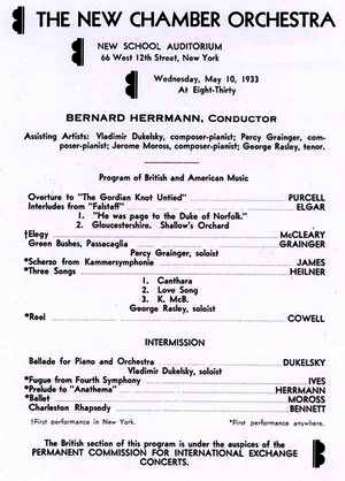
His father encouraged his interest in music and he took up the violin, winning a $100 prize for one of his own compositions at the age of 13. Herrmann's interest in composition became more serious sometime around 1927 while he attended DeWitt Clinton High School and studied with Gustav Heine. His first notable work is considered to be a tone poem called "The Forest" he wrote in January 1929. He enrolled at New York University (while still in high school) and studied composition with Philip James and conducting with Albert Stoessel. Stoessel later headed the opera and orchestra at Juilliard and Herrmann landed a fellowship there in 1930 where he studied conducting and composition with Bernard Wagenaar. He officially finished high school in 1931 around the time he formed his own orchestra, The New York Chamber Orchestra. This was before he was 20. He left Juilliard in 1932 but without a degree. That fall, he attended lectures in advanced composition and orchestration at NYU by Percy Grainger. Herrmann also worked as a music editor and arranger at the Harms music publishing company around this period. That same fall, some dancers he knew from Juilliard asked him to arrange ballet music for a musical revue called +New Americana, which inadvertently led to his professional composing, conducting, and Broadway debuts when he went on to direct the orchestra during his arrangement of The Shakers and his own piece, "Amour à la Militaire," when it opened Oct. 5, 1932. It ran 77 performances.*
By 1934, he was a staff conductor with CBS radio. He seriously began his prolific composing work during this period, writing many scores to accompany CBS radio programs including "The City of Brass" which accompanied David Ross' narration of one of the tales from One Thousand and One Nights or The Arabian Nights. In 1935, he composed the orchestral piece the Currier and Ives Suite. It was described as a short, five-movement piece on the Film Score website which has been running a series all year on Herrmann's centennial. The site notes that its composition occurred while he was employed by CBS because one of the pages of the composition was on CBS paper. Other than that, it says the origin of the piece is largely a mystery. There is a YouTube clip set against classic Currier and Ives drawings that has the orchestral piece.
Herrmann was named chief conductor of the CBS Symphony Orchestra in 1943 (a title he held until the orchestra disbanded in 1951 as TV began to displace radio), where it was said he introduced American audiences to more new musical works than any conductor in history. He particularly championed the American composer Charles Ives. Even before getting that post, Herrmann's output beyond the network and for mediums other than radio or orchestra bloomed. During the 1937-38 period, Herrmann got his feet wet for the first time in composing opera with a 45-minute cantata of Moby Dick. It didn't receive a world premiere until 1940 with The New York Philharmonic under the direction of Sir John Barbirolli. The cantata had never received a live performance in the United States since until April of this year when John Kendall Bailey conducted a 40-voice men's chorus and four soloists to perform it with the American Philharmonic-Sonoma County. Below are excerpts from the score, though it doesn't indicate from what recording it is taken and though it includes stills from John Huston's film of Moby Dick, note that Herrmann did not score that film.

While still just a staff conductor at CBS, the musical prodigy Herrmann would meet another young wunderkind making waves in New York named Orson Welles. He composed and arranged scores for Welles' Mercury Theater broadcasts, including the infamous 1938 War of the Worlds . While working at CBS, Welles lured Herrmann to Hollywood with him and when Welles made his astounding debut as the actor, writer and director of Citizen Kane in 1941, Herrmann had an equally impressive first year as a film composer. Not only did he make an impressive first showing with Citizen Kane and Welles' 1942 followup The Magnificent Ambersons, in between he composed the score for director William Dieterle's 1941 film The Devil and Daniel Webster aka All That Money Can Buy. In 1941, both the scores for Kane and Daniel Webster earned Herrmann Oscar nominations. His Daniel Webster score won (and there were 20 nominees). Though some of his greatest work still was to come, many for Hitchcock. He would receive another nomination in 1946 for director John Cromwell's Anna and the King of Siam but would not receive another nomination until he received two posthumous nominations in 1976. As is unfortunately the case with many YouTube clips, the embedding has been disabled, click here and listen to his lovely piece as the reporter reads Thatcher's diary leading into the flashback to Kane's childhood. Also, two pieces from Ambersons: Herrmann's subtle score running beneath Welles' narration of George's comeuppance and a much bouncier, holiday-theme Herrmann piece accompanying the snowride scene. I couldn't find a sample for The Devil and Daniel Webster/All That Money Can Buy.
In 1943, Herrmann composed the score for Jane Eyre directed by Robert Stevenson but involving many Mercury Theater players including Welles starring as Rochester, Agnes Moorehead as Mrs. Reed and John Houseman co-writing the script. Joan Fontaine starred in the title role. This is Herrmann's main title theme. He didn't score another film for two years when he did director John Brahm's 1945 psychological thriller Hangover Square, which I've never seen but certainly sounds interesting. It stars Laird Cregar as a composer suffering lapses in his memory who thinks he may have killed someone and seeks help from his doctor (George Sanders). Even though the composer is engaged, he somehow finds himself involved with a music hall dancer (Linda Darnell) and his temporary memory losses are threatening the concerto he has a deadline to finish. The following year, he composed the score for Anna and King of Siam, which earned him that third Oscar nomination.
In 1947, Herrmann penned the score for The Ghost and Mrs. Muir directed by Joseph L. Mankiewicz, a film that's very popular on YouTube, only for some reason people like to use scenes and stills from the movie and place modern songs over them. The next year, Herrmann made his first foray into composing for television, making music for many installments of Studio One which went by about a half-dozen different titles during its run. That kept him busy until 1951 when he debuted his first full-fledged opera Wuthering Heights. In the clip below, Yves Saelens sings "Now art thou dear, my golden June" (Edgar Linton's aria) in a concert performance of the opera at the Festival de Radio France et Montpellier 2010. Alain Altinoglu conducts the Orchestre National de Montpellier.
Directed by Robert Wise; Piece: Prelude/Outer Space/Radar
On Dangerous Ground (1952)
Directed by Nicholas Ray (Ida Lupino uncredited)
The Snows of Kiliminjaro (1952)
Directed by Henry King (Roy Ward Baker uncredited)
White Witch Doctor (1953) directed by Henry Hathaway
Now, I'm not going to list EVERY film or television show Herrmann scored, because it would grow too long. It's still going to be so long, that's why I've had to divide it into two posts so everything doesn't get knocked off the page. I'm tempted to leave out lesser titles or even bigger names if there isn't a music sample I can't find. Sometimes though, I'll find some other compelling reason to include a title figure anyone can click on his credits themselves.
Shower of Stars TV series (1954) Episode: "A Christmas Carol"
In 1955 when Burt Lancaster directed the first of the only two films he ever would helm, The Kentuckian, and he chose Herrmann for the score. Of course, that year was auspicious for another reason: It marked the first teaming of one of the most important director-composer partnerships in film history: Herrmann and Alfred Hitchcock. What brought The Master of Suspense and Herrmann together for the first time actually wasn't one of Hitchcock's tense masterpieces but his dark comedy The Trouble With Harry about the small Vermont town with the problem of a body that just won't stay put. It also marked the film debut of Shirley MacLaine.
Directed by Nunnally Johnson; Pieces: Prelude, The Children's Hour
So this is where we will leave part I. Click here just in case Part II still doesn't show on the main page.
*Much of the information in this section comes from the Herrmann biography found on Artists Direct.
Tweet
Labels: Agnes M., Books, Curtiz, Frank Loesser, Gregory Peck, Herrmann, Hitchcock, Huston, Lancaster, Lupino, MacLaine, Mankiewicz, Music, N. Ray, Oscars, Sanders, Television, Theater, Welles, Wise
TO READ ON, CLICK HERE
Centennial Tributes: Bernard Herrmann Part II
By Edward Copeland
So I had to divide this tribute to Bernard Herrmann in two parts. If somehow you started here and want to backtrack, click here. We pick up still in 1956 and I wanted to use two clips from Hitchcock's 1956 The Man Who Knew Too Much, but YouTube has removed both since I wrote this and I could find no good substitute.
A Hatful of Rain (1957) directed by Fred Zinnemann; Scene: Turning Johnny in
Have Gun — Will Travel was one of the most popular TV Westerns of its time starring Richard Boone as Paladin, a West Point grad turned gunfighter after the Civil War. It ran from 1957-1963. It managed to have two themes: the instrumental one that Herrmann wrote for its opening credits and a song "The Ballad of Paladin" that played over the closing credits. We, of course, are only interested in Herrmann's contribution.
1958 brings us back to Vertigo, whose opening credit sequence I used as the opening to Part I simply because I felt it was one of if not his greatest. Thankfully, it is not one of the movies. Unfortunately, another clip I planned to use from it from YouTube also disappeared that I wanted to include to show how his score worked within the context of the Hitchcock masterpiece, but most did not so I got to use one to top Part II and another for after this graf. There are so many choices because frankly I don't believe Vertigo would be as great as it is without Herrmann's contribution. I could have selected the opening rooftop chase, the first time Scottie sees Madeleine at Scotty's restaurant with those beautiful, vivid reds (which I took up top), the museum scene, or many others. I had settled on the scene where Scottie tails Madeleine and saves her after she jumps into the bay but that disappeared, so I went with the museum
The 7th Voyage of Sinbad (1958) directed by Nathan Juran; Piece: Skeleton fight
North by Northwest (1959) directed by Hitchcock; Piece: Title sequence
On Oct. 2, 1959, one of the most iconic television series of all times premiered on CBS: Rod Serling's The Twilight Zone. Bernard Herrmann wrote the show's theme, though not the famous one when you're familiar with and you could mimic right now. His intro music was only used for the first season, though he scored many individual episodes.
Here we have an interesting comparison of a Bernard Herrmann score that later is evoked in another composer's score either as homage or something else. You be the judge. First, listen to part of Herrmann's score for director Henry Levin's 1959 film Journey to the Center of the Earth. Then, listen to its echoes present in Danny Elfman's main title music for Tim Burton's 1989 Batman. Next in 1960, Herrmann and Hitch teamed again for the memorable Psycho. If I had my preference, I'd embed a clip of the Saul Bass title sequence with the score, but it's been disabled, so you'll have to click to hear it. However, I was able to embed the shower scene.
Tender Is the Night (1962) directed by Henry King; Pieces: 3 tracks
Here is one of the more interesting comparisons. First, we have Herrmann's original main theme for J. Lee Thompson's 1962 Cape Fear (but unfortunately not actual footage from the movie) and then we have Elmer Bernstein's adaptation of Herrmann's score for Martin Scorsese's 1991 remake of the film — complete with Saul Bass title sequence.
Marnie (1964) directed by Hitchcock; Piece: Prelude
Fahrenheit 411 (1966) directed by Francois Truffaut; Piece: Prelude
The Virginian TV series Episode: "The Reckoning (9/13/67); Piece: Title credits
What's next is something special. First, we have sequences from Truffaut's 1968 film The Bride Wore Black without dialogue, only Herrmann's score. After that, we have Herrmann himself discussing his work on the score of the film against scenes from it.
Director Roy Boulting made a thriller in 1968 called Twisted Nerve for which Herrmann composed a frightening, whistle for the film's killer to use. It has taken on a popularity greater than the film itself. So here are three takes on it. First, we have the whistle as it is emanates from Hywel Bennett as the killer in the movie. Second, we have how Herrmann incorporated the whistle into the movie's score. Lastly, we have Quentin Tarantino's homage to it in a scene in Kill Bill Vol. 1.
In 1974, Herrmann scored the schlocky horror film It's Alive, but I could find no samples of his work from that film. On Dec. 24, 1975, Bernard Herrmann died of a heart attack at the age of 64, but he left two scores behind, both of which received his final two Oscar nominations in 1976: Brian De Palma's Obsession and one of his greatest, Martin Scorsese's Taxi Driver. Both nominations lost to Jerry Goldsmith's score for The Omen.
First, from Obsession
Of course, it's nearly impossible to keep a clip from a Scorsese film up for long, but we've got the masterful Taxi Driver score, if not the images that go with them.
Ironic in a way, that Bernard Herrmann's film scoring career began with the ultimately lonely Charles Foster Kane and ended with the God's lonely man Travis Bickle. What range. What talent. Imagine if he had lived longer.
Tweet
Labels: De Niro, De Palma, Doris Day, Herrmann, Hitchcock, J. Stewart, Music, Oscars, Scorsese, Tarantino, Television, Tim Burton, Walsh
TO READ ON, CLICK HERE
Saturday, March 20, 2010
Pedro paints a puzzle

By Edward Copeland
Early in his career, Pedro Almodóvar's best films were usually no more than entertaining trifles, funny and full of color but not much else. However, if any director has ever come close to the idea of the auteur theory, this Spanish filmmaker may be the one. Granted, each film he makes now isn't better than the one that came before it but since he leaped into the newer phase of his career, each subsequent work has fit into that same level of newfound maturity and fascination. That's why I'm doubly surprised that Broken Embraces didn't garner more notice than it did when it was released last year. Perhaps we have begun to take Pedro's new style and skills for granted.
While Broken Embraces doesn't reach the heights of Almodóvar's creative upsurge such as Talk to Her or All About My Mother, I do think it's his best since those, topping his fine, but marginally lesser work on Bad Education and Volver.
It also shows once again that though Woody Allen was able to secure a great, Oscar-winning performance out of Penélope Cruz in Vicky Cristina Barcelona, no one harnesses the actress's talent as well as Almodóvar does. I haven't seen Nine, but I'm willing to wager she was much more deserving of an Oscar nomination for her outstanding work in Broken Embraces than the nomination she got for Rob Marshall's misguided musical adaptation. Working in her native language, really allows her acting chops to flow and flourish, be they a comic, romantic or emotional bent or just priceless facial reactions as reflected following a sexual romp with an older lover that simultaneous shows disgust, temporary relief and then shock.
Cruz plays Magdalena, or Lena for short, in Broken Embraces, but she really is not the main character of this romantic thriller. That role goes to Lluis Homar as Mateo Blanco, a once successful film director, who still writes, though his skills have been limited by his blindness. How he became blind is just one of the pieces of the jigsaw puzzle that Almodóvar is creating here which, in its own way, is his homage to Hitchcock. The score by Alberto Iglesias unmistakably apes classic Bernard Herrmann works at crucial points in the story, which leaps between different time periods as it tells its tale. The story even includes a character who in his younger days (Ruben Ochiandiano) reminded me of one out of Brian De Palma's Dressed to Kill, so Pedro could be doing an homage to an homage.
Without giving too much away, what sets the plot in motion is that Lena, whose father is dying of cancer but is evicted from a hospital, becomes mistress to a powerful magnate (Jose Luis Gomez) who arranges for her dad to be placed in a private clinic. After two years of boredom and unhappiness with the older man, Lena seeks a life of her own and auditions for one of Mateo's movies where she not only lands the part but the director's love as well.
In addition to Cruz, the entire cast is excellent, especially Blanca Portillo as Judit, Mateo's production manager. As to be expected in an Almodóvar film, it's full of colorful, vibrant images, but the amount of intrigue and suspense is a bit of a departure and he handles it well.
It's a shame more notice wasn't given upon the release of Broken Embraces, because it certainly deserved it and now that it's on DVD, it should not be missed.
Tweet
Labels: 00s, Almodóvar, De Palma, Foreign, Herrmann, Hitchcock, Penélope Cruz, Woody
TO READ ON, CLICK HERE


