Friday, August 03, 2012
Edward Copeland's Top 100 of 2012 (100-81)
With the release of the latest Sight & Sound poll, conducted every 10 years to determine the all-time best films, The House Next Door blog of Slant Magazine invited some of us not lucky enough to contribute to the S&S list to submit our own Top 10s to The House, which posted mine today. Sight & Sound magazine, a publication of the British Film Institute, began its survey in 1952, using only critics. Its 2002 list boasted its largest sample yet, receiving ballots from 145 film critics, writers and scholars as well as 108 directors. The results can be found here, though a note claims the page isn't actively maintained, though it appears complete to me. Since I planned to revise my personal Top 10, posted as part of my Top 100 in 2007, I figured I owed it to my entire Top 100 to redo my entire list. As before, my rule is simple: A film must be at least 10 years old to appear on my list. Therefore, movies released between 1998 and 2002 might appear on this list whereas they couldn't on the 2007 version. The most difficult part of assembling these lists always involves determining rankings. It's an arbitrary process and once you get past the Top 10 or 20, not only do the placements seem rather meaningless but inclusion and exclusions of films begin to weigh on you. In fact, selecting No. 1 remains easy but if I could, I'd have tied Numbers 2 through 20 or so at No. 2. A lot of great films didn't make this 100 through no fault of their own, falling victim to my whim at the moment I made the decision of what made the cut and where it went. In parentheses after a director's name, you'll find a film's 2007 rank or, if it's new to the list, you'll see NR for not ranked or NE for not eligible. I also should note that this does not mean the return of this blog. I had committed to taking part in The House's feature prior to pulling the plug and completed most of this before signing off.

Part of the arbitrary nature of this list (and from the very first all-time 10-best list I compiled in high school) was to try to make sure I represented my favorite directors while still allowing for those films that might be a more singular achievement. (For example, my first high school list had to be sure to include a Woody Allen, a Huston, a Hitchcock, a Wilder, a Truffaut, an Altman.) The more great cinema you see, the harder it becomes to justify that since lots of directors deserve recognition and many films might be a filmmaker's strongest work. As I've caught up with a lot of Werner Herzog's work over the years, I felt he'd earned inclusion. I was torn between choosing Nosferatu or Aguirre: The Wrath of God to represent him, but opted for the vampire tale because Herzog's "reversioning" of Murnau's silent classic manages to be both a masterpiece of atmospherics and the best version of the Dracula tale put on screen.
Pedro Almodóvar’s career evolution has taken an arc that I imagine few could have anticipated. I know I certainly didn’t back in the 1980s, when his films mainly consisted of camp, color and sexual obsession. Around the time of 1997’s Live Flesh, the Spanish filmmaker’s style took an abrupt change, filtering genres through his unique perspective to exhilarating results that continue through last year’s The Skin I Live In. The greatest of this run of seven features happens to be the most recent film to make this new Top 100 list. Telling the story of two men caring for women they love, both of whom happen to be comatose, Almodóvar’s Oscar-winning screenplay manages to balance humor, pathos and even outlandish touches you’d never expect to make one helluva movie and the writer-director’s best film so far.
Littered along the highways of film history lie multiple tales of adversity breeding triumphs of cinema. As director Jules Dassin faced a possible subpoena from the House Un-American Activities Committee, presumably followed by blacklisting, at the end of the 1940s, producer Darryl Zanuck gave him an exit strategy. Dassin flew to London to hurriedly begin filming an adaptation of the novel Night and the City, which he’d never read, and as a result produced one of the greatest noirs of all time. Not only did he make the movie on the fly, Zanuck even stuck him with creating a role for Gene Tierney, nearly suicidal after a bad love affair. The novel’s author, Gerald Kersh, hated the movie about hustler Harry Fabian (Richard Widmark) scheming to bring Greco-Roman wrestling to London while ducking all sorts of colorful characters played by wonderful actors such as Francis L. Sullivan, Googie Withers, Herbert Lom, Hugh Marlowe and Mike Mazurki. Of course, Kersh’s gripe was understandable — the film bore no resemblance whatsoever to his novel other than the title. However, that didn’t prevent it from being a damn fine film.
It takes a lot to fool me and, in retrospect, I should have seen the final twist coming, but I didn't because Sayles crafted in his best film a compelling story in which the plot turn was unexpected and the movie’s story didn't hinge on it. Even if the secret never had been revealed, this portrait of skeletons from the past and their influence on the lives of people in the present still would resonate. Sayles assembles a helluva ensemble including Chris Cooper, Elizabeth Peña, Matthew McConaughey, Kris Kristofferson, Joe Morton and, in one great single scene, Frances McDormand, to name but a few. Sayles has made some good films since Lone Star, but none come close to equaling the artistry, vitality and humanity of this one. I await another great one from him.
Set piece after set piece, Hitchcock puts Cary Grant through the paces and pulls the viewer along to his most purely entertaining offering. Grant never loses his cool as he's hunted by everyone, James Mason makes a suave bad guy and Martin Landau a perfectly sinister hired thug. With cameos by four former U.S. presidents. There's not much else to say about it: It's not an exercise in style or filled with layers and depth, it's just damn fun. In fact, it’s as much a comedy as a thriller.

There's something to be said for quitting while you're ahead and Charles Laughton, one of the finest screen actors ever, certainly did with the only film he ever directed. The film's influences seem more prevalent than people who have actually seen this disturbing thriller with the great Robert Mitchum as the creepy preacher with love on one hand and hate on the other and the legendary Lillian Gish as the equivalent of the old woman who lived in a shoe, assuming the old woman was well armed.
In describing the film that put Kurosawa on the world’s radar as a major filmmaker, I’m going to let Robert Altman speak for me. This quote comes from his introduction to the Criterion Collection edition of the movie. "Rashomon is the most interesting, for me, of Kurosawa's films.…The main thing here is that when one sees a film you see the characters on screen.…You see very specific things — you see a tree, you see a sword — so one takes that as truth, but in this film, you take it as truth and then you find out it's not necessarily true and you see these various versions of the episode that has taken place that these people are talking about. You're never told which is true and which isn't true which leads you to the proper conclusion that it's all true and none of it's true. It becomes a poem and it cracks this visual thing that we have in our minds that if we see it, it must be a fact. In reading, in radio — where you don't have these specific visuals — your mind is making them up. What my mind makes up and what your mind makes up…is never the same."
For years, my standard response when asked about Raging Bull was that it was a film easier to admire than love. Each time that I’d see the movie again though, that point-of-view became less satisfactory because, as any great film should, the film kept rising higher in my esteem. In the film's opening moments, when Robert De Niro plays the older, fat Jake preparing for his lounge act in 1964 before it cuts to the ripped fighter in 1941, even though I consciously know both versions of La Motta were played by the same actor and that De Niro was that actor, the performance so entrances that I actually ask, "Who is this guy and why hasn't he made more movies?" To gaze at the way he sculpted his body into the shape of a believable middleweight boxer, sweat glistening in Michael Chapman's gorgeous black-and-white cinematography, truly makes an impressive achievement. Acting isn't the proper word for what De Niro does here. He doesn't portray Jake La Motta, he becomes Jake La Motta, or at least the screen version, and leaves all vestiges of Robert De Niro somewhere else. Even when De Niro turns in good or great work in other roles, they never come as close to complete immersion as his La Motta does.
"Out of the worst crime novels I have ever read, Jules Dassin has made the best crime film I've ever seen," François Truffaut wrote about Rififi in his book The Films in My Life. I haven't read the Auguste Le Breton novel, but I don't doubt Truffaut's word. Dassin structures the film like a solid three-act play. Act I: Planning the heist. Act II: Carrying it out. Act III: The aftermath. Dassin fine-tunes each of the film's element to the point that Rififi practically runs as a machine all its own. The various characters behave more as chess pieces to be moved around as the story's game requires than as representatives of people. One single sequence though makes Rififi a landmark both in films and particularly heist movies: the robbery itself. Dassin films this in a 32-minute long silent sequence. No one speaks. Keeping everything as quiet as possible becomes the thieves' No. 1 priority. It's absolutely riveting. You'll be holding your breath as if you were involved in the crime yourself.
Howard Hawks appears for the first time on the list with a Western starring John Wayne that turned out to be so much fun they remade it (more or less) seven years later as El Dorado. I’ll stick with the original where the Duke’s allies include a great Dean Martin as a soused deputy sheriff, young Ricky Nelson and the always wily Walter Brennan. Wayne even gets to romance Angie Dickinson. No deep themes hidden here, though it's more layered than your typical Western. Still, that doesn't mean you can't kick up your spurs and enjoy.
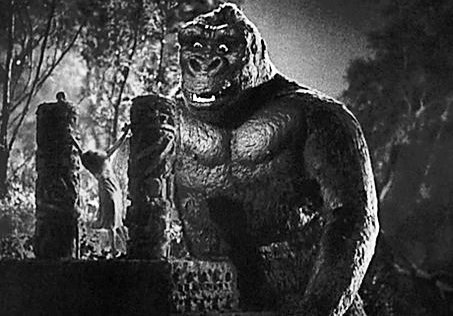
The first time was the charm. One of the few insightful comments I heard on the 2007 AFI special was when Martin Scorsese said that in many ways he finds the primitive stop-motion effects of the original King Kong more impressive than later CGI versions. He's absolutely right. The 1933 version also offers more thrills and emotions (and in half the time) than Peter Jackson's technically superior but dramatically inferior and unnecessary remake. Let’s not even discuss the 1976 version.
When L.A. Confidential debuted on this list in its first year of eligibility in 2007, I wrote, “Of the films of fairly recent vintage, this is one that grows stronger each time I see it, earning comparisons to the great Chinatown…Well acted (even if Kim Basinger's Oscar was beyond generous), well written and well directed, I believe L.A. Confidential’s reputation will only grow greater as the years go on — yet it lost the Oscar (and a spot on the AFI list) to the insipid Titanic.” When I re-watched the film recently, my prediction proved to be spot-on as it only deepens as an experience and an entertainment as time passes. It still boggles my mind that with Russell Crowe, Guy Pearce, Kevin Spacey and James Cromwell (just to name four) delivering impeccable work that only Basinger landed a nomination, but losing best picture and director to James Cameron and Titanic remains the bigger crime.
Simply put: The tensest comedy ever made and perhaps Scorsese's most underrated film. Griffin Dunne plays the perfect beleaguered straight man enveloped by a universe of misfits and oddballs in lower Manhattan when all he wanted to do was get laid. It’s hard to imagine that this movie nearly became a Tim Burton project, but thanks to the many setbacks Scorsese endured attempting to make The Last Temptation of Christ, the film ended up being his — and recharged his batteries as well. While Scorsese has made great films since, I’d love to see him step back sometime and make another indie feature like After Hours on the fly just to see what happens. Joseph Minion wrote an excellent script and this represents one case where I think the changed ending actually proves superior to the originally intended one. By the way, whatever happened to Joseph Minion?
Watchability often gets undervalued when rating a film's worth, but I never tire of sitting through this thrill ride. One aspect that has impressed me since I first saw it as a teen back in 1985 (and I went two nights in a row, dragging my parents to it on the second) was its attention to detail such as Marty arriving in 1955 and mowing down a pine tree on the farm of the deranged man trying to “breed pines.” Then, when he returns to 1985, Twin Pines Mall now bears the sign Lone Pine Mall. It’s just a quiet sight gag in the background without any overt attempt to call attention to the joke. You either catch it or you don’t. I always admire films that respect audiences like that, especially when they happen to be this much fun. With equal touches of satire, suspense and genuine emotion, Back to the Future elicits pure joy. No matter how many times I see it, the final sequence where they prepare to send Marty back to 1985 holds me in rapt attention as I wonder if this time might be the time he doesn't actually make it.
A comedy about the Vietnam War that's full of blood and set in Korea, just as a matter of subterfuge. The film that put Altman on the map and inspired one of TV's best comedies (until it got too full of itself), MASH still holds up with its brilliant ensemble and wicked wit. I still wish the TV show had kept that theme song with its lyrics. Through early morning fog I see/visions of the things to be/the pains that are withheld for me/I realize and I can see.../That suicide is painless/It brings on many changes/and I can take or leave it if I please.

Back in 1985, before Goodfellas and The Sopranos really mixed mob stories with jet black comedy, the great director John Huston, in his second-to-last film, brought to the screen an adaptation of Richard Condon's Mafia satire Prizzi's Honor, complete with great performances and some of the most memorable lines ever collected in a single film. Huston may have been in the twilight of his days, but his filmmaking prowess was as strong as ever. Jack Nicholson disappeared into the role of Charley Partanna more than he had any role in recent memory. Kathleen Turner matched well with Nicholson as Charley's love whose work outside the house causes problems. William Hickey gave an eccentric and indelible portrait of the aging don. Finally, John's daughter Anjelica made up for a misfire of an acting debut decades earlier with her brilliant performance as the scheming Maerose and took home one of the most deserved supporting actress Oscars ever given.
Before Zhang Yimou started being obsessed with spectacle and martial arts, film after film, he produced some of the greatest personal stories in the history of movies, especially when his muse was the great and beautiful Gong Li. This film was their first truly flawless effort as Gong plays the young bride of a powerful lord who already has multiple wives and who encourages the sometimes brutal competition between the women.
"The film actually is like a snail — it kind of turns in on itself and becomes itself," Altman describes his film in an interview on its DVD. One of the many "comebacks" of Robert Altman's career, this brilliant Hollywood satire holds up viewing after viewing because it's so much more than merely a satire. Thanks to Tim Robbins' superb performance as the sympathetic heel of a Hollywood executive and the cynical yet deeper emotional punch of Michael Tolkin's script, Altman wows from the opening eight-minute take to one of the greatest final punchlines in movie history. However, the more times you see it, the more you discover to see. While some specific references have aged, the movie's relevance remains — now more than ever.
Schindler’s List marked an important moment in Spielberg’s development as a filmmaker: Peter Pan finally grew up. It’s a harrowing, well-made movie that everyone should see. At the same time, I can foresee a time when it slips off this list entirely. It isn’t the fault of the film — I find it nearly flawless. However, if someone placed a gun to my head and ordered me to choose to watch either Schindler’s or one of Spielberg’s best post-1993 films such as Catch Me If You Can or Minority Report, I’d opt for one of the latter two. Are they better films than Schindler’s List? I can’t say that. However, the epic holocaust tale isn’t a film you find yourself wanting to pop a bowl of popcorn and watching on a whim. As I said earlier, for me at least, rewatchability remains an important factor. I’ve seen Schindler’s List three times but I haven’t reached the point where I want to go through that wrenching experience again.
Bergman once said that by the time he was done making Wild Strawberries, the film really belonged more to Victor Sjöström, who played Borg, the renowned professor and lauded physician about to receive an honorary degree. The film marked Sjöström 's return from semi-retirement, but he already was a legend as the first true Swedish acting-directing star. Borg decides to drive his old Packard to the event instead of flying to meet his son. The journey becomes more than just a road trip for the professor, but a metaphysical trek through his past as he questions what led him to this moment. As the car winds closer to the ceremony, Borg's inner journey does as well as he comes to realize that for all his scientific training, the only thing he can't analyze is himself. "The day's clear reality dissolves into even clearer remnants of memory," he says. Wild Strawberries represents Bergman growing into his powers as a filmmaker and while it may concern a 78-year-old man examining his life, the subject proves as timeless for people of any age as the film itself.
Tweet
Labels: Almodóvar, Altman, D. Zanuck, Dassin, Hawks, Herzog, Hitchcock, Huston, Ingmar Bergman, Kurosawa, Laughton, Lists, Murnau, Sayles, Scorsese, Spielberg, Tim Burton, Truffaut, Zemeckis, Zhang Yimou
TO READ ON, CLICK HERE


Friday, December 23, 2011
“I never dreamed that any mere physical experience could be so stimulating!”

By Ivan G. Shreve, Jr.
One of my fondest memories of collegiate life was a weekend in 1982 in which the activities department at Marshall University put together a film tribute to actor Humphrey Bogart as part of their weekly showing of classic and cult movies. I can’t recollect the exact scheduling (the MU people would showcase a feature on Friday afternoons/evenings and then have a matinee on Sundays) but I do recall that Key Largo, The Maltese Falcon and Casablanca made up the lineup and this little event exposed me to three of Bogie’s major classics for the first time. The last film, which I have forcefully stated many times at my home base of Thrilling Days of Yesteryear, is my favorite movie of all time. I still can remember the audience cheering wildly at Claude Rains’ discovery that Bogart, as Rick Blaine, has double-crossed him (“Not so fast, Louie…”) and will be helping Ingrid Bergman and Paul Henreid out on the next plane to Lisbon.
That weekend wasn’t my introduction to one of my favorite actors, however. Years earlier, through the magic of television, I saw the film that earned Bogie his best actor Oscar, The African Queen (1951), because my mother was a huge fan of the film and it soon became one of my favorites, one of those movies which gets watched to the very end if I should happen to see it playing on, say, Turner Classic Movies. Fortunately for classic movie fans, you don’t have to wait for its TCM scheduling — Queen made its Region 1 DVD debut (it had only been previously available in Region 2 releases) on March 23, 2010 (simultaneously with its Blu-ray debut) in a breathtakingly gorgeous restoration from Paramount Home Video. In fact, it was explained that its long absence from DVD was due to the difficulty in locating the film’s original negative. Queen, based on the 1935 novel by C.S. Forester, made the rounds of motion picture theaters 60 years ago today.

It is September 1914, and Anglican missionaries Samuel (Robert Morley) and Rose Sayer (Katharine Hepburn) spread the gospel to natives in the German Eastern African village of Kungdu when they receive a visit from Charlie Allnut (Bogart), skipper of the African Queen. Allnut is responsible for bringing their mail and supplies, and during his stopover informs the Sayers that since war has broken out between England and Germany, their mail delivery will be affected; he also advises the two of them to abandon their post because of his concern that the German army will recruit Kungdu’s able-bodied young men to fight for their cause. Samuel staunchly refuses, but only seconds after Charlie departs he and Rose are visited by German soldiers, who respond to Samuel’s protests with the business end of a rifle butt as his fellow conscripts start rounding up the natives and setting the village ablaze. With Kungdu in ruins, Samuel soon comes down with fever and dies — Charlie returns to the village in time to help Rose bury her brother and then agrees to spirit her away on his boat.

Despite the vessel being well-stocked with provisions, Charlie and Rose’s escape from their circumstances will not be an easy task; the Ulanga River presents obstacles in the three sets of rapids and a German stronghold in the form of a fort in the town of Shona. Because the ship’s supplies also include blasting materials (gelignite) and oxygen/hydrogen tanks, Rose, filled with both stiff-upper-lip patriotism and bitterness over her brother's death, proposes that the two of them fashion makeshift torpedoes out of the materials and use them to take on the Queen Louisa (or as the Germans refer to it, the Königin Luise), a large gunboat guarding the lake in which the Ulanga empties. Charlie is convinced that what Rose is suggesting will be a suicide mission, but he agrees to the plan only to get cold feet shortly after navigating the first set of rapids. He declares his intentions to have nothing to do with Rose’s plan after a gin-sponsored bender. The next morning, suffering from a hangover, Charlie watches helplessly as Rose pours every last drop of his precious gin into the Ulanga and follows this up with “the silent treatment,” Charlie reconsiders the mission.
German soldiers fire upon Charlie and Rose as they pass the fort at Shona, and though the two of them avoid being hit by gunfire, the men do manage to hit the African Queen’s boiler, disconnecting one of its steam pressure hoses and bringing the vessel to a temporary halt. (Charlie manages to reconnect the hose and they pass by the fort unscathed.) The boat then hits the second set of rapids and survives the ordeal with minimal damage, prompting the duo to engage in a celebratory embrace which leads to a kiss. It is by this time in their adventure that they cannot deny the strong attraction that has developed between them, which leads to an amusing scene in which Rose asks her new boyfriend awkwardly: “Dear, what is your first name?”

The couple finally navigates the final set of rapids, but in doing so sustain damage to the Queen’s shaft and propeller. Rose convinces Charlie that he has the skills to repair the boat and, using what is available on a nearby island, he restores the Queen to working order and they’re off again down the river. However, they soon discover the deception of the Ulanga River; they “lose the channel” and become stranded on a mud bank surrounded by reeds in all directions — with Charlie sidelined with fever (after an experience in which he emerges from the murky water covered with leeches). When all appears lost, Rose offers up a prayer asking that she and Charlie be granted entrance into the Kingdom of Heaven…and in answer to that prayer, rains from a monsoon soon lift the boat out of the mud and into the mouth of the lake — as it turns out, they were less than a hundred yards from their destination.

Charlie and Rose, having spotted the Louisa patrolling the lake, prepare the makeshift torpedoes and go after the German craft come nightfall, but en route they get trapped in a squall and the African Queen capsizes due to the holes made in its sides to accompany the torpedoes. The Louisa’s crew captures Charlie who is crestfallen because he thinks Rose has drowned, so much so that he stoically accepts the captain’s decision to hang him. Surprisingly, Rose has survived the Queen’s sinking and is brought aboard to face questioning where she proudly tells the Louisa’s captain of their plot to scuttle the ship, resulting in her sentence of execution as well. Before the couple's hanging, Charlie asks the Louisa’s captain if he’ll marry him and Rose; that buys enough time for the Louisa to run into the Queen’s wreckage, detonating the torpedoes and sinking the ship. The newly married Allnuts swim to safety toward the Belgian Congo as the film concludes.
Upon its publication in 1935, The African Queen originally was optioned for a film adaptation by several studios including RKO and Warner Bros. — Charles Laughton and Elsa Lanchester even made a movie (with a similar story, though the source material came from W.
 Somerset Maugham) in 1938 entitled Vessel of Wrath (aka The Beachcomber). Over the years, several actors were suggested for the part of Charlie Allnut; John Mills, David Niven and James Mason being the most prominent — Bette Davis was the only actress in serious contention for Rose, but after an abortive attempt to do the movie in 1947 (scuttled because of Davis’ pregnancy) she was passed over two years later in favor of Katharine Hepburn when the production got underway. (Director John Huston, who had already chosen Humphrey Bogart for his Charlie, once stated in an interview that Hepburn was tabbed because Bogart had expressed an interest in working with her.) While it’s possible to see Davis playing the part, the choice of Hepburn (in what would be her first color film) was the right one despite some initial reservations on the part of Huston with Kate’s performance. Thinking she was making the Rose character a little too severe, John suggested that Hepburn imitate the indomitable spirit of former first lady Eleanor Roosevelt, who always remained cheerful despite any adversity. (Hepburn later observed that Huston’s suggestion was the finest bit of directing she’d ever received.)
Hepburn’s performance in the film is a marvel because the actress bravely allowed herself to be filmed au natural, which no doubt stunned audiences at the time as they saw the great Kate playing her true middle-age (something that she would go on to do from that point in
 her career, particularly in David Lean's wonderful 1955 film Summertime) and yet they witnessed a woman who transforms from a “crazy, psalm-singing, skinny old maid” into a spunky, sexy woman whose romance with the unlikely Charlie makes her giddy as a schoolgirl (I love the scene where she giggles and laughs uncontrollably at Charlie’s animal noises on the boat). The relationship between the characters is so genuine and feels so right, you literally watch the barriers between the two melt away during the course of their adventure. Pay particularly close attention when Rose helps Charlie pump water out of the boat and she stops momentarily, caught up in her romantic reverie. Charlie has got it bad as well. In assisting Rose with the task,c you can just see how dazed and delighted he is to have found true love. Director John Huston could scarcely ignore the magic between the two characters and decided to buck the tradition of most of his films (which tend to feature what one critic has called “beautiful losers”) by allowing Charlie and Rose’s torpedo scheme to succeed (in Forester’s book the plan doesn’t quite come off) and joining the two in holy matrimony (a plot device also designed to ward off criticism by bluenoses finger-wagging at Charlie and Rose’s cohabitation outside marriage).
Huston and Bogart were not only close friends in real life, they had made onscreen magic working together as far back as the director’s feature film debut, The Maltese Falcon, and as recently as one of Huston’s masterpieces, The Treasure of the Sierra Madre. To accommodate the handicap of Bogart’s inability to do a Cockney accent, however, the character of Charlie Allnut became a Canadian, prompting a hefty rewrite of the script. Though the role of Charlie would seem a departure for Bogie, known for his tough-guy antiheroes, there are many shared characteristics between him and other Bogart characters (Allnut shares the same unshaven scruffiness as Sierra Madre’s Fred C. Dobbs, for example), particularly that of the individual who eventually comes around in support of the cause for the greater good. Bogart was nominated for a best actor Oscar for his performance (Hepburn also was tabbed, along with Huston for his direction and screenplay with co-writer James Agee) and despite stiff competition that year from Marlon Brando, Montgomery Clift and Fredric March, the Academy got sentimental and awarded the actor the coveted trophy.
The realistic atmosphere and look of the film stem from the decision by Huston and producer Sam Spiegel (along with brothers John and James Woolf, who financed the movie through their Romulus Films company) to shoot on location in Uganda and the Congo in Africa.
 Under normal circumstances, this production would have been daunting but because it was a Technicolor film (which necessitated large, unwieldy cameras), the shoot proved to be an ordeal for all involved. Hepburn later detailed the colorful history of the production in a book, The Making of the African Queen, or: How I Went to Africa with Bogart, Bacall and Huston and Almost Lost My Mind, and a fascinating featurette included on the Paramount Home Video DVD, Embracing Chaos: Making the African Queen, also contains enthralling anecdotes about this remarkable motion picture. The cast and crew survived any number of adverse conditions, chiefly among them sickness due to the dysentery resulting from contaminated drinking water. Hepburn, for example, became so ill that a bucket was placed near the pipe organ she plays in the opening church scenes. According to cinematographer Jack Cardiff, the actress was “a real trouper.” The only two individuals on the film who escaped illness, according to legend, were Huston and Bogart, primarily because the men subsisted on the imported Scotch they had brought with them. (Bogie later cracked: “All I ate was baked beans, canned asparagus and Scotch whiskey. Whenever a fly bit Huston or me, it dropped dead.”)
The size of the African Queen also presented problems where the Technicolor cameras were concerned — because there was not enough room for the cameras on the boat (which measured 16 feet long and 5 feet wide), a mock-up of the craft was put together on a larger raft and the production used several such rafts to the point where the river hosted a small flotilla, with the last pontoon housing Hepburn’s “loo” (her contract stipulated that she be provided with private restroom facilities). The waters of the river, considered poisonous due to bacteria, animal excrement, etc., were never utilized in shots or sequences requiring Bogie and Kate’s immersal — they were filmed separately in studio tanks at the Isleworth Studios in London. Despite the challenges presented in the making of the film, what resulted was a certified masterpiece — at a time when “independent” films are the Hollywood darlings of today, The African Queen was a noteworthy example of that particular type of movie (made outside the dictates of the studio system) even though industry wags remained skeptical about its performance at the box office. (The film was a tremendous success, but director Huston never collected on the payday because of his desire to sever his ties with producer Spiegel; cinematographer Cardiff also had the option of taking a percentage of the profits to subsidize a lower salary but he begged off, having had a bad experience with another film he had worked on in that same year, The Magic Box.)
Queen enraptured me as a young movie fan, and continues to do so today — I think it would be the perfect film to introduce to classic movie-adverse audiences because of its skillful blend of adventure, romance and even comedy (There are some hilarious moments in this movie, chiefly the scene where Charlie sets down to tea with the Sayers). The fact that it’s in gorgeous Technicolor also is a plus, particularly since new generations often shrink from movies filmed in monochrome. Writer-director Nicholas Meyer observes in the Embracing Chaos documentary that “Movies are like soufflés — they either rise or they don’t — and people seldom are able to predict or tell you why. The African Queen is an improbably cinematic triumph, made against seemingly insurmountable odds and comprising a bunch of disparate, desperate characters who, saving the movie business, would probably not even be in the same world let alone the same room with each other.” The results of that grand moviemaking adventure captured on film make The African Queen a must-see for audiences of any age.
Tweet
Labels: 50s, Bacall, Bette, Bogart, Brando, Clift, Fredric March, Huston, Ingrid Bergman, K. Hepburn, Laughton, Lean, Mason, Movie Tributes, Niven, Rains
TO READ ON, CLICK HERE
Sunday, December 18, 2011
Centennial Tributes: Jules Dassin Part I

By Edward Copeland
With a name like Jules Dassin and some of his most classic films made in France, Turkey, Italy and Greece and mostly filmed in French with some Italian, Greek, Turkish and Russian thrown in, it's easy to assume that the great director himself hailed from Europe, probably France. In actuality, when Dassin was born 100 years ago today, that event occurred in Middletown, Conn., and he grew up in Harlem, N.Y., and went to school in The Bronx. Dassin was quintessentially American — until after working in the theater and making 11 features
 for or distributed by Hollywood studios, Dassin was one of those unfortunate artists who received the most un-American of treatments from the first round of Communist witch-hunting by the House Un-American Activities Committee (before Joe McCarthy really made blacklisting a phenomenon) and Dassin couldn't work in the U.S. so he headed to Europe where he made one of the greatest heist films ever. Eventually, he did come back to the U.S. from time to time, but his later films lacked the punch of either his early studio work or his movies made in exile. That exile also introduced him to the woman who became his second wife and the great love of his life — Melina Mercouri. So, though eventually he returned to the U.S. to make some films and direct a Broadway musical based on the couple's most famous film collaboration, Never on Sunday, Greece became his adopted home — until he and Mercouri were booted from there by a military coup led by dictators who felt they were agitators. Eventually, they were able to return to Greece as well, staying together until Mercouri's death in 1994 at the age of 73. However, Dassin lived a much longer and vibrant life, almost making it to his own centennial. He only died a little more than three years ago at the age of 96. In some of his early work in Hollywood, he directed some classic examples of film noir that also boasted elements of social consciousness, something he maintained in real life right up until the end as seen in one of the best discoveries I found preparing this piece: an interview conducted at the Los Angeles County Museum of Art in 2004 when he was 93 or 94 that Criterion included on The Naked City DVD. The invaluable Criterion Collection also includes interviews from other years with Dassin, the most recent being 2005, on DVDs of his various films, leaving us a great resource on the man, his films and the blacklist.
 As was the case with many directors, Dassin's first foray into the creative arts began as a theater actor, in Dassin's case working with The Yiddish Theater called ARTEF (acronym for the Arbeter Teater Farband or Worker’s Theatrical Alliance) in New York in the mid-1930s after studying acting at the Civic Repertory Theatre Company begun by Eva Le Gallienne. It was during this time that he joined the Communist Party, though he quit in 1939 when Stalin signed the Soviet Union's nonaggression pact with Hitler. “You grow up in Harlem where there’s trouble getting fed and keeping families warm, and live very close to Fifth Avenue, which is elegant,” he told The Guardian newspaper in a 2002 interview. “You fret, you get ideas, seeing a lot of poverty around you, and it’s a very natural process.”
Around the same time, he quit the party. Dassin decided to take his career in another direction — both literally and geographically. He headed to Hollywood where he was hired by RKO to a six-month apprentice director contract at $250 a week where Dassin got to assist directors at work but didn't actually do much in the way of hands-on participation. At least that was the way Dassin described it in the 2004 L.A. County museum interview on The Naked City DVD. One director working on the lot at the time that Dassin who Dassin was assigned to and who particularly fascinated Dassin with his technique was Alfred Hitchcock, who was making Mr. & Mrs. Smith at the time. As Dassin tells it, his awestruck gazing at Hitch at work became very noticeable — so much so that after each take Hitchcock would turn to find Dassin and ask him if the take was OK. As the RKO contract neared its end, the studio informed Dassin that he was being let go. Fortunately, MGM hired Dassin and gave him his first film assignment making shorts. Dassin said his farewells to his friends at RKO — even working up the nerve to say goodbye to Hitchcock, who already had heard that Dassin would be making his first film. Hitchcock gave Dassin these words of advice: "Don't ever make a picture with children, animals or Charles Laughton." Of course, Dassin would end up doing films with all three.
At MGM, he made short documentaries about Arthur Rubinstein and Marian Andersen. He then made a short adaptation of Edgar Allan Poe's story "The Tell-Tale Heart." Frustrated with his progress, Dassin was able to get his short of the Poe story screened theatrically and that prompted MGM to sign him to a seven-year contract. In that 2004 interview, Dassin didn't express much affection for his time at MGM, equating the contract to being a slave. While he was tied to them for seven years and had to make what they told him to make, they had the option of dumping him every six months. Dassin had tried to get time off to direct a play on Broadway, but MGM wouldn't even let him do that. (He had directed one play that ran a month in 1940 called Medicine Show.) Of the seven features and the Poe short (I have no idea if the other shorts still exist) that he made at MGM, I've only managed to see the short and two of the features. While none come close to what Dassin made later of the ones I saw, they weren't complete embarrassments.
This 20-minute adaptation of Edgar Allan Poe's famous short story proves to be quite a stylish film debut for Jules Dassin. The short opens with a biblical quote, specifically Romans II.15: "The law is written in their hearts, their conscience also bearing witness." It stars Joseph
 Schildkraut, the second person to ever win an Oscar for best supporting actor playing Captain Dreyfus in 1937's The Life of Emile Zola, as the young man who finally snaps at the abuse inflicted upon him by his tyrannical boss and kills the old man (Roman Bohnen). Dassin really pulls out the attention-getting stops: Focusing on Schildkraut's ear from the short's beginning before the killing even takes place. The boss slaps him on it and he threatens to quit, but the boss tells him he's too much of a coward to do that. He's worked for the old man since he was 14 and he's almost 30 now. Murder will out and the young killer slowly goes mad as he becomes convinced that he still hears the boss's beating heart below the floorboards where he hid his body. In his limited amount of time, Dassin creates a very atmospheric tale, helped immeasurably by cinematographer Paul Vogel, who later won an Oscar for his black & white photography in Battleground. The short's only negative is a somewhat obvious and overbearing musical score by Sol Kaplan. For some reason, The Tell-Tale Heart is included as a bonus feature on the Shadow of The Thin Man DVD in The Thin Man series box set.
 Didn't get to see this one which starred Conrad Veidt (best known as Nazi Major Strasser in Casablanca) as identical twins: one a stamp collector and rare bookshop owner, the other a ruthless Nazi. On one of the many interviews included on Criterion DVDs, Dassin said of Veidt on the French TV program Ciné Parade in 1972, "At the time, he was the big European star. He was a big actor with a personality to match." When Veidt realized he would be directed by a first-timer, he objected. Dassin sought advice and one of the crew suggested setting up dolly tracks so when Veidt returned to the set, he asked what they were for and Dassin explained that they were doing a shot that started back at one point and then zoomed up to him for a close-up. Veidt thought it sounded great and was satisfied after that.
Dassin's next film was a comedy I also haven't seen, so here's the IMDb summary by Les Adams, though I've added performers' names. "The town gossips are reporting that a household servant in exclusive Rocky Point is writing an expose of the colony. Mrs. Sophia Sommerfield (Spring Byington) is convinced it can't be either one of her maids, Martha Lindstrom (Marsha Hunt) or Mrs. McKessic (Marjorie Main), although, unknown to Sophia, she is totally unaware that her son, Jeff (Richard Carlson), is married to Martha."
Of Dassin's MGM features, this Joan Crawford vehicle happens to be the earliest one I've seen. Produced by Joseph L. Mankiewicz, Reunion in France opens telling us it's May 9, 1940, in Paris and then adds these words: The Ninth Night of the Ninth Month Too Uneventful to Be Taken Seriously and Too Far Away to Worry About. Crawford plays Michele de la Becque, a Parisian society figure with a high-profile
 beau Robert Cortot (Philip Dorn), trying to pretend that the Nazi threat isn't knocking on France's door. As Michele heads off on a train trip, an announcement at the station tells everyone to get into shelters. When Michele returns, she finds that the Nazis have not only occupied Paris — they've taken over her house as their headquarters as well, leaving her servants' quarters for use as her new home. More disturbing, she finds that Robert seems awfully cozy with the Nazi high command. Meanwhile, she stumbles across American pilot Pat Talbot working with the British (John Wayne) and hides him out, even though he's out to stop Cortot from supplying the Nazis with war machinery he's producing. It does lead to one nice dialogue exchange between Michele and Pat where Pat speaks negatively about Michele's love. "You hardly know Cortot," Michele tells Pat, defending her boyfriend's character. "I hardly know Hitler either," Pat replies. The story unfolds in a by-the-numbers fashion, but Dassin does add some nice touches. Old TV sitcom fans will spot Natalie Schafer aka Lovey on Gilligan's Island as the top Nazi's wife. On his appearance on Ciné Parade, Dassin told the interviewer about working with a huge star like Crawford and the star system in general in that era. "To explain the attitude of the time, I was young and I seemed even younger,"
 Dassin told the interviewer in 1972. "While shooting the first scene, at a certain point I said, 'Cut.' An icy silence fell over the set. She (Joan Crawford) turned as if to say, 'Who dared to say cut?' Immediately, the assistant director shouted, 'Why all this noise?' She said to me, 'Never say cut to Joan Crawford. Never.' I said, 'But it wasn't any good.' She said, 'What?' I said, 'It wasn't any good,'" the director shared with the audience. Two minutes later, Dassin found himself in Louis B. Mayer's office. "It's over," Mayer told him. "I thought I'd been fired on my very first scene, but no, she'd invited me to dinner. Joan Crawford. At her house. That was quite something," Dassin said. He went on to elaborate on what dinner at Joan Crawford's house was like, including being greeted by her three adopted children who all wore white gloves. Eventually, she asked him about why he had called cut during that scene. "Because the scene wasn't any good," Dassin told her. Crawford asked him if he thought she was a bad actress but he assured her that wasn't the case. "On the contrary. You're good," he told her "So what was wrong?" she asked. "When you're in character, and it's part of you, I love it, but when you act the grand lady, it feels fake," Dassin explained. "Really? I do that," Crawford said with surprise and Dassin confirmed it. "Fine. Let's give it another try tomorrow," Crawford agreed. Dassin got to keep his job as director on the film under the condition that he never say, "Cut." Instead, he and Crawford worked out a hand signal where he would run his finger across his forehead and then she would know.
Dassin's next film has been seen so rarely, IMDb doesn't even have a plot synopsis or summary. It's never been released on any home format, but apparently pops up on TCM now and then. I borrowed the first two grafs by Laura at Laura's Miscellaneous Musings to at least get an idea of the movie. "Young Ideas is an MGM "B" movie which starts poorly but builds to an entertaining second half, thanks largely to the talent of its fine cast. Jo (Mary Astor), a best-selling author, is swept off her feet by small-town chemistry professor Michael (Herbert Marshall), much to the dismay of Jo's college-age children Jeff and Susan (Elliott Reid, Susan Peters). Jeff and Susan don't want to leave their home in New York, and Jo's agent Adam (Allyn Joslyn) is also apoplectic. Adam conspires with Jeff and Susan to break up Jo and Michael's marriage."
When I saw The Canterville Ghost, I had no idea that it was directed by the man responsible for films such as Rififi and Night and the City. This fun little trifle teamed the charming Margaret O'Brien, the same year she stole the show in Meet Me in St. Louis as Judy
 Garland's little sister, and Charles Laughton, meaning Dassin ignored two-thirds of
 Hitchcock's advice on his fifth feature. Based on the Oscar Wilde story, Laughton plays the cowardly ghost of Sir Simon de Canterville, sealed in a wall by his father in the 17th century after running away from a duel and doomed to haunt the halls of his family's castle until some Canterville descendant commits an act of bravery while wearing the family ring. Alas, all subsequent Cantervilles have proved to be cowards as well. The charming young O'Brien plays Lady Jessica de Canterville, the 6-year-old who currently owns the castle, though she lives nearby with an aunt because Sir Simon's ghost scares her. A bunch of American soldiers take refuge in the empty castle and have first-hand experiences with the ghost when young Jessica discovers that one of the fighting men, Cuffy Williams (Robert Young), has the Canterville birthmark. After the little girl overcomes her fear enough to introduce Cuffy to Sir Simon, they decide that perhaps Cuffy is a Canterville and he might lift Sir Simon's curse. The Canterville Ghost isn't a masterpiece by any means, but it's likable enough.
 Again, I must rely on the plot summary provided by an IMDb user, this time by Kathy Li. Again, I've inserted the performers' names. "Evie's co-workers at the uniform shirt factory, and her almost-fiancée's inability to kiss, inspire Evie (Marsha Hunt) to slip a letter into a size 16½ shirt for some anonymous soldier. It's received by 'Wolf' Larson (John Carroll), who immediately throws it away, but his sensitive, dreaming — and short — buddy John McPherson (Hume Cronyn) snags it, and begins a correspondence with Evie, pretending to be Wolf. But things get complicated when Evie wants to meet her tall, handsome soldier. And even more complicated when Wolf sees Evie and likes what he sees."
Dassin finally finished his MGM contract with this film that IMDb also lacks a synopsis or summary to describe. TCM's website does, but I had to insert the performers' names there as well. "Carrying $500,000 in stolen government certificates, which are stashed in the binding of his favorite cookbook, master confidence artist Ace Connors (John Hodiak) meets with businessman Dwight Chadwick (Lloyd Corrigan) at a posh Beverly Hills hotel to discuss an oil investment deal. Chadwick's sultry friend, Ricki Woodner (Lucille Ball), a confidence artist working a phony art racket, joins the men at their poolside rendezvous and tries to sell Chadwick on some paintings she claims were smuggled out of Europe. Ricki wastes little time in souring Chadwick on his deal with Ace, to which Ace responds by identifying one of her paintings as a fake. Following the meeting, Ace receives word that detectives in New York are closing in on his bond scheme, and that a deal is being made in which he is to serve a five-year sentence in Sing Sing penitentiary in exchange for his voluntary return to New York to face trial. Assigned to escort Ace back to New York is detective Bob Simms (Lloyd Nolan), Ace's inept but persistent nemesis of many years. Ace accepts the terms of the Sing Sing deal after a menacing visit from Fly Feletti (Elisha Cook Jr.), his former partner, who is seeking his share of the half million-dollar bond deal."

With MGM's shackles removed from Dassin, you almost can say that it was at this point that his film career truly began and he began to direct the classic films that earned him his reputation. Mark Hellinger, who had achieved national fame as a New York columnist after starting out as a theater critic before trying his luck in Hollywood, spending several years at Warner Bros., where he worked on films such as They Drive By Night and High Sierra. Frustrated by the lack of social realism in films and being under the thumb of Jack Warner, Hellinger leaped at the opportunity to set himself up as an independent producer at Universal-International. The first film to come out of his new deal was The Killers starring Burt Lancaster. For his second film, he hired Lancaster again to star and Dassin to direct the prison noir Brute Force, Dassin's first great film. It also reunited the director with Cronyn from A Letter to Evie, but though I've only read the description of Cronyn's Evie character, that comedy's John McPherson bears little resemblance to Brute Force's Captain Munsey, head of the prison guards at Westgate Penitentiary and one of the all-time hissable screen villains. The film also had a screenplay by Richard Brooks, who would go on to write and direct films such as The Blackboard Jungle, Elmer Gantry, The Professionals and In Cold Blood. The opening credits for Brute Force show an imaginative flair, first listing Lancaster, Cronyn and Charles Bickford "As The Men Inside." After that, it ticks off the names Yvonne De Carlo, Ann Blyth, Ella Raines and Anita Colby "As The Women On The Outside." That hardly accounts for the entire ensemble as the credits announce that Brute Force is "Introducing Howard Duff, 'Radio's Sam Spade' as Soldier."

Though the film was made in 1947, Brute Force maintains a lot of intensity in its scenes today. Early on, there's a scene where inmates use blowtorches to drive another prisoner into a press to his death. Watch Brute Force and try to imagine The Shawshank Redemption being made without it. Granted, there isn't any shower rape in Brute Force and the warden (Roman Bohnen, the old man in Dassin's Tell-Tale Heart short) isn't corrupt as much as ineffective but the guards, led by Cronyn's Munsey are a different story. The overcrowded penitentiary has been facing political pressures from outside over a series of incidents, the most recent being a prisoner's suicide that Munsey provoked, so harsher discipline is demanded, including revoking all privileges, including paroles, and making all the men on the cell block where the suicide took place work on the prison's drain pipe. Of the prison staff, only the alcoholic Doc Walters (Art Smith) argues against a harder line doing any good. "He doesn't know that kindness is actually a weakness and weakness is an infection that makes a man a follower instead of a leader," the evil and ambitious Munsey says in the meeting. "You're worse than the worst inmates in this prison," the doctor tells Munsey.
The suspension of parole hearings even angers the generally genial Gallagher (Bickford), who runs the prison paper, The Westgate News, and is nearing release. Before Gallagher always urged the hot-head de facto inmate leader Joe Collins (Lancaster) to calm his rage, telling
 him, "Those gates only open three times. When you come in, when you've served your time, or when you're dead." Gallagher always has served as a peacemaker, even breaking up inmate fights, pissing off Munsey in the process. "I understand you're responsible for settling that little feud over in cell block J. We appreciate your assistance, of course, but…," Munsey tells Gallagher as he passes his table at breakfast. "The boys and I were only trying to help," Gallagher replies. "Gallagher, when are you gonna' remember that you're not back home, running a gang of hoodlums? Let me be the policeman. You just serve your time. And that way we'll both get paid off," Munsey warns him. "Like the good book says to us, Captain, we all get what's coming to us — all of us," Gallagher smiles at the guard. With the crackdown, Gallagher's attitude changes when Joe once again concocts an escape plan. "Look, Gallagher, I know this drum's full of crackpots. One convict's gonna' buy his way out, another knows the governor's cousin. A third guy's even gonna' float out in a homemade balloon. But I'm not buyin' any pipe dreams. It can be done. It's been done before, and it'll be done again. It can be done here — by us," Collins insists. "Collins, if I ever put in with anybody, it'll be with you," Gallagher pledges.
Brooks' dialogue overflows with memorable lines from the talented cast. Brute Force gets around the pure prison scenes when the various inmates share tales of their lives in the outside world, some touching, some funny. One of the best gets told by the inmate Spencer (John Hoyt, who decades later would play the grandfather on the Nell Carter sitcom Gimme a Break). His story becomes a first-person film noir parody within a tough prison noir drama. Spencer talks about the woman he still dreams about named Flossie (Anita Colby) back when he was a gambling fool. He delivers his voiceover monologue in the pitch-perfect style of the genre while the flashbacks play as a pantomime. Here's just the punchline excerpt: "Flossie had looks, brains and all the accessories. She was better than a deck with six aces. I regret to report that she also knew how to handle a gun — my gun…She wanted all the money I'd won and I never refused a lady — especially when she's armed." Spencer also gets one of the film's other most memorable lines when he says, "You know, I was just thinking. An insurance company could go flat broke in this prison." Brute Force really introduced Jules Dassin to the world as a director to watch. The great cast, daring producer and solid screenplay helped make Brute Force a classic, but the pulsating score by Miklos Rozsa, the crisp, stark cinematography by William H. Daniels and Edward Curtiss' film editing all contributed as well. Dassin's earlier works had shown hints of what he could do, but Brute Force was the first film where he could really show his stuff which he'd be able to do even more in his next three American-financed films.
Unfortunately, these would come just as he became a victim of the blacklist and headed to Europe so he could continue to work in film. When I started to delve into Dassin and discovered so many of the DVDS of his best films contained interviews with him, this tribute began to morph into something larger than usual. I hope to keep it two parts and I hope the second part comes today, but to do his life and work justice may end up taking three parts and two days.
Tweet
Labels: blacklist, Crawford, Cronyn, Dassin, Documentary, Foreign, Garland, Hitchcock, L. Ball, Lancaster, Laughton, Mankiewicz, Mary Astor, Musicals, Oscars, R. Brooks, Wayne
TO READ ON, CLICK HERE
Friday, December 09, 2011
Centennial Tributes: Broderick Crawford

By Ivan G. Shreve, Jr.
In 1949, Columbia Pictures brought Robert Penn Warren’s classic novel All the King’s Men to the big screen in an adaptation that deviated a great deal from the source material (as most films are wont to do) but nevertheless made for a compelling movie about idealism and political corruption in telling the tragic story of the rise and fall of a populist demagogue named Willie Stark. In casting the film, director Robert Rossen first offered the role of Stark to John Wayne who — not surprisingly — turned down the part, thinking the script unpatriotic. Rossen then decided upon Broderick Crawford, a burly character actor whose prolific if undistinguished cinematic career was comprised of playing tough guys and Runyonesque hoods in vehicles such as Tight Shoes (1941) and Butch Minds the Baby (1942). The role of Willie Stark fit Crawford like a glove, however; he won an Oscar for his performance in King’s Men beating out the Duke, who also had been nominated that same year for his starring turn in Sands of Iwo Jima.
Crawford’s triumph for All the King’s Men has often acted as a litmus test where Academy Awards are concerned; many film historians and critics argue that the Best Actor Oscar should not have gone to someone whose movie career, with the exception of King’s Men and Born Yesterday (1950), was marked by admittedly one-note performances in B-pictures, alternately playing heroes and villains. Is the purpose of Academy Awards to single out meritorious individual performances, or are they largely recognition for an entire distinguished body of work? I suppose it matters very little in the final analysis, because there are no mulligans when it comes to Oscars: Crawford won his, and in all honesty I think it was most deserved. The actor, who would become one of Hollywood’s most cantankerous character thespians, was born 100 years ago today, and now is good as time as any to see if his stage, screen and television legacy holds up.
Broderick Crawford was born in Philadelphia in 1911 to a second generation of performers, vaudevillians Lester Crawford and Helen Broderick. The latter name is familiar to many classic film buffs that’ve seen the comedienne in such Fred Astaire-Ginger Rogers vehicles as Top Hat (1935) and Swing Time (1936). Before her movie career, she and her husband were a successful comedy duo in vaudeville, with an act that occasionally featured their young son in small roles. Brod graduated from the Dean Academy in Franklin, Mass., (where he was a well-regarded athlete) and was accepted at Harvard but his further academic pursuits came to a halt when he dropped out after three months to find work in New York. He became a jack-of-all-trades (longshoreman, seaman, etc.) though eventually the show business bug consumed him and he landed a number of radio jobs in the 1930s; reportedly appearing from time to time on Flywheel, Shyster and Flywheel — the 1932-33 half-hour comedy series starring Groucho and Chico Marx.
With performing in his blood, Broderick made his Broadway debut in 1934 as a football player in She Loves Me Not (he had made his stage debut in the same production in 1932 in London, where his talents attracted the notice of Alfred Lunt and Lynn Fontanne, who in turn introduced him to Noel Coward) and later appeared in such productions as Coward’s Point Verlaine, Sweet Mystery of Life and Of Mice and Men. It was for the latter play that Crawford earned exceptional critical acclaim, though when it came time for Hollywood to do its adaptation Brod was overlooked for the part in favor of Lon Chaney, Jr. By that point in his show business career, Crawford had set stage work aside in favor of the movies; his film debut was in the Samuel Goldwyn-produced Woman Chases Man (1937; with Miriam Hopkins and Joel McCrea) and he continued to appear in such B-flicks as Submarine D-1, Undercover Doctor and Eternally Yours. On occasion, Broderick would land roles in “A” productions such as Beau Geste, The Real Glory, Seven Sinners and Slightly Honorable but his rough-hewn manner and less-than-matinee-idol looks (in later years he remarked that his cinematic countenance resembled that of “a retired pugilist”) usually relegated him to character parts in scores of shoot-‘em-up Westerns like The Texas Rangers Ride Again and When the Daltons Rode. He did, however, prove versatile and adept at humorous turns in films like The Black Cat (Brod’s actually one of the “heroes” in this horror comedy, teamed with cinematic toothache Hugh Herbert) and Larceny, Inc.; he supported Edward G. Robinson in this last one as the lunkheaded Jug Martin, who assists Eddie and Ed Brophy in their attempts to rob a bank by purchasing and operating a luggage store next to it. (A decade later, Crawford paid homage to Robinson by re-creating a role that Eddie G. had played in the 1938 crime comedy A Slight Case of Murder but unfortunately, Stop, You’re Killing Me can’t quite measure up to the original.)
Crawford’s film career was interrupted briefly by World War II; he enlisted in the U.S. Army Air Corps and while in Europe saw action in the Battle of the Bulge. He later was assigned to the Armed Forces Radio Network in 1944, where as Sergeant Crawford he fell back on his previous radio experience to serve as an announcer for Glenn Miller’s band. Back in Hollywood by 1946, Brod returned to the B-picture grind with occasional bright spots such as Black Angel, The Time of Your Life (as a melancholy policeman) and Night unto Night. His gig in All the King’s Men transformed him into a box-office draw and made him the most unlikely leading man since Wallace Beery; signing a contract with Columbia that same year, he also nabbed the plum role of tyrannical junk tycoon Harry Brock opposite Judy Holliday in Born Yesterday — a part that actor Paul Douglas had played to great acclaim on stage.
Crawford’s brilliant comic turn in Yesterday had an unfortunate side effect in that it earned him enmity from critics who have argued that, for the most part, he played variations of Harry Brock in practically every film in its wake. The success of both King’s Men and Yesterday nevertheless earned him considerable cache to appear in “A” productions such as Night People (1954) and Not as a Stranger (1955) —the latter film once described by one critic as “the worst film with the best cast.” His turn as Capt. “Waco” Grimes in Between Heaven and Hell (1956) features some of his best work, and his approach to the character may remind you of Col. Kurtz in Joseph Conrad’s Heart of Darkness. That same year, he surprised critics again by scoring as a petty thief seeking redemption in Federico Fellini’s Il Bidone.
Truth be told, Crawford worked his magic best as a screen heavy; he appeared as a formidable villain against Clark Gable in 1952’s Lone Star, and particularly shone in film noirs such as Big House, U.S.A. and New York Confidential (both 1955). One of his best showcases in that style was in 1952’s Scandal Sheet, a film directed by Phil Karlson (based on a novel by Sam Fuller) in which he plays a tyrannical tabloid editor who assigns his star reporter (John Derek, who had played son Tom Stark in King’s Men) to investigate a sensationalistic murder knowing full well that he is the guilty party. Scandal Sheet bears a strong resemblance to the earlier The Big Clock (1948) — in which powerful magazine magnate Charles Laughton tries to frame editor Ray Milland for a murder Charlie committed — but while Crawford was certainly not in Laughton’s league watching him sweat bullets as the noose tightens around his neck during Derek and girlfriend Donna Reed’s relentless investigation is certainly worth the price of admission.
Crawford also headlined another underrated noir entitled The Mob (1951); as undercover cop Johnny Damico, Crawford sets out to find a hit man while exposing corruption in the waterfront rackets — Mob has some memorably snappy dialogue in addition to its first-rate supporting cast (Richard Kiley, Ernest Borgnine, Neville Brand) though I will admit Brod seems more like the guy who’d be running the waterfront in the first place. Other standout noirs with Crawford include Down Three Dark Streets (1954), in which he plays a stalwart FBI agent, and Human Desire (also 1954), a Fritz Lang-directed remake of Jean Renoir's La Bête Humaine that cast him as the cuckolded husband in a torrid love affair between wife Gloria Grahame and co-worker Glenn Ford. (Crawford’s husband in Desire is a truly pitiful soul who earns the audience’s sympathy because Gloria, not to put too fine a point on it, is a real bitch.)
Ford and Crawford squared off again two years later in an underrated Western that’s been a longtime favorite of mine, The Fastest Gun Alive. Brod is the loathsome Vinnie Harold, a gun-toting bully compelled to challenge any individual who’s acquired a reputation as a fast gun. When he arrives in a town where shopkeeper Ford’s prowess with a firearm is being kept under wraps by the populace (they’re afraid that Glenn’s rep will draw every gunslinger in for miles around…and they were pretty much right), he and his men (John Dehner, Noah Beery, Jr.) threaten to set the burg ablaze unless they identify Ford. A great psychological oater, Fastest Gun stands out among the many Westerns Crawford appeared in at that time, which included such films as Last of the Comanches and The Last Posse (both 1953).
Toward the latter part of the 1950s, Crawford’s film appearances became sporadic (The Decks Ran Red, Goliath and the Dragon) due to his conquering another medium: television. Syndicated TV king Frederic Ziv tabbed Brod to play the lead role in a half-hour crime drama series entitled Highway Patrol, in which the actor played Dan Matthews, head of a state police patrol (the state was never specified). Ziv, who was responsible for such boob tube hits as Sea Hunt and Bat Masterson, scored a bona fide success in Patrol, which ran for four seasons (a total of 156 episodes) and made Crawford a TV icon, brandishing a trademark fedora and barking mile-a-minute orders into a microphone (“10-4, 10-4”). Crawford by this point in his career had finely honed the belligerence (and drinking habits) that made many producers reluctant to work with the volatile star, but Ziv got along well with Brod, though he later admitted: “To be honest, Broderick could be a handful.” Ziv wanted Crawford to do a fifth season of Patrol but Broderick took a pass, later explaining “We ran out of crimes.” However, he did go to work again for the company in 1961, starring as insurance investigator (whose specialty was precious gems) John King in King of Diamonds. The series lasted but a single season, as did a later show entitled The Interns (1970-71).
Throughout the 1960s and 1970s, Crawford found himself in demand as a frequent guest star in most of the hit dramatic TV shows from that era: The Virginian, Rawhide, Burke’s Law, The Name of the Game, etc. His movie work largely was relegated to foreign films though he turned up in the likes of Convicts 4, A House is Not a Home, The Oscar and Terror in the Wax Museum. His last notable film role was the titular protagonist of Larry Cohen’s 1977 cult curiosity The Private Files of J. Edgar Hoover — a part he also had played in a sketch hosting Saturday Night Live in 1977, in which he also appeared in a send-up of Highway Patrol. Crawford also landed a tongue-in-cheek cameo on the first season of the TV series CHiPs, a watered-down version of the show that made him a household name (and he said as much, remarking to star Larry Wilcox: “You know, I was making those Highway Patrol shows long before you guys were born”).
Broderick Crawford rarely had any pretensions about being a great actor (he was famous for remarking “Don’t applaud, just send me the check”) — he took what work he wanted, and wasn’t what one would consider a leading man type in the style of a Cary Grant or James Stewart. Aside from his starring turns in All the King’s Men and Born Yesterday, his greatest legacy in show business was an unassuming little half-hour television cop show that is still around for us to enjoy today (Highway Patrol is frequently rerun on affiliates that carry ThisTV programming, and the first season of the series has been released on manufactured-on-demand DVD). But his performances were never boring, and when given the right material (King’s Men, Yesterday, The Mob, Scandal Sheet), he could be a most mesmerizing presence…and if you don’t believe me, check out Turner Classic Movies for a three-film festival beginning at 8 p.m. EST this evening in honor of his 100th birthday.
I’m serious, you need to sit down and watch.
“Do what I’m tellin’ ya!!!”
Tweet
Labels: Astaire, B. Crawford, Borgnine, Cary, Edward G., Fellini, Fuller, Gable, Ginger Rogers, Glenn Ford, J. Stewart, Joel McCrea, Lang, Laughton, Lon Chaney Jr., Marx Brothers, Oscars, Renoir, Wayne
TO READ ON, CLICK HERE
Monday, August 15, 2011
An American Masterpiece

“A Place in the Sun was done right before I met George. It hadn’t come out yet, when I came to Paramount, but it had been finished. I remember seeing that film and being devastated by it. It was different in many ways than any film I had seen before coming out of Hollywood — including the style of other films by George Stevens. The use of close-ups in that film, the use of that liquid dissolve on top of dissolve in the love scenes between Montgomery Clift and Elizabeth Taylor is the quintessential height of romantic filmmaking. And the scenes with Elizabeth Taylor are done with these extraordinary close-ups. The love scenes — I don’t think there are better kiss scenes in the history of film. It’s hard to do a kissing scene. It’s hard to do a love scene. First of all, kisses — especially in those days in Hollywood — when you could show nothing else, were supposed to indicate every kind of orgasmic pleasure, every kind of romantic fulfillment — and if lovers start to kiss too intensely on the screen, it can become embarrassing for the audience. What George did was that the camera came in and did a lot of the work. The camera came so close, dealing with two of the most beautiful faces in the world. I think the camera treasured those faces, and made them almost become one.” — director Alan J. Pakula
By John Cochrane
Today marks the 60th anniversary of the release of George Stevens’ 1951 film A Place in the Sun, a tragic romance that is one of the best motion pictures ever to come out of the Hollywood studio system. An updated abridgement of Theodore Dreiser’s epic novel An American Tragedy (1925) and its stage adaptation by Patrick Kearney, A Place in the Sun stars Montgomery Clift as George Eastman — a drifting, but earnest war veteran who seeks employment at his rich uncle’s clothing factory. George dreams of leaving his poor, staunchly religious upbringing behind and escaping into the privileged world of his relatives. Instead, he is ensnared in an ill-fated love triangle, and eventually accused of drowning of Alice Tripp — a plain co-worker that he once secretly dated and impregnated — so that he can be with Angela Vickers, a young and beautiful socialite with whom he has fallen deeply in love.
Based on the real life trial and execution of Chester Gillette in 1906, An American Tragedy is considered a classic of American fiction — its plot seemingly straight out of the murder ballads of American folk music. But its sprawling story already had been filmed by Josef von Sternberg in 1931, and Paramount was not eager to make the picture again. Using his already sizable talent and industry experience, producer/director George Stevens changed the characters names, recast the story after World War II, and cut the first third of the book — which depicts more of the protagonist’s youth and family life and his involvement as a passenger in a fatal car accident. Stevens also shifted the tone away from a more sympathetic tone for Alice and toward the blossoming relationship between George and Angela — capitalizing on the good looks and strong on-screen rapport of Clift and Elizabeth Taylor, in her first adult role. This change in audience identification becomes pivotal in the scene on the lake between George and Alice, where it becomes clear that although George has lured his ex-girlfriend to her demise, he does not have the heart to follow through with it.
Working with cinematographer William C. Mellor, Stevens avoids flashy photography, instead employing understated master shots — creating the feeling of an impartial observer who is watching fate play itself out. Only when George and Angela’s love affair takes off toward the middle of the film, do we really start to see
 intimate close-ups — including tight over-the-shoulder shots, which draw the audience into their doomed courtship. Stevens and his editor William Hornbeck also are very effective in their use of montages, dissolves and wipes to condense the story’s plot to its simple essence. Throughout the movie, we see images superimposed on top of one another, indicating what or who a character is thinking about, or what is going on simultaneously in the story. This creates a number of unforgettable images — including a repeated motif showing George as a trapped outsider, and a distant shot of Angela in her room after George has been put on trial for murder — his newspaper picture burning up in a fireplace in the foreground. Believing that preparation and editing are the key ingredients in creating an effective motion picture, Stevens shot a lot of footage to cover himself in post-production. The result paid off in one of the best looking, effortlessly paced films ever made in Hollywood.
 Beyond the technical aspects, much of the success of A Place in the Sun comes from its cast. Montgomery Clift plays George Eastman with the perfect amount of dread and vulnerability — damned by forces that are beyond his control, and in some cases by his own poor decisions that have come back to haunt him. In his book Who The Hell’s In It: Conversations with Hollywood's Legendary Actors, director, film historian and critic Peter Bogdanovich calls Clift, “the purest, least mannered of the method actors; perhaps the most sensitive, certainly the most poetic.” In addition to impossibly good looks, Montgomery Clift’s eyes are among the most tragic and unforgettable in the history of cinema. George truly sees himself as a victim of circumstance, but you can’t help but identify or feel sorry for his character. During the closing scenes in court and jail, as he comes to terms with his guilty conscience and accepts his fate, it’s impossible to imagine anyone else but Montgomery Clift in the part.

As the glamorous and energetic Angela Vickers, two-time Academy Award-winner Elizabeth Taylor — already considered one of the most beautiful women in the world at 17 — moves beyond the family films of her childhood to match Clift’s intensity and intuitive acting. Together, they create heart-rending scenes of initial hope and happiness, and then despair. Lines that might sound corny or false coming from others such as “It always seems like we spend the best part of our time saying goodbye” and “Love me for as long as I live, then forget me” ring true. You can feel the passion radiating from the screen. In an industry where genuine romantic chemistry is sought often and extremely hard to come by, they had it.

The third part of the triangle, Shelley Winters began her career as a blonde bombshell. She fought to be cast in the film against type — even going as far to attend a meeting with Stevens in drab disguise in order to get a screen test. She plays Alice as clingy, insecure and increasingly desperate — but not unreasonable or unsympathetic. Winters was so believable in the part that she would go onto play more vulnerable, doomed women who are manipulated by the men they love in Charles Laughton’s The Night of the Hunter (1955) and Stanley Kubrick’s Lolita (1962), eventually winning two supporting actress Oscars — including one for George Stevens’ The Diary of Anne Frank (1959). Rounding out the cast is a pre-Perry Mason Raymond Burr as the aggressive prosecutor Mr. Marlowe — in a righteously determined supporting role that would foreshadow his future career.
Despite the 12-year-age difference, Montgomery Clift and Elizabeth Taylor would remain great friends for life until Clift’s tragically early death in 1966. They would work together in two more pictures — once again as star-crossed lovers in Raintree County (1956) — a Gone With the Wind (1939) knock-off during which Taylor helped save a badly injured Clift’s life in a real-life car accident, and as a doctor and troubled patient in Suddenly Last Summer (1959) — a psychodrama based on the Tennessee Williams play. But neither film would approach the beauty of A Place in the Sun — which won six well-deserved Oscars at the Academy Awards for 1951, for directing, black & white cinematography, film editing, music score of a dramatic or comedy picture, black & white costume design, and writing (screenplay). Its only losses were actor (Clift) to Humphrey Bogart in The African Queen, actress (Winters) to Vivien Leigh in A Streetcar Named Desire, and picture to Vincente Minnelli’s musical An American in Paris.
George Stevens (1904-1975) is a figure whose name is not mentioned in film circles nowadays as often as it should be — probably because like other great directors such as Sidney Lumet and Louis Malle, he made terrific films in a number of different styles and genres, rather than developing an immediately identifiable brand — such as a John Ford or Alfred Hitchcock. Cutting his teeth as a cinematographer and gag writer for many of the Laurel & Hardy shorts, Stevens would go on to film such enduring pictures as the adventure movie Gunga
 Din (1939), staring Cary Grant and Douglas Fairbanks Jr., the classic Western Shane (1953), and Swing Time (1936) — considered by many of be the best of the Astaire and Rogers musicals. After volunteering and serving as a major in World War II, where he filmed vital, historic footage at Normandy and Dachau, his films show an increased depth and seriousness about the human condition. Nominated five times for best director, he won a second directing Oscar for Giant (1956), an epic soap opera with buried anti-racism themes which turned out to be James Dean's third and final film. It plays in many ways like a forerunner of such television shows as Dallas and Dynasty. In 1966, Stevens sued NBC Television and Paramount Pictures in an effort to prevent showing A Place in the Sun on television with commercials inserted — a battle that he would eventually lose, but that showed his commitment to the art of cinema — a gesture that was not lost on the other Hollywood filmmakers who had held him in high regard for years. Driving his family home from the Academy Awards — his best director Oscar for A Place in the Sun sitting between them — Stevens smiled at his over-excited son, George Jr., saying “We’ll have a better idea of what kind of picture this is, in about 25 years.” But the verdict on this timeless and distinctly American classic has never been in question.
 Tweet
Labels: 50s, Astaire, Bogart, Bogdanovich, Cary, Clift, G. Stevens, Ginger Rogers, Hitchcock, James Dean, John Ford, Kubrick, Laughton, Liz, Movie Tributes, Shelley Winters, Tennessee Williams, V. Leigh, von Sternberg
TO READ ON, CLICK HERE


