Friday, August 03, 2012
Edward Copeland's Top 100 of 2012 (100-81)
With the release of the latest Sight & Sound poll, conducted every 10 years to determine the all-time best films, The House Next Door blog of Slant Magazine invited some of us not lucky enough to contribute to the S&S list to submit our own Top 10s to The House, which posted mine today. Sight & Sound magazine, a publication of the British Film Institute, began its survey in 1952, using only critics. Its 2002 list boasted its largest sample yet, receiving ballots from 145 film critics, writers and scholars as well as 108 directors. The results can be found here, though a note claims the page isn't actively maintained, though it appears complete to me. Since I planned to revise my personal Top 10, posted as part of my Top 100 in 2007, I figured I owed it to my entire Top 100 to redo my entire list. As before, my rule is simple: A film must be at least 10 years old to appear on my list. Therefore, movies released between 1998 and 2002 might appear on this list whereas they couldn't on the 2007 version. The most difficult part of assembling these lists always involves determining rankings. It's an arbitrary process and once you get past the Top 10 or 20, not only do the placements seem rather meaningless but inclusion and exclusions of films begin to weigh on you. In fact, selecting No. 1 remains easy but if I could, I'd have tied Numbers 2 through 20 or so at No. 2. A lot of great films didn't make this 100 through no fault of their own, falling victim to my whim at the moment I made the decision of what made the cut and where it went. In parentheses after a director's name, you'll find a film's 2007 rank or, if it's new to the list, you'll see NR for not ranked or NE for not eligible. I also should note that this does not mean the return of this blog. I had committed to taking part in The House's feature prior to pulling the plug and completed most of this before signing off.

Part of the arbitrary nature of this list (and from the very first all-time 10-best list I compiled in high school) was to try to make sure I represented my favorite directors while still allowing for those films that might be a more singular achievement. (For example, my first high school list had to be sure to include a Woody Allen, a Huston, a Hitchcock, a Wilder, a Truffaut, an Altman.) The more great cinema you see, the harder it becomes to justify that since lots of directors deserve recognition and many films might be a filmmaker's strongest work. As I've caught up with a lot of Werner Herzog's work over the years, I felt he'd earned inclusion. I was torn between choosing Nosferatu or Aguirre: The Wrath of God to represent him, but opted for the vampire tale because Herzog's "reversioning" of Murnau's silent classic manages to be both a masterpiece of atmospherics and the best version of the Dracula tale put on screen.
Pedro Almodóvar’s career evolution has taken an arc that I imagine few could have anticipated. I know I certainly didn’t back in the 1980s, when his films mainly consisted of camp, color and sexual obsession. Around the time of 1997’s Live Flesh, the Spanish filmmaker’s style took an abrupt change, filtering genres through his unique perspective to exhilarating results that continue through last year’s The Skin I Live In. The greatest of this run of seven features happens to be the most recent film to make this new Top 100 list. Telling the story of two men caring for women they love, both of whom happen to be comatose, Almodóvar’s Oscar-winning screenplay manages to balance humor, pathos and even outlandish touches you’d never expect to make one helluva movie and the writer-director’s best film so far.
Littered along the highways of film history lie multiple tales of adversity breeding triumphs of cinema. As director Jules Dassin faced a possible subpoena from the House Un-American Activities Committee, presumably followed by blacklisting, at the end of the 1940s, producer Darryl Zanuck gave him an exit strategy. Dassin flew to London to hurriedly begin filming an adaptation of the novel Night and the City, which he’d never read, and as a result produced one of the greatest noirs of all time. Not only did he make the movie on the fly, Zanuck even stuck him with creating a role for Gene Tierney, nearly suicidal after a bad love affair. The novel’s author, Gerald Kersh, hated the movie about hustler Harry Fabian (Richard Widmark) scheming to bring Greco-Roman wrestling to London while ducking all sorts of colorful characters played by wonderful actors such as Francis L. Sullivan, Googie Withers, Herbert Lom, Hugh Marlowe and Mike Mazurki. Of course, Kersh’s gripe was understandable — the film bore no resemblance whatsoever to his novel other than the title. However, that didn’t prevent it from being a damn fine film.
It takes a lot to fool me and, in retrospect, I should have seen the final twist coming, but I didn't because Sayles crafted in his best film a compelling story in which the plot turn was unexpected and the movie’s story didn't hinge on it. Even if the secret never had been revealed, this portrait of skeletons from the past and their influence on the lives of people in the present still would resonate. Sayles assembles a helluva ensemble including Chris Cooper, Elizabeth Peña, Matthew McConaughey, Kris Kristofferson, Joe Morton and, in one great single scene, Frances McDormand, to name but a few. Sayles has made some good films since Lone Star, but none come close to equaling the artistry, vitality and humanity of this one. I await another great one from him.
Set piece after set piece, Hitchcock puts Cary Grant through the paces and pulls the viewer along to his most purely entertaining offering. Grant never loses his cool as he's hunted by everyone, James Mason makes a suave bad guy and Martin Landau a perfectly sinister hired thug. With cameos by four former U.S. presidents. There's not much else to say about it: It's not an exercise in style or filled with layers and depth, it's just damn fun. In fact, it’s as much a comedy as a thriller.

There's something to be said for quitting while you're ahead and Charles Laughton, one of the finest screen actors ever, certainly did with the only film he ever directed. The film's influences seem more prevalent than people who have actually seen this disturbing thriller with the great Robert Mitchum as the creepy preacher with love on one hand and hate on the other and the legendary Lillian Gish as the equivalent of the old woman who lived in a shoe, assuming the old woman was well armed.
In describing the film that put Kurosawa on the world’s radar as a major filmmaker, I’m going to let Robert Altman speak for me. This quote comes from his introduction to the Criterion Collection edition of the movie. "Rashomon is the most interesting, for me, of Kurosawa's films.…The main thing here is that when one sees a film you see the characters on screen.…You see very specific things — you see a tree, you see a sword — so one takes that as truth, but in this film, you take it as truth and then you find out it's not necessarily true and you see these various versions of the episode that has taken place that these people are talking about. You're never told which is true and which isn't true which leads you to the proper conclusion that it's all true and none of it's true. It becomes a poem and it cracks this visual thing that we have in our minds that if we see it, it must be a fact. In reading, in radio — where you don't have these specific visuals — your mind is making them up. What my mind makes up and what your mind makes up…is never the same."
For years, my standard response when asked about Raging Bull was that it was a film easier to admire than love. Each time that I’d see the movie again though, that point-of-view became less satisfactory because, as any great film should, the film kept rising higher in my esteem. In the film's opening moments, when Robert De Niro plays the older, fat Jake preparing for his lounge act in 1964 before it cuts to the ripped fighter in 1941, even though I consciously know both versions of La Motta were played by the same actor and that De Niro was that actor, the performance so entrances that I actually ask, "Who is this guy and why hasn't he made more movies?" To gaze at the way he sculpted his body into the shape of a believable middleweight boxer, sweat glistening in Michael Chapman's gorgeous black-and-white cinematography, truly makes an impressive achievement. Acting isn't the proper word for what De Niro does here. He doesn't portray Jake La Motta, he becomes Jake La Motta, or at least the screen version, and leaves all vestiges of Robert De Niro somewhere else. Even when De Niro turns in good or great work in other roles, they never come as close to complete immersion as his La Motta does.
"Out of the worst crime novels I have ever read, Jules Dassin has made the best crime film I've ever seen," François Truffaut wrote about Rififi in his book The Films in My Life. I haven't read the Auguste Le Breton novel, but I don't doubt Truffaut's word. Dassin structures the film like a solid three-act play. Act I: Planning the heist. Act II: Carrying it out. Act III: The aftermath. Dassin fine-tunes each of the film's element to the point that Rififi practically runs as a machine all its own. The various characters behave more as chess pieces to be moved around as the story's game requires than as representatives of people. One single sequence though makes Rififi a landmark both in films and particularly heist movies: the robbery itself. Dassin films this in a 32-minute long silent sequence. No one speaks. Keeping everything as quiet as possible becomes the thieves' No. 1 priority. It's absolutely riveting. You'll be holding your breath as if you were involved in the crime yourself.
Howard Hawks appears for the first time on the list with a Western starring John Wayne that turned out to be so much fun they remade it (more or less) seven years later as El Dorado. I’ll stick with the original where the Duke’s allies include a great Dean Martin as a soused deputy sheriff, young Ricky Nelson and the always wily Walter Brennan. Wayne even gets to romance Angie Dickinson. No deep themes hidden here, though it's more layered than your typical Western. Still, that doesn't mean you can't kick up your spurs and enjoy.
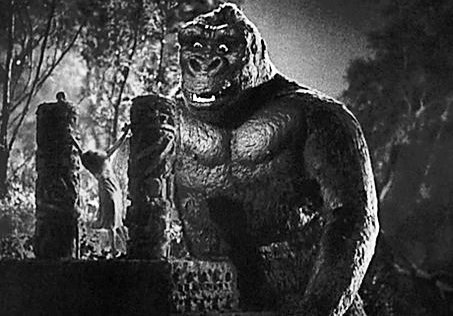
The first time was the charm. One of the few insightful comments I heard on the 2007 AFI special was when Martin Scorsese said that in many ways he finds the primitive stop-motion effects of the original King Kong more impressive than later CGI versions. He's absolutely right. The 1933 version also offers more thrills and emotions (and in half the time) than Peter Jackson's technically superior but dramatically inferior and unnecessary remake. Let’s not even discuss the 1976 version.
When L.A. Confidential debuted on this list in its first year of eligibility in 2007, I wrote, “Of the films of fairly recent vintage, this is one that grows stronger each time I see it, earning comparisons to the great Chinatown…Well acted (even if Kim Basinger's Oscar was beyond generous), well written and well directed, I believe L.A. Confidential’s reputation will only grow greater as the years go on — yet it lost the Oscar (and a spot on the AFI list) to the insipid Titanic.” When I re-watched the film recently, my prediction proved to be spot-on as it only deepens as an experience and an entertainment as time passes. It still boggles my mind that with Russell Crowe, Guy Pearce, Kevin Spacey and James Cromwell (just to name four) delivering impeccable work that only Basinger landed a nomination, but losing best picture and director to James Cameron and Titanic remains the bigger crime.
Simply put: The tensest comedy ever made and perhaps Scorsese's most underrated film. Griffin Dunne plays the perfect beleaguered straight man enveloped by a universe of misfits and oddballs in lower Manhattan when all he wanted to do was get laid. It’s hard to imagine that this movie nearly became a Tim Burton project, but thanks to the many setbacks Scorsese endured attempting to make The Last Temptation of Christ, the film ended up being his — and recharged his batteries as well. While Scorsese has made great films since, I’d love to see him step back sometime and make another indie feature like After Hours on the fly just to see what happens. Joseph Minion wrote an excellent script and this represents one case where I think the changed ending actually proves superior to the originally intended one. By the way, whatever happened to Joseph Minion?
Watchability often gets undervalued when rating a film's worth, but I never tire of sitting through this thrill ride. One aspect that has impressed me since I first saw it as a teen back in 1985 (and I went two nights in a row, dragging my parents to it on the second) was its attention to detail such as Marty arriving in 1955 and mowing down a pine tree on the farm of the deranged man trying to “breed pines.” Then, when he returns to 1985, Twin Pines Mall now bears the sign Lone Pine Mall. It’s just a quiet sight gag in the background without any overt attempt to call attention to the joke. You either catch it or you don’t. I always admire films that respect audiences like that, especially when they happen to be this much fun. With equal touches of satire, suspense and genuine emotion, Back to the Future elicits pure joy. No matter how many times I see it, the final sequence where they prepare to send Marty back to 1985 holds me in rapt attention as I wonder if this time might be the time he doesn't actually make it.
A comedy about the Vietnam War that's full of blood and set in Korea, just as a matter of subterfuge. The film that put Altman on the map and inspired one of TV's best comedies (until it got too full of itself), MASH still holds up with its brilliant ensemble and wicked wit. I still wish the TV show had kept that theme song with its lyrics. Through early morning fog I see/visions of the things to be/the pains that are withheld for me/I realize and I can see.../That suicide is painless/It brings on many changes/and I can take or leave it if I please.

Back in 1985, before Goodfellas and The Sopranos really mixed mob stories with jet black comedy, the great director John Huston, in his second-to-last film, brought to the screen an adaptation of Richard Condon's Mafia satire Prizzi's Honor, complete with great performances and some of the most memorable lines ever collected in a single film. Huston may have been in the twilight of his days, but his filmmaking prowess was as strong as ever. Jack Nicholson disappeared into the role of Charley Partanna more than he had any role in recent memory. Kathleen Turner matched well with Nicholson as Charley's love whose work outside the house causes problems. William Hickey gave an eccentric and indelible portrait of the aging don. Finally, John's daughter Anjelica made up for a misfire of an acting debut decades earlier with her brilliant performance as the scheming Maerose and took home one of the most deserved supporting actress Oscars ever given.
Before Zhang Yimou started being obsessed with spectacle and martial arts, film after film, he produced some of the greatest personal stories in the history of movies, especially when his muse was the great and beautiful Gong Li. This film was their first truly flawless effort as Gong plays the young bride of a powerful lord who already has multiple wives and who encourages the sometimes brutal competition between the women.
"The film actually is like a snail — it kind of turns in on itself and becomes itself," Altman describes his film in an interview on its DVD. One of the many "comebacks" of Robert Altman's career, this brilliant Hollywood satire holds up viewing after viewing because it's so much more than merely a satire. Thanks to Tim Robbins' superb performance as the sympathetic heel of a Hollywood executive and the cynical yet deeper emotional punch of Michael Tolkin's script, Altman wows from the opening eight-minute take to one of the greatest final punchlines in movie history. However, the more times you see it, the more you discover to see. While some specific references have aged, the movie's relevance remains — now more than ever.
Schindler’s List marked an important moment in Spielberg’s development as a filmmaker: Peter Pan finally grew up. It’s a harrowing, well-made movie that everyone should see. At the same time, I can foresee a time when it slips off this list entirely. It isn’t the fault of the film — I find it nearly flawless. However, if someone placed a gun to my head and ordered me to choose to watch either Schindler’s or one of Spielberg’s best post-1993 films such as Catch Me If You Can or Minority Report, I’d opt for one of the latter two. Are they better films than Schindler’s List? I can’t say that. However, the epic holocaust tale isn’t a film you find yourself wanting to pop a bowl of popcorn and watching on a whim. As I said earlier, for me at least, rewatchability remains an important factor. I’ve seen Schindler’s List three times but I haven’t reached the point where I want to go through that wrenching experience again.
Bergman once said that by the time he was done making Wild Strawberries, the film really belonged more to Victor Sjöström, who played Borg, the renowned professor and lauded physician about to receive an honorary degree. The film marked Sjöström 's return from semi-retirement, but he already was a legend as the first true Swedish acting-directing star. Borg decides to drive his old Packard to the event instead of flying to meet his son. The journey becomes more than just a road trip for the professor, but a metaphysical trek through his past as he questions what led him to this moment. As the car winds closer to the ceremony, Borg's inner journey does as well as he comes to realize that for all his scientific training, the only thing he can't analyze is himself. "The day's clear reality dissolves into even clearer remnants of memory," he says. Wild Strawberries represents Bergman growing into his powers as a filmmaker and while it may concern a 78-year-old man examining his life, the subject proves as timeless for people of any age as the film itself.
Tweet
Labels: Almodóvar, Altman, D. Zanuck, Dassin, Hawks, Herzog, Hitchcock, Huston, Ingmar Bergman, Kurosawa, Laughton, Lists, Murnau, Sayles, Scorsese, Spielberg, Tim Burton, Truffaut, Zemeckis, Zhang Yimou
TO READ ON, CLICK HERE


Sunday, December 18, 2011
Centennial Tributes: Jules Dassin Part II

By Edward Copeland
As we dive into the second half of this tribute to Jules Dassin, we're on an uphill climb artistically and a downhill slide personally as we talk about when he made his best films, including two out-and-out masterpieces, and when the witch-hunting politicians froze him out of movie work by getting Hollywood to blacklist him because of his youthful flirtation with communism. Never mind that he resigned from the Communist Party soon after joining when Stalin signed his 1939 pact with Hitler, once a commie, always a commie, right? At least that was the attitude then. We haven't reached that point yet. First, following making the great Brute Force, Dassin re-teams with producer Mark Hellinger for The Naked City, a landmark because it was the first sound film to shoot entirely in New York. Henry Hathaway had filmed some scenes of 1945's The House on 92nd Street on the streets of New York, but not the entire movie. Another film had shot partly on the streets of New York, but The Naked City became the first movie to film its entire production there. If you started here accidentally and missed Part I, click here.

Hellinger's role in The Naked City extended beyond producing — he also narrated the film which, to me at least, turns out to be a demerit at times. In his 1948 New York Times review, Bosley Crowther, mixed on the movie overall, referred to the narration as "a virtual Hellinger column on film." Not all the narration is cringeworthy (Two examples: "How many things this sky has seen that man has done to man"; "Milk! Isn't there anything else for ulcers except for milk?") Some come off fine such as when
 Hellinger notes, "There's a pulse to a city that never stops beating." When the narration grates the most are the times when it sounds like a talkative moviegoer asking their companion annoying questions such as, "Is Henderson the murderer? Did a taxicab take him to the Pennsylvania Railroad Station? Who is Henderson? Where does he live? Who knows him?" The movie itself starts with an overhead shot of the city skyline as Hellinger waxes on about the city as the daytime shots turn into nighttime images and he tells us, "This is the city when it's silent or asleep, as if it ever really is." After his narration introduces us to various inhabitants of the city who work nights, he also shows us people resting at home or out on the town (cleverly introducing people who will be major characters later without pointing that out) "And while some people work and most sleep, others are at the close of an evening of relaxation — " We see a night club getting ready to close and its attendees departing before the camera switches to a young woman's apartment where we see her being murdered by two men. "And still another — is at the close of her life." The killers try to fake her death as a bathtub drowning and we see the movie's destination at last. After some more wandering around the city the next morning (including one killer getting drunk and nervous about the crime and his co-conspirator offing him and dumping his body in the river), once the dead woman's maid discovers her body, they show a particularly nice sequence of the chain of calls through switchboard operators going from hospital to a police precinct to the medical examiner before finally ending up at the homicide squad.
The Naked City follows the investigation of that young lady's murder in an almost documentary style. Originally, Hellinger intended to use Homicide as the title but then decided to borrow The Naked City from the books of photographs by famous crime scene photographer Weegee, whose life was fictionalized in the 1992 film The Public Eye starring Joe Pesci, because he wanted the movie to have the feel of Weegee's photos. Playing the men leading the investigation were Barry Fitzgerald as Det. Lt. Dan Muldoon, the veteran with two decades of experience, and Don Taylor as Det. Jimmy Halloran, the greenhorn who'd only been working homicide for three months. Muldoon always has to explain to Halloran the right way to solve a case such as the one they are in, giving Fitzgerald the chance to say things like "That's the way you run a case, lad — step by step" and sound even more Irish than usual as he does it. When
 they determine that the murder had to be committed by two people, Muldoon pins it on "Joseph P. MacGillicuddy," his version of John Doe. Since The Naked City strives for realism, one thing sticks out that I tend not to notice in other pre-1966 police movies or TV shows: There were no such things as Miranda rights so you never hear anyone told, "You have the right to remain silent, etc." The fine cast also includes Howard Duff, reuniting with Dassin from Brute Force, as a compulsive liar who was involved with both the dead woman and her best friend (Dorothy Hart). If you look closely, the film overflows with familiar faces in brief, mostly uncredited roles including Paul Ford, John Marley, Arthur O'Connell, David Opatoshu and, making their film debuts, Kathleen Freeman, James Gregory and John Randolph. There also is a very funny scene where Halloran seeks information from a sidewalk store clerk selling soda on the whereabouts of the suspected killer and the vendor is played by the comic great Molly Picon. However, the film's true star is New York.

While The Naked City gets lumped into the noir category, personally I don't think it belongs there. While The Naked City turns out mostly fine, the film doesn't approach the greatness of Brute Force or Dassin's films that follow. What makes The Naked City stand out from other films has little to do with its story or acting, but its landmark use of New York — and I mean the real New York, not Toronto. Dassin employed several tricks to film on the streets without crowds getting in the way because word always leaked as to where they would be shooting. In one of the Criterion interviews, he tells of a fake portable newsstand they had to conceal the camera as well as a flower delivery van with a mirror on the side that they could see out of but outsiders couldn't see in. They also employed jugglers to distract onlookers so they wouldn't disrupt shooting.


On the DVD interview, Dassin said his favorite method was to place this guy a bit down the street from where they were shooting, have him climb up a pole, wave a flag and give patriotic speeches. While he mesmerized crowds, the film crew got their work done. Some of that location shooting still amazes. Taylor as Halloran does most of the running throughout the city, on and off subways and buses, past landmarks still familar today and, most especially, the climactic foot chase after the killer that leads to awesome shots on the Williamsburg Bridge. The movie ended up winning the Oscar for best black & white cinematography for William H. Daniels and best film editing for Paul Weatherwax. Now, Dassin contended that elements of the films that put more of an emphasis on class differences within the city and other social issues were cut from the film before release. In many interviews, he said that by the time filming had been completed, rumor already had begun to swirl that he might be called before HUAC to testify about his former membership in the Communist Party. He also didn't believe Hellinger would make those cuts, mainly because Universal didn't want to release The Naked City because they didn't know how to market it. However, Hellinger's contract with the studio had a clause requiring them to release it — and a good thing that it did because three months before The Naked City finally did reach theaters, Hellinger died of a heart attack at 44, another reason Dassin doubted the cuts were his. To paraphrase the film's famous closing line of Hellinger narration, "There are eight million stories from the Hollywood blacklist. This just leads to a much bigger one."
Before Dassin found a new home in Hollywood, he finally got that chance to direct some theater again, staging two Broadway productions in 1948. First, he directed the original play Joy to the World by Allan Scott, the screenwriter of six Astaire-Rogers musicals including Top Hat and Swing Time as well as other films. The comedy takes aim at Hollywood and the difficulty one has maintaining his integrity in the movie business. The play, which ran from March 18 to July 3 at the Plymouth Theatre, also has a strong plea for intellectual freedom and against censorship. Produced by John Houseman, its cast included Morris Carnovsky, who would appear in Dassin's next film and on the blacklist, being named by both Elia Kazan and Sterling Hayden; Bert Freed, TV's first Columbo; and Marsha Hunt, who starred in two of Dassin's MGM films — The Affairs of Martha and A Letter to Evie. The second production was the musical Magdalena which ran from Sept. 20 through Dec. 4. The songs were by lyricists Robert Wright and George Forrest and composer Heitor Villa-Lobos. It was John Raitt's first show following Carousel and choreographed by the most influential yet least-known dance master Jack Cole, subject of an in-development musical project with its eye on Broadway today. One of his two assistant choreographers on Magdalena was Gwen Verdon.
When Dassin headed back west, Darryl F. Zanuck and 20th Century Fox came calling, seeking to sign him to direct A.I. Bezzerides' adaptation of his own novel Thieves' Market, renamed Thieves' Highway. Before that project got rolling, Dassin received an urgent phone call from Zanuck with a very important question: "Are you now or were you ever familiar with the fundamentals of playing baseball?" Dassin told him yes. In an interview recorded in New York in 2000 and on the Criterion Collection DVD of Rififi, shared this fun little anecdote. It seems that the MGM vs. Fox baseball game was coming up the following weekend and Fox was short a player and Zanuck wanted to see if Dassin could be the one. According to Dassin, he turned out to be the MVP of the game as Fox beat MGM, which apparently was an unusual occurrence. Dassin's agent called him in a rush, wanting to know if Dassin had signed the contract for Thieves' Highway yet. Dassin told him that he had. The agent told him that was too bad — after his performance in the ballgame, he could have negotiated him a higher salary for the film.
While The Naked City didn't really seem like noir to me, Thieves' Highway most definitely does, though it's noir in a setting I never imagined before — crooks run amok among those who sell fresh fruit and vegetables. Richard Conte stars as Nick "Nico" Garcos, a veteran who traveled the world following the war and brings home gifts from everywhere to his proud Greek family. His father Yanko (Morris
 Carnovsky) is even joyfully singing a Greek song when his boy shows up unannounced, surprising him. (Interesting that as important as Greece will become in Dassin's life later that it's a distinct element of this film.) While the mood overflows with happiness in the Garcos house, Nick discovers that things haven't gone well during his absence when one of his presents turns out to be a special pair of shoes for his father and he urges him to try them on. There's a problem — Yanko can't wear shoes anymore. He rolls away from the table to reveal to his son that he no longer has legs. His father tells him the story about how he had a huge load of the season's first crop of juicy tomatoes and one of the biggest produce dealers on the San Francisco market Mike Figlia (Lee J. Cobb) had agreed to buy them but as he asked for his money, Figlia insisted they have a drink to celebrate first. That drink turned into more drinks and the next thing Yanko knew, he was on the side of the road under his wrecked truck minus his legs. Figlia claims he paid him and someone must have taken the money from the truck. To make matters worse, since he couldn't use the truck anymore, he sold it and the man he sold it to has stiffed him on payment as well. While Nick's mom (Tamara Shayne) tries to calm things down and argues that perhaps Figlia told the truth, Nick can tell that Figlia was lying and his dad never got paid. First though, he's getting the truck back.
When he finds Ed Kinney (Millard Mitchell), the man who bought the truck, Nick demands the keys to the truck or the money. Kinney complains that he can't pay right now because the truck has been giving him fits but he needs it to pick up a load of golden delicious apples. Nick makes a deal that he'll be his partner to pick up the apples and take them to San Francisco for the sale. The one hitch — Kinney already had a deal set with two guys Slob and Pete (Jack Oakie, Joseph Penney) so Kinney has to make up a story about how he can't make the run. The men go away disappointed — but they also tail him and see that he's lying and make it a point to harass them. If Mitchell looks familiar, he's probably best known for his role three years later as movie exec R.F. Simpson in Singin' in the Rain. Mitchell's career was cut short. A heavy smoker, lung cancer claimed his life at the age of 50 in 1953. Another interesting tale that comes out of the Dassin interviews on DVD is that Oakie, the longtime comic actor who scored an Oscar nod for his Mussolini spoof in Chaplin's The Great Dictator, was completely deaf when he made Thieves' Highway, something that Dassin didn't realize for weeks because Oakie was so good at picking up cues from other actors and never missed his mark or messed up a take. After Kinney and Nick team up, the first portion of the film concentrates on the long haul to San Francisco after they pick up the apples with Nick driving the decrepit truck, Kinney following in another and Slob and Pete harassing them along the way. As Dassin said, the enemy for these men is fatigue and drivers employed many tricks to stay wake on the roads at night.

After a near disaster, Kinney decides it's best if he and Nick switch trucks, letting him, the more experienced driver, try to hold it together while Nick takes the better rig with the first half of the load on to San Francisco. As in The Naked City, Dassin breaks some ground here by doing some amazing location shooting in San Francisco's market area with crowded streets and lots of activity. When we
 arrive there, that's when Cobb appears playing the most diabolical produce salesman in the history of film. Cobb's centennial was Dec. 8, but I got so backed up with other projects I wasn't able to do a proper salute to this towering actor. In the 2005 interview on the DVD, Dassin said that Cobb truly "enjoyed his villainy." During the work on this piece, I uncovered more and more names of actors and directors who named names before HUAC that I had never known about before. I mentioned Sterling Hayden earlier, which was news to me. I also didn't know about Cobb. It's odd
 how all the ire and bile aimed at people who did name names seemed to be reserved for Elia Kazan. In Cobb's case, the pressure on the actor when he was called to testify before HUAC had nearly brought his wife to a nervous breakdown so Cobb felt compelled to name names to preserve his wife's sanity. Regardless, that doesn't take away from the fact that Cobb was a great actor and not just anyone can turn a produce dealer into a plausible bad guy. Conte matches him well as the good guy without turning Nick into a bland opponent. When things heat up between Nick and Figlia and Figlia suggests they go off to his office, one man comments that Figlia will "eat that kid alive." A buyer named Midge who's seeking golden delicious apples and is played by Hope Emerson, who will be a memorable villain herself the following year as the women's prison matron in Caged, responds, "I'll take odds on the kid." One of Figlia's deceptive tricks against Nick involves utilizing a local hooker named Rica (played by Valentina Cortese, best known for her Oscar-nominated turn in Truffaut's Day for Night, in only her second English-language film and her first shot in the U.S, though her last name is spelled Cortesa). Rica keeps Nick occupied while his truck, which is stuck in front of Figlia’s stand because of flat tires, gets raided and has its apples sold off by Figlia. In the 2005 interview, Dassin told of how Zanuck was a very hands-on producer. Since Rica would inevitably turn out to be the proverbial hooker with a heart of gold who would end up aiding Nick, Zanuck insisted that they write in a part of "a bourgeois fiancée who betrays Nick" to justify the hero falling for the hooker. Barbara Lawrence played that role, Polly Faber.

In addition to Thieves' Highway's noirish elements, which basically get segregated to San Francisco once Nick arrives and Figlia and Rica join the film, the movie's other half covers Kinney's treacherous drive in the truck that's barely holding together. Dassin builds genuine suspense in these scenes, aided by Alfred Newman's score. His journey isn't helped by the constant taunting by Slob and Pete, but as he steers the truck through curvy, mountainous highways, the sequences seem to foreshadow what would come several years later in Henri-Georges Clouzot's The Wages of Fear. When the drive finally goes fatally wrong, the truck crashes and rolls down an embankment, apples going everywhere. Even Slob and Pete rush down, but it's too late as the truck bursts into flames. "From that angle, apples rolling down the hill into the camera. I said to myself, 'That's a good shot.' I think that's one of the shots I've enjoyed most in films I've made," Dassin said in 2005. One thing in Thieves' Highway that didn't particularly please Dassin was that Zanuck shot an entirely new ending that he didn't know about because he already was in London prepping Night and the City. When Nick finally gets his physical revenge on Figlia, Zanuck's ending added police coming in to make the point that people "shouldn't take the law into their own hands." However, given what Zanuck did for Dassin overall when the witchhunters came calling, he couldn't complain that much. When the shit really started to hit the fan, it didn't sound as if Zanuck was someone who would be as helpful as he was during Dassin's crisis. In 1949, word came down that HUAC was going to call Dassin to testify and Zanuck and other Fox executives had a meeting about "the problem." In the 2004 L.A. County Museum of Art interview, Dassin said that Zanuck told him, "He was going to step on my neck because I was a dirty red."
is to be a nice guy, but you can't make it.'" — Jules Dassin
As Dassin went on to tell in that 2004 interview, after Zanuck's "threat," he was surprised to find the producer at his front door — not something you'd expect from someone at Zanuck's level. He informed Dassin that he was flying to London the next day and handed him the novel Night and the City by Gerald Kersh. Dassin told Zanuck he couldn't rush off on a moment's notice like that — he had family
 problems. Zanuck disagreed with the director, saying that he also had family needs and this could end up being the last film he ever made. Zanuck advised him to get shooting on the film as fast as he could and to do the most expensive scenes first so the studio wouldn't have an excuse to shut the production down. Dassin followed Zanuck's advice and was in London readying the shoot when he learned that he'd been called to
 appear before the House Un-American Activities Committee. Zanuck informed the panel that he was abroad and got his scheduled hearing postponed. When Dassin was about two weeks away from the start of shooting on the film, Zanuck called. He asked Dassin if he agreed that he owed him one. Yes, he did owe him, Dassin said in the 2004 interview. Zanuck requested a favor — he wanted Dassin to cast Gene Tierney in a role. Dassin was confused, since there wasn't a role in the movie that she could really play, but Zanuck explained that a love affair had just ended very badly for the actress and she was almost suicidal. When she got in those states, Zanuck said, the only thing that snaps her out of it is work. Quickly, the role of Mary Bristol was written into the script of Night and the City and Tierney joined Richard Widmark and the rest of the talented cast in one of the two best films Dassin ever made. Kersh, the author of the novel the film was based on, did not agree. Dassin never admitted it until an interview in 2005, but Zanuck had encouraged him to everything in such a rush, he never read the book. Many years later, when he did, he could see why Kersh got mad — Night and the City the movie had no resemblance to Night and the City the novel whatsoever.
I haven't read the novel but if the godawful 1992 film with the same title starring Robert De Niro and Jessica Lange hewed closer to its narrative, I'm glad that I haven't. If, on the other hand, the 1992 Night and the City just provides more evidence that nine times out of 10, when you try to remake a classic film, you only end up with the celluloid equivalent of diarrhea, Kersh should be grateful he died in 1968. I actually saw the disaster of a remake before I ever saw the original and once I saw the original, I couldn't believe that they were supposed to have come from the same source material. When ranking Dassin's films, I'm always torn between Night and the City and Rififi as to which I think is the greatest. Preparing for this tribute, I watched the films on consecutive nights. It's such a close call, but for today anyway, I give Rififi the slight edge. However, that doesn't mean I love Night and the City any less. What a script. What a cast. Every detail done to perfection. "Night and the city. The night is tonight, tomorrow night or any night. The city is London." Those are the words that open the film then we see Widmark's Harry Fabian running like hell through a square — and running will be what he's doing for a lot of the movie when he doesn't slow down long enough to try to make his Greco-Roman wrestling scheme work or to make time for Mary or listen to offers from the likes of Francis L. Sullivan's Philip Nosseross, a nightclub owner who resembles a more genial Jabba the Hutt, or his wife Helen (the wonderful Googie Withers, who just passed away in July), who wants her own action and to escape her husband.

When Night and the City opened in 1950, it depended where you lived what music accompanied Fabian's film-opening sprint. Britain, still recovering from the damage of World War II, had laws in place to ensure that it kept a certain amount of the profits of films made there
 and provide workers jobs as well. As a result, there were two versions of Night and the City, and Dassin wasn't allowed to participate in the editing of either one — one because he wasn't British, the other because when he returned to the United States, he was banned from the 20th Century Fox lot. The British cut runs longer, adding some more character scenes, and contains a moodier score by Benjamin Frankel, who would go on to score John Huston's Night of the Iguana and Ken Annakin's Battle of the Bulge. The American cut, which Dassin says he prefers, has music composed by the great and prolific Franz Waxman, who composed many scores for Hitchcock
 including Rear Window as well as Billy Wilder's Sunset Blvd., and previously wrote the music for Dassin's Reunion in France. Waxman uses a variety of styles throughout Night and the City, parts with a jazz tinge, other moments matching the kinetic nature of various chase sequences. I've not seen the entire British version to know how it works, but I know that Nick De Maggio edited the American cut superbly. He also edited Thieves' Highway and would go on to cut another classic Widmark noir, Samuel Fuller's Pickup on South Street. Max Greene was responsible for the great cinematography. Some of the greatest movies seem as if they come into existence by accident. When you consider what a rush job Night and the City was, how Dassin didn't even read the book (though presumably the credited screenwriter Jo Eisinger had), how a role for Gene Tierney had to be created out of thin air and shoehorned into the story at the last minute, how a lot of the roles had to be cast with British actors by law and Dassin didn't know any (one of his casting directors turned out to be Douglas Fairbanks Jr.) and that Zanuck, who liked to meddle with his directors' pictures, didn't reshoot anything or change the editing when he really could have since Dassin was barred from the editing room because of the blacklist, it's a fucking miracle how brilliantly Night and the City turned out. Some things are just fucking meant to be. Even with the character of the huge old Greco-Roman wrestler Gregorious. Dassin drew a picture of a wrestler he'd seen once and said that's how he envisioned the person they got to play the part. Someone recognized the drawing as Stanislaus Zbyszko, but thought he was dead. Another person knew that Zbyszko actually was not only alive but had a farm in Missouri. They contacted him and he ended up playing the part of Gregorious. At a moment of professional and personal crisis for Jules Dassin, the stars truly aligned when it came to Night and the City.
The ensemble does the best job at selling the movie, foremost Widmark as the smooth yet smarmy Fabian. You can see how some people buy into his dreams just as you easily as others see right through him. As Mary's friend Adam (Hugh Marlowe) so accurately describes him, "Harry's an artist without an art." Tierney does fine given that she's playing a role that really has no reason for being there. Herbert Lom manages to be both frightening and unctuous as a crooked wrestling promoter who still has concerns about his father, Gregorious (Zbyszko) when Fabian manages to bring him into the machinations. Above them all though are Sullivan and Withers as Philip and Helen, the husband and wife who don't quite know how they got together but can't figure out a way to split up. When Helen makes plans to pin her exit on Fabian's scheme, Philip warns, "You don't know what you're getting into." Helen knows deep down, but she doesn't care. "I know what I'm getting out of," she tells him. Night and the City, despite the turmoil going on on the outside, is by far the best film Dassin had made until that point. Some good ones will still come, but now he'll face the toughest time of the blacklist.
Tweet
Labels: Astaire, blacklist, Chaplin, D. Zanuck, Dassin, De Niro, Fuller, G. Tierney, Ginger Rogers, Hayden, Hitchcock, Huston, J. Lange, Kazan, Lee J. Cobb, Remakes, Truffaut, Widmark, Wilder
TO READ ON, CLICK HERE
Monday, June 13, 2011
A nightingale sang in Berkeley Square

By Ivan G. Shreve, Jr.
The film opens on British hunter Captain Alan Thorndike (Walter Pidgeon), as he finds himself in Germany — in an area presumed to be Berchtesgarten, the Bavarian retreat of Adolf Hitler — with an opportunity to rid the world of a monster and prevent the Second World War. Thorndike has the Fuehrer lined up in the sights of his precision rifle and, pulling the trigger, there is an audible click…no bullet in the chamber. Giving his would-be target a friendly wave, we’re left to ponder as to whether it was his intention to assassinate Hitler. He firmly believes it was a “sporting stalk,” but the audience notices that he’s had second thoughts when he takes a bullet from his jacket and loads the rifle for a second go. Of course, our friend does not succeed at this encore; he’s tackled by a German soldier and captured by the Gestapo.
In 1941, debate raged on in America as to whether or not the U.S. should get involved in World War II…but perhaps the most anti-interventionist faction was based in the country’s motion picture industry. Hollywood took special pains to sit on the fence because they were anxious to not jeopardize the lucrative take from the rentals generated from U.S. films worldwide. Occasionally there would be a picture released that dared to take an anti-isolationist stance — Confessions of a Nazi Spy (1939) is considered by many to have started the ball rolling, followed by such features as Alfred Hitchcock's Foreign Correspondent (1940), The Mortal Storm (1940) and Charlie Chaplin’s The Great Dictator (1940). Seventy years ago on this date, a film was released to theaters that was directed by a man who had a little first-hand knowledge about the politics of Germany (having fled the country in 1934) and who no doubt identified with the protagonist of a film based on Rogue Male, a novel written by author Geoffrey Household shortly before war broke out in 1939. The director to whom I’m coyly referring is Fritz Lang…and the movie is his classic 1941 suspense thriller Man Hunt.
Captured by the Gestapo, Captain Thorndike is questioned by Major Quive-Smith (George Sanders)…who finds Thorndike’s “sporting stalk” defense to be a pile of manure, and tries to convince his prisoner to sign a
 confession that he attempted to assassinate the Fuehrer on behalf of the British government. Thorndike refuses and is worked over by goons in the Gestapo’s employ — but because the good captain is made of sterner stuff, Quive-Smith decides to silence him by arranging his death in a “hunting accident.” Thorndike escapes his captors and gradually makes his way aboard a British sailing vessel, where he is kept out of sight by a young cabin boy named Vaner (Roddy McDowall). Thorndike, you see, is not out of the jungle yet because also onboard is a sinister hired gun (John Carradine) who answers to “Mr. Jones” and is masquerading as Thorndike with the help of Thorndike’s passport.
Arriving on his home turf of London, Thorndike is convinced he’s safe and sound but, like many a protagonist in Lang’s films, he’s in a nightmare from which he can’t awaken. He’s being stalked by Jones and several other Nazi swine, and his request to his brother, Lord Gerald Risborough (Frederick Worlock), for assistance goes unheeded because Risborough doesn’t want to risk an international incident that could plunge Britain into war with Germany. (The fact that Thorndike no longer has a valid passport on him certainly doesn’t help matters either.) Thorndike’s only salvation is a young Cockney girl named Jerry Stokes (Joan Bennett), who helps him get to his brother’s home the night he arrives in London and later hides him out in her flat when he’s hunted by the police — the gendarmes find the mangled body of Jones in the London Underground and, locating Thorndike’s credentials on the corpse, assume that it’s Thorndike who has been murdered.
Thorndike contacts his solicitor (Holmes Herbert) and arranges to get enough money to enable him to hide out from his pursuers and to make certain that Jerry is repaid for her kindness and assistance as well. He provides Jerry with the address at a post office in Lyme Regis to allow her to get in touch with him and let him know when the heat has died down. Thorndike’s trip to the Lyme Regis post office, however, allows Quive-Smith to learn of his hiding place…and institutes a final showdown between the two men from which Thorndike emerges as the victor. There follows a passage of time and having enlisted in the RAF once World War II is underway, Thorndike bails out of a bomber over Germany with hunting rifle in his hand…the implication being that he’ll be damned if he misses his intended target (Hitler) this time.
Serialized in Atlantic Monthly before being published in novel form in 1939, Gregory Household’s Rogue Male would soon become a best seller and later one of the classic thriller novels of all time. The book, having been written before World War II, never specifically states that the unnamed European dictator was the man mockingly nicknamed “Schickelgruber,” but the book-buying public wasn’t fooled for a second. Rogue Male was a perfect candidate for a movie adaptation despite its controversial (for the U.S.) pro-intervention stance and screenwriter Dudley Nichols (a longtime collaborator of director John Ford — in fact, Ford was originally assigned to direct Man Hunt) was assigned the task. The movie also would find its perfect director to handle the subject material in German émigré Fritz Lang.
Because Lang approached Man Hunt with not entirely clean hands — namely, his fervent anti-Nazism — the movie attracted the attention of the Hays Office, and was one of the first war films to do so. Hays head Joseph Breen objected to the fact that the film depicted all Germans as evil, and was no doubt instrumental in making sure that there were enough “nice” Germans in the movie to counteract this (the character of the jeweler, for instance). The censors also insisted that the director soft-pedal the “enhanced interrogation techniques” used by Sanders’ Gestapo to get Pidgeon’s hero to confess — which actually worked in the movie’s favor, since the sequences were more effective with the torture implied as opposed to visually spelled out. As if Lang didn’t have enough trouble, the head of the studio producing Man Hunt, Darryl F. Zanuck, also was not too crazy about Fritz’s anti-Nazi enthusiasm and forbid the director to go anywhere near the editing room during the movie’s final stages. (Lang and assistant Gene Fowler, Jr. did an end run around Zanuck, however, and worked on the movie in secret.)
What makes Man Hunt both a classic Hollywood thriller and one of Lang’s best works is its pitch-perfect casting. Walter Pidgeon would establish himself onscreen as the epitome of British stiff-upper-lipness (though Pidgeon himself was Canadian) in films such as Mrs. Miniver (1942) and The Miniver Story (1950), and the part of Captain Thorndike in this film is one of his best movie roles. He’s a very engaging hero and the audience is with him every step of the way — especially in the rousing final sequence where Thorndike parachutes out of the plane with rifle in hand and loaded for bear. Pidgeon is fine with the he-man heroics but what really makes this movie strong is the tender relationship his Thorndike enjoys with leading lady Joan Bennett, who plays the part of the plucky Jerry.
It’s not too hard for audiences to decipher that Jerry practices the world’s oldest profession (and I’m not referring to farming) despite the Hays Office’s insistence that a sewing machine take prominent space in her flat in an effort to convince moviegoers that she was doing freelance seamstress work. Jerry is more or less accosted by Thorndike when the two characters meet in the film (he puts his hand over her mouth to keep her from screaming and cluing the thugs on his trail as to his whereabouts) and though she’s frightened and intimidated by him at first, she gradually develops an affection that quickly blossoms into infatuation and then love. Thorndike is a right guy because he doesn’t judge Jerry on her social station or background (unlike his sister-in-law when the two try to get help in the House of Risborough); he treats her with an commendable degree of kindness and respect. There’s a wonderful and subtle sequence set inside Jerry’s apartment the morning after their visit to Thorndike’s relatives where Jerry has ventured out and secured breakfast (fish and chips!) and Thorndike pulls a chair up to the table, insisting that Jerry sit down. The expression on her face is that of an indescribable reverence at his thoughtfulness; she then tells him: “You act like a gent but you ain’t…I mean…you really acts like a gent.”
Bennett is so luminescent and lovely in the part of Jerry that I often marvel at how she is so much different from the femme fatales she plays in later Lang films such as The Woman in the Window (1944) and Scarlet Street (1945). (Joan is so appealing in the part that I’m even willing to overlook the fact that she has one of the most unconvincing Cockney accents in the history of the cinema.) Her Jerry has become so taken with Thorndike that she’s prepared to travel to the four ends of the earth with him — something Thorndike vetoes only because he fears for her safety, and not due to any social stigma. In fact, when he tells her that he’ll arrange for her to be financially compensated by his solicitor for helping him in his hour of need she gets upset because she’s concerned that Thorndike is going to treat her in the same manner as her other “gentlemen.” Instead, all she wants from him is what he promised her earlier in the film — she’s lost a pin that adorned her hat and he’s agreed to furnish her with a new one. He’s as good as his word in doing so, because as he informs her: “Every good soldier needs a crest for his cap.”
The brooch that Thorndike purchases for Jerry is a little chromium arrow — a trinket that will take on significance later in the film because in the climactic mano-a-mano between Thorndike and Quive-Smith, the major presents Jerry’s hat with the arrow attached to make his adversary aware Jerry has been disposed of, but the quick-thinking Thorndike, just when it appears that he’s up against it and at the mercy of the contemptible Quive-Smith, is able to fashion his lady love’s souvenir into something that brings about the Nazi’s downfall. Sanders, an actor whose picture you would find in the dictionary if you searching for a definition of “cad,” gives a performance as one of the silver screen’s most delectably villainous rat bastards, deftly mixing his patented brand of suavity with appropriate sinister menace.
The supporting performances in Man Hunt are equally worthy of praise, including Carradine as a ruthless killer (whose demise in the London subway is particularly memorable) and McDowall (in his American film debut) as the resourceful cabin boy who’s got Pidgeon’s back. McDowall would also re-team that same year for Fox’s How Green Was My Valley, exhibiting a similar surrogate-father-and-son relationship. Other familiar faces in Man Hunt include Ludwig Stossel, Heather Thatcher (as Lady Risborough — her interactions with Bennett’s Cockney gal are priceless), Egon Brecher, Roger Imhof and Frederick Vogeding. The music score is one of my favorites from any film — composed by Lionel Newman, it’s an enchanting melody that uses “A Nightingale Sang in Berkeley Square” as a continuing motif.
Fritz Lang’s dedicated moviemaking mission against the Nazi menace would resurface in three additional films in the wake of Man Hunt: Hangmen Also Die! (1943), Ministry of Fear (1944) and Cloak and Dagger (1946) — the last released after the end of World War II, of course, but using the final days of the war as background for its subject matter. But Man Hunt was the first and best, thanks to first-rate casting, direction and scripting…and not to mention the source material; author Household’s Rogue Male would see additional adaptations (including a critically acclaimed TV movie in 1976 starring Peter O’Toole) and a sequel, Rogue Justice, that sadly has not been adapted for either film or television to my knowledge. When the U.S. entered World War II on Dec. 7, 1941, with the attack on Pearl Harbor, they were not only prepared to fight in the theater of war but the ones at audiences’ local movie houses as well…and 70 years later, Man Hunt remains a textbook example of how Hollywood was committed to the fight.
Tweet
Labels: 40s, Chaplin, D. Zanuck, Fiction, Hitchcock, J. Carradine, Joan Bennett, John Ford, Lang, Movie Tributes, O'Toole, Sanders
TO READ ON, CLICK HERE
Saturday, April 23, 2011
“I ain’t so tough…”

By Ivan G. Shreve, Jr.
There have been many variations of the tale but most of them are in agreement that the starring role in Warner Bros.’ production of The Public Enemy (1931) had originally been assigned to actor Edward Woods, a stage veteran recently signed to the studio. The picture, based on a novel entitled Beer and Blood by John Bright and Kubec Glasmon (and adapted for the screen by Harvey F. Thew), would chronicle the based-on-true-events story of a pair of Chicago pals who graduate from petty crime to the upper levels of the rackets only to both meet particularly grisly and violent ends by the movie’s conclusion. Woods would play Tom Powers, and a studio contract player who had also been quietly making a name for himself in a few Warner productions would play Powers’ sidekick, Matt Doyle.
This player — born James Francis Cagney, Jr. — had for many years been a stage comedian and hoofer when Warners hired him (and co-star Joan Blondell) to appear in the film adaptation of a Broadway play they had appeared in, Penny Arcade (which was re-titled Sinners’ Holiday for the screen). Director William “Wild Bill” Wellman, at the helm of Enemy, couldn’t help but notice the effectiveness of the charismatic Cagney and decided to switch the two actors in their parts. And that is the reason why Edward Woods remains a mere footnote in cinematic history, and the fortunate James Cagney became a silver screen icon for his breakthrough performance in The Public Enemy…released to theaters on this date 80 years ago today.
As the film begins, we get a glimpse at the early life of rambunctious scamps Tom Powers and Matt Doyle, two chums who engage in the usual sort of childhood mischief growing up on the back streets of the Windy City in 1909. The movie seems to argue the “nurture” not “nature” argument because Tom’s parents don’t take much of a hand in raising him right; his father (a policeman) is an uncommunicative authoritarian who regularly administers beatings to his progeny and his mother (Beryl Mercer) is a sainted Irish mother stereotype who forgives him for any and all transgressions. As such, Tom and Matt fall under the spell of the neighborhood Fagin, a two-bit hood nicknamed “Putty Nose” (Murray Kinnell) who encourages them to commit petty larceny (in one scene, he agrees to fence some watches the boys have rooked) and promises to let them in on the “next big thing” he’s got going. That turns out to be an ill-fated attempt to rob a furrier’s but when things turn sour (a friend of Tom and Matt’s is killed, and the duo shoot and kill the cop responsible) Putty Nose takes it on the lam, reneging on his promise to stand by his “boys.”
Older but no wiser, Tom and Matt gravitate to the employ of a jovial bootlegger named Paddy Ryan (Robert Emmett O’Connor), who's raking in money hand over fist thanks to Prohibition…and because Tom displays a ruthlessness that outshines Ryan’s rivals he and Matt rise quickly through the ranks, enjoying the benefits that come from living the gangster life: sharp clothes, flashy cars and loose women (played by Blondell and Mae Clarke). Tom hasn’t forgotten his humble origins, however, and goes out of his way to financially assist his ma (now a widow) but runs into friction with his older, straight-laced brother Mike (Donald Cook), a World War I veteran (and a shell-shocked one at that) whose attempts to better himself by studying and going to night school haven’t quite reaped the same level of financial rewards his younger sibling now enjoys.
Another hood who works for Paddy, “Nails” Nathan (Leslie Fenton), is a pal of Tom and Matt’s but is killed in a freak accident while horseback riding (he fell off his steed and was trampled to death) — and that forebodes a bleak future for the Ryan mob, who find themselves embroiled in a gang war with Paddy’s rival, “Schemer” Burns. Burns’ men kill Matt and when Tom retaliates he ends up wounded and hospitalized, his family concerned as to whether he’ll pull through. Burns’ mob kidnaps Tom and when Paddy promises to quit the rackets if they return Tom to his family’s home the rival gang is only too happy to comply in one of the most unforgettable endings in movie history.
In the opening scenes of Public Enemy the young Tom and Matt are played by child actors Frank Coughlin, Jr. and Frankie Darro…and if it seems odd that Darro, who literally looks like Jimmy Cagney’s “kid bruddah,” essays the role that Edward Woods eventually plays as an adult that’s because the childhood scenes were filmed before director Wellman decided to make the famous switcheroo. Wellman not only took credit for bestowing Cagney with the showier part but also for coming up with the movie’s notorious and now iconic scene in which Jimmy’s character rewards girlfriend Mae Clarke with a grapefruit shoved in her mush. Wellman claims it was inspired by something he’d always wanted to do to his wife whenever the two of them got in a scrap; the film’s producer, a young Darryl F. Zanuck maintained the inspiration for the bit came in a script conference and a third variation from writers Glasmon and Bright argues that it was motivated by a real-life mobster who once shoved an omelet into his moll’s kisser. Whichever version you choose to go with, it laid the groundwork for Cagney’s reputation as a guy who could sometimes demonstrate a little cruelty towards his women — though when you put it in the big picture it’s rather tame compared to what he does to Clarke in 1933’s Lady Killer (he grabs her by her hair and drags her across a hotel room floor before booting her out into the corridor).
Public Enemy is arguably quite brutal (perhaps even more brutal than Little Caesar and Scarface, the other members of the 1930s gangster movie Holy Trinity) but Wellman cleverly allows much of the film’s violence to occur off-camera, particularly in the case of the revenge murders of Putty Face and Burns — and a bizarre sequence in which Tom and Matt avenge Nails’ demise by purchasing the horse responsible and shooting it in its stall. Oddly enough, most of the onscreen violence was sort of accidental — in a scene where Cook’s Mike Powers punches out his brother “Wild Bill” instructed the actor to really let Cagney have it…and Jimmy got one of his teeth broken in the process. Cagney’s dental mishap pales in comparison to what could have happened in the scene where the rival Burns gang unleashes machine gun fire on Tom and Matt; as was the custom of the time live ammunition had to be used and Jimmy narrowly missed being hit by the resulting barrage (which takes out a bit of the building where Cagney had been poking his head out earlier).
After the opening credits, there is a “foreword” that reads: “It is the ambition of the authors of ‘The Public Enemy’ to honestly depict an environment that exists today in a certain strata of American life, rather than glorify the hoodlum or the criminal.” Well, that may have been the objective of the authors but I’ve always believed that Warners had other ideas. (It’s what kept Cecil B. DeMille going in the film business all those years — he could show the “sin” as long as he wrapped things up with the “salvation.”) Gangsters are bad, bad, bad but when a charming, energetic guy such as Cagney is essaying the part you can’t tell me people in the audience (both then and today) didn’t feel a sense of admiration for a hood who’s driving around in a nice ride, has money to burn and is courting the likes of the Platinum Blonde herownself, Jean Harlow (in one of her early and very effective showcases), to swanky nightclubs. Cagney is catnip to females in Enemy — the wife of his mentor even seduces him at one point in the film. If you doubt what I’m saying here, compare and contrast Jimmy’s character with that of his older brother — a dour sourpuss who’s been busting his hump trying to academically better himself and is still trapped in a nickel-and-dime job as a trolley car conductor. OK, Cagney does come to a particularly violent end as the movie calls it a wrap but he accomplishes what John Derek’s Nick Romano sets out to do in 1949’s Knock on Any Door: “Live fast, die young, leave a good-looking corpse.” (Well, two out of three isn’t bad.)
James Cagney’s flirtation with gangster roles didn’t necessarily start with Public Enemy — he had played a hood in two earlier films, the aforementioned Holiday and Doorway to Hell — but the studio quickly realized that tough guy parts became him (even to the point of shooting Smart Money, a film he co-starred in with WB’s other resident mobster, Edward G. Robinson, at the same time) and Enemy proved to be the actor’s passport to silver screen immortality. Cagney never dismissed the importance that Enemy played in his career though he was disappointed that Warners begin to typecast him in those kinds of parts (not to mention the pittance they were paying him every week. He was later able to establish himself as one of moviedom’s most versatile thesps, winning an Academy Award for best actor in a film that let him show audiences what he was doing before the onslaught of gangster melodramas: singing and dancing as George M. Cohan in Yankee Doodle Dandy.
The success of Public Enemy led to subsequent re-releases throughout the years, notably in 1941 and 1954…the latter year is when a young man named Martin Scorsese saw it on the big screen (paired with Little Caesar) and the future director has never been shy in admitting its influence on his directing career. When Enemy was re-released in 1941, though, the studio had to excise three scenes in order to comply with the Production Code; one of them was the aforementioned seduction scene between Cagney’s character and his boss’s moll and the other was a shot of Cook and Blondell having a roll in the hay (a sequence that was previously believed to be lost because the studio dumped the original footage in the 1950s). The third is a bit in which an effeminate tailor measures Cagney for a suit; he keeps rattling off Jimmy’s measurements ending with the phrase “and a half,” prompting his assistant to echo him (except he pronounces “half” as “hawf”). This scene will give you an idea that in addition to the action and drama in the film there are some fairly comedic moments (even the sequence where they croak the horse is amusing in a black humor sort of way).
Nominated for an Academy Award for best screenplay, The Public Enemy did very well at the box office and earned raves from the critics, and has since become one of the seminal films in the gangster genre…a classic that was acknowledged as such when it was selected for the Library of Congress’ National Film Registry in 1998. The cast is marvelous, the direction tight and stylish and the script has a rat-a-tat-ness that is punctuated by Cagney’s signature fast-talking style. It was the film that made the actor a force to be reckoned with…and 80 years later since its debut it remains a staple in any serious filmgoer’s education.
Tweet
Labels: 30s, Blondell, Cagney, D. Zanuck, Edward G., Harlow, Movie Tributes, Oscars, Scorsese, Theater, Wellman
TO READ ON, CLICK HERE
Wednesday, October 13, 2010
All the world's a stage

By Edward Copeland
Many elements can contribute to a classic film: stylish or revolutionary direction, a unique or powerfully told tale, a performance so great it raises the quality of an entire production. While bits of most of those appear in All About Eve, in the end its status in the stratosphere of cinematic greatness gets set in cement by Joseph L. Mankiewicz's brilliant screenplay and, more specifically, its dialogue. You could close your eyes and just listen to it and be blown away by his work. Maybe it's because I worship the written word that it holds such appeal because All About Eve celebrates the witty rendering of language and does so through the vehicle of some of movie's most memorable characters.

No matter how different all my greatest (or favorite) films are, the singular thing they have in common is that each time I re-watch them, I discover something new. In the case of All About Eve, I put something together for the first time in this visit: several of my very favorite films not only contain voiceover narration but multiple voiceover narrators. Both Henry and Karen Hill narrate portions of Goodfellas. Rashomon tells its tale from several points of view. Woody Allen's Hannah and Her Sisters offers the voices of the three sisters plus Allen and Michael Caine's characters. Citizen Kane's structure consists of interviews with different subjects and, in one case, the reporter reading a witness's papers. Here, in All About Eve, we alternate between the takes of theater star Margo Channing (Bette Davis), her good friend Karen (Celeste Holm) and acerbic theater critic/columnist Addison DeWitt (George Sanders). The technique is not a magic bullet, however, because it only made The Thin Red Line even more unbearable than it already was.
Addison, wonderful wry Addison, bats first in terms of the film's narration and who better to guide us into this backstage drama since he lives and breathes theater, though he does it through his writing, not through any actual participation in the theatrical arts himself. In a way, he's the theatrical version of the title of Howard Cosell's autobiography: I Never Played the Game. Of course, while DeWitt may not act in, write, direct or produce plays, he's definitely into gamesmanship. Toying with those who do contribute to theater, that is Addison's sport of choice.
As All About Eve opens, we watch as Eve Harrington (Anne Baxter) receives the Sarah Siddons Award for Distinguished Achievement in the theater. This event's description that Addison deciphers for us begins with an
 introductory speech by an older actor of some renown. DeWitt explains, "Being an actor, he'll go on speaking for some time." The camera also pans down to show all the empty spaces where the evening's previous awards used to reside. Addison runs down the meaning of that for us as well as those awards' relative meaninglessness in comparison to the one Eve receives. "The minor awards are for such as the writer and director since their function is to merely construct a tower so the world can applaud a light which flashes on top of it," DeWitt tells us as we briefly see dour-looking playwright Lloyd Richards (Hugh Marlowe) and sour-looking director Bill Simpson (Gary Merrill). That night that light belongs to Eve, who Addison informs us, has become the youngest person ever to win the Sarah Siddons honor. Also present in the audience, looking none too pleased at Eve's good fortune, is that great actress Margo. DeWitt informs us that she made her theatrical debut at the age of 4 as a fairy in A Midsummer Night's Dream when she strode on to the stage stark naked and she's been a star ever since.
It's at the point where Mankiewicz's camera switches its focus to the audience, specifically to Karen Richards (Holm), wife of the playwright and best friend of Margo, that the voiceover narration gets handed over to let Karen tell the beginnings of the story, namely how she's responsible for bringing Eve Harrington into Margo's
 life in the first place. Karen had noticed the poor, dowdy Eve hanging by the stage door night after night, performance after performance, during the run of Margo's latest hit play. The kind-hearted Karen finally takes it upon herself to ask Eve what she does during the beginning and end of each show and Eve tells her she goes and sees the show, that she hasn't missed a performance of the play yet. Karen finds this so impressive that she decides that Margo just must meet this woman who goes beyond the definition of a mere fan and takes her backstage to meet the star. Knowing how mercurial Margo can be at time, Karen enters alone at first where she finds Margo with her dresser Birdie (the sublime Thelma Ritter) and her husband Lloyd. She's currently haranguing the playwright about plays written about Southern women such as the one she's starring in right now. She wants to know why playwrights insist on depicting all these romantically challenged women in the South.
 Coming from the region herself, Margo declares, "Love is the one thing we were never starved for in the South." Karen tries to ease in to her introduction of Eve by talking about fans in general, but this only launches Margo into a rant about the mobs waiting for autographs outside the stage door. "Autograph fiends — they're not people," Margo spits. "Those little beasts that run around in packs like coyotes." Karen tries to get Margo more charitable, but she's on a roll and can't be stopped. "They're nobodies! Fans! They're juvenile delinquents! They're mental deficients! They never see a play or movie. They're never inside long enough," Margo's monologue continues. Karen breaks in long enough to tell her there's one of those fans she wants her to meet. When she describes Eve and how she's always there and has seen every performance, Margo knows immediately who Karen is talking about and is game enough to allow her into the dressing room. Eve enters meekly and after prodding, shares her tale
 about how she lived in San Francisco with her husband who was killed in the war, but she saw Margo give a performance and after a brief detour for a job at a midwest brewery, she came to New York with nothing, just to watch Margo perform. It's as if Channing is The Grateful Dead and Eve is a Deadhead. The entire room is touched except for the suspicious and cynical Birdie who adds at the end of Eve's story that it has "Everything but the bloodhounds snapping at her rear end." Margo makes Birdie apologize, though she's the only one whose instincts will be on the mark from the beginning. Unfortunately, at some point in the film, her character just sort of vanishes without explanation, which is too bad because I love Thelma Ritter and it denies Birdie her deserved moment of "I told you so." Sometime during this sequence, they are joined by Bill, who not only directed the play but is Margo's significant other. It also signals that soon we'll be switching to our third narrator, Margo herself.
 Something in Eve though appeals to Margo and she invites her to accompany them to dinner after they drop Bill at the airport for his flight to Hollywood to direct his first film. Interestingly enough, Darryl Zanuck, the producer of All About Eve, is named as the producer of Bill's fictional film as well. It's funny to listen to
 successful Broadway director Bill discuss his shot at directing film as if he's abandoning a medium for the masses for a chance to make movies "which mean something." Was there ever this perception? It's also funny to remember how income tax rates used to be. They don't mention what Bill will make for directing his film, but presumably the salary was a lot lower than directors make today, but it still must have been a heady paycheck. So, the next time you hear a millionaire whining about possibly having to have his tax rate rise 3% to 39% show him All About Eve when Bill tells Eve that "80% of his salary" for directing the movie will go to taxes. Then they can shut the hell up. Since this is the portion of the film where Eve bends over backward to ingratiate herself with her newfound theater companions, she volunteers to check Bill's luggage and then bring his ticket to the gate so that he and Margo can have some private goodbye time. Bill comments that he "forgot they grew them that way." Eve has such a lack of pretense. Margo feels she must watch out for her as if she's "a loose lamb in the jungle." Margo continues to be the narrator and takes Eve under her wing as an all-purpose assistant, though Birdie still remains the sole person with qualms about this "lamb."
As I alluded to at the beginning of the piece, great actors delivering 40-karat dialogue powers my love for All About Eve. As many times as I've seen this film in whole or in part, if you asked me to name a particularly great shot or an interesting camera move than Mankiewicz employs to tell his story, I'd come up blank. This isn't a negative criticism: The film might be chock full of them but the words he wrote produce such magic that I'm mesmerized by them to the exclusion of the technical aspects. The only shot I can really recall is not a good one: it sticks out like a sore thumb. Late in the film, when Eve has landed the lead in a play written by Lloyd and directed by Bill, it's receiving an out-of-town tryout in New Haven, Conn. She and Addison go for a walk on the street from the theater and the marquee can be seen behind them in a horribly obvious back-projection shot that I can't understand the necessity of using. Couldn't the conversation have been staged elsewhere or the theater marquee set up simply somewhere? Still, a minor criticism for a film that's such a verbal masterpiece, even if it's not also the visual wonder that the bounty of other great 1950 releases are such as Wilder's Sunset Blvd., Reed's The Third Man or Huston's The Asphalt Jungle.
Having written about Sunset Blvd., so recently for its 60th anniversary, its interesting what it and All About Eve have in common. Though Bette Davis' Margo Channing isn't insane like Gloria Swanson's Norma Desmond,
 both are actresses involved with younger men worrying about their age. Granted, Margo's Bill is only eight years her junior and he's her willing love interest not part of a con that has turned into emotional blackmail such as William Holden's Joe Gillis. Also, Norma is 50, 10 years older than Margo and gave up working when sound came to the movies. Margo, being a creature of the stage, has kept working steadily, but having hit the dreaded 40, worries about her future, especially in regards to future employment. Karen tries to reassure Margo that eight years isn't that big a difference, but Margo tells her that, "Those years stretch as more years go by." It also can be an easy sore to puncture should there be a lovers' spat as when she and Bill fight once and he says, though in a tone indicating he means to be funny, that he always denies the rumor that she was starring in Our American Cousin the night Abraham Lincoln was shot.
Speaking of age, writer Matt Zoller Seitz pointed out a flaw in All About Eve that I've always chosen to ignore, but that I really couldn't any longer once he wrote his piece "Trash-talking nine classic movies" for Salon. The article wasn't a contrarian view out to tear down classics of cinema — he admits he adores the movie — just that some of the greats bear significant flaws and he finds that Mankiewicz's movie's weakness turns out to be Eve herself. Seitz writes:
"The only weak spot, unfortunately, is the casting of the title character, Eve Harrington. Anne Baxter is a shade too old to be playing the 'girl' or 'kid' described in much of the dialogue (she was 26 when the film was shot), and more damagingly, she's simply not as compelling and imaginative as her fellow actors."

It's hard to argue with his judgment. When I watched the film again for this tribute, frequently stopping the movie to jot down yet another line of dialogue that I loved, not a single one was dialogue that sprang forth from Baxter's lips. Granted, Eve Harrington's scheming requires her to pretend to be mousy and meek, so it would be out of place for her to toss off one of the pithy bon mots that the other characters do with ease. At the same time, the film makes the point from the beginning that Birdie can smell the fraud, how does she so easily fool the rest? During the
 initial scene where Karen takes Eve into Margo's dressing room, I scrawled the note, "Awfully accommodating to a stalker." Seitz writes further on this point that, "I don't believe that Baxter's version of the dewy-eyed foundling routine could fool so many battle-scarred showbiz veterans, except maybe Celeste Holm's kindhearted Karen." Actually, that is the truth because Karen is the one she ultimately tricks to get what she wants in terms of being Margo's understudy and delaying her on purpose so she'd miss a show and Eve would get her chance on stage. Later, when Eve has dropped the pretense of being the innocent, she uses that information to force Karen to make Lloyd give her the lead in his new play instead of Margo. Karen gets saved by the lucky timing of Margo passing on the part to spend time starting married life with Bill. Karen's relieved laughter is hilarious, even though none of her dining companions know why she's laughing, especially after returning from a meeting Eve had summoned her to in the restaurant's rest room.
Of course, Birdie truthfully isn't the only one who has Eve's number early. Addison knows her game pretty much from the outset, but it's not in his professional interest as a columnist or his personal interest as an
 asshole to warn anyone about her. Shakespeare said, "All the world's a stage" and that's how DeWitt views it. Who is he to interrupt the players before the final curtain falls? The movie's great centerpiece is a party that Margo holds to celebrate Bill's homecoming and a belated birthday bash, but which she really regrets having before it starts because of rising tensions between her and just about everyone. In Margo's narration, she says, "Even before the party started, I could smell disaster in the air." It's the scene where the film's most famous line appears: "Fasten your seat belts, it's going to be a bumpy night." That is just but one of the priceless quotes that fly from the various characters, including an uninvited Addison squiring an aspring actress named Miss Caswell and played by Marilyn Monroe. Even Marilyn gets some laugh lines. When she wants another drink, she calls out, "Waiter!" Addison corrects her that the man is a butler, not a waiter. Miss Caswell suggests that someone could be named Butler and that might cause confusion. "You have a point," DeWitt responds, "an idiotic one — but a point nonetheless." Going back to Seitz's piece, I think another problem with Baxter/Eve comes from the fact that Mankiewicz's screenplay doesn't provide Eve with any levity. She's the film's only humorless character.
Then again, Eve isn't Hannibal Lecter, a villain who should come with his own set of drums to deliver rimshots after each of his lines, so perhaps that's OK because the rest of the cast provides such a bounty of well-delivered dialogue that you can listen to over and over again. As I mentioned before, most of my notes on the film consisted of lines from the film. Now, it would be fairly ridiculous if I just listed them all, especially for those out there who haven't experienced All About Eve. People get all bent out of shape about spoiling a movie's plot twists, but for me it's even a greater sin to ruin all of its magnificent lines, especially when you're dealing with a screenplay as sparkling and crackling with wit as Mankiewicz produced. Still, I'm compelled to single out a few otherwise how can I convince the uninitiated that I'm not selling them a bill of goods? I will list them by the characters who spoke them.
LLOYD: You knew when you came in that the audition was over, that Eve was your understudy, playing that childish little game of cat and mouse.
MARGO: Not mouse, never mouse. If anything rat!
LLOYD: I shall never understand the weird process by which a body with a voice suddenly fancies itself as a mind. Just when exactly does an actress decide they're HER words she's speaking and HER thoughts she's expressing?
MARGO: Usually at the point where she has to rewrite and rethink them, to keep the audience from leaving the theater!
LLOYD: What makes you think either Miller or Sherwood would stand for the nonsense I take from you? You'd better stick to Beaumont and Fletcher! They've been dead for three hundred years!
MARGO: ALL playwrights should be dead for three hundred years!
LLOYD: There comes a time that a piano realizes that it has not written a concerto.
Eve would ask Abbott to give her Costello.
The cynicism you refer to, I acquired the day I discovered I was different from little boys!
You can always put that award where your heart ought to be.
(To Margo) Many of your guests have been wondering when they may be permitted to view the body. Where has it been laid out?
Every so often, some elder statesman of the theater or the cinema assures the public that actors and actress are just plain folks, ignoring the fact that their greatest attraction to the public istheir complete lack of resemblance to normal human beings.

(To Eve) Is it possible, even conceivable, that you've confused me with that gang of backward children you play tricks on, that you have the same contempt for me as you have for them?... Look closely, Eve. It's time you did. I am Addison DeWitt. I am nobody's fool, least of all yours.
That I should want you at all suddenly strikes me as the height of improbability. But that in itself is probably the reason: You're an improbable person, Eve, and so am I. We have that in common. Also our contempt for humanity and inability to love and be loved, insatiable ambition, and talent. We deserve each other.
There, I've said too much, but the words that flow from All About Eve are infectious, thanks in no small part to the stellar cast that delivers them. Bette Davis gives what may be her finest work and I'd still place her second that year to Gloria Swanson's Norma Desmond. Two of the greatest performances by actresses in the
 history of film and they both lost the Oscar to Judy Holliday in Born Yesterday. I don't mean to cast aspersions on Holliday, but let's be serious. Thankfully, George Sanders did win his most deserved supporting actor prize as Addison DeWitt, another of filmdom's all-time great characters. Thelma Ritter and Celeste Holm both earned nominations for supporting actress but I have to admit that Ritter had better parts (as in Pickup on South Street) and Holm already had an Oscar for being the best part of the terribly creaky Gentleman's Agreement, so I can't argue with Josephine Hull's win for her delightful turn in Harvey, which also turns 60 today. The most amazing achievement though belongs to Mankiewicz who won writing and directing Oscars for two years running, the previous year being for A Letter to Three Wives. There's no disputing the worthiness of that prize for writing, but as much as I love All About Eve, I question his directing win when he was competing against John Huston for The Asphalt Jungle, Billy Wilder for Sunset Blvd. and Carol Reed for The Third Man. Still, slight reservations aside, I always will worship All About Eve, today on its 60th anniversary and on all anniversaries yet to come.
Tweet
Labels: 50s, Abbott and Costello, Arthur Miller, Bette, Caine, Carol Reed, D. Zanuck, Gloria Swanson, Hannibal Lecter, Holden, Huston, Mankiewicz, Marilyn, Movie Tributes, Sanders, Thelma Ritter, Wilder, Woody
TO READ ON, CLICK HERE


