Friday, August 03, 2012
Edward Copeland's Top 100 of 2012 (100-81)
By Edward Copeland
With the release of the latest Sight & Sound poll, conducted every 10 years to determine the all-time best films, The House Next Door blog of Slant Magazine invited some of us not lucky enough to contribute to the S&S list to submit our own Top 10s to The House, which posted mine today. Sight & Sound magazine, a publication of the British Film Institute, began its survey in 1952, using only critics. Its 2002 list boasted its largest sample yet, receiving ballots from 145 film critics, writers and scholars as well as 108 directors. The results can be found here, though a note claims the page isn't actively maintained, though it appears complete to me. Since I planned to revise my personal Top 10, posted as part of my Top 100 in 2007, I figured I owed it to my entire Top 100 to redo my entire list. As before, my rule is simple: A film must be at least 10 years old to appear on my list. Therefore, movies released between 1998 and 2002 might appear on this list whereas they couldn't on the 2007 version. The most difficult part of assembling these lists always involves determining rankings. It's an arbitrary process and once you get past the Top 10 or 20, not only do the placements seem rather meaningless but inclusion and exclusions of films begin to weigh on you. In fact, selecting No. 1 remains easy but if I could, I'd have tied Numbers 2 through 20 or so at No. 2. A lot of great films didn't make this 100 through no fault of their own, falling victim to my whim at the moment I made the decision of what made the cut and where it went. In parentheses after a director's name, you'll find a film's 2007 rank or, if it's new to the list, you'll see NR for not ranked or NE for not eligible. I also should note that this does not mean the return of this blog. I had committed to taking part in The House's feature prior to pulling the plug and completed most of this before signing off.

100 NOSFERATU: PHANTOM DER NACHT directed by Werner Herzog (NR)
Part of the arbitrary nature of this list (and from the very first all-time 10-best list I compiled in high school) was to try to make sure I represented my favorite directors while still allowing for those films that might be a more singular achievement. (For example, my first high school list had to be sure to include a Woody Allen, a Huston, a Hitchcock, a Wilder, a Truffaut, an Altman.) The more great cinema you see, the harder it becomes to justify that since lots of directors deserve recognition and many films might be a filmmaker's strongest work. As I've caught up with a lot of Werner Herzog's work over the years, I felt he'd earned inclusion. I was torn between choosing Nosferatu or Aguirre: The Wrath of God to represent him, but opted for the vampire tale because Herzog's "reversioning" of Murnau's silent classic manages to be both a masterpiece of atmospherics and the best version of the Dracula tale put on screen.
99 TALK TO HER directed by Pedro Almodóvar (NE)
Pedro Almodóvar’s career evolution has taken an arc that I imagine few could have anticipated. I know I certainly didn’t back in the 1980s, when his films mainly consisted of camp, color and sexual obsession. Around the time of 1997’s Live Flesh, the Spanish filmmaker’s style took an abrupt change, filtering genres through his unique perspective to exhilarating results that continue through last year’s The Skin I Live In. The greatest of this run of seven features happens to be the most recent film to make this new Top 100 list. Telling the story of two men caring for women they love, both of whom happen to be comatose, Almodóvar’s Oscar-winning screenplay manages to balance humor, pathos and even outlandish touches you’d never expect to make one helluva movie and the writer-director’s best film so far.
98 NIGHT AND THE CITY directed by Jules Dassin (NR)
Littered along the highways of film history lie multiple tales of adversity breeding triumphs of cinema. As director Jules Dassin faced a possible subpoena from the House Un-American Activities Committee, presumably followed by blacklisting, at the end of the 1940s, producer Darryl Zanuck gave him an exit strategy. Dassin flew to London to hurriedly begin filming an adaptation of the novel Night and the City, which he’d never read, and as a result produced one of the greatest noirs of all time. Not only did he make the movie on the fly, Zanuck even stuck him with creating a role for Gene Tierney, nearly suicidal after a bad love affair. The novel’s author, Gerald Kersh, hated the movie about hustler Harry Fabian (Richard Widmark) scheming to bring Greco-Roman wrestling to London while ducking all sorts of colorful characters played by wonderful actors such as Francis L. Sullivan, Googie Withers, Herbert Lom, Hugh Marlowe and Mike Mazurki. Of course, Kersh’s gripe was understandable — the film bore no resemblance whatsoever to his novel other than the title. However, that didn’t prevent it from being a damn fine film.
97 LONE STAR directed by John Sayles (92)
It takes a lot to fool me and, in retrospect, I should have seen the final twist coming, but I didn't because Sayles crafted in his best film a compelling story in which the plot turn was unexpected and the movie’s story didn't hinge on it. Even if the secret never had been revealed, this portrait of skeletons from the past and their influence on the lives of people in the present still would resonate. Sayles assembles a helluva ensemble including Chris Cooper, Elizabeth Peña, Matthew McConaughey, Kris Kristofferson, Joe Morton and, in one great single scene, Frances McDormand, to name but a few. Sayles has made some good films since Lone Star, but none come close to equaling the artistry, vitality and humanity of this one. I await another great one from him.
96 NORTH BY NORTHWEST directed by Alfred Hitchcock (81)
Set piece after set piece, Hitchcock puts Cary Grant through the paces and pulls the viewer along to his most purely entertaining offering. Grant never loses his cool as he's hunted by everyone, James Mason makes a suave bad guy and Martin Landau a perfectly sinister hired thug. With cameos by four former U.S. presidents. There's not much else to say about it: It's not an exercise in style or filled with layers and depth, it's just damn fun. In fact, it’s as much a comedy as a thriller.

95 THE NIGHT OF THE HUNTER directed by Charles Laughton (87)
There's something to be said for quitting while you're ahead and Charles Laughton, one of the finest screen actors ever, certainly did with the only film he ever directed. The film's influences seem more prevalent than people who have actually seen this disturbing thriller with the great Robert Mitchum as the creepy preacher with love on one hand and hate on the other and the legendary Lillian Gish as the equivalent of the old woman who lived in a shoe, assuming the old woman was well armed.
94 RASHOMON directed by Akira Kurosawa (NR)
In describing the film that put Kurosawa on the world’s radar as a major filmmaker, I’m going to let Robert Altman speak for me. This quote comes from his introduction to the Criterion Collection edition of the movie. "Rashomon is the most interesting, for me, of Kurosawa's films.…The main thing here is that when one sees a film you see the characters on screen.…You see very specific things — you see a tree, you see a sword — so one takes that as truth, but in this film, you take it as truth and then you find out it's not necessarily true and you see these various versions of the episode that has taken place that these people are talking about. You're never told which is true and which isn't true which leads you to the proper conclusion that it's all true and none of it's true. It becomes a poem and it cracks this visual thing that we have in our minds that if we see it, it must be a fact. In reading, in radio — where you don't have these specific visuals — your mind is making them up. What my mind makes up and what your mind makes up…is never the same."
93 RAGING BULL directed by Martin Scorsese (NR)
For years, my standard response when asked about Raging Bull was that it was a film easier to admire than love. Each time that I’d see the movie again though, that point-of-view became less satisfactory because, as any great film should, the film kept rising higher in my esteem. In the film's opening moments, when Robert De Niro plays the older, fat Jake preparing for his lounge act in 1964 before it cuts to the ripped fighter in 1941, even though I consciously know both versions of La Motta were played by the same actor and that De Niro was that actor, the performance so entrances that I actually ask, "Who is this guy and why hasn't he made more movies?" To gaze at the way he sculpted his body into the shape of a believable middleweight boxer, sweat glistening in Michael Chapman's gorgeous black-and-white cinematography, truly makes an impressive achievement. Acting isn't the proper word for what De Niro does here. He doesn't portray Jake La Motta, he becomes Jake La Motta, or at least the screen version, and leaves all vestiges of Robert De Niro somewhere else. Even when De Niro turns in good or great work in other roles, they never come as close to complete immersion as his La Motta does.
92 RIFIFI directed by Jules Dassin (NR)
"Out of the worst crime novels I have ever read, Jules Dassin has made the best crime film I've ever seen," François Truffaut wrote about Rififi in his book The Films in My Life. I haven't read the Auguste Le Breton novel, but I don't doubt Truffaut's word. Dassin structures the film like a solid three-act play. Act I: Planning the heist. Act II: Carrying it out. Act III: The aftermath. Dassin fine-tunes each of the film's element to the point that Rififi practically runs as a machine all its own. The various characters behave more as chess pieces to be moved around as the story's game requires than as representatives of people. One single sequence though makes Rififi a landmark both in films and particularly heist movies: the robbery itself. Dassin films this in a 32-minute long silent sequence. No one speaks. Keeping everything as quiet as possible becomes the thieves' No. 1 priority. It's absolutely riveting. You'll be holding your breath as if you were involved in the crime yourself.
91 RIO BRAVO directed by Howard Hawks (79)
Howard Hawks appears for the first time on the list with a Western starring John Wayne that turned out to be so much fun they remade it (more or less) seven years later as El Dorado. I’ll stick with the original where the Duke’s allies include a great Dean Martin as a soused deputy sheriff, young Ricky Nelson and the always wily Walter Brennan. Wayne even gets to romance Angie Dickinson. No deep themes hidden here, though it's more layered than your typical Western. Still, that doesn't mean you can't kick up your spurs and enjoy.

90 KING KONG directed by Merian C. Cooper and Ernest B. Schoedsack (76)
The first time was the charm. One of the few insightful comments I heard on the 2007 AFI special was when Martin Scorsese said that in many ways he finds the primitive stop-motion effects of the original King Kong more impressive than later CGI versions. He's absolutely right. The 1933 version also offers more thrills and emotions (and in half the time) than Peter Jackson's technically superior but dramatically inferior and unnecessary remake. Let’s not even discuss the 1976 version.
89 L.A. CONFIDENTIAL directed by Curtis Hanson (90)
When L.A. Confidential debuted on this list in its first year of eligibility in 2007, I wrote, “Of the films of fairly recent vintage, this is one that grows stronger each time I see it, earning comparisons to the great Chinatown…Well acted (even if Kim Basinger's Oscar was beyond generous), well written and well directed, I believe L.A. Confidential’s reputation will only grow greater as the years go on — yet it lost the Oscar (and a spot on the AFI list) to the insipid Titanic.” When I re-watched the film recently, my prediction proved to be spot-on as it only deepens as an experience and an entertainment as time passes. It still boggles my mind that with Russell Crowe, Guy Pearce, Kevin Spacey and James Cromwell (just to name four) delivering impeccable work that only Basinger landed a nomination, but losing best picture and director to James Cameron and Titanic remains the bigger crime.
88 AFTER HOURS directed by Martin Scorsese (88)
Simply put: The tensest comedy ever made and perhaps Scorsese's most underrated film. Griffin Dunne plays the perfect beleaguered straight man enveloped by a universe of misfits and oddballs in lower Manhattan when all he wanted to do was get laid. It’s hard to imagine that this movie nearly became a Tim Burton project, but thanks to the many setbacks Scorsese endured attempting to make The Last Temptation of Christ, the film ended up being his — and recharged his batteries as well. While Scorsese has made great films since, I’d love to see him step back sometime and make another indie feature like After Hours on the fly just to see what happens. Joseph Minion wrote an excellent script and this represents one case where I think the changed ending actually proves superior to the originally intended one. By the way, whatever happened to Joseph Minion?
87 BACK TO THE FUTURE directed by Robert Zemeckis (86)
Watchability often gets undervalued when rating a film's worth, but I never tire of sitting through this thrill ride. One aspect that has impressed me since I first saw it as a teen back in 1985 (and I went two nights in a row, dragging my parents to it on the second) was its attention to detail such as Marty arriving in 1955 and mowing down a pine tree on the farm of the deranged man trying to “breed pines.” Then, when he returns to 1985, Twin Pines Mall now bears the sign Lone Pine Mall. It’s just a quiet sight gag in the background without any overt attempt to call attention to the joke. You either catch it or you don’t. I always admire films that respect audiences like that, especially when they happen to be this much fun. With equal touches of satire, suspense and genuine emotion, Back to the Future elicits pure joy. No matter how many times I see it, the final sequence where they prepare to send Marty back to 1985 holds me in rapt attention as I wonder if this time might be the time he doesn't actually make it.
86 MASH directed by Robert Altman (77)
A comedy about the Vietnam War that's full of blood and set in Korea, just as a matter of subterfuge. The film that put Altman on the map and inspired one of TV's best comedies (until it got too full of itself), MASH still holds up with its brilliant ensemble and wicked wit. I still wish the TV show had kept that theme song with its lyrics. Through early morning fog I see/visions of the things to be/the pains that are withheld for me/I realize and I can see.../That suicide is painless/It brings on many changes/and I can take or leave it if I please.

85 PRIZZI'S HONOR directed by John Huston (85)
Back in 1985, before Goodfellas and The Sopranos really mixed mob stories with jet black comedy, the great director John Huston, in his second-to-last film, brought to the screen an adaptation of Richard Condon's Mafia satire Prizzi's Honor, complete with great performances and some of the most memorable lines ever collected in a single film. Huston may have been in the twilight of his days, but his filmmaking prowess was as strong as ever. Jack Nicholson disappeared into the role of Charley Partanna more than he had any role in recent memory. Kathleen Turner matched well with Nicholson as Charley's love whose work outside the house causes problems. William Hickey gave an eccentric and indelible portrait of the aging don. Finally, John's daughter Anjelica made up for a misfire of an acting debut decades earlier with her brilliant performance as the scheming Maerose and took home one of the most deserved supporting actress Oscars ever given.
84 RAISE THE RED LANTERN directed by Zhang Yimou (84)
Before Zhang Yimou started being obsessed with spectacle and martial arts, film after film, he produced some of the greatest personal stories in the history of movies, especially when his muse was the great and beautiful Gong Li. This film was their first truly flawless effort as Gong plays the young bride of a powerful lord who already has multiple wives and who encourages the sometimes brutal competition between the women.
83 THE PLAYER directed by Robert Altman (82)
"The film actually is like a snail — it kind of turns in on itself and becomes itself," Altman describes his film in an interview on its DVD. One of the many "comebacks" of Robert Altman's career, this brilliant Hollywood satire holds up viewing after viewing because it's so much more than merely a satire. Thanks to Tim Robbins' superb performance as the sympathetic heel of a Hollywood executive and the cynical yet deeper emotional punch of Michael Tolkin's script, Altman wows from the opening eight-minute take to one of the greatest final punchlines in movie history. However, the more times you see it, the more you discover to see. While some specific references have aged, the movie's relevance remains — now more than ever.
82 SCHINDLER'S LIST directed by Steven Spielberg (78)
Schindler’s List marked an important moment in Spielberg’s development as a filmmaker: Peter Pan finally grew up. It’s a harrowing, well-made movie that everyone should see. At the same time, I can foresee a time when it slips off this list entirely. It isn’t the fault of the film — I find it nearly flawless. However, if someone placed a gun to my head and ordered me to choose to watch either Schindler’s or one of Spielberg’s best post-1993 films such as Catch Me If You Can or Minority Report, I’d opt for one of the latter two. Are they better films than Schindler’s List? I can’t say that. However, the epic holocaust tale isn’t a film you find yourself wanting to pop a bowl of popcorn and watching on a whim. As I said earlier, for me at least, rewatchability remains an important factor. I’ve seen Schindler’s List three times but I haven’t reached the point where I want to go through that wrenching experience again.
81 WILD STRAWBERRIES directed by Ingmar Bergman (NR)
Bergman once said that by the time he was done making Wild Strawberries, the film really belonged more to Victor Sjöström, who played Borg, the renowned professor and lauded physician about to receive an honorary degree. The film marked Sjöström 's return from semi-retirement, but he already was a legend as the first true Swedish acting-directing star. Borg decides to drive his old Packard to the event instead of flying to meet his son. The journey becomes more than just a road trip for the professor, but a metaphysical trek through his past as he questions what led him to this moment. As the car winds closer to the ceremony, Borg's inner journey does as well as he comes to realize that for all his scientific training, the only thing he can't analyze is himself. "The day's clear reality dissolves into even clearer remnants of memory," he says. Wild Strawberries represents Bergman growing into his powers as a filmmaker and while it may concern a 78-year-old man examining his life, the subject proves as timeless for people of any age as the film itself.
TO LEARN FILMS 80-61, CLICK HERE
Tweet
TO READ ON, CLICK HERE
With the release of the latest Sight & Sound poll, conducted every 10 years to determine the all-time best films, The House Next Door blog of Slant Magazine invited some of us not lucky enough to contribute to the S&S list to submit our own Top 10s to The House, which posted mine today. Sight & Sound magazine, a publication of the British Film Institute, began its survey in 1952, using only critics. Its 2002 list boasted its largest sample yet, receiving ballots from 145 film critics, writers and scholars as well as 108 directors. The results can be found here, though a note claims the page isn't actively maintained, though it appears complete to me. Since I planned to revise my personal Top 10, posted as part of my Top 100 in 2007, I figured I owed it to my entire Top 100 to redo my entire list. As before, my rule is simple: A film must be at least 10 years old to appear on my list. Therefore, movies released between 1998 and 2002 might appear on this list whereas they couldn't on the 2007 version. The most difficult part of assembling these lists always involves determining rankings. It's an arbitrary process and once you get past the Top 10 or 20, not only do the placements seem rather meaningless but inclusion and exclusions of films begin to weigh on you. In fact, selecting No. 1 remains easy but if I could, I'd have tied Numbers 2 through 20 or so at No. 2. A lot of great films didn't make this 100 through no fault of their own, falling victim to my whim at the moment I made the decision of what made the cut and where it went. In parentheses after a director's name, you'll find a film's 2007 rank or, if it's new to the list, you'll see NR for not ranked or NE for not eligible. I also should note that this does not mean the return of this blog. I had committed to taking part in The House's feature prior to pulling the plug and completed most of this before signing off.

Part of the arbitrary nature of this list (and from the very first all-time 10-best list I compiled in high school) was to try to make sure I represented my favorite directors while still allowing for those films that might be a more singular achievement. (For example, my first high school list had to be sure to include a Woody Allen, a Huston, a Hitchcock, a Wilder, a Truffaut, an Altman.) The more great cinema you see, the harder it becomes to justify that since lots of directors deserve recognition and many films might be a filmmaker's strongest work. As I've caught up with a lot of Werner Herzog's work over the years, I felt he'd earned inclusion. I was torn between choosing Nosferatu or Aguirre: The Wrath of God to represent him, but opted for the vampire tale because Herzog's "reversioning" of Murnau's silent classic manages to be both a masterpiece of atmospherics and the best version of the Dracula tale put on screen.
Pedro Almodóvar’s career evolution has taken an arc that I imagine few could have anticipated. I know I certainly didn’t back in the 1980s, when his films mainly consisted of camp, color and sexual obsession. Around the time of 1997’s Live Flesh, the Spanish filmmaker’s style took an abrupt change, filtering genres through his unique perspective to exhilarating results that continue through last year’s The Skin I Live In. The greatest of this run of seven features happens to be the most recent film to make this new Top 100 list. Telling the story of two men caring for women they love, both of whom happen to be comatose, Almodóvar’s Oscar-winning screenplay manages to balance humor, pathos and even outlandish touches you’d never expect to make one helluva movie and the writer-director’s best film so far.
Littered along the highways of film history lie multiple tales of adversity breeding triumphs of cinema. As director Jules Dassin faced a possible subpoena from the House Un-American Activities Committee, presumably followed by blacklisting, at the end of the 1940s, producer Darryl Zanuck gave him an exit strategy. Dassin flew to London to hurriedly begin filming an adaptation of the novel Night and the City, which he’d never read, and as a result produced one of the greatest noirs of all time. Not only did he make the movie on the fly, Zanuck even stuck him with creating a role for Gene Tierney, nearly suicidal after a bad love affair. The novel’s author, Gerald Kersh, hated the movie about hustler Harry Fabian (Richard Widmark) scheming to bring Greco-Roman wrestling to London while ducking all sorts of colorful characters played by wonderful actors such as Francis L. Sullivan, Googie Withers, Herbert Lom, Hugh Marlowe and Mike Mazurki. Of course, Kersh’s gripe was understandable — the film bore no resemblance whatsoever to his novel other than the title. However, that didn’t prevent it from being a damn fine film.
It takes a lot to fool me and, in retrospect, I should have seen the final twist coming, but I didn't because Sayles crafted in his best film a compelling story in which the plot turn was unexpected and the movie’s story didn't hinge on it. Even if the secret never had been revealed, this portrait of skeletons from the past and their influence on the lives of people in the present still would resonate. Sayles assembles a helluva ensemble including Chris Cooper, Elizabeth Peña, Matthew McConaughey, Kris Kristofferson, Joe Morton and, in one great single scene, Frances McDormand, to name but a few. Sayles has made some good films since Lone Star, but none come close to equaling the artistry, vitality and humanity of this one. I await another great one from him.
Set piece after set piece, Hitchcock puts Cary Grant through the paces and pulls the viewer along to his most purely entertaining offering. Grant never loses his cool as he's hunted by everyone, James Mason makes a suave bad guy and Martin Landau a perfectly sinister hired thug. With cameos by four former U.S. presidents. There's not much else to say about it: It's not an exercise in style or filled with layers and depth, it's just damn fun. In fact, it’s as much a comedy as a thriller.

There's something to be said for quitting while you're ahead and Charles Laughton, one of the finest screen actors ever, certainly did with the only film he ever directed. The film's influences seem more prevalent than people who have actually seen this disturbing thriller with the great Robert Mitchum as the creepy preacher with love on one hand and hate on the other and the legendary Lillian Gish as the equivalent of the old woman who lived in a shoe, assuming the old woman was well armed.
In describing the film that put Kurosawa on the world’s radar as a major filmmaker, I’m going to let Robert Altman speak for me. This quote comes from his introduction to the Criterion Collection edition of the movie. "Rashomon is the most interesting, for me, of Kurosawa's films.…The main thing here is that when one sees a film you see the characters on screen.…You see very specific things — you see a tree, you see a sword — so one takes that as truth, but in this film, you take it as truth and then you find out it's not necessarily true and you see these various versions of the episode that has taken place that these people are talking about. You're never told which is true and which isn't true which leads you to the proper conclusion that it's all true and none of it's true. It becomes a poem and it cracks this visual thing that we have in our minds that if we see it, it must be a fact. In reading, in radio — where you don't have these specific visuals — your mind is making them up. What my mind makes up and what your mind makes up…is never the same."
For years, my standard response when asked about Raging Bull was that it was a film easier to admire than love. Each time that I’d see the movie again though, that point-of-view became less satisfactory because, as any great film should, the film kept rising higher in my esteem. In the film's opening moments, when Robert De Niro plays the older, fat Jake preparing for his lounge act in 1964 before it cuts to the ripped fighter in 1941, even though I consciously know both versions of La Motta were played by the same actor and that De Niro was that actor, the performance so entrances that I actually ask, "Who is this guy and why hasn't he made more movies?" To gaze at the way he sculpted his body into the shape of a believable middleweight boxer, sweat glistening in Michael Chapman's gorgeous black-and-white cinematography, truly makes an impressive achievement. Acting isn't the proper word for what De Niro does here. He doesn't portray Jake La Motta, he becomes Jake La Motta, or at least the screen version, and leaves all vestiges of Robert De Niro somewhere else. Even when De Niro turns in good or great work in other roles, they never come as close to complete immersion as his La Motta does.
"Out of the worst crime novels I have ever read, Jules Dassin has made the best crime film I've ever seen," François Truffaut wrote about Rififi in his book The Films in My Life. I haven't read the Auguste Le Breton novel, but I don't doubt Truffaut's word. Dassin structures the film like a solid three-act play. Act I: Planning the heist. Act II: Carrying it out. Act III: The aftermath. Dassin fine-tunes each of the film's element to the point that Rififi practically runs as a machine all its own. The various characters behave more as chess pieces to be moved around as the story's game requires than as representatives of people. One single sequence though makes Rififi a landmark both in films and particularly heist movies: the robbery itself. Dassin films this in a 32-minute long silent sequence. No one speaks. Keeping everything as quiet as possible becomes the thieves' No. 1 priority. It's absolutely riveting. You'll be holding your breath as if you were involved in the crime yourself.
Howard Hawks appears for the first time on the list with a Western starring John Wayne that turned out to be so much fun they remade it (more or less) seven years later as El Dorado. I’ll stick with the original where the Duke’s allies include a great Dean Martin as a soused deputy sheriff, young Ricky Nelson and the always wily Walter Brennan. Wayne even gets to romance Angie Dickinson. No deep themes hidden here, though it's more layered than your typical Western. Still, that doesn't mean you can't kick up your spurs and enjoy.
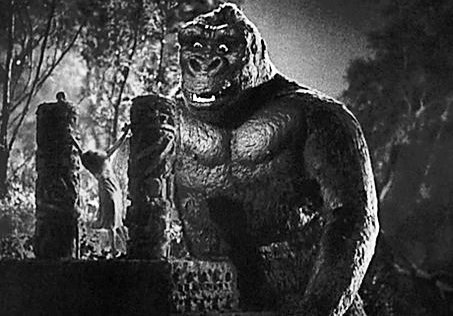
The first time was the charm. One of the few insightful comments I heard on the 2007 AFI special was when Martin Scorsese said that in many ways he finds the primitive stop-motion effects of the original King Kong more impressive than later CGI versions. He's absolutely right. The 1933 version also offers more thrills and emotions (and in half the time) than Peter Jackson's technically superior but dramatically inferior and unnecessary remake. Let’s not even discuss the 1976 version.
When L.A. Confidential debuted on this list in its first year of eligibility in 2007, I wrote, “Of the films of fairly recent vintage, this is one that grows stronger each time I see it, earning comparisons to the great Chinatown…Well acted (even if Kim Basinger's Oscar was beyond generous), well written and well directed, I believe L.A. Confidential’s reputation will only grow greater as the years go on — yet it lost the Oscar (and a spot on the AFI list) to the insipid Titanic.” When I re-watched the film recently, my prediction proved to be spot-on as it only deepens as an experience and an entertainment as time passes. It still boggles my mind that with Russell Crowe, Guy Pearce, Kevin Spacey and James Cromwell (just to name four) delivering impeccable work that only Basinger landed a nomination, but losing best picture and director to James Cameron and Titanic remains the bigger crime.
Simply put: The tensest comedy ever made and perhaps Scorsese's most underrated film. Griffin Dunne plays the perfect beleaguered straight man enveloped by a universe of misfits and oddballs in lower Manhattan when all he wanted to do was get laid. It’s hard to imagine that this movie nearly became a Tim Burton project, but thanks to the many setbacks Scorsese endured attempting to make The Last Temptation of Christ, the film ended up being his — and recharged his batteries as well. While Scorsese has made great films since, I’d love to see him step back sometime and make another indie feature like After Hours on the fly just to see what happens. Joseph Minion wrote an excellent script and this represents one case where I think the changed ending actually proves superior to the originally intended one. By the way, whatever happened to Joseph Minion?
Watchability often gets undervalued when rating a film's worth, but I never tire of sitting through this thrill ride. One aspect that has impressed me since I first saw it as a teen back in 1985 (and I went two nights in a row, dragging my parents to it on the second) was its attention to detail such as Marty arriving in 1955 and mowing down a pine tree on the farm of the deranged man trying to “breed pines.” Then, when he returns to 1985, Twin Pines Mall now bears the sign Lone Pine Mall. It’s just a quiet sight gag in the background without any overt attempt to call attention to the joke. You either catch it or you don’t. I always admire films that respect audiences like that, especially when they happen to be this much fun. With equal touches of satire, suspense and genuine emotion, Back to the Future elicits pure joy. No matter how many times I see it, the final sequence where they prepare to send Marty back to 1985 holds me in rapt attention as I wonder if this time might be the time he doesn't actually make it.
A comedy about the Vietnam War that's full of blood and set in Korea, just as a matter of subterfuge. The film that put Altman on the map and inspired one of TV's best comedies (until it got too full of itself), MASH still holds up with its brilliant ensemble and wicked wit. I still wish the TV show had kept that theme song with its lyrics. Through early morning fog I see/visions of the things to be/the pains that are withheld for me/I realize and I can see.../That suicide is painless/It brings on many changes/and I can take or leave it if I please.

Back in 1985, before Goodfellas and The Sopranos really mixed mob stories with jet black comedy, the great director John Huston, in his second-to-last film, brought to the screen an adaptation of Richard Condon's Mafia satire Prizzi's Honor, complete with great performances and some of the most memorable lines ever collected in a single film. Huston may have been in the twilight of his days, but his filmmaking prowess was as strong as ever. Jack Nicholson disappeared into the role of Charley Partanna more than he had any role in recent memory. Kathleen Turner matched well with Nicholson as Charley's love whose work outside the house causes problems. William Hickey gave an eccentric and indelible portrait of the aging don. Finally, John's daughter Anjelica made up for a misfire of an acting debut decades earlier with her brilliant performance as the scheming Maerose and took home one of the most deserved supporting actress Oscars ever given.
Before Zhang Yimou started being obsessed with spectacle and martial arts, film after film, he produced some of the greatest personal stories in the history of movies, especially when his muse was the great and beautiful Gong Li. This film was their first truly flawless effort as Gong plays the young bride of a powerful lord who already has multiple wives and who encourages the sometimes brutal competition between the women.
"The film actually is like a snail — it kind of turns in on itself and becomes itself," Altman describes his film in an interview on its DVD. One of the many "comebacks" of Robert Altman's career, this brilliant Hollywood satire holds up viewing after viewing because it's so much more than merely a satire. Thanks to Tim Robbins' superb performance as the sympathetic heel of a Hollywood executive and the cynical yet deeper emotional punch of Michael Tolkin's script, Altman wows from the opening eight-minute take to one of the greatest final punchlines in movie history. However, the more times you see it, the more you discover to see. While some specific references have aged, the movie's relevance remains — now more than ever.
Schindler’s List marked an important moment in Spielberg’s development as a filmmaker: Peter Pan finally grew up. It’s a harrowing, well-made movie that everyone should see. At the same time, I can foresee a time when it slips off this list entirely. It isn’t the fault of the film — I find it nearly flawless. However, if someone placed a gun to my head and ordered me to choose to watch either Schindler’s or one of Spielberg’s best post-1993 films such as Catch Me If You Can or Minority Report, I’d opt for one of the latter two. Are they better films than Schindler’s List? I can’t say that. However, the epic holocaust tale isn’t a film you find yourself wanting to pop a bowl of popcorn and watching on a whim. As I said earlier, for me at least, rewatchability remains an important factor. I’ve seen Schindler’s List three times but I haven’t reached the point where I want to go through that wrenching experience again.
Bergman once said that by the time he was done making Wild Strawberries, the film really belonged more to Victor Sjöström, who played Borg, the renowned professor and lauded physician about to receive an honorary degree. The film marked Sjöström 's return from semi-retirement, but he already was a legend as the first true Swedish acting-directing star. Borg decides to drive his old Packard to the event instead of flying to meet his son. The journey becomes more than just a road trip for the professor, but a metaphysical trek through his past as he questions what led him to this moment. As the car winds closer to the ceremony, Borg's inner journey does as well as he comes to realize that for all his scientific training, the only thing he can't analyze is himself. "The day's clear reality dissolves into even clearer remnants of memory," he says. Wild Strawberries represents Bergman growing into his powers as a filmmaker and while it may concern a 78-year-old man examining his life, the subject proves as timeless for people of any age as the film itself.
Tweet
Labels: Almodóvar, Altman, D. Zanuck, Dassin, Hawks, Herzog, Hitchcock, Huston, Ingmar Bergman, Kurosawa, Laughton, Lists, Murnau, Sayles, Scorsese, Spielberg, Tim Burton, Truffaut, Zemeckis, Zhang Yimou
TO READ ON, CLICK HERE


Monday, April 30, 2012
A vision for all — perhaps not meant for one man alone

"I was most jealous of Truffaut — in a friendly way — with Jules and Jim. I said, 'It's so good! How I wish I'd made it.' Certain scenes had me dying of jealousy. I said, 'I should've done that, not him.'" — Jean Renoir
By Edward Copeland
From the first time I saw Jules and Jim in high school, the movie became a personal touchstone and remains one as we mark its 50th anniversary. Truthfully, I know the parallels my teen eyes recognized between myself and others in my life then didn't mirror the characters on screen as closely as my imagination wanted to believe, but as that fantasy faded away, I began to appreciate more of the artistry of a film that I already loved. In addition to what Jules and Jim contains within its frames, the movie also forged the connection I've always felt with François Truffaut.
If you discovered, probably early in your life, that your genetic makeup left you susceptible to artistic impulses of some kind — it needn't matter whether that creative bent took the form of movies, writing, art, music, whatever — the odds weighed heavily toward you falling for at least one Catherine in your lifetime. (Now, I'm speaking from the point-of-view of a straight male. I wouldn't dare presume straight female or gay perspectives, though I've witnessed similar dynamics secondhand.) As far as we go, the Catherines of the real world function like those purple-hued bug zappers hanging on summer porches and inevitably drawing us like moths to their pulsating light and our doom — and we wouldn't trade one goddamn miserable minute of it if it meant losing a single second of the joy. This isn't a new phenomenon:
 F. Scott had his Zelda and Tom had his Viv during the same era when Jules and Jim takes place. (A brief aside: I think Tom sent me a personal message from the past when he published The Waste Land in 1922 and penned those lines, "April is the cruellest month.") To casual and outside observers, proclaiming that Catherine must be crazy comes rather easily and mounting a counterargument against that assumption makes for a steep climb. Yes, our real world Catherines come with a fair amount of mental instability, as do we, but without our neuroses and idiosyncrasies, we probably wouldn't be drawn to these wild, wonderful, wounding women in the first place. Of course, Henri-Pierre Roché's novel and François Truffaut's film take the men's point-of-view, even when filtered through Michel Sobor's narration, so Jules and Jim aren't portrayed as being as unstable as Catherine. The closest the male friends come shows through Jules' fear and neediness at times. As for the Catherines of the real world, people do have the capacity for change, no matter what David Chase might believe, and can end up being vital parts of your life even as you become the one holding the monopoly on the madness in the friendship. It's a cliché, but it originates from truth: Most of the best art stems from suffering. Anyone remember Billy Joel during the years when he and Christie Brinkley were happily married? Jules and Jim, for me at least, represents a cinematic temple to that idea. Of course, it also begs the question that if misery breeds great art, why in the hell haven't I accomplished something of note?
 Jules and Jim made its U.S. premiere April 23, 1962, the same year the film made its initial debut in France on Jan. 23. Though it marked Truffaut's third feature film as a director following The 400 Blows and Shoot the Piano Player, Jules and Jim was only the second of his films to reach U.S. movie theaters. Shoot the Piano Player, though it opened elsewhere in 1960, wouldn't get its U.S. release until July 23, 1962. (Like Jules and Jim, The 400 Blows reached U.S. shores in the same year, 1959, that Truffaut's directing
 debut did elsewhere, just a few months later.) As I remind people as often as possible, all opinions about movies are subjective. Before beginning my lovesick tribute to what I think holds the title as the true masterpiece born of the French New Wave, I feel that I shouldn't pretend all critics agreed about Jules and Jim and I'd allow one to have his say before I got started. "With the years, I've sometimes felt the reputation of Jules and Jim is a bit exaggerated," this former critic said to Richard Roud, then-director of the New York Film Festival, in October 1977 on a television program called Camera Three. The ex-critic added, "and that I was too young when I made it." That appearance happened to be François Truffaut's first time on American television. I guess you can remove the man from the role of film critic but you can't take the critic out of the man. "I continue to re-read the book every year. It was one of my favorites. I've often felt that the film was too decorative, not cruel enough, that love was crueler that that," Truffaut went on to tell Roud. Now, François, don't be so hard on yourself. For those who haven't seen Jules and Jim, I'll be vague, I think you could call the film's dénouement fairly devastating. Besides, most recognize (or know from experience) that cruelty usually crosses love's path at some point. On top of that, the subject cuts too close to Truffaut for him to judge. Jules and Jim may speak to me in personal ways, but that isn't why the film rests among my 20 favorite films of all time. As John Houseman used to claim in TV commercials about how Smith Barney made money, Jules and Jim got that rank on my list "the old-fashioned way. It earned it."
While I knew that Jules and Jim originated as a novel by Henri-Pierre Roché, it wasn't until I obtained the Criterion edition that I learned that Roché loosely based it on his relationship with Franz Hessel, a German writer who translated Proust into German (as Jim does in the film) and Helen Grund, who became Hessel's wife and herself translated Vladimir Nabokov's Lolita into German. Legend has it that Roché also introduced Gertrude Stein to Pablo Picasso through his original career as an art dealer and art collector. Though the circles that Roché circulated in preceded the time period of Woody Allen's recent Midnight in Paris, he did know many of the literary and artistic figures depicted in Allen's fantasy. The real-life coincidences that brought Truffaut and Roché together border on the extraordinary. Truffaut
 stumbled upon the novel in a secondhand bookstore and it led to a letter-writing relationship between himself and Roché where the young critic Truffaut promised that if he ever made movies, he would bring Jules and Jim to the screen. Jules and Jim was the first novel that Roché ever wrote — which he did at the age of 74. His second novel, also autobiographical, Two English Girls and the Continent, eventually became the source material of a later Truffaut film, Two English Girls. Two English Girls, sort of the inverse of Jules and Jim with two women pining for the same man, marks its 40th anniversary this year but unfortunately, like too many other great films I'd like to write about this year, no proper DVD copy has been made for rental or at a reasonable price, the same situation that in the past two years has befallen other films such as Steven Soderbergh's Kafka, Barbet Schroeder's Barfly with its great performances by Mickey Rourke and Faye Dunaway and two of John Sayles' very best films — City of Hope and Matewan. Who said only old classics become lost films? With the constant format changes, some never made the leap from pan-and-scanned VHS. A true travesty, but I've digressed from the subject at hand. Roché didn't live long enough to see the movie of his first novel, but the film version brought best-seller status to his book that it never saw in his lifetime. One aspect that didn't occur to me until I re-watched the movie for this tribute: Not only has the film reached its 50th anniversary this year, 2012 also means a full century has passed from where its story begins in 1912.
The film starts in blackness — literally if you were in a French-speaking country or watching without subtitles. You hear a voice (Jeanne Moreau's as Catherine, though we wouldn't know that yet) say, "You said, 'I love you.' I said, 'Wait.' I was about to say, 'Take me.' You said, 'Go.'" Then, quite abruptly, Truffaut launches us into the film's imagery with a bouncy spirit, playing music beneath the credits that seems to herald that a carnival lies ahead courtesy of prolific film composer Georges Delerue, who scores the entire film, though it won't all sound like this energetic romp which accompanies clips, some of scenes that will arrive later in the film, others that just fit the tone of the piece — such as Jules and Jim jokingly fencing with brooms. As with many others, Delerue would collaborate with Truffaut on nearly all of his films, having first worked on Shoot the Piano Player. We'll also get a glimpse of an hourglass, its sand pouring through to clue us in advance of the importance the passage of time serves in the story. We see our first swift sightings of Moreau as Catherine, though her actual entrance
 into the film doesn't occur immediately. While Catherine certainly acts as the catalyst for most events in Jules and Jim, her name isn't in the title for a reason. At its heart, Jules and Jim spins a story of friendship between two men. Oskar Werner's Jules acts as the outsider, the Austrian in Paris, until Henri Serre's Jim takes him beneath his wing, acting, quite literally, in the early days of their acquaintance as Jules' wingman. As with many Truffaut films, Jules and Jim employs a narrator (Michel Subor) not only to for exposition purposes but because Truffaut wanted to maintain as much of Roché's prose as possible in the adaptation he co-wrote with Jean Gruault. Jules and Jim's friendship begins when Jules, the foreigner in Paris, approaches Jim blindly to see if the Frenchman might wrangle him an invitation to the Quatres Arts Ball. Jim succeeds and a friendship blossoms as they search for a slave costume for Jules to wear to the event. From that, the men began to teach one another the other's language and culture and shared their poems,
 which they'd translate into the other's native tongue. Before long, the men saw each other every day, talking endlessly, finding common ground such as, the narrator informs us, "a relative indifference toward money." The omniscient voice also tells the viewer, "They chatted easily. Neither had ever had such an attentive listener." Jules though lacks luck when it comes to love in Paris, even of the transitory kind while Jim draws women to him as if he were a magnet. Jim finds getting women so easy that he willingly hands some off to Jules, including a musician. "They were in love for about a week." This early setup runs us through the women, most of whom bear little importance to the story so they receive scant attention from the film. Desperate for some amorous action, Jules even ignores Jim's warning to stay away from the "professionals" only to learn that he should have trusted Jim's word and avoided the disappointment. This changes one evening, when the men encounter a woman named Thérèse (Marie Dubois) seeking refuge from her loutish anarchist boyfriend who blames her for a shortage of paint that he thinks will make people believe that anarchists don't know how to spell.
What separates Jules' and Jim's relationship with Thérèse from what lies ahead with Catherine comes from Thérèse clearly indicating a preference between the two men, in this case Jules. Though Dubois' role takes up very little screen time, she does prove a charmer (and remember that U.S. moviegoers, at the time of Jules and Jim's release, had yet to see her film debut as the waitress Lena in love with Charles Aznavour's piano-playing Charlie in Truffaut's second feature, Shoot the Piano Player). When they return to the house,
 Jules acts the part of the gentleman, offering Thérèse his bed while he sleeps in a rocking chair, but romance occurs quickly and rectifies that situation. That hourglass first spotted in the opening credits reappears and Jules explains that he prefers it to a clock. When all the sand passes through to the bottom, that means it's time to go to sleep, he explains. She simply smiles and tells him he's sweet. Thérèse demonstrates for Jules her trick that she calls "the steam engine." She places a lit cigarette in her mouth and puffs out her cheeks like a blowfish and then chugs in a circle in the bedroom until she has reached Jules' chair, one of the many, recurrent visuals of circular imagery that Truffaut utilizes in the film. You shouldn't feel bad for Jim — he's busy bedding his frequent lover Gilberte (Vanna Urbino) and making excuses to depart her bed before the sun rises despite her request to lie beside her for a complete night for a change. Jim nixes that idea, saying that if they did that they might as well be married and she'd expect him to stay the next night as well. Gilberte expresses skepticism at his excuse, especially when he suggests that she imagine he's working at a factory, betting that his plan involves sleeping until noon. Later that night, Jules, Jim and Thérèse go to a café and no sooner have they sat down that after making eyes at another
 man, Thérèse asks Jules for some change to play music. He complies, she takes the money and the man follows her. Thérèse asks if she can stay with him that night and the two depart. Jules starts to stand in outrage, but Jim grabs his arm and he sits back down. "Lose one, find 10 more," Jim advises. Jules admits that he didn't love Thérèse. "She was both mother and doting daughter at the same time," Jules says, sighing that he doesn't have luck with Parisian women. He shows Jim photos of some of the women back home he loves, presenting them in order of preference and contemplating returning for one of them in a couple of months if the situation in France doesn't change. However, Jules lacks a photograph of one named Helga so he sketches her in broad strokes on the café's table. Jim tries to buy the table, but the establishment's owner refuses unless he purchases the entire set.

That night, they go to the home of Jules' friend Albert (played by Serge Rezvani, a renaissance artist, though he prefers the term multidisciplinarian, who billed himself as Bassiak here and added the first name Boris when taking credit as the composer of "Le Tourbillon" that Moreau memorably sings) to see his slides of ancient sculptures he found around the country. (Somehow it slips my mind between viewings of Jules and Jim how little dialogue the actors actually get to speak openly in the film in favor of voiceover. For example, when Jules and Jim enter Albert's place, they exchange introductions out loud but then Henri Serre as Jim doesn't simply ask Oskar Werner's Jules, "Who's Albert?" Instead, we hear Michel Subor's narrator say, "Jim asked" — When I first heard
 this the first few times I watched the film, it sounded as if Subor narrated this entire dialogue. After hearing it for the umpteenth time, it sounds as if Subor merely starts it the Serre asks in voiceover, "Who's Albert?" with Werner's voice replying, "A friend to artists and sculptors. He knows everyone who'll be famous in 10 years." I can't say with 100% certainty which interpretation stands as the correct answer. I've looked for verification, but found none. Jules' response tipped me in that direction because Werner's voice can be distinguished easily from Subor's while Serre's falls in the same vocal range.) One slide of a stone face particularly strikes the friends' fancy — and Subor definitely
 describes this, informing the viewer, "The tranquil smile of the crudely sculpted face mesmerized them. The statue was in an outdoor museum on an Adriatic island. They set out immediately to see it. They both had the same white suit made. They spent an hour by the statue. It exceeded their expectations. They walked rapidly around it in silence. They didn't speak of it until the next day. Had they ever met such a smile? Never. And if they ever did, they'd follow it. Jules and Jim returned home, full of this revelation. Paris took them gently back in." Later, Jules and Jim hit the gym where they spar with some kickboxing. Jules inquires about the progress of Jim's book. Jim tells him he thinks it's going well and will turn out to be very autobiographical and concern their friendship. He proceeds to read Jules a passage. "Jacques and Julien were inseparable. Julien's last novel had been a success. He had described, as if in a fairy tale, the women he had known before he met Jacques or even Lucienne. Jacques was proud for Jules' sake. People called them Don Quixote and Sancho Panza and rumors circulated behind their
 backs about their unusual friendship. They ate together in small restaurants, and each splurged on the best cigars to give the other." Jules finds the writing beautiful and offers to translate it to German. Jim's brief allusion in his novel to "rumors" about his friendship with Jules marks the closest the film ever comes to implying anything homoerotic between the men. While Jules and Jim opened the door for many cinematic variations on your standard triangle, we'd still need almost 40 years before Y Tu Mama Tambien. As the guys shower, Jules announces that his cousin wrote him and three girls that studied with him in Munich would be visiting Paris — one from Berlin, one from Holland and one from there in France, Jules plans to host a dinner for the visitors the next night. Neither friend has any idea who Catherine happens to be yet or that she will be the French girl in that group of visitors. This Quixote and Sancho soon will be tilting at a very shapely and unpredictable windmill that will change the course of all three lives forever. The next night, when Catherine (Moreau) descends the stairs and lifts the lace netting covering her face, her resemblance to the sculpture stuns Jules and Jim, something Truffaut emphasizes through quick cuts, and Michel Subor's narration, and the young men will keep the oath they made to that statue — they've found that smile, now they must follow it.
 While for me, Jules and Jim stands at the high watermark of the French New Wave films, I know many others won't agree and when you look objectively at the story of Jules and Jim, it may employ many of that movement's techniques but many aspects of Truffaut's film set it apart from its cinematic brethren such as its period setting and a time span that covers more than two decades. Jules and Jim also caused moral uproars about the open relationships among the various characters in the film (and though Jules, Jim and Catherine might be involved simultaneously, they never took part in a ménage à trois). In a funny way, the 1962 film forecast the free love movement to come later that decade except its source material happened to be a semiautobiographical novel set in the early part of the 20th century. The prurience though lies in the mind of the fuddy duddy because part of what makes Jules and Jim so special comes from Truffaut's refusal to pass any judgment, be it positive or negative, upon the behavior of his characters. Despite the director's own criticism many years down the road that the film isn't cruel enough when it comes to love, the three main characters do suffer by the end but he doesn't paint it as punishment for their sins.
Tweet
Labels: 60s, Books, Criticism, Dunaway, Fiction, Fitzgerald, Foreign, Mickey Rourke, Movie Tributes, Ray Top 100, Renoir, Sayles, Soderbergh, Truffaut, Woody
TO READ ON, CLICK HERE
Sunday, April 10, 2011
Howlingly Scary, Howlingly Hilarious

By Phil
What can you say about a movie in which the villain digs into his own forehead to retrieve a bullet, but not before quipping to a woman unlucky enough to be witness, “I want to give you a piece of my mind”? Don’t answer that. It’s a rhetorical question. Suffice it to say that The Howling, released 30 years ago today, understood the irresistibility of dishing up horror with a dash of humor. A werewolf picture jam-packed with B-movie references and a giddy love of the genre, it quickly earned a cult following that has remained loyal since the film first hit screens in 1981.
It had to share the love from fanboys. While The Howling helped steer the career of director Joe Dante into (regrettably) safer, more mainstream fare, the movie was initially overshadowed by another man-becomes-wolf horror-comedy from 1981, John Landis’ An American Werewolf in London. Comparisons between the two flicks were inevitable. Released within four months of each other, both embraced the spirit of drive-in exploitation while boasting more polished filmmaking, and both featured onscreen werewolf transformations that would have made Lon Chaney Jr.’s head spin with envy.

Still, I prefer The Howling for its generous humor, genuine creepiness and willingness to sleaze it up. It’s a nicely calibrated blend of smart camp and lowbrow shocks, anchored by Dee Wallace’s surprisingly effective performance as a woman trapped between lycanthropy and self-help jibber-jabber. A year before she would be Elliott’s mom in E.T.: the Extra-Terrestrial, Wallace plays Karen White, a TV news reporter in Los Angeles with the misfortune of having drawn the affection of a serial killer. As the film opens, Karen has agreed to meet with the psychopath, Eddie Quist (Robert Picardo), in a peepshow stall at a seedy porn store. Eddie appears behind Karen in silhouette, hissing about what he’s going to do to her. Karen stares ahead, in mute horror, at a grainy bondage reel being projected.
Then Eddie commands Karen to face him. She turns and sees…Well, we don’t know what she sees exactly. Karen lets out a scream, the first of many in The Howling. Two police officers who have been trailing Karen open fire, killing Eddie Quist.
The incident naturally rattles our heroine. When she returns to work, Karen freezes up under the unmerciful gaze of the camera. At home, she rejects the loving arms of husband Bill Neill (Christopher Stone). Knowing she needs help, Karen is intrigued when a courtly therapist, Dr. George Waggner (Patrick Macnee), suggests she join his self-help group in Big Sur called The Colony.
The ensuing detour into quasi-psychobabble gives Dante and screenwriter John Sayles, at the time just coming off Alligator and Piranha (also helmed by Dante), a ripe avenue for satire. Karen and Bill are bemused by the goings-on of The Colony, whose inhabitants soak in Dr. Waggner’s cautionary line that “repression is the father of neurosis.” The good doctor might be on to something, but his EST-styled knockoff includes some curious aspects. The Colony appears to host more barbecue cookouts than your average pop-psych cult.

There are other red flags, too, including John Carradine as a crazy old coot and Elisabeth Brooks as a resident nymphomaniac outfitted in what looks to be an early prototype for Xena: Warrior Princess. There is more to The Colony than meets the eye. Chris and Terry (Dennis Dugan and Belinda Balaski), an intrepid pair of reporters who work with Karen, discover mysterious links between Dr. Waggner’s sanctuary and Eddie Quist. And speaking of the slain killer, his corpse has suddenly disappeared from the morgue.
It all makes for an irrepressible horror flick that delivers its jolts with a grin. Unlike a raft of slasher flicks of the late ‘70s and early ‘80s, Dante and Sayles mined the inherent absurdity of their yarn but, honestly, there’s really no other way to approach a story of werewolves who are urged on by a pop psychiatrist to embrace their inner animal.
The Howling exposes its funny bone in the opening minutes, with a sly bit involving a news anchor whose authoritative delivery masks an aw-shucks Southern twang. Dante, an avid movie buff, peppers the proceedings with knowing winks to the genre. Several characters’ names are lifted from movie directors of werewolf flicks, such as George Waggner (1941’s The Wolf Man) and Lew Landers (1944’s Cry of the Werewolf). Dante also isn’t shy about shoehorning in wolf references in everything from cartoons to literature.
Similarly, The Howling makes room for an array of B-movie icons. Kevin McCarthy of Don Siegel’s classic Invasion of the Body Snatchers portrays Karen’s boss at the TV station, while The Thing from Another
 World’s Kenneth Tobey turns up briefly as a cop. Forrest J. Ackerman, the man behind Famous Monsters of Filmland magazine, makes an appearance. Dante’s mentor, the notoriously penurious Roger Corman, has a fitting cameo as a guy checking a pay phone for forgotten change. Corman even gets a second, however peripheral, nod in The Howling. His 1959 comic-horror picture, A Bucket of Blood, is referenced when its star, Dick Miller, turns up to play a slick occult bookshop owner named Walter Paisley. The name is the character Miller played in — wait for it — A Bucket of Blood. Miller’s performance in The Howling launched what would become tradition for Dante, who went on to cast the actor in a slew of his movies.
Despite the cornucopia of inside jokes, The Howling is, above all, a monster picture and it offers a humdinger of one thanks to the inventiveness of special-effects maestro Rob Bottin. By inflating various-size bladders pasted on to the face and body of actor Picardo, Bottin fashioned an impressive, before-your-eyes transmogrification from man to beast. In today’s world of CG wizardry, where even the lamest schlockfest can be visually interesting, it is tempting to forget just how eye-popping Bottin’s feat really was. Moreover, The Howling’s fully realized werewolves are a far cry from the mega-hirsute guys who roamed the Hollywood countryside of yesteryear. Bottin’s creations, shot at oblique angles and occasionally backlit in cartoon-friendly colors, look as if they just padded in from Little Red Riding Hood’s neck of the woods. These are giant wolves, not wolf men.

The non-monster moments also are memorable. Dante assembled a strong cast; it’s a kick to see veteran character actors such as Carradine and Slim Pickens (as a yokel sheriff, of course) chewing on the scenery, especially when the aforementioned chewing involves fake fangs.
At the center of it all is Dee Wallace. With her feathery blonde hair and all-American good looks, she is an appealing damsel in distress. But she does one better, imbuing her character with melancholic vulnerability and investing The Howling with a welcome depth of emotion. It makes the film’s ending, in which Karen transforms into a werewolf for the local TV news, as heartbreaking as it is howlingly hilarious.


Tweet
Labels: 80s, Corman, Don Siegel, J. Carradine, Joe Dante, Landis, Lon Chaney Jr., Movie Tributes, Sayles
TO READ ON, CLICK HERE
Sunday, December 05, 2010
A person who don't look out for himself is too dumb to look out for anyone else

By Edward Copeland
The best films grow in your esteem over time and that is the case with The Grifters, which debuted 20 years ago today. I liked the movie when it debuted, but each time I've seen it since, again most recently, it just gets better and better.
As I mentioned two days ago when I reviewed this year's The Killer Inside Me, this remembrance of The Grifters is the third time this year I've written about a film adaptation of a Jim Thompson crime novel (the
 third being After Dark, My Sweet). What I've found most interesting in comparing the three films is the approach to what time period they set them in. All three of the novels were pretty much set in the same era that Thompson wrote them: roughly the late 1940s through the early 1960s. In the film After Dark, My Sweet, it was updated to modern times. The Killer Inside Me, the most faithful adaptation in all respects, was a period piece that took place in the same era as the novel. The Grifters, produced by Martin Scorsese and directed by Stephen Frears, takes the most unusual course of all by placing its tale in sort of a time limbo. The women dress as if they are in the 1940s, everyone drives cars that look like they're from the 1970s and John Cusack's character wears 1980s Armani suits and tries to pull off his initial short con at a Bennigans.
Then again, of the three Thompson novels I've read that were turned into films, The Grifters is the least faithful, even though the book is short. However, the changes make for a leaner, sleeker, better film. The nurse who appears fleetingly in the movie has a larger role in the novel and the movie makes no mention of
 the fact that Roy Dillon (Cusack) holds down a job as a salesman in addition to his part-time action as a hustler. They even changed the spelling of Annette Bening's character's first name from the novel's Moira to Myra. Still, the changes that the late screenwriter and crime novelist Donald Westlake made actually improves the film over the novel while the same cannot be said for the other two Thompson films I've discussed. There are a couple of weaknesses (and this may lead to spoilers for those who haven't seen the film or read the book). The novel makes a point early on of having Roy comment on the physical resemblance between his mother Lilly (Anjelica Huston) and Moira (height, hair color, body type, facial structure), but you can't really say that about Huston and Bening. Also, Lilly is supposed to look young enough to be Roy's sister since she had him at 14, but Huston does look old enough in her nearly white wig to have given birth to Cusack, even though she actually was the right age in real life for the character. These are minor criticisms though because the performers, Huston and Bening especially, are so superb that it doesn't matter.
"Grifters got an irresistible urge to beat a guy who's wise. There's nothing to whipping a fool. Fools are made to be whipped, but to take another pro, who knows you, who has his eye on you, now that's a score."

Mintz (Eddie Jones), the grifter who schooled Roy on some of the tricks of the trade, tells him that in a flashback explaining how Roy got his start taking suckers. It's those cons that unite the three principals of the story, though each has a different approach. Roy is a solo artist who does the quick hit. Myra, especially back when she had a partner (J.T. Walsh in flashbacks) before he went nuts, prefers the long con with the bigger payoff, where you work someone over a long period of time before you take him. Lilly is almost a professional, working for Bobo Justus (Pat Hingle, in a frightening performance) purposely placing large amounts of money on horses with long odds to bring those odds down before the start of a race. Of course, she's also taking discarded losing tickets here and there and grabbing some winnings for herself to keep in a stash hidden in a compartment in the trunk of her car. She just has to make sure Bobo doesn't find out. He's not a forgiving boss.
Westlake's streamlining of Thompson's novel makes for a truly efficient film, aided by Frears' direction and Elmer Bernstein's great score which seems to accelerate the momentum as it goes on. In the commentary, Frears gives Westlake the credit for introducing the three characters through the brilliant tri-screen opening
 that perfectly sets up where Roy, Lilly and Myra are at this stage in their various nefarious careers. Lilly is the pro. She know exactly what she is doing, how not to get noticed, either by the authorities or (at least she tries) the unforgiving Bobo. Roy, the youngest of the three, has become pretty good at what he does, but he's still strictly small time and sometimes has the misfortune of getting caught by would-be marks. Myra, who works well with a partner, is a bit at sea on her own and finds herself relying on sex more and more often to get what she wants, even if it means banging her landlord (Gailard Sartrain) because she needs to hang on to what little cash she still has (and the roof over her head) or putting the moves on a geeky jewelry store proprietor (Stephen Tobolowsky). What separates Myra from Roy and Lilly is she is the only one of the three who has an air of desperation about her, though she tries not to let it show.
Fate more or less brings these three into the same circle. Even though Lilly is Roy's mother, they've been estranged for years, though when Bobo, who is based out of Baltimore, assigns Lilly to California tracks, she decides to look Roy up in Los Angeles. Myra and Roy have been lovers for quite a while. In fact, for a long
 time during their relationship, Myra didn't even realize Roy was in on the grift until they took a train trip and she spied him taking a group of young sailors (again dressed outside of any discernible period) in a common dice con called the "tat." (Look close: one of those young sailors is Jeremy Piven.) After that, she's always trying to get Roy to join her as a partner in the long con, to re-create the glories of her past, but that's one lesson Mintz emphasized to him in his tutelage: Work alone. Myra keeps trying though, comparing her institutionalized ex-partner and Roy, "I kissed a motherfuckin' frog and you're my prince." When it turns out that a would-be mark injured Roy worse than he thought, Lilly takes over and gets him hospitalized, that's when she and Myra meet and take an instant dislike to one another. They are like jealous lovers fighting over a man.

Unfortunately, because Lilly's maternal instinct chose this time to reassert itself (She tells the doctor she finally gets to take her seriously that he knows who she works for and if Roy doesn't make it, she'll have him killed), she missed some races she needed to cover and cost Bobo some money and Bobo doesn't like to lose money. He makes a special trip to the coast to mete out punishment. Anyone who has ever seen the late Pat Hingle in his countless roles, be it as Commissioner Gordon in the Tim Burton Batman films or countless
 television appearances such as the original owner of Cheers who comes back and tends bar for a night, they won't be prepared for his malevolent Bobo Justus. The scene isn't quite as explicit as it is in the novel, but if you've read it, you know what Lilly is in store for when he asks her if she has a long coat to cover her dress. His abuse is equal parts physical and psychological, making Lilly wrap up oranges in a towel and having her explain what happens if people don't hit others with them correctly, causing her to stutter in fear, then faking her out and letting her off with just a cigar burn on her hand. Then, everything's back to normal and he's having a friendly conversation with her on the veranda, even joking with her about if she's stealing that much from him and acting as if he doesn't mind and she's going along with it — because she knows she got off easy. "A person who don't look out for himself is too dumb to look out for anyone else," she tells him with a nervous grin. Lilly may be the pro of the three main characters, but she always has to be looking over her shoulder. Her paranoia is well justified, given her employer.
As I mentioned in the review of The Killer Inside Me, Westlake says that Thompson belongs to America's second generation of crime novelist, following his forefathers such as Dashiell Hammett and Raymond Chandler, only Thompson, based a lot on the life he actually lived, was far more nihilistic than either of the
 earlier writers. Thompson also had a source that Chandler and Hammett didn't, Westlake pointed out: the early movies and film noirs as wells as the novels. Thompson though was a true crime novelist. It's a mistake to place his works exclusively in the noir column. Granted, I've only read the three books and seen Coup de Torchon, Bertrand Tavernier's 1981 film that transferred Thompson's novel Pop. 1280 to a 1938 French colony in Africa. Of all those though, only After Dark, My Sweet comes close to the usual noir trappings, and even that's by the loosest definition of the term. Thompson didn't play by the numbers in anything he wrote. Even though The Grifters concerns con artists, unlike the innumerable films about the subject there aren't the twists, reversals or set-ups you'd expect. The usual con artist tale can't help but get you wrapped up in the fun of the scheme, but The Grifters isn't that type of story. It's dark and unsettling; a character study where you can't be certain where the characters will end up. In one of the extras on the DVD, Frears told Westlake and others repeat similar ideas: Thompson wrote a Greek tragedy for the underclass.
What keeps this from being a grim undertaking is its stellar cast. Annette Bening had a few films under her belt before she made The Grifters (including Postcards from the Edge the same year and Milos Forman's Valmont, ironically playing the role Glenn Close did in another version of the same story Frears directed as Dangerous Liaisons), but her performance as Myra might as well have been her debut because from the moment she slinks into the film, a star is born. Myra doesn't just seduce the various men in her path, but the camera as well. She's sexy, funny and moves like a cat, earning a well-deserved Oscar nomination for supporting actress in the process. That Bening, Diane Ladd's crazy turn in Wild at Heart and Lorraine Bracco's work in Goodfellas all lost to Whoopi Goldberg in Ghost can be labeled nothing short of ridiculous. She's really what keeps some lightness in the film. It's as if her performance actually skips along in tune to Bernstein's evocative score.
In contrast, though he was the youngest of the three leads, John Cusack was practically a veteran, having made his film debut in 1983 in Class. Still, The Grifters marked a real turning point in his career, showing that he could play a different type of adult role. Aside from being part of the ensemble in John Sayles' Eight
 Men Out and a small but significant part in Fat Man and Little Boy, his roles were almost exclusively in teen romances and comedies, ranging on a realism scale from Say Anything and The Sure Thing to farces such as One Crazy Summer, Better Off Dead and Tapeheads. He even had that minor part in Sixteen Candles. He'd played leads before, but not like The Grifters' Roy Dillon. He really has to anchor the film between the two women, being a convincing lover for Bening and an estranged but still caring son for Huston. Cusack pulls the role off perfectly. When the film reaches its climax and one of the women tries to pull off an unbelievable lie (and perhaps go even further to pull it off), he excels at the shock and torn feelings he has at the moment. In another scene, where he's called to make an identification and realizes it's not who it's supposed to be, he gives the perfect sly, small grin, just enough for the audience to catch, but out of reach of the authorities.
Which brings us to the magnificent Anjelica Huston. Five years after her father John directed her to an Oscar for her killer supporting performance as Maerose Prizzi in Prizzi's Honor and a year after she scored a second nomination for her delightful turn as one of Ron Silver's wives in Paul Mazursky's Enemies, A Love Story (the
 same year she played Martin Landau's mistress in Woody Allen's Crimes and Misdemeanors), Anjelica stepped up to lead with her stellar Lilly Dillon. She lost to Kathy Bates in Misery (a mistake in my opinion, not that Bates hasn't deserved the prize at other times), but Huston's Lilly is a wonder. She's a tough cookie but like most cookies, she can break. It's difficult to point out how great she is because she gets the toughest scenes to pull off but to describe them in detail, except in cases such as the Bobo scene, would be spoilers for those who haven't seen the film. In the vaguest terms possible, Lilly is a survivor and she will do whatever it takes to prevail. The ends always justify the means for her, even if they're accidental or emotionally destructive. As long as Lilly lives another day, she'll live with the consequences. The way Huston plays Lilly, she's hard to get a beat on except in those moments when her entire being is an open wound and her body completes her tasks by instinct. There's a shot in the film where Lilly takes the elevator in the hotel where Roy resides that makes it appear as if she's descending into Hell, at least that's what Frears says his intention was. I don't buy it. Lilly Dillon was born in Hell and has resided there her entire life. The Grifters, on the other hand, isn't remotely hellish as far as film experiences go. It just gets better with age.
Tweet
Labels: 90s, A. Huston, Bening, Books, Fiction, Huston, Jim Thompson, K. Bates, Landau, Mazursky, Movie Tributes, Sayles, Scorsese, Television, Tim Burton, Woody
TO READ ON, CLICK HERE
Monday, November 22, 2010
Boardwalk Empire No. 10: The Emerald City
BLOGGER'S NOTE: This recap contains spoilers, so if you haven't seen the episode yet, move along.

By Edward Copeland
The oceanside scene is soothing: A young man and woman cling to each other as they stroll along the beach. They seem very much in love. As they separate, you can see that the man is Richard Harrow, when his face was intact, only it must not appear that way to the woman who lets out a terrified shriek. The reverie is
 broken and we see that scream belongs to young Emily Schroeder who has awoken Richard from his dream on the couch, where he was sleeping without his mask on and she saw the horror of his disfigurement. He quickly puts the mask back on as Nucky and Margaret come running down the stairs. Margaret looks disapprovingly as she picks up her daughter and whisks her away. Nucky just sort of shakes his head. "We are a little on edge here as it is." Since the assassination attempt on Nucky on the Boardwalk, Richard has been staying at Margaret's as their protector. With just three episodes left in the season, we're starting to get answers to more unresolved questions and more twists and Boardwalk Empire is keeping up its pace toward a big first season finish. Two things though set "The Emerald City" apart: a lot of short, quick scenes as opposed to the series' usual scenes of some length and an extended showcase for Michael Shannon. They could have titled the episode "The Last Temptation of Agent Van Alden," except that I'm not certain this is his last or, for that matter, his first. Either way, Shannon excels at depicting all sides of the agent's inner turmoil.
As you would expect, Agent Van Alden and Supervisor Elliott have some questions for Agent Sebso about how it was that his task of taking Billy Winslow to a N.Y. lockup ended with him shooting Winslow to death. Sebso says that Billy had to "make water" and he didn't want him to go on the car seat. "Why didn't you let him?" an angry Van Alden interjects. Sebso admits his bladder was bursting as well, so he decided to pull over to the side of the ride and he unlocked his handcuffs. Elliott points out that he violated standard protocol, but Sebso says that
 nothing in Winslow's demeanor indicated to him that Billy would do what he did. Plus, Elliott notes, you didn't want to have to unbutton his trousers and pull out his johnson. "So, in service to your modesty, you end up killing our only eyewitness," Van Alden sneers. Ellott warns Nelson that he's not going to tell him again. "I know I fouled up," Sebso tells them, "but killing that prisoner, I know it will haunt me for the rest of my days." Elliott seems to deliberate for a minute or two but then tells Sebso that he acted in self-defense and he's exonerated. Van Alden, exemplified by one of the quintessential Michael Shannon stares, turn his head to look at his boss in disbelief. Sebso is excused and Nelson closes the door and turns back to Elliott who asks if he has any idea what kind of embarrassment this is for the department. "I take full responsibility," Van Alden says. "That's fine Nelson, that's precisely where I place the blame. I told you I wanted numbers." Van Alden still insists that Winslow's confession is a direct link to Nucky Thompson. "Winslow is dead. His confession is useless hearsay," Elliott tells his underling. Van Alden says he can get another crack at Darmody, but Elliott says he's been released for lack of evidence and Thompson's lawyers are swarming like hornets. Shannon is so great at playing Van Alden's obsession, because he can't give it up, insisting that Jimmy committed murder under the direct orders...but Elliott stops him. "For God's sake man, you have bungled this from the start. This is your last chance Nelson. One more misstep and you'll be hunting moonshiners down in the Everglades."
Nucky is having breakfast and reading the newspaper. On the back page is more news of the Black Sox scandal. Margaret asks about how the ratification of the women's right to vote is going and Nucky tells her it's up to Tennessee. Margaret asks why he doesn't seem more excited and Thompson tells her he doesn't want her to be disappointed because the South is not known for forward thinking. Once again, it's interesting to see the Republican Party before its transformation. Imagine it making fun of the South today or embracing forward thinking. Richard comes in and tells Nucky that Eddie is there with the car and he tells him to tell Eddie he'll be there in a few minutes. Margaret asks if this is how life is going to be, with people shooting at him, and suggests that she and her kids go somewhere else for awhile. Nucky tells her not to worry. Besides, he'd miss them too much. "Success breeds enemies," Nucky says. "You'll learn that when women get the right to vote."

Sixtus D'Alessio must have just stumbled when Eddie fired on him because, aside from a large bruise on his face, he seems fine as he, his brothers Leo and Matteo (Al Linea) and Mickey Doyle stand before Arnold Rothstein and Lucky Luciano in New York to explain themselves. "Stock prices over the ticker, race results over the wire, radio will have news reports within minutes of their occurrence," Rothstein tells the room. "It's the age of information and the businessman lives and sometimes dies on its value." The would-be alcohol magnates seem uncertain as to why they are hearing this speech, but as a viewer, who cares? Watching Michael Stuhlbarg
 get a scene like he does here is an absolute joy. While I loved John Sayles' Eight Men Out and I haven't seen it in years, it's hard now to imagine that Stuhlbarg is playing the same person Michael Lerner played in that movie. Back to the scene. Rothstein asks Mickey if he knows why he's a successful gambler. Doyle says "Because you're lucky?" Rothstein points at Luciano. "He's Lucky. I create my luck. I'm a successful gambler because I never bet on an event whose outcome I'm not certain of in advance," Rothstein replies. Leo smiles and makes a crack about the World Series and Rothstein putting the fix in, but gets no reaction. Rothstein talks about all the research and intelligence gathering he does in advance, while a waiter brings him milk and a slice of cake, which he confirms is devil's food. "Due diligence," Meyer Lansky interjects. "Which brings me to Nucky Thompson," Rothstein says. "A man you said you knew everything about." "How was I supposed to know his chauffeur carried a gun?" Mickey asks. "Have you been listening to a single word I said?" Rothstein said. I believe it's the first time in the entire series that Stuhlbarg has raised his voice as Rothstein and it's both chilling and electrifying. "Sheer and utter incompetence. A woman shot, an innocent tourist no less, and it tipped my hand to Thompson," Rothstein rails. Sixtus said they figured that by doing it on the Boardwalk at night, it would send a message. "Sent a message alright, that you're idiots," Lucky says, joining the conversation. Leo steps up and promises Rothstein that he'll kill Nucky himself. Matteo adds that they will bring him his head if he wants it. Rothstein said that the grandstanding is commendable, but he's less than convinced. Leo asks how they can make it up to him. "Nothing says I'm sorry like money."
In Chicago, Johnny Torrio is holding a meeting with some of his associates about his frustration over missed moneymaking opportunities. Capone is at the bar, giggling with someone else. Torrio tells the men he's talking to that there are at least two and a half million people in Chicago alone, half of them are Irish and half of
 those dope fiends. With so many looking to drink whiskey and fuck, he wants to know why they aren't making more money. Capone's continued laughter finally gets to Torrio, who asks Al if he is even listening. A Jewish associate of Torrio's, Jake Guzik (Joe Caniano) huffs his way into the bar, complaining that he had to park 10 blocks away, but Torrio says it looks like he could use the exercise. Jake hands Torrio an envelope thick with cash and Torrio tells him they were just discussing how much money is being left on the table. There's a 10-block area without a cathouse or a place to get a drink, Torrio complains. Al comes over, acting subservient, and gives Torrio a cigarette and lights it, only it goes off because it's a novelty cigarette. Torrio is not pleased. "What are you? 12 years old?" "I'm sorry," Al says. "You are a sorry fucking moron," Capone's displeased boss replies. "I thought you'd have a laugh." Torrio throws a glass against the bar. "We're in the middle of a fucking meeting." Torrio apologizes to Jake and tells him he'll see him at his son's bar mitzvah. He then turns to Capone again and reminds him that "This ain't no fucking grade school."
Jimmy and Nucky are meeting in his office when Nucky tells Jimmy that he's seen his share of grotesque, but Richard... Jimmy tells him that apparently it's a big improvement over what it used to be. "Try explaining that to a 4-year-old," Nucky says. "From now on, when he's in the house, tell him to keep the mask on." Eddie enters and tells them Mickey Doyle is there and asks if he should frisk him. Nucky asks him if he's Tom Mix all
 of a sudden and then tells Jimmy to do it. Mickey comes in and tells Nucky he comes hat in hand, to apologize. He tells them he has partners: The D'Alessios. Nucky slams him against the wall and tells him he should throw him out the fucking window while Jimmy holds a gun at his head. Mickey says he can help. That's why he came. "I'll tell you everything I know." Nucky tells him to have a drink, though Jimmy says he should piss in it. Mickey explains how he owed them money and this is how they saw to get it back, first by putting Chalky out of business, then by robbing his ward boss out on the street. As stupid as Mickey seems, he also knows that they plan to kill him because he knows they are making fun of him, both behind his back and while he's in the room. He also tells them about the ruse Meyer Lansky tried to pull on Chalky and it all stems from Rothstein trying to muscle in on the liquor business. "Isn't ruining baseball enough?" Nucky asks. He tells Jimmy to get Chalky on the phone, but they find that Eddie's on the line. Nucky yells at Eddie to get off the phone and Eddie runs in to say that the news had just come in on the wire: Women can vote.

One of those newly empowered at the ballot box, Margaret, is on the couch, reading The Wizard of Oz to her children when Richard peeks in. Margaret asks Richard if he'd like to join them and reads a section dealing with the Tin Woodsman. Richard points to his face and says, "That's me. The Tin Woodsman. Maybe I need some oil" Margaret's little girl smiles. "Yes, he's from Oz," Margaret tells the children. "Who better to have in our house than the mighty Tin Woodsman?" Richard smiles a smile, completed by his mask.
In his small hotel room, Van Alden looks through his file. He looks at an ad for the Ziegfeld Follies, then he crumples a newspaper clipping of Republican Party activities and stares yet again at the photo of the 16-year-old Margaret. Shannon's creepy glare under the dim lighting is eerie.
Nucky says he knows she won't imbibe, but he hope she doesn't mind that he's about to as he opens a bottle of champagne in their bedroom to celebrate women's suffrage. Margaret decides that since it's such a momentous occasion, she'll join in. "You've caught up with Ireland at last," she toasts. Nucky reminds her that the U.S. is her country as well and reminds her of all the things the Republican Party has done for progress such as
 emancipation, prohibition and the women's vote. (What happened to that Republican Party? Of course, they did keep the corruption and cronyism.) Margaret says it's because the party saw an opportunity. "A simple thank you would suffice," Nucky says. He asks her to speak for Bader at Sunday's League of Women Voters lunch where Bacharach will announce he's not seeking re-election. Margaret wants to know why Bader should be mayor since he's just the owner of a construction business. Nucky says he could build great things for the people of the city. Margaret is not convinced that this makes him qualified to be a good mayor. Nucky reminds her that Andrew Johnson was only a tailor and he became president but she reminds him that he got impeached as well. She sees he's annoying him and asks what she's supposed to say. Nucky says that it's time for a change and that it's a new Republican Party. Gone are the days of incompetence, cronyism and violence in the streets. Margaret asks what happens to the county treasurer. "Me? I'm not going anywhere." "So you'll control the new mayor just like you did the old one," Margaret says. Nucky denies that he controls anyone. He describes himself as sort of an overseer. For the city's businesses to keep running over the long haul, it needs continuity of leadership. If Fletcher and the Democrats win, they'd be starting from scratch. He reminds her that this isn't a fantasy world like Oz but a real place with real people and to make it run properly, you need to tell them what they want to hear.
Now that the Darmody family has been reunited, they take a stroll on the Boardwalk. Jimmy holds Tommy up to the window of the nurses running the incubators and tells his son that this place is where he and Angela got
 him, explaining to the boy that they cooked him up in one of those right there. Tommy laughs and crawls down out of Jimmy's arms and tells him he's foolin' him and starts running down the row of shops. Jimmy starts chasing him, but his bad leg keeps him a few steps behind. Angela seems to be legitimately enjoying the moment and lags behind. Jimmy finally catches up with him outside the photo shop and picks him up again. Tommy points to a picture of Robert and Mary Dittrich and says, "That's mommy's kissing friend." Jimmy isn't certain he heard right so he asks Tommy what he just said and the boy repeats it. "That's mommy's kissing
 friend." Jimmy mumbles "son of a bitch" and puts Tommy down as a still-smiling Angela joins her family and immediately realizes something is wrong. She asks Jimmy what it is and he tells her to ask her son. Inside, Robert is setting up a child for a portrait shoot. As Robert places his head inside the camera, he doesn't see the image of the customer but of Jimmy as he punches him through the camera and proceeds to beat the shit out of him. He picks Robert up and tosses him through the glass of the store's door. Mary comes out from the back of the store and Jimmy warns her not to fuck Robert before going out on the sidewalk and continuing the beating. By now a crowd has gathered, Tommy is bawling in Angela's arms and Angela is pleading with Jimmy to stop. Jimmy makes it a point of telling the crowd that Robert had relations with his wife while he was away at the war, which Angela tells the crowd isn't true, but Jimmy continues the beating.
Margaret comes downstairs when she hears a knock at the door. She's surprised to find Agent Van Alden on her doorstep. He asks if he can come inside and she says of course. As he enters, Richard steps into the hallway from a backroom. Van Alden shows his identification and explains that he's a federal agent and he needs to speak to
 Mrs. Schroeder privately. Harrow says he'll be out back with the children. Van Alden and Margaret adjourn to the living room where Margaret takes a seat. Van Alden says he'd like to show her a photo and see if she can identify the girl and then brings out the picture of the 16-year-old Margaret. Margaret asks if this is meant to be some kind of joke. Nelson says he doesn't find it funny in the least. Margaret says it's the photo they took of her at Ellis Island. Van Alden says when he looks at this girl he sees hope, yearning, a promise of a new life, a promise of America. "What happened to that girl, Mrs. Schroeder?" "Am I to be deported?" Margaret asks, "because I am a citizen
 of this country now." Van Alden tells her that she is consorting with a murderer, the man who killed the father of her children. "That's not true," Margaret responds. "It is true. He's a panderer and a criminal," Van Alden says in his usual tone, then Shannon does an almost imperceptible shift to a side of the agent we haven't seen before: Lovesick puppy dog as Van Alden sits next to Margaret on the couch. "Your life doesn't have to be like this and I know you don't want it to be," Nelson smiles. Shannon, well-matched with an acting partner as talented as Kelly Macdonald, watches as Margaret gets stern and peeved. "You don't know me at all." With his smile growing creepier and creepier, Van Alden tells her that he can see into her soul when he looks at her picture every night and grabs her hands, which she quickly pulls away. She stands and gets away from him, accusing him of entering her home under the pretense of official business when his true intentions were obviously quite different. The lovesick puppy dog is gone and the proselytizing pit bull returns, accusingly asking her if this the life she wants. "I can offer you salvation." Margaret tells him to leave. Van Alden turns to exit, but before departing he turns to face her again and shouts, "I came here to save you, not from prosecution, but from the fires of hell that will surely await you should you fail to repent."
Torrio and Capone show up for Jake Guzik's son's bar mitzvah. Torrio tells Al to find them seats while he goes to pay respects to Jake. As Capone sits down, he removes his cap and a rabbi sitting in the row in front of him tells him he must put it back on. Al tells him that if he kept his hat on in church, someone would box his ears. The rabbi says in the Jewish faith, they wear yarmulkes because God is above looking down. He asks the rabbi what this ceremony is all about and the rabbi explains that at age 13, it marks a boy becoming a man. Capone says that makes sense since 13 is when they send you to reform school. The rabbi tells him he should really wear a yarmulke. He's a man: he should wear a man's hat. Capone looks more thoughtful that we've seen him before. Maybe he is too old, not just for the cap he wears, but the silly jokes he pulls. He's married and has a deaf son to worry about. He wants to go somewhere in this business, and this is not a business where you can afford to become a liability.
Jimmy arrives late for the meeting Nucky is holding with Chalky for Mickey to fill him on "Michael Lewis." They ask about Jimmy's bandaged hand, courtesy of his savaging of Dittrich, but he says he slammed it in an icebox. They are going to have Mickey set up another meeting between Lansky and Chalky and this time Chalky should accept any deal that gets offered so they can get as many of them in one place as possible. Chalky asks Nucky what he is going to do with Rothstein. "I'm going to make him the richest corpse in New York."
Sunday arrives and with it the League of Women Voters meeting and the occasion of Margaret's big speech. First, Mayor Bacharach makes the announcement of his retirement from politics and then he introduces her.
 Nucky asks her ahead of time if she's nervous, but she says she's not really. He says he was the first time he had to give a speech, but then he got so used to it, he could sell snake oil. Margaret seems to be looking at Nucky with suspicious eyes since her encounter with Van Alden. At the beginning of her speech introducing Edward Bader and endorsing him for mayor, she admits to being flattered and terrified when asked to give this talk. She tells the attendees that Bader is a builder, which makes sense for someone seeking the office of mayor. "Where other men see an empty lot, he sees a hospital. Where other men see an overgrown field, he sees a school for children," Margaret says. "Most importantly, where other men see shop girls and chambermaids, he sees voters." After much applause, she introduces Bader and takes a seat behind him on the platform. She stares into space as she watches Nucky and Ward Boss Neary chatting and laughing about something and not paying attention to anything Bader says.
Torrio comes down the stairs at the whorehouse to see Al Capone standing, looking quite serious and, as if he'd taken the rabbi's advice, he's ditched the cap for a sharper looking hat. Torrio asks him what he's doing. Al says he wanted to apologize for the novelty cigarette. He's right. He needs to get serious. Torrio tells Al that he brought him there from Brooklyn for a reason. He thought he saw something in him. Look at Jake Guzik. Three years ago, he was running a cathouse and now look at what he's made of himself. Capone tells him the brewery's distribution is a mess, but he thinks he could fix that, if he gave him the chance. Al tells him he's ready to be responsible for his actions.
Chalky is regaling Sixtus, Matteo, Mickey and "Michael" about his history with Nucky and how he first met him when he was making collections for the Commodore when the Commodore ran the town. One day, the Commodore himself came in and told Chalky he had bad news: He was going to have to start paying 7% of what I was making to him. Chalky tells them he was shocked, because for the three years before that he'd
 been giving Nucky 12%. Meyer/Michael says that Rothstein doesn't do business that way. Chiseling your partners doesn't pay off in the end. He also tells Chalky that they aren't interested in the "piss water" he's peddling, they want the real stuff. He asks if he can part with 500 cases a month. "You know I can, Mr. Lewis," Chalky says, emphasizing the name. Lansky apologizes for the previous ruse, but that was before Mickey told them how unhappy he was with Nucky. From now on, he'll be their Atlantic City contact. "Play your cards right, and you'll have a Packard for every day of the week," Matteo adds. Michael K. Williams beautifully plays Chalky in that moment, resisting the urge to explode since Matteo just revealed his involvement in the lynching of his driver and stays on course. Meyer and Chalky shake hands and Lansky says they'll send trucks and men the next day. Chalky, however, can only keep the anger down for so long. He walks slowly toward the garage doors and says, "One more thing." He then turns around holding two guns. "How do you know I drive a Packard?"
After nightfall, Angela makes a trip to the photo shop and finds Mary. She said she went to the hospital first, but she'd already left. Mary says that Robert was knocked out by the morphine. Angela asks about his injuries and learns that Jimmy gave him five broken ribs, a broken nose and a fractured jaw. Angela apologizes, but Mary takes the blame. She says she should have left Robert months ago because she doesn't love him. Mary suggests that Angela get Tommy and the three of them run off to Paris. She says a boat leaves every month. She paints a romantic picture of Tommy learning to speak French along the Seine and of getting to dance with Isadora Duncan. Robert would be fine and get over her. She asks if Jimmy has ever been violent with Angela and she says no, not yet anyway. The lovers make tentative plans for their escape.

Halloran drops Margaret off at her home and she thanks the deputy. He says perhaps you'll be thanking me as sheriff come November. Richard comes into the living room to close the curtains and Margaret tells him she feels she owes him an apology for how harshly she treated him at first because his affliction frightened her. "I can be disconcerting," Harrow says. Margaret says you should judge a person by what's on the inside. "I can't do that," Harrow says, "Why should you?" Richard says that sometimes he forgets about his face and he'll pass a mirror and not be able to recall who he was before. Jack Huston as Richard Harrow has been a great addition to an already rich ensemble. It's a shame he came on so late in the series' run that we didn't get more of him. (For those wondering if he had a connection to the famous Huston acting-directing dynasty, he is Tony Huston's son. Tony wrote The Dead. This also makes him John's grandson and Anjelica's nephew.)


Van Alden's spiral (and Shannon's tour de force) continues as he shows up at a speakeasy, not to raid it, but to be a customer. You can feel his unease as he approaches the bartender who asks what he can get him. He orders a whiskey and downs it with a followup order of "Again." As he gets his second glass, he spots Lucy Danziger sitting alone across the room. With trepidation, he approaches her and asks if he can join her. "Sure. Why not?" He offers her a cigarette, which she takes and he lights. "What's your name, handsome?" she asks. "Nelson." She asks Nelson to buy her another drink.

Nucky and Jimmy arrive at Chalky's where Lansky, Matteo and Sixtus now sit bound on the floor while Mickey leans against a post. Nucky pulls Chalky over to ask him what happened. The idea was to get as many of them in the same place as once as they could. There are still four other brothers, not to mention Luciano out there.
 Chalky wants to know why he didn't tell him that they were the ones who lynched his driver. Nucky says they hadn't confirmed that until now, but Chalky says it didn't take him long to confirm. Lansky asks Nucky if he could speak to him for a moment. He tells him that even though he's not that familiar with him, if he lets him go, he's certain he could talk Rothstein into an accommodation. Nucky says Rothstein has made his bed. "And you fellas can die in it," Jimmy adds. Tough talk when he ain't in the room, Sixtus mumbles under his breath. Jimmy asks him what he said. "Thought you
 heard me. I said you, Mr. Thompson and this coon here could all go fuck each other," Sixtus barks. Jimmy pulls out his gun. "Tough guy. You gonna shoot me for mouthin' off?" Sixtus asks defiantly. "I wasn't going to," Jimmy says, "but you kinda talked me into it" before unloading one into his head, blood and brain splattering on his crying brother Matteo's face. One of Chalky's men asks what to do with the body and Chalky says to leave him out by the dock with the other garbage. This sets Matteo off who tells Chalky, "When my brothers come back, they're gonna string you up higher than they did that other coon." Chalky picks Matteo up off the floor and shoves him against a post and proceeds to choke the life right out of him until he falls limp to the floor. With two of his compatriots dead, Lansky looks even more nervous. Nucky approaches him and unties him. "You can go now and please tell Mr. Rothstein what you saw here tonight." We only saw Leo and Ignatius sign life insurance policies with Rothstein but at the last meeting in New York, Sixtus and Matteo were both there, so I bet Rothstein made them sign policies as well. I wonder if he did and he just got $1 million richer, provided they find corpses.
Van Alden and Lucy have ended up back in his hotel room where she's riding on top of the agent quite energetically. He turns her around and starts vigorously taking her from behind, presumably to hide the scars of his self-flagellation. After he finishes, he crumples up in the corner of the bed, clutching his stomach as if he's about to throw up.

After his busy night, Nucky returns to Margaret's house late and is surprised to find she's lying in bed, still awake. He says election business kept him away. She doesn't comment on what's on her mind. She does climb out of bed and just stares at herself in the mirror as if she's suddenly uncertain about everything in her world.
Tweet
Labels: A. Huston, Boardwalk Empire, HBO, Huston, Michael Shannon, Sayles, TV Recap
TO READ ON, CLICK HERE


