Monday, February 20, 2012
Nothing just happens

By Edward Copeland
People tend to be described as dog people or cat people. New York people or L.A. people — you get the idea. When it comes to filmmakers, countless directors fall into that sort of categorizing where either you love their work or their movies just rub you the wrong way. I know many people who flat-out dislike the films of Alexander Payne whereas he hasn't disappointed me yet. The Descendants, Payne's first work on the big screen as a director/co-writer since the "14e arrondissement" segment in 2006's Paris, je t'aime and first feature since the sublime Sideways in 2004, doesn't break his streak. In fact, I think it could be Payne's finest film so far and it definitely delivers a role to George Clooney that allows the actor to give the best performance of his career.
Perhaps the secret to Payne's success can be put in two simple words: He reads. With the exception of Citizen Ruth, his first feature as a writer/director, all Payne's subsequent films have been adaptations of novels — not giant, well-known best sellers, mind you, but fiction that somehow crossed his path and seemed as if they'd transfer well into films. In a recent profile in The New York Times, Payne said that the reason he started to co-write his own screenplays was because when he began his career all the scripts that came his way didn't appeal to him. The Descendants began life as a well-reviewed 2007 novel by Kaui Hart Hemmings and marks the first Payne feature that the director didn't co-write with Jim Taylor (though Taylor does serve as a producer). Nat Faxon & Jim Rash, the other writers credited with Payne on the screenplay, both received their first feature writing credits, having worked primarily as actors.
Matt King (Clooney) makes a great living practicing law in paradise — or at least that's what many think when they hear the word Hawaii. Not everyone agrees, especially Matt King with everything he has on his plate. As he says in a voiceover early in the film, "Paradise can go fuck itself." Though King and his extended family of cousins bear little outward signs of being native Hawaiians, their ancestry stretches back to original Hawaiian royalty, giving them the rights to a huge tract of beautiful, untouched Hawaiian land that's their family has held in trust for eons. The trust expires in seven years and Matt somehow has become the trustee who makes the final call after a vote by the various cousins whether to hold on to the land or accept one of two competing offers that will make all the relatives rich.
The pre-scheduled family meeting has come at a most inopportune time for Matt as his wife, Elizabeth, suffers severe injuries in a boating accident that places her in a coma. Soon after, the doctor informs Matt that Elizabeth is in a persistent vegetative state and won't be coming back. According to the terms of her living will, Elizabeth didn't want any unusual measures taken to keep her alive and wants all life support turned off so her friends can have a chance to say goodbye before her funeral. Matt, who pretty much lives in a world of obliviousness, finds himself suddenly the main caretaker for his precocious and odd 10-year-old daughter Scottie (Amara Miller).
As he finds himself dealing with several incidents Scottie has caused at school and with her friends, he retrieves his 17-year-old daughter Alexandra (Shailene Woodley) from the boarding school he and Elizabeth sent her to following drug problems. Alexandra still harbors a grudge against her mother about a fight they had over Christmas break that her father urges her to let go and Alex realizes that Matt has no idea what mother and daughter fought about and she fills him in — Elizabeth had been cheating on him with another man.
The screenplay, which deservedly won the Writers Guild Award for adapted screenplay last night, perfectly blends the comedy and pathos of all the characters' situations and the entire cast from the biggest roles to the smallest perform them with pitch-perfect aplomb. Among some of the performers who show up in small but quite effective roles are Beau Bridges as one of Matt's cousins, Robert Forster as Elizabeth's perpetually pissed father, Matthew Lillard as Elizabeth's lover and Judy Greer as his wife. You probably guess early on that the land trust decision and Matt's stepping into his role as a father and dealing with his dying wife's secrets will tie together, but they tie together quite naturally and without any gimmicks.
The Descendants also marks Payne's best use of visuals as a director. He especially finds some really unusual and unique framing built around Clooney's head — and I don't mean Clooney's usual handsome profile. No scene or shot seems extraneous and while the film provides plenty of laughs, the feeling it leaves you with is one of warmth and the credit for that really belongs to its four main characters.
The actor who hasn't been discussed much in all the praise showered upon The Descendants is Nick Krause who plays Sid, who Matt describes as being about "100 miles from smartsville." He appears to be a stoned-out teen whose presence never really gets explained but Alex insists that she needs him there for if her dad wants her to stay and help with Scottie. Sid's knack for saying the wrong thing at the wrong time balances out with an ability to define a situation accurately without fear of repercussions. One of the best tiny scenes come when Matt wanders in on Sid in the middle of the night and random talk reveals why Alex relates to Sid.
Amara Miller gives one of the better turns I've seen from someone playing a precocious 10-year-old. She manages to sound as if she's saying and doing things beyond her years without losing that essence of childhood that so often gets lost in the work of professional child actors. There isn't any of that sing-songy fakery that they often give off. You always believe she's a kid first.
Shailene Woodley emerges as the movie's real find as Alexandra, giving a fully rounded performance as Alex begins as cynical, caustic and shielded, angry at her mom, her dad and the world until she slowly develops into her father's co-conspirator in his desire to track down the man who cuckolded him. Her evolution from Matt's nemesis to his ally serves as the story's bridge.
Clooney stands out, but not because he's the biggest star but because Matt King gives him a different type of character to play than he ever has had the chance to portray before. Clooney never has turned in a bad performance, but far too often his parts have been ones that he simply slided by on his charm. We've never seen Clooney play someone as completely at sea as Matt King is. When Alex tells him that he hasn't got a clue, referring specifically to her mom's affair, she could be talking about anything. Matt even describes himself to another child's parent as "the understudy parent." He appears to do his job competently, but a parade of elephants could walk past his house and he might not notice. The arc of Matt regaining control of himself and connecting with his daughters drives The Descendants and taps acting power not seen from Clooney before.
It's a helluva coincidence that in the same year both Clooney here and his buddy Brad Pitt in Moneyball landed roles that stretched their abilities as actors and provided each with his best screen performance yet. In terms of lead actors, 2011 truly has been an embarrassment of riches. If I were an Oscar voter, I'd be horribly torn between Clooney, Pitt and Gary Oldman in Tinker Tailor Soldier Spy. For a change, none of the nominees in that acting category is a joke and yet there still are countless others who would have been deserving of a slot.
As for The Descendants, I feel confident it should win adapted screenplay Sunday, but though I've been unable to see Extremely Loud and Incredibly Close or War Horse, I think it deserves the top prize as well.
Tweet
Labels: 10s, Beau Bridges, Brad Pitt, George Clooney, Oldman, Payne
TO READ ON, CLICK HERE


Sunday, January 15, 2012
Adapt or die

By Edward Copeland
Brad Pitt, as far as I'm concerned, always has received a bit of a bum rap as an actor. Granted, he doesn't have the breadth of abilities of others in his generation such as Edward Norton or Philip Seymour Hoffman (who actually co-stars with him here in Moneyball), but when Pitt gets a role that falls into his narrower range such as in Fight Club or The Assassination of Jesse James By the Coward Robert Ford, he truly excels. In fact, the older Pitt gets, the more his talent grows and there hasn't been a better example yet than his performance as Billy Beane in Moneyball where he delivers his best work yet. It also doesn't hurt that he's working from an incredibly strong script by Steven Zaillian and Aaron Sorkin.
Zaillian and Sorkin's screenplay, with a story by Stan Chervin, was adapted from Michael Lewis' book Moneyball: The Art of Winning an Unfair Game. While there have been many films about baseball and several I've liked a lot, Moneyball may revolve around the game, but it doesn't resemble other baseball movies though it manages to be just as compelling — if not more so — than other sports movies where the climax involves a Big Game. Bennett Miller helms Moneyball, his first film since his feature debut, Capote, six years ago. While I liked Capote well enough, Moneyball represents a quantum leap forward in quality for Miller.
Billy Beane works as the general manager of the Oakland A's and the movie begins when the team faced off against the New York Yankees in the October 2011 American League Championship Series. At the time, the A's boasted some talented up-and-coming players such as Johnny Damon and Jason Giambi and Oakland almost pulls off the win, but the Yankees prevail. Figures on the screen put the disparity between the teams in very stark terms: It isn't really the Yankees vs. the A's, it's $114,457,768 vs. $39,722,689. Teams with smaller payrolls just can't compete (especially once the season ends and the Yankees poach Damon and Giambi from the A's). As one sports radio talk show host comments, "It's like we're a farm system for the New York Yankees." I don't follow baseball, but that is a ridiculous disparity. It's much like the political system has become following the Supreme Court's Citizens United ruling.
Beane, once a promising player himself, pleads to the Athletics' owner for more money to try to level the playing field with the richer teams, but the owner balks. During a meeting with Cleveland Indians General Manager Mark Shapiro (Reed Diamond) to obtain replacements for his lost stars, Beane gets shot down at every turn by what he can afford. While he's there, he notices a young man (Jonah Hill) whispering advice that appears to be taken. Beane zeroes in on the guy and learns his name is Peter Brand. Brand advocates a different approach to team building. Instead of chasing star players who cost a fortune and may or may not deliver championships, Brand proposes following a statistical formula based on which players get on base most often, usually at lower salaries.
Oakland's veteran baseball scouts and his manager Art Howe (Hoffman) resist this new system and it falls flat at first as Howe continues to use the players the way he always has, ignoring Beane's suggestions. Finally, Beane makes moves that force his Howe to give his new player acquisitions to get game time. Eventually, the new method reaps rewards and the A's go on an incredible and historic winning streak. Even if you aren't a baseball fan, it's difficult not to feel the excitement when a home run comes at a crucial time.
The only criticism I had with Moneyball is that it dips a bit too often into flashbacks to Beane's life as a promising baseball player coming out of high school (It doesn't help that the actor playing the younger Beane doesn't look that much like Pitt). They could have made all the same points they make in those scenes in less time and without so much repetition and shortened the film's 133-minute running time. However, that's a minor complaint against an otherwise solid film.
Pretty much from top to bottom, the cast excels, including brief appearances by Robin Wright as Beane's ex-wife and Arliss Howard as the head of the Boston Red Sox. Hoffman turns in a fine performance as always, but he lays back since this isn't his movie and makes no scene-stealing attempts. Hill gets to show he's capable of playing a role unlike anything he's played before. He's been fine in most of the comedies in which he's appeared, most from the Judd Apatow Factory such as Funny People, Walk Hard: The Dewey Cox Story, Superbad and Knocked Up, even if the movies' quality varied, but it's nice to see him given the opportunity to portray a completely different type of character and do it well.
Combining the screenplay and Pitt's best-ever performance proves ultimately to be the winning formula that makes Moneyball so compelling. Pitt (who also was a producer) never strikes a false note and the film rarely does either. Even though Moneyball tells a true story, I didn't know what happened in 2002 so the ending came as a genuine surprise, yet one that felt wholly appropriate — and not the way a fictional script would choose to finish its tale. That's another reason Moneyball belongs on the list of 2011's best films.
Tweet
Labels: 10s, Apatow, Books, Brad Pitt, Capote, Edward Norton, Jonah Hill, Nonfiction, P.S. Hoffman, Robin Wright, Sorkin
TO READ ON, CLICK HERE
Thursday, December 01, 2011
The dino ate her baby

By Edward Copeland
Most people who know me and my past opinions on director Terrence Malick won't believe me when I say that I started watching The Tree of Life with an open mind. Given the reviews it received — even from non-Malick devotees — and that it seems likely to figure in this
 year's awards, I thought I'd give it a shot. Besides, the fact that I ended up thinking The Tree of Life was profoundly muddled and silly was no more preordained than all the glowing reviews the film received from those who think the man walks on water. Actually, I bet the odds were better that I'd end up liking The Tree of Life than one of his worshippers would have written a pan. As it turns out, neither his apostles nor I ended up shocking anyone, though some of my criticisms of the movie surprised even me. I have my usual problems with The Tree of Life that I do with his other films: no narrative, no characters, pretty but empty. However, I didn't expect to review a Malick film and use the adjective derivative to describe it (and I don't mean derivative of himself). As a sort of unofficial rule, if one of our writers has reviewed a recent release, I tend not to run another one, but for this I make an exception. However, I don't want anyone to misinterpret this as a rebuttal to J.D.'s positive review of The Tree of Life. In fact, when I decided to watch it, I debated whether I would write about it, no matter how I ended up feeling about the film. I decided that if I ended up liking it, that deserved to be noted and if I had my usual reaction to his work, I was going to stay silent. As I watched the movie though and found more things I wanted to shout to the world, I knew I couldn't keep my naysaying to myself.
Before I dive into my own thoughts, I wanted to mention some amusing things I discovered on the Web that I felt were worth mentioning about the film.

Penn who makes a brief appearance in the film playing Brad Pitt's son, told Le Figaro that he is not sure what his character added to the film.
Penn said: "On screen, I didn't see the emotion of the script, which is the most beautiful I've ever read. In my opinion, a more conventional narrative would have made the film better and clearer without affecting its beauty and impact.
"Frankly, I'm still trying to understand what I was there to do and what I was meant to add in that context. Even Terry himself didn't manage to explain it to me clearly."

While cinephiles delight in deciphering the complexities of Terrence Malick’s new film, The Tree of Life, movie theaters across the country are dealing with something else: a steady stream of walkouts.
I counted 12 to 15 people leaving a showing I attended last weekend at the Cobb Jupiter 18 theater. A colleague at another screening counted 17.
At a Connecticut art-house theater, enough people were asking for refunds, which the theater does not permit, that management posted this notice: "We would like to take this opportunity to remind patrons that The Tree of Life is a uniquely visionary and deeply philosophical film from an auteur director. It does not follow a traditional, linear narrative approach to storytelling."
I remember a movie buff pal of mine in the thrall of having seen the movie predicting that it could be an unexpected box office hit and I told him at the time that even if it were really great, a Malick film would never set the box office on fire. (Current figures courtesy Box Office Mojo. Total domestic gross: $13,303,319. Foreign gross: $41 million. Production budget: $32 million. Perhaps not having English as your native language helps.) Granted, I'm not a Malick fan, but I do think it would be a great thing if we lived in a country where the majority of people had more discerning tastes, but unfortunately that isn't the case. Centuries ago, even the English peasants enjoyed Shakespeare as popular entertainment. Today, while many of us still worship the Bard, most think reading him or watching his plays is comparable to having a root canal. Look at the kind of people that get elected time and time again: People in West Virginia and South Carolina sent men over the age of 90 back to the Senate for six-year-terms and, not surprisingly, they died in office. We're not a country of rocket scientists.
Putting that aside, that doesn't excuse Malick for making the malarkey that is The Tree of Life. Now I'm fully prepared for the backlash I'll get and I don't care because one thing people forget — alas, even critics a lot of the time I'm afraid — is that all opinions are subjective. My opinion is as valid as yours. Too many people are insecure about what they believe so when someone posits the opposite, they take it as a personal attack when it isn't. Those who love The Tree of Life aren't wrong but neither are those who puncture its meandering pretentiousness because there isn't a right answer. It's not an equation such as what 2+2 equals. If only one point of view on a movie or a novel or a work of theater were valid and all others were bunk, that would delegitimize criticism in general.
I'm guilty of wanting to gird myself with backers of my point-of-view, but I decided not to list other critics who went against the wave on The Tree of Life with the exception of one, whose lead I enjoyed so much (and who actually identified himself as someone who had liked Malick's previous films). So, only Michael Atkinson at Sight & Sound gets a review excerpt:
As you may well have already deduced, Terrence Malick’s new hyper-reverie is an entirely unique launch into the present-moment film-culture ether — an ambitious Rorschach blot that is almost exactly as pretentious and unwittingly absurd as it is inspired, evocative and gorgeous. It often seems to have been deliberately calibrated to divide its viewership into warring camps, to intoxicate the Malickians into awestruck swoons just as it produces scoffings from the skeptics and stupefies the average filmgoer. But that presumes Malick considers a viewership at all — which he may not, and if there are many, many ways to look at The Tree of Life, which seems already to be a film that’s more interesting to argue about than to actually watch, then it’s difficult to shake the sense of it as the spectacle of a man gone deep-sea diving in his own navel.
Atkinson later adds, "I, just so we’re clear, have not been a Malick skeptic until now; his 1970s double-hitter ages beautifully, and The Thin Red Line (1998) is an epochal explosion of broken hearts, adrenal fever and genre-movie subversions. The New World (2005), for all its historical pathmarks, played like a sweet chapter elided from the previous film, with much of the same visual and tonal vocabulary." So I guess there were some admirers who felt that The Tree of Life was too much. Though as he gets deeper into the faults he finds within The Tree of Life, Atkinson asks two questions that I, myself found hilarious and wondered what the answer would be. "Does Malick think the universe shines out of his ass? Do you?" he asks.
I think my prologue has gone on long enough, now it's time for me to unload. One of the things that grated on my nerves in Days of Heaven and, most especially, in The Thin Red Line were the pseudo-philosophical voiceover narrations by characters with really bad attempts at backwoods Southern accents. One mark in the favor of The Tree of Life is that the inevitable voiceovers haven't been required to sound like untalented junior high school students trying to put on a production of Greater Tuna. Unfortunately, for the first 40 minutes or so of the movie, all dialogue, be it voiceover or between characters, is conducted in such a whispery tone that's
 overpowered by music and sound effects that you can barely hear what Jessica Chastain as Mrs. O'Brien, Brad Pitt's character's wife and mother of the three boys, is even saying. It may have been a blessing that I couldn't see it until DVD because then I could hit the subtitles to figure out what the hell was being said. As expected, it was the usual Malick attempt at being poetic, discussing the paths you choose in life. Thanks to having to use the subtitles, I can quote Mrs. O'Brien verbatim. "The nuns taught us there were two ways through life — the way of nature and the way of grace. You have to choose which one you'll follow. Grace doesn't try to please itself. Accepts being slighted, forgotten, disliked. Accepts insults and injuries. Nature only wants to please itself. Get others to please it too. Likes to lord it over them. To have its own way. It finds reasons to be unhappy when all the world is shining around it. And love is smiling through all things," Mrs. O'Brien says in a whispered voiceover, perhaps addressing us, perhaps addressing her sons. One thing is certain: I found it a surprising point-of-view from Malick who never met a leaf or a tree he didn't like, but if you delve into what she's saying — basically choosing a life of grace over nature "which only wants to please itself," this may be Malick's way of confessing to compulsive masturbation because Lord knows that's what his films play like and The Tree of Life may be the ultimate culmination of that habit. Call it autoerotic moviemmaking without a plastic bag over his head or noose around his neck (as far as we know).
During this opening section where you can't make out most of what anyone is saying, the O'Briens receive word that one of their sons has died (I honestly can't tell you which one other than it's not the one who grows up to be Sean Penn and it doesn't happen until that son is 19-years-old, not that Pitt or Chastain show any evidence of aging. The DVD labels this chapter "Grief." I will not go to the trouble of naming the infinite number of films that have had better depictions of grieving, mainly because it's one of the few moments of The Tree of Life that didn't look to me as if it was ripping off another (and usually better) movie. That front section though does, in its own odd way, set up the battle for young Jack's soul between Jessica Chastain's mother who is all that is good (she literally levitates around a tree in the yard in one scene without any explanation and ends up dying and placed in a Sleeping Beauty-like glass coffin in the woods; when she gives birth to one of the boys, it's done in a strange room completely draped in white). In contrast, Pitt's Mr. O'Brien, who gets fleshed out more in the film's second half, seems as if he was spawned by a lab experiment that united the genes of Robert De Niro's Dwight Hansen from This Boy's Life and Jack Nicholson's Robert Dupea in Five Easy Pieces. In its 1950s suburban Malick-like way (at one point Mr. O'Brien actually accuses his wife of trying to turn his sons against him), it almost sets the two up as if Chastain's Mrs. O'Brien is Willem DaFoe's Sgt. Elias and Pitt's Mr. O'Brien is Tom Berenger's Sgt. Barnes from Oliver Stone's Platoon, fighting over three young boys instead of Charlie Sheen. Before we can really dive into Mr. Brien's abusive "I wish I'd been a pianist" character more deeply, we interrupt this sketchiness for the creation of the world.
Throughout The Tree of Life, the film will fade to black and something resembling a large pilot light will appear in the middle of the screen, usually accompanied by voiceover, then back to another scene, either of the kids, or Mrs. O'Brien, or maybe the older Jack walking aimlessly in structures of glass and concrete supposedly looking contemplative. At one point, we do get Mrs. O'Brien swinging on a swing which, if I recall correctly, one of the wives or girlfriends back at home during World War II in The Thin Red Line did as well. I wonder if it's the same swring. Anyway, about 30 minutes into the movie, the flame doesn't go to a "normal" scene but to a more than
 15-minute sequence of exploding volcanoes with lots of magma, rushing water and all sorts of imagery evoking the creation of the universe. Eventually, we witness the development of the first sea creatures, which actually are better defined as characters than the human ones have been up to that point. We get to the infamous moment with the dinosaurs (which, much to my disappointment did not speak in voiceover) as one skips over to another lying by a creek and proceeds to step on its head, crushing it until it is dead. What a revelation! Is this the first murder? Dinosaurs predated man, but if man evolved from apes then apes predated man and they used a bone as a weapon to kill another ape for the first murder 43 years ago in Kubrick's 2001. The Tree of Life even tosses in a shot of the planet Jupiter for some reason and in the book and movie sequel, 2010, Jupiter answered the questions from 2001 no one really needed answered as the planet served as the beginning of a second sun for Earth. Then again, The Tree of Life's ending includes many shots of the sun, maybe Malick is endorsing Arthur C. Clarke's tale as science fact. On the other hand, perhaps he's a Star Wars nut and it's an homage to Tatooine. Now, I'm far from the first (nor will I be the last) to note similarities to 2001: A Space Odyssey, especially with Douglas Trumbull coming out of retirement to help Malick with special effects, but The Tree of Life is no 2001 — and I'm not even that film's biggest fan — but there's more character development in HAL 9000 than any of the stick figures of Malick's film.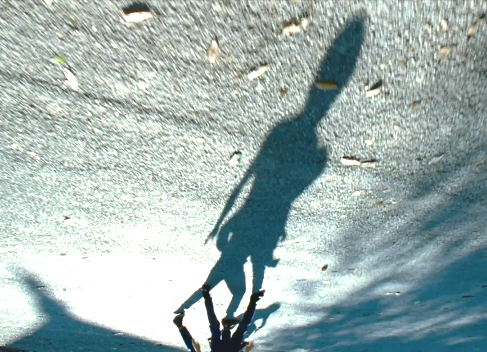
Even pieces on Malick I've read by people who love him and The Tree of Life acknowledge that with each new film, he seems to be less interested not only in conventional narrative structure but dialogue as well. I have no problem with playing around with structure — many of the greatest films of all time have done that, but it takes some special skills to pull off films that eschew dialogue and characterization, that embrace style at the expense of substance. Now, Malick defenders will argue that The Tree of Life actually overflows with substantive ideas, but does it or does Malick just toss some images on the screen and let the viewer do all the work, conjuring substance that may or may not be there. For me, the most telling shot of the entire film occurs early when Malick films the boys playing outside and their shadows on the sidewalk seem to resemble aliens. That seems wholly appropriate because watching Malick films, they don't seem to be made by someone who has any connection to humanity anymore. The one line of dialogue in the film that actually stood out to me is when Mr. O'Brien tells his son, "Toscanini recorded a piece 65 times. When he was done, he said, 'It could have been better.' Think about it." Perhaps that explains how Malick ended up with about a dozen different versions of The New World.
Now, I know I'm treading on dangerous ground with what I'm about to write, so I ask my friends who admire Malick and/or The Tree of Life not to take this part personally, but it's something that struck me as strange before I saw it. Now that I have seen the film, it makes me feel that it's an even odder side effect. The film's fans discuss it in terms of its spirituality and how it raises "the big questions."
 Friends, who in everyday life would willingly categorize themselves as atheists, agnostics or general nonbelievers or would even go so far as to mock those who do profess religious faith, suddenly ask, "What is God's plan for us?" "Why are we here?" and other similar existential questions inspired from the viewing the film. Malick certainly isn't playing the role of evangelist here and the next day, they'll be back to their normal selves, but it's so out of character. Even in an actual great film such as The Rapture which raises these issues, the conversation doesn't change the films' admirers' ways of thinking. (Coincidence or not, when Penn's adult Jack wanders toward the end, the barren landscape resembles both the desert that Mimi Rogers' character Sharon in The Rapture takes her daughter to as she awaits the endtimes and the purgatory she's left in because she refuses to give in to God. (There's a more compelling idea in the last half of that sentence describing The Rapture than in the entire 2 hours and 18 minutes of The Tree of Life.) In some cases, I think it stems from people so devoted to Malick that they'd never dare criticize, in others, they defy reason. As for being unable to criticize favorite directors of yours, I always remember what Roger Ebert says Robert Altman told him once. "If you never gave me a bad review, how could I believe the good ones?" Even masters such as Wilder and Hitchcock don't have perfect records.
In the end, what really struck me about The Tree of Life wasn't all the elements it had that annoyed me in previous Malick films but the amount of images and situations in a film hailed as such a unique and original vision that looked as if they were lifted from other films. When Penn wanders in that desert, it differs from The Rapture in that he finds a door and the thought that crossed my mind was Beetlejuice — not that I expected him to face off against giant worm creatures. I think it was my subconscious thinking of films I'd rather be watching and, honestly, had just as many profound things to say about the life cycle as Malick's film does. Then all the family members at their various ages reunite in the barren land to come to grace. Jack and his dad set aside their rocky relationship (and I awaited Jack to say to his dad with a crack in his voice, "Want to have a catch?"). Even though the living and the dead hadn't reassembled in a church, it also reminded me of the idyllic ending of Places in the Heart.
More than the many films that The Tree of Life reminded me of is the master filmmaker who kept invading my thoughts. If it's true that the O'Brien family represents a pseudo-autobiographical look at Malick's own family life and their story came out as this muddle, think of how many distinct and masterful films (not always directed by him) Ingmar Bergman wrote about his family's life. Aside from that, Bergman also made some of the greatest films of all time that tackled all the issues Malick supposedly flirts with in The Tree of Life — memory, dying, death, loss, faith, etc. — and he made them all with finesse, skill and daring — he even toyed with linear structure to represent memory. Sure, Bergman never thought about including dinosaurs, but he did let a knight play chess with death and I'd rather re-watch The Seventh Seal another hundred times before even considering dipping my toes into Malick's murky waters again.
Tweet
Labels: 10s, Altman, Berenger, Brad Pitt, C. Sheen, Dafoe, De Niro, Ebert, Hitchcock, Ingmar Bergman, Kubrick, Malick, Nicholson, Oliver Stone, Sean Penn, Shakespeare, Star Wars, Wilder
TO READ ON, CLICK HERE
Tuesday, August 09, 2011
Animation adults will appreciate more than kids

By Edward Copeland
Back in the days when Dennis Miller was funny, before he turned into Howard Beale after Arthur Jensen gives him the corporate cosmology speech in Network, part of what appealed to me about his comedy was that I felt as if I was one of the few who understood most of the cultural and historical references that Miller tossed in his standup as if they were adjectives. Rango plays as if it were an animated film made exclusively for an audience appreciative of that sort of referential humor. As a result, I found the movie very enjoyable at the same time that I questioned if it weren't weighed down by so many allusions and homages that it would fly over the heads of younger viewers. More importantly, would Rango be strong enough to stand on its own if all those clever references were removed and it had to get by solely on what remains?

When I was thinking of how to begin my review of Rango and I'd settled on using my Dennis Miller line about how a once sharp comedian turned into a right-wing mouthpiece and compared his evolution to how the malevolent chairman of CCA, the conglomerate that owned UBS in Network, transformed Howard Beale from a latter-day prophet denouncing the hypocrisies of our times into a preacher of corporate evangelism, I didn't even think of the irony that Ned Beatty played Arthur Jensen in Network and also voices the villainous Mayor in Rango. This follows Beatty's great vocal work last year as the bad teddy bear Lotso in Pixar's marvelous Toy Story 3. Beatty could corner the market on voicing the antagonists in animated films. He's always great when he appears on screen, but it's amazing to hear how he can create distinctive characters with only his voice.
That aside, on to Rango itself. In a way, besides the plethora of references, I wonder if the filmmakers intended Rango for an older age range. It received a PG rating (though I'm not sure why) but the MPAA details
 claim it is for "rude humor, language, action and smoking." I bet the smoking pushed it over. So, should Disney ever revive their great old practice of re-releasing their classic animated films to theaters every few years for new generations, I suppose that 1961's One Hundred and One Dalmatians would have to have the G it received in its 1991 re-release changed to a PG because of Cruella's smoking habit. (The MPAA won't issue any warnings to parents that their children might be influenced to turn dogs into fur coats but SMOKING!) How much further will rating movies for behavior go? There's a big anti-junk food and concerns about childhood obesity going on. If someone eats a candy bar, will that eventually earn a PG? How about the presence of overweight actors? If Jack Black made a completely family friendly film, will he eventually be penalized by the MPAA for being out of shape? I bet they'll never issue warnings for pencil-thin actresses who might subliminally push young girls into having eating disorders.
Pardon my digression. As much as I enjoyed Rango, I find myself less interested in writing about the film itself than issues around its periphery. Though my reason for thinking Rango had an older audience in mind is the behind-the-scenes creative team who assembled for it. Its director is Gore Verbinski who helmed the first three Pirates of the Caribbean films (which I only got through an hour of the first one when I realized I had nearly another 90 minutes to endure so I gave up); the god-awful film The Mexican starring Brad Pitt and Julia Roberts, a film whose sole redeeming quality was James Gandolfini as a gay hit man; the American remake of the Japanese thriller The Ring and a couple other less notable films, but nothing animated or truly family oriented among them.
Verbinski also gets a third of the story credit on Rango alongside James Ward Byrkit, whose writing credits are puzzlers but longest section on IMDb lists his work in movie art departments, and John Logan, who actually wrote the screenplay. Logan has an extensive resume of screenplay work including Sweeney Todd: The Demon Barber of Fleet Street, The Aviator, The Last Samurai and Gladiator, none of which you see as material aiming for the younger crowd. All though have worked with Johnny Depp, who voices Rango, so I can't help but feel that the film is a bit of a lark for those involved that turned out to be very entertaining, at least for film buffs.
However, I can't speak for the young out there, I can only speak for myself and I quite enjoyed Rango. Depp's title character is a chameleon living a solitary life with imaginary friends and dreams of being an actor and a hero. Rango isn't his real name: He'll adopt that later. A series of accidents ends up flipping him into the middle of the desert on the other side of the road from his usual haunts. Parched, desperate for water, he encounters a female lizard named Beans (Isla Fisher) who, against her better judgment, helps him to the closest town with the hopeful name of Dirt.
We've had a few allusions already (we've definitely landed in Sergio Leone territory), but once in town, he's not treated kindly by the townsfolk who distrust strangers. We hear obvious echoes of Pat Buttram-esque and Gabby Hayes-like voices among the crowds. When he goes to the bar and someone asks his name, he spots Durango on the bottom of a bottle of cactus juice and just takes the Rango part. Feeling more confident, Rango starts spinning tales of how he is a gunfighter and he once killed the notorious Jenkins Brothers (all six of them) with one bullet. Everyone is impressed, but they also are hurting. Dirt is in the midst of a serious water problem, as in they don't have much if any. They also are terrorized by a real desperado, a large rattlesnake named Jake (voiced by Bill Nighy). What keeps Jake at bay is a hawk who seems to circle looking for him, but the same scavenger chased Rango when he was struggling in the desert and when Rango sees him in town, he runs for it and kills the hawk by knocking the water tower over on it.
The town fears for its future: Water already is scarce and now that the hawk is dead, what's to stop Jake, but Rango tells them to have no fear, Jake happens to be his half-brother. They're stealing from everywhere else, why not toss a little Shakespearean element into the mix? At one point, Rango actually tells some of the
 younger townfolk, "Stay in school, eat your veggies, and burn all the books that ain't Shakespeare." The townspeople take Rango to meet the Mayor, who seems a friendly enough chap, saying Rango is giving the town hope and appoints him sheriff. The Mayor, an old turtle scooting around in a wheelchair he certainly must have obtained from Mr. Potter in It's a Wonderful Life says at one point that he "who controls the water controls everything" and Beatty even puts a slight bit of John Huston in his voice. In fact, Rango appropriates the plot of Chinatown more than any other film, so much so that I wonder if Robert Towne should sue. On the plus side, the Mayor doesn't have a daughter that he fathered a child with that Rango falls for and the movie doesn't end with "Forget it Rango, it's Dirt." It's interesting that Rango is at least the second film involving animation that adopts a Chinatown-like plot to its tale, the first being Robert Zemeckis' great Who Framed Roger Rabbit with its plan to destroy Toon Town for the L.A. streetcar.
The plot plays out as you would expect, though Dirt seems to exist out of time. It's an Old West town free of technology, but Rango crossed a highway full of cars to get there and when he figures out where the water is being diverted to, over a dune he spots Las Vegas. Plot isn't what's charming about Rango though, it's all the extras that make it so much fun. In addition to the obvious references to Chinatown and Leone's spaghetti Westerns, they manage to sneak in allusions to The Court Jester, Easy Rider, The Lord of the Rings, Fear and Loathing in Las Vegas and, when they get to the big climactic assault/chase, Francis Ford Coppola's Apocalypse Now, even using Wagner's "Ride of the Valkyries." Late in the film, when Rattlesnake Jake shows up and exposes Rango's stories about the Jenkins Brothers as lies, Rango dejectedly leaves and hallucinates a visit from The Man With No Name, riding around the desert in a golf cart. I actually thought at first that Clint Eastwood had done a vocal cameo for the film (which would have been really cool), but it turns out that it's only a pretty damn good impression of Eastwood by Timothy Olyphant.
Is Rango a great film? Not really. Is it a fun film? Yes, especially if you know a lot about movies. It's also exceedingly well made on the animation side. It wasn't made or converted to 3-D as all animated films seem required to be now, but even watching it at home, the depth of its images and its fine use of colors and shadings would be one of the greatest arguments as to why you don't need the money-grubbing gimmick in the first place. In addition to Depp and all the other great voicework I've already mentioned, Rango also includes nice vocal turns from Abigail Breslin, Alfred Molina, Stephen Root, Harry Dean Stanton, Ray Winstone and Ian Abercrombie.
Tweet
Labels: 10s, Animation, Brad Pitt, Coppola, Depp, Disney, Eastwood, Gandolfini, Huston, Julia Roberts, Leone, N. Beatty, Pixar, Shakespeare, Towne, Zemeckis
TO READ ON, CLICK HERE
Tuesday, June 28, 2011
Cinematic Grace

By J.D.
Decades in the making, the gestation period of Terrence Malick’s The Tree of Life (2011) is as epic as the film itself. After Days of Heaven (1978) was released to critical acclaim and nominated for four Academy Awards, Paramount, the studio that backed it, offered the director $1 million dollars for his next project, regardless of its subject matter. Despite being burnt out from making and editing Days, he agreed. Malick had been contemplating his most ambitious film yet: the creation of our galaxy and the Earth as well as the beginnings of life. It was originally called Qasida (a reference to an ancient Arabian form of rhythmic lyric poetry) and eventually shortened to Q. In 1979, Malick and a small crew began shooting footage in exotic locales all over the world. The footage they were getting looked great but Paramount was nervous about the absence of a screenplay (Malick would write 40-page poetic descriptions of the imagery) and a structured shooting schedule. Eventually, the studio lost patience with the director’s methods and he not only quit the project but the movie business for 20 years.
The first signs that Malick was returning to his Q project came during pre-production on The New World (2005) when producer Sarah Green received a revised treatment for what would become The Tree of Life. By July 2007, there was a script that fused the cosmic nature of Q with a semi-autobiographical story that focused on a Texas family in the 1950s as seen through the eyes of the oldest child Jack (Hunter McCracken as a child and Sean Penn as an adult). As early as Days of Heaven, Malick had been moving away from linear narratives to a more philosophical tone poem approach. With The Thin Red Line (1998), he began to explore in greater detail man’s relationship with his environment and with the Earth. This continued with The New World, which embraced a nonlinear narrative more than anything he had done before. The Tree of Life is the culmination of Malick’s body of work so far.
The film begins with the death of one of the O’Brien children. The mother (Jessica Chastain) is understandably devastated while the father (Brad Pitt) is stoic but eventually the cracks begin to show and he also grieves in his own way. Cut to the present day and Jack O’Brien (Sean Penn) is an architect, unhappy and adrift in the world, still haunted by the death of his brother. The film flashes back to his reminisces of his childhood in the ‘50s. In this first section, Malick cuts back and forth between the impersonal concrete and glass jungle of the big city in which Jack works and the idyllic suburban neighborhood of his youth.
Early on in the film, the mother says in a disembodied voiceover, “There are two ways through life: the way of nature, and the way of Grace. You have to choose which one you'll follow. Grace doesn't try to please itself. Accepts being slighted, forgotten, disliked. Accepts insults and injuries. Nature only wants to please itself. Get others to please it too. Likes to lord it over them. To have its own way. It finds reasons to be unhappy when all the world is shining around it. And love is smiling through all things.” I believe that this passage is integral to understanding Malick’s film and it becomes apparent that the mother represents Grace, accepting insults and injuries, while the father represents nature, lording over his family.
Right from the get-go, Malick dispenses with the traditional notion of how a scene is structured and linked to another in favor of an impressionistic approach. This is no more apparent than when the narrative segues to an extraordinary sequence depicting the creation of our galaxy and the Earth with absolutely breathtaking imagery — a stunning mix of unusual practical effects (created by Dan Glass and the legendary Douglas Trumbull) and actual footage courtesy of NASA. With this sequence we are entering Stanley Kubrick territory. Like 2001: A Space Odyssey (1968), Malick mixes science with spirituality, the cosmic and the ethereal, occasionally commented on via existential voiceover musings about God by the mother. He actually shows the Earth forming and early life being created on the most basic cellular level on up to the dinosaurs. This sequence and its placement so early on in the film is just one of the audacious choices Malick makes.
The film then goes back to early stages of the O’Brien family, to the creation of their children, the painful and glorious experience of childbirth, much like that of the Earth itself. Malick presents two approaches to parenting: the mother is a nurturing figure while the father is a stern disciplinarian. She is in tune with nature while he represents structure. It is this part of the film that is the most engaging as we are presented with familiar, relatable imagery: a very young boy gazes in wonderment and then jealousy at his baby sibling; the shadows of tree branches playing across a wall; the family playing with sparklers at night; kids playing in tall grass; and a tree-lined suburb at dusk with the sky the most amazing shade of purple-blue. These are the innocent, carefree days when you had no worries and would spend hours playing with other children until called in by your mother for the night. Malick has come full circle by returning to the same tranquil Texas suburbs first glimpsed at the beginning of Badlands (1973), his debut feature. These scenes will be instantly familiar to anyone who grew up in the suburbs or a rural environment.
As he did with Linda Manz in Days of Heaven, Malick demonstrates an incredible affinity for working with children and pulling naturalistic performances out of them. All of the kids, especially newcomer Hunter McCracken, act very comfortable in front of the camera, almost as if Malick caught them unaware that they were being filmed. McCracken has a very expressive face, which he utilizes well over the course of the film as Jack becomes increasingly rebellious, testing the rules imposed by his father. Malick documents the children’s behavior and all of their idiosyncrasies, like how they interact with each other and how this differs with their interaction with adults, especially in the ‘50s when they were much more respectful. Much of the film is seen from a child’s point-of-view with low angle shots that look up at adults, trees, and so on. It’s only in the scenes with other children that the camera takes a more level position.

At one point, the father tells Jack that his mother is naive and that “It takes fierce will to get ahead in this world.” Brad Pitt doesn’t play the stereotypical strict father figure but one with layers that are gradually revealed through the course of the film. He works in a factory, a labyrinthine maze of metal machinery but we learn that he wanted to originally be a musician but it didn’t work out. He had to become responsible and lead a more traditional life in order to provide for his family. He still plays piano and passes this ability on to his children. Pitt delivers an excellent performance that grounds the film. The actor has aged well and grown into his looks, relying less and less on them as he gets older. There is a nice scene where he accompanies one of his sons playing an acoustic guitar with the piano that is brief but does a lot to humanize his character. The mother, in comparison, is a more elusive character, more of an ethereal figure as played by Jessica Chastain.
You simply cannot engage The Tree of Life in a traditional way. The first section is a little impenetrable at first as one has to leave the concept of traditional narrative behind and get acclimatized to Malick’s approach. One has to let it wash over you and let his poetic imagery work its magic. Like all of his films, this is one that people will either passionately love or hate because of its ambitious, unusual approach. It will be seen as pretentious by some but any film that strives to tackle big themes like life and death and what it means to be human on such an epic (and also intimate) scale runs that risk. What prevents it from collapsing under its own thematic weight is Malick’s sincerity. He really believes in what he is showing us and treats it with the solemnity and weight it deserves. The Tree of Life has the kind of lofty ambitions most films only dream of reaching and it is easy to see why it is being compared to 2001. Like that film, Malick’s will undoubtedly reveal more upon repeated viewings. There is just so much to absorb that one viewing is not enough because you are too busy trying to make sense of what all this breathtaking imagery means. It will take repeated viewings to fully appreciate what Malick is trying to do and say. This is an important film by a master filmmaker.
Tweet
Labels: 00s, Brad Pitt, Malick, Oscars, Sean Penn
TO READ ON, CLICK HERE
Tuesday, May 24, 2011
You Get What You Settle For

By VenetianBlond
This past week, buying a ticket to Bridesmaids was positioned as something of a social responsibility in order to prove that movies by and about women could make the box office numbers necessary to keep studios making those kinds of movies. It seems fitting, then, to take another look at Thelma & Louise, celebrating its 20th anniversary today. On one level, the film serves as a thought experiment to see what would happen in a "buddies on the lam" film with two female leads rather than two men or a man and a woman, but it also became a touchstone for a "hell, yeah!" moment roughly corresponding with the nascent riot grrl movement in music. The question became whether or not the freedom to screw up as badly as men do was something to aspire to.

Louise (Susan Sarandon) is a waitress at a diner with an unreliable boyfriend and her best friend Thelma (Geena Davis) is trapped at home in an airless marriage. They're planning a girls' weekend away, but Thelma can't quite figure out how to ask her husband for permission to go. Her first little act of rebellion is to just leave without asking at all. It's Thelma's insistence on having fun that overrides Louise's natural practicality and sets them on their crime spree. At a roadhouse, Thelma drinks too much and dances too close with the wrong man. Louise finds her in the parking lot beaten and very nearly raped, and she pulls the gun that Thelma packed for no good reason at all. As they're walking away, the man gets one last insult in and Louise shoots him. They flee, as Louise explains, because everyone in the roadhouse saw Thelma behaving badly with him, plus they were no longer in immediate danger when Louise killed him. Nobody will believe their side of the story.
Louise, after a panicked, sleepless night putting some miles between them and the murder, decides to go to Mexico. She leaves the choice to Thelma as to whether or not she will join her. "Something has crossed over in me," Thelma says. "I can't go back." They try to be smart by having Thelma call home to see if the police are chasing them, and Louise gets some money from her boyfriend Jimmy (Michael Madsen) who is just shady enough to want to stay away from the police. Then they run into J.D., a very polite young thief who manages to charm his way into Thelma's bed only to disappear the next morning with all their money. He did, however, inadvertently teach Thelma how to commit a robbery, so desperate for cash, she knocks over a store adding armed robbery to their problems.
Things keep going from bad to worse as they try to get to Mexico without going through Texas, as Louise demands. Thelma finds out later that Louise was raped in Texas, got no justice and vowed never to set foot there again. When pulled over, they imprison the police officer in his trunk. They even set off a massive explosion when they destroy the rig of a trucker who had been disgustingly vulgar to them on the road. It's an exhilarating ride though, culminating in some of the most gorgeous terrain America has to offer.

The ending is about as iconic as they come. When Thelma and Louise are pinned between the local police, the FBI, and the Grand Canyon, they choose to drive off the edge into oblivion. Part of what makes the movie provocative is that ending. Does it mean to say there's no hope living in a man's world? That true friendship is worth dying for? Crime doesn't pay?


The movie won screenwriter Callie Khouri the 1991 Oscar for best original screenplay, lead actress nominations for both Davis and Sarandon and a directing nomination for Ridley Scott, but it has some serious problems in execution. First, the ADR is distractingly bad in places, as mismatched as any bowdlerized TV airing of an R movie. Second, Christopher McDonald, as Thelma's husband Darryl, was in a completely different movie from everyone else. Either nobody told him this was not a madcap comedy, or he had the production crew in such stitches they just egged him on. Madsen is much more effective as Jimmy because he's completely believable as a man who can be incredibly sweet but also frighteningly violent. In a scene in a hotel room, when Jimmy suddenly turns over a table, Sarandon shows a whole history with a violent man with her acting alone. Without a word it's clear that he's blown up like this many times before, and she needs to calm him down before something truly awful happens. It's a devastating scene.

The biggest problem is the fact that not long after being beaten and very nearly raped, Thelma begs Louise to pick up young drifter J.D. from the side of the road. Granted, he looks like Brad Pitt, because it is Brad Pitt, in the role that launched his film career, but still. It's hard to believe that even someone as unschooled and flighty as Thelma would pull something like that. It's even more incongruous given the elements that made the film resonate with audiences, particularly female audiences. It completely nails the feeling of what it's like when a fun moment turns on a dime and goes horribly wrong. It also shows how gross it is to be the center of the wrong kind of attention. It actually plays out the scenarios of what it would be like to actually say and do things (like blow up the disgusting trucker's rig) that are only ever imagined.
To try to keep a tally chart of feminist versus standard paradigm elements is frustrating, because there's an "and yet" component to much of the film. Thelma does gain agency over the course of the film as she goes from wife who can't muster the courage to ask to leave the house for the weekend to a woman who makes her own choices and acts on them. But she can't do that within her societal context — she becomes a criminal on the run. Even though they choose to kill themselves by driving that '66 convertible into the Canyon, it still is reminiscent of the "bad women get punished by death" trope. The detective played by Harvey Keitel defends them and tries to deescalate the situation, but he also infantilizes them by calling them "them girls." It seems he wants to rescue them.
It's unfortunate that the success of women's films or "chick flicks" is dependent on so few exemplars. What's reassuring is that dynamic individuals such as Kathryn Bigelow and Tina Fey are redefining the terms. Davis was inspired by the role of Thelma to create a foundation researching gender equity in film. At any rate, if I were on the run trying to escape punishment for my crimes, I'd say I'd be glad to jump into the back of that '66 convertible with Thelma & Louise.
Tweet
Labels: 90s, Brad Pitt, Geena Davis, Keitel, Movie Tributes, Oscars, R. Scott, Susan Sarandon
TO READ ON, CLICK HERE
Wednesday, April 06, 2011
He's got the world on a string

By Edward Copeland
To be perfectly honest, if you asked the average person or even some fairly knowledgeable film buffs what exactly it is that a producer does, they wouldn't be able to give an adequate definition, especially when the list and types on some movies and TV shows has grown so long. Watching Douglas McGrath's highly entertaining documentary His Way about Jerry Weintraub and his rise in the entertainment industry won't necessarily give you a better idea of a producer's role, because Weintraub's portrait as a one-of-a-kind self-made man amazes on a professional level and his private life will make your jaw drop in disbelief at the charmed and unorthodox life he lives.
His Way, which premiered Monday night on HBO, opens with quick shots of some of the luxury items Weintraub surrounds himself with, many emblazoned with the monogram JW while Sinatra sings, "I've Got the World on a String." Then a series of famous figures, including most of the major stars of the Ocean's 11 remake and its sequels which Weintraub produced, as well as others, try to describe Weintraub in a few words. Among those quotes:
Out of high school, Weintraub entered the Air Force, serving in Alaska, where his drive for success led him to get the midnight to 8 a.m. shift so during the day he could go into Fairbanks and work at a Woolworth's where his ingenuity eventually got him promoted to manager.
He had an early failed marriage to a high school sweetheart, but moved back to his native New York where he started his climb in the entertainment industry, beginning as an NBC page, then to the fabled William Morris mailroom and before moving on to the television division of MCA before transferring to its night clubs division. Eventually, he left to manage talent on his own, taking about any act and providing one of the main inspirations for the title character in Woody Allen's Broadway Danny Rose, which makes writer-director McGrath's involvement somewhat ironic since he co-wrote Bullets Over Broadway with Allen.
Weintraub's constant pursuit of more talent to manage led him to the well-known (in certain circles) singer Jean Morgan. Much of her success she gained in Europe, but she'd been performing since she was a child, including in Kennebunkport, Maine, which is how the elder Bushes came to know Weintraub. Weintraub not only became her manager, he also wooed her away from her husband and remains married to her to this date, but to say it's a conventional marriage would not be truthful, but more on that later.
As his acts grew, Weintraub decided he wanted to promote a tour of Elvis Presley. After a year of calling Col. Tom Parker every day and being rejected, Parker changed his tune one day and told Weintraub to show up in Vegas with a check for $1 million and they'd talk. With much scrambling, Weintraub managed to get a cashier's check for $1 million by promising a radio exec he knew that he'd give him half of his concert proceeds for all acts. So Weintraub set up a tour for Elvis, with Weintraub getting 50% of the profits and the Colonel and Elvis getting the other half. Elvis had only two demands: No empty seats and only fans in the front rows, no big shots. When his show sold out so fast in Miami Beach, Weintraub proposed adding a matinee, and Elvis said yes and the venue manager told him it was sold out.
However, when Weintraub arrived, there were all these rows of tickets for the matinee. He asked the venue manager why he lied and he said he told him what he wanted to hear. Weintraub told Parker they had a problem, but the Colonel corrected him that they didn't, he did. In a stroke of genius, Weintraub got the officials at the neighboring Dade County prison to have inmates move the empty 5,000 seats into the parking lot for the matinee and cover them with a tarp and put them back for the evening show. Elvis never said they had to sell out, he just didn't want any empty seats, though later he said they should rethink the matinees because the crowd wasn't as loud and excited as the one at night.
After the evening performance, Parker took Weintraub into a room with two locked briefcases. He unlocked them both which were filled with cash which the Colonel said were from the concessions. Weintraub said that didn't belong to him, but Parker insisted and after making an even pile of cash on a table, used his cane to divide it equally saying that half was Weintraub's. After that, Weintraub was a multimillionaire. It boosted his reputation to the point that Frank Sinatra came calling, saying he'd grown bored with what he was doing and he wanted Jerry to do for him what he did for Elvis.
Weintraub's stable of big music talent grew to include Bob Dylan, Led Zeppelin, Neil Diamond, The Carpenters and John Denver, but as successful as he was with the music management business, he always wanted to make movies. One day, Robert Altman met with him, wanting Weintraub to manage him, but Weintraub surprised him by saying he didn't want to manage him, he wanted to produce his next movie and he did. That movie was Nashville.
Other films Weintraub produced include Oh, God!, Cruising, All Night Long, The Karate Kid and, as mentioned, Ocean's 11, 12 and 13 (those films' director, Steven Soderbergh, is both an interview subject in and an executive producer of His Way). One of his biggest hassles came when he made Barry Levinson's Diner for troubled studio chief David Begelman. Weintraub warned him not to call during the screening, knowing that it had been turned down by all the studios in town, and within seconds of it ending, the phone began ringing. Weintraub ignored it, went to the projection booth and took the print.
He then arranged a special screening for Pauline Kael (after the studio had done a test screening in Phoenix, which obviously was the wrong audience) who loved it and penned a rave. Weintraub took the review back to Begelman and his minions and showed them Kael's review that she planned to run whether they released the film or not, so it was up to them if they wanted to look like idiots or not. Diner was saved.
The one misstep that Weintraub has seemed to have made in his career was when he opened his own independent film studio, the Weintraub Entertainment Group, but his skills weren't suited to be an executive and the company ended up losing him $30 million.
The most iconoclastic aspect about Weintraub actually concerns his family life. Throughout his life, Weintraub has been nothing if not honest. He tells the story of a good-looking young woman who walked into his office one day and told him she wanted to have sex with him. Jean was out of town, so Jerry took the young lady home when Jean unexpectedly showed up. He tried to keep her out of the bedroom, but she figured out what was going on. He tried to call Jean for hours and when she did talk to him, he offered her a divorce, half of everything, whatever she wanted. Jean made a different offer. She didn't want a divorce. She just asked him to open an account for her and deposit $1 million in it. From then on, he could sleep with any bimbo he wanted, but each time, she'd get $1 million.
That's not the strangest part. Later, while making the film Pure Country, Weintraub met a woman named Susie Elkins and they fell in love. Again, Jane didn't feel the need for a divorce and in fact, she and Susie have become good friends and the three can often be seen together. Weintraub's daughter Julie says that it's other people who are more uncomfortable with the unusual situation than they are, and most of the interview subjects seem to back that up such as Barbara Bush who says she'd have killed George if he had ever tried to pull something like that on her.
As George Clooney says, Jerry Weintraub may be 72, but everything about him acts as if he's 15. Brad Pitt closes by guessing, "I'm sure he has his funeral arranged and it will be a great show."
His Way certainly is, if not a great show, a tremendously entertaining one. I've just mentioned a handful of the anecdotes. It will air again on HBO at 1 p.m. EDT/noon CDT Saturday, 7:30 p.m./6:30 p.m. April 15, 11 a.m./10 a.m. April 17, 11 a.m./10 a.m. April 21 and midnight/11 p.m. April 25. It also airs on HBO2 at 10 a.m./9 a.m. and 8 p.m./7 p.m. April 13.
Tweet
Labels: 10s, Altman, B. Levinson, Brad Pitt, Documentary, Dylan, Elvis, George Clooney, HBO, Julia Roberts, Kael, Music, Sinatra, Soderbergh, Television, Willis, Woody
TO READ ON, CLICK HERE
Tuesday, December 21, 2010
Looks Great, Less Filling

By J.D.
It has been more than 25 years since Tron (1982) was released in theaters. Made on the cusp of the home computer revolution, the film was a simple good versus evil parable that saw a disgraced computer programmer hack into the network of the corporation that fired him only to be zapped into cyberspace where he got to see how the other half lived. Tron was a modest success at the box office and resoundly trashed by critics. It seemed destined to become merely a footnote in cinematic history as one of the earliest examples of computer graphics in a Hollywood film. Over the years, it developed a decent cult following who dreamed of a sequel some day. That day has finally come.
Hoping for a lucrative franchise that doesn’t involve pirates, Disney ponied up a considerable amount of money so that the filmmakers of Tron: Legacy (2010) were able to utilize the same kind of 3D digital cameras that were used to make Avatar (2009) and the CGI technology used to age Brad Pitt in The Curious Case of Benjamin Button (2008). And, in keeping with the original filmmakers hiring cutting edge composer Wendy Carlos, Tron: Legacy features an atmospheric score by hip electronica music duo Daft Punk. The end result is a stunning assault on the senses.
In 1989, hotshot programmer and CEO of Encom Kevin Flynn (Jeff Bridges) disappeared, leaving his young son Sam with his grandparents and no indication as to why he left. Since the death of his wife four years before, Flynn’s behavior had become increasingly erratic and he had become obsessed about a brave new world, a digital frontier that he had experienced in Tron. Sam (Garrett Hedlund) grows up to become a rebellious chip off the old block as he breaks into Encom just so he can publicly embarrass the company’s current CEO. Since Flynn’s absence, Encom has returned to its old, soulless ways much to the chagrin of his longtime friend and current board member Alan Bradley (Bruce Boxleitner). He informs Sam that he got a page from his father at the office in his old arcade.
Long shuttered and collecting dust, it is a cemetery for classic arcade games. Sam uncovers his father’s personal computer and before he knows it, he’s zapped into the computer world. Flynn’s prized program Clu (also Bridges) has taken over and rules the computer world with a fascist, iron fist. Flynn has become a fugitive and it’s up to Sam, with the help of a program named Quorra (Olivia Wilde), to make things right again.
Rather fittingly, the real world footage is shot in 2D but once we enter cyberspace, the film comes vividly to life with cutting edge 3D technology. Much of the iconography from the first film is present — the disc battle, light cycles, etc. — but amped up with The Matrix-like action sequences and three-dimensionalized. If there was ever a film would that begged to be given the 3D treatment it is this one. The filmmakers have basically taken the imagery of Tron and cranked it up to 11 — pure, unadulterated eye candy with things like dialogue and characterization taking a backseat. The attention paid to production and art design is phenomenal with all kinds of neon-drenched landscapes full of ambient sounds that will keep architecture buffs busy for years. That being said, the CG to recreate a younger version of Jeff Bridges, circa 1982, is distracting with its waxy, stiff look and dead, lifeless eyes, which, I guess, is appropriate for what is basically an evil clone of the real deal within the film.

Say what you will about the original Tron and its flaws but at least it was anchored by a playful and charismatic performance by Jeff Bridges who acted as the audience surrogate into a strange, new world. This time around, Garrett Hedlund takes on that role with limited success. The uninspired screenplay doesn’t do him any favors and so he does the best with what he was to work with, which admittedly isn’t all that much. Bridges plays a grizzled, burnt out version of his original character and with his beard and long hair it almost seems like the Dude from The Big Lebowski (1998) was zapped into the computer world. As if sensing this, Bridges even lets out a few Dudeisms at certain key moments in the film, which at least livens up the forgettable script.
Noted British actor Michael Sheen even shows up channeling David Bowie’s Ziggy Stardust persona as Castor, a preening, flamboyant host of a nightclub where Daft Punk have a cameo as DJs. Using these musicians to do the score for Tron: Legacy was a masterstroke and they seem like the logical evolutionary step from Wendy Carlos. However, those fans expecting them to recreate their trademark dance music maybe disappointed as they opt for a more orchestral score that at times is reminiscent of early 1980s John Carpenter, in particular Escape from New York (1981). Their finest moment comes during a battle at Castor’s club where Daft Punk gets to really show off their musical chops as they segue from ambient music to pulsating dance music to bombastic beats that accompany with the action. Along with Trent Reznor and Atticus Ross’ score for The Social Network (2010), this may be the best soundtrack of the year.
Tron: Legacy replaces the “information just wants to be free” message of its predecessor with a “sins of the father” theme as Flynn attempts to stop Clu, his Frankensteinian creation, and repair the damage done between him and Sam. Tron: Legacy manages to make this world and its characters accessible to those not familiar with the first film by basically rehashing its plot, blow-by-blow, which may disappoint fans. However, it does feel like a continuation of the first film with all kinds of references to things that happened in it. There is also a rather nifty cameo by a notable character actor that hints at a possible villain for the next film, if this one makes enough money. Of course, there is the usual criticism that the dialogue is weak, the story is formulaic and there is a real lack of characterization — all issues critics had with the original film. Tron: Legacy certainly lacks in these areas also, but like the first film, the visuals are so impressive, so captivating in the way they immerse you in the computer world, that you tend to ignore the flaws, relax and enjoy the ride.
Tweet
Labels: 10s, Brad Pitt, Disney, Jeff Bridges, John Carpenter
TO READ ON, CLICK HERE
Saturday, December 04, 2010
From the Vault: Morgan Freeman

ORIGINALLY PUBLISHED SEPT. 17, 1995
When Morgan Freeman grabs your arm and urges you to follow him down a particular fork in life's road, his commanding and reassuring presence makes you eager to follow. Of course, the respected three-time Oscar nominated actor was actually just borrowing me to visually illustrate a point about conquering life's obstacles and fulfilling one's dreams. Still, this wasn't just an acclaimed actor tugging on me — it was Easy Reader from television's The Electric Company. For almost any person reared on educational programming in the 1970s, the symbolism — and the sentiment — would be hard to ignore.
In David Fincher's Seven, Freeman plays a homicide detective in an unnamed large city just days from retirement when he's confronted with what appears to be the beginning of a serial killer's spree. Partnered with Freeman is a new transfer to the city's force, played by Brad Pitt. The expected rookie-veteran friction is there, as Pitt is eager to pursue the case, where each of the victims represents one of the seven deadly sins, and Freeman wants to get away from it as soon as possible.
Seven marks Freeman's first role since securing his third Oscar nomination for 1994's The Shawshank Redemption and appearing as a military official in Outbreak. Previously he earned a supporting nomination for 1987's Street Smart, the role that first allowed him "to dance" on screen, and a best actor nod for Driving Miss Daisy in 1989.
While the nominations are flattering and he certainly wouldn't turn down an Oscar, Freeman has seen the dangers of looking for awards instead of good roles. When he was 13, he received a best actor prize, followed by merely an honorable mention the next year and no award at all the year after that, he said. It's tough to feel like a has-been at 15.
"If you think in terms of awards and roles, you're shooting yourself in the foot. I was crushed, but you have to get over that."
The ups and downs of any actor's career are a given, and Freeman has seen many since his teen years. During the 1960s, he performed office work while trying to make his way into the profession. When one of his office jobs fell through and Freeman was making a trip to the employment office to prove he'd been looking for work, he grew frustrated with his official designation as office worker. He told a small, older red-haired woman named Mrs. Lipton that he wasn't an office worker — he was an actor. Mrs. Lipton pulled out another stamp and told Freeman, "You've got six months. Go be an actor."
That was 1965. Before the deadline passed in 1966, Freeman had secured his first paying job as an actor in a play with a road company. That job, and the chance Mrs. Lipton gave him, started the slow, steady rise of Freeman's career — until it hit a dead patch in 1981, causing Freeman to believe he'd peaked and to consider driving a cab to make ends meet.
"When I'd get to a point where I thought, 'It's not going to happen. I'm not gonna make it,' some friend of mine would say, 'Ah bullshit, of course you are' and I'd be heartened by someone else believing in me, but many times I've been to the wall."
In 1983, Freeman had his sagging spirits and career revived by Paul Newman, who was casting roles for Harry and Son, a movie Newman was directing and producing as well as acting in. He gave Freeman a reading for a role he'd already cast and was surprised to hear that Freeman was idle at the time. "That's criminal," Newman told him. Freeman was leaving the audition, when Newman called him back and had him read for a different part. Newman hired Freeman on the spot and the climb to his current star status began again.
"In this business it seems like, if you've got work, you get work. It jump-started me again and it's been going like that ever since."
Since making Street Smart in 1987, Freeman has appeared in two Oscar-winning best pictures (Driving Miss Daisy and Unforgiven) and another best picture nominee (The Shawshank Redemption.) His acting approach is workmanlike. If asked how much of himself he puts into a certain part, Freeman responds, "I don't know what myself is so I don't see me anywhere." He isn't admitting to a personality disorder, he's just nodding to his chosen profession.
"I'm not methodical. I don't sit down and ponder roles. I read the script and if I like it and all things are equal and I've got a shot at doing it, then it's just a matter of learning the lines, wearing the costume correctly if possible, and, as Spencer Tracy said, come in prepared and not bumping into the furniture."
Among his upcoming roles is a part in Dead Drop, a chase movie starring Keanu Reeves and set to film in Chicago this winter. The chilling Midwestern season has Freeman looking forward to the climate "as much as I look forward to losing my big toe." When questioned as to why he took the part, Freeman breaks into a familiar tune and sings "Money. Money. Money. Money." Still, the substantial paychecks he now earns aren't his motivation any more than possible awards are.
"I'll act for free. If you don't pay me, I'll do it anyway. Money affords you the time and space to do this passion. I'm happy to have the passion to act instead of for digging ditches."
Freeman still remembers the importance of the opportunity Mrs. Lipton gave him.
"Somebody comes along, just when you're at the end of the rope and maybe there's a fork in the road and you're tired and you want to sit there on this rock maybe and think there's no point in going on because either fork I take is going to be the same thing. (Then) someone comes along and says, 'Here. I'm going this way. Come along.' You just need to get going again, to take that other step. Success is very often the very next step you take."
Tweet
Labels: Brad Pitt, Fincher, Interview, Morgan Freeman, Newman, Oscars, Television, Tracy
TO READ ON, CLICK HERE


