Tuesday, March 20, 2012
You’re written in her book…

By Kevin J. Olson
Basic Instinct is one of those movies that deserve to be rediscovered. That may sound strange for a film that made more than $300 million worldwide upon its release, but there’s a lot more to the film than just the sex, the violence and the controversy that surrounded the film upon its initial release. Like all of Verhoeven’s films — with the exception of maybe Hollow Man — there’s something deeper, something more worthy of deconstruction lurking beneath the film’s familiar template. Verhoeven likes working within genre films so that he can distract one set of viewers with the sex and the ultra-violence that has become synonymous with his name, yet he also likes to use that familiar structure so that he can explicate deeper themes and tropes through his unique lens. Make no mistake: Verhoeven — despite his Dutch masterpiece The 4th Man — does not make art films. Sure, his films have a depth to them that may sneak up on people, but he flaunts his mainstream styling, and, for all intents and purposes, the man is an action filmmaker. However, in 1992, Verhoeven wanted to do something different with Basic Instinct and mine the familiar territory of the Hitchcockian thriller and the character type of the femme fatale.
Joe Eszterhas’ sleazy neo-noir script is perfectly suited for the subversively wry Dutch director. Eszterhas was famous for his ‘80s scripts Flashdance and Jagged Edge (which I really like), and wrote Basic Instinct prompting a bidding war at the time. It was around the late ‘80s when the film’s producers were hoping to get it made with a mainstream actress in the lead. When major stars such as Michelle Pfeiffer, Kathleen Turner, Kim Basinger and Meg Ryan turned down the role, Verhoeven and the producers gave the role to the relatively unknown Sharon Stone (who had a small role in Verhoeven’s own Total Recall). Her performance as Catherine Tramell would go on to define her career and be one of the most iconic and memorable female performances of the ‘90s.
The film’s basic plot structure comes right out of Hitchcock with its twisting narrative and male protagonist who always seems to be in the wrong place at the wrong time and who just can’t seem to avoid trouble. Michael Douglas was perfectly cast as the barely-hanging-on detective Nick Curran. Curran investigates the murder of a rock star who died via multiple stab wounds from an ice pick. One of the suspects is the women who matches a description of the suspect and was the last person to see the rock star alive. Crime author Catherine Tramell (Sharon Stone) wrote a novel titled Basic Instinct in which a character dies in the exact same way (white scarf stuffed in their mouth and killed by ice pick). Curran learns that she’s writing a new book about a cop and soon finds that she uses him, and others, for her material as dangerous real-life situations play out.
Curran serves as the prototypical noir protagonist who enjoys getting a little dirty and gets a little too drawn into the seedy underworld he’s investigating. I love the way that the film sets up the viewer with Nick’s past about being a little trigger happy and a little coked-up while accidentally shooting some tourists while undercover; it’s a nice bit of foreshadowing for the film’s ending which some feel unnecessarily removed the ambiguity surrounding the identity of the icepick killer; however, I like the little bit of punctuation at the end because it makes that final decision Nick makes have more impact. It leaves the viewer with a little bit of a sour taste in their mouth just like those old, hard-boiled noirs used to do. Also, you can’t tell me that Hitch didn’t have a wry smile on his face when he filmed some of his endings in similar vein that left the viewer in a state of, “what the hell was that?”
One thing that makes the film so memorable — and one of my top five choices whenever I get in a Verhoeven-y mood — is the energy the auteur brings to the film. Verhoeven and his d.p. Jan de Bont (who would later go on to make a name for himself in ‘90s action films with the tremendous Speed), are more than up to the task in making Basic Instinct a beautiful and efficient neo-noir that has the right look
 and sound; it’s part polished Hitchcock (the style and the music) and part hard-boiled noir (the character types and the language/content). Sure, kinky sex and graphic violence fill the narrative, but many movies like Basic Instinct consist solely of overkill with no sense of vitality or variety (Eszterhas’ own Jade, for example). Quite honestly, there isn’t even that much action in the film, but that energy and style that Verhoeven brings to the dialogue and the characters — driven by Stone’s performance — makes the film feel like wall-to-wall action. Just as he did with the science-fiction subgenre in RoboCop, the Middle Ages action film in Flesh + Blood, the exploitation subgenre in Showgirls, the pro-war propaganda film in Starship Troopers and the WWII drama in Black Book Verhoeven brings unmitigated verve and élan to these overly familiar premises. Even though Basic Instinct doesn't approach the best of Verhoeven’s films, just look at the way he frames Stone in that interrogation scene, the way he shoots bird’s eye as his characters run toward crashing waves on the beach with the overdramatic music in the background, or the fun he wrings from the obligatory car chase.
 And maybe that’s the word I’m looking for, “fun.” Verhoeven’s zeal often translates into a fun movie experience where you often find yourself laughing unexpectedly because you know the filmmakers aren’t taking themselves too seriously (RoboCop exemplifies this in its purposeful absurdity and seems Dada-esque in its satirical take on a violent dystopian future). Starship Troopers may be one of the most misunderstood of all of Verhoeven’s works because of its subtle satire — something definitely lacking in Basic Instinct. While I don’t see signs of satirism in Basic Instinct as Verhoeven approaches many of his other genre films, I do think that he’s using the overblown and melodramatic (much like he did to great effect in 2006’s Black Book) to sneak in the things he really wants to say underneath that all-too-familiar veneer of sex and violence. One only needs to look to Eszterhas’ other psychosexual thriller of the ‘90s, the aforementioned Jade, to see that these kinds of films aren’t always filmed with the kind of intensity Verhoeven brings to this script. William Friedkin helmed that Eszterhas script, and produced a complete and utter mess; an ugly film that wasted the talents of its leading actress and lacked any of the drama or Hitchcockian qualities found in Basic Instinct. That’s the impact of Verhoeven.
I think now that people can see Basic Instinct in a light removed from its controversy surrounding its portrayal of homosexual relationships (the film was protested so passionately that the filmmakers had to have extra security on hand during filming) and it being just “that movie where Sharon Stone shows Michael Douglas and Newman from Seinfeld her crotch,” they’ll see one of the best modern examples of the femme fatale archetype. Catherine is a character type that Verhoeven has studied before (Christine from The 4th Man kind of acts as a precursor to Basic Instinct), and it’s one of the most memorable characters of any of his films. Stone plays Catherine with such an icy confidence — she’s the perfect femme fatale: she’s confident sexually and ambiguously dangerous throughout the film’s mystery so that you know with certainty she’s the killer…but then again, you’re not really sure. It’s a fine balancing act by Stone who, after this film, wouldn’t really have another performance this juicy (although I thought she was pretty good in Scorsese’s Casino). I love the way in which she completely manipulates Douglas’ character throughout the entire film. Those who think that Stone’s performance, and her character, functions solely as a sex-crazed character couldn’t be more wrong. Sex may indeed be the most valuable weapon in Catherine’s arsenal, and she knows that she must use it in order to maneuver Nick, but it’s not because she’s extremely beautiful, it’s because Verhoeven understands that for the traditional male, there’s nothing scarier than a blatantly promiscuous woman, confident about sex and her sexual prowess. The femme fatale archetype hinges on flipping the preconceived notions about power and sex, and, often, how those two usually connect. No better modern femme fatale has been put on celluloid than Sharon Stone’s portrayal of Catherine Tramell (Kathleen Turner’s Matty Walker from Body Heat ranks up there, too).
Just look at the film’s most famous (or infamous) scene. Catherine being interrogated by a group of male police officers and people from the office of the district attorney — a kind of verbal gangbang as Verhoeven’s camera goes in and out of focus on the men throwing their
 rapid-fire questions at her. Catherine maintains total control of the situation, despite the bravado and machismo of the cops tuned up for full effect. Of course, the scene lives in infamy for Stone flashing her panty-less crotch at the officers as she crosses her legs. The scene's importance though stems from Catherine letting these people understand that not only does she feel comfortable showing them that she doesn’t wear underwear, but also that she can wield her control over the room by messing with their minds as well by flipping roles and interrogating Nick about his attempt to quit smoking (which, just like all of his other attempts to stunt his vices, go by the wayside by film’s end). This brings those in the room to wonder if the two know each other from a previous encounter, and it shows that Catherine, on the surface, can manipulate men with her sexuality, but she’s just as keen to mess with their heads. In other words: she’ll fuck you, but she’ll fuck your mind, too, and each will be equally as fun for her. The way Stone plays that scene proves crucial to its success — she doesn’t allow Catherine to be an object, rare in movies such as this and Hollywood in general, yet she allows Catherine’s sexuality to take control of the room as she flippantly disregards the no smoking rule — she performs it masterfully, and it’s a shame that more remember the scene for her uncrossing her legs than her acting and Verhoeven's underlying commentary that follows.
 It’s interesting to compare Basic Instinct and the character of Catherine with another Michael Douglas film of the ‘90s, Disclosure. In that film, Demi Moore attempts to seduce Michael Douglas and then wrongfully accuse him of sexual harassment in order to ruin his life. It’s all very tame and banal because you don't believe Moore as a femme fatale. She lacks the assurance as an actress that Stone gives Catherine, and because of that, we don’t buy Douglas’ plight; the whole thing just feels lifeless, as if it’s going through the motions. Basic Instinct, on the other hand, is the opposite. Not because Douglas’ character has more definition than in Disclosure, but because we buy why Nick would follow Catherine down into that world of rough sex and violence. Moore brings the sex and tries to play scary…attempts to equal what a male would do in that performance. Stone’s performance, though, does the opposite. As I mentioned earlier, sex happens to be the best weapon in Catherine’s arsenal, and that makes her scary because she cannot be contained, controlled or manipulated like most women in thrillers such as these. Disclosure tries to invert this trope as Basic Instinct does but it comes off so artificially because the movie takes itself too seriously.

What I love about Catherine is that she lacks anything subversive about her character; she’s as blatant an archetype for a femme fatale as you’ll get. From the minute Douglas and his partner meet her, they understand they’re dealing with a woman who controls everything. The film's script makes her sexy and smart, sure, but that’s not the scariest thing about Catherine as a femme fatale — that would be her awareness of her ability to control others. She knows she can control Nick with her sexuality, and more importantly, she knows she can manipulate Nick because he’s willing to let her. Nick can't help himself around her, yet he feels as if he always controls his faculties. When he has a bit of rough sex with his on-again-off-again girlfriend (Jeanne Tripplehorn), it’s eerie and offsetting because it seems as if Catherine’s influence already has penetrated Nick’s daily life; he has succumbed to her power. It isn’t long after this scene that Nick begins his obsession with Catherine. The power games between the male and female leads — those kinds of gender war-type films popular in ‘90s dramas — lacked teeth in Disclosure; however, with Basic Instinct, thanks to Verhoeven’s direction and Stone’s performance, there’s an electricity to it that keeps the film’s over-the-top and headlong momentum rolling.
Paul Verhoeven could be as misunderstood an auteur in mainstream Hollywood system as exists. I admire the fact that Verhoeven goes all-in regarding his films; he just lays it all out there — realism be damned. He reminds me of my favorite Italian horror filmmakers that prove that style can be substance. I mean, sure, the film contains awkward moments of haughty aesthetic, but I like that about Verhoeven. He reminds me of Ken Russell a little bit in that regard: here’s a filmmaker who, if you’re willing to go along for the ride, does have something to say in his films; it’s there lurking beneath the surface of all of that ultra-violence and gratuitous sex and nudity. Twenty years later, people can take a fresh look at Basic Instinct as a film without all the outside distractions. Here’s a film where Verhoeven inverts the experience of the typical theatergoing male. The sex can't be labeled pornographic by any means (a male-dominated exercise, no doubt), but it’s explicit in its portrayal of sex, which I think scares some people more (and probably explains why the idiots in the MPAA initially gave the film an NC-17) in the audience it’s a film where the sex is primarily controlled, orchestrated and because the female lead dominates it. I think that’s Verhoeven being deliciously subversive, and I really admire that about Basic Instinct.
In Roger Ebert’s 1992 review, he wrote, "The film is like a crossword puzzle. It keeps your interest until you solve it, by the ending. Then it's just a worthless scrap with the spaces filled in." Narratively speaking, the same could be said for a number of Hitchcock films; It’s the style that keeps us coming back to those, and it’s the style, as well as the subtext, that keeps me coming back to Verhoeven’s film. I
 think it’s incredibly shortsighted of Ebert to see the film in this light considering it’s so heavily indebted to Hitchcock, whose films, for the most part, played exactly as he describes above. Verhoeven always has had an uncanny knack for capturing the particular milieu of whatever genre he’s tackling. Even though he’s over-the-top, he never comes right out and admits his purpose. Perhaps that’s why so many people have trouble with him: he’s so good at it that you think what you’re getting is just another genre film competently crafted and nothing more. I think maybe that’s why people have a hard time looking beyond the general silliness of something such as Starship Troopers or the sex and violence in Basic Instinct as films that are saying something beyond their gruff narratives and ultra-violent surfaces. I also think that the knock on Basic Instinct — and Verhoeven in general — derives from over-the-top tendencies that allow the film to get lost by the end. It results in a well-made, but not great, experience. For me, I love the way Verhoeven goes storming into his narratives, and Basic Instinct (even though it’s “lesser” Verhoeven), 20 years later, still stands as one of his most loopy, over-the-top and slyly fun rides.
 Tweet
Labels: 90s, Demi, Ebert, Hitchcock, K. Turner, M. Douglas, Meg Ryan, Movie Tributes, Pfeiffer, Scorsese, Seinfeld, Sharon Stone
TO READ ON, CLICK HERE


Monday, January 16, 2012
It's about which master you've been serving

By Edward Copeland
I've never read a single novel by John le Carré and I remember when the TV miniseries Tinker, Tailor, Soldier, Spy aired starring Alec Guinness, who was Obi-Wan to me at the time (as well as the blind butler from Murder By Death — I was starting sixth grade — sue me!), but I didn't see it. In college, I did see the movie adaptation of le Carré's novel The Russia House starring Sean Connery and Michelle Pfeiffer, which I thought might be an aberration. I liked it quite a bit, but movies reared me to think spies meant James Bond. Now, that I've seen the outstanding new film version of Tinker Tailor Soldier Spy (no commas please), I'm getting the impression that, like Rick and the waters in Casablanca, I was misinformed as to the nature of le Carré's novels. Looking at the film adaptations of his books, I wish I had time to read them now. I can't compare the new film to the TV miniseries or Gary Oldman's performance as George Smiley to Guinness', but I can say that Oldman and the new movie both are damn good.
Tomas Alfredson directed this version of le Carré's tale, marking the Swedish filmmaker's first English-language movie and his first feature since 2008's creepy and moving vampire film Let the Right One In, remade in the U.S. two years later as Let Me In.
Tinker Tailor Soldier Spy takes place in the early 1970s in the upper echelons of British intelligence (referred to as "The Circus.") The top man, known as Control (John Hurt, in an excellent performance), receives word that a Soviet operative in Budapest wants to switch sides so Control sends agent Jim Prideaux (Mark Strong) to Hungary, but the operation goes awry and in the fallout, Control is forced to retire and so is Smiley. Control, already ailing, dies soon afterward. Word gets to Oliver Lacon (Simon McBurney), the civil servant in charge of British intelligence via Ricki Tarr, a discredited agent in hiding (Tom Hardy, unrecognizable when compared to his role in Warrior) that the Hungarian mission's objective truly had been to ferret out the truth about Control's suspicions that one of the top men in The Circus actually works for the Soviets as a mole.
Lacon approaches the retired Smiley and asks him to lead a secret probe to determine if the mole exists and, if so, who he is. Smiley enlists the help of a young, still-working agent, Peter Guillam (Benedict Cumberbatch), and another retired intelligence official Mendel (Roger Lloyd-Pack). Their search of Control's flat uncovers the code names he had given to his suspects, based on the old rhyme, attached to photos taped to chess pieces. Percy Alleline (Toby Jones), who took Control's job as chief, was called Tinker. Bill Haydon (Colin Firth), now Alleline's deputy, was christened Tailor. His close allies Roy Bland (Ciaran Hinds) and Toby Esterhase (David Dencik) were Soldier and Poorman, respectively. Smiley, whom Control also suspected, had been named Beggarman.


Bridget O'Connor wrote most of the screenplay until her death from cancer and it was completed by Peter Straughn. Through the taut direction by Alfredson and the carefully constructed screenplay that doesn't always play out in strictly chronological order and lacks major action sequences, Tinker Tailor drips with suspense, helped in no small part by the great ensemble assembled. If the film contains a weakness, it's that the four potential moles aren't developed well enough, particularly Hinds' character. Toby Jones acts his part very well, especially considering that they almost try too hard to make him look guilty. It's interesting to see Jones in a fictional role for a change after playing Karl Rove in W., Swifty Lazar in Frost/Nixon and being the best screen Truman Capote in Infamous. In addition to those already mentioned, there is a brief but memorable appearance by Kathy Burke as another operative who was purged. Burke just doesn't appear in enough movies, but her most memorable performance might be Queen Mary Tudor in Elizabeth opposite Cate Blanchett. If you look closely, you'll spot le Carré himself playing a drunk in a Christmas party scenes. The most amazing thing for viewers of Boardwalk Empire is the chance to hear Stephen Graham use his actual British accent in his role as Jerry Westerby, an intelligence officer monitoring the teletype the night of the Hungarian mission. His look also doesn't remind you remotely of Al Capone. Interestingly enough, one of the film's more important characters, Smiley's wife, never actually appears. The two performances that deserve the most praise are Hurt's brief work as Control, which frankly I'm surprised hasn't been mentioned much in awards talk. The MVP prize undoubtedly goes to Oldman's quiet, reserved work as Smiley.
Since Oldman took the film world by storm in 1986 in Sid & Nancy, he's made some bad movies and been over-the-top at times but he's also done a lot of great work yet his performances seem resistant to recognition from his peers. Granted, I haven't seen all of the top 2011 best actor contenders as of yet, but of what I have, Oldman belongs in that list. Tinker Tailor Soldier Spy deserves more notice than it's been receiving as well.
Tweet
Labels: 10s, Blanchett, Boardwalk Empire, Books, Capote, Colin Firth, Connery, Fiction, Guinness, John Hurt, Oldman, Pfeiffer
TO READ ON, CLICK HERE
Monday, November 28, 2011
Ken Russell (1927-2011)

As a director, Ken Russell always has been a mixed bag to me. To say that he had a tendency to go over-the-top would be an understatement and I found very few of his films satisfying as a whole though he did produce many fine performances in his films even if the films themselves were so-so.

Glenda Jackson (who won her first her Oscar), Alan Bates and Oliver Reed in his adaptation of D.H. Lawrence's Women in Love; Twiggy in the musical The Boy Friend (perhaps his most enjoyable and mainstream outing); the spectacle of Tommy bringing the landmark album by The Who to cinematic life with its eclectic cast including Oscar-nominee Ann-Margret as the deaf-dumb-and-blind boy's mom (covered in beans at one point), a brief bit by Jack Nicholson as The Specialist, Tina Turner's Acid Queen and the band's late drummer Keith Moon as Uncle Ernie, to name but a few; William Hurt's experimentations with mind-altering drugs and isolation chambers to a devolved consciousness in Altered States, based ion the novel by Paddy Chayefsky who wrote the screenplay as well, but hated the film so much that he disowned it and the film credits the script to his given first and middle name, Sidney Aaron; and the loony Crimes of Passion which contains a brave but great Kathleen Turner performance. However, what I remember the most about Russell was one of his many performances as an actor (check out his filmography), particularly his supporting role as Walter in Tom Stoppard's adaptation of John Le Carre's The Russia House starring Sean Connery and Michelle Pfeiffer, an incredibly underrated Fred Schepisi film from 1990. Russell gave an entertaining and compelling turn in his rather small role. For someone whose reputation mainly is that of a director, surprisingly, that might be what I remember about him most. To read the full New York Times obit, click here.
RIP Mr. Russell.
Tweet
Labels: Books, Chayefsky, Connery, Fiction, K. Turner, Musicals, Nicholson, Obituary, Oscars, Pfeiffer, Stoppard, William Hurt
TO READ ON, CLICK HERE
Tuesday, March 29, 2011
A Very Safe Bet

By Squish
I firmly believe that criticism, whether print media, television or the works of an online hobbyist such as myself, creates a better appreciation of the art one is writing about. The simple math of it makes a critic doubly involved in the same movie — watching followed by analyzing. And the fact that I've had to spend another two hours or more revisiting Dangerous Liaisons makes this task one of the most pleasant I've had in recent months.
What makes Dangerous Liaisons so exceptional is not the beautiful cinematography and attention to visual detail, it's not the spectacular performance of John Malkovich and Glenn Close...OK, wait, it is a lot of that, but what I'm trying to emphasize is this: Dangerous Liaisons is one of the most perfectly written scripts I've heard in my life, particularly as it relates to the relationship between Valmont and de Merteuil.
Their true relationship is one that must always remain a secret. In this still sexually strict age of 18th century France, these two bored aristocrats have the stern judgment of their peers to consider whenever they engage in the task of defiling others. This means that the option of gloating proud upon their successes in seduction
 has truly no other audience apart from themselves. Accepting this fact, the two competitively consort, raising each other's bar of debauchery. When de Merteuil first suggests Valmont seduce the young and naive Cécile de Volanges (Uma Thurman), he instantly refuses declaring how beneath him that simple task would be. Nay, he raises his standard to a much more difficult task in order to win a truly glorious prize, the chaste Madame de Tourvel (Michelle Pfeiffer). And, since she needs his debauchery to be as base as hers lest she be alone, de Merteuil's promises her own sex to tempt him into considering her task. Ironically, these two are exquisitely bred and exceptionally skilled manipulators. Valmont and the Marquise Isabelle de Merteuil constantly keep the rigid decorum of the aristocracy even when speaking honestly with one another, yet never getting away from seeming like slathering jackals underneath it all.
Their victories only come from sexually debasing others, and it quite obviously makes for a lonely existence, and both of them maintain their games because they only have each other. The script is one of the best examples of how to properly provide exposition to the audience as there's ever been.
Still, no matter what I write, it's nothing compared to the multi-layered guise-within-a-guise that is Dangerous Liaisons. My praise goes out to Choderlos de Laclos for having written the original novel, to Christopher Hampton for the screenplay. It's rare that I go out of my way to see more of a writer's scripts, but I'm looking forward to exploring his other works, such as Atonement and The Quiet American.
One final thing: I was impressed with how some of the casting choices helped create a very satisfying nigh fourth-wall-breaking subtext. Close, here as the immoral and seductive Marquise Isabelle de Merteuil, has had previous important roles that included the freaky mom from The World According To Garp and the year just before Dangerous Liaisons, she showed how psychotic she could be with Fatal Attraction. Keanu Reeves and Uma Thurman, both in roles of true neophytes, when they themselves were relatively unknown actors, predating even Bill & Ted's Excellent Adventure, though his character in Dangerous Liaisons is made even better today by Keanu's stereotypical goof-off "whoa. I know Kung-Fu" persona that he still hasn't completely shaken off. A neat undercurrent if I do say so myself.
Tweet
Labels: 80s, Glenn Close, Malkovich, Movie Tributes, Pfeiffer
TO READ ON, CLICK HERE
Tuesday, October 13, 2009
Another season, another reason

By Edward Copeland
It's a cliche to say, "They don't make 'em like they used to." It's downright depressing when that trite saying is being employed to refer to a film such as The Fabulous Baker Boys that is just marking its 20th anniversary. Has Hollywood really degenerated this much this fast? In 1989, this was a big studio release. Now, we'd be lucky if someone would pick it up as an independent feature. Maybe if the Baker Boys were built out of Legos or transformed into robots.
When I first saw Steve Kloves' film in 1989, while I liked it, I didn't know quite what to think of it because it really was unlike any major studio release I was used to at the time. Here it was though: a film more like a tone poem than a heavily plotted release with Warner Bros. behind it and marquee names such as Sydney Pollack and Paula Weinstein backing a first-time writer-director on a film whose commercial prospects must
 have seemed limited. Before Kloves made The Fabulous Baker Boys, his main credit was as the screenwriter of the good but largely forgotten coming-of-age film Racing With the Moon starring Sean Penn, Nicolas Cage and Elizabeth McGovern. Michelle Pfeiffer's star was just beginning to rise, but she couldn't be counted on to lure in audiences. Jeff Bridges was a much respected actor but hardly box office gold and that was even more the case with his co-star, brother Beau. They even dared to allow a film with an open-ended, ambiguous ending. Still, they took the chance and allowed this film to be made and it is one that grows better and better with each viewing, even though I know deep down that if all the planets hadn't been in alignment at the right moment in the late 1980s, this film gem would never have been made. That makes me sad. It also makes me sadder to think of Kloves' career direction. He made another film as writer-director, Flesh and Bone, a mixed bag of a movie most notable for first gaining notice for Gwyneth Paltrow. Since then, he's been purely a screenwriter, albeit a great one, doing a faithful and solid job at adapting Michael Chabon's Wonder Boys and adapting every single Harry Potter book with the exception of The Order of the Phoenix. He got the job because The Fabulous Baker Boys is one of J.K. Rowlings' favorite films. Still, I wish Kloves had the chance to write and direct his own original work again.
Still, even if Kloves never directs again, he's left us a great one in The Fabulous Baker Boys where seemingly
 every aspect is top notch, from Dave Grusin's moody, jazz-like score which seems in perfect harmony with Michael Ballhaus' cinematography, full of smoke and shadows, almost creating a color noir look to this tale of two piano-playing brothers. You're never quite certain where this film is heading because plot is almost irrelevant, yet Kloves creates a fictional universe with such complete confidence that it's never a concern. Having real-life brothers Jeff and Beau Bridges play Jack and Frank Baker was a brilliant stroke. Not only do the true siblings have a short-hand that only a lifetime of knowing each other could have brought, Baker Boys also gives each of the actors what may well be their finest feature film roles. Most of Beau's best work came on TV after this, but his Frank is memorable as the passive-aggressive control freak, who fancies himself the business brains behind the act and who works to support his wife and kids, even though he knows that his brother is the one with the greater talent. Jack though is the center of the film and Jeff
 Bridges is superb as the chain-smoking, borderline alcoholic who hates the redundancy of his life and would rather be playing what he wants instead of the same set for the umpteenth time. He can be cruel and as one character describes him, cold as razorblades, yet he still takes time to be a pseudo-surrogate dad for the young girl who lives upstairs from him and frequently is abandoned by her mother for her frequent boyfriends. Bridges has been great so often in so many films sometimes it's easy to forget about him, but I've never forgotten his Jack Baker. Of course, the third member of this acting team is Pfeiffer as Susie Diamond, the singer the brothers hire when Frank decides that perhaps they need a vocalist to jump-start the act. Pfeiffer's work is both sultry and superb and there's a wisp of sadness when you remember when Pfeiffer was on the rise before she began turning down great roles and appeared to commit career suicide in crap such as I Am Sam. Susie not only revitalizes the act, she creates friction about other changes. When one of Frank's kids get sick and he has to let Jack and Susie perform alone, the two relish the chance to change the playlist. When Frank learns later they skipped "Feelings," an argument ensues over whether the song is filet mignon or parsley. In terms of movies, The Fabulous Baker Boys is most definitely filet. In fact, 1989 may be the most recent year to serve up so many delectable entrees and desserts in the form of movies. From the masterpieces to the solid good times, it truly was an amazing year and The Fabulous Baker Boys is another example of what cinematic magic that movie year managed to bestow as gifts to us who worship films.
Tweet
Labels: 80s, Beau Bridges, Chabon, Gwyneth Paltrow, Jeff Bridges, Movie Tributes, Nicolas Cage, Pfeiffer, Sean Penn, Sydney Pollack
TO READ ON, CLICK HERE
Monday, December 10, 2007
Dragging down the party
As Odienator expressed so well a while back, John Waters' original Hairspray in 1988 was quite fun. I never got to see its stage incarnation, though I've listened to the original cast album numerous times and seen several clips of production numbers. Now, I've seen the film version of the musical version of the original movie and it's mostly a charming affair, though it's sunk frequently by the grotesque miscasting better known as John Travolta as Edna Turnblad.
Every detail of the Travolta Edna is wrong. Why does it always seem that when film makeup goes bad, it goes horribly bad, as it does here. The latex and body suit harnessed to Travolta creates something that not only looks fake and rips you violently from the 1962 Baltimore that the film is trying to create, sometimes it repulses you.
Unfortunately, all the blame for why Travolta just does not work doesn't lie with what he's wearing, it's with the performance itself. Not only did Divine and, in what I've seen of Harvey Fierstein, make Edna a real woman with minimal makeup tricks, they also created actual characters. Travolta for some reason has chosen to adopt a fake Southernish accent that seems like a bad parody of Dustin Hoffman's voice as his Dorothy Michaels character in Tootsie, another case where a man in drag created a plausible female character.
Fortunately though, Travolta's screen time is limited to some extent and when he is off, it truly allows the others in the cast to shine, especially newcomer Nikki Blonsky as Tracy. The rest of the ensemble also is mostly fine across the board, including Christopher Walken (though imagine how good he could have been doing his number with someone other than Travolta as his partner), Amanda Bynes, James Marsden, Queen Latifah, Elijah Kelley and and Taylor Parks, to name but a few.
Michelle Pfeiffer does get to have more fun than she's had in a long time as the film's villainous Velma von Tussle, though the story change of making her the station manager and trying to seduce Walken, dowsn't really work. (Also, I have to admit, that I regret not giving her a husband as co-conspirator and a climax involving a time bomb hidden in a bouffant hairdo.)
With all the digital wizardry out there at talented people's fingers these days, maybe someone can alter the film and somehow insert Divine back into the role and let Fierstein do a Marni Nixon for the late actor.
Tweet
Labels: 00s, Dustin Hoffman, Musicals, Pfeiffer, Remakes, Travolta, Walken
TO READ ON, CLICK HERE
Thursday, August 02, 2007
From the Vault: The Age of Innocence

Flowers erupt sensually into bloom in the opening credits of The Age of Innocence, exploding with an intensity and passion that wasn't tolerated in the era it depicts. That time and place is New York's high society in the 1870s as Edith Wharton so beautifully described it in her Pulitzer Prize-winning novel.
With The Age of Innocence, director Martin Scorsese once again has staked his claim to the unofficial title of America's greatest working filmmaker, this time by making a film that would seem completely out of his realm but which, upon closer examination, turns out to contain many themes common to his other works. He substitutes grandeur for grit, psychological violence for physical brawls.
The Age of Innocence concerns the struggle between individualism and society and the complications of falling in love with on person when you've committed to someone else. A young lawyer named Newland Archer (Daniel Day-Lewis) is happily engaged to a seemingly dense woman named May (Winona Ryder). Archer practically bursts with joy at his impending nuptials — until he meets her cousin, Countess Ellen Olenska (Michelle Pfeiffer).
The social scene keeps Ellen at arm's length when she flees Europe and her philandering husband to return to New York. Society frowns upon her actions, not so much for making a bad marriage to an outsider but for admitting her mistake publicly and leaving the situation. In the 1870s, her social circle viewed it as better to be married and miserable than divorced and at peace.
Archer and Ellen's chaste and pent-up longing gives The Age of Innocence its emotional wallop. Adding to that, the film slyly depicts the social scene itself, including frequently funny passages culled from the novel itself and read in voiceover by Joanne Woodward.
Scorsese and co-screenwriter Jay Cocks were wise to include Wharton's prose, not only because it pleases the ear but because it actually aids the film's clarity. On all levels, The Age of Innocence succeeds resoundingly. From Elmer Bernstein's mixing of original and classical music to form a pulsating score to Dante Ferretti's production design, Michael Ballhaus' cinematography and Gabriella Pescucci's costumes, the film overwhelms.
The film shows the serving of so many elegant meals that it makes you long to have attended one of the dinners, despite the consequences. Scorsese's direction, which includes many of his most subtle touches, gets ample aid from his veteran editor Thelma Schoonmaker (as in a nice scene that literally goes beneath Archer's outer veneer to find a secret hidden in a shirt pocket).
The acting excels across the board. Day-Lewis and Pfeiffer draw their characters so well that the audience begins caring about them almost from the moment they appear. Ryder also does well playing a young woman who isn't as dim as she appears and Miriam Margolyes provides a nice comic turn as Mrs. Mingott, a grande dame of New York society.
However, the film belongs to Scorsese, who injects what could be a staid costume drama with an energizing passion. Sprinkled with Wharton's wry observations, it seems a perfect collaboration despite the fact that Wharton died long before Scorsese was born.
The Age of Innocence resembles the opulent meals it takes pleasure in recreating. It looks and tastes great and when it's over your hunger for exquisite filmmaking has been more than satisfied.
Tweet
Labels: 90s, Day-Lewis, Pfeiffer, Scorsese, Winona
TO READ ON, CLICK HERE
Saturday, June 24, 2006
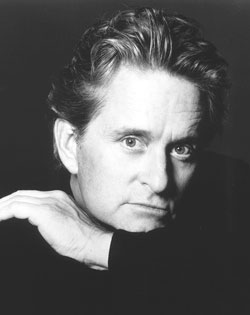
Is Michael Douglas a Male Chauvinist Pig?
By Josh R
Did that get your attention?
When Mr. Copeland enlisted me as a contributor to this forum, he probably didn’t anticipate a post such as this — I think I’m supposed to be more informative than confrontational (trusting sort that he is, he overestimates my better instincts). Well, I can’t always take the classy route. This piece may contain some actual information, but it’s mostly just an old-fashioned hatchet job. Sometimes I like to get up on my high horse and kick up a little mud in people’s faces, especially when I feel such a response is merited.
I guess we’re at the point now where we can legitimately (if somewhat grudgingly) refer to Michael Douglas as a Hollywood legend. So maybe the guy doesn’t have the acting chops of a Dustin Hoffman or a Robert De Niro — or the sex appeal and glamour of a Robert Redford or Warren Beatty. Perhaps he can’t rival any of these gentlemen in terms of old-fashioned movie star charisma. OK, he definitely can’t. Still, one can make the fair argument that he’s earned his place in the pantheon. He is an Academy Award-winning actor and producer whose career spans more than 30 years. In a business where the careers of many actors of his generation have fallen by the wayside, he has weathered an unusual number of flops and misfires to retain his status as an A-List marquee attraction. His résumé also has included its fair share of hits, of both the critical and commercial variety. If the bulk of his work hasn’t demonstrated much beyond a solid professionalism, he has, on occasion, shown himself to be a talented and resourceful actor. He is a mainstay of Hollywood social circles, a mover-and-a-shaker, son of Kirk, and husband to Catherine Zeta-Jones. Whether you like the guy or not, he is, without question, a star.
Which is why it may come as something of a surprise that the man has been rejected by more women than any other man in the history of Hollywood.
It’s not his love life I’m referring to — in fact, reputation holds that he’s done fairly well in that department (to the point that his pre-nuptial agreement with Ms. Zeta-Jones is known to include an infidelity clause). The rejection that Mr. Douglas has suffered at the hands of Hollywood’s female acting elite has been of a professional nature — and, on at least three (and possibly four) occasions, it appears to have been deserved.
The lead role in One Flew Over the Cuckoo’s Nest, produced by Mr. Douglas and for which he received the Academy Award for best picture, was turned down by (in alphabetical order) Anne Bancroft, Ellen Burstyn, Colleen Dewhurst, Faye Dunaway, Jane Fonda, Angela Lansbury, Jeanne Moreau and Geraldine Page. Most of the actresses cited personal reasons for their refusal, ostensibly because of the nature of the material.
Ken Kesey’s novel had ignited a firestorm of controversy upon its publication in 1963, mainly due to its depiction of the character often referred to only as "Big Nurse," the sadistic ogre who presides over a mental ward populated by male patients. In Nurse Ratched, whose ugly countenance was described in almost as much detail (if not as frequently referenced) as her large, fleshy tits, Kesey had fashioned an interpretation of the female authority figure as an emasculating control freak, with no attempt to understand or get to the root of her behavior. As written by Kesey, critics observed that the character had about as much dimension as the Wicked Witch of the West. Since the novel’s debut on the best seller list coincided with the advent of the women’s movement, feminist activists had a field day denouncing what they (correctly) perceived as a monstrous disservice to the cause of women’s advancement in the professional arena. At the end of the novel, Ratched is raped by McMurphy — as imagined by Kesey, the assault is less an act of violence than an act of justice, retribution for her "rape" of the inmates in her charge. It’s a rape that the reader is supposed to cheer for.
Needless to say, by 1975, this wasn’t going to fly, so Douglas and his collaborators had to soften the material considerably. The character’s fiendish, subhuman bullying (with accompanying grunting) was replaced with a more subtle form of villainy, and the rape was jettisoned in favor of strangulation. Nevertheless, no major actress of the period was willing to go anywhere near it — some demurring politely, others expressing
 indignation that the film was being made in the first place. Joanne Woodward was never offered the role of Nurse Ratched — the story goes that she’d already taken herself out the running with a preemptive strike before the production team had even had the chance to approach her. Having gotten wind of the fact that her name had been bandied about in a casting session, she reportedly told Douglas that not only had she no intention of taking the role, she had no desire of even seeing the finished product. The role eventually was filled by an unknown, Louise Fletcher, who won an Academy Award for her performance before promptly returning to obscurity. The previous year’s winner, Ellen Burstyn (who had been among the first to take a pass on the film), went on television and asked Academy members not to vote in the best actress category to protest the lack of good roles for women. Fletcher later related to The New York Times, in reference to a conversation she’d had with Burstyn after the latter’s comments, “She hadn’t even seen Cuckoo’s Nest because she thought it would be too painful an experience. I told her that I thought it would have been nicer if she’d said what she said in a year when she had been nominated.”
Fatal Attraction is perhaps Mr. Douglas’ best-known and most influential film as an actor — for you young’uns out there, it’s about a basically decent guy who cheats on his angelic, idealized homemaker wife with a high-powered cosmopolitan book editor who turns out to be a raving psychopath. General chaos ensues — knives are wielded, children are kidnapped, cars are splashed with acid and beloved household pets are tossed into the crock pot. The role was turned down by Isabelle Adjani, Barbara Hershey, Miranda Richardson and Debra Winger. Richardson, a relative unknown whose involvement with the film might have propelled her to stardom, publicly stated that she found the script “regressive in its attitudes.” While the LA Reader’s John Powers was among those who saw the film as being “about men’s fear and hatred of women,” The New Yorker’s Pauline Kael went a step further in declaring “the film is about men seeing feminists as witches, and the way she’s presented here, the woman is a witch…she parrots the aggressively angry, self-righteous statements that have become commonplaces of feminist fiction, and they’re so inappropriate to the circumstances that they’re proof she’s loco.”
Unlike Cuckoo’s Nest (and Basic Instinct, which I’ll discuss presently), the producers didn’t have to resort to drafting an unknown actress to fill their star role. Glenn Close, who found herself in a bit of a career cul-de-sac after being typecast as the virgin mother (The World According to Garp), the nurturing, all-giving earth mother (The Big Chill), and quite literally, a glowing Madonna (the living embodiment of goodness and decency in The Natural), was desperate to break out of the holding pattern. She aggressively courted the role in a calculated risk that paid big dividends, earning an Oscar nomination for the performance. She’s been happily playing bitches ever since.

The impetus for this piece was seeing Basic Instinct again fairly recently — Douglas’ next monster hit after Fatal Attraction. I’m not sure what I was expecting, although it seemed diverting enough way back in good old 1992. For anyone who hasn’t had the “pleasure,” it’s basically the same deal as Fatal Attraction, only with an S&M twist and a cold-blooded gal who has no ability to love instead of a pathetic one who loves too much. Once again, audiences encountered a high-powered professional woman (in this case, a best-selling author) who is a sexual predator and sick as all get-out. Sharon Stone deservedly became an overnight sensation on the strength of her performance as Catherine Tramell, the ice-pick-wielding loony/white-hot fuck machine who inspired a thousand beaver jokes, thanks to the infamous and oft-parodied scene where director Paul Verhoeven invites the audience to rubberneck his leading lady’s privates. The actress had been knocking around Hollywood for many years, getting regular work without getting anywhere in particular, until she landed the role that would vault her into the bigtime.
As good as she was, her casting probably represented the last resort of an increasingly desperate production team. Kim Basinger, Michelle Pfeiffer, Julia Roberts, Demi Moore, Meg Ryan, Virginia Madsen, Lena Olin, Greta Scacchi and Emma Thompson all said no — whether their reluctance had more to do with the copious amount of female nudity the job required than the quality of the script and the nature of the character remains to be seen. In any event, the film became the subject of much protest as the result the character’s sexual orientation — which could be more accurately described as pansexual than bi. The film’s detractors claimed that the filmmakers not only viewed bisexuality as a perversion, but went so far as to equate it with sociopathic behavior. Gay and lesbian activists picketed while the film was shooting on location in San Francisco, requiring the deployment of police riot squads, and the controversy had already gotten a great deal of coverage before the film had even opened.
Having seen the film again recently, I do not find that it is offensive to gay people. I believe that it is offensive to all people. Not surprisingly, given the participation of Mr. Douglas, it is particularly insulting to women, particularly of the white-collar working variety. In addition to its insistence that there is something inherently evil about female sexuality, the film presents us with a secondary female character, a psychologist played by Jeanne Tripplehorn, who is not only completely incompetent in a professional capacity but a total doormat in her off hours. Her irrational attachment to Douglas’ character, who treats her like shit even when he’s making love to her (if that’s what it can be called, given the rough and graphic nature of their sex scenes), not only overrules her judgment and professional code of ethics, but leads to her eventual demise. And, yeah, turns out she also swings both ways. Dude…it’s hot!

If these three films provide us with a virtual who’s who of Hollywood actresses (at least in terms of who had the good sense not to bite), they don’t represent the only contribution Mr. Douglas has made to advancement of women’s rights during his long tenure as a leading man. As far as I know, Demi Moore was the first choice for the lead in Disclosure, which would serve to reason given her status as the top female box office attraction of the early '90s, after Julia Roberts. As such, there is no list of conscientious objectors to report, which might create the false impression that the film’s content is of a less incendiary nature than the other films discussed here. Actually, it’s probably the most corrosive of the bunch. Barry Levinson’s adaptation of the Michael Crichton novel plays to the popular male paranoia that not only are women trying to take away their jobs, they want to rip off their balls in the process. Once again, Douglas plays a basically decent guy who is passed over for a promotion in favor of the castrating bitch essayed by Ms. Moore, who becomes his new boss. Prowling through the corridors of power in stiletto heels and leaving a tiny trail of stab wounds in her wake, this dragon lady has no sooner started lashing the whip than she initiates an aggressive campaign to get into Mr. Douglas’ pants…much to his discomfort and embarrassment. It’s an exercise in role reversal that actually serves to trivialize the issue of workplace sexual harassment rather than shed any new light on the subject. The scene in which Ms. Moore throws Douglas up against a desk and starts shoving his cock in her mouth above his protests would be ludicrously funny in a high-camp way if it didn’t leave such a foul aftertaste (no pun intended).
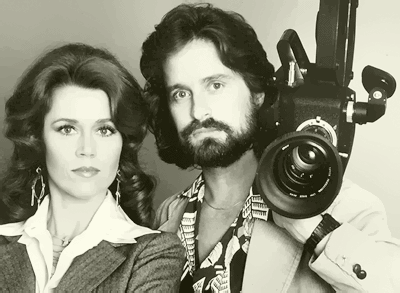
The tenor of this piece might suggest that I nurse a deep and abiding hatred for Michael Douglas — as both an actor and as a member of the human race. This is not the case — I have nothing against the guy. He has made some highly enjoyable films — Romancing the Stone and The War of the Roses always have been particular favorites of mine — and his turn as a rumpled professor experiencing a midlife crisis in Curtis Hanson’s Wonder Boys probably represents his best acting work to date (although his performance as greed incarnate in Oliver Stone’s Wall Street still commands a devoted following). I’m not really even trying to suggest that Michael Douglas actually is sexist. Putting aside the content of these films, there really isn’t anything to indicate that, as a private citizen, the man has a lack of respect for women and isn’t sympathetic to the issues that affect them. In his defense, it should be noted that he also produced The China Syndrome, which showed a strong, sympathetic female protagonist who refuses to accept the limitations imposed upon her by the powers-that-be, and proves her mettle and her integrity as a journalist.
That said, there’s no denying the fact that Michael Douglas has been involved with some of the most blatant exercises in anti-woman propaganda that the modern cinema has produced. I’m not one of those watchdogs who goes into a tizzy over any perceived instance of political incorrectness — frankly, I think most people are waaaay oversensitive about that kind of thing — but when you look at the kinds of films Michael Douglas has done, you’ve gotta wonder what’s going on in his head (beyond “Damn, I’m married to Catherine Zeta-Jones!”). If he had made just one of these films, I probably wouldn’t think much of it, but the fact is, he was involved with all four of them — and you’d be hard-pressed to find any four films made in the last 30 years which provoked more outrage on the part of feminist advocates. Whether this particular feature of Mr. Douglas’s career is the result of bad judgment or simply bad taste is open to debate, but in any event, it does seem to indicate a certain level of insensitivity (or at least lack of consideration) on his part. He seems to have been on his best behavior for the past decade or so…maybe Catherine managed to get some veto power to go along with the infidelity clause.
Tweet
Labels: B. Levinson, Bancroft, Barbara Hershey, Burstyn, Debra Winger, Demi, Dunaway, Emma Thompson, Geraldine Page, Glenn Close, J. Fonda, Julia Roberts, Kael, Lansbury, Pfeiffer, Sharon Stone
TO READ ON, CLICK HERE



